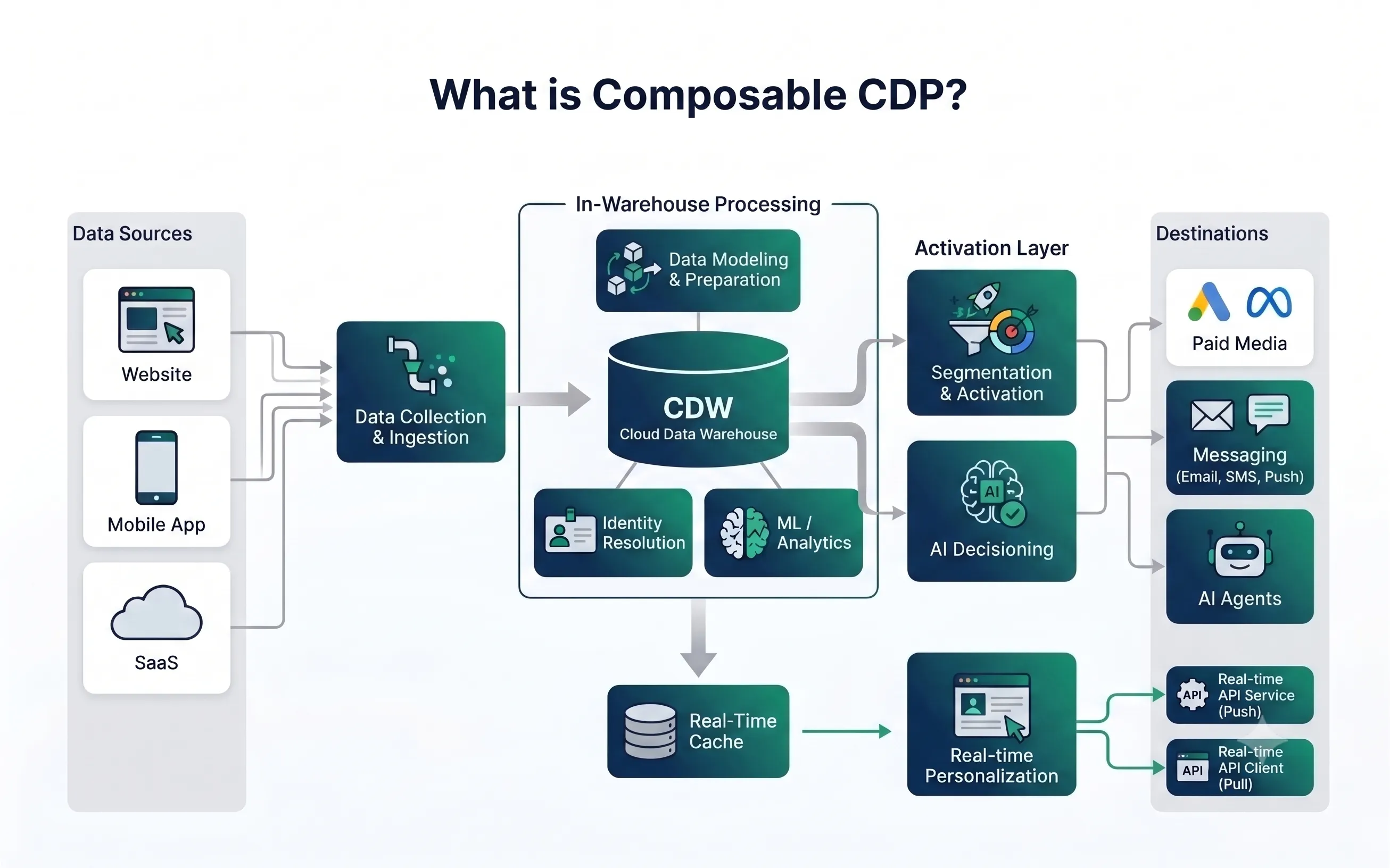
 *Composable CDP architecture. Data sources feed a cloud data warehouse that handles identity resolution, data modeling, and ML — then an activation layer segments audiences and routes them to paid media, messaging platforms, and AI agents. A real-time cache enables in-session personalization via API.*
Rather than consolidating all customer data into a proprietary CDP database, the composable approach keeps unified customer profiles in your warehouse and uses connectors — often via [reverse ETL](/glossary/reverse-etl/) — to sync audiences and attributes to downstream marketing and analytics tools. For a comprehensive overview of CDP fundamentals, see [What Is a Customer Data Platform?](/basics/what-is-a-customer-data-platform-cdp/).
## Composable Software: The Underlying Principle
Composable software is an approach to building system infrastructure through independent, interchangeable modules rather than monolithic applications. Core applications are broken into specialized microservices that communicate through APIs, making them easier to scale and faster to develop. Unlike platform architectures—where replaceable modules depend on a shared core system—composable systems allow every component to be swapped without affecting the rest of the stack. A composable CDP applies this same modular philosophy to the customer data technology stack.
## What is a Composable CDP?
The term "composable CDP" emerged around 2021 as data teams began questioning whether they needed a traditional, all-in-one CDP when they already had centralized customer data in modern cloud warehouses. The composable philosophy borrows from broader composable software principles: build solutions from interchangeable components instead of monolithic systems.
In a composable CDP architecture, each capability—data ingestion, identity resolution, segmentation, activation—can be fulfilled by a different tool. For example:
- **Data ingestion**: Connectors and pipelines that collect customer events from websites, apps, CRMs, and other sources into the warehouse
- **Transformation & modeling**: SQL-based tools that clean, join, and shape raw data into unified customer tables and computed attributes
- **Identity resolution**: Deterministic or probabilistic matching logic that stitches anonymous and known profiles into a single customer record
- **Activation**: Reverse ETL tools that sync audiences and attributes from the warehouse to marketing platforms, ad networks, and CRMs
- **Orchestration**: Schedulers and workflow engines that coordinate pipeline execution, monitor data freshness, and manage dependencies
The warehouse acts as the single source of truth, eliminating data silos and reducing the need to copy customer data into yet another platform. See the [Composable CDP Vendors](#composable-cdp-vendors) section below for a breakdown of the leading platforms in this space.
## How It Works: Mapping Composable Components to the Customer Intelligence Loop
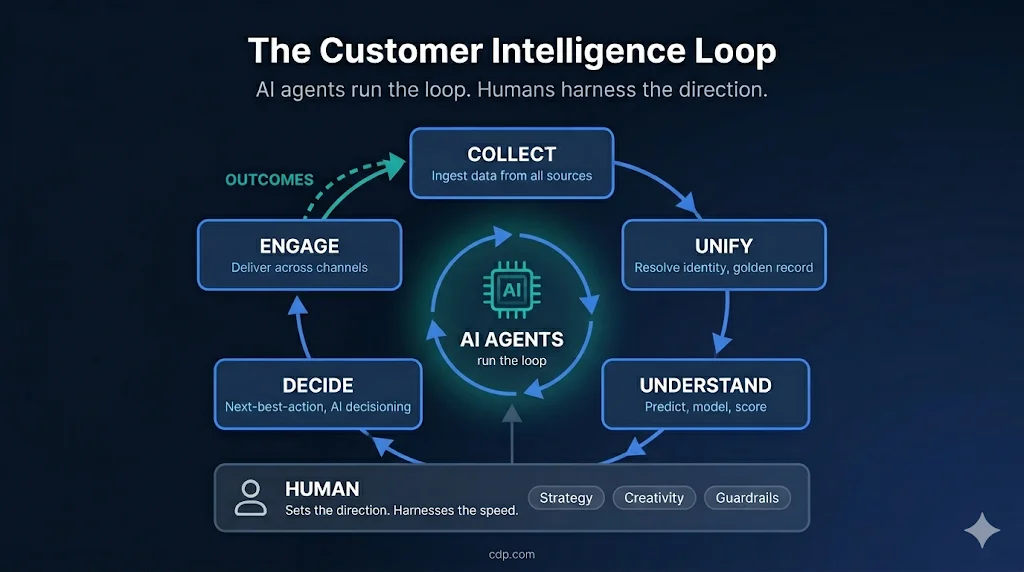
Every CDP — composable or otherwise — must execute the five stages of the Customer Intelligence Loop. In a composable stack, each stage is handled by a separate vendor or tool:
| Loop Stage | Composable Component | What It Does |
|---|---|---|
| **COLLECT** | Data ingestion pipelines | Batch and streaming connectors pull events from websites, apps, CRMs, and transactional systems into the warehouse |
| **UNIFY** | Warehouse modeling + identity resolution | SQL and transformation frameworks join raw tables into unified customer profiles with deterministic or probabilistic matching |
| **UNDERSTAND** | Analytics and ML | BI dashboards, ML notebooks, and custom models surface insights — churn risk, LTV, product affinity |
| **DECIDE** | Scoring and audience selection | SQL queries and modeling layers score customers and build audience segments for activation |
| **ENGAGE** | Reverse ETL + external messaging/ad platforms | Sync tools push audiences to email, SMS, push, and ad platforms for campaign execution |
The modularity is real and valuable for engineering control. But notice the architectural consequence: **outcomes from ENGAGE (opens, clicks, conversions) must travel back through the entire chain — ESP → reverse ETL → warehouse → dbt rebuild → model retrain — before the system can learn from them.**
### Warehouse-Native Foundation
Composable CDPs rely on your cloud data warehouse as the storage and compute layer for the COLLECT and UNIFY stages. Customer event streams, transaction records, support tickets, and other data sources are ingested via [data integration](/glossary/data-integration/) tools and modeled into unified customer profiles using SQL or transformation frameworks like dbt.
Because the warehouse already stores behavioral, transactional, and demographic data, there's no need to replicate everything into a separate CDP database. Analysts and engineers can query, join, and enrich customer data using familiar SQL workflows.
### Reverse ETL for Activation
Once customer profiles and segments are defined in the warehouse (UNIFY and UNDERSTAND), reverse ETL tools handle ENGAGE by pushing data to operational systems — email platforms (Braze, Iterable), ad networks (Google Ads, Facebook), CRMs (Salesforce, HubSpot), and customer support tools (Zendesk, Intercom).
Reverse ETL essentially inverts the traditional ETL flow: instead of extracting from operational tools into a warehouse, it extracts from the warehouse into operational tools. This enables marketing and customer success teams to activate warehouse-defined audiences without writing code or waiting for engineering support.
### Modular Activation and Experimentation
Because components are loosely coupled, teams can swap tools as needs evolve. If a new identity resolution vendor offers better accuracy, you can replace that layer without rebuilding your entire stack. If you want to test a new activation channel, you add a connector without re-architecting your data model. This flexibility is the composable stack's defining strength — and the source of its structural limitation for AI use cases, where the full cycle must close without crossing vendor boundaries.
## Pros and Cons of Composable CDPs
### Advantages
**Data ownership and portability**: Customer data stays in your warehouse, which you control. If you switch activation vendors, your unified profiles remain intact.
**Leverage existing investments**: If you've already built data pipelines, dbt models, and warehouse infrastructure, composable CDPs extend that foundation rather than replacing it.
**Flexibility and customization**: SQL-based modeling gives teams complete control over how customer attributes are defined, calculated, and enriched. You can incorporate proprietary business logic without waiting for vendor feature releases.
**Cost efficiency at entry point**: Warehouse-based storage and compute can initially appear more economical than per-profile or platform licensing from Agentic CDPs.
### Disadvantages
**Pricing can scale up quickly**: While composable CDPs often market lower entry costs, total cost of ownership can escalate as data volumes and activation use cases grow. According to G2 reviewer data (2025), users frequently cite unexpected cost increases as connector counts, sync frequencies, and row volumes expand — often approaching or exceeding Agentic CDP pricing at enterprise scale. (Enterprise suites face a parallel cost problem called [suite tax](/glossary/suite-tax/) — paying for an entire ecosystem to access CDP capabilities.)
**Higher complexity**: Building a composable stack requires integrating multiple tools, managing dependencies, and ensuring data quality across components. This demands strong data engineering expertise.
**Slower time to value**: Unlike Agentic CDPs with pre-built capabilities, composable architectures require upfront investment in data modeling, pipeline orchestration, and tool integration.
**Limited out-of-box AI**: Most composable CDPs rely on separate ML platforms for the UNDERSTAND and DECIDE stages. You won't get built-in propensity scoring or next-best-action recommendations without additional tooling — and each additional tool is another vendor boundary the feedback cycle must cross.
**Maintenance overhead**: As your stack grows, so does the operational burden of monitoring the pipeline across vendors — debugging sync failures between DECIDE and ENGAGE, keeping connectors up to date, and ensuring outcome data flows back to COLLECT reliably.
### 3-Year TCO: Composable vs Agentic
Cost comparisons between composable and agentic CDPs are misleading without modeling total cost of ownership across time. Composable stacks have lower entry costs but scale non-linearly as activation use cases grow. The CDP market is projected to reach $28.2 billion by 2028 at a 39.9% CAGR (MarketsandMarkets, 2023), and much of that growth will be driven by organizations consolidating multi-vendor stacks into unified platforms.
| Cost Category | Composable CDP | Agentic CDP |
|---|---|---|
| **Warehouse compute** | $50K-300K/year (scales with query volume, dbt rebuilds, ML workloads) | $0-50K/year (optional warehouse connect; managed storage included) |
| **Reverse ETL / sync fees** | $30K-150K/year (per-row × connector count × sync frequency) | Included (native activation) |
| **ESP / messaging platform** | $50K-500K/year (separate Braze, Iterable, or similar) | Included (native email, SMS, push) |
| **Identity resolution tool** | $0-100K/year (separate vendor or warehouse-native SQL) | Included (built-in AI-powered matching) |
| **Data engineering headcount** | 2-5 FTEs dedicated to pipeline maintenance ($200K-750K/year) | 0.5-1 FTE for CDP administration ($100K-150K/year) |
| **Integration maintenance** | $25K-100K/year (connector upgrades, debugging, monitoring) | Minimal (pre-built connectors maintained by vendor) |
| **3-year total (10M profiles)** | **$1.1M-5.7M** | **$300K-1.2M** |
These ranges reflect publicly available pricing tiers and G2 reviewer-reported costs as of 2025, modeled on 10M active profiles with daily syncs to 8 downstream tools at mid-tier ESP contract pricing. Actual costs vary significantly by vendor, data volume, sync frequency, and use case complexity. The key insight is not that composable is "expensive" — it is that composable costs compound multiplicatively (rows × connectors × frequency × tools), while agentic CDP pricing is typically per-profile with activation included.
### PII Duplication Across Vendor Boundaries
A composable CDP keeps unified profiles in the warehouse — but activation still requires copying personally identifiable information (PII) to external tools. Every [reverse ETL](/glossary/reverse-etl/) sync that pushes email addresses, phone numbers, or customer attributes to a separate ESP, ad platform, or CRM creates another copy of PII outside your primary data environment. In a typical composable stack, customer PII may exist in three or more systems simultaneously: the warehouse, the reverse ETL tool's sync cache, and each downstream activation platform.
Each additional copy introduces compliance overhead: separate GDPR Article 28 data processing agreements per vendor, slower deletion-request fulfillment (propagating across 3-5 systems takes days, not minutes), expanded breach surface with independent SOC 2 audit requirements, and data residency complexity when vendors store data in different regions. For a detailed compliance analysis, see [CISO's Guide to CDP Architecture](/articles/ciso-guide-cdp-architecture/).
## Composable CDP Vendors
The composable CDP market includes pure-play reverse ETL tools, warehouse-native audience builders, and hybrid platforms that offer both composable and managed CDP modes.
| Vendor | Type | Key Capability |
|---|---|---|
| **ActionIQ** | Hybrid CDP | Warehouse-native deployment with managed identity and orchestration (acquired by Uniphore, 2024) |
| **Hightouch** | Pure-play reverse ETL | Warehouse-native audience builder with 200+ destination connectors |
| **Salesforce Data Cloud** | Zero-copy (Salesforce ecosystem) | Zero-copy data sharing across Salesforce products and external warehouses |
| **[Treasure AI](https://www.treasure.ai/product/composable-cdp?utm_source=cdp-dot-com&utm_medium=website-referral&utm_campaign=glossary&utm_content=inline)** | Composable + Complete CDP | [Composable Audience Studio](https://docs.treasure.ai/products/customer-data-platform/composable-cdp) for zero-copy federated queries on Snowflake, BigQuery, and Databricks, plus a [Complete CDP](https://docs.treasure.ai/products/customer-data-platform/complete-cdp) with real-time profiles, native messaging, and AI decisioning |
Other notable composable CDPs include Census (warehouse-native reverse ETL, acquired by Fivetran in 2025) and RudderStack (open-source event streaming with reverse ETL). For a side-by-side comparison with pricing and feature details, see the [composable CDP vendors overview](/basics/cdp-vendors/#composable-cdp-vendors).
The composable landscape shifted in June 2026 when Databricks launched [CustomerLake](/articles/what-is-databricks-customerlake-cdp/), an [Agentic CDP](/glossary/agentic-cdp/) embedded directly in the lakehouse. CustomerLake occupies the same position composable vendors built their value proposition on — the activation layer between the warehouse and marketing tools — but as a native capability of the data platform itself rather than a third-party tool. For composable CDP vendors, this creates structural pressure: the data platform they depend on as a foundation is now a direct competitor for the activation layer.
The wider market points the same direction. In an August 2026 E-Commerce Times interview, Lisa Loftis, principal management consultant of customer intelligence at SAS, argued that standalone CDPs are disappearing as composable architectures become the preferred approach — with CDP functionality becoming an embedded feature within broader enterprise suites. Worth noting: SAS sells exactly this kind of embedded capability, so the argument doubles as a vendor position. As reported in the same interview, Gartner's 2025 Magic Quadrant for Customer Data Platforms expects the broader data management market — not just CDPs — to converge into a single ecosystem enabled by data fabric and GenAI by 2028. And the strongest counterpoint predates the interview: David Raab, founder of the Customer Data Platform Institute, argued last year (remarks Loftis relayed) that campaign and delivery CDPs — CDPs embedded inside larger customer-facing products — already make up more than two-thirds of the industry, so the category is evolving rather than disappearing. For buyers, all three readings carry one practical signal: CDP capabilities are increasingly consumed as a feature of a broader platform, whether a marketing suite or the data platform itself, rather than as a standalone point product.
## When Composable CDPs Make Sense
Composable CDPs are a strong fit when your organization already has a mature cloud data warehouse with well-modeled customer data and a data engineering team that can maintain the multi-vendor pipeline. Specifically, composable works well when:
- Your activation cadence is batch-oriented — daily or weekly audience syncs, periodic reporting — and that speed is sufficient
- You need custom data models or complex identity resolution logic that off-the-shelf matching cannot handle
- You want to avoid per-profile pricing or vendor lock-in
- Your AI/ML needs are limited to batch-trained models (churn prediction, LTV scoring) that tolerate hourly or daily data refreshes
For organizations that need real-time feedback loops, built-in AI decisioning, or sub-second profile access for personalization, an [Agentic CDP](/glossary/agentic-cdp/) may be a better fit. An Agentic CDP bundles data collection, identity resolution, AI decisioning, and native messaging into a single platform — allowing AI agents to run the full [Customer Intelligence Loop](/glossary/customer-intelligence-loop/) continuously without crossing vendor boundaries. Some Agentic CDPs also support [hybrid deployment](/glossary/hybrid-cdp/), connecting to your existing warehouse while adding managed storage for real-time use cases. For a detailed comparison, see [Packaged vs Composable CDP](/articles/packaged-cdp-vs-composable-cdp/). To score both models against the same requirements, use a [CDP RFP template](https://www.treasure.ai/your-complimentary-rfp-template/?utm_source=cdp-dot-com&utm_medium=website-referral&utm_campaign=glossary&utm_content=inline).
## AI and the Feedback Loop Challenge
As venture capitalist Tomasz Tunguz argues in [AI's Bundling Moment](https://www.linkedin.com/pulse/ais-bundling-moment-tomasz-tunguz-wucfc/), AI is reversing the SaaS era's unbundling playbook — AI systems perform best when they can observe entire workflows end-to-end and act on insights in real time. In a composable stack, the [Customer Intelligence Loop](/glossary/customer-intelligence-loop/) is split across vendor boundaries: outcomes from ENGAGE (opens, clicks, conversions) must travel back through the ESP, reverse ETL, warehouse rebuild, and model retrain before the system can learn — a round-trip measured in hours, not seconds.
This feedback latency is manageable for batch use cases (weekly audience syncs, periodic reporting) but becomes a structural limitation for real-time AI decisioning and [agentic marketing](/glossary/agentic-marketing/). Organizations weighing this trade-off should evaluate how fast they need the loop to close and whether a [hybrid deployment](/glossary/hybrid-cdp/) or [Agentic CDP](/glossary/agentic-cdp/) better fits their real-time requirements. For a detailed analysis, see [Packaged vs Composable CDP](/articles/packaged-cdp-vs-composable-cdp/) and [How to Evaluate a CDP in the AI Era](/articles/how-to-evaluate-cdp-ai-era/).
## FAQ
### What is the difference between a composable CDP and a data warehouse?
A [data warehouse](/glossary/cdp-vs-data-warehouse/) is infrastructure for storing and querying data. A composable CDP is an architecture that uses your data warehouse as the foundation, then adds specialized tools for identity resolution, segmentation, and activation. The warehouse provides the "what" (unified customer data), while the composable CDP tools provide the "how" (turning that data into actionable customer experiences).
### Can small companies use composable CDPs, or are they only for enterprises?
Composable CDPs generally require more technical expertise and infrastructure than integrated CDPs, making them better suited for mid-market and enterprise organizations with dedicated data teams. However, startups with strong engineering resources and existing warehouse investments can adopt composable approaches—especially if they already use modern data stacks (Fivetran, dbt, Snowflake) and want to avoid the cost and complexity of adding another proprietary platform.
### Can composable CDPs support agentic AI and real-time marketing?
**Composable CDPs handle triggered real-time messages (abandoned cart, order confirmation) effectively, but struggle with continuously-learning AI agents.** The distinction matters: sending a triggered message based on a pre-defined rule works fine in composable stacks. The structural limitation is continuous learning — when AI agents need to act, observe the outcome, and improve the next decision in seconds. In composable architectures, outcomes must traverse reverse ETL back to the warehouse, then through dbt rebuilds and model retraining, before the system learns — a round-trip measured in hours, not seconds. For use cases requiring closed-loop learning, Agentic CDPs with built-in messaging and AI decisioning keep the entire cycle within a single platform boundary.
**Further Reading:** [How to Evaluate a CDP in the AI Era: 10 Questions Every Buyer Should Ask](/articles/how-to-evaluate-cdp-ai-era/)
### How does reverse ETL differ from packaged CDP activation?
Packaged CDPs store customer profiles in their own database and activate them via pre-built integrations to marketing tools. [Reverse ETL](/glossary/reverse-etl/) flips this model: customer profiles live in your warehouse, and reverse ETL connectors sync segments and attributes to downstream tools on demand. This keeps your warehouse as the source of truth and eliminates the need to duplicate customer data into yet another system. The end result—personalized campaigns, targeted ads, enriched CRM records—is similar, but the underlying data flow is fundamentally different.
### What is composable CDP architecture?
**Composable CDP architecture uses your cloud data warehouse as the foundation and layers modular tools on top for each CDP function.** The typical stack maps to the five stages of the Customer Intelligence Loop: data ingestion tools (Fivetran, Airbyte) handle COLLECT, SQL and dbt handle UNIFY and UNDERSTAND, reverse ETL tools handle DECIDE/ENGAGE by syncing audiences to downstream platforms. Each component can be swapped independently, but every vendor boundary introduces integration complexity and latency. See the Loop mapping table above for a detailed component breakdown.
### Is Snowflake or BigQuery a composable CDP?
**No — Snowflake and BigQuery are data warehouses, not CDPs, but they serve as the foundation layer for composable CDP architectures.** A warehouse stores and queries customer data but lacks native identity resolution, audience segmentation, and marketing activation. Building a composable CDP on top requires adding specialized tools for each capability. For detailed assessments, see [Is Snowflake a CDP?](/articles/is-snowflake-a-cdp/) and [What Is Databricks CustomerLake?](/articles/what-is-databricks-customerlake-cdp/).
### What is the difference between a composable CDP and an agentic CDP?
**A [composable CDP](/glossary/composable-cdp/) assembles best-of-breed tools on your data warehouse; an [Agentic CDP](/glossary/agentic-cdp/) bundles data unification, AI decisioning, and native messaging into a single platform.** The core architectural difference is where the [Customer Intelligence Loop](/glossary/customer-intelligence-loop/) executes. In a composable stack, the loop spans multiple vendors — data warehouse, reverse ETL, external ESP, separate ML platform — and outcomes must traverse all of them before the system learns. An Agentic CDP keeps the entire loop within one platform boundary, enabling AI agents to collect data, make decisions, act, and learn from outcomes in seconds rather than hours. Composable CDPs offer greater engineering control and avoid vendor lock-in; Agentic CDPs offer faster feedback loops and lower operational complexity. For a detailed comparison, see [Packaged vs Composable CDP](/articles/packaged-cdp-vs-composable-cdp/).
### How much does a composable CDP cost?
**Composable CDP costs typically range from $1.1M to $5.7M over three years for 10M active profiles, compared to $300K–$1.2M for an Agentic CDP.** The gap stems from how costs compound: composable stacks incur separate charges for warehouse compute ($50K–$300K/year), reverse ETL sync fees ($30K–$150K/year), external messaging platforms ($50K–$500K/year), and 2–5 dedicated data engineering FTEs ($200K–$750K/year). Each variable multiplies against the others — rows × connectors × sync frequency × tools — so costs scale non-linearly as activation use cases grow. Entry costs are lower than Agentic CDPs, but total cost of ownership often converges or exceeds them at enterprise scale. See the [3-Year TCO comparison](#3-year-tco-composable-vs-agentic) above for a detailed breakdown.
### What is Databricks CustomerLake and how does it affect composable CDPs?
**[Databricks CustomerLake](/articles/what-is-databricks-customerlake-cdp/) is an [Agentic CDP](/glossary/agentic-cdp/) embedded directly in the Databricks lakehouse, launched in June 2026.** It occupies the same position composable CDP vendors built their value proposition on — the activation layer between the data warehouse and marketing tools — but as a native capability of the data platform itself. For composable vendors like Hightouch and Census (acquired by Fivetran), this creates structural pressure: the data platform they depend on as a foundation is now a direct competitor for the activation layer. Organizations evaluating composable CDPs on Databricks should assess whether CustomerLake's native integration eliminates the need for a separate reverse ETL tool.
### Are standalone CDPs disappearing?
**Treat "the standalone CDP is dead" claims — from analyst summaries or vendor decks alike — as directional signals, not verdicts.** Consolidation pressure is real, and CDP capability increasingly ships inside suites and data platforms. What does not change is how to evaluate: loop speed against your use cases' latency requirements, identity quality against your match complexity, activation depth against your channel mix. Packaging is not incidental here — the deployment model largely determines whether a platform can close the loop fast enough for real-time AI use cases.
## Related Terms
- [Data Warehouse](/glossary/data-warehouse/) — The storage layer that composable CDPs build upon
- [Data Governance](/glossary/data-governance/) — Policies for managing data quality across multi-vendor stacks
- [Customer Data Platform](/basics/what-is-a-customer-data-platform-cdp/) — The broader category composable CDPs belong to
- [Real-Time CDP](/glossary/real-time-cdp/) — Streaming architecture that composable stacks struggle to replicate
- [Data Lakehouse](/glossary/data-lakehouse/) — Alternative foundation layer some composable stacks use
- [Customer Intelligence Loop](/glossary/customer-intelligence-loop/) — The five-stage cycle composable stacks split across vendors
- [Marketing Harness](/glossary/marketing-harness/) — Execution layer around marketing agents; its customer context can come from composable stacks
---
### Consent Management
URL: https://cdp.com/glossary/consent-management/
**Consent management is a process that informs users about how an organization intends to use and govern their data.** It lets users determine what data they are willing to share. Consent management logs and tracks consent collection, so organizations can stay in compliance with global [data privacy](/glossary/data-privacy/) regulations.
Users’ explicit consent gives an organization permission to collect their data, but at the same time, gives users control over the data and how it’s used. Consent management allows users to rescind their consent at any time.
Due to the misuse of [personal data](/glossary/pii-personally-identifiable-information/), [recent regulations](/basics/international-u-s-data-privacy-laws-and-regulations-you-need-to-know/) control how businesses collect and manage data. In general, data privacy laws require organizations to collect consent before handling any personal information. It is essential (and even mandatory) to obtain explicit consent from users before using their information.
Consent is one of six lawful bases to process user data, according to the European Union’s General Data Protection Regulation (GDPR), and obtaining consent is the easiest way to protect your business. [GDPR](https://gdpr-info.eu/), which went into effect in 2018, is a set of laws on data protection in the European Union.
Failure to comply with consent can lead to fines, lawsuits, and damage to your business’ reputation. Organizations operating globally must track requirements across dozens of jurisdictions — see our [U.S. and international data privacy laws tracker](/basics/international-u-s-data-privacy-laws-and-regulations-you-need-to-know/) for a comprehensive reference. While data collected on digital platforms is essential to making decisions about your business, you must obtain prior permission to use your customers’ data.
### How Consent Management Works
In the consent management process, you gather detailed information about customer opt-ins, including who, when, and what users were told, and what method users consented to. This process includes a variety of steps:
- Informing users their data is being collected
- Providing them information about what data is being collected
- Giving them the opportunity to decide if they agree to this process
- Recording the consent
- Allowing users to withdraw or change their consent
- Allowing users to access or delete their data
Consent management also ensures you are not contacting customers who no longer want to be contacted.
Consent management benefits organizations because it protects your interests and honors your customers’ choices for data use and privacy. It’s important to have a consent management strategy in place to improve the transparency of data collection, provide choice, and secure users’ data. Strong [data governance](/glossary/data-governance/) practices underpin effective consent management. By respecting users’ information, data, and data preferences, organizations can foster a higher sense of trust.
Some organizations use a Consent Management Platform that automates the process of requiring consent, storing the user preferences, and updating those preferences as needed. Requesting user consent can be as simple as accepting the use of cookies to track [first-party data](/glossary/first-party-data/). A more complex example could be providing a customer with a contract that describes the data you are collecting and how you are processing it.
If you provide a mobile app, you will need to ask for consent to perform location tracking, data sharing, and other data management activities. Your consent management practices should also include other ways you collect customer data, such as customer support centers, chatbots, in-person events, and anywhere else that data is acquired or exchanged. A [customer data platform](/basics/what-is-a-customer-data-platform-cdp/) can centralize consent preferences across all these channels, ensuring a consistent [customer experience](/glossary/customer-experience-cx/).
## FAQ
### What is the difference between consent management and privacy compliance?
Consent management is a specific process within privacy compliance that focuses on obtaining, recording, and managing user permissions for data collection and use. Privacy compliance is the broader practice of adhering to all data protection regulations (GDPR, CCPA, etc.), which includes consent management as well as data security, breach notification, data access rights, and other regulatory requirements.
### Do I need a Consent Management Platform (CMP)?
A Consent Management Platform is highly recommended for organizations that collect customer data across multiple channels and need to comply with privacy regulations. A CMP automates the process of requesting consent, storing user preferences, updating those preferences over time, and ensuring you don't contact customers who have withdrawn consent. While manual processes are possible for simple use cases, most businesses benefit from automated consent management.
### What happens if a user withdraws their consent?
When a user withdraws consent, organizations must immediately stop processing their data for the purposes covered by that consent and remove them from relevant marketing and communication lists. The consent management system should record the withdrawal, update user preferences across all systems, and in some cases, delete or anonymize the user's data depending on the specific regulations and the nature of the consent withdrawal.
## Related Terms
- [Cookieless Tracking](/glossary/cookieless-tracking/) — Privacy-compliant tracking methods that reduce consent friction
- [Data Masking](/glossary/data-masking/) — Protects personal data in systems where consent is limited
- [Tag Management](/glossary/tag-management/) — Controls which tracking tags fire based on consent status
- [Data Lifecycle Management](/glossary/data-lifecycle-management/) — Governs data retention aligned with consent withdrawal policies
- [CDP vs DMP](/basics/cdp-vs-dmp-vs-crm-differences-similarities-and-best-practices/) — CDP vs DMP vs CRM: key differences marketers must know
- [First-Party Cookie](/glossary/first-party-cookie/) — The first-party cookie and the first-party data collected enables direct...
- [Third-Party Data](/glossary/third-party-data/) — Third-party data is customer information collected by organizations with no direct relationship to the end user.
---
### Content Marketing Strategy
URL: https://cdp.com/glossary/content-marketing-strategy/
**A content marketing strategy is a comprehensive plan for creating and deploying media to increase brand awareness.** Different types of [content marketing](/glossary/content-marketing/) assets include online articles, blog posts, videos, infographics, whitepapers, social media, web pages, and other formats.
Unlike some traditional advertising approaches, content marketing usually does not usually explicitly promote a product or service or deliver direct sales pitches or offers. Rather, a successful content marketing strategy depends upon delivering information and stories that the intended audience — defined through customer segmentation — is likely to find valuable. This can in turn boost interest in that company’s products or services. A consumer food business, for example, might create recurring blog posts or videos with recipes and meal-planning tips in order to attract gourmands. The same principles also apply to B2B content marketing, along with a stronger focus on increasing ROI. Content marketing ROI can be measured by tracking metrics through marketing analytics that connect back to a company’s particular goals.
## Why Is Content Marketing Strategy Important?
People are bombarded daily with marketing and advertising messages, especially in the digital age. Moreover, people are increasingly adept at tuning out or altogether blocking such messages, especially if they perceive them as irrelevant. An effective content marketing strategy helps get past that barrier by delivering information that people find informative or even entertaining, often amplified through [social media marketing](/glossary/social-media-marketing/). [Personalization](/glossary/personalization/) plays a key role in ensuring the right content reaches the right audience at each stage of the [customer journey](/glossary/customer-journey/). It is a critical means of relationship-building in the digital age, both with prospective and existing customers. Instead of associating a brand with a particular sales pitch or tagline, people can connect it with the value they find in the content related to that brand.
## How CDPs Inform Content Strategy
A [customer data platform (CDP)](/basics/what-is-a-customer-data-platform-cdp/) gives content strategists what editorial intuition alone cannot: a data-driven view of which content drives real business outcomes across different audience segments. By unifying behavioral data from website visits, email opens, webinar attendance, and social interactions into a single [customer profile](/glossary/customer-360/), a CDP reveals patterns that shape smarter content decisions.
For example, a CDP might show that enterprise prospects who read comparison articles request demos at a higher rate than those who only read introductory guides. This insight directly informs content prioritization — the strategy shifts toward producing more comparison and evaluation content for that segment. Similarly, content engagement data flowing back into the CDP helps identify which topics correlate with higher customer lifetime value over time.
CDPs also enable content distribution strategies based on [first-party data](/glossary/first-party-data/) rather than third-party assumptions. Instead of guessing which channels will reach a particular audience, teams can use CDP segments to match content to the channels where each audience actually engages. This closed-loop approach — where content performance data feeds the CDP and the CDP informs content planning — makes strategy iterative and measurable rather than speculative. With the rise of [agentic CDPs](/glossary/agentic-cdp/), this loop tightens further: AI agents can continuously analyze content performance, identify emerging audience interests, and recommend strategy adjustments in near real time rather than waiting for quarterly reviews.
## What are the components of a content marketing strategy?
A strategy that survives contact with a real quarter has six working parts, and each one fails in a recognizable way when it is missing.
**Audience definition.** Segments should come from observed behavior — what people read, ask, and buy — rather than from demographics alone. The failure mode is a persona copied from a slide deck: content then speaks to an audience nobody has actually met. Validate every segment against first-party data before planning topics against it, and recheck when engagement patterns shift. A workable test: for each segment, name the question it typed into search last month and the publication it already reads. If no one can answer both, the segment is a demographic label, and topics planned against it will reach nobody in particular.
**Goals tied to decisions.** Each goal should name the decision the content is meant to change — a prospect shortlisting the brand, a buyer comparing options, a customer adopting a feature. "Publish more posts" is not a goal; it is an output target, and hitting it says nothing about whether the content worked. Pair each lagging outcome with a leading indicator readable weekly — pipeline influenced for revenue goals, return visits for consideration goals — so the strategy corrects course inside the quarter rather than after it closes.
**Content pillars.** A small number of themes — three to five for most teams — where the brand has genuine depth and can say something competitors cannot. Pillars keep the library cumulative, so each new asset strengthens the others instead of starting from zero. Chasing every trending topic has the opposite effect: authority stays shallow and no theme accrues enough depth to own a query space.
**Channel and distribution plan.** Every asset needs a named route to its audience before it is written: owned channels such as the blog and email newsletter, communities and partner placements, commission-based programs such as [affiliate marketing](/glossary/affiliate-marketing/), and paid amplification. Deciding distribution after publishing is how good assets disappear unread.
**Workflow and ownership.** One owner decides what gets made; named people research, draft, review, publish, and measure. Without a single accountable owner, production drifts toward whatever is easiest to ship, and the strategy slowly becomes a document nobody opens. The smallest durable artifact is a one-page operating summary — segments, goals and their metrics, pillars, current bets. Anything longer stops being read; anything shorter cannot arbitrate a disagreement about what to produce next.
**Measurement plan.** Choose the primary metric per goal, the review cadence, and the conditions that would end or expand an initiative — before publishing, not after. Traffic-based goals deserve particular skepticism: 74.6% of searches produced no click in 2026 (First Page Sage, 2026), so visits can hold steady while the demand behind them moves into AI answers. A measurement plan written once results are in tends to justify whatever was already done.
These components connect through a fixed rhythm. Quarterly, revalidate segments and goals against fresh behavior data and retire any pillar that no longer matches what the audience engages with. Monthly, read each pillar against its primary metric and shift effort toward what is compounding. Weekly, the calendar turns the current bets into assigned, dated work. The rhythm matters more than the documents: a plain strategy reviewed on schedule outperforms a sophisticated one reviewed annually, because only the reviewed one ever changes.
## Which formats and channels fit which goals?
Formats are not interchangeable: a format earns its place by matching the decision a reader is making at that moment. Use this table to choose deliberately instead of defaulting to whatever the team enjoys producing.
| Goal | Best-fit formats | Primary distribution | Signal to watch | Common failure mode |
|---|---|---|---|---|
| Build awareness | Original research, data studies, definitive explainers | Search plus social amplification | Branded search volume, citations from other sites | Publishing opinions with no original data — nothing to cite, nothing that ranks |
| Win consideration | Comparison guides, in-depth how-tos, webinars | Search, email nurture, sales follow-up | Engaged time, return visits, content-assisted conversions | Gating everything behind forms before proving any value |
| Keep and grow customers | Playbooks, onboarding series, release education | Email, in-product messaging, help center | Feature adoption, ticket deflection, retention by cohort | Shipping acquisition content to an audience that already bought |
| Defend a topic space | Topic clusters, glossaries, refreshed cornerstone pages | Search | Share of queries answered, refresh lift on aging pages | Letting cornerstone pages decay while only new assets get effort |
Paid distribution has a place, but it amplifies rather than rescues: sponsorships and programmatic buys through an [ad exchange](/glossary/ad-exchange/) work best on assets that already earn attention organically, because promotion multiplies whatever response the content produces — including none.
## Why do content marketing strategies fail?
Most strategies do not fail on the quality of their ideas; they fail on operation. The recurring mechanisms, and the fixes:
**The document is filed, not operated.** A strategy written once and never referenced in planning constrains nothing. Fix: review it in the same meeting where the calendar is planned, and require every planned piece to map to a pillar and a goal. Pieces that map to neither get cut, or the strategy gets revised — one or the other, explicitly.
**Volume replaces depth.** Publishing cadence quietly becomes the goal itself. When [AI agents](/glossary/ai-agent/) make drafts nearly free, the pressure grows, and a site fills with thin pages that compete with one another for the same queries. Fix: measure whether a piece changed anything, and consolidate overlapping pages instead of adding another variant.
**Success is reported as activity.** Posts published, impressions, and sessions fill dashboards while pipeline and retention go unmeasured, so budget decisions rest on numbers that cannot justify them. The distortion compounds: organic traffic on informational queries fell 43.9% between January 2023 and July 2026 (First Page Sage, 2026), so the same activity buys less outcome every quarter even when nothing changes. Fix: one primary metric per goal, reviewed on a fixed cadence, with activity metrics kept as diagnostics only.
**Content decays silently.** Claims go stale, products change, and pages that once performed erode without anyone noticing — dashboards celebrate new publications, not the slow decline of old ones. Fix: schedule refresh audits the same way new content is scheduled; update, merge, or retire pages on a calendar.
**The strategy imitates competitors.** Copying the topics a rival covers concedes the one advantage available: a point of view they cannot publish. Fix: ground the pillars in what the company knows that others do not — its own usage data, its own customer questions, its own failures.
**Execution accelerates while judgment does not.** As AI takes over more production — the shift described in [agentic marketing](/glossary/agentic-marketing/) — the strategy matters more, not less, because it is the only thing deciding what all that new capacity should work on. A team that scales output without revisiting its audience and pillar decisions simply produces its existing mistakes faster.
## FAQ
### What is the difference between content marketing and content marketing strategy?
Content marketing refers to the actual creation and distribution of valuable content such as blog posts, videos, and infographics. A content marketing strategy is the overarching plan that guides those efforts, defining target audiences, content themes, distribution channels, publishing cadence, and measurable goals. Without a strategy, content marketing efforts tend to be ad hoc and difficult to measure.
### How do you measure content marketing ROI?
Content marketing ROI is measured by tracking metrics that align with your specific business goals. Common metrics include organic search traffic, lead generation, conversion rates, email signups, social shares, and ultimately revenue attributed to content-driven touchpoints. Tools like [marketing analytics](/glossary/marketing-analytics/) platforms and customer data platforms help connect content engagement to downstream business outcomes.
### How often should you update your content marketing strategy?
Most organizations should review and update their content marketing strategy at least quarterly, with a comprehensive annual overhaul. Market conditions, audience preferences, search algorithm changes, and competitive dynamics all shift over time. Regular performance reviews help identify which content types and topics are delivering results and where adjustments are needed to stay relevant and effective.
### Who should own a content marketing strategy?
**One accountable marketing leader should own the strategy, with named contributors from product, sales, and customer success.** Shared ownership without a single decision-maker is the most common reason strategies stall: topics wait for consensus, and the calendar drifts toward whatever is easiest to produce. The owner arbitrates what gets made, holds the review cadence, and reports the primary metrics. Contributors supply subject-matter depth and the real customer questions the owner would not see otherwise.
### What is the difference between a content marketing strategy and an editorial calendar?
**An editorial calendar is an execution artifact; the strategy is the plan the calendar serves.** The strategy defines audiences, goals, content pillars, distribution channels, and how results are measured. The calendar schedules the resulting work — titles, formats, owners, and publish dates. A calendar without a strategy produces a steady stream of disconnected posts; a strategy without a calendar stays a document nobody acts on. Build the strategy first, then let the calendar show whether production actually follows it.
## Related Terms
- [Email Marketing](/glossary/email-marketing/) — Key distribution channel for content marketing campaigns
- [Social Media Marketing](/glossary/social-media-marketing/) — Amplifies content reach through social sharing
- [Growth Marketing](/glossary/growth-marketing/) — Data-driven framework that content strategy supports
- [Lead Nurturing](/glossary/lead-nurturing/) — Uses content sequences to move prospects toward conversion
- [Agile Methodology](/glossary/agile-methodology-definition/) — Agile methodology is a set of iterative principles for software development and project management that prioritizes collaboration, flexibility, and speed.
- [AI Creative Automation](/glossary/ai-creative-automation/) — AI creative automation uses generative AI and machine learning to produce, adapt, and optimize marketing creative assets across channels at scale.
- [Vibe Marketing](/glossary/vibe-marketing/) — Vibe marketing is an AI-driven approach where marketers set strategic direction and brand tone while AI handles execution, optimization, and content production.
---
### Content Marketing
URL: https://cdp.com/glossary/content-marketing/
**Content marketing is the development and publication of various types of media to help cultivate a target audience, such as prospective customers for a product or service.** It is also used to build brand equity and cultivate loyal, long-term relationships with these audiences. Content marketing spans a wide range of digital formats, including blog posts, webinars, videos, and infographics.
Unlike some other forms of marketing and advertising, content marketing rarely pitches a company’s products or services directly. Rather, it creates interest around a brand and its offerings by distributing content that a target audience — identified through customer segmentation — is likely to find both relevant and valuable. For example, a consumer retail business specializing in kitchen and household goods might create a website that publishes recipes and time-saving cleaning tips.
A complete [content marketing strategy](/glossary/content-marketing-strategy/) usually includes a social media marketing component. This is because a company’s content marketing ROI is amplified when people share the material on social platforms. In fact, social shares are one of the key content [marketing](https://www.treasure.ai/product/?utm_source=cdp-dot-com&utm_medium=website-referral&utm_campaign=glossary&utm_content=inline) statistics businesses use to measure their digital performance. Tracking these metrics through marketing analytics helps teams understand which content formats and topics resonate most with their audiences.
## Why Content Marketing?
Content marketing is an immensely valuable method of communicating with the modern consumer, who is always online and overwhelmed with digital noise. Popular video platforms provide a good example. A viewer can bypass or ignore a non-native ad, but they will watch a high-quality branded video that interests or entertains them. By delivering valuable, relevant content that an audience actually cares about—versus what they might perceive as “just another ad”—brand marketers can build meaningful, long-term relationships that foster loyalty and trust.
## How CDPs Power Content Personalization
A [customer data platform (CDP)](/basics/what-is-a-customer-data-platform-cdp/) transforms content marketing from a broadcast approach into a personalized experience. Without unified customer data, content teams rely on broad audience assumptions — publishing the same blog post, video, or email to everyone regardless of their interests or stage in the [customer journey](/glossary/customer-journey/).
CDPs change this by connecting content engagement signals back to individual [customer profiles](/glossary/customer-360/). When a visitor reads three articles about data governance, downloads a whitepaper on compliance, and attends a webinar on privacy regulations, the CDP captures all of these interactions under a single [identity](/glossary/identity-resolution/). Marketers can then use this unified profile to serve that visitor content about related topics rather than generic introductory material.
The feedback loop also works in reverse: [first-party data](/glossary/first-party-data/) generated by content engagement — time on page, scroll depth, downloads, video completions — feeds back into the CDP to enrich audience segments. These enriched segments inform future content decisions, helping teams prioritize topics and formats that drive measurable conversions rather than just pageviews. This data-driven cycle makes content marketing progressively more effective over time, turning every piece of published content into both an engagement asset and a data collection mechanism. As AI-driven CDPs evolve into [agentic platforms](/glossary/agentic-cdp/), this cycle accelerates further — AI agents can autonomously match content to micro-segments in real time, testing variations and optimizing distribution without manual intervention from marketing teams.
## Owned, earned, and paid content distribution
Publishing an asset and distributing it are different jobs, and programs that treat them as one quietly stall. A blog that depends on search rankings alone rents its audience from an algorithm; an email list that only grows when a new post ships is a distribution plan with one leg. Every piece of content reaches its audience through three routes, and each carries a different cost structure and a different way of failing.
| Route | Best for | Cost profile | Failure mode | Skip if |
|---|---|---|---|---|
| Owned — the blog, email list, podcast, and resource center you control | Compounding, searchable assets that keep working after publication | Production time; little media spend | Building a library for an audience that does not exist yet | You need measurable pipeline within one quarter |
| Earned — shares, mentions, backlinks, and partner or [affiliate](/glossary/affiliate-marketing/) placements | Credibility and reach that advertising cannot buy outright | Relationships and genuinely repeatable claims | Pitching coverage that deserves none | The content makes no claim another site would want to repeat |
| Paid — social promotion, newsletter sponsorships, and native placements bought through an [ad exchange](/glossary/ad-exchange/) | Putting budget behind assets that already prove engagement | Media spend for every impression | Paying to amplify content that failed organically | The asset has no organic engagement data yet |
The routes reward a sequence, not a split budget. Prove an asset on owned channels first, where engagement is cheap signal. Put promotion money behind the minority of pieces that already convert — paid distribution amplifies winners, but it cannot resurrect a post nobody read. Treat earned reach as a consequence of publishing claims worth repeating: original numbers, a contrarian position, a teardown so useful that other sites link to it just to argue with it.
Distribution debt compounds in reverse, too. Teams keep producing while last quarter's assets sit unread, and the fix costs less than commissioning replacements: a quarterly audit that re-promotes proven pieces through owned channels reaches an audience that already exists.
## How AI search changes content marketing
Answer engines now intercept questions before a results page loads. In 2026, 74.6% of searches ended without a click, up from 54.1% in 2022 (First Page Sage, 2026). The damage concentrates exactly where content marketing lives: informational queries lost 43.9% of their organic traffic between January 2023 and July 2026, the steepest decline of any intent class, and a page that ranks first still loses 56.9% of its click-through when an AI Overview appears above it (First Page Sage, 2026).
The counterweight arrives through the same shift. Referrals from AI platforms grew from 0.1% to 6.2% of all sessions over the same period, and those visitors became leads at roughly 2.5 times the rate of Google organic visitors — 4.7% versus 1.9% (First Page Sage, 2026). They arrive late, after an assistant has already answered the broad questions, so the content they land on needs to close a decision, not introduce a topic.
The pattern is sharpest for B2B SaaS, the category that leans hardest on content marketing: its organic traffic fell 29.4% over the same period, yet it drew 11.8% of its sessions from AI platforms — the highest share of the twelve industries studied (First Page Sage, 2026). Content teams are losing the middle of the funnel to AI answers while the buyers who do arrive are better qualified than before.
Three adjustments follow, and none of them abandons search:
- **Write sentences an assistant can quote whole.** Bold one-shot definitions, attributed figures, and comparison tables survive summarization; winding build-ups do not.
- **Weight decision-layer content higher.** Comparisons, implementation timelines, and explicit skip-if conditions are what assistants quote for buying questions — and buying intent is the traffic that still converts.
- **Track AI referrals as their own channel.** They convert at a different rate than organic search, so blending them into one organic number hides both.
Search is not dead: organic still delivered 42.8% of sessions in 2026, the largest single source (First Page Sage, 2026). The job is to extend the moat from ranking to being cited inside the answer. As assistants mature into [agentic AI](/glossary/agentic-ai/) that compares options and builds shortlists on a user's behalf, the brands already written down as citable sources are the ones the agent shortlists.
## What a content marketing workflow needs
The difference between a content program and a content habit is a workflow. Without one, output depends on whoever has bandwidth that week, quality depends on whoever wrote the piece, and performance reviews depend on whoever remembers the numbers. A workable workflow has five stages, and the expensive failures happen at the first and the last.
- **Brief.** Name the question the piece answers, the audience segment it serves, the distribution route it ships with, and the one metric that defines success. A brief that only names a topic produces an article that answers everything and therefore nothing.
- **Source.** Interview the people who do the work. Practitioner input is what separates a page from the generic output generated at scale, and it supplies the specific detail assistants prefer to cite.
- **Review.** Check claims the way an editor checks facts: every number attributed to a named source with a year, every product claim one the company can defend. One fabricated statistic costs more trust than a hundred accurate articles earn.
- **Publish with distribution attached.** An asset without an email segment, a social plan, and an internal-link path is unpublished in practice.
- **Review performance on a schedule.** Feed results back into the brief library: which questions deserve a refresh, which formats earn attention, which distribution routes actually moved the metric.
None of this requires heavy tooling to start. A shared brief template and a fixed review cadence carry most programs further than a software purchase. What it requires is refusing to let a stage become optional, because each skipped stage reappears later as a page that ranks for nothing and quotes nobody.
## Keeping a content library alive: refresh, repurpose, prune
Content decays quietly. Figures age, product references drift, and a post that held a top position for two years slides down the results page without anyone deciding anything. Programs that only add — never revisit — accumulate hundreds of posts, most of them underperforming, leaving overlapping pages to compete for the same queries.
Three maintenance verbs keep a library compounding:
- **Refresh** the pages that almost win: update dated figures, deepen thin sections, and reconfirm that the one-shot answer still matches what people actually ask.
- **Repurpose** what proved itself: a webinar becomes articles and short clips, a data-rich post becomes the figure other sites cite. One strong idea, many formats.
- **Prune** what cannot be saved: merge near-duplicates, redirect them to the strongest page, and retire posts that no longer serve a reader or a goal. Pruning concentrates authority instead of splitting it across a dozen weak pages.
Give your proven pages a scheduled review and let the long tail wait until data flags it. Maintenance is cheaper than replacement, and the library that gets revisited keeps compounding while the one that only accumulates quietly rots.
## FAQ
### What are the most effective types of content marketing?
The most effective types include blog posts and articles for SEO-driven organic traffic, video content for engagement and brand storytelling, and [email](/glossary/email-marketing/) newsletters for nurturing existing audiences. The best format depends on your audience's preferences and where they consume information. Data from [marketing analytics](/glossary/marketing-analytics/) can reveal which content types resonate most with your specific audience.
### How is content marketing different from traditional advertising?
Traditional advertising directly promotes a product or service through paid placements like display ads, TV commercials, or print ads. Content marketing takes an indirect approach by creating valuable, informative, or entertaining material that attracts and engages a target audience without explicit sales pitches. Over time, this builds trust and brand affinity that naturally leads to purchase consideration.
### How does content marketing support SEO?
Content marketing supports SEO by creating high-quality, keyword-relevant pages that search engines index and rank for targeted queries. Each piece of content represents an opportunity to appear in search results for terms your audience is actively searching. Consistently publishing valuable content also builds domain authority, earns backlinks from other sites, and increases the total volume of organic search traffic over time.
### How long does content marketing take to show results?
**Content marketing compounds: early engagement signals can appear within weeks, while organic search and revenue results generally take several months of consistent publishing.** Search engines need time to index and rank new pages, and buyers rarely convert on the first useful article they read. Results arrive faster where a site already has authority and slower in competitive topics with entrenched incumbents. Judge the program on trajectory — engaged readers, returning visitors, content-sourced leads — rather than on any single post.
### How much does content marketing cost?
**Cost is driven by who produces the content and how deeply it is researched, not by the channel it publishes on.** The main line items are production (strategy, writing, design, video), distribution (email tooling, promotion budget, sponsorships), and the platform layer that connects engagement data back to the audience. In-house teams trade higher fixed cost for accumulating institutional knowledge; agencies trade lower fixed cost for a ramp-up period on new topics. Budget per series, not per post.
## Related Terms
- [Lead Nurturing](/glossary/lead-nurturing/) — Content sequences that guide prospects through the funnel
- [Growth Marketing](/glossary/growth-marketing/) — Broader acquisition strategy that content marketing feeds
- [Customer Journey](/glossary/customer-journey/) — Maps the stages where content engages audiences
- [Conversion Rate Optimization](/glossary/conversion-rate-optimization/) — Optimizes content-driven landing pages for conversions
- [Brand Awareness](/glossary/brand-awareness/) — Brand awareness measures how well consumers recognize and recall a brand
- [Event Management](/glossary/event-management/) — Event management is the end-to-end process of planning and executing gatherings — virtual webinars or in-person trade shows, conferences, and concerts.
- [Experiential Marketing](/glossary/experiential-marketing/) — Experiential marketing creates immersive brand experiences that engage consumers through interactive, memorable touchpoints beyond traditional advertising.
---
### Context Engineering
URL: https://cdp.com/glossary/context-engineering/
**Context engineering is the practice of selecting, structuring, and delivering the right data context to AI models at inference time — ensuring that the model has the precise customer, behavioral, and business information it needs to generate accurate, relevant outputs for a specific task.**
The term has gained rapid traction in 2025-2026 as organizations move from experimenting with AI to deploying it in production marketing workflows. Prompt engineering — crafting the right question — turned out to be only half the challenge. The other half is context engineering: assembling the right data to accompany that question. A perfectly worded prompt paired with incomplete or stale customer data produces mediocre personalization, inaccurate predictions, and generic recommendations.
## Why Context Engineering Matters for Marketing AI
Large language models and [AI decisioning](/glossary/ai-decisioning/) systems are only as good as the context they receive. In marketing, context means customer data: purchase history, browsing behavior, engagement patterns, lifecycle stage, consent status, segment membership, and real-time signals like cart contents or current page. The quality, completeness, and timeliness of this context directly determines whether an AI agent sends the right offer to the right customer at the right moment — or delivers an irrelevant experience.
Context engineering is particularly critical for [AI personalization](/glossary/ai-personalization/) at scale. When an AI model generates a product recommendation, composes a personalized email subject line, or decides the optimal send time, it draws on dozens of contextual variables. Missing a single variable — say, the customer's recent support ticket about a defective product — can turn a well-intentioned recommendation into a tone-deaf interaction.
## The CDP as Context Engine
A [Customer Data Platform](/basics/what-is-a-customer-data-platform-cdp/) is the natural infrastructure for context engineering in marketing. CDPs perform the heavy lifting that context engineering requires: collecting data from every touchpoint, resolving identities into unified profiles, enriching profiles with computed attributes, and serving those profiles to AI models at inference time with low latency.
Without a CDP, context engineering requires manual assembly — querying multiple databases, joining tables, filtering for relevance, formatting for the model's expected schema — for every AI interaction. This approach does not scale. CDPs automate the context assembly pipeline: when an AI agent needs to decide the next best action for a customer, the CDP delivers a structured, real-time profile containing every relevant attribute, behavior, and preference in the format the model expects.
[Agentic CDPs](/glossary/agentic-cdp/) that bundle data unification, AI decisioning, and activation within a single platform have a structural advantage for context engineering. The context assembly, model inference, and downstream action happen within a single system boundary, eliminating the latency and data loss that occur when context must be passed across multiple vendor APIs.
## How Context Engineering Works
### Context Selection
Not all data is useful context. A product recommendation model needs purchase history, browsing behavior, and inventory availability — but not the customer's support ticket metadata from three years ago. Context selection defines which attributes, events, and computed features are relevant for each AI use case. This requires collaboration between data engineers, marketers, and data scientists to map model inputs to business logic.
### Context Assembly
Once selection criteria are defined, the system assembles context in real time from the [unified customer profile](/glossary/customer-data-unification/). This involves querying the CDP for the customer's current state, enriching the profile with computed attributes (lifetime value tier, predicted churn score, recency-frequency-monetary metrics), and formatting the context as a structured payload the model can consume — typically JSON, a feature vector, or a prompt template with variable injection.
### Context Freshness and Latency
Stale context produces stale outputs. If the AI model does not know that a customer just abandoned a cart 30 seconds ago, it cannot send a timely recovery message. Context engineering requires [real-time data processing](/glossary/real-time-data-processing/) infrastructure that streams events from customer touchpoints to the CDP and from the CDP to AI models with minimal latency. For agentic use cases where AI systems act autonomously, sub-second context delivery is essential.
### Context Governance
Context engineering introduces governance requirements. Which customer data is permissible as AI input? Does the customer's consent cover AI-assisted personalization? Are there regulatory restrictions on using certain attributes (health data, financial data, age) in model inputs? Context governance ensures that every piece of data delivered to an AI model is permissioned, compliant, and auditable — extending [data governance](/glossary/data-governance/) practices into the AI layer.
## Context Engineering vs. Prompt Engineering
| Dimension | Context Engineering | Prompt Engineering |
|-----------|-------------------|-------------------|
| **Focus** | What data the model receives | How the question is framed |
| **Input** | Customer profiles, behavioral events, business rules | Instructions, examples, output format |
| **Scope** | Data infrastructure and pipeline | Model interaction layer |
| **Skills required** | Data engineering, CDP architecture, governance | NLP, model tuning, UX writing |
| **Impact** | Determines relevance and accuracy of outputs | Determines format and tone of outputs |
| **Dependency** | Requires unified, real-time data infrastructure | Requires understanding of model capabilities |
In practice, context engineering and prompt engineering work together. The prompt defines the task; the context provides the data the model needs to execute it. Organizations that invest in prompt engineering without context engineering produce well-formatted but irrelevant outputs.
## Practical Applications in Marketing
- **Real-time personalization**: Assemble a customer's browsing session, purchase history, and segment membership as context for an AI model that selects the optimal homepage hero, product recommendations, and messaging tone
- **Next-best-action decisioning**: Deliver the customer's full engagement history, channel preferences, and predicted intent as context for [AI decisioning](/glossary/ai-decisioning/) models that choose whether to send an email, trigger a push notification, or hold
- **Content generation**: Provide customer persona data, past engagement metrics, and brand guidelines as context for generative AI that produces personalized email copy and subject lines
- **Predictive analytics**: Enrich model inputs with real-time behavioral signals from the CDP to improve churn prediction, LTV forecasting, and propensity scoring accuracy
## FAQ
### What is the difference between context engineering and feature engineering?
Feature engineering is a machine learning discipline that transforms raw data into numerical features (variables) for model training. Context engineering is broader — it encompasses selecting, assembling, and delivering all relevant data (features, text, metadata, business rules) to AI models at inference time. Feature engineering is one component of context engineering, but context engineering also addresses real-time data delivery, governance, formatting for LLMs, and integration with the model serving infrastructure.
### Why do CDPs matter for context engineering?
CDPs provide the unified, real-time customer profiles that context engineering requires. Without a CDP, assembling context means querying multiple siloed systems, joining data manually, and formatting it for each AI model — a process that does not scale and introduces latency. CDPs automate context assembly by maintaining a continuously updated profile for every customer, enriched with computed attributes and behavioral history, available for real-time delivery to AI systems.
### How does context engineering relate to retrieval-augmented generation (RAG)?
Retrieval-augmented generation is one implementation pattern within context engineering. RAG retrieves relevant documents or data from a knowledge base and injects them into the model's prompt at inference time. Context engineering is the broader discipline that includes RAG but also encompasses real-time profile assembly, feature computation, governance, and multi-source data orchestration. In marketing, context engineering typically combines RAG (for product catalogs, content libraries) with real-time CDP profile data (for customer state).
## Related Terms
- [Agentic CDP](/glossary/agentic-cdp/) — CDPs with built-in AI capabilities that leverage context engineering for decisioning
- [Data Enrichment](/glossary/data-enrichment/) — Appending computed and external attributes that improve context quality
- [AI Marketing](/glossary/ai-marketing/) — The broader discipline of applying AI to marketing workflows powered by context
- [Golden Record](/glossary/golden-record/) — The single authoritative customer profile that serves as primary context source
- [Customer Context Platform](/glossary/customer-context-platform/) — Related but distinct: the infrastructure that makes context assembly repeatable across every agent
---
### Conversational AI
URL: https://cdp.com/glossary/conversational-ai/
**Conversational AI is a category of [artificial intelligence](/glossary/artificial-intelligence-ai/) that enables machines to understand, process, and respond to human language in natural dialogue — powering intelligent customer interactions across chat, voice, email, and messaging channels.**
Unlike simple rule-based chatbots that follow scripted decision trees, conversational AI uses [large language models](/glossary/large-language-model/), natural language understanding, and contextual reasoning to handle open-ended conversations. A customer can ask "I bought a jacket last month and it's starting to pill — what are my options?" and conversational AI can understand the intent (product quality issue), identify the relevant order, assess return eligibility, and respond with specific options — all without human intervention.
The technology has matured rapidly since 2023, driven by advances in LLMs and the growing availability of unified customer data, and a rising share of customer service issues are resolved without a brand's own agent involved: [Gartner](https://www.gartner.com/en/newsroom/press-releases/2024-12-16-gartner-predicts-unofficial-third-party-tools-powered-by-genai-will-resolve-40-of-customer-service-issues-by-2027) expects unofficial third-party tools powered by generative AI to resolve 40% of customer service issues by 2027 (Gartner, 2024). But the quality of these interactions depends entirely on the customer context available to the AI — which is where customer data platforms become essential.
## CDP Connection
Conversational AI without customer context is just a sophisticated FAQ bot. A [customer data platform](/basics/what-is-a-customer-data-platform-cdp/) transforms conversational AI from a generic responder into a customer-aware agent by providing the [single customer view](/glossary/single-customer-view-scv/) that makes every interaction personalized and informed.
When a customer contacts support or engages with a marketing chatbot, the conversational AI can query the CDP's unified profile to access purchase history, support ticket history, loyalty status, product preferences, [behavioral data](/glossary/behavioral-data/), and engagement patterns. Instead of asking "Can you provide your order number?", the AI already knows the customer's recent orders. Instead of generic product recommendations, the AI suggests items based on actual browsing and purchase patterns.
This context also enables proactive engagement. A [real-time CDP](/glossary/real-time-cdp/) can trigger conversational AI when behavioral signals indicate high intent (browsing a pricing page repeatedly), risk (declining engagement patterns), or opportunity (cart value above a threshold). The CDP provides the "when" and "why"; conversational AI handles the "how."
## How Conversational AI Works
### Natural Language Understanding
The AI parses customer input to identify intent (what the customer wants), entities (specific products, dates, account details), and sentiment (frustrated, curious, ready to buy). Modern systems use transformer-based models that understand context across an entire conversation, not just the latest message. This means a customer can say "the blue one" five messages into a conversation, and the AI correctly resolves this to the specific product discussed earlier.
### Context Retrieval
Before generating a response, the AI retrieves relevant context from connected systems — primarily the CDP. This typically uses [retrieval-augmented generation](/glossary/retrieval-augmented-generation/), where the customer's unified profile, recent interactions, and relevant knowledge base articles are injected into the LLM's prompt. The quality of context retrieval directly determines response quality. CDPs with [identity resolution](/glossary/identity-resolution/) ensure the AI accesses the complete profile, not a fragmented view from a single channel.
### Response Generation
The LLM generates a natural language response grounded in the retrieved context. Advanced systems use guardrails to prevent hallucination (generating false information about products, policies, or customer accounts), enforce brand voice consistency, and escalate to human agents when confidence is low or the situation is sensitive.
### Learning and Optimization
Conversational AI systems improve through feedback loops. Every interaction generates data — was the issue resolved? Did the customer express satisfaction? Did they convert? — that flows back into the CDP and informs [AI decisioning](/glossary/ai-decisioning/) about when and how to engage customers conversationally. Systems integrated with [Agentic CDPs](/glossary/agentic-cdp/) can close this feedback loop in real time, continuously improving response quality.
## Conversational AI vs. Rule-Based Chatbots
| Dimension | Rule-Based Chatbot | Conversational AI |
|-----------|-------------------|-------------------|
| **Understanding** | Keyword matching, decision trees | Natural language understanding, intent recognition |
| **Responses** | Pre-written scripts | Dynamically generated, context-aware |
| **Flexibility** | Breaks on unexpected inputs | Handles open-ended conversations |
| **Personalization** | Segment-level at best | Individual-level with CDP data |
| **Maintenance** | Manual script updates | Self-improving with feedback loops |
| **Complexity Handling** | Simple, single-intent queries | Multi-turn, multi-intent conversations |
## Practical Guidance
**Connect your CDP before launching conversational AI.** The single biggest determinant of conversational AI quality is customer context. Organizations that deploy conversational AI without CDP integration create faster FAQ bots — useful, but not transformative. Those that connect unified [customer 360](/glossary/customer-360/) profiles create experiences that feel like talking to a knowledgeable human who remembers every past interaction.
**Design for handoff, not replacement.** The best conversational AI implementations include escalation to human agents, with full conversation context transferred automatically. Customers who hit a poor bot interaction frequently abandon the brand's digital channels entirely rather than try another route, so build human handoff triggers for emotional situations, complex complaints, and high-value customer interactions.
**Measure resolution, not deflection.** Many organizations measure chatbot success by "deflection rate" — the percentage of conversations that avoid human contact. This incentivizes building bots that frustrate customers into giving up. Instead, measure first-contact resolution rate, [customer satisfaction](/glossary/customer-experience-cx/) scores, and conversion impact to ensure conversational AI is actually helping customers.
## Choosing a deployment approach
Three deployment patterns cover nearly every conversational AI program, and the right one is decided by data sensitivity, engineering capacity, and how much the conversations need to do — not by which option demos best.
| Approach | What you establish | Why it matters | Failure mode |
|---|---|---|---|
| Managed conversational platform | A live assistant quickly, with the provider operating the model layer | Speed to launch with no infrastructure to run | A configuration ceiling — the moment requirements outgrow the templates, progress stalls |
| LLM API with a retrieval layer | Direct control over grounding, tone, tools, and escalation logic | The assistant behaves the way your policies require instead of the way a product defaults | Every capability added multiplies latency, cost, and the surface you have to evaluate |
| Self-hosted open-weight models | Complete control over data flow and model behavior | Sensitive data never leaves infrastructure you operate, and nothing changes without your review | Your team now owns safety testing, version upgrades, and on-call for the model itself |
Start scoped under any of the three: one intent cluster, one channel, measured against a baseline. The scope question changes character when conversations start carrying transactions — purchases, plan changes, cancellations — because an assistant that completes a purchase has crossed into [agentic commerce](/glossary/agentic-commerce/), where confirmation steps, audit trails, and reversal paths stop being optional. Expanding a scoped deployment is routine; walking back an over-scoped one is not.
## Failure modes and how to fix them
Conversational AI fails in predictable ways, and the failure is rarely the model — it is the system around the model: what it can retrieve, when it escalates, and how anyone notices the difference. Four failures cause most of the damage.
**Hallucinated confidence.** Asked about a policy it cannot verify, a generative model will often produce a plausible-sounding answer anyway. The fix is grounding: retrieve the answer from your own documentation before responding, and instruct the system to decline when retrieval returns nothing. "I don't know" has to be a designed behavior, not a brand risk.
**Stale knowledge.** The assistant answers from the knowledge it is given, while catalogs, pricing, and policies change without announcements. A bot confidently describing a discontinued plan does more damage than no bot at all. Treat the knowledge base as a pipeline with a freshness requirement — content reaches the assistant when it publishes, not on a monthly sync.
**Silent failure loops.** The most expensive conversation is the one where a customer rephrases the same question three times and gives up quietly. No aggregate metric flags it. Treat repeated phrasing, negative sentiment shifts, and multi-turn non-resolution as escalation signals, and route those conversations to a person with the full transcript attached.
**Autonomy without bounds.** When the assistant stops only answering and starts doing — issuing refunds, changing subscriptions, booking appointments — it is behaving like an [AI agent](/glossary/ai-agent/), and the guardrails have to change with it. Decide in advance which actions the system may take unilaterally, which require confirmation, and which always go to a human. That boundary is the line between conversational AI and [agentic AI](/glossary/agentic-ai/), and it is a policy decision, not a technical one.
## Measuring conversational AI performance
A single success rate hides more than it reveals. Conversational systems drift — a knowledge source expires, a model update changes tone, a new product launches without documentation — and the aggregate score moves too slowly to show it. A scorecard that watches the conversation lifecycle catches what one number conceals.
| Metric | What it establishes | Why it matters | Failure mode when ignored |
|---|---|---|---|
| First-contact resolution | Whether the answer actually solved the problem | The difference between a resolved issue and a repeated one | Confident responses mask unresolved issues that resurface as repeat contacts |
| Escalation reason mix | Why humans take over | Points at the specific intents and topics that need work | Every escalation gets read as "the bot failed" when the real gap is a missing knowledge source |
| Repeat-contact rate | Whether customers return about the same issue | Catches failures that each individual conversation scored as resolved | Dead-end loops stay invisible because every conversation looks successful on its own |
| Post-conversation sentiment | How the interaction felt | Captures tone and pacing damage that resolution metrics miss | Speed gets optimized while trust erodes one interaction at a time |
| End-to-end latency | How long a full exchange takes | Responsiveness is part of the quality of the response | A model swap improves accuracy while making every reply slower |
Two practices keep the numbers honest. Baseline every metric before launch, because a system deployed without one gets judged against expectations rather than evidence. And read transcripts — a weekly sample of full conversations surfaces failure patterns no aggregate metric catches, and it is the only reliable way to find the questions the assistant answers wrongly with complete confidence.
## Conversational data is customer data
Every conversation produces customer data — the transcript, the intents extracted, the sentiment signals, the resolution outcome — and it belongs in the same governance regime as the rest of the profile. The common gap: teams govern what flows into the CDP carefully, then let a chat assistant accumulate years of transcripts outside that discipline, disconnected from the identity they belong to.
Three questions to settle before launch:
**What may the assistant see?** Retrieval should draw on profile fields chosen deliberately for conversation use. An assistant that can read everything the CDP knows has a far larger blast radius when it mishandles context or is manipulated into repeating it.
**What can change the assistant's behavior?** Transcripts are untrusted input. A customer — or text on a page the assistant retrieves — can carry instructions, and a system that cannot tell retrieved content from directives will follow them. Treat everything retrieved as data, and reserve behavior change for configuration only your team controls.
**Where do the transcripts go?** Route them into the CDP against a resolved identity, or the next interaction starts from zero and the learning loop loses its signal. Transcript governance and personalization quality are the same decision viewed from two directions.
## FAQ
### What is the difference between conversational AI and a chatbot?
Conversational AI is the technology category — the models, natural language processing, and contextual reasoning that let machines hold human-like dialogue. A chatbot is one implementation of it, typically a messaging interface on a website, app, or messaging platform. All modern AI chatbots use conversational AI, but the same technology also powers voice assistants, email response systems, and cross-channel AI agents. Conversational AI is the engine; chatbots are one type of vehicle built on it.
### How does a CDP make conversational AI more effective?
A CDP provides three capabilities that transform conversational AI quality. First, identity resolution ensures the AI knows who it is talking to and can see their history across channels. Second, unified profiles give it purchase history, preferences, support interactions, and behavioral patterns, so responses are personalized rather than generic. Third, real-time streaming means the AI knows what the customer did five minutes ago, not just last month.
### Can conversational AI handle complex customer issues or only simple queries?
Modern conversational AI powered by LLMs handles multi-turn, multi-intent conversations that were previously impossible to automate. It can troubleshoot issues by consulting documentation, process returns by reading order data, and recommend products from purchase history. It still has limits: emotionally charged situations, novel problems outside its training data, and high-stakes decisions like large refunds are better handled by humans. The best implementations use AI for most interactions and escalate the rest.
### Is conversational AI the same as generative AI?
**No — conversational AI is the application discipline, and generative AI is one engine it can run on.** A generative model drafts the response, but a conversational system also owns intent detection, context retrieval, escalation policy, and channel behavior. Earlier conversational systems did all of this with intent classifiers and no generative model at all. Judge the pair separately: a strong model inside weak dialogue design still produces a frustrating assistant.
### How long does it take to deploy conversational AI?
**Data readiness sets the timeline — model choice barely moves it.** A single-channel assistant answering from a static knowledge base is the fastest case, because nothing has to integrate. The schedule stretches each time the system must read CDP profiles, act on customer records, or hand off to human tools with full context, because every integration carries design, evaluation, and rollout work. Teams that prepare unified profiles first deploy faster than teams that buy the model first.
## Related Terms
- [AI Chatbot](/glossary/ai-chatbot/) — A specific implementation of conversational AI for messaging interfaces
- [Customer Self-Service](/glossary/customer-self-service/) — Broader category of customer-facing automation including conversational AI
- [Omnichannel Marketing](/glossary/omnichannel-marketing/) — Cross-channel strategy where conversational AI ensures consistent experiences
- [Voice of Customer](/glossary/voice-of-customer/) — Feedback data that conversational AI interactions generate for CDP enrichment
- [LLM Marketing](/glossary/llm-marketing/) — Using large language models across marketing, including the conversation layer
---
### Conversational Commerce
URL: https://cdp.com/glossary/conversational-commerce/
**Conversational commerce is the practice of selling and servicing customers through conversational interfaces — chat, messaging apps, voice assistants, and AI-driven shopping agents — grounded in a shopper's unified, real-time profile from a [customer data platform (CDP)](/basics/what-is-a-customer-data-platform-cdp/) so the interaction recognizes the customer and acts on their context.** Without that grounding, the same interface is a scripted bot answering the same way for every visitor.
The category predates AI — brands have sold through Facebook Messenger and WhatsApp Business since the mid-2010s — but large language models changed what the conversation can do. A shopper can now ask "will this fit me the way the medium did last time" and get an answer instead of a menu of pre-written options. That shift moved conversational commerce from a novelty channel into a real revenue surface, and it raised the stakes on the data behind it: a fluent model with no memory of the shopper fails the same test a scripted bot did.
## Why the Conversation Depends on a Unified Profile
A conversational commerce interaction that starts cold has to ask everything: size, past orders, loyalty status, whether the customer already contacted support about this order. Every one of those questions is a moment the shopper might abandon. [Why Every Customer-Facing AI Agent Needs a CDP](/articles/why-every-customer-facing-ai-agent-needs-a-cdp/) makes the general case; for conversational commerce specifically, the profile has to include cart contents, order and return history, loyalty tier, size and fit preferences, and consent status — assembled through [identity resolution](/glossary/identity-resolution/) so the same shopper is recognized whether they messaged on WhatsApp last week or opened the site's chat widget today.
An [agentic CDP](/glossary/agentic-cdp/) exposes that profile as a real-time lookup the conversation can query mid-session, not a batch export the bot reads from yesterday. [How to Connect Customer Data to AI Agents](/articles/connect-customer-data-to-ai-agents/) covers the mechanics: a sub-second API or MCP tool call the conversational interface fires before it responds, not a document search that only approximates the shopper's actual situation.
## How Conversational Commerce Works
Most implementations run on one of three surfaces:
- **Messaging apps** — WhatsApp Business, Instagram and Facebook Messenger, and SMS, meeting the customer in a channel they already use daily for personal conversations.
- **Voice assistants** — smart speakers and in-car assistants handling reordering and simple purchases through spoken conversation.
- **Site and app chat widgets** — an AI-driven shopping assistant embedded directly in the buying flow, answering product questions and completing checkout without leaving the conversation.
Across all three, the mechanism is the same: the interface captures intent, queries the unified profile, and responds with an answer or action grounded in that shopper's specific history — rather than a generic script every visitor sees.
## Conversational Commerce vs. Adjacent Terms
| Term | What it actually is | How it relates here |
|---|---|---|
| [AI Shopping Assistant](/glossary/ai-shopping-assistant/) | The specific AI agent a shopper talks to inside a conversational commerce channel | The tool; conversational commerce is the broader practice of selling through that kind of interface |
| [AI Chatbot](/glossary/ai-chatbot/) | The conversational interface itself, regardless of industry | Conversational commerce is chatbots (and voice, and messaging) applied specifically to buying and post-purchase service |
| [Conversational AI](/glossary/conversational-ai/) | The NLU and dialogue-generation technology underneath | Powers how the conversation understands and responds; doesn't itself decide what to sell or recommend |
| [Agentic Commerce](/glossary/agentic-commerce/) | The broader autonomous-agent operating model across pricing, merchandising, and checkout | Conversational commerce is one surface of it — the parts of the buying experience that happen through dialogue, not the pricing engine or merchandising layer running silently in the background |
## Practical Guidance
**Connect the channel to your CDP before investing in the model.** A more fluent LLM behind a chat widget with no profile access still answers every shopper the same way. Unified data is the higher-leverage investment.
**Design for handoff between channels, not just handoff to a human.** A shopper who starts on WhatsApp and finishes on the site's chat widget should not have to restate their order number — identity resolution should carry the conversation's context across surfaces, not just within one session.
**Write purchase and preference signals back to the profile immediately.** Every conversational commerce interaction is a data source: size preferences, style feedback, and complaint history should update the same profile marketing and support read from, closing the loop for the next interaction.
## FAQ
### Is conversational commerce the same as chatbot marketing?
**No — chatbot marketing uses conversational interfaces to promote products and campaigns, while conversational commerce covers the full transaction: discovery, purchase, and post-purchase service.** A marketing chatbot that only answers questions and hands off to checkout is doing chatbot marketing. A conversational commerce implementation completes the sale and manages returns inside the same conversation.
### Does conversational commerce require a dedicated app or platform?
**No — most conversational commerce runs on messaging platforms shoppers already use, like WhatsApp Business, Instagram, and SMS, plus chat widgets embedded directly on a brand's own site or app.** The channel matters less than whether the conversation is grounded in the shopper's real, unified profile rather than operating as a standalone tool with no memory of past interactions.
### Can conversational commerce work without a CDP?
**Yes, but it degrades to a scripted or generic bot that treats every shopper the same way.** Without unified data, the conversation can still answer general product questions and process a simple checkout, but it can't recognize a returning customer, reference their order history, or apply their loyalty status — the specific capabilities that make conversational commerce feel personal rather than transactional.
## Related Terms
- [Digital Commerce](/glossary/digital-commerce/) — The broader channels and infrastructure for online selling that conversational commerce operates within
- [Identity Resolution](/glossary/identity-resolution/) — The matching technology that recognizes the same shopper across messaging apps, voice, and chat widgets
- [Real-Time Personalization](/glossary/real-time-personalization/) — The CDP capability that lets a conversation respond to what a shopper just did, not last month
- [Customer Self-Service](/glossary/customer-self-service/) — The broader self-serve channel strategy that conversational commerce is one interactive form of
---
### Conversion API (CAPI)
URL: https://cdp.com/glossary/conversion-api/
**A Conversion API (CAPI) is a server-side tracking solution that enables businesses to send conversion event data directly from their servers to advertising platforms like Meta, Google, TikTok, and Snapchat.** Unlike traditional browser-based pixel tracking, CAPIs bypass the user's browser entirely, creating a more reliable and privacy-compliant method for measuring advertising performance.
When a user takes an action on your website or app—such as making a purchase, signing up for a newsletter, or adding items to a cart—a CAPI sends that event data from your server to the ad platform's server. This server-to-server communication provides more accurate [marketing attribution](/glossary/marketing-attribution/) and better [return on ad spend](/glossary/return-on-ad-spend-roas/) measurement, especially in today's privacy-first digital landscape.
## Why Conversion APIs Exist
The digital advertising ecosystem has undergone dramatic changes in recent years, making browser-based tracking increasingly unreliable:
**Cookie Deprecation**: Chrome's planned elimination of [third-party cookies](/glossary/third-party-cookie/) joins Safari and Firefox, which already block them by default. This makes traditional pixel-based tracking ineffective for a growing portion of web traffic.
**iOS App Tracking Transparency (ATT)**: Apple's ATT framework requires apps to ask permission before tracking users across apps and websites. The majority of iOS users opt out, creating massive blind spots in mobile attribution.
**Browser Restrictions**: Intelligent Tracking Prevention (ITP) in Safari, Enhanced Tracking Protection in Firefox, and ad blockers significantly limit cookie lifespans and block tracking scripts entirely.
**User Privacy Expectations**: Regulations like GDPR and CCPA reflect growing consumer demand for [data privacy](/glossary/data-privacy/), making server-side tracking both a compliance necessity and a trust-building measure.
Conversion APIs address these challenges by moving data collection to the server side, where it's not subject to browser limitations or ad blockers, while still respecting user consent through proper [consent management](/glossary/consent-management/) practices.
## How Conversion APIs Work
The CAPI workflow operates through server-to-server communication:
1. **Event Capture**: A user completes an action on your website or app (purchase, signup, etc.)
2. **Server Processing**: Your server captures the event along with [first-party data](/glossary/first-party-data/) like email addresses, phone numbers, or customer IDs
3. **Data Hashing**: Personally identifiable information (PII) is hashed using SHA-256 encryption before transmission
4. **API Call**: Your server sends the hashed event data directly to the advertising platform's API endpoint
5. **User Matching**: The platform uses [identity resolution](/glossary/identity-resolution/) to match the hashed identifiers with user profiles
6. **Attribution**: The platform attributes the conversion to the appropriate ad campaign, improving optimization and reporting
This server-side approach provides several advantages: it captures events that browser blockers would prevent, maintains data accuracy even when cookies are blocked, and gives businesses full control over what data gets shared.
## Major Conversion API Platforms
**Meta Conversions API (CAPI)**: Meta's solution for Facebook and Instagram advertising allows server-side event tracking alongside or instead of the Meta Pixel. It improves attribution accuracy, campaign optimization, and measurement for iOS users.
**Google Enhanced Conversions**: Google Ads' CAPI equivalent supplements Google Tag data by sending first-party conversion data from your website. It uses hashed customer data to improve conversion measurement and bidding.
**TikTok Events API**: TikTok's server-side tracking solution helps advertisers measure and optimize campaigns despite browser restrictions, particularly important for reaching younger demographics.
**Snapchat Conversions API (CAPI)**: Snap's implementation enables more accurate tracking and attribution for Snapchat ad campaigns, addressing the same privacy and technical limitations.
## CAPI vs. Pixel Tracking
Traditional pixel tracking and Conversion APIs serve the same goal but operate fundamentally differently:
**Pixel Tracking** relies on JavaScript code loaded in the user's browser. It's simple to implement but vulnerable to ad blockers, cookie restrictions, and browser privacy features. Data flows from the user's browser directly to the ad platform.
**Conversion APIs** operate server-side, making them immune to browser-based blocking. They require more technical implementation but provide superior data accuracy, especially for mobile app conversions and users with ad blockers or strict privacy settings.
Most advertisers now implement a hybrid approach, using both pixels and CAPIs together. The pixel captures client-side events while the CAPI fills gaps and provides redundancy, creating the most complete picture of campaign performance.
## How CDPs Simplify CAPI Implementation
Customer Data Platforms make Conversion API deployment significantly easier through [data activation](/glossary/data-activation/) capabilities. Rather than building individual integrations for each advertising platform, CDPs provide:
**Unified Event Collection**: Capture conversion events once and distribute them to multiple CAPIs simultaneously.
**Automatic Data Formatting**: CDPs handle the technical requirements of each platform's API, including proper hashing, parameter mapping, and error handling.
**Identity Resolution**: Advanced CDPs perform sophisticated [identity resolution](/glossary/identity-resolution/) across devices and channels before sending data to ad platforms, improving match rates.
**Consent Enforcement**: CDPs integrate with [consent management](/glossary/consent-management/) platforms to ensure only properly consented data flows to advertising platforms.
**Real-Time Activation**: Send conversion events to ad platforms in real-time, enabling immediate campaign optimization.
This infrastructure allows marketing teams to implement and manage multiple CAPIs without deep technical expertise, accelerating time to value and improving data quality. Teams evaluating platforms for this capability can go deeper with [CDP Training from Treasure AI](https://www.treasure.ai/cdp-training?utm_source=cdp-dot-com&utm_medium=website-referral&utm_campaign=glossary&utm_content=inline).
## AI's Impact on Conversion APIs
Artificial intelligence is transforming how Conversion APIs are utilized for advertising optimization. Machine learning algorithms from Meta, Google, and other platforms use CAPI data to:
- Predict which users are most likely to convert based on server-side event patterns
- Automatically adjust bidding strategies in real-time as conversion data flows in
- Identify high-value audiences by analyzing first-party conversion data
- Reduce the data required for effective optimization through predictive modeling
AI models perform better with complete, accurate data—exactly what CAPIs provide. As advertising platforms invest more heavily in AI-driven campaign management, the quality and completeness of CAPI data becomes increasingly critical to competitive performance.
## FAQ
### Do I need to remove my tracking pixel if I implement a Conversion API?
No. The recommended approach is to run both simultaneously. The pixel captures client-side events that happen in the browser, while the CAPI captures server-side events and fills gaps where pixel tracking fails. This dual implementation, often called "redundant events," provides the most complete dataset and allows advertising platforms to deduplicate events using event IDs.
### What data should I send through a Conversion API?
At minimum, send standard conversion events (purchases, leads, registrations) along with hashed customer identifiers like email addresses and phone numbers. Include event metadata such as value, currency, content IDs, and timestamps. Always hash personally identifiable information before transmission and respect user consent preferences as required by privacy regulations.
### How much does it improve advertising performance?
Businesses implementing CAPIs typically see 10-30% more conversions attributed correctly, leading to better campaign optimization and ROI. Meta reports that advertisers using CAPI see an average 13% decrease in cost per action. Results vary based on your audience demographics, the percentage of users with ad blockers or iOS devices, and data quality, but most advertisers see meaningful improvements in attribution accuracy and campaign performance.
### What does CAPI stand for?
**CAPI stands for Conversion API — sometimes written "Conversions API" — the server-side tracking method used by Meta, Google, TikTok, and Snapchat.** The acronym itself is platform-agnostic: each ad platform ships its own implementation (Meta Conversions API, Google Enhanced Conversions, TikTok Events API), but all describe the same underlying pattern — sending conversion events directly from your server rather than relying on browser-based pixel tracking.
### How do I implement a Conversion API?
**Implementation starts with generating an access token from the ad platform, then configuring your server to send hashed event data to a documented API endpoint.** Most CDPs and server-side tag management tools handle this without custom code, mapping existing event data to each platform's required parameters. Platforms including Meta and Google also offer no-code partner integrations (Shopify, WooCommerce) for teams without dedicated engineering resources.
### How does a Conversion API work with Google Ads?
**Google's CAPI equivalent, Enhanced Conversions, sends hashed first-party conversion data from your server or website directly to Google Ads, supplementing standard Google Tag data.** This improves conversion measurement accuracy and Smart Bidding optimization as browser-based tracking degrades. Enhanced Conversions can be implemented through Google Tag Manager, the Google Ads API, or a direct server-side integration.
## Related Terms
- [Data Pipeline](/glossary/data-pipeline/) — Server-side infrastructure that powers CAPI event delivery
- [Behavioral Data](/glossary/behavioral-data/) — The user interaction signals that CAPIs capture server-side
- [Real-Time Data Processing](/glossary/real-time-data-processing/) — Enables instant event transmission to ad platforms
- [Customer Data Platform](/basics/what-is-a-customer-data-platform-cdp/) — Centralizes CAPI event routing across multiple ad networks
- [CDP vs DMP](/basics/cdp-vs-dmp-vs-crm-differences-similarities-and-best-practices/) — CDP vs DMP vs CRM: key differences marketers must know
---
### Conversion Rate Optimization
URL: https://cdp.com/glossary/conversion-rate-optimization/
**Conversion rate optimization (CRO) is the data-driven practice of increasing the percentage of website visitors who complete a desired action, such as making a purchase or signing up.** A [customer data platform (CDP)](/basics/what-is-a-customer-data-platform-cdp/) strengthens CRO by unifying behavioral data across channels into a single customer profile, so teams can optimize for the people most likely to convert rather than optimizing a page for every visitor equally.
With CRO, businesses use [customer journey](/glossary/customer-journey/) analytics and [marketing analytics](/glossary/marketing-analytics/) insights to boost the ROI of online marketing. That means applying CRO practices to increase revenue or improve other key performance metrics for campaigns. CRO is also a go-to strategy for mitigating challenges faced by online retailers, such as abandoned shopping carts and low click-through rates.
## Why Conversion Rate Optimization Matters
CRO is a crucial strategy for boosting the ROI of ecommerce marketing and improving [customer experience](/glossary/customer-experience-cx/). Consider an online marketing campaign that drives traffic to a landing page for a new product launch, which includes a “Buy Now” button. As the campaign rolls out, traffic to the page may increase, but the number of visitors who complete a purchase might lag below the company’s goal.
In this instance, marketers would use CRO to increase the number of visitors who complete the transaction. Effective CRO strategies include testing and revising inbound link copy and other marketing messages, leveraging landing page optimization (including A/B testing, [personalization](/glossary/personalization/), and usability improvements), and using ecommerce analytics to identify opportunities for streamlining the shopping cart experience. [Behavioral data](/glossary/behavioral-data/) plays a key role in understanding where visitors drop off and what motivates them to convert.
## CRO and Customer Data
Customer data sets the ceiling on what a CRO program can achieve. Traditional CRO tools see visitors as anonymous sessions on a single page. A CDP connects each session to a unified [customer profile](/glossary/customer-360/) that includes purchase history, email engagement, support interactions, and offline activity.
This unified view unlocks more precise optimization. Instead of running a single A/B test for all visitors, marketers can test different experiences for distinct segments: returning customers see streamlined checkout flows, while first-time visitors receive trust-building social proof. CDPs also reveal which upstream touchpoints — paid ads, organic search, [email marketing](/glossary/email-marketing/) — produce visitors with the highest conversion potential, allowing teams to allocate CRO resources where they will have the greatest impact.
The real-time capabilities of modern CDPs further strengthen CRO. When a visitor adds items to a cart and then hesitates, the CDP can trigger a personalized nudge — a limited-time discount, a reminder of loyalty points, or a recommendation based on past purchases — in seconds rather than waiting for a batch retargeting campaign, where live identity resolution and profile latency allow. This immediate, data-informed response closes the gap between visitor intent and completed conversion. Where a CDP accumulates conversion pattern data across segments, it can also support models that identify which visitors are most likely to convert and what intervention is most effective for each profile.
## How to Measure Conversion Rate Optimization
Marketers track CRO effectiveness through measurable outcomes: conversion rate, revenue per session, [return on ad spend](/glossary/return-on-ad-spend-roas/), and [customer acquisition cost](/glossary/customer-acquisition-cost/). The discipline is not about chasing a single benchmark — industry averages (2-4% for ecommerce) are a starting point, not a target. What matters is whether CRO investment produces measurable improvement in your own conversion rate and associated KPIs.
Experiments are the core instrument. A/B testing compares two versions of a page element to see which drives more conversions, but the insight only compounds when results are segmented by customer attributes — which page earns for a returning customer differs from a first-time visitor. Segment-level results carry a real trade-off: splitting every experiment into segments multiplies the number of comparisons and dilutes sample size, so each cell needs more traffic and longer run time, with correction for multiple comparisons. The segmentation layer that makes this possible can come from a CDP or from your own instrumented event and attribute pipeline.
## CRO Techniques and Process
The most common CRO techniques include A/B testing, improving page load speed, simplifying forms and checkout flows, adding clear calls-to-action, and using personalization to tailor experiences to different audience segments. Heatmaps and session recordings reveal where visitors engage and where they drop off. **The one variable that separates modern CRO from page-level tinkering is a segmentation layer** — whether a CDP or your own instrumented event and attribute pipeline — because without it, optimization guesses against a single anonymous session.
A disciplined CRO process moves from hypothesis to experiment to measurement. Concretely, a team might test whether removing a single form field lifts submission rate among returning users — an experiment that must be analyzed per segment, controlling for traffic source, and only trusted once each segment has enough conversions for statistical power. This is the difference between "data-driven conversion optimization" as a phrase and as a method: segment-level results are only meaningful when the sample size, run length, and multiple-comparison risk are accounted for up front.
## FAQ
### What is a good conversion rate?
A good conversion rate varies by industry, traffic source, and conversion type. For e-commerce, average conversion rates typically range from 2% to 4%, while top-performing sites achieve 5% or higher. B2B lead generation pages may see 2% to 5% on average. Rather than benchmarking against industry averages alone, focus on continuously improving your own conversion rate through systematic testing and optimization.
### How do I know if I have enough traffic to A/B test?
A reliable A/B test needs enough conversions per variant to detect a meaningful difference — commonly thousands of conversions total, not thousands of visitors. For a small expected lift, you need more traffic and a longer run. As a rough gate, if your page converts at 2% and you want to detect a 10% relative lift, you need on the order of tens of thousands of visitors. If that volume is not available, consider a few high-impact tests rather than many small ones, or accept a lower-confidence result and validate it over a longer window.
### What is the difference between CRO and UX optimization?
CRO is focused on increasing the conversion rate toward a specific business outcome — a purchase, signup, or qualified lead. UX optimization is focused on the overall quality of the user experience, which may include usability, accessibility, and satisfaction, not just the final conversion. The two overlap: better UX often improves conversion, and CRO testing often improves usability. But they have different success metrics — CRO measures outcome conversion, UX measures experience quality.
### Do CDPs prevent test pollution from bot traffic?
A [customer data platform](/basics/what-is-a-customer-data-platform-cdp/) can help exclude bot and non-engaged sessions from analysis by filtering on engagement signals and known bot patterns, which reduces noise in test results. That said, bot filtering and engagement thresholds are also native features of many analytics and testing platforms. The data foundation is one contributor to cleaner experiments, not the only mechanism.
### How does a CDP help with conversion rate optimization?
A [customer data platform](/basics/what-is-a-customer-data-platform-cdp/) enhances CRO by providing a unified view of each visitor's behavior, preferences, and history across all channels. This data enables more precise personalization of landing pages, product recommendations, and messaging based on real customer attributes rather than generic assumptions. CDPs also improve A/B testing by allowing marketers to segment results by customer characteristics and identify which variations work best for specific audiences.
### What is the relationship between CRO and customer data?
CRO and customer data are inseparable in modern practice. The most advanced CRO programs use cross-channel profiles to test segment-specific experiences — the difference between optimizing for all visitors and optimizing for the visitors most likely to convert. Segment-level optimization is where a unified view of customer behavior becomes a competitive advantage, because it lets teams act on who a visitor is rather than treating every session as identical.
### Why is conversion rate optimization important?
CRO matters because it turns existing traffic into more revenue without increasing ad spend. With rising acquisition costs and the loss of [third-party cookies](/glossary/third-party-cookie/), improving the conversion rate of the traffic you already have is one of the highest-ROI activities available. Every percentage point of conversion rate improvement compounds across all future traffic.
## Related Terms
- [CRO Tools](/glossary/cro-tools/) — The software category used to run CRO experiments
- [CRO Agency](/glossary/cro-agency/) — The service firms that operationalize CRO as a paid engagement
- [Campaign Analytics](/glossary/campaign-analytics/) — Tracks conversion metrics across marketing campaigns
- [Growth Marketing](/glossary/growth-marketing/) — CRO is a core tactic within growth marketing programs
- [Marketing Attribution](/glossary/marketing-attribution/) — Identifies which touchpoints drive the most conversions
- [Customer Acquisition Cost](/glossary/customer-acquisition-cost/) — Higher conversion rates directly lower acquisition costs
- [Agentic Commerce](/glossary/agentic-commerce/) — Agentic commerce uses autonomous AI agents to manage product discovery, pricing, checkout optimization, and more
---
### Cookieless Advertising
URL: https://cdp.com/glossary/cookieless-advertising/
**Cookieless advertising is the practice of buying, targeting, and measuring digital ads without relying on third-party cookies — using first-party audience data, contextual targeting, data clean rooms, and privacy-preserving APIs to reach the right consumers while respecting their privacy.**
While [cookieless tracking](/glossary/cookieless-tracking/) addresses the measurement and analytics side of cookie deprecation, cookieless advertising focuses on the media buying and audience targeting challenge. Marketers must rethink how they build audiences, deliver personalized creative, retarget prospects, and attribute conversions — all without the cross-site tracking infrastructure that powered programmatic advertising for over a decade.
## Why Cookieless Advertising Is Urgent
Safari and Firefox have blocked third-party cookies by default since 2020. Google Chrome's Privacy Sandbox initiative has replaced third-party cookies with privacy-preserving APIs including Topics API, Protected Audiences API, and Attribution Reporting API. Together, these changes affect over 90% of global browser traffic.
The impact on advertising is structural. Retargeting audiences built on third-party cookies have shrunk dramatically. Lookalike modeling based on third-party data segments produces lower match rates. Multi-touch attribution models that relied on cookie-based tracking now have significant blind spots. Advertisers who have not adapted are paying more for less precise targeting and less reliable measurement.
## The CDP Connection
Customer Data Platforms are central to cookieless advertising because they aggregate and activate the [first-party data](/glossary/first-party-data/) that replaces third-party cookie signals. A CDP ingests behavioral, transactional, and declared data from owned channels, resolves identities through [identity resolution](/glossary/identity-resolution/), and builds high-value audience segments based on actual customer relationships rather than inferred cookie trails.
These first-party audiences can then be hashed and matched against advertising platforms (Google Customer Match, Meta Custom Audiences, LinkedIn Matched Audiences) for targeting, retargeting, and lookalike expansion — all without third-party cookies. CDPs that control the full pipeline from data collection through [data activation](/glossary/data-activation/) eliminate the need to export raw PII to external systems, reducing privacy risk.
## How Cookieless Advertising Works
### First-Party Audience Targeting
Brands build advertising audiences from their own customer data — email subscribers, purchasers, app users, loyalty members. CDPs unify these records into segments defined by behavior, value, lifecycle stage, or predicted outcomes. These segments are uploaded to ad platforms using hashed identifiers (SHA-256 email, phone) for deterministic matching. First-party audiences consistently outperform third-party segments in match rate, conversion rate, and return on ad spend.
### Contextual Targeting
Contextual advertising serves ads based on the content of the page rather than the identity of the user. A travel brand places ads alongside vacation planning content; a B2B software company targets articles about digital transformation. Modern contextual platforms use natural language processing and computer vision to classify page content at scale, moving beyond simple keyword matching to semantic understanding of topics and sentiment.
### Data Clean Rooms
[Data clean rooms](/glossary/data-clean-room/) enable advertisers and publishers to match their first-party datasets in a privacy-preserving environment without sharing raw data. Brands can measure campaign overlap, build co-marketed audiences, and run attribution analysis across walled gardens — all without cookies or direct PII exchange. Clean rooms from Google, Meta, AWS, and Snowflake are becoming standard infrastructure for enterprise advertisers.
### Privacy-Preserving APIs
Google's Privacy Sandbox introduces browser-native alternatives to cookie-based advertising. Topics API provides coarse-grained interest signals. Protected Audiences API enables on-device remarketing auctions without server-side tracking. Attribution Reporting API measures conversions with differential privacy noise to prevent individual identification.
### Seller-Defined Audiences
Publishers create audience segments from their own first-party data and make them available through programmatic pipes using IAB Tech Lab standards. Advertisers buy these publisher-defined segments without requiring cross-site tracking, keeping user data within the publisher's domain.
## Cookieless Advertising vs. Cookie-Based Advertising
| Dimension | Cookieless Advertising | Cookie-Based Advertising |
|-----------|----------------------|--------------------------|
| **Audience source** | First-party data, contextual signals, clean rooms | Third-party cookie pools |
| **Identity** | Hashed deterministic IDs, cohort-level signals | Cross-site cookie tracking |
| **Retargeting** | First-party site visitors, CRM audiences | Pixel-based, cross-site |
| **Attribution** | Conversion APIs, modeled conversions, incrementality | Multi-touch cookie paths |
| **Privacy compliance** | Consent-based, regulation-aligned | Requires explicit consent under GDPR |
| **Signal durability** | Persistent (tied to customer IDs) | Degrading (browser restrictions) |
## Implementation Considerations
- **Build first-party data assets first**: Invest in authenticated experiences — logins, loyalty programs, email subscriptions — that generate durable identity signals. A CDP accelerates this by unifying data from every [first-party data](/glossary/first-party-data/) source into actionable profiles
- **Implement conversion APIs**: Deploy server-side conversion tracking (Meta CAPI, Google Enhanced Conversions) to maintain measurement accuracy without browser-side dependencies
- **Test contextual campaigns**: Run A/B tests comparing contextual targeting against legacy cookie-based segments to establish performance baselines
- **Adopt [consent management](/glossary/consent-management/)**: Ensure every data collection and activation workflow respects user consent preferences across jurisdictions
## FAQ
### What is the difference between cookieless advertising and cookieless tracking?
Cookieless advertising focuses on how brands buy, target, and deliver ads without third-party cookies — including audience building, contextual targeting, and retargeting through first-party data. Cookieless tracking focuses on how brands measure and analyze user behavior without cookies, covering server-side tagging, conversion APIs, and analytics. Both are necessary for a complete post-cookie strategy, but they address different parts of the marketing workflow.
### How do CDPs enable cookieless advertising?
CDPs collect first-party data from every owned channel, resolve customer identities across devices and touchpoints, and build audience segments based on actual behavior and transactions. These segments are activated to advertising platforms using hashed identifiers for privacy-safe matching. Because CDPs maintain persistent customer profiles independent of cookies, they provide the stable audience foundation that cookieless advertising requires.
### Is contextual targeting as effective as cookie-based targeting?
Contextual targeting has improved significantly with advances in natural language processing and semantic analysis. Studies from IAS and Oracle Moat show that modern contextual targeting achieves comparable click-through rates and, in some categories, higher brand safety scores than behavioral targeting. However, contextual works best for awareness and consideration campaigns. For lower-funnel retargeting and conversion optimization, first-party audience strategies through CDPs remain more effective.
## Related Terms
- [Zero-Party Data](/glossary/zero-party-data/) — Preference data customers share explicitly, a high-value signal for cookieless audience building
- [Data Privacy](/glossary/data-privacy/) — The regulatory and ethical framework governing data use in advertising
- [PII (Personally Identifiable Information)](/glossary/pii-personally-identifiable-information/) — The sensitive data that clean rooms and hashed matching protect during ad targeting
- [Data Governance](/glossary/data-governance/) — Policies ensuring advertising data use meets compliance standards
---
### Cookieless Tracking
URL: https://cdp.com/glossary/cookieless-tracking/
**Cookieless tracking is a set of methods for measuring and understanding user behavior across digital channels without relying on third-party cookies — including server-side tagging, first-party data collection, consent-based identity frameworks, and privacy-preserving APIs that respect user privacy while giving marketers the signals they need to personalize experiences and measure campaign performance.**
The decline of third-party cookies has been one of the most disruptive shifts in digital marketing. Browser vendors — led by Apple's Safari (Intelligent Tracking Prevention), Mozilla's Firefox (Enhanced Tracking Protection), and Google's Privacy Sandbox initiative in Chrome — have systematically restricted or eliminated third-party cookie functionality. This has forced marketers to rethink how they track, attribute, and personalize across the customer journey.
## Why Third-Party Cookies Are Disappearing
Third-party cookies were never designed for the scale of cross-site tracking they eventually enabled. Originally a mechanism for maintaining session state, they became the backbone of programmatic advertising, retargeting, and multi-touch attribution. Several forces are driving their demise:
- **[Privacy regulation](/basics/international-u-s-data-privacy-laws-and-regulations-you-need-to-know/)**: GDPR, CCPA/CPRA, and ePrivacy directives require explicit consent for tracking, making blanket cookie deployment legally risky
- **Browser enforcement**: Safari and Firefox already block third-party cookies by default. Chrome's Privacy Sandbox introduces Topics API and Attribution Reporting API as replacements
- **Consumer expectations**: Users increasingly expect transparency and control over their data. Ad blockers and cookie rejection rates continue to rise
- **Signal degradation**: Even where cookies still function, iOS App Tracking Transparency (ATT) and shortened cookie lifespans (7-day caps in Safari) reduce data quality
## Cookieless Tracking Methods
### Server-Side Tagging
Server-side tagging moves data collection from the browser to a server endpoint you control. Instead of loading third-party JavaScript tags that set cookies, events are sent to your server, which then forwards data to analytics and advertising platforms. This approach improves page performance, increases data accuracy, and gives you full control over what data leaves your infrastructure.
### First-Party Data and Identity
[First-party data](/glossary/first-party-data/) collected through authenticated experiences — logins, email subscriptions, loyalty programs, purchase transactions — provides durable identity signals that persist regardless of cookie policies. When a customer logs in, you establish a deterministic [identity resolution](/glossary/identity-resolution/) link that works across devices and sessions without any cookies.
### Conversion APIs
Major advertising platforms (Meta [Conversion API](/glossary/conversion-api/), Google Enhanced Conversions, TikTok Events API) now offer server-to-server integrations that transmit conversion events directly from your backend. These bypass browser-side limitations entirely, improving match rates and attribution accuracy compared to pixel-based tracking.
### Privacy-Preserving APIs
Google's Privacy Sandbox introduces browser-native APIs — Topics API for interest-based advertising, Attribution Reporting API for conversion measurement, and Protected Audiences API for remarketing — that provide aggregate signals without exposing individual user data.
### Probabilistic and Contextual Approaches
Contextual targeting (serving ads based on page content rather than user identity) and probabilistic modeling (inferring user identity from device signals, IP patterns, and behavioral fingerprints) offer cookie-free alternatives, though with lower precision than deterministic methods.
## How CDPs Enable Cookieless Marketing
Customer Data Platforms play a critical role in the transition to cookieless marketing by serving as the central hub for [first-party data](/glossary/first-party-data/) collection and activation.
A CDP ingests [behavioral data](/glossary/behavioral-data/) from server-side event streams, authenticated sessions, and offline interactions, then resolves these signals into [unified customer profiles](/glossary/customer-data-unification/). This identity layer replaces the cross-site tracking that cookies once provided — but with higher accuracy and full privacy compliance.
CDPs also connect to conversion APIs and advertising platforms, enabling marketers to build audiences and measure performance without browser-side dependencies. When combined with [personalization](/glossary/personalization/) engines and AI-powered decisioning, CDPs let marketers maintain — and often improve — campaign effectiveness even as third-party signals degrade.
The shift to cookieless tracking reinforces the value of platforms that control the full [data pipeline](/glossary/data-pipeline/). When identity resolution, audience building, and activation happen within a single system, there is no need to pass user identifiers across vendor boundaries, reducing both [privacy risk](/glossary/data-privacy/) and signal loss.
## The Business Impact
Organizations that proactively adopt cookieless strategies gain several advantages:
- **Future-proofing**: No dependency on browser vendors' cookie policies
- **Better data quality**: Server-side collection eliminates ad blocker interference and JavaScript errors
- **Stronger consent posture**: First-party, consent-based data collection aligns with evolving privacy law
- **Improved attribution**: Conversion APIs provide more complete measurement than client-side pixels
## FAQ
### Why are third-party cookies being deprecated?
Third-party cookies enable cross-site tracking without meaningful user consent, creating privacy concerns that regulators and browser vendors have moved to address. GDPR and CCPA require explicit consent for tracking, while browsers like Safari and Firefox block third-party cookies by default. Google Chrome is transitioning to Privacy Sandbox APIs that provide aggregate measurement without individual-level tracking. Consumer awareness of data privacy has also grown, with ad blocker usage and cookie rejection rates increasing steadily.
### What are the best alternatives to cookie-based tracking?
The most effective alternatives combine server-side tagging, first-party data strategies, and platform conversion APIs. Server-side tagging gives you control over data collection without browser-side limitations. Building authenticated experiences (logins, loyalty programs, email subscriptions) generates durable [first-party data](/glossary/first-party-data/) that works across devices. Conversion APIs from Meta, Google, and other platforms transmit events server-to-server, bypassing cookie restrictions entirely. Contextual targeting offers a privacy-safe approach for advertising without any user-level tracking.
### How do CDPs enable cookieless marketing strategies?
CDPs serve as the foundation for cookieless marketing by unifying first-party data from all customer touchpoints — web, mobile, email, point-of-sale, and customer service — into persistent, identity-resolved profiles. This unified view replaces the fragmented, cookie-dependent tracking of the past. CDPs ingest server-side event streams, connect to conversion APIs, and activate audiences across advertising and [marketing automation](/glossary/marketing-automation/) platforms without relying on browser-side cookies. The result is more accurate targeting, better measurement, and full compliance with privacy regulations.
## Related Terms
- [Zero-Party Data](/glossary/zero-party-data/) — Data explicitly shared by customers through preferences and surveys, a key cookieless data source
- [Consent Management](/glossary/consent-management/) — The frameworks and tools that govern user consent for data collection in a post-cookie landscape
- [Data Clean Room](/glossary/data-clean-room/) — Privacy-preserving environments for cross-party data analysis without sharing raw user-level data
- [Data Governance](/glossary/data-governance/) — The policies and processes that ensure cookieless data collection meets regulatory and organizational standards
---
### Counterfactual Analysis
URL: https://cdp.com/glossary/counterfactual-analysis/
**Counterfactual analysis is a causal reasoning method that estimates what would have happened to a customer or audience in the absence of a specific marketing intervention, enabling marketers to isolate the true incremental impact of their actions.** By constructing a credible "alternate reality" where the campaign, offer, or treatment did not occur, counterfactual analysis answers the fundamental measurement question: did this marketing actually change anything?
Every marketing measurement challenge ultimately reduces to a counterfactual problem. When a customer converts after receiving an email, the relevant question is not "did they convert?" but "would they have converted without the email?" Traditional [marketing attribution](/glossary/marketing-attribution/) models sidestep this question by distributing credit across touchpoints. Counterfactual analysis confronts it directly by estimating the baseline outcome and measuring the difference.
Customer Data Platforms provide the rich historical data that counterfactual models require to construct accurate baselines. A [CDP](/basics/what-is-a-customer-data-platform-cdp/) unifies behavioral, transactional, and engagement data across every touchpoint into a [customer 360](/glossary/customer-360/) profile, enabling models to predict individual-level counterfactual outcomes based on comprehensive customer histories rather than sparse, channel-specific data.
## How Counterfactual Analysis Works
### Constructing the Counterfactual Baseline
The core challenge is estimating an outcome that, by definition, was not observed. If a customer received a discount offer and purchased, you cannot observe what would have happened without the offer. Counterfactual analysis uses statistical and experimental methods to construct this unobserved baseline:
- **Randomized control groups**: The gold standard. Randomly withhold treatment from a subset and use their outcomes as the counterfactual for the treated group.
- **Matched control groups**: When randomization is not feasible, match treated customers to similar untreated customers based on observable characteristics using techniques like propensity score matching.
- **Synthetic controls**: Construct a weighted combination of untreated units that mimics the treated group's pre-intervention trajectory, commonly used in geo-level [incrementality testing](/glossary/incrementality-testing/).
### Estimating Individual Treatment Effects
Advanced counterfactual methods estimate treatment effects at the individual level rather than just the group average. Using machine learning models trained on experimental data, each customer receives an estimated individual treatment effect (ITE) — the predicted difference between their outcome with and without treatment. This powers [uplift modeling](/glossary/uplift-modeling/), which targets only customers whose counterfactual outcome differs meaningfully from their treated outcome.
### Temporal Counterfactuals
Marketing interventions have time-dependent effects. A promotional email may drive immediate conversions but also pull forward purchases that would have occurred next week. Counterfactual analysis with temporal modeling accounts for these dynamics by comparing treated and counterfactual trajectories over extended windows, capturing both immediate lift and downstream effects like purchase acceleration or cannibalization.
### Validation and Sensitivity Testing
Because the counterfactual is inherently unobservable, every estimate carries uncertainty. Robust counterfactual analysis includes sensitivity checks: how much would results change if unobserved confounders existed? Techniques like Rosenbaum bounds and placebo tests help quantify this uncertainty and establish confidence in causal conclusions.
## Counterfactual Analysis vs Correlation-Based Attribution
| Dimension | Counterfactual Analysis | Correlation-Based Attribution |
|-----------|------------------------|-------------------------------|
| **Question** | What would have happened without the intervention? | Which touchpoints preceded conversion? |
| **Causal rigor** | Establishes causation through experimental or quasi-experimental design | Assumes correlation implies contribution |
| **Data requirement** | Control groups or matched baselines | Touchpoint-level journey data |
| **Granularity** | Individual or group level | Journey / touchpoint level |
| **Handles "sure things"** | Yes — identifies customers who would convert regardless | No — credits touchpoints even for inevitable conversions |
## Practical Guidance
Start by implementing systematic holdout groups for your highest-spend campaigns. Even a 5% random holdout provides a credible counterfactual baseline for measuring [incremental lift](/glossary/incremental-lift/). Use your CDP's [audience segmentation](/glossary/audience-segmentation/) capabilities to create matched control groups when randomization is impractical — match on purchase history, engagement recency, and demographic attributes to ensure comparability.
For always-on programs like retargeting or lifecycle email, geo-based counterfactuals offer a practical alternative. Select matched geographic regions, suppress marketing in holdout regions, and compare outcomes. [AI decisioning](/glossary/ai-decisioning/) engines within modern CDPs can automate the creation and management of counterfactual holdouts across campaigns, making continuous causal measurement operationally feasible.
Connect counterfactual insights to budget allocation by feeding [incremental lift](/glossary/incremental-lift/) measurements into your [marketing mix modeling](/glossary/marketing-mix-modeling/) framework, creating a unified measurement system that combines experimental causal rigor with cross-channel strategic planning.
## FAQ
### Why is counterfactual analysis more reliable than last-click attribution?
Last-click attribution assigns 100% credit to the final touchpoint before conversion, ignoring whether the customer would have converted anyway. Counterfactual analysis directly estimates the no-treatment outcome, measuring only the incremental impact of marketing. This prevents marketers from over-investing in channels that reach customers who are already going to purchase, such as branded search or retargeting campaigns targeting high-intent users.
### How do you construct a counterfactual when you cannot run a randomized experiment?
When randomization is not possible, quasi-experimental methods provide credible counterfactuals. Propensity score matching pairs treated customers with similar untreated customers based on observable characteristics. Synthetic control methods create weighted combinations of untreated groups that mirror the treated group's pre-intervention behavior. Difference-in-differences compares changes over time between treated and untreated groups. Each method has trade-offs in rigor and feasibility.
### Can counterfactual analysis measure long-term marketing effects?
Yes. Extending the measurement window beyond the campaign period captures delayed conversions, purchase acceleration effects, and brand-building impact. The key is maintaining control group integrity over the extended period — ensuring holdout groups remain unexposed to the treatment throughout the measurement window. CDPs with persistent customer profiles make long-term counterfactual tracking feasible by connecting pre-campaign, during-campaign, and post-campaign behavior to the same unified profile.
## Related Terms
- [Causal Inference in Marketing](/glossary/causal-inference-marketing/) — The broader statistical discipline that counterfactual analysis belongs to
- [Predictive Analytics](/glossary/predictive-analytics/) — Forecasts future outcomes while counterfactual analysis estimates alternative past outcomes
- [Return on Ad Spend](/glossary/return-on-ad-spend-roas/) — Financial metric that counterfactual analysis makes more accurate by isolating true incremental revenue
- [Data Activation](/glossary/data-activation/) — Operationalizes counterfactual insights by targeting only incrementally responsive customers
---
### CPG Marketing: Definition, Strategies & Examples (2026)
URL: https://cdp.com/glossary/cpg-marketing/
**CPG marketing is the activities and campaigns used to generate awareness, brand affinity, and loyalty for consumer packaged goods.** Consumer packaged goods (CPG) are products purchased by consumers that require regular replacement or repurchase. Examples of CPGs include food, beverages, household cleaners, toiletries, tobacco, and cosmetics.
Consumer packaged goods are the opposite of durable goods, which receive extended use and are replaced infrequently. Durable goods (such as a new car) receive more purchase consideration than consumer packaged goods, including research, comparison shopping, and “try before you buy.”
The market for CPGs is highly competitive, with a low cost to consumers to switch brands. Consumers switch from one CPG brand to another based on price, availability, brand and many other factors. This is where CPG marketing comes into play.
## What Is CPG Marketing?
CPG marketing is defined as the activities and campaigns used to generate awareness, brand affinity, and loyalty for a company’s consumer packaged goods. CPG marketing can involve online or offline marketing tactics (such as display advertising for online marketing and billboard ads for offline marketing) in standalone campaigns, as well as “always on” programs.
CPG marketing initiatives come in two varieties: **paid** and **organic**. In a paid initiative, the CPG marketer spends budget with one or more vendors or partners. Paid marketing examples include online advertising, paid search (also referred to as PPC), billboard advertising, and paid social media marketing. Organic CPG marketing involves activities that do not cost money. Examples include [content marketing](/glossary/content-marketing/), organic social media posts, and [email marketing](/glossary/email-marketing/).
## Why Is CPG Marketing Important?
CPG marketing is important because consumers have near-unlimited choice and zero switching costs. Think of any consumer packaged goods item (laundry detergent, soda, iced tea, frozen pizza, etc.) and you’ll find 10+ choices in the supermarket or department store. If you buy one brand of iced tea today, there’s no cost in trying a different brand tomorrow.
CPG marketing is used to stay “top of mind” with consumers and to remind them of reasons to choose your product. Even the most recognizable brands can’t rest easy. Brands like Coca-Cola, Pepsi, Starbucks, Budweiser, Kleenex, and Tide invest in CPG marketing to drive purchase consideration and stay ahead of the competition.
## CPG Marketing Challenges
CPG marketers face a number of challenges they need to overcome.
**Access to [first-party data](/glossary/first-party-data/):** Because CPGs are sold by retailers (supermarkets, department stores, etc.), CPG marketers don’t have immediate access to purchase data, including the quantity and type of products purchased. Access to this first-party purchase data can help CPG marketers better understand their customers to create more [personalized](/glossary/personalization/) offers, inform pricing strategy (for example, discounting and special offers) and improve future CPG marketing and advertising campaigns.
**User-generated content:** Before the web, social media and forum sites, CPG marketers were very much in control of their brand and reputation. The rise of user-generated content and customer review sites changed this dynamic entirely. Today, a poor product review can be seen by thousands or hundreds of thousands of consumers, damaging a CPG’s reputation.
**Weak or non-existent brand loyalty:** Previous generations tended to stick with the brands they selected. Grandfather smoked the same cigarette brand for 50 years, while mother always used the same laundry detergent. Today’s millennial and Gen Z generations are far less loyal to brands. In fact, some CPG marketers say that we’re in an “epidemic of disloyalty.” CPG marketers must manage a constant cycle of landing new customers, since a percentage of current customers will switch to another brand.
## CPG Marketing Analytics
CPG [marketing analytics](/glossary/marketing-analytics/) involves the curation, ingestion, and analysis of data sets related to consumer packaged goods sales, as well as related marketing and advertising campaigns. Marketing analytics can be backward-looking and forward-looking.
Backward-looking analytics evaluate data sources to explain the reason for a previous outcome. Forward-looking analytics analyze data to predict future purchasing patterns and outcomes. This is also known as [predictive analytics](/glossary/predictive-analytics/).
## How the COVID-19 Pandemic Affected CPG Marketing
The COVID-19 pandemic forced consumers to shelter-in-place and altered consumer behavior and preferences. With consumers spending a lot more time at home, convenience and safety became a top consideration.
People preferred to order groceries online and have them dropped off outside their door. In the early phase of the pandemic, sales of certain CPGs (like toilet paper, sanitizing wipes, and hand sanitizer) surged, as supply dwindled. Sales on e-commerce sites grew rapidly at the expense of purchases in brick-and-mortar stores.
In addition, several brands reduced CPG marketing budgets in response to lower consumer demand and sales. An April 2020 article in [Marketing Dive](https://www.marketingdive.com/news/pepsico-trims-nonessential-marketing-spend-while-focusing-on-growth-areas/576984/) reported that PepsiCo reduced their “non-essential” marketing spending, while focusing investments on identified growth areas.
To adapt to the changes brought on by the pandemic, CPG marketers took the following actions:
- Optimized e-commerce sites to take advantage of increased web visitors
- Shifted promotions from in-store marketing to online and [mobile marketing](/glossary/mobile-marketing/)
- Shifted CPG marketing budget away from discretionary items towards growth opportunities
- Did more with less: identified ways to meet product sales goals on fewer budget dollars
- Launched DTC (Direct to Consumer) programs to directly connect with consumers and to build up more first party customer data (see our take on [Direct to Consumer CPG](https://www.treasure.ai/blog/2020/08/03/3-cpg-companies-embracing-dtc-and-customer-data/?utm_source=cdp-dot-com&utm_medium=website-referral&utm_campaign=glossary&utm_content=inline))
## What Is One of the Best CPG Marketing Campaigns?
One of the best CPG marketing campaigns wasn’t entirely planned. It happened at the 2013 Super Bowl during a game played between the Baltimore Ravens and San Francisco 49ers. The lights went out at the Louisiana Superdome and Oreo tweeted a photo with the caption “You can still dunk in the dark.”
That tweet is talked about as one of the best CPG marketing campaigns. The response on social media:
- 15,000 retweets on Twitter
- 20,000 likes on Facebook
- Followers on Instagram increased from 2,000 to 36,000
While the tweet was not planned ahead of time, Oreo was well-prepared. According to an article at [Forbes](https://www.forbes.com/sites/jenniferrooney/2013/02/04/behind-the-scenes-of-oreos-real-time-super-bowl-slam-dunk/?sh=325b45692e66), the company was celebrating the 100th birthday of the Oreo and kicked off a campaign at the Super Bowl. Because of the campaign launch, Oreo assembled a social media command center that was staffed with brand and agency personnel. The team that assembled in the command center was able to take advantage of the real-time marketing opportunity.
## What Is CPG Syndicated Data and Who Provides It?
CPG syndicated data provides aggregated product sales information from a broad set of retailers. The two leading providers of CPG syndicated data are Nielsen and IRI—both providers collect, organize, and sell CPG market data.
Nielsen’s CPG data provides comprehensive information on market shares, competitive sales volumes, and insights into distribution, pricing, merchandising, and promotion. Nielsen’s global retail network includes 900,000+ stores in 100+ countries. Through cooperation agreements, these stores share their sales data with Nielsen. In addition, Nielsen collects point-of-sale (POS) data from stores through checkout scanners.
IRI’s “consumer and shopper solutions” provide datasets of shopper insights, segment planning, opportunity sizing, and activation strategies. IRI uses “purchase propensity models” that forecast future spend for brands and categories. In addition, IRI analyzes frequent shopper and loyalty program data to give CPG marketers insights for more effective targeting and activation.
## CPG Marketing Conferences
The CPG industry hosts numerous in-person and virtual conferences for CPG marketers.
- The [Online & Digital Grocery Summit](https://www.digitalgrocerysummit.com/) (virtual summit in 2021) brings together Retailers and CPG brands to understand the key actions to optimize eCommerce strategies and increase online sales.
- [Groceryshop](https://groceryshop.com/) (in-person event in Las Vegas) brings together leaders from the grocery ecosystem, including established and startup CPG brands, supermarkets, c-stores, drug stores, general merchandise stores, discount stores, ecommerce players and more.
- [Food Automation & Manufacturing Conference and Expo](https://www.foodengineeringmag.com/food-automation-conference) (in-person event in Miami with a virtual component) brings together processors and suppliers to learn about the latest advances in engineering, automation, sustainability and food safety.
- [Natural Products Expo East](https://www.expoeast.com/en/home.html) (in-person event in Philadelphia) brings together the natural and organic products industry.
- [Americas Food & Beverage Show & Conference](https://www.americasfoodandbeverage.com/) (virtual event in 2021) is the meeting place for decision makers and buyers from all sectors of the food and beverage industries.
### CPG Success Story: Nestlé
Major CPG brands are using CDPs to solve the first-party data challenge. [Nestlé achieved 49% lower cost per lead and 71% higher click-through rates](https://www.treasure.ai/customers/nestle-global-cpg/?utm_source=cdp-dot-com&utm_medium=website-referral&utm_campaign=glossary&utm_content=inline) by unifying consumer data across DTC, loyalty, and campaign touchpoints in Mexico and Brazil — demonstrating that CPG brands can build meaningful first-party relationships even without owning the retail point of sale.
### Read More: [Why DTC Is The Next Step for CPG Brands](/articles/why-dtc-is-the-next-step-for-cpg-brands/)
## How CDPs Help CPG Brands Build First-Party Data
The first-party data gap is the structural problem in CPG marketing: the retailer owns the transaction, the brand owns the product. A [customer data platform](/basics/what-is-a-customer-data-platform-cdp/) narrows that gap by giving a CPG brand one place to collect, unify, and act on the consumer data it does control.
That data arrives through four routes a brand owns outright — DTC storefronts and subscription refills, loyalty and rewards programs, recipe or lifestyle content that asks for a registration, and on-pack QR codes, rebates, and product registrations. Each route produces a different identifier: an email address here, a device ID there, a postal address on a rebate form. [Identity resolution](/glossary/identity-resolution/) collapses those records into one persistent profile, so a consumer who entered a sweepstakes in March and bought a two-pack from the brand site in June is one person rather than two.
Retailer data can be joined to those profiles without either side handing over raw customer records. Where a retailer operates a [retail media network](/glossary/retail-media-network-definition/), a CPG brand can match its own audiences against retailer purchase data inside a [data clean room](/glossary/data-clean-room/) and see, in aggregate, what share of that audience converted at the shelf — matched inside the clean room's access-controlled environment, with only the resulting audience or aggregate insight returned to the brand's CDP, and the closest most brands get to point-of-sale visibility on products they don’t sell themselves.
The limit is worth stating plainly. A CDP unifies data a brand has collected; it does not create relationships the brand never had. Categories that give consumers a reason to identify themselves — pet food, infant nutrition, coffee subscriptions, cosmetics — build usable profiles far faster than paper towels or canned soup. The useful test for a CPG marketer is whether a unified profile supports a decision about reorder timing, pack size, or regional promotion, not how many registrations the program accumulated.
## FAQ
### What is CPG marketing and why is it important?
CPG marketing encompasses the activities and campaigns used to generate awareness, brand affinity, and loyalty for consumer packaged goods such as food, beverages, and household products. It is critically important because consumers have near-unlimited choice and zero switching costs in the CPG category, meaning brands must constantly invest in staying top of mind and driving purchase consideration.
### How do CPG brands collect first-party data without selling direct to consumers?
CPG brands traditionally lack direct customer relationships because their products are sold through retailers. To collect first-party data, many brands launch direct-to-consumer (DTC) channels, loyalty programs, sweepstakes, recipe or lifestyle websites, and mobile apps that encourage consumers to register and engage directly. [Customer data platforms](/basics/what-is-a-customer-data-platform-cdp/) help unify this data with retailer syndicated data to build more complete customer profiles.
### What is the difference between CPG marketing and retail marketing?
CPG marketing focuses on promoting specific branded products (like a cereal or cleaning product) to drive consumer demand regardless of where the product is purchased. Retail marketing focuses on driving foot traffic and sales for a specific store or e-commerce platform, promoting the shopping experience and store-level deals. CPG brands often partner with retailers on joint marketing programs, but their strategies and goals differ fundamentally.
## Related Terms
- [Retail Marketing](/glossary/retail-marketing/) — Complementary discipline focused on driving in-store and e-commerce sales
- [Direct to Consumer (DTC)](/glossary/direct-to-consumer-dtc/) — Channel strategy CPG brands use to build direct customer relationships
- [Customer Lifetime Value](/glossary/customer-lifetime-value/) — Key metric for measuring long-term CPG customer profitability
- [Customer Segmentation](/glossary/customer-segmentation-definition/) — Technique for grouping CPG consumers by behavior, demographics, or purchase patterns
- [Omnichannel Marketing](/glossary/omnichannel-marketing/) — Strategy for delivering consistent CPG brand experiences across all channels
---
### CRO (Conversion Rate Optimization) Agency
URL: https://cdp.com/glossary/cro-agency/
**A CRO (conversion rate optimization) agency is a marketing services firm that helps businesses improve their conversion rate on a paid, outsourced basis — not to be confused with a Chief Revenue Officer.** CRO agencies run experiments, redesign landing pages, and apply [conversion rate optimization](/glossary/conversion-rate-optimization/) expertise to increase the percentage of website visitors who complete a desired action. They typically charge a monthly retainer, a project fee, or a performance-based fee tied to measured lift.
Businesses hire a CRO agency when they lack in-house experimentation capability, want an outside perspective on their funnel, or need dedicated resources for a [personalization](/glossary/personalization/) and testing program without building a team. The trade-off is cost and control: an agency brings specialized skill, but the work lives outside your organization, and its recommendations depend on the data you hand over.
## What a CRO Agency Does
A CRO agency's scope usually covers the full experimentation loop: auditing the funnel to find friction, forming test hypotheses, redesigning landing pages and forms, running A/B and multivariate tests, and reporting on lift. Many agencies also layer in [behavioral data](/glossary/behavioral-data/) analysis, session recording, and heatmap review to identify where visitors drop off.
The deliverable is not a one-time fix but an ongoing testing cadence. A serious engagement produces a backlog of prioritized experiments, each with a hypothesis, a control, and a measurement plan. What an agency does not typically own is your underlying customer data infrastructure — it analyzes whatever unified profiles you have and is only as effective as that data.
## How Much a CRO Agency Costs
CRO agency pricing varies by engagement model. Monthly retainers for a dedicated experimentation team commonly run from several thousand to tens of thousands of dollars per month; a typical mid-market engagement sits in the low five figures monthly, while enterprise programs with dedicated analysts and designers can reach six figures. Project-based engagements — a single funnel audit or landing-page redesign — are a one-off cost of a few thousand to low five figures but deliver less compound value. Performance-based models charge based on measured conversion lift, aligning incentives but requiring a trustworthy measurement foundation.
Budget against the full picture, not the retainer alone. A project that costs $40,000 a year is worth roughly one junior analyst's loaded salary — which frames the honest comparison when you weigh outsourcing against the in-house and AI-assisted route below. Over a three-year horizon, the cumulative retainer is often the largest single cost line, so the decision is less "do we pay for CRO?" and more "where should that money live."
Cost escalates with data quality demands. An agency that must run segment-level experiments needs a segmentation layer it can target against — a [customer data platform (CDP)](/basics/what-is-a-customer-data-platform-cdp/) or your own instrumented event and attribute pipeline — otherwise, on many tools, it is limited to page-level A/B tests. The more sophisticated the engagement, the more it depends on infrastructure your team controls.
## When to Hire a CRO Agency vs. Bring CRO In-House
The decision is not "outsource or don't" — it is "which parts of CRO belong outside, and which belong inside." Three factors decide it:
**Where the expertise is scarce.** If you have no one on staff who can design a sound experiment or prevent testing mistakes, an agency provides skill you cannot buy quickly. This is the strongest reason to hire.
**Where the data lives.** The measurement and segmentation foundation of CRO — unifying customer behavior across channels into a [customer profile](/glossary/customer-360/) — is infrastructure your team must own. This part should stay in-house because it is your asset and it compounds.
**What can now be automated.** The parts of CRO that are repetitive — running tests, segmenting audiences, applying winning variations under pre-registered stopping rules — are increasingly automatable. AI and a CDP can take over much of the mechanical loop that agencies historically performed manually. What remains genuinely human is strategy, creativity, and the statistical judgment about when a result is trustworthy and what to test next.
This is the honest line. **An agency's real value is strategic and creative judgment, not the ability to run experiments** — and the running, measuring, and segmentation is exactly the part AI and customer data can carry. A team that owns its data foundation can often bring the mechanical CRO loop in-house and reserve agency spend for strategy and outside perspective.
## AI and CDP: the In-House Replacement for the Mechanical CRO Loop
The parts of CRO an agency has traditionally billed as labor — the hourly craft of setting up tests and parsing results — are the parts now automated by AI and powered by a single source of truth for customer data. An [agentic CDP](/glossary/agentic-cdp/) and AI can:
- **Segment automatically.** Instead of an analyst building audience segments from raw behavior, the CDP maintains the [unified profile](/glossary/customer-360/) and AI pulls segment-level cohorts from it in minutes.
- **Run and evaluate experiments.** AI tools can design, launch, and monitor tests, flagging when a variant reaches significance under pre-registered stopping rules and guardrail-metric checks. This is where human statistical judgment still belongs, even in an automated loop — avoiding peeking and inflated false-positive rates.
- **Personalize at scale.** Rather than a fixed landing-page test for everyone, real-time [personalization](/glossary/real-time-personalization/) tailors the experience per segment — returning customers see streamlined checkout, first-timers see trust signals.
- **Reserve humans for judgment.** Strategy, hypothesis selection, and creative direction stay with people; the loop runs on data.
None of this makes every agency obsolete. It redefines what an agency should be paid for. The buyer who wants to reduce external dependence should invest first in a clean, unified customer data foundation, because that is the asset that makes the in-house or AI-assisted loop possible — and it is the one thing no agency can own for you.
## FAQ
### What is a CRO agency?
**A CRO agency is a marketing services firm that runs conversion rate optimization as a paid service — auditing funnels, running experiments, and redesigning pages to lift conversion.** Engagements are typically retainer, project, or performance-based. Agencies bring specialized experimentation skill, but their effectiveness depends on the customer data infrastructure you provide.
### How much does hiring a CRO agency cost?
**CRO agency costs vary by model: monthly retainers for a dedicated team commonly range from several thousand to tens of thousands of dollars per month, while project-based audits are cheaper but deliver less compound value.** Performance-based pricing ties fees to measured lift. Sophisticated segment-level work depends on a targeting and segmentation layer — a CDP or your own instrumented event pipeline — which can raise both cost and value.
### When should I hire a CRO agency instead of doing it in-house?
**Hire when you lack in-house experimentation skill or need a credible outside perspective on your funnel; keep in-house the parts tied to your own data — measurement, segmentation, and the mechanistic running of tests.** The honest rule is that a CRO agency's durable value is strategic and creative judgment. The mechanical loop — running tests, segmenting audiences, applying winning variations — can be automated with AI and a unified customer data foundation, but deciding when a result is trustworthy still requires human statistical judgment, guardrail checks, and pre-registered stopping rules.
### Can AI replace a CRO agency?
**AI can replace the mechanical, data-driven parts of CRO — running tests, segmenting audiences, personalizing at scale — but not the strategic and creative judgment that is an agency's real value.** A team that owns a unified customer data foundation can bring the repetitive CRO loop in-house and keep an agency only for strategy and outside perspective. The dividing line is the data you own.
### What should a CRO agency know about my data?
**A CRO agency is only as effective as the customer data you give it — segment-level work requires unified profiles across channels, not anonymous single-session data.** Keep ownership of that foundation in-house. The agency should be able to read from your CDP and run experiments against real segments rather than isolated page sessions.
## Related Terms
- [Conversion Rate Optimization](/glossary/conversion-rate-optimization/) — The discipline that CRO agencies operationalize
- [CRO Tools](/glossary/cro-tools/) — The software category agencies and in-house teams use to run experiments
- [Marketing Agency](/glossary/marketing-agency/) — The broader agency category that includes CRO-focused firms
- [Marketing Attribution](/glossary/marketing-attribution/) — Determines which touchpoints drive conversions
- [Behavioral Data](/glossary/behavioral-data/) — The signals CRO analysis depends on
- [Agentic CDP](/glossary/agentic-cdp/) — The AI-driven data foundation that can automate the mechanical CRO loop in-house
---
### CRO (Conversion Rate Optimization) Tools
URL: https://cdp.com/glossary/cro-tools/
**CRO (conversion rate optimization) tools are software applications that help businesses increase the percentage of website visitors who convert — covering A/B testing, heatmaps, session recording, form analytics, and [personalization](/glossary/personalization/).** The category spans dedicated [conversion rate optimization](/glossary/conversion-rate-optimization/) platforms, analytics add-ons, and integrated marketing stacks. What separates modern CRO tools from older ones is whether they can act on unified customer data rather than a single anonymous session.
Choosing the right CRO tools is not a matter of picking the most popular A/B testing product. The tools you need depend on whether you have the data foundation to use them for segment-level work or only for page-level experiments, and whether that foundation is something you own in-house.
## What CRO Tools Do
CRO tools cluster into a few functional groups:
- **Testing tools** run A/B, multivariate, and server-side experiments to compare page versions and measure lift.
- **Behavior analytics tools** capture how visitors behave — heatmaps, click maps, session recordings, and scroll depth.
- **Form analytics tools** measure where forms cause friction and abandonment.
- **Personalization tools** tailor page experiences, messaging, or offers to visitor attributes and segments.
- **Survey and feedback tools** gather direct visitor input alongside behavioral signals.
Most tools fall into "point solutions" (one function) or "platforms" (integrated suites). Point solutions are cheaper and easier to adopt; platforms consolidate the loop but cost more and take longer to deploy. Neither automatically improves your conversion rate — the tool only executes the loop that strategy and data define.
## The Data Ceiling on CRO Tools
Every CRO tool has a ceiling, and that ceiling is set by the targeting layer you give it. A testing tool limited to comparing "all visitors on this page" against another "all visitors" variant is operating at the coarsest granularity. Its findings are coarse: it can tell you which page wins, but not which page wins for your highest-value returning customers versus a first-time visitor.
To run segment-level experiments, the tool needs attributes and segmentation made available to it. That layer can be a [customer data platform (CDP)](/basics/what-is-a-customer-data-platform-cdp/), or your own instrumented event and attribute pipeline feeding server-side or feature-flag testing. Bot filtering and engagement thresholds are native features of many serious testing and analytics platforms — they do not require unified customer profiles. What unified data changes is the ability to act on who a visitor is, not just that a visit happened.
**The most important CRO tool decision is not which software to buy but whether you have the targeting layer and data quality to make any of it effective.** Without clean segmentation, even an expensive testing platform produces shallow results. The highest-leverage investment is usually that layer, not another point tool.
## CRO Tools and AI
AI is reshaping the CRO tool landscape. Tools increasingly automate parts of the loop that were manual: drafting test variants, estimating required sample sizes, and recommending which experiment to run next. An [agentic CDP](/glossary/agentic-cdp/) takes this further — AI agents can segment audiences, run tests, and apply [personalization](/glossary/real-time-personalization/) based on the unified profile, in minutes rather than human review cycles.
The buyer implication is worth stating as a question, not a conclusion. If AI can carry the mechanical loop — segmentation, running tests, applying variations — how much should you pay for a tool that only automates that loop? The counterpoint matters: a tool is what operationalizes the AI and provides the instrumentation, logging, and guardrails an automated loop still needs. And deciding when a test result is trustworthy is not mechanical — significance depends on pre-registered stopping rules and guardrail metrics, where human statistical judgment remains necessary. Tools execute; people decide what to test and whether the result is real; and the targeting layer decides how much either can accomplish.
## How to Choose CRO Tools
The choice follows your data and your goal, in that order:
1. **Assess your data foundation first.** Can your team unify customer behavior across channels into a single profile? If not, that is the first gap to close — no tool compensates for it.
2. **Match tools to the loop you actually run.** Testing tools matter if you run experiments; behavior analytics matter if you're diagnosing friction; personalization tools matter if you want to act on segments in real time.
3. **Prefer tools that integrate with your stack.** A tool that cannot read from your CDP limits you to page-level work. Integration with your [data activation](/glossary/data-activation/) layer is the difference between a point tool and a lever.
4. **Budget for judgment, not just software.** The tool is the smallest cost in a CRO program. The strategy, experiment design, and interpretation are where results come from.
## FAQ
### What are CRO tools?
**CRO tools are software for conversion rate optimization — A/B testing, heatmaps, session recording, form analytics, and personalization — that help businesses increase the share of visitors who convert.** The category splits between point solutions (one function) and integrated platforms. No tool improves conversion on its own; effectiveness depends on the strategy and customer data behind it.
### Are CRO tools worth it?
**CRO tools are worth it only when you have the targeting layer and process to act on what they reveal — a tool without clean segmentation produces shallow, page-level results no matter how capable the software.** The highest-leverage spend is usually the data layer, not another point tool. Where tools do deliver is the operational loop: instrumentation, experiment execution, and the logging and guardrails an automated process needs. Budget for the strategy and data behind the tool, not the tool alone.
### What is the best CRO tool?
**The leading CRO tools each serve a different function: VWO and Optimizely for A/B testing, Hotjar and Mouseflow for behavior analytics and session recording, and Dynamic Yield for personalization — none is a universal best, and which you need depends on the part of the loop you run and your targeting layer.** A testing platform matters if you run experiments; behavior analytics matters if you're diagnosing where visitors drop off; personalization tools matter if you act on segments in real time. Before choosing, confirm the tool can read from your segmentation layer — a CDP or your own attribute pipeline — because that is what separates page-level testing from segment-level optimization. No tool improves conversion on its own; the strategy and data behind it decide the outcome.
### Do I need a CDP for CRO?
**A CDP is not strictly required for basic CRO, but it is the difference between page-level testing and segment-level optimization — and increasingly the infrastructure behind effective, AI-assisted CRO.** Server-side and feature-flag testing tools can segment by attributes from your own event pipeline without a CDP. What unified customer data adds is acting on who a visitor is across channels, rather than within a single tool's view. If segment-level work matters to you, invest in the segmentation layer — whether that is a CDP or your own instrumented attributes — before buying more tools.
### What is the difference between CRO tools and a CRO agency?
**CRO tools are software that executes the optimization loop; a [CRO agency](/glossary/cro-agency/) is a service that provides the strategy, experiment design, and judgment around it.** A tool automates testing, analysis, and personalization; an agency decides what to test and why. Both depend on the same thing: a clean, unified customer data foundation. The tool is the instrument; the agency is the operator — and a CDP is the foundation neither can replace.
## Related Terms
- [Conversion Rate Optimization](/glossary/conversion-rate-optimization/) — The discipline that CRO tools operationalize
- [CRO Agency](/glossary/cro-agency/) — The service that provides the strategy and judgment around CRO tools
- [Personalization](/glossary/personalization/) — Tailoring experiences to visitor attributes, a core CRO tool capability
- [Customer Data Platform](/basics/what-is-a-customer-data-platform-cdp/) — The unified data foundation that makes CRO tools effective
- [Agentic CDP](/glossary/agentic-cdp/) — The AI-driven data foundation that automates the mechanical CRO loop
---
### Cross-Channel Marketing
URL: https://cdp.com/glossary/cross-channel-marketing/
**Cross-channel marketing is a strategy that coordinates marketing messages and experiences across multiple channels — such as email, social media, web, mobile, and in-store — so that each channel is aware of interactions happening in others and they work together as a unified experience.** Unlike [multichannel marketing](/glossary/multichannel-marketing/) where channels operate independently, cross-channel marketing connects the dots between touchpoints, allowing a customer's action in one channel to inform and shape their experience in the next.
## How Cross-Channel Differs from Multichannel and Omnichannel
Understanding the spectrum of multi-channel approaches is essential for developing the right strategy. These three terms represent progressively higher levels of channel coordination:
**Multichannel marketing** means a brand is present on multiple channels, but each channel operates as a separate silo. The email team, social team, and web team each run campaigns independently. A customer who browses products on the website receives the same generic email as everyone else, with no acknowledgment of their browsing behavior.
**Cross-channel marketing** introduces coordination between channels. The channels share data and respond to each other. A customer who abandons a cart on the website might receive a targeted email referencing the specific products they left behind, followed by a social media ad reinforcing the same message. Each channel plays a defined role in advancing the [customer journey](/glossary/customer-journey/).
**[Omnichannel marketing](/glossary/omnichannel-marketing/)** represents the most advanced approach — a fully seamless experience where channel boundaries become invisible to the customer. The experience is continuous and consistent regardless of where the customer interacts, with real-time context flowing between every touchpoint.
Cross-channel marketing sits in the practical middle ground. It achieves meaningful coordination and [personalization](/glossary/personalization/) across channels without requiring the complete real-time integration that omnichannel demands.
## Benefits of Cross-Channel Marketing
### Consistent Customer Experience
When channels communicate with each other, customers receive coherent messaging regardless of how they interact with a brand. A promotion seen on social media is reflected on the website, acknowledged in email, and honored in-store. This consistency builds trust and reduces the confusion that arises when channels contradict each other.
### Higher Conversion Rates
Cross-channel campaigns consistently outperform single-channel efforts: customers who interact with a brand across three or more channels tend to convert at higher rates than single-channel customers, because each touchpoint reinforces the last instead of competing with it. By orchestrating touchpoints in a logical sequence — awareness through display, consideration through email, conversion through retargeting — cross-channel marketing guides customers along the path to purchase more effectively.
### Better Attribution and Insights
When channels operate in silos, marketers struggle to understand how different touchpoints contribute to conversions. Cross-channel marketing provides visibility into how interactions across channels influence each other, enabling more accurate attribution and smarter budget allocation. [Marketing analytics](/glossary/marketing-analytics/) becomes far more meaningful when channel interactions are connected.
### Reduced Wasted Spend
Channel coordination prevents the common problem of bombarding customers with redundant messages. Without cross-channel awareness, a customer who already purchased might continue receiving acquisition ads for the same product across display, social, and email. Cross-channel marketing suppresses irrelevant messages and reallocates spend toward more productive interactions.
## Building a Cross-Channel Strategy
### 1. Unify Customer Data
The foundation of cross-channel marketing is a unified view of each customer's interactions across every channel. This requires connecting data from email platforms, web analytics, advertising systems, CRM, point-of-sale, and mobile apps into a single customer profile. A [Customer Data Platform](/basics/what-is-a-customer-data-platform-cdp/) provides this [unified data layer](/glossary/unified-data-layer/) by collecting and resolving identities across all touchpoints.
### 2. Map the Customer Journey
Document how customers actually move between channels during their journey — not how you assume they do. Analyze [behavioral data](/glossary/behavioral-data/) patterns to identify the most common channel sequences and the transitions where customers drop off. Use these insights to design cross-channel flows that meet customers where they are.
### 3. Coordinate Messaging Across Channels
Design campaigns where each channel plays a specific role. Email might nurture consideration, social builds awareness, the website facilitates research, and retargeting drives conversion. Ensure messaging is consistent in theme but adapted to the strengths and norms of each channel.
### 4. Automate Channel Orchestration
[Marketing automation](/glossary/marketing-automation/) enables real-time coordination across channels based on customer behavior. When a customer takes an action in one channel — opening an email, visiting a product page, downloading content — automated workflows trigger the appropriate next interaction in the most effective channel. This moves cross-channel from a planning concept to an operational reality.
### 5. Activate with Unified Data
Cross-channel marketing depends on the ability to activate customer data across all channels simultaneously. [Data activation](/glossary/data-activation/) capabilities ensure that audience segments, personalization signals, and suppression lists are consistently applied across every channel in your marketing mix.
## How CDPs Power Cross-Channel Marketing
Customer Data Platforms are the technical foundation that makes cross-channel marketing operational. A CDP collects interaction data from all channels, resolves customer identities across those channels, and makes the unified profile available for activation everywhere.
Without a CDP, cross-channel marketing requires manual data exports, CSV file transfers between platforms, and constant synchronization efforts that introduce delays and errors. With a CDP, audience segments built from cross-channel behavior are automatically pushed to email platforms, ad networks, and personalization engines — keeping every channel working from the same up-to-date [customer intelligence](/glossary/customer-intelligence-platform/).
This unified foundation transforms cross-channel from a marketing aspiration into a measurable, repeatable capability.
## Common Cross-Channel Marketing Mistakes
Most cross-channel programs fail at coordination, not at channel coverage. The channels are live, the campaigns ship on time, and the customer still receives a sequence that reads like several brands talking past each other. Seven failure modes account for most of that gap, and each has a specific fix.
**Channels reading yesterday's snapshot instead of today's state.** Even a program built on the shared-state model above often segments off a nightly batch refresh, so email, push, and paid social all fire against the same stale snapshot for up to 24 hours: the reminder still lands after the purchase, the ad still promotes the product already sitting in the customer's order history, and nobody notices because every channel agrees with every other channel — they are just all agreeing on old data. Fix: check the refresh cadence each channel actually reads from, not just whether they share a profile, and move the highest-value triggers (post-purchase, cart, support resolution) onto an event-driven feed instead of the nightly batch.
**Attribution credited to the last channel touched.** Last-touch reporting hands the conversion to the retargeting ad or the branded search click that closed the sale, and starves the channels that created the demand in the first place. Budget migrates toward the closers, upper-funnel spend shrinks, and cross-channel performance can look like it's improving in the reports while the actual demand pipeline feeding it quietly thins out. Fix: measure with [marketing attribution](/glossary/marketing-attribution/) models that distribute credit across the touchpoints that influenced the outcome, and confirm the model's conclusions with holdout tests before moving budget on them.
**Tests run one channel at a time.** A subject-line test in email and a creative test in paid social each produce a winner inside their own channel, and neither answers whether the sequence worked. The variables that decide a cross-channel outcome — which channel opens the sequence, which one follows, how long the gap between them runs — are never the thing under test, so the program optimizes its parts while the whole stays unmeasured. Fix: hold a share of the audience out of the entire sequence rather than out of a single message, and judge flows on the incremental lift of the sequence instead of per-channel engagement rates.
**Suppression that only reaches owned channels.** Purchase suppression usually gets implemented where it is easiest — inside the email platform — while ad platforms keep spending against audience lists uploaded days earlier. The customer who bought on Tuesday sees the acquisition offer on Thursday, which wastes media budget and tells the customer plainly that the channels do not talk. Fix: treat suppression as an audience the CDP pushes to every destination on the same cadence as profile updates, paid channels included, and track the sync lag of each destination rather than assuming it is zero.
**Frequency managed inside each channel.** Every channel enforces a sensible limit of its own — a weekly email cap, a daily push cap, an ad frequency ceiling — and no one owns the total. A customer can sit comfortably inside all three caps and still hear from the brand almost every day, and the opt-out that follows usually ends the relationship in more than one channel at once. Fix: measure contacts per customer per week across all channels, set a ceiling per segment, and enforce it in the orchestration layer instead of in channel settings.
**Consent and preferences stored in the sending tool.** An unsubscribe recorded in the email platform does not reach SMS, push, or the ad audiences already uploaded to a platform's servers. The result is both a compliance exposure and a trust problem, because the customer experiences one act of opting out and sees it honored in one place. Fix: hold [consent management](/glossary/consent-management/) state on the unified profile, treat every channel as a subscriber to it, and check it at send time rather than at list-build time.
**Orchestration rules that never get revisited after launch.** Cross-channel flows are designed during implementation, when the product catalog, the channel mix, and the audience definitions all reflect that quarter. A year later the flows still run, still report activity, and quietly send the wrong sequence to segments that no longer behave the way the original design assumed. Fix: give every live flow a review date and a holdout group, compare each flow against its holdout on a fixed cadence, and retire the ones that no longer beat it.
The common thread is that coordination gets treated as a property of the campaign plan when it is a property of the data. Schedules, suppression lists, frequency caps, and consent all behave correctly inside the tool that owns them and break at the boundary between tools — which is exactly the boundary cross-channel marketing exists to close. A practical diagnostic: take ten customers who converted last month and reconstruct every message they received, in order, across all channels. If the sequence cannot be defended to the customer who received it, the problem is in the shared data layer, not in any one channel team's execution.
## FAQ
### What is the difference between cross-channel, multichannel, and omnichannel marketing?
Multichannel marketing means being present on multiple channels that operate independently with no shared data or coordination. Cross-channel marketing adds coordination — channels share customer data and respond to interactions happening in other channels, so a website visit can trigger a relevant email follow-up. Omnichannel marketing represents full seamless integration where channel boundaries disappear entirely, and the customer experience is continuous and real-time across every touchpoint.
### What are the main benefits of cross-channel marketing?
Cross-channel marketing delivers higher conversion rates by guiding customers through a coordinated sequence of touchpoints, improves customer experience through consistent messaging across channels, reduces wasted ad spend by suppressing irrelevant messages after conversion, and provides better marketing attribution by connecting how interactions in one channel influence behavior in others. Organizations with mature cross-channel programs typically see measurable improvements in customer lifetime value and retention.
### How do CDPs enable cross-channel marketing?
CDPs enable cross-channel marketing by creating a unified customer profile that connects interactions across all channels — web, email, mobile, social, in-store, and more. This unified profile allows marketers to see a customer's complete history regardless of channel, build audience segments based on cross-channel behavior, and activate those segments consistently across every marketing platform. Without a CDP, cross-channel coordination requires manual data transfers and constant synchronization that introduce delays and errors.
## Related Terms
- [Customer Journey Orchestration](/glossary/customer-journey-orchestration/) — Orchestration automates the cross-channel sequences that cross-channel marketing strategies define
- [Customer Segmentation](/glossary/customer-segmentation-definition/) — Segmentation determines which audiences receive which cross-channel campaigns
- [Real-Time CDP](/glossary/real-time-cdp/) — Real-time data processing enables instant cross-channel coordination as customer behavior unfolds
- [Identity Resolution](/glossary/identity-resolution/) — Resolving identities across channels is the prerequisite for connecting cross-channel interactions to a single customer
- [AI Creative Automation](/glossary/ai-creative-automation/) — AI creative automation uses generative AI and machine learning to produce, adapt, and optimize marketing creative assets across channels at scale.
- [Drip Marketing](/glossary/drip-marketing/) — Drip marketing automates pre-composed messages sent over time based on triggers or schedules.
- [Mobile Marketing](/glossary/mobile-marketing/) — Mobile marketing is the practice of connecting with prospects and customers on their smartphones and other mobile devices, such as tablets or smartwatches.
---
### Customer 360
URL: https://cdp.com/glossary/customer-360/
**Customer 360 is a comprehensive, unified view of each customer that consolidates data from every touchpoint, channel, and system into a single actionable profile.** Rather than having customer information scattered across multiple databases, CRM systems, marketing platforms, and analytics tools, a Customer 360 view brings all of this data together through [data integration](/glossary/data-integration/) to create a complete picture of who each customer is, what they've done, and how they prefer to interact with your brand.
## What Data Goes Into a Customer 360 View?
A comprehensive Customer 360 profile typically includes multiple categories of data:
**Identity Data**: Basic demographic information such as name, email address, phone number, location, job title, and company. This forms the foundation of the customer profile and enables [identity resolution](/glossary/identity-resolution/) across channels.
**Transactional Data**: Purchase history, order values, product preferences, subscription status, and payment information. This reveals what customers buy, how much they spend, and their buying patterns over time.
**Behavioral Data**: Website visits, page views, email opens and clicks, content downloads, app usage, and social media interactions. [Behavioral data](/glossary/behavioral-data/) shows how customers engage with your brand across digital touchpoints.
**Interaction Data**: Customer service calls, chat transcripts, support tickets, survey responses, and feedback. This captures the quality of customer relationships and reveals pain points or satisfaction drivers.
**Consent and Preference Data**: Privacy settings, marketing opt-ins, data sharing permissions, and communication preferences managed through [consent management](/glossary/consent-management/) systems.
## Customer 360 vs Single Customer View
While often used interchangeably, Customer 360 and [Single Customer View](/glossary/single-customer-view-scv/) (SCV) have subtle but important differences. A Single Customer View typically refers to the technical achievement of creating one unified record per customer through [customer data unification](/glossary/customer-data-unification/) — merging duplicate records and resolving identities across systems.
Customer 360 goes beyond the technical unification to encompass the strategic application of that unified view. It includes enriched profile data, historical context, predictive insights, and the operational capabilities to act on that information in real-time. Achieving a Single Customer View is a prerequisite for building a true Customer 360.
## Why Customer 360 Matters for Customer Experience
A Customer 360 view is foundational to delivering exceptional [customer experience](/glossary/customer-experience-cx/) in today's omnichannel environment. When every team — from marketing to sales to support — has access to the same complete customer picture, several critical benefits emerge:
**Personalization at Scale**: Marketing teams can deliver highly relevant messages based on complete purchase history, browsing behavior, and stated preferences rather than making assumptions from incomplete data.
**Consistent Experiences**: Customers don't have to repeat themselves when moving from one channel to another. A support agent can see the marketing emails a customer received, the sales conversations they had, and their recent purchase history.
**Proactive Engagement**: Organizations can identify opportunities and risks before they become obvious. A complete view reveals early warning signs of churn or signals that a customer is ready for an upsell.
**Smarter Decision-Making**: Product, marketing, and leadership teams can analyze complete customer journeys to understand what drives satisfaction, loyalty, and revenue.
## How CDPs Build Customer 360
[Customer Data Platforms (CDPs)](/basics/what-is-a-customer-data-platform-cdp/) are purpose-built to create and maintain Customer 360 views. Unlike traditional integration approaches that require custom coding for each data source, CDPs provide a unified platform that:
**Ingests Data from All Sources**: CDPs connect to CRM systems, marketing automation platforms, e-commerce systems, customer service tools, mobile apps, and website analytics to collect data from every customer touchpoint through [data pipelines](/glossary/data-pipeline/).
**Resolves Identities**: Using sophisticated [identity resolution](/glossary/identity-resolution/) algorithms, CDPs match records across systems to determine when different identifiers (email addresses, device IDs, customer IDs) belong to the same person.
**Creates Unified Profiles**: All data about each customer is merged into a single, persistent profile that updates in real-time as new interactions occur.
**Enriches Profiles**: CDPs calculate derived attributes like customer lifetime value, engagement scores, product affinities, and segment memberships through [data enrichment](/glossary/data-enrichment/).
**Makes Data Accessible**: Unified profiles are made available to downstream systems through APIs, integrations, and [data activation](/glossary/data-activation/) capabilities, ensuring every team works from the same customer view.
## Customer 360 Platform Categories
The term "customer 360 platform" requires careful unpacking because major vendors have co-opted it for products that serve narrower purposes. Salesforce brands its entire CRM ecosystem as "Customer 360" — but this is fundamentally a CRM platform with add-on modules. A true customer 360 platform must work with all data types (known and anonymous), all channels (online and offline), and all teams — which is precisely what CDPs are architected to do.
| Category | How It Achieves C360 | Strengths | Limitations |
|---|---|---|---|
| Customer Data Platform | Purpose-built for data unification and activation | All data types, native identity resolution, real-time profiles | Requires integration with activation channels |
| CRM Platform (e.g., Salesforce) | Extends CRM with marketing/service modules | Deep sales/service workflows, large ecosystem | Known contacts only, limited behavioral data ingestion |
| Data Platform (e.g., Snowflake + tools) | Custom-built unification on warehouse | Full data control, leverages existing infrastructure | Requires engineering to build CDP-equivalent features |
| Marketing Cloud Suite (e.g., Adobe) | Bundles analytics, personalization, CDP | Broad capability set | M&A integration gaps, [suite tax](/glossary/suite-tax/) licensing costs |
## Choosing the Right Customer 360 Solution
The right customer 360 solution depends on three factors: who will use the unified data, how quickly the organization needs real-time profiles, and where existing technology investments lie.
**Start with the use case.** If the primary goal is marketing personalization and [audience segmentation](/glossary/audience-segmentation/) across channels, a CDP-centric approach delivers the fastest path to value. If the organization needs to improve sales and service interactions with known customers, extending an existing CRM investment may be more practical. If data engineering capacity is strong and the organization already runs a modern data stack, a warehouse-centric approach leverages existing infrastructure.
**Consider real-time requirements.** Organizations running [real-time personalization](/glossary/real-time-cdp/), triggered messaging, or AI-driven [next-best-action](/glossary/next-best-action/) decisioning need sub-second profile access. CDP-centric solutions handle this natively. Warehouse-centric solutions typically operate on batch schedules.
**Evaluate total cost of ownership.** CRM-centric solutions often involve suite-level licensing at premium pricing. Warehouse-centric solutions carry lower software licensing costs but higher engineering labor costs. CDP-centric solutions fall between, with purpose-built functionality that reduces engineering effort. For evaluation guidance, see [how to choose the right CDP](/basics/how-to-choose-the-right-customer-data-platform-cdp/).
## AI's Impact on Customer 360
Artificial intelligence is transforming Customer 360 from a static data repository into a dynamic, intelligent system. Modern AI-powered CDPs enhance Customer 360 views in several ways:
**Predictive Attributes**: AI adds forward-looking dimensions to customer profiles — predicted lifetime value, churn probability, next best action recommendations, and propensity to purchase specific products. These predictive attributes turn Customer 360 from a historical record into a strategic asset.
**Real-Time Updating**: Machine learning models process incoming data streams to update profiles instantly, ensuring the Customer 360 view reflects the most current customer state rather than batch updates that may be hours old.
**Profile Enrichment**: AI algorithms automatically infer missing attributes, predict preferences, and enrich profiles with third-party data through [data enrichment](/glossary/data-enrichment/) based on behavioral patterns and lookalike modeling.
**Anomaly Detection**: AI identifies unusual patterns in customer behavior that may indicate fraud, account takeover, or significant life events that create marketing opportunities.
As AI capabilities evolve, Customer 360 views are moving from comprehensive records of past behavior to intelligent, predictive systems that anticipate customer needs in real-time. In the [Agentic CDP](/glossary/agentic-cdp/) era, AI agents — not human analysts — become the primary consumers of Customer 360 profiles, querying unified data via APIs and MCP to make autonomous decisions at scale.
## Common Customer 360 Implementation Failure Modes
Customer 360 programs rarely fail outright. They stall: the profiles exist, the architecture diagram is accurate, and nothing a customer experiences has changed. Five patterns account for most of that gap between a unified profile and a better interaction, and each one is detectable before launch.
**The profile nobody acts on.** The unified view lands in an analytics environment, gets reviewed in quarterly business reviews, and never reaches a campaign tool, a service desk screen, or an API a product team can call. A Customer 360 that only produces reports is a warehouse project with a better name — unification was never the point, action was. **Fix:** name the first three consuming surfaces — one channel, one service interface, one application — before ingestion work starts, and treat the program as unfinished until a customer-facing system reads the profile.
**Matching tuned once and never revisited.** Match rules calibrated at implementation, against a snapshot of the data, decay as new sources, new identifier types, and new consent states arrive. Over-matching collapses two members of a household into one person; under-matching leaves the same customer sitting in four profiles that each look complete. Both stay invisible until someone receives a message written for somebody else. **Fix:** track false-merge rate (audit a sample of merged pairs) and false-split rate (unresolved duplicates), not just match volume — volume metrics can keep climbing while merge accuracy quietly degrades — and assign a named reviewer, not a one-time acceptance test signed off at go-live.
**Data quality assumed rather than measured.** Every source system has its own idea of what a complete record is, and a CDP will unify bad inputs as faithfully as good ones. Blank fields, stale addresses, and test records from a legacy migration become profile attributes that segmentation rules then treat as fact, which is how a supposedly complete view produces confidently wrong targeting. **Fix:** profile each source for completeness, duplication, and recency before onboarding it, and publish per-attribute [data quality](/glossary/data-quality/) measures so downstream teams know which fields they can trust.
**Consent joined after the profile is assembled.** The deeper problem predates any campaign: combining records from two sources without a lawful basis for that specific linkage is itself the exposure, independent of whether the merged profile is ever activated. The symptom shows up later — teams discover at campaign QA that a segment includes customers who never opted in to that channel, or that a market's data cannot be used for the purpose the model was trained on — but by then the unlawful linkage has already happened. Retrofitting permissions into an assembled profile is slower than building them in. **Fix:** resolve consent and preference state in the same pass as identity, carry it as a first-class profile attribute, and enforce it at activation rather than in campaign review.
**Ownership that ends at go-live.** The implementation team disbands, source-system owners keep changing schemas without telling anyone, and profile attributes quietly stop populating. Nobody notices for a quarter because nothing breaks loudly — the profile simply gets thinner. **Fix:** assign a named owner to every source feed and every derived attribute under a standing [data governance](/glossary/data-governance/) forum, with schema-change notification as a contractual expectation between teams, not a courtesy.
One sequencing decision prevents several of these at once: scope the first release around the use case that will consume it, then add sources as later use cases demand them. Programs that try to onboard every system before activating anything spend their first year in integration work and produce no evidence that the unified profile changes outcomes. The [CDP implementation guide](/articles/cdp-implementation-guide/) covers the phasing in detail.
## FAQ
### What is the difference between Customer 360 and Single Customer View?
**[Single Customer View](/glossary/single-customer-view-scv/) (SCV) is the technical achievement of creating one unified record per customer; Customer 360 is the strategic application of that unified view.** SCV focuses on merging duplicates and resolving identities across systems. Customer 360 goes further — it includes enriched profile data, historical context, predictive insights, and the operational capabilities to act on that information in real-time. Achieving a Single Customer View is a prerequisite for building a true Customer 360.
### What is the difference between a customer 360 platform and a CRM?
**A CRM manages known customer relationships through manual data entry; a customer 360 platform ingests data from all sources automatically, including anonymous behavioral data.** While Salesforce brands its CRM as "Customer 360," a true customer 360 platform handles all data types, all channels, and serves all teams — capabilities that go beyond what a CRM provides natively. [CDPs](/basics/what-is-a-customer-data-platform-cdp/) are the product category most closely aligned with the full customer 360 platform definition.
### How does a CDP build a Customer 360?
**CDPs build Customer 360 views by ingesting data from all sources, resolving identities to match records across systems, creating unified profiles that update in real-time, enriching profiles with predictive insights, and activating this data through APIs and connectors.** This automated, purpose-built approach eliminates the need for custom coding and ensures every team works from the same complete, up-to-date customer view.
### Can you build a customer 360 without a CDP?
**Yes, but with significant trade-offs.** Organizations can achieve partial customer 360 views using CRM systems, data warehouses, or custom-built integrations. However, these approaches typically lack automated [identity resolution](/glossary/identity-resolution/), real-time profile updates, and built-in activation capabilities that CDPs provide out of the box. The result is often a more complete data store but a less actionable customer profile — data is unified for analysis but not easily activated for personalization, messaging, or AI-driven decisioning across channels.
### How long does it take to implement a customer 360 solution?
**Implementation timelines vary by approach.** CDP-centric deployments typically achieve initial data unification within 4 to 8 weeks, with full activation in 2 to 4 months. CRM-centric implementations take 3 to 6 months within an established vendor ecosystem. Warehouse-centric approaches require 6 to 12 months to build custom identity resolution and activation pipelines, plus ongoing maintenance costs.
### How do I evaluate customer 360 platforms?
**Evaluate across five dimensions: data ingestion breadth, identity resolution accuracy, profile completeness, activation capabilities, and governance controls.** Can it connect to all your sources? How well does it merge records across systems? Does it support all data types including behavioral and anonymous? Can it push profiles to your marketing and service tools in real time? Does it meet your compliance and data residency requirements? Request proof-of-concept deployments with your actual data rather than relying on demo environments.
## Related Terms
- [Golden Record](/glossary/golden-record/) — The single authoritative profile that a Customer 360 produces
- [Customer Data Platform](/basics/what-is-a-customer-data-platform-cdp/) — Purpose-built software for assembling Customer 360 views
- [Single Customer View (SCV)](/glossary/single-customer-view-scv/) — The unified record that serves as the foundation of a customer 360 profile
- [Identity Resolution](/glossary/identity-resolution/) — The matching process at the core of every customer 360 platform
- [Data Activation](/glossary/data-activation/) — Pushing unified profiles to execution channels for personalization
- [Customer Intelligence Platform](/glossary/customer-intelligence-platform/) — Analytics layer that enriches customer 360 data with predictive insights
- [Customer 360 in the AI Era](/articles/customer-360-ai-era/) — How AI is reshaping customer 360 from static profiles to real-time action
---
### Customer Acquisition Cost (CAC)
URL: https://cdp.com/glossary/customer-acquisition-cost/
**Customer acquisition cost (CAC) is a fundamental business metric that measures the total cost a company spends to acquire a new customer.** This encompasses all marketing and sales expenses—including advertising spend, marketing salaries, sales team compensation, software tools, creative production, and related overhead—divided by the number of new customers acquired during a specific period.
Understanding CAC is critical for sustainable growth. A company that spends more to acquire customers than those customers generate in revenue is on an unsustainable path. By tracking CAC alongside metrics like [customer lifetime value](/glossary/customer-lifetime-value/), businesses can make informed decisions about marketing investments, pricing strategies, and overall business viability.
## How to Calculate CAC
The basic CAC formula is straightforward:
**CAC = Total Sales and Marketing Costs / Number of New Customers Acquired**
For example, if a company spends $100,000 on marketing and sales in a quarter and acquires 500 new customers, the CAC is $200 per customer.
However, accurately calculating CAC requires determining which costs to include. Most businesses include:
- Paid advertising spend (search, social, display, affiliate)
- Marketing salaries and commissions
- Sales team salaries and commissions
- Marketing technology and tools (CRM, automation platforms, analytics)
- Creative and content production costs
- Agency and consultant fees
- Events and sponsorships
The time period matters as well. Some marketing efforts have delayed impact, so companies often calculate CAC over monthly, quarterly, and annual periods to understand trends.
## CAC Benchmarks by Industry
CAC varies significantly across industries based on product complexity, sales cycles, and competitive dynamics. According to research from ProfitWell and FirstPageSage (2024-2025), average CAC benchmarks include:
- **SaaS/Software**: $205-$450 (varies by deal size and complexity)
- **E-commerce**: $45-$127 (depending on product category and average order value)
- **Financial Services**: $175-$425
- **Healthcare**: $200-$400
- **Real Estate**: $660-$1,200
- **Travel and Hospitality**: $85-$165
These benchmarks shift based on business model, with B2B companies typically experiencing higher CAC than B2C due to longer sales cycles and more complex decision-making processes.
## CAC vs LTV Ratio: The Golden Metric
CAC becomes most meaningful when analyzed alongside [customer lifetime value](/glossary/customer-lifetime-value/) (LTV). The LTV:CAC ratio indicates whether customer acquisition is economically viable.
**Healthy LTV:CAC ratios:**
- **3:1 or higher** - Ideal for most businesses; each dollar spent acquiring customers returns three dollars in lifetime value
- **2:1 to 3:1** - Acceptable but may indicate room for optimization
- **Below 2:1** - Unsustainable; acquisition costs are too high relative to customer value
- **Above 5:1** - May indicate underinvestment in growth opportunities
A declining LTV:CAC ratio signals trouble, whether from rising acquisition costs, decreasing customer value, or both. Companies must continuously optimize both sides of the equation.
## How CDPs Reduce CAC
Customer Data Platforms play a crucial role in reducing acquisition costs through improved targeting, efficiency, and [personalization](/glossary/personalization/). By unifying customer data from all touchpoints, CDPs enable:
**Better [customer segmentation](/glossary/customer-segmentation-definition/)**: CDPs identify high-value customer characteristics, allowing marketers to focus acquisition spend on prospects most likely to convert and deliver strong lifetime value. Through advanced [audience segmentation](/glossary/audience-segmentation/), this precision targeting eliminates waste on poorly-matched audiences.
**Improved [marketing attribution](/glossary/marketing-attribution/)**: Understanding which channels and campaigns truly drive conversions allows businesses to reallocate budget from underperforming tactics to high-ROI channels, directly reducing CAC.
**Enhanced audience creation**: By analyzing existing customer data, CDPs can build more accurate [lookalike models](/glossary/lookalike-model/) for paid advertising platforms, finding new prospects who closely resemble best customers at lower cost-per-acquisition.
**Personalized experiences**: Tailored messaging and experiences based on unified customer profiles improve conversion rates at every funnel stage, requiring fewer prospects to achieve the same customer acquisition volume.
**Optimized [return on ad spend](/glossary/return-on-ad-spend-roas/)**: Real-time data integration allows faster optimization of campaigns, reducing spend on ineffective targeting while scaling successful approaches.
Teams evaluating platforms for this capability can go deeper with [CDP Training from Treasure AI](https://www.treasure.ai/cdp-training?utm_source=cdp-dot-com&utm_medium=website-referral&utm_campaign=glossary&utm_content=inline).
## AI's Impact on Reducing CAC
Artificial intelligence is transforming customer acquisition economics through automation and predictive capabilities. AI-powered systems integrated with modern CDPs deliver significant CAC improvements:
**Predictive lead scoring**: Machine learning models and [propensity modeling](/glossary/propensity-modeling/) analyze thousands of data points to identify which prospects are most likely to convert, allowing sales teams to prioritize high-probability opportunities and marketing to suppress spend on low-intent audiences.
**AI-driven [lookalike modeling](/glossary/lookalike-model/)**: Advanced algorithms identify subtle patterns in customer data that humans miss, creating more precise lookalike audiences for advertising platforms. This improves match rates and reduces cost-per-acquisition.
**Automated bid optimization**: AI systems continuously adjust bidding strategies across advertising platforms in real-time, maximizing conversions while minimizing spend. These systems respond to market conditions faster than manual optimization.
**Dynamic creative optimization**: AI tests thousands of creative variations, automatically serving the highest-performing combinations to specific audience segments, improving click-through and conversion rates.
**Churn prediction and prevention**: By identifying at-risk customers before they leave, AI-driven retention efforts protect the LTV side of the LTV:CAC equation, making acquisition investments more valuable.
Companies leveraging AI-enhanced CDPs report CAC reductions of 20-40% while simultaneously improving customer quality and lifetime value, creating compounding benefits for growth efficiency.
## CAC Payback Period: How to Calculate It
**CAC payback period is the number of months a customer's gross margin takes to repay what it cost to acquire them.** The LTV:CAC ratio answers whether acquisition pays for itself; payback answers when, and the two routinely disagree. Two companies with an identical 3:1 ratio can sit six months and twenty-four months from break-even. The second one funds that gap out of cash for a year and a half.
The formula:
**CAC Payback Period (months) = CAC / (Monthly Revenue per Customer × Gross Margin %)**
A $200 CAC against $40 in monthly revenue at a 70% gross margin returns $28 of margin per month, so the customer repays acquisition in about 7.1 months. Run the same customer at a 40% margin and payback stretches past 12 months on identical revenue. That is why margin belongs in the denominator rather than revenue: a revenue-based payback ignores the cost of serving the customer and reports a break-even date the business never reaches.
Billing terms move the cash answer independently of the accounting one. Annual prepayment collects a year of margin on day one while the accrual view still spreads payback across twelve months; monthly billing with a discounted first period does the reverse. Calculate payback on the same clock your contracts bill on, and say which clock you used, or two teams will quote different payback periods from the same data.
Benchmarking payback against another company's figure is weaker than it looks, because gross margin structure and billing terms vary more between businesses than acquisition efficiency does. Three internal comparisons carry more weight:
- **Against your own churn curve.** If payback lands later than the point where half of a cohort has lapsed, the average customer leaves before repaying what you spent to win them — an acquisition problem the LTV:CAC ratio can still report as healthy.
- **Against earlier cohorts.** Payback calculated per acquisition cohort shows the direction of travel. A blended figure averages cheap early cohorts with expensive recent ones and can stay flat while every new cohort gets worse.
- **Against available cash.** Cash-constrained companies are governed by payback, not by the ratio. A 5:1 LTV:CAC that repays in 30 months can still run a company out of money before the return arrives.
Payback is also a forward-looking control, not only a report. Where [predicted lifetime value](/glossary/customer-lifetime-value-prediction/) is scored per profile, expected payback by segment can set bid caps and spend limits before a cohort matures — the acquisition team stops bidding at the point where a segment's projected margin no longer clears its projected cost.
## Common CAC Measurement Mistakes
Most arguments about CAC are definition arguments, not arithmetic ones. The formula is a single division; the inputs decide whether the result means anything, and a flawed input survives every recalculation until someone changes the definition. Five checks before CAC enters a budget decision:
**Only paid media in the numerator.** Ad spend is the easiest cost to export, so many CAC figures stop there, leaving out salaries, commissions, agency retainers, and martech subscriptions that can equal or exceed media spend. The result is a number marketing defends and finance does not recognize. Fix: agree one cost list with finance, publish it beside the figure, and change it only at the start of a fiscal period.
**Spend and customers on different clocks.** Spend booked in March produces customers in April and May, so dividing one month's spend by the same month's new customers penalizes every month you increase investment and flatters every month you cut it. Fix: lag the denominator by the median time from first touch to purchase, or report CAC quarterly where the sales cycle runs long.
**Organic customers credited to paid spend.** When direct, referral, and brand-driven signups sit in the denominator of a paid-spend calculation, paid CAC looks better than it is and budget grows against customers you would have won anyway. Fix: report paid CAC and blended CAC side by side, and size the difference with [incrementality testing](/glossary/incrementality-testing/) rather than attribution reports alone.
**One blended number across every channel.** A healthy company average can conceal a single channel consuming most of the budget at several times the cost of the others, and the blend hides it until growth stalls. Fix: calculate CAC by channel and by segment, treat the blended figure as a summary rather than a decision input, and pair it with the [channel-level acquisition data](/articles/customer-acquisition-data-tips/) that shows which sources produce buyers instead of form fills.
**Duplicate and unresolved identities in the customer count.** A returning buyer who checks out with a new email address counts as a new customer, and duplicate records inflate the denominator until CAC appears to improve on its own. Fix: calculate against profiles unified by [identity resolution](/glossary/identity-resolution/), then reconcile the count against the new-customer number finance reports.
Three of these — the paid-media-only numerator, organic credited to paid, and unresolved duplicate identities — push the reported number down; the fourth, a single blended number across channels, doesn't bias the average so much as hide which channel it's actually coming from. Between them, this is why an unexamined CAC tends to look better than it is. Publish the definition next to the figure — cost list, time window, channel scope, and what counts as a new customer — and re-derive CAC whenever one of those four changes. A CAC that every team computes the same way is worth more than a more precise one that only one team trusts.
## Conclusion
Customer acquisition cost remains one of the most critical metrics for business health and growth sustainability. By carefully tracking CAC, comparing it against industry benchmarks, and optimizing the LTV:CAC ratio, companies build profitable, scalable acquisition strategies. Modern technology—particularly Customer Data Platforms enhanced with artificial intelligence—provides unprecedented opportunities to reduce acquisition costs while improving customer quality, creating a competitive advantage in increasingly expensive digital marketing landscapes.
## FAQ
### What is a good customer acquisition cost?
**A "good" CAC is one that keeps your LTV:CAC ratio at 3:1 or higher — each dollar spent acquiring customers returns at least three dollars in lifetime value.** Industries with higher-value customers can sustain higher CAC, while lower-margin businesses must keep acquisition costs minimal to remain profitable.
### What is the difference between CAC and CPA?
**CAC (Customer Acquisition Cost) includes ALL costs to acquire a customer across all marketing and sales activities divided by new customers gained, while CPA (Cost Per Acquisition) typically measures a single campaign or channel conversion cost, often for a specific action like a signup or purchase.** CAC provides a holistic view of acquisition economics, while CPA measures individual channel or campaign efficiency.
### How can a CDP help reduce customer acquisition cost?
**A CDP reduces CAC by unifying customer data across all touchpoints, enabling better targeting and eliminating wasted spend on poorly-matched audiences.** With complete customer profiles, marketers can identify high-value customer characteristics, build more accurate lookalike audiences, and personalize messaging to improve conversion rates. This precision approach means fewer marketing dollars are wasted, directly lowering the cost to acquire each customer.
## Related Terms
- [Growth Marketing](/glossary/growth-marketing/) — Data-driven acquisition strategies that optimize CAC
- [Customer Retention](/glossary/customer-retention/) — Retention improvements that protect the LTV side of the ratio
- [Churn Prediction](/glossary/churn-prediction/) — Preventing churn preserves ROI on acquisition investment
- [Campaign Analytics](/glossary/campaign-analytics/) — Measures channel-level efficiency to reduce wasted spend
- [AI Lead Scoring: How It Works, Models & CDP Integration](/glossary/ai-lead-scoring/) — AI lead scoring uses machine learning to rank leads by conversion likelihood, replacing manual rules with predictive models.
---
### Customer Analytics Platform
URL: https://cdp.com/glossary/customer-analytics-platform/
**A customer analytics platform is a software solution purpose-built for analyzing how customers interact with digital products and experiences, providing capabilities such as behavioral analytics, funnel analysis, cohort analysis, retention measurement, and journey visualization.** Products like Amplitude, Mixpanel, and Heap define this category, which focuses on answering "what are customers doing and why?" rather than "who is each customer?" — the domain of [Customer Data Platforms](/basics/what-is-a-customer-data-platform-cdp/). While both work with customer data, they solve fundamentally different problems and increasingly complement each other in modern data stacks.
## Analytics-First vs Data-First
The core distinction between a customer analytics platform and a CDP is their starting point and primary purpose.
A customer analytics platform is **analytics-first**: it ingests event-level behavioral data (clicks, page views, feature usage, transactions) and provides powerful tools for exploring that data interactively. Product managers use it to understand feature adoption. Growth teams use it to identify conversion bottlenecks. Marketing teams use it to measure campaign impact on user behavior. The output is insight — charts, dashboards, statistical analysis — that informs decisions.
A CDP is **data-first**: it ingests data from all sources, resolves identities across systems, and creates unified customer profiles that other tools can act on. The output is actionable data — profiles, segments, and real-time signals — that powers personalization, messaging, and [data activation](/glossary/data-activation/) across channels.
This means a customer analytics platform tells you that 35% of users drop off at step 3 of your onboarding flow, while a CDP lets you identify those specific users, enrich their profiles, and trigger a personalized intervention in real time. Both insights matter, but they serve different operational purposes.
## How Customer Analytics Platforms Work
### Event Tracking and Collection
Customer analytics platforms capture granular user interactions as structured events. Every button click, page view, search query, feature toggle, and transaction is logged with associated properties (timestamp, user ID, device type, session context). Modern platforms like Heap offer autocapture — recording all interactions automatically without requiring engineers to instrument each event — while others like Amplitude and Mixpanel use explicit event tracking that gives teams precise control over what is captured.
### Behavioral Analysis
The core analytical capabilities distinguish customer analytics platforms from general-purpose [business intelligence](/glossary/business-intelligence/) tools:
**Funnel analysis** maps conversion paths step by step, revealing where users drop off between defined stages (sign-up to activation, cart to purchase, trial to paid conversion). Unlike web analytics tools that show aggregate page flow, customer analytics platforms track individual user journeys through multi-step funnels.
**Cohort analysis** groups users by shared characteristics or behaviors (sign-up date, acquisition channel, first feature used) and tracks how each cohort behaves over time. This reveals whether product changes improve retention for new users without disrupting existing users.
**Retention analysis** measures how frequently users return to a product over defined time periods. Day-1, Day-7, and Day-30 retention curves are standard metrics that product teams use to evaluate engagement quality and predict long-term value.
### Journey Visualization
[Customer journey analytics](/glossary/customer-journey-analytics/) capabilities map the actual paths users take through a product, revealing common sequences, unexpected detours, and the behaviors that correlate with desired outcomes (conversion, retention, expansion). This differs from prescriptive journey maps — the analytics platform shows what users actually do, not what the organization assumed they would do.
### Predictive Capabilities
Advanced customer analytics platforms incorporate [predictive analytics](/glossary/predictive-analytics/) to forecast user behavior: likelihood to convert, churn risk, expected [lifetime value](/glossary/customer-lifetime-value/), and propensity to adopt specific features. These predictions enable proactive intervention rather than reactive analysis.
## Customer Analytics Platform vs CDP
| Capability | Customer Analytics Platform | Customer Data Platform |
|---|---|---|
| Primary purpose | Analyze user behavior | Unify and activate customer data |
| Data scope | Product/digital behavioral events | All sources (behavioral, transactional, CRM, support, offline) |
| Identity resolution | Session/user-level within product | Cross-system identity unification |
| Output | Insights, dashboards, reports | Unified profiles, segments, real-time signals |
| Primary users | Product managers, growth teams, analysts | Marketing, data teams, sales, service |
| Activation | Limited (experiment targeting, basic integrations) | Native multi-channel activation |
| Real-time personalization | Not a core capability | Core capability |
| AI/ML | Behavioral prediction, anomaly detection | Segmentation, decisioning, personalization |
## How CDPs and Customer Analytics Platforms Work Together
The most effective customer data architectures use both platforms in a complementary configuration, with data flowing in both directions.
**CDP feeds analytics platform.** A CDP provides [identity resolution](/glossary/identity-resolution/) that enriches analytics data with cross-channel context. Instead of analyzing anonymous session data, the analytics platform receives unified profiles that connect web behavior to email engagement, purchase history, and support interactions. This enables analyses like "how does in-store purchase behavior correlate with digital feature adoption?" — questions that are impossible with product analytics data alone.
**Analytics platform feeds CDP.** Behavioral insights and computed metrics from the analytics platform flow back into the CDP as profile attributes. Product engagement scores, feature adoption flags, and predicted churn signals enrich the unified profile and inform [audience segmentation](/glossary/audience-segmentation/) and activation strategies. A user flagged as "at-risk" by the analytics platform's retention model can trigger a re-engagement campaign orchestrated by the CDP.
This bidirectional integration is where organizations realize the full value of both platforms. Without a CDP, the analytics platform operates in a data silo — rich in product behavioral data but blind to the broader customer relationship. Without a customer analytics platform, the CDP has unified profiles but limited depth in understanding product engagement patterns.
For organizations evaluating whether they need both, the key question is operational scope. If the goal is purely product analytics and experimentation, a customer analytics platform may be sufficient. If the goal is cross-channel personalization, unified customer profiles, and AI-driven activation, a CDP is essential — and connecting it to a customer analytics platform makes both more powerful.
## FAQ
### What is the difference between a customer analytics platform and a CDP?
A customer analytics platform is built to analyze how users interact with digital products, offering behavioral analytics, funnel analysis, cohort analysis, and retention measurement. Its output is insight — charts, dashboards, and statistical analysis that inform product and marketing decisions. A CDP is built to unify customer data from all sources, resolve identities across systems, and activate unified profiles across channels. Its output is actionable data — profiles, segments, and real-time signals that power personalization and messaging. The two platforms complement each other: the CDP provides cross-channel identity and activation, while the analytics platform provides depth of behavioral understanding.
### Do I need both a customer analytics platform and a CDP?
It depends on your operational needs. If your primary goal is understanding product usage patterns and running experiments, a customer analytics platform alone may be sufficient. If you also need to unify customer data across all touchpoints, personalize experiences across channels, and activate audiences in real time, you need a CDP. Organizations that use both benefit from bidirectional data flow: the CDP enriches analytics with cross-channel identity, while the analytics platform feeds behavioral insights back into the CDP as profile attributes. Most enterprise organizations with both digital products and multi-channel marketing benefit from running both platforms.
### How does a customer analytics platform differ from web analytics?
Web analytics tools like Google Analytics measure aggregate website traffic — page views, sessions, bounce rates, traffic sources — and are optimized for marketing attribution and channel performance reporting. Customer analytics platforms go deeper into individual user behavior within digital products, providing funnel analysis, cohort-level retention tracking, feature adoption measurement, and behavioral segmentation. Web analytics answers "how much traffic did we get from Google?"; a customer analytics platform answers "which user behaviors predict long-term retention?" The distinction matters for product-led growth teams who need behavioral depth beyond what traffic analytics provides.
## Related Terms
- [Marketing Analytics](/glossary/marketing-analytics/) — Measures campaign and channel performance, complementing product-focused customer analytics
- [Customer Intelligence Platform](/glossary/customer-intelligence-platform/) — Broader category that combines customer data with AI-driven insights
- [Audience Management Platform](/glossary/audience-management-platform/) — Activates audiences defined through analytics insights
- [Customer Journey Analytics](/glossary/customer-journey-analytics/) — Specialized capability for mapping multi-channel customer paths
- [Marketing Intelligence Platform](/glossary/marketing-intelligence-platform/) — Provides market and competitive context alongside customer behavioral data
- [Customer Data Analytics: Methods, Tools & CDP Integration](/glossary/customer-data-analytics/) — Customer data analytics transforms raw data into insights via segmentation, behavioral analysis, and predictive modeling.
---
### Customer Context Platform: What It Is & Isn't
URL: https://cdp.com/glossary/customer-context-platform/
**A customer context platform is a system that maintains persistent, structured customer state — resolved identity, attributes, behavioral events, consent status, and predictive scores — and delivers it to AI agents, assistants, and applications at the moment of an interaction.** It is not a new software category. It is an [agentic CDP](/glossary/agentic-cdp/) described from the consuming side of the interface: named for what the AI system needs rather than for the platform that produces it.
Some vendors now market the term as a product; architects use it as a tier in a diagram. The requirements underneath are the ones [customer data platforms](/basics/what-is-a-customer-data-platform-cdp/) have been built around for a decade: identity resolution, unified profiles, real-time serving, governed access. What differs is emphasis — the [agent data platform](/glossary/agentic-data-platform/) framing covers the whole cycle an agent runs (read, decide, act, learn), while "customer context platform" narrows to the first move: getting correct, current customer state into a model's working context before it decides anything. [Context engineering](/glossary/context-engineering/) is the related but distinct practice of assembling that context for a task; the platform makes it repeatable across every agent and channel.
## Why "Context" Became the Operative Word
Customer-facing AI agents rarely fail because the model is weak. They fail because the model was handed the wrong customer state — a profile synced eleven hours ago, an upsell sent to someone who filed a complaint that morning. It looks like a reasoning failure and is usually a delivery failure.
Two developments pushed "context" into the vocabulary. The Model Context Protocol (Anthropic, November 2024) made context a first-class interface noun — agents request it through a standard instead of bespoke integrations. Then volume made the failure mode expensive: [Gartner projects 60% of brands will use agentic AI for one-to-one customer interactions by 2028](https://www.gartner.com/en/newsroom/press-releases/2026-01-15-gartner-predicts-60-percent-of-brands-will-use-agentic-ai-to-deliver-streamlined-one-to-one-interactions-by-2028). Every one of those interactions is a read against customer state, and a stale read is a wrong answer delivered confidently.
In [Customer Intelligence Loop](/glossary/customer-intelligence-loop/) terms, context is what the UNDERSTAND and DECIDE stages consume. Speeding the loop up without fixing what it reads only produces bad decisions faster.
## What Counts as Customer Context
Four properties separate context from a data dump — and they double as the questions to ask of anything marketed as a context platform or context layer:
- **Resolved, not per-source.** Context describes one person, not one system's record of a person. Without [identity resolution](/glossary/identity-resolution/) across email, device, loyalty ID, and account, the agent gets fragments and treats them as separate customers. A context service that skips this step is a cache with better branding.
- **Current, not recent.** Freshness is measured against the interaction, not the batch schedule. If the customer added an item to their cart 30 seconds ago, that belongs in context now.
- **Scoped, not exhaustive.** A 300-attribute profile pasted into a prompt is a token bill, not context. Useful context is selected for the task: a retention agent needs engagement recency and value tier, not the full clickstream.
- **Permissioned at read time.** Consent state, suppression lists, and regional restrictions get enforced when context is served, per agent and per use case — not reviewed afterward in an audit.
Not every use case needs all four: an assistant answering "where is my order" works fine on a read-only lookup against one system. They start to matter when an agent *decides* something — an offer, a price, a retention action.
## How Context Delivery Works
Three mechanics do the work. **Profile lookup at inference**: the agent requests a customer's current state through an API or MCP endpoint and gets a structured response in milliseconds, not a query queued behind analytical workloads. **Context shaping**: the platform returns only the attributes relevant to the task and permitted for that agent, which keeps payloads small and decisions explainable. **Write-back**: what happened in the interaction — the offer shown, the answer given, the outcome — returns to the profile, so the next agent to read that customer starts warm.
Write-back is the piece most often missing. A read-only context service makes each agent individually smarter while leaving the loop open, which is why two agents still contradict each other within the same hour. For the integration pattern, see [How to Connect Customer Data to AI Agents](/articles/connect-customer-data-to-ai-agents/).
## Customer Context Platform, Agentic Data Platform, and Agentic CDP
| Dimension | Customer Context Platform | [Agentic Data Platform](/glossary/agentic-data-platform/) | [Agentic CDP](/glossary/agentic-cdp/) |
|---|---|---|---|
| What the name emphasizes | Delivery of customer state at interaction time | Infrastructure agents operate on | Platform architecture and generation (Stage 3) |
| Scope implied | Read and serve, sometimes write-back | Read, decide, act, learn | Collect, unify, understand, decide, engage |
| Risk of the label | Suggests a thin layer replaces unification | Suggests a category break from CDPs | Claimed at different architectural stages |
The three names describe one capability set at different zoom levels. Treating any of them as a separate purchase is how organizations end up buying a caching layer on top of the fragmentation that caused the problem.
## FAQ
### Is a customer context platform different from a CDP?
**Not architecturally.** The capabilities it requires — identity resolution, persistent unified profiles, real-time serving, governed access — are CDP capabilities. The term reframes them around the AI systems consuming the data rather than the marketers who historically queried it. A CDP with sub-second profile APIs and closed feedback loops already functions as a customer context platform.
### What is a customer context layer?
**"Customer context layer" is the same concept named as a tier in an architecture diagram rather than as a product.** Engineers use it to mark the boundary between AI applications and customer data infrastructure. The word is useful for drawing systems and misleading for buying them: it suggests something thin that sits above existing silos, when the hard work is the unification underneath.
### Can a vector database serve as a customer context platform?
**No — a vector database retrieves semantically similar text, not resolved customer state.** [Retrieval-augmented generation](/glossary/retrieval-augmented-generation/) over embedded documents answers questions about policies, catalogs, and knowledge bases. It cannot tell an agent that this caller's subscription renews in four days and their last two tickets went unresolved. Production agents use both, for different questions.
### Is CRM access enough context for an AI agent?
**Rarely — a CRM holds sales-recorded facts, not behavioral state.** It knows account owner, stage, and logged activity, but usually not last night's browsing session, app events, or cross-channel engagement, and it rarely ties anonymous activity to a known person. Agents on CRM data alone misread active customers as disengaged.
## Related Terms
- [Agentic Data Platform](/glossary/agentic-data-platform/) — Another naming variant for the same agent-facing data infrastructure
- [Customer 360](/glossary/customer-360/) — The unified profile that customer context is assembled from
- [Real-Time Data Processing](/glossary/real-time-data-processing/) — Streaming infrastructure that keeps served context current
- [AI Data Foundation](/glossary/ai-data-foundation/) — The enterprise-wide data layer of which customer context is the customer-facing slice
---
### Customer Data Analytics: Methods, Tools & CDP Integration
URL: https://cdp.com/glossary/customer-data-analytics/
**Customer data analytics is the process of examining customer data—transactions, behaviors, demographics, and interactions—to uncover patterns, measure performance, and predict future outcomes.** While [customer intelligence](/glossary/customer-intelligence-platform/) focuses on the strategic practice of turning data into decisions, customer data analytics is the hands-on discipline of collecting, processing, and modeling the data itself. Organizations that systematically analyze customer data report 23 times higher customer acquisition rates and 19 times higher profitability, according to McKinsey research.
## Customer Data Collection: Building the Foundation
Effective customer data analytics starts with systematic data collection across every touchpoint. The quality of analytics output is directly limited by the quality of data input.
**First-party data collection** captures interactions customers have directly with your brand: website visits, app usage, email engagement, purchase transactions, and support interactions. [First-party data](/glossary/first-party-data/) is the most valuable source because it reflects actual customer behavior with your business.
**Zero-party data collection** gathers information customers intentionally share: survey responses, preference center selections, quiz results, and explicit feedback. Zero-party data provides stated preferences that complement behavioral signals.
**Event tracking** records granular user actions—page views, clicks, scroll depth, video plays, cart additions—through client-side SDKs or server-side data pipelines. Each event should include a timestamp, user identifier, and contextual attributes to enable meaningful analysis.
**Offline data integration** connects in-store purchases, call center interactions, and direct mail responses to digital profiles through data integration processes, closing the gap between online and offline customer journeys.
The challenge is not collecting more data but connecting it. Without [identity resolution](/glossary/identity-resolution/), a single customer browsing on mobile, purchasing on desktop, and calling support appears as three separate individuals in analytics systems.
## Core Customer Data Analytics Methods
**Segmentation analysis** divides customers into groups based on shared characteristics—demographics, purchase behavior, engagement patterns, or lifecycle stage. [Customer segmentation](/glossary/customer-segmentation-definition/) forms the foundation of targeted marketing and personalization.
**Behavioral analysis** examines what customers do across channels: browse patterns, purchase sequences, content consumption, and feature adoption. Tools like Google Analytics 4, Amplitude, and Mixpanel specialize in behavioral event analysis.
**Cohort analysis** groups customers by a shared experience or time period (e.g., all customers acquired in January) and tracks their behavior over time to measure retention, lifetime value progression, and campaign impact.
**Funnel analysis** maps conversion paths from awareness through purchase, identifying where prospects drop off and which steps have the highest friction.
**[Predictive analytics](/glossary/predictive-analytics/)** applies machine learning models to forecast future customer behavior—churn prediction, customer lifetime value estimation, purchase propensity, and next-best-action recommendations.
## Customer Data Analytics vs Related Disciplines
| Dimension | Customer Data Analytics | Customer Intelligence | [Marketing Analytics](/glossary/marketing-analytics/) |
|---|---|---|---|
| **Focus** | Collecting and analyzing customer data | Turning data into strategic decisions | Measuring campaign and channel performance |
| **Key question** | "What are customers doing?" | "Why, and what should we do about it?" | "How are our campaigns performing?" |
| **Methods** | Segmentation, cohort, funnel, behavioral analysis | RFM, journey mapping, predictive scoring | Attribution, A/B testing, ROAS, CTR |
| **Users** | Analysts, data teams, marketers | Strategy, leadership, CX teams | Marketing ops, performance marketers |
| **Output** | Patterns, segments, predictions | Recommendations, strategies | Campaign reports, optimization actions |
## How CDPs Enable Customer Data Analytics
A common bottleneck in customer data analytics is that relevant data is scattered across 10-20 tools, each with its own schema, identifiers, and access patterns. [Customer data platforms](/basics/what-is-a-customer-data-platform-cdp/) solve this by creating a [unified data layer](/glossary/unified-data-layer/) that feeds analytics with complete, identity-resolved customer profiles.
CDPs contribute to customer data analytics in three ways. First, they provide a single customer view that eliminates the fragmentation that makes cross-channel analysis unreliable. Second, they offer built-in segmentation and audience management capabilities that let marketers perform analytics without depending on data teams. Third, modern [Agentic CDPs](/glossary/agentic-cdp/) embed predictive models and natural language querying, enabling self-service analytics for non-technical users.
That said, CDPs are not the only path. Organizations with mature data engineering teams may run customer data analytics directly on their data warehouse using SQL and BI tools, or use dedicated [customer analytics platforms](/glossary/customer-analytics-platform/) like Amplitude or Mixpanel for product-specific behavioral analysis.
## Questions Customer-Level Analysis Answers
A system-level report counts what happened inside one tool. A joined customer record—the complete [customer 360](/glossary/customer-360/) view assembled from every touchpoint—makes questions about a person answerable, and those are the questions that decide revenue. Five of them come up constantly, and each has a reason it cannot be answered from any single system's report.
**Who is most valuable?** Measured by customer rather than by order, revenue is almost always concentrated: a minority of customers accounts for most of it. Order-level averages hide that concentration, because averaging across orders spreads a few large, loyal buyers across a base of many small ones and makes the whole base look uniform. The concentration only becomes visible when revenue is attributed to the people who produced it.
**Who is about to leave?** Declining engagement and a stretching purchase cadence are readable only across systems—email engagement slowing in one, site activity thinning in another, orders skipping in a third. Any single system shows a customer who looks normal. Only the joined record shows the arc, and by the time one system's numbers fall, the arc has been visible for a while.
**What does a customer do before they buy?** The sequence that precedes conversion — the research, the comparison, the abandoned cart, the return visit — explains a purchase in a way no single touchpoint does. That path crosses channels, so it exists only in a joined record. [Customer journey analytics](/glossary/customer-journey-analytics/) is the method; the joined record is what makes it possible.
**Who is buying what they did not intend to?** Cross-category affinity—browsing one product and leaving with an adjacent one—appears as a pattern across events, not as a field on any order record. It is the raw material for relevant recommendations and honest merchandising, and it is invisible below the person level.
**Which acquisition sources produce customers worth keeping?** A source that converts many people who never return is worse than one that converts rarely and retains for years. Ranking sources is where this question hands off to [marketing analytics](/glossary/marketing-analytics/), which owns channel and campaign measurement; what customer-level analysis supplies is the join — the same source, read against what the customer did next.
None of these questions is answerable at the system level, because no single system holds the evidence. That is why data quality and identity work sit upstream of analytics rather than beside it as a separate project: the analysis inherits whatever the joined record gets right or wrong.
## How Analytical Needs Differ by Business Model
The joined record is the same object in every business, but the question it gets asked changes with how the business makes money. A metric set copied from a company with a different model measures that company's priorities, not yours—which is why two teams running identical analytics stacks can still be answering entirely different questions.
| Business model | The analytical question that dominates | What the data has to support |
|---|---|---|
| Subscription or recurring revenue | Retention and expansion—who stays, who upgrades, who quietly disengages | Event-level usage over time, tied to each subscriber |
| E-commerce or retail | What gets bought together, and what brings people back? | Line-item basket contents tied to a resolved customer ID, including guest-checkout and in-store orders |
| High-consideration B2B | Where are a deal's stakeholders in their evaluation? | A stable account key with person-level events kept underneath it, plus opportunity stages — engagement alone does not encode where a deal stands |
| Marketplace or multi-sided | How do the two sides interact, and is each growing? | Both sides identified *and linked on the same transactions*, so a match traces to the buyer and seller who produced it |
| Services or appointments | Which bookings convert to attendance? | Booking records joined to attendance records |
| Financial or regulated products | Lifetime value under churn and compliance constraints | Long retention windows, because the relationship spans years |
One platform can serve all six, but only if it can hold the specific data each row requires. What changes is which question dominates, and therefore which data the analysis cannot do without. Teams that inherit another company's metric set usually discover the mismatch late: every number is present, and none of them answers the question their own business model asks. Naming the dominant question is also how you name the systems whose data has to reach the joined record.
## Why Data Quality Sets the Ceiling
Every analytical answer inherits the state of the underlying data, so the data sets a ceiling on what analysis can find before any analysis begins. Five properties of the data do the limiting, and each fails in a distinct way.
**Coverage.** A customer whose behavior happens in a system you do not capture is only partly analyzable, and no model recovers the missing half. The analysis is accurate about the part it can see and silent about the part it cannot, which makes the blind spot difficult to notice from the results themselves.
**Identity.** Unresolved records produce analysis that is correct per record and wrong per customer: three rows belonging to one person read as three occasional buyers instead of one loyal one. Over-resolution is worse. A merge that joins two people yields one profile that never existed, with frequency and lifetime-value metrics inflated in the direction nobody audits — and once an activation has acted on the merged record, it is not cleanly reversible. [Identity resolution](/glossary/identity-resolution/) returns a match set with a confidence level and a per-field survivorship rule, and the analysis inherits both.
**Consistency.** A status field that means one thing in the storefront and another in the support desk makes every metric built on it uninterpretable. The total computes cleanly and means nothing.
**Timeliness.** Analysis of last quarter's data answers last quarter's question. Decisions get made now, against a customer base that has already moved on.
**Retention depth.** Some questions cannot be asked at all because the history was not kept. A cohort comparison, a seasonality check, a long-run value estimate—once the raw records are gone, no future analysis work recovers them retroactively.
The practical consequence is an ordering problem. Analytical programs that start with tooling and end with data quality get results that plateau: the dashboards exist, and the answers stay shallow. Programs that resolve identity and coverage first run slower at first and never hit the ceiling, because every later question is asked against data that can bear it.
## FAQ
### What is customer data analytics?
Customer data analytics is the process of collecting, processing, and analyzing customer data—including transactions, behaviors, demographics, and interactions—to uncover patterns, measure marketing performance, and predict future customer actions. It encompasses methods like segmentation analysis, behavioral analysis, cohort analysis, funnel analysis, and predictive modeling, and is foundational to data-driven marketing and personalization strategies.
### What data do you need for customer data analytics?
Effective customer data analytics requires four categories of data: transactional data (purchase history, order values, frequency), behavioral data (website visits, email engagement, app usage, content consumption), demographic and firmographic data (age, location, industry, company size), and interaction data (support tickets, chat transcripts, survey responses). First-party data collected directly from customer interactions is the most valuable and reliable source for analytics.
### How is customer data analytics different from marketing analytics?
**Customer data analytics answers "Who are our customers and what are they doing?" while [marketing analytics](/glossary/marketing-analytics/) answers "How are our campaigns performing?"** Customer data analytics focuses on understanding individual customers and segments—their behaviors, preferences, lifetime value, and predicted actions. Marketing analytics measures campaign-level metrics—click-through rates, conversion rates, cost per acquisition, and ROAS. The two are complementary: customer data analytics provides the audience insights that inform campaign targeting, while marketing analytics measures whether those campaigns delivered results.
### How do you tell whether a joined record is good enough to analyze?
**Measure it before you trust it: match rate, the share of revenue-bearing transactions attached to a resolved ID, and a manual merge audit on a random sample.** A joined record covering most orders by count but few by revenue is missing the customers you most need, and a merge audit is the only check that catches two people collapsed into one profile. Publish those numbers next to the model, not after it.
### Do you need a CDP for customer data analytics?
**No — for batch and near-real-time questions, a warehouse-native stack with a resolved identity layer can answer the same ones.** A CDP is one way to get the joined, persistent profile customer-level analysis needs, not the only way. The trade-offs are who maintains the assembly and what the warehouse charges to serve it: zero-copy profile joins land on your compute budget and concurrency limits, and sub-second profile access at interaction time is a latency problem warehouses were not built for.
## Related Terms
- [Customer Intelligence](/glossary/customer-intelligence-platform/) — The strategic discipline that applies customer data analytics insights to decisions
- [Customer Analytics Platform](/glossary/customer-analytics-platform/) — Specialized software for behavioral and product analytics
- [Marketing Analytics](/glossary/marketing-analytics/) — Campaign and channel performance measurement
- [Predictive Analytics for Marketing](/glossary/predictive-analytics-marketing/) — ML-powered forecasting applied to customer behavior
- [Data Activation](/glossary/data-activation/) — Operationalizing analytics insights across marketing channels
---
### Customer Data Graph
URL: https://cdp.com/glossary/customer-data-graph/
**A customer data graph is a network-based data structure that maps relationships between customers, products, interactions, channels, and business entities as interconnected nodes and edges — enabling CDPs and AI models to traverse complex relationships that flat profile tables cannot represent.**
Traditional customer profiles store attributes in rows and columns: name, email, purchase count, last visit date. A customer data graph goes further by encoding *relationships* — this customer bought this product, which belongs to this category, which was recommended by this campaign, which was triggered by this behavioral signal. These connections allow AI models to reason across entities rather than analyzing isolated records.
Graph-based approaches have gained traction as [AI decisioning](/glossary/ai-decisioning/) moves from batch segmentation to real-time, contextual recommendations. When an AI agent needs to determine the next best action for a customer, traversing a graph of relationships produces richer context than querying a flat table.
### The CDP Connection
A [Customer Data Platform (CDP)](/basics/what-is-a-customer-data-platform-cdp/) serves as the primary data source for building customer data graphs. CDPs unify behavioral, transactional, and identity data through [identity resolution](/glossary/identity-resolution/), creating the foundation that graph structures extend. While a CDP produces a [golden record](/glossary/golden-record/) for each customer, a customer data graph connects those records to every product, channel, household, and interaction — transforming isolated profiles into a queryable knowledge network.
## How Customer Data Graphs Work
### 1. Entity Modeling
Every meaningful business object becomes a node in the graph: customers, products, stores, campaigns, support tickets, devices, and households. Each node carries attributes (a customer's lifetime value, a product's category, a campaign's channel).
### 2. Relationship Encoding
Edges connect nodes and carry their own attributes. A "purchased" edge between a customer and a product might include timestamp, channel, order value, and discount applied. A "belongs_to" edge links a customer to a household. A "responded_to" edge connects a customer to a campaign.
### 3. Graph Traversal for Intelligence
Queries traverse the graph to answer complex questions that relational databases handle poorly. For example: "Find customers who purchased products in the same category as items frequently returned by churned customers in the past 90 days." This requires crossing customer, product, category, and behavioral nodes in a single query — a natural operation in a graph, but a multi-join nightmare in SQL.
### 4. Real-Time Updates
As new events stream into the CDP, the graph updates in real time. A new purchase creates edges between the customer, product, and channel nodes. A support ticket connects the customer to a product and an issue category. These live updates keep the graph current for [real-time CDP](/glossary/real-time-cdp/) use cases.
### 5. AI and Machine Learning Applications
Graph neural networks (GNNs) and graph embeddings extract patterns from customer data graphs that traditional ML models miss. Recommendations based on collaborative filtering through graph relationships, fraud detection through anomalous relationship patterns, and churn prediction based on network effects all benefit from graph-structured data.
## Customer Data Graph vs. Identity Graph
| Dimension | Customer Data Graph | Identity Graph |
|---|---|---|
| **Scope** | All entities — customers, products, channels, campaigns, interactions | Customer identities only — emails, devices, cookies, accounts |
| **Purpose** | Relationship intelligence and AI context | Identity resolution and profile unification |
| **Node Types** | Customers, products, campaigns, stores, households, events | Identifiers — email, phone, device ID, cookie, loyalty ID |
| **Primary Use** | Recommendations, network analysis, contextual AI | Deduplication, cross-device matching, [customer 360](/glossary/customer-360/) |
| **Complexity** | Higher — many entity types and relationship categories | Focused — identity matching rules and confidence scoring |
An [identity graph](/glossary/identity-graph/) is a specialized subset of a customer data graph. The identity graph resolves who a customer is; the customer data graph maps everything that customer has done, bought, and interacted with.
## Practical Guidance
**Start with your CDP's unified profiles.** A customer data graph is only as good as the identity resolution underneath it. Ensure your CDP has resolved duplicates and created reliable [single customer views](/glossary/single-customer-view-scv/) before layering graph structures on top.
**Prioritize high-value relationships.** Not every data point needs to be a graph edge. Focus on relationships that drive business decisions: purchase-product, customer-household, campaign-response, and product-category connections.
**Choose the right graph technology.** Purpose-built graph databases (Neo4j, Amazon Neptune, TigerGraph) handle traversal queries efficiently. Some CDPs offer built-in graph capabilities. Evaluate whether you need a standalone graph database or whether your CDP's native graph features are sufficient.
**Feed graph context to AI agents.** When [AI agents](/glossary/ai-agent/) make real-time decisions, provide them with graph-derived context — related products, household members, recent interactions across channels — so their recommendations reflect the full relationship network.
## FAQ
### What is the difference between a customer data graph and a customer profile?
A customer profile is a flat record of attributes about one individual — demographics, preferences, behavioral scores. A customer data graph is a network structure that connects that individual to every product, interaction, channel, and household they are associated with through typed, attributed relationships. The profile tells you who the customer is; the graph tells you how they relate to everything in your business ecosystem.
### How does a customer data graph improve AI recommendations?
AI models trained on graph-structured data can detect patterns that tabular data misses. Graph-based collaborative filtering identifies products purchased by customers with similar relationship patterns, not just similar attributes. Graph neural networks propagate signals across connected entities, so a product recall, a trending category, or a household member's purchase can influence recommendations for related customers in real time.
### Does a CDP include a customer data graph?
Some CDPs include built-in graph capabilities, particularly for identity resolution and household linkage. However, a full customer data graph that spans products, campaigns, stores, and interactions may require a dedicated graph database or a CDP with advanced graph features. The CDP provides the unified data foundation; the graph layer adds relationship intelligence on top.
## Related Terms
- [Data Modeling](/glossary/data-modeling/) — Structuring data schemas to represent business entities and relationships
- [Data Fabric](/glossary/data-fabric/) — An architecture that provides unified access to data across distributed systems
- [Customer Data Unification](/glossary/customer-data-unification/) — Merging data from multiple sources into a coherent customer view
- [AI Personalization](/glossary/ai-personalization/) — Using AI to tailor experiences based on individual customer context
---
### Customer Data Integration
URL: https://cdp.com/glossary/customer-data-integration/
**Customer data integration is the practice of consolidating customer information from every touchpoint — CRM, website, mobile app, point-of-sale, customer support, and marketing platforms — into a single, consistent profile that teams across the organization can act on.**
While general [data integration](/glossary/data-integration/) covers any type of data movement between systems, customer data integration focuses specifically on people-centric records. The challenge is not just moving data but resolving identities, reconciling schemas, and maintaining a living profile that updates as customers interact across channels in real time.
## Why Customer Data Integration Matters Now
Enterprise brands operate an average of 10-20 customer-facing systems. Each system captures a fragment of the customer relationship: the email platform knows open rates, the CRM knows deal stages, the e-commerce engine knows purchase history, and the support platform knows ticket sentiment. Without customer data integration, these fragments remain siloed, producing inconsistent experiences and incomplete analytics.
The rise of AI-powered marketing has raised the stakes. [AI decisioning](/glossary/ai-decisioning/) models require complete, real-time customer context to generate accurate predictions and next-best-action recommendations. Partial profiles produce partial intelligence. Organizations that unify customer data across every source give their AI systems the full picture needed to personalize at scale.
## The CDP Connection
A [Customer Data Platform](/basics/what-is-a-customer-data-platform-cdp/) is purpose-built for customer data integration. Unlike general-purpose integration tools or iPaaS platforms that move any data between any systems, CDPs specialize in ingesting, resolving, and unifying customer records. The CDP serves as the persistent integration hub — ingesting events and attributes from every source, performing [identity resolution](/glossary/identity-resolution/) to match records across identifiers, and producing a [golden record](/glossary/golden-record/) for each customer that downstream systems can consume.
## How Customer Data Integration Works
### Data Collection Across Touchpoints
Customer data integration begins with connecting every system that captures customer interactions. This includes behavioral data from websites and mobile apps, transactional data from e-commerce and POS systems, engagement data from email and SMS platforms, and service data from support and call center tools. Modern CDPs support multiple [data ingestion](/glossary/data-ingestion/) methods — real-time APIs, streaming SDKs, batch imports, and webhook listeners — to accommodate diverse source systems.
### Identity Resolution and Matching
The defining challenge of customer data integration is connecting records that describe the same person but use different identifiers. A website visitor identified by a cookie, an email subscriber identified by address, and a retail customer identified by loyalty card number may all be the same individual. CDPs perform deterministic and probabilistic [identity resolution](/glossary/identity-resolution/) to merge these fragments into a unified profile, building an [identity graph](/glossary/identity-graph/) that maps relationships between identifiers.
### Schema Harmonization
Source systems use different field names, data types, and structures. One system stores "phone_number" as a string; another stores "mobile" as an integer. Customer data integration requires mapping these variations to a canonical schema so that downstream consumers receive consistent, queryable data. CDPs automate much of this mapping through configurable connectors and machine-learning-assisted schema suggestions.
### Profile Enrichment and Maintenance
Once unified, customer profiles are continuously enriched through [data enrichment](/glossary/data-enrichment/) techniques — appending demographic, firmographic, or behavioral attributes from first-party and permissioned sources. Profiles must also be maintained: deduplication, [data cleansing](/glossary/data-cleansing-definition/), and consent enforcement ensure data quality over time.
### Activation and Syndication
Integrated customer data becomes valuable only when it reaches the systems that act on it. CDPs syndicate unified profiles to marketing automation, advertising platforms, analytics tools, and AI engines through [data activation](/glossary/data-activation/) workflows. This closes the loop between integration and action.
Centralizing customer data integration in a CDP also consolidates PII into a single governed system rather than scattering it across vendor boundaries. When customer profiles are exported to external ESPs, analytics platforms, and ad networks, each copy creates an additional PII surface that must be secured, audited, and included in breach notification workflows. API-based activation — where downstream systems query the CDP rather than storing copies — reduces PII sprawl and simplifies [data governance](/glossary/data-governance/) for security and compliance teams.
## Customer Data Integration vs. General Data Integration
| Dimension | Customer Data Integration | General Data Integration |
|-----------|--------------------------|--------------------------|
| **Focus** | People-centric records (profiles, behaviors, transactions) | Any data type (logs, IoT, financial, operational) |
| **Identity** | Requires identity resolution across identifiers | No identity matching needed |
| **Schema** | Customer-specific canonical model | Domain-agnostic schema mapping |
| **Primary tool** | Customer Data Platform | iPaaS, ETL tools, data fabric |
| **Output** | Unified customer profile | Consolidated dataset or warehouse table |
| **Update frequency** | Real-time or near-real-time | Batch or streaming depending on use case |
## Practical Use Cases
- **Omnichannel personalization**: Integrate web, mobile, email, and in-store data so AI models can personalize across every channel using the same [Customer 360](/glossary/customer-360/) view
- **Churn prediction**: Combine support ticket sentiment, usage frequency, and billing data into a single profile that ML models can score for churn risk
- **Customer lifetime value**: Unify purchase history, engagement metrics, and demographic data to calculate and predict LTV at the individual level
- **Privacy compliance**: Centralize consent signals from every touchpoint so that opt-outs propagate instantly across all downstream systems via [consent management](/glossary/consent-management/) workflows
## The Systems a Customer Record Lives In
Before arguing about technology, look at where the data actually is. Most organizations keep the customer in about six kinds of systems, and each holds a different slice of the same person: what they own, what they receive, what they buy, what they complain about, what they look at, and what they pay. No slice is complete, and the slices do not agree on who the customer is. This is the practical ground customer data integration starts from.
| System | What it holds about the customer | What makes it hard to join |
|---|---|---|
| CRM | Ownership, deal history, contacts — the relationship as sales sees it | Records are entered by hand, so one person appears under several spellings, often at the account level rather than the person level |
| Marketing automation or email | Engagement history and consent state — what was sent, opened, clicked, and what permission covers it | Everything hangs off the email address, which changes without notice; consent can attach to a list or campaign rather than to the person |
| Commerce or POS | Orders, returns, and in-store purchases | Guest checkouts and loyalty numbers leave one buyer with several identifiers; register-side capture of names and emails is inconsistent |
| Support desk | Tickets, resolutions, satisfaction ratings | Requester identity is retyped at every contact and drifts from the account email; tickets attach to orders and products, not to people |
| Web and app analytics | Anonymous or pseudonymous behavior — sessions, page views, feature use | Visitors are identified by device identifiers and cookies, with no name attached; one person on several devices is several visitors |
| Billing or subscription | Plan, renewal, payment state, invoices | Keyed to an account or invoice entity rather than a person; the payer and the person the profile describes are often different people |
None of these systems is wrong. Each is built around its own transaction — a deal, a send, an order, a ticket, a session, an invoice — and the customer is a side effect of that transaction, captured incidentally in whatever fields it happens to require. That is why the identifiers never line up: every system minted its own at the moment the customer first appeared in it, for purposes of its own. No system's identifier is authoritative across the rest. Reconciling the six is the work customer data integration exists to do, and no source system will do it on your behalf.
## Deciding Which System Owns a Field
The first governance question integration raises is not technical. The same attribute — an email address, a phone number, a shipping address, a plan tier — exists in several systems, and the systems disagree. Billing marks the subscription cancelled while the CRM still shows an active plan; the customer gives a new email to support that never reaches the email platform. Until someone decides which source wins, every consumer of the joined profile inherits the argument.
Four resolution policies cover most cases, and each is right somewhere:
- **System of record.** One system is declared authoritative for a field and every other copy defers. The right default where one system genuinely knows more — billing for payment state, commerce for purchase history, CRM for account ownership.
- **Most-recent-wins.** The value with the latest *event* time takes the field — not the latest ingestion time, or the outcome depends on which job ran last. Correct for attributes that genuinely change, such as an email address. It fails in two ways: a correction that restates an older event loses to a stale write that is merely newer, and once a wrong value wins it stays newest until the source happens to resend the right one. Replaying or backfilling history rewrites recency, so a backfill needs the same policy applied to event time, not load time. Where a hand-entered source can write the field — a support agent retyping a requester's email, the desk row in the table above — rank that source below the self-service ones, or exclude it from the field entirely: recency propagates typos as efficiently as corrections.
- **Source priority.** Each field carries a ranked list of sources, tried in order. Useful when several systems are usually right and the join needs a deterministic tie-break; brittle when the ranking is set once and never revisited as systems change around it.
- **Computed fields.** Lifetime value, tenure, and churn scores exist only in the joined view; no source system holds them. They still need an owner — a definition, its inputs, and a place where disputes about the calculation get settled.
- **Consent and suppression.** These follow neither recency nor source priority: the restrictive value wins even when a newer source says otherwise, and it is enforced at the profile rather than at the system that supplied it, so a suppression recorded in one place suppresses sends from all of them. Track where each consent flag entered — a list, a campaign, a preference center — because that origin is what tells you whether it binds the customer or only one team's tooling.
Whatever the policy is, it has to be written down, per field, where the people operating the integration can read it — so that a disagreement is a lookup rather than a debate. A policy that lives in the heads of whoever built the pipeline leaves when they do, and the next maintainers re-decide it informally, source by source. That is how an undocumented conflict policy quietly reintroduces the fragmentation the integration removed.
Deletion is where the weakness shows. An erasure request has to reach three classes of copy, and only the first appears in a system list: the live records in each connected system; the snapshots and backups that cannot be edited in place, covered by a stated retention expiry you can point at rather than by live deletion; and the derived copies the integration itself produced — computed fields, exported audiences and segments already synced to advertising platforms, model training sets, the attribute history, and the identity-graph edges still recording that an identifier belonged to the person. An erasure you cannot verify is an erasure you cannot claim, so propagate, then read back, then record which systems confirmed — and leave a tombstone so the next backfill does not restore what was deleted.
## Keeping the Joined View Correct Over Time
Building the joined view once is the easy part. The ongoing problem is drift: the join was correct when it shipped and the world around it kept moving. A new source system appears and starts sending its own version of the customer. A field gets repurposed — the notes column starts carrying consent timestamps. A key format changes when order numbers gain a prefix or account identifiers are re-issued. A merge rule starts over-matching, folding two people into one profile, or under-matching, splitting one person in two; the [customer data unification](/glossary/customer-data-unification/) step merges whatever reaches it, so a defect upstream becomes errors in every profile downstream. A system migrates, history is re-keyed, and the mapping that made the old keys legible is lost. None of these announces itself as an integration problem.
Three monitoring practices catch the common cases:
- **Match-rate trend, measured per source and per identifier type.** A falling rate is the leading indicator that something upstream changed — a new source, a re-issued identifier, a renamed field — long before anyone files a ticket. Read it per source: an aggregate rate moves by a fraction of a point when a field is renamed on a small source, and it also moves for benign reasons such as cookie decay.
- **Over-merge detection.** A rising match rate is not automatically good. A merge rule that starts folding two people into one profile raises the rate while corrupting every downstream metric, so the check that catches a falling rate is blind to it. Alert when two distinct verified identifiers land in one profile, and review recently merged pairs on a schedule.
- **Field presence, type and value-range per source.** A field that goes quietly empty is a schema change nobody announced. A field that stays populated but changes meaning is worse, and only a type or distribution check catches it — the notes column still arrives full, it just carries something else now. Watch the set of fields as well: a new column appearing is how a repurposing announces itself.
- **Volume and freshness per source.** Row count and latest event timestamp inside an expected band. This is the check that catches a source which stopped sending entirely, because zero incoming rows means zero unpopulated fields and the presence check passes green.
- **Periodic reconciliation on a fixed panel.** Compare the joined view against its sources on a schedule — a fixed set of high-value profiles reconciled attribute by attribute, plus a canary record that a synthetic change is written to and read back — rather than sampling randomly and rather than assuming the pipeline still works because it did not error.
These checks are themselves scheduled and sequenced work — pull each source, compare, alert, rerun — which is the operational ground [data orchestration](/glossary/data-orchestration/) covers. The measure of the whole effort is not whether the jobs completed. A pipeline that runs green while profiles carry stale emails is failing regardless of its dashboard. Integration quality is what downstream users can answer from the joined view: whether the plan status is right, whether the suppression was honored, whether the record describes the person in front of them.
## FAQ
### How is customer data integration different from general data integration?
Customer data integration focuses specifically on unifying people-centric records across CRM, marketing, sales, support, and transactional systems. It requires identity resolution to connect records that describe the same person using different identifiers. General data integration moves any type of data between systems without performing identity matching or building unified customer profiles.
### What role does a CDP play in customer data integration?
A Customer Data Platform is the primary technology for automating customer data integration. It ingests data from every customer-facing system, resolves identities across channels and devices, harmonizes schemas into a canonical customer model, and syndicates unified profiles to downstream marketing, analytics, and AI systems. CDPs handle the full lifecycle from collection through activation.
### Can customer data integration work without a CDP?
Organizations can build custom integrations using ETL tools, data warehouses, and internal engineering resources. However, this approach requires maintaining identity resolution logic, schema mapping, consent enforcement, and real-time syndication capabilities that CDPs provide out of the box. Custom-built solutions typically take longer to deploy, cost more to maintain, and lack the pre-built connectors that CDPs offer for common marketing and sales platforms.
### What is the difference between customer data integration and customer data unification?
**Customer data integration is the ongoing practice of linking customer records across systems and keeping them correct; customer data unification is the single profile that practice produces.** Integration governs the connections — which system owns each field, how conflicts settle, how deletions propagate. [Customer data unification](/glossary/customer-data-unification/) is the output: one profile per person, built from those joined records by identity resolution. The distinction from [general data integration](/glossary/data-integration/) is different again: general integration moves any data, not people.
### How long does customer data integration take?
**The first integration is fast; the durable work — governance and monitoring — is ongoing, not a project with an end date.** Connecting a new source is bounded engineering. What keeps the joined view trustworthy comes after: documented field ownership, a conflict policy that settles disagreements without a debate, and deletion propagation that reaches every copy. Those are operational disciplines with no finish line — treat customer data integration as a one-time project and the join quietly decays.
## Related Terms
- [Customer Data Unification](/glossary/customer-data-unification/) — The process of merging resolved customer records into a single canonical profile
- [Data Pipeline](/glossary/data-pipeline/) — The automated workflows that move customer data from source to destination
- [Single Customer View (SCV)](/glossary/single-customer-view-scv/) — The output of customer data integration: one complete profile per customer
- [Data Orchestration](/glossary/data-orchestration/) — Coordinates sequencing and dependencies across integration workflows
---
### Customer Data Management
URL: https://cdp.com/glossary/customer-data-management-definition/
**Customer data management (CDM) is the strategy and set of practices an organization uses to collect, organize, govern, and activate customer data across every touchpoint — ensuring accuracy, compliance, and business value at every stage.** CDM overlaps with master data management (MDM) and is often run as a domain within it once an MDM practice exists, spanning [customer data integration](/glossary/customer-data-integration/), quality assurance, [data activation](/glossary/data-activation/), and privacy compliance.
A strong CDM strategy combines customer data from marketing, sales, product, and support systems, then normalizes and enriches it to build a detailed [unified customer profile](/glossary/single-customer-view-scv/). [Identity resolution](/glossary/identity-resolution/) and [data enrichment](/glossary/data-enrichment/) are critical steps in this process, ensuring that records from disparate systems are matched and enhanced before activation. Marketing, sales, and other departments use this unified profile to create personalized, contextually relevant customer experiences.
Customer data management also involves legal and compliance stakeholders to ensure that data is collected, stored, and used in accordance with privacy regulations like GDPR and CCPA.
## How Customer Data Management Works
Customer data management runs as a repeating cycle, not a project with an end date. Six stages carry a customer record from the moment it is captured to the moment it is retired, and each stage has an owner, a standard it enforces, and a characteristic failure when nobody owns it.
**Capture.** Records enter through forms, checkout, app sessions, support conversations, loyalty sign-ups, and partner feeds. Two decisions get made here and are rarely revisited: which fields are collected, and what permission covers each of them. [Consent management](/glossary/consent-management/) belongs to the customer record from this point forward, not to the channel tool that happened to collect it.
**Standardize.** Sources disagree about formats and vocabularies — phone numbers with and without country codes, states as names in one system and codes in another, a subscription state called "Cancelled" in billing and "Churned" in the CRM. Normalizing to one schema at ingestion is what keeps every downstream consumer from writing its own translation rules.
**Resolve.** Standardized records that describe the same person are matched into one profile through identity resolution, which is where duplicate customers, households sharing an address, and the same person's web and store behavior get reconciled into a single set of attributes.
**Enrich and derive.** Missing attributes are filled from third-party or partner sources, and computed fields — lifetime value, tenure, propensity scores — are calculated on the joined record. These values exist only in the profile, so they need a definition and an owner in a way source-system fields do not.
**Govern.** Attributes are classified (identifier, sensitive, regulated, derived), access is granted by class rather than by system, retention clocks — assigned per category as early as Capture — are enforced here, and [data quality](/glossary/data-quality/) checks run continuously rather than as periodic cleanups.
**Activate and measure.** Profiles reach the channels, models, and service systems that use them, and the outcomes return as new events on the same records. In CDP terms this closing step is the [Customer Intelligence Loop](/glossary/customer-intelligence-loop/) — engagement outcomes feeding back into collection, so the next decision is made on fresher data than the last one.
In most organizations these stages sit in different teams: marketing operations owns the capture surfaces, data engineering owns standardization and resolution, legal and privacy own retention and consent policy, and analytics and [first-party data](/glossary/first-party-data/) programs consume the output. Customer data management is the agreement that binds them — what counts as a customer, who decides when systems disagree, how long a record is kept, and which use each field was collected for.
## How CDPs Automate Customer Data Management
A [customer data platform](/basics/what-is-a-customer-data-platform-cdp/) is the operational layer that automates the core CDM processes that were previously manual or fragmented across tools. Where traditional CDM required data engineers to write custom ETL scripts, maintain mapping rules, and manually deduplicate records, a CDP handles these steps continuously and at scale:
- **Automated ingestion**: CDPs connect to hundreds of sources — CRM, POS, mobile apps, web analytics — and ingest zero, first, second, and third-party data without custom pipelines.
- **Continuous quality enforcement**: Instead of periodic batch cleansing, CDPs validate and normalize data during ingestion, catching errors before they propagate to downstream systems.
- **Built-in governance**: CDPs execute the retention windows and consent rules governance defines — enforcing deletion on schedule and supporting right-to-deletion requests within the same platform that stores unified profiles — but deciding the retention period and consent policy itself is not something a platform does for you (see below).
- **Real-time activation**: Once data is cleansed and unified into a customer 360, CDPs activate it immediately across channels — closing the gap between data management and data use.
This shift from manual to automated CDM is why organizations increasingly treat the CDP as the backbone of their customer data management strategy.
## Customer Data Management Technologies
Several technologies play a role in customer data management:
- **Customer Data Platforms (CDPs)** collect and integrate customer data from various sources, cleanse it, and create unified customer profiles. CDPs also provide analytics — including predictive analytics — and activation channels to act on data insights.
- **[Data Management Platforms](/glossary/data-management-platform-dmp/) (DMPs)** store and manage third-party or anonymized customer data, primarily for ad targeting.
- **[Data warehouses](/glossary/data-warehouse/)** store large volumes of structured data for analytical queries but lack the real-time profile serving and activation capabilities of a CDP.
**Read More:** [What Is The Difference Between CDP Vs. DMP Vs. CRM?](/basics/cdp-vs-dmp-vs-crm-differences-similarities-and-best-practices/)
## Customer Data Management vs. a Customer Data Platform
Automates does not mean replaces: the previous section covers what a CDP executes once CDM's rules exist; this section covers what no platform decides for you. Customer data management is a discipline; a customer data platform is software that executes part of it. Vendor material uses the two interchangeably, which hides the part of the work no platform performs.
| | Customer data management | Customer data platform |
|---|---|---|
| **What it is** | A discipline: definitions, policies, and processes for customer data | Software that ingests, unifies, stores, and activates customer profiles |
| **Scope** | Every customer record, wherever it lives — CRM, billing, support, spreadsheets, partner systems | The sources connected to it and the profiles it builds |
| **Owned by** | Shared across marketing operations, data engineering, privacy, and each source system's business owner | The team that administers the platform |
| **Produces** | Agreed definitions, ownership rules, quality standards, retention policy — the policy layer a platform then executes | Unified profiles, segments, predictive scores, real-time activation — running the six-stage cycle above at scale, on CDM's rules |
| **Fails as** | Standards nobody applies, so each system manages customer data its own way | A platform fed by ungoverned sources and used by no one |
| **Time horizon** | Continuous; outlives any single tool | Replaceable; platforms get migrated |
A platform is the fastest way to execute the middle of the lifecycle — ingestion, resolution, activation — at a scale manual processes cannot reach. It cannot decide what a customer is, which system wins when two disagree, how long a record is kept, or whether a field was worth collecting. Buying one without settling those questions encodes the disagreements into automated pipelines, where they propagate faster than they did by hand. The reverse case is slower but just as costly: management standards with no platform behind them depend on manual reconciliation, and quality decays between cleanups.
For how a CDP differs from adjacent systems — CRM and the data warehouse — the full side-by-side table lives in the [customer data platform guide](/basics/what-is-a-customer-data-platform-cdp/#customer-data-platform-vs-crm-vs-dmp-vs-data-warehouse).
### Where Master Data Management Fits
Master data management governs every master entity an organization maintains — products, suppliers, locations, employees, and customers — under one set of standards for definition, hierarchy, and stewardship. Customer data management is the customer slice of that work, and it carries obligations the other domains do not: consent and preference state, deletion rights, and channel-level suppression. Organizations with a mature MDM practice usually run customer data as a domain within it. Organizations without one usually arrive at customer data management first, because customer records are where inconsistency becomes visible to customers.
## Why Do You Need Customer Data Management?
Organizations that implement customer data management ensure their customer data is high quality and accurate, improving data-driven decision-making and increasing loyalty and retention. The best CDM strategies rest on four pillars:
- **[Data governance](/glossary/data-governance/):** Implement standards for how data is captured, managed, stored, retrieved, and used.
- **Data quality**: Ensure only high-quality data is maintained through validation and data cleansing processes against all data integrated into a single source of truth.
- **Data relevance:** Only capture the data necessary to support business goals and be transparent about why and how that data is used.
- **Data security:** Include the technology and processes to ensure all customer data is secure, accessible only to those who need it, and that customer privacy preferences are stored and applied appropriately.
Without disciplined customer data management, organizations risk building personalization and AI models on incomplete or inaccurate data — resulting in poor customer experiences and wasted spend.
## Common Customer Data Management Mistakes
These are not beginner problems. They appear in organizations that already run a CDP, a warehouse, and a governance council, and most of them stay invisible in dashboards until a downstream decision goes wrong.
**No agreed definition of a customer.** Billing counts accounts, the app counts logins, marketing counts email addresses, and the store counts loyalty cards. Each system reports a different customer total, and segments built on top of them overlap in ways nobody can explain. The disagreement usually surfaces in front of an executive, when two teams present conflicting numbers for the same month.
**Fix:** write down the entity grain — person, household, or account — and its primary key before anything joins, then state how systems operating at a different grain roll up to it.
**Fields collected with no named consumer.** Forms and schemas grow by accretion: a field is added for one campaign, the campaign ends, the field stays. An unused field still adds a retention obligation and widens what a breach exposes, and in most forms it costs conversion at the point of collection too, which is the practical case for [data minimization](/glossary/data-minimization/) rather than a legal abstraction.
**Fix:** require a named consumer — a model, a segment, a report, a service process — and a retention period before any field is added to a form or a schema.
**Enrichment written into the same fields as customer-provided data.** Purchased and inferred attributes land on top of self-reported ones, so a customer's stated job title is replaced by a vendor's guess and nobody can tell afterward which is which. Licensing terms that restrict how a third-party attribute may be used travel with values that are no longer identifiable as third-party.
**Fix:** keep enriched values in separate fields from self-reported ones, store source and timestamp per attribute, and record each feed's license terms next to the fields it populates.
**Retention that defaults to indefinite.** No one decides to keep customer data forever. It happens because no data category was ever given a clock, and storage is cheap enough that nothing forces the question. The cost is asymmetric: a browsing record several years old predicts almost nothing, while still enlarging every breach, every subject-access response, and every deletion request.
**Fix:** set a retention period per data category at ingestion, and make "keep indefinitely" an approved exception with a named owner rather than the default state.
**Defects corrected downstream and never reported upstream.** A fix applied in the warehouse or the CDP does not change the CRM field a support agent typed it into, so the same error arrives again next week and re-cleaning becomes a permanent line item. Teams often measure corrections applied, which rises when the problem gets worse.
**Fix:** route recurring defects back to the owning team with counts and examples, and make defect rate at the source system a [data stewardship](/glossary/data-stewardship/) metric alongside downstream quality scores.
**New sources connected without a schema contract.** An acquisition, a new tool, or a partner feed arrives with its own field names, encodings, and identifier semantics. The mapping ends up inside one pipeline and one engineer's memory, and a producer-side change — a renamed column, a reused field, a new identifier format — lands without notice.
**Fix:** agree a written contract per source covering fields, types, identifiers, update semantics, and a notice period for changes, and make it a precondition for connecting the source.
## FAQ
### What is customer data management?
**Customer data management (CDM) is a strategy that combines tools, processes, and people to collect, organize, and analyze customer data.** It aggregates data from marketing, sales, product, and support teams to create unified customer profiles that enable personalized experiences, better decision-making, and compliance with data privacy regulations.
### What is the difference between a CDP and a DMP for customer data management?
**A CDP collects first-party customer data to build persistent, unified profiles, while a DMP manages anonymized or third-party data for ad targeting.** CDPs are designed for known-customer use cases across the full customer lifecycle — personalization, analytics, and activation. DMPs focus on anonymous audience segments for programmatic advertising and typically retain data for shorter windows.
### Why is data quality important in customer data management?
**Inaccurate or duplicate data leads to poor personalization, wasted spend, and flawed decisions.** High-quality data ensures customer profiles are reliable and that analytics insights are trustworthy. Strong data quality practices — including validation, cleansing, deduplication, and governance — are foundational to any effective customer data management strategy and to the identity resolution process within a CDP.
### How do you measure whether customer data management is working?
**Measure fitness for use, not volume.** Useful indicators include the share of records that conform to the agreed customer definition, duplicate rate over time, consent coverage across active profiles, the time it takes to make a newly connected source usable, and the proportion of profiles a live use case actually reads. Counts of records stored say nothing about whether the data can be acted on.
### What does AI change about customer data management?
**AI raises the cost of unmanaged customer data, because models and agents act on records no person reviews first.** Three requirements become operational rather than aspirational: provenance, so a model's inputs can be traced; consent that explicitly covers analysis and model training, not only messaging; and freshness, since an agent deciding in real time is only as accurate as the most recent event on the profile.
## Related Terms
- [Customer Data Unification](/glossary/customer-data-unification/) — Core CDM process that merges records into unified profiles
- [Golden Record](/glossary/golden-record/) — The single authoritative record CDM aims to produce
- [Data Pipeline](/glossary/data-pipeline/) — Infrastructure that moves customer data between systems
- [Data Lineage](/glossary/data-lineage/) — Tracks data origins and transformations for auditability
- [CDP Center of Excellence (CoE)](/glossary/cdp-center-of-excellence-definition/) — A CDP Center of Excellence is a cross-functional team that drives adoption, governance, and ROI.
- [Marketing Data Management: Unify, Govern & Activate Data](/glossary/marketing-data-management/) — Marketing data management is the practice of collecting, organizing, and maintaining marketing data for accurate analysis and activation.
---
### Customer Data Unification
URL: https://cdp.com/glossary/customer-data-unification/
**Customer data unification is the process of combining fragmented customer records from multiple sources—CRM, website, mobile app, email platform, point-of-sale, support systems, and advertising platforms—into single, accurate, and complete profiles for each individual through identity resolution, deduplication, and data merging.**
Most organizations have customer data scattered across dozens of systems, each holding a partial view. The CRM knows the customer's company name and contract value. The email platform knows open rates and click behavior. Website analytics knows browsing patterns but only as an anonymous cookie. The mobile app knows in-app purchases but uses a different identifier. Customer service knows support ticket history under yet another ID. Without unification, these fragments never connect—marketers send redundant messages, AI models train on incomplete data, and customer experiences feel disjointed because no single system understands the complete customer journey.
Customer data unification solves this by establishing persistent, unified profiles—one record per real-world individual that consolidates all known attributes, behaviors, and interactions across every touchpoint. This unified view is the foundation for personalization, AI decisioning, and customer experience excellence.
## How Customer Data Unification Works
Data unification involves several technical processes working together:
**Identity Resolution** is the core capability—matching records across systems that refer to the same real-world individual but use different identifiers. A customer might appear as:
- sarah.johnson@company.com in the CRM
- sj479@personal-email.com in the email platform
- Cookie ID abc123xyz in web analytics
- Mobile advertising ID def456uvw in ad platforms
- Loyalty card number 987654321 in point-of-sale systems
- Support ticket submitter "S. Johnson" in customer service
Identity resolution uses deterministic matching (exact matches on email, phone number, loyalty ID) and probabilistic matching (statistical likelihood based on name, address, device fingerprints, behavioral patterns) to determine that all six records represent the same person, creating a unified identity graph that connects all identifiers to one master profile.
**Data Merging** consolidates attributes from source systems into the unified profile. When multiple sources provide values for the same attribute (e.g., two different phone numbers), merge rules determine which value to keep—typically based on recency, source priority, or data quality scores. Advanced systems maintain attribute histories so you can see how customer data evolved over time.
**Profile Enrichment** adds derived attributes calculated from raw data. Rather than just storing individual purchase transactions, the unified profile calculates total lifetime value, average order value, purchase frequency, preferred categories, and churn propensity. These enrichments make profiles immediately actionable without requiring downstream systems to recalculate metrics.
**Continuous Updates** ensure profiles stay current. Unlike one-time ETL jobs that unify data on a schedule, modern [Real-Time CDPs](/glossary/real-time-cdp/) perform unification continuously—as new events arrive, identity resolution runs instantly, profiles update within milliseconds, and the unified view is immediately available for activation and AI decisioning.
## Why Customer Data Unification Matters
According to the [CDP Institute](https://www.cdpinstitute.org/), customer data unification is the prerequisite capability that makes all other customer experience initiatives possible:
**Personalization Requires Complete Context:** Effective personalization depends on understanding the full customer journey—not just website behavior or email engagement in isolation. When a customer who spent 20 minutes browsing winter coats on the website receives an email promoting summer sandals (because the email system doesn't know about website behavior), the disconnect damages brand perception. Unified profiles enable consistent, contextually relevant experiences across channels.
**AI Needs Unified Training Data:** Machine learning models discover patterns in data. If customer data remains fragmented across systems, AI models train on incomplete information and produce unreliable predictions. A churn prediction model that only sees CRM data might miss critical signals in website engagement, support interactions, or payment patterns. [AI marketing](/glossary/ai-marketing/) effectiveness is directly constrained by data completeness—unified profiles provide the complete customer histories that enable accurate predictions.
**Customer Experience Demands Consistency:** Customers don't think in channels—they expect brands to recognize them regardless of touchpoint. When a customer calls support after abandoning a cart online, they expect the support agent to know about the abandoned cart without having to explain. When they switch from mobile app to desktop website, they expect their preferences to carry over. These seamless experiences only happen when customer data unifies across systems in real time.
**Marketing Efficiency Requires Deduplication:** Without unification, the same customer existing as three separate records in your email platform receives three copies of every campaign—generating complaints, suppressing deliverability, and wasting budget. Unified profiles eliminate this redundancy, improving sender reputation, reducing costs, and creating better customer experiences.
## Customer Data Unification Approaches
Organizations approach unification through different architectural patterns:
**[Customer Data Platforms (CDPs)](/basics/what-is-a-customer-data-platform-cdp/)** are purpose-built for continuous customer data unification. They ingest data from all sources, perform identity resolution automatically, maintain unified profiles, and expose those profiles through APIs for activation and AI decisioning. CDPs handle unification as a core function, typically using sophisticated machine learning algorithms for probabilistic matching and conflict resolution.
**Data Warehouses with Custom Unification** use SQL queries and ETL pipelines to merge customer records during scheduled batch processes. This approach works for organizations with strong data engineering teams but requires significant custom development to build identity resolution logic, maintain identity graphs, and keep unified views updated. The [CDP vs Data Warehouse](/glossary/cdp-vs-data-warehouse/) debate often centers on whether to build unification capabilities on warehouse infrastructure or adopt purpose-built CDP platforms.
**Reverse ETL and [Composable Stacks](/glossary/composable-cdp/)** sync unified profiles from data warehouses to operational tools using reverse ETL platforms. This composable approach leverages warehouse investments for unification but introduces latency—profiles only update when warehouse batch jobs and reverse ETL syncs complete, making real-time use cases difficult.
**Master Data Management (MDM)** systems focus on creating "golden records" for entities like customers, products, and locations, primarily for governance and data quality purposes. MDM and CDP capabilities overlap in customer identity management, but MDM typically prioritizes data governance over real-time activation speed.
## Identity Resolution Techniques
Identity resolution—the core of data unification—uses several matching approaches:
**Deterministic Matching** links records that share exact identifiers: same email address, phone number, loyalty card number, or customer ID. Deterministic matches have high confidence but only connect records where identifiers explicitly match.
**Probabilistic Matching** uses statistical algorithms to identify likely matches based on similarity across multiple attributes—name, address, device fingerprints, behavioral patterns. If "Sarah Johnson" at "123 Main St, Austin TX" in the CRM and "S. Johnson" at "123 Main Street, Austin Texas 78701" in the support system have overlapping phone numbers and similar purchase patterns, probabilistic matching assigns a confidence score that they represent the same person.
**Graph-Based Resolution** builds identity graphs that connect all known identifiers for each individual. Once the system establishes that email A and cookie B belong to the same person, and cookie B and device ID C belong to the same person, the graph transitively connects email A to device ID C—enabling unified profiles even when direct matches don't exist.
**Behavioral Signals** supplement attribute matching. If a user logs in on a desktop with a known email, then switches to a mobile device from the same IP address and exhibits similar browsing patterns, behavioral signals suggest the mobile session belongs to the same person—even without explicit login.
## Data Unification Challenges
Customer data unification faces several ongoing challenges:
**Privacy Regulations** like GDPR and CCPA impose constraints on data collection, cross-device tracking, and identity resolution—particularly for probabilistic matching that infers connections without explicit consent. Organizations must balance unification capabilities with privacy compliance, often implementing consent management that limits unification scope based on user preferences.
**Identity Fragmentation** increases as customers use more devices, browsers, and platforms—each generating separate identifiers. The decline of third-party cookies and mobile advertising IDs makes probabilistic matching harder, increasing reliance on first-party identifiers (email, phone, loyalty numbers) that require authentication.
**Data Quality Variance** across source systems complicates merging. When the CRM has "John Smith" and the email platform has "Jon Smyth," is this the same person with a typo, or two different people? Resolving these ambiguities requires sophisticated fuzzy matching and human-in-the-loop data stewardship.
**Real-Time Requirements:** As organizations adopt [AI marketing automation](/glossary/ai-marketing-automation/), the latency tolerance for unification shrinks. Batch unification that runs nightly doesn't support real-time personalization or AI decisioning that needs current profiles updated within seconds of new events arriving.
## Common Customer Data Unification Failure Modes
The constraints above apply to every organization. The failure modes below are different: they describe unification programs that shipped, run every day, and still produce profiles the business cannot act on. Each one is cheaper to design against than to unwind after the [identity resolution](/glossary/identity-resolution/) graph has been running for a year.
**Over-merged profiles.** Matching thresholds set too loosely collapse distinct people into one record — a household sharing an email address, a family tablet, a shared mailbox like info@company.com, a store kiosk that logs every walk-in under one identifier. The result is worse than a duplicate, because a profile whose purchase history and preferences contradict each other still looks complete to every downstream system consuming it.
**Fix:** set match confidence thresholds per identifier class rather than one global threshold, exclude known shared identifiers from match keys, and keep merge lineage so any merge can be reversed to its source records.
**Survivorship rules nobody agreed on.** When two systems disagree about a customer's address, phone number, or channel preference, something decides which value wins. If no one wrote that rule down, the winner is whichever pipeline happened to write last. Teams usually discover this in production, through a message sent to an address the customer replaced two years ago.
**Fix:** define survivorship per attribute — recency for behavioral fields, source priority for fields a system of record owns — and store which source supplied each surviving value, so any profile can be explained to the team that disputes it.
**Consent state left out of the merge.** Attributes merge while consent, opt-outs, and deletion requests stay attached to whichever source record carried them. The unified profile then activates a customer in a channel they opted out of somewhere else, and a deletion request honored against one record leaves the rest of the identity graph intact. This is the same [consent management](/glossary/consent-management/) constraint described above, applied at merge time rather than at collection time.
**Fix:** resolve consent and suppression through the same identity graph as every other attribute, and treat deletion as propagation work across every identifier the graph links, not a single-system edit.
**Unification that never reaches a channel.** Profiles land in a table, feed a dashboard, and change no customer's experience. Programs in this state report profiles created rather than profiles used, which is why the gap can persist for quarters without anyone raising it. A unified profile earns its cost at the point of [data activation](/glossary/data-activation/).
**Fix:** name the activating use case before building — the audience, the triggered message, the model that reads the profile — and track the share of profiles that reach a live destination.
**Match rate treated as a launch metric.** Match rates get measured once at go-live, reported, and never watched again. Then a mobile release changes how the app sends identifiers, a new source arrives with unhashed emails, or a consent change removes a key across a segment of traffic — and the graph stops connecting records it used to connect, with no error anywhere.
**Fix:** monitor match rate and unmatched-event volume per source on a fixed cadence with an alert threshold, the same way you monitor pipeline uptime.
## FAQ
### What's the difference between customer data unification and data integration?
Data integration connects systems and moves data between them—API connections, ETL pipelines, file transfers. Customer data unification goes further by resolving identities across those integrated sources and merging the data into single customer profiles. You can integrate data without unifying it (e.g., syncing CRM data to a data warehouse but leaving customer records fragmented), and you can unify data without directly integrating source systems (e.g., exporting CSVs and merging them manually). Modern CDPs handle both integration and unification as continuous, automated processes.
### Can I do customer data unification without a CDP?
Yes, but it requires significant engineering effort. Organizations with strong data engineering teams can build unification capabilities on [data warehouse](/glossary/cdp-vs-data-warehouse/) infrastructure using SQL, custom identity resolution algorithms, and scheduled ETL jobs. However, maintaining these custom systems typically costs more in engineering time than adopting purpose-built CDP platforms, especially as requirements evolve toward real-time unification, AI decisioning, and complex probabilistic matching.
### How does customer data unification affect personalization?
Unification is the prerequisite for effective personalization. Without unified profiles, personalization systems only see partial customer data—resulting in irrelevant recommendations, redundant messages, and disjointed experiences. Unified profiles provide complete customer context, enabling personalization engines and AI systems to make decisions based on the full journey across all touchpoints. The quality of personalization is directly constrained by the completeness and accuracy of customer data unification.
---
## Related Terms
- [Golden Record](/glossary/golden-record/) — The single authoritative profile that unification produces for each customer
- [Data Integration](/glossary/data-integration/) — Connects source systems so data can flow into the unification process
- [Entity Resolution](/glossary/entity-resolution/) — Broader matching discipline that underpins customer identity linking
- [Data Validation](/glossary/data-validation/) — Ensures incoming records meet quality standards before merging
- [Single Customer View](/glossary/single-customer-view-scv/) — The unified profile output that downstream teams consume
- [CDP Center of Excellence (CoE)](/glossary/cdp-center-of-excellence-definition/) — A CDP Center of Excellence is a cross-functional team that drives adoption, governance, and ROI.
- [CDP vs CRM](/glossary/cdp-vs-crm/) — CDP vs CRM: Learn how Customer Data Platforms and CRM systems differ in data scope, identity resolution, and use cases for marketing and sales teams.
---
### Customer Digital Twin
URL: https://cdp.com/glossary/customer-digital-twin/
**A customer digital twin is a dynamic, data-driven virtual representation of an individual customer that mirrors their behaviors, preferences, and decision patterns—enabling organizations to simulate interactions, predict responses, and optimize marketing strategies before executing them in the real world.** Borrowed from industrial engineering, where digital twins model physical assets like jet engines and factory equipment, the concept applied to customers creates a living computational model that evolves as new data arrives.
The customer digital twin concept has gained traction as organizations seek to move beyond retrospective analytics toward forward-looking simulation. Rather than analyzing what customers did last quarter and hoping the pattern holds, digital twins allow marketers to ask "what if?"—testing message variations, offer structures, and journey sequences against virtual customer models before committing budget to real campaigns. Gartner has identified digital twin technology as a strategic trend, and its application to customer experience represents one of the fastest-growing use cases.
Customer digital twins require a comprehensive, continuously updated data foundation—which is precisely what a [Customer Data Platform (CDP)](/basics/what-is-a-customer-data-platform-cdp/) provides. The CDP's [unified customer profiles](/glossary/customer-360/) serve as the source of truth from which digital twins are constructed. Every behavioral event, transaction, preference signal, and interaction captured in the CDP feeds the twin's model, keeping it synchronized with the real customer's evolving state.
## How Customer Digital Twins Work
### Profile Construction
A customer digital twin begins with the unified profile maintained by a CDP. This profile aggregates [first-party data](/glossary/first-party-data/)—demographics, transaction history, [behavioral data](/glossary/behavioral-data/), communication preferences, and engagement patterns—into a structured representation of the customer. The digital twin extends this profile with probabilistic attributes: predicted preferences, estimated price sensitivity, modeled channel affinity, and inferred life stage.
### Behavioral Modeling
Machine learning models trained on historical interaction data simulate how the customer would respond to different stimuli. These models capture individual-level patterns: How does this customer typically respond to discount offers versus value messaging? Do they engage more via email or push notifications? How long is their typical consideration window before purchase? [Predictive analytics](/glossary/predictive-analytics/) powers these simulations, using the customer's historical behavior — including which past offers they received and how they responded, not just what they did on their own — as training data; the build section below explains why training on outcomes alone, without that treatment record, produces a biased model.
### Simulation and Scenario Testing
The core value of a digital twin lies in simulation. Marketers can test scenarios against the virtual model: "If we send a 15% discount on Thursday morning via email, what is the predicted conversion probability versus a free-shipping offer sent Friday afternoon via SMS?" The twin processes these scenarios through its behavioral models and returns predicted outcomes, allowing teams to optimize before spending.
### Continuous Synchronization
A customer digital twin is not a static snapshot—it updates continuously as the real customer generates new data. Each purchase, email open, support call, or website visit refreshes the inputs the twin reads at serving time. This synchronization is powered by [real-time data processing](/glossary/real-time-data-processing/) pipelines that stream events from the CDP to the digital twin infrastructure — though keeping inputs current is a different job from retraining the response model on what those events actually led to, which is what closes the loop (see the open-loop mistake below).
## How a Customer Digital Twin Is Built
The section above describes what a twin does once it exists. Getting one into production is a data and modeling pipeline, and most of the difficulty sits in the parts that have nothing to do with choosing an algorithm.
**Features, not raw events.** Simulation models do not read clickstream. They read features — derived attributes with an explicit definition and time window, such as orders in the trailing 90 days or days since last support contact. The build starts by deciding which features the twin needs, then computing them identically during training and during serving. That consistency requirement is why a [feature store](/glossary/feature-store/) usually appears early: a feature calculated one way in a training notebook and another way in the production pipeline degrades predictions for reasons nobody can trace back to a line of code.
**Labeled outcomes come from past treatments.** A twin learns response by being shown what followed an action: which customer received which offer, on which channel, at what time, and what happened next. That requires campaign history stored as individual treatment records joined to outcomes — not as aggregate campaign reports. Organizations that kept only send counts and conversion totals have no individual-level training data at all, and this, rather than model selection, is usually what sets the start date of a digital twin program.
**Individual models begin as pooled models.** Most customers carry too little history to support a model of their own. Practical implementations use a hierarchy: a cohort or population model supplies the prior, and individual deviations are learned as evidence accumulates. A six-year customer with forty orders is modeled largely on their own record; a two-week-old account behaves mostly like its cohort until it earns the right to differ. This is what makes "a model per customer" tractable at a base of millions.
**Calibration decides whether simulated numbers are usable.** If a twin reports a 31% conversion probability and that number reaches a budget forecast, it has to be true that roughly 31 of 100 similar customers convert. Ranking metrics say nothing about that — a model can order customers correctly and still be badly miscalibrated. Calibration is checked by comparing predicted against realized rates by decile on held-out data.
**Causal validation separates a twin from a [propensity model](/glossary/propensity-modeling/).** Simulation asks what changes if we act, which is a causal question, while a model trained on observational history answers a correlational one. Teams close that gap by holding out randomized control groups and validating predicted lift against measured lift, using [uplift modeling](/glossary/uplift-modeling/) and [incrementality testing](/glossary/incrementality-testing/) rather than response rates alone.
**Serving and retraining close the loop.** In production the twin is queried like any other profile attribute, so it inherits the latency budget of the calling system — a [real-time decisioning engine](/glossary/real-time-decisioning-engine/) needs a score in milliseconds, while a planning simulation can run in batch overnight. Outcomes then flow back as new labels, which is the twin's position in the [Customer Intelligence Loop](/glossary/customer-intelligence-loop/): it sits in the Understand and Decide stages and depends on Collect capturing what Engage produced, feeding the retraining loop.
For a build-vs-buy read: the feature store (first item above) and the serving and retraining infrastructure (this item) are typically covered by a CDP or Agentic CDP's existing plumbing. Labeled-outcome logging, hierarchical modeling, and causal validation require a data science function most marketing teams don't have in-house — that gap, not the algorithm, is usually what sets the timeline and the build-vs-partner decision.
## Customer Digital Twin vs. Customer Profile
| Dimension | Customer Profile | Customer Digital Twin |
|---|---|---|
| Nature | Data record (attributes and history) | Computational model (attributes + behavior simulation) |
| Purpose | Describe the customer as they are | Predict how the customer will respond |
| Update frequency | Event-driven or batch | Continuous, with model retraining |
| Capabilities | Segmentation, targeting, reporting | Simulation, scenario testing, optimization |
| Complexity | Structured data storage | ML models, behavioral engines, simulation logic |
| Typical user | Marketers, analysts | Data scientists, advanced marketing teams |
**The boundary that matters is record versus model.** The comparison that gets blurred most often is the one against Customer 360 and the single customer view. A Customer 360 profile is a record: it states what happened — orders placed, pages viewed, tickets opened, consents granted — resolved to one identity, and its correctness standard is fidelity to the past. Such profiles often carry predicted fields as well, a churn score or a lifetime value estimate, but those are attributes attached to the record rather than outputs of a system that can be asked a conditional question and validated against held-out results. A digital twin is a model: it states what would happen under conditions that have not occurred, and its correctness standard is predictive accuracy against outcomes it never saw during training. A record is verified against source systems; a model can only be validated statistically, against held-out results.
That difference has a practical consequence. A twin can be wrong while the profile underneath it is entirely right — accurate history plus a poorly calibrated response model produces confident, incorrect simulations, and because the source data checks out, the error tends to get investigated as a data problem. The dependency runs one way: no simulation is better than the [identity resolution](/glossary/identity-resolution/) and [data quality](/glossary/data-quality/) beneath it. A digital twin is a layer built on the unified profile, not a rename of it.
## Applications
**Campaign simulation**: Before launching a campaign, marketers run it against digital twins of their target audience to predict response rates, optimal send times, and expected ROI. This reduces wasted spend on underperforming creative and timing combinations.
**Journey optimization**: [Customer journey orchestration](/glossary/customer-journey-orchestration/) systems use digital twins to simulate which journey paths maximize conversion and lifetime value. By testing branching logic against virtual customers, teams can design optimal flows before exposing real customers to suboptimal experiences.
**Product and pricing strategy**: Digital twins predict how individual customers or segments will respond to pricing changes, new product introductions, or feature modifications. Retail and subscription businesses use this capability to model revenue impact before implementing changes.
**Churn prevention**: By simulating forward from current behavioral patterns, digital twins identify customers whose modeled trajectory leads to [churn](/glossary/churn-prediction/). Retention teams can intervene with personalized offers tested against the twin before reaching out to the real customer.
## Implementation Maturity Levels
Most organizations adopt customer digital twins incrementally:
1. **Level 1 — Enhanced profiles (not yet a twin)**: Enriched customer profiles with [propensity scores](/glossary/propensity-modeling/) and predicted attributes (most organizations start here). Worth building, but per the first mistake below, this stage shouldn't be marketed internally or externally as a "digital twin" until it can answer a counterfactual question end to end.
2. **Level 2 — Individual behavioral models**: Per-customer ML models that predict responses to specific actions.
3. **Level 3 — Full simulation**: Comprehensive digital twins with scenario testing, multi-variable optimization, and continuous synchronization.
Organizations at Level 1 often already have the infrastructure in place through their CDP and [Agentic CDP](/glossary/agentic-cdp/) capabilities. Advancing to Levels 2 and 3 requires investment in simulation infrastructure, data science expertise, and reliable feedback mechanisms.
## Common Customer Digital Twin Mistakes
Digital twin programs rarely fail loudly. They fail by producing plausible numbers that nobody can defend, in six repeating patterns.
**Relabeling a unified profile as a digital twin.** The program ships enriched profiles carrying a few predicted attributes and adopts the name. Nothing in the system can answer a "what would happen if we did X instead" question, so the simulation use cases that justified the investment never arrive, and the term quietly comes to mean "profile with scores." **Fix:** require the system to answer one counterfactual question end to end before the program takes the name.
**Optimizing for who will convert instead of who will change.** A response model ranks customers by predicted conversion, so campaigns go to the people most likely to buy — many of whom would have bought regardless. Budget concentrates on the customers who need the least persuasion, and reported performance looks strong because the untreated baseline is never observed. **Fix:** model the difference between treated and untreated outcomes, and keep a control group in every campaign that feeds the twin.
**Training on data shaped by the previous targeting policy.** Campaign history contains outcomes only for the customers the old rules chose to contact. A model trained on that record learns the rules as if they were customer behavior, then recommends what the organization was already doing — a loop that looks like validation. **Fix:** randomize a small slice of each campaign's audience so every cycle contributes observations the targeting logic did not select.
**Ignoring the cold-start majority.** Per-customer models need history, and in most customer bases the majority of records are thin: new, dormant, or single-purchase. Twins built without pooled priors either overfit a handful of events or decline to score, and the coverage gap falls hardest on new customers, which is exactly where acquisition decisions get made. **Fix:** fall back to cohort priors and state the evidence threshold at which an individual model takes over.
**Running the twin open-loop.** Synchronizing input events is not the same as feeding outcomes back. A deployed twin keeps emitting well-formed predictions after the behavior it modeled has shifted — a pricing change, a new competitor, a seasonal break — and nothing in the pipeline raises an error. Accuracy decays silently until someone audits predictions against results. **Fix:** write campaign outcomes back as labels, track predicted-versus-realized drift on a schedule, and define a retraining trigger.
**Treating inferred attributes as ordinary profile fields.** A twin generates estimates the customer never disclosed: price sensitivity, life stage, churn risk, predicted value. Those are personal data, they are invisible to the person they describe, they can carry bias from the history they were trained on, and they propagate to every downstream system the profile syncs to. **Fix:** tag inferred attributes with their model version and provenance, and hold them to the same retention, access, and review rules as other model output under your [AI governance](/glossary/ai-governance/) policy.
## FAQ
### What is the difference between a customer digital twin and a customer persona?
A customer persona is a fictional, generalized archetype representing a segment of customers—created manually by marketing teams based on research and assumptions. A customer digital twin is a data-driven computational model of an actual individual customer, built from real behavioral data and continuously updated. Personas are static and subjective; digital twins are dynamic and empirical. Personas inform strategy at a segment level, while digital twins enable individual-level simulation and prediction.
### Do you need a CDP to build customer digital twins?
A CDP is not strictly required but provides the ideal foundation. Customer digital twins need comprehensive, unified behavioral and transactional data for each individual customer. A CDP consolidates this data from all sources, resolves identities across channels, and maintains real-time profiles—exactly the inputs digital twins require. Without a CDP, organizations must manually integrate data from siloed systems, which introduces latency, gaps, and identity fragmentation that degrade twin accuracy. Teams weighing that build-vs-buy question can go deeper with [CDP Training from Treasure AI](https://www.treasure.ai/cdp-training?utm_source=cdp-dot-com&utm_medium=website-referral&utm_campaign=glossary&utm_content=inline).
### How are customer digital twins used in AI-driven marketing?
AI-driven marketing uses customer digital twins as simulation environments for testing and optimizing interactions before executing them. AI agents can test message variations, offer types, channel selections, and timing against digital twins to determine the optimal approach for each customer. In [agentic marketing](/glossary/agentic-marketing/) architectures, digital twins serve as the customer model that AI agents consult when making real-time decisions—predicting responses, evaluating trade-offs, and selecting the action most likely to achieve the desired outcome.
## Related Terms
- [Customer 360](/glossary/customer-360/) — Unified profile that serves as the data foundation for digital twins
- [Next-Best Action](/glossary/next-best-action/) — Decisioning framework enhanced by digital twin simulations
- [Single Customer View (SCV)](/glossary/single-customer-view-scv/) — Unified record that digital twins extend with predictive capabilities
- [AI Decisioning](/glossary/ai-decisioning/) — Automated decision-making that digital twins inform with simulated outcomes
- [Synthetic Personas](/glossary/synthetic-personas/) — Synthetic personas are AI-generated customer archetypes built from real behavioral data, enabling marketers to simulate audience reactions and test strategies.
---
### Customer Engagement
URL: https://cdp.com/glossary/customer-engagement/
**Customer engagement is the sum of all ongoing interactions between a brand and its customers across every touchpoint, measuring the depth, quality, and emotional connection of the relationship beyond simple transactions.** Engaged customers do not just buy products — they interact with content, participate in communities, provide feedback, advocate for the brand, and maintain an active, two-way relationship. High engagement correlates strongly with increased [customer lifetime value](/glossary/customer-lifetime-value/), higher retention rates, and greater willingness to recommend a brand to others.
## Engagement vs. Experience vs. Satisfaction
These three concepts are related but distinct, and understanding the differences matters for measurement and strategy:
**[Customer experience (CX)](/glossary/customer-experience-cx/)** is the customer's overall perception of their interactions with a brand. It encompasses every touchpoint and evaluates how seamless, pleasant, and effective those interactions feel. CX is primarily about what the brand delivers.
**Customer satisfaction** measures whether a specific interaction or product met the customer's expectations. It is typically assessed at a point in time — after a purchase, a support call, or a service encounter.
**Customer engagement** measures the customer's active participation in the relationship. It goes beyond whether the experience was satisfactory to assess whether the customer is invested enough to take voluntary actions — reading content, joining a loyalty program, sharing on social media, or attending events. Engagement is primarily about what the customer does.
A customer can be satisfied without being engaged. They may have had a perfectly adequate purchase experience but never interact with the brand again until the next transaction. Truly engaged customers maintain an active relationship between purchases, making them far more valuable over time.
## Why Customer Engagement Matters
### Revenue Impact
Engaged customers spend more, buy more frequently, and are more likely to explore new products and services from a brand. They also cost less to retain than acquiring new customers, which directly impacts profitability. Research consistently shows that fully engaged customers deliver a significant premium in revenue and share of wallet compared to disengaged customers.
### Retention and Loyalty
Engagement is one of the strongest predictors of [customer retention](/glossary/customer-retention/). Customers who actively interact with a brand — opening emails, using the mobile app, participating in loyalty programs — churn at dramatically lower rates than passive customers. Monitoring engagement levels provides an early warning system for attrition risk, allowing brands to intervene before customers leave.
### Organic Growth
Engaged customers become advocates who generate word-of-mouth referrals, post positive reviews, and share brand content with their networks. This organic advocacy is more trusted and more cost-effective than paid acquisition. A base of highly engaged customers creates a self-reinforcing growth cycle that reduces reliance on advertising spend.
## How to Measure Customer Engagement
Engagement is not a single metric but a composite picture built from multiple signals across channels:
**[Behavioral data](/glossary/behavioral-data/) metrics** track what customers do — website visit frequency, email open and click rates, app session length, social media interactions, content consumption, and purchase frequency. These observable actions provide the clearest signal of engagement levels.
**Attitudinal metrics** capture how customers feel — Net Promoter Score (NPS), customer effort score (CES), and brand sentiment measured through surveys or social listening. These subjective measures complement behavioral data by revealing the emotional dimension of engagement.
**Composite engagement scores** combine multiple behavioral and attitudinal signals into a single index for each customer. This score can be tracked over time to identify trends and segment customers into engagement tiers — highly engaged, moderately engaged, at-risk, and disengaged — each requiring different strategies.
## Strategies for Driving Customer Engagement
### Personalization at Scale
Generic, one-size-fits-all communications fail to create engagement because they signal that the brand does not know or value the individual customer. [Personalization](/glossary/personalization/) — adapting content, offers, and experiences based on customer preferences, behavior, and context — demonstrates that the brand understands and responds to each customer as an individual. This relevance drives higher engagement across every channel.
### Consistent Omnichannel Presence
Engagement requires meeting customers in the channels they prefer, with consistent quality and context across all of them. An [omnichannel approach](/glossary/omnichannel-marketing/) ensures that engagement opportunities are available everywhere — from mobile apps and email to in-store interactions and social media — and that each interaction builds on previous ones rather than starting from zero.
### Value-Driven Content
Customers engage with brands that provide value beyond the products they sell. Educational content, community forums, exclusive events, and helpful tools give customers reasons to interact with the brand between purchases. This ongoing value exchange deepens the relationship and keeps the brand relevant in customers' lives.
### Proactive Communication
Rather than waiting for customers to initiate contact, engaged brands reach out proactively with relevant information — product tips, service updates, personalized recommendations, and milestone acknowledgments. Proactive engagement shows customers that the brand is invested in the relationship, not just the transaction.
## How CDPs Drive Customer Engagement
A [Customer Data Platform](/basics/what-is-a-customer-data-platform-cdp/) provides the data foundation for understanding and improving customer engagement at scale. By unifying interaction data from every channel into a single customer profile, a CDP reveals the complete engagement picture — how frequently a customer interacts, through which channels, with what content, and how their engagement level is trending over time.
This unified view enables several engagement-driving capabilities. Brands can build engagement scoring models that incorporate signals from all channels, not just email opens or website visits in isolation. They can identify customers whose engagement is declining and trigger re-engagement campaigns through [marketing automation](/glossary/marketing-automation/) before those customers churn. They can [segment audiences](/glossary/audience-segmentation/) by engagement level and tailor strategies accordingly — nurturing moderately engaged customers differently than rewarding highly engaged ones.
CDPs also enable the real-time [personalization](/glossary/personalization/) that drives engagement. When every touchpoint has access to the full customer profile, each interaction can be relevant, timely, and contextual — the qualities that transform passive customers into actively engaged ones.
## Customer Engagement Platform (CEP)
A customer engagement platform (CEP) is the software category built to operationalize customer engagement at scale — orchestrating personalized interactions across email, push notifications, SMS, in-app messaging, and web. CEPs pair multi-channel delivery with [journey orchestration](/glossary/customer-journey-orchestration/), segmentation, and campaign analytics. A CEP focuses on message execution, while a Customer Data Platform focuses on unifying the data that makes those messages relevant — so the two are typically deployed together. For a full breakdown of how the categories differ and overlap, see [CDP vs Customer Engagement Platform](/articles/cdp-vs-customer-engagement-platform/).
## FAQ
### What is the difference between customer engagement and customer experience?
Customer experience (CX) is the customer's overall perception of their interactions with a brand — how seamless, pleasant, and effective those interactions feel. Customer engagement measures the customer's active, voluntary participation in the relationship beyond transactions, including actions like consuming content, interacting on social media, joining loyalty programs, and advocating for the brand. A customer can have a good experience without being engaged. Engagement reflects the depth and ongoing nature of the relationship, not just the quality of individual interactions.
### How do you measure customer engagement?
Customer engagement is measured through a combination of behavioral and attitudinal metrics. Behavioral signals include website visit frequency, email engagement rates, app usage, social media interactions, content consumption, and purchase frequency. Attitudinal measures include Net Promoter Score (NPS), customer effort score, and brand sentiment. Organizations often combine these into a composite engagement score for each customer, enabling segmentation into tiers such as highly engaged, moderately engaged, at-risk, and disengaged.
### How do CDPs drive customer engagement?
CDPs drive engagement by unifying customer interaction data from all channels into a single profile, providing a complete picture of each customer's engagement level and patterns. This enables brands to build cross-channel engagement scores, identify declining engagement before it leads to churn, personalize interactions based on the full customer context, and segment audiences by engagement tier for tailored strategies. The unified data foundation ensures that every touchpoint — from email to mobile app to in-store — can deliver the relevant, personalized experiences that deepen customer engagement.
### How is a customer engagement platform different from marketing automation?
Marketing automation platforms originated in B2B demand generation, focusing on email campaigns, lead scoring, and nurture sequences tied to a sales funnel. Customer engagement platforms are broader, supporting consumer-scale messaging across more channels (push, SMS, in-app, web) with real-time triggering capabilities. CEPs are typically optimized for high-volume, event-driven personalization rather than structured linear workflows, though the two categories are increasingly converging as vendors expand their capabilities.
### What are the key features to look for in a customer engagement platform?
The most important features include native multi-channel delivery (email, push, SMS, in-app at minimum), visual journey orchestration with branching logic, real-time event triggering for behavioral responses, robust personalization with dynamic content, and comprehensive analytics with A/B testing. Equally critical is the platform's ability to integrate with your data infrastructure — particularly your CDP or data warehouse — since the quality of engagement depends directly on the quality and completeness of the customer data powering it.
## Related Terms
- [Customer Journey](/glossary/customer-journey/) — Engagement happens across every stage of the customer journey, from awareness through advocacy
- [Cross-Channel Marketing](/glossary/cross-channel-marketing/) — Coordinated cross-channel campaigns are a primary driver of deeper customer engagement
- [Churn Prediction](/glossary/churn-prediction/) — Declining engagement is a leading indicator that churn prediction models use to identify at-risk customers
- [Customer Experience Strategy](/glossary/customer-experience-strategy/) — A customer experience (CX) strategy defines how a company delivers positive interactions at every touchpoint.
- [Digital Experience](/glossary/digital-experience/) — Digital experience is a subset of customer experience (CX) that deals specifically with how people interact with your company virtually via technology.
- [Mobile Marketing](/glossary/mobile-marketing/) — Mobile marketing is the practice of connecting with prospects and customers on their smartphones and other mobile devices, such as tablets or smartwatches.
---
### Customer Experience (CX)
URL: https://cdp.com/glossary/customer-experience-cx/
**Customer experience (CX) is the customer’s perception of their interactions with your business, including all the actions, messages, and engagement you perform across all customer touchpoints.** This includes visiting your website, buying and using your product, receiving marketing ads and emails, sales calls, dealing with customer support, and more — every stage of the [customer journey](/glossary/customer-journey/). This includes visiting your website, buying and using your product, receiving marketing ads and emails, sales calls, dealing with customer support, and more.
Brands tend to rate the experience they deliver far higher than their customers do.
A positive customer experience must be useful, usable, and enjoyable. It is believed that a positive customer experience is more important than your product, increasing retention and sales and building brand loyalty.
## Who is Responsible for Customer Experience?
Many believe that marketing is responsible for customer experience. Some companies also adopted CX roles such as the Customer Experience Officer, Chief Experience Officer, or Chief Customer Officer. But the reality is that every person and department in the company has a role in customer experience, it is the foundation of customer centric business strategies. Effective CX also depends on [omnichannel marketing](/glossary/omnichannel-marketing/) to deliver consistent interactions across every channel. A [customer data platform (CDP)](/basics/what-is-a-customer-data-platform-cdp/) can help unify data across all these departments so every team acts on the same customer profile instead of siloed, department-specific records. Being customer centric means every department and employee in the company must work with the customer’s needs top of mind.
Every action a person in your company takes that affects a customer influences the customer experience. Even one bad interaction can lead to the customer having a bad experience overall, and a pattern of them will push the customer to a competitor.
## What Makes a Great Customer Experience?
A lot of things go into creating a great customer experience, including everything from the quality of the product to communications from marketing and sales to interactions with customer support.
Some examples of how to create a great customer experience include:
- Truthful marketing and communications related to the product.
- Creating a product that is intuitive and easy to use.
- Transparent pricing with no hidden costs to surprise customers.
- Access to self-help resources so customers can find answers to their questions quickly and easily.
- Consistent messaging and information across all touchpoints.
- Proactive communications to help customers use the product or make them aware of issues.
## What Makes a Bad Customer Experience?
What makes a bad customer experience is subjective to each customer, but some common challenges include:
- A lack of [personalization](/glossary/personalization/) in marketing communications, such as sending generic emails and messages or messages that don’t align with the customer’s needs.
- Long wait times to speak with customer support, either on the phone or through chatbots. Also, making a customer repeat basic information as they get transferred to other departments or support staff.
- A lack of human interaction. While many customers want self-service, the need for personal, human interaction is still critical to a good experience.
- Forcing support through a single channel instead of offering customers multiple ways to get help, including phone, chat, and self-service.
## How Can You Measure Customer Experience?
Delivering a great customer experience takes time and effort, and it’s an ongoing process. Leveraging [customer segmentation](/glossary/customer-segmentation-definition/) helps tailor measurement approaches to different audience groups. There are a few things you can do to know how well you are delivering on customer experience — see [A 4-Step Approach to Better CX with Unified Customer Data](/articles/better-cx-cdp/) for a practical framework. These include:
- Conduct customer satisfaction surveys such as Net Promoter Score (NPS) and Customer Satisfaction (CSAT).
- Analyze [customer retention](/glossary/customer-retention/) and churn rates and why they churn.
- Analyze customer support tickets, as well as self-service usage to see where customers are facing problems.
- Directly interview customers, including those that churned to understand what is working and what isn’t.
- Review marketing communications and the impact of those communications.
## How do you fix a broken customer experience?
A bad experience rarely comes from one dramatic failure. It comes from a touchpoint that quietly broke while everyone assumed another team owned it, and it stays broken until someone goes looking. Fixing customer experience therefore starts with locating the worst touchpoint, not with launching a company-wide initiative.
Work in this order:
- **Find the worst touchpoint with data you already collect.** Support ticket themes, churn interviews, and survey comments usually point at the same few broken moments. Start where the evidence repeats.
- **Name the root cause, not the symptom.** Customers waiting days for an answer is a symptom. The cause may be an ownership gap between two teams, or a customer profile that never synced between the tools each team uses.
- **Fix one thing at a time and re-measure.** Treat each fix as a short, iterative cycle — the cadence agile teams use in software ([agile methodology](/glossary/agile-methodology-definition/)) — so you can tell which change actually moved the number.
- **Close the loop with the customers who complained.** Tell them what changed and thank them for the report. It is the cheapest trust repair most companies never do.
Most broken experiences trace back to one of a few root causes:
| Symptom customers report | Likely root cause | First fix | Where the fix fails |
|---|---|---|---|
| “I have to repeat myself every time I contact you” | Customer data scattered across departmental tools | Unify profiles so every team sees the same history | Buying a new tool without retiring the old silos |
| “Nobody answered me for days” | Support volume concentrated on issues nobody owns | Assign ownership for the top ten ticket themes | Ownership granted without the authority to change the product |
| “They offered me a deal on a product I already bought” | Marketing sends from static lists, not live profiles | Trigger messages from current profile and purchase status | Syncs that run weekly when the offer expires in a day |
| “I found out about the outage from a post online” | No proactive monitoring tied to customer communication | Notify affected customers before they discover the problem | Notifications that arrive after the complaints or explain nothing |
The last column matters most. Fixes fail not because the diagnosis was wrong but because the fix was installed once and abandoned — a touchpoint stays fixed only if someone owns it after the project ends.
## Should customer experience be proactive or reactive?
Most companies run customer experience reactively: the customer hits a problem, contacts support, and the company responds. The alternative is to act before the customer has to ask. Neither approach is wrong — the right mix depends on the cost of waiting against the risk of sending messages customers did not want.
| Approach | What triggers the action | Works best for | Failure mode |
|---|---|---|---|
| Reactive | The customer contacts you first | Complex, high-stakes problems where the customer wants a human | Permanent firefighting, with the same complaints recurring for years |
| Proactive | Your own data shows a problem the customer has not noticed | Outages, shipping delays, billing errors, onboarding stalls | Over-messaging, which trains customers to ignore your alerts |
| Predictive | A model flags a risk before any human sees a signal | Churn risk, lapsing usage, timing offers to customer needs | Acting on a stale or wrong prediction, which erodes trust faster than doing nothing |
Reactive quality is the entry fee: answer fast, resolve fully, and never make the customer repeat themselves. Proactive experience is where differentiation lives, because a company that warns a customer about a problem before the customer notices turns a would-be complaint into proof that someone is paying attention. Predictive experience is the most powerful and the most fragile — it depends entirely on the quality of the data underneath, and a wrong prediction reads as intrusion rather than helpfulness.
A practical rule: automate the proactive layer for events with an obvious cause, such as a failed payment or a service outage, and keep the predictive layer under human review until its accuracy is proven on your own customers.
## How is AI changing customer experience?
AI is moving customer experience from systems that answer to systems that act. A chatbot resolves scripted questions; an [agentic AI](/glossary/agentic-ai/) system can check an order, issue a refund, update the account, and confirm the fix without a human in the loop. Extended across the whole experience, this is what [agentic customer experience](/glossary/agentic-customer-experience/) describes: AI that completes entire tasks on the customer’s behalf instead of routing the customer to a form.
The shift starts before the first touchpoint. Buyers increasingly arrive through AI assistants — AI platform referrals grew from 0.1% to 6.2% of all site sessions between January 2023 and July 2026 (First Page Sage, 2026) — and they form their impression of a company from the quality of those answers.
The failure modes are specific:
- **Stale data.** An agent that reads a profile synced yesterday cancels the wrong subscription or repeats an offer the customer already used.
- **No escape hatch.** A customer who cannot reach a human after the AI mishandles a case reports a worse experience than a wait in a queue would have been.
- **Confident errors.** An AI that invents a policy or promises a refund it cannot issue leaves a support problem larger than the one it solved.
The common thread is data currency, not model quality. These systems act on whatever the customer profile says at the moment they act, which is why the [agentic CDP](/glossary/agentic-cdp/) pattern — a customer data platform built to feed autonomous agents — has become the practical foundation for AI-driven experience.
## Why do customer expectations keep rising?
Customer expectations are set less by your industry than by the best experience your customer had anywhere last week. A buyer who reorders supplies in two taps at midnight expects the same ease from an enterprise vendor, and rates it against that standard. This cross-industry benchmarking is why standing still feels like falling behind: every experience that gets faster somewhere else quietly re-prices yours.
Three mechanisms do most of the raising:
- **Consumer-grade experiences become the default.** Features that start as delight — one-click reordering, live delivery tracking, instant answers — harden into expectations within a few years, and companies then compete to remove friction the customer never asked to notice.
- **Every good interaction resets the baseline.** Customers do not average their experiences; the most recent excellent one becomes the new normal, and yesterday’s delight reads as today’s slowness.
- **AI compresses response time toward zero.** Once a customer can get an instant, accurate answer from an assistant, a next-day email reply reads as refusal rather than diligence.
The practical consequence is that customer experience has no finish line — it is a rate of improvement measured against everyone the customer interacts with, not against last year’s survey scores. Teams that benchmark only against their own history are comparing themselves to a version of the market that no longer exists.
## FAQ
### What is the difference between customer experience and customer service?
Customer experience (CX) encompasses all interactions a customer has with your business across every touchpoint—marketing, sales, product usage, support, and beyond. Customer service is one component of customer experience, specifically focused on helping customers solve problems and answer questions. While customer service is important, CX represents the customer’s holistic perception of your entire brand relationship.
### Who is responsible for customer experience in a company?
While some companies have dedicated CX roles like Chief Customer Officer or Customer Experience Officer, the reality is that every department and employee affects customer experience. Marketing, sales, product, engineering, support, and even finance all create touchpoints that shape customer perception. Being truly customer-centric means every person and department works with customer needs as the foundation of their decisions.
### How does personalization impact customer experience?
Personalization significantly improves customer experience by making interactions more relevant, timely, and valuable to each individual customer. However, a lack of personalization—such as generic emails, irrelevant product recommendations, or messages that don’t align with customer needs—creates a negative experience. Effective personalization requires unified customer data, behavioral insights, and consistent messaging across all touchpoints to create seamless, contextually appropriate interactions.
### What is the difference between customer experience and user experience?
**Customer experience covers every interaction a customer has with your business; user experience (UX) covers only how a person interacts with a specific product or interface.** UX is a subset of CX. A fast, well-designed app cannot offset confusing billing, slow support, or broken delivery — all of which sit outside UX but inside CX. Improving UX lifts one touchpoint; improving CX requires every team that shapes a touchpoint to act together.
### How long does it take to improve customer experience?
**You can fix one broken touchpoint in weeks, but a measurable shift in overall customer experience takes several quarters.** Quick wins — shorter wait times, a clearer checkout step, closing the loop on common complaints — show up in CSAT within one or two quarters. Deeper changes, such as unifying customer data or retraining teams around shared ownership, move slower because they alter how the whole company operates. Treat CX improvement as an ongoing program, not a project.
## Related Terms
- [Customer Engagement](/glossary/customer-engagement/) — Active interactions that shape overall CX perception
- [Customer Health Score](/glossary/customer-health-score/) — Quantifies CX quality into a trackable metric
- [Customer Self-Service](/glossary/customer-self-service/) — Empowers customers to resolve issues independently
- [Customer Lifetime Value](/glossary/customer-lifetime-value/) — Better CX directly increases long-term customer value
- [AI Chatbot](/glossary/ai-chatbot/) — An AI chatbot is a conversational interface that uses LLMs and customer data to deliver personalized support, recommendations, and marketing interactions.
- [Customer Insights Platform: Definition, Tools & CDPs](/glossary/customer-insights-platform/) — A customer insights platform centralizes qualitative and quantitative customer feedback to surface actionable insights for product, marketing, and CX teams.
- [Mobile Marketing](/glossary/mobile-marketing/) — Mobile marketing is the practice of connecting with prospects and customers on their smartphones and other mobile devices, such as tablets or smartwatches.
---
### Customer Experience Management
URL: https://cdp.com/glossary/customer-experience-management/
**Customer experience management (CEM) is the practice of designing, measuring, and optimizing personalized interactions across physical and digital touchpoints throughout the entire customer lifecycle.** Customer experience can be broadly defined as how customers feel about a brand over all interactions, digital and offline, during their entire relationship. CEM is sometimes abbreviated as CXM.
## What Is Customer Experience Management (CEM)?
Customer experience management is a company’s proactive investment in delivering the strongest possible [customer experience](/glossary/customer-experience-cx/). Top-notch experiences do not happen by accident; they are the product of systematic efforts to ensure high-quality interactions that meet and ideally exceed customer expectations.
CEM fundamentally relies on strong customer data analytics to reveal critical insights into customer behavior and expectations, so that experiences can be tailored to different [customer segments](/glossary/audience-segmentation/). Today, much of this data management and analytics is handled by [customer data platforms (CDPs)](/basics/what-is-a-customer-data-platform-cdp/), which unify data to help companies deliver highly personalized interactions in the right place and at the right time.
## Why Customer Experience Management Matters
Customer experience is increasingly one of the most important competitive differentiators a business has. This is particularly true for consumer-focused businesses such as retailers and financial services. CX spans both physical interactions, such as a retail store experience, and digital interactions across omnichannel touchpoints like websites, mobile apps, and social media.
Without a CEM strategy and proper tools in place, including [customer journey](/glossary/customer-journey/) mapping and customer segmentation, companies rely on guesswork. Research from Forrester shows that CX leaders outperform CX laggards on revenue growth, cost reduction, and customer loyalty, making disciplined CEM a business imperative rather than a nice-to-have initiative.
## The CDP as the Single Customer View for CEM
Effective CEM requires a complete, accurate view of every customer. The fundamental challenge is that customer data lives in dozens of disconnected systems: CRM, email platforms, e-commerce, support tickets, mobile apps, and in-store point-of-sale. Each system captures a fragment of the customer relationship. Without unification, CEM platforms operate on incomplete information, leading to experiences that feel inconsistent or impersonal.
A CDP solves this problem by applying [identity resolution](/glossary/identity-resolution/) to build persistent, unified profiles that connect every interaction across channels and devices. These profiles give CEM teams three advantages. First, they see the full customer history when designing experiences, not just the data from one channel. Second, real-time profile updates mean CEM can respond to behavior as it happens, not days later. Third, [AI-driven decisioning](/glossary/ai-decisioning/) on top of unified profiles automates [next-best-action](/glossary/next-best-action/) recommendations, scaling CEM beyond what human teams could manage manually.
CEM metrics like Net Promoter Score (NPS), Customer Effort Score (CES), and churn indicators flow back into CDP profiles, creating a feedback loop that continuously improves experience quality. This closed loop transforms CEM from periodic campaign optimization into always-on experience optimization powered by [first-party data](/glossary/first-party-data/).
## CEM in Practice: From Reactive to Proactive
Most organizations begin CEM reactively, responding to complaints, fixing broken processes, and patching poor experiences after they occur. Mature CEM programs shift to a proactive model where data predicts which customers are at risk of negative experiences before they happen.
A CDP enables this shift by surfacing behavioral patterns that precede churn or dissatisfaction. For example, a customer whose support ticket volume spikes while purchase frequency drops is exhibiting a recognizable pattern. With unified profiles, CEM teams can trigger proactive outreach, personalized offers, or escalated service before the customer decides to leave. [Predictive analytics](/glossary/predictive-analytics/) built on CDP data makes this kind of anticipatory CEM scalable across millions of customers, rather than relying on individual account managers to notice warning signs manually.
## FAQ
### What is the difference between CRM and customer experience management?
CRM (customer relationship management) is a technology platform that tracks customer interactions, manages sales pipelines, and stores contact information. Customer experience management (CEM) is a broader strategic discipline that focuses on designing and optimizing every interaction a customer has with a brand across all touchpoints. CRM is often one tool within a larger CEM strategy, but CEM encompasses culture, processes, and analytics beyond what a CRM system provides.
### How do you measure customer experience management success?
Customer experience management is commonly measured through metrics such as Net Promoter Score (NPS), Customer Satisfaction Score (CSAT), Customer Effort Score (CES), and customer retention rates. These quantitative measures are complemented by qualitative feedback from surveys, reviews, and support interactions. Tracking these metrics over time reveals whether CEM initiatives are improving customer perceptions and driving loyalty.
### What role does a CDP play in customer experience management?
A customer data platform supports CEM by unifying customer data from all channels and touchpoints into a single profile, enabling teams to deliver consistent, [personalized](/glossary/personalization/) experiences. With a complete view of each customer’s history, preferences, and behavior, organizations can anticipate needs, resolve issues faster, and tailor interactions across marketing, sales, and support. This data-driven foundation transforms CEM from guesswork into a systematic, measurable practice.
## Related Terms
- [Customer Retention](/glossary/customer-retention/) — CEM directly improves retention through better experiences
- [Customer Lifetime Value](/glossary/customer-lifetime-value/) — Effective CEM increases long-term revenue per customer
- [Customer Health Score](/glossary/customer-health-score/) — Measures CEM effectiveness at the individual level
- [Customer Self-Service](/glossary/customer-self-service/) — Self-service channels reduce friction in CEM strategies
- [Voice of Customer (VoC)](/glossary/voice-of-customer/) — Voice of Customer (VoC) captures customer feedback across surveys, reviews, and support interactions to enrich CDP profiles with sentiment and preference data.
- [Agentic Personalization](/glossary/agentic-personalization/) — Agentic personalization uses autonomous AI agents to tailor customer experiences in real time across channels, adapting continuously without human intervention.
---
### Customer Experience Strategy
URL: https://cdp.com/glossary/customer-experience-strategy/
**Customer experience (CX) strategy encompasses all of the plans that a company makes to ensure positive, high-quality customer experiences.** [Customer experience](/glossary/customer-experience-cx/) spans all of the interactions between a business and its customers, and CX is defined by how customers feel about those interactions over time. A data-driven CX strategy relies on unified customer profiles to deliver consistent experiences across every touchpoint.
## What Is Customer Experience Strategy?
Customer experience (CX) strategy is how a company defines its CX goals and puts in place long-term, data-driven plans that empower employees to meet or exceed customer expectations and improve customer retention. It bridges qualitative components like brand mission and vision with quantitative elements such as customer data analytics, behavioral insights, and real-time feedback loops.
A [customer journey](/glossary/customer-journey/) map is a key building block of a successful customer experience strategy. It defines every interaction in a customer's relationship with a brand, from first awareness through ongoing engagement. These maps reveal friction points that data alone cannot surface and help teams prioritize which moments matter most to customers.
## Why Is Customer Experience Strategy So Important?
Companies need the right mix of planning, processes, people, and tools in order to deliver exceptional customer experiences through effective personalization and [omnichannel](/glossary/omnichannel-marketing/) engagement. CX strategy is the glue that binds everything together. It defines not just what a company will deliver to customers, but also the when, where, how, and why. In the absence of a well-defined CX strategy, companies tend to take an improvisational approach, which leads to inconsistent experiences and higher churn.
Customer experience has become a genuine competitive battleground — and, for many brands, a losing one: [Forrester's 2025 US Customer Experience Index](https://www.forrester.com/blogs/cx-index-2025-results/) found CX quality declined at 25% of major U.S. brands, the fourth consecutive year of decline. This competition demands a systematic approach: defined metrics, cross-functional alignment, and a technology foundation that connects customer data to every interaction point.
## CDPs as the Data Foundation for CX Strategy
A [customer data platform](/basics/what-is-a-customer-data-platform-cdp/) provides the [unified data layer](/glossary/unified-data-layer/) that CX strategy requires. Without a CDP, CX teams operate on fragmented data spread across marketing, sales, support, and product systems. Each team sees a partial view of the customer, leading to disconnected experiences that undermine even the best-designed strategy.
CDPs strengthen CX strategy in three ways. First, [identity resolution](/glossary/identity-resolution/) creates a single, persistent profile for each customer, ensuring every team works from the same view. Second, unified profiles enable real-time [audience segmentation](/glossary/audience-segmentation/) so experiences can be tailored based on behavior, lifecycle stage, and preferences rather than static demographics. Third, CX outcome metrics like Net Promoter Score (NPS), satisfaction ratings, and support ticket sentiment feed back into the CDP, enriching profiles and informing the next interaction.
This feedback loop turns CX strategy from a static plan into a continuous system. Every customer interaction generates data that updates profiles, refines segments, and improves future engagement. [AI-driven decisioning](/glossary/ai-decisioning/) accelerates this cycle by identifying patterns across millions of profiles and recommending [next-best actions](/glossary/next-best-action/) in real time.
## Measuring CX Strategy Effectiveness
Effective CX strategy requires measurable outcomes tied to business impact. Common CX metrics include Net Promoter Score (NPS) for loyalty, Customer Satisfaction Score (CSAT) for interaction quality, Customer Effort Score (CES) for friction, and customer lifetime value for revenue impact. These metrics should be tracked at the segment level, not just as company-wide averages, because different customer groups experience different journeys.
A CDP makes segment-level CX measurement practical by connecting experience metrics to unified profiles. Teams can compare NPS scores across acquisition channels, lifecycle stages, or product lines to identify where CX strategy is working and where it needs adjustment. This granularity transforms CX measurement from periodic surveys into continuous, data-driven optimization.
## FAQ
### What are the key components of a customer experience strategy?
**A strong CX strategy includes a clear vision, journey maps, defined KPIs, and an enabling technology stack.** Detailed [customer journey](/glossary/customer-journey/) maps for each major persona identify moments that matter most. Measurable KPIs such as NPS, CSAT, and churn rate track progress. Employee training programs and a data infrastructure that enables [personalization](/glossary/personalization/) ensure consistent execution across every touchpoint.
### How do you build a customer experience strategy from scratch?
**Start by mapping current customer journeys to identify pain points and high-impact moments.** Gather voice-of-customer data through surveys, interviews, and behavioral analytics to understand expectations. Define measurable CX goals, prioritize improvements with the highest business impact, and align cross-functional teams around shared customer outcomes. A customer data platform accelerates this process by providing a unified view of customer interactions across all channels.
### What is the difference between customer experience strategy and customer service strategy?
**Customer service strategy focuses on support interactions, while CX strategy encompasses every brand touchpoint.** Customer service addresses response times, resolution quality, and channel availability. CX strategy is far broader, covering marketing, product, sales, onboarding, ongoing engagement, and advocacy. Customer service is one important element within CX strategy, but CX also includes proactive personalization, digital experience design, and data-driven optimization.
## Related Terms
- [Customer Health Score](/glossary/customer-health-score/) — Quantifies relationship strength to guide CX strategy priorities
- [Customer Self-Service](/glossary/customer-self-service/) — Empowers customers to resolve issues independently within the CX strategy
- [Customer Engagement](/glossary/customer-engagement/) — Measures the depth of interaction that CX strategy aims to improve
- [Customer Lifetime Value](/glossary/customer-lifetime-value/) — Key metric that a successful CX strategy directly increases
- [Agentic Customer Experience](/glossary/agentic-customer-experience/) — Agentic customer experience uses autonomous AI agents to deliver personalized, adaptive interactions across every touchpoint without manual orchestration.
---
### Customer Health Score
URL: https://cdp.com/glossary/customer-health-score/
**A customer health score is a composite metric that aggregates multiple data points—product usage, engagement patterns, support interactions, payment history, and sentiment signals—into a single score that predicts a customer's likelihood to renew, churn, or expand their relationship with a business.** Customer success teams use health scores to prioritize their efforts, intervening proactively with at-risk accounts while identifying expansion opportunities among healthy customers. When powered by unified customer data, health scores transform customer success from a reactive function into a predictive, data-driven discipline.
## Why Customer Health Scores Matter
Customer retention has a direct and measurable impact on profitability. Research consistently shows that improving retention rates by just 5% can increase profits by 25-95%, and acquiring a new customer costs five to seven times more than retaining an existing one. Despite these economics, many organizations still manage customer relationships reactively—responding to complaints, processing cancellations, and conducting periodic check-ins without a systematic way to identify which accounts need attention and why.
Customer health scores solve this prioritization problem. In a portfolio of hundreds or thousands of accounts, customer success managers cannot monitor every interaction and data point for every customer. A well-designed health score synthesizes the signals that matter most into an actionable indicator that directs attention where it will have the greatest impact on [customer retention](/glossary/customer-retention/) and revenue.
Beyond retention, health scores also identify expansion opportunities. Customers with consistently high health scores who are also showing increased usage or growing team adoption may be ideal candidates for upselling or cross-selling. This makes health scores a revenue tool, not just a risk management mechanism.
## Key Indicators and Data Inputs
Effective customer health scores draw from multiple data categories, each contributing a different dimension of customer well-being.
**Product usage metrics**: Login frequency, feature adoption breadth, session duration, and workflow completion rates indicate how deeply embedded your product is in the customer's operations. Declining usage is often the earliest warning sign of future churn, while expanding usage signals growing dependency and satisfaction.
**Engagement signals**: Email open rates, webinar attendance, community participation, event registration, and content consumption reveal how invested the customer is in the broader relationship beyond the product itself. Engaged customers are more likely to renew and expand.
**Support interactions**: Ticket volume, resolution times, escalation frequency, and sentiment in support conversations provide direct insight into customer friction. A spike in support tickets or a pattern of negative sentiment often precedes cancellation.
**Financial indicators**: Payment timeliness, contract value trends, discount requests, and billing disputes reflect the customer's financial commitment and satisfaction with pricing. Late payments or frequent discount negotiations can signal wavering commitment.
**Relationship depth**: Number of active users, stakeholder engagement level, executive sponsor involvement, and cross-departmental adoption indicate organizational commitment. Accounts with a single point of contact are riskier than those with broad organizational adoption.
**Survey and feedback data**: NPS scores, CSAT ratings, and qualitative feedback provide direct customer sentiment that complements behavioral indicators. However, survey data should be weighted carefully since it represents a point-in-time snapshot and may lag behind behavioral changes.
## Building a Customer Health Score Model
Designing an effective health score requires balancing simplicity with predictive accuracy. The most common approaches include:
**Weighted scoring models**: Assign weights to each indicator based on its correlation with desired outcomes (renewal, expansion, churn). For example, product usage might account for 40% of the score, support sentiment 20%, engagement 20%, and financial health 20%. These weights are calibrated using historical data to determine which factors most strongly predict outcomes.
**Machine learning models**: More sophisticated approaches use [churn prediction](/glossary/churn-prediction/) algorithms that learn complex relationships between input variables and outcomes. [Predictive analytics](/glossary/predictive-analytics/) models can detect non-linear patterns and interaction effects that simple weighted models miss. For instance, a modest usage decline combined with a recent support escalation might be more predictive than either signal alone.
**Tiered scoring systems**: Many organizations use a simple color-coded system—green, yellow, red—that translates complex data into immediately actionable categories. Green accounts receive standard engagement, yellow accounts get increased monitoring, and red accounts trigger intervention playbooks.
Regardless of methodology, the best health scores share several characteristics: they are transparent (teams understand what drives the score), actionable (they suggest what to do, not just that something is wrong), and continuously validated against actual outcomes to ensure accuracy.
## How CDPs Automate Health Scoring
[Customer Data Platforms](/basics/what-is-a-customer-data-platform-cdp/) fundamentally improve health scoring by solving the [data unification](/glossary/customer-data-unification/) challenge that undermines most customer success programs. Without a CDP, the data needed for health scores lives in separate systems—product analytics, CRM, support platforms, billing systems, and marketing tools—requiring manual data assembly that is slow, error-prone, and impossible to maintain at scale.
A CDP creates [unified customer profiles](/glossary/single-customer-view-scv/) that combine [behavioral data](/glossary/behavioral-data/) from every touchpoint, enabling automated health score calculation that updates in real-time as new data arrives. When a customer submits a support ticket, reduces their login frequency, or misses a payment, the health score adjusts immediately rather than waiting for a monthly manual review. Teams building this capability can go deeper with [CDP Training from Treasure AI](https://www.treasure.ai/cdp-training?utm_source=cdp-dot-com&utm_medium=website-referral&utm_campaign=glossary&utm_content=inline).
CDPs also enable health score activation through automated workflows. When a health score drops below a threshold, the CDP can automatically trigger alerts to the assigned customer success manager, enroll the account in a re-engagement campaign, adjust the customer's [segment](/glossary/customer-segmentation-definition/) for personalized messaging, and update the CRM with the latest risk assessment.
The integration between unified data and automated activation transforms health scoring from a periodic analytical exercise into a continuous, operational system that protects and grows [customer lifetime value](/glossary/customer-lifetime-value/) at scale. As AI capabilities advance, CDPs can further enhance health scoring with predictive models that forecast score trajectories, giving teams even earlier warning of emerging risk.
## FAQ
### How do you calculate a customer health score?
Start by identifying the metrics most predictive of customer outcomes in your specific business. Common inputs include product usage frequency, feature adoption, support ticket volume and sentiment, payment history, engagement with communications, and NPS scores. Assign weights to each metric based on historical correlation with renewal and churn outcomes—for example, usage metrics might receive 40% weight while support interactions receive 20%. Aggregate the weighted inputs into a composite score, typically on a 0-100 scale. Validate the model by comparing predicted health scores against actual customer outcomes over a 6-12 month period, and adjust weights based on the results. Many organizations start with a simple weighted model and evolve toward machine learning as their data matures.
### What are the most important indicators in a customer health score?
The most predictive indicators vary by business model, but product usage metrics are consistently among the strongest signals across industries. For SaaS companies, login frequency, feature adoption breadth, and active user counts are critical. Support interaction patterns—particularly escalation frequency and sentiment—are strong secondary indicators. Financial signals like payment timeliness and contract value changes provide additional predictive power. The key is to measure leading indicators (behaviors that precede churn) rather than lagging indicators (outcomes that confirm churn has already occurred). For example, declining feature usage is a leading indicator, while a cancellation request is a lagging one. Effective health scores weight leading indicators more heavily.
### How do CDPs improve customer health scoring compared to manual approaches?
Manual health scoring typically involves customer success managers gathering data from multiple systems—CRM, support platform, product analytics, billing—and subjectively assessing account health during periodic reviews. This approach is slow, inconsistent, and limited by the number of accounts one person can monitor. CDPs automate this process by unifying all relevant data into a single profile and calculating health scores continuously as new data arrives. This means health scores update in real-time when a customer's behavior changes, rather than waiting for the next manual review cycle. CDPs also enable automated responses—triggering alerts, adjusting segments, and initiating workflows when scores change. The result is a [customer experience](/glossary/customer-experience-cx/) management system that scales across thousands of accounts while responding to emerging risk within hours instead of weeks.
## Related Terms
- [Customer 360](/glossary/customer-360/) — A complete customer view provides the comprehensive data foundation that health scores require
- [Propensity Modeling](/glossary/propensity-modeling/) — Propensity models predict specific customer actions, complementing the broader risk assessment of health scores
- [Customer Engagement](/glossary/customer-engagement/) — Engagement signals are a key input to health score calculations
- [Data Enrichment](/glossary/data-enrichment/) — Enriching customer profiles with external data improves health score accuracy
- [Customer Experience Management](/glossary/customer-experience-management/) — Customer experience management (CEM) is the practice of designing personalized interactions across every touchpoint.
- [Customer Experience Strategy](/glossary/customer-experience-strategy/) — A customer experience (CX) strategy defines how a company delivers positive interactions at every touchpoint.
- [Intent Prediction](/glossary/intent-prediction/) — Intent prediction uses machine learning to identify what a customer is likely to do next based on behavioral signals, enabling proactive marketing actions.
---
### Customer Insights Platform: Definition, Tools & CDPs
URL: https://cdp.com/glossary/customer-insights-platform/
**A customer insights platform is software that centralizes qualitative and quantitative customer feedback — surveys, reviews, support interactions, social listening, and behavioral data — to surface actionable insights that inform product, marketing, and customer experience decisions.** While a [customer intelligence platform](/glossary/customer-intelligence-platform/) focuses on analytical modeling and predictive scoring, a customer insights platform emphasizes capturing the voice of the customer and making feedback accessible across the organization.
Companies like Qualtrics, Medallia, UserTesting, and Hotjar exemplify different facets of the customer insights platform category — from enterprise experience management to focused usability research. The common thread is turning customer signals into understanding that drives better decisions. The commercial case rests on retention: Frederick Reichheld and W. Earl Sasser's research ("Zero Defections: Quality Comes to Services," Harvard Business Review, 1990) found that a 5% increase in customer retention can increase profits by 25-95% — a figure [Bain & Company](https://www.bain.com/insights/retaining-customers-is-the-real-challenge/) has continued to cite — and feedback is where the reasons customers leave are stated in their own words.
## How a Customer Insights Platform Works
Between a customer typing a sentence into a feedback box and a team changing something, the platform does four distinct jobs. Most disappointing insights programs fail inside one of them rather than across all four.
### Capture and sampling
Solicited feedback is triggered: a rule fires a survey after a defined event — order delivered, support ticket closed, feature used for the first time — and the platform decides who is asked and how often the same person can be asked again. Unsolicited feedback is ingested instead: reviews, app store ratings, social mentions, and support transcripts arrive through connectors on their own schedule.
The trigger rules decide whose voice is counted, and they deserve more scrutiny than they usually get. A checkout survey that fires on completed orders never hears from the customers who abandoned. Sampling design, not analysis quality, sets the ceiling on what the platform can tell you.
### Normalization into feedback records
Every incoming signal becomes a feedback record: verbatim text, any structured score, channel, timestamp, the touchpoint that produced it, and whatever identity key the source carried — an email address, a logged-in user ID, an order number, an anonymous device ID, or nothing at all. The unit of record is the response, not the person.
That is the structural difference between an insights platform and a profile-centric system. Without [identity resolution](/glossary/identity-resolution/) applied across sources, "we heard from 4,200 customers this quarter" means 4,200 responses from an unknown number of people, some of whom answered five times.
### Text analysis
Natural language processing classifies sentiment, extracts themes, and tags intent across the verbatim corpus. Models arrive pre-trained on general language and are then tuned to the vocabulary of your category, where the same word carries a different charge — "cancelled" means one thing to a subscription business and another to an airline.
The maintenance burden sits in the theme taxonomy. Categories learned eighteen months ago mis-bucket today's complaints after a product rename or a pricing change, and the resulting trend line looks stable while the underlying issue moves. Validate classification against a hand-labeled sample of a few hundred verbatims each quarter rather than trusting a vendor accuracy figure measured on someone else's corpus.
### Scoring, routing, and closing the loop
Experience metrics roll up by touchpoint, segment, and period, and routing rules do the operational work: a detractor response opens a service case, a theme spike alerts the product owner. Two loops then run at different speeds — the inner loop recovers an individual customer within hours, the outer loop changes the product, policy, or process over quarters. Programs that run only the outer loop produce insight without recovery, and the customers who supplied it never hear back.
## Customer Insights Platform vs Customer Intelligence Platform
These terms are sometimes used interchangeably, but they serve different functions:
| Dimension | Customer Insights Platform | [Customer Intelligence Platform](/glossary/customer-intelligence-platform/) |
|---|---|---|
| **Primary input** | Surveys, reviews, support tickets, session recordings, social mentions | Transactional data, behavioral events, CRM records |
| **Analysis type** | Sentiment analysis, theme extraction, NPS tracking, usability testing | Predictive models, segmentation, CLV scoring, propensity analysis |
| **Key question** | "What do customers think and feel?" | "What will customers do next?" |
| **Primary users** | Product managers, CX teams, UX researchers | Marketing, data science, revenue teams |
| **Output** | Themes, sentiment trends, verbatim feedback, experience scores | Scores, segments, predictions, recommendations |
| **Data nature** | Primarily qualitative + structured feedback | Primarily quantitative behavioral data |
In practice, the most effective organizations combine both: insights platforms capture what customers say and feel, while intelligence platforms predict what customers will do. A [customer data platform](/basics/what-is-a-customer-data-platform-cdp/) can serve as the unifying layer that feeds both.
## Customer Insights Platform vs CDP vs Survey Tools
Three categories collect customer feedback and get compared in buying conversations, usually because a survey tool is already in place and someone is asking whether it is enough.
| Dimension | Customer Insights Platform | Survey / VoC Point Tool | Customer Data Platform |
|---|---|---|---|
| **Built to** | Aggregate feedback across channels and explain why customers feel as they do | Field a questionnaire and report its results | Unify all customer data into persistent profiles and activate them |
| **Primary inputs** | Surveys, reviews, support transcripts, session recordings, social mentions | Responses to the surveys it fields | Behavioral events, transactions, CRM records, plus feedback attributes passed in |
| **Unit of record** | Feedback record | Survey response | Persistent person profile |
| **Identity handling** | Partial — joins responses where the source carried a key | Respondent-level inside the tool | Cross-system identity resolution as a core function |
| **Analysis depth** | Sentiment, theme extraction, experience scoring across sources | Descriptive statistics, basic text tagging | Segmentation, propensity and churn models, next-best-action |
| **Acting on the result** | Alerts, service cases, tickets into product tools | Typically export and manual follow-up; native alerting exists in some individual tools | Native multi-channel activation in real time |
| **Typical owner** | CX, product, and research teams | Whichever team runs the survey | Marketing and data teams |
| **Where it runs out** | Cannot say what a respondent bought or is likely to do next | Cannot see feedback that arrives outside its own questionnaires | Does not analyze free text at research depth on its own |
A survey tool plus a spreadsheet is genuinely sufficient when feedback arrives through one channel, the volume is a few thousand responses a quarter, and one team acts on all of it. As a rule of thumb, the insights platform earns its cost once feedback arrives through several channels rather than one, verbatim volume passes what a researcher can read, and several teams need to work from the same themes instead of each quoting the responses that support their roadmap.
Sequencing matters more than category choice. Buying an insights platform before customer data is unified produces themes that cannot be attached to who said them, which is why the segment-level question — do high-value customers complain about different things? — stays unanswered for another year.
## Core Capabilities of a Customer Insights Platform
**Voice of customer (VoC) collection**: Systematically capturing customer feedback through surveys, in-app feedback widgets, post-interaction ratings, and [voice of customer](/glossary/voice-of-customer/) programs. The goal is continuous feedback capture, not periodic surveys.
**Sentiment and text analysis**: Using NLP to analyze unstructured feedback — support tickets, reviews, social media mentions, chat transcripts — and classify sentiment, extract themes, and identify emerging issues. Tools like Medallia and Qualtrics use AI to surface patterns across thousands of feedback responses automatically.
**Experience measurement**: Tracking quantitative experience metrics — Net Promoter Score (NPS), Customer Satisfaction (CSAT), Customer Effort Score (CES) — across touchpoints and over time.
**Session replay and behavioral insight**: Platforms like Hotjar and FullStory complement survey data with visual recordings of user sessions, heatmaps, and click tracking that show what customers actually do (not just what they say they do).
**Cross-functional insight sharing**: Making customer insights accessible to product, marketing, CX, and leadership teams through dashboards, automated alerts, and integrations with tools like Slack, Jira, and Confluence.
## How CDPs Complement Customer Insights Platforms
Customer insights platforms excel at capturing what customers think and feel, but they typically lack the unified behavioral profiles needed to connect feedback to specific customer segments or lifecycle stages. [Customer data platforms](/basics/what-is-a-customer-data-platform-cdp/) bridge this gap:
- **Segment-level insights**: By connecting feedback data to CDP segments, teams can analyze sentiment by customer cohort — do high-value customers feel differently than new customers? — though the answer is only as representative as the share of responses that actually resolve to a profile (see the match-rate discussion below)
- **Journey-stage context**: [Customer journey analytics](/glossary/customer-journey-analytics/) from the CDP reveals where in the journey feedback was captured, adding context that standalone insights platforms miss
- **Activation**: Negative sentiment scores from the insights platform can trigger retention workflows in the CDP — a detractor NPS response can enroll the customer in a recovery campaign through [marketing automation](/glossary/marketing-automation/), provided the sync is fast enough and the consent scope covers it (see the operational details below)
## How Feedback Data Reaches the Customer Profile
The integration between the two systems is a join, and the join is the part that fails quietly. Responses carry whatever key the invitation carried — an email address for an emailed survey, a user ID for an in-product prompt, nothing at all for an anonymous web intercept or a panel study. Treat the match rate as a reported number rather than an assumption: if 30% of responses resolve to a known profile, every segment-level sentiment figure describes that 30%.
What should flow into the profile is derived, not raw. Latest NPS and the date it was given, a rolling sentiment trend, theme flags such as "shipping complaint, September 2026", and survey-eligibility state are compact attributes that segmentation and [AI decisioning](/glossary/ai-decisioning/) can act on. Raw verbatims should stay in the insights platform. Free text is where customers volunteer names, order details, account numbers, and occasionally health information, and copying that text into every downstream tool spreads exposure with no analytical gain. Feedback is [zero-party data](/glossary/zero-party-data/): declared, given for a stated purpose, and perishable — a preference stated eighteen months ago is a historical fact, not a current one.
Data flows the other way too, typically through the CDP's profile API or a scheduled export rather than a real-time stream, which carries the same latency consideration as the forward direction. Value tier, lifecycle stage, and channel preference from the profile let the insights team weight responses by who gave them, while behavioral signals cover the customers who never answer — pairing sentiment with [churn prediction](/glossary/churn-prediction/) output is how a program learns that its quietest segment is also its fastest-shrinking one.
Two operational details decide whether any of this changes a customer's experience. Latency: an automated recovery campaign is only as fast as the sync behind it, and a score that lands on the profile in tomorrow morning's batch arrives after tonight's upsell email has already gone to a detractor. Consent: research consent is not marketing consent, and [consent management](/glossary/consent-management/) records should carry the purpose feedback was given for, so a customer who agreed to answer a product survey is not retargeted on the strength of the answer.
## Common Customer Insights Platform Mistakes
Insights programs rarely fail at collection — most teams end up with more feedback than anyone can read. They fail in the distance between a theme and a change. Six patterns account for most of it.
**The score becomes the target.** Once a team is compensated on NPS, the cheapest way to move it is to change who gets asked and when — survey after a successful delivery, skip the customers with open tickets. The number improves and the experience does not. **Fix:** report every score alongside the two drivers moving it, and review the drivers first in any operating meeting.
**No frequency cap across sources.** Each team adds its own trigger until a single customer receives a post-purchase survey, a support CSAT prompt, and a quarterly relationship survey in the same fortnight. Response rates fall, the remaining respondents are the delighted and the furious, and the trend line moves without anything underlying it changing. **Fix:** enforce one contact-frequency rule per person across every trigger, applied where surveys fire rather than in each tool's own settings.
**Responses counted as customers.** Dashboards report response volume as if each row were a distinct person, which inflates reach and lets a handful of repeat respondents set a theme's priority. **Fix:** resolve responses to profiles before reporting, and publish the match rate next to every figure derived from the join — the same match-rate discipline covered above.
**Themes with nowhere to go.** A theme list is reviewed weekly, discussed, and carried forward unchanged because no workflow, backlog, or budget line is attached to any item on it. The program produces reading material. **Fix:** cap the active theme list at what teams can genuinely act on in a quarter, and give each theme an owner and one triggered action in the system that can do something about it.
**Verbatims copied into every downstream tool.** Free text gets synced to the warehouse, the CRM, the support desk, and a BI extract because it is easy to pipe and someone might want it. Each copy inherits the PII inside it; none inherits the deletion request. **Fix:** redact at ingestion, sync derived attributes rather than raw text — the same derived-vs-raw split covered above — and keep one governed copy of the verbatim corpus.
**Listening only to the people who answer.** Respondents are a self-selected minority, and the customers most likely to leave are usually the ones who stopped engaging altogether — including with your surveys. **Fix:** pair feedback with behavioral signals for the silent majority, and treat non-response plus declining engagement as its own signal rather than an absence of data.
## FAQ
### What is a customer insights platform?
A customer insights platform is software that centralizes qualitative and quantitative customer feedback — including surveys, reviews, support interactions, session recordings, and social media mentions — to surface actionable patterns and themes that inform product development, marketing strategy, and customer experience improvements. It differs from analytics platforms by emphasizing the voice of the customer rather than behavioral metrics alone.
### What is the difference between a customer insights platform and a customer intelligence platform?
A customer insights platform focuses on capturing and analyzing what customers think and feel through feedback channels like surveys, reviews, and support interactions. A customer intelligence platform focuses on predicting what customers will do through analytical modeling of behavioral and transactional data. Insights platforms answer "Why are customers unhappy?" while intelligence platforms answer "Which customers are likely to churn?" The two are complementary — insights inform strategy, intelligence automates action.
### What are examples of customer insights platforms?
Leading customer insights platforms include Qualtrics and Medallia for enterprise experience management, UserTesting for usability research, Hotjar and FullStory for session replay and behavioral insights, and SurveyMonkey for survey-based feedback collection. Many organizations use multiple tools across these categories to capture different types of customer insight.
### Can a CDP replace a customer insights platform?
**No — a CDP stores and activates feedback data, but it does not run the research work that produces it.** Survey fielding, sampling design, theme taxonomies, and verbatim analysis at research depth sit in the insights platform. The CDP contributes the profile the feedback attaches to and the channels that respond to it. Organizations with modest feedback volume sometimes cover both with a survey tool feeding the CDP directly.
### Which team should own a customer insights platform?
**Customer experience or research teams usually own the platform, while product and marketing consume its output.** Ownership matters less than two shared rules: one team controls survey triggers and frequency caps so respondents are not over-asked, and every active theme has a named owner outside the insights team who can change something. Split trigger control across teams and response rates decline within a quarter.
## Related Terms
- [Customer Intelligence Platform](/glossary/customer-intelligence-platform/) — Analytical counterpart focused on predictive modeling rather than feedback analysis
- [Voice of Customer (VoC)](/glossary/voice-of-customer/) — The feedback collection methodology that insights platforms operationalize
- [Customer Sentiment Analysis](/glossary/customer-sentiment-analysis-definition/) — NLP-based analysis of unstructured customer feedback
- [Customer Experience (CX)](/glossary/customer-experience-cx/) — The experience layer that insights platforms measure and improve
- [Customer Analytics Platform](/glossary/customer-analytics-platform/) — Behavioral analytics counterpart for product and digital engagement data
---
### Customer Intelligence Loop
URL: https://cdp.com/glossary/customer-intelligence-loop/
**The Customer Intelligence Loop is a five-stage continuous cycle — Collect, Unify, Understand, Decide, Engage — where engagement outcomes feed back to data collection, enabling the system to learn from every customer interaction and improve autonomously over time. AI agents run the loop continuously; humans harness the direction with strategy, creativity, and guardrails.** Unlike linear marketing pipelines that end at message delivery, the Customer Intelligence Loop closes the gap between action and learning, making it the architectural foundation that defines how [Customer Data Platforms](/basics/what-is-a-customer-data-platform-cdp/) create compounding value — and the evolutionary pressure that drove CDPs from packaged platforms to [agentic CDPs](/glossary/agentic-cdp/).

## The Five Stages
### 1. Collect
Ingest customer data from every source: website behavior, mobile app events, point-of-sale transactions, CRM records, customer service interactions, [data warehouse](/glossary/data-warehouse/) syncs, advertising platforms, and partner data feeds. The Collect stage is not a one-time import — it runs continuously, ingesting streaming events alongside batch loads. In an [agentic CDP](/glossary/agentic-cdp/), Collect also receives engagement outcomes from stage 5, which is what makes the framework a loop rather than a pipeline.
### 2. Unify
Resolve customer identity across devices, channels, and interaction types. [Identity resolution](/glossary/identity-resolution/) stitches anonymous browsing behavior, known email addresses, device IDs, loyalty numbers, and offline purchase records into a single [golden record](/glossary/golden-record/). Without Unify, subsequent stages operate on fragmented data — an AI model predicting churn from email behavior alone will misclassify customers who are active in other channels.
### 3. Understand
Apply [predictive analytics](/glossary/predictive-analytics/) and machine learning to unified profiles: churn prediction, lifetime value modeling, [propensity scoring](/glossary/propensity-modeling/), audience clustering, and behavioral pattern detection. The Understand stage transforms raw unified data into actionable intelligence — signals that tell the system not just who the customer is, but what they are likely to do next. This stage improves every time the loop cycles, because new engagement outcomes from stage 5 retrain the models with fresh evidence.
### 4. Decide
Select the optimal action for each customer. [AI decisioning](/glossary/ai-decisioning/) engines evaluate the customer's current profile, predictive scores, business rules, and guardrails to determine [next-best-action](/glossary/next-best-action/) — which message, which channel, which offer, at what time. In agentic CDPs, AI agents perform this stage autonomously, harnessed by human-defined strategy and constraints. In earlier CDP generations, humans performed this stage manually through segmentation rules and campaign scheduling.
### 5. Engage
Deliver the chosen action across channels: email, SMS, push notifications, in-app messages, web [personalization](/glossary/personalization/), or advertising platforms. The Engage stage is the only part of the loop the customer sees — the visible tip of the iceberg. [Customer engagement platforms](/glossary/customer-engagement/) like Braze and Iterable are purpose-built for this stage. Agentic CDPs with native messaging can execute this stage internally, keeping the entire loop within a single platform boundary.
## What Closes the Loop
After Engage, outcomes — opens, clicks, purchases, conversions, unsubscribes, support calls, in-store visits — flow back to Collect. This closed feedback loop is the defining architectural feature: the system learns from the results of its own actions. Customer profiles update. Predictive models in Understand retrain on fresh evidence. Decisions in stage 4 improve because they are now informed by what actually happened, not just what was predicted.
What closes the loop is the partnership between AI agents and humans. **AI agents close the loop at speed** — autonomously cycling through Collect, Unify, Understand, Decide, and Engage millions of times, feeding outcomes back to Collect within seconds. **Humans close the loop at the strategic level** — setting the objectives the agents optimize toward, defining the creative and brand guardrails that constrain agent actions, and intervening when the system drifts. Neither can close the loop alone: agents without human direction optimize for the wrong outcomes; humans without agents cannot run the loop fast enough for AI-era personalization.
The speed of this feedback determines the intelligence of the system:
| Architecture | Loop Speed | Learning Capability |
|---|---|---|
| **Packaged CDP** (Stage 1) | Weekly/monthly batch cycles | Models retrain on stale data; campaigns improve slowly |
| **[Composable CDP](/glossary/composable-cdp/)** (Stage 2) | Slow — stages split across vendors | Outcomes take hours to traverse warehouse → reverse ETL → ESP → warehouse pipeline |
| **[Agentic CDP](/glossary/agentic-cdp/)** (Stage 3) | Continuous — minutes or seconds | Models retrain on real-time outcomes; every engagement makes the next decision smarter |
The Customer Intelligence Loop is the evolutionary driver behind the [3-stage CDP evolution](/articles/packaged-cdp-vs-composable-cdp/). Packaged CDPs ran the loop too slowly. Composable CDPs slowed the loop by distributing stages across separate vendors. Agentic CDPs exist because AI agents need the full loop running continuously — and that requires bundling data, intelligence, and activation within a single platform.
## Customer Intelligence Loop vs Braze's "4 D's"
Braze's "4 D's" framework — Data, Decisioning, Design, Distribution — describes the engagement workflow from data input to message delivery. It maps to stages 4 and 5 of the Customer Intelligence Loop, with partial coverage of stage 1 through Braze Data Platform's cloud data ingestion.
The key difference is structural: the 4 D's is a linear pipeline that ends at Distribution. The Customer Intelligence Loop closes the cycle — engagement outcomes feed back to Collect, retraining predictive models and updating profiles. The 4 D's describes what happens after data is prepared. The Customer Intelligence Loop describes the full cycle from raw data to delivered message and back, including the upstream stages (Collect, Unify, Understand) that determine whether the downstream stages operate on complete, unified, and predictive intelligence or on partial, siloed, channel-specific data.
Both frameworks are valid within their scope. The question for organizations is whether their marketing stack covers only stages 4-5 or the full loop. For a comprehensive comparison, see [CDP vs Customer Engagement Platform](/articles/cdp-vs-customer-engagement-platform/).
## Why the Loop Matters for AI
AI agents are the users that make the Customer Intelligence Loop transformative. A human marketer can run the loop manually — building segments on Mondays, launching campaigns on Wednesdays, reviewing results on Fridays. An agentic CDP with AI agents runs the loop continuously, around the clock, harnessed by human creativity and strategic judgment.
This changes three things:
- **Speed**: AI agents cycle through Collect-Unify-Understand-Decide-Engage in minutes, not weeks. Campaign iterations that took a human team five business days happen autonomously before the next meeting.
- **Scale**: Agents run the loop independently for every customer or micro-segment, not one campaign at a time. A million customers can each be on a personalized loop cycle simultaneously.
- **Compounding intelligence**: Every loop cycle makes the next one smarter. Predictive models improve with each outcome. Decisioning calibrates with each result. The system compounds intelligence the way interest compounds money — slowly at first, then unmistakably.
Without the loop, AI is a feature bolted onto a static data store. With the loop, AI becomes the engine of a system that learns, adapts, and improves with every customer interaction.
## How the Loop Fails Stage by Stage
The loop fails operationally before it fails architecturally. Each stage has a characteristic failure mode, and because the stages feed one another, a defect in Collect surfaces weeks later as a wrong decision in Decide. Naming the failure at its origin is what makes the loop fixable.
| Stage | Characteristic failure | What it costs | The fix |
|---|---|---|---|
| Collect | Only campaign touchpoints are ingested; service calls, in-store visits, and unsubscribe reasons never arrive | The loop optimizes on a partial record of what actually happened | Inventory every outcome source and wire the missing ones before the first full cycle |
| Unify | Identity resolution tuned for known customers, blind to anonymous and pre-purchase behavior | Decisions ignore most of the path leading to a purchase | Resolve anonymous identifiers, not just logged-in ones |
| Understand | Models retrain on a calendar disconnected from engagement outcomes | Scores drift while behavior shifts | Trigger retraining on outcome volume, not on a fixed schedule |
| Decide | Guardrails and business rules frozen at launch | Agents optimize toward last year's strategy | Review guardrails whenever strategy changes, and log every rule the decision engine overrode |
| Engage | Frequency caps and suppression lists live outside the loop | Fatigue signals never re-enter Collect | Capture suppressions, opt-downs, and ignored messages as first-class events |
One root cause sits under most of these failures: teams treat the outcome side of the loop as a reporting concern rather than a data-collection concern. Dashboards show what happened; the loop needs what happened as structured events held to the same quality bar as purchase transactions. A useful audit question for any stage: does an outcome produced here arrive back at Collect automatically, or does a human have to notice it first?
## Loop Cadence: Matching Speed to Decision Type
Not every decision in the loop deserves the same speed, and forcing one cadence onto all five stages produces two opposite failures. Decisions that expire in minutes get run on overnight batches and arrive late. Pattern-level decisions get re-litigated in real time, and the system overreacts to a single click. The fix is to assign a cadence per decision type and keep each tier honest about what it can learn at that speed.
| Cadence | What belongs here | Why the speed matters | Failure when mismatched |
|---|---|---|---|
| Real-time (seconds) | Session-level choices: next message, offer eligibility, channel selection | Context expires in minutes; a stale decision is a wrong decision | Batch latency delivers the offer after the moment has passed |
| Campaign (hours to days) | Audience refreshes, model retraining, creative rotation | Patterns need volume before they mean anything | Real-time sensitivity overreacts to single events and whipsaws campaigns |
| Strategic (weeks to quarters) | Objectives, value definitions, guardrails, brand constraints | Agents optimize toward whatever this layer says | A fast loop with a stale strategy compounds in the wrong direction |
The real-time tier is where [agentic personalization](/glossary/agentic-personalization/) earns its keep — per-customer choices made while the customer is still present. The strategic tier is where most organizations underinvest: agents cycle daily whether or not anyone revisits the objectives they optimize toward, and an annual guardrail review attached to a daily loop is the waterfall problem [agile methodology](/glossary/agile-methodology-definition/) was developed to solve, restated at platform scale.
## Who Runs the Loop
The loop crosses org charts, and ownership gaps break it as surely as architecture gaps do. Every stage has a natural owner; the failures concentrate in the handoffs between them.
| Role | What it owns in the loop | The handoff that breaks |
|---|---|---|
| Data engineering | Collect pipelines and the Unify infrastructure beneath identity resolution | Treating engagement outcomes as marketing's schema problem |
| Data science | Understand: models, scores, and their retraining | Shipping a model whose retraining nobody owns |
| Marketing operations | Decide rules and Engage execution: campaigns, frequency caps, suppression | Running decisions without logging why each one was made |
| Brand and creative | Guardrails: voice, offer constraints, what an agent may never do | Guardrails written once at launch and never revisited |
As [agentic AI](/glossary/agentic-ai/) takes over more of the Decide stage, human ownership concentrates in the layers agents cannot hold themselves: objectives, guardrails, and the judgment about whether the loop optimizes for the right thing. One role should be accountable for the loop as a system — its cycle latency, its outcome capture, the freshness of its guardrails. The title matters less than the existence of a single owner, because a loop owned by everyone is owned by no one.
## FAQ
### What is the Customer Intelligence Loop?
**The Customer Intelligence Loop is a five-stage continuous cycle — Collect, Unify, Understand, Decide, Engage — where engagement outcomes feed back to data collection.** Unlike linear marketing pipelines that end at message delivery, the loop closes the gap between action and learning. Each cycle updates customer profiles and retrains predictive models, making the system progressively smarter. It is the framework that explains why CDPs evolved from batch platforms to real-time, AI-driven [agentic CDPs](/glossary/agentic-cdp/).
### How is the Customer Intelligence Loop different from a marketing funnel?
**A marketing funnel describes the customer's journey; the Customer Intelligence Loop describes the platform's operating cycle.** Funnels are linear — awareness to conversion — and customer-facing. The Customer Intelligence Loop is cyclical and system-facing: it describes how the technology stack collects data, resolves identity, builds intelligence, makes decisions, and delivers engagement — then learns from the outcome. Every marketing funnel benefits from a faster, more complete Customer Intelligence Loop powering it behind the scenes.
### Why did the Customer Intelligence Loop drive CDPs to become agentic?
**Because AI agents need the full loop running continuously, and earlier CDP architectures could not deliver that.** Packaged CDPs ran the loop in weekly batch cycles — too slow for real-time AI. Composable CDPs split the stages across separate vendors, with hours of latency between them. Agentic CDPs bundle data, intelligence, and activation in one platform so the Customer Intelligence Loop runs continuously, in minutes, with outcomes feeding back into every subsequent decision.
### What metrics show a Customer Intelligence Loop is working?
**Four metrics expose a loop that is closing: outcome capture rate, cycle latency, decision acceptance rate, and suppression accuracy.** Outcome capture rate tracks how many engagement results re-enter Collect as data. Cycle latency tracks the time from Engage back to an updated decision. Acceptance rate shows how often human review confirms agent decisions, and suppression accuracy shows whether it leaves over-messaged customers alone. Rising values mean the loop is learning, not repeating.
### Can a small team run the Customer Intelligence Loop?
**Yes — the loop is an architectural property, not a headcount requirement.** A team of two or three can run it when the platform automates the middle stages and humans supply strategy, guardrails, and creative. What a small team cannot do is run the loop manually: hand-built segments, spreadsheet-scored models, and per-channel campaign calendars reproduce the batch cycle the loop exists to replace. Start narrow — one channel, one decision type — and widen once outcome capture is automatic.
## Related Terms
- [Agentic CDP](/glossary/agentic-cdp/) — The third-generation CDP architecture built to run the Customer Intelligence Loop at AI speed
- [AI Decisioning](/glossary/ai-decisioning/) — The Decide stage of the loop, where AI agents select optimal actions based on unified profiles
- [Identity Resolution](/glossary/identity-resolution/) — The Unify stage, which connects fragmented customer data into a single golden record
- [Customer Engagement Platform](/glossary/customer-engagement/) — Platforms that excel at the Engage stage but typically cover only stages 4-5 of the loop
- [AI CMO](/glossary/ai-cmo/) — An AI CMO is an autonomous AI agent system that performs chief marketing...
- [Marketing Harness](/glossary/marketing-harness/) — The execution layer whose observability feeds engagement outcomes back into the loop
---
### Customer Intelligence Platform
URL: https://cdp.com/glossary/customer-intelligence-platform/
**A customer intelligence platform (CIP) is enterprise software that aggregates customer data from multiple sources and applies analytics, machine learning, and visualization capabilities to generate actionable insights about customer behavior, preferences, and lifetime value.** Unlike general-purpose [business intelligence](/glossary/business-intelligence/) tools that focus on operational metrics, a CIP is purpose-built for customer-centric analysis—helping marketing, sales, and CX teams understand who their customers are, what they want, and what they are likely to do next. (For the related but distinct [customer insights platform](/glossary/customer-insights-platform/) category, which focuses on surfacing qualitative and quantitative customer insights for cross-functional teams, see the dedicated entry.)
The customer intelligence platform category—sometimes marketed as a customer insights platform by vendors like Domo, Medallia, and Qualtrics (the latter two primarily experience management platforms with strong CIP capabilities)—emerged as organizations realized that traditional BI dashboards and standalone analytics tools were insufficient for the depth and speed of customer intelligence that modern marketing demands. CIPs consolidate data from CRM systems, web analytics, transactional databases, and third-party sources into a unified analytical environment, reducing the time from data collection to insight activation.
As AI reshapes the marketing technology landscape, CIPs are converging with [Customer Data Platforms](/basics/what-is-a-customer-data-platform-cdp/). Modern CDPs increasingly embed the analytical and predictive capabilities that once required a separate CIP—[predictive analytics](/glossary/predictive-analytics/), [customer segmentation](/glossary/customer-segmentation-definition/), churn scoring, and lifetime value modeling. This convergence means organizations can unify data, generate insights, and activate audiences within a single platform rather than maintaining separate systems for data management and intelligence.
## What Is Customer Intelligence?
**Customer intelligence is the practice of collecting, analyzing, and applying customer data to generate actionable insights that improve marketing, sales, and customer experience strategies.** Unlike traditional business intelligence that focuses on operational metrics and financial performance, customer intelligence specifically examines customer behaviors, preferences, interactions, and characteristics to understand what drives customer decisions and how to better serve their needs.
At its core, customer intelligence transforms raw customer data into strategic knowledge that informs product development, marketing campaigns, customer service improvements, and overall business strategy. It spans the entire lifecycle of data—from collection and integration to analysis and activation—creating a continuous feedback loop, the [Customer Intelligence Loop](/glossary/customer-intelligence-loop/), that refines understanding over time. A customer intelligence platform is the software category that operationalizes this practice at scale.
## How a Customer Intelligence Platform Works
### Data Aggregation and Integration
A CIP ingests data from multiple sources—CRM, marketing automation, e-commerce, customer support, social media, and offline channels—through [data integration](/glossary/data-integration/) connectors. The platform normalizes and deduplicates records to create a consistent analytical dataset. Unlike a data warehouse that stores raw data for general querying, a CIP pre-structures data around customer entities for faster analysis.
### Identity Stitching
CIPs resolve customer identities across data sources, linking email addresses, device IDs, loyalty numbers, and other known identifiers into unified profiles. Unlike CDPs that may use probabilistic matching, CIPs typically perform deterministic-only stitching on known identifiers—sufficient for analytical use cases but less comprehensive than full [identity resolution](/glossary/identity-resolution/). This capability ensures that insights reflect more complete customer journeys rather than fragmented touchpoint data.
### Analytical Modeling
The core value of a CIP lies in its analytical layer. Built-in models calculate [customer lifetime value](/glossary/customer-lifetime-value/), predict [churn](/glossary/churn-prediction/), score propensity to purchase, and identify behavioral patterns across segments. Advanced CIPs use machine learning to surface anomalies and emerging trends that human analysts would miss.
### Insight Activation
CIPs make insights actionable by pushing segments, scores, and recommendations to downstream marketing and sales systems. This [data activation](/glossary/data-activation/) capability bridges the gap between understanding customers and acting on that understanding.
## Customer Intelligence Platform vs. Customer Data Platform
| Capability | Customer Intelligence Platform | Customer Data Platform |
|---|---|---|
| Primary purpose | Analyze customer data and generate insights | Unify customer data and enable activation |
| Data storage | Analytical dataset (aggregated) | Persistent unified profiles (raw + enriched) |
| Identity resolution | Basic stitching for analytics | Advanced, real-time identity graph |
| Analytics depth | Deep: predictive models, statistical analysis | Varies: basic to advanced, depending on vendor |
| Real-time activation | Limited; typically batch-oriented | Core capability; real-time segment updates |
| Audience of users | Analysts, data scientists | Marketers, analysts, engineers |
| AI capabilities | Strong analytical AI | Increasingly embedded (Agentic CDPs) |
In short: customer insights platforms analyze existing customer data to generate insights; CDPs unify and activate customer data across channels. The distinction is narrowing. [Agentic CDPs](/glossary/agentic-cdp/) now incorporate predictive modeling, natural language querying, and automated insight surfacing—capabilities that once defined the CIP category. For organizations evaluating both, the key question is whether they need a separate analytical layer or whether their CDP's built-in intelligence capabilities are sufficient.
## When a Customer Intelligence Platform Makes Sense
**Complement to a basic CDP**: Organizations using a CDP with limited analytical capabilities may add a CIP to perform deeper predictive modeling and advanced segmentation.
**Data science-heavy teams**: Companies with dedicated data science teams may prefer a CIP's flexible modeling environment over the more opinionated analytics built into CDPs.
**Multi-platform environments**: Enterprises running multiple CDPs or data systems across business units may use a CIP as a centralized analytical layer that sits above disparate data sources.
## The Convergence Trend
The standalone CIP is increasingly being absorbed into broader platforms. As Tomasz Tunguz argues in his [AI's Bundling Moment](https://www.linkedin.com/pulse/ais-bundling-moment-tomasz-tunguz-wucfc/) thesis, AI rewards platforms that control the full data pipeline—ingestion, unification, analysis, decisioning, and activation—within a single boundary. Separating intelligence into a standalone platform introduces latency and context loss between insight generation and action. Organizations building for AI-driven [marketing automation](/glossary/marketing-automation/) increasingly favor platforms that combine data unification and intelligence in one system.
## Common Customer Intelligence Platform Pitfalls
Customer intelligence platform programs rarely fail on the analytics. The models are defensible, the dashboards refresh on schedule, and the marketing calendar looks the same as it did two quarters earlier. Six patterns account for most of the distance between a working analytical layer and a measurable change in what customers experience, and each one is visible in how the platform is bought, staffed, and wired up rather than in the model code.
**Insight that never reaches an activation surface.** A propensity score is computed, reviewed in a monthly performance meeting, and never reaches the email tool, the ad platform, or the API a service application calls. The analysis was correct and nothing downstream changed, which is the most expensive way to be right. **Fix:** name the consuming system and the decision the score will change before the model is specified, and treat a score with no receiving endpoint as unfinished work rather than a delivered project.
**Models trained once and never retrained.** Churn and lifetime-value models fitted to one year of behavior keep scoring confidently after pricing, product assortment, or acquisition mix have shifted underneath them. This failure is quiet — the scores still populate, the dashboards still load, and accuracy decays without raising an error. Teams usually discover it when a retention campaign aimed at "high-risk" customers converts no better than a random holdout. **Fix:** give every production model a retraining schedule, a holdout accuracy check, and a named owner who is accountable for both, and alert on score distribution shifts the same way you would alert on a broken data feed.
**The platform treated as a dashboard rather than a decision layer.** Adoption gets reported in logins, report views, and the number of dashboards published — metrics that rise steadily whether or not a single campaign, offer, or service policy changed as a result. A recurring report nobody is accountable for acting on is a cost center with good visualizations. **Fix:** attach each standing report to the decision it informs and the person who owns that decision, retire the reports where nobody can name one, and push the scores that do drive action into [AI decisioning](/glossary/ai-decisioning/) or campaign logic so the action happens without a human relaying it.
**Analytical identity mistaken for activation-grade identity.** Deterministic stitching on known identifiers is adequate for cohort analysis and trend reporting, where an unresolved record dilutes an average rather than misdirecting a message. The same profile set used for one-to-one targeting produces duplicate sends, contradictory offers, and segment counts that do not reconcile with the system that delivers the message. Teams then spend review cycles arguing about which number is correct instead of acting on either. **Fix:** keep identity ownership in one system, reconcile CIP segment counts against activation-system counts before a segment is used for targeting, and state plainly which analyses the analytical match rate can support.
**A second copy of customer data with its own governance.** Standing up an analytical environment copies personally identifiable data out of the systems that collected it, and suppression lists, channel preferences, and consent state frequently do not travel with it because none of them were needed to compute an average. The exposure surfaces at the moment an analytical segment is pushed to a channel, which is also the moment it is hardest to unwind. **Fix:** carry [consent](/glossary/consent-management/) and suppression state as first-class attributes of the analytical dataset, enforce them where segments leave the platform, and put the CIP under the same [data governance](/glossary/data-governance/) forum as its source systems rather than treating it as a reporting sandbox.
**No agreement on which metric decides success.** The analytics team ships a model and reports accuracy or AUC; marketing judges the same program on campaign lift or revenue, and the two numbers can move in opposite directions without either side being wrong. The program stalls in review meetings that relitigate whose metric counts, not because the models are bad. **Fix:** name the business metric before the model exists, and require every analytical output to state which decision it changes and by how much, not just how well it predicts.
One sequencing choice prevents several of these at once: start with a decision that already has an owner and a channel, instrument it end to end, and add analytical scope as later decisions demand it. Programs that begin by rebuilding the full model catalog spend their first year in data engineering and produce no evidence that any insight changed an outcome — which is also the hardest position from which to defend the renewal.
## FAQ
### What is the difference between a customer intelligence platform and a CDP?
A customer intelligence platform focuses on analyzing customer data to generate insights—predictive models, segmentation analysis, lifetime value calculations, and behavioral pattern detection. A CDP focuses on unifying customer data from all sources into persistent profiles and activating those profiles across marketing channels. While CIPs emphasize analytical depth, CDPs emphasize data unification and real-time activation. The categories are converging as modern CDPs embed increasingly sophisticated analytics.
### Do I need both a CIP and a CDP?
Most organizations do not need both. Modern CDPs—particularly Agentic CDPs—include predictive analytics, machine learning-based segmentation, and automated insight surfacing that cover the majority of CIP use cases. A separate CIP may add value for organizations with advanced data science teams that need custom modeling environments or for enterprises with fragmented data infrastructure requiring a centralized analytical layer.
### How does AI change the customer intelligence platform category?
AI is accelerating the convergence of CIPs and CDPs. Natural language querying allows business users to ask questions about customer data without writing code. Automated insight surfacing proactively identifies trends and anomalies. Predictive models that once required dedicated data science teams are now embedded into CDP workflows. This means the standalone CIP is becoming less necessary as AI-native platforms combine data management and intelligence in a single system.
### What is the difference between customer intelligence and business intelligence?
While business intelligence focuses on internal operational data such as sales figures, inventory levels, and financial performance, customer intelligence centers exclusively on understanding customers—their behaviors, preferences, and characteristics. Customer intelligence addresses customer-centric questions like "Why do customers choose our product?" whereas business intelligence answers operational questions like "How much revenue did we generate?"
### What analytics methods are used in customer intelligence?
The most common customer intelligence analytics methods include cohort analysis to compare customer groups over time, RFM analysis (Recency, Frequency, Monetary value) for value-based segmentation, customer journey analysis to map touchpoints and identify friction, churn prediction modeling to flag at-risk customers, and market basket analysis for cross-sell opportunities. These methods require unified, high-quality customer data to produce reliable insights.
## Related Terms
- [Marketing Intelligence](/glossary/marketing-intelligence/) — Broader discipline that CIPs support with customer-specific insights
- [Customer Journey Analytics](/glossary/customer-journey-analytics/) — Analyzes touchpoint sequences that CIPs use to model behavior
- [Marketing Analytics](/glossary/marketing-analytics/) — Performance measurement capability often embedded in CIPs
- [Propensity Modeling](/glossary/propensity-modeling/) — Predictive technique commonly deployed within CIP platforms
- [Customer Sentiment Analysis](/glossary/customer-sentiment-analysis-definition/) — Unstructured data analysis that advanced CIPs incorporate
- [AI-Powered CRM](/glossary/ai-powered-crm/) — AI-powered CRM integrates machine learning and generative AI into customer relationship management to automate workflows and predict outcomes.
---
### Customer Journey Analytics
URL: https://cdp.com/glossary/customer-journey-analytics/
**Customer journey analytics is the practice of tracking, measuring, and analyzing every interaction a customer has with a brand across all channels and over time to understand behavior patterns, identify friction points, and optimize the end-to-end experience.** Unlike traditional web analytics or campaign-level reporting that examines isolated touchpoints, customer journey analytics connects the full sequence of interactions — from first ad impression to post-purchase support — into a unified view of how customers actually move through their relationship with a brand.
## Why Single-Touchpoint Analytics Falls Short
Traditional analytics tools measure individual channels in isolation. A web analytics platform might tell you that a landing page has a 40% bounce rate, but it cannot explain that most of those bouncing visitors had already engaged with three emails and a social ad before arriving. Without connecting these touchpoints into a coherent sequence, marketers optimize individual channels without understanding how those channels influence each other.
Customer journey analytics solves this by stitching together interactions across email, web, mobile apps, in-store visits, call center contacts, and advertising exposures. This cross-channel view reveals patterns that single-touchpoint analysis misses — such as which combinations of early-stage touchpoints most reliably lead to conversion, or where customers consistently abandon their journey.
## Core Capabilities of Journey Analytics
### Path Analysis
Path analysis visualizes the actual routes customers take through their journey, rather than the idealized funnels marketers design. By examining millions of real customer paths, organizations discover that the most common journey to purchase might involve seven touchpoints across four channels over three weeks — a reality far more complex than a simple awareness-consideration-purchase funnel. This connects directly to [customer journey mapping](/glossary/customer-journey/), but replaces assumptions with data.
### Journey-Based Segmentation
Rather than segmenting audiences by demographics or single behaviors, journey analytics enables segmentation based on the paths customers have taken. You can identify cohorts of customers who followed similar journey patterns and compare their outcomes. This approach often reveals that journey shape — the sequence and timing of interactions — predicts conversion and retention more accurately than any single attribute.
### Cross-Channel Attribution
[Marketing attribution](/glossary/marketing-attribution/) becomes far more accurate when analyzed in the context of complete journeys. Journey analytics moves beyond last-click or first-click models to understand the true contribution of each touchpoint within the sequence. A display ad that never generates direct clicks might consistently appear in journeys that end in high-value purchases, making it a critical assist that single-channel attribution would undervalue.
### Predictive Journey Modeling
Advanced journey analytics uses [predictive analytics](/glossary/predictive-analytics/) to predict where a customer is heading based on the pattern of interactions they have completed so far. If a customer's journey matches a pattern historically associated with churn, the system can trigger [proactive interventions](/glossary/customer-journey-orchestration/) before the customer disengages. This predictive capability transforms journey analytics from a retrospective reporting tool into a real-time decisioning engine.
## Key Journey Metrics
Effective journey analytics programs track metrics that span the full customer lifecycle rather than individual campaign metrics:
- **Journey completion rate**: The percentage of customers who progress through a defined journey from start to desired outcome
- **Time to conversion**: The elapsed time and number of touchpoints between first interaction and purchase
- **Journey drop-off points**: The specific stages or transitions where customers most frequently abandon their journey
- **Cross-channel influence**: How interactions in one channel affect behavior in subsequent channels
- **Journey-level revenue**: Total revenue attributed to specific journey patterns rather than individual touchpoints
These metrics complement traditional [marketing analytics](/glossary/marketing-analytics/) by adding the dimension of sequence and time.
## The Role of CDPs in Journey Analytics
Journey analytics depends on the ability to connect interactions across channels into a single customer timeline — which is precisely what a [Customer Data Platform](/basics/what-is-a-customer-data-platform-cdp/) provides. Without unified customer profiles, journey analysis fragments into channel-by-channel reporting. A CDP creates the [identity resolution](/glossary/identity-resolution/) foundation that makes true cross-channel journey analytics possible.
CDPs collect [behavioral data](/glossary/behavioral-data/) from every touchpoint, resolve those interactions to individual customer profiles, and maintain a chronological event stream that journey analytics tools can query. This [unified data layer](/glossary/unified-data-layer/) means that a website visit, an email open, an in-store purchase, and a support call all appear as connected events in a single customer timeline rather than as disconnected records in separate systems.
When journey analytics reveals that a particular journey pattern leads to high [customer lifetime value](/glossary/customer-lifetime-value/), organizations can use that insight to design [orchestration strategies](/glossary/customer-journey-orchestration/) that guide more customers along that optimal path.
## CDP as the Data Foundation for Journey Analytics
Journey analytics is only as accurate as the data feeding it. When customer interactions are fragmented across channel-specific tools — a web analytics platform, an email service provider, a mobile SDK, a point-of-sale system — journey analysis becomes an exercise in stitching incomplete datasets together after the fact. A [Customer Data Platform](/basics/what-is-a-customer-data-platform-cdp/) eliminates this fragmentation by providing a unified, identity-resolved data layer purpose-built for cross-channel analysis.
The critical enabler is [identity resolution](/glossary/identity-resolution/). Without deterministic and probabilistic identity matching, the same customer browsing on mobile, clicking an email on desktop, and purchasing in-store appears as three separate individuals. Journey analytics built on unresolved data produces misleading path analyses, inflated visitor counts, and attribution models that credit the wrong touchpoints. CDPs resolve these identities continuously, ensuring that journey analytics reflects actual customer behavior rather than device-level or session-level fragments.
### CDP-Native vs Standalone Journey Analytics
Organizations evaluating journey analytics capabilities face a build-vs-buy decision: use journey analytics features built into their CDP, or adopt a standalone analytics platform. Each approach carries trade-offs.
| Dimension | CDP-Native Journey Analytics | Standalone Tools (Adobe CJA, Amplitude, Mixpanel) |
|-----------|------------------------------|---------------------------------------------------|
| **Data Foundation** | Unified, identity-resolved profiles from all sources | Requires data import or SDK instrumentation per channel |
| **Identity Resolution** | Built-in cross-device and cross-channel matching | Typically relies on user IDs passed at login; anonymous stitching varies |
| **Real-Time Updates** | Profiles and journeys update in milliseconds | Event streaming available; analysis refresh depends on platform |
| **Activation** | Insights feed directly into [audience segmentation](/glossary/audience-segmentation/) and orchestration | Insights must be exported to activation tools via integrations |
| **Offline Data** | In-store, call center, and IoT data unified alongside digital | Primarily digital-first; offline data requires custom pipelines |
| **Analytics Depth** | Growing but typically less advanced than dedicated analytics tools | Deep statistical analysis, cohort exploration, and experimentation |
| **Implementation** | Part of the CDP — no additional vendor contract | Separate procurement, integration, and maintenance |
For organizations already operating a CDP, native journey analytics offers a faster path to cross-channel insights without additional vendor complexity. Standalone platforms like Adobe Customer Journey Analytics, Amplitude, and Mixpanel provide deeper analytical capabilities — advanced funnel analysis, statistical significance testing, and product analytics features — but require robust data pipelines to deliver the same cross-channel accuracy that a CDP provides natively.
The strongest architecture often combines both: a CDP as the authoritative data layer feeding identity-resolved event streams to a dedicated analytics platform for deep exploration, while also powering real-time [journey orchestration](/glossary/customer-journey-orchestration/) directly.
## FAQ
### What is the difference between customer journey analytics and web analytics?
Web analytics measures behavior within a single digital channel — page views, bounce rates, session duration, and conversion events on a website or app. Customer journey analytics connects interactions across all channels (web, email, mobile, in-store, call center, advertising) over time to analyze the complete sequence of touchpoints a customer experiences. Web analytics tells you what happened on your website; journey analytics tells you how your website fits into the broader customer experience.
### What are the most important customer journey metrics to track?
The most valuable journey metrics include journey completion rate (percentage of customers reaching desired outcomes), time to conversion (elapsed time and touchpoint count from first interaction to purchase), journey drop-off points (where customers abandon), and cross-channel influence (how one channel affects behavior in another). These journey-level metrics reveal insights that campaign or channel metrics cannot, such as which combination of early interactions most reliably predicts long-term customer value.
### How do CDPs enable customer journey analytics?
CDPs enable journey analytics by resolving customer identities across channels and maintaining a unified, chronological record of all interactions for each customer. Without a CDP, customer data remains siloed in separate channel-specific tools, making it impossible to connect a website visit to an email click to an in-store purchase as part of one journey. The CDP provides the identity-resolved, cross-channel data foundation that journey analytics requires to produce accurate, actionable insights.
## Related Terms
- [Customer Segmentation](/glossary/customer-segmentation-definition/) — Journey analytics enables path-based segmentation that groups customers by journey patterns rather than static attributes
- [Data Activation](/glossary/data-activation/) — Journey insights must be activated across channels to guide customers along optimal paths
- [Campaign Analytics](/glossary/campaign-analytics/) — Campaign analytics measures individual campaign performance, while journey analytics connects campaigns into a full-path view
- [Cross-Channel Marketing](/glossary/cross-channel-marketing/) — Journey analytics reveals how cross-channel interactions influence each other and drive conversions
- [Behavioral AI](/glossary/behavioral-ai/) — Behavioral AI applies machine learning to customer behavioral data to detect patterns, predict actions, and automate personalized marketing responses.
- [Agentic Customer Experience](/glossary/agentic-customer-experience/) — Agentic customer experience uses autonomous AI agents to deliver personalized, adaptive interactions across every touchpoint without manual orchestration.
---
### Customer Journey Orchestration
URL: https://cdp.com/glossary/customer-journey-orchestration/
**Customer journey orchestration is the process of delivering personalized experiences along the customer journey that lead to an optimal next step.** The customer journey is the path users follow as they interact with a company from the prospect stage to an established customer and beyond.
### What is Customer Journey Orchestration?
The customer journey is the path users follow as they interact with a company from the prospect stage to an established customer and beyond. It’s made up of all of the touch points that users have with the company, usually through the efforts of the company’s sales, service, and [marketing automation](/glossary/marketing-automation/) teams.
Journey orchestration, also called customer journey orchestration, is the process of delivering [personalized experiences](/glossary/personalization/) along the customer journey that lead to an optimal next step. This process relies on robust customer data, deep analytics, and [artificial intelligence (AI)](/glossary/artificial-intelligence-ai/) to predict the next best step as part of a smart journey design.
### How Does Customer Journey Orchestration Work?
Customer journey orchestration works in real-time—leveraging [real-time CDP](/glossary/real-time-cdp/) capabilities—to provide a next step to a potential customer using an email marketing platform, website, mobile app, or SMS marketing service. It analyzes a user’s journey—whether that included filling out a form to download marketing content, asking a question through a website chatbot, or speaking with a salesperson on a call—to provide them with a new touchpoint, such as a link to related resources, an email with information connected to their interests, or a call from to answer questions they may have.
Whether the journey is driven by demographic, behavioral, or affinity-driven customer data, journey orchestration analyzes relevant data and uses predictive modeling to determine the next steps most likely to lead to the desired result.
Journey orchestration not only personalizes the [customer experience](/glossary/customer-experience-cx/), it makes the experience seamless across omnichannel touchpoints as well. Research from [The State of Customer Journey Management](/industry-studies/the-state-of-customer-journey-management/) study confirms that organizations investing in orchestration see measurable improvements in cross-channel consistency. While business operations may be siloed in different departments, the customer has one experience. If they recently signed up for and attended several product-focused webinars with the marketing team, AI-driven journey orchestration can determine that they have an interest in that product and send them a next step such as the option to sign up for an in-person, 1-on-1 demo for that product with the sales team. This better unites the efforts of all teams for a seamless customer journey.
### Technology Used in Customer Journey Orchestration
There are two options for the technology to power journey orchestration: a dedicated customer journey orchestration engine or a broader platform with integrated journey orchestration.
An engine will connect to your customer data sources such as a [customer relationship management (CRM)](/glossary/customer-relationship-management-crm/) or [customer data platform (CDP)](/basics/what-is-a-customer-data-platform-cdp/), analyzing the data to determine an optimal, personalized next step for each potential customer and their journey. It also connects to end-points to provide that step, such as sending an email or a push notification through a mobile app.
The other option is to use a robust platform like a CDP or CRM that has journey orchestration capabilities included. This can reduce costs associated with your technology stack by using one platform. It can also lessen the chance of inconsistencies or issues with the integrity of the data by eliminating the need for separate platforms to house customer data and perform journey orchestration.
## FAQ
### What is the difference between customer journey orchestration and marketing automation?
Customer journey orchestration uses real-time data and AI to dynamically determine the optimal next step for each individual customer across all channels, adapting to their behavior as it happens. Marketing automation typically follows predefined, rule-based workflows and campaigns that treat customers in similar segments the same way. Orchestration is more adaptive and personalized, while automation is more structured and campaign-focused.
### How does AI improve customer journey orchestration?
AI analyzes vast amounts of customer data in real-time to predict the next best action for each individual based on their behaviors, preferences, and journey stage. It uses predictive modeling to determine which touchpoints, messages, or offers have the highest likelihood of driving desired outcomes. AI also enables seamless cross-channel experiences by connecting insights from marketing, sales, and service interactions to provide contextually relevant next steps.
### What technology do I need for customer journey orchestration?
You can either use a dedicated customer journey orchestration engine that connects to your data sources (CRM, CDP) and activation endpoints (email, mobile apps), or choose an integrated platform like a CDP or CRM with built-in orchestration capabilities. The integrated approach typically reduces costs, minimizes data integration issues, and ensures data consistency by eliminating the need for multiple platforms to manage customer data and orchestration.
## Related Terms
- [Customer Journey Analytics](/glossary/customer-journey-analytics/) — Analyzes journey data to inform orchestration decisions
- [Lifecycle Marketing](/glossary/lifecycle-marketing/) — Stage-based framework that orchestration automates across channels
- [Next Best Action](/glossary/next-best-action/) — AI-driven recommendation engine powering orchestration decisions
- [Cross-Channel Marketing](/glossary/cross-channel-marketing/) — Multi-channel execution layer that orchestration coordinates
- [Agile Methodology](/glossary/agile-methodology-definition/) — Agile methodology is a set of iterative principles for software development and project management that prioritizes collaboration, flexibility, and speed.
- [AI Agent Orchestration](/glossary/ai-agent-orchestration/) — AI agent orchestration coordinates multiple autonomous AI agents to collaborate on complex marketing goals.
- [Drip Marketing](/glossary/drip-marketing/) — Drip marketing automates pre-composed messages sent over time based on triggers or schedules.
- [Agentic CDP](/glossary/agentic-cdp/) — CDP architecture designed for autonomous AI agents and real-time decisioning
---
### Customer Journey
URL: https://cdp.com/glossary/customer-journey/
**The customer journey is the full-cycle relationship between a business and its customers, from brand awareness to sales and ongoing retention.** It encompasses every touchpoint with customers, from brand awareness to sales. Post-sale, the customer journey continues to retention and advocacy. Understanding the full journey is essential to delivering a great [customer experience](/glossary/customer-experience-cx/).
Without [mapping and analyzing your customer journey](/glossary/customer-journey-orchestration/), you won’t be able to understand your customers’ behaviors and how they engage with your business. Mapping the customer journey helps you gain insights into how people become aware of your brand, what leads to conversions or sales, and why they leave or return. A [customer data platform](/basics/what-is-a-customer-data-platform-cdp/) can unify the data needed to map these journeys accurately. [CDP Training from Treasure AI](https://www.treasure.ai/cdp-training?utm_source=cdp-dot-com&utm_medium=website-referral&utm_campaign=glossary&utm_content=inline) covers how that mapping is typically built.
In most customer journeys, the path to purchase is not an immediate one. There are several stages that lead to the purchase, and during each stage, you want to know how customers feel about your business, product, or service. Most customer journey models involve awareness, consideration, conversion, retention, and advocacy.
### 1. **Awareness or Discovery**
Awareness or discovery is the stage when someone discovers your products or services. For this stage, you want to make sure you have a strong brand presence.
### 2. **Consideration**
The consideration phase is when the customer is considering which product or service will meet their needs and typically involves research and product comparison. Customer reviews, free samples, free trials, product documentation and frequently asked questions (FAQ) are helpful to influence users’ decision-making process during the consideration phase. [Personalization](/glossary/personalization/) plays a key role in guiding customers through this stage.
### 3. **Conversion or Acquisition**
In the conversion or acquisition stage, potential customers have turned into actual customers, having purchased your products or services. Focus on strong customer service to ensure a good first impression with your brand.
### 4. **Retention**
The retention phase is focused on maintaining a consistent and ongoing relationship with customers. Ask for customers’ feedback and reviews, offer them discounts on new products, and share ways they can best use the newly purchased product.
### 5. **Advocacy**
In theadvocacy stage, customers become an advocate for your brand. Word-of-mouth marketing from advocates can be encouraged by asking for reviews, starting a referral program, or asking customers to share their experiences with your products on social media.
For a detailed look at how brands connect data across every stage, see [Connect the Customer Journey Across All Stages](/industry-studies/treasure-data-customer-journey/).
There are many benefits to customer journey mapping. First, organizations can optimize and improve each stage in the journey based on [customer segmentation](/glossary/customer-segmentation-definition/) and customer needs. This can lead to an increase in conversions and sales. Understanding customer interactions at each stage of the journey helps you get into the minds of customers, which lets you better serve their needs. [Marketing attribution](/glossary/marketing-attribution/) helps identify which touchpoints drive the most impact. You can also identify where you fall short and resolve any stumbling blocks customers come across in their journeys.
Not everyone on the customer journey will get to that point of purchase or become a long-term customer or advocate. That’s the value of understanding the journey. By identifying pitfalls and areas of improvement—using [behavioral data](/glossary/behavioral-data/) to spot drop-off patterns—you can reach the users that abandon their carts or lose interest in your brand. Find ways to re-engage with these users through [omnichannel marketing](/glossary/omnichannel-marketing/) to convince them that your products and services are the right choice after all.
## Does the same journey model fit every business?
The five stages are a frame, not a template. The stages appear in almost every journey, but their order, weight, and length change with what you sell and how decisions get made. A map that borrows the standard model without adjusting it describes a buying process your customers do not actually follow.
| Business context | Journey shape and pace | Where it usually breaks | What to establish first |
|---|---|---|---|
| B2C e-commerce | Short and loop-heavy; discovery often starts in feeds, search results, or marketplaces rather than on your own site | A straight-line map from awareness to purchase that misses the loop back through returns, exchanges, and repeat buys | Give the post-purchase stages the same mapping effort as the pre-purchase ones |
| Subscription products | Continuous; the journey restarts at every billing cycle instead of ending at the sale | Treating the first purchase as the finish line and leaving renewal and cancellation unmapped | Map onboarding and renewal with the same detail as acquisition |
| B2B purchases | Long and multi-threaded; several people at the buying company each run a journey of their own | One map built around a single buyer role that hides the rest of the buying group and the handoffs between them | A map per role in the buying group, plus explicit handoffs between the roles |
| Considered services | Evaluation-heavy, with research that happens away from your website where you cannot observe it | Mapping only the touchpoints you own, which turns the evaluation period into a blank space | Written assumptions about off-site research, tested against customer interviews |
Adjust the model before filling it in: rename stages to match your customers' vocabulary, add stages your business needs — a trial stage, a renewal stage — and remove stages that do not occur. A shared, adjusted model also gives teams a common vocabulary; when marketing, sales, and support each describe the journey differently, every cross-team conversation about customers starts with a translation problem.
## Where journey programs go wrong
Most journey programs that fail fail the same few ways. Recognizing the failure modes early is cheaper than discovering them in production.
**The dead map.** A journey map produced in a workshop, presented once, and never touched again. When a channel, product, or policy changes, the map quietly stops describing reality, and teams keep making decisions against an obsolete picture. The fix is ownership and cadence: name who maintains the map, and review it on a schedule tied to planning the business already does.
**The idealized map.** A map that documents the happy path the business wants instead of the path customers take. Real journeys include detours — comparison shopping that ends without a purchase, a support call that precedes a first order, a return that becomes an exchange. Seed the map from observed behavior wherever you have it, and mark every step that is assumption rather than evidence so the unvalidated parts stay visible.
**Siloed stage ownership.** Each team optimizes its own stage while the seams between stages belong to no one. The handoff from marketing to sales, the switch from trial to paid, and the move from purchase to onboarding are where customers stall, because no team is accountable for the junction. Assign every handoff an owner as explicitly as you assign the stages.
**One channel's view of a many-channel journey.** A map built from website analytics alone describes site visitors, not customers. Paid impressions bought through an [ad exchange](/glossary/ad-exchange/), store visits, phone calls, and transactional emails all move the journey forward without appearing in a web analytics report. Build the touchpoint inventory across owned, paid, and earned channels before drawing the map.
**Many records, one customer.** When the same person appears as separate records across devices, email addresses, and sessions, journey analysis reports several fragmentary paths instead of one complete one, and movement between stages looks weaker than it is. Resolve identity before interpreting stage-to-stage movement, because every conclusion downstream rests on that unit of analysis.
**Measurement without design.** A team instruments the journey, reports stage-to-stage conversion every month, and changes nothing. Reporting without a change attached is observation, not improvement; pair every stage metric with a hypothesis about what would move it and a change made to test that hypothesis.
## Keeping the map alive
A journey map stays useful when it is treated as a working document rather than an artifact. Three habits do most of the work:
- **Short iteration cycles.** Revisiting the map in small, regular increments — the same build-measure-adjust loop described in [agile methodology](/glossary/agile-methodology-definition/) — beats an annual redesign, because the business changes in between.
- **A changelog.** Every change records what changed, why, and what evidence prompted it. Without this, nobody can tell a validated journey from a plausible guess six months later.
- **Explicit stage boundaries.** Write down the entry and exit criteria for each stage — what has to be true for a customer to count as having moved from consideration to conversion. Teams that disagree about where a customer stands cannot agree about what to do next, and the disagreement usually traces back to an undefined boundary.
Feed each review with the material that shows drift: recurring themes from support conversations, changes in where customers drop off, channels added or retired, and product or policy changes that alter what a stage means. Every revision should trace to a question about customer behavior the change will help answer and to a measurement that will show whether it did. A map change with no question behind it is decoration.
## When software acts on the customer's behalf
A growing share of journeys now includes software acting for the customer: assistants that compare options, place orders, and manage subscriptions with little human attention at each step. This compresses the early stages — awareness and consideration collapse into a single request, and the touchpoint the software reads, such as product data, pricing, availability, and policy pages, matters more than the landing page a human visitor would have seen.
The practical adjustments follow from that shift. Keep product, pricing, and policy information accurate and machine-readable, so an agent evaluating options on a customer's behalf works from current facts. Expect transactions to arrive through [agentic commerce](/glossary/agentic-commerce/) flows, and plan the post-purchase stages accordingly, because delivery, support, and renewal are where the human customer still deals with your brand directly. Treat service conversations handled by automated agents as journey stages in their own right — [agentic customer experience](/glossary/agentic-customer-experience/) covers what that shift means on the experience side. The five-stage frame still holds; what changes is how quickly customers pass through the first two stages, and who is doing the moving.
## FAQ
### What are the 5 stages of the customer journey?
The five main stages are: 1) Awareness or Discovery (when customers first learn about your brand), 2) Consideration (researching and comparing options), 3) Conversion or Acquisition (making a purchase), 4) Retention (maintaining ongoing relationships through service and engagement), and 5) Advocacy (when satisfied customers recommend your brand to others). Each stage requires different strategies and touchpoints to guide customers forward.
### How do you map a customer journey?
Customer journey mapping involves documenting all touchpoints and interactions customers have with your brand across each stage, identifying customer emotions and pain points at each step, and analyzing behavior patterns to understand what drives conversions or causes drop-offs. This process helps organizations visualize the complete customer experience, identify opportunities for improvement, and optimize engagement strategies at every stage.
### What is the difference between customer journey and customer experience?
The customer journey is the sequential path customers follow from awareness through purchase and beyond, encompassing all stages and touchpoints over time. Customer experience (CX) is the customer’s perception and feeling about their interactions with your business at each of those touchpoints. The journey is the map of what happens, while the experience is how customers feel about what happens.
### What is the difference between a customer journey and a marketing funnel?
**The funnel is the business's measurement view of movement toward a sale, while the journey is the customer's full path, including everything after the sale.** Funnels count how many people progress from awareness through interest to purchase and where they stop. A journey map covers the same ground from the customer's side and extends past the sale into support, retention, renewal, and advocacy. Use the funnel to measure progression, and the journey to design what happens at each step.
### What is a touchpoint in a customer journey?
**A touchpoint is any point of contact between a customer and your business, whether your business controls it or not.** Touchpoints range from ads and search results to product pages, checkout, order and shipping notifications, support conversations, renewal notices, and the reviews customers write about you. Inventorying them is the first step of journey mapping, because every stage is reached through touchpoints, and a touchpoint nobody recorded becomes a blind spot in the finished map.
## Related Terms
- [Customer Journey Analytics](/glossary/customer-journey-analytics/) — Measures and visualizes journey performance across stages
- [Lifecycle Marketing](/glossary/lifecycle-marketing/) — Aligns marketing strategies to each journey stage
- [Customer Onboarding](/glossary/customer-onboarding/) — The critical early journey phase that drives long-term adoption
- [Customer Persona](/glossary/customer-persona/) — Defines the archetypal travelers who move through the journey
- [AI Chatbot](/glossary/ai-chatbot/) — An AI chatbot is a conversational interface that uses LLMs and customer data to deliver personalized support, recommendations, and marketing interactions.
- [Digital Experience](/glossary/digital-experience/) — Digital experience is a subset of customer experience (CX) that deals specifically with how people interact with your company virtually via technology.
- [Event Management](/glossary/event-management/) — Event management is the end-to-end process of planning and executing gatherings — virtual webinars or in-person trade shows, conferences, and concerts.
---
### Customer Lifetime Value Prediction
URL: https://cdp.com/glossary/customer-lifetime-value-prediction/
**Customer lifetime value prediction (CLV prediction) is the application of machine learning and statistical modeling to forecast the total revenue or profit an individual customer will generate over their entire future relationship with a brand.** While [customer lifetime value](/glossary/customer-lifetime-value/) is the metric itself—a dollar figure representing customer worth—CLV prediction is the methodology: the models, features, training approaches, and inference pipelines that produce those forecasts at scale.
Accurate CLV prediction transforms how organizations allocate resources. Instead of treating all customers equally or relying on backward-looking averages, predictive CLV enables [AI customer segmentation](/glossary/ai-customer-segmentation/) by future value, intelligent acquisition budget allocation, proactive [customer retention](/glossary/customer-retention/) interventions, and personalized engagement strategies calibrated to each customer's projected worth. Companies with mature CLV prediction capabilities report 20-30% improvements in marketing ROI by concentrating spend on customers with the highest predicted long-term value.
### The CDP Connection
CLV prediction models are only as good as the data they train on. [Customer Data Platforms](/basics/what-is-a-customer-data-platform-cdp/) provide the unified, identity-resolved behavioral and transactional data that these models require. A CDP's [golden record](/glossary/golden-record/)—combining purchase history, engagement patterns, support interactions, and [first-party data](/glossary/first-party-data/) across all channels—gives CLV models the comprehensive feature set needed for accurate long-horizon forecasts. Without unified data, models train on fragmented channel-specific signals that underestimate cross-channel customer value. Teams building that data foundation can go deeper with [CDP Training from Treasure AI](https://www.treasure.ai/cdp-training?utm_source=cdp-dot-com&utm_medium=website-referral&utm_campaign=glossary&utm_content=inline).
## How Customer Lifetime Value Prediction Works
### Feature Engineering
CLV prediction starts with constructing features from raw customer data. Common feature categories include:
- **Recency, Frequency, Monetary (RFM)**: Time since last purchase, transaction count, and average order value—the foundational predictors of future spending behavior.
- **Behavioral signals**: Website visits, email engagement, app usage, content consumption patterns, and [behavioral data](/glossary/behavioral-data/) depth.
- **Customer tenure and lifecycle stage**: Time since first interaction, onboarding completion, and progression through [customer journey](/glossary/customer-journey/) milestones.
- **Product and category affinity**: Which product lines, categories, or services the customer engages with, and the diversity of their purchasing.
- **Support and satisfaction**: Support ticket frequency, resolution outcomes, NPS scores, and sentiment signals.
### Probabilistic Models
Traditional CLV prediction uses probabilistic frameworks like the BG/NBD (Beta-Geometric/Negative Binomial Distribution) model for predicting future transaction counts and the Gamma-Gamma model for predicting monetary value per transaction. These models estimate each customer's probability of being "alive" (still active) and their expected future purchase behavior. They require minimal feature engineering and work well with limited data, making them a strong starting point.
### Machine Learning Approaches
Modern CLV prediction increasingly uses gradient-boosted trees (XGBoost, LightGBM), deep neural networks, and transformer-based sequence models. These approaches can ingest hundreds of features simultaneously, capture nonlinear relationships between variables, and model complex temporal patterns in customer behavior. Deep learning models that process event sequences—treating each customer's interaction history as a time series—have shown significant accuracy improvements over traditional probabilistic methods.
### Model Training and Validation
CLV models are trained on historical data using a temporal holdout approach: the model learns from a customer's behavior in an observation window and predicts their value in a subsequent holdout window. This mirrors real-world usage where the model must predict future value from past behavior. Key metrics include mean absolute error (MAE), root mean squared error (RMSE), and rank-order accuracy (do high-predicted-value customers actually generate more revenue?).
### Inference and Activation
Trained models score every customer in the CDP, producing predicted CLV values that are written back to customer profiles. These predictions then drive downstream applications: [marketing activation](/glossary/marketing-activation/) campaigns target high-CLV prospects with premium experiences, acquisition teams set bid caps based on predicted payback periods, and retention systems trigger interventions when high-value customers show [churn prediction](/glossary/churn-prediction/) signals.
## CLV Prediction Approaches Compared
| Dimension | Probabilistic (BG/NBD) | Gradient-Boosted Trees | Deep Learning / Sequence Models |
|---|---|---|---|
| Data requirements | Transaction logs only | Tabular features (100+) | Raw event sequences |
| Feature engineering | Minimal (RFM automatic) | Extensive manual engineering | Learned representations |
| Accuracy (data-rich) | Good baseline | Strong | Highest reported accuracy |
| Interpretability | High (parameter meanings clear) | Moderate (SHAP explanations) | Low (black box) |
| Cold-start handling | Handles naturally via priors | Requires imputation strategies | Requires minimum event history |
| Best for | Contractual and subscription businesses | General-purpose, tabular data | High-event-volume businesses |
## Use Cases
- **Acquisition budget optimization**: Set customer acquisition cost (CAC) targets by channel based on the predicted CLV of customers each channel attracts. Channels that deliver high-CLV customers justify higher acquisition spend.
- **Tiered engagement strategies**: Assign customers to service tiers—premium support, dedicated account managers, self-serve—based on predicted lifetime value rather than current spend.
- **[Predictive analytics](/glossary/predictive-analytics/)-driven retention**: Combine CLV predictions with churn probability scores to prioritize retention interventions. A high-CLV customer with rising churn risk demands immediate attention; a low-CLV churning customer may not warrant intervention cost.
- **Personalization calibration**: Adjust discount depth, offer generosity, and engagement intensity based on predicted customer value. High-CLV customers receive experiences that reinforce loyalty rather than margin-eroding discounts.
## FAQ
### How is CLV prediction different from calculating customer lifetime value?
Calculating CLV uses historical formulas—average order value multiplied by purchase frequency and customer lifespan—to compute a backward-looking metric. CLV prediction uses machine learning to forecast future value based on behavioral patterns, accounting for churn probability, purchase trajectory changes, and hundreds of predictive signals. The calculation tells you what a customer was worth; the prediction tells you what they will be worth.
### How much historical data do CLV prediction models need?
Most CLV models require at least 12-18 months of transactional data to capture seasonal patterns and sufficient lifecycle variation. Probabilistic models like BG/NBD can produce reasonable estimates with as few as 3-6 months of data, while deep learning sequence models typically need 18-24 months of event-level data to outperform simpler approaches. The observation and holdout windows together should span at least one full business cycle.
### Can CLV prediction work for non-transactional businesses?
Yes. While CLV prediction originated in transactional retail and subscription contexts, it has been adapted for businesses where value is measured through engagement, ad revenue, referral activity, or contract renewals. The modeling approach shifts from predicting purchase frequency and monetary value to predicting engagement depth, renewal probability, or expansion revenue. The unified customer data from a CDP is equally critical in these contexts.
## Related Terms
- [Propensity Modeling](/glossary/propensity-modeling/) — Predicts likelihood of specific customer actions that CLV models incorporate as features
- [Lookalike Model](/glossary/lookalike-model/) — Uses CLV predictions to find new prospects resembling high-value existing customers
- [Customer Segmentation](/glossary/customer-segmentation-definition/) — CLV predictions enable value-based segmentation for differentiated strategies
- [Revenue Operations](/glossary/revenue-operations/) — Operational discipline that uses CLV predictions to align marketing, sales, and customer success
---
### Customer Lifetime Value
URL: https://cdp.com/glossary/customer-lifetime-value/
**Customer lifetime value (CLV) is the amount of money a customer is expected to spend with your company over their lifetime with your brand.** All businesses survive and thrive on having customers, and a lot of effort goes into acquiring and retaining them. But how do you know the value of your customers in terms of profitability over their lifetime with your company? By calculating the customer lifetime value.
## What Is Customer Lifetime Value?
Customer lifetime value is the amount of money a customer is expected to spend with your company (buying products or services) over their lifetime with your company. CLV is also known as CLTV and sometimes LTV. Essentially, it is an educated estimate of the amount of profit you earn from a customer relationship. The CLV works best for companies that have multi-year relationships.
You can measure CLV for all your customers. However, this approach works best if you only have a couple of products close in value or customer segments. A better approach is to determine lifetime value for individual personas, [customer segments](/glossary/customer-segmentation-definition/), or cohorts. Measuring CLV by customer segments gives you deeper insights into which customer segments are most profitable.
Measuring customer lifetime value is essential for a few reasons, including:
- How much do you need to spend to acquire a customer and still make a profit?
- Budgeting spends on marketing, sales, customer support, and customer service.
- Determining your most profitable customers.
- Determining your most profitable products and services.
You typically calculate CLTV using historical data, but you can also use a [predictive analytics](/glossary/predictive-analytics/) model that considers customer churn.
## How to Calculate Customer Lifetime Value
There are a few formulas out there that help you calculate customer lifetime value, some basic, others more in-depth, but they all follow the same general formula:
### **CLV = Average Order Value (AOV) X Average Purchase Frequency Rate (AFR)**
- Average Purchase Value is the average revenue you make for each purchase in a year (Total Revenues / Total purchases).
- Average Purchase Frequency Rate is total purchases divided by the number of unique customers in a year.
For example, let's say your business sells high-end women's shoes. In a single year, you sell 5,000 pairs of shoes to 3,500 customers earning revenues of $1,050,000. Using the formula above:
- CLV = (1050000/5000) X (5000/3500) = $210 X 1.43 = $300
- So your CLV is $300 per customer per year.
- Let's take this a step further and factor in the costs to make those shoes.
- CLV = AOV x AFR X Gross Margin
- Gross Margin is the amount of profit you earn after the costs of making the product are removed, Revenues - Cost of Goods Sold (COGS).
For our shoe example, let's assume it costs an average of $50 to make a pair of shoes ($250,000 to produce 5,000 pairs of shoes).
- Gross Margin = (1050000 - 250000)/1050000 = .76 or 76%
- CLV = $210 X 1.43 X .76 = $228
Not everyone agrees that you should include Gross Margin in the CLV calculation because costs to make products fluctuate, but if your costs don't fluctuate greatly, then it's good to include it.
## Calculate Churn Rate
Another aspect that you can bring into the CLV calculation is [Churn Rate](/glossary/churn-prediction/) (the percentage of customers that leave you over a defined period). By adding Churn Rate into the calculation, you are performing predictive analysis.
### **Churn Rate = (Lost Customers ÷ Total Customers at the Start of Time Period) x 100.**
In our example, 250 people only make one purchase over their lifetime, so Churn Rate = (250/5000) X 100 = 5%
Adding Churn Rate into the calculation we get:
- CLV = AOV x AFR X Gross Margin X Churn Rate
- CLV = $210 X 1.43 X .76 X (1/.2) = $1.141.14
## Calculate Customer Acquisition Costs
The last thing to consider when calculating customer lifetime value is [customer acquisition costs](/glossary/customer-acquisition-cost/) (CAC). CAC is the amount of money you spend to acquire a customer. Adding CAC to your CLV calculation gives you a more accurate view of your profit from each customer.
### **CAC = Costs associated with converting a customer / the number of customers acquired. Costs include spending by marketing and sales.**
For our example, let's assume marketing spends $650,000 per year, making CAC equal to $130 (650000/5000).
- CLV = (AOV x AFR X Gross Margin X Churn Rate) - CAC
- CLV = ($210 X 1.43 X .76 X (1/.2)) - $130 = $1.141.14 - $130 = $1011.14
The above calculations are done using an overall average of revenues and don't consider that each type of shoe sold costs a different amount with different gross margins. It also doesn't look at the types of customers that purchase from you (segments that buy lower-end shoes versus customer segments that purchase higher-end shoes).
Consider that someone who buys lower-end shoes may purchase several pairs of shoes a year, whereas someone who buys high-end shoes might only purchase a single pair over several years. Which type of customer is more profitable for you? The only way to know is to calculate CLV separately for each segment.
## How to Improve Customer Lifetime Value
Knowing customer lifetime value is half the challenge. Putting programs and activities in place to improve it is the second part. Improved CLV directly affects revenue and reduces [customer retention](/glossary/customer-retention/) costs.
There are a lot of ways you can improve CLV. Some relate to acquisition, and some relate to retention. The following are a few ways you can improve CLV.
### If you are an ecommerce company, you can:
- Make it easier to buy from you by finding ways to streamline the checkout process.
- Offer bundles at a discounted rate to increase the amount purchased during a single order.
- Provide additional related offers as a customer goes through the checkout process (usually at a discount).
- Send follow-up emails with new offers or special deals during certain times of the year.
- Create a loyalty program that includes discounts, early notice of sales, or special deals.
- Create a [customer engagement](/glossary/customer-engagement/) program that regularly surveys your customers to get their opinions on your products.
- Make it easy to do returns or exchanges.
### If you are a SaaS company, some ways to improve CLV include:
- Offer free trials or subscription levels based on usage.
- Optimize the onboarding process, making it easier for a customer to get set up (provide virtual training, guided tours, templates, easy access to support through email or phone).
- Create a regular communications program that sends customers information to help them use the service (monthly customer newsletter, how-to blogs or videos, etc.).
- Conduct regular customer satisfaction surveys to understand what's working and what's not, including how you can improve your service to keep your most profitable customers happy.
- Collect customer feedback on most-wanted features so you can focus on the enhancements that keep customers happy or upgrade them to the next level.
- Offer [personalized](/glossary/personalization/) content based on where a customer is in their [journey](/glossary/customer-journey/) with your application (onboarding, using for a month, using for a year, subscribed but not actively using).
- Offer add-on services or upgrades to the next version at a discount.
Measuring customer lifetime value is key to your company's success. While you can calculate it for your business overall, the best approach is to separate your calculation by some unique identifier, such as persona, segment/cohort.
### Read More: [How to Improve Customer Lifetime Value With a CDP](/articles/how-to-improve-customer-ltv-with-a-cdp/)
## Historical, cohort, or predictive CLV: choosing an approach
The formula stays the same no matter which approach feeds it — what changes is how much of the estimate comes from observed behavior and how much comes from a model. Pick the approach your data can support today, and name the limitation you are accepting.
| Approach | What it establishes | Why it matters | Failure mode |
|---|---|---|---|
| Historical | Total revenue to date divided by the customers who produced it | Needs no modeling, so it is the fastest way to validate that your formula and data plumbing are sound | Survivorship bias: averaging only customers who are still active drops everyone who churned and inflates what a new customer appears to be worth |
| Cohort-based | Revenue tracked by acquisition period, so each group of customers builds its own value curve | Turns CLV from a single number into a trend you can compare across pricing, product, and channel changes | Recent cohorts are incomplete, so a 2-month-old cohort always looks worse than a mature one — an apparent decline that is really early data |
| Predictive | Modeled future spend per customer, built from early signals such as recency, frequency, and product mix | Lets you budget acquisition and retention against expected value while relationships are still young | The model degrades when pricing, assortment, or customer mix shifts, so it needs scheduled retraining, not one-time calibration |
Work through them in order. If you cannot yet tie every order to an acquisition date, fix that gap first, because every later approach depends on it. Once cohort curves are clean, they usually replace the blended average — a curve shows whether value per customer is rising or falling instead of guessing from a total. Add a predictive layer only when you have enough completed cohorts to train against, and treat its output as a hypothesis that realized numbers later confirm or correct. A prediction that feeds automated decisioning, including [agentic AI](/glossary/agentic-ai/) systems acting with minimal human review, carries these limitations into every downstream action, so keep a plainly calculated historical figure next to it as the check.
## Common CLV calculation mistakes and how to fix them
Most CLV errors are not math errors — they are definition and data errors that survive every recalculation until someone changes the inputs. Four worth checking before you trust the number:
**Revenue counted, margin ignored.** A segment that spends heavily on low-margin products can look more valuable than a smaller segment buying high-margin ones. Fix: apply gross margin at the product-line or segment level wherever the mix differs, and keep the blended margin as a company-wide sanity check.
**Mismatched time windows.** Pairing 12 months of spend with churn measured over 24 makes one segment look better or worse than it is, and the error repeats in every report built on it. Fix: settle on one observation window and label it on every number you publish.
**Gross figures left unnetted.** Refunds, returns, and chargebacks sit in the revenue numerator but never reach the bank, so CLV drifts upward each period. Fix: net them out before averaging, then reconcile the result against the revenue figure finance reports.
**Broken identity resolution.** Duplicate customer records split one buyer into several, which understates purchase frequency, while over-merged records inflate it. Fix: reconcile the customer count and order count behind the calculation against a trusted source before comparing one period to another.
## How often to recalculate customer lifetime value, and what invalidates the number
A CLV figure has a shelf life. Recalculate on a schedule matched to purchase tempo — monthly or quarterly for ecommerce, quarterly or semiannually for subscription and other multi-year relationships — and re-derive out of cycle when a trigger event changes the inputs: a price change, a new product line, a shift in acquisition channel mix, or a churn spike after a service incident. Publish the window and its date next to the number so two teams quoting CLV in the same meeting are quoting the same vintage.
The refreshed figure matters because it feeds the systems that act on it. Lifecycle messaging, value-tiered service levels, and [agentic personalization](/glossary/agentic-personalization/) programs all consume the score, and a stale input bends every downstream decision. A calculation that lives in a spreadsheet ages fastest of all — connecting it to the platform that activates segments, a packaged CDP or an [agentic CDP](/glossary/agentic-cdp/) where agents are the primary consumers, keeps the number where decisions happen.
## FAQ
### What is a good customer lifetime value?
A good customer lifetime value depends on your industry and business model, but generally CLV should be at least 3 times your customer acquisition cost (CAC) to ensure profitability. The key is to calculate CLV by customer segments or cohorts rather than overall averages, as this reveals which customer types are most profitable. Multi-year subscription businesses and high-margin product companies typically see higher CLV ratios.
### How can I increase customer lifetime value?
You can increase CLV by improving retention (reducing churn through better onboarding, customer service, and loyalty programs), increasing purchase frequency (through targeted campaigns, subscriptions, and reminders), raising average order value (via upsells, cross-sells, bundles, and premium offerings), and reducing customer acquisition costs. The most effective approach is to focus on your highest-value segments and optimize their experience first.
### Should I include customer acquisition cost in CLV calculations?
Including customer acquisition cost (CAC) in your CLV calculation provides a more accurate view of actual profit per customer and helps determine if your acquisition spending is sustainable. The formula becomes: CLV = (AOV × AFR × Gross Margin × Churn Rate) - CAC. While some marketers calculate CLV and CAC separately, subtracting CAC gives you the true net value of a customer relationship.
### What data do I need to calculate customer lifetime value?
**You need complete order or invoice history with amounts and dates, a reliable first-purchase or signup date for each customer, gross-margin data, and refund and cancellation records.** Records should tie to a single customer identifier, and segment attributes such as acquisition channel or plan tier let you split the calculation where it matters most. If purchase history is fragmented across systems, consolidate it first — averages built on partial history quietly understate value and hide your best segments.
### Can I calculate customer lifetime value for a new business with little history?
**Yes — state the observation window and treat the result as provisional rather than a benchmark.** With less than a year of data, calculate value to date for the customers you already have instead of projecting a lifetime figure, and watch how each new cohort's curve develops rather than extrapolating the first few months. Absolute numbers stabilize once cohorts mature; the trend across cohorts tells you more than any single figure.
## Related Terms
- [Propensity Modeling](/glossary/propensity-modeling/) — Predicts which customers are likely to purchase, churn, or upgrade, directly informing CLV estimates
- [Customer 360](/glossary/customer-360/) — Unified customer profile that provides the data foundation for accurate CLV calculations
- [Revenue Operations](/glossary/revenue-operations/) — Cross-functional discipline that uses CLV to align marketing, sales, and customer success
- [Marketing Analytics](/glossary/marketing-analytics/) — Broader analytical practice that incorporates CLV as a key performance metric
- [Customer Health Score](/glossary/customer-health-score/) — Leading indicator that helps predict future CLV changes
- [Customer Experience Management](/glossary/customer-experience-management/) — Customer experience management (CEM) is the practice of designing personalized interactions across every touchpoint.
- [Customer Experience Strategy](/glossary/customer-experience-strategy/) — A customer experience (CX) strategy defines how a company delivers positive interactions at every touchpoint.
---
### Customer Onboarding
URL: https://cdp.com/glossary/customer-onboarding/
**Customer onboarding is the strategic process of guiding new customers from their initial purchase or signup through their first meaningful interactions with a product or service, ultimately leading to successful adoption and long-term engagement.** This critical phase establishes the foundation for the entire customer relationship, directly impacting retention rates, [customer lifetime value](/glossary/customer-lifetime-value/), and overall business growth.
## What is Customer Onboarding?
Customer onboarding encompasses all touchpoints, communications, and experiences that occur between the moment a customer commits to a product or service and the point at which they become proficient, engaged users. This process transforms new customers from uncertain beginners into confident advocates who understand the product's value and how to leverage it for their specific needs.
Effective onboarding goes beyond simple product tutorials or welcome emails. It involves orchestrating a comprehensive experience that educates customers, removes friction, demonstrates value quickly, and creates positive emotional connections with the brand. Modern onboarding strategies leverage customer data to deliver personalized experiences that align with individual goals, preferences, and behaviors.
The scope of onboarding varies by industry and business model. For SaaS companies, it might involve product walkthroughs, feature discovery, and integration setup. For e-commerce, it could include account configuration, preference setting, and first purchase encouragement. For financial services, onboarding often encompasses compliance verification, account funding, and education about available services.
## Why Customer Onboarding Matters
The onboarding phase represents a make-or-break moment for customer relationships. Research consistently demonstrates that the quality of onboarding directly correlates with long-term [customer retention](/glossary/customer-retention/) and revenue outcomes.
86% of people say they'd be more likely to stay loyal to a business that invests in onboarding content that welcomes and educates them after purchase ([Wyzowl, 2020](https://wyzowl.com/customer-onboarding-statistics/)). Conversely, poor onboarding experiences drive real churn — customers who don't understand how to use a product rarely stick around long enough to see its value. For SaaS companies specifically, consultant Patrick McKenzie's widely-cited observation that 40-60% of trial signups never return after their first session ([Kalzumeus, 2013](https://www.kalzumeus.com/2013/04/24/marketing-for-people-who-would-rather-be-building-stuff/)) still holds up as a rough benchmark for how much is lost to weak first-session onboarding.
The financial impact is substantial. Companies with strong onboarding processes see 50% greater new customer retention and can increase customer lifetime value by up to 400%. Additionally, well-onboarded customers reach their "time to value" faster, achieving their first meaningful outcome in days rather than weeks or months.
Beyond retention, effective onboarding influences expansion revenue. Customers who experience positive onboarding are more likely to explore advanced features, upgrade to premium tiers, and adopt additional products or services. They also become brand advocates, generating referrals and positive reviews that reduce customer acquisition costs.
## Key Stages of Customer Onboarding
Successful onboarding typically follows a structured progression through several key stages:
**Activation**: The initial stage where customers complete critical setup steps and experience their first "aha moment" that demonstrates product value. This might involve completing a profile, making a first transaction, or achieving an initial goal.
**Education**: Customers learn core features and best practices through tutorials, guides, contextual help, and progressive disclosure of functionality. The focus is on building competence and confidence.
**Engagement**: Users begin incorporating the product into their regular workflows or routines, establishing usage patterns that signal adoption. Frequency and depth of engagement increase during this stage.
**Value Realization**: Customers achieve meaningful outcomes that justify their decision to purchase. They experience tangible benefits aligned with their original goals and expectations.
**Expansion**: As customers become proficient with core functionality, they discover additional features, use cases, or products that further enhance their experience and deepen their relationship with the brand.
## How CDPs Improve Customer Onboarding
Customer Data Platforms fundamentally enhance onboarding by creating unified customer profiles that enable sophisticated [personalization](/glossary/personalization/) at scale. CDPs consolidate data from every touchpoint—website behavior, product usage, support interactions, email engagement, and more—into a single, comprehensive view of each new customer.
This unified data foundation enables several critical onboarding capabilities. [Customer segmentation](/glossary/customer-segmentation-definition/) allows businesses to group new users based on demographics, firmographics, signup source, stated goals, or early behavioral signals, then tailor onboarding sequences to each segment's specific needs and contexts.
CDPs power dynamic [customer journey orchestration](/glossary/customer-journey-orchestration/), automatically adapting onboarding flows based on real-time behavior. If a customer skips a tutorial, the system can trigger an alternative educational touchpoint. If they struggle with a particular feature, contextual help can appear proactively. If they demonstrate rapid adoption, the pace can accelerate toward advanced features.
[Data activation](/glossary/data-activation/) ensures that insights gathered during onboarding flow seamlessly to all customer-facing systems. Support teams see onboarding progress when customers contact them. Email platforms send triggered messages based on milestone completion or inactivity. Product interfaces adjust based on proficiency levels and feature familiarity.
Real-time triggers enable businesses to respond instantly to critical onboarding moments. When a customer completes their first transaction, reaches a usage threshold, or exhibits confusion signals, automated workflows can congratulate them, request feedback, offer assistance, or suggest next steps—all within minutes of the triggering event.
The [customer journey](/glossary/customer-journey/) view provided by CDPs helps teams identify where new customers encounter friction, where they drop off, and which paths lead to successful adoption. This intelligence enables continuous optimization of onboarding experiences based on aggregate behavioral data rather than assumptions.
## AI's Impact on Customer Onboarding
Artificial intelligence is transforming customer onboarding from a largely linear, segment-based process into a highly adaptive, individualized experience that responds to each customer's unique context and behavior patterns.
**AI-Driven Onboarding Flows**: Machine learning algorithms analyze historical onboarding data to identify patterns associated with successful adoption. These models can predict which onboarding path will work best for each individual customer based on their characteristics and early actions, then automatically route them through optimized sequences. AI can also adjust messaging tone, content complexity, and communication frequency based on engagement signals and inferred preferences.
Natural language processing enables conversational onboarding experiences through chatbots and virtual assistants that answer questions, provide guidance, and collect information in natural dialogue rather than rigid forms. These AI assistants learn from each interaction, improving their ability to address common concerns and recognize when to escalate to human support.
**Predictive Churn During Onboarding**: AI models can identify early warning signs that a customer is likely to abandon the onboarding process before achieving value realization. By analyzing thousands of behavioral variables—time between sessions, feature exploration patterns, support ticket content, email open rates, error encounters—predictive algorithms flag at-risk customers in real time.
These predictions enable proactive intervention. When AI detects elevated churn risk, it can trigger personalized outreach from customer success teams, adjust the onboarding sequence to address likely frustrations, offer incentives to encourage continued engagement, or simplify the path to the customer's stated goal.
AI-powered sentiment analysis of support conversations, survey responses, and in-app feedback provides real-time pulse checks on onboarding satisfaction, allowing teams to address issues before they escalate to churn. Recommendation engines suggest next-best actions, content, or features based on similar customers' successful paths, creating individualized roadmaps to value.
## FAQ
### What is the typical duration of a customer onboarding process?
Onboarding duration varies significantly by product complexity and industry. Simple consumer apps might consider onboarding complete after a few days or sessions, while complex B2B software can have onboarding periods of 30-90 days or longer. The key is defining onboarding by value realization rather than elapsed time—onboarding concludes when customers achieve their first meaningful outcome and establish sustainable usage patterns, regardless of how long that takes.
### How do you measure customer onboarding success?
Effective onboarding measurement combines several metrics: activation rate (percentage of new customers completing critical setup steps), time to value (how long until first meaningful outcome), feature adoption rate (breadth of product usage), engagement frequency (how often customers return), onboarding completion rate (percentage finishing the designed sequence), and first-period retention (percentage still active after 30/60/90 days). The most important metric is correlation between onboarding behaviors and long-term customer lifetime value.
### What are the most common customer onboarding mistakes?
The most frequent onboarding failures include overwhelming customers with too much information too quickly, focusing on product features rather than customer outcomes, using generic one-size-fits-all approaches instead of personalized experiences, neglecting to demonstrate value early in the journey, creating unnecessary friction through complex setup requirements, failing to provide proactive support when customers struggle, and not measuring or optimizing the onboarding process based on data. Successful onboarding requires continuous testing, iteration, and refinement based on customer behavior and feedback.
## Related Terms
- [Churn Prediction](/glossary/churn-prediction/) — Identifies at-risk users during onboarding before they abandon the product
- [Customer Engagement](/glossary/customer-engagement/) — Ongoing interaction patterns that successful onboarding establishes
- [Lifecycle Marketing](/glossary/lifecycle-marketing/) — Broader framework that positions onboarding as the first lifecycle stage
- [Next Best Action](/glossary/next-best-action/) — Powers adaptive onboarding by recommending optimal steps per user
- [Customer Experience (CX)](/glossary/customer-experience-cx/) — The quality standard onboarding must meet to drive adoption
---
### Customer Persona
URL: https://cdp.com/glossary/customer-persona/
**A customer persona, also called a buyer persona, is a representation of the customers that buy your products or services.** This enables marketers to understand better who their ideal customer is, what leads them to look for a solution like theirs, and how they make decisions.
There has been much discussion about the benefits of customer personas. When done right, they help marketers truly understand their customers through [customer segmentation](/glossary/customer-segmentation-definition/) and support targeted [personalization](/glossary/personalization/) in campaigns and programs.
### People Persona vs. Customer Persona
When marketing first started creating personas, they built “people” personas. People personas outline a fictional character with a name, age, personal interests, job title, and other personal information, in addition to their needs, buying habits, and decision-making process. While some of the attributes of a people persona are still used in customer personas, adding that level of personal characteristics isn’t necessary for many situations.
A customer (buyer) persona is built from performing actual buyer interviews and pulling together the common emotional and practical aspects of the buying decision—often drawing on [behavioral data](/glossary/behavioral-data/)—including barriers, success factors, and decision criteria. It doesn’t typically detail the personal characteristics of the individual; instead, focusing on attributes related to the person’s job and role in the buying process (e.g., decision-maker, influencer).
### B2C Persona v. B2B Persona
Is there a difference between creating a B2B customer persona and a B2C persona? The truth is there isn’t much difference in how you build personas, but there is a difference in the attributes you apply to the persona.
B2C personas tend to have more personal attributes, including demographics (e.g., age, income, education, occupation), geographics (location), and psychographics (e.g., interests, what makes them buy, frustrations). Collecting this information relies on robust [first-party data](/glossary/first-party-data/) strategies.
B2B personas can include demographic information, but the most important attributes are job title and description, goals, challenges, role in the buying process, trusted sources, perceived barriers, and how they move through the buyer’s journey.
Another consideration is the type of product purchased. For high consideration purchases, personas should include more information about the buying process and what drives the persona to buy (or keep them from moving forward). For low-consideration purchases, you don’t need to go as detailed.
### How Many Personas Do You Need?
Most companies create more than one persona, defining each persona as a segment of their customers and representing the most common attributes of that segment. Other companies develop personas for each buying role in the company (e.g., decision-maker, influencer). There is no right number of personas you need. However, having too many makes it challenging for marketing teams to effectively work on each persona-based strategy.
The most important way to understand who your customers are and how many personas you need is to interview existing customers. You can also gather customer data from systems that store customer data, such as your CRM, [marketing automation](/glossary/marketing-automation/) platform, ERP system, and other systems. If you use a [customer data platform](/basics/what-is-a-customer-data-platform-cdp/), you can easily pull this data together and get a single customer view. In addition, talk with your Marketing, Sales, and Support teams to gain customer insights that help you identify key characteristics of your customers.
Once you have all the customer data identified, look for similarities in key attributes, then decide which ones might require a unique persona.
## Building Customer Personas: A Practical Process
Personas fail more often from a rushed process than from a lack of data. These six steps take a persona from raw data collection to a working tool your teams keep current.
1. **Collect data across every customer touchpoint.** Behavioral data from your website and product shows what customers do, transactional records show what they buy, and support logs show where they struggle. Interviews and surveys capture the motivations and objections that no system records. A persona fed by a single source inherits that source's blind spots.
2. **Unify records into complete profiles.** If the same customer exists as partial records in three tools, every attribute you draw is unreliable. Identity resolution and [customer data unification](/glossary/customer-data-unification/) merge those fragments into one profile, so the persona describes a person rather than a patchwork. A persona built on incomplete profiles inherits the gaps.
3. **Choose attributes that drive decisions.** An attribute belongs in a persona only if it changes what you would say, offer, or build for that segment. Goals, barriers, decision criteria, buying triggers, and preferred channels usually pass that test; age, income, and job title pass only when they correlate with those behaviors. Demographics that describe the customer without changing your approach are decoration.
4. **Validate the draft against real segments.** Write the draft, then pull the matching segment from your actual data and compare: do these customers use the channels the persona claims, buy for the reasons it lists, and hesitate where it says they do at each stage of the [customer journey](/glossary/customer-journey/)? Then talk to customers in the segment; their language either confirms the draft or exposes it. Where reality contradicts the persona, revise the persona, not the segment.
5. **Put the persona to work in your marketing systems.** A persona in a slide deck changes nothing; it earns its keep through [marketing activation](/glossary/marketing-activation/) — campaigns, content, and programs built for each persona and targeted at its segment. If no tool can target that segment, the persona stays theoretical.
6. **Set a refresh cadence before the persona goes stale.** Personas decay as products, markets, and buying behavior shift. Revalidate on a schedule matched to market velocity — annually for stable markets, more often when you launch products, enter new markets, or your customer base shifts. Treat every campaign result and support conversation as evidence, and end each review with a decision: confirm, revise, or retire.
## Customer Persona vs Buyer Persona vs Ideal Customer Profile
Casual usage treats customer persona and buyer persona as interchangeable — the definition above does. When the question is which tool to build, the working distinctions are:
| Dimension | Customer Persona | Buyer Persona | Ideal Customer Profile (ICP) |
|---|---|---|---|
| **Focus** | The whole customer — who buys and uses the product, across acquisition and the post-purchase relationship | The individual making a specific purchase decision — their role, criteria, and objections | The account or segment most likely to buy, stay, and grow — a fit definition, not a person |
| **Data basis** | Behavioral, transactional, and support data plus customer interviews | Buyer interviews, win/loss analysis, and sales call notes | Quantitative analysis of your existing book: which accounts renew, expand, and cost least to serve |
| **Granularity** | Segment-level composite, semi-fictional | Role-level — decision-maker, influencer, end user | Account-level, defined by firmographic and technographic attributes |
| **Primary use** | Messaging, content planning, personalization, lifecycle design | Sales enablement and campaign copy aimed at the decision moment | Targeting, lead qualification, and budget allocation |
Use a customer persona when the problem is a segment over time: what to say, what to build, and how the experience differs across the relationship. Use a buyer persona when the problem is one purchase — what a decision-maker needs to see to choose you and what stops them from moving forward. Use an ICP when the problem is where to aim: which accounts justify scarce sales and marketing attention. Most B2B teams need all three — the ICP says where to play, the buyer persona says how to win the deal, and the customer persona says how to keep and grow the account after it closes.
## Using Personas in AI-Driven Marketing
A persona written for a human reader is a story; a persona consumed by an AI system is an input. Segmentation models, next-best-action engines, and AI agents do not read persona documents and draw conclusions the way a marketer does — they consume attributes as structured fields that decide which message, offer, or action comes next.
That changes what well-written means. A vivid narrative with a name, a photo, and a quote helps a copywriter empathize; a machine needs the same persona expressed as attributes it can match against real profiles — field names, allowed values, recency windows. Attribute quality matters more when a machine reads personas because the system applies each attribute literally. A line like "values sustainability" gives a model nothing to match, and "engaged with sustainability content" works only if that attribute exists, is populated, and stays current — a stale preferred-channel value sends a next-best-action engine down the wrong path, and the error repeats in every decision that follows.
The characteristic failure mode of AI-era personas is a document that describes humans but cannot be operationalized as data: rich narratives with no mapping to the fields your systems actually hold. When a segmentation model cannot find the attributes a persona describes, it does not complain — it quietly optimizes on whatever data it does have, and control over targeting slips away by default. The practical test for every persona attribute is whether a machine could match it against a unified customer profile; attributes that fail belong in strategy notes, not the persona.
## Common Persona Mistakes
Most persona programs fail in one of five ways; each has a direct fix.
**Demographics-only personas.** A persona defined by age, income, and location says who the customer is but not how they buy. Two customers with matching demographics can hold opposite decision criteria, and the persona cannot say which message fits either. **Fix:** rebuild each persona around attributes that change your actions — goals, barriers, decision criteria, channels — and keep demographics only where they correlate with those.
**Unvalidated assumptions presented as research.** A persona drafted in a workshop and labeled research-based is an opinion with better formatting, yet it ends up steering budget for years. **Fix:** tag every attribute with its source — interview, observed data, or hypothesis — and test the hypotheses against real segments before the persona influences spend.
**Persona sprawl.** Twenty personas mean none receives strategy, content, or measurement attention, so teams default to the two or three they remember. **Fix:** keep the set small enough that every persona has an owner and fresh evidence, and merge or retire the rest.
**Static personas in fast-moving markets.** Products, pricing, and buying behavior shift faster than an annual review cycle — a persona accurate at the last refresh has been misleading campaigns ever since. **Fix:** match the refresh cadence to market velocity, and revalidate immediately after launches or market entries that change who your customers are.
**Personas disconnected from activation data.** The persona lives in a deck while campaigns target segments someone else defined, so none of the persona's insight reaches a customer. **Fix:** connect every persona to the segments your campaigns actually target, and treat a persona with no matching segment as unfinished work.
## FAQ
### What is the difference between a customer persona and a customer profile?
A customer persona is a semi-fictional representation of an ideal customer segment, built from research and interviews to capture motivations, goals, and decision-making patterns. A customer profile, by contrast, is a data-driven record of an actual individual customer, containing real attributes like purchase history, demographics, and behavioral data. Personas guide strategy and messaging, while profiles power personalization and targeting.
### How often should you update your customer personas?
Customer personas should be reviewed and updated at least once a year, or whenever your business undergoes significant changes such as entering a new market, launching a new product line, or experiencing shifts in your customer base. Outdated personas can lead to misaligned messaging and wasted marketing spend. Regularly validating personas against actual customer data from your CRM or CDP ensures they remain accurate and actionable — [CDP Training from Treasure AI](https://www.treasure.ai/cdp-training?utm_source=cdp-dot-com&utm_medium=website-referral&utm_campaign=glossary&utm_content=inline) covers how to build that validation workflow.
### How many customer personas should a company have?
Most companies find that three to five personas are sufficient to represent their core customer segments without overcomplicating their marketing strategy. Having too many personas makes it difficult for teams to create tailored content and campaigns for each one effectively. The right number depends on the diversity of your customer base and the complexity of your buying process—start with the segments that drive the most revenue and expand from there.
### What data do you need to build a customer persona?
**Build a persona from behavioral, transactional, and support data, plus qualitative input from customer interviews.** Behavioral data shows what customers do, transactional records show what they buy, and support interactions show where they struggle. Interviews and surveys supply the declared attributes — motivations, objections, decision criteria — that no system records. Use both: quantitative data establishes what happens across segments, qualitative research explains why; a CDP provides the observed half only.
## Related Terms
- [Audience Segmentation](/glossary/audience-segmentation/) — Groups real customers into segments that personas represent
- [Customer 360](/glossary/customer-360/) — Provides the unified data that validates and refines persona accuracy
- [Lookalike Model](/glossary/lookalike-model/) — Finds new prospects who resemble high-value persona profiles
- [Intent Data](/glossary/intent-data/) — Reveals purchase signals that sharpen persona buying behavior insights
---
### Customer Relationship Management (CRM)
URL: https://cdp.com/glossary/customer-relationship-management-crm/
**Customer relationship management (CRM) is a process for collecting, maintaining and updating information about customers and prospective customers.** A CRM system is the software companies use to implement this process.
## What is Customer Relationship Management (CRM)?
Customer relationship management (CRM) is a process for collecting, maintaining and updating information about customers and prospective customers. A CRM system is the software companies use to implement this process.
### What is a CRM system used for?
A CRM system is used to store, update and maintain information about customers. Some CRM data is entered automatically, such as when a customer submits a website form, while other data is entered manually, often by salespeople or customer support staff after a conversation with a customer.
A CRM system is used to track and record all touchpoints along the [customer journey](/glossary/customer-journey/), from pre-purchase, to purchase, to retention and advocacy. The system enables organizations to record customer interactions (e.g., phone calls, including dates, times and call transcripts), as well as customer purchase history (e.g., product numbers, purchase dates, purchase amounts). CRM systems help organizations provide better customer service and [customer experience](/glossary/customer-experience-cx/). When used effectively, CRM systems can help retain customers and grow revenue.
### Who are the users of CRM systems?
A CRM system is a centralized database that everyone in the organization can access, but it is typically used primarily by customer service and sales. While the primary users of CRM systems are sales and marketing teams, many departments and groups now access and update the system. Salespeople use a CRM system to record information about the customers and accounts they manage, updating purchase details, customer contact information (e.g., phone number, email address), renewal dates and more. Sales managers use Salesforce to manage sales teams.
Marketers use CRM systems—often alongside [marketing automation](/glossary/marketing-automation/) tools—to manage and execute campaigns. The sales leads generated by a digital marketing campaign are stored in a CRM system, along with details associated with that campaign. As these sales leads develop into customers, details are tracked and updated in the CRM system. Marketers also use the CRM system to generate reports and analyze campaign effectiveness in order to inform future campaigns.
Customer support and customer success teams use CRM systems to record and update customer information, including details of support cases and trouble tickets. When a call comes in to customer support, the staffer receiving the call can access the CRM system to review the customer’s full history: products purchased, past trouble tickets and more.
Several other departments access CRM systems today, including executives and business development, finance, legal, IT and human resources teams.
### What are the types of CRM systems?
CRM systems are provided in one of two ways: cloud-based or on-premises. With cloud-based, also referred to as Software as a Service (SaaS), the system is hosted and provided by a vendor (such as Salesforce, Microsoft, or Oracle). Customers of cloud-based CRM systems simply access the service from their browsers, with no software to install. On-premises CRM systems require an IT team to install and configure the software on servers that they provision and manage.
In addition to the delivery model, CRM systems come in two other flavors: proprietary and open source. Most cloud-based CRM systems are proprietary, as the vendor providing the CRM does not make the underlying source code available. Open source CRM systems come with the associated software code, which organizations can review and modify.
### What’s the difference between a CRM and a CDP?
A [customer data platform (CDP)](/basics/what-is-a-customer-data-platform-cdp/) is a central location for all customer data – from the digital and physical worlds – that helps organizations profile and segment customers based on their attributes and behaviors. While a CRM is used primarily as an operational tool, a CDP is used to drive analysis and insights from customer data, to make advertising more efficient and effective, and to help [personalize](/glossary/personalization/) customer experiences for each individual.
While a CRM helps sales, marketing and customer support carry out their day-to-day business, a CDP incorporates data from additional customer-facing systems through [data integration](/glossary/data-integration/) (such as website analytics, in-store POS systems, loyalty programs, social media, and billing systems) to help analyze [customer 360](/glossary/customer-360/) profiles and use [predictive analytics](/glossary/predictive-analytics/) to create actionable next steps with customers.
For a deeper comparison, see [CDP vs DMP vs CRM: Differences, Similarities, and Best Practices](/basics/cdp-vs-dmp-vs-crm-differences-similarities-and-best-practices/). While CRM data is transactional, a CDP’s data is multi-dimensional and available minute by minute. While CRM systems define the sources of data and the structure in which to store it, the best CDP systems provide no limitations on structure and can ingest and store unstructured data.
## FAQ
### What are the main benefits of using a CRM system?
A CRM system centralizes customer information so sales, marketing, and support teams can access a complete history of interactions, purchases, and communications in one place. This leads to improved customer service, more effective sales pipeline management, better campaign targeting, and higher [customer retention](/glossary/customer-retention/) rates and improved [customer lifetime value](/glossary/customer-lifetime-value/). CRM systems also provide reporting and analytics that help organizations identify trends and optimize their customer engagement strategies.
### How much does a CRM system cost?
CRM pricing varies widely depending on the vendor, deployment model, and feature set. Cloud-based CRM systems typically charge per user per month, ranging from free tiers for basic functionality to over $300 per user per month for enterprise editions with advanced features. On-premises CRM solutions involve higher upfront licensing and infrastructure costs but may offer lower long-term expenses for large organizations.
### Can a CRM replace a CDP?
No, a CRM and a CDP serve different purposes and are complementary rather than interchangeable. A CRM focuses on managing known customer relationships and sales processes, primarily relying on manually entered or form-submitted data. A CDP ingests data from all customer touchpoints—including anonymous web behavior, mobile app usage, and offline interactions—to create unified profiles for analytics and personalization. Most organizations benefit from using both systems together, with the CDP enriching the CRM with broader customer insights.
## Related Terms
- [Lead Nurturing](/glossary/lead-nurturing/) — CRM-driven process for guiding prospects toward purchase readiness
- [Revenue Operations](/glossary/revenue-operations/) — Aligns sales, marketing, and service teams around shared CRM data
- [Identity Resolution](/glossary/identity-resolution/) — Links fragmented CRM records to unified customer identities
- [AI-Powered CRM](/glossary/ai-powered-crm/) — AI-powered CRM integrates machine learning and generative AI into customer relationship management to automate workflows and predict outcomes.
---
### Customer Retention
URL: https://cdp.com/glossary/customer-retention/
**Customer retention is a measure of an organization’s ability to keep customers.** Customer retention rate is the inverse of churn rate; the former measures the ability to keep customers, while the latter is a measure of customers leaving.
## What is Customer Retention?
Customer retention is a measure of an organization’s ability to keep customers. Customer retention rate is the inverse of [churn](/glossary/churn-prediction/) rate; the former measures the ability to keep customers, while the latter is a measure of customers leaving.
In a subscription business, customer retention refers to users who keep their subscription active and continue paying at the specified frequency (e.g., weekly, monthly, annual, etc.). In a non-subscription business, customer retention refers to users who continue to use the purchased product or service. These users may become repeat customers by purchasing more of the same products.
## How to Calculate Customer Retention Rate
Customer retention rate is measured using the total number of customers at the beginning and end of a time period, along with the number of new customers acquired. Specifically:
CE = Customers at the end of the period
CN = New customers acquired during the period
CB = Customers at the beginning of the period
[(CE - CN) / CB] \* 100
If you started the period with 1,000 customers (“CB”), acquired 100 new customers (“CN”) and ended the period with 800 customers (“CE”), then the customer retention rate is:
[ (800-100) / 1,000 ] \* 100
In other words:
(700 / 1,000) \* 100 = 70%
## Benefits of Customer Retention
Retaining existing customers is easier and more cost-effective than acquiring new customers, and directly impacts [customer lifetime value (CLV)](/glossary/customer-lifetime-value/). Customers have already used your product or service and may have interacted with your customer support or customer success teams. As a result, convincing them to stay can be easier than making the case to someone else who’s not familiar with your brand.
In addition to the lower cost of retention, existing customers might spend more with your company, increasing their customer lifetime value (CLV). They might purchase products or choose higher-priced options. In a subscription business, existing customers might extend the duration of their subscription or upgrade to a higher-tiered subscription. Customers might also become brand ambassadors and recommend your company to their colleagues, friends, family and social media followers. These ambassadors can help your company increase sales via word-of-mouth marketing (WOM marketing).
## How to Improve Customer Retention
Customer retention goes hand-in-hand with customer satisfaction. If customers are satisfied with the products and services you provide, they’re unlikely to churn. However, unhappy customers are likely to leave and negatively impact your customer retention rate.
The first step in improving customer retention is to understand customers’ satisfaction during the [customer journey](/glossary/customer-journey/). Tools like [customer segmentation](/glossary/customer-segmentation-definition/) can help identify which groups are most at risk, while [personalization](/glossary/personalization/) ensures each interaction feels relevant. For a quantitative approach, you can ask customers to complete customer satisfaction surveys. When providing customer support, ask customers to rate the level of service provided. For a qualitative approach, have customer support or customer success teams interview customers about how they’re using your product or service and how it’s working for them.
In addition, education and documentation can improve customer satisfaction, especially if you have a complex product offering. Create on-demand videos to educate customers on how to use your products and provide timely, relevant and detailed documentation (e.g., product guides and product manuals).
For some types of businesses (e.g., airline, hospitality, retail, etc.), a loyalty program can retain customers and encourage them to spend more. Customers are incentivized to accumulate loyalty points, which can be applied to future rewards. Loyalty programs have been shown to increase both customer satisfaction and customer retention. Combining loyalty programs with [marketing automation](/glossary/marketing-automation/) allows brands to trigger timely, personalized rewards based on customer behavior.
## Diagnosing why customers leave
A retention rate tells you how many customers left. It never tells you why they left, and that difference decides whether your next initiative fixes the problem or just funds a hypothesis. Diagnosis is also a different discipline from prediction: churn prediction models estimate who is about to leave, while diagnosis works backward from customers who already have. You need both — prediction buys time to intervene, diagnosis removes the cause so fewer customers need saving.
Three inputs do most of the diagnostic work:
- **Cohort comparisons.** Group customers by the month or quarter they joined, then follow each group's retention curve separately. If every cohort declines at the same pace, the cause is something all customers share — a product gap, a support experience, a price-to-value mismatch. If recent cohorts fall off faster than older ones, look at what changed in acquisition, pricing, or the first-week experience.
- **Exit signals.** Cancellation flows, exit surveys, and the last few support tickets before departure carry the closest thing to a stated reason. Read them as a set, not as individual stories: one angry email is an anecdote, the same complaint repeated across departed customers from several cohorts is a finding.
- **Behavior before departure.** Most customers go quiet before they go. The actions they stop taking, and how long before the cancellation they stopped, point at the moment value stopped being delivered.
Define what leaving means before you count causes. A subscription cancellation is unambiguous; a retail customer who never returns is not. Most businesses treat a customer as lapsed after a window longer than the typical repurchase gap, and that choice moves every number downstream — set it deliberately, write it down, and change it rarely, or your retention trend becomes an artifact of a moving definition.
The failure mode is anchoring on the loudest account. A demanding customer who threatens to leave gets a meeting; the customers who left without a word get a spreadsheet. Require a pattern — the same reason appearing across multiple cohorts or channels — before you fund a fix, then re-check the diagnosis a quarter later. If the rate has not moved, the cause was wrong or the fix was too small.
## Matching the retention lever to the actual problem
Retention levers get chosen by fashion: a loyalty program because a competitor launched one, win-back discounts because a dashboard flagged churn. Work in the other direction. Start from the symptom your numbers show, form the likeliest cause, and pick the first lever that addresses it — knowing in advance what goes wrong when the lever is guessed instead of chosen.
| Symptom in your data | Likely cause | First lever | Failure mode if you guess |
|---|---|---|---|
| New customers churn within their first weeks | They never reached the product's core value | Rebuild onboarding around one fast moment of value and measure time-to-value | A discount delays the cancellation without fixing it; churn reappears at renewal |
| Every cohort declines at the same steady rate | Expectations set by marketing outpace what the product delivers | Align acquisition messaging with the product's actual delivery | Retention absorbs a problem owned by marketing, and churn continues |
| Customers stay but never repurchase or expand | Value is delivered but under-discovered | Education and adoption campaigns for the features your best customers use | Activity is mistaken for success; logged-in customers still leave |
| A sharp spike after one change — a price move, a redesign, a policy | That change damaged perceived value or trust | Explain the reasoning, grandfather existing customers where possible, roll back if the damage persists | A one-off event is treated as a trend, and the program gets rebuilt around it |
| At-risk accounts get flagged but save offers arrive too late | Intervention triggers after the decision to leave is already made | Move the trigger earlier, based on leading signals rather than inactivity | Automation delivers apologies for a cause that never gets fixed |
Treat the table as a source of hypotheses, not verdicts. Pick the row your data matches, run the lever as a test with a control group where you can, and let the retention curve — not the launch announcement — tell you whether the cause was real.
## Retention metrics that pair with the retention rate
The retention rate is an aggregate, lagging number: it confirms what already happened. Operators pair it with metrics that move earlier and decompose it into parts that point at causes.
- **Repeat purchase rate** — the share of customers who buy more than once in a period. In a non-subscription business this is the closest observable proxy for retention itself, since there is no renewal event to count.
- **Time between purchases** — when the median gap between orders stretches, customers are drifting before they have formally left. It is the earliest signal on this list and the cheapest to track.
- **Resurrection rate** — the share of dormant customers who buy again after a quiet period. Win-back programs get judged on it, and a healthy resurrection rate can offset a mediocre new-customer curve.
- **Retention by cohort** — the same rate, calculated per joining period instead of blended. A blended average can look stable while recent cohorts quietly retain worse, because older, larger cohorts prop it up.
- **Net revenue retention** — subscription businesses also track the revenue kept from existing customers, expansions included, against the prior period. It can exceed the customer-count rate when remaining customers upgrade, a case a count-only view misses entirely.
The failure mode is dashboard sprawl: many metrics reviewed monthly, none owned, none tied to a decision. Pick the one or two that move earliest in your business, give each an owner, and review the rest quarterly.
## Running retention as a standing program
Retention fails as an organization when it is everyone's value and no one's job. A standing program is deliberately unglamorous: one owner accountable for the rate, a short list of active levers, and a fixed review rhythm.
Structure the work like product development rather than a campaign calendar. Each cycle, pick one or two levers from the diagnosis, ship them as tests with control groups where feasible, and retire what did not move the curve. Teams that run [agile methodology](/glossary/agile-methodology-definition/) will recognize the loop: short cycles, a shippable change each round, and decisions made on measured results rather than opinion — applied to customer behavior instead of software.
None of this runs on gut feel. The triggers, cohorts, and leading signals above all depend on purchase history, product usage, and support interactions being readable in one place — the unified profile a customer data platform exists to provide. Where that data sits in separate tools, retention work stalls at the reporting stage, and the dashboards describe the leak without anyone able to act on it.
Automation carries the routine touches so the team can work on causes. Replenishment reminders, renewal nudges, and win-back sequences run themselves once the triggers are defined, and [agentic AI](/glossary/agentic-ai/) extends this beyond scheduled messages to systems that choose the action that fits each customer and execute it. Hand the routine outreach to [agentic customer experience](/glossary/agentic-customer-experience/) workflows and spend the reclaimed hours on diagnosis.
Two rules keep the program honest. First, the owner reports retention and cohort curves to the same leadership forum that reviews acquisition — a metric absent from budget conversations loses them by default. Second, a lever that has not moved a metric in two quarters gets cut, whatever opinion is attached to it.
## FAQ
### What is a good customer retention rate?
A good customer retention rate varies by industry, because businesses with different purchase cycles measure retention over different timeframes. What is healthy for a subscription service differs from what is healthy for a retailer, so compare yourself to businesses that replenish at a similar rhythm. The key is to benchmark against your specific industry and continually work to improve your rate over time.
### How does customer retention differ from customer acquisition?
Customer retention focuses on keeping existing customers engaged and purchasing, while customer acquisition involves attracting new customers to your business. Retention typically costs less than acquisition and directly impacts customer lifetime value. A strong [customer experience](/glossary/customer-experience-cx/) is the foundation of high retention rates. Both strategies are essential, but retention often delivers better ROI since existing customers already trust your brand.
### What tools help improve customer retention?
[Customer data platforms (CDPs)](/basics/what-is-a-customer-data-platform-cdp/) and Customer Relationship Management (CRM) systems are essential for tracking customer behavior and engagement patterns. Marketing automation platforms enable personalized communications based on customer actions. Additionally, customer feedback tools, loyalty program software, and analytics platforms help identify at-risk customers and opportunities to improve satisfaction.
### How often should you measure customer retention?
**Measure retention on a cadence that matches your purchase cycle — monthly for subscription businesses, quarterly or longer for retailers with infrequent purchases.** A rate measured over too short a window counts customers who simply have not bought yet as churned. Between measurement points, watch leading indicators such as declining usage, stretching repurchase gaps, or cooling support sentiment, and compare cohorts from the same period rather than one blended average.
### How long does it take to improve customer retention?
**The retention rate only registers a fix after a full purchase cycle has passed, so expect the metric to confirm improvement later than the customer experience actually changed.** A cancellation flow rebuilt this quarter may not show up in an annual-cohort number until next year. Validate progress in weeks with leading indicators — usage, repurchase gaps, support sentiment — and treat the retention rate as the scoreboard rather than the steering wheel.
## Related Terms
- [Customer Health Score](/glossary/customer-health-score/) — Predicts retention risk by scoring engagement and satisfaction signals
- [Lifecycle Marketing](/glossary/lifecycle-marketing/) — Structures retention campaigns around each customer lifecycle stage
- [Customer Onboarding](/glossary/customer-onboarding/) — Early experience phase that sets the foundation for long-term retention
- [Propensity Modeling](/glossary/propensity-modeling/) — Forecasts which customers are most likely to churn or renew
- [Customer Experience Management](/glossary/customer-experience-management/) — Customer experience management (CEM) is the practice of designing personalized interactions across every touchpoint.
- [Drip Marketing](/glossary/drip-marketing/) — Drip marketing automates pre-composed messages sent over time based on triggers or schedules.
---
### Customer Segmentation: Types & Examples
URL: https://cdp.com/glossary/customer-segmentation-definition/
**Customer segmentation is the process of dividing a customer base into distinct groups based on shared characteristics — such as demographics, behavior, purchase history, or psychographics — so that each group can be targeted with relevant messaging, offers, and experiences.** A comprehensive segmentation strategy is foundational to [personalization](/glossary/personalization/) and allows brands to focus resources on their highest-value audiences.
## Types of Customer Segmentation
Segmentation approaches range from broad to granular, and most organizations use several in combination:
- **Demographic segmentation** groups customers by attributes like age, gender, income, education, or job title. It is the most common starting point because demographic data is widely available in CRM and registration systems.
- **Geographic segmentation** divides audiences by location — country, region, city, or even climate zone — enabling localized campaigns and regional product strategies.
- **[Behavioral segmentation](/glossary/behavioral-data/)** uses observed actions such as purchase frequency, browsing patterns, email engagement, and product usage to group customers by what they actually do, not just who they are.
- **Psychographic segmentation** classifies customers by values, interests, lifestyle, and attitudes. Though harder to capture, psychographic data drives messaging that resonates on an emotional level.
- **Micro-segmentation** narrows audiences to very specific slices — for example, "customers who purchased in Category X with average order value above $100 in the last 30 days." Smaller, more precise segments improve return on ad spend and provide cleaner inputs for [lookalike](/glossary/lookalike-model/) algorithms.
## How CDPs Transform Customer Segmentation
Traditional segmentation relies on static lists exported from a database or spreadsheet — snapshots that go stale within hours. A [customer data platform](/basics/what-is-a-customer-data-platform-cdp/) changes this by enabling real-time, behavioral segmentation across every channel:
- **Unified data foundation**: CDPs merge data from web, mobile, email, POS, and support systems into a single [customer 360](/glossary/customer-360/) profile. Segments built on unified profiles reflect the full picture, not just one channel's view.
- **Real-time membership**: When a customer takes an action — abandons a cart, opens a support ticket, crosses a spend threshold — the CDP updates segment membership immediately. Downstream activation tools receive the change in seconds, not in the next batch cycle.
- **Cross-channel consistency**: Because segments are defined centrally in the CDP, the same audience definition drives email, paid media, on-site personalization, and call center routing — eliminating the conflicting lists that plague multi-tool stacks.
- **AI-powered segment discovery**: Modern CDPs use machine learning to surface segments that human analysts might miss. [Predictive analytics](/glossary/predictive-analytics/) scores like churn propensity or [customer lifetime value](/glossary/customer-lifetime-value/) create dynamic segments that update as model outputs change, enabling [next-best action](/glossary/next-best-action/) recommendations at the individual level.
## Benefits of Customer Segmentation
Effective segmentation delivers measurable marketing and business outcomes:
- Identify [behavioral](/glossary/behavioral-data/) and transactional trends across customer groups
- Deliver targeted experiences and messages that improve conversion rates
- Acquire new customers through lookalike modeling, retain existing ones, and reduce churn
- Optimize campaign budgets by suppressing low-fit audiences and prioritizing high-value segments
- Enable cross-sell and upsell strategies based on purchase history patterns
## CDP Use Cases for Customer Segmentation
The way you use customer segments depends on your business, customers, and goals. By using a CDP to segment your audiences, you can:
- Identify customers based on where they are in the [customer journey](/glossary/customer-journey/)
- Avoid targeting loyal customers with irrelevant acquisition messaging through audience suppression
- Respond to high-value customers who engage in positive behavior with reward points and exclusive offers
- Routinely analyze segments for changing behavioral patterns and optimize campaigns accordingly
**Read More:** [How to Improve Ad Spend with a CDP](/articles/3-ways-to-improve-your-ad-spend-with-a-cdp/)
## FAQ
### What are the main types of customer segmentation?
**The main types are demographic, geographic, behavioral, and psychographic segmentation.** Demographic uses attributes like age and income; geographic uses location; behavioral uses purchase and engagement patterns; psychographic uses values and lifestyle. Modern CDPs add micro-segmentation — very narrow audience slices based on specific attributes like product category, spend group, or recency — for more targeted and effective personalization.
### How does a CDP improve segmentation compared to traditional tools?
**A CDP enables real-time, cross-channel segmentation on unified customer profiles instead of static, single-channel lists.** Traditional tools export snapshots that go stale quickly, while a CDP updates segment membership the moment a customer takes an action. This means downstream activation — email, paid media, on-site personalization — always reflects current behavior rather than yesterday's data.
### What is the difference between customer segmentation and personalization?
**Segmentation groups customers by shared characteristics; personalization uses those groups (and individual data) to tailor experiences.** Segmentation is the organizing step that identifies meaningful audience clusters, while personalization is the execution that delivers customized content, offers, and messaging. A CDP connects both — segments feed personalization engines and [audience segmentation](/glossary/audience-segmentation/) rules in real time.
## Related Terms
- [Lookalike Model](/glossary/lookalike-model/) — Expands high-value segments by finding similar prospects
- [Customer Persona](/glossary/customer-persona/) — Qualitative profiles that guide which segments to create
- [AI Personalization](/glossary/ai-personalization/) — Uses segments as inputs for individualized customer experiences
- [Propensity Modeling](/glossary/propensity-modeling/) — Scores segment members by likelihood of conversion or churn
- [Customer Lifetime Value Prediction](/glossary/customer-lifetime-value-prediction/) — Customer lifetime value prediction uses machine learning models to forecast the total revenue a customer will generate over their relationship with a brand.
- [AI Customer Segmentation](/glossary/ai-customer-segmentation/) — Machine learning that discovers and continuously refines customer and prospect segments
- [B2B Customer Segmentation](/glossary/b2b-customer-segmentation/) — B2B customer segmentation divides business customers into groups by firmographics, behavior, and value.
- [Data-Driven Marketing: Strategy, Benefits & CDP Role](/glossary/data-driven-marketing/) — Data-driven marketing uses behavioral, transactional, and demographic customer data to guide campaign decisions.
---
### Customer Self-Service
URL: https://cdp.com/glossary/customer-self-service/
**Customer self-service refers to the tools, resources, and digital experiences that enable customers to find information, resolve problems, and complete tasks independently without contacting a human support agent.** Common self-service channels include knowledge bases, FAQ pages, community forums, chatbots, interactive troubleshooting guides, and account management portals. As customer expectations for instant resolution grow and support costs rise, self-service has become a critical component of [customer experience](/glossary/customer-experience-cx/) strategy, with research showing that over 70% of customers now prefer to resolve issues on their own when effective self-service options are available.
## Why Customer Self-Service Matters
Self-service delivers measurable benefits for both customers and businesses, making it one of the highest-ROI investments in customer experience.
**Customer satisfaction**: Modern customers expect immediate answers. Self-service eliminates wait times, phone queues, and email delays by providing instant access to solutions 24 hours a day, seven days a week. [Customer engagement](/glossary/customer-engagement/) improves when customers feel empowered to solve problems on their own terms. When self-service tools are well-designed, customer satisfaction scores often exceed those of human-assisted support because customers value speed and autonomy.
**Cost efficiency**: Each self-service interaction costs a fraction of a human-assisted interaction. Industry benchmarks suggest that a self-service resolution costs $0.10 or less, compared to $8-12 for a phone call and $3-5 for a live chat interaction. At scale, shifting even 20-30% of support volume to self-service can reduce operating costs significantly.
**Scalability**: Unlike human support teams, self-service channels scale without proportional cost increases. A knowledge base that serves 1,000 customers per day costs the same to maintain as one that serves 100,000 customers per day. This scalability is particularly valuable for growing businesses and during seasonal demand spikes.
**Agent productivity**: When routine questions are deflected to self-service, human agents can focus on complex, high-value interactions that require empathy, judgment, and creative problem-solving. This improves agent satisfaction and retention while elevating the quality of human-assisted support.
## Self-Service Channels and Technologies
Effective self-service strategies deploy multiple channels to meet customers where they are and match the right tool to the right type of need.
**Knowledge bases and help centers**: Structured libraries of articles, guides, and tutorials that address common questions and procedures. Effective knowledge bases use clear categorization, robust search functionality, and progressive disclosure to help customers find relevant content quickly. They should be continuously updated based on support ticket analysis and search query data.
**AI-powered chatbots and virtual assistants**: Conversational interfaces that understand natural language queries and provide immediate responses. Modern [AI agents](/glossary/ai-agent/) go beyond scripted responses—they can access customer account data, execute transactions, troubleshoot technical issues, and seamlessly escalate to human agents when they reach the limits of their capabilities.
**Community forums**: Peer-to-peer support platforms where customers help each other. Communities are particularly effective for products with passionate user bases and complex use cases. They generate organic content that supplements official documentation and reduces support volume.
**Account management portals**: Self-service interfaces where customers manage subscriptions, update billing information, track orders, configure preferences, and access usage data. These portals reduce administrative support volume while giving customers direct control over their accounts.
**Interactive troubleshooting tools**: Guided diagnostic workflows that walk customers through step-by-step resolution processes. Decision-tree tools are effective for technical products where issues follow predictable patterns.
## The Role of Customer Data in Self-Service
The quality of self-service experiences depends directly on the quality and accessibility of customer data. Generic, one-size-fits-all self-service frustrates customers and drives them to expensive human-assisted channels. Data-informed self-service, on the other hand, anticipates customer needs and delivers relevant solutions proactively.
[Personalization](/glossary/personalization/) transforms self-service from a static resource into a dynamic experience tailored to each customer's context. When a self-service portal knows the customer's product version, purchase history, account configuration, and previous support interactions, it can surface the most relevant articles, pre-populate forms, and skip diagnostic steps that do not apply. This reduces time-to-resolution and increases self-service completion rates.
Customer data also informs self-service content strategy. By analyzing which topics generate the most support tickets, which knowledge base articles have low satisfaction ratings, and which search queries return no results, organizations can continuously improve their self-service resources. This data-driven content optimization creates a virtuous cycle where self-service becomes increasingly effective over time.
A [customer data platform](/basics/what-is-a-customer-data-platform-cdp/) plays an important role here by unifying customer data across channels and making it accessible to self-service tools in real-time. When a chatbot can access the customer's complete [journey](/glossary/customer-journey/) history—including recent purchases, open support cases, and product usage patterns—it can deliver contextually aware responses that resolve issues faster.
## Self-Service and Customer Retention
Well-executed self-service is a powerful driver of [customer retention](/glossary/customer-retention/). Customers who can quickly resolve issues on their own are more likely to remain satisfied and loyal than those who experience friction in getting help. Conversely, poor self-service—outdated articles, unhelpful chatbots, or confusing navigation—can accelerate churn by compounding the frustration that prompted the customer to seek help in the first place.
The key to retention-positive self-service is treating it as a product, not an afterthought. This means investing in user experience design, maintaining content quality, monitoring performance metrics, and iterating continuously based on customer feedback and [behavioral data](/glossary/behavioral-data/).
Self-service interactions also generate valuable signals for customer health monitoring. A customer who begins visiting the help center more frequently, searching for cancellation-related topics, or abandoning self-service flows may be signaling dissatisfaction that warrants proactive outreach from customer success teams. [Churn prediction](/glossary/churn-prediction/) models can incorporate these self-service behavioral signals to identify at-risk customers before they leave.
## FAQ
### What are the main benefits of customer self-service?
The primary benefits span both customer experience and business operations. For customers, self-service provides instant access to solutions without waiting for agent availability, offers 24/7 support regardless of time zone, and gives them control over their own experience. For businesses, self-service dramatically reduces support costs by deflecting routine inquiries, improves scalability without proportional headcount increases, and frees human agents to handle complex cases that genuinely require personal attention. Additionally, self-service interactions generate data about common customer issues and content gaps that inform product improvements and knowledge base optimization.
### What are the most effective self-service channels?
The most effective channels depend on the type of customer need and the complexity of the product. Knowledge bases and help centers are the foundation for most self-service strategies, providing searchable documentation for common questions and procedures. AI-powered chatbots are increasingly effective for transactional requests and guided troubleshooting, especially when they can access customer account data for personalized responses. Account management portals are essential for subscription businesses, enabling customers to handle billing, configuration, and administrative tasks independently. Community forums work well for products with engaged user communities and complex use cases. The strongest self-service strategies combine multiple channels and use data to route customers to the most appropriate option based on their specific situation.
### How does customer data improve self-service experiences?
Customer data transforms self-service from generic to personalized and contextually relevant. When self-service tools can access a customer's product version, account configuration, purchase history, and previous interactions, they can surface the most relevant solutions immediately rather than forcing customers to navigate through irrelevant content. For example, a chatbot that knows a customer's subscription tier and recent feature usage can skip basic diagnostic questions and jump directly to applicable troubleshooting steps. CDPs enable this by unifying customer data from across systems and making it available to self-service tools in real-time. This data-driven approach increases self-service completion rates, reduces escalations to human agents, and improves overall customer satisfaction.
## Related Terms
- [Customer Journey Orchestration](/glossary/customer-journey-orchestration/) — Self-service interactions are touchpoints within broader orchestrated customer journeys
- [AI Decisioning](/glossary/ai-decisioning/) — Powers intelligent chatbot responses and dynamic content surfacing in self-service channels
- [Single Customer View](/glossary/single-customer-view-scv/) — Provides the unified profile data that enables personalized self-service experiences
- [Customer Onboarding](/glossary/customer-onboarding/) — Self-service tools are critical for guiding new customers through onboarding independently
- [Real-Time Personalization](/glossary/real-time-personalization/) — Enables dynamic self-service experiences tailored to each customer's context in the moment
- [AI Chatbot](/glossary/ai-chatbot/) — An AI chatbot is a conversational interface that uses LLMs and customer data to deliver personalized support, recommendations, and marketing interactions.
- [Customer Experience Management](/glossary/customer-experience-management/) — Customer experience management (CEM) is the practice of designing personalized interactions across every touchpoint.
---
### Customer Sentiment Analysis
URL: https://cdp.com/glossary/customer-sentiment-analysis-definition/
**Customer sentiment analysis, also called opinion mining, is the automated process of identifying emotions in digital interactions to glean how your customers feel about your products, services, or brand.** This level of insight allows brands to message their customers as fully-rounded people, enhancing the overall [customer experience](/glossary/customer-experience-cx/). Combined with predictive analytics and unified customer data, sentiment analysis transforms subjective feelings into actionable signals that drive personalization, retention, and product development.
## How Does Customer Sentiment Analysis Work?
Customer sentiment analysis leverages natural language processing (NLP) and advanced machine learning algorithms to detect patterns in text and classify customer feelings as positive, negative, or neutral. These algorithms analyze content from support tickets, product reviews, social media posts, survey responses, and chat transcripts.
Algorithms can go further by distinguishing opinions — whether they are subjective or objective, comparative or direct, explicit or implicit. By applying customer sentiment analysis, unstructured data is turned into structured information that teams can measure and act on. Modern NLP models can also detect nuanced emotions like frustration, excitement, or confusion, going beyond simple positive-negative classification.
## How Do Companies Use Customer Sentiment Analysis to Improve CX?
Sentiment data on customer likes and dislikes can be unified with other customer data — including behavioral data — within a [customer data platform](/basics/what-is-a-customer-data-platform-cdp/) and used by marketing, sales, product development, and customer service to develop more customer-centric products and services. Other use cases include brand strategy optimization, monitoring of brand reputation through [social media analytics](/glossary/social-media-analytics-tools/), and tracking customer sentiment over time. [AI marketing](/glossary/ai-marketing/) tools increasingly automate sentiment scoring at scale, enabling real-time response to shifts in customer opinion.
## How CDPs Unify Sentiment Signals Across Channels
The most powerful application of sentiment analysis occurs when signals from every customer touchpoint converge in a single profile. A CDP collects sentiment data from support tickets, product reviews, social media mentions, NPS surveys, and chat interactions, then links each signal to the corresponding customer profile through [identity resolution](/glossary/identity-resolution/). The result is a sentiment score that reflects the full breadth of a customer’s relationship with the brand — not just their most recent interaction.
This unified sentiment view enables several high-impact use cases. Marketers can build segments based on sentiment trends — for example, identifying customers whose sentiment has declined over the past 30 days and routing them into retention campaigns before they churn. Product teams can correlate sentiment dips with specific feature releases or service changes. Sales teams can prioritize outreach to prospects showing positive sentiment across multiple channels.
Because sentiment scores become profile-level attributes within the CDP, they can also feed [churn prediction](/glossary/churn-prediction/) models as input features. A customer with declining sentiment, reduced engagement, and an upcoming renewal date represents a different risk profile than one with stable sentiment — and the CDP makes that distinction visible and actionable across every downstream system. This continuous sentiment monitoring also helps brands measure the long-term impact of service changes and product launches on overall customer satisfaction.
## Learn More About Customer Data Analytics
- [What Is Data Analytics? 4 Ways To Measure Customer Data](/basics/what-is-data-analytics/)
- [A Complete Marketer’s Guide To Multi-Touch Attribution And Models](/glossary/multi-touch-attribution-definition/)
## FAQ
### What tools are used for customer sentiment analysis?
**Customer sentiment analysis typically relies on NLP platforms, social media listening tools, and machine learning-based text analytics software.** Popular tools include dedicated sentiment analysis APIs, customer experience platforms with built-in sentiment scoring, and CDP solutions that integrate sentiment data into unified customer profiles. Many organizations also use open-source NLP libraries to build custom models tailored to their industry vocabulary.
### What is the difference between sentiment analysis and opinion mining?
**Sentiment analysis and opinion mining are essentially the same concept and are used interchangeably.** Both refer to the automated process of detecting and classifying emotions expressed in text as positive, negative, or neutral. Some practitioners use "opinion mining" to emphasize the extraction of specific opinions about product features, while "sentiment analysis" is the broader, more commonly used term.
### How can sentiment analysis improve marketing campaigns?
**Sentiment analysis helps marketers understand how customers feel about their brand and campaigns in real time, enabling rapid adjustments.** By identifying negative sentiment early, teams can address issues before they escalate into PR crises or widespread churn. Positive sentiment signals can be leveraged to amplify successful campaigns, identify brand advocates, and inform content creation that resonates with target audiences.
## Related Terms
- [Customer Intelligence](/glossary/customer-intelligence-platform/) — Broader discipline that sentiment analysis feeds into
- [Customer Retention](/glossary/customer-retention/) — Sentiment signals help identify at-risk customers early
- [Churn Prediction](/glossary/churn-prediction/) — Uses sentiment scores as input features for churn models
- [Marketing Analytics](/glossary/marketing-analytics/) — Measures campaign impact using sentiment trends
- [Customer Insights Platform: Definition, Tools & CDPs](/glossary/customer-insights-platform/) — A customer insights platform centralizes qualitative and quantitative customer feedback to surface actionable insights for product, marketing, and CX teams.
- [Social Media Analytics Tools](/glossary/social-media-analytics-tools/) — Social media analytics tools collect, process, and visualize data from social platforms to turn engagement metrics into actionable marketing insights.
---
### Customer Service Automation
URL: https://cdp.com/glossary/customer-service-automation/
**Customer service automation is the use of software, rules, and AI to run support operations — routing tickets, triaging urgency, deflecting repetitive requests, drafting responses, resolving issues, and following up — across the full ticket lifecycle, with minimal manual work at each step.** It is a process-and-workflow discipline: the goal is not one clever bot but an end-to-end pipeline where the right cases reach the right resolution path automatically, and only the cases that genuinely need human judgment reach a human.
## Why Customer Service Automation Matters Now
Support volume grows faster than headcount in most organizations. Every new product, channel, and customer adds ticket volume, but hiring and training agents does not scale at the same rate. Automation closes that gap by handling the high-volume, low-complexity share of requests — password resets, order status, return policy questions — without adding agents, freeing human agents for the cases that need empathy, negotiation, or judgment.
The risk is automating badly. A routing rule built on stale account data sends a platinum customer's urgent ticket to the general queue. A deflection bot recommends an article for a product the customer already replaced. Automation amplifies whatever data it runs on — good or bad — at the speed and scale of software.
## How Customer Service Automation Works
A mature automation pipeline touches every stage of the ticket lifecycle:
**Routing and triage.** Incoming requests — email, chat, form, phone transcript — are classified by intent, urgency, and customer value, then sent to the right queue or resolution path. Rules-based routing handles clear-cut categories; AI models handle ambiguous language and multi-issue tickets.
**Deflection.** Before a ticket is even created, automation surfaces a relevant knowledge base article, order status, or account action so the customer resolves the issue on their own. This is where automation and [customer self-service](/glossary/customer-self-service/) overlap: self-service is the customer-facing experience, deflection is the automated logic deciding what to surface and when.
**Response drafting.** For tickets that reach a queue, generative models draft a first-pass reply — pulling the relevant order, policy, or troubleshooting steps — for an agent to review, edit, and send, cutting handle time without removing human review from anything but the simplest categories.
**Resolution.** Fully automated resolution — issuing a refund, updating an address, resetting a subscription — is reserved for well-defined, low-risk actions the automation can execute directly, not just recommend.
**Follow-up.** After resolution, automation triggers a satisfaction survey, checks whether the same issue recurs, and flags accounts showing a pattern of repeat contacts for proactive outreach instead of waiting for the next ticket.
## Why Automation Is Only as Good as the Data Behind It
Every stage above depends on the same input: an accurate, current view of the customer. Routing a ticket correctly requires knowing the customer's plan tier and support entitlements right now, not as of last night's batch export. Drafting a useful first-pass response requires the customer's order history, prior tickets, and product usage in one place, not scattered across a helpdesk, a billing system, and a product analytics tool. Deciding whether an issue is safe to resolve automatically requires knowing whether this account has disputed a similar charge before.
This is the role a [customer data platform (CDP)](/basics/what-is-a-customer-data-platform-cdp/) plays in service automation: it unifies ticket history, purchase records, entitlements, and product usage into one real-time profile that routing rules and AI models read from. Without that foundation, automation still runs — it just automates the wrong decisions faster. A routing engine reading a three-day-old CRM export will misroute exactly as confidently as one reading a live profile; the difference only shows up in outcomes, after the ticket has already gone to the wrong queue. An [agentic CDP](/glossary/agentic-cdp/) extends this further, giving support automation the same real-time profile marketing and sales AI read from — so a resolved ticket is visible to the next team's decisions within seconds, not after a nightly sync. [Why Every Customer-Facing AI Agent Needs a Customer Data Platform](/articles/why-every-customer-facing-ai-agent-needs-a-cdp/) covers this in depth for support, alongside marketing and sales AI.
## How It Differs from Adjacent AI Concepts
"Customer service automation" gets used loosely alongside several related terms. Each names a different layer of the same system:
- **Automation vs. the AI agent.** Automation is the pipeline — the routing rules, triage logic, and workflow that moves a ticket from intake to resolution. An [AI customer service agent](/glossary/ai-customer-service-agent/) is the autonomous actor that can independently work a case within that pipeline, deciding what to do next rather than following a fixed script.
- **Automation vs. self-service.** Automation is what runs behind the scenes; customer self-service is what the customer experiences directly — a help center, an account portal, a chatbot the customer initiates.
- **Automation vs. the interface layer.** An [AI chatbot](/glossary/ai-chatbot/) or a broader [conversational AI](/glossary/conversational-ai/) system is the language interface a customer talks to. Automation is the workflow that decides what happens after that conversation ends — where the ticket goes, what gets logged, and what triggers next.
## Deciding what to automate first
Not every stage of the pipeline deserves automation at the same time, and the order matters more than the ambition. Automating resolution before routing produces confident wrong answers at scale. Automating deflection before the knowledge base is current pushes customers toward stale articles and manufactures repeat contacts. The workable sequence starts where the data is already trustworthy and the action is easy to reverse.
Match the mechanism to the request type, and be explicit about the failure mode of the wrong match:
| Request type | Automate with | Why it fits | Failure mode if forced |
|---|---|---|---|
| Password resets, order status, plan and usage limits | Deflection and self-service flows | The answer is factual, personal, and already true in a system of record | A generic article that ignores the customer's actual account state creates a second contact |
| Billing disputes and refund exceptions | Drafting with human review | The policy exists, but judgment and tone decide the outcome | Fully automated resolution of a dispute the customer was right about |
| Ambiguous, multi-issue tickets | AI routing and triage | The model's job is to choose the right queue and surface both issues, not to answer | Rules-only routing acts on the first issue it recognizes and drops the rest |
| High-risk, irreversible actions such as account closure or contract changes | Human agents only | One wrong automated action costs more than a thousand correct ones save | An automation reading yesterday's entitlements closes an enterprise account |
Two tests cut across every row. First, reversibility: if the automation is wrong, how expensive is the wrong action, and how quickly does anyone find out? Routing mistakes are cheap and visible in queue metrics; an automated account closure is expensive and visible in churn. Second, scope: a request that needs multi-step investigation — reproducing a bug, reconciling an invoice, negotiating a renewal — is a job for the autonomous actor described in the section above, not for a rule or a template. Automate the cheap-to-be-wrong categories first, and expand the automated set only as measurement shows the pipeline resolving issues, not merely closing tickets.
## Where service automation fails and how to fix it
Automation rarely fails at the demo stage; it fails in the months after, for reasons that have little to do with model quality. Four failure modes account for most of the damage, and each has a specific fix:
- **Over-deflection.** The deflection rate climbs while repeat contacts climb with it — the bot answers, the customer's issue stays, and the second ticket arrives angrier. The fix is to measure resolution, not deflection, and to cap deflection in any category where repeat contacts rise after it is automated.
- **Stale-profile misrouting.** A routing engine reading a nightly export sends the escalated enterprise ticket to the standard queue for a day at a time. The fix is the real-time profile described above: entitlements and account state read at ticket creation, not at the last sync.
- **Policy drift.** The help center gets rewritten, and the rules, templates, and model prompts that quote the old policy keep enforcing it for months. The fix is to treat policy text as an owned input: every policy change triggers a review of every rule and template that cites it.
- **Feedback-loop poisoning.** Systems that learn from resolved tickets learn from badly resolved ones too — one mishandled refund becomes the precedent the model repeats. The fix is periodic human audit of sampled automated resolutions, weighted toward the categories you automated most aggressively.
- **Metric gaming.** When containment rate becomes the target, the system optimizes for closing tickets rather than resolving issues, and the scoreboard reports success while churn does the real reporting. Pair every efficiency metric with a quality metric so neither can be won by losing the other.
## When the customer automates too
Everything above describes automation a company runs on its own workload. The other half arrives on its own: customers can now act through software of their own. An [agentic AI](/glossary/agentic-ai/) assistant drafts the complaint, cites the exact policy line, and states the remedy it considers owed. An [agentic commerce](/glossary/agentic-commerce/) agent places, amends, and disputes orders without a human typing a word. This is the service-side face of the [agentic customer experience](/glossary/agentic-customer-experience/): the customer's side of the interaction is automated too, and it reads your help center more precisely than the article was written.
Three consequences for service automation:
- **Tickets get sharper and harder to deflect.** A machine-authored ticket quotes entitlements and prior correspondence. The generic knowledge base article that deflects a tired human deflects nobody here — the request either resolves against the customer's actual account state or escalates immediately.
- **Volume gets spikier and better-formed.** When a promotion breaks or a price changes, an automated customer base can produce hundreds of parallel, correctly formatted requests within minutes. Routing rules tuned to human phrasing misclassify them; intent classification has to handle precision as well as rambling.
- **Verification becomes part of the pipeline.** When a request arrives from a customer's agent, the automation must confirm which human it acts for and what it is authorized to request before resolving anything. An unverified agent that can close tickets, change addresses, or approve refunds is an attack surface, not a channel.
The organizations that treat agent-authored tickets as a first-class channel — with their own routing rules, verification steps, and audit trail — keep the cost advantages automation was built for. The ones that treat them as abuse train their models on the wrong lessons and discover the damage in escalation volume.
## FAQ
### What are the main benefits of customer service automation?
**Lower cost per ticket, faster resolution, and more consistent handling of routine requests.** Automating routing and deflection reduces the volume reaching human agents, freeing them for complex cases that need judgment. Consistency improves too: an automated rule applies the same policy to every ticket in a category, where human handling varies by agent experience and workload.
### How is customer service automation different from an AI customer service agent?
**Automation is the process; the agent is the actor that works within it.** Customer service automation refers to the rules, triage logic, and workflows that move tickets through their lifecycle — some steps rule-based, some AI-assisted. An AI customer service agent is a specific kind of automated actor: one that can independently investigate a case, take multi-step action, and decide what to do next rather than following a single fixed rule.
### What customer data does service automation need to work well?
**A real-time, unified view of the customer's account, history, and entitlements.** At minimum: plan tier and support entitlements, prior ticket history, purchase and billing records, and current product usage. Automation built on data that is siloed across separate systems, or stale by hours or days, routes and resolves tickets based on an outdated picture of the customer — which is why unified, real-time data infrastructure matters as much as the automation logic itself.
### Does customer service automation hurt customer satisfaction?
**Misapplied automation hurts satisfaction; well-scoped automation raises it.** The damage comes from configuration errors, not from automation itself: deflecting a customer to an article that does not fit their account, forcing a chatbot conversation when the customer needs a human, and automating an emotionally charged case that needed empathy. Measure satisfaction per automation tier, not only overall, so a rising deflection rate cannot hide a falling score.
### Can customer service automation handle angry or emotionally charged customers?
**It should detect them and escalate, not handle them.** Automation's role with an upset customer is narrow: recognize the sentiment, pull the account context, route the case to a human with the history attached, and skip the deflection attempt. A drafted reply can be factually correct and still inflame the contact, because the customer is reacting to the situation, not the policy. Treat sentiment as a routing signal, not as a wording problem for a model to smooth over.
## Related Terms
- [Conversational AI](/glossary/conversational-ai/) — The natural-language interface layer customers interact with inside an automated support flow
- [Agentic CDP](/glossary/agentic-cdp/) — The real-time data foundation that lets support automation share context with marketing and sales AI
- [AI Decisioning](/glossary/ai-decisioning/) — The logic engine that determines which action an automated workflow takes next
- [Next Best Action](/glossary/next-best-action/) — Applies the same decisioning approach to selecting the optimal customer action across channels, including support follow-up
---
### Data Activation Platform
URL: https://cdp.com/glossary/data-activation-platform/
**A data activation platform is software that transforms stored customer data into actionable outputs — syncing audiences to advertising platforms, triggering personalized messages, updating CRM records, and powering real-time website experiences.** It bridges the gap between where data lives (data warehouses, lakes, CDPs) and where data is used (marketing tools, sales systems, customer-facing applications). The category overlaps significantly with customer data platforms (CDPs) and [reverse ETL](/glossary/reverse-etl/) tools, but data activation platforms emphasize the operational "last mile" of making data usable in business workflows.
The term gained traction as organizations realized that collecting and unifying customer data is only valuable if that data drives action. A data warehouse containing perfectly modeled customer segments is inert if those segments never reach the email platform, ad network, or personalization engine where they influence customer experiences. Data activation platforms solve this delivery problem.
## How Data Activation Platforms Work
Data activation platforms connect to data sources (warehouses, CDPs, databases) and destinations (marketing, sales, and service tools), then orchestrate the flow of customer data between them.
### Source Connectivity
Data activation platforms read from wherever unified customer data resides:
- **Cloud data warehouses**: Snowflake, BigQuery, Databricks, Redshift — the platform queries tables or views containing customer segments, attributes, and computed metrics
- **Customer data platforms**: Some activation platforms sit downstream of a CDP, syncing unified profiles to operational tools
- **Databases and data lakes**: Direct connections to operational databases or cloud storage containing customer records
### Audience and Data Modeling
Most platforms provide a layer for defining which data to activate:
- **Audience builder**: Visual or SQL-based interfaces for defining customer segments (e.g., "customers who purchased in the last 30 days with lifetime value above $500")
- **Computed attributes**: Derived metrics like engagement scores, propensity models, or recency-frequency-monetary (RFM) calculations
- **Identity mapping**: Connecting internal customer IDs to the identifiers required by each destination (email addresses for ESPs, device IDs for ad platforms, account IDs for CRMs), often leveraging an [identity graph](/glossary/identity-graph/) to map relationships between identifiers
### Destination Syncing
The core function: pushing data to downstream tools. This involves:
- **Field mapping**: Matching source columns to destination fields (e.g., mapping a `churn_risk_score` column in the warehouse to a custom property in HubSpot)
- **Sync scheduling**: Running syncs on a schedule (every 15 minutes, hourly, daily) or triggered by events
- **Incremental updates**: Detecting changes since the last sync and sending only updated records to minimize API usage and processing time
- **Error handling**: Managing API rate limits, failed records, and schema mismatches
## Data Activation Platform vs. CDP
The overlap between data activation platforms and CDPs creates genuine market confusion. Both activate customer data. The distinction lies in scope:
| Capability | Data Activation Platform | Customer Data Platform |
|-----------|------------------------|----------------------|
| **Data collection** | Minimal — reads from existing stores | Collects raw data from sources (SDKs, APIs, integrations) |
| **Identity resolution** | Limited or none — relies on upstream resolution | Core capability — matches and merges records into unified profiles |
| **Data storage** | Typically no persistent storage — passes through | Stores unified customer profiles |
| **Segmentation** | Basic audience building or SQL queries | Advanced [audience segmentation](/glossary/audience-segmentation/) with behavioral, predictive, and ML-based criteria |
| **[Data activation](/glossary/data-activation/)** | Primary function — syncing data to tools | One of several functions alongside collection, unification, and analytics |
| **AI/ML capabilities** | Rarely included | Increasingly embedded ([predictive analytics](/glossary/predictive-analytics/), next best action, decisioning) |
In practice, data activation platforms excel when an organization has already invested in a [data warehouse](/glossary/data-warehouse/) and data engineering team, and needs to get warehouse-resident data into operational tools. CDPs provide a more complete solution that handles the full pipeline from collection through activation.
Some vendors straddle both categories. Reverse ETL tools like Hightouch and Census began as pure activation platforms but have expanded into audience management and identity resolution. Meanwhile, CDPs have strengthened their activation capabilities, reducing the need for a separate activation layer.
## Data Activation Platform vs. Reverse ETL
Data activation platforms and [reverse ETL](/glossary/reverse-etl/) tools share significant overlap, and the terms are sometimes used interchangeably. However, data activation platforms have evolved beyond the original reverse ETL scope:
**Reverse ETL** in its original definition is narrowly focused on syncing data from a warehouse to SaaS tools — the reverse of the traditional ETL pipeline. It's primarily an infrastructure layer that handles connectivity, scheduling, and incremental syncing.
**Data activation platforms** build on reverse ETL with additional capabilities: visual audience builders, computed attributes, event triggering, real-time activation via webhooks or streaming, and sometimes basic identity resolution. They aim to make data activation accessible to marketing and business teams, not just data engineers writing SQL.
The trend is convergence. Most tools that started as reverse ETL have adopted the "data activation platform" label as they expand functionality upstream toward segmentation and downstream toward real-time use cases.
## The Role of Activation in Composable and Hybrid Architectures
Data activation platforms play different roles depending on CDP architecture:
### In Composable CDP Architectures
In a [composable CDP](/glossary/composable-cdp/) stack, the data activation platform is essential infrastructure. The data warehouse serves as the single source of truth, and the activation platform is the mechanism that delivers unified data to marketing, sales, and service tools. Without it, warehouse data remains inert.
This architecture gives data engineering teams control over the data layer while marketing teams use the activation platform's audience builder to define and push segments. The trade-off is that activation depends on the sync schedule — typically ranging from 15 minutes to daily — which limits real-time use cases.
### In Agentic CDP Architectures
[Agentic CDPs](/glossary/agentic-cdp/) bundle activation as a native capability within the platform. Data collection, identity resolution, segmentation, AI decisioning, and activation operate within a single system with shared infrastructure. This eliminates the need for a separate activation platform and enables real-time activation without batch sync delays.
The advantage of native activation is speed and simplicity: when a customer performs an action (abandons a cart, crosses a churn threshold), the CDP can trigger a response in real time without waiting for a scheduled sync. The disadvantage is tighter vendor coupling — the organization relies on the CDP's built-in connectors rather than choosing a specialized activation tool.
## Key Capabilities to Evaluate
When assessing data activation platforms, organizations should consider:
**Connector ecosystem**: How many destination integrations does the platform support? Are the connectors you need (Salesforce, Google Ads, Meta, Braze, etc.) available and well-maintained?
**Sync latency**: Can the platform support your activation speed requirements? Daily syncs may be sufficient for CRM enrichment, but real-time personalization requires streaming or event-triggered activation.
**Audience management**: Does the platform offer visual segmentation, or must all audiences be defined in SQL? Can marketing teams self-serve, or do they depend on data engineering for every audience change?
**[Data governance](/glossary/data-governance/)**: Does the platform enforce access controls, PII handling policies, and [consent management](/glossary/consent-management/)? Syncing customer data to dozens of downstream tools multiplies the compliance surface area, making governance critical.
**[Data observability](/glossary/data-observability/)**: Can you monitor sync health, track data freshness in destination tools, and debug failed records? Operational reliability becomes critical when business processes depend on activated data.
## How to Choose the Best Data Activation Platform
The right data activation platform depends on how fast you need to act and who needs to act. Enterprises consolidating data across many business units weigh governance and connector breadth most heavily; advertisers running real-time audience suppression and prospecting prioritize activation speed and identity accuracy. Six criteria separate platforms that check the box from those that drive results:
| Criterion | What to Evaluate | Why It Matters |
|---|---|---|
| **Real-time vs Batch** | Can the platform activate in milliseconds, or only on scheduled syncs? | AI agents and triggered experiences require sub-second activation |
| **[Identity Resolution](/glossary/identity-resolution/)** | Does the platform resolve identities natively, or depend on upstream matching? | Activation without identity resolution sends messages to fragments, not people |
| **Activation Breadth** | How many destinations are natively supported? (Target: 200+) | Each missing connector means a custom integration to build and maintain |
| **Governance and Consent** | Is consent enforced at the point of activation, or managed separately? | Separate consent management creates gaps that regulators and customers will find |
| **AI Agent Access** | Does the platform expose APIs, CLI, and MCP interfaces for agent-driven activation? | If only humans can trigger activation, you cannot run the customer intelligence loop continuously |
| **Deployment Flexibility** | Can the platform run composable (on your warehouse) and complete (standalone)? | Business needs change; locking into one deployment model limits future options |
For advertisers, real-time activation and identity accuracy decide whether suppression lists and lookalike seeds reflect reality or yesterday's data. For enterprises, governance and deployment flexibility usually outweigh raw speed — the platform must satisfy compliance across regions and business units before it activates a single audience.
## FAQ
### What is the difference between a data activation platform and a CDP?
A data activation platform focuses on the last mile of customer data — syncing audiences, attributes, and computed metrics from a data warehouse or other source into operational marketing, sales, and service tools. It typically does not collect raw data, resolve identities, or store unified profiles. A CDP handles the full pipeline: collecting data from multiple sources, resolving identities into unified customer profiles, segmenting audiences, and activating data to downstream tools. A data activation platform is one component of what a CDP does end-to-end, and is most commonly used in composable architectures where the warehouse serves as the data foundation.
### How does a data activation platform differ from reverse ETL?
Reverse ETL in its original form is a narrow infrastructure capability: syncing data from a cloud data warehouse back to SaaS applications on a scheduled basis. Data activation platforms evolved from reverse ETL by adding higher-level features — visual audience builders for non-technical users, computed attributes and metrics, event-triggered activation, real-time streaming capabilities, and sometimes basic identity resolution. Most tools that started as pure reverse ETL now market themselves as data activation platforms to reflect this expanded scope. The underlying sync infrastructure is similar, but the user experience and capabilities differ.
### What are the key capabilities of a data activation platform?
The essential capabilities include broad destination connectivity (integrations with marketing, sales, and service tools), flexible sync scheduling (batch, near-real-time, or event-triggered), audience management (visual segment builders or SQL-based definitions), identity mapping (translating internal IDs to destination-specific identifiers), incremental change detection (sending only updated records to minimize API usage), data governance controls (PII handling, consent enforcement, access controls), and operational monitoring (sync health dashboards, error alerting, data freshness tracking). Advanced platforms also offer computed attributes, multi-source joins, and webhook-based real-time activation.
### What is the difference between batch and real-time data activation?
**Batch activation processes data on a schedule (hourly or daily); real-time activation responds in milliseconds.** Batch works well for use cases like weekly audience syncs or monthly segmentation refreshes. Real-time is essential for triggered experiences (cart abandonment, in-session personalization) and AI agent decisioning, where delays of even minutes can mean missed opportunities. When choosing a platform, match its activation speed to your highest-value use case rather than the average one.
### How do AI agents use a data activation platform?
**AI agents use the activation platform as their execution layer — the mechanism through which decisions become customer actions.** An agent identifies a churn risk, selects the optimal retention offer and channel, and activates the campaign through the platform's API without human intervention. This requires the platform to expose programmatic interfaces (APIs, CLI, MCP) and operate in real time, which is why AI agent access is a core evaluation criterion for enterprise buyers.
## Related Terms
- [Data Orchestration](/glossary/data-orchestration/) — Coordinates the workflows and scheduling that data activation platforms rely on to sync data between systems
- [Real-Time CDP](/glossary/real-time-cdp/) — Extends activation beyond batch syncing to streaming, event-driven data delivery
- [Marketing Activation](/glossary/marketing-activation/) — The downstream use case where activated data powers campaigns, personalization, and customer engagement
- [Data Pipeline](/glossary/data-pipeline/) — The broader infrastructure through which data flows from collection to activation
- [Customer Data Unification](/glossary/customer-data-unification/) — The upstream process that creates the unified profiles activation platforms deliver to tools
---
### Data Activation
URL: https://cdp.com/glossary/data-activation/
**Data activation is the process of putting customer data to work by making unified profiles and segments available to marketing, advertising, and customer experience tools in real time.** It transforms raw data stored in a Customer Data Platform (CDP) into actionable insights and automated workflows that directly influence customer interactions across every touchpoint.
While many organizations invest heavily in collecting and storing customer data, data without activation is merely digital inventory. Data activation is what converts that inventory into business value—enabling personalized experiences, targeted campaigns, and measurable results. It represents the critical "last mile" that determines whether an organization's data strategy succeeds or fails.
## Why Data Activation Matters
The gap between data collection and data utilization is one of the most significant challenges facing modern marketing and customer experience teams. Organizations often accumulate vast quantities of customer data across multiple systems—CRM platforms, web analytics, transaction databases, mobile apps, and more—yet struggle to leverage that data effectively.
Data activation solves this problem by creating a systematic approach to deploying customer insights at the moment they matter most. Without activation, even the most sophisticated [identity resolution](/glossary/identity-resolution/) and customer profiling efforts remain theoretical exercises. Activation is what transforms a unified customer view into personalized email content, targeted advertising, dynamic website experiences, and intelligent customer service interactions.
The business impact is substantial. Organizations with effective data activation capabilities can achieve higher conversion rates, improved customer lifetime value, reduced acquisition costs, and stronger customer retention. More fundamentally, data activation enables businesses to meet rising customer expectations for relevant, timely, and personalized interactions across every channel.
## The Data Activation Loop
Data activation operates within a continuous cycle that connects data collection to business outcomes:
**Collect**: Customer data flows into the CDP from multiple sources—websites, mobile apps, CRM systems, point-of-sale systems, customer service platforms, and third-party data providers. This includes behavioral data, transactional data, demographic information, and engagement metrics.
**Unify**: The CDP performs [identity resolution](/glossary/identity-resolution/) to connect fragmented data points into complete customer profiles. This creates a single, comprehensive view of each customer that spans all touchpoints and interactions.
**Segment**: Marketers and data teams create audience segments based on unified profiles using criteria like behavior patterns, purchase history, engagement levels, predicted lifetime value, or specific product interests. Modern CDPs support both static segments and dynamic segments that update in real time as customer behaviors change. Learn more about [customer segmentation](/glossary/customer-segmentation-definition/) and [audience segmentation](/glossary/audience-segmentation/).
**Activate**: Unified profiles and segments are pushed to downstream marketing, advertising, and customer experience platforms where they trigger specific actions—sending emails, displaying personalized content, launching ad campaigns, or routing customer service calls. [Customer intelligence](/glossary/customer-intelligence-platform/) derived from unified data drives these activation decisions.
**Measure**: Results from activated campaigns and experiences flow back into the CDP, enabling teams to assess performance, refine segments, and optimize future activation strategies.
This closed-loop process ensures that data activation becomes progressively more effective over time as organizations learn what works and what doesn't.
## Channels for Data Activation
Modern data activation spans virtually every customer-facing channel and system:
**Email Marketing**: Unified customer profiles enable sophisticated email personalization, from basic name personalization to dynamic content blocks that adapt based on browsing history, purchase patterns, or predicted interests.
**Digital Advertising**: Activated segments can be synchronized to advertising platforms including Google Ads, Meta, LinkedIn, and programmatic display networks. This enables precise audience targeting while respecting privacy boundaries and consent preferences.
**Web Personalization**: Customer data activates [personalization](/glossary/personalization/) engines that modify website content, product recommendations, messaging, and calls-to-action in real time based on who's visiting and their previous interactions.
**Mobile Push Notifications**: App-based engagement leverages activated data to send timely, relevant push notifications that drive re-engagement and conversions.
**SMS and Messaging**: Text message campaigns activate based on customer preferences, behaviors, and lifecycle stage, delivering high-impact communications at critical moments.
**Call Centers and Customer Service**: Service representatives gain access to activated customer profiles that provide complete context for every interaction, enabling more informed and personalized support.
**In-Store and Physical Channels**: Activated data bridges digital and physical experiences through loyalty programs, point-of-sale systems, and location-based mobile experiences.
**Customer Journey Orchestration**: The most sophisticated activation involves coordinated experiences across multiple channels through [customer journey orchestration](/glossary/customer-journey-orchestration/) platforms that trigger sequences of interactions based on customer behavior and preferences.
This [omnichannel marketing](/glossary/omnichannel-marketing/) approach ensures customers receive consistent, coordinated experiences regardless of how they choose to interact with your brand.
## How CDPs Serve as the Activation Layer
Customer Data Platforms have emerged as the essential infrastructure for data activation because they solve the foundational challenges that prevent effective activation at scale:
**Unified Customer Profiles**: CDPs create the single source of truth needed for consistent activation across channels. Without unified profiles, different systems activate based on incomplete or conflicting customer views.
**Real-Time Data Availability**: Modern [real-time CDP](/glossary/real-time-cdp/) platforms process and make data available for activation within milliseconds of collection, enabling experiences that respond to customer behavior as it happens.
**Pre-Built Integrations**: CDPs maintain hundreds of pre-built connectors to marketing, advertising, and customer experience platforms, dramatically reducing the technical effort required to activate data across diverse systems.
**Governance and Consent Management**: CDPs enforce consent preferences and privacy regulations at the point of activation, ensuring that data is only used in ways customers have authorized.
**Audience Management**: CDPs provide interfaces for marketers to create, manage, and activate segments without requiring constant technical support.
By centralizing these capabilities, CDPs make [marketing activation](/glossary/marketing-activation/) accessible to marketing teams while maintaining the governance and technical rigor required for enterprise-scale operations.
## Real-Time vs Batch Activation
Data activation occurs along a spectrum from real-time to batch processing, with different use cases requiring different approaches:
**Real-Time Activation** occurs within seconds or milliseconds of a triggering event. When a customer abandons a shopping cart, browses specific content, or reaches a threshold behavior, real-time activation can immediately trigger a personalized response—a targeted ad, a website overlay, or a push notification. Real-time activation is essential for [delivering real-time personalized experiences](/articles/how-to-deliver-real-time-personalized-experiences-with-a-cdp/) that respond to customer intent while it's still active.
**Batch Activation** processes data on a scheduled basis—hourly, daily, or weekly. Many use cases don't require real-time responses and can benefit from the efficiency of batch processing. Email newsletters, monthly customer reports, and certain advertising campaigns often activate through batch processes.
The distinction matters because real-time activation requires more sophisticated infrastructure and typically comes with higher costs. Organizations should evaluate which activation use cases genuinely require real-time capabilities and which can effectively operate on batch schedules.
## Reverse ETL and Data Activation
[Reverse ETL](/glossary/reverse-etl/) has emerged as a complementary approach to data activation, particularly for organizations with significant investments in cloud data warehouses. Reverse ETL extracts data from warehouses and loads it into operational systems—effectively activating warehouse data.
While CDPs and Reverse ETL tools both enable data activation, they serve different architectural patterns. CDPs collect data directly from sources, unify it, and activate it as a primary function. Reverse ETL assumes data has already been collected and transformed in a warehouse and focuses specifically on the activation step.
Many modern data stacks use both approaches: CDPs for real-time activation and customer experience use cases, and Reverse ETL for activating the results of complex warehouse-based analytics and modeling.
## AI's Impact on Data Activation
Artificial intelligence is fundamentally transforming how data activation works, shifting from rule-based workflows to intelligent, autonomous systems:
**Predictive Activation**: AI models can predict which customers are most likely to convert, churn, or respond to specific offers, automatically activating targeted segments based on these predictions rather than relying on manually defined rules.
**Real-Time Decisioning**: Machine learning models can evaluate dozens of variables in real time to determine the optimal message, offer, channel, and timing for each customer interaction, activating the highest-probability action at the moment of engagement. This includes [next best action](/glossary/next-best-action/) recommendations that guide each individual customer interaction.
**Agentic Marketing**: The emergence of AI agents represents the next evolution of data activation. Rather than marketers defining segments and activation rules, AI agents can autonomously identify opportunities, create segments, test hypotheses, and activate campaigns across channels while continuously learning and optimizing.
**Natural Language Segment Creation**: Generative AI enables marketers to create sophisticated segments using natural language queries rather than technical interfaces, democratizing access to activation capabilities.
**Content Personalization at Scale**: AI can generate personalized content variations for different segments and even individual customers, dramatically expanding what's possible through activated personalization.
As AI capabilities mature, the boundary between data activation and autonomous marketing systems continues to blur, pointing toward a future where activation becomes increasingly intelligent and self-optimizing.
## Conclusion
Data activation represents the essential bridge between data collection and business value. While Customer Data Platforms have made activation more accessible and powerful than ever before, the fundamental principle remains constant: customer data only creates value when it's put to work.
Organizations that master data activation—building the infrastructure, processes, and capabilities to systematically deploy customer insights across every touchpoint—gain a decisive competitive advantage in an increasingly customer-centric marketplace. As AI continues to evolve, the sophistication and impact of data activation will only increase, making it an even more critical capability for business success.
## FAQ
### What is the difference between data activation and data analytics?
Data analytics generates insights from customer data by analyzing patterns, trends, and behaviors to understand what's happening and why. Data activation takes those insights and puts them to work by pushing segments, predictions, and decisions to marketing channels where they directly influence customer experiences. While analytics answers questions, activation drives action.
### What channels support data activation?
Data activation works across virtually all customer-facing channels including email marketing platforms, digital advertising networks (Google Ads, Meta, LinkedIn), web personalization engines, mobile push notifications, SMS messaging, call center systems, and in-store point-of-sale systems. Modern CDPs maintain pre-built integrations with hundreds of these platforms to enable seamless activation across the entire customer journey.
### How is data activation different from reverse ETL?
Reverse ETL is one technical mechanism for activating data by extracting it from cloud data warehouses and loading it into operational systems. Data activation is the broader business strategy of making customer data actionable across all channels, which can be accomplished through CDPs, reverse ETL tools, or a combination of both. While reverse ETL focuses on warehouse-to-tool data movement, data activation encompasses the entire process of turning data into customer experiences.
## Related Terms
- [Data Activation Platform](/glossary/data-activation-platform/) — Purpose-built tooling designed specifically for activation workflows
- [Data Orchestration](/glossary/data-orchestration/) — Coordinates the data flows that feed activation channels
- [Cross-Channel Marketing](/glossary/cross-channel-marketing/) — Activation strategy that delivers coordinated messages across channels
- [Conversion API](/glossary/conversion-api/) — Server-side activation mechanism for ad platforms
- [Agentic Marketing](/glossary/agentic-marketing/) — AI agents that autonomously execute activation decisions
- [AI Recommendation Engine](/glossary/ai-recommendation-engine/) — An AI recommendation engine uses machine learning to predict and suggest the most relevant products, content, or actions for each individual user in real time.
- [Customer Data Analytics: Methods, Tools & CDP Integration](/glossary/customer-data-analytics/) — Customer data analytics transforms raw data into insights via segmentation, behavioral analysis, and predictive modeling.
- [Agentic CDP](/glossary/agentic-cdp/) — Agentic CDPs embed activation as a core capability with closed feedback loops
---
### Data Aggregation
URL: https://cdp.com/glossary/data-aggregation/
**Data aggregation is the process of gathering data from multiple disparate sources and combining it into a summarized, unified dataset suitable for analysis, reporting, and decision-making.** It involves collecting raw data points — such as transactions, interactions, sensor readings, or behavioral events — and organizing them into structured formats like totals, averages, counts, or distributions. Data aggregation serves as a foundational preprocessing step that transforms high-volume, granular data into actionable summaries that analysts and systems can efficiently consume.
## Why Data Aggregation Matters
Modern organizations generate and collect data from dozens or even hundreds of sources: websites, mobile apps, CRM systems, point-of-sale terminals, IoT devices, social media platforms, and third-party providers. In its raw form, this data is too voluminous and fragmented to yield useful insights. Data aggregation solves this by consolidating scattered data points into coherent, analyzable datasets.
Without aggregation, analysts would need to query each source individually, manually reconcile different schemas, and process enormous volumes of raw records. Aggregation reduces this complexity, enabling faster queries, clearer reporting, and more efficient storage. It is a critical step in any [data pipeline](/glossary/data-pipeline/) that moves information from collection through transformation to consumption.
## Methods of Data Aggregation
Organizations use several approaches to aggregate data, depending on their technical infrastructure and analytical needs:
- **Time-based aggregation**: Summarizing data across time intervals — hourly, daily, weekly, or monthly totals. For example, calculating daily revenue from individual transaction records or computing weekly active users from session logs.
- **Spatial aggregation**: Combining data by geographic dimensions such as region, city, or store location. Retailers aggregate sales data by store to compare regional performance.
- **Categorical aggregation**: Grouping data by business dimensions like product category, customer segment, or marketing channel. This enables comparative analysis across meaningful business categories.
- **Rolling aggregation**: Computing moving averages or cumulative totals over sliding time windows, useful for trend analysis and smoothing out short-term fluctuations.
Each method serves different analytical purposes, and most organizations use combinations of these approaches within their [data warehouse](/glossary/data-warehouse/) or analytics infrastructure.
## Data Aggregation vs. Data Integration
Data aggregation and [data integration](/glossary/data-integration/) are related but distinct processes. Data integration focuses on combining data from multiple sources into a unified system while preserving the granularity of individual records. It involves schema mapping, data transformation, and identity resolution to create a coherent dataset where each record remains individually accessible.
Data aggregation, by contrast, summarizes individual records into higher-level metrics. Integration asks "how do we connect these datasets?" while aggregation asks "how do we summarize this data for analysis?" In practice, integration often precedes aggregation: organizations first unify their data sources through integration, then aggregate the unified data for reporting and analysis.
A [Customer Data Platform](/basics/what-is-a-customer-data-platform-cdp/) performs both functions. It integrates data from multiple channels through [data ingestion](/glossary/data-ingestion/) and [identity resolution](/glossary/identity-resolution/), creating unified customer profiles. It then enables aggregation of those profiles for segmentation, analytics, and activation — for example, calculating average purchase frequency per segment or total engagement scores across channels.
## Data Aggregation in Customer Data Platforms
Within a CDP context, data aggregation plays several important roles. First, it enables the creation of summary attributes on customer profiles — metrics like total lifetime spend, average order value, purchase frequency, and engagement scores. These aggregated attributes power segmentation and personalization without requiring real-time computation against raw event data.
Second, aggregation supports [marketing analytics](/glossary/marketing-analytics/) and reporting. Marketing teams need to understand segment-level trends — how engagement metrics shift across cohorts, how campaign performance varies by audience, and how [customer 360](/glossary/customer-360/) profiles evolve over time. Aggregated views make these analyses practical at scale.
Third, aggregated data is often more portable and privacy-safe than raw event data. Sharing aggregated, anonymized metrics across teams or with external partners carries less regulatory risk than sharing granular, individually identifiable records.
## Challenges of Data Aggregation
While aggregation simplifies analysis, it introduces trade-offs. The most significant is information loss: summarizing data inherently discards detail. An average purchase value conceals the distribution of individual transactions, and a daily active user count obscures session-level engagement patterns. Organizations must carefully choose aggregation granularity to balance analytical utility with information preservation.
Data quality is another challenge. Aggregations amplify upstream data issues — if source data contains duplicates, missing values, or inconsistencies, aggregated metrics will be misleading. Ensuring clean, validated data through proper [data validation](/glossary/data-validation/) and governance processes is essential before aggregation produces reliable results.
Timing and freshness also matter. Batch aggregations computed overnight may be insufficient for real-time use cases like personalization or fraud detection. Organizations increasingly need both pre-computed aggregations for reporting and real-time computation for operational decisions.
## Choosing an Aggregation Granularity
The most consequential decision in any aggregation effort is granularity — the level of detail a summary preserves. Aggregate too finely and queries stay slow, storage costs climb, and consumers drown in near-raw data. Aggregate too coarsely and the detail needed for every follow-up question is gone. Neither extreme fails loudly; both fail quietly, by making the next decision harder. The right choice depends on the decisions the aggregate will support, not on the volume of data going into it.
Four granularities cover most practical needs, and each has a characteristic failure mode when it is applied to the wrong job:
| Granularity | What it produces | Use it when | Failure mode when misapplied |
|---|---|---|---|
| Time-window rollups | Counts, sums, and rates keyed by event type and interval (hourly, daily, weekly) | Traffic, revenue, and campaign reporting where the trend matters more than any individual | A churn problem hides inside a healthy-looking daily total |
| Session-level | Pages viewed, duration, and conversion outcome per visit | Funnel and content analysis | One person generating many short sessions inflates engagement counts |
| Profile-level | Per-customer lifetime totals: spend, order count, last activity | Segmentation, personalization, and CDP summary attributes | A lifetime figure cannot distinguish a recent spike from an old one, so timing-based signals disappear |
| Cohort- or segment-level | Averages and distributions across a defined group | Comparing audiences and measuring campaign lift | The group aggregate improves while every member does worse — the summary hides the reversal |
Two rules keep granularity decisions honest. First, retain the raw events and treat every aggregate as derived, so any summary can be recomputed when its logic changes or a bug is found. Second, design the drill-down path from aggregate back to the underlying records before it is needed, because the follow-up to every aggregate answer is a question the aggregate cannot answer, and answering it always requires a finer grain.
Granularities also compose, and composition is where mistakes hide. A CDP profile attribute is typically a profile-level aggregate computed from time-window and categorical rollups underneath it, so an error in the lower layer propagates silently upward into every segment built on that attribute.
## Failure Modes in Aggregation Pipelines
Most aggregation defects trace back to a small set of mechanical causes rather than exotic edge cases. Each has a direct fix:
- **Double counting.** The same event ingested twice — through a retry, a replay, or two parallel collection paths — inflates every downstream total, and the error compounds at each level of summarization. Fix: deduplicate on a stable event identifier at ingestion and make aggregate updates idempotent, so replaying a batch leaves the totals unchanged.
- **Late-arriving events.** A device that regains connectivity hours later sends events whose window has already closed. If the aggregate was finalized on schedule, the events either land in the wrong period or drop out of the totals entirely. Fix: keep windows open for a defined late-arrival period and recompute the affected windows rather than appending.
- **Time-zone misalignment.** Aggregating calendar days in one fixed clock while the business operates on local midnight quietly shifts daily figures — a promotion that ends at local midnight appears to bleed into the next day. Fix: declare the business clock explicitly and aggregate against it.
- **Definition drift.** Two teams compute the same metric name with different logic — one counts every session as active, the other only logged-in sessions. Both dashboards publish, the numbers disagree, and confidence in all of them erodes. Fix: define each aggregate once in a shared, documented place and make every consumer read the same definition.
- **Aggregating before identity resolution.** Events captured before login are summarized against an anonymous profile and events after login against the known one, so one person's lifetime totals split across two rows and undercount them. Fix: resolve identities before aggregating, or define profile aggregates so they recompute when profiles merge.
- **Unrecoverable aggregates.** When raw events expire or are discarded after summarization, a bug in the aggregation logic becomes permanent — there is nothing left to recompute from. Fix: retain raw data longer than the aggregates derived from it.
A useful habit is to treat every published aggregate as a claim with a lineage: which events fed it, over which window, computed with which definition. Aggregations that can answer those questions can be debugged; aggregations that cannot can only be distrusted.
## Data Aggregation and Agentic AI
AI agents — software that plans and carries out multi-step tasks — consume data through the same aggregation layer that serves human analysts, but their demands pull in two directions at once. An [agentic AI](/glossary/agentic-ai/) workflow reads pre-aggregated metrics because they are compact and fast to retrieve: an agent sequencing next week's campaigns needs segment totals, not millions of raw events. On an [agentic data platform](/glossary/agentic-data-platform/), aggregates are often the agent's primary view of customer behavior.
The failure mode runs both ways. An agent given only coarse aggregates cannot investigate exceptions — it will act on a segment average that looks healthy because a few outlier accounts prop it up. An agent handed raw event detail drowns: context and latency budgets cannot absorb event-level data at scale, and the agent spends its capacity parsing rather than deciding.
The workable pattern is layered access. Give agents aggregates for orientation, a governed path to drill into the underlying records when a decision warrants it, and an explicit freshness statement for each aggregate, so the agent knows how old the number it is reasoning over actually is. In a CDP, this layered pattern is what separates an [agentic CDP](/glossary/agentic-cdp/) — where agents act on governed aggregates and drill down when warranted — from a static report an agent can only quote. The freshness statement matters more for agents than for dashboards: an agent that cannot tell a live figure from a stale one will confidently act on the stale one.
## FAQ
### What is the difference between data aggregation and data integration?
[Data integration](/glossary/data-integration/) combines data from multiple sources into a unified system while preserving individual record-level detail. It focuses on schema alignment, identity resolution, and creating a coherent dataset. Data aggregation summarizes individual records into higher-level metrics like totals, averages, and counts. Integration typically happens first — connecting disparate data sources — and aggregation follows as a downstream step that transforms unified data into actionable summaries for analysis and reporting.
### What are the most common methods of data aggregation?
The most common methods include time-based aggregation (summarizing data by hour, day, week, or month), spatial aggregation (grouping by geography or location), categorical aggregation (grouping by business dimensions like product type or customer segment), and rolling aggregation (computing moving averages over sliding windows). Most organizations combine these methods depending on their analytical needs, applying different aggregation approaches to different datasets within their [data pipeline](/glossary/data-pipeline/).
### How does data aggregation work within a Customer Data Platform?
CDPs aggregate data at the customer profile level, computing summary attributes such as total lifetime spend, purchase frequency, average order value, and engagement scores from raw event data. These aggregated attributes are stored on unified customer profiles and used to power segmentation, audience analytics, and activation. CDPs also provide aggregate reporting views that help marketing teams analyze trends across segments and campaigns without querying raw event logs directly.
### Does data aggregation destroy the underlying data?
**No — aggregation produces a derived summary on top of the raw records; it does not replace them.** Totals, averages, and counts are calculated from event-level data, and that underlying data should be retained so any aggregate can be audited, corrected, and recomputed. Real problems start when teams discard raw events after summarizing them, because an error in the aggregation logic then becomes permanent and invisible.
### How often should aggregated data be refreshed?
**Match the refresh cadence to the decision the aggregate supports: overnight batches suit reporting, while personalization and operational decisions need aggregates computed in near real time.** A weekly executive dashboard tolerates data that is a day old. A segment used to suppress customers who just purchased must reflect events from the last few minutes, or the message contradicts what the customer just did. Stating each aggregate's freshness explicitly prevents both over-building and stale decisions.
## Related Terms
- [Data Enrichment](/glossary/data-enrichment/) — Augments aggregated profiles with additional attributes from external or internal sources
- [Business Intelligence](/glossary/business-intelligence/) — Consumes aggregated data to produce dashboards, reports, and analytical insights
- [Data Modeling](/glossary/data-modeling/) — Defines the schemas and structures that determine how data is aggregated and stored
- [Customer Segmentation](/glossary/customer-segmentation-definition/) — Uses aggregated customer attributes to group audiences for targeting and personalization
- [Data Governance](/glossary/data-governance/) — Establishes the policies that ensure aggregated data is accurate, consistent, and compliant
---
### Data Clean Room
URL: https://cdp.com/glossary/data-clean-room/
**A data clean room is a secure, encrypted location where [first-party data](/glossary/first-party-data/) can be anonymized and matched with aggregated second-and-third-party data from trusted partners and publishers to perform analysis.** Only the aggregated data is analyzed, with no way to revert the data to its original data set. This ensures the confidentiality of the first-party data.
## What Does a Data Clean Room Do?
Data clean rooms are not new, but they have been given a new life due to the diminishing [third-party cookie](/glossary/third-party-cookie/).
As third-party cookies come to an end and [data privacy](/glossary/data-privacy/) regulations continue to evolve, companies are challenged with developing a deeper understanding of their customers and how their marketing and advertising strategies are performing. A data clean room is a safe way to gather the data they need to resolve these challenges.
With a data clean room, you can:
- Identify ad performance and where you are wasting ad spend
- See where you are duplicating efforts across channels
- Understand how customers are interacting with your brand
- Identify lookalike audiences, or define new [segments](/glossary/customer-segmentation-definition/) for targeting
- Find new opportunities to reach and engage with customers
- Determine [customer lifetime value](/glossary/customer-lifetime-value/)
- Find ways to work with partners to build joint marketing programs
## Types of Data Clean Rooms
There are several types of data clean rooms. It's essential to understand the differences between each one.
## Walled Gardens
The most well-known data clean rooms are from the large tech companies that provide advertising services, like Google Ads Data Hub and [Amazon Marketing Cloud](https://advertising.amazon.com/solutions/products/amazon-marketing-cloud).
These walled gardens - closed ecosystems with complete control over their network and data - give an advertiser limited access to aggregated customer data so they can analyze how their advertising is performing. Companies only have access to their data, not their competitors' data.
They cannot bring in data from other locations to get a complete view of advertising performance (hence the term, "walled garden”). Depending on the publisher, there may also be restrictions on how big the datasets are to analyze.
## AdTech Vendor Data Clean Room
Some adtech vendors offer data clean rooms similar to Google and Amazon. These are also walled gardens, meaning a company can only get access to their data from the vendor and the vendor has complete control over what aggregate data is provided and how it can be queried. One of the challenges with these rooms is that it can be difficult to determine the validity of the [attribution model](/glossary/attribution-modeling/), so the company can't be sure they are measuring against the correct data.
## Agency Data Clean Room
Several agencies provide data clean rooms that enable a company to connect their first-party data with multiple third-party data sources, including ad networks and [demand-side platforms](/glossary/demand-side-platforms/). These data clean rooms would not include data from the walled gardens mentioned above.
## Private Data Clean Room
Companies can create their own data clean rooms with complete control over where the space is located, how it's secured, and how the data is imported and matched up. Also called a partner data clean room, the company can work with multiple partners to bring in their data, anonymize it and match it up, giving all parties the ability to query the dataset. Each partner retains control over how their data is used in the data clean room.
In most cases, data never leaves the data clean room, regardless of what type of data clean room is employed. However, there are examples where segments or target lists can be exported out to use in an ad network, a [customer data platform](/basics/what-is-a-customer-data-platform-cdp/) or demand-side platform for marketing and advertising purposes.
As more companies look for new ways to improve ad performance and overall customer experience, they will likely use more than one type of data clean room to ensure they are measuring the performance of all their marketing programs.
## How a data clean room works
Every data clean room runs the same underlying sequence: bring data in, match it, aggregate it, and answer queries under restrictions. The implementations differ — a walled garden enforces its rules on its own servers, a private room on infrastructure you control — but understanding the sequence lets you evaluate any of them and predict where each one breaks.
**Ingestion.** Each party loads its data into the room: customer records, event logs, ad exposure data, or partner datasets. At this stage the other party sees nothing. Ingestion is also where the first consequential decision gets made — which fields to load and which to leave out — because everything loaded becomes subject to the room's matching and retention rules.
**Normalization and hashing.** Join keys such as email addresses or phone numbers are cleaned and hashed so neither party ever handles the other's raw identifiers. This step looks trivial and fails often: if one side hashes a lowercased, trimmed email and the other hashes the address exactly as it arrived, capital letters and stray spaces intact, the two datasets produce almost no overlap even though both were processed "correctly".
**Matching.** The room intersects the datasets on the hashed keys to find the shared population — common customers, overlapping prospects, groups that saw an ad and later bought. The match rate coming out of this step determines how much of the analysis is worth anything; a low match rate quietly skews every downstream number toward whichever side matched.
**Aggregation under thresholds.** Results come back only as aggregates, and rooms enforce minimum group sizes before a figure is returned at all. A query that isolates too few people returns nothing rather than a small count, which protects individuals but can also hide exactly the segment a marketer cares about.
**Querying and output.** Analysts run queries against the combined data — some rooms restrict them to pre-approved templates, others permit free-form SQL — and the room returns tables and metrics. Anything that leaves the room, such as an audience segment destined for an ad platform, passes through a separate export permission.
## Choosing a data clean room type
The four types described above differ less in what they technically do than in who controls the data, the queries, and the results. That control question decides which room fits a given goal: a brand that wants to know how its retail media spend performed needs different machinery from one building a joint measurement program with a partner. The table compresses the trade-offs into the terms a decision actually turns on.
| Type | What it can do | Control you keep | Watch out for | Best for |
|---|---|---|---|---|
| Walled garden | Measure campaign performance inside one platform's network | Low — the platform owns the data, the query rules, and the aggregation thresholds | Results that cannot be reconciled with other channels, because the underlying definitions are the platform's own | Measuring spend that runs on that platform |
| AdTech vendor room | Connect your data with a vendor's ad ecosystem for measurement and audience work | Low to medium — the vendor controls aggregation and querying | Attribution logic you cannot inspect, so the numbers are hard to challenge or audit | Teams already committed to that vendor's buying stack |
| Agency room | Pool first-party data with multiple third-party sources the agency connects | Medium — you influence scope, but the agency operates the room | Coverage gaps: walled garden data stays out, so the picture is partial by design | Advertisers without an in-house data team |
| Private room | Match and query data from any partner you onboard, under your own security and rules | High — you set ingestion, matching, retention, and export rules | The operating burden: match-rate engineering, key hygiene, governance, and cost all land on you | Long-term partner programs and tightly controlled data |
Two questions sort most of these decisions. First, where does the data you need actually live? If the answer is inside a walled garden, no other room type can reach it. Second, who operates the machinery — matching quality, key management, query tuning — if not you? A room nobody operates produces match rates nobody trusts.
## Data clean room failure modes and how to fix them
Most clean room disappointments trace back to a handful of operational failures, not to the concept itself. Each failure is cheap to prevent before ingestion and expensive to repair after.
- **Mismatched join keys.** One party hashes emails after lowercasing them; the other does not. The match rate collapses, and every overlap number understates reality without anyone noticing. Fix: agree on a written normalization and hashing specification — exact field, exact transformation, exact hash function — before any data is loaded, then verify it on a small sample.
- **Divergent event definitions.** One party counts a purchase at checkout; the other counts it at payment confirmation. Both datasets are internally consistent, and the joint metrics are still wrong. Fix: publish a shared measurement dictionary that names each event, its trigger, and its time zone, and version it like code.
- **Sparse results from privacy thresholds.** Queries that slice too finely return empty tables, and teams conclude the room "has no data". Fix: design questions for aggregate answers — wider time windows, coarser segments — and check the threshold rules before promising a stakeholder a specific number.
- **Assuming row-level access.** Teams plan dashboards and activations around record-level exports the room was never going to release. Fix: treat export permissions as a contract term settled up front, not a technical detail discovered at the end.
- **One room per platform, totals nobody trusts.** Each walled garden reports in its own definitions, and adding the reports together double-counts customers who appear in several. Fix: treat per-platform rooms as inputs and reconcile their outputs in a single reporting layer with definitions you own.
None of these failures announces itself; the room keeps returning numbers throughout. That is what makes the unglamorous work around join keys and event definitions the difference between measurement and theater.
## Questions to settle before you join a data clean room
A data clean room is part technical environment, part agreement between parties. The technical half is visible in every product demonstration. The agreement half is where projects stall, because it has no demo. Before committing, get written answers to five questions.
1. **What may be queried, and by whom?** Some rooms expose only pre-built templates; others allow free-form SQL. Whatever the mode, ask for evidence of match rates on a sample of real data rather than accepting a claim.
2. **What leaves the room?** Aggregated reports, audience segments headed for an [ad exchange](/glossary/ad-exchange/) or another activation destination, or nothing at all — every room draws the line differently, and the export rules determine whether insights can ever become campaigns.
3. **Who pays for what?** Infrastructure, query volume, and onboarding engineering can land on either side of the partnership. Unassigned costs rarely appear as line items; they appear as slowed-down projects.
4. **How long is data kept, and what happens on exit?** Retention periods, deletion on departure, and the fate of derived audiences when the partnership ends should be stated in the agreement, not discovered during it.
5. **Whose numbers win a dispute?** When two parties read different results from the same room, the agreement should name the definitions that prevail. The alternative is re-arguing measurement in every quarterly review.
None of these questions is technical, which is exactly why they get skipped — and why the expensive surprises tend to arrive after data has been loaded and matching has begun.
## FAQ
### What is the difference between a data clean room and a CDP?
A data clean room is a secure environment for analyzing aggregated, anonymized data from multiple sources (often including partners or ad platforms) without exposing raw data, while a CDP stores and activates identified customer data for personalization and targeting. Data clean rooms are primarily used for measurement, attribution, and insights across partners, whereas CDPs focus on creating unified customer profiles for direct engagement and activation.
### Why are data clean rooms important in a privacy-first world?
Data clean rooms enable companies to gain insights and measure marketing performance while maintaining strict privacy controls and compliance with regulations like GDPR. They allow analysis of combined datasets without exposing individual-level data or sharing raw customer information between parties. This makes them essential for collaboration with partners, walled garden platforms, and publishers as third-party cookies disappear.
### Can data from a data clean room be exported for marketing use?
In most cases, data never leaves the data clean room in its raw form to protect privacy and confidentiality. However, some data clean rooms allow aggregated insights or specific segments and target lists to be exported for use in advertising platforms, CDPs, or demand-side platforms for marketing and advertising purposes, provided the data remains anonymized and meets privacy requirements.
### How is data matched inside a data clean room?
**Join keys such as hashed email addresses or phone numbers are matched across the parties' datasets, and only the aggregate overlap is returned.** Before matching, each party normalizes and pseudonymizes its identifiers — trimming whitespace, lowercasing, then hashing — so raw records never cross the boundary. Match quality depends entirely on both sides applying identical rules; mismatched hashing is the most common reason a clean room reports little or no overlapping customers.
### How much does a data clean room cost?
**Pricing varies by type: walled-garden rooms are usually tied to advertising spend on that platform, while private rooms carry infrastructure and engineering costs you own.** Agency-operated and vendor-operated rooms typically charge through service fees or subscriptions rather than per-query billing. Because no two rooms meter the same way, compare the total cost of running your measurement program — data preparation, query time, and analysis — rather than the license fee alone.
## Related Terms
- [Cookieless Tracking](/glossary/cookieless-tracking/) — Privacy-preserving tracking methods that complement data clean room strategies
- [Data Onboarding](/glossary/data-onboarding/) — Process of matching offline data to online identifiers, often used alongside clean rooms
- [Data Governance](/glossary/data-governance/) — Policies and controls that govern how data is managed within clean room environments
- [PII (Personally Identifiable Information)](/glossary/pii-personally-identifiable-information/) — The sensitive data that clean rooms are designed to protect and anonymize
- [CDP vs DMP](/basics/cdp-vs-dmp-vs-crm-differences-similarities-and-best-practices/) — CDP vs DMP vs CRM: key differences marketers must know
- [Data Monetization: Strategies, Models & CDP's Role](/glossary/data-monetization/) — Data monetization generates measurable revenue from data assets through direct and indirect strategies.
- [Second-Party Cookie](/glossary/second-party-cookie/) — A second-party cookie represents data shared directly between two...
---
### Data Cleansing
URL: https://cdp.com/glossary/data-cleansing-definition/
**Data cleansing is the process of detecting, correcting, and removing inaccurate, incomplete, or corrupt records from a dataset to ensure data quality, reliability, and consistency across systems.** When integrating and unifying customer data, ensuring the final unified dataset is accurate is critical — because every downstream process, from [identity resolution](/glossary/identity-resolution/) to campaign targeting, depends on the quality of the input data.
## Why Do You Need Data Cleansing?
Customer data degrades constantly. Industry research suggests that up to 30% of data becomes outdated each year due to job changes, address moves, and evolving customer information. Without cleansing, these errors compound:
- **Human data entry** introduces typos, missing fields, and incorrect formatting.
- **Multiple systems** use different structures, formats, or naming conventions for the same data types — "USA" vs. "United States" vs. "US," for example.
- **Stale records** accumulate as customers change email addresses, phone numbers, or preferences without updating every system they interact with.
When bringing data together through [data integration](/glossary/data-integration/) for unification and analysis, these discrepancies must be resolved. Unclean data leads to duplicate profiles, inaccurate segments, and wasted marketing spend.
## How CDPs Perform Continuous Data Cleansing
A [customer data platform](/basics/what-is-a-customer-data-platform-cdp/) does not treat data cleansing as a one-time project. Instead, CDPs perform continuous cleansing during ingestion — validating, normalizing, and deduplicating records as they flow in from CRM, web, mobile, POS, and other sources:
- **Deduplication**: CDPs match incoming records against existing profiles using deterministic and probabilistic methods, merging duplicates instead of creating new entries.
- **Normalization**: Fields are standardized to consistent formats — phone numbers gain country codes, addresses conform to postal standards, dates align to a single format.
- **[Validation](/glossary/data-validation/)**: Incoming data is checked against predefined rules (valid email syntax, numeric ranges, required fields) and flagged or rejected when it fails.
- **Conflict resolution**: When two sources disagree on a field value (e.g., two different addresses), the CDP applies recency, source-priority, or frequency rules to determine the authoritative value for the [golden record](/glossary/golden-record/).
This continuous approach ensures clean data is always available for segmentation, analytics, and activation — without waiting for periodic batch cleansing jobs.
## What Does the Data Cleansing Process Look Like?
Data cleansing, sometimes referred to as data scrubbing, involves activities such as:
- Deleting duplicate records
- Modifying or removing corrupt or incorrect data
- Rectifying incomplete records by filling missing fields where possible
- Standardizing data formats across sources
- Identifying and removing erroneous entries
These operations ensure the final data is higher quality, providing more accurate, consistent, and trustworthy information for data-driven decision-making. Effective [data governance](/glossary/data-governance/) policies guide which rules are applied and reduce ongoing data management costs.
## Data Cleansing vs. Related Processes
**Data cleansing vs. data transformation**: Cleansing corrects errors in existing data. Transformation converts data from one format or structure to another — often required when moving data between systems. Both may happen during [ETL/ELT](/glossary/etl-and-elt/) workflows, but they address different problems.
**Data cleansing vs. [data enrichment](/glossary/data-enrichment/)**: Cleansing fixes what is already there. Enrichment augments a dataset with additional data from external sources — for example, appending firmographic data to a [unified customer profile](/glossary/single-customer-view-scv/). Enrichment assumes the base record is already clean; enriching dirty data multiplies errors rather than fixing them.
**Data cleansing vs. data validation**: Validation is preventive — it checks data at the point of entry against predefined rules before it enters the system. Cleansing is corrective — it fixes problems in data that has already been collected. Most organizations use both practices together, and CDPs typically embed both within their ingestion pipelines.
## Why Clean Data Matters for CDPs
Clean data is a prerequisite for accurate identity resolution. If email addresses are malformed, phone numbers lack country codes, or names contain typos, the CDP cannot reliably match records across systems — leading to fragmented profiles and inaccurate [customer 360](/glossary/customer-360/) views. Clean data also improves [predictive analytics](/glossary/predictive-analytics/) accuracy, since models trained on noisy data produce unreliable scores and recommendations.
## FAQ
### What is the difference between data cleansing and data validation?
**Data cleansing corrects errors in existing datasets, while data validation prevents bad data from entering in the first place.** Validation applies rules at the point of entry — checking email format, required fields, numeric ranges — and rejects non-conforming records. Cleansing fixes problems in data already collected: duplicates, formatting inconsistencies, outdated values. CDPs use both within their ingestion pipelines for comprehensive quality control.
### How often should data cleansing be performed?
**Ideally, data cleansing should be continuous rather than periodic.** Customer data degrades quickly — up to 30% becomes outdated annually. Automated cleansing within a CDP or [data pipeline](/glossary/data-pipeline/) maintains quality in near real time without manual intervention. Organizations that rely on periodic batch cleansing risk acting on stale or inaccurate data between cleansing cycles.
### What are the most common data quality issues that data cleansing addresses?
**The most frequent issues are duplicate records, incomplete fields, inconsistent formatting, and outdated information.** Typographical errors from manual entry, conflicting naming conventions across systems, and records that have not been updated after customer life changes also require attention. Addressing these issues is essential for accurate identity resolution, reliable customer profiles, and effective activation across channels.
## Related Terms
- [Golden Record](/glossary/golden-record/) — The authoritative profile that cleansing helps produce
- [Customer Data Unification](/glossary/customer-data-unification/) — Merges records after cleansing removes duplicates and errors
- [Data Validation](/glossary/data-validation/) — Prevents bad data at entry, complementing post-entry cleansing
- [Data Lifecycle Management](/glossary/data-lifecycle-management/) — Governs when and how cleansed data is retained or archived
---
### Data Democratization
URL: https://cdp.com/glossary/data-democratization-definition/
**Data democratization is the process of enabling both technical and non-technical users within an organization to access, understand, and act on data — without relying on data engineering or IT gatekeepers — so that every team can make faster, better data-driven decisions.**
The concept is gaining traction as organizations realize that hoarding data inside specialized teams creates bottlenecks. When customer data is accessible and shareable across departments, all processes and activities become fundamentally more data-driven and customer-centric. Data democratization provides companies a centralized source of truth, breaking down the silos that slow marketing, sales, and service teams.
## How CDPs Democratize Customer Data
A [customer data platform](/basics/what-is-a-customer-data-platform-cdp/) is one of the most effective tools for data democratization because it is purpose-built to give non-technical users self-service access to unified customer data:
- **No SQL required**: CDPs provide visual interfaces for building [audience segments](/glossary/audience-segmentation/), exploring customer profiles, and creating activation workflows. Marketers, analysts, and service reps can answer their own data questions without filing tickets to data engineering.
- **Unified profiles as the access layer**: Instead of requiring users to query raw tables across multiple systems, a CDP presents a single [customer 360](/glossary/customer-360/) view that synthesizes CRM, web, mobile, transactional, and support data. Teams access the same profile regardless of their department, ensuring consistency.
- **Built-in governance**: Democratization without controls is dangerous. CDPs enforce role-based access, consent compliance, and [data governance](/glossary/data-governance/) policies within the same platform — ensuring that broadly accessible data is accurate, secure, and privacy-compliant.
- **Real-time availability**: Traditional democratization via [data warehouses](/glossary/data-warehouse/) or [business intelligence](/glossary/business-intelligence/) dashboards introduces latency — reports reflect yesterday's data at best. CDPs serve profiles and segments in real time, enabling teams to act on current customer behavior, not stale snapshots.
By centralizing customer data and wrapping it in a self-service interface with governance guardrails, CDPs solve the core tension of data democratization: broad access without sacrificing quality or compliance.
## Benefits of Data Democratization
The benefits of democratizing customer data are extensive and measurable:
- **Faster time to insight**: Marketers, sales reps, and service agents can get data on their own without waiting for data teams to build custom reports or queries. This eliminates the weeks-long request queues common in centralized data organizations.
- **Higher-quality decisions**: When everyone works from the same unified dataset — not department-specific exports — planning is more accurate and cross-functional strategies are aligned.
- **Freed data teams**: Data scientists and engineers can focus on strategic initiatives (building predictive models, optimizing [data pipelines](/glossary/data-pipeline/)) instead of fielding ad hoc data requests.
- **Iterative optimization**: With self-service access, teams can track the impact of small changes — copy variations, creative adjustments, timing shifts — through [data visualization](/glossary/data-visualization-tools/) and reporting without external help.
- **Compliance at scale**: Centralized customer profiles make it easier to enforce privacy regulations — right-to-be-forgotten requests, consent management, and retention policies — across the entire organization.
## Challenges of Data Democratization
Broad data access introduces risks that organizations must actively manage:
- **Security and privacy**: More users accessing data increases the surface area for breaches. Role-based access controls and [consent management](/glossary/consent-management/) are essential.
- **Data literacy gaps**: Non-technical users may misinterpret data without proper training. Contextual metadata, clear field definitions, and curated views help mitigate this.
- **Quality and consistency**: If multiple tools serve different versions of the same data, democratization amplifies confusion. A CDP addresses this by maintaining a single canonical profile.
- **Cultural resistance**: Teams accustomed to controlling "their" data may resist sharing. Executive sponsorship and cross-functional KPIs help drive cultural change — a challenge that a [CDP Center of Excellence](/glossary/cdp-center-of-excellence-definition/) is specifically designed to address.
## FAQ
### What is the difference between data democratization and data governance?
**Data democratization makes data broadly accessible, while data governance establishes the rules for using it responsibly.** Democratization focuses on removing access barriers so every employee can make data-driven decisions. Governance defines policies, standards, and controls for data quality, security, and compliance. The two are complementary — effective democratization requires strong governance to ensure widely accessible data remains accurate and privacy-compliant.
### What are the biggest challenges of data democratization?
**The primary challenges are maintaining security while broadening access and ensuring non-technical users interpret data correctly.** Organizations also face cultural resistance from teams accustomed to controlling data, quality inconsistencies when multiple tools serve conflicting versions of the same data, and technical hurdles in integrating siloed systems through [data integration](/glossary/data-integration/). A CDP helps by unifying customer data with built-in governance controls and self-service interfaces.
### How does a CDP support data democratization?
**A CDP centralizes customer data into a unified platform that both technical and non-technical users can access without SQL.** It eliminates request queues by providing self-service interfaces for querying profiles and building segments. CDPs also maintain data quality through automated cleansing and [identity resolution](/glossary/identity-resolution/), ensuring democratized data is trustworthy and actionable for marketing, sales, and service teams.
## Related Terms
- [Data Lineage](/glossary/data-lineage/) — Helps non-technical users trace data origins and trust results
- [Data Observability](/glossary/data-observability/) — Ensures democratized data remains reliable and accurate
- [Marketing Intelligence](/glossary/marketing-intelligence/) — Applies democratized data to marketing strategy decisions
- [Data Activation](/glossary/data-activation/) — Turns democratized insights into actions across channels
---
### Data-Driven Marketing: Strategy, Benefits & CDP Role
URL: https://cdp.com/glossary/data-driven-marketing/
**Data-driven marketing is a strategy that uses customer data — behavioral signals, transactional history, demographic attributes, and engagement patterns — to guide every marketing decision, from audience targeting and channel selection to messaging and budget allocation.** Rather than relying on intuition, past experience, or broad demographic assumptions, data-driven marketing grounds decisions in measurable evidence about what customers actually do and what drives them to convert.
According to McKinsey, organizations that adopt data-driven marketing are 23 times more likely to acquire customers and 6 times more likely to retain them. The advantage comes not from having more data but from systematically connecting data to decisions — and this is where most organizations struggle. Forrester reports that fewer than 30% of enterprises successfully translate data insights into marketing action, a gap that reflects organizational, technical, and cultural barriers rather than a lack of available data.
## What Is Data-Driven Marketing vs. Traditional Marketing?
Data-driven marketing differs from traditional marketing in three structural ways:
| Dimension | Data-Driven Marketing | Traditional Marketing |
|---|---|---|
| **Decision basis** | Customer behavior data, A/B test results, predictive models | Experience, intuition, historical campaigns |
| **Targeting** | Individual-level or micro-segment based on behavioral signals | Broad demographic segments |
| **Optimization** | Continuous, real-time based on performance metrics | Periodic campaign reviews |
| **Measurement** | Multi-touch attribution, incrementality testing | Last-click or no formal attribution |
| **Personalization** | Dynamic content based on unified customer profiles | Static creative by audience segment |
## Core Pillars of Data-Driven Marketing
**Data quality as a prerequisite**: Data-driven marketing is only as good as its underlying data. Before pursuing advanced personalization or predictive models, organizations must establish data hygiene practices — deduplication, validation, and consistent formatting — across all customer data sources. HubSpot research indicates that 40% of business objectives fail due to inaccurate data.
**[First-party data](/glossary/first-party-data/) as the foundation**: Data-driven marketing relies primarily on data collected directly from customer interactions — website behavior, purchase history, email engagement, app usage. With [third-party cookies](/glossary/third-party-cookie/) declining, first-party data has become the most reliable and privacy-compliant signal for marketing decisions.
**Unified customer profiles**: Effective data-driven marketing requires connecting data across channels into a single view of each customer through [identity resolution](/glossary/identity-resolution/). Without a [Customer 360](/glossary/customer-360/), data remains in silos and marketers make decisions based on partial information.
**Marketing analytics and measurement**: Every campaign, channel, and touchpoint must be measured. Data-driven teams track performance in near real-time and use [marketing attribution](/glossary/marketing-attribution/) to understand which activities actually drive outcomes versus which merely correlate with them.
**Experimentation culture**: Data-driven organizations run systematic A/B and multivariate tests rather than debating creative direction in meetings. Booking.com, for example, runs over 1,000 concurrent experiments at any given time, crediting this velocity as a primary driver of conversion optimization. Testing velocity — how many experiments a team runs per month — is one of the strongest predictors of marketing performance improvement, provided each test is powered to actually resolve the effect it's testing for.
**Activation and automation**: Insights must translate to action. [Marketing automation](/glossary/marketing-automation/) workflows trigger campaigns based on customer behavior and data signals, closing the loop between insight and execution through [data activation](/glossary/data-activation/).
## How CDPs Enable Data-Driven Marketing
The biggest barrier to data-driven marketing is not analytics capability — it is data fragmentation. When customer data lives across 10-20 disconnected tools, marketers cannot build the unified view needed to make informed decisions.
[Customer data platforms](/basics/what-is-a-customer-data-platform-cdp/) address this by:
- **Unifying data** from every channel into persistent customer profiles with resolved identities
- **Enabling segmentation** based on cross-channel behavior, not just single-tool data
- **Powering personalization** with complete context about each customer's history and preferences
- **Activating segments** across marketing, advertising, and CX tools in real time through data activation
As AI capabilities become embedded in marketing platforms, data-driven marketing is evolving from human-analyzed dashboards toward autonomous [AI decisioning](/glossary/ai-decisioning/) — where models ingest unified data, identify opportunities, and trigger actions in real time without manual campaign setup.
CDPs are not the only path. Organizations with mature data engineering teams can achieve similar unification through data warehouses and [reverse ETL](/glossary/reverse-etl/), though this approach requires more technical resources and typically operates on batch rather than real-time cadences.
## How to Build a Data-Driven Marketing Strategy
Most programs stall in the same place: the team buys tooling before agreeing on which decisions the data is supposed to improve. Sequencing matters more than tool selection.
**1. Write down the decisions before the data.** List the recurring decisions the team actually makes — who receives the launch campaign, which channel gets the next incremental dollar, when a churn-risk account gets an intervention, which creative direction ships. Each one names the evidence that would change it. Ten to fifteen decisions are enough to scope everything that follows, and the exercise exposes the decisions nobody can describe in data terms. Those are usually the expensive ones.
**2. Audit the data you already own against that list.** For each decision, record which system holds the relevant signal, who owns it, how often it refreshes, and what consent basis it was collected under. Teams routinely find the signal exists but sits in a tool no marketer can query, or refreshes weekly when the decision is made daily. Cadence gaps are more common than coverage gaps, and they break more campaigns.
**3. Resolve identity before investing in models.** Cross-channel decisions need profiles keyed to a person, not to a cookie, an email address, and a loyalty ID that never meet. [Predictive models](/glossary/predictive-analytics-marketing/) built on fragmented profiles inherit the fragmentation — they learn the shape of your collection gaps alongside the shape of customer behavior, and no amount of feature engineering separates the two afterward.
**4. Set the outcome metric and its baseline before the first campaign.** Decide what the program is supposed to move — revenue per customer, retention rate, [customer lifetime value](/glossary/customer-lifetime-value/) — measure where it sits today, and hold out a control group from the start. A baseline reconstructed afterward is an argument. One recorded beforehand is evidence.
**5. Prove the full path on one bounded use case.** Pick a single workflow with clear economics — cart abandonment, post-purchase cross-sell, win-back — and run it end to end: profile, segment, message, measured outcome, and the outcome written back to the profile. This is the step that reveals whether the pipeline actually closes, and it is far cheaper to discover a broken write-back on one campaign than across twelve.
**6. Automate what repeats, and only what repeats.** Once a decision has been made the same way three times on the same evidence, it is a candidate for automation. Decisions still being argued each quarter are not — automating them encodes the argument rather than resolving it, and the resulting rules are the hardest to retire later.
The order carries the value. A team that deploys a scoring model before it can measure a baseline has no way to tell whether the model worked, and a team that ingests three new data sources before mapping decisions has bought governance obligations it will not use.
## Common Data-Driven Marketing Mistakes
Programs rarely fail on analytics capability. They fail in the gap between a number and a decision, and each failure below is cheaper to design against than to unwind after a year of reporting.
**Data collected but never activated.** Tracking expands, the warehouse grows, and nothing downstream changes because no decision was ever wired to the new signal. The waste is not only storage and engineering time — unused customer data still carries retention, access, and breach obligations.
**Fix:** before ingesting a source, name the decision it changes and the campaign or model that will consume it. If neither exists yet, defer the collection.
**Vanity metrics substituting for outcome metrics.** Opens, clicks, and impressions move reliably and correlate weakly with revenue, which makes them comfortable to report and dangerous to optimize against. A campaign that lifts click rate while pulling conversions away from an existing channel reads as a win in every dashboard it touches.
**Fix:** pair each activity metric with the outcome it is supposed to move and report them together, with a holdout group so the outcome reflects incrementality rather than seasonality.
**Siloed data treated as data-driven because the dashboards exist.** A reporting layer built on disconnected systems reports the disconnection faithfully. The organization sees charts, believes it is operating on evidence, and still cannot tell whether the person in the email report is the person in the support ticket.
**Fix:** test the profile at decision time, not report time. If a marketer cannot segment on web behavior, purchase history, and service contacts in one query without filing a data request, the constraint is unification, not analytics.
**Personalization scaled before [data quality](/glossary/data-quality/) is measured.** Duplicate profiles, stale addresses, and misparsed names are tolerable in a quarterly report and visible to customers in a subject line. Every personalization token is a public test of your match rate, and the failures land in the inbox rather than in a dashboard nobody reads.
**Fix:** measure duplicate rate, match rate, and field completeness on the specific attributes a campaign personalizes on, and gate the launch on thresholds set in advance.
**Consent treated as a legal review at the end.** A program gets designed, then sent for approval, then partially rebuilt when the approval comes back. [Consent management](/glossary/consent-management/) bolted on afterward produces suppression logic that one channel honors and another quietly ignores, which is the usual route to messaging someone who opted out months ago.
**Fix:** carry consent state as an attribute on the unified profile and let activation read it at send time, so a preference set in one channel applies in all of them.
**Tests too small to resolve the effect they are looking for.** A team runs an A/B test on a segment that cannot detect a realistic lift, reads the noise as a result, and ships the losing variant with confidence. Testing velocity only compounds when individual tests can conclude.
**Fix:** calculate the sample needed for the smallest lift worth acting on before launching. If the segment cannot reach it, change the test design rather than the conclusion.
## FAQ
### What is data-driven marketing?
Data-driven marketing is a strategy that uses customer data — including behavioral signals, transactional history, demographics, and engagement patterns — to guide marketing decisions such as audience targeting, channel selection, messaging, timing, and budget allocation. Instead of relying on intuition or broad assumptions, data-driven marketers ground every decision in measurable evidence about customer behavior and campaign performance.
### What data is needed for data-driven marketing?
Data-driven marketing requires three categories of data: behavioral data (website visits, email engagement, app usage, content consumption), transactional data (purchase history, order values, subscription status), and demographic or firmographic data (age, location, industry, company size). First-party data collected directly from customer interactions is the most valuable and privacy-compliant source. Organizations also benefit from connecting offline data (in-store purchases, call center interactions) to digital profiles.
### How is data-driven marketing different from traditional marketing?
Data-driven marketing differs from traditional marketing in how decisions are made, how audiences are targeted, and how results are measured. Traditional marketing relies on experience and broad demographic targeting with periodic reviews. Data-driven marketing uses individual-level behavioral data, continuous optimization, multi-touch attribution, and systematic A/B testing to make decisions grounded in evidence rather than assumptions.
## Related Terms
- [First-Party Data](/glossary/first-party-data/) — The owned data foundation that powers data-driven marketing decisions
- [Marketing Analytics](/glossary/marketing-analytics/) — The measurement discipline that data-driven marketing depends on
- [Data Activation](/glossary/data-activation/) — The process of operationalizing data insights into marketing actions
- [Customer Segmentation](/glossary/customer-segmentation-definition/) — Behavioral and value-based grouping enabled by unified customer data
- [Data Silos](/glossary/data-silos/) — The primary barrier preventing organizations from becoming data-driven
---
### Data Enrichment
URL: https://cdp.com/glossary/data-enrichment/
**Data enrichment is the process of enhancing existing customer data with additional information from internal or external sources to create more complete and actionable profiles.** Rather than relying solely on the basic information customers provide directly, organizations use data enrichment to append complementary attributes that provide deeper context about who their customers are, what they do, and how they behave.
## What is Data Enrichment?
Data enrichment is the process of enhancing existing customer data with additional information from internal or external sources to create more complete and actionable profiles. Rather than relying solely on the basic information customers provide directly, organizations use data enrichment to append complementary attributes that provide deeper context about who their customers are, what they do, and how they behave. This enriched data enables more precise segmentation, personalized marketing, and informed business decisions.
In the context of a Customer Data Platform (CDP), data enrichment transforms raw [first-party data](/glossary/first-party-data/) collected from websites, mobile apps, and customer interactions into comprehensive profiles that drive meaningful engagement. After [identity resolution](/glossary/identity-resolution/) links disparate data points to individual customers, enrichment adds layers of context that make those unified profiles truly valuable for marketing and customer experience teams.
## Types of Data Enrichment
**Demographic Enrichment** adds personal attributes such as age, gender, income level, education, marital status, and household composition. This information helps organizations understand the life stage and socioeconomic context of their customers, enabling more relevant messaging and product recommendations. While some demographic data comes from customer-provided information, enrichment fills gaps by appending modeled or inferred attributes from third-party data providers.
**Firmographic Enrichment** applies to B2B contexts, adding company-level attributes such as industry classification, company size, revenue, location, technology stack, and organizational structure. When a business customer submits only an email address, firmographic enrichment can automatically append details about their employer, helping sales and marketing teams prioritize high-value prospects and tailor outreach appropriately.
**Behavioral Enrichment** layers on insights derived from customer actions and engagement patterns. This includes purchase history, content consumption, product affinities, channel preferences, and engagement frequency. CDPs excel at [behavioral data](/glossary/behavioral-data/) enrichment because they continuously collect interaction data across touchpoints, using this information to build dynamic behavioral profiles that evolve with each customer action. These enriched behavioral attributes enable more precise [audience segmentation](/glossary/audience-segmentation/), allowing marketers to target customers based on actual behaviors rather than assumptions.
**Intent Enrichment** identifies signals that indicate a customer's likelihood to purchase, churn, or take specific actions. By analyzing patterns such as website browsing behavior, content downloads, search queries, and engagement with competitive offerings, intent enrichment helps predict customer needs and optimal timing for outreach. This type of enrichment often combines internal behavioral signals with external intent data from third-party providers.
## Enrichment Sources
Organizations draw enrichment data from both internal and external sources. Internal sources include CRM systems, transaction databases, customer service records, loyalty programs, and marketing automation platforms. By consolidating this scattered internal data, CDPs create enriched profiles through [customer data unification](/glossary/customer-data-unification/) without relying on external vendors. These enriched profiles contribute to a comprehensive [Customer 360](/glossary/customer-360/) view that gives teams complete visibility into each customer's history and context.
External enrichment sources include third-party data providers that offer demographic, firmographic, and intent data; social media platforms that provide social graph information and interests; public databases and government records; and data cooperatives or exchanges where organizations share anonymized insights. Privacy-focused organizations increasingly leverage [data clean rooms](/glossary/data-clean-room/) to enrich their data through secure collaboration with partners without sharing raw customer information.
## How CDPs Handle Data Enrichment
Modern CDPs approach enrichment as an ongoing, automated process rather than a one-time data append. As new customer interactions occur, the CDP continuously updates profiles with fresh behavioral signals through automated [data pipelines](/glossary/data-pipeline/), ensuring enriched data remains current and actionable. This real-time enrichment capability distinguishes CDPs from traditional data warehouses that rely on batch processing.
The enrichment process typically occurs after identity resolution establishes a [single customer view](/glossary/single-customer-view-scv/). Once disparate identifiers are linked to a unified profile, the CDP can confidently append enrichment attributes to the correct individual, avoiding the data quality issues that arise from enriching fragmented records.
CDPs also enable selective enrichment based on business rules and [data governance](/glossary/data-governance/) policies. Organizations can specify which customer segments require which types of enrichment, balancing the value of additional data against costs, privacy considerations, and compliance requirements. This flexibility ensures enrichment investments focus on high-value use cases rather than indiscriminately appending data to every profile.
## AI's Impact on Data Enrichment
Artificial intelligence has fundamentally transformed data enrichment capabilities, enabling more sophisticated and automated enhancement of customer profiles. AI-powered enrichment uses natural language processing to extract insights from unstructured data sources such as social media posts, customer service transcripts, and product reviews, identifying sentiment, interests, and topics that structured data fields cannot capture.
Machine learning models predict missing demographic attributes by analyzing behavioral patterns and known characteristics of similar customers. These predictive demographics provide probabilistic enrichment when direct data sources are unavailable, helping organizations build more complete profiles while respecting customer privacy preferences.
Automated firmographic appending leverages AI to match business email domains to company databases, extract firmographic details from website content, and continuously update company attributes as businesses evolve. This automation reduces manual data entry and ensures B2B profiles remain accurate without constant human oversight.
AI also powers anomaly detection in enrichment processes, identifying when appended data conflicts with known attributes or when enrichment sources provide outdated information. This quality control ensures enriched profiles remain trustworthy foundations for critical marketing and business decisions.
As data enrichment continues to evolve, organizations increasingly recognize it not as a one-time project but as an essential, ongoing capability that transforms basic customer data into strategic business assets. The combination of comprehensive internal data collection, selective external data sources, and AI-powered enhancement enables CDPs to deliver the complete, accurate customer profiles that drive personalization at scale.
## FAQ
### What are the main types of data enrichment?
The four primary types are demographic enrichment (adding personal attributes like age, income, and education), firmographic enrichment (appending company-level data such as industry and revenue for B2B contexts), behavioral enrichment (layering on customer actions and engagement patterns), and intent enrichment (identifying signals that predict purchase likelihood or churn risk). Most organizations combine multiple enrichment types to build comprehensive customer profiles that support personalized marketing and informed business decisions.
### What is the difference between data enrichment and data cleansing?
Data cleansing focuses on fixing errors, removing duplicates, standardizing formats, and correcting inaccuracies within existing data fields to improve data quality. Data enrichment, by contrast, adds new information to existing records by appending additional attributes from internal or external sources. While cleansing ensures your current data is accurate and consistent, enrichment expands what you know about each customer by introducing new data points that weren't previously captured.
### How does a CDP automate data enrichment?
A CDP automates enrichment by continuously collecting behavioral data across all customer touchpoints and applying it to unified profiles in real-time, rather than requiring manual batch updates. As customers interact with websites, apps, and other channels, the CDP's data pipelines automatically append behavioral signals, apply AI models to predict missing attributes, and trigger enrichment from integrated third-party sources based on predefined rules. This ongoing automation ensures customer profiles remain current and actionable without manual intervention, enabling marketing teams to act on fresh insights immediately.
## Related Terms
- [Data Aggregation](/glossary/data-aggregation/) — Collects raw data from multiple sources before enrichment begins
- [Data Ingestion](/glossary/data-ingestion/) — The intake process that feeds new data into enrichment workflows
- [Intent Data](/glossary/intent-data/) — A key enrichment source revealing purchase signals and research activity
- [Data Onboarding](/glossary/data-onboarding/) — Converts offline data to digital formats for profile enrichment
- [Predictive Analytics](/glossary/predictive-analytics/) — Uses enriched profiles to forecast customer behavior and outcomes
- [Second-Party Data](/glossary/second-party-data/) — Second-party data is another organization's first-party data shared through a direct partnership.
- [Voice of Customer (VoC)](/glossary/voice-of-customer/) — Voice of Customer (VoC) captures customer feedback across surveys, reviews, and support interactions to enrich CDP profiles with sentiment and preference data.
---
### Data Fabric
URL: https://cdp.com/glossary/data-fabric/
**A data fabric is an architectural approach that creates a unified data management layer across disparate systems, cloud environments, and on-premises infrastructure.** Rather than physically moving or consolidating data into a single location, a data fabric uses intelligent metadata management, automated [data integration](/glossary/data-integration/), and AI-driven orchestration to provide seamless access to data wherever it resides.
The core principle of data fabric is to abstract complexity from end users and applications. By creating a virtual layer that connects siloed data sources, organizations can query, analyze, and activate data without needing to understand the underlying technical infrastructure. This architecture addresses the growing challenge of managing data across hybrid cloud environments, legacy systems, and modern applications while maintaining [data governance](/glossary/data-governance/) and security standards.
Data fabrics leverage active metadata—enriched information about data assets that includes lineage, quality metrics, usage patterns, and business context. This metadata enables automated data discovery, intelligent recommendations for data products, and dynamic optimization of data flows based on performance requirements and compliance rules.
## Data Fabric vs Data Mesh
While both data fabric and data mesh address the challenges of distributed data management, they represent fundamentally different philosophical approaches.
Data fabric is technology-centric, providing a centralized architecture layer that abstracts and automates data access across the organization. It relies on intelligent orchestration, metadata management, and integration services to create a unified view. The data fabric approach centralizes governance and technical implementation while distributing data physically.
Data mesh, conversely, is organizationally-centric, treating data as a product owned by domain teams. It emphasizes decentralized ownership, federated governance, and self-service infrastructure. Each domain is responsible for publishing and maintaining their data products according to shared standards.
Many enterprises find value in combining elements of both approaches—using data fabric technology to implement the technical infrastructure that supports a data mesh organizational model.
## Key Components
A comprehensive data fabric architecture consists of several interconnected components:
**Active Metadata Layer**: Goes beyond traditional metadata catalogs by incorporating machine learning to analyze usage patterns, recommend datasets, and automate [data pipeline](/glossary/data-pipeline/) optimization. This layer tracks data lineage, quality metrics, and business semantics across all connected systems.
**Integration Services**: Provide connectivity to diverse data sources through APIs, connectors, and adapters. These services handle data transformation, protocol translation, and format conversion, enabling interoperability between legacy systems and modern cloud platforms.
**Data Orchestration**: Automates the movement and transformation of data based on policies, business rules, and performance requirements. Orchestration engines manage workflow execution, handle failures, and optimize resource utilization across the fabric.
**Access and Security Layer**: Implements unified authentication, authorization, and encryption across all data assets. This component ensures consistent policy enforcement regardless of where data physically resides, supporting compliance with regulations like GDPR and CCPA.
**Analytics and AI Services**: Embedded intelligence that continuously learns from data usage patterns to improve recommendations, predict data quality issues, and optimize performance. These services enable proactive data management rather than reactive troubleshooting.
## How CDPs Relate to Data Fabric Architecture
Customer Data Platforms function as specialized components within data fabric architectures, focusing specifically on customer data unification and activation. A CDP performs [identity resolution](/glossary/identity-resolution/) to create unified customer profiles, stitching together data from CRM systems, websites, mobile apps, and offline touchpoints to build a [Customer 360](/glossary/customer-360/) view.
In a data fabric environment, CDPs can leverage the underlying integration and metadata infrastructure to accelerate customer data onboarding. Rather than building custom connectors for each source system, CDPs can consume data through the fabric's standardized interfaces. The active metadata layer helps CDPs understand data quality, lineage, and business context, improving the accuracy of identity resolution and segmentation.
Conversely, CDPs contribute valuable customer insights back to the data fabric. Unified profiles, behavioral segments, and engagement metrics become accessible to other systems through the fabric's access layer. This enables marketing automation platforms, analytics tools, and customer service applications to leverage CDP-enriched data without direct integration.
[Real-time CDP](/glossary/real-time-cdp/) implementations particularly benefit from data fabric architectures. The fabric's orchestration capabilities support low-latency [data activation](/glossary/data-activation/), enabling personalized experiences across channels based on current customer behavior. Stream processing services within the fabric can deliver real-time events to the CDP for immediate profile updates and trigger-based actions.
## AI's Impact on Data Fabric Evolution
Artificial intelligence has transformed data fabrics from passive integration layers into intelligent, self-optimizing systems. Modern data fabrics employ machine learning across multiple functions to reduce manual effort and improve performance.
AI-powered data discovery automatically identifies and catalogs new data sources as they come online, extracting schema information and suggesting appropriate classifications. Natural language processing analyzes column names, data values, and usage patterns to recommend business glossary terms and assign semantic meaning.
Predictive analytics within the fabric anticipate data quality issues before they impact downstream systems. By analyzing historical patterns, AI models can flag anomalies, detect schema drift, and recommend remediation actions. This proactive approach prevents data quality problems from propagating through the organization.
Intelligent automation optimizes data pipeline execution by learning which transformations are most resource-intensive and adjusting scheduling and resource allocation accordingly. Machine learning models predict query patterns and pre-materialize frequently accessed views, reducing latency for end users.
Large language models are increasingly integrated into data fabrics to provide conversational interfaces for data access. Business users can ask questions in natural language, and the AI translates these into appropriate queries across the fabric, democratizing data access beyond technical specialists.
## FAQ
### Do I need to migrate all my data to implement a data fabric?
No. Data fabric architectures are designed to work with data in place, creating a virtual integration layer rather than requiring physical data migration. The fabric connects to existing databases, data warehouses, cloud storage, and applications through APIs and connectors, allowing you to maintain current infrastructure while improving accessibility and governance.
### How does a data fabric improve data governance across multiple cloud platforms?
A data fabric provides a centralized governance layer that enforces consistent policies across all connected systems, regardless of where data physically resides. Access controls, data classification, and compliance rules are defined once and automatically applied across AWS, Azure, Google Cloud, and on-premises environments. The active metadata layer tracks data lineage and usage, providing audit trails required for regulatory compliance.
### What's the relationship between a data fabric and a data warehouse?
A data warehouse is a specific data storage and analytics platform, while a data fabric is an architectural layer that can include data warehouses as one of many connected components. Data fabrics provide access to data warehouses alongside operational databases, data lakes, SaaS applications, and other sources through a unified interface. Organizations often use data fabrics to make warehouse data more accessible while also exposing data that hasn't been moved into the warehouse.
## Related Terms
- [Data Lakehouse](/glossary/data-lakehouse/) — Unified storage architecture that a data fabric can orchestrate
- [Data Orchestration](/glossary/data-orchestration/) — Automates data movement and transformation across fabric layers
- [Data Lineage](/glossary/data-lineage/) — Tracks data origin and flow, a key metadata capability in fabrics
- [Data Observability](/glossary/data-observability/) — Monitors data health across the distributed systems a fabric connects
- [Data Modeling](/glossary/data-modeling/) — Defines data structures that fabrics standardize across sources
- [Cloud Migration](/glossary/cloud-migration-definition/) — Cloud migration is where an organization's digital assets, services, databases, applications, infrastructure, and storage are moved into cloud environments.
- [Customer Data Graph](/glossary/customer-data-graph/) — A customer data graph maps relationships between customers, products, channels, and interactions as a connected network.
---
### Data Governance
URL: https://cdp.com/glossary/data-governance/
**Data governance is the framework of policies, processes, and standards that organizations establish to ensure data is accurate, consistent, secure, and used responsibly throughout its lifecycle.** It defines who can access and use data, how data quality is maintained, and how the organization complies with regulatory requirements as data flows through various [data pipelines](/glossary/data-pipeline/).
At its core, data governance establishes accountability for data management. It assigns roles and responsibilities, creates standardized processes for data handling, and implements controls that protect data integrity while enabling business value. Data governance encompasses everything from how data is collected and stored to how it's analyzed, shared, and eventually archived or deleted.
## Why Data Governance Matters
Without proper data governance, organizations face significant risks including regulatory penalties, security breaches, poor decision-making based on inaccurate data, and erosion of customer trust. Data governance provides several critical benefits:
**Regulatory Compliance**: Organizations must comply with a growing array of [data privacy regulations](/glossary/data-privacy-regulations/) including GDPR, CCPA, and industry-specific requirements. Data governance ensures the policies and processes are in place to meet these legal obligations, including proper handling of [personally identifiable information (PII)](/glossary/pii-personally-identifiable-information/) and management of customer consent.
**Data Quality and Consistency**: Governance frameworks establish standards for data accuracy, completeness, and consistency across systems. This is particularly crucial for creating a reliable [single customer view](/glossary/single-customer-view-scv/) where data from multiple sources must be reconciled and unified.
**Risk Mitigation**: By controlling who can access sensitive data and how it can be used, data governance reduces the risk of data breaches, misuse, and unauthorized sharing. It establishes clear protocols for data security and [data privacy](/glossary/data-privacy/) protection, aligned with [applicable privacy laws by jurisdiction](/basics/international-u-s-data-privacy-laws-and-regulations-you-need-to-know/).
**Business Value**: High-quality, well-governed data leads to better analytics, more accurate customer insights, and improved operational efficiency. Organizations with mature data governance practices can make faster, more confident decisions based on trusted data.
## Key Components of Data Governance
Effective data governance programs include several interconnected components:
**Data Stewardship**: Assigns specific individuals or teams responsibility for data quality, documentation, and compliance. Data stewards ensure their designated data domains meet organizational standards and resolve data quality issues.
**Data Policies and Standards**: Establishes rules for data management including naming conventions, data classification schemes, retention policies, and usage guidelines. These policies ensure consistency across the organization.
**Data Quality Management**: Implements processes to monitor, measure, and improve data accuracy, completeness, and reliability. This includes data validation rules, cleansing procedures, quality metrics, and [data enrichment](/glossary/data-enrichment/) techniques to enhance data value.
**Metadata Management**: Maintains documentation about data sources, definitions, lineage, and relationships. Metadata helps users understand what data means, where it comes from, and how it should be used.
**Access Control and Security**: Defines who can access what data and under what circumstances. This includes authentication, authorization, and audit trails to ensure data is accessed only by authorized users for legitimate purposes.
**[Consent Management](/glossary/consent-management/)**: Captures and enforces customer preferences for how their data can be used, particularly important for [customer data management](/glossary/customer-data-management-definition/) and marketing activities.
## How CDPs Enable Data Governance
Customer Data Platforms play a crucial role in operationalizing data governance for customer information. CDPs provide several governance capabilities:
**Centralized Control**: By consolidating customer data from multiple sources into a unified platform through [data integration](/glossary/data-integration/), CDPs create a single point of governance. This makes it easier to apply consistent policies, standards, and security controls across all customer data.
**[Identity Resolution](/glossary/identity-resolution/)**: CDPs use governance rules to determine how customer identities should be matched and merged, ensuring the [single customer view](/glossary/single-customer-view-scv/) is created according to organizational standards and compliance requirements.
**Consent Enforcement**: Modern CDPs include built-in [consent management](/glossary/consent-management/) capabilities that capture customer preferences and automatically enforce them across all data uses and activations. This ensures marketing and analytics activities respect customer choices.
**Audit Trails**: CDPs maintain detailed logs of who accessed customer data, when, and for what purpose. This auditability is essential for compliance with regulations and investigating potential data misuse.
**[Data Clean Rooms](/glossary/data-clean-room/)**: Some CDP implementations include or integrate with data clean rooms, which provide privacy-safe environments for data collaboration while maintaining governance controls over sensitive information.
## AI's Impact on Data Governance
Artificial intelligence and machine learning are fundamentally transforming data governance practices, creating both new challenges and powerful new capabilities:
**Automated Data Quality**: AI-powered tools can automatically detect data quality issues, identify anomalies, and suggest or implement corrections at scale. Machine learning models can learn normal data patterns and flag deviations that might indicate quality problems or security issues.
**AI-Driven Classification**: Rather than relying solely on manual tagging, AI can automatically classify data based on its content, identifying sensitive information like PII and applying appropriate governance policies. Natural language processing can analyze unstructured data to determine its classification and required controls.
**Governance for AI Training Data**: Organizations must now govern not just operational data but also the datasets used to train AI models. This includes ensuring training data is representative, unbiased, properly sourced, and compliant with regulations. Poor governance of AI training data can result in biased models and regulatory violations.
**Explainability Requirements**: As AI systems make more decisions affecting customers, data governance must ensure those decisions can be explained and audited. This requires maintaining detailed lineage of data used in AI models and documentation of model logic.
**Real-Time Policy Enforcement**: AI enables real-time monitoring and enforcement of governance policies. Systems can automatically block or modify data access requests that violate policies, rather than relying on after-the-fact auditing.
**Agent Access Governance**: As [AI agents](/glossary/ai-agent/) increasingly access customer data autonomously — triggering campaigns, adjusting offers, or resolving support tickets in real time — governance must extend beyond human users to non-human actors. Organizations need to define what data each agent can access, what actions it can take, and under what constraints. Without agent-level governance, a single misconfigured agent could violate consent preferences or expose PII at scale, far faster than any human error. This is an emerging discipline that will become central to data governance as [agentic marketing](/glossary/agentic-marketing/) adoption accelerates.
## Building a Data Governance Framework
Implementing effective data governance requires more than technology—it demands organizational commitment, cross-functional collaboration, and continuous improvement. Start by defining clear data ownership, establishing baseline policies, and implementing governance controls in high-priority areas like customer data and regulated information. Then expand governance practices systematically across the organization.
The goal is not to restrict data use but to enable it safely and responsibly. Well-designed data governance frameworks empower employees to leverage data confidently, knowing the appropriate controls are in place to protect the organization and its customers.
**Read More:** [Data Governance Best Practices](/articles/data-governance-best-practices/)
## Who Does What in Data Governance
Most governance programs fail at the org chart before they fail at the tooling. The framework is sound, the platform is bought, and yet nobody can say who approves a new data definition or who gets called when a pipeline ships bad data into the customer profile store. Governance assigns four working roles, and the most common structural mistake is assigning them to a committee instead of to people.
| Role | What they own | What breaks without them |
|---|---|---|
| Data owner | A named senior person accountable for one data domain — customer, product, finance. Approves access, settles definitions, accepts residual risk. | Definitions drift team by team, and access requests either stall or get waved through. |
| Data steward | The operational counterpart to the owner. Maintains quality rules, documents metadata, and resolves day-to-day disputes within the domain. | Policies exist on paper while the pipelines keep shipping data that violates them. |
| Data custodian | The technical team operating storage, pipelines, and access controls; implements what the owner decides. | Backups, retention, and permissions quietly stop matching the written policy. |
| Governance council | A cross-functional body that arbitrates cross-domain conflicts, prioritizes which domains get governed first, and revises policy on a set cadence. | Disputes wait months for a ruling, so teams stop asking and route around governance entirely. |
Two details separate working structures from decorative ones. Ownership attaches to domains, not to departments — one named owner per domain, whatever the company's size. And stewardship is a job with allocated time, not an honorific added to an existing workload; an understaffed stewardship function is the usual reason metadata goes stale and quality rules go unenforced.
## Centralized, Federated, or Decentralized: Choosing an Operating Model
Once the roles exist, the organization has to decide where governance decisions get made. Three operating models cover nearly every company, and the choice is structural rather than administrative: it determines how fast policies ship and how much local context survives contact with the center.
| Model | How decisions get made | Best fit | What breaks |
|---|---|---|---|
| Centralized | One body writes and enforces policy for every domain | Heavily regulated industries where definitions must be uniform everywhere | Policy ships slowly, reads as foreign to the teams it governs, and accumulates exceptions |
| Federated | A central body sets standards; domain teams implement and extend them within those standards | Most mid-size and large companies, especially those running a shared customer data platform | Standards erode when the center stops enforcing them or domains stop staffing stewardship |
| Decentralized | Each team governs its own data with no central authority | Early-stage companies where a handful of teams share context face to face | The same field means three things in three systems, and nobody can reconcile them at reporting time |
Federated governance is the default in practice for a plain reason: it matches how data platforms already work. A central platform team owns the schema, the consent standards, and the access model, while marketing, sales, and support own the semantics of their own domains. Whichever model you choose, write it down — the failure mode is not picking the wrong model, it is leaving the structure implicit until every team assumes another team is governing.
## Common Failure Modes and How to Fix Them
Governance rarely fails loudly. It decays in predictable ways, and each failure mode has a known fix.
**Policy without enforcement.** The dictionary is written, the access policy is approved, and nothing wires either into the pipelines that move data. Within a few quarters the documentation describes an organization that no longer exists. The fix: attach every policy to an enforcement point — a validation rule at ingestion, a column-level permission, a consent check before activation — so the compliant path is also the default path.
**Tool-first sequencing.** Buying a catalog or a quality platform feels like progress, but software cannot decide what "active customer" means for your business. Teams that deploy tooling before settling definitions spend a year organizing data nobody agreed on. The fix: settle definitions and ownership first, then buy tooling to scale those decisions.
**Governance as a project.** A program that ends has already failed. Schemas change, new sources arrive, and day-one policies decay silently. The fix: give the council a recurring cadence — quarterly policy reviews, monthly quality reporting — and run governance the way an [agile methodology](/glossary/agile-methodology-definition/) runs product work: short cycles, working increments, retrospective-driven adjustment.
**Governance that blocks activation.** When every campaign request becomes a multi-day access ticket, marketing teams build shadow extracts and unmanaged exports, which is worse than the risk the controls were meant to manage. The fix: tier the data — strict controls on PII and regulated fields, fast self-serve paths for aggregated or low-sensitivity data.
**Governance that stops at human users.** The framework covers employees and forgets autonomous actors. Connecting an [agentic data platform](/glossary/agentic-data-platform/) puts software in the loop for decisions governance historically made about people, and [AI agent orchestration](/glossary/ai-agent-orchestration/) means one agent's output becomes another agent's input — a policy that reviews each agent in isolation still misses the chain. The fix: define agent-level permissions the same way you define human access, and review the workflow, not just the actor.
## FAQ
### What are the key components of data governance?
Data governance includes data stewardship (assigning accountability), data policies and standards (establishing rules), data quality management (ensuring accuracy), metadata management (documenting data sources and definitions), access control and security (protecting sensitive information), and consent management (respecting customer preferences). These components work together to create a comprehensive framework for responsible data management.
### How does data governance differ from data management?
Data governance establishes the policies, standards, and accountability framework for how data should be managed, while data management involves the actual execution of those policies through technical processes and tools. Think of governance as the "what" and "why"—defining rules and objectives—while data management is the "how"—implementing systems like data pipelines, integration processes, and quality controls to operationalize those rules.
### Why is data governance important for CDPs?
CDPs consolidate customer data into unified profiles, making governance critical for data quality, regulatory compliance, and customer privacy. Strong governance lets a CDP enforce consent preferences across every activation, maintain audit trails, and apply consistent identity resolution rules — essential to customer trust and to avoiding penalties. Enterprise CDPs embed this natively: [Treasure AI](https://treasure.ai/?utm_source=cdp-dot-com&utm_medium=website-referral&utm_campaign=glossary&utm_content=inline) (formerly Treasure Data) builds consent enforcement into the CDP data layer, and suite platforms like Salesforce Data Cloud and Adobe Real-Time CDP offer similar controls.
### How long does it take to implement data governance?
**The first governed domain can be operating within weeks; organization-wide maturity is an ongoing practice, not a project with an end date.** Start with the domain that carries the most regulatory exposure — usually customer data. Define ownership, write the core definitions, and attach policies to an enforcement point before expanding to the next domain. Teams that try to govern everything at once usually finish nothing; sequencing by risk and usage is what makes the effort compound.
### What is the difference between data governance and data security?
**Data governance is the rulebook, and data security is one set of controls that enforces part of it.** Governance defines who may access which data, under what conditions, and who is accountable; security implements the technical controls — authentication, authorization, encryption, monitoring — that execute those decisions. Strong security controls cannot compensate for undefined ownership, and written policy without security controls is unenforceable intent, so mature organizations run both together.
## Related Terms
- [Data Lifecycle Management](/glossary/data-lifecycle-management/) — Governs data from creation through archival and deletion
- [Data Lineage](/glossary/data-lineage/) — Traces data origin and transformations for audit and compliance
- [Data Observability](/glossary/data-observability/) — Monitors data quality metrics that governance policies define
- [Data Validation](/glossary/data-validation/) — Enforces rules at the point of entry to maintain governed standards
- [Composable CDP](/glossary/composable-cdp/) — Composable CDP architectures require governance policies across multiple independent vendor components
- [CDP Center of Excellence (CoE)](/glossary/cdp-center-of-excellence-definition/) — A CDP Center of Excellence is a cross-functional team that drives adoption, governance, and ROI.
- [Data Monetization: Strategies, Models & CDP's Role](/glossary/data-monetization/) — Data monetization generates measurable revenue from data assets through direct and indirect strategies.
---
### Data Ingestion
URL: https://cdp.com/glossary/data-ingestion/
**Data ingestion is the process of connecting to multiple data sources and transporting the data from each source into a single repository, typically a database, data warehouse, or data lake.** Once the data is in the central repository, it can be accessed and analyzed by anyone in the organization with access rights. Data ingestion can occur in batches on a schedule, or it can occur in real-time with a steady flow of data from the source system into the central repository.
Although data ingestion is often used interchangeably with [data integration](/glossary/data-integration/), the two are not the same. Data ingestion imports the data in the new repository in its raw form. With data integration, the data is transformed as part of the process of moving it from the source system through an ETL (Extract, Transform, Load) process. In addition, in some architectures, integrating data means the data stays in the source systems but is accessible through a centralized application, like a search engine.
## Benefits of Data Ingestion
The most significant benefit of data ingestion is speed: data reaches a central repository quickly because no transformation is required during the move. Once ingested, data can be cleaned for consistency and correctness, then go through transformation processes as part of a broader [data pipeline](/glossary/data-pipeline/).
Centralizing data is also essential for analytics systems that derive common themes and insights across the full dataset.
## Data Ingestion as a Core CDP Capability
Data ingestion is the foundational layer of every [customer data platform (CDP)](/basics/what-is-a-customer-data-platform-cdp/). A CDP must ingest data from dozens or hundreds of source systems, including marketing automation, CRM, ERP, web analytics, e-commerce, mobile apps, social media, point-of-sale, and IoT devices. This breadth of ingestion is what differentiates CDPs from single-purpose tools.
CDPs must handle both batch and streaming ingestion simultaneously. Batch ingestion processes historical data loads on a schedule, while [real-time data processing](/glossary/real-time-data-processing/) captures events as they occur, enabling immediate personalization and triggered messaging. [Agentic CDPs](/glossary/agentic-cdp/) depend on streaming ingestion to keep customer profiles current so AI agents can make sub-second decisions.
Once ingested, CDP data goes through [identity resolution](/glossary/identity-resolution/) to match records across sources, deduplication to merge profiles, and cleansing to resolve discrepancies. The unified data is then available to analytics engines, machine learning models, and [data activation](/glossary/data-activation/) pipelines that deliver audiences to external systems for campaigns and programs.
Schema flexibility is another critical requirement. CDPs must accept structured data (transaction records, form submissions), semi-structured data (JSON event logs, API responses), and unstructured data (customer service transcripts, social media posts) without requiring rigid schemas to be defined in advance.
## Challenges with Data Ingestion
Ensuring that data ingestion is performed securely is critical, especially with customer data and proprietary information. Proper data governance policies are essential for managing both the transport and storage of ingested data. Only authorized analytics tools, systems, and people should have access to the ingested repository.
## How data ingestion works, step by step
Ingestion looks like a single action from the outside, but every ingestion job runs the same five-step cycle, and each step has a characteristic failure that only shows up downstream.
**1. Connect.** The job authenticates to the source with an API key, OAuth token, service account, or read-only database credential. Credentials expire, and expired credentials are the most common silent stop: the job keeps running on its schedule while the source rejects every request. Rotating credentials on a fixed calendar and alerting on authentication failures — not just job failures — closes most of that gap.
**2. Extract.** The job reads data out of the source: polling an API page by page, receiving pushed events from an SDK or webhook, downloading files from object storage, or tailing a database's change log. Extraction is where pagination and rate limits bite. A poller that assumes the API's default page size imports the first page and quietly drops everything after it; a poller that ignores rate-limit headers gets throttled and produces a half-read that still reports success.
**3. Transform in flight.** Ingestion applies only light, per-record reshaping during transport: renaming fields to a common schema, casting types, normalizing timestamps to a single reference timezone, and filtering out obvious noise such as test events. Heavy reshaping — joining sources, deriving metrics, harmonizing categories — belongs to integration downstream. When teams push heavy transformation into the ingestion step, every source change breaks the transport job instead of only the modeling that depends on it.
**4. Load.** The job writes records into the repository with a deduplication strategy: a primary key, an upsert, or an event identifier that makes the write idempotent. Without idempotent loads, any retry — a webhook delivered twice, a nightly job re-run after a failure — double-counts records, and inflated counts are hard to spot weeks after the fact.
**5. Monitor.** Someone compares row counts, freshness lag, and error rates against expectations. Ingestion failures are quiet by nature: an empty table is easier to miss than a broken page, and the first visible symptom is often a dashboard showing yesterday's numbers or a segment that stopped growing. The consumers that inherit the gap include dashboards, activation jobs, and any [AI agent](/glossary/ai-agent/) acting on customer records without a human reviewing the input.
One distinction runs through all five steps: pull versus push. Pulling — polling an API, reading a file drop — means the ingestion side controls timing and can batch, retry, and back off on its own schedule. Pushing — webhooks, SDK event streams — means the source controls timing, so the ingestion side must be continuously available and absorb bursts. Most CDPs run both, because sources differ, and the mix is a design decision rather than a default.
The pattern across all five steps is the same: ingestion rarely fails loudly. It fails by delivering less than expected while reporting success. That is why ingestion is treated as the first leg of a broader data pipeline — the leg whose correctness decides whether everything after it starts from honest data.
## Matching the ingestion method to the source
There is no universally correct ingestion method. The source's shape — how it exposes data, how often it changes, and how quickly decisions consume it — decides the method, and a mismatch surfaces as either stale profiles or throttled, failing syncs.
Three dimensions drive the choice. Volume: how many records the source produces per day. Volatility: how often existing records change, not just how often new ones appear. Latency: how stale a record may be when a decision uses it. A source with high volume, low volatility, and relaxed latency — a transaction archive, for example — suits batch. A source with low volume but high volatility — an active shopping cart, for example — rewards streaming. Change data capture exists for the awkward middle: high volume and high volatility, where polling either costs too much or falls behind.
| Source situation | Ingestion method | What to establish first | Why the method fits | Failure mode when mismatched |
|---|---|---|---|---|
| Cloud SaaS tool with a REST API (CRM, email platform, support desk) | Scheduled API polling | Rate limits, auth scope, pagination depth, and whether the API supports "changed since" filters | Incremental pulls move volume proportional to change instead of table size | Polling too aggressively hits rate limits and the source throttles or cuts off the sync; polling too rarely leaves profiles weeks stale |
| Website and app events | Streaming push from an SDK or webhook | An event schema contract, payload size limits, and tolerance for out-of-order arrival | Events arrive while intent is live, so the profile reflects behavior with minimal delay | Webhook retries without idempotency keys turn one purchase into three and inflate conversion counts |
| Transactional database (orders, subscriptions) | Log-based change data capture | Primary keys, the source's log retention window, and a policy for schema changes | Captures inserts, updates, and deletes continuously without adding query load to a production system | A log retention window shorter than the sync interval forces a full reload after any outage |
| Files dropped by a partner or legacy system | Scheduled batch file load | Delimiter and encoding consistency, stable column order, and an arrival time you can alert on | The cheapest method for high volumes no decision consumes within minutes | The partner adds a column and positional parsing shifts every field, silently corrupting loads |
| Historical archive or one-time migration | Bulk one-time load | Which system is the source of truth for identity fields, and a planned deduplication pass | Volume justifies a one-off job tuned for throughput rather than latency | Running a bulk load through tooling sized for steady-state syncs takes days or stalls on rate limits |
Two habits keep the choice honest. First, start from the decision the data feeds: if nothing consumes a source within an hour of an event, batch is the right answer regardless of how current streaming looks. Second, re-check the match when the source grows: a source that moves from thousands to millions of records turns an incremental poller into a throttled one, and the fix is a method change, not a longer schedule. In practice one source often justifies two methods — a bulk load for history, then a steady-state incremental or streaming sync from the point of cutover — and treating the two as separate jobs with separate monitoring is what keeps the cutover clean.
## Who owns data ingestion?
Data ingestion sits between teams, which is exactly why it breaks. The data engineering side owns whether records arrive: connectors, schedules, credentials, and load correctness. The marketing and analytics side owns whether the right records arrive at all: which sources matter, which fields a segment or model will actually use, and how fresh the data must be for the decision it feeds. When one side assumes the other defined the contract, the failure is predictable — a source gets connected because it was easy to connect, fields sync that no one uses, and a field that segmentation depends on was never mapped at all.
The practical fix is an explicit schema contract per source: which fields are expected, their types, which field serves as the deduplication key, and what freshness commitment applies. A contract makes drift visible — when the source adds or renames a field, someone knows which downstream consumer to warn. Without one, drift surfaces as a silently empty column, usually discovered by whoever built the campaign on top of it.
Ownership also decides incident response. When a sync fails overnight, someone has to know whether that is a broken connector (data engineering), a changed source (the team that owns the relationship), or an expired credential (platform operations). Teams that write this down recover in hours; teams that improvise ownership recover in days.
## Common ingestion failure modes and how to fix them
Most ingestion problems are not dramatic outages. They are quiet distortions that pass the job's own success checks and surface weeks later as wrong numbers. The six below cover most of what goes wrong in transport; each has a fix that is cheaper to apply at ingestion time than to repair downstream.
| Failure mode | How it shows up | What to do about it |
|---|---|---|
| Schema drift — a source adds, renames, or removes a field | Mapped fields arrive empty; reports show gaps instead of errors | Alert on unexpected null rates per field, map against a pinned schema version, and fail the load on unrecognized structure rather than passing it through |
| Duplicate records from retries | Counts inflate; the same event appears two or three times | Require idempotency keys and deduplicate on load, not during analysis |
| Rate limiting and throttling | Syncs slow down or fail intermittently, worse at peak hours | Pull incrementally, respect the source's throttling headers, and stagger schedules across sources |
| Timestamp and timezone inconsistency | Events land on the wrong day; recency-based segments misfire | Normalize to a single reference timezone during transport and keep the original offset in a separate field |
| Partial loads after a crash | Half a batch lands; totals look plausible because the missing rows are spread randomly | Wrap loads transactionally or checkpoint progress, and alert on row-count deltas between runs |
| Late-arriving data | Yesterday's events appear today, after yesterday's reports were already sent | Define a late-arrival window and a reprocessing policy instead of assuming data is final at load time |
Fixing these at the transport layer matters because every downstream consumer — identity resolution, segmentation, activation — inherits the same defect and would otherwise have to detect and repair it separately, if it notices at all. Automation raises the stakes: an [agentic data platform](/glossary/agentic-data-platform/) can act on ingested records without a person reviewing the gap first, so a silent ingestion defect becomes an automated decision made on incomplete data. Checks and rules belong to the validation discipline; the fixes above decide whether that discipline receives honest data in the first place.
## FAQ
### What is the difference between data ingestion and data integration?
Data ingestion imports raw data from source systems into a central repository without transforming it, preserving the original format and structure. Data integration, on the other hand, involves transforming and harmonizing data as part of the transfer process through ETL (Extract, Transform, Load) pipelines. Ingestion prioritizes speed and simplicity, while integration focuses on making data immediately usable by standardizing formats and resolving inconsistencies during the move.
### What is the difference between batch and real-time data ingestion?
Batch data ingestion collects and transfers data in scheduled intervals—hourly, daily, or weekly—making it efficient for large volumes of data that do not require immediate processing. Real-time data ingestion streams data continuously from source systems as events occur, enabling near-instant availability for analytics and activation. The choice between batch and real-time depends on your use case: real-time is essential for personalization and time-sensitive customer interactions (see [real-time CDP](/glossary/real-time-cdp/)), while batch is sufficient for reporting and historical analysis.
### What types of data sources can be ingested into a CDP?
A CDP can ingest data from virtually any customer-facing system, including CRM platforms, marketing automation tools, web and mobile analytics, e-commerce platforms, point-of-sale systems, social media, customer support software, and third-party data providers. CDPs support both structured data (like transaction records and form submissions) and semi-structured or unstructured data (like JSON event logs and customer service transcripts). This broad ingestion capability is what enables CDPs to create comprehensive, unified customer profiles.
### How often should data be ingested into a CDP?
**Cadence should follow how quickly decisions consume the data, not how often the source can send it.** Daily batch ingestion is enough for reporting and long-cycle campaigns. Hourly or 15-minute syncs suit teams that refresh segments between sends. Streaming earns its extra cost only when a decision window is measured in minutes, such as abandoned-cart follow-up or in-session personalization. Choosing the slowest cadence that still meets the deadline keeps API load, cost, and failure surface down.
### What is an ingestion connector?
**An ingestion connector is a prebuilt integration that handles the mechanics of moving data from one specific source: authentication, pagination, rate limits, and field mapping.** Connectors replace the custom scripts every team would otherwise write and maintain against the same APIs. The trade-off is coupling. When a source changes its API, the connector must be updated before syncs recover, so a connector's maintenance record matters as much as its feature list.
## Related Terms
- [Data Orchestration](/glossary/data-orchestration/) — Coordinates ingestion schedules and dependencies across sources
- [Real-Time Data Processing](/glossary/real-time-data-processing/) — Handles streaming ingestion for low-latency use cases
- [Data Validation](/glossary/data-validation/) — Checks ingested data for errors before downstream processing
- [Data Aggregation](/glossary/data-aggregation/) — Summarizes ingested records for reporting and analysis
---
### Data Integration
URL: https://cdp.com/glossary/data-integration/
**Data integration is the process of combining data from multiple disparate sources into a unified, consistent view.** This consolidated data becomes accessible for analysis, operational workflows, and downstream applications.
## What is Data Integration?
Data integration is the process of combining data from multiple disparate sources into a unified, consistent view. This consolidated data becomes accessible for analysis, operational workflows, and downstream applications. In modern enterprises, data lives across CRM systems, marketing automation platforms, e-commerce databases, customer support tools, mobile apps, and countless other sources. Data integration connects these siloed systems, transforming fragmented information into actionable intelligence through [data pipelines](/glossary/data-pipeline/) that automate the flow of information.
The core challenge of data integration extends beyond simple data movement. It requires resolving schema differences, handling varying data formats, maintaining data quality, managing update frequencies, and ensuring consistency across sources—all while adhering to [data governance](/glossary/data-governance/) policies that protect privacy and maintain compliance. Organizations that master data integration gain a competitive advantage through better customer insights, streamlined operations, and more personalized experiences.
## Why Data Integration Matters
Customer expectations have evolved. Modern consumers interact with brands across multiple touchpoints—websites, mobile apps, retail stores, customer service channels, and social media. Without effective data integration, each interaction exists in isolation, preventing organizations from understanding the complete customer journey.
Data integration enables several critical business capabilities. Marketing teams can create personalized campaigns based on comprehensive customer profiles rather than partial data from a single system, achieving a complete [Customer 360](/glossary/customer-360/) view. Product teams can analyze user behavior across platforms to identify friction points and opportunities. Sales teams can access complete interaction histories before engaging prospects. Support teams can resolve issues faster with full context about customer relationships.
Beyond customer-facing benefits, data integration reduces operational inefficiencies. Manual data transfers become automated. Duplicate data entry disappears. Reporting no longer requires copying data between spreadsheets. Teams spend less time gathering data and more time acting on insights.
## Common Approaches to Data Integration
Organizations employ several approaches to data integration, each suited to different use cases and technical requirements.
**ETL (Extract, Transform, Load)** represents the traditional approach. Data is extracted from source systems, transformed to match the target schema and business rules, then loaded into a destination like a data warehouse. [ETL and ELT](/glossary/etl-and-elt/) processes work well for batch processing and historical analysis, though they introduce latency between data generation and availability.
**ELT (Extract, Load, Transform)** inverts the traditional sequence. Raw data loads directly into modern data warehouses with substantial processing power, where transformations occur. This approach leverages cloud infrastructure capabilities and provides flexibility in transformation logic, but requires robust destination systems.
**API-based integration** connects applications through real-time interfaces. When a user updates their email address in one system, an API call can propagate that change to connected systems immediately. This approach supports real-time synchronization but can become complex at scale with numerous point-to-point integrations.
**Streaming integration** processes data continuously as events occur. Technologies like Apache Kafka enable high-volume, low-latency data movement through real-time [data pipelines](/glossary/data-pipeline/). Streaming integration powers real-time personalization, fraud detection, and operational monitoring where seconds matter.
[Reverse ETL](/glossary/reverse-etl/) has emerged as a complementary pattern, moving processed data from warehouses back into operational systems. This completes the data integration loop, ensuring insights generated from integrated data can activate campaigns, update CRM records, and trigger workflows.
## How CDPs Handle Data Integration
Customer Data Platforms specialize in [customer data integration](/glossary/customer-data-integration/) specifically. While general integration tools move any type of data, CDPs focus on creating unified customer profiles from marketing, sales, support, product, and transactional sources.
CDPs typically support multiple [data ingestion](/glossary/data-ingestion/) methods simultaneously—batch imports, real-time API connections, SDK instrumentation, and streaming pipelines. This flexibility accommodates diverse source systems without forcing organizations to standardize on a single integration pattern.
The platform's [customer data unification](/glossary/customer-data-unification/) capability distinguishes CDPs from generic integration tools. After ingesting data, CDPs perform [identity resolution](/glossary/identity-resolution/) to connect records across sources. An email address from your e-commerce platform, a mobile device ID from your app, and a customer service ticket ID all merge into a single customer profile, even when each source uses different identifiers.
CDPs also handle schema mapping for customer-related data. Marketing automation platforms might store "email_address" while CRM systems use "primary_email" and e-commerce databases reference "contact_email." The CDP maps these variations to a unified schema without requiring source systems to change, often applying [data enrichment](/glossary/data-enrichment/) techniques to enhance profiles with additional attributes and insights.
## AI's Impact on Data Integration
Artificial intelligence is transforming data integration from a primarily manual, technical process into an increasingly automated capability. AI-assisted schema mapping can analyze source data and suggest field mappings, reducing the time required to connect new data sources from weeks to hours. Machine learning models identify patterns in field names, data types, and sample values to propose mappings that previously required extensive human interpretation.
Automated data quality management leverages AI to detect anomalies, inconsistencies, and errors in integrated data. Rather than relying solely on predefined validation rules, AI models learn normal patterns and flag deviations for review. This adaptive approach catches issues that rule-based systems miss, particularly as data sources evolve.
Intelligent data routing applies machine learning to optimize when and how data moves between systems. Based on historical patterns, business priorities, and system performance, AI can determine whether specific data updates should process immediately or batch with other changes, balancing timeliness against system load.
Natural language interfaces are emerging that allow non-technical users to define integration requirements in plain language rather than SQL or code. This democratization expands who can participate in data integration beyond specialized engineering teams.
## The Future of Data Integration
Data integration continues evolving alongside cloud infrastructure, real-time processing capabilities, and AI advancement. Organizations increasingly expect near-real-time data availability rather than overnight batch processes. Privacy regulations demand more sophisticated controls over how integrated data is used and shared. The proliferation of SaaS applications creates exponentially more integration endpoints.
Success in this environment requires platforms that balance flexibility with simplicity—powerful enough to handle complex integration scenarios while accessible enough that marketing and operations teams can configure new connections. The organizations that build this capability will understand customers more completely, operate more efficiently, and deliver better experiences than competitors working with fragmented data.
## Data Integration Patterns
The approaches above describe how each pattern moves data. Choosing among them is a matching problem, and mismatches are expensive in both directions: batch machinery feeding a real-time need starves the use case, while streaming infrastructure serving a weekly report adds cost without changing any decision.
| Pattern | How it works | Best for | Watch out for |
|---|---|---|---|
| Batch ETL | Data is extracted on a schedule, transformed to match the destination schema, then loaded | Reporting, historical analysis, and initial loads where hours of latency are acceptable | Decisions run on stale data, and failed loads surface late |
| ELT into the warehouse | Raw data is loaded first and transformed inside the destination using its compute | Teams that want raw history retained and transformation logic versioned with the data | Transformation cost lands on the destination, and schema changes ripple into downstream models |
| Streaming / CDC | Changes are captured from source logs and propagated continuously | Operational use cases where minutes matter: personalization, fraud, support context | Requires schema discipline at the source; silently dropped events are hard to detect |
| API-based point-to-point | Applications call each other's interfaces directly to sync specific records | Narrow, two-system needs with low record volume | Connections multiply with every tool added, and each becomes a separate failure point and ownership question |
| Reverse ETL | Unified, transformed data in the destination is synced back into operational tools | Activating analytical output in the systems where work happens | Every sync copies customer data again, widening the privacy and consistency surface |
| iPaaS-managed | A managed platform hosts prebuilt connectors and the orchestration between them | Standard application-to-application flows maintained by non-specialists | Prebuilt connectors assume standard schemas; custom fields fall back to engineering |
Most organizations run several patterns at once, and that is usually correct rather than sprawl. Sources differ in what they expose—some provide change logs, others only scheduled exports or APIs—and destinations differ in what latency they can tolerate. Two questions decide the fit for a given source-destination pair: how fresh must the data be, and what can the source actually provide? The pattern where those two answers meet is usually the cheapest to run. Cost follows the same logic: every step up in freshness buys speed with more moving parts, so paying for continuous delivery into a destination that reads weekly is waste.
## Common Data Integration Challenges
The failure modes below describe integrations that technically work and practically disappoint. Each has a mitigation that costs less the earlier it is applied.
**Schema drift.** Source teams rename fields, retype columns, and add attributes without announcing it to every downstream consumer. The integration keeps running while quietly delivering empty values or misparsed fields. Mitigation: monitor field presence, types, and value ranges at each source and alert on change, rather than discovering breakage in a report.
**Identity mismatch across sources.** The same person arrives as an email address in one system, a device identifier in another, and an account number in a third. Until those references are reconciled, each system holds a partial customer and joined reports double-count. Mitigation: define what identifier each source must carry before building the integration, not after.
**Latency mismatch.** Sources on nightly batch cycles get asked to feed use cases that need current data, such as an offer triggered while the customer is still on the site. The integration succeeds; the use case still fails. Mitigation: classify each destination use case by its freshness requirement and route it to a source path that meets it.
**Duplicated customer data across tools.** Every tool that keeps its own copy of customer records multiplies the surface that privacy teams must inventory, govern, and delete against, and a correction applied in one system stays unapplied in the rest. Mitigation: limit which systems hold raw customer data and treat deletion requests as propagation work, not single-system edits.
**Integration sprawl and unclear ownership.** Integrations accumulate one project at a time, each owned by whoever built it, until a connection fails and nobody can list what depended on it. Mitigation: keep an inventory of active integrations with named owners and documented downstream dependencies.
## Data Integration and the Customer Data Layer
Integration quality sets the ceiling on everything built above it. A unified profile is only as complete as the integrations feeding it: attributes a source never sends are attributes the profile never has, and no downstream tooling recovers them.
Identity resolution makes the dependency concrete. Resolution joins records that arrive carrying consistent identifiers, so decisions made at the integration layer—which identifier each source sends, in what format, how often—determine match rates before unification runs. An integration that drops or garbles identifiers does not slow identity resolution; it shrinks the profile graph it can produce.
Where integration logic lives differs by architecture. In warehouse-native (composable) stacks, transformations and joins run inside the warehouse and downstream tools consume its tables, so the data team owns integration behavior directly. In packaged platforms, the vendor's ingestion layer handles schema mapping and identity stitching before storage, trading that direct ownership for managed operation. The work does not disappear under either model; it moves, and with it moves the accountability for when it breaks.
AI consumption tightens both requirements. A human analyst who finds a profile field missing works around it; an AI agent reading the same profile acts on whatever is present. When agents make the decisions, freshness windows compress from days to minutes and completeness gaps stop being inconveniences and become wrong actions—making the integration layer the binding constraint on how much automation a customer data layer can safely support.
## FAQ
### What is the difference between data integration and data migration?
Data integration is an ongoing process of combining data from multiple sources into a unified view, enabling continuous synchronization and analysis across systems. Data migration, in contrast, is a one-time project that moves data from one system to another, typically when replacing legacy systems or consolidating platforms.
### What are the most common data integration methods?
The most common methods include ETL (Extract, Transform, Load) for batch processing, ELT (Extract, Load, Transform) leveraging modern cloud warehouses, API-based integration for real-time synchronization, and streaming integration for continuous, low-latency data movement. Organizations often use multiple methods simultaneously based on their specific use cases and technical requirements.
### How does a CDP handle data integration?
A CDP specializes in integrating customer data from marketing, sales, support, and transactional systems through multiple ingestion methods including batch imports, real-time APIs, and streaming [data pipelines](/glossary/data-pipeline/). Unlike generic integration tools, CDPs perform identity resolution to unify customer records across sources and apply schema mapping to create consistent customer profiles, enabling a complete [Customer 360](/glossary/customer-360/) view.
### What's the difference between data integration and data ingestion?
**Data ingestion is the movement step; data integration is the reconciliation that makes moved data usable.** Ingestion copies data from a source into a destination — a batch file, an API stream, or an event feed. Integration covers what happens around that movement: aligning schemas, joining records that refer to the same customer, and reconciling conflicts. Treat ingestion-only tools and platforms that also reconcile conflicts as different purchases, even when both say "integration" on the pricing page.
### How do you integrate data without a data engineer?
**Standard sources can be integrated without engineering; custom sources and high-volume change capture still need one.** Managed connectors and low-code pipelines cover common cases — a SaaS CRM, an e-commerce platform, a support tool — through configuration rather than code. Engineering becomes necessary when a source exposes no standard interface or a transformation encodes nontrivial business rules. The usual middle path is buying the connectors and keeping transformations in your own warehouse.
## Related Terms
- [Data Fabric](/glossary/data-fabric/) — Architecture that virtualizes integration across distributed systems
- [Data Orchestration](/glossary/data-orchestration/) — Coordinates the sequencing and flow of integration workflows
- [Data Onboarding](/glossary/data-onboarding/) — Transfers offline data into digital systems for integration
- [Real-Time Data Processing](/glossary/real-time-data-processing/) — Enables low-latency integration for streaming use cases
- [Marketing Data Management: Unify, Govern & Activate Data](/glossary/marketing-data-management/) — Marketing data management is the practice of collecting, organizing, and maintaining marketing data for accurate analysis and activation.
- [Second-Party Data](/glossary/second-party-data/) — Second-party data is another organization's first-party data shared through a direct partnership.
---
### Data Lake
URL: https://cdp.com/glossary/data-lake-definition/
**A data lake is a centralized repository that stores data in its raw, unprocessed format at any scale, supporting structured, semi-structured, and unstructured data for analytics, machine learning, and data science.** It can help lower the total cost of ownership of data and simplify data management through flexible [data integration](/glossary/data-integration/). However, if it is not managed properly and regularly cleaned, it can become what is often called a “data swamp.”
## Elements of a Data Lake
To support the effective use of a data lake, it provides several essential elements:
- A searchable data catalog of all data stored in the lake
- Data governance, including a classification taxonomy that helps identify sensitive data and tools for data masking and encryption
- Data security features that monitor usage and only allow authorized users to access data
**Read More:** [How Data Masking Keeps Customer Data Private, Safe And Secure](/articles/how-data-masking-keeps-customer-data-private-safe-and-secure/)
## Top Uses for Data Lakes
Data lakes are used by data scientists and business analysts, often as part of a broader data pipeline, for big data processing and analytics. Business analysts create dashboards and visualizations that help identify issues or opportunities. Data scientists perform data mining, machine learning, and predictive analytics to identify business trends, detect fraud, or perform risk management.
## Data Lake vs. Data Warehouse
A data lake is not the same as a [data warehouse](/glossary/cdp-vs-data-warehouse/). Although both store diverse data from across the organization, a [data warehouse](/glossary/data-warehouse/) stores data that is processed, cleaned, and optimized for analysis. A data lake stores data in its raw, natural format. Organizations often use ETL and ELT processes to move and transform data between these systems.
## Data Lake vs. CDP: Complementary Roles
Data lakes and [customer data platforms](/basics/what-is-a-customer-data-platform-cdp/) serve different purposes in the customer data stack, though they often work together. A data lake excels at storing massive volumes of raw data cheaply, but it lacks the capabilities marketers and AI agents need to act on customer data: [identity resolution](/glossary/identity-resolution/), real-time profile access, audience segmentation, and channel activation.
A CDP adds these layers on top of the raw data. It can ingest behavioral, transactional, and interaction data from a data lake, resolve identities to build unified customer profiles, and make those profiles available in real time for personalization and activation. The data lake remains the system of record for historical and analytical workloads, while the CDP serves as the operational layer that turns stored data into customer experiences.
This distinction matters for [composable CDP](/glossary/composable-cdp/) architectures that attempt to build CDP functionality directly on top of a data lake or warehouse. While the approach offers data engineering flexibility, data lakes are optimized for analytical queries rather than the sub-second profile lookups that real-time activation and AI decisioning require. Organizations evaluating this trade-off should consider whether their use cases demand real-time responsiveness or can tolerate batch processing cycles.
## Types of Data Lakes
Data lakes can exist on-premises or in the cloud. Common cloud data lake services include Amazon S3, Google Cloud Storage, Apache Hadoop, and Microsoft Azure Data Lake.
## FAQ
### What is the difference between a data lake and a data warehouse?
A data lake stores data in its raw, unprocessed format and can hold structured, semi-structured, and unstructured data at any scale. A [data warehouse](/glossary/cdp-vs-data-warehouse/) stores data that has been cleaned, processed, and organized into a predefined schema optimized for analysis and reporting. Data lakes offer more flexibility for data scientists, while data warehouses are better suited for business analysts running structured queries.
### What is a data swamp and how do you prevent one?
A data swamp is a data lake that has become unmanageable due to poor governance, lack of metadata, and no quality controls—making it nearly impossible to find or trust the data stored within it. You can prevent a data swamp by implementing a searchable data catalog, enforcing data governance policies, classifying and tagging data as it enters the lake, and regularly auditing data quality.
### How does a data lake support a customer data platform (CDP)?
A data lake can serve as a scalable storage layer that feeds customer data into a [customer data platform](/basics/what-is-a-customer-data-platform-cdp/) for unification and activation. CDPs can ingest raw behavioral, transactional, and interaction data from a data lake, apply identity resolution to build unified customer profiles, and then activate those profiles across marketing and engagement channels.
## Related Terms
- [Data Lakehouse](/glossary/data-lakehouse/) — Adds warehouse-like structure and transactions to data lake storage
- [Data Modeling](/glossary/data-modeling/) — Defines schemas applied when reading data from the lake
- [Data Lineage](/glossary/data-lineage/) — Tracks data origin and transformations within the lake
- [Data Observability](/glossary/data-observability/) — Monitors data quality to prevent lakes from becoming swamps
- [Marketing Data Lake](/glossary/marketing-data-lake/) — A marketing data lake stores raw, unstructured marketing data at scale for advanced analytics and AI.
- [Database Management: Schema vs. Schemaless](/glossary/schema-schemaless-database-management/) — There are two ways you can store data in a database: schema or schemaless
---
### Data Lakehouse
URL: https://cdp.com/glossary/data-lakehouse/
**A data lakehouse is a modern data architecture that merges the best capabilities of data lakes and data warehouses into a single, unified platform.** By combining the low-cost storage and flexibility of data lakes with the structured query performance and ACID transaction guarantees of data warehouses, the lakehouse architecture eliminates the need to maintain separate systems for different workloads.
## What is a Data Lakehouse?
A data lakehouse is a modern data architecture that merges the best capabilities of data lakes and data warehouses into a single, unified platform. By combining the low-cost storage and flexibility of data lakes with the structured query performance and ACID transaction guarantees of data warehouses, the lakehouse architecture eliminates the need to maintain separate systems for different workloads.
The term "data lakehouse" emerged in response to organizations struggling with the limitations of traditional two-tier architectures, where raw data lands in a data lake and then gets copied into a data warehouse for analytics. This duplication creates data silos, increases costs, introduces latency, and complicates [data governance](/glossary/data-governance/). A lakehouse architecture stores all data in open file formats on low-cost object storage while providing warehouse-like capabilities through a metadata and transaction layer.
Popular data lakehouse platforms include Databricks (which coined the term), Snowflake (with its hybrid architecture), and open-source implementations built on Apache Iceberg, Delta Lake, or Apache Hudi table formats. These platforms enable organizations to run SQL analytics, real-time dashboards, machine learning training, and data science workloads on the same underlying data without movement or duplication.
## Data Lakehouse vs Data Warehouse vs Data Lake
Understanding the differences between these three architectures helps clarify why the lakehouse model has gained traction:
**Data Warehouse**: Traditional data warehouses like Teradata, Oracle, or cloud-native options like Snowflake and BigQuery excel at structured analytics. They enforce schema-on-write, meaning data must conform to a predefined structure before loading. This provides fast query performance and data quality guarantees but limits flexibility. Data warehouses typically store data in proprietary formats, making it difficult to use the same data for machine learning or other non-SQL workloads. They also become expensive at scale.
**Data Lake**: Data lakes, built on technologies like Hadoop HDFS or cloud object storage (S3, Azure Data Lake, GCS), store raw data in open formats like Parquet, Avro, or JSON. They use schema-on-read, allowing flexibility to store any data type without predefined structure. While cost-effective and versatile, data lakes often become "data swamps" due to poor governance, lack of ACID transactions, and slow query performance. Running SQL analytics on raw data lake files requires separate query engines like Presto or Athena.
**Data Lakehouse**: The lakehouse architecture combines the strengths of both approaches. It stores data in open formats on low-cost object storage (like a data lake) but adds a metadata and transaction layer (like a data warehouse) to enable ACID transactions, schema enforcement, time travel, and efficient query performance. This unified approach supports both structured BI analytics and unstructured AI/ML workloads on the same data, eliminating the need for complex [data pipelines](/glossary/data-pipeline/) to move data between systems.
## Key Features
Modern data lakehouse platforms share several fundamental capabilities:
**ACID Transactions**: Unlike traditional data lakes, lakehouses support atomicity, consistency, isolation, and durability through table formats like Delta Lake, Apache Iceberg, or Hudi. This ensures data reliability for concurrent reads and writes, preventing issues like partial updates or dirty reads that plague basic data lake implementations.
**Schema Enforcement and Evolution**: Lakehouses enforce schema constraints to maintain data quality while allowing schemas to evolve over time. This schema-on-write capability, borrowed from data warehouses, prevents bad data from entering the system while retaining the flexibility to adapt to changing business requirements.
**Open Data Formats**: By storing data in open formats like Parquet with metadata layers (Delta Lake, Iceberg), lakehouses avoid vendor lock-in. The same data can be accessed by multiple tools and engines—Spark for [data integration](/glossary/data-integration/), SQL engines for analytics, Python for machine learning—without proprietary format conversions.
**Time Travel and Versioning**: Lakehouses maintain complete data lineage and version history, enabling queries against historical snapshots. This supports audit requirements, rollback capabilities, and reproducible analytics—critical for both compliance and ML model training.
**Unified Governance**: With all data in one platform, lakehouses simplify governance compared to managing separate lake and warehouse systems. Role-based access controls, data lineage tracking, and compliance policies apply consistently across all workloads.
## How Data Lakehouses Relate to CDPs
The relationship between data lakehouses and customer data platforms is evolving rapidly, especially with the rise of [composable CDP](/glossary/composable-cdp/) architectures. Traditional packaged CDPs store customer data in proprietary databases, creating yet another data silo. In contrast, composable CDPs leverage the organization's existing data lakehouse as the foundation for customer data.
A lakehouse can serve as the central customer data repository, with [CDP vs data warehouse](/glossary/cdp-vs-data-warehouse/) distinctions blurring as organizations build CDP capabilities directly on top of their lakehouse infrastructure. Customer profiles, event streams, and behavioral data reside in the lakehouse in open formats, while specialized tools layer on top for identity resolution, segmentation, and activation.
This architecture enables powerful workflows: customer data flows from various sources through [data pipelines](/glossary/data-pipeline/) into the lakehouse, gets unified and enriched, and then activates to downstream marketing and analytics tools via [reverse ETL](/glossary/reverse-etl/). The lakehouse serves as the single source of truth, eliminating redundant storage and ensuring consistency across all customer touchpoints.
Organizations using Databricks or Snowflake as their data lakehouse can build composable CDP architectures using tools like Hightouch, Census, or native reverse ETL capabilities to activate customer segments directly from lakehouse tables to marketing platforms. This approach provides CDP functionality while maintaining data in open, accessible formats — though it is worth noting that the "data stays in the lakehouse" promise applies only to storage and modeling. Every reverse ETL sync copies customer [PII](/glossary/pii-personally-identifiable-information/) to each destination platform, expanding the compliance surface area with each activation channel added.
In June 2026, Databricks took this further by launching [CustomerLake](/articles/what-is-databricks-customerlake-cdp/), an [Agentic CDP](/glossary/agentic-cdp/) embedded natively in the lakehouse. Rather than layering activation tools on top of the lakehouse, CustomerLake builds identity resolution, audience segmentation, and campaign automation directly into the data platform — eliminating the reverse ETL layer entirely. This represents a shift from the lakehouse as CDP *foundation* to the lakehouse as CDP *itself*.
## AI's Impact on Data Lakehouses
Artificial intelligence and machine learning have become primary drivers for lakehouse adoption. Traditional data warehouses, optimized for SQL analytics, struggle with the computational requirements and data access patterns needed for AI workloads. Data lakehouses excel in this domain.
**AI/ML Training on Lakehouse Data**: Training machine learning models requires access to large volumes of raw, historical data in flexible formats. Lakehouses store the full history of customer interactions, product data, and operational metrics in formats like Parquet that ML frameworks can consume directly. Data scientists can use Spark, TensorFlow, or PyTorch to train models on the same data that analysts query for BI reports, eliminating the need to export data into separate ML environments.
**Feature Stores**: Modern lakehouse platforms integrate with or provide [feature store](/glossary/feature-store/) capabilities, which manage the features (input variables) used in ML models. A feature store built on a lakehouse can serve both training (batch) and inference (real-time) workloads from the same underlying data. This ensures consistency between the features used to train a model and those used in production, reducing the "training-serving skew" that degrades model accuracy.
For customer data use cases, lakehouse-based feature stores enable sophisticated AI applications like next-best-action recommendations, churn prediction, and personalization—all powered by the comprehensive customer data already residing in the lakehouse. The open architecture means models trained in the lakehouse can serve predictions via APIs to CDPs, marketing automation platforms, or directly to customer-facing applications.
## FAQ
### What is the difference between a data lake and a data lakehouse?
A [data lake](/glossary/data-lake-definition/) stores raw data in open formats on low-cost storage but lacks transaction guarantees, schema enforcement, and optimized query performance. A data lakehouse adds a metadata and transaction layer on top of data lake storage, providing ACID transactions, schema management, and warehouse-like query speeds while retaining the flexibility and cost benefits of data lake architecture. Think of a lakehouse as a data lake with the governance and performance capabilities of a data warehouse.
### Can a data lakehouse replace my existing data warehouse?
For many organizations, yes. Data lakehouses like Databricks and Snowflake provide SQL query performance comparable to traditional data warehouses while offering additional capabilities for AI/ML and unstructured data. However, the migration decision depends on your specific workloads, existing investments, and performance requirements. Some organizations adopt a hybrid approach, using lakehouses for raw data and ML workloads while maintaining warehouses for specific high-performance analytics use cases. The trend is toward lakehouse consolidation as the technology matures.
### How does a composable CDP architecture use a data lakehouse?
A composable CDP leverages a data lakehouse as the central storage and processing layer for customer data, rather than using a proprietary CDP database. Customer data from all sources lands in the lakehouse through [data integration](/glossary/data-integration/) processes, gets unified and enriched using lakehouse processing capabilities, and then activates to marketing and analytics tools via [reverse ETL](/glossary/reverse-etl/). This architecture provides CDP functionality—identity resolution, segmentation, activation—while keeping data in open formats that any tool can access, eliminating vendor lock-in and data silos inherent in traditional packaged CDPs.
## Related Terms
- [Data Warehouse](/glossary/data-warehouse/) — Structured analytics platform that lakehouses aim to unify with data lakes
- [Data Fabric](/glossary/data-fabric/) — Architectural layer that can orchestrate access across lakehouses
- [Data Modeling](/glossary/data-modeling/) — Defines schemas and relationships within lakehouse tables
- [ETL and ELT](/glossary/etl-and-elt/) — Processing patterns used to load and transform lakehouse data
- [Cloud Migration](/glossary/cloud-migration-definition/) — Cloud migration is where an organization's digital assets, services, databases, applications, infrastructure, and storage are moved into cloud environments.
- [Marketing Data Warehouse](/glossary/marketing-data-warehouse/) — A marketing data warehouse centralizes campaign and customer data for analytics and attribution.
- [Modular AI Stack](/glossary/modular-ai-stack/) — A modular AI stack is a layered architecture of interchangeable AI tools and services built for specific business needs.
---
### Data Lifecycle Management
URL: https://cdp.com/glossary/data-lifecycle-management/
**Data lifecycle management (DLM) is the practice of governing data through every stage of its existence — from initial creation or collection, through active use and storage, to eventual archival or deletion.** DLM encompasses the policies, processes, and technologies that ensure data remains accurate, accessible, secure, and compliant throughout its useful life while being properly disposed of when it is no longer needed. For [customer data platforms](/basics/what-is-a-customer-data-platform-cdp/), lifecycle management is essential for balancing the value of retaining rich customer histories against [data privacy](/glossary/data-privacy/) obligations — which vary by jurisdiction under [regulations like GDPR and CCPA](/basics/international-u-s-data-privacy-laws-and-regulations-you-need-to-know/) — and storage efficiency.
## Stages of the Data Lifecycle
Data moves through distinct stages, each with its own management requirements and challenges.
**Creation and collection** is where data enters the organization. Customer data is generated through website interactions, purchases, app usage, form submissions, support tickets, and dozens of other touchpoints. At this stage, DLM establishes how data is captured, what consent is obtained, what metadata is attached, and how the data is classified. Proper classification at the point of collection — identifying [personally identifiable information (PII)](/glossary/pii-personally-identifiable-information/), tagging data sensitivity levels, recording consent scope — prevents costly remediation later in the lifecycle.
**Storage and organization** determines where data lives and how it is structured for access. Data may reside in operational databases, data warehouses, data lakes, or CDP-managed storage. DLM policies govern storage tier selection (hot storage for frequently accessed data, cold storage for historical archives), redundancy and backup requirements, encryption standards, and access controls. Well-organized storage enables efficient [data pipeline](/glossary/data-pipeline/) operations and reduces the cost of maintaining large customer datasets.
**Active use and processing** is where data generates business value. Customer data is queried for analytics, processed through identity resolution and segmentation, enriched with additional attributes, and activated across marketing channels. During this stage, DLM ensures that data quality is maintained through [data cleansing](/glossary/data-cleansing-definition/) processes, that access is restricted to authorized users and systems, and that processing activities are logged for audit purposes.
**Sharing and distribution** governs how data moves between systems, teams, and external partners. [Data activation](/glossary/data-activation/) — pushing customer segments to advertising platforms, email systems, or analytics tools — is a form of data distribution that carries specific compliance requirements. DLM policies define what data can be shared, with whom, under what conditions, and with what contractual protections. This stage is particularly critical when data crosses organizational or jurisdictional boundaries.
**Archival** moves data that is no longer actively needed but must be retained for legal, regulatory, or business reasons to lower-cost storage tiers. Archived customer data might include historical transaction records required for financial audits, consent records that must be preserved for GDPR compliance, or behavioral data retained for long-term trend analysis. DLM policies specify retention periods, archival formats, and the conditions under which archived data can be restored to active use.
**Deletion and destruction** is the final stage, where data is permanently removed when it has outlived its retention period or when a customer exercises their right to erasure. Proper deletion requires removing data from all locations — primary databases, backups, caches, downstream systems, and any copies created through data sharing. Under GDPR Article 17 and CCPA, organizations must be able to execute deletion requests across their entire data ecosystem, making lifecycle tracking essential for compliance.
## Data Lifecycle Management vs Data Governance
DLM and [data governance](/glossary/data-governance/) are closely related but serve different purposes.
**Data governance** establishes the overarching framework of policies, standards, roles, and responsibilities for managing data as an organizational asset. It defines who can access what data, what quality standards must be met, and how compliance obligations are fulfilled. Governance is the "what" and "who" — the rules and accountabilities.
**Data lifecycle management** operationalizes governance policies across the specific stages of data's existence. It is the "when" and "how" — the processes and technologies that enforce governance rules at each lifecycle stage. DLM implements governance by ensuring that data classified as PII during collection is encrypted during storage, access-controlled during use, tracked during distribution, retained for the correct period during archival, and permanently removed during deletion.
In practice, effective DLM is impossible without governance policies to implement, and governance policies are ineffective without DLM processes to enforce them. The two disciplines work in tandem.
## How CDPs Manage Data Lifecycles
Customer data platforms sit at the center of customer data flows, making them natural enforcement points for lifecycle management policies.
**Consent-aware collection** ensures that data entering the CDP is collected with appropriate consent. Modern CDPs integrate with [consent management](/glossary/consent-management/) platforms to capture and enforce consent preferences at the point of ingestion — rejecting or anonymizing data that lacks proper consent, and tagging data with the specific purposes for which consent was granted.
**Retention policy enforcement** automatically manages how long different types of customer data are retained. A CDP might retain behavioral event data for 12 months, aggregate profile attributes indefinitely, and delete raw clickstream data after 90 days. Automated retention policies eliminate the risk of manual oversight and ensure compliance with regulatory requirements and data minimization principles.
**Right-to-deletion execution** handles consumer data subject requests across the CDP and its connected systems. When a customer requests deletion, the CDP must remove their data from its own storage, trigger deletion in downstream systems that received copies through activation, and confirm completion. CDPs that maintain comprehensive [data lineage](/glossary/data-lineage/) can execute these requests more quickly and completely than organizations relying on manual tracking across multiple systems.
**Storage optimization** moves aging customer data through storage tiers to balance accessibility against cost. Recent behavioral data that powers [real-time personalization](/glossary/real-time-personalization/) stays in high-performance storage, while historical data used for trend analysis or model training migrates to cost-effective archival tiers. Intelligent tiering ensures that CDPs can maintain rich customer histories without incurring the storage costs of keeping all data in hot storage indefinitely.
## DLM and Privacy Compliance
Privacy regulations have transformed data lifecycle management from a cost optimization exercise into a compliance imperative. GDPR, CCPA, and similar regulations require organizations to demonstrate control over personal data throughout its lifecycle.
**Data minimization** (GDPR Article 5) requires collecting only the data necessary for specified purposes. DLM enforces this by establishing collection policies that limit data intake to what is genuinely needed for stated business objectives — preventing the common pattern of collecting everything "just in case."
**Storage limitation** requires that personal data be kept only as long as necessary for its original purpose. DLM implements this through automated retention schedules that flag and delete data that has exceeded its retention period, reducing both compliance risk and storage costs.
**Accountability** requires organizations to demonstrate compliance with data protection principles. DLM provides the audit trails, processing logs, and lineage records that prove data has been handled in accordance with regulations throughout its lifecycle.
For CDPs managing millions of customer profiles across multiple jurisdictions, automated lifecycle management is the only practical way to maintain compliance at scale. Manual processes cannot reliably track consent, enforce retention, and execute deletion across the volume and complexity of modern customer data operations.
## FAQ
### What are the stages of the data lifecycle?
The data lifecycle consists of six stages: creation and collection (data enters the organization through customer interactions and system integrations), storage and organization (data is structured and secured in appropriate systems), active use and processing (data is analyzed, transformed, and used for business purposes), sharing and distribution (data is delivered to downstream systems and partners), archival (inactive data is moved to lower-cost storage for long-term retention), and deletion and destruction (data is permanently removed when no longer needed or when required by regulation). Effective management at each stage ensures data remains valuable, secure, and compliant throughout its existence.
### What is the difference between data lifecycle management and data governance?
Data governance establishes the overarching framework of policies, standards, roles, and responsibilities for managing data across the organization — defining what rules apply and who is accountable. Data lifecycle management operationalizes those governance policies at each stage of data's existence, implementing the specific processes and technologies that enforce rules from collection through deletion. Governance provides the "what" and "who"; lifecycle management provides the "when" and "how." Both are essential — governance without lifecycle management lacks enforcement, and lifecycle management without governance lacks direction.
### How do CDPs manage the data lifecycle?
CDPs manage data lifecycles through consent-aware ingestion that tags data with collection context and consent scope, automated retention policies that enforce how long different data types are kept, right-to-deletion workflows that execute erasure requests across the CDP and its connected downstream systems, and storage optimization that moves aging data through cost-appropriate tiers. Because CDPs sit at the center of customer data flows — ingesting from dozens of sources and activating to downstream channels — they serve as natural enforcement points for lifecycle policies, ensuring that customer data is collected with consent, used appropriately, retained only as long as needed, and deleted completely when required.
## Related Terms
- [Data Observability](/glossary/data-observability/) — Monitors data health and freshness across lifecycle stages to detect issues early
- [Data Validation](/glossary/data-validation/) — Ensures data quality at the collection stage before it enters active use
- [Data Ingestion](/glossary/data-ingestion/) — The initial stage where data enters the organization and lifecycle management policies first apply
- [Data Warehouse](/glossary/data-warehouse/) — A common storage layer where lifecycle policies govern retention, tiering, and archival
- [First-Party Data](/glossary/first-party-data/) — The primary data type governed by lifecycle management in CDP contexts
- [Data Stewardship](/glossary/data-stewardship/) — Data stewardship assigns accountability for data quality, compliance, and proper usage within an organization — a key role in enterprise CDP governance.
- [First-Party Data Strategy](/glossary/first-party-data-strategy/) — A first-party data strategy is a framework for collecting, governing, and activating customer data from owned channels.
---
### Data Lineage
URL: https://cdp.com/glossary/data-lineage/
**Data lineage is the practice of tracking and visualizing data's complete lifecycle — from its origin in source systems, through every transformation, enrichment, and movement across pipelines and platforms, to its final consumption in reports, models, and activation systems. It provides an auditable record of how data arrived at its current state and what happened to it along the way.**
Think of data lineage as a supply chain manifest for data. Just as manufacturers trace raw materials from suppliers through assembly to finished goods, data lineage traces a customer record from its source (a web form submission, a CRM entry, a point-of-sale transaction) through every [ETL/ELT](/glossary/etl-and-elt/) transformation, joining, and enrichment step to its final use in a marketing campaign, an AI model, or a [data privacy](/glossary/data-privacy/) compliance report.
## Why Data Lineage Matters
### Regulatory Compliance
Privacy regulations like GDPR, CCPA, and industry-specific frameworks (HIPAA, PCI-DSS) require organizations to demonstrate where personal data came from, how it was processed, and where it was sent. When a customer exercises their right to data access or deletion, lineage enables teams to trace every copy and transformation of that customer's data across the entire ecosystem. Without lineage, compliance becomes guesswork.
### Impact Analysis
When a source system changes its schema, a [data pipeline](/glossary/data-pipeline/) is modified, or a transformation rule is updated, lineage reveals exactly which downstream tables, reports, dashboards, and models are affected. This prevents the cascading failures that occur when teams change upstream data without understanding downstream dependencies.
### Root Cause Debugging
When a marketing segment produces unexpected results or a machine learning model's predictions degrade, lineage allows data engineers to trace the issue back to its source. Was the problem in the raw data? A transformation step? An enrichment join? Without lineage, debugging becomes a manual, time-consuming investigation across multiple systems.
### Trust and Transparency
Business users need to trust the data they act on. Lineage provides transparency into how a number was calculated, where a customer attribute came from, and whether the data is fresh. This trust enables self-service analytics and reduces the bottleneck of data teams answering "where did this number come from?" questions.
## Types of Data Lineage
### Table-Level Lineage
Tracks relationships between tables and datasets — which source tables feed into which target tables. This provides a high-level map of data flow through the organization. Most data catalog tools provide table-level lineage as a baseline capability.
### Column-Level Lineage
Tracks how individual fields transform as they move through pipelines. A customer's "full_name" field might originate as separate "first_name" and "last_name" columns in the CRM, get concatenated in a transformation step, then be hashed before being sent to an advertising platform. Column-level lineage captures each of these transformations.
### Pipeline-Level Lineage
Maps the orchestration layer — which jobs, workflows, and schedules move data between systems. This is critical for understanding timing dependencies, identifying stale data, and debugging pipeline failures.
## Data Lineage vs. Data Catalog
Lineage and data catalogs are complementary but serve different purposes:
- A **data catalog** answers "what data exists and what does it mean?" — it provides metadata, descriptions, ownership, and discoverability
- **Data lineage** answers "where did this data come from and how did it get here?" — it provides provenance, transformation history, and dependency mapping
Most modern [data governance](/glossary/data-governance/) platforms combine both capabilities, allowing users to discover datasets in the catalog and then trace their lineage to understand provenance.
## Implementing Data Lineage
### Automated Lineage Extraction
Modern lineage tools parse SQL queries, [ETL/ELT](/glossary/etl-and-elt/) job definitions, and pipeline configurations to automatically extract lineage relationships. This approach scales better than manual documentation and stays current as pipelines evolve. Tools like Apache Atlas, OpenLineage, DataHub, and commercial platforms (Atlan, Alation, Collibra) provide automated extraction.
### Lineage Standards
The OpenLineage project provides an open standard for lineage metadata, enabling interoperability across tools. Adopting standards prevents vendor lock-in and ensures lineage data can flow between catalog, orchestration, and governance systems.
### Visualization
Lineage is most useful when visualized as directed acyclic graphs (DAGs) that show data flowing from sources through transformations to destinations. Interactive visualizations that allow users to click on any node and see its upstream sources or downstream consumers make lineage actionable for both technical and business users.
## How CDPs Provide Data Lineage
Customer Data Platforms ingest data from dozens of sources — web analytics, CRM, email, mobile apps, point-of-sale, customer service — and transform it through [identity resolution](/glossary/identity-resolution/), [data enrichment](/glossary/data-enrichment/), and segmentation before activating it across downstream channels. This complexity makes lineage essential.
CDPs provide lineage capabilities at several levels:
- **Source tracking**: Recording which system originated each data point in a unified customer profile, so teams know whether an email address came from a web form, a CRM import, or a third-party enrichment provider
- **Transformation audit trails**: Documenting how identity resolution merged records, how enrichment added attributes, and how segmentation rules classified profiles
- **Activation lineage**: Tracking which customer segments were sent to which [data integration](/glossary/data-integration/) destinations, when, and with what data — critical for compliance auditing and debugging campaign issues
- **[Data warehouse](/glossary/data-warehouse/) synchronization**: When CDPs sync profiles to warehouses for analytics, lineage ensures analysts can trace warehouse tables back to their CDP sources
In an environment where customer data flows through multiple systems, lineage transforms data management from reactive firefighting into proactive governance. Teams can assess the impact of changes before making them, respond to compliance requests with confidence, and debug issues in minutes rather than days.
## FAQ
### Why does data lineage matter for organizations?
Data lineage matters for three primary reasons. First, regulatory compliance — GDPR, CCPA, and industry regulations require organizations to demonstrate how personal data is collected, processed, and shared, and lineage provides the auditable record to satisfy these requirements. Second, operational reliability — when upstream data sources change or pipelines break, lineage reveals exactly which downstream reports, models, and activations are affected, enabling precise impact analysis rather than guesswork. Third, data trust — business users are more likely to act on data when they can verify its origin and understand how it was transformed, reducing the friction that slows data-driven decision-making.
### What is the difference between data lineage and a data catalog?
A data catalog is an inventory of an organization's data assets — tables, columns, dashboards, models — with metadata describing what each asset contains, who owns it, and how it should be used. Data lineage complements the catalog by mapping how data flows between those assets: which sources feed which tables, what transformations occur along the way, and which downstream consumers depend on each dataset. The catalog answers "what data do we have?" while lineage answers "where did it come from and what happened to it?" Most modern [data governance](/glossary/data-governance/) platforms integrate both capabilities, allowing users to discover a dataset in the catalog and immediately view its upstream and downstream lineage.
### How do CDPs provide data lineage for customer data?
CDPs track lineage across the full customer data lifecycle. At ingestion, they record which source system — CRM, web analytics, mobile app, point-of-sale — originated each data point in a unified profile. During unification, they document how identity resolution merged records from multiple sources and how enrichment processes added attributes. During activation, they log which segments were sent to which downstream platforms, when the data was transmitted, and what fields were included. This end-to-end lineage enables teams to answer questions like "where did this customer's email address originate?" or "which campaigns received this segment before we corrected the data?" — questions that are critical for compliance, debugging, and maintaining data quality across the [data pipeline](/glossary/data-pipeline/).
## Related Terms
- [Data Lifecycle Management](/glossary/data-lifecycle-management/) — Governs data from creation to deletion; lineage provides the visibility needed to enforce lifecycle policies
- [Data Observability](/glossary/data-observability/) — Monitors data health in real time, complementing lineage's historical provenance tracking
- [Data Ingestion](/glossary/data-ingestion/) — The entry point where lineage tracking begins as data enters the organization
- [Data Lakehouse](/glossary/data-lakehouse/) — A storage architecture where lineage tracks data across raw and curated layers
- [Consent Management](/glossary/consent-management/) — Lineage enables organizations to trace how consent-scoped data was collected, processed, and shared
---
### DMP Vendors 2026: Top Data Management Platforms
URL: https://cdp.com/glossary/data-management-platform-dmp-vendors/
**[Data management platform (DMP)](/glossary/data-management-platform-dmp/) vendors provide software tools used primarily in advertising and marketing to build profiles of anonymous individuals, store summary data, and share data with advertising systems.** Following is a list of digital management platform (DMP) vendors. Check back often as we update this page with more recent information.
## Neustar IDMP
TransUnion [acquired Neustar for $3.1 billion](https://newsroom.transunion.com/transunion-and-neustar-announce-transaction-close/) in December 2021; Neustar's identity [data management platform (DMP)](/glossary/data-management-platform-dmp/) now operates as part of TransUnion's marketing solutions business. Its OneID system ingests [first-party data](/glossary/first-party-data/), second-party, and third-party data such as media events, customer engagement, and audience behavior to create a single view of the customer across all online and offline channels. The DMP includes access to over 200 data providers and leverages identity data from government, telecom, utilities, and financial services, giving it a large set of person-, household-, and device-level identity data. Neustar DMP offers the Data Science Development Kit (DSDK) to help customers build their own custom intelligence solutions.
## LiveRamp
[LiveRamp](https://liveramp.com/) refers to itself as a data connectivity platform. It works directly with DMPs to enrich customer profiles by bringing in additional identity data through offline sources and its data marketplace.
## The Trade Desk
[The Trade Desk](https://www.thetradedesk.com/us/our-platform/dmp-data-management-platform) offers both a DMP and a DSP ([demand-side platform](/glossary/demand-side-platforms/)) and is well-known for its extensive marketplace of third-party data providers (it currently includes 100,000 premium third-party data segments). It leverages first-party data and look-a-like audiences, tapping into its comprehensive data marketplace to improve existing audiences and audience segments and define new ones.
## Adobe Audience Manager
Adobe Audience Manager is a key piece of the Adobe Experience Cloud, connecting consumer data with experience delivery. Adobe bridges the DMP with its CDP, matching audience data on a persistent ID to deliver real-time segmentation, targeting, and analysis. The Adobe Audience Manager is built on the concept of “privacy by design” and holds vertical-specific security certificates in highly regulated industries such as financial services and healthcare.
## Nielsen DMP
[Nielsen Marketing Cloud](https://www.nielsen.com/solutions/media-planning/marketing-cloud/), which includes the Nielsen DMP, remains an active product as of 2026 — it should not be confused with Nielsen's separate Marketing Mix Modeling business, which was divested to Circana. It connects and manages first-party, second-party, and third-party data across all channels and devices, including web, mobile, and offline. It combines a brand’s first-party data with its set of audience data (which includes IoT data) to enrich customer data. The Nielsen DMP provides access to 60,000 defined audience segments and automates audience model creation using its adaptive learning technology—Nielsen AI. This DMP also provides tools for activating audience data through integrations with hundreds of search, email, social, website, and content personalization platforms.
## Oracle BlueKai DMP (Sunset)
Oracle acquired the BlueKai data management platform in 2014, and it operated as Oracle BlueKai DMP until Oracle [exited the advertising business entirely](https://community.oracle.com/customerconnect/discussion/793704/product-notice-bluekai-data-activation-app-for-eloqua-reaches-end-of-life-sept-30-2024), reaching end of life on September 30, 2024. At its peak, the DMP unified first-, second-, and third-party advertising data using the Oracle ID Graph to connect data across channels and devices, with over 200 preloaded integrations. Organizations still referencing Oracle BlueKai should migrate to an active DMP or CDP. Oracle's own customer-data investment now sits in its CDP rather than in advertising — see [What Is Oracle Unity?](/articles/what-is-oracle-unity/) for what the advertising exit removed from that product.
## OnAudience.com
[OnAudience DMP](https://www.onaudience.com/dmp) collects customer data from all channels and enables the creation of custom segments for targeted ad campaigns. It is also an audience data provider integrating with data and digital marketing vendors to offer access to 27 billion user profiles that enable the development of look-a-like audiences and improves the targeting of existing audience segments. The OnAudience DMP is GDPR and CCPA friendly.
## Salesforce Audience Studio
In 2016, Salesforce acquired Krux DMP, renaming the product as Salesforce DMP and, later, Salesforce Audience Studio. Although listed as a leader in the Forrester Wave for DMPs in 2019, Salesforce has officially stopped selling the product and is now promoting its CDP software. Learn the [difference between a DMP and a CDP](/basics/cdp-vs-dmp-vs-crm-differences-similarities-and-best-practices/).
## Permutive
[Permutive’s DMP](https://permutive.com/products/data-management-platform/) supports both advertisers and publishers. It ingests data from all sources, including first-, second-, and third-party data. The DMP can access audience data on Safari and Firefox, where 3rd party cookies are often blocked. Built on edge processing, Permutive offers real-time segmentation and analysis, including unlimited analysis of historical data and live campaign analysis.
## ADEX DMP
The [ADEX data management platform](https://theadex.com/data-management-platform/) is a German-based self-hosted data technology solution focused on serving EMEA and AP. It collects data from all data sources and provides real-time segmentation, look-a-like audience building, and integrates with a number of ad providers for data activation. ADEX also provides a data marketplace to share customer data.
## Lotame
[Lotame](https://www.lotame.com/products/) is a provider of data solutions. It offers four components in its data management platform: Lotame LAB, which enables the building, segmenting, and scaling of audiences; Lotame Connect, which allows the connecting of any data source; Lotame Analytics for actionable data insights; and Lotame Data Exchange, which it touts as the “world’s largest 2nd and 3rd party data sources.” Lotame provides solutions for marketers, agencies, and publishers.
## Synthio
[Synthio](https://synthio.com/solutions/), a contact data management platform, was acquired by Vertify, a customer data intelligence solutions provider, in 2020. It integrates with marketing automation and CRM systems and provides tools to manage and improve the quality and health of all B2B contacts.
## DMPs Who Made The Forrester Wave for Data Management Platforms
The Forrester Wave for Data Management Platforms, Q2, 2019 is the most recent DMP wave from the technology research firm. In that wave, Salesforce Audience Studio and Adobe Audience Manager topped the list as leaders in the DMP market. Other vendors who made the list include:
- Strong Performers: Neustar Identity DMP (now part of TransUnion), Nielsen's Marketing Cloud, Oracle DMP (sunset September 2024)
- Contenders: Lotame, ADEX
It’s important to note that technology research firm, Gartner, doesn’t provide a magic quadrant report for data management platforms for marketers. It does, however, have a magic quadrant for data management platforms for analytics, but that report does not include DMPs for marketing.
## How to Evaluate Whether to Migrate From a DMP to a CDP
The question is rarely DMP or CDP in the abstract. It is whether the work you still ask a DMP to do — anonymous reach, short-window audience rules, bought third-party segments — still earns its cost, and whether the platform doing it is still being invested in. Five questions settle that faster than a feature matrix, and each is answered with your own numbers.
**What share of your addressable audience do you already know?** Count the people you can reach through owned channels with a durable identifier — logged-in users, subscribers, purchasers — against the audience your media buys reach. When that share is high, most DMP segments are re-deriving from rented data what you already hold. When it is low and prospecting carries the revenue, anonymous reach is still doing real work.
**How far back do your use cases need to see?** DMP profiles carry summary attributes over a short window because anonymous identifiers churn out from under them — vendors using edge or server-side collection, such as Permutive on Safari and Firefox, slow that churn but do not eliminate the underlying constraint. Lifetime value, churn risk and post-purchase sequencing need history measured in years, and no retention setting makes a cookie-scoped profile hold it. A [customer data platform](/basics/what-is-a-customer-data-platform-cdp/) keeps a persistent profile per person, and that difference decides these use cases.
**Where do the audiences have to land?** If every destination is a DSP or an ad exchange, a DMP maps cleanly to the job. Once the same audience has to reach email, the contact center, the website and in-product experiences, most DMPs struggle to serve them — they were built to hand segments to the buying side, and even the ones with owned-channel integrations are activating a cookie-scoped audience rather than a person-level profile, which caps how much personalization the destination can do with it.
**How much of your performance actually comes from third-party segments?** Pull match rates per destination and holdout results per segment, then separate the audiences that beat their holdout from those that mostly re-reach people already addressable in first-party channels. Teams that skip this measurement argue about the migration for a year on anecdotes.
**What leaves with you when the contract ends?** Onboarded first-party data is yours; second- and third-party audiences are rented, and segments derived from them are often governed by the same license. Confirm export rights for segment definitions, taxonomy and performance history before renewal, because contract end frequently means deletion.
## Common Mistakes When Migrating Off a DMP
Migrations off a DMP fail in predictable ways, and nearly all of them come from treating the move as a data transfer rather than a change of model. Most DMPs store anonymous, cookie-scoped summaries — identity-linked DMPs like Neustar's OneID or Adobe Audience Manager's persistent-ID matching are the exception, not the default — while a CDP stores person-level profiles assembled by [identity resolution](/glossary/identity-resolution/) as its baseline. Six mistakes account for most of the damage.
**Assuming DMP segments transfer one-to-one into a CDP.** A DMP segment is a rule over anonymous profiles — "saw an SUV page in the last 30 days" evaluated against cookie IDs. The same rule in a CDP runs against resolved individuals carrying purchase history and consent state, so it selects a different population — usually smaller, both because identity resolution deduplicates multi-device cookies into one person and because consent-required suppression removes people the DMP never had to ask. Porting the syntax reproduces neither the audience nor the intent. **Fix:** rebuild each segment from the decision it feeds, and keep a mapping of intent to new rule, not of rule to rule.
**Retiring cookie-based segments with no first-party replacement mapped.** Some audiences rest entirely on purchased attributes with no owned signal underneath them. Those disappear at cutover, and the gap surfaces as a campaign nobody can build two weeks after the DMP is switched off. **Fix:** classify every active segment by source — first-party behavior, onboarded list, second-party, third-party — and mark each replace, rebuild or retire before a migration date is set.
**Connecting activation destinations before identity resolution is validated.** Wiring destinations is visible progress, so teams do it first. But if the [identity graph](/glossary/identity-graph/) is merging a household into one profile or splitting one person across three, every connected destination inherits the error at once, and it reads as suppression failures and frequency complaints rather than as an identity bug. **Fix:** validate match and merge accuracy against a holdout of known customers, then activate one destination and reconcile audience counts before opening the rest.
**Reading reach loss as migration failure.** Audience counts fall when anonymous third-party reach gives way to consented first-party profiles. That is the trade, not a defect, and judging the new platform on segment size reverses the decision that prompted the move. **Fix:** agree the success metric before cutover — performance per matched user against a holdout — and record the DMP's baseline on that metric while you still can.
**Running both platforms with no exit criteria.** Parallel running is correct; open-ended parallel running is not. Two systems hold two definitions of the same audience, the definitions drift, and nobody can say which number is right. **Fix:** set a fixed parallel window — 60 to 90 days is typical for a high-volume prospecting segment — with a named exit condition per use case, and retire each as its condition is met.
**Leaving consent state behind.** DMP audiences run on permissions written for ad targeting. A CDP sends the same people into email, SMS and service channels, where the permission that covered a programmatic impression does not cover a message. **Fix:** treat consent and suppression as profile attributes that travel with the segment, and make [consent management](/glossary/consent-management/) records the gate on each new destination rather than a check at the end.
## FAQ
### What are the top DMP vendors in the market?
**Leading active DMP vendors include Adobe Audience Manager, Lotame, and Permutive; Oracle BlueKai and Salesforce Audience Studio have been sunset.** Adobe and Salesforce Audience Studio were recognized as leaders in the 2019 Forrester Wave for Data Management Platforms, though Salesforce has since discontinued its DMP in favor of its CDP offering and Oracle exited the advertising business in September 2024. The vendor landscape continues to shift as the industry moves toward [customer data platforms](/basics/what-is-a-customer-data-platform-cdp/). [Forrester's Wave evaluation of B2C CDPs](https://www.treasure.ai/forrester-wave-cdp/?utm_source=cdp-dot-com&utm_medium=website-referral&utm_campaign=glossary&utm_content=inline) is one place to see how that shift is being scored today.
### Are DMPs being replaced by CDPs?
**Many organizations are transitioning from DMPs to CDPs as the advertising ecosystem moves away from third-party cookies.** DMPs rely heavily on anonymous, cookie-based data that is becoming less available due to browser [data privacy](/glossary/data-privacy/) changes and regulations like GDPR and CCPA. [Customer data platforms](/basics/what-is-a-customer-data-platform-cdp/) offer a more future-proof approach by building profiles on first-party data and personally identifiable information (PII) with long-term data retention, enabling richer [customer segmentation](/glossary/customer-segmentation-definition/).
### What replaces a DMP after a vendor sunsets one?
**A CDP plus a data clean room covers much of the work: the CDP holds first-party profiles and builds the audiences, and the [clean room](/glossary/data-clean-room/) handles privacy-safe partner and publisher matching and measurement.** What it does not replace is open-market third-party segment buying — reach that genuinely needs anonymous scale shifts instead to the audience marketplaces inside DSPs and to retail media networks, where identifiers stay in the publisher's environment. Cheap open-market third-party targeting is the part that does not come back.
### How do I choose the right DMP vendor?
**When selecting a DMP vendor, evaluate their data source integrations, audience segmentation capabilities, real-time processing speed, and compatibility with your existing [ad exchanges](/glossary/ad-exchange/) and [DSPs](/glossary/demand-side-platforms/).** Also consider whether a DMP alone meets your needs or if a CDP would provide broader value by supporting the full customer lifecycle beyond just advertising use cases.
## Related Terms
- [Data Clean Room](/glossary/data-clean-room/) — Privacy-safe environment increasingly used as a complement or alternative to DMPs
- [Data Activation](/glossary/data-activation/) — The process of pushing audience segments from DMPs or CDPs to marketing channels
- [Ad Exchange](/glossary/ad-exchange/) — Marketplace where DMP-built audience segments are used for programmatic buying
- [Identity Resolution](/glossary/identity-resolution/) — Matching and unifying user profiles across devices and channels, a key CDP advantage over DMPs
---
### Data Management Platform (DMP): Definition & Future
URL: https://cdp.com/glossary/data-management-platform-dmp/
**A DMP, or data management platform, is a software tool used primarily in advertising and marketing to build profiles of anonymous individuals, store summary data about each individual, and share their data with advertising systems.** DMPs are used to store, manage and analyze data about ad campaigns and audiences, connecting to demand-side and supply-side platforms to purchase ads through ad networks.
## What Is a DMP?
A DMP, or data management platform, is a software tool used primarily in advertising and marketing to build profiles of anonymous individuals, store summary data about each individual, and share their data with advertising systems.
## Why Are DMPs Used in Advertising and Marketing?
DMPs are used to store, manage and analyze data about ad campaigns and audiences. A DMP connects to a [DSP (Demand Side Platform)](/glossary/demand-side-platforms/) or [SSP (Supply Side Platform)](/glossary/supply-side-platforms-ssps/) to purchase ads through ad networks. A DMP ingests anonymous identifiers for your customers, matches these against third party lists, builds a look-alike model with summary data, and selects similar anonymous individuals from third-party lists, and sends those lists to advertising systems.
In short, a DMP is a platform for *audience data*. It’s useful for [customer segmentation](/glossary/customer-segmentation-definition/), building lookalike audiences, and optimizing paid media spend through [programmatic advertising](/glossary/programmatic-advertising/). It doesn’t store [first-party data](/glossary/first-party-data/)—most of the data it uses is third-party data stored in the form of cookie IDs and based on user behavior.
## Who Should Use a DMP?
Marketers who are getting started with audience segmentation for digital advertising can get the most utility out of a DMP. The platform is good for building look-alike audiences based on a few key data points: For example, people who live in Albuquerque and own an iPhone.
Most marketers aren’t focused exclusively on digital ads, of course. That’s why it makes sense to integrate a DMP with other parts of the Martech stack, in order to cover the entire customer journey. Instead of the two data points above, a full stack would enable you to identify John Wick, who lives in Albuquerque, owns an iPhone, is currently researching Android handsets, and who recently bought a set of bluetooth earbuds from your online store. That type of granular data isn’t possible with a DMP.
## What’s the Difference between a DMP and a Customer Data Platform?
A DMP can be a useful tool to have when building your marketing strategy. It’s a good first step to becoming a more data-driven marketer. But it works better as part of an ecosystem, not as a stand-alone solution. Let’s compare with a similar-sounding platform that is often equated to a DMP: [the Customer Data Platform, or CDP](/basics/what-is-a-customer-data-platform-cdp/).
While DMPs are focused on anonymized *audience* data, a CDP is built for all types of customer data. A DMP is for audience segmentation, while a CDP is for building a comprehensive, 360-degree view of named, individual customers.
The platforms have different capabilities to support their respective functions. DMPs, for example, don’t store first-party data or personally-identifiable information (PII). They are generally cookie-based and rely on anonymized data to create audience segments, raising distinct [data privacy](/glossary/data-privacy/) considerations.
By contrast, a CDP can aggregate data from a host of different sources, including first-party data and PII. CDPs are built with security and privacy features that make them a safe repository for individual customer data.
The differences extend to how each platform stores and retrieves data, as well. CDPs rely on long-term data retention to build persistent customer profiles (thus the extra security). DMPs typically hold data for around 90 days (Adobe Audience Manager, one common DMP, retains user data for up to 120 days depending on data type).
DMPs work well for the function they’re intended for: Short-term tasks involving broadly-defined audience segmentation and [display advertising](/glossary/display-advertising/). For a detailed view of individual customers and intelligent orchestrating of the customer journey, a CDP is essential.
Fortunately, most CDPs can work together with any DMP. As long as the CDP can use the DMP identifier for its ID resolution, the third-party data from the DMP can be used to enhance the customer profiles in your CDP.
### **Read More: [CDP vs. DMP: How To Get The Most Value Out of Customer Data](/basics/cdp-vs-dmp-vs-crm-differences-similarities-and-best-practices/)**
## How a DMP works, stage by stage
From the outside a DMP looks like a black box—data goes in, audiences come out—but the internal pipeline is short, and every failure mode later in this page starts in one of its stages. Four stages matter: collection, profiling, classification, and delivery.
**Collection.** The DMP gathers anonymous identifiers from every source pointed at it: tags and pixels on your site and apps, mobile device identifiers, cookie IDs matched from data partners, and onboarded files of hashed customer records. Nothing at this stage knows who the person is. The platform knows only that a browser, a device, or a hashed record appeared and did something.
**Profiling.** Each identifier accumulates summary attributes: pages viewed, products seen, approximate location, device type, and the recency of each event. These summaries are shallow by design. A DMP stores what an anonymous profile can support, not the depth of history a named-customer system holds.
**Classification.** Marketers define a taxonomy—a hierarchy of audience definitions—and the DMP continuously evaluates profiles against it. A segment is not a list someone exports; it is a rule, re-run against the profile base, so people enter and leave segments as their behavior changes. This stage decides quality: a taxonomy built carelessly produces overlapping, contradictory segments that quietly compete with each other in the same auctions.
**Delivery.** Finished segments sync to the buying side—DSPs, an [ad exchange](/glossary/ad-exchange/), or an ad network—through APIs or pixel-based matching, where they act as targeting inputs. Measurement then flows back: responses to the campaign write new events into the profile, sharpening the next round of segment evaluation.
The failure mode to watch across this pipeline is collection asymmetry. Teams point every tag at the DMP, the platform fills with thin profiles—identifiers carrying a pageview or two and nothing else—and every downstream segment inherits that emptiness. The fix is to instrument the events that map to real intent, such as product views, cart events, and content completions, rather than collecting everything and hoping depth appears on its own.
## Which data belongs in a DMP
The question sounds like an integration detail, but it decides whether the platform produces usable audiences or expensive noise. A DMP works with anonymous, summarized data, so everything you load has to pass two tests: it must still mean something without a name attached, and it must be actionable in a media-buying system within the platform’s short retention window. Data that fails either test belongs in a warehouse or a CDP, not here.
| Data source | What it establishes | Why it matters | Failure mode |
|---|---|---|---|
| First-party site and app behavior | Proof of current interest on properties you control | The freshest signal you have, and the one you can correct when it degrades | Collected thinly—a pageview here, a scroll there—so every segment inherits hollow profiles |
| Onboarded customer lists (hashed emails, CRM exports) | A bridge between anonymous profiles and traits you already know, such as category affinity or a lapsed purchase | Lets media reflect real customer knowledge without exposing identities | Lists age quickly; stale onboarding matches the wrong people and burns spend |
| Second-party data from a named partner | Reach into an audience a partner has gathered with known provenance | Adds scale with better provenance than open-market data | Overlaps audiences you already reach, so you pay twice for the same people |
| Third-party audience data | Scale for lookalike modeling and cold-audience prospecting | The use case the category was built on | Provenance is opaque and the identifiers underneath decay, so performance drifts without an obvious cause |
Read the table down its failure column rather than its promise column, because that column is what shows up in your invoice. Two prioritization rules follow. First, onboard the data that changes a decision: a segment of people who viewed a pricing page twice in a week changes how you bid, while a dump of every historical pageview changes nothing. Second, treat partner and third-party data as rented—contract for defined usage, verify the match rate you actually receive on each sync, and re-evaluate every source on a fixed schedule, because its value decays even while the contract stays valid.
## Common DMP failure modes and how to fix them
DMPs rarely fail loudly. The pipeline keeps running, segments keep syncing, and the damage surfaces only as eroding return on ad spend that no one can trace to a cause. Five failure modes account for most of it.
**Taxonomy sprawl.** Segments multiply without governance: overlapping definitions, duplicate audiences built by different teams from the same intent, and test segments that outlive their tests. In the auction, overlapping segments bid against each other and inflate frequency on the same anonymous users. The fix is unglamorous but mechanical—one naming convention, one accountable owner, and a quarterly audit that archives any segment no active campaign uses.
**Frequency burnout.** Frequency caps usually live in the DSP, not the DMP, so a person sitting in three overlapping segments can be capped three times—once per segment—rather than once per person. Maintain a suppression segment of recently reached users and apply it across campaigns, so the cap follows the person instead of the segment.
**Silent match loss.** A segment leaves the DMP with its full membership, and the receiving platform matches only the identifiers it recognizes. Reach shrinks after the handoff, and because campaigns still deliver, the gap goes unnoticed. Track match and sync rates per destination as a standing report, and judge a segment’s performance after the match, not before.
**Data decay.** Cookie-based profiles churn out from under live segments: the rule stays active while the population beneath it turns over. Time-box every segment at creation, watch performance by segment age, and refresh the underlying source before performance asks for it.
**Measurement disconnect.** Segments are treated as targeting inputs and never tested, so their contribution stays unknowable. Run a holdout or geo-split for every major segment; if a segment cannot beat its holdout, retire it and redirect the budget.
## Where DMPs fit in an AI-driven ad stack
Media buying is starting to be executed by software that plans, bids, and revises campaigns on its own—[agentic advertising](/glossary/agentic-advertising/) is the term for campaigns run this way, built on [agentic AI](/glossary/agentic-ai/), software that pursues a goal rather than following a fixed workflow. These systems change what a DMP is worth, because an agent consumes an audience definition the way it consumes any other input: as structured, machine-readable rules. A clean taxonomy becomes directly usable by the buying system; a sprawled one becomes unusable at machine speed.
The durable asset is the taxonomy, not the identifiers. Cookie IDs decay, but the definitions—in-market for a category, lapsed purchaser, high-intent researcher—remain valuable as logic that any buying system can evaluate against whatever identifiers exist next. Treat the DMP as the place where that logic is authored, versioned, and kept honest.
Automation also raises the cost of dirty data. An automated buyer will act on a decayed or overlapping segment at machine speed and machine budget, which turns the governance habits above from editorial hygiene into a control surface. When you evaluate any DMP investment, make portability the deciding test: segments must export in a form an external system can act on, because the buying logic no longer lives in one place.
## FAQ
### What does a DMP do?
A data management platform collects, organizes, and analyzes anonymous audience data—primarily from third-party sources—to help advertisers build audience segments and improve ad targeting. DMPs connect to [demand side platforms (DSPs)](/glossary/demand-side-platforms/) and ad exchanges to deliver those segments for programmatic advertising campaigns.
### Is a DMP the same as a CDP?
No, a DMP and a [CDP](/basics/what-is-a-customer-data-platform-cdp/) serve different purposes. A DMP focuses on anonymous, cookie-based audience data for short-term advertising use cases. A CDP collects first-party, personally identifiable data to build persistent, long-term customer profiles that support marketing, sales, and service across the entire customer lifecycle.
### Do I still need a DMP in a cookieless world?
The value of traditional DMPs is declining as third-party cookies are phased out by major browsers and privacy regulations tighten. Many organizations are shifting investment toward CDPs, which rely on first-party data and durable identifiers rather than cookies. However, some DMP vendors are adapting by incorporating first-party data capabilities and contextual targeting to remain relevant.
### How much does a DMP cost?
**Most DMPs are priced on data volume or media spend, so cost scales with how much audience data you manage and how much advertising you run through it.** Contracts commonly charge by monthly active profiles or managed data volume, while media-linked pricing layers a fee onto the ad spend the platform supports. Budget beyond the license for integration, onboarding, and the ongoing governance the taxonomy needs—those operational costs often exceed the subscription.
### Who owns the data you load into a DMP?
**You own the first-party data you onboard; data licensed from partners or third-party providers is rented, with usage defined by contract.** That distinction drives real decisions: owned data can be reused across systems and survives a platform change, while licensed segments may restrict where and how long you can use them. Before signing, confirm export rights—whether segments built with licensed data can leave the platform—and what happens to derived audiences after the contract ends.
## Related Terms
- [Data Clean Room](/glossary/data-clean-room/) — Privacy-safe alternative for audience collaboration as DMPs decline
- [Data Activation](/glossary/data-activation/) — Pushes audience segments to marketing channels for engagement
- [Audience Segmentation](/glossary/audience-segmentation/) — Core DMP capability for grouping users by shared traits
- [Identity Resolution](/glossary/identity-resolution/) — Replaces cookie-based matching as DMPs transition to first-party data
---
### Data Masking
URL: https://cdp.com/glossary/data-masking/
**Data masking is a technique for modifying data that allows authorized people or applications to use [personally identifiable information (PII)](/glossary/pii-personally-identifiable-information/) and other personal data while preventing or limiting its exposure or use by unauthorized people or applications, in an effort to improve [data governance](/glossary/data-governance/) and data privacy.** It is also sometimes called data obfuscation.
There are several types of data masking, each with its advantages and disadvantages.
## Static Data Masking
Static data masking (SDM) is when sensitive information is permanently replaced by altering data at rest. In such a case, developers and marketers could be working on a dataset that no longer reflects the real world in an important way.
## Dynamic Data Masking
Dynamic data masking replaces sensitive data in transit, leaving the original at-rest data unchanged and unmasked, and so is less likely to suffer problems of model drift or data drift. But if data is rapidly changing, there can still be a risk of divergence from reality in important ways, or missed insights and opportunities. Dynamic data masking happens when programs are running and is performed on-demand as needed. In dynamic data masking, the original, complete data set is unaffected and stored unmasked.
## On-the-Fly Data Masking
On-the-fly is a type of data masking that uses the extract-transform-load (ETL) method to transform sensitive data from one data source or environment, mask it, and send to another data source/environment through data integration pipelines so that the resulting masked data can be shared or used. The original data remains unmasked, while the resulting masked data is used in the testing or development environment, or in other applications that require masked data.
## History of Data Masking
The need for data masking has evolved over the years. What started out as a technique used mostly internally by software developers, data scientists, and software testers has become widespread, particularly in organizations that want to separate their test environments from their production database. Many companies now offer data masking capabilities, either in standalone privacy protection apps, or as part of a larger product such as a [customer data platform (CDP)](/basics/what-is-a-customer-data-platform-cdp/).
## Data Masking in Customer Data Platforms
[Customer data platforms](/basics/what-is-a-customer-data-platform-cdp/) handle large volumes of personally identifiable information including names, email addresses, phone numbers, and purchase histories. Data masking is essential for CDPs to maintain compliance with privacy regulations like GDPR and CCPA while still enabling marketing teams to work with customer profiles.
CDPs implement data masking through several mechanisms. Role-based access controls ensure that only authorized personnel see full customer details, while analysts and campaign managers work with masked profiles that preserve analytical utility. Tokenization replaces sensitive identifiers with non-reversible tokens, allowing CDPs to maintain [identity resolution](/glossary/identity-resolution/) linkages without exposing raw PII in downstream systems. When CDPs activate data to external platforms through [data activation](/glossary/data-activation/), masking ensures that only the minimum necessary fields are shared with each destination.
As AI agents increasingly access CDP data for autonomous decisioning, data masking becomes even more critical. [Agentic CDPs](/glossary/agentic-cdp/) must ensure that AI processes can operate on customer profiles without exposing sensitive data in logs, prompts, or third-party model calls.
**Read more: [How Data Masking Keeps Customer Data Private, Safe and Secure](/articles/how-data-masking-keeps-customer-data-private-safe-and-secure/)**
## FAQ
### What is the difference between data masking and data encryption?
**Data masking replaces sensitive data with realistic but fictitious values, making masked data usable without exposing real information.** Data encryption transforms data into an unreadable format using cryptographic keys, and the original can be restored with the correct key. Masking is typically used for non-production environments and role-based access, while encryption protects data in production and transit.
### When should organizations use data masking?
**Organizations should use data masking whenever sensitive customer data needs to be shared with teams or systems that do not require access to real PII.** This includes development environments, third-party vendors, analytics platforms, and AI model training. It is especially critical for compliance with GDPR and CCPA, where minimizing PII exposure reduces both legal and security risk.
### How does data masking work in a customer data platform?
**A CDP uses data masking to protect PII while enabling marketers and analysts to work with customer profiles.** Dynamic masking restricts sensitive fields based on user roles, so authorized personnel see full details while others work with obfuscated data. CDPs also apply tokenization when activating data to external platforms, ensuring downstream systems never receive raw PII.
## Related Terms
- [Data Clean Room](/glossary/data-clean-room/) — Privacy-safe environment that may use masking for data sharing
- [Data Lifecycle Management](/glossary/data-lifecycle-management/) — Governs when masked data is retained, archived, or deleted
- [Data Validation](/glossary/data-validation/) — Ensures masked data retains structural integrity after obfuscation
- [Data Lineage](/glossary/data-lineage/) — Tracks where masking was applied across the data flow
---
### Data Minimization
URL: https://cdp.com/glossary/data-minimization/
**Data minimization is the data protection principle that requires organizations to collect, process, and retain only the personal data that is strictly necessary for a specific, clearly defined purpose.** Enshrined in GDPR Article 5(1)(c) and reflected in [privacy frameworks worldwide](/basics/international-u-s-data-privacy-laws-and-regulations-you-need-to-know/), data minimization limits the scope of customer data an organization handles, reducing both privacy risk and the blast radius of potential data breaches.
The principle challenges a legacy mindset in marketing: collect everything, figure out what to do with it later. For years, organizations accumulated customer data indiscriminately, assuming more data always meant better insights. Data minimization inverts this logic — organizations must justify every data point they collect against a legitimate, documented purpose. This forces marketing teams to think deliberately about which customer attributes genuinely drive value.
Customer Data Platforms are the operational enforcement layer for data minimization. Because a [CDP](/basics/what-is-a-customer-data-platform-cdp/) serves as the central hub for customer data collection, unification, and activation, it is where data minimization policies translate into technical controls. A well-configured CDP enforces collection limits, automates retention schedules, and restricts which data fields flow to downstream activation systems — ensuring that only purpose-appropriate data reaches each marketing channel.
## How Data Minimization Works
### Purpose Limitation and Data Mapping
Data minimization begins with clearly defining why each data point is collected. Organizations must document the specific purpose for every category of customer data: behavioral data for personalization, email addresses for campaign delivery, purchase history for [customer lifetime value](/glossary/customer-lifetime-value/) modeling. Data that cannot be tied to a documented purpose should not be collected.
CDPs facilitate this through data mapping — cataloging which data fields exist, where they originate, what purpose they serve, and which systems access them. This mapping creates the foundation for enforcing minimization across the data lifecycle.
### Collection Minimization
At the point of data ingestion, minimization means collecting only the fields and attributes needed for stated purposes. Rather than ingesting every available field from a website analytics platform or CRM, configure data pipelines to capture only relevant attributes. [Consent management](/glossary/consent-management/) platforms integrate with CDPs to ensure collection aligns with customer-granted permissions — if a customer consents only to essential analytics, non-essential behavioral tracking should not be collected.
### Processing Minimization
Even when data is legitimately collected, processing minimization restricts which systems and teams can access it. [Data governance](/glossary/data-governance/) policies within the CDP define role-based access controls and purpose-based restrictions. A marketing team building audience segments may access behavioral attributes without needing to see raw [PII](/glossary/pii-personally-identifiable-information/). An analytics team running [campaign analytics](/glossary/campaign-analytics/) may need aggregated performance data but not individual customer records.
### Retention Minimization
Data minimization extends to how long data is kept. Retention policies should specify maximum storage durations aligned with the data's purpose. Website session data needed for real-time personalization may be retained for 30 days. Purchase history needed for CLV modeling may be retained for 24 months. CDPs can automate retention enforcement, purging data that has exceeded its retention window without manual intervention.
### Downstream Activation Controls
When CDPs activate data by sending customer attributes to advertising platforms, email systems, or other channels through [data activation](/glossary/data-activation/), minimization requires sending only the attributes needed for that specific activation. An email platform needs email addresses and segmentation flags, not full behavioral histories. An ad platform needs audience membership, not raw PII. CDPs enforce this by configuring field-level export controls for each integration.
## Data Minimization vs Data Maximization
| Dimension | Data Minimization | Data Maximization |
|-----------|-------------------|-------------------|
| **Philosophy** | Collect only what is needed | Collect everything possible |
| **Regulatory alignment** | Required by GDPR, CCPA, and most privacy laws | Conflicts with modern privacy regulations |
| **Breach risk** | Lower — less data to expose | Higher — more data at risk |
| **Storage costs** | Lower | Higher |
| **Analytics capability** | Focused — optimized for stated purposes | Broader but often noisier |
| **Trust signal** | Builds customer trust through restraint | May erode trust through over-collection |
## Practical Guidance
Audit your current data collection against documented business purposes. For each data field in your CDP, ask: what specific use case requires this data? If the answer is "we might need it someday," that field is a candidate for removal. [First-party data](/glossary/first-party-data/) strategies actually benefit from minimization — fewer, higher-quality data points produce better models than sprawling, noisy datasets.
Implement technical guardrails in your CDP: configure collection filters at the ingestion layer, set automated retention schedules with alerts before purging, and use field-level access controls to restrict data visibility by team and purpose. [Agentic CDPs](/glossary/agentic-cdp/) can assist by automatically identifying unused data fields and suggesting retention policy adjustments based on actual data usage patterns.
Pair data minimization with [privacy-enhancing technologies](/glossary/privacy-enhancing-technologies/) for defense in depth. Even when data is legitimately collected and retained, techniques like [data masking](/glossary/data-masking/) and differential privacy provide additional protection layers. This layered approach satisfies both the letter of regulatory requirements and the spirit of customer privacy expectations.
## FAQ
### Does data minimization reduce marketing effectiveness?
Not when implemented thoughtfully. Research consistently shows that focused, high-quality data produces better predictive models and personalization outcomes than large volumes of noisy, unstructured data. Data minimization forces marketing teams to identify which data points actually drive outcomes, leading to cleaner models, faster processing, and more relevant customer experiences. The constraint encourages disciplined data strategy rather than indiscriminate accumulation.
### How does data minimization apply to AI and machine learning?
AI and ML models can require large training datasets, creating apparent tension with data minimization. The resolution lies in purpose-specific training data curation, retention limits on training data after model development, and privacy-preserving techniques like federated learning and synthetic data that reduce the need to centralize raw customer data for model training. GDPR explicitly requires that AI processing of personal data comply with minimization principles.
### What is the difference between data minimization and data anonymization?
Data minimization limits what data is collected and retained. Data anonymization transforms collected data to remove identifying information. They are complementary: minimization reduces the volume of data at risk, while anonymization reduces the identifiability of data that is retained. An effective privacy strategy uses both — collect only necessary data (minimization), then apply anonymization or pseudonymization to the data that remains.
## Related Terms
- [Data Privacy Regulations](/glossary/data-privacy-regulations/) — Legal frameworks like GDPR and CCPA that mandate data minimization principles
- [Federated Learning](/glossary/federated-learning/) — Trains AI models without centralizing data, supporting minimization at the architectural level
- [Identity Resolution](/glossary/identity-resolution/) — Unifies customer profiles while minimization controls what data those profiles contain
- [Consent Management](/glossary/consent-management/) — Captures customer permissions that data minimization policies enforce technically
- [Synthetic Data for Marketing](/glossary/synthetic-data-marketing/) — Synthetic data for marketing is artificially generated customer data that mirrors real behavioral patterns, enabling AI model training and testing safely.
---
### Data Modeling for Customer Data Platforms
URL: https://cdp.com/glossary/data-modeling/
**Data modeling is the practice of defining how customer data is structured, related, and stored so that a CDP can unify profiles, resolve identities, and activate audiences across channels.**
Without a deliberate data model, customer data becomes a disorganized pile of tables and events that no system — human or AI — can reliably act on. A well-designed data model turns raw ingestion streams into a coherent graph of customers, their attributes, their behaviors, and their relationships to products, accounts, and channels.
## Why Data Modeling Matters for CDPs
CDPs ingest data from dozens of sources: websites, mobile apps, CRMs, point-of-sale systems, call centers, and third-party enrichment providers. Each source has its own schema, naming conventions, and granularity. Data modeling is the layer that reconciles these differences.
A strong data model enables:
- **Identity resolution** — Linking anonymous cookies, email addresses, phone numbers, and device IDs to a single customer profile requires a well-defined identity graph schema.
- **Consistent segmentation** — Marketers can build audiences using standardized attributes (e.g., `lifetime_value`, `last_purchase_date`) rather than hunting through raw tables.
- **Real-time activation** — Streaming data pipelines need pre-defined schemas to process events as they arrive, not after batch transformation.
- **AI and machine learning** — Predictive models require structured feature sets. A messy data model produces unreliable predictions.
## Core Components of a CDP Data Model
### 1. Customer Entity (Profile)
The central entity. Every CDP revolves around a unified customer profile that consolidates attributes from all sources.
| Attribute Type | Examples |
|---|---|
| Identifiers | email, phone, cookie ID, device ID, loyalty ID |
| Demographics | name, age, gender, location, language |
| Computed metrics | lifetime value, churn score, engagement score |
| Consent & preferences | opt-in status, channel preferences, privacy flags |
### 2. Event (Behavioral) Data
Time-stamped actions that describe what a customer did. Events are the foundation for behavioral segmentation and journey orchestration.
Common event categories:
- **Digital engagement** — page views, clicks, searches, video plays
- **Transactions** — purchases, returns, subscriptions, renewals
- **Communication** — email opens, push notification taps, SMS replies
- **Service** — support tickets, chat sessions, NPS responses
### 3. Relationships and Hierarchies
Real-world customer data is rarely flat. A CDP data model must handle:
- **Account-to-contact** — B2B scenarios where multiple people belong to one company
- **Household** — B2C scenarios where family members share an address or loyalty account
- **Product catalog** — Linking purchase events to product attributes (category, SKU, margin)
### 4. Identity Graph
The identity graph is a specialized data structure that maps all known identifiers for a single person. It supports both deterministic matching (same email across sources) and probabilistic matching (behavioral signals suggesting two profiles are the same person). See [identity resolution](/glossary/identity-resolution/) for a deeper explanation.
## Schema Approaches: Fixed vs. Flexible
CDPs take different approaches to schema design:
| Approach | How It Works | Trade-off |
|---|---|---|
| **Fixed schema** | The CDP defines a standard set of tables and fields. Data must conform on ingestion. | Faster queries, stronger governance, but less flexibility for unusual data. |
| **Flexible schema** | The CDP accepts arbitrary key-value attributes and nested objects. Schema evolves at ingestion time. | Maximum flexibility, but harder to enforce consistency and optimize performance. |
| **Hybrid schema** | Core entities (profiles, events) have fixed schemas. Custom attributes extend them without altering the base model. | Balances governance with adaptability — the approach most modern CDPs use. |
Hybrid CDPs typically enforce a canonical profile schema while allowing teams to attach custom attributes and event types without a migration.
## How Data Models Are Built for a CDP
Modeling work moves through three levels of abstraction: conceptual (which entities the business actually acts on), logical (the attributes, keys, and relationships of each entity), and physical (how the platform stores, partitions, and indexes them). CDP projects compress these levels, because ingestion is continuous — the model has to be usable while new sources are still landing. The sequence below is the order in which decisions become expensive to reverse — steps 1 through 3 are the inputs the canonical profile schema (Best Practice 1, below) is built from; the entity itself gets defined once those are settled, not before.
**1. Inventory the sources and state their grain.** For every source, write down what a single row represents: one order, one order line, one session, one daily snapshot. Grain is the detail that silently breaks aggregates — two sources joined at mismatched grain will double-count revenue however clean the identifiers are.
**2. Decide which identifiers each source must emit.** Match rates are constrained at this step before the resolution engine ever runs — it cannot recover identity signal a source never sent, however capable its probabilistic matching is. A source that can only send a hashed email constrains every join it participates in, and that limit belongs in the model's documentation rather than in a campaign post-mortem. Specify which identifiers are required, which are optional, and the exact format each arrives in.
**3. Define the event taxonomy before the first event lands.** Each event type needs a name, a required property set, a type for every property, and a named owner who approves changes to it. This is also where [data quality](/glossary/data-quality/) rules belong: a property that must be non-null, a currency that must be minor units, a timestamp that must be UTC.
**4. Derive profile attributes instead of accumulating them.** A computed attribute such as `lifetime_value` is a definition plus a refresh cadence plus the events it reads. Written that way, it can be recomputed, audited, and corrected; written as a column someone populates, it drifts. The resulting attribute can be recomputed, audited, and corrected precisely because it is defined this way, rather than hand-maintained as a column someone edits directly.
**5. Model consent and permissions as first-class profile fields — a schema decision, not a sequencing one.** Consent itself has to be captured before you process anything under it; what this step decides is how that consent state lives in the model once it exists. Opt-in state, purpose, capture source, and timestamp belong on the profile, because activation filters on them at send time and audits ask for them months later. [Consent management](/glossary/consent-management/) fails structurally when permission lives only in the system that captured it.
**6. Validate the model against the queries it has to serve.** Three query shapes probe different weaknesses: a segment build (joins and aggregation), a single-profile lookup at activation latency (key access), and a training extract (event history completeness). A schema that answers all three is finished. One that answers only the first was designed for reporting.
Ownership of these steps shifts with the deployment model, but the review step does not move: an approved change to an event's property set or to an attribute's definition is a change to every segment, model, and activation reading it downstream. Schema review is the cheapest control on that chain, and the first one dropped when a new source is urgent.
## Data Modeling in the AI Era
AI is changing how CDPs use data models in two important ways:
1. **[Feature stores](/glossary/feature-store/) replace manual modeling** — Instead of analysts hand-crafting every computed attribute, AI systems automatically generate features (e.g., purchase frequency trends, channel affinity scores) from raw event data. The data model must support this by providing clean, well-typed event streams.
2. **AI agents need structured access** — As CDPs evolve from human-queried tools to foundations for [AI agents](/glossary/ai-marketing-automation/), the data model becomes an API contract. An agent deciding whether to send a discount offer needs to read `churn_score`, `last_purchase_date`, and `lifetime_value` from a predictable schema — not parse unstructured JSON blobs.
A well-modeled CDP becomes the structured memory layer that AI agents rely on for real-time customer decisioning.
## Data Modeling vs. Data Warehousing
Data modeling in a CDP differs from traditional data warehouse modeling (star schemas, snowflake schemas) in several ways:
| Dimension | Data Warehouse | CDP |
|---|---|---|
| **Primary entity** | Business transactions (facts) | Customer profiles |
| **Optimization goal** | Analytical query performance | Real-time profile lookup and segmentation |
| **Schema evolution** | Slow, managed by data engineering | Continuous, driven by new data sources |
| **Identity** | Assumed (single key per table) | Must be resolved across sources |
| **Latency** | Batch (hourly/daily) | Streaming and batch hybrid |
[Composable CDPs](/glossary/composable-cdp/) that run entirely on the data warehouse inherit its modeling paradigm — optimized for analytics but not always for the real-time profile access that activation demands. Hybrid CDPs maintain their own optimized customer data store alongside warehouse connectivity.
## Best Practices
1. **Start with the customer entity** — Define your canonical profile schema first. Everything else references it.
2. **Standardize event naming** — Use a consistent taxonomy (e.g., `product_viewed`, `order_completed`) across all sources. Inconsistent event names are the most common data modeling mistake.
3. **Design for identity resolution** — Include all known identifiers in your schema from day one. Retrofitting identity fields is painful.
4. **Separate raw from modeled** — Keep raw ingestion data intact. Apply transformations into modeled tables so you can always reprocess.
5. **Version your schema** — Track schema changes so downstream consumers (segments, models, activations) can adapt.
## Common Data Modeling Mistakes
Inconsistent event naming, noted above, is the most common mistake and the easiest to see. The six below are the ones that survive a naming convention: each produces a model that looks correct in review and fails later, in a segment, a prediction, or a privacy request.
**Mirroring the source schema instead of the customer.** The fastest way to get data into a CDP is to recreate each source system's tables inside it. What arrives is one profile shape per system — a Salesforce-shaped customer, a Shopify-shaped customer — and segments that have to be rebuilt per tool because no single entity spans them. **Fix:** model the entity the business acts on, then map every source into it.
**Using a mutable value as the profile key.** Email addresses change, get corrected, and get reused across family members. Keyed on one, a profile splits when the address changes and merges two people when it is reused, and deletion requests hit only the fragment that still carries the old value. **Fix:** assign an internal identifier that nothing outside the platform can change, and hold email as an attribute.
**Blurring events and state.** Current state written over its own history leaves no way to answer what a customer looked like at decision time, which is exactly the question a model retrain or an incident review asks. The inverse also happens: durable state pushed into the event stream with no as-of view, so reconstructing a subscription status means replaying every event. **Fix:** keep events immutable and timestamped, and derive current state from them.
**Attribute sprawl on the profile.** Each new question adds a column, until the profile carries hundreds of scores and flags with no owner, no refresh cadence, and no way for a marketer to tell which propensity score is current. Segments then split on whichever attribute was easiest to find. **Fix:** require a definition, a refresh cadence, and an owner for every derived attribute (the same discipline as the derivation step above), and retire the ones that have none.
**No deletion path through the model.** Deletion is a modeling property, not an operational one. Event tables keyed only by a source-local ID, enrichment tables joined on a dropped key, and exported extracts with no link back to the profile all become records that cannot be found when a customer asks to be erased under [data privacy regulations](/glossary/data-privacy-regulations/) such as GDPR Article 17 or the CCPA's deletion right. **Fix:** make every table holding customer data resolvable back to the profile key, and treat an unresolvable table as a defect.
**Retrofitting households and accounts.** Household and B2B account rollups added after the profile model is in production mean reprocessing history, rewriting segment logic, and reconciling metrics that were previously counted per person. **Fix:** decide at design time whether the entity being acted on is a person, a household, or an account — and model the other two as relationships to it from the start.
## FAQ
### What is the difference between data modeling and data mapping?
Data modeling defines the target schema — what entities exist, what attributes they have, and how they relate to each other. Data mapping is the process of connecting source fields to that target schema. You model first, then map. In a CDP context, modeling determines that a unified profile has fields like `email` and `lifetime_value`, while mapping determines that Salesforce's `Contact.Email` and Shopify's `customer.email` both feed into that `email` field.
### Do I need a data engineer to set up data modeling in a CDP?
It depends on the CDP. Composable CDPs built on data warehouses typically require data engineering skills to define and maintain dbt models, SQL transformations, and identity resolution logic. Hybrid CDPs with built-in data modeling tools let marketing technologists configure schemas through visual interfaces, though complex custom models still benefit from engineering support.
### How does data modeling affect segmentation accuracy?
Directly. If your data model inconsistently tracks purchase events — some sources record `order_total` as cents, others as dollars — segments based on purchase value will be wrong. A well-modeled CDP normalizes these differences at ingestion, ensuring that every segment query operates on clean, consistent data. Poor data modeling is the root cause of most segmentation errors.
## Related Terms
- [Identity Resolution](/glossary/identity-resolution/) — Relies on well-defined identity graph schemas within the data model
- [Data Integration](/glossary/data-integration/) — Connects source systems whose data the model must reconcile
- [Data Activation](/glossary/data-activation/) — Consumes modeled profiles and segments for downstream delivery
- [Composable CDP](/glossary/composable-cdp/) — Requires manual data modeling via SQL and dbt transformations
- [Data Pipeline](/glossary/data-pipeline/) — Moves raw data into the modeled schema for processing
- [Data Governance](/glossary/data-governance/) — Enforces consistency and quality standards across data models
- [Data Lineage](/glossary/data-lineage/) — Traces where a modeled attribute's values came from, needed to audit the derivation rules above
- [PII (Personally Identifiable Information)](/glossary/pii-personally-identifiable-information/) — The category of profile fields a deletion path has to resolve without exception
- [Customer Data Graph](/glossary/customer-data-graph/) — A customer data graph maps relationships between customers, products, channels, and interactions as a connected network.
---
### Data Monetization: Strategies, Models & CDP's Role
URL: https://cdp.com/glossary/data-monetization/
**Data monetization is the process of using data assets to generate measurable economic value — either directly through selling or licensing data, or indirectly by using data to improve marketing performance, reduce costs, and increase customer lifetime value.** For marketing and customer experience teams, data monetization typically means leveraging [first-party data](/glossary/first-party-data/) to drive better targeting, personalization, and customer retention rather than selling data to third parties. Successful data monetization requires unified, high-quality customer data — organizations cannot monetize data they have not first resolved through [identity resolution](/glossary/identity-resolution/).
Organizations that treat their data as an asset to be productized — rather than merely maintained — tend to compound an advantage that is difficult for competitors to replicate. The opportunity is significant, but so are the risks: privacy regulations like GDPR and CCPA impose strict limits on how customer data can be used and shared, making governance a prerequisite for any monetization strategy.
## Direct vs Indirect Data Monetization
| Dimension | Direct Monetization | Indirect Monetization |
|---|---|---|
| **Mechanism** | Selling, licensing, or sharing data with external parties | Using data internally to improve decisions and performance |
| **Revenue type** | New revenue stream from data products | Increased revenue from better marketing, reduced costs |
| **Examples** | Data marketplaces, [retail media networks](/glossary/retail-media-network-definition/), audience syndication | Personalized campaigns, churn reduction, CLV optimization |
| **Privacy risk** | High — data leaves organizational boundary | Lower — data stays within organizational control |
| **Common in** | Publishers, retailers, financial services | All industries with customer data |
For most marketing organizations, indirect monetization delivers greater ROI with lower risk. Improving customer segmentation accuracy, reducing acquisition waste through predictive analytics, and increasing retention through personalization all represent data monetization — they convert data assets into measurable financial outcomes.
## Indirect Data Monetization Strategies
**Improved targeting and reduced waste**: Using unified customer data to identify high-value prospects and suppress low-probability audiences reduces customer acquisition cost and improves ROAS. Every dollar not spent on an unlikely-to-convert prospect is data monetization in practice.
**Personalization-driven revenue lift**: [Real-time personalization](/glossary/real-time-personalization/) powered by comprehensive customer profiles increases conversion rates and average order values. McKinsey reports that personalization can deliver 5-15% revenue increases and 10-30% improvements in marketing efficiency.
**Churn prevention**: [Churn prediction](/glossary/churn-prediction/) models that flag at-risk customers before they leave enable proactive retention campaigns. The revenue preserved through churn prevention is a direct form of data monetization.
**Customer lifetime value optimization**: Understanding CLV by segment allows organizations to invest appropriately in acquisition and retention, shifting budget from low-value to high-value customer cohorts.
## Direct Data Monetization Models
**Retail media networks**: Retailers like Amazon, Walmart, and Target monetize their [first-party purchase data](/glossary/first-party-data/) by allowing brands to advertise directly to their customers on owned properties. This model turns customer data into a high-margin advertising business.
**Audience syndication**: Organizations share anonymized audience segments with advertising partners through [data clean rooms](/glossary/data-clean-room/) that enable targeting without exposing personally identifiable information.
**[Second-party data](/glossary/second-party-data/) partnerships**: Two organizations share customer data directly in a controlled, mutually beneficial arrangement — for example, an airline and a hotel chain sharing travel intent signals to improve targeting for both.
**Emerging AI-driven models**: Organizations are beginning to monetize predictive segments and synthetic audiences as licensable data products — using AI to generate privacy-safe audience profiles that capture behavioral patterns without exposing individual records.
## Privacy and Data Governance Considerations
Data monetization requires strong [data governance](/glossary/data-governance/) and consent management frameworks. Key considerations include:
- **Consent and transparency**: Customers must understand and consent to how their data is used, particularly for direct monetization models
- **Data minimization**: Share only the data necessary for the stated purpose
- **Regulatory compliance**: GDPR, CCPA, and emerging regulations restrict data sharing and require documented legal bases for processing
- **Data clean rooms**: Privacy-enhancing technologies enable collaboration on data without exposing raw customer records
## Deciding Whether to Monetize
The first question is not how to monetize data — it is whether your organization should at all. Organizations that start here rarely regret it, and the ones that skip the question usually discover it later in the form of stalled pilots and legal escalations. Work through the conditions below honestly; a single "yes" in the left column is reason to stop or defer.
| Condition | What it means |
|---|---|
| **Your data has no external demand** | A unique asset nobody else can price is not a product. If no external audience has ever asked for your data, the absence of demand is the answer — not a marketing problem to overcome. |
| **The data hovers near the identifiability threshold** | If the data would have to be aggregated or masked so heavily to clear privacy constraints that it stops being useful to a buyer, it is not sellable. What survives the aggregation is usually not worth paying for. |
| **Nobody can operationally serve buyers** | Monetization is a product business with support obligations, quality guarantees, and customers who escalate — not a side effect of having a warehouse. If no team can own buyer onboarding and support, the program stalls at the first real customer. |
| **There is no governing layer to arbitrate use** | Without a governance function that decides what may be shared, the first sensitive request goes to whoever answers the email. That is how accidental disclosures happen and how programs get shut down retroactively. |
| **You operate in a regulated or competitively sensitive category** | Competing with your own customers is a real risk in retail and financial services. If your buyers are also the businesses your data describes, selling insights about them reads as a conflict of interest — because it is one. |
| **Monetization is a substitute for a weak core business** | Data monetization is a margin add-on, not a rescue. If the core business cannot fund the program through its early quarters, the program will not outlive its internal sponsorship. |
The organizations that monetize successfully treat it as a product line — with an owner, a roadmap, and a support model — rather than a project. That is also why most successful programs start from data that already had an external audience asking for it: demand existed first, and the program was built to serve it.
## What a Monetization Program Requires
Suppose the decision is yes — what does running a program actually involve? The build is operational, not analytical. Each requirement below is something programs have to stand up before the first sale, and each one is a common place for programs to fail.
| Requirement | What it involves | Why programs fail without it |
|---|---|---|
| **A defined data product** | A specific output with a schema, a refresh cadence, and a quality guarantee — not "our data." Buyers purchase a bounded thing they can integrate, not access to your database. | Vague offerings cannot be priced, contracted, or supported. Deals stall in scoping because nobody can state what is being sold. |
| **Candidate evaluation and auditing** | A defined standard for who counts as a clean candidate buyer, a refresh cycle for that list, and the evidence a compliant candidate must supply before access. | Ad-hoc buyer vetting lets the wrong counterparties in, and the resulting incident ends the program and its internal sponsorship with it. |
| **Output controls** | Aggregation thresholds so no delivered cell describes a handful of people, plus query logging so aggregate outputs cannot be differenced back to individuals through repeated queries. | Without controls, each delivered output is an unreviewed disclosure. One re-identification event is enough to end external data sharing permanently. |
| **A serving and contract layer** | How outputs are actually delivered, what the buyer may and may not do with them, and what happens to the data when the agreement ends. | Programs without delivery and contract mechanics improvise both per deal, which produces inconsistent terms and unenforceable promises. |
| **Measurement** | A decision, made up front, on whether the program is measured on collected revenue or on incremental value — a program that cannibalizes your own marketing spend is not growth. | Without agreed measurement, the program's internal sponsors define success after the fact, and the program lives or dies by whoever tells the story. |
| **A stop condition** | The event that ends the program — a consent posture change, an incident threshold, a demand floor — agreed in advance, while nobody is invested in continuing. | Programs with no exit definition continue on inertia long after they should stop, because stopping looks like failure and continuing looks like patience. |
The honest cost side deserves its own paragraph. A monetization program carries engineering, legal, and customer-facing support obligations from day one, and those obligations persist whether or not revenue arrives. Programs that fail usually fail on the operational load rather than on demand — the sales conversation was the easy part, and the sustained work of serving buyers was not staffed for it. Budget for the load before the first deal, not after.
## The Risks That Sink Monetization Programs
The FAQ above lists the headline risks; these are the four failure modes that actually end programs. Each is avoidable, and each becomes expensive the moment it surfaces.
**Selling data your customers did not agree to have sold.** Consent obtained for service delivery is not consent to monetize. The gap between the two is invisible while the program runs and surfaces only after a complaint — a journalist's question, a regulator's inquiry, or a customer noticing their own data in someone else's campaign.
**Fix:** Audit consent language against every monetization use before launch, and restrict the program to data whose collection basis clearly covers external use.
**Competing with your own customers.** Retailers and marketplaces that sell insights their suppliers can use against each other — or that quietly use buyer data to build competing private-label offerings — teach their suppliers to withhold data in return. The long-term cost is degraded upstream data quality, not just the reputational hit.
**Fix:** Draw an explicit line between insights that help suppliers and analyses that exploit them, and hold it even when a specific deal is tempting.
**Monetization that degrades the source.** A program that rewards teams for collecting more, keeping longer, and asking fewer questions corrupts the data governance the rest of the business depends on. The monetization margin looks good in isolation while the quality of every downstream use — analytics, personalization, AI systems — quietly erodes.
**Fix:** Make the governance team a program stakeholder with veto power, and treat source-data health metrics as program metrics.
**Revenue that never arrives.** Programs measured on pipeline or pilots rather than collected revenue can continue indefinitely without earning anything, quietly burning engineering and legal capacity because stopping looks like failure. The pilots were real; the business never was.
**Fix:** Measure the program on collected revenue from the first quarter, and pre-agree the stop condition so ending it is a decision, not an admission.
## FAQ
### What is data monetization?
Data monetization is the process of generating measurable economic value from data assets. It takes two forms: direct monetization, where data is sold, licensed, or shared with external parties (such as retail media networks or audience syndication); and indirect monetization, where data is used internally to improve business outcomes — better targeting, personalized customer experiences, churn prevention, and optimized budget allocation. For most marketing organizations, indirect monetization delivers the highest ROI with the lowest privacy risk.
### How do companies monetize first-party data?
Companies monetize first-party data through both direct and indirect strategies. Indirectly, they use customer data to improve marketing targeting, personalize experiences, predict churn, and optimize lifetime value — converting data into revenue lift and cost savings. Directly, retailers monetize purchase data through retail media networks, publishers monetize audience data through programmatic advertising, and enterprises share anonymized segments through data clean rooms for partner activation.
### What are the risks of data monetization?
The primary risks are privacy violations, regulatory penalties, and customer trust erosion. Sharing or selling customer data without proper consent can result in GDPR fines up to 4% of global revenue or CCPA penalties. Even legal monetization can damage brand trust if customers feel their data is being exploited. Effective data monetization requires documented consent management, data governance frameworks, and privacy-enhancing technologies like data clean rooms to balance revenue opportunity with customer protection.
### Can you monetize data without selling it?
**Yes — and most organizations that monetize data do exactly that.** Indirect monetization through better targeting, improved retention, sharper pricing, and reduced acquisition waste is where most realized value sits, while direct sale of data is the visible minority. [Activating data](/glossary/marketing-activation/) across your own campaigns converts the same asset into measurable returns without any data leaving your control.
### Is data monetization legal?
**It can be lawful, but only when the underlying collection supports it.** The data must rest on a lawful basis that covers monetization, not just service delivery; disclosure duties usually reach the monetizing organization; and rules differ by jurisdiction. The pattern is consistent even where the detail is not — the collection must have contemplated this use. The real question is whether a specific dataset can be documented as lawfully monetizable, so start with your [consent management](/glossary/consent-management/) records.
## Related Terms
- [First-Party Data](/glossary/first-party-data/) — The most valuable and privacy-compliant data asset for monetization
- [Retail Media Network](/glossary/retail-media-network-definition/) — A direct monetization model built on first-party purchase data
- [Data Clean Room](/glossary/data-clean-room/) — Privacy-preserving technology enabling data collaboration without exposure
- [Data Governance](/glossary/data-governance/) — Policies and frameworks required for responsible data monetization
- [Customer Lifetime Value](/glossary/customer-lifetime-value/) — Key metric that data monetization strategies optimize
---
### Data Observability
URL: https://cdp.com/glossary/data-observability/
**Data observability is the ability to understand, monitor, and troubleshoot the health of data across an organization's entire data ecosystem.** It applies the principles of software application observability — monitoring, alerting, and root cause analysis — to data pipelines, warehouses, and downstream systems. Data observability tracks five key dimensions: freshness, volume, schema, distribution, and lineage. For [customer data platforms](/basics/what-is-a-customer-data-platform-cdp/), observability ensures that the customer profiles powering [personalization](/glossary/personalization/), [audience segmentation](/glossary/audience-segmentation/), and [AI decisioning](/glossary/ai-decisioning/) are accurate, complete, and current.
## The Five Pillars of Data Observability
Data observability frameworks typically monitor five interconnected dimensions that together provide a comprehensive view of data health.
**Freshness** measures whether data is arriving on schedule. Is the customer event stream updating every few seconds as expected, or has it gone stale? Freshness monitoring detects delays in [data pipelines](/glossary/data-pipeline/) before they cascade into downstream problems. A stale customer profile can mean an AI agent makes decisions based on yesterday's behavior instead of this morning's — degrading personalization quality without any visible error.
**Volume** tracks the quantity of data flowing through pipelines. Sudden drops might indicate a broken connector or source system outage. Unexpected spikes could signal duplicate data, a bot attack, or a misconfigured integration. Volume anomaly detection establishes baseline patterns and alerts when actual volumes deviate significantly, catching issues that simple error monitoring would miss.
**Schema** monitors the structure of incoming data — column names, data types, nullable fields, and relationships between tables. Schema changes are one of the most common causes of pipeline failures. When an upstream system renames a field, adds a new column, or changes a data type, schema monitoring detects the change before it breaks downstream transformations or corrupts customer profiles.
**Distribution** analyzes the statistical properties of data values within fields. Are values within expected ranges? Has the percentage of null values in the email field suddenly increased from 2% to 40%? Has the average order value shifted dramatically? Distribution monitoring catches data quality issues that pass schema validation but represent meaningful anomalies in the actual data. Effective [data cleansing](/glossary/data-cleansing-definition/) depends on distribution monitoring to identify records that need correction.
**Lineage** maps how data flows from source to destination — which tables feed which transformations, which models consume which datasets, and which downstream reports or activations depend on which upstream sources. When something breaks, lineage enables impact analysis: if the CRM connector fails, which customer segments are affected? Which campaigns will send with stale data?
## Data Observability vs Data Monitoring
Data monitoring and data observability are related but distinct concepts. Data monitoring typically involves setting predefined thresholds and alerts on specific, known metrics — checking whether a pipeline ran on schedule, whether row counts fall within expected bounds, or whether specific data quality rules pass.
Data observability goes further by applying machine learning and statistical analysis to automatically detect anomalies that you did not anticipate and therefore could not create manual rules for. Monitoring answers: "Did the thing I expected to happen actually happen?" Observability answers: "Is anything unexpected happening that I should know about?"
In practice, observability encompasses monitoring while adding automated anomaly detection, root cause analysis, and impact assessment. A monitoring system might alert you that a pipeline failed. An observability platform tells you why it failed, which upstream change caused the failure, and which downstream systems and business processes are affected.
## Why Data Observability Matters for CDPs
Customer data platforms aggregate data from dozens or hundreds of sources, process it through complex transformation and [customer data unification](/glossary/customer-data-unification/) pipelines, and deliver it to downstream activation channels. This complexity creates many potential failure points where data quality issues can emerge undetected.
**Profile accuracy depends on pipeline reliability.** A CDP's value lies in its unified customer profiles. If an ingestion pipeline silently fails for one data source, customer profiles become incomplete. If a schema change in the CRM corrupts the email field, segments built on email engagement become unreliable. Without observability, these issues can persist for days or weeks before someone notices downstream symptoms — by which time campaigns have been sent to wrong audiences and AI models have trained on corrupted data.
**AI amplifies data quality issues.** When [AI agents](/glossary/ai-agent/) and machine learning models consume customer data for personalization and decisioning, data quality problems are amplified rather than absorbed. A human marketer reviewing a segment might notice that engagement rates look unusual and investigate. An AI agent making thousands of automated decisions per minute will act on whatever data it receives — correct or not. Data observability provides the safety net that prevents bad data from becoming bad customer experiences at AI scale.
**[Data governance](/glossary/data-governance/) requires visibility.** Compliance with privacy regulations like GDPR and CCPA requires knowing where customer data flows, how it is transformed, and where copies exist. Lineage tracking within data observability platforms provides this visibility, supporting audit requirements and enabling organizations to respond quickly to data subject access requests and deletion obligations.
**Multi-source complexity demands automation.** A CDP ingesting data from 50+ sources cannot rely on manual monitoring. The combinatorial complexity of checking freshness, volume, schema, and distribution across every source, every pipeline stage, and every destination requires automated observability that learns normal patterns and surfaces anomalies without human configuration for every possible failure mode.
## Implementing Data Observability
Organizations adopting data observability typically follow a phased approach.
**Start with critical pipelines.** Identify the data pipelines that have the highest business impact — typically those feeding customer-facing personalization, revenue reporting, or compliance systems. Instrument these pipelines first to achieve immediate value.
**Establish baselines.** Before setting alerts, allow the observability platform to learn normal patterns for freshness, volume, and distribution across your data assets. This baseline period — typically two to four weeks — reduces false positives and makes anomaly detection more meaningful.
**Integrate with [data integration](/glossary/data-integration/) workflows.** Connect observability alerts to the teams and systems responsible for remediation. When an anomaly is detected, the right team should be notified with enough context — lineage, impact assessment, suggested root cause — to resolve the issue quickly.
**Extend to downstream impact.** As observability matures, extend monitoring beyond pipeline health to measure downstream impact: are customer segments changing size unexpectedly? Are activation delivery rates dropping? Are AI model prediction scores drifting? These business-level indicators often surface data quality issues that technical pipeline monitoring alone would miss.
## Data Observability in the Modern Data Stack
Data observability has become an essential layer in modern data architectures, sitting alongside [data warehouses](/glossary/data-warehouse/), transformation tools, and [data orchestration](/glossary/data-orchestration/) platforms. Specialized vendors like Monte Carlo, Bigeye, and Anomalo provide dedicated observability platforms, while major cloud data platforms are building native observability features into their offerings.
For organizations using CDPs, data observability serves as the quality assurance layer that ensures the data entering the platform — and the profiles and segments it produces — meet the accuracy and freshness standards required for effective customer engagement. As AI-driven marketing becomes the norm, observability transitions from a nice-to-have operational tool to a critical safeguard against automated decisions made on faulty data.
## FAQ
### What is the difference between data observability and data monitoring?
Data monitoring uses predefined rules and thresholds to check whether known expectations are met — for example, alerting when a pipeline fails or row counts drop below a set number. Data observability goes beyond monitoring by using machine learning to automatically detect anomalies you did not anticipate, trace their root cause through data lineage, and assess their downstream impact. Monitoring tells you something broke; observability tells you what broke, why it broke, what caused it upstream, and what is affected downstream — including anomalies you did not know to look for.
### What are the five pillars of data observability?
The five pillars are freshness (is data arriving on schedule), volume (is the expected amount of data flowing through pipelines), schema (has the structure of the data changed unexpectedly), distribution (are data values within normal statistical ranges), and lineage (how does data flow from source through transformations to destinations). Together, these five dimensions provide comprehensive visibility into data health across an organization's entire data ecosystem, enabling teams to detect, diagnose, and resolve data quality issues before they impact business operations.
### Why do CDPs need data observability?
CDPs aggregate data from dozens or hundreds of sources and use it to build unified customer profiles that power segmentation, personalization, and AI-driven decisioning. Without observability, data quality issues — a stale pipeline, a corrupted field, a schema change — can silently degrade profile accuracy, causing campaigns to target wrong audiences and AI models to make decisions on faulty data. Data observability provides automated detection of these issues across all data sources and pipeline stages, ensuring that the customer profiles CDPs deliver are accurate, complete, and fresh enough to support reliable activation and AI-driven customer experiences.
## Related Terms
- [Data Lineage](/glossary/data-lineage/) — Tracks data flow from source to destination, a core pillar of observability
- [Data Validation](/glossary/data-validation/) — Preventive quality checks that complement observability's anomaly detection
- [Data Ingestion](/glossary/data-ingestion/) — The entry point where observability monitoring begins in CDP workflows
- [Real-Time Data Processing](/glossary/real-time-data-processing/) — Streaming architectures where freshness monitoring is most critical
---
### Data Onboarding
URL: https://cdp.com/glossary/data-onboarding/
**Data onboarding is the process of transferring offline customer data — such as CRM records, in-store purchase history, call center interactions, and direct mail responses — into online digital environments where it can be used for targeted advertising, [personalization](/glossary/personalization/), and cross-channel analytics.** The process involves matching offline customer identifiers (names, postal addresses, email addresses, phone numbers) to online identifiers (device IDs, cookies, hashed emails) through deterministic or probabilistic [identity resolution](/glossary/identity-resolution/) techniques, enabling marketers to reach known customers across digital channels.
## How Data Onboarding Works
The data onboarding process follows a structured workflow. First, an organization exports offline customer records — typically from a CRM, point-of-sale system, or loyalty database — containing personally identifiable information (PII) such as names, email addresses, and mailing addresses.
Next, these records are hashed and matched against an [identity graph](/glossary/identity-graph/) maintained by the onboarding provider or a [data clean room](/glossary/data-clean-room/). The matching process links offline identities to online profiles using deterministic matching (exact matches on hashed emails or phone numbers) or probabilistic matching (statistical inference based on multiple weaker signals). Match rates typically range from 40% to 80% depending on data quality and the size of the provider's identity graph.
Once matched, the onboarded audience segments are pushed to digital advertising platforms (DSPs, social networks, connected TV platforms) or analytics tools where marketers can target, suppress, or analyze these audiences. The entire process is designed to be privacy-safe — raw PII is never shared with media platforms, and matching occurs through hashed, anonymized identifiers.
## Use Cases for Data Onboarding
Data onboarding unlocks several valuable marketing capabilities:
- **CRM retargeting**: Reaching existing customers with personalized ads across display, social, and video channels based on their offline purchase history or loyalty tier. A retailer might target high-value in-store customers with digital ads promoting an exclusive online sale.
- **Suppression targeting**: Excluding existing customers or recent purchasers from acquisition campaigns, reducing wasted ad spend and improving customer experience. This ensures brands don't pay to advertise to people who already converted.
- **[Lookalike modeling](/glossary/lookalike-model/)**: Using onboarded customer segments as seed audiences for lookalike or act-alike modeling on platforms like Meta and Google, finding new prospects who resemble a brand's best existing customers.
- **Offline-to-online measurement**: Connecting digital ad exposure to offline outcomes like in-store purchases or call center inquiries, enabling true cross-channel attribution.
## Data Onboarding vs. Data Integration
Data onboarding and [data integration](/glossary/data-integration/) both involve connecting disparate data sources, but they serve different purposes. Data integration is a broad discipline focused on combining data from multiple systems into a unified repository — merging CRM data with web analytics, support tickets, and transaction records into a coherent dataset.
Data onboarding is narrower and more specific: it bridges the offline-to-online gap for activation in digital advertising environments. Integration creates a unified internal data asset; onboarding creates addressable audiences in external media platforms. A CDP performs data integration as a core function through [data ingestion](/glossary/data-ingestion/) and [customer data unification](/glossary/customer-data-unification/), while data onboarding is typically one of many activation capabilities a CDP enables downstream.
## The Role of CDPs in Data Onboarding
Customer Data Platforms have significantly simplified data onboarding by consolidating the process within a unified platform. Before CDPs, organizations needed to work with specialized data onboarding vendors, manually export CRM files, wait days for matching and segment delivery, and manage separate contracts with each activation destination.
Modern CDPs internalize much of this workflow. They ingest offline data through native connectors, perform identity resolution to link offline and online identifiers, and activate audiences directly to advertising platforms through built-in integrations. This reduces the onboarding cycle from days to hours or even minutes, and eliminates the need for a separate onboarding vendor in many cases.
CDPs also improve match rates by maintaining their own identity graphs built from [first-party data](/glossary/first-party-data/) collected across all customer touchpoints. Because a CDP continuously resolves identities across channels, it often achieves higher match rates than standalone onboarding services that rely solely on third-party identity graphs.
## Privacy Considerations in Data Onboarding
Data onboarding involves handling sensitive customer information, making privacy compliance essential. Organizations must ensure several safeguards are in place:
First, proper consent must be obtained before using customer data for digital advertising. Under GDPR, CCPA, and similar regulations, customers must be informed about how their data will be used and given the ability to opt out. [Consent management](/glossary/consent-management/) is especially important when offline data collected for one purpose (a loyalty program) is repurposed for digital advertising.
Second, data minimization principles should guide which fields are shared during the onboarding process. Only the identifiers necessary for matching should be transmitted, and all PII must be hashed before leaving the organization's environment.
Third, [data clean rooms](/glossary/data-clean-room/) are increasingly used as privacy-safe environments for data onboarding, allowing organizations to match and activate audiences without exposing raw customer data to any external party. This approach addresses growing regulatory scrutiny and consumer expectations around data privacy.
## FAQ
### How does data onboarding work?
Data onboarding starts with exporting offline customer records (names, emails, addresses) from CRM or loyalty systems. These records are hashed for privacy and matched against an identity graph that links offline identifiers to online profiles like device IDs or hashed emails. Matched records form audience segments that are pushed to digital advertising platforms for targeting, suppression, or measurement. The process typically takes hours to days depending on the provider, and match rates range from 40% to 80% based on data quality.
### What is the difference between data onboarding and data integration?
Data onboarding specifically bridges offline customer data to online digital environments for advertising activation — connecting CRM records to addressable digital audiences. [Data integration](/glossary/data-integration/) is a broader process of combining data from multiple sources into a unified system for internal use. Integration creates a consolidated data asset within an organization, while onboarding creates targetable audiences in external media platforms. CDPs perform data integration as a core function and enable data onboarding as a downstream activation capability.
### What privacy safeguards are important for data onboarding?
Key safeguards include obtaining proper customer consent before using offline data for digital advertising, hashing all personally identifiable information before it leaves your environment, applying data minimization principles to share only necessary identifiers, and maintaining clear data processing agreements with onboarding vendors. Using [data clean rooms](/glossary/data-clean-room/) for the matching process adds an additional privacy layer by ensuring no raw PII is exposed to external parties. Organizations should also provide customers with transparent opt-out mechanisms and regularly audit their onboarding workflows for regulatory compliance.
## Related Terms
- [Data Enrichment](/glossary/data-enrichment/) — Augments onboarded profiles with additional attributes for deeper targeting
- [Data Activation](/glossary/data-activation/) — The downstream step where onboarded audiences are delivered to marketing channels
- [Customer 360](/glossary/customer-360/) — The unified profile that data onboarding helps complete by bridging offline and online data
- [Cross-Channel Marketing](/glossary/cross-channel-marketing/) — Marketing strategy enabled by connecting offline audiences to digital channels
- [Data Privacy](/glossary/data-privacy/) — Regulatory and ethical framework governing how onboarded PII is handled
- [Second-Party Cookie](/glossary/second-party-cookie/) — A second-party cookie represents data shared directly between two...
---
### Data Orchestration
URL: https://cdp.com/glossary/data-orchestration/
**Data orchestration is the automated coordination, scheduling, and management of data workflows across multiple systems, pipelines, and tools.** It ensures that data moves reliably from source to destination in the correct sequence, at the right time, and with proper error handling — transforming fragmented data processes into a unified, repeatable operation. In [customer data platforms](/basics/what-is-a-customer-data-platform-cdp/), orchestration is the control layer that coordinates ingestion, unification, [data enrichment](/glossary/data-enrichment/), and activation into a single coherent workflow.
## How Data Orchestration Works
Data orchestration operates as the central coordination layer that sits above individual data processes and manages their execution as a unified workflow.
**Workflow definition** is the starting point. Teams define directed acyclic graphs (DAGs) or workflow specifications that describe which tasks must run, in what order, and with what dependencies. For example, a customer profile update workflow might specify: ingest new event data → resolve identities → update profile attributes → recalculate segments → activate updated audiences to downstream channels.
**Scheduling and triggering** determines when workflows execute. Orchestration systems support time-based schedules (hourly, daily), event-driven triggers (new data arrives, API webhook fires), and dependency-based execution (start task B only when task A completes successfully). Modern orchestration platforms combine all three modes to handle complex, multi-step [data pipelines](/glossary/data-pipeline/).
**Dependency management** ensures tasks execute in the correct order. If segment recalculation depends on identity resolution completing first, the orchestration layer enforces that sequence — even when individual components run on different systems or cloud services.
**Error handling and retry logic** automatically manages failures. When a pipeline step fails — a source API times out, a transformation encounters malformed data, an activation endpoint returns an error — the orchestrator can retry with backoff, skip non-critical steps, alert operators, or trigger fallback workflows. This resilience is essential for production [data integration](/glossary/data-integration/) workflows that must run reliably at scale.
**Monitoring and observability** provides visibility into workflow health. Orchestration platforms track task durations, success rates, data volumes processed, and resource consumption, giving operations teams the information they need to identify bottlenecks and optimize performance.
## Data Orchestration vs Data Integration
Data orchestration and [data integration](/glossary/data-integration/) are complementary but distinct concepts that are frequently confused.
**Data integration** focuses on connecting disparate data sources and combining their data into a unified view. It answers the question: how do we get data from system A into system B in a usable format? Integration tools handle connectors, format conversions, schema mapping, and data merging.
**Data orchestration** focuses on coordinating when and how integration tasks — along with transformations, validations, and activations — execute as part of a larger workflow. It answers the question: in what order, on what schedule, and with what error handling should these data processes run?
In practice, orchestration manages integration. A CDP might use integration connectors to pull data from a CRM, e-commerce platform, and web analytics tool, while orchestration ensures those three ingestion jobs run in the correct sequence, with proper error handling, before triggering downstream identity resolution and segmentation.
## Data Orchestration vs ETL
[ETL and ELT](/glossary/etl-and-elt/) describe specific patterns for extracting, transforming, and loading data. Orchestration is the broader coordination layer that manages ETL/ELT jobs alongside other data processes.
An ETL job extracts data from a source, transforms it, and loads it into a destination. Orchestration schedules that ETL job, monitors its execution, manages its dependencies on upstream data availability, handles failures, and triggers downstream processes when the job completes. A single orchestration workflow might coordinate dozens of ETL/ELT jobs, API calls, ML model executions, and [data activation](/glossary/data-activation/) syncs into a coherent end-to-end pipeline.
Think of ETL as a single instrument playing a part. Orchestration is the conductor ensuring all instruments play together in harmony.
## How CDPs Use Data Orchestration
Customer data platforms rely on orchestration to coordinate the complex, multi-step workflows that turn raw customer signals into actionable unified profiles.
**Ingestion orchestration** coordinates the collection of customer data from dozens or hundreds of sources. A CDP might simultaneously ingest web behavioral events via streaming, CRM updates via batch API calls, and transaction data via database change capture — all managed by an orchestration layer that ensures data arrives completely and in the correct order for downstream processing. Effective [data ingestion](/glossary/data-ingestion/) depends on orchestration to handle the diversity of source systems and update frequencies.
**Identity and profile orchestration** sequences the steps required to maintain accurate customer profiles: deduplication, [identity resolution](/glossary/identity-resolution/), profile merging, attribute calculation, and segment membership evaluation. These steps have strict dependencies — you cannot calculate lifetime value until you have resolved which transactions belong to which customer — and orchestration enforces that order.
**Activation orchestration** coordinates the delivery of unified profiles and segments to downstream marketing, advertising, and analytics platforms. This includes managing sync schedules, handling rate limits imposed by destination APIs, retrying failed deliveries, and ensuring that all activation channels receive consistent, up-to-date customer data.
**AI workflow orchestration** is an emerging capability where orchestration coordinates machine learning pipelines alongside traditional data workflows. This includes scheduling model training on fresh data, deploying updated models to production, and routing real-time decisioning requests to the appropriate model version — creating the closed feedback loops that [AI-driven personalization](/glossary/ai-personalization/) requires.
## The Role of Orchestration in Modern Data Architectures
As data architectures grow more complex — spanning cloud [data warehouses](/glossary/data-warehouse/), streaming platforms, ML infrastructure, and activation channels — orchestration becomes increasingly critical. Without it, organizations face brittle, manually managed processes that break silently and create data quality issues downstream.
Modern orchestration platforms like Apache Airflow, Dagster, Prefect, and cloud-native alternatives provide the infrastructure for defining, scheduling, and monitoring these complex workflows. For CDPs, orchestration quality directly impacts data freshness, profile accuracy, and the speed at which customer insights translate into personalized experiences.
## Common data orchestration failure modes
Most orchestration failures are not exotic. They come from a handful of predictable mechanisms, and each has a direct fix. Designing for them changes the goal: not a flawless first draft of a workflow, but one that fails loudly, recovers cleanly, and never writes the same customer event twice.
| Failure mode | What goes wrong | Fix |
|---|---|---|
| Upstream schema drift | A source renames, retypes, or drops a field. The workflow keeps running and reports success while empty or wrong values flow downstream. | Validate the expected shape of incoming data before dependent tasks run, and fail the workflow when the contract is broken. |
| Dependency cycles | Two tasks each wait for the other, and the workflow deadlocks before doing any work. | Enforce a single direction of dependency at definition time — a graph that cannot be drawn left to right is a design error, not a runtime surprise. |
| Retry storms | Aggressive retries against a struggling destination turn a partial outage into a full one. | Cap total retries, back off between attempts, and route persistent failures to a dead-letter path instead of the live destination. |
| Silent partial success | A job writes some batches, exits cleanly, and downstream steps consume incomplete data as if nothing happened. | Make each task report its own completion criteria, and hold downstream steps until those criteria pass — an exit code alone proves nothing. |
| Overlapping runs | A slow nightly run is still executing when the next trigger fires, and two instances write the same records. | Prevent concurrent runs of the same workflow by default: queue, skip, or cancel the new trigger rather than double-writing. |
One habit cuts across every row: the orchestrator can only enforce what a task declares. A workflow whose tasks state their inputs, outputs, and completion conditions in machine-checkable terms can be scheduled, retried, and audited automatically. A workflow held together by tribal knowledge cannot — it fails in ways nobody sees until a report is wrong.
## Choosing a data orchestration approach
Four triggering approaches cover nearly every orchestration need, and most teams run a mix. The useful question is not which approach wins but which failure mode each workflow can tolerate — and what the team must establish before that failure mode becomes survivable.
| Approach | Best suited for | What to establish first | Failure mode if skipped |
|---|---|---|---|
| Time-based scheduling | Workflows on a predictable cadence: nightly profile rebuilds, daily segment recalculation. | A freshness expectation for each output — how old the data may be when it is consumed. | Jobs run on time while the business quietly works from stale data. |
| Event-driven triggering | Immediate reactions to arrivals: a file lands, a webhook fires, a record changes. | Idempotent task design, because the same event can legitimately arrive more than once. | Duplicate processing and double-sent activations after an innocent replay. |
| Dependency-driven DAGs | Multi-step sequences where order matters more than timing. | A declared, acyclic dependency graph before the first task is written. | Undocumented ordering assumptions that surface as wrong numbers in production. |
| Agent-initiated workflows | Steps that an [agentic AI](/glossary/agentic-ai/) system proposes or starts within defined boundaries. | Explicit permission scopes and an audit trail for every automated decision. | Automation that acts beyond its mandate with no record of why. |
Whatever the mix, the orchestrator stays the enforcement point. As the surrounding stack turns into an [agentic data platform](/glossary/agentic-data-platform/), more workflow decisions are made by software rather than people, which raises rather than lowers the value of declared dependencies, idempotent tasks, and complete run histories.
## Idempotency, backfills, and safe replays
Sooner or later, every orchestrated workflow has to run again on data it has already seen: a bug is fixed, a source re-sends a file, or a backfill must rebuild a month of profiles. Workflows that survive this are built on idempotency — running the same task twice with the same input produces the same result instead of a duplicate.
The stakes are concrete in customer data. An audience sync that is not idempotent turns one replay into duplicate contacts in an advertising platform. A segment recalculation that counts events twice inflates lifetime value. An identity merge that re-executes on the same records can compound matches that should have been settled once.
Three mechanisms make replays safe:
- **Idempotency keys.** Each unit of work carries a stable identifier — source, event ID, and target window — so a re-run updates the same record instead of creating a second one.
- **Watermarks.** The workflow records the point each source was last processed to, so a backfill starts from the last known good state instead of re-reading everything.
- **Scoped replay windows.** A backfill declares the exact date range it rebuilds, and monitoring treats out-of-window writes as errors rather than background noise.
The failure mode when any of these is missing is subtle: nothing crashes, dashboards look normal, and the same customer receives the same message twice. Treating replay safety as a design requirement rather than a cleanup exercise is what separates an orchestrated workflow from a scheduled script.
## FAQ
### What is the difference between data orchestration and data integration?
Data integration connects data sources and combines their data into a unified format — connectors, schema mapping, and data merging. Data orchestration is the coordination layer that manages when and how integration tasks run alongside transformation, validation, and activation. Orchestration schedules integration jobs, enforces dependencies between them, handles errors, and keeps the workflow executing reliably. Integration moves data between systems; orchestration ensures those movements happen in the right order at the right time.
### How is data orchestration different from ETL?
ETL (Extract, Transform, Load) is a specific pattern for moving and transforming data from sources to destinations. Orchestration is the broader discipline that coordinates ETL jobs alongside API calls, ML model training, data quality checks, and activation syncs in one workflow. An orchestration platform schedules those jobs, manages dependencies, handles failures with retry logic, and triggers downstream processes on completion. ETL is one type of task orchestration manages; orchestration covers the whole workflow lifecycle.
### How do CDPs use data orchestration?
CDPs use orchestration to coordinate the multi-step workflows that transform raw customer data into unified, actionable profiles. This includes scheduling data ingestion from dozens of sources, sequencing identity resolution and profile unification steps in the correct dependency order, coordinating segment recalculation when profiles update, and managing the activation of audiences to downstream marketing and analytics platforms. Orchestration ensures these processes run reliably, handle errors gracefully, and deliver fresh, accurate customer data across all channels.
### What causes most data orchestration failures?
**Most data orchestration failures start outside the orchestrator — in upstream schema changes, missed dependencies, and source outages that the workflow then executes faithfully against.** The orchestrator itself rarely breaks; it runs an incomplete plan correctly. The durable fixes are declared dependencies, contract checks before dependent tasks run, completion criteria that a task must report beyond its exit code, and caps on retries so a struggling destination is not flooded.
### Is data orchestration only for batch workflows?
**No — orchestration coordinates batch schedules, event-driven triggers, and streaming handoffs inside the same workflow.** A single customer data workflow can rebuild profiles nightly, trigger enrichment the moment a file arrives, and route high-value events to activation within seconds. Batch, streaming, and event patterns differ in latency and cost, not in coordination needs; each still depends on declared dependencies, error handling, and monitoring to run reliably.
## Related Terms
- [Data Observability](/glossary/data-observability/) — Monitors the health and performance of orchestrated workflows
- [Real-Time Data Processing](/glossary/real-time-data-processing/) — Streaming complement to batch orchestration for low-latency use cases
- [Data Governance](/glossary/data-governance/) — Policy layer that orchestration workflows must respect for compliance
- [Customer Data Unification](/glossary/customer-data-unification/) — Key downstream process that orchestration sequences and coordinates
- [Data Lineage](/glossary/data-lineage/) — Traces data flow across orchestrated pipeline steps for auditability
- [AI Orchestration](/glossary/ai-orchestration/) — AI orchestration coordinates AI models, data pipelines, and execution systems into unified workflows.
- [Composable AI](/glossary/composable-ai/) — Composable AI is an architecture where AI capabilities are built from interchangeable, reusable components.
---
### Data Pipeline
URL: https://cdp.com/glossary/data-pipeline/
**A data pipeline is an automated series of processes that extract, transform, and load data from source systems to a destination for analysis, activation, or storage.** Data pipelines enable organizations to move data reliably from multiple sources—such as databases, applications, APIs, and IoT devices—through various transformation stages, and ultimately deliver it to warehouses, analytics platforms, or operational systems where it can generate business value.
In modern data architectures, pipelines serve as the critical infrastructure that powers everything from business intelligence dashboards to machine learning models and customer engagement platforms. A well-designed data pipeline ensures data quality, consistency, and timeliness while minimizing manual intervention and reducing the risk of errors.
## Components of a Data Pipeline
A typical data pipeline consists of several core components working in concert:
**Data sources** represent the starting point, including transactional databases, web analytics platforms, CRM systems, mobile apps, and third-party APIs. The pipeline must connect to these diverse sources and handle their varying data formats and update frequencies. Effective [data integration](/glossary/data-integration/) strategies are essential for combining data from these disparate sources into a cohesive view.
**[Data ingestion](/glossary/data-ingestion/)** mechanisms pull data from sources through connectors, APIs, webhooks, or direct database connections. This stage determines how frequently data is collected and whether it flows continuously or in scheduled batches.
**Transformation layers** clean, enrich, validate, and restructure data to make it suitable for downstream use. This may include filtering out duplicates, standardizing formats, joining datasets, aggregating values, or applying business logic. [Data enrichment](/glossary/data-enrichment/) processes often occur in this stage to augment records with additional context and attributes.
**Data destinations** receive the processed data, whether that's a data warehouse, data lake, analytics platform, or operational system. For customer data platforms, this often includes both storage for historical analysis and [data activation](/glossary/data-activation/) channels for real-time personalization.
**Orchestration and monitoring** tools coordinate the pipeline's various stages, handle errors, manage dependencies between tasks, and provide visibility into pipeline health and performance. Strong [data governance](/glossary/data-governance/) practices ensure pipelines maintain data quality, security, and compliance throughout the entire flow.
## Batch vs. Streaming Data Pipelines
Data pipelines operate in two fundamental modes, each suited to different use cases:
**Batch pipelines** process data in scheduled intervals—hourly, daily, or weekly. They collect data over a period, then process it all at once. Batch processing is cost-effective for large volumes of data where real-time updates aren't critical, such as daily sales reports or monthly analytics aggregations.
**Streaming pipelines** process data continuously as it arrives, enabling near-instantaneous insights and actions. Streaming is essential for use cases requiring immediate responses, such as fraud detection, real-time personalization, or operational monitoring. [Real-time CDPs](/glossary/real-time-cdp/) rely heavily on streaming pipelines to capture and act on [behavioral data](/glossary/behavioral-data/) as customers interact with digital properties.
Many modern organizations employ hybrid approaches, using streaming for time-sensitive data and batch processing for resource-intensive transformations or historical analysis.
## Data Pipeline vs. ETL
While data pipelines and [ETL and ELT](/glossary/etl-and-elt/) processes are closely related, the terms aren't perfectly synonymous. ETL (Extract, Transform, Load) and ELT (Extract, Load, Transform) describe specific patterns for moving and transforming data, where the order of operations differs based on where transformation occurs.
Data pipeline is a broader term encompassing ETL/ELT patterns but also including real-time streaming, event processing, [reverse ETL](/glossary/reverse-etl/) (moving data from warehouses back to operational tools), and more complex workflows involving multiple transformation stages, branching logic, and diverse destinations.
Think of ETL/ELT as specific architectural patterns within the broader category of data pipelines. Modern data pipelines often combine elements of both, transforming some data before loading and performing additional transformations after loading, depending on performance requirements and data volume.
## How CDPs Use Data Pipelines
Customer Data Platforms depend on sophisticated data pipelines to fulfill their core mission of unifying customer data across touchpoints. CDP pipelines typically handle several critical functions:
**Identity resolution pipelines** ingest customer identifiers from multiple sources, apply matching algorithms to determine which records represent the same individual, and maintain a unified customer profile that evolves over time.
**Real-time ingestion pipelines** capture behavioral events as customers browse websites, use mobile apps, or interact with marketing campaigns, making this data immediately available for segmentation and activation.
**Enrichment pipelines** augment customer profiles with data from external sources, such as demographic information, firmographic data, or predictive scores from machine learning models.
**Activation pipelines** push unified customer data and segments to marketing automation platforms, advertising channels, and personalization engines through [data activation](/glossary/data-activation/) processes, enabling coordinated experiences across channels.
The sophistication of a CDP's data pipeline capabilities directly impacts its ability to deliver timely, accurate customer insights and power effective personalization at scale.
## AI's Impact on Data Pipelines
Artificial intelligence is transforming data pipeline development and operation in several significant ways:
**AI-powered data quality checks** automatically detect anomalies, outliers, and data drift that might indicate upstream issues or changing business conditions. Rather than relying on manually configured validation rules, machine learning models learn normal data patterns and flag deviations for investigation.
**Self-healing pipelines** use AI to automatically recover from common failures, such as retrying failed API calls with exponential backoff, switching to backup data sources when primary sources are unavailable, or adjusting processing parameters when performance degrades.
**Intelligent routing** analyzes incoming data characteristics and dynamically determines the optimal processing path, balancing factors like data urgency, volume, and transformation complexity to maximize throughput while meeting latency requirements.
**Automated schema evolution** detects changes in source data structures and adapts downstream transformations accordingly, reducing the maintenance burden when APIs change or new data fields are introduced.
These AI capabilities are making data pipelines more resilient, efficient, and accessible to organizations without extensive data engineering resources, democratizing access to sophisticated data infrastructure that was previously available only to large enterprises.
## Common data pipeline failure modes
When a pipeline breaks, the symptom usually shows up far from the cause: a dashboard is wrong, an audience sync stalls, a model trains on stale records, while the job that actually failed is three hops upstream. Most incidents trace back to a short list of recurring mechanisms rather than exotic bugs, which means each one has a specific, cheap prevention if it is designed for in advance. High-volume event sources—clickstreams, impression logs from an [ad exchange](/glossary/ad-exchange/), IoT telemetry—are the most exposed, because volume multiplies every upstream imperfection.
| Failure mode | What it looks like | Root cause | Fix |
|---|---|---|---|
| Schema drift | A job fails the morning after a source adds, renames, or retypes a column | Transformations assume a fixed structure the source never guaranteed | Validate incoming structure, version transformations, and alert on contract breaks before load |
| Late-arriving data | Yesterday's totals change after publication; dashboards disagree for hours | Sources deliver events late, but aggregation windows close too early | Partition by event time, keep windows reopenable, and reprocess only affected partitions |
| Duplicate records | Counts inflate and identity resolution merges profiles that should stay separate | Retries and at-least-once delivery replay the same records | Make every load idempotent and deduplicate on a stable key at load time |
| Credential and access failures | The job runs but pulls empty or partial extracts | Rotated keys, expired tokens, or revoked permissions | Rotate secrets programmatically and test a small extract after each rotation |
| Silent quality decay | Nothing fails, yet aggregates drift and analysts stop trusting the numbers | Upstream business logic changed without anyone notifying the pipeline team | Monitor row counts, null rates, and value distributions, not only job success |
The common thread is quiet failure. A scheduler can only report whether a job ran; it cannot report whether the output still means anything. A pipeline that survives production treats correctness checks as a first-class stage of the pipeline itself, wired to the same escalation path as failed jobs, so that a green checkmark never becomes the only evidence that the data is good.
## Data pipeline design decisions
Tooling gets the attention, but a handful of up-front decisions determine cost, reliability, and how painful every later change will be. Deciding them explicitly—and writing the reasoning down—prevents the most expensive class of pipeline problems: an architecture that quietly stopped fitting the workload it serves.
| Decision | Options | Choose one approach when | Failure mode to avoid |
|---|---|---|---|
| Load pattern | Full reload vs. incremental load | Full reload for small, simple tables; incremental when reprocessing everything each run is slow or expensive | Incremental loads without a reliable change key silently miss updates and deletes |
| Where transformation runs | Before load (ETL) vs. after load (ELT) | Before load when raw volume would overwhelm the destination or sensitive fields must be dropped early; after load when analysts need raw history and the destination has elastic compute | Transformation logic split across both stages with no documented owner, so the same metric has two definitions |
| Delivery guarantee | At-least-once with dedupe vs. exactly-once | At-least-once for most sources; exactly-once where double-counting money or inventory is unacceptable | Assuming exactly-once behavior from a system that only promises at-least-once |
| Backfill strategy | Reprocess from the source vs. replay from raw storage | Replay from raw storage when sources rate-limit API access or purge history quickly | No replay path at all, which turns a bad transformation into permanently wrong data |
Freshness requirements should drive these choices, not the other way around. A pipeline feeding a daily report can batch everything overnight with simple full reloads, because hours of lag cost nothing. A pipeline feeding real-time personalization must stream, deduplicate carefully, and treat seconds of lag as an incident. Incremental loading adds its own mechanics either way: the pipeline needs a watermark or change key that tells it what has already been processed, and that key has to survive retries. Teams that pick one architecture for every workload usually pay for it twice—once in streaming costs for data nobody needed immediately, and once in stale dashboards for data somebody did.
## Who builds and owns data pipelines
Ownership decides whether a pipeline improves or rots. In practice the work splits across roles: data engineers build and operate the movement infrastructure, analytics engineers own the transformation logic that produces reporting tables, platform teams maintain shared scheduling and monitoring, and the teams that run source systems own the contracts for the data they expose. None of these roles can carry the whole pipeline alone, because each sees only its slice of the flow.
The recurring failure is the orphaned pipeline: built by one person, undocumented, with no runbook and no list of downstream consumers. It runs fine until a source changes, and nobody can say what breaks when it does. The fix is to treat pipelines as products with named owners, documented interfaces, and change notification—the same discipline engineering teams already apply to application code.
Ownership matters more as the consumer list grows. Pipelines that once served only human analysts now feed automated systems and [agentic data platforms](/glossary/agentic-data-platform/) that act on data without a person noticing it is wrong. A silent break in that world propagates into decisions faster than any review meeting can catch it, which is why ownership and contracts are reliability features, not bureaucracy.
## FAQ
### What is the difference between a data pipeline and ETL?
ETL (Extract, Transform, Load) is one specific pattern for moving data, where transformation happens before loading into the destination. A data pipeline is the broader architectural concept that can implement ETL, ELT (Extract, Load, Transform), streaming, reverse ETL, or hybrid approaches depending on requirements. Modern data pipelines often combine multiple patterns to handle different data types and use cases within a single infrastructure.
### What are the main components of a data pipeline?
The core components include data sources (where data originates), ingestion mechanisms (connectors and APIs that pull data), transformation layers (processing logic that cleans and restructures data), storage or destinations (warehouses, lakes, or operational systems), and orchestration tools (scheduling, monitoring, and error handling). These components work together to automate the flow of data from collection through delivery, ensuring reliability and data quality at each stage.
### How do CDPs use data pipelines?
CDPs leverage data pipelines to unify customer data from multiple touchpoints, resolve identities across devices and channels, enrich profiles with additional attributes, and activate data across marketing and engagement platforms. The pipelines handle both real-time streaming for immediate behavioral data and batch processing for complex transformations, enabling CDPs to maintain up-to-date customer profiles and power personalized experiences at scale.
### Why do data pipeline failures often go unnoticed?
**Because a pipeline can run green while delivering wrong data: schedulers report whether a job finished, not whether its output is correct.** Schema drift, a reused field, late arrivals, and duplicates all pass status checks without tripping an alert. Catching them requires data-level checks—row counts, null rates, distribution shifts—alongside job monitoring, so a successful run is never mistaken for healthy data.
### How long should a data pipeline take to run?
**There is no single correct runtime: a pipeline is fast enough when it delivers data within the freshness its downstream use case requires.** A nightly finance report tolerates a multi-hour batch window, while personalization and fraud checks need events available within seconds. The common mistake is sizing one pipeline for the average request instead of the most time-sensitive one. Measure end-to-end latency from source event to destination availability, not just job duration.
## Related Terms
- [Data Orchestration](/glossary/data-orchestration/) — Coordinates scheduling and dependencies across pipeline stages
- [Data Observability](/glossary/data-observability/) — Monitors pipeline health, latency, and data quality in production
- [Data Lineage](/glossary/data-lineage/) — Traces how data flows and transforms through each pipeline step
- [Data Fabric](/glossary/data-fabric/) — Architecture that abstracts and automates pipeline connectivity
- [AI Orchestration](/glossary/ai-orchestration/) — AI orchestration coordinates AI models, data pipelines, and execution systems into unified workflows.
- [Data Activation Platform](/glossary/data-activation-platform/) — A data activation platform transforms stored customer data into actionable outputs like audience syncing, real-time personalization, and campaign triggering.
- [Low-Code/No-Code Development](/glossary/low-code-no-code/) — Low-code/no-code development refers to software that enable enterprise developers and business users to build web experiences and applications in a modular way.
---
### Data Privacy Regulations: GDPR, CCPA & Global Laws
URL: https://cdp.com/glossary/data-privacy-regulations/
**Data privacy regulations are legal frameworks that protect the personal data of citizens or residents within specific jurisdictions, granting individuals rights over how businesses collect, store, and use their information.** These [data privacy](/glossary/data-privacy/) regulations can exist at the multi-national, national, state, and local levels.
Typically, data privacy regulations apply to commercial organizations and can dictate how they collect, store, and process [personally identifiable information (PII)](/glossary/pii-personally-identifiable-information/). They can affect businesses operating in a location even if the business is located elsewhere.
The types of personal data that are protected, as well as how long data can be stored and what purposes it can be used for, can vary greatly for each regulation. Proper [data governance](/glossary/data-governance/) is essential for compliance. Non-compliance can lead to different outcomes per guideline but can include warnings, bans on an organization’s ability to process personal data, and fines of up to millions or even billions of dollars.
More than 170 countries now have a data privacy law in force — 172 by Privacy Laws & Business's count as of March 2025. This page explains how the major regulations work; for the complete reference of [data privacy laws by country and U.S. state](/basics/international-u-s-data-privacy-laws-and-regulations-you-need-to-know/), see our dedicated guide.
## Examples of Data Privacy Regulations
### What is The General Data Protection Regulation (GDPR)?
[GDPR](https://gdpr-info.eu/) is a data privacy law that protects the privacy of individuals in the European Union. It includes a list of privacy rights of individuals in the EU and also includes data protection principles that organizations processing personal data must uphold. Examples of protected data under GDPR include names, email addresses, physical addresses, ethnicity, gender, and web cookies.
GDPR principles stipulate several requirements. For example, they require that data is processed following all laws and in a way that's fair and transparent to the individual. They also require that the purpose of processing the data be specified when it’s collected and that organizations only collect as much data as needed for that purpose. The individual’s data must be kept up-to-date for as long as the business stores it, and the data can’t be kept any longer than needed for the purpose it was collected for.
GDPR also requires that safety measures — including [consent management](/glossary/consent-management/) mechanisms — are taken when processing data to preserve confidentiality and security, and restricts who within an organization can have access to personal data and who will be responsible for demonstrating compliance.
### What is The California Consumer Privacy Act (CCPA)?
[CCPA](https://oag.ca.gov/privacy/ccpa) protects California residents, even if they’re temporarily not in the state. It gives them rights such as knowing the information a business collects and how the organization will use and share the data. It also gives them the right to delete personal data that a business collects, opt out of their information being sold, and the right to non-discrimination if they decide to exercise any of their rights under CCPA.
CCPA protects [personally identifiable information (PII)](/glossary/pii-personally-identifiable-information/) as well as information that can be linked to a household such as names, emails, social security numbers, purchase history, online browsing history, geolocation data, and fingerprints.
Unlike GDPR, CCPA has more specific requirements for the businesses it applies to, such as annual gross revenue, the number of California residents it buys, receives, or sells data from, or how much of the organization’s revenue is from selling residents’ personal data.
**The 2026 regulations changed what compliance requires.** A CCPA regulation package that took effect January 1, 2026 made the law operational rather than declaratory: businesses must now complete a risk assessment before selling or sharing personal data, processing sensitive personal data, or deploying certain automated technologies; they must give consumers a way to confirm whether an opt-out request — including one sent through the Global Privacy Control — was honored; requests to know can reach past the standard 12-month lookback to anything collected on or after January 1, 2022; and a correction must hold even when the source it came from re-supplies the old value. The automated decision-making provisions (pre-use notice, access, and a right to opt out) become operative January 1, 2027, and cybersecurity audit certifications phase in from April 1, 2028 by revenue band. Applicability figures are indexed to the Consumer Price Index and reset every odd-numbered year — the revenue threshold is $26,625,000 as of January 1, 2025, not the $25 million in the original statute — so cite the CPPA's current schedule rather than a fixed number. The same indexation reaches the statutory damages a consumer can recover under the CCPA's data-breach private right of action: $107 to $799 per consumer per incident, up from the $100 to $750 in the original statute.
### What is The Personal Information Protection and Electronic Documents Act (PIPEDA)?
[PIPEDA](https://www.priv.gc.ca/en/privacy-topics/privacy-laws-in-canada/the-personal-information-protection-and-electronic-documents-act-pipeda/) is one of Canada’s national privacy laws, though the country also has a separate Privacy Act. It applies to all private-sector organizations operating in Canada that conduct commercial activity and handle personal information.
The act generally protects information such as names, DNA, ages, marital status, race, national or ethnic origin, medical history, education history, employment history, financial information, and identifying numbers like a social insurance number. To comply with PIPEDA, businesses must adhere to 10 principles similar to those under GDPR.
### What Are U.S. State Privacy Laws?
**The United States has no federal comprehensive privacy law, so the operative rules come from the states: 24 states have enacted comprehensive consumer privacy laws, 20 of them in effect as of July 2026.** California's CCPA, as amended by the CPRA, remains the broadest — it is the only state law that also covers employee and business-to-business data, and the only one enforced by a dedicated regulator, the California Privacy Protection Agency. Most other states follow the Virginia model, which grants rights to access, correct, delete, and opt out of sale, targeted advertising, and profiling, but omits GDPR-style lawful-basis and data-protection-officer requirements.
Applicability is threshold-based rather than location-based. Most state laws reach only businesses that process personal data of 100,000 or more residents of that state, or 25,000 residents when the business earns revenue from selling data — so whether a law applies depends on your customer footprint in the state, not on where the company is headquartered. Alabama, Louisiana, Oklahoma, and Vermont are the four most recent additions, taking effect between 2027 and 2028. For state-by-state effective dates, applicability thresholds, and penalty amounts, see [U.S. data privacy laws by state](/basics/international-u-s-data-privacy-laws-and-regulations-you-need-to-know/).
## How Major Data Privacy Regulations Compare
**The strictest data privacy regulations by penalty are the EU's GDPR (up to €20 million or 4% of global annual revenue) and China's PIPL (up to ¥50 million or 5% of annual revenue).** The table below compares the major regulations in force as of 2026:
| Regulation | Jurisdiction | Effective | Who It Protects | Maximum Penalty |
|---|---|---|---|---|
| GDPR (General Data Protection Regulation) | European Union / EEA | May 25, 2018 | Individuals in the EU/EEA | €20 million or 4% of global annual revenue, whichever is higher |
| CCPA/CPRA (California Consumer Privacy Act, as amended) | California, USA | Jan 1, 2020 (CPRA amendments Jan 1, 2023; 2026 regulations Jan 1, 2026) | California residents | $2,663 per violation; $7,988 per intentional violation or one involving a consumer under 16 (CPI-adjusted Jan 1, 2025; assessed per consumer — fines compound at scale) |
| PIPEDA (Personal Information Protection and Electronic Documents Act) | Canada (federal, private sector) | Fully in force Jan 1, 2004 | Canadian consumers | Up to CAD $100,000 per offence for knowingly violating breach-reporting, access, or obstruction provisions (s. 28; $10,000 on summary conviction) |
| PIPL (Personal Information Protection Law) | China | Nov 1, 2021 | Individuals in China | ¥50 million or 5% of annual revenue |
| LGPD (Lei Geral de Proteção de Dados) | Brazil | Sep 18, 2020 (sanctions enforceable from Aug 1, 2021) | Individuals in Brazil | 2% of Brazil revenue, capped at R$50 million per violation |
| DPDP Act (Digital Personal Data Protection Act) | India | Enacted Aug 2023; rules phasing in through 2027 | Individuals in India | ₹250 crore (approx. US$30 million) |
Penalties are only part of the picture. These regulations also differ in the individual rights they grant — access, deletion, portability, opt-out of sale — and in cross-border transfer rules. PIPL, for example, routes personal information out of China only through government-sanctioned mechanisms — a security assessment, certification, or a standard contract filed with the Cyberspace Administration of China — a data-residency constraint GDPR and CCPA do not impose.
## What Data Privacy Regulations Mean for Customer Data Strategy
**For marketing and data teams, privacy regulations translate into three operational requirements: capturing consent, honoring it in every channel, and deleting customer data on request.**
- **Consent must be enforced everywhere, not just recorded.** Email, advertising, and analytics systems all need to respect the customer's current consent state, not the state at the time of collection.
- **Deletion requests must propagate.** When a customer exercises their right to erasure, every system holding a copy of their record must execute it — practical only when customer data is unified rather than scattered across tools.
- **Regulations reward centralized [first-party data](/glossary/first-party-data/).** A governed, single view of the customer — for example in a [customer data platform (CDP)](/basics/what-is-a-customer-data-platform-cdp/) — makes rights fulfillment and audit trails tractable.
Regulatory scope is also expanding beyond personal data into AI decisioning. In Colorado, SB 26-189, signed in May 2026, replaced the state's earlier AI Act with a framework governing automated decision-making technology (ADMT) used in consequential decisions about consumers; it takes effect on January 1, 2027, and the state published draft implementing rules in August 2026. When marketing automation crosses into AI-driven decisions about customers, [AI governance](/glossary/ai-governance/) becomes part of the same compliance program as consent management and data governance.
## Common Data Privacy Compliance Mistakes
Most compliance failures start as reasonable assumptions that hold until an audit, a deletion request, or a regulator's questionnaire tests them. Each of the four below costs less to fix as a [data privacy governance](/articles/data-privacy-governance-best-practices/) control than as an enforcement response.
**Treating the strictest law as a superset.** Teams build a GDPR program and assume it satisfies everything else. It does not. CCPA grants an opt-out of sale and sharing that GDPR has no direct equivalent for, reaches employee and business-to-business records, and requires businesses to honor the Global Privacy Control signal; PIPL adds a mandatory government security assessment for cross-border transfers above certain thresholds, a state pre-clearance step that GDPR's self-administered transfer mechanism (standard contractual clauses, binding corporate rules, and a documented transfer impact assessment) does not require.
**Fix:** map obligations jurisdiction by jurisdiction against your customer footprint, then build to the union of them, not to one law.
**Recording consent without recording proof.** A checkbox that flips a boolean in a marketing tool cannot show what the customer agreed to. GDPR Article 7(1) puts the burden on the controller to demonstrate that consent was given — which means retaining the purpose, the timestamp, the channel, and the version of the notice the customer saw.
**Fix:** store each consent decision as an immutable event carrying its scope and notice version, not as a mutable field on a profile.
**Leaving processors and ad platforms out of scope.** Liability does not transfer with the data. Under GDPR the controller remains accountable for every processor it engages, and under the CCPA an audience uploaded to an ad platform for cross-context behavioral advertising counts as sharing that consumers can opt out of, whatever the platform's terms say.
**Fix:** keep a current register of every vendor that receives personal data, with its contract basis and the purposes it is permitted to use the data for.
**Calling pseudonymized data anonymous.** Hashing an email address does not take it out of scope. GDPR Article 4(5) defines pseudonymization as processing that leaves data attributable to a person only with additional information, and Recital 26 keeps that data in scope as personal data — which is what hashed identifiers sent to ad platforms during [data onboarding](/glossary/data-onboarding/) typically are, unless the hashing scheme genuinely forecloses re-identification on both sides.
**Fix:** classify every identifier by whether re-identification is possible, and apply [data minimization](/glossary/data-minimization/) to the fields that fail that test.
## FAQ
### Is there a federal data privacy law in the United States?
**No — the United States has no comprehensive federal consumer privacy law, so the operative rules come from the states, 24 of which have enacted comprehensive consumer privacy laws (20 in effect as of July 2026).** Federal statutes address specific sectors and data types instead, such as health information under HIPAA and financial data under GLBA, leaving general consumer privacy to state law. California's CCPA/CPRA is the broadest state law and the only one enforced by a dedicated privacy regulator.
### What happens if a company violates data privacy regulations?
**Violations can result in fines of up to €20 million or 4% of annual global revenue under GDPR — whichever is higher.** Beyond fines, companies may face enforcement actions like bans on processing personal data, mandatory audits, and legal action from affected individuals. Reputational damage and loss of customer trust can also have long-term business impacts.
### Do data privacy regulations apply to companies outside their jurisdiction?
**Yes — many privacy regulations have extraterritorial reach and apply to companies processing data of residents in that jurisdiction, regardless of where the company is located.** GDPR applies to any organization processing the data of individuals in the EU, and CCPA applies to businesses handling California residents' data. This means companies worldwide must comply if they serve customers in these regions.
### How often do data privacy regulations change?
**Data privacy regulations evolve continuously — new laws are introduced every year at national, state, and local levels, and existing regulations are amended to address gaps.** Companies should monitor regulatory developments quarterly and work with legal counsel to maintain compliance as requirements change. A customer data platform with consent enforcement and deletion propagation can help operationalize specific obligations: honoring opt-outs across channels and executing deletion requests against unified profiles. Enterprise CDPs including Salesforce Data Cloud, Adobe Real-Time CDP, and [Treasure AI](https://treasure.ai/?utm_source=cdp-dot-com&utm_medium=website-referral&utm_campaign=glossary&utm_content=inline) (formerly Treasure Data) natively support consent enforcement and deletion-request propagation across unified profiles. Compliance itself, however, remains a legal and governance function first.
## Related Terms
- [Data Masking](/glossary/data-masking/) — Technique for protecting PII to meet regulatory requirements
- [Cookieless Tracking](/glossary/cookieless-tracking/) — Privacy-compliant alternative emerging from stricter regulations
- [Data Clean Room](/glossary/data-clean-room/) — Enables data collaboration without exposing regulated personal data
- [Consent Management](/glossary/consent-management/) — Operationalizes regulatory consent requirements across channels
---
### Data Privacy
URL: https://cdp.com/glossary/data-privacy/
**Data privacy is the practice of giving individuals control over how their personal information is collected, used, and shared, ensuring that organizations handle customer data transparently and in compliance with applicable regulations.** In many countries, data privacy is considered a fundamental right, and there are a growing number of regulations arising to support those rights. Organizations must implement robust [data governance](/glossary/data-governance/) frameworks to meet these obligations.
## Data Privacy vs. Data Protection
Data privacy primarily involves ensuring consumers have the right to say who can collect and use their personal information, while data protection relates to the tools and processes a company puts in place to ensure data is secure.
Both data privacy and data protection are part of privacy regulations and are critical aspects of data management in companies.
## Privacy Regulations
Privacy regulations such as the EU’s GDPR (General Data Protection Regulation), CCPA (California Consumer Privacy Act), and [many other laws across countries and U.S. states](/basics/international-u-s-data-privacy-laws-and-regulations-you-need-to-know/) are forcing companies across the globe to put in place processes that adequately capture and protect [personally identifiable information (PII)](/glossary/pii-personally-identifiable-information/) and other consumer data.
But data privacy is about more than compliance with privacy regulations; data privacy is about building trust with your customers. It is about being completely transparent about what you are doing as a company with that data and giving consumers the ability to decide when and how they want to share their data with a company.
## Consent Management
Many companies implement [consent management](/glossary/consent-management/) to obtain consumers' consent to capture and use their personal data and manage it appropriately. Consent management includes the system, process, and policies that help consumers determine which information they’re willing to share and which uses of the customer data they’re willing to allow.
With consent management, consumers are explicitly asked to provide permission to capture and use their information on websites, mobile applications, email, and other channels. These permissions may differ for each channel, and a consent management application helps manage these permissions across channels.
## Building Trust Through Data Privacy
While some might think that data privacy reduces a company’s ability to create exceptional customer experiences, the opposite is true. When a company is completely transparent about what they are using a consumer’s data for and only collecting the [first-party data](/glossary/first-party-data/) they need to improve experiences, most consumers will consent to have their data collected.
It’s then up to the company to live up to the promises they make, using the data collected to deliver targeted personalized experiences while at the same time ensuring that data is appropriately secured through techniques like [data masking](/glossary/data-masking/).
## How CDPs Centralize Data Privacy
A [customer data platform (CDP)](/basics/what-is-a-customer-data-platform-cdp/) reduces privacy risk by consolidating personally identifiable information (PII) into a single governed system rather than scattering it across dozens of marketing tools. When a customer submits a data deletion request under GDPR or CCPA, a CDP can execute that request from one system of record instead of requiring manual removal from each individual tool. CDPs also enforce consent preferences at the profile level — if a customer opts out of email tracking, the CDP propagates that preference to every downstream activation channel automatically.
This centralized architecture is particularly important as first-party data strategies replace third-party cookie tracking. With behavioral data flowing in from web, mobile, email, and in-store channels, having a single privacy enforcement layer ensures that consent rules are applied consistently regardless of the data source. Companies also employ privacy compliance officers, publish detailed data privacy policies, and provide mechanisms for consumers to easily manage their permissions at any time.
### Read More: [International Data Privacy Laws and Regulations](/basics/international-u-s-data-privacy-laws-and-regulations-you-need-to-know/)
## Core Principles of Data Privacy
Regulations differ in scope and enforcement, but they draw on the same small set of principles. Teams that build around these principles absorb new laws as configuration; teams that build around a single statute rewrite their program every time the law changes.
| Principle | What it requires | How teams implement it |
|---|---|---|
| Notice and transparency | Tell individuals what is collected, why, and with whom it is shared, before collection and in plain language | Privacy notices at each collection point, written for the reader rather than for a legal file |
| Purpose limitation | Use personal data only for the purposes it was collected for | A documented purpose for every dataset; a new purpose triggers a new notice and a fresh basis |
| Data minimization | Collect only what the stated purpose requires | Field-level review at intake: every attribute earns its place or is dropped |
| Lawful basis or consent | Hold a recognized basis for processing, and explicit consent where the law requires it | Consent captured per channel and per purpose, with records showing what each person agreed to |
| Individual rights | Honor access, correction, deletion, and portability requests within the deadlines each law sets | One intake path, identity verification, and fulfillment from the unified profile instead of tool by tool |
| Retention limits and accountability | Keep data only as long as the purpose needs, and be able to demonstrate compliance | Written retention schedules, a named owner per dataset, and audit logs of processing activities |
These principles outlast any specific regulation because new laws recombine them rather than replace them. The next statute will still be a statement about notice, purpose, minimization, basis, rights, and retention. The mechanics in the right-hand column change far less often than the laws that mandate them, which is what makes the principles the safer foundation to build on.
## Major Data Privacy Regulations at a Glance
An orientation to the regimes that appear most often in privacy programs — [the detailed comparison](/glossary/data-privacy-regulations/) covers how they differ, and nothing here substitutes for the law itself.
| Regulation | Jurisdiction | Core obligation | Main consumer rights |
|---|---|---|---|
| General Data Protection Regulation (GDPR) | European Union | Process personal data only with a lawful basis, and handle rights requests | Access, correction, deletion, portability, objection |
| California Consumer Privacy Act (CCPA/CPRA) | California, United States | Disclose data practices and honor opt-outs of sale and sharing | Know, delete, correct, opt out, limit use of sensitive data |
| Lei Geral de Proteção de Dados (LGPD) | Brazil | Process personal data with a legal basis, under a designated accountability owner | Confirmation of processing, access, correction, deletion, portability |
| Personal Data Protection Act (PDPA) | Singapore and comparable frameworks across Asia-Pacific | Obtain consent or another permitted basis before collecting, using, or disclosing data | Access, correction, withdrawal of consent |
| Act on the Protection of Personal Information (APPI) | Japan | Specify the purpose of use, and keep personal data accurate and secure | Disclosure, correction, cessation of use, suspension of third-party provision |
| Digital Personal Data Protection Act (DPDP Act) | India | Process personal data on the basis of notice and consent for specified purposes | Access, correction, erasure, grievance redressal, nomination |
The pattern across regimes is consistent: individuals receive a similar set of rights, and organizations accept a similar set of obligations — transparency, a lawful basis, security, and accountability. What differs is scope, definitions, and enforcement, and that is where compliance work happens. For jurisdiction-by-jurisdiction detail — how these laws interact, and how U.S. state laws differ from one another — see the [International Data Privacy Laws and Regulations guide](/basics/international-u-s-data-privacy-laws-and-regulations-you-need-to-know/).
## Data Privacy in the AI Era
AI splits the privacy question in two. Training consumes large volumes of historical data; even when the records are discarded afterward, the trained model retains an imprint of their patterns. Inference-time personalization is the opposite: every request touches one person's data in real time, under the same consent and purpose rules as any other processing.
Purpose limitation is where AI creates the sharpest obligations. A model trained on purchase history to forecast demand generalizes beyond the purpose that data was collected for, and repointing it at customer service transcripts or behavioral events extends it further. Each new use needs its own documented purpose and lawful basis — assuming the original notice covers everything is the failure the principle exists to prevent.
Several regimes now give individuals rights over solely automated decisions with significant effects: meaningful information about how a decision was reached and, in some cases, review by a person. AI agents raise the stakes: an agent acting on a customer's behalf — changing a booking, resolving a dispute — reads that person's profile and takes actions that are themselves processing, so every action must trace to a lawful basis. Accountability stays with the company; delegating execution to an agent does not move it.
The governance consequence: privacy and AI governance converge on the same artifacts — documented purposes, data lineage from source to model, and retention rules that cover training sets and derived data, not just production tables. Where teams pool data across organizations to train or evaluate models, a [data clean room](/glossary/data-clean-room/) is the pattern: compute on combined data without exposing raw personal records, moving privacy enforcement from policy into architecture.
## Common Data Privacy Mistakes
The same four patterns account for most privacy programs that look complete and are not. Each has a short fix.
**Privacy treated as a legal-only project.** Counsel writes the policy, nobody in product or engineering owns enforcement, and the systems end up doing things the policy does not describe. **Fix:** name a product-side owner accountable for what the systems actually do.
**Collecting data "just in case."** Every attribute that might someday matter gets stored, which multiplies what must be secured, justified under data minimization, and eventually deleted. **Fix:** tie every field to a documented purpose; without one, do not collect it.
**Consent captured once and never re-evaluated.** Purposes change — a marketing consent recorded years ago does not cover today's uses — but the stored consent is never revisited, so the recorded basis drifts. **Fix:** re-present consent when purposes change and make preferences easy to revisit.
**Deletion requests handled manually, tool by tool.** A request arrives, someone emails three vendors, and nothing records what was deleted where — so the next request starts from zero and partial erasure goes unnoticed. **Fix:** keep a central request record and execute deletions from the unified profile.
## FAQ
### What is the difference between data privacy and data security?
Data privacy governs who has access to personal information and how it can be used, focusing on consumer rights and consent. Data security involves the technical measures and safeguards protecting data from unauthorized access, breaches, and cyber threats. Both are essential—security protects the data, while privacy ensures it's used appropriately and ethically.
### Do data privacy laws apply to B2B companies?
Most data privacy regulations like GDPR and CCPA apply to B2B companies when they collect personal information about individual contacts, such as names, email addresses, and job titles. The laws protect individuals, not companies, so B2B organizations must comply when processing employee or contact data. However, purely corporate information that doesn't identify individuals typically falls outside privacy law scope.
### How can companies build customer trust through data privacy?
Companies build trust by being transparent about data collection and use, providing clear and accessible privacy policies, and offering easy opt-out mechanisms. Collecting only necessary data, honoring customer preferences promptly, and communicating proactively about data practices demonstrate respect for privacy. Using privacy as a competitive advantage rather than just compliance checkbox resonates with increasingly privacy-conscious consumers.
### How long can companies keep customer data?
**Only as long as the collection purpose requires — retention must be purpose-bound, and "keep everything forever" fails under every major privacy regime.** The retention schedule is set per data category, with a deletion trigger for when the purpose ends, and it must be enforced in the systems that hold the data — backups and downstream tools included — not just stated in a policy. A unified customer profile makes this enforceable: one record, one retention rule, one deletion action.
### Do data privacy laws apply to AI training data?
**Yes — training a model on personal data is processing, so the same legal bases and individual rights apply.** The live question is purpose limitation: models generalize beyond the purpose their training data was collected for, and jurisdictions have not settled on one rule for when that is acceptable. The convergence is toward transparency and opt-out mechanisms rather than a single standard. Document each training dataset — purpose, source, and lawful basis — so both questions have answers ready.
## Related Terms
- [Cookieless Tracking](/glossary/cookieless-tracking/) — Privacy-preserving tracking methods that reduce reliance on cookies
- [Data Clean Room](/glossary/data-clean-room/) — Enables secure data sharing without exposing personal information
- [Tag Management](/glossary/tag-management/) — Controls which tracking scripts collect user data on websites
- [Consent Management](/glossary/consent-management/) — Captures and enforces user privacy preferences across channels
- [Third-Party Data](/glossary/third-party-data/) — Third-party data is customer information collected by organizations with no direct relationship to the end user.
- [Cookieless Advertising](/glossary/cookieless-advertising/) — Cookieless advertising targets and measures ads without third-party cookies using first-party audiences, contextual targeting, and clean rooms.
---
### Data Quality
URL: https://cdp.com/glossary/data-quality/
**Data quality is the measure of how well data serves its intended purpose, evaluated across dimensions including accuracy, completeness, consistency, timeliness, and validity.** High-quality data is foundational to every capability a [Customer Data Platform](/basics/what-is-a-customer-data-platform-cdp/) provides — from [identity resolution](/glossary/identity-resolution/) and [customer segmentation](/glossary/customer-segmentation-definition/) to AI-powered [personalization](/glossary/personalization/) and [next-best-action](/glossary/next-best-action/) decisioning. Poor data quality, by contrast, propagates errors through every downstream process, degrading customer experiences and undermining trust in analytics.
## Dimensions of Data Quality
Data quality is not a single metric but a composite of several measurable dimensions:
**Accuracy** refers to whether data values correctly represent real-world entities. An email address with a typo, a phone number with a missing digit, or a mislabeled product category are all accuracy failures. In CDP contexts, accuracy directly impacts whether messages reach the right customers.
**Completeness** measures whether all required data fields are populated. A customer profile missing a postal code, email, or consent status cannot be fully activated. Organizations often set completeness thresholds — for example, requiring 80% completeness for key fields before proceeding with CDP ingestion.
**Consistency** evaluates whether the same data is represented identically across systems. If one source records a customer as "New York" and another as "NY," inconsistency creates duplicates and fragments the [single customer view](/glossary/single-customer-view-scv/).
**Timeliness** reflects whether data is current enough for its intended use. A real-time [personalization](/glossary/personalization/) engine requires up-to-the-second behavioral data, while a quarterly business review can tolerate month-old figures.
**Validity** checks whether data conforms to defined formats and business rules — email addresses follow the correct syntax, dates fall within expected ranges, and categorical values match allowed options.
## Why Data Quality Matters for CDPs
CDPs are only as effective as the data flowing into them. Several CDP capabilities are particularly sensitive to data quality:
**Identity Resolution**: Matching customer identities across sources requires accurate identifiers. Misspelled names, outdated email addresses, and inconsistent formatting cause [identity resolution](/glossary/identity-resolution/) algorithms to either miss valid matches or incorrectly merge distinct customers. Both outcomes degrade the unified profile.
**Segmentation Accuracy**: [Audience segmentation](/glossary/audience-segmentation/) built on incomplete or inaccurate data produces unreliable audiences. A segment targeting "high-value customers who purchased in the last 30 days" will misfire if purchase data is delayed or transaction amounts are incorrect.
**AI Model Performance**: Machine learning models trained on poor-quality data learn the wrong patterns. An [Agentic CDP](/glossary/agentic-cdp/) making next-best-action decisions needs clean, complete, and timely data to produce accurate predictions. The principle "garbage in, garbage out" applies directly to every AI-powered CDP capability.
**Activation Reliability**: When a CDP activates audiences to downstream channels — email platforms, ad networks, CRM systems — data quality issues compound. Invalid email addresses increase bounce rates, incorrect phone numbers waste SMS budgets, and outdated consent records risk regulatory violations.
## Building a Data Quality Program
Effective data quality management is an ongoing discipline, not a one-time cleanup:
**Profile at source**: Before ingesting data into a CDP, assess each source's quality baseline across all dimensions. Understanding where quality issues originate allows you to fix problems at the source rather than repeatedly cleaning data downstream.
**Set quality thresholds**: Define minimum acceptable quality levels for each data source and field. Common thresholds include email validity above 95%, address completeness above 80%, and consent records present for 100% of profiles.
**Automate validation**: Implement validation rules at the point of ingestion. CDPs and [data pipelines](/glossary/data-pipeline/) can automatically reject or flag records that fail format checks, range validations, or business rules.
**Monitor continuously**: Data quality degrades over time — customers move, change email addresses, and update preferences. Implement ongoing monitoring with alerts when quality metrics drop below thresholds.
**Establish [data governance](/glossary/data-governance/)**: Data quality and governance are inseparable. Governance frameworks assign accountability for data quality, define standards, and create processes for remediation. Without governance, quality improvements are temporary.
## FAQ
### What is data quality in the context of a CDP?
Data quality in a CDP context refers to how accurate, complete, consistent, and timely customer data is across all ingested sources. It directly affects every CDP capability — identity resolution depends on accurate identifiers, segmentation depends on complete attributes, and AI decisioning depends on timely behavioral signals. Organizations typically assess data quality before CDP implementation and monitor it continuously after launch.
### How does poor data quality affect AI and personalization?
Poor data quality causes AI models to learn incorrect patterns, leading to irrelevant recommendations, mistargeted campaigns, and inaccurate predictions. For example, if purchase data is incomplete, a churn prediction model may incorrectly flag active customers as at-risk. If behavioral data is delayed, real-time personalization engines make decisions based on stale information. The compounding effect means even small quality issues at the source can produce significant errors in AI-driven outputs.
### What is a good data quality threshold for CDP implementation?
There is no universal threshold, but common benchmarks include 80% or higher completeness for key profile fields (email, name, consent status), 95% or higher validity for contact identifiers (email format, phone format), and 100% coverage for consent and privacy-related fields. Organizations should set thresholds based on their specific use cases — real-time personalization demands higher timeliness standards than batch reporting, for example.
## Related Terms
- [Data Governance](/glossary/data-governance/) — Framework of policies and standards that sustains data quality over time
- [Data Validation](/glossary/data-validation/) — Rules applied at ingestion to enforce quality standards automatically
- [Data Enrichment](/glossary/data-enrichment/) — Process of supplementing records to improve completeness and accuracy
- [Data Observability](/glossary/data-observability/) — Monitoring infrastructure that detects quality degradation in real time
- [Data Stewardship](/glossary/data-stewardship/) — Data stewardship assigns accountability for data quality, compliance, and proper usage within an organization — a key role in enterprise CDP governance.
- [Marketing Data Management: Unify, Govern & Activate Data](/glossary/marketing-data-management/) — Marketing data management is the practice of collecting, organizing, and maintaining marketing data for accurate analysis and activation.
---
### Data Silos: What They Are, Why They Form & How to Break Them
URL: https://cdp.com/glossary/data-silos/
**A data silo is an isolated repository of data controlled by one department, system, or application that is not accessible to other parts of the organization.** Data silos are one of the most persistent challenges in enterprise marketing and customer experience. When customer information is trapped in disconnected systems — CRM, email platform, ad networks, support tools, e-commerce database — no single team has a complete view of the customer, leading to fragmented experiences, wasted spend, and unreliable analytics.
According to a Forrester study, 74% of enterprises say they want to be data-driven, but only 29% report successfully connecting analytics insights to action — a gap largely attributable to data silos that prevent unified customer views.
## What Are Data Silos?
A data silo occurs when a dataset is stored in a system that is isolated from the rest of the organization — accessible to one team or application but invisible to others. In customer-facing contexts, this means marketing sees email engagement but not support history, sales sees CRM records but not website behavior, and support sees tickets but not purchase patterns. The result is that every team operates with an incomplete understanding of the customer.
## Why Data Silos Form
Data silos are rarely intentional. They emerge from natural organizational and technical forces:
**Departmental autonomy**: Marketing, sales, support, and product teams select tools optimized for their own workflows. Each team's best-of-breed choice creates another isolated data store. A typical enterprise marketing stack includes 12-20 tools, according to Gartner, each generating data in its own format and schema.
**M&A and growth**: Acquisitions bring legacy systems with incompatible data models. Growing companies add tools faster than they can integrate them. Regional expansions create parallel technology stacks that serve local markets independently.
**Technical debt**: Older systems use proprietary data formats or lack modern APIs, making integration expensive. The cost of connecting a legacy system often exceeds the cost of the system itself, so organizations postpone integration indefinitely.
**Vendor lock-in**: SaaS platforms incentivize keeping data within their ecosystems. Exporting customer data often requires custom development, and some vendors impose API rate limits or charge for data access that discourage integration.
## Impact of Data Silos on Marketing and CX
| Problem | Cause | Business Impact |
|---|---|---|
| **Incomplete customer profiles** | Behavioral, transactional, and support data live in separate systems | Personalization fails; messages miss context |
| **Duplicated outreach** | Same customer exists as separate records across tools | Customer receives redundant emails, ads, and offers |
| **Inaccurate attribution** | [Marketing attribution](/glossary/marketing-attribution/) cannot trace cross-channel journeys | Budget allocated to wrong channels |
| **Slow time-to-insight** | Analysts manually extract and reconcile data from multiple sources | Decisions delayed by days or weeks |
| **Compliance risk** | Customer data scattered across systems complicates [GDPR and CCPA](/glossary/data-privacy-regulations/) responses | Missed deletion requests, audit failures |
| **AI limitations** | ML models train on partial data | [Predictive analytics](/glossary/predictive-analytics/) produce unreliable forecasts |
## Signs Your Organization Has a Data Silo Problem
**Data silos announce themselves through operational symptoms long before anyone runs a formal data audit.** Every organization has some isolation between systems. The diagnostic question is whether it has crossed from tolerable to expensive, and these patterns are the reliable tells.
**Two teams report different numbers for the same metric.** Marketing counts active customers one way, finance another, support a third — each pulling from its own system with its own definition of "active." When a quarterly review opens with a reconciliation debate instead of a decision, the underlying cause is usually structural rather than a [data quality](/glossary/data-quality/) lapse in any one system. Each number is correct inside its own silo and wrong about the company.
**Answering a basic customer question takes people, not a query.** "What has this account done with us in the past 90 days?" should be a single lookup. When it requires a message to three teams and a spreadsheet merge, the systems holding the answer are not connected to each other. Count the systems someone must open to assemble that answer: three or more, and unification is overdue.
**Customers repeat themselves across channels.** A customer explains a problem in chat on Monday, re-explains it to a phone agent on Wednesday, then receives a promotional email for the product they were complaining about. Every channel acted correctly on the data it could see. That is precisely the failure mode — competence inside the silo, incoherence outside it.
**Lists move by hand.** Suppression lists, loyalty tiers, and churn-risk segments get exported to CSV and re-uploaded somewhere else. Manual file transfer is the organizational workaround for a missing integration, and it runs stale between transfers: the customer who unsubscribed or churned on Tuesday stays in the file until someone remembers to export it again.
**Every new tool starts a new integration project.** In an organization without silos, customer data has a default destination and new tools connect to it. When each addition to the stack triggers a scoping exercise about which systems it must be wired to, there is no shared foundation — only a widening collection of point connections.
**Privacy requests run off a manual checklist.** When a deletion or access request arrives and the team works from a list of systems kept in a shared document that no one is confident is complete, fragmentation has become a compliance exposure. The regulator's question — did you delete the data everywhere it lives — is the same question the marketer asks about profiles, phrased with legal consequences.
**Analytics and AI work stalls before the modeling starts.** Analysts spend most of their time collecting and reconciling data rather than interpreting it, and pilots stop at the data-collection step. This is the most expensive symptom because it is invisible on any system inventory: the projects that would have used unified data are quietly never proposed. The pattern is consistent enough that [AI initiatives built on fragmented data](/articles/ai-without-unified-data/) tend to fail at the data layer rather than the model layer.
One or two of these signs is normal. Four or more, appearing across different teams, indicates that silos are now setting the ceiling on what the organization can do with its customer data — and the symptom list is a useful map of where to start, because the most painful sign usually points at the most disconnected system.
## How to Break Data Silos
### 1. Audit Your Data Landscape
Map every system that stores customer data: who owns it, what data it holds, how it connects (or doesn't) to other systems, and who depends on it. This audit typically reveals 3-5x more customer data repositories than leadership assumes exist.
### 2. Establish a Unified Customer Identifier
[Identity resolution](/glossary/identity-resolution/) is the technical foundation for breaking silos. Without a shared identifier that connects records across systems — linking email addresses, device IDs, loyalty numbers, and CRM IDs to a single profile — data remains fragmented regardless of how many integrations you build.
### 3. Implement a Data Unification Layer
Organizations choose from several architectural approaches:
- **[Customer data platform](/basics/what-is-a-customer-data-platform-cdp/)**: Purpose-built for unifying customer data across marketing, sales, and support systems. CDPs provide pre-built connectors, identity resolution, and marketer-accessible interfaces. Because CDPs maintain a persistent unified profile with closed-loop activation, they reduce the risk of silo re-formation by keeping the unified view on the operational path rather than in a copy — though as with any architecture, that only holds as long as the profile stays load-bearing in daily operations, not just implemented and left alone. Best for organizations that need operational customer profiles for real-time activation.
- **Data warehouse + [reverse ETL](/glossary/reverse-etl/)**: Consolidates data in a central warehouse (Snowflake, BigQuery, Databricks) and syncs unified records back to operational tools. Effective for analytical unification, though each reverse ETL sync creates a data copy in the downstream tool — which can reintroduce fragmentation if not governed carefully. Best for organizations with mature data engineering teams who prefer SQL-first workflows.
- **[Data integration](/glossary/data-integration/) platforms**: Tools like Fivetran, Airbyte, or Segment handle data movement between systems. These solve the plumbing but not the identity resolution or activation layers.
### 4. Establish Data Governance
Define clear [data governance](/glossary/data-governance/) policies: who can access what, how data quality is maintained, how long data is retained, and how privacy regulations are enforced across the unified system.
## Why Data Silos Re-Form After Integration Projects
**Most organizations have broken their data silos at least once and watched them return within a few years.** An integration project that connects today's systems without changing how tomorrow's data gets connected buys time rather than a fix. Four mechanics drive the relapse, and each has a structural counter.
**Point-to-point connections multiply faster than teams can maintain them.** Wiring a handful of systems directly to each other is manageable; every tool added afterward needs a connector to every system it must exchange data with. Past a certain size the connection map stops being maintainable, and the rational engineering response is to defer the next integration — which recreates silos one postponed ticket at a time. A hub model, where every system reads from and writes back to one unified profile, grows in a straight line instead of a curve.
**Copying data between tools is not unifying it.** Each sync leaves the destination with its own version of the record, and those versions drift the moment either side transforms a field, applies a different merge rule, or fails quietly overnight. Copy-based integration also spreads personal data into more systems that must then be governed, audited, and purged on request. Teams that survive this stage instrument their pipelines — [data observability](/glossary/data-observability/) exists because a sync that silently stops is indistinguishable from a customer who simply went quiet.
**Tool adoption outpaces the integration queue.** Departments buy software on their own budget in weeks; central integration work is planned in quarters. New silos form in the gap, and no one-time project closes it, because the gap is a procurement rhythm rather than a technical state. The counter is a rule applied at purchase, not after: a new customer-facing tool goes live with a named customer identifier and a defined path into the unified profile, or it does not go live.
**The unified layer is treated as a project rather than an operating system.** When the migration ends and the team disperses, upstream schema changes break pipelines silently, no one owns the profile definition, and the first conflicting field goes unresolved because no daily work depends on the answer. A unified profile that campaigns, service agents, and AI models read from every day gets repaired within hours. One that only feeds a quarterly report decays unnoticed until someone rebuilds it.
The durable test is whether the unified profile sits on the critical path of daily operations. This is also why unification and activation drift apart in practice: when decisions and messaging run in systems that never write results back, the engagement platform becomes the newest silo — the one holding the record of what actually worked. Closing that gap is what the [Customer Intelligence Loop](/glossary/customer-intelligence-loop/) describes: data collected, unified, interpreted, acted on, and the outcome returned to the same profile that produced the decision. Silos re-form wherever that return path is missing.
## FAQ
### What are data silos?
Data silos are isolated repositories of information controlled by a single department, system, or application that are inaccessible to other parts of the organization. In marketing and customer experience, data silos typically occur when customer data is trapped in disconnected tools — CRM, email platforms, ad networks, support systems — preventing teams from building a complete picture of customer behavior and preferences.
### Why are data silos a problem for marketing?
Data silos prevent marketing teams from seeing the full customer journey, leading to incomplete personalization, duplicated outreach, inaccurate attribution, and slow decision-making. When customer data lives in 10-20 disconnected systems, marketers cannot coordinate messaging across channels, accurately measure campaign ROI, or build reliable predictive models. Forrester research indicates that the gap between wanting to be data-driven and achieving it is largely due to fragmented, siloed data.
### How do you break data silos?
Breaking data silos requires a four-step approach: first, audit every system storing customer data to map the full landscape; second, establish unified customer identifiers through identity resolution; third, implement a data unification layer — either a customer data platform, a data warehouse with reverse ETL, or integration platforms; and fourth, establish data governance policies to maintain quality, access control, and compliance across the unified environment.
## Related Terms
- [Data Integration](/glossary/data-integration/) — The technical process of connecting siloed data sources
- [Identity Resolution](/glossary/identity-resolution/) — Links fragmented records across silos into unified customer profiles
- [Customer 360](/glossary/customer-360/) — The unified customer view that results from breaking data silos
- [Marketing Data Management](/glossary/marketing-data-management/) — The practice of organizing marketing data to prevent and resolve silos
- [Data Governance](/glossary/data-governance/) — Policies that prevent new silos from forming
- [Data-Driven Marketing: Strategy, Benefits & CDP Role](/glossary/data-driven-marketing/) — Data-driven marketing uses behavioral, transactional, and demographic customer data to guide campaign decisions.
---
### Data Stewardship
URL: https://cdp.com/glossary/data-stewardship/
**Data stewardship is the practice of assigning specific individuals or teams accountability for the quality, compliance, and proper usage of data within designated domains of an organization.** Data stewards serve as the bridge between technical data management and business strategy — they define quality standards, resolve data issues, enforce [data governance](/glossary/data-governance/) policies, and ensure that data serves its intended business purposes while remaining compliant with [data privacy regulations](/glossary/data-privacy-regulations/).
## The Role of a Data Steward
Data stewards are responsible for the health and usability of data within their domain. Their responsibilities typically include:
**Quality oversight**: Data stewards define and enforce quality standards for their domain — setting thresholds for accuracy, completeness, and consistency. When [data quality](/glossary/data-quality/) issues arise, stewards investigate root causes and coordinate remediation across teams.
**Policy enforcement**: Stewards translate organizational [data governance](/glossary/data-governance/) policies into operational rules for their domain. This includes defining who can access specific data, how data should be classified, what retention periods apply, and how [personally identifiable information (PII)](/glossary/pii-personally-identifiable-information/) must be handled.
**Business context**: While data engineers manage the technical infrastructure, data stewards provide business context — documenting what data means, how it should be interpreted, and what its limitations are. This metadata is essential for accurate analytics and AI model training.
**Cross-team coordination**: In organizations running dozens of marketing and customer-facing tools, data stewards coordinate data standards across teams. When marketing defines "active customer" differently than customer service, a data steward resolves the inconsistency.
**Compliance support**: Data stewards work with legal and compliance teams to ensure data handling meets regulatory requirements including GDPR, CCPA, and industry-specific regulations. They maintain documentation that supports audit processes and breach response procedures.
## Data Stewardship in Enterprise CDPs
Data stewardship becomes especially critical in [enterprise CDP](/glossary/enterprise-cdp/) environments where dozens of teams interact with customer data simultaneously. An enterprise CDP consolidates data from 50 to 200 marketing and customer-facing tools, creating a shared resource that requires coordinated governance.
**Multi-brand coordination**: Enterprise organizations managing multiple brands need stewards to enforce data isolation between brands while enabling cross-brand analytics where appropriate. A steward ensures that Brand A's customer data cannot be inadvertently used in Brand B's campaigns unless explicitly authorized.
**Identity resolution standards**: Data stewards define the business rules that govern [identity resolution](/glossary/identity-resolution/) — determining when two records should be merged into a single profile and when they should remain separate. These rules reflect business logic (a shared household email might represent one customer or two) that technical systems cannot determine autonomously.
**Consent management**: As [consent management](/glossary/consent-management/) grows more complex across jurisdictions, data stewards ensure consent records are properly maintained and enforced. They define how consent should flow from collection points through the CDP to activation channels, ensuring no customer receives communications they haven't authorized.
**AI model governance**: With the rise of [Agentic CDPs](/glossary/agentic-cdp/), data stewards increasingly oversee the data used to train and operate AI models. This includes ensuring training data is representative, that model outputs align with business intent, and that AI-driven decisions can be explained and audited.
## Data Stewardship vs. Data Ownership
Data stewardship and data ownership are complementary but distinct roles:
**Data owners** are typically senior business leaders (VP of Marketing, Chief Data Officer) who have ultimate accountability for data within their domain. They set strategic direction, approve policies, and make high-level decisions about data usage.
**Data stewards** handle the day-to-day operational responsibility. They implement the policies data owners approve, monitor quality, resolve issues, and coordinate with technical teams. A data owner might decide that customer consent must be tracked at the channel level; a data steward implements that decision across systems and monitors compliance.
In practice, effective data stewardship requires both roles. Without ownership, stewards lack the authority to enforce standards. Without stewardship, owners lack the operational capacity to maintain data quality at scale.
## FAQ
### What does a data steward do?
A data steward is responsible for the quality, compliance, and proper usage of data within a specific domain of an organization. Day-to-day responsibilities include defining and monitoring data quality standards, enforcing governance policies, resolving data inconsistencies across systems, maintaining business metadata, coordinating data standards across teams, and supporting compliance with privacy regulations. Data stewards bridge the gap between technical data management and business requirements.
### How does data stewardship differ from data governance?
Data governance is the overarching framework — the policies, standards, and organizational structures that define how data should be managed. Data stewardship is the operational execution of that framework. Governance sets the rules; stewardship enforces them daily. For example, a governance framework might require that all customer PII be classified and access-controlled. Data stewards implement that requirement by classifying data, configuring access controls, and monitoring for violations within their domain.
### Why is data stewardship important for CDP implementations?
CDPs consolidate customer data from many sources into a unified platform, making stewardship essential for maintaining data integrity at scale. Without stewards, data quality degrades as multiple teams ingest, modify, and activate customer data without coordinated standards. Data stewards ensure identity resolution rules reflect business reality, consent records are accurately maintained, and data quality meets the thresholds required for AI-powered decisioning and personalization.
## Related Terms
- [Data Governance](/glossary/data-governance/) — The overarching policy framework that data stewardship operationalizes
- [Enterprise CDP](/glossary/enterprise-cdp/) — Large-scale CDP environments where stewardship is critical for multi-team coordination
- [Data Quality](/glossary/data-quality/) — The measurable standards that data stewards define and enforce
- [Data Lifecycle Management](/glossary/data-lifecycle-management/) — End-to-end data management that stewards oversee from ingestion to archival
---
### Data Validation
URL: https://cdp.com/glossary/data-validation/
**Data validation is the process of checking data for accuracy, completeness, consistency, and conformity to defined rules before it enters a system or is used for analysis, decisioning, or activation. It acts as a quality gate that prevents corrupt, incomplete, or malformed data from propagating through pipelines and degrading downstream operations.**
In [customer data management](/basics/what-is-a-customer-data-platform-cdp/), validation is especially critical because errors compound: a malformed email address flows into a CDP, triggers a failed delivery, skews engagement metrics, and ultimately corrupts the machine learning models trained on that data. Catching errors at the point of ingestion is orders of magnitude cheaper than correcting them after they have polluted downstream systems.
## Why Data Validation Matters
Modern organizations ingest data from dozens of sources — web analytics, CRM, mobile apps, point-of-sale systems, IoT devices, third-party [data enrichment](/glossary/data-enrichment/) providers. Each source has its own schema, formatting conventions, and failure modes. Without validation:
- **Bad data enters production**: Null values, duplicate records, and format mismatches corrupt customer profiles
- **Decisions are made on faulty data**: [Marketing campaigns](/glossary/marketing-activation/) target wrong audiences, AI models learn from noisy inputs
- **Compliance risk increases**: Invalid consent records or malformed PII fields create regulatory exposure under [data governance](/glossary/data-governance/) frameworks
- **Debugging becomes expensive**: When a downstream report looks wrong, tracing the issue back through a complex [data pipeline](/glossary/data-pipeline/) without validation checkpoints is time-consuming
## Types of Data Validation
### Format Validation
Checks that data conforms to expected patterns. Email addresses must contain an @ symbol and valid domain. Phone numbers must match country-specific formats. Dates must follow ISO 8601 or another specified standard. Postal codes must match regional patterns.
### Range Validation
Ensures numeric and date values fall within acceptable bounds. Age cannot be negative or exceed 150. Transaction amounts must be positive. Event timestamps cannot be in the future (for historical data) or more than a specified duration in the past.
### Referential Validation
Verifies that relationships between data elements are valid. A customer ID referenced in an order record must exist in the customer table. A product SKU in a transaction must correspond to an active product. This is especially important in [data integration](/glossary/data-integration/) scenarios where data from multiple sources must align.
### Consistency Validation
Checks that related fields do not contradict each other. A customer's country and phone number country code should match. A subscription end date should not precede the start date. An order's line item totals should sum to the order total.
### Completeness Validation
Ensures that required fields are populated. A customer record without an email address or customer ID may be useless for activation. An event without a timestamp cannot be placed in sequence. Completeness rules define which fields are mandatory versus optional for each data source.
### Uniqueness Validation
Detects duplicate records that would inflate metrics or create conflicting profiles. Two customer records with the same email but different names may represent a duplicate entry or a shared account, requiring resolution through [customer data unification](/glossary/customer-data-unification/) processes.
## Data Validation vs. Data Cleansing
Validation and [data cleansing](/glossary/data-cleansing-definition/) are complementary but distinct:
- **Validation** identifies problems — it flags records that fail defined rules
- **Cleansing** fixes problems — it standardizes formats, removes duplicates, fills gaps, and corrects errors
Validation happens at the point of ingestion (preventive), while cleansing can happen at ingestion or as a batch process on existing data (corrective). A robust data quality strategy includes both: validation gates that reject or quarantine bad data, plus cleansing processes that improve data already in the system.
## Implementing Data Validation
### Schema-Level Validation
Define schemas for every data source using tools like JSON Schema, Avro, or Protobuf. Schema validation catches structural issues — missing fields, wrong data types, unexpected values — before data enters the pipeline.
### Rule Engines
Business rules that go beyond schema validation — cross-field consistency checks, domain-specific logic, threshold alerts — are typically implemented in rule engines or data quality frameworks like Great Expectations, dbt tests, or custom validation layers.
### Real-Time vs. Batch Validation
Real-time validation checks each event or record as it arrives, rejecting or flagging issues immediately. Batch validation runs periodically against accumulated data, catching patterns (drift, gradual degradation) that per-record checks might miss. Most production systems use both.
### Monitoring and Alerting
Validation is not a one-time setup. Data sources change schemas without notice, new edge cases emerge, and upstream systems introduce bugs. Continuous monitoring of validation pass/fail rates, with alerts when failure rates spike, is essential for maintaining data quality over time.
## How CDPs Validate Customer Data
Customer Data Platforms sit at the intersection of dozens of data sources, making validation a core responsibility. CDPs implement validation through:
- **Ingestion-time schema enforcement**: Rejecting events that do not conform to defined schemas
- **Identity validation**: Ensuring that identifiers (email, phone, customer ID) meet format and uniqueness requirements before being used in [identity resolution](/glossary/identity-resolution/)
- **Profile completeness scoring**: Flagging profiles that lack critical fields needed for [audience segmentation](/glossary/audience-segmentation/) and activation
- **Anomaly detection**: Identifying sudden changes in data volume, format distributions, or value ranges that may indicate upstream issues
When validation is embedded in the [data pipeline](/glossary/data-pipeline/) rather than bolted on as an afterthought, data quality improves systematically. Teams spend less time debugging bad data and more time deriving value from clean, trustworthy customer profiles.
## FAQ
### What is the difference between data validation and data cleansing?
Data validation is the process of checking whether data meets predefined quality rules — it identifies problems like missing fields, format errors, out-of-range values, and duplicates. [Data cleansing](/glossary/data-cleansing-definition/) is the process of correcting those problems — standardizing formats, filling gaps, removing duplicates, and fixing inconsistencies. Validation is primarily preventive (catching errors at ingestion), while cleansing is corrective (improving data already stored). Both are essential: validation prevents bad data from entering, and cleansing addresses issues that validation alone cannot catch, such as historical data quality degradation.
### What are the main types of data validation?
The primary types are format validation (checking patterns like email or date formats), range validation (ensuring numeric values fall within acceptable bounds), referential validation (verifying that foreign key relationships are valid), consistency validation (checking that related fields do not contradict each other), completeness validation (ensuring required fields are populated), and uniqueness validation (detecting duplicate records). Production systems typically implement multiple validation types in layers — schema validation catches structural issues, while business rule engines handle domain-specific logic.
### How do CDPs validate incoming customer data?
CDPs validate customer data at multiple stages of the ingestion and unification process. At ingestion, schema enforcement rejects events with missing required fields or incorrect data types. Identity validation ensures that key identifiers like email addresses and phone numbers conform to expected formats before they enter the identity resolution process. Profile-level validation checks completeness and consistency across unified profiles — flagging records that lack fields critical for [data integration](/glossary/data-integration/) and segmentation. Advanced CDPs also apply anomaly detection to spot sudden changes in data patterns that may indicate upstream system issues, enabling teams to investigate before bad data reaches activation systems.
## Related Terms
- [Data Observability](/glossary/data-observability/) — Monitors data health continuously, complementing point-in-time validation checks
- [Data Ingestion](/glossary/data-ingestion/) — The pipeline stage where validation rules are first applied to incoming data
- [Data Modeling](/glossary/data-modeling/) — Defines the schemas and structures that validation rules enforce
- [Data Lineage](/glossary/data-lineage/) — Traces data provenance to help diagnose validation failures back to their source
- [Database Management: Schema vs. Schemaless](/glossary/schema-schemaless-database-management/) — There are two ways you can store data in a database: schema or schemaless
---
### Data Visualization Tools
URL: https://cdp.com/glossary/data-visualization-tools/
**Data visualization tools are software applications that render information in visual formats such as graphs, charts, or heat maps to facilitate data analysis and interpretation.** Data visualization tools are software applications that render information in a visual format such as a graph, chart, or heat map for data analysis purposes. Such tools make it easier to understand and work with massive amounts of data. With effective data visualization tools, people can make data-driven decisions without having to spend valuable time trying to wrangle raw data into an interpretable format. Properly configured, data visualization software does that work for you, sifting through vast stores of information to present only the most meaningful, relevant data.
Data visualization tools can vary considerably. They range from software that emphasizes simplicity and ease of use to more complex business intelligence platforms requiring a higher degree of technical and data science skill. The end goal is fundamentally the same across different tools, however: making it easier to understand and act upon data.
## What Is Data Visualization?
**Data visualization is the practice of displaying information in graphical form — charts, dashboards, and interactive graphics — to make complex data more accessible and understandable.** By representing different kinds of data visually, individuals and teams can readily identify insights and patterns across large stores of information, which is particularly crucial in the age of big data, when organizations must interpret massive datasets rapidly.
You can think of data visualization as a method for translating raw information — often enormous quantities of data — into a format people can readily see and understand. It enables organizations to spot relationships and trends that would otherwise stay buried in spreadsheets, so teams spend less time mining data and more time acting on what it is telling them. Data visualization tools are the software layer that puts this practice into action.
## Why Data Visualization Tools?
The proper data visualization tools can bring the power of data analytics to just about any user in an organization. From marketing to finance to HR and other departments, data visualization tools make massive amounts of data — stored in systems like data warehouses — interpretable and actionable across different lines of business. Combined with marketing analytics, there is great marketing potential in the practice of making data more meaningful to people throughout your organization. This practice leads to data-driven decision-making, pattern identification through [predictive analytics](/glossary/predictive-analytics/), increased efficiency, and new insights.
## How CDPs Transform Data Visualization
Without a [customer data platform](/basics/what-is-a-customer-data-platform-cdp/), visualization dashboards typically reflect a single channel: email performance in the ESP, ad metrics in the DSP, web behavior in the analytics tool. Each dashboard tells a partial story. A CDP changes this by unifying data across every touchpoint into persistent customer profiles built on [identity resolution](/glossary/identity-resolution/). When visualization tools connect to a CDP rather than individual source systems, they can render cross-channel views that were previously impossible — for example, a single chart showing how the same cohort of customers interacted with email, mobile app, paid social, and in-store events over a 90-day window.
This [unified data layer](/glossary/unified-data-layer/) also improves accuracy. When visualization tools pull from siloed sources, the same customer often appears as multiple records, inflating audience counts and distorting conversion rates. CDP-sourced dashboards work from deduplicated golden records, so the numbers reflect real individuals rather than fragmented identifiers.
## Visualization Use Cases in Customer Data
Marketing and analytics teams commonly use data visualization tools with CDP data for several high-value applications:
- **Segment performance dashboards** display engagement and conversion metrics for each [customer segment](/glossary/customer-segmentation-definition/), allowing marketers to compare AI-discovered micro-segments against manually created audiences.
- **[Customer journey](/glossary/customer-journey-analytics/) flow diagrams** show the most common paths customers take across channels, highlighting drop-off points where intervention can improve retention.
- **[Campaign analytics](/glossary/campaign-analytics/) reports** combine impressions, clicks, and revenue attribution in a single view, replacing the spreadsheet-based reconciliation that teams perform when data lives in separate platforms.
- **Real-time operational views** monitor data ingestion rates, profile merge activity, and [data activation](/glossary/data-activation/) throughput — critical for teams managing an [agentic CDP](/glossary/agentic-cdp/) where the Customer Intelligence Loop runs continuously.
The most effective deployments treat visualization not as a reporting afterthought but as an operational layer that helps teams act on unified [first-party data](/glossary/first-party-data/) in near real time.
## FAQ
### What are the most popular data visualization tools?
Popular data visualization tools include Tableau, Microsoft Power BI, Looker (now part of Google Cloud), and open-source options like Apache Superset and Grafana. The best choice depends on your organization's technical capabilities, data infrastructure, budget, and specific use cases—ranging from simple dashboards for marketing teams to complex analytical workspaces for data scientists.
### How do data visualization tools work with customer data platforms?
Data visualization tools connect to [customer data platforms (CDPs)](/basics/what-is-a-customer-data-platform-cdp/) to render unified customer data as interactive dashboards, charts, and reports. By visualizing CDP data, marketers can identify audience segments, track campaign performance across channels, and spot behavioral trends that inform personalization strategies—all without needing to write SQL queries or manipulate raw data.
### What should I look for when choosing a data visualization tool?
Key factors include ease of use for non-technical users, the range of supported data source connections, real-time data refresh capabilities, collaboration features for sharing insights across teams, and scalability to handle growing data volumes. Also consider whether the tool supports embedded analytics and how well it integrates with your existing [marketing analytics](/glossary/marketing-analytics/) stack.
### What are the most common types of data visualization?
**The most common types include bar charts, line graphs, pie charts, heat maps, scatter plots, and geographic maps.** More advanced visualizations include treemaps, Sankey diagrams, and network graphs, often powered by predictive analytics models. The right type depends on the data being represented — line graphs work well for trends over time, while heat maps are effective for showing density or intensity across categories.
### How is data visualization used in marketing?
**Marketers use data visualization to track campaign performance, understand customer segments, and monitor conversion funnels.** Visual dashboards make it easy to spot which channels drive the most engagement, where customers drop off in the [customer journey](/glossary/customer-journey/), and how different audience segments respond to personalization efforts.
### What is the difference between data visualization and data analytics?
**Data analytics discovers insights; data visualization communicates them.** Analytics is the process of examining, cleaning, transforming, and modeling data to find useful information. Visualization presents those results in graphical formats that are easier to interpret. They work together as complementary disciplines — analytics without visualization leaves insights buried in spreadsheets, while visualization without analytics risks displaying misleading patterns.
## Related Terms
- [Campaign Analytics](/glossary/campaign-analytics/) — Uses visualization tools to display marketing performance metrics
- [Data Modeling](/glossary/data-modeling/) — Defines the data structures that visualization tools render
- [Customer Journey Analytics](/glossary/customer-journey-analytics/) — Visualizes how customers move across touchpoints over time
- [Product Analytics](/glossary/product-analytics/) — Tracks in-product behavior often displayed through visual dashboards
---
### Data Warehouse
URL: https://cdp.com/glossary/data-warehouse/
**A data warehouse is a centralized repository designed to store, integrate, and manage large volumes of structured data from multiple sources, optimized for analytical queries, reporting, and business intelligence rather than transactional operations.** In the context of customer data platforms, data warehouses serve as the analytical foundation that enables organizations to understand customer behavior, measure marketing performance, and power AI-driven decisioning at scale.
## Data Warehouse Fundamentals
Data warehouses are purpose-built for analytics. Unlike operational databases that optimize for fast transaction processing (inserting, updating, and retrieving individual records), data warehouses optimize for complex queries that scan millions of rows to calculate aggregations, identify trends, and generate insights.
The architecture typically follows a pattern where data is extracted from source systems (websites, mobile apps, CRM, email platforms, point-of-sale systems), transformed into consistent formats and structures, then loaded into the warehouse. This Extract, Transform, Load (ETL) process—or its modern variant, Extract, Load, Transform (ELT)—ensures data quality and consistency across disparate sources.
Modern cloud data warehouses like Snowflake, Google BigQuery, Amazon Redshift, and Databricks have revolutionized analytics by decoupling storage and compute. Organizations can store petabytes of customer data economically while scaling query processing power up or down based on analytical workload. This elasticity makes advanced analytics accessible to mid-market companies, not just enterprises with massive infrastructure budgets.
## Data Warehouses vs Customer Data Platforms
The relationship between data warehouses and CDPs represents one of the most important architectural decisions in customer data strategy.
**Packaged CDPs** emerged as packaged platforms that ingest customer data, resolve identities, build unified profiles, and activate audiences—all within a vendor's managed infrastructure. They prioritized speed to value and ease of use for marketers over analytical flexibility.
**Hybrid CDPs** offer flexible deployment, supporting both managed storage and warehouse-native architectures. Organizations can run the CDP directly on their existing warehouse (leveraging storage and compute they already own) or use the vendor's managed infrastructure, or combine both approaches based on use case requirements. Critically, Hybrid CDPs include built-in AI capabilities that operate seamlessly across deployment models.
**Composable CDPs** represent a warehouse-centric approach where organizations assemble best-of-breed tools—reverse ETL for activation, identity resolution libraries, transformation frameworks—atop their data warehouse. This architecture maximizes flexibility and leverages existing warehouse investments but requires significant data engineering expertise to implement and maintain.
The key trade-off is integration versus flexibility. Hybrid CDPs that bundle data storage, identity resolution, AI decisioning, and activation into unified platforms minimize latency and integration complexity—critical factors for real-time AI applications. Composable approaches maximize analytical flexibility and avoid vendor lock-in but introduce integration challenges and operational overhead that can undermine AI effectiveness when data must traverse 4-5 separate vendor systems.
## The Warehouse-Native Movement
The rise of cloud data warehouses sparked the "warehouse-native" movement in customer data. The argument is compelling: if you already centralize data in Snowflake or BigQuery for analytics, why duplicate it into a separate CDP?
Warehouse-native CDPs connect directly to customer data in your warehouse, eliminating data copies and the cost/latency of syncing. Identity resolution and audience segmentation happen through SQL transformations within the warehouse. Activation occurs via reverse ETL tools that push computed audiences to marketing platforms.
This approach offers several advantages. Data teams retain full control and visibility into customer data models. SQL-based transformations are portable and version-controlled. Storage and compute costs benefit from warehouse economies of scale. Analytics and activation operate on identical data without sync delays.
However, the warehouse-native approach also introduces challenges. Real-time use cases become difficult when identity resolution runs as batch SQL jobs rather than streaming processes. Coordinating updates across identity resolution libraries, transformation frameworks, reverse ETL tools, and business intelligence platforms requires sophisticated orchestration. Marketing teams lose the self-service capabilities that packaged CDPs provide, becoming dependent on data engineering for audience creation and activation. And the "data stays in the warehouse" promise breaks at the point of activation: every [reverse ETL](/glossary/reverse-etl/) sync copies customer [PII](/glossary/pii-personally-identifiable-information/) — names, emails, phone numbers — to each downstream tool, multiplying compliance surface area across vendor boundaries.
Most critically, the AI era favors platforms that control the full data pipeline. When AI agents need to ingest real-time behavioral signals, apply decisioning models, and activate personalized messages within milliseconds, stitching together 4-5 separate warehouse-native tools creates latency and context loss that undermines AI effectiveness. This is the core argument for Hybrid CDPs with native AI rather than composable warehouse-based stacks.
## Data Modeling for Customer Analytics
Effective warehouse implementations require thoughtful data modeling. Common approaches for customer data include:
**Star Schemas** organize data into central fact tables (events, transactions, sessions) surrounded by dimension tables (customers, products, campaigns, channels). This structure optimizes for analytical queries and remains intuitive for business users building reports.
**Snowflake Schemas** normalize dimensions into hierarchies, reducing redundancy at the cost of query complexity. Less common for customer data where query performance typically outweighs storage efficiency.
**Data Vault Models** provide auditability and flexibility by separating hubs (business keys), links (relationships), and satellites (attributes). Popular in regulated industries where tracking data lineage and change history is critical.
**Wide Tables** denormalize customer attributes into single, wide tables optimized for fast scanning. Modern columnar warehouses handle wide tables efficiently, making this approach popular for audience segmentation and BI.
The optimal model depends on analytical use cases, team capabilities, and performance requirements. Most organizations use hybrid approaches—dimensional models for reporting, wide tables for audience activation, event streams for real-time analytics.
## Data Warehouses in AI-Driven Marketing
The role of data warehouses is evolving as AI reshapes customer engagement. Traditional batch analytics—where marketing teams query warehouses to understand last week's performance—is giving way to real-time decisioning where AI agents access customer data continuously to orchestrate personalized experiences.
This shift creates new requirements. Warehouses must support both analytical queries (complex aggregations over historical data) and operational queries (fast lookups of individual customer profiles). Latency measured in minutes becomes inadequate when AI needs to personalize website experiences in milliseconds.
Hybrid architectures are emerging where warehouses handle historical analytics and model training while operational data stores (often within CDPs) power real-time decisioning. Data flows bidirectionally: behavioral events stream from operational systems into warehouses for analysis, while AI models trained on warehouse data deploy into operational environments for activation.
The warehouse remains central to AI workflows, but its role shifts from being the single source of truth for all customer data to being the analytical foundation that informs AI models, while operational systems handle real-time execution.
## Why warehouse costs spike and how to control them
The warehouse bill is where warehouse-native ambitions meet reality. Storage is inexpensive; compute is not, and most cost problems trace to a handful of mechanical causes rather than to a platform's list price.
Cloud warehouses meter storage and compute separately. Storage is billed by volume and is comparatively cheap. Compute is billed for the time it runs, whether or not a query was worth running. Two consequences follow: an always-on warehouse bills around the clock even when nobody is querying it, and a single unpruned query can read far more data than the analysis requires. Four drivers account for most avoidable spend:
| Cost driver | What happens | How to control it |
|---|---|---|
| Idle compute | A warehouse left running between queries bills continuously for capacity nobody is using | Auto-suspend that stops compute after a short idle window and auto-resume on the next query |
| Unpruned scans | Queries filter on columns that no partition or clustering key covers, so each one reads entire tables | Partition and cluster tables on the columns queries actually filter by — typically dates and customer identifiers |
| Data duplication | The same customer data copied into staging, production, and every downstream tool multiplies storage and sync volume | Keep one analytical copy and prune duplicates as they appear |
| Unbounded retention | Event tables grow forever while rows nobody queries anymore keep costing money and slowing scans | Lifecycle policies that archive or expire stale data on a schedule |
The failure mode is a slow leak, not a spike. Spend creeps as pipelines accumulate, dashboards multiply against the same tables, and every new consumer schedules its own full scans. Teams that assign each workload an owner and review spend per workload catch the leak early; teams that watch one blended monthly total usually discover it only after the bill has doubled.
## Why warehouse queries slow down
A warehouse that ran last quarter's dashboards in seconds rarely degrades at random. It degrades because the workload changed and the storage layout did not — and the cause is usually diagnosable from the query plan.
Three mechanisms account for most of it. The first is the full scan: a query that filters on a column no partition or clustering key covers reads every row in the table, and its cost grows with the table. The second is concurrency: analytical warehouses queue queries against shared compute, so scheduled jobs and self-service dashboards competing for the same capacity slow each other down. The third is fragmentation: continuous small inserts leave storage as many small files, forcing even simple queries to open thousands of files instead of a few large ones.
| Symptom | Likely cause | Fix |
|---|---|---|
| The same query gets slower every month | Table growth has outpaced the partitioning scheme, so each run scans more rows | Repartition on the filter columns and move recurring aggregations into incremental models |
| Dashboards time out at predictable hours | Scheduled jobs queueing on shared compute during peak refresh windows | Isolate ad hoc and scheduled workloads on separate compute, and stagger refresh schedules |
| Simple lookups are slow despite small result sets | Storage fragmented by continuous small inserts | Batch or compact ingestion so tables consolidate into fewer, larger files |
| One ad hoc query degrades everything else | An unbounded scan monopolizing the shared queue | Rewrite the query so partition pruning applies, and run heavy exploration on isolated compute |
The habit that prevents all four: read the scan volume in the query plan before optimizing anything else. A query that reads an entire table to return one customer's row is a storage-layout problem, not a compute-size problem.
## Data quality and access governance in the warehouse
A warehouse is only as trustworthy as its weakest pipeline, and the stakes rise every year because decisions — and increasingly autonomous agents — act on what the tables say. A silent data defect becomes a silent business defect.
Treat data quality as code. Schema contracts fail the pipeline when a source renames or retypes a field; freshness checks flag stale loads before a dashboard does; uniqueness and null checks protect the keys that identity resolution depends on. Run the tests inside the transformation layer so a broken build stops in the pipeline rather than surfacing in a campaign. The characteristic failure is schema drift: a source system quietly changes a field, transformations keep running against nulls, and downstream audiences shrink without an error anywhere.
Access governance decides who and what can read which data. Least-privilege roles, column-level masking for identifiers, row-level policies, and audit logs on every query form the baseline. Machine-scale consumers raise the stakes: an [agentic data platform](/glossary/agentic-data-platform/) acting directly on warehouse data multiplies both the value of good governance and the blast radius of weak governance. Masking and audit logs also answer the question [agentic AI](/glossary/agentic-ai/) forces on every data owner — when software rather than people composes the queries, access control is the boundary that keeps autonomous behavior inside approved data.
Governance retrofitted after an incident costs more than governance designed in. Naming an owner for every dataset and every role on day one is cheaper than unwinding a year of accumulated permissions.
## FAQ
### What is the difference between a data warehouse and a data lake?
A data warehouse stores structured, processed data optimized for analytical queries, typically following predefined schemas. A data lake stores raw, unstructured or semi-structured data in its native format, providing flexibility but requiring processing before analysis. In practice, modern platforms blur this distinction—data lakes increasingly add structure through metadata layers, while warehouses ingest semi-structured data like JSON. Many organizations use both: lakes for raw data storage and experimentation, warehouses for production analytics and reporting.
### Do I still need a CDP if I have a data warehouse?
It depends on your requirements. Warehouses excel at historical analysis but struggle with real-time identity resolution, cross-channel activation, and self-service audiences. If you have strong data engineering and mainly need batch analytics, a warehouse with reverse ETL may suffice. If you need real-time personalization, AI-driven decisioning, or self-service for marketers, a Hybrid CDP that works with your warehouse while adding operational capabilities delivers better outcomes. A platform combining storage, identity, AI, and activation beats loosely coupled warehouse-native stacks.
### How do Composable CDPs use data warehouses differently than Hybrid CDPs?
Composable CDPs treat the warehouse as the primary data store and compute environment: identity resolution, transformation, and audience computation all run inside it using SQL and dbt models. Hybrid CDPs offer a choice: warehouse-native like a composable approach, or managed storage, with AI capabilities that work across both. The Hybrid route provides a migration path with analytical flexibility plus operational speed, while Composable commits fully to warehouse-centricity and requires separate tools for each capability.
### How much does a data warehouse cost to run?
**There is no fixed price — the bill separates into storage, billed by volume, and compute, billed for the time it runs.** Storage is comparatively cheap, so spikes almost always come from compute: idle warehouses that never suspend, queries that scan entire tables, and concurrent workloads that trigger extra capacity. Teams control the bill with auto-suspend policies, partitioned tables, incremental processing, and per-workload spend reviews.
### Do you need a data engineer to run a data warehouse?
**Not always, but someone must own the SQL modeling, the pipelines, and the cost.** A small team can start with a few tables and scheduled loads; query interfaces keep lowering the barrier for marketers. Engineering needs grow with the architecture: identity resolution, real-time streams, and orchestration across transformation and activation layers each require dedicated skills. When nobody owns those, audiences drift and costs creep — one reason Hybrid CDPs that absorb the operational layer appeal to teams without engineering capacity.
## Related Terms
- [CDP vs Data Warehouse](/glossary/cdp-vs-data-warehouse/) — Compares when a warehouse alone suffices versus needing a CDP
- [Composable CDP](/glossary/composable-cdp/) — Architecture that builds CDP capabilities on top of the warehouse
- [Reverse ETL](/glossary/reverse-etl/) — Pushes warehouse data to operational tools for activation
- [ETL and ELT](/glossary/etl-and-elt/) — Data movement patterns that load data into the warehouse
- [Marketing Data Warehouse](/glossary/marketing-data-warehouse/) — A marketing data warehouse centralizes campaign and customer data for analytics and attribution.
---
### Demand Side Platforms
URL: https://cdp.com/glossary/demand-side-platforms/
**A demand side platform (DSP) is a software platform that helps marketers programmatically buy advertising from multiple ad exchanges and ad networks through automated bidding and campaign management.**
There’s no shortage of technology to manage your customer data, including [customer data platforms](/basics/what-is-a-customer-data-platform-cdp/), demand side platforms, and [data management platforms (DMPs)](/glossary/data-management-platform-dmp/). But these platforms are not identical. Each serves a different purpose for managing customer data. Let’s look at one that tends to cause confusion—the demand side platform (DSP).
What is a demand side platform? A demand side platform helps marketers programmatically buy advertising from multiple ad exchanges and ad networks.
What is an [ad exchange](/glossary/ad-exchange/)? An ad exchange enables publishers to sell their ad inventory directly to buyers through a marketplace. Ad exchanges are different from ad networks which work as an intermediary to aggregate ad inventory from publishers and sell it on their behalf (think Google AdSense). In fact, an ad network can also sell inventory to an ad exchange.
Imagine trying to manage your advertising manually for different ad networks or publisher sites. It would be next to impossible to decide where to advertise, coordinate all the content and assets, bid for premium locations, and track performance across campaigns. A DSP solves these challenges by giving you one place to manage all your advertising and doing much of the heavy lifting for you.
Many components make up a demand side platform. For example, the ad server stores the creative and, in some cases, serves the ad. The bidders place bids on inventory. The campaign tracker tracks and manages impressions, clicks, win notifications, and so on. And then, there is a component to manage the budget, reporting tools, and more.
## How Does a DSP Support the Ad Buying Process?
Publishers that offer advertising space list their available inventory using a [supply-side platform (SSP)](/glossary/supply-side-platforms-ssps/)—also known as a sell-side platform. The SSP communicates inventory availability to ad exchanges, providing details of ad impressions (who typically sees the ads). It’s a similar process for ad networks.
The DSP connects with these ad exchanges and decides which ad space to buy based on a brand’s target market requirements, such as demographics, location, buying behavior, and budget. The DSP also knows what type of ad to purchase, including display, video, mobile, or search ads.
With an exchange, ad space is purchased through an auction, where the DSP performs real-time bidding against other brands who want the same ad space. The ad space, of course, goes to the highest bidder.
A few [examples of DSPs](https://clearcode.cc/blog/top-demand-side-platforms/) include DataXU (acquired by Roku in 2019), Amazon DSP, Bidswitch, StackAdapt, Acuity Ads, and many more.
## Types of DSPs
There are several types of DSPs that support various needs:
- **Mobile DSP:** Supports advertising on mobile devices, including smartphones and tablets. Mobile DSPs track device models, operating systems, screen sizes, and more to help improve the ad experience on a mobile device. Mediasmart and Adikteev are examples of mobile DSPs.
- **Self-serve DSP:** A self-serve DSP provides the advertiser complete control over the ad buying process, from selecting inventory to targeting and campaign management. Examples include BidMind, Targetoo, and StackAdapt.
- **White-label DSP:** A demand side platform you purchase outright and re-brand to your company is called a white-label DSP. You can customize it to work for your company, including connecting to the SSPs and ad exchanges you prefer. Examples of white-label DSPs are SmartyAds and Targetoo.
- **Managed DSP:** A full-service or managed DSP does all the work for an advertiser, including providing an account manager who oversees the campaigns from start to finish.
## Demand Side Platform Benefits
The benefits of a DSP are:
- It’s faster to find and purchase ads, especially if you advertise across many publisher sites and ad networks.
- It’s more efficient. You manage your advertising across all networks and exchanges from a central location, making it easier to manage the budget and track overall performance.
- All ad performance data comes into a central location, improving the ability to target the right audiences in the right locations.
It all sounds good, but a DSP can also be expensive and complex to use. A brand will often have at least one resource dedicated to managing advertising and the DSP (unless you go with a fully managed DSP).
## The Difference Between a DSP, a DMP, and a CDP
A demand side platform is not the same as a data management platform (DMP). The two work together to improve advertising performance. A DMP aggregates customer data from various third-party sources and some first-party sources that have been anonymized. It then analyzes that data and generates audience segments that help improve ad targeting. The DMP pushes the anonymous audience segments to the DSP and collects response data to enhance its analysis of future segmenting.
Although a DMP sounds similar to a customer data platform (CDP), the two are actually complementary (see [DMP vs. CDP](/basics/cdp-vs-dmp-vs-crm-differences-similarities-and-best-practices/) article). DMPs are primarily used to support advertising, while a CDP supports all marketing activities. Also, DMP data is short-term, continually updating as advertising data changes, while a CDP stores customer data long-term to help improve the customer lifecycle.
And then there’s the privacy element. CDPs develop a [360 degree view of customers](https://www.treasure.ai/blog/2019/03/18/customer-data-what-does-a-360-degree-view-of-the-customer-really-mean/?utm_source=cdp-dot-com&utm_medium=website-referral&utm_campaign=glossary&utm_content=inline) using mostly first-party data with some second-party and third-party data. They also key that customer data on tangible customer attributes (PII). On the other hand, a DMP stores mostly third-party customer data, keyed on anonymous identifiers, like cookie ID (non-PII).
## Programmatic Advertising is Key to Successful Advertising
Successful digital advertising comes with placing ads in the right places at the right time for the right audiences. It’s a complex process that requires adtech to do it well. A demand side platform is the best tool to help brands programmatically target and reach their audiences, so it’s critical to understand what it enables and how it can work for your company.
## How a DSP decides which impressions to buy
When an impression becomes available, the DSP receives a bid request describing the opportunity: the site or app, the ad format, the device, and any audience signals attached to it. The DSP evaluates that request against the campaign's targeting rules, remaining budget, and frequency caps in milliseconds, then decides whether to bid and at what price. Three internal controls shape that decision more than anything else:
- **Budget pacing** spreads spend across the flight instead of exhausting it in the first hours. A campaign that must run for a month bids conservatively early on and grows more aggressive as data accumulates. Pacing set too loose drains the budget before the campaign reaches the audiences most likely to convert; pacing set too tight leaves budget unspent and forfeits reach.
- **Frequency capping** limits how often the same person sees the same ad. Without a cap, a narrow audience sees the same creative many times over, which raises cost while producing fatigue rather than persuasion. Caps inside a DSP apply only to inventory that the DSP buys, which is why frequency often climbs when a brand runs several channels at once.
- **Bid valuation** estimates what an impression is worth by combining the predicted likelihood of a conversion with the value of that conversion, then bids a portion of it to preserve margin. When the estimate is off—usually because conversion data is sparse or misattributed—the DSP systematically overpays for inventory that never converts.
These controls matter because most DSP performance problems trace back to one of them: a pacing curve that front-loads spend, a missing frequency cap, or a valuation model learning from the wrong conversion signal. Before blaming the inventory or the auction, check what the DSP was told to optimize toward and what guardrails it was given.
## Where DSP campaigns go wrong and how to fix them
Most DSP underperformance is self-inflicted through setup rather than caused by the platform. Four failure modes account for most of it:
- **Targeting that is too broad.** An open-ended audience plus default category settings lets the DSP bid on nearly everything, and the algorithm then optimizes toward cheap impressions instead of useful ones. Fix it by seeding campaigns with customer segments synced from a CDP or CRM and letting the DSP expand outward only after those seed segments convert.
- **Waste on made-for-advertising inventory.** A meaningful share of open-exchange impressions comes from pages built to generate ad clicks rather than to serve readers. The symptoms are high click-through rates with near-zero conversions. Maintain inclusion lists of vetted placements, and treat unusually cheap inventory with suspicion rather than delight.
- **Brand safety set and forgotten.** Default exclusion categories typically block either too little or far too much, and both errors cost money. Review exclusions against the placements where impressions actually served, and adjust on evidence rather than on fear of a headline.
- **Measurement mismatch.** The DSP optimizes toward whatever signal it is fed. If that signal counts every view-through as a conversion over a long window, the campaign reports success while driving little incremental revenue. Define what counts as a conversion, which attribution model applies, and how much post-view credit you accept before launch, then audit the DSP's numbers against an independent server-side signal.
The discipline that prevents all four is the same: define the audience, the inventory you will accept, and the conversion you will pay for before the first bid goes out. A DSP automates decisions; it does not supply judgment about what a good decision looks like.
## Choosing a buying route inside a DSP
The same impression can often be bought several ways, and the route changes the price, the quality control, and the risk. Establish what each campaign needs before choosing:
| Buying route | How it works | Best for | Failure mode to watch |
|---|---|---|---|
| Open exchange | Bids on any available inventory against the open market | Reach at the lowest price and broad prospecting | Inconsistent quality; budget leaks to low-value placements without curated lists |
| Private marketplace (PMP) | Invitation-only deal with specific publishers at negotiated terms | Premium placements with known quality | Scale dries up if the publisher's sellable inventory shrinks |
| Programmatic guaranteed | Fixed volume reserved in advance at a fixed price | Locking in high-value placements for a launch window | Paying reserved prices even when performance lags |
Many campaigns blend routes: guaranteed deals for a flagship placement, PMPs for vetted mid-funnel reach, open exchange for prospecting. Compare performance by route rather than in aggregate, because a blended average hides which route the money actually worked in. Re-balance toward the route with the best incremental results, and revisit the split whenever creative, seasonality, or pricing changes.
## How agentic AI is changing DSP workflows
DSPs began as dashboards a human operates; they are turning into systems an [AI agent](/glossary/ai-agent/) can operate. In an [agentic advertising](/glossary/agentic-advertising/) workflow, the agent receives a brief—audience, budget, flight dates, guardrails—then drafts the campaign: audience logic, inventory filters, bid strategy, and creative variants. A human reviews and approves, the agent launches, and it continues adjusting pacing and targeting within those guardrails instead of waiting for the next weekly optimization review.
The gain is speed: optimizations that waited for a scheduled media review can happen continuously. The risk is equally practical. An agent optimizes toward the metric it is given, and a proxy metric—clicks, cheap reach, view-through conversions—can drift a long way from revenue. Guardrails therefore matter more as execution gets faster: hard caps on spend and frequency, an allowlist of inventory the agent may touch, and a defined escalation path when performance leaves its expected range.
Teams adopting this workflow should also decide what stays human. Budget approval, brand safety rules, and the definition of a worthwhile conversion are judgment calls; delegating them to an agent only automates the mistake faster. The pattern to aim for is machine execution inside human-set boundaries—an agent that can move budget between campaigns it is allowed to touch, but cannot invent a new audience or relax a frequency cap on its own.
## FAQ
### What is the difference between a DSP and an SSP?
A demand side platform (DSP) is used by advertisers and agencies to buy ad inventory programmatically across multiple exchanges and networks. A [supply side platform (SSP)](/glossary/supply-side-platforms-ssps/) is used by publishers to sell their available ad space to the highest bidder. The two platforms work together—SSPs make inventory available, and DSPs evaluate and bid on that inventory in real-time auctions.
### How does a DSP use data to improve ad targeting?
A DSP leverages audience data from [data management platforms (DMPs)](/glossary/data-management-platform-dmp/) and first-party sources to target ads based on demographics, browsing behavior, location, device type, and purchase intent. By analyzing this data alongside real-time bidding signals, the DSP determines which ad impressions are most likely to reach a brand’s target audience and automatically places bids accordingly.
### Do I need both a DSP and a CDP?
A DSP and a [CDP](/basics/what-is-a-customer-data-platform-cdp/) serve complementary roles. The DSP handles programmatic ad buying and campaign execution, while the CDP unifies first-party customer data to build comprehensive profiles. When integrated, a CDP can feed rich, first-party audience segments to a DSP, enabling more precise ad targeting and reducing reliance on third-party cookie data.
### Can small businesses use a DSP, or are they built for large advertisers?
**Yes—self-serve and managed DSPs let smaller advertisers run programmatic campaigns, though the economics favor larger budgets.** Self-serve platforms charge little or nothing to enter, while managed options add a service fee that suits teams without in-house media expertise. What matters most is enough budget and clean first-party data to make automated bidding worthwhile. Smaller advertisers often start with a single channel or a managed DSP, then expand once campaigns prove out.
### What does it cost to use a DSP?
**DSPs typically charge a percentage of media spend, a flat platform fee, or a markup on inventory costs, and data and measurement often add separate line items.** Pricing varies by contract type, so ask how fees are disclosed before committing. The media budget is only part of the total—creative production, audience data, and verification tools can each carry their own cost. Comparing total cost of ownership across platforms matters more than comparing headline rates.
## Related Terms
- [Audience Segmentation](/glossary/audience-segmentation/) — Defines the target audiences that DSPs use for ad buying
- [Data Activation](/glossary/data-activation/) — Pushes unified customer data to DSPs for campaign execution
- [First-Party Data](/glossary/first-party-data/) — Increasingly replaces third-party cookies for DSP targeting
- [Marketing Activation](/glossary/marketing-activation/) — Broader activation strategy that includes programmatic advertising
- [Conversion API](/glossary/conversion-api/) — Server-side alternative to cookie-based ad tracking
---
### Descriptive Analytics
URL: https://cdp.com/glossary/descriptive-analytics/
**Descriptive analytics analyze historical and current data to answer fundamental questions about business performance: what happened, when it happened, where it happened, and how it happened.**
As the most foundational type of analytics, descriptive analytics transform raw customer data into meaningful summaries, reports, and dashboards. In the context of customer data platforms (CDPs), descriptive analytics help marketing teams understand campaign performance, customer behavior patterns, and engagement metrics across channels.
While [predictive analytics](/glossary/predictive-analytics/) forecast what will happen and [prescriptive analytics](/glossary/prescriptive-analytics/) recommend what actions to take, descriptive analytics focus on understanding the past and present. This historical context is essential — you can't optimize what you don't measure, and you can't predict the future without understanding what happened before.
## How Descriptive Analytics Work
Descriptive analytics rely on two core techniques: **aggregation** and **data mining**.
**Aggregation** involves summarizing large datasets into digestible metrics. For example, a CDP might aggregate millions of individual customer interactions into metrics like:
- Total website visitors this month
- Average order value by customer segment
- Email open rates by campaign
- Conversion rate by traffic source
**Data mining** uncovers patterns and relationships in historical data. Common descriptive data mining techniques include:
- **Clustering**: Grouping customers with similar behaviors (e.g., high-value buyers, discount seekers, browse-only visitors)
- **Association rules**: Identifying product combinations frequently purchased together
- **Trend analysis**: Tracking metrics over time to spot seasonal patterns or growth trajectories
In a CDP environment, descriptive analytics typically manifest as dashboards, reports, and segment performance summaries. These insights help marketers understand which campaigns drove revenue, which channels perform best, and how customer behavior varies across segments.
## Types of Descriptive Reports
Descriptive analytics can be divided into two categories based on how they're delivered:
### Ad Hoc Reports
**Ad hoc reports** are created on demand to answer a specific, one-time question. For example:
- "How many customers who purchased in Q4 2025 also engaged with our loyalty program?"
- "What was the average time-to-conversion for customers who entered through our holiday campaign?"
- "Which product category had the highest return rate last month?"
Ad hoc reports require flexible query tools that allow analysts to slice data by multiple dimensions without waiting for IT to build custom reports. Modern CDPs often include self-service reporting interfaces where marketers can build ad hoc queries using drag-and-drop filters.
### Canned Reports
**Canned reports** (also called scheduled or standard reports) are pre-formatted, recurring reports delivered on a regular schedule — daily, weekly, or monthly. Examples include:
- Weekly email performance summary (open rates, click rates, conversions)
- Monthly customer acquisition report (new customers by source, conversion funnel metrics)
- Quarterly executive dashboard (revenue, customer lifetime value, retention rate)
Canned reports are designed for consistency and efficiency. Once configured, they run automatically and deliver insights to stakeholders without manual effort.
## Descriptive Analytics in the Customer Data Platform
In a CDP context, descriptive analytics serve three critical functions:
**1. Performance Monitoring**: Track how campaigns, channels, and customer segments are performing. Metrics like email open rates, website conversion rates, and customer lifetime value are all descriptive analytics outputs.
**2. Audience Insights**: Understand who your customers are and how they behave. Descriptive analytics reveal demographic breakdowns, purchase patterns, engagement frequency, and channel preferences.
**3. Foundation for Advanced Analytics**: Descriptive analytics provide the historical data that powers [predictive analytics](/glossary/predictive-analytics/) (forecasting future behavior) and [prescriptive analytics](/glossary/prescriptive-analytics/) (recommending optimal actions). You can't build accurate predictive models without high-quality historical data.
## The Analytics Hierarchy
Descriptive analytics sit at the base of the analytics maturity model:
| Analytics Type | Question Answered | Complexity | CDP Use Case Example |
|---------------|-------------------|------------|----------------------|
| **Descriptive** | What happened? | Low | "Last month's email campaign had a 22% open rate" |
| **Diagnostic** | Why did it happen? | Medium | "Open rates dropped because we sent during a holiday weekend" |
| **Predictive** | What will happen? | High | "This customer has an 80% probability of purchasing in the next 30 days" |
| **Prescriptive** | What should we do? | Very High | "Send this customer a 15% discount via email on Tuesday at 2pm" |
Most organizations start with descriptive analytics to establish baseline performance, then progress toward diagnostic and predictive capabilities. However, many analytics programs remain at the descriptive stage, struggling to move beyond "what happened" to "what should we do about it."
## Limitations of Descriptive Analytics
While essential, descriptive analytics have inherent limitations:
**Backward-Looking**: Descriptive analytics tell you what already happened. They don't predict future outcomes or recommend actions. By the time you see a decline in engagement metrics, the damage may already be done.
**Correlation vs. Causation**: Descriptive analytics can show that two metrics are correlated (e.g., email open rates and revenue both increased), but they don't prove causation. You need diagnostic or experimental analysis to determine why.
**Human Interpretation Required**: Unlike [AI decisioning](/glossary/ai-decisioning/), which autonomously selects optimal actions, descriptive analytics require humans to interpret the data and decide what to do next. This creates bottlenecks in organizations where analysts are overwhelmed with reporting requests.
## Descriptive Analytics vs. AI-Powered Analytics
The rise of AI is shifting the role of descriptive analytics. In traditional workflows, marketers review descriptive reports and manually decide what campaigns to launch. In AI-powered CDPs, descriptive analytics feed machine learning models that automatically optimize campaigns in real time.
For example:
- **Traditional approach**: Review last week's email performance report → notice low open rates on Thursdays → manually reschedule future emails
- **AI approach**: AI continuously analyzes send-time performance across all customers → automatically schedules emails at the optimal time for each individual
Descriptive analytics remain essential as the data foundation, but AI layers reduce the manual interpretation burden. As organizations adopt [Agentic CDPs](/glossary/agentic-cdp/), descriptive reporting evolves from "the end product" to "the training data for AI models."
## Getting started with descriptive analytics
A team adopting descriptive analytics does not need a modeling project to start; it needs a handful of reports that settle the questions the team re-litigates every month. A workable sequence:
**1. Start from a recurring question.** Pick the question the team keeps arguing about without data — whether retention is slipping, which channel produces customers who stay, whether the last campaign paid for itself. A report that answers no standing question becomes wallpaper within weeks.
**2. Write the definitions before the queries.** For every metric, record the numerator, the denominator, the time window, and which records are excluded. Two teams computing "active customer" differently will produce two dashboards that disagree, and both will be technically correct. Name one person who arbitrates definition disputes, so disagreements get settled rather than forked — a one-page metric dictionary is cheaper than a reconciliation meeting.
**3. Connect the sources once, deliberately.** Purchase history lives in commerce systems, engagement in email and site tooling, identity resolution in the CDP. Model them into one shared layer so every report draws on the same joins instead of re-implementing them, and disagreements stop being about plumbing.
**4. Build the smallest report that answers the question.** A trend line plus one segment breakdown usually beats a forty-tile dashboard. Every extra tile is a maintenance liability and another place for a stale number to hide.
**5. Attach a cadence and an owner.** Decide who reads the report, when, and which decision it feeds. Teams that work in sprint iterations can fold the review into the existing [sprint review](/glossary/agile-methodology-definition/) ritual, so the numbers are inspected while the work that produced them is still fresh.
A report nobody reads is not a reporting failure — it is evidence that the question behind it was never real.
## Choosing metrics for descriptive reports
What belongs on the report is the first real design decision, and the common failure is choosing metric forms that flatter the business instead of informing it. Four metric forms cover most descriptive reporting, and each misleads in a characteristic way:
| Metric Form | What It Establishes | How It Misleads | The Fix |
|---|---|---|---|
| **Count** (orders per week) | Direction and scale of volume | Grows with the business even when efficiency is falling | Pair every count with a rate |
| **Rate** (conversion percentage) | Efficiency of a single step | A tiny segment can post an impressive rate | Show the denominator beside the rate |
| **Average** (mean order value) | Central tendency of a distribution | A few extreme orders dominate the mean | Report the median and the spread as well |
| **Cohort comparison** (each month's new customers) | Retention across the customer lifetime | Young cohorts look best simply because less time has passed | Truncate cohorts before they mature |
Two habits keep a descriptive report honest. First, one question per report: a dashboard built to answer three questions answers none of them well. Second, a guardrail pairing: every metric that can be gamed — pushing conversion up by narrowing the audience, for instance — travels with a second metric that would expose the trade-off. A number that rises no matter what the team does is a vanity metric, and it is the most common output of descriptive reporting done carelessly.
## Reporting failure modes and fixes
Most descriptive reporting programs fail in operation rather than in analysis. Four failure modes account for most of the damage:
| Failure Mode | Symptom | Root Cause | Fix |
|---|---|---|---|
| Definition drift | Two tools report different values for the same metric | The metric name spread while its calculation did not | One owned definition, queried from one modeled layer |
| Dashboard sprawl | Nobody can locate the current report | Reports accrete and nothing is retired | Retire on a schedule; one canonical report per question |
| Latency mismatch | Decisions are made on data that is days old | Source sync schedules lag the report's schedule | Print the freshness timestamp on the report itself |
| Interpretation gap | The report is read, and nothing changes | Numbers arrive without a written account of what moved and why | Attach a short summary naming the change, the likely driver, and the proposed action |
The interpretation gap is the quiet one. A report that lands without a narrative gets skimmed, filed, and rebuilt next month by someone asking the same question. Latency mismatch hides a subtler trap: an order placed at 11:58 p.m. often lands in the warehouse the next morning, so a report that files events by arrival time rather than event time will quietly move late-night revenue into the wrong day. Some teams now let an [AI agent](/glossary/ai-agent/) draft the first-pass commentary — what changed, by how much, and across which segments — with the report owner editing and signing it before distribution. The drafting is automatable; the accountability is not. Whatever produces the summary, the fix is the same: the report travels with a point of view, or it travels nowhere.
## FAQ
### What is the difference between descriptive and diagnostic analytics?
Descriptive analytics answer "what happened" by summarizing historical data (e.g., "website traffic increased last month"). Diagnostic analytics answer "why did it happen" by investigating root causes (e.g., "traffic increased because we launched a new content marketing campaign and improved SEO rankings"). Descriptive analytics provide the metrics; diagnostic analytics explain them.
### Can a CDP perform descriptive analytics automatically?
Yes. Most modern CDPs include built-in reporting dashboards that automatically generate descriptive analytics — campaign performance summaries, audience segment breakdowns, customer journey visualizations, and engagement metrics. However, ad hoc analysis often requires manual query building or integration with business intelligence tools like Tableau, Looker, or Power BI.
### Is descriptive analytics still valuable in the age of AI?
Absolutely. Descriptive analytics provide the historical data that AI models require for training. Without high-quality descriptive data on past customer behavior, [predictive analytics](/glossary/predictive-analytics/) and [AI decisioning](/glossary/ai-decisioning/) models can't learn which actions drive the best outcomes. Even as AI automates decision-making, marketers still need descriptive dashboards to monitor AI performance and understand what the models are learning.
### What tools do teams use for descriptive analytics?
Most teams start with a spreadsheet and graduate to SQL-based reporting, then to a business intelligence layer that renders the same queries as dashboards. A CDP adds the customer dimension: it unifies identities and events so reports can be cut by segment, lifecycle stage, or channel. The tool matters less than the discipline behind it — a plain weekly email built on agreed metric definitions outperforms a dashboard nobody trusts.
### How often should descriptive reports be reviewed?
Match the review frequency to the decision the report feeds. Operational monitoring — campaign delivery, site errors, stock levels — deserves a daily view. Trend questions such as retention, channel mix, and average order value move slowly enough for a weekly or monthly review. Whatever the schedule, name the person accountable for reading the report and acting on it. Any report that has not informed a decision in a quarter is a candidate for retirement.
## Related Terms
- [Predictive Analytics](/glossary/predictive-analytics/) — Forecasting future customer behavior using historical data
- [Prescriptive Analytics](/glossary/prescriptive-analytics/) — Recommending optimal actions based on data analysis
- [AI Decisioning](/glossary/ai-decisioning/) — Autonomous decision-making powered by machine learning
- [Customer Data Platform (CDP)](/basics/what-is-a-customer-data-platform-cdp/) — Platform that unifies customer data for analytics and activation
- [Business Intelligence](/glossary/business-intelligence/) — Technologies for analyzing business data
---
### Differential Privacy
URL: https://cdp.com/glossary/differential-privacy/
**Differential privacy is a mathematical framework that adds carefully calibrated statistical noise to datasets or query results, enabling organizations to extract aggregate insights and train AI models without exposing any individual's personal information.**
Invented by cryptographer Cynthia Dwork in 2006, differential privacy provides a provable guarantee: the output of any analysis is essentially the same whether or not any single individual's data is included. This means an attacker cannot determine with confidence whether a specific person contributed to a dataset, even with access to the results. Apple, Google, and the US Census Bureau use differential privacy in production systems that process billions of records.
For marketing organizations that rely on [customer data platforms](/basics/what-is-a-customer-data-platform-cdp/) to unify and activate customer data, differential privacy offers a path to responsible AI adoption. As [data privacy regulations](/glossary/data-privacy-regulations/) tighten globally and consumers grow more protective of their [personally identifiable information](/glossary/pii-personally-identifiable-information/), differential privacy enables advanced analytics, [predictive modeling](/glossary/predictive-analytics/), and audience insights without increasing compliance risk.
### How Differential Privacy Relates to CDPs
CDPs consolidate customer data from dozens of sources into unified profiles — creating exactly the kind of rich, linked dataset that privacy regulations are designed to protect. Differential privacy allows CDP operators to share aggregated audience insights, train [AI decisioning](/glossary/ai-decisioning/) models, and power [lookalike models](/glossary/lookalike-model/) without exposing the underlying individual profiles. When a CDP applies differential privacy to exported analytics or model training data, it maintains the statistical utility of the dataset while providing mathematical proof that no individual can be re-identified.
## How Differential Privacy Works
### The Noise Mechanism
Differential privacy works by adding random noise drawn from a specific probability distribution (typically Laplacian or Gaussian) to query results or data outputs. The amount of noise is calibrated to a parameter called epsilon (ε): smaller epsilon values add more noise for stronger privacy, while larger values preserve more accuracy at the cost of weaker privacy guarantees. Organizations choose epsilon based on their tolerance for the privacy-accuracy trade-off.
### Local vs. Global Differential Privacy
In local differential privacy, noise is added on the user's device before data is sent to the server — Apple uses this approach for keyboard usage analytics. In global differential privacy, the data curator (such as a CDP) holds raw data and adds noise to query outputs. Global differential privacy provides better accuracy at the same privacy level because noise is applied once to aggregate results rather than to each individual record.
### Privacy Budget
Every differentially private query consumes a portion of a finite privacy budget. As more queries run against the same dataset, the cumulative information revealed increases. Organizations must track and manage their privacy budget to ensure the total privacy loss stays within acceptable bounds. This is particularly relevant for CDPs where multiple teams — marketing, analytics, data science — run queries against the same customer data.
### Composability
One of differential privacy's strengths is composability: the privacy guarantees hold even when multiple analyses are combined. If two separate queries each satisfy ε-differential privacy, their combination satisfies 2ε-differential privacy. This mathematical property allows organizations to reason rigorously about cumulative privacy risk across many queries and use cases.
## Differential Privacy vs. Other Privacy Techniques
| Technique | Protection Method | Reversible? | Mathematical Guarantee | Best For |
|-----------|------------------|-------------|----------------------|----------|
| **Differential Privacy** | Calibrated noise addition | No | Provable (epsilon bound) | Analytics, model training |
| **[Data Masking](/glossary/data-masking/)** | Replace/redact sensitive fields | Sometimes | None (heuristic) | Development, testing |
| **Anonymization** | Remove identifiers | N/A | None (re-identification risk) | Data sharing, research |
| **[Data Clean Rooms](/glossary/data-clean-room/)** | Controlled computation environment | N/A | Varies by implementation | Cross-party collaboration |
| **Encryption** | Mathematical transformation | Yes (with key) | Cryptographic | Data at rest and in transit |
Differential privacy is the only technique that provides a formal, mathematical guarantee against re-identification — making it the gold standard for privacy-preserving analytics.
## Practical Applications in Marketing
Differential privacy is increasingly practical for marketing teams. Common applications include training [AI personalization](/glossary/ai-personalization/) models on customer behavior without memorizing individual patterns, generating aggregate audience reports for media partners without exposing [first-party data](/glossary/first-party-data/), and enabling cross-brand data collaboration in clean rooms with provable privacy protection.
When implementing differential privacy, start with high-volume datasets where the noise has minimal impact on aggregate accuracy. Segment-level analytics with thousands of customers per segment tolerate noise well. Individual-level predictions require different approaches — differential privacy works best for population-level insights, not one-to-one personalization.
## FAQ
### How does differential privacy differ from anonymization?
Anonymization removes direct identifiers like names and email addresses but remains vulnerable to re-identification through linkage attacks — combining anonymized data with external datasets to identify individuals. Differential privacy provides a mathematically provable guarantee that no individual can be identified, regardless of what external information an attacker possesses. Research has shown that supposedly anonymized datasets (Netflix viewing data, NYC taxi records) can be de-anonymized, while differentially private data resists such attacks by design.
### Does differential privacy reduce data accuracy?
Differential privacy does reduce precision at the individual record level because noise is added to outputs. However, for aggregate analytics and large population segments, the impact on accuracy is minimal. A segment of 50,000 customers will show nearly identical behavioral patterns whether or not differential privacy is applied. The privacy-accuracy trade-off is controlled by the epsilon parameter — organizations can tune it to match their specific needs for precision versus privacy protection.
### Can CDPs implement differential privacy today?
Yes. Several CDP and analytics platforms now offer differential privacy capabilities, particularly for audience analytics, model training, and data clean room applications. Google's differential privacy libraries are open source, and cloud providers like AWS and Google Cloud offer managed differential privacy services. Organizations using CDPs can apply differential privacy to exported datasets, aggregate reporting APIs, and AI model training pipelines without replacing their existing infrastructure.
## Related Terms
- [Data Minimization](/glossary/data-minimization/) — Collects only necessary data, complementing differential privacy's protection of collected data
- [Federated Learning](/glossary/federated-learning/) — Trains AI models across distributed data without centralizing it, often combined with differential privacy
- [Privacy-Enhancing Technologies](/glossary/privacy-enhancing-technologies/) — Broader category of techniques including differential privacy
- [Synthetic Data Marketing](/glossary/synthetic-data-marketing/) — Generated data that can incorporate differential privacy guarantees
---
### Digital Commerce
URL: https://cdp.com/glossary/digital-commerce/
**Digital commerce is the buying and selling of goods and services through digital channels, encompassing the entire ecosystem of transactions, interactions, and experiences that occur across websites, mobile apps, social media platforms, marketplaces, and emerging channels like conversational AI and connected devices.** Unlike the narrower term "e-commerce," which typically refers to online storefronts and shopping carts, digital commerce includes the full spectrum of digitally enabled commercial activity — from product discovery and research through purchase, fulfillment, and post-sale engagement. Customer data platforms play a central role in digital commerce by unifying buyer behavior across channels to enable [personalization](/glossary/personalization/) at every stage of the purchase journey.
## Digital Commerce vs E-Commerce
While the terms are often used interchangeably, digital commerce and e-commerce represent different scopes of commercial activity.
**E-commerce** traditionally refers to the transactional layer — an online store where customers browse products, add items to a cart, and complete a purchase. It focuses on the point of sale and the logistics surrounding it: catalog management, payment processing, order fulfillment, and returns.
**Digital commerce** encompasses the entire commercial experience across digital touchpoints. This includes the e-commerce transaction itself but extends to product discovery through search and social media, content marketing that educates buyers, personalized recommendations that guide purchasing decisions, loyalty programs that drive repeat business, and post-purchase engagement that builds long-term customer value. Digital commerce recognizes that the purchase is one moment in a longer [customer journey](/glossary/customer-journey/) that spans multiple channels and interactions.
In practice, this distinction matters because optimizing only the transactional layer (e-commerce) misses the majority of the commercial experience. A brand might have an efficient checkout process but lose customers during the discovery phase due to irrelevant product recommendations, or fail to retain customers post-purchase due to generic follow-up communications.
## Key Channels in Digital Commerce
Digital commerce operates across an expanding set of channels, each generating valuable customer data.
**Web storefronts** remain the foundation of digital commerce, providing full-featured shopping experiences with product catalogs, search, filtering, reviews, and checkout. Modern web storefronts increasingly incorporate AI-powered recommendations, dynamic pricing, and personalized content based on visitor behavior and profile data.
**Mobile commerce** encompasses both native shopping apps and mobile-optimized websites. Mobile generates unique behavioral signals — location data, push notification engagement, app session patterns — that enrich customer profiles and enable context-aware personalization. Mobile commerce now accounts for the majority of digital commerce traffic in most markets.
**Social commerce** integrates shopping directly into social media platforms. Customers discover, evaluate, and purchase products without leaving Instagram, TikTok, Facebook, or Pinterest. Social commerce blurs the line between content consumption and shopping, making [behavioral data](/glossary/behavioral-data/) from social interactions increasingly valuable for understanding purchase intent.
**Marketplace commerce** involves selling through third-party platforms like Amazon, Walmart Marketplace, Etsy, or regional equivalents. Marketplaces offer access to massive built-in audiences but limit the seller's direct relationship with customers and their access to customer data — making [first-party data](/glossary/first-party-data/) collection through owned channels even more strategically important.
**Conversational commerce** uses messaging apps, chatbots, and voice assistants to facilitate transactions. AI-powered conversational interfaces can guide customers through product selection, answer questions, process orders, and provide post-purchase support — all within a natural language dialogue.
## The Role of Customer Data in Digital Commerce
Customer data is the competitive differentiator in digital commerce. The ability to recognize customers across channels, understand their preferences and intent, and deliver relevant experiences at every touchpoint separates leading digital commerce operations from commodity shopping experiences.
**Unified customer profiles** connect browsing behavior, purchase history, email engagement, app usage, support interactions, and loyalty program activity into a [single customer view](/glossary/single-customer-view-scv/) of each customer. Without unification, a brand might show a returning customer the same product recommendations they saw last month, send a discount offer for an item the customer already purchased, or fail to recognize a high-value customer when they call support.
**Real-time behavioral signals** enable in-session personalization. When a customer browsing a clothing site spends significant time viewing winter coats, that behavioral signal can trigger personalized product recommendations, adjust homepage merchandising, and inform the next email communication — but only if the data flows from the browsing session to the personalization engine in real time.
**Cross-channel consistency** ensures customers receive coherent experiences regardless of which channel they use. A customer who adds items to their cart on mobile should see those items when they switch to desktop. A customer who returns a product in-store should not receive an email asking them to review that product. This consistency requires a [unified data layer](/glossary/unified-data-layer/) that maintains a current view of each customer's state across all channels.
**Predictive insights** use historical customer data to anticipate future behavior. [Propensity models](/glossary/propensity-modeling/) can identify which customers are likely to purchase, which products they are likely to buy, and when they are most likely to convert — enabling proactive engagement through [omnichannel marketing](/glossary/omnichannel-marketing/) rather than reactive responses.
## How CDPs Power Digital Commerce
Customer data platforms serve as the data infrastructure layer that enables personalized digital commerce at scale.
**Profile unification across commerce channels** stitches together anonymous browsing sessions with known customer identities through [identity resolution](/glossary/identity-resolution/), connecting web, mobile, social, and in-store interactions into unified profiles. This unification enables recognizing returning customers even when they switch devices or channels, and attributing the full customer journey rather than just the last touch before purchase.
**[Real-time segmentation](/glossary/real-time-cdp/) and personalization** uses unified profiles to create dynamic audience segments that update as customer behavior changes. A CDP can identify customers who browsed a product category three times without purchasing, customers whose average order value has increased over the last quarter, or customers showing early signs of churn — and make these segments available to personalization engines, email platforms, and ad networks in real time, provided the suppression pipeline to each destination is actually built out, which is the exception rather than the default (see the suppression mistake below).
**Cross-channel activation** delivers unified customer data to every commerce touchpoint. A CDP feeds personalization data to the website for product recommendations, to the email platform for targeted campaigns, to the ad network for retargeting, and to the customer service platform for context-rich support interactions. This [data activation](/glossary/data-activation/) across channels is what transforms raw customer data into personalized commerce experiences.
**Measurement and attribution** connects marketing activities to commerce outcomes, helping organizations understand which touchpoints and campaigns drive purchases, what the true [customer acquisition cost](/glossary/customer-acquisition-cost/) is across channels, and how [customer lifetime value](/glossary/customer-lifetime-value/) evolves over time. This measurement capability informs both marketing budget allocation and product strategy.
## Common Digital Commerce Data Mistakes
Digital commerce programs rarely fail on channel coverage. They fail on the data underneath, and the same errors recur across retailers, brands, and marketplace sellers.
**Treating the order record as the customer record.** Commerce platforms are built around orders, keyed to whatever email address was typed at checkout. Guest checkout, a work address on one order and a personal one on the next, and a shipment sent as a gift each turn one person into several buyers — so repeat-purchase rate understates loyalty, and every segment built on order counts inherits the error.
**Fix:** resolve identity across sessions, devices, and addresses before the commerce record becomes the customer profile, and let the commerce platform own orders rather than customers.
**Training recommendations on a single channel's events.** A site recommender that sees only web sessions keeps promoting the category a customer already bought in the app, on a marketplace, or in a store. The model is not wrong; its inputs stop at the channel boundary, which rarely shows up in the model's own within-channel accuracy scores.
**Fix:** feed the [recommendation engine](/glossary/ai-recommendation-engine/) profile attributes from every channel — purchases, returns, service history — alongside the current session's clickstream.
**Counting marketplace orders as customer growth.** Marketplace demand arrives without a durable identifier for the buyer, so a brand growing through Amazon or Tmall books the revenue while the platform keeps the relationship. The reported customer base grows; the addressable one does not.
**Fix:** report owned-channel and marketplace demand as separate lines, and build the identifier deliberately — warranty registration, loyalty enrollment, or a packaging insert that gives the buyer a reason to create an account.
**Suppression that stops at the channel boundary.** Purchase and return events usually reach the email platform and rarely reach the ad accounts, so paid media keeps bidding on people who already bought. The waste hides inside blended [return on ad spend](/glossary/return-on-ad-spend-roas/), because attribution credits the ad for a purchase that would have happened anyway — the audience being re-advertised is the one already converting.
**Fix:** publish purchase, return, and consent state from the unified profile to every destination as an audience, and confirm the sync frequency each ad platform honors in practice, not the one it documents.
**Leaving post-purchase events out of the profile.** Returns, refunds, delivery failures, and support contacts land in systems marketing never reads, so customer value is computed on gross orders. A serial returner scores as a top customer and gets the VIP treatment; a shopper whose last two deliveries arrived damaged gets a loyalty upsell.
**Fix:** write fulfillment, returns, and service outcomes back into the unified profile, and compute value net of returns before using it for segmentation or bidding.
**Personalizing on catalog data nobody audits.** Product attributes — size, color, category, availability — drive most commerce personalization, and they degrade quietly through discontinued SKUs, mis-mapped categories, and missing images. Customers read these [data quality](/glossary/data-quality/) failures as a broken store, and they see them in the homepage hero slot.
**Fix:** monitor attribute completeness and stock accuracy on the exact fields recommendation and email modules read, and fail closed — a generic module beats a personalized one pointing at an out-of-stock product.
## Digital Commerce Trends
Several trends are reshaping digital commerce and the role of customer data within it.
**AI-native commerce** is embedding artificial intelligence into every layer of the shopping experience — from AI-generated product descriptions and dynamic pricing to conversational shopping assistants and autonomous inventory management. These AI capabilities depend on rich, unified customer data to deliver personalized rather than generic experiences.
**Privacy-first personalization** responds to increasing regulation and consumer expectations around data privacy. Digital commerce organizations are shifting from third-party data dependency to first-party data strategies, using authenticated interactions and value exchanges (loyalty programs, account benefits) to build consented customer relationships that support personalization without surveillance.
**Unified commerce** is the broader standard digital commerce is expanding to meet: one experience spanning online and offline, not only the digital channels this page covers. Customers expect to browse online and pick up in-store, return online purchases at physical locations, and receive consistent pricing and promotions regardless of channel. Unified commerce requires unified customer data — making CDPs increasingly central to the commerce technology stack.
## FAQ
### What is the difference between digital commerce and e-commerce?
E-commerce refers specifically to the online transactional layer — browsing products, adding to cart, and completing purchases on a website or app. Digital commerce is a broader concept that encompasses the entire digitally enabled commercial experience, including product discovery through search and social media, content-driven education, personalized recommendations, loyalty engagement, and post-purchase interactions across all digital channels. E-commerce is one component of digital commerce; digital commerce encompasses the full customer journey from awareness through long-term retention.
### What role does customer data play in digital commerce?
Customer data is the foundation of personalized digital commerce. Unified customer profiles that connect browsing behavior, purchase history, channel preferences, and engagement patterns across all touchpoints enable organizations to deliver relevant product recommendations, personalized pricing and promotions, consistent cross-channel experiences, and proactive engagement based on predicted behavior. Without unified customer data, digital commerce defaults to generic experiences that treat every visitor the same — losing the relevance and personalization that drive conversion, satisfaction, and long-term loyalty.
### How do CDPs power digital commerce?
CDPs serve as the data infrastructure layer for digital commerce by unifying customer data from web, mobile, social, in-store, and marketplace channels into comprehensive profiles. They then make these profiles available in real time to personalization engines, email platforms, advertising networks, and customer service tools — enabling consistent, personalized experiences across every commerce touchpoint. CDPs also provide the segmentation capabilities to target specific customer groups with relevant offers, and the measurement infrastructure to connect marketing activities to commerce outcomes, helping organizations optimize their digital commerce strategies based on actual customer behavior rather than channel-siloed metrics.
### What is the difference between digital commerce and unified commerce?
**Digital commerce covers commercial activity through digital channels; unified commerce covers all channels, digital and physical, running on one set of customer, inventory, and order data.** Unified commerce is the operating requirement behind experiences like buy online, pick up in store, or returning an online purchase at a counter. A brand can run sophisticated digital commerce and still fail the unified test if store systems and online systems hold separate records of the same customer.
### How is agentic commerce different from digital commerce?
**Digital commerce describes where buying and selling happen; [agentic commerce](/glossary/agentic-commerce/) describes a shopper's AI agent doing the buying — discovering, evaluating, and completing a purchase on the shopper's behalf, with the human providing intent and authorization rather than configuring rules.** Agentic commerce transacts inside digital commerce channels and depends on the same unified profiles, with a stricter requirement: a merchant serving a buying agent needs current, machine-readable data at decision time, not a report the next morning.
## Related Terms
- [Customer Engagement](/glossary/customer-engagement/) — The interactions and relationship-building that digital commerce experiences aim to drive
- [Cross-Channel Marketing](/glossary/cross-channel-marketing/) — Coordinating marketing messages across the digital commerce channels customers use
- [Customer Journey Orchestration](/glossary/customer-journey-orchestration/) — Automating personalized experiences across digital commerce touchpoints
- [Real-Time Personalization](/glossary/real-time-personalization/) — Delivering in-session tailored experiences critical for commerce conversion
- [Customer Retention](/glossary/customer-retention/) — Post-purchase strategy that turns one-time buyers into repeat customers
- [Digital Experience](/glossary/digital-experience/) — Digital experience is a subset of customer experience (CX) that deals specifically with how people interact with your company virtually via technology.
- [Affiliate Marketing](/glossary/affiliate-marketing/) — Affiliate marketing is a results-driven program where businesses pay third parties for referring new customers or visitors to their online properties.
- [Agentic Commerce](/glossary/agentic-commerce/) — Commerce in which a shopper's AI agent independently discovers, evaluates, and completes a purchase on their behalf.
- [Digital Experience Platform (DXP)](/glossary/digital-experience-platform-dxp/) — A digital experience platform (DXP) is an integrated set of tools that lets businesses manage and personalize digital experiences across channels.
---
### Digital Experience Platform (DXP)
URL: https://cdp.com/glossary/digital-experience-platform-dxp/
**A digital experience platform (DXP) is an integrated set of tools that allows businesses to manage, personalize, and optimize the digital customer experience across all channels and devices.** The platform enables creation, delivery, and continuous optimization of digital user experiences by combining content management, analytics, and [personalization](/glossary/personalization/) capabilities in a unified system.
DXPs evolved from other tools such as CMSs and web experience management (WEM) systems. The digital experience platform becomes a hub for content management, analytics, asset management, and data management. Some DXPs even allow you to build your own customized suite of technology.
## What Are the Goals of a Digital Experience Platform?
The primary goal of a digital experience platform is to improve the [customer experience](/glossary/customer-experience-cx/) for customers on all platforms, whether that’s a website, mobile app, or blog. They allow you to meet customer expectations and ensure consistent [omnichannel marketing](/glossary/omnichannel-marketing/) across every channel.
Digital experience platforms also help improve targeting accuracy by providing new insights into customer expectations. DXPs can pinpoint immediate customer needs and help marketers fill them at the right phase of the [customer journey](/glossary/customer-journey/).
## Types of Digital Experience Platforms
There are three types of digital experience platforms, each with slightly different uses.
- **CMS DXP**: Provides detailed analytics that accelerate the customer journey.
- **Portal DXP:** Focuses on integrating with different intranet portals, such as suppliers and partners.
- **Commercial DXP:** Primarily offers support for e-commerce transactions. They can manage data from online shopping carts and inventory.
## Common Digital Experience Platform Capabilities
A DXP offers many useful features, either natively or through integration with other technologies.
- Delivery of [content](/glossary/content-marketing/) and experiences
- Cross-platform support
- Content and asset management
- Detailed, real-time analytics
- Optimization and personalization tools
- Customer data management
- Integration with other tools
Other features that a modern DXP may offer include:
- Commerce tools, like payment gateways
- [Customer relationship management](/glossary/customer-relationship-management-crm/) (CRM)
- Marketing management
- Campaign management
## How to Evaluate Different Digital Experience Platform Vendors
If you’re considering DXP vendors, look for capabilities like:
- The tools you need in your industry
- A track record of excellent performance
- Robust security, backups, and reliability
- Scalability and openness to third-party systems
- Cutting-edge technology such as the latest AI
## CDP vs. DXP: Complementary, Not Competing
CDPs and DXPs serve different but complementary roles in the [MarTech](/glossary/martech/) stack. A [customer data platform (CDP)](/basics/what-is-a-customer-data-platform-cdp/) collects, unifies, and activates customer data from every touchpoint, building persistent profiles through [identity resolution](/glossary/identity-resolution/). A DXP uses that data to deliver personalized digital experiences across web, mobile, and other channels. Without a CDP, a DXP operates on incomplete or siloed data — it becomes an expensive CMS that cannot truly personalize because it lacks a unified customer view.
When integrated, the CDP feeds real-time [audience segments](/glossary/audience-segmentation/) and individual profile data to the DXP, enabling dynamic content, personalized product recommendations, and contextual messaging based on each customer’s full behavioral history. The DXP then generates engagement data — page views, clicks, content interactions — that flows back into the CDP to enrich customer profiles. This closed loop between data unification and experience delivery is what separates modern digital experience stacks from legacy content management setups. For a deeper look at when you need a DXP, a CDP, or both, see [What Is a Digital Experience Platform (DXP)? vs CDP](/articles/what-is-a-digital-experience-platform/).
API connectivity is at the heart of this integration. A well-designed API layer allows the CDP and DXP to exchange data in real time, enabling personalization decisions that reflect the customer’s most recent interactions rather than batch-processed data that may be hours or days old.
## FAQ
### What is the difference between a DXP and a CMS?
A content management system (CMS) focuses primarily on creating, managing, and publishing content for websites. A digital experience platform (DXP) extends CMS capabilities with personalization, analytics, multi-channel delivery, commerce tools, and integrations with other marketing technologies. Think of a DXP as an evolution of the CMS, designed to manage the complete digital customer experience rather than just web content.
### How does a DXP work with a customer data platform?
A DXP handles experience delivery and content management, while a [CDP](/basics/what-is-a-customer-data-platform-cdp/) collects and unifies customer data from all touchpoints. When integrated, the CDP feeds unified customer profiles and segments to the DXP, enabling real-time personalization of content and experiences based on a complete view of each customer’s behavior, preferences, and history.
### What are the leading digital experience platform vendors?
Major DXP vendors include Adobe Experience Manager, Sitecore, Optimizely (formerly Episerver), Acquia, and Bloomreach. When evaluating vendors, consider factors like your industry requirements, the platform’s integration capabilities with your existing martech stack, scalability, and whether the platform supports both B2B and B2C use cases.
## Related Terms
- [Customer Engagement](/glossary/customer-engagement/) — DXPs aim to deepen engagement through personalized digital experiences
- [MarTech](/glossary/martech/) — DXPs serve as a central hub within the broader MarTech stack
- [Data Activation](/glossary/data-activation/) — Feeds unified customer data into DXPs for real-time personalization
- [Digital Commerce](/glossary/digital-commerce/) — Commercial DXPs manage online storefronts and transaction experiences
---
### Digital Experience
URL: https://cdp.com/glossary/digital-experience/
**Digital experience is a subset of customer experience that encompasses all interactions people have with your company through digital channels and technology.** Digital experience is a subset of [customer experience (CX)](/glossary/customer-experience-cx/) that deals specifically with how people interact with your company virtually via technology. Digital customer experience reflects how people feel about your business and brand based on their virtual interactions over time.
As with overall CX, a strong digital experience begins with mapping your most common customer journeys. The next stage is using analytics, based on accurate and unified data, to improve that customer journey. The digital customer journey encompasses all engagements made possible by technology. As a result, digital experience includes every online and mobile touchpoint, from the first moment of awareness to web browsing to social media interactions to post-sale customer service and more. For example, digital experience includes the moment a person downloads and first opens your mobile app, and especially how they feel about your brand after using it. See also more information about [CX analytics](https://www.treasure.ai/blog/2021/08/12/cx-analytics-measuring-and-improving-customer-experience/?utm_source=cdp-dot-com&utm_medium=website-referral&utm_campaign=glossary&utm_content=inline).
## Why Is Digital Experience Important?
High-value digital experiences are minimum table stakes for today's consumers. Shoppers expect online and mobile customer experiences powered by [personalization](/glossary/personalization/) that are engaging, easy to use, and always available. Their overall opinion of your business is heavily influenced by your digital customer experience. For example, a website or digital store that isn't optimized for mobile devices creates the impression of a business that is behind the times or simply doesn't care about customer service. By optimizing digital experience, you can boost sales, ROI, and customer satisfaction. Learn how a CDP helps build a more [personalized digital experience](https://www.treasure.ai/product/?utm_source=cdp-dot-com&utm_medium=website-referral&utm_campaign=glossary&utm_content=inline).
## How CDPs Unify Digital Experience Data
A [customer data platform (CDP)](/basics/what-is-a-customer-data-platform-cdp/) plays a central role in delivering consistent digital experiences across channels. Without a CDP, digital experience data is typically siloed in separate systems: web analytics captures website behavior, a mobile SDK tracks app interactions, email platforms log opens and clicks, and IoT devices record yet another layer of engagement. Each system holds a fragment of the customer's digital journey but none has the full picture.
CDPs solve this by ingesting data from all digital touchpoints and using [identity resolution](/glossary/identity-resolution/) to stitch those fragments into a single, persistent [customer profile](/glossary/customer-360/). When a visitor browses products on your website, later opens your mobile app, and then interacts with a chatbot, the CDP recognizes these as the same individual. This unified view enables brands to deliver personalized content and offers that reflect the customer's full digital history rather than just the current session.
The real-time nature of modern CDPs is especially important for digital experience. [Behavioral data](/glossary/behavioral-data/) flowing into the CDP can trigger immediate actions: showing a returning mobile user the items they browsed on desktop, adjusting homepage content based on past purchase patterns, or suppressing an offer the customer has already redeemed. This cross-channel consistency transforms digital experience from a collection of disconnected interactions into a coherent, personalized journey that builds long-term loyalty. The result is a measurable improvement in engagement metrics like session depth, return visit frequency, and overall customer lifetime value.
## Where digital experiences break down
A digital experience rarely fails for one dramatic reason. It fails through a handful of recurring mechanisms, each traceable to a data or infrastructure gap that can be named, and each with a known fix.
The first is **identity amnesia**. A customer adds a product to her cart on her phone, returns on a laptop the same evening, and finds an empty cart, no saved preferences, and a form asking for details she has already provided. The experience treats every visit as a first encounter because identity is matched within a single session or channel instead of persistently across all of them. Resolving identity across sessions, devices, and channels — persistently, not per visit — is the fix.
The second is **latency between behavior and response**. When activation runs on overnight batches, the homepage promotes a product the customer bought that morning, the app displays a promotion that expired days ago, and the recommendations module reads like a snapshot from last season. The longer the gap between what a customer does and what the experience does about it, the stronger the impression that the brand is not paying attention. The fix is acting on current behavior rather than yesterday's export.
The third is **contradiction between channels**. The mobile app quotes one price and the website another; an email confirms an order the checkout never completed; a discount code works in one channel and is rejected in the next. Each surface renders from its own copy of the customer data, and customers read the contradiction as carelessness. Serving every channel from the same profile removes the disagreement at its source.
The fourth is **service without context**. A chatbot that cannot see the customer's order history asks for an account number she has already provided; the human agent who takes over cannot read the transcript; the follow-up survey arrives by email asking the same questions again. Joining service history to the same unified profile that powers the site and the app ends the repetition.
A final mechanism is quieter: personalization that references data the customer never knowingly shared. Relevance turns invasive the moment an experience says "we noticed" about something the customer never handed over, and trust, once spent, is slow to rebuild. Restraint and consent-aware data use are part of experience quality, not an afterthought.
## How to prioritize digital experience improvements
None of these mechanisms can be fixed everywhere at once, and treating them as one undifferentiated program is a common reason digital experience work stalls. The practical sequence starts from evidence: identify the journeys with the highest traffic and the sharpest drop-off, quantify where customers abandon, and fix the friction that affects the most people first. A checkout abandoned at the payment step deserves attention before a slow-loading page that visitors only skim.
The four investments below address the mechanisms described above, roughly in the order most teams can act on them.
| Where to invest first | What it fixes | Data you need | Fails when |
|---|---|---|---|
| Speed and stability | Abandonment caused by slow pages, errors, and tasks that time out | Session-level performance telemetry for web and apps | The bottleneck is third-party tags and scripts rather than your own code, so page optimization changes nothing |
| Continuity across sessions and channels | Amnesia: empty carts, repeated questions, starting over at every visit | Identity resolved across web, mobile, and service touchpoints | Matching stops at the session or device boundary, so no persistent profile accumulates |
| Relevant content and offers | Generic interactions that ignore browsing and purchase history | Behavioral and transactional data unified in one profile | Activation runs on stale batches, so offers trail what the customer has already done |
| Context-aware service | Repeating the same information to a bot, an agent, and a survey | Service history joined to the profile the site and app use | Service tools keep a separate data store, so context stops at the channel edge |
Two sequencing rules hold across most situations. Fix what breaks trust before what adds delight: customers forgive a plain experience that remembers them, rarely a polished one that contradicts itself. And re-measure after every fix, because improvements interact — a faster site moves the drop-off to the next step of the journey, and the previous priority list ages quickly.
## Who should own digital experience?
In many companies the honest answer is no one. Marketing runs the website, product runs the app, service runs chat and support, and each team measures its own slice of the result. A customer's experience crosses all of those boundaries, so the seams between teams become seams in the experience: nobody owns the moment the app hands off to the contact center, or the moment a campaign promise meets the product's actual behavior.
The operating model that works treats digital experience as a cross-functional program with a named accountable owner, a shared map of the priority journeys, and one set of cross-channel metrics that every contributing team reports against. The cadence matters as much as the structure: a recurring loop that reviews friction findings, turns them into prioritized experiments, and checks whether each fix moved the metric it targeted. Without that loop, ownership stays a diagram rather than becoming a practice.
A practical starting point is an ownership audit rather than a reorganization. List your digital touchpoints, name the team accountable for each, and mark every handoff where accountability is unclear — those handoffs are where experience gaps concentrate.
A unified customer profile also changes the politics, not just the plumbing. When the website, app, and service teams all read from the same profile, arguments about whose numbers are right give way to a shared view of what the customer actually did, which shortens the debate and leaves more time for fixing what the data shows.
## How AI agents are changing digital experience
The newest shift is that a growing share of digital experience is mediated by AI rather than rendered on your own screens. Customers increasingly ask an [AI agent](/glossary/ai-agent/) to compare products, place an order, or resolve a billing problem on their behalf, and your website may never render a page in the process. AI platforms grew from 0.1% to 6.2% of all website sessions between January 2023 and July 2026, a 5,580% increase (First Page Sage, 2026). The share is small; the slope is not.
The change runs in two directions. On the customer's side, [agentic customer experience](/glossary/agentic-customer-experience/) covers interactions where an agent acts for the customer — comparing options, making the purchase, chasing the refund — and judges your brand on whether the task got done, not on how the page looked. On the brand's side, delivery increasingly depends on an [agentic experience platform](/glossary/agentic-experience-platform/): software that lets AI agents execute tasks across channels under the brand's rules, extending the digital experience beyond interfaces designed for human browsing.
The practical demands this places on brands are concrete. Product and service information needs to be readable and actionable by machines, not only visually polished. Agents need current context, which is the role of an [agentic data platform](/glossary/agentic-data-platform/): the same real-time profile your website reads, made available to the agents acting on the customer's behalf. And discovery increasingly ends before a visit — 74.6% of searches produced no click in 2026 (First Page Sage, 2026), so the first digital touchpoint many buyers have with a brand is an AI-generated answer rather than a homepage. A digital experience strategy that optimizes only the interfaces your team controls misses both shifts.
## FAQ
### What is the difference between digital experience and customer experience?
[Customer experience (CX)](/glossary/customer-experience-cx/) encompasses every interaction a person has with your brand, including in-store visits, phone calls, and physical product usage. Digital experience is the subset of CX that covers only virtual and technology-mediated touchpoints—websites, mobile apps, email, social media, and chatbots. A strong overall CX strategy requires optimizing both digital and physical experiences.
### How do you measure digital experience?
Key metrics for measuring digital experience include Net Promoter Score (NPS), Customer Satisfaction Score (CSAT), task completion rates, page load times, bounce rates, and session duration. More advanced approaches use [marketing analytics](/glossary/marketing-analytics/) and journey mapping to track how customers move across digital touchpoints and identify friction points that lead to drop-off or dissatisfaction.
### How does a CDP improve digital experience?
A [customer data platform (CDP)](/basics/what-is-a-customer-data-platform-cdp/) improves digital experience by unifying customer data from all channels into a single profile, enabling real-time [personalization](/glossary/personalization/) across websites, apps, and email. With a complete view of each customer's behavior and preferences, brands can deliver relevant content, product recommendations, and offers at every digital touchpoint rather than treating each interaction in isolation.
### What is an example of a digital experience?
**Ordering groceries through a mobile app is a digital experience — so is tracking the delivery in a web portal.** A shopper browses laptops on a retailer's website one evening, opens the retailer's app the next morning, and finds her shortlist saved, her filters applied, and a notification that the model she wanted is back in stock. Each interface is a channel; the digital experience is how effortlessly she moved between them without starting over.
### What is the difference between digital experience and user experience?
**User experience (UX) is the subset of digital experience concerned with how a person interacts with a single interface or product.** Digital experience spans every digital touchpoint a customer has with a company and how those touchpoints connect. A UX team asks whether a checkout flow is easy to complete; a digital experience team asks whether the checkout recognizes the customer, reflects her history, and agrees with what the mobile app and the support team already know.
## Related Terms
- [Customer Journey](/glossary/customer-journey/) — Maps the full path customers take across digital touchpoints
- [Customer Engagement](/glossary/customer-engagement/) — Measures how actively customers interact with digital channels
- [Omnichannel Marketing](/glossary/omnichannel-marketing/) — Delivers consistent experiences across all digital and physical channels
- [Digital Commerce](/glossary/digital-commerce/) — The transactional side of digital experience
- [Real-Time Personalization](/glossary/real-time-personalization/) — Adapts digital experiences instantly based on user behavior
- [Agile Methodology](/glossary/agile-methodology-definition/) — Agile methodology is a set of iterative principles for software development and project management that prioritizes collaboration, flexibility, and speed.
---
### DTC Meaning in Business: Direct to Consumer Model
URL: https://cdp.com/glossary/direct-to-consumer-dtc/
**Direct to consumer (DTC, also written D2C) is a sales strategy where manufacturers and brands sell their products directly to customers instead of through third-party retailers and wholesalers.** The model gained momentum as [ecommerce](/glossary/ecommerce-marketing/) growth — accelerated by the pandemic — made it feasible for brands of every size to own their sales channel, collect [first-party data](/glossary/first-party-data/), and build direct customer relationships without intermediary margins.
## DTC vs Wholesale and Retail
**The core difference between DTC and traditional retail is who owns the customer relationship and the data it generates.** In a wholesale or retail model, the retailer controls pricing, merchandising, and customer interactions. In a DTC model, the brand controls every touchpoint from discovery to delivery.
| Dimension | DTC (Direct to Consumer) | Wholesale / Retail |
|---|---|---|
| Customer relationship | Brand owns it directly | Retailer owns it |
| Customer data | Brand collects first-party data | Limited or no data shared with brand |
| Profit margins | Higher — no retailer markup | Lower — the retailer takes a markup |
| Brand control | Full control over pricing, messaging, UX | Retailer controls shelf placement, pricing |
| Distribution reach | Must build own audience | Draws on retailer’s existing traffic |
| Logistics | Brand handles fulfillment | Retailer handles fulfillment |
| Personalization | Highly personalized via owned data | Depends on what the retailer shares, such as audiences through a retail media network or a clean-room program |
| Type | Description | Example |
|---|---|---|
| Experiential Marketing | Immersive, in-person experiences that connect consumers to a brand on an emotional level | Red Bull hosts extreme sports events and pop-up experiences at music festivals |
| Sampling Campaigns | Free product trials distributed to targeted audience segments to drive first purchase | Sephora ships trial kits to Beauty Insider loyalty program members |
| In-Store Promotions | Retail-based activations that let consumers touch, try, and experience products | Apple sets up hands-on demo stations in electronics stores and its own retail locations |
| Digital & Social Media Campaigns | Online activations using social platforms, influencers, and interactive content | Gymshark launches hashtag challenges on TikTok with fitness influencer partners |
| Promotional Offers | Time-limited discounts, reward programs, or giveaways that create purchase urgency | HubSpot offers a 14-day free trial with guided onboarding support |
| Content-Led Activation | Educational or entertaining content designed to drive engagement and lead generation | Shopify publishes free business tools and calculators to capture merchant leads |
*A typical composable CDP architecture. Each component in this diagram — data collection, warehouse processing, activation layer, and destinations — represents a separate vendor boundary where the five questions below apply.*
## 1. Where Does PII Actually End Up?
The core promise of a composable CDP is that your data stays in the warehouse. For analytical use cases — segmentation queries, reporting dashboards, ML model training — this is true. Your warehouse remains the single source of truth, and no vendor copies your data into a proprietary store.
But activation changes the picture. When you use [reverse ETL](/glossary/reverse-etl/) to sync audience segments to downstream tools, PII leaves the warehouse on every sync. A customer's email address, purchase history, and segment membership get copied to your ESP. Their device identifiers and behavioral attributes get pushed to ad platforms. CRM records flow to Salesforce or HubSpot.
Count the systems that hold customer PII after a fully deployed composable stack: the warehouse itself, the reverse ETL tool's sync cache, each email service provider, each advertising platform, each CRM instance. For a typical mid-market deployment, that is five to eight systems holding some subset of customer PII.
Each system represents a separate Data Processing Agreement. Each requires its own SOC 2 audit review. Each is a distinct breach notification vector under GDPR's 72-hour reporting requirement. Your CISO and DPO need to evaluate every one of these boundaries, not just the warehouse.
A [hybrid CDP](/glossary/hybrid-cdp/) with built-in messaging and [data activation](/glossary/data-activation/) capabilities keeps PII within one or two system boundaries for most activation use cases. That doesn't make composable wrong — but it means the "data stays in the warehouse" narrative needs an asterisk for every activation channel you deploy.
**The question to ask your team**: after full deployment across all activation channels, how many distinct systems will hold customer PII? Is your security team resourced to audit and monitor all of them?
## 2. Can Your AI Learn from Outcomes in Real Time?
Composable architectures handle batch machine learning well. Training a churn prediction model on warehouse data, scoring customers overnight, and syncing high-risk segments to a retention campaign the next morning — this workflow runs fine on a composable stack. If your AI use cases are purely batch, this section may not apply to you.
But real-time AI use cases expose a structural constraint. Consider the path a [Customer Intelligence Loop](/glossary/customer-intelligence-loop/) must travel in a composable architecture:
1. An AI model queries the warehouse for a customer profile
2. The model makes a decision (send offer A vs. offer B)
3. Reverse ETL syncs the decision to the ESP (minutes to hours, depending on sync frequency)
4. The ESP delivers the message
5. The customer acts (opens, clicks, converts — or doesn't)
6. The ESP sends outcome data back to the warehouse (minutes to hours)
7. The AI model can now learn from the result
Total loop time: hours to days. For [next best action](/glossary/next-best-action/) engines or [agentic marketing](/glossary/agentic-marketing/) systems that need to read a profile, decide, act, and learn in seconds, this latency is not a configuration problem. It is structural. As long as the decisioning layer and the activation layer are separate systems connected by reverse ETL, the loop cannot close fast enough for real-time learning.
This doesn't mean composable is broken. It means composable serves a specific set of use cases well and a different set poorly. Be honest about which set your organization is building toward. If your roadmap includes real-time AI decisioning within the next 12 to 18 months, evaluate whether the architecture can get you there — or whether you are building infrastructure that will need to be replaced.
**The question to ask your team**: what is the minimum acceptable latency for your AI to learn from customer outcomes? Can the composable architecture meet that requirement, or are you planning to solve it later?
## 3. What Is the Real Total Cost of Ownership?
The entry price of a composable CDP is attractive. Reverse ETL connectors are inexpensive on a per-connection basis. Your warehouse is a sunk cost you're already paying. The identity resolution layer might be open source or low-cost SaaS. On paper, the bill of materials looks significantly cheaper than a packaged CDP platform.
But the total cost of ownership includes line items that rarely appear in the initial evaluation:
- **Warehouse compute**: [Identity resolution](/glossary/identity-resolution/) queries and segment materialization are computationally expensive. Organizations routinely report that CDP-related workloads increase their Snowflake or BigQuery bill by two to three times. These queries run frequently, scan large tables, and cannot be easily optimized without degrading match quality.
- **Per-row and per-sync pricing**: Many reverse ETL tools price on rows synced per month. This scales non-linearly as you add activation channels and increase sync frequency. A sync that costs $500 per month at launch can cost $5,000 per month at scale.
- **Engineering headcount**: Someone needs to maintain the pipelines, monitor sync health, debug failures, handle schema changes, and manage version upgrades across multiple tools. This is not a set-and-forget deployment. Estimate at least one full-time data engineer for ongoing operations, often more.
- **Multi-vendor contract management**: Procurement, legal review, and vendor management across four to six tools creates a [suite tax](/glossary/suite-tax/) that is real even if it doesn't appear on a cloud bill.
- **Security audit costs**: SOC 2 review and vendor security assessments cost $15,000 to $30,000 per vendor per year. Multiply by the number of tools in your stack.
G2 reviews of composable CDP tools frequently cite unexpected cost escalation as the top complaint. The three-year TCO — including warehouse compute, per-row pricing at scale, engineering time, and security audits — often exceeds the licensing cost of a packaged platform that includes activation and AI natively.
**The question to ask your CFO**: model the three-year TCO of the composable stack, including all of the above, and compare it to a [customer data platform](/basics/what-is-a-customer-data-platform-cdp/) with built-in activation. Which is actually cheaper?
## 4. What Happens When a Sync Fails at 2 AM?
A composable stack has four to five distinct failure points in the activation path: the warehouse, the reverse ETL tool, the identity resolution service, the ESP or ad platform, and the orchestration layer. Each is a separate system with its own uptime SLA, its own error handling, and its own support team.
When a campaign fails to send because a segment didn't sync, the investigation spans multiple systems. Was it a warehouse query timeout? A reverse ETL API rate limit? An ESP authentication token expiration? A schema mismatch between the identity layer and the activation tool? Each possibility requires checking a different vendor's dashboard and potentially opening a separate support ticket.
Mean time to recovery is structurally higher in multi-vendor architectures because diagnosis requires cross-system correlation that no single vendor's monitoring covers. You will build custom alerting. You will create runbooks that span four dashboards. You will staff on-call rotations for pipeline operations that, in a single-platform CDP, are the vendor's responsibility.
This is manageable for organizations with mature data platform teams and existing on-call culture. It is a significant operational burden for teams that adopted composable to avoid the complexity of a monolithic platform and instead inherited a different kind of complexity.
**The question to ask your team**: who is on-call for the composable stack? Is your data engineering team staffed and willing to own 24/7 pipeline operations for marketing activation?
## 5. Are You Building a CDP or Building Infrastructure to Avoid Buying One?
This is the honest self-reflection question. It is not a gotcha.
Start listing what a fully deployed composable CDP requires: a warehouse for storage, an ingestion layer for data collection, an identity resolution engine, a segmentation and audience builder, a reverse ETL tool for activation, an orchestration layer for journey logic, and increasingly, an AI layer for decisioning. Add monitoring, alerting, and operational tooling.
That is a customer data platform. You are building a custom CDP from components, not avoiding a CDP. The distinction between "composable CDP" and "CDP built from composable parts" is semantic, not architectural.
There are legitimate reasons to build rather than buy. Your data governance requirements may be unusually strict. Your existing warehouse investment may be too large to duplicate. Your engineering team may have the capacity and the preference to own the full stack. These are valid business reasons.
But many organizations adopt composable architectures because the engineering is technically interesting — SQL-based transforms are elegant, the tool ecosystem is exciting, and "we built it ourselves" carries professional satisfaction. Technical interest is not the same as business justification.
Data engineers' time has enormous opportunity cost. Every month spent building and maintaining CDP infrastructure is a month not spent on revenue-generating data products, ML models, or customer-facing analytics. If three engineers spend six months replicating what a packaged [Agentic CDP](/glossary/agentic-cdp/) delivers out of the box, the opportunity cost alone may exceed the platform's licensing fee.
**The question to ask your leadership**: given the total effort required, is building composable CDP infrastructure the highest-value use of your data engineering team's time? What would they build instead?
## Making the Decision
These five questions do not have predetermined answers. An organization with purely batch use cases, a strong data platform team, a modest activation footprint, and strict data residency requirements may answer every question and correctly conclude that composable is the right architecture.
But an organization planning real-time AI use cases, activating across many channels, operating with a lean data team, or subject to rigorous security audits may find that the composable model introduces more complexity than it eliminates. In that case, a hybrid CDP that combines warehouse connectivity with built-in activation and AI deserves serious evaluation — not because composable is wrong, but because the trade-offs don't favor it for that specific context.
The worst outcome is choosing an architecture based on narrative rather than requirements. Ask the questions. Do the math. Let the answers guide the decision. Note that some vendors now bridge composable and integrated architectures — Treasure AI, for example, offers a full [Composable CDP](https://www.treasure.ai/product/composable-cdp?utm_source=cdp-dot-com&utm_medium=website-referral&utm_campaign=articles&utm_content=inline) (Composable Audience Studio with zero-copy federated queries on Snowflake, BigQuery, and Databricks) alongside a [Complete CDP](https://docs.treasure.ai/products/customer-data-platform/complete-cdp) with real-time profiles, native messaging, and embedded AI. For a side-by-side comparison of composable CDP vendors (Hightouch, Salesforce Data Cloud, Treasure AI, and others), see the [composable CDP vendors comparison](/basics/cdp-vendors/#composable-cdp-vendors).
For a broader evaluation framework covering both composable and hybrid architectures, see [How to Evaluate a CDP in the AI Era](/articles/how-to-evaluate-cdp-ai-era/).
## FAQ
### Is a composable CDP cheaper than a packaged CDP?
At entry scale, composable stacks often cost less in direct licensing fees. However, three-year total cost of ownership — including warehouse compute increases of two to three times for identity resolution and segmentation queries, per-row reverse ETL pricing at scale, engineering headcount for pipeline maintenance, and SOC 2 audit costs per vendor — frequently exceeds packaged CDP licensing. Organizations should model full TCO across all cost categories before comparing sticker prices.
### Can a composable CDP support real-time AI use cases?
Composable architectures handle batch AI well, including churn prediction, lifetime value scoring, and overnight segment generation. Real-time AI use cases — such as next best action engines and agentic marketing systems — require closed feedback loops that complete in seconds. The structural separation between the decisioning layer in the warehouse and the activation layer in external tools, connected by reverse ETL with minutes-to-hours latency, prevents these loops from closing fast enough for real-time learning.
### Which vendors offer composable CDP capabilities?
**The main composable CDP vendors are Hightouch, Salesforce Data Cloud, Treasure AI, and ActionIQ.** Hightouch is the leading pure-play reverse ETL vendor. Salesforce Data Cloud provides zero-copy warehouse integration within the Salesforce ecosystem. Treasure AI offers both a [Composable CDP](https://www.treasure.ai/product/composable-cdp?utm_source=cdp-dot-com&utm_medium=website-referral&utm_campaign=articles&utm_content=inline) (Composable Audience Studio for zero-copy federated queries on Snowflake, BigQuery, and Databricks) and a [Complete CDP](https://docs.treasure.ai/products/customer-data-platform/complete-cdp) with real-time profiles, native messaging, and embedded AI decisioning — making it the only vendor that spans both composable and agentic architectures. Census (acquired by Fivetran in 2025) and RudderStack provide reverse ETL and event streaming respectively. Evaluate each against the five questions in this article before committing.
### How many engineers does a composable CDP require to maintain?
A production composable CDP deployment typically requires at least one full-time data engineer for ongoing operations: pipeline monitoring, sync debugging, schema management, tool upgrades, and on-call coverage. Organizations with complex activation requirements or high reliability expectations often dedicate two to three engineers. This is in addition to the initial build effort, which commonly spans three to six months with two or more engineers. The suite tax of managing multiple vendor relationships adds further overhead beyond direct engineering time.
## Related Terms
- [Composable CDP](/glossary/composable-cdp/) — The architecture this article evaluates, built from modular best-of-breed tools
- [Agentic CDP](/glossary/agentic-cdp/) — The alternative architecture combining warehouse connectivity with embedded AI and built-in activation
- [Customer Intelligence Loop](/glossary/customer-intelligence-loop/) — The five-stage cycle that composable architectures struggle to run continuously
- [Reverse ETL](/glossary/reverse-etl/) — The sync mechanism that moves data from warehouse to activation tools
- [Agentic CDP](/glossary/agentic-cdp/) — CDP architecture with AI built into the platform rather than bolted on
---
### How to Connect Customer Data to AI Agents
URL: https://cdp.com/articles/connect-customer-data-to-ai-agents/
Ask an AI agent about an order and it says "let me check on that" — then asks the customer for their account number, plan, and issue, exactly like the ticket-only chatbots it was supposed to replace. **You connect customer data to an AI agent by giving it a real-time profile lookup — a unified record combining identity, order history, ticket history, entitlements, consent status, and behavioral signals — that the agent calls as a tool before it generates a response, not by feeding it more documents to search.**
Most teams describe this problem in their own systems' language: "connect our CRM to the chatbot," "give the AI access to our helpdesk data," "let the sales agent see order history." Those are the same request wearing different clothes. The fix isn't a longer integration list — it's one identity-resolved [customer profile](/basics/what-is-a-customer-data-platform-cdp/) the agent can query in real time, no matter how many source systems feed it. The category of software that builds and serves that profile is a customer data platform (CDP); you don't need to adopt the term to build the thing this guide describes.
## 1. Unify the Data Into One Profile
An agent can't query five systems mid-conversation and stitch the answer together itself — by the time it tried, the customer would have hung up. The data has to be unified before the agent ever asks for it: CRM records, helpdesk tickets, order and billing history, product usage, and web or app behavior resolved to the same person through [identity resolution](/glossary/identity-resolution/), not joined ad hoc at query time.
The output is a single [customer 360](/glossary/customer-360/) record per person — one profile an agent reads, not five APIs it has to reconcile. This is the step most "connect our data" projects skip, and it's the reason the resulting agent still asks customers to repeat themselves: partial data joined on the fly produces a partial, sometimes wrong, answer.
## 2. Expose the Profile as a Real-Time Lookup (API, Tool, or MCP)
A unified profile that only updates overnight is still too slow. If a payment fails at 9 a.m. and the batch sync runs at midnight, the agent tells the customer their payment succeeded for fourteen hours. The profile needs to be queryable at conversation speed — a REST or GraphQL endpoint, a function the agent framework can call, or a tool exposed through Model Context Protocol (MCP) that any compliant agent can discover and call without custom integration code per agent.
Which wiring you choose matters less than the two properties it must have: in-session latency — the bar for a live customer-facing agent is sub-100ms, per the [agentic CDP](/glossary/agentic-cdp/) real-time standard, not the seconds a warehouse query can take — and a query interface the agent's tool-calling layer can invoke on demand ("get customer profile by email" or "get order status by order ID"), rather than a data dump the agent has to search through.
## 3. Gate Access by Consent and Entitlements
An agent that can query everything will eventually surface something it shouldn't. [Consent management](/glossary/consent-management/) status has to travel with the profile, not sit in a separate compliance system the agent never checks — if a customer opted out of marketing contact, the sales agent reading their profile should see that flag before it drafts an outreach message.
Entitlements work the same way: a support agent answering a free-tier customer needs to know it can't offer a paid-tier remedy, and a sales agent shouldn't see a competitor's confidential contract terms just because both accounts share a parent company. Scope the lookup response to what the requesting agent and its use case are authorized to see — not the full raw record.
## 4. Let the Agent Call the Lookup Before It Responds
This is the architectural decision that makes everything above matter: the profile lookup runs as the agent's first move, before it drafts anything. The reliable mechanism is forcing the call at the API level — the required/forced `tool_choice` parameter most agent frameworks expose — rather than only instructing it in the system prompt, which models can still skip under load. A prompt rule ("before responding to any account-specific question, call get_customer_profile") belongs there too, but as reinforcement, not the sole guarantee.
The reverse order is the common failure mode: an agent drafts a plausible-sounding response first, then tries to verify it, or skips verification entirely because nothing forced the lookup. Sequencing the lookup first is a tool-calling-configuration choice, not a modeling one — it doesn't take a better language model, just stricter enforcement of when the tool must run. Even forced tool-calling isn't a 100% guarantee, which is why the evaluation in step 5 matters.
## 5. Evaluate on Context-Dependent Cases
Standard chatbot evaluation asks the same scripted questions and checks the same scripted answers. That tells you nothing about whether the agent uses customer data correctly, because the right answer to "where's my order" is different for every customer who asks it. Build your test set from real profile variety instead: the same question asked by a customer with an overdue invoice, one with a fresh order, and one with no order at all, and confirm the agent's answer changes correctly each time rather than defaulting to a generic response.
Watch specifically for two failure patterns: the agent answering confidently from a stale or incomplete profile (wrong but sounds right), and the agent falling back to a generic answer when the lookup returns nothing (right that it doesn't know, but unhelpful). Both are lookup-quality problems, not language-model problems, and no amount of prompt tuning fixes either one.
## What Each Data Type Lets the Agent Do
| Data Type | What It Lets the Agent Do |
|---|---|
| Order & subscription history | Answer "where's my order" or "when does my plan renew" without asking the customer to repeat it |
| Entitlements & plan tier | Give plan-specific answers and avoid offering — or promising to fix — something the account isn't entitled to |
| Consent status | Skip a channel or offer the customer has opted out of, instead of triggering a compliance problem |
| Cross-channel ticket history | Recognize an issue already reported on another channel, and how it was resolved |
| [Churn-risk](/glossary/churn-prediction/) or usage signals | Escalate or prioritize a response before the customer has to ask twice |
| Account engagement signals | Point a sales agent toward the right [next-best action](/glossary/next-best-action/) — expansion outreach vs. addressing friction first |
## Document Retrieval vs. Profile Lookup: Two Grounding Problems
**Semantic retrieval over documents grounds an agent in your content; a structured profile lookup grounds it in this customer.** Both are forms of retrieval — a profile lookup can even serve as the retrieval step inside a [retrieval-augmented generation](/glossary/retrieval-augmented-generation/) (RAG) pipeline — but they answer different questions, and most production agents need both.
The RAG most teams build first is vector search: it retrieves semantically similar passages from a knowledge base, product catalog, or policy document — it answers "what is our refund policy" well because that's a static fact living in a document somewhere. It does not answer "what is this customer's order status," because that's not a passage in any document; it's a live record in an operational system. A profile lookup is a deterministic query against structured customer data — it returns the exact order, the exact plan, the exact ticket, not the most similar-sounding passage. Retrieval doesn't have to mean vector search: a profile lookup wired as a RAG system's retrieval source is structured retrieval, the "CDP as the retrieval layer" pattern the [RAG entry](/glossary/retrieval-augmented-generation/) describes.
Confusing the two is the most common reason "we trained the chatbot on our data" projects underperform: teams dump customer records into a vector store and hope semantic search returns the right one, when what they needed was a deterministic query against a structured, real-time profile. Training or fine-tuning a model on your content improves how it writes; it does nothing for how well it knows a specific customer at the moment they show up.
## Support: Where This Matters Most Today
A customer emails support at 11 p.m.: their subscription renewal failed, they've opened the app four times in the past hour, and this is their third ticket this month. A chatbot with only the ticket text asks them to confirm their account number. An [AI customer service agent](/glossary/ai-customer-service-agent/) connected to a real-time profile lookup already knows the account, the failed payment, and the prior tickets before the customer finishes typing.
This is the sharpest version of the freshness problem, too. A profile lookup that returns data from eight hours ago doesn't know it's wrong — it tells the customer their payment succeeded because the sync hasn't caught the failure yet, or offers a retention discount to someone who already canceled. Reliable [customer service automation](/glossary/customer-service-automation/) depends on the lookup being both complete and current; a complete profile that's hours old is not much better than an incomplete one that's fresh.
## Sales: Give the Agent Account Context, Not Just CRM Fields
A [sales agent](/glossary/ai-sales-agent/) or [AI SDR](/glossary/ai-sdr/) reading only CRM fields sees deal stage and contact history — not whether the account is expanding usage, sitting on an open support complaint, or engaging with marketing content this week. The same profile lookup used in support gives the sales agent that account-level context before it drafts an outreach message or scores a lead, which is what separates a genuinely personalized sequence from a mail-merge with a first name inserted. [How to Leverage Customer Data for Hyper-Personalized Sales Outreach](/articles/how-to-leverage-customer-data-for-hyper-personalized-sales-outreach/) covers the outreach mechanics this context enables in more depth.
## Commerce: Ground the Shopping Agent in the Customer's Cart and History
A conversational shopping or checkout agent needs the same lookup pattern applied to commerce data: current cart contents, order history, loyalty tier, and browsing intent, read before it recommends a product or resolves a checkout question. This is the data foundation behind [agentic commerce](/glossary/agentic-commerce/) — without it, a shopping agent recommends from category popularity instead of what this customer actually buys and needs restocked.
## Related Articles
- [Why Every Customer-Facing AI Agent Needs a Customer Data Platform](/articles/why-every-customer-facing-ai-agent-needs-a-cdp/) — The cross-department case for one shared customer profile across marketing, sales, and support AI
- [How to Leverage Customer Data for Hyper-Personalized Sales Outreach](/articles/how-to-leverage-customer-data-for-hyper-personalized-sales-outreach/) — Applying account context to outreach sequencing and timing
- [How AI Is Redefining the CDP](/articles/how-ai-is-redefining-the-cdp/) — How agent-first architecture is reshaping what a CDP does
## FAQ
### How do I make my AI support agent smarter?
**Connect it to a real-time customer profile lookup before you touch the model.** Most disappointing support agents fail on missing context, not language quality — a stronger model reading a stale or partial profile still gives the wrong answer. Unify order, ticket, and entitlement data into one record, expose it as a lookup the agent calls first, and the same model gets noticeably better without any retraining.
### Can I connect my CRM to an AI chatbot?
**Yes, but a CRM alone gives the agent a narrow view.** CRM data covers contacts, deals, and sales activity — it doesn't include support tickets, product usage, or marketing engagement. Connecting the CRM is a reasonable first source, but for an agent to avoid asking customers to repeat information, it typically needs that CRM data unified with helpdesk, billing, and usage data into one profile, not queried in isolation.
### Do I need a CDP to give an AI agent customer context?
**You need what a CDP does — unification, identity resolution, and a real-time query interface — whether or not you call it that.** Some teams build this with a data warehouse and a custom API layer; others adopt a platform built for the job. The requirement is functional: one identity-resolved profile, updated in real time, queryable by an agent in milliseconds. How you assemble that is an architecture decision, not a naming one.
### Is this the same as training a chatbot on my own data?
**No — training or fine-tuning changes how a model writes; a profile lookup changes what it knows about a specific customer.** Training on your documents (or using RAG over them) helps an agent answer general questions about your product or policies. It does nothing for "what did this customer order" or "is their payment overdue," because that's not content in a document — it's a live record that has to be queried, not learned.
### How real-time does the customer data need to be for an AI agent?
**Fast enough that the agent never contradicts what just happened.** A payment that failed an hour ago, a ticket filed five minutes ago, or a plan upgrade from this morning all need to be visible before the agent responds — batch syncs measured in hours reintroduce the exact "confidently wrong" failure mode unified data was supposed to fix. For a live, in-session agent the latency bar is sub-100ms — the seconds a warehouse query can take are too slow to sit inside a conversation.
## Related Terms
- [Agentic CDP](/glossary/agentic-cdp/) — The real-time, headless CDP architecture built to serve the profile lookups described in this guide
- [Identity Resolution](/glossary/identity-resolution/) — The process that unifies fragmented records into the single profile an agent queries
- [Customer 360](/glossary/customer-360/) — The unified profile format support, sales, and commerce agents all read from
- [Retrieval-Augmented Generation (RAG)](/glossary/retrieval-augmented-generation/) — The document-grounding technique this guide's profile lookup complements but doesn't replace
- [AI Customer Service Agent](/glossary/ai-customer-service-agent/) — The support-specific application of the profile lookup pattern covered in depth here
---
### Consent Management and Data Privacy in Your CDP
URL: https://cdp.com/articles/consent-management-customer-data-platform-cdp/
Rules and [regulations around data privacy](/glossary/data-privacy-regulations/) and data usage are constantly evolving. International privacy regulations have been established that can impose large penalties on companies that do not collect and manage consumer data appropriately. Compliance with data privacy regulations is essential to the success of a business, but can be a challenge to manage. That's where [consent management](/glossary/consent-management/) comes in.
### What is Consent Management, and How Does it Work in Marketing?
You’re probably familiar with consent management requests because most websites use them. For example: the cookie prompt. This type of consent request often appears with pop-ups disclosing details about tracking (i.e., the use of cookies) that you can accept or decline.
With consent management, you give users greater control of what data is collected about them and how you will use that data. However, it's not a simple binary question (i.e., yes or no), especially when you have different purposes to track and collect user data.
You may use customer data for marketing or customer service, so you need to ask consent questions for each of those functions. Inform the user of how you are collecting and using their data, and what it means for them. You then need to adjust your tracking according to their preferences, along with processing any data requests you receive.
### Why is Consent Management Important Today?
Consent management is important today because it logs and tracks consent collection, helping organizations stay in compliance with global privacy regulations. While the collection and management of customer data is needed for marketing and advertising campaigns, organizations must do so in compliance with local and international data privacy laws.
**Read More: [International and U.S. Data Privacy Laws and Regulations](/basics/international-u-s-data-privacy-laws-and-regulations-you-need-to-know/)**
Customers care about [how their data is being handled](/articles/data-privacy-governance-best-practices/), and technology is responding to this desire.
### What is a Consent Management Platform?
A consent management platform automates the process of requesting consent. The platform stores user preferences, and updates those preferences as needed. Requesting consent can be as simple as accepting the use of cookies to track data, while a more complex scenario is providing a user with a contract that describes the data you are collecting, and how you are processing it.
### How Do You Develop a Consent Management Framework?
In order to develop a consent management framework that complies with data privacy laws, you must define the requirements needed for consent, along with developing [privacy policies and standards](https://www.ncbi.nlm.nih.gov/pmc/articles/PMC7281864/) that protect user data.
Once developed, the framework needs to become a standard part of business operations. Your consent management platform must manage the consent requirements according to each regulation. This reduces manual efforts and helps you minimize the possibility of penalties and fines.
The consent management framework must allow users to manage their privacy settings using easy-to-access systems. Users must also have the ability to see the information you have stored about them. In order to manage customer data while [respecting privacy laws and collecting user consent](https://www.treasure.ai/blog/2021/05/19/answers-to-7-faqs-on-data-privacy-security-identity-best-practices/?utm_source=cdp-dot-com&utm_medium=website-referral&utm_campaign=articles&utm_content=inline), combine your customer data platform (CDP) with a consent management platform to unify the consent data with the customer data collected across platforms.
### How Does a CDP Help with Consent Management?
Creating a [unified customer profile](/articles/data-privacy-governance-best-practices/) across channels and platforms makes it easier to comply with data requests and preferences. The unified customer profile includes all consent and privacy requirements across applications and regions.
Because consent can vary across regions, platforms and experiences, it’s important to unify customer profiles across all channels and experiences. By unifying the customer profile, you can apply the right restrictions at the right time without slowing down campaigns.
A [customer data platform (CDP)](/basics/what-is-a-customer-data-platform-cdp/) is used to create a single user profile through cross-platform data collection. Some CDPs are capable of integrating with consent management platforms to become the trusted clearinghouse of user data. Some CDPs also provide [identity resolution](/glossary/identity-resolution/) and [data masking](/articles/how-data-masking-keeps-customer-data-private-safe-and-secure/) capabilities to ensure personal data is managed appropriately and securely. CDPs can store consent centrally and use it to ensure compliance across all connected downstream systems. CDPs can also integrate with consent management tools like OneTrust or Gigya.
However, not all CDPs let you capture and manage consent directly. A [2022 CDP Institute report](https://www.cdpinstitute.org/news/few-cdps-offer-full-consent-management-capability-cdp-institute-report/), based on a survey of more than 40 vendors, found that relatively few CDPs call themselves a consent management platform, while nearly all can use consent and preference data to govern access to customer profiles.
When evaluating solutions, ask CDP vendors whether they store and use data in real time. Also ask if they store fine-grained consent information with additional metadata, such as the timestamp and channel where it was collected.
### Consent Management Platforms and CDPs
With a CDP working with your consent management platform, you save time and money by automating the workflow that updates consent management changes across platforms and customer profiles. In addition, you can easily associate a customer's profile with other service providers and third-party technologies to ensure management of user consent across platforms and channels.
### Learn more about [data privacy and governance best practices here](/articles/data-privacy-governance-best-practices/).
## Where consent enforcement must live in your stack
Capturing consent is the visible part of consent management. The harder problem is propagation: a consent decision only matters if every system that acts on that customer reads the same decision. Most consent failures are not capture failures — the banner worked and the preference was recorded — they are propagation failures, where the preference center says one thing and the systems acting on customer data say another.
There are three architectural patterns for where consent state lives, and the choice determines what you must establish before launch and what breaks when you skip it:
| Approach | Best for | What to establish first | Why it matters | Failure mode |
|---|---|---|---|---|
| Consent platform as the sole system of record | Small stacks with few activation channels | That every downstream tool queries it directly or accepts frequent updates | One authoritative preference, so there is a single answer to any consent question | Tools that never query it keep acting on stale preferences |
| CDP as the distribution layer | Multi-channel stacks where profiles feed many destinations | A field-level mapping from each consent purpose to the profile attributes and events that depend on it | Enforcement happens where activation happens, not beside it | A CDP that stores consent but cannot suppress at the channel level documents non-compliance without preventing it |
| Integrated consent platform plus enforcing CDP | Regulated or multi-region businesses with continuous activation | Which system is the system of record, how updates propagate, and how fast | Capture and enforcement each sit with the tool built for them | Two systems of record that disagree — an audit finds whichever one it samples first |
Whichever pattern you choose, the update path deserves more scrutiny than the capture path. Consent captured today and enforced tomorrow is where violations happen: a customer opts out on Monday, and a campaign assembled the week before launches on Tuesday. Event-driven propagation — a consent change updates the profile and every connected destination within the same workflow — closes most of that gap. Batch synchronization is workable for low-frequency channels, but the sync interval becomes part of your compliance posture, so choose it deliberately instead of inheriting a vendor default.
## Five consent management failure modes and the fix for each
Consent programs rarely fail in exotic ways. The same handful of mechanisms accounts for most of them, and each has a specific fix. None of them is solved by adding another banner.
- **Withdrawn consent that never propagates.** The preference center records the withdrawal, but the marketing platform reads its audiences from a nightly export and messages the customer anyway. The fix: treat a consent change as an event, not a row update — the change should suppress the profile in every connected destination within the same workflow, and each destination should confirm it applied the suppression.
- **Consent records keyed to the wrong identifier.** The banner captures consent against a cookie or device ID while the CDP keys profiles to an email or account ID. If the two never merge, a profile can look fully consented while its permission sits orphaned on a device record. The fix: run consent records through identity resolution like any other customer data, so a permission captured on a cookie attaches to the person rather than the browser.
- **Siloed preference stores.** Each tool in the stack keeps its own copy of a customer's choices, and someone who opts out in three systems remains opted in to a fourth. The fix: one system of record with distribution from it, and any store that disagrees treated as a defect rather than a discrepancy to monitor.
- **Preferences captured but never enforced.** The organization records granular purposes, then builds segments without reading them — the CDP holds consent state that no query ever consults. The fix: make consent a required input to every segment definition and audience export. A segment that cannot state which consent it runs on does not ship.
- **Consent state stripped from extracts.** Profiles exported to a data warehouse or a file-based destination frequently lose their consent metadata, so everyone downstream works with data whose permissions are invisible. The fix: carry consent purpose, timestamp, and capture source as columns in every extract, and treat an extract without them as incomplete rather than usable.
## Consent rules for AI agents and automated activation
[Agentic marketing](/glossary/agentic-marketing/) extends consent management from campaigns that humans launch to systems that act continuously. When an [AI agent](/glossary/agentic-ai/) decides which customers receive a message, an offer, or a suppression, consent becomes an input the agent checks before it acts rather than a report humans review after the fact. A stack where enforcement depends on someone noticing a flag will not hold once decisions run in minutes.
Three rules keep consent intact as automation increases:
1. **Consent must be machine-readable at the point of decision.** An agent that acts in minutes cannot wait for a nightly compliance extract. Consent state belongs on the profile the agent already reads, expressed per purpose, so the check is a lookup rather than a review.
2. **Suppression outranks opportunity.** Where consent is absent, withdrawn, or ambiguous, the decision resolves to do nothing. Automating outreach is only safe when the no path is as deterministic as the yes path.
3. **New purposes require new consent.** Using data for something the customer never agreed to — training a model on support transcripts, or appending profiles to audiences pushed to an [ad exchange](/glossary/ad-exchange/) — is a consent failure even when the original collection was fully compliant. Audiences built in the CDP carry their consent state into paid channels; an export that strips it hands enforcement to a system that never captured the consent.
The same logic covers [agentic personalization](/glossary/agentic-personalization/), where the system selecting content for each customer reads the same profile a campaign manager would and inherits the same obligations. Automation changes the speed of the decision, not the terms under which the data was collected.
## FAQ
### Who should own consent management in your organization?
**One accountable owner — usually a privacy or data governance lead — should own consent policy, while marketing and engineering own enforcement.** Consent requirements interpreted separately by legal, marketing, and engineering produce three versions of the same rule. The owner defines what consent is required for each purpose and approves changes to it. Marketing applies that definition to campaigns, and data teams encode it in profiles, segments, and exports. Distribute the work; never the decision rights.
### How long should you keep consent records?
**Keep consent records at least as long as you keep the data they govern.** Deleting the evidence while retaining the data is the failure mode: without the record, you cannot demonstrate that the collection was permitted. A complete record carries the purpose, the timestamp, the channel, and the version of the consent text the customer saw. Retention periods differ across jurisdictions, so set yours with legal counsel rather than copying another company's policy.
---
### Customer 360 in the AI Era
URL: https://cdp.com/articles/customer-360-ai-era/
**Customer 360 AI is the evolution from static unified profiles to dynamic, AI-driven customer views that autonomously decide, act, and learn across channels in real time.** Where first-generation [customer 360](/glossary/customer-360/) focused on assembling a single view of the customer, the AI era demands that the profile itself becomes an operational asset — not just something humans query, but something AI agents access to drive personalized interactions at scale.
This shift is forcing organizations to rethink the architecture behind their customer 360. Cloud data warehouses like Snowflake and Databricks have become popular foundations for unifying customer data. But unification is only part of the problem. What happens *after* the profile is built — how the organization acts on it and learns from outcomes — is where architectural choices diverge.
## What Is Customer 360 AI?
A traditional customer 360 consolidates data from CRM, email, web, mobile, POS, and support into a single profile. It answers: *Who is this customer? What have they done?*
Customer 360 AI extends this by adding predictive intelligence and operational activation. It answers: *What should we do next? Did it work? How do we improve?*
The difference is not incremental — it requires fundamentally different architecture. A read-optimized analytical store (the [data warehouse](/glossary/data-warehouse/)) serves the first question. An operational platform with real-time [identity resolution](/glossary/identity-resolution/), native messaging, and [AI decisioning](/glossary/ai-decisioning/) serves the second.
## Three Forces Reshaping Customer 360 — and the Missing Fourth
Snowflake's AI Era Playbook (Florian Delval, 2025) identifies three forces reshaping customer 360: data gravity, privacy, and predictive profiles. These are real and well-observed. But the framework stops short of the most consequential shift.
### Data Gravity
Customer data is consolidating into cloud data platforms. As data mass increases, applications and processing gravity toward the data — not the other way around. This is why cloud data warehouses have become central to customer data strategies: it is more efficient to compute where the data lives than to move data to where the computation runs.
This force is genuine. CDPs that ignore data gravity — forcing organizations to replicate all data into a proprietary store — create unnecessary duplication. Modern [hybrid CDPs](/glossary/hybrid-cdp/) address this by connecting to external warehouses while maintaining a real-time cache for operational access.
### Privacy and Governance
Regulatory pressure (GDPR, CCPA, emerging state-level laws) demands that organizations minimize unnecessary data movement and maintain auditable access controls. Cloud data warehouses with mature governance frameworks — role-based access, column-level masking, audit logging — provide a strong compliance foundation.
This force is also genuine. However, the privacy argument cuts both ways. [Composable CDP](/glossary/composable-cdp/) architectures that rely on [reverse ETL](/glossary/reverse-etl/) to activate data create PII copies in every downstream tool. The more channels and destinations you activate, the more copies you create — and the more complex your breach notification and data residency obligations become.
### Predictive Profiles
Static demographic profiles are evolving into dynamic, ML-enriched views that include behavioral scores (engagement propensity), predicted outcomes (churn risk, LTV), and real-time context (current session activity, recent interactions). Cloud data warehouses with native ML capabilities (Snowflake Cortex, Databricks Mosaic AI) can build these enrichments at scale.
This force is genuine for batch prediction use cases: churn scoring, lifetime value modeling, demand forecasting. These models retrain well on daily or hourly batch cycles and do not require real-time feedback.
### The Fourth Force: Act and Learn
The three forces above address how customer 360 data is *stored*, *governed*, and *enriched*. They do not address how it is *activated* and how the system *learns from outcomes*.
This is the gap. In the AI era, the value of a customer 360 is not in the profile itself — it is in the [Customer Intelligence Loop](/glossary/customer-intelligence-loop/) that the profile enables. To understand where that loop slows down, it helps to map the full cycle.
### The Customer Intelligence Loop

**The Customer Intelligence Loop — COLLECT → UNIFY → UNDERSTAND → DECIDE → ENGAGE → back to COLLECT — is the continuous cycle through which organizations turn raw customer data into action and learning. [AI agents run the loop continuously](/glossary/agentic-marketing/); humans harness the direction with strategy, creativity, and guardrails.** Each stage builds on the previous:
1. **COLLECT** — Ingest customer events from every touchpoint: web, mobile, POS, CRM, support, IoT
2. **UNIFY** — Resolve identities and merge records into a single customer profile
3. **UNDERSTAND** — Enrich profiles with predictive scores, segments, and behavioral context
4. **DECIDE** — AI determines the [next-best action](/glossary/next-best-action/) for each individual in real time
5. **ENGAGE** — Execute that action: send a message, adjust an offer, personalize a page
The loop closes when engagement outcomes (opens, clicks, purchases, ignores) flow back to COLLECT — updating the profile and improving the next decision. This is what researchers call a [continuous intelligence](https://www.gartner.com/en/information-technology/glossary/continuous-intelligence) system: not a batch pipeline that runs weekly, but a cycle that completes in seconds. It is also why Tomasz Tunguz argues in [AI's Bundling Moment](https://www.linkedin.com/pulse/ais-bundling-moment-tomasz-tunguz-wucfc/) that AI rewards platform breadth over best-of-breed specialization — splitting the loop across vendors introduces latency and context loss that undermines AI effectiveness.
Cloud data warehouses and CDPs each excel at different stages of this loop — and understanding that division is the key to choosing the right architecture.
## The Customer Intelligence Loop: CDW vs CDP
| Loop stage | Cloud data warehouse role | CDP role |
|---|---|---|
| **COLLECT** | Strong — Snowpipe Streaming, Delta Lake Autoloader ingest high-volume events | Strong — real-time event streaming with immediate profile updates |
| **UNIFY** | Batch — SQL/dbt joins on deterministic keys (email, account ID) | Real-time — probabilistic identity resolution that stitches anonymous and known profiles as events arrive |
| **UNDERSTAND** | Strong — Cortex, Mosaic AI, custom Spark for churn, LTV, and recommendation models | Supported — native predictive scoring, or imports warehouse-trained models |
| **DECIDE** | Limited — analytical query latency (seconds) is too slow for in-session decisioning | Strong — sub-50ms [AI decisioning](/glossary/ai-decisioning/) on unified profiles |
| **ENGAGE** | None — requires external messaging platform connected via reverse ETL | Native — built-in email, SMS, push notification delivery |
| **Loop closure** | Open — outcomes return via batch ETL (hours to days) | Closed — outcomes update profiles and models within seconds |
The pattern is clear. Cloud data warehouses own the analytical stages: COLLECT (high-volume ingestion), UNIFY (batch identity), and UNDERSTAND (ML model training). CDPs own the operational stages: DECIDE (real-time AI) and ENGAGE (native messaging). The critical differentiator is loop closure — feeding engagement outcomes back to COLLECT fast enough for AI to learn and improve the next decision.
A composable stack that splits DECIDE and ENGAGE across 3–5 vendors keeps the loop structurally open. An [Agentic CDP](/glossary/agentic-cdp/) closes it by executing DECIDE, ENGAGE, and loop closure within a single platform boundary. The warehouse remains the analytical backbone — both systems are necessary to run the full loop.
This matters because AI agents that cannot learn from outcomes in real time are structurally limited. They can make predictions, but they cannot improve those predictions based on what actually happened. Each interaction that goes unlearned is a missed optimization. Over weeks and months, closed-loop systems accumulate compounding advantages in personalization accuracy, offer relevance, and campaign conversion.
## When Real-Time Matters and When It Doesn't
Not all customer 360 use cases require real-time capabilities. The architectural choice depends on which tier your use cases fall into.
### Real-Time Required
These use cases need sub-second profile access, immediate action, and fast learning:
- **Cart abandonment**: Detecting abandonment, deciding the offer, and sending the message must happen within minutes — not hours. Each hour of delay reduces recovery rate by an estimated 10–15%
- **In-session personalization**: Product recommendations, content customization, and dynamic offers based on the customer's current browsing context. Warehouse query latency (seconds) cannot support page-load-time decisions (milliseconds)
- **Event-triggered messaging**: Welcome series after signup, re-engagement after inactivity, post-purchase follow-up. The customer expects immediacy — a "welcome" email arriving 24 hours after registration loses its impact
- **AI agent interactions**: When AI agents serve customers in real time — chat, voice, or autonomous outreach — they need instant access to the full customer profile. Querying a warehouse per interaction is architecturally impractical
**Business impact**: A mid-market retailer implementing cart abandonment on a composable stack (cloud data warehouse + reverse ETL + messaging platform) required three teams and two weeks to ship the campaign. The same campaign on an Agentic CDP was live in under an hour — configured by a marketing manager without engineering involvement.
### Batch Is Fine
These use cases work well with daily or hourly data refreshes:
- **Churn prediction and prevention**: Monthly churn models retrained on daily data are standard practice. The intervention (email series, offer) is planned, not triggered in the moment
- **Lifetime value forecasting**: LTV models inform strategic decisions (segment investment, acquisition budgets) that operate on weekly or monthly cycles
- **Recommendation model training**: Collaborative filtering and content-based models retrain on batch data. The trained model may serve real-time predictions, but the training itself is batch
- **Cohort analysis and reporting**: Historical segmentation, funnel analysis, and attribution reporting are inherently retrospective
For these use cases, a cloud data warehouse with native ML capabilities is the right tool. There is no architectural advantage to running batch predictions through a CDP.
## Total Cost of Ownership: CDW Stack vs Agentic CDP
Cost is frequently the deciding factor. A representative comparison for a mid-market organization (~5M profiles, 10 activation destinations, 3-year horizon):
### The CDW + Reverse ETL + ESP Stack
| Component | Annual cost |
|---|---|
| Cloud data warehouse compute | $80K–$250K |
| Reverse ETL platform | $30K–$100K |
| Messaging platform (ESP) | $50K–$150K |
| Identity resolution (if separate) | $50K–$150K |
| Data engineering FTEs (3–5 dedicated) | $450K–$1M |
| Integration maintenance | $20K–$50K |
| **Annual total** | **$680K–$1.7M** |
### Agentic CDP
| Component | Annual cost |
|---|---|
| Platform license (bundled: identity, AI, messaging, activation) | $200K–$500K |
| Data engineering support (0.5 FTE for integration) | $75K–$150K |
| Cloud data warehouse (retained for analytics) | $50K–$150K |
| **Annual total** | **$325K–$800K** |
The CDW stack often appears cheaper at entry — the warehouse is already paid for, and reverse ETL tools have low starting prices. But per-row pricing, connector costs, and engineering headcount scale non-linearly. By year 3, the TCO of a multi-vendor composable stack frequently exceeds an Agentic CDP with bundled capabilities. The difference widens as activation volume (more channels, higher sync frequency) increases.
### The On-Call Reality
Beyond licensing costs, consider operational burden. A composable stack introduces 4–5 distinct failure points: warehouse job timeout, reverse ETL API rate limit, identity resolution mismatch, ESP delivery failure, orchestration DAG error. When a sync breaks at 2am, the root cause could span any vendor boundary. A single-platform CDP consolidates monitoring, alerting, and troubleshooting into one system with one support contract.
## What Cloud Data Warehouse Vendors Are Building
Snowflake and Databricks are actively extending their platforms toward operational use cases. These capabilities are worth understanding:
- **Snowflake Cortex**: LLM-powered analysis, natural language querying, ML model training within the warehouse
- **Dynamic Tables**: Continuous, incremental data transformation — moving Snowflake closer to near-real-time processing
- **Databricks Genie**: Conversational interface for business users to query lakehouse data
- **Delta Sharing**: Zero-copy data sharing across platforms and organizations
These are meaningful capabilities that strengthen the analytical layer. However, they do not add native messaging, sub-second profile serving, or closed feedback loops — the operational capabilities that define a CDP. Extending a warehouse into an operational platform is architecturally equivalent to building a CDP inside the warehouse rather than replacing one.
For detailed analysis of Snowflake and Databricks as [CDP alternatives](/articles/cdp-alternatives/), see [Is Snowflake a CDP?](/articles/is-snowflake-a-cdp/) and [What Is Databricks CustomerLake?](/articles/what-is-databricks-customerlake-cdp/).
## Migration Path: CDW First, CDP for Real-Time Action
Most organizations do not need to choose one architecture over the other. The migration typically follows three phases:
1. **Phase 1 — Analytical foundation**: Use your cloud data warehouse for customer data unification, batch ML models, and reporting. This is where most organizations start, and it delivers immediate value for analytics use cases
2. **Phase 2 — Add real-time action**: When real-time use cases emerge (triggered messaging, in-session personalization, AI agents), add an Agentic CDP connected to the warehouse. The CDP handles real-time identity, activation, and feedback loops. The warehouse remains the analytical backbone
3. **Phase 3 — Consolidate activation**: As the CDP proves value, consolidate messaging and activation into the CDP's native channels. Retire the reverse ETL + ESP stack as contracts renew. The warehouse continues to serve batch analytics and ML model training
This phased approach preserves existing data infrastructure investments, minimizes disruption, and incrementally adds the real-time operational capabilities that the AI era demands.
### Quick Self-Assessment: Do You Need a CDP?
Answer these five questions to determine where your organization sits:
1. **How many real-time use cases do you have today?** If none — stay with your warehouse. If 3+ — evaluate a CDP
2. **How many vendor systems hold customer PII?** Count every tool that receives customer data via reverse ETL. If 5+ — the compliance argument for consolidation is strong
3. **How long does it take to ship a triggered campaign?** If the answer is "weeks" and involves data engineering tickets — a CDP's self-service layer will accelerate marketing
4. **Do your AI models learn from campaign outcomes in real time?** If outcome data returns via batch ETL (hours to days), your models are learning slower than they could
5. **What is your 3-year TCO for the current stack?** Include warehouse compute, reverse ETL, messaging platform, identity resolution, and engineering headcount. Compare against an Agentic CDP quote
If you answered "yes" to questions 2–4, you are likely at the Phase 2 inflection point.
## Related Articles
- [How AI Is Redefining the CDP](/articles/how-ai-is-redefining-the-cdp/) — How agent-first architecture reshapes what a CDP is and does
- [How to Democratize AI Across the Enterprise with a CDP](/articles/how-to-democratize-ai-across-the-enterprise-with-a-cdp/) — Making AI accessible to every team through unified data
- [Managing Data for AI: Role of the CDP](/industry-studies/managing-data-for-ai-cdp-treasure-data/) — Research on how CDPs solve AI data management challenges
- [Why Every Customer-Facing AI Agent Needs a CDP](/articles/why-every-customer-facing-ai-agent-needs-a-cdp/) — How CDPs provide the data foundation for AI agent success
## FAQ
### Can a cloud data warehouse replace a CDP for customer 360?
**Partially — a cloud data warehouse can build the analytical layer of a customer 360 but cannot replace the operational layer.** Warehouses excel at unifying data, running batch analytics, and training ML models. CDPs excel at real-time profile serving, native messaging, and closed-loop AI learning. For organizations that only need historical analysis and batch predictions, a warehouse may be sufficient. For organizations that need to act on customer data in real time and learn from outcomes, a CDP provides capabilities the warehouse architecturally cannot.
### What is the difference between a CDW-based customer 360 and an Agentic CDP?
**A CDW-based customer 360 answers "who is this customer and what might they do?" An Agentic CDP answers "what should we do right now?" and learns from the result.** The warehouse-based 360 unifies profiles and enables batch analysis. The Agentic CDP adds real-time identity stitching, native messaging (email, SMS, push), AI decisioning, and closed feedback loops — turning the profile from a reference document into an operational engine that AI agents use autonomously.
### How do I know when to add a CDP to my cloud data warehouse?
**Add a CDP when your use cases shift from analysis to action.** Three signals indicate the inflection point: (1) marketing requests real-time triggered campaigns (cart abandonment, welcome series) that batch sync cannot support, (2) your CISO raises concerns about PII duplicated across 5+ vendor systems via reverse ETL, or (3) AI initiatives require closed feedback loops where models learn from outcomes in seconds, not hours. Most mid-to-large organizations reach this point within 12–18 months of building a warehouse-based customer 360.
---
### How To Optimize Data For B2B Customer Acquisition
URL: https://cdp.com/articles/customer-acquisition-data-tips/
There’s always room for improvement in how B2B companies source prospects, craft and deliver campaigns, and manage opportunities to ensure long-term satisfaction.
Collecting data along the way is essential to see what’s working, what isn’t, and where there is room for iteration that can unlock new efficiencies and fresh opportunities.
[According to McKinsey](https://www.mckinsey.com/capabilities/growth-marketing-and-sales/our-insights/insights-to-impact-creating-and-sustaining-data-driven-commercial-growth), companies that consistently use data-driven strategies to lead their customer acquisition efforts report "above-market growth and an earnings before interest, taxes, depreciation, and amortization (EBITDA) increase of 15 to 25 percent." It’s much easier for companies to establish performance measurement baselines and determine how each salesperson contributes to sales efforts with correct data.
Without data-driven strategies, everything is subjective. It’s much more challenging to accurately measure performance, identify areas for improvement, and pinpoint opportunities to enhance effective customer acquisition strategies.
## The Role Data Plays in Sales and Customer Acquisition
There are many ways in which data plays a direct role in successful B2B campaigns. Some are operational; others focus on competitive analysis, or finding new opportunities for your company to pursue.
Here, we'll dive into five areas where you can drive the most impact with data.
### 1. Uniform Sales and Marketing Messaging
It’s not uncommon for sales and marketing teams to exist in silos. While [B2B companies are beginning to shift away from this traditional model](https://hbr.org/2022/02/traditional-b2b-sales-and-marketing-are-becoming-obsolete), many continue to face department misalignment. Marketing professionals conduct their daily activities by building campaigns based on best practices and intuition, without taking into account feedback from sales leaders who interact with customers. The inverse is also true.
Salespeople are in the weeds talking with customers daily, and can’t always keep track of the campaigns or psychological anchors that marketing would like them to use. With the right data, it’s easier for sales and marketing teams to align around a common message and sell products to potential customers.
Focus on collecting both quantitative and qualitative data. Quantitative data helps you support your assumptions with hard numbers and facts. Qualitative data helps you better understand how decision-makers at companies [think, feel, and act,](https://www.treasure.ai/blog/2020/07/07/how-data-drives-emotion-in-marketing/?utm_source=cdp-dot-com&utm_medium=website-referral&utm_campaign=articles&utm_content=inline) which impact how they make purchase decisions for their companies.
This can help you create a unified message that your salespeople share in meetings, and your marketing teams in their campaigns.
### 2. Lead Quality Improvement
In B2B sales, lead quality directly equates to that lead’s likelihood to make a purchase. With the right data, it’s much easier to paint a picture of potential customers and their characteristics. Implementing a concrete [data governance plan](/articles/data-privacy-governance-best-practices/) also protects everyone interacting with the data - from your salespeople, to management, to any contractors you may bring to fulfill various roles in your strategy.
When you understand prospects’ unique demographic, psychographic, and behavioral makeups, it’s easier to [craft marketing messaging](https://www.treasure.ai/blog/2020/03/13/marketing-personalization-what-it-means-and-why-it-matters/?utm_source=cdp-dot-com&utm_medium=website-referral&utm_campaign=articles&utm_content=inline) and sales approaches that directly speak to their pain points.
You also build a positive feedback loop. As you better understand who your high-intent customers are and what makes them tick, it’s easier to appeal to them through your marketing and sales messaging.
As those customers are onboarded to your platform, service, or tool, they have a more natural affinity for the solution you provide, so they’re more likely to stick around longer. In the best-case scenarios, they become brand advocates, referring you to their friends and family as an option. Upsell, retention, and special offers are also easier to craft when you know what elements to include, and you aren’t playing a guessing game.
### 3. Sales Strategy Optimization
Sales strategy development can be improved through data analytics by offering a comprehensive view of the customer.
When your best customers are repeat purchasers of your product or service, certain data points signal why they stay loyal to your brand. These may include your brand’s level of customer service, loyalty programs that encourage repeat purchases (usually in return for a discount on future purchases), and other perks which [make staying a loyal customer more attractive](/articles/customer-loyalty-retention-cdp/). When your best customers are repeat customers, this raises your customer lifetime value.
People who are happy with your company will also recommend your product to their colleagues. Acquisition in this type of scenario comes from referrals and word of mouth.
Data from your marketing, advertising, and social media campaigns can help to further capitalize on what works from a messaging perspective. This helps your marketing and sales teams to align on how they engage with current and potential customers.
### 4. Easier Competitive Analysis
Competitive analysis is always a challenging task. You’re working off assumptions, whatever presumptions you have about how your competitor operates, and what you can gather from talking to others in your industry.
Data analysis makes it easier to see how your competition operates, and helps you to answer questions about your competitors like:
- What is the core of their content and marketing strategy?
- Which keywords are they chasing in their content?
- What opportunities does that provide for our organization?
- Who is their typical customer? How is that customer different from your ideal customer?
- On which platforms are they finding the greatest success?
- Where are your competitors missing the mark? What do you do better?
When you have data points supporting your answers to these questions, your tactical decisions have a foundation that focuses on facts rather than assumptions. This foundation makes it much easier to continue refining a customer acquisition strategy best suited to how you approach your marketing, and the place you have in your niche.
In short, there are no more guessing games. Concrete facts help you make better decisions.
### 5. Better Customer Segmentation
To effectively market to your entire customer ecosystem, you must take the time to [segment your customers](/articles/customer-segmentation-cdp/) by their purchase behavior and demographics, among other factors. The more data you collect throughout the customer journey, the easier it will be to create segments.
These segments allow you to experiment with different customer acquisition strategies and find the sweet spot that works for your brand.
Some potential data-driven customer segments include:
- Firmographics
- Behavior-based
- Profit potential / CLV
- Customer sophistication/market awareness
In B2B customer acquisition, the interplay of firmographics and demographics sets the table for the right marketing messaging. Where demographics illustrate an individual’s unique personal characteristics, firmographics dive into similar company features.
Examples of firmographics include:
- Industry
- Company size
- Location
- Revenue
- Operating structure
## Optimize Your Customer Acquisition Strategy
Learning to collect and interpret data is undeniably essential as an element of your B2B customer acquisition strategy. By leveraging the correct data, businesses can streamline their sales and marketing efforts, enhance lead quality, optimize sales strategies, conduct more accurate competitive analysis more accurately, and segment their customers more effectively.
Companies that can effectively integrate the insights gained from data into their overall strategies will continue to excel in an increasingly complex, competitive, and nuanced business landscape.
## Which customer acquisition data to collect first
Teams new to data-driven acquisition usually ask the same question first: what should we actually collect? Start from the decisions you need to make — which channels deserve more budget, which prospects deserve a salesperson’s time — and collect the data those decisions consume. A dataset nobody queries is a maintenance cost, not an asset.
The five data types below cover most B2B acquisition decisions. Each answers a question the others cannot:
| Data type | What it tells you | Where it comes from | Best for | Failure mode if you skip it |
|---|---|---|---|---|
| First-party behavioral | Which pages, emails, and product interactions precede a purchase | Website analytics, email platforms, product telemetry | Prioritizing high-intent accounts | You optimize for the loudest channel instead of the one that converts |
| Firmographic | Whether a prospect resembles the customers who stay and expand | CRM records and company registries | Qualifying and routing leads | Sales time goes to companies that look right but never buy |
| Zero-party | What prospects say they want, in their own words | Forms, surveys, and preference centers | Messaging that matches stated pain points | You personalize on inference and address the wrong problem |
| Product usage | Which features correlate with expansion and renewal | Product telemetry | Steering acquisition toward profiles that retain | You acquire customers who churn before they repay their acquisition cost |
| Spend by channel | What each channel costs per acquired customer | Ad platform and agency spend reports reconciled with won deals | Budget allocation | Budgets follow habit or last click rather than contribution |
Sequence matters less than covering the first and last rows. Behavioral data shows where demand already is; spend data shows what that demand costs. Firmographic and zero-party data sharpen the middle of the funnel, and product usage becomes decisive once acquisition feeds a product-led motion. Collecting all five on day one is unnecessary. Collecting none of them deliberately is how acquisition decisions stay a matter of opinion.
## Measuring what customer acquisition actually costs
Once collection is underway, the question shifts from what to measure to which numbers should drive budget. Blended reporting is the default failure mode: an average across channels can look healthy while one channel quietly consumes most of the spend. The four metrics below expose that.
| Metric | The question it answers | Common failure mode | The fix |
|---|---|---|---|
| Customer acquisition cost (CAC) by channel | What did each channel spend to win one customer? | One blended CAC across all channels hides the expensive one | Attribute spend to the deals it sourced, including content and brand programs |
| CAC payback period | How long until a customer repays the cost of acquiring them? | Calculating against revenue when contracts bill annually | Calculate against gross margin, on the same clock as your contract terms |
| Lead-to-customer conversion rate by source | Which sources produce buyers rather than form fills? | Celebrating lead volume rewards sources that generate noise | Measure closed revenue per source, not leads per source |
| LTV:CAC by segment | Which segments justify their acquisition spend? | Applying one average lifetime value across all segments | Compute the ratio per segment; a strong average can hide a segment that loses money |
Last-click attribution deserves a specific warning. It is easy to pull, it flatters the channels that close rather than the channels that create demand, and it quietly starves the top of the funnel. You do not need a perfect attribution model to avoid this. You need one consistent model, applied the same way in every review, with its known blind spots named when budget decisions are made.
## What agentic AI changes about your acquisition data
Messy acquisition data used to produce slow, human-sized mistakes: a rep emailed a stale contact, a campaign targeted a decayed segment. [Agentic AI](/glossary/agentic-ai/) removes the human from that loop. [Agentic marketing](/glossary/agentic-marketing/) systems select audiences, adjust spend, and launch outreach on their own, so every defect in your data is now executed at machine speed rather than caught by someone reviewing a list.
Three requirements follow. First, freshness: a profile that was accurate yesterday can drive a wrong action today, so syncs need to be event-driven rather than nightly batch exports. Second, machine-readable consent state: an agent that cannot see who opted out will contact them, and a policy document does not prevent that. Third, auditability: log which profile an agent acted on, what it did, and which data it relied on, so a mistargeted campaign can be traced to the record that caused it.
[Agentic personalization](/glossary/agentic-personalization/) raises the same stakes for segments. When agents tailor messages to a segment automatically, the segment definition becomes the message’s source of truth, and a segment built on stale firmographics no longer describes the people receiving the message. Personalization quality is now bounded by data quality, directly and automatically.
## FAQ
### How much customer data do you need before your acquisition strategy is reliable?
**Enough to cover at least one complete sales cycle — coverage matters more than volume.** Close rates and channel costs measured over a partial cycle mislead, because deals that entered late in the window never appear in the result. Gaps are the bigger risk: duplicated identities, stale contact records, and inconsistent campaign tagging corrupt the analysis at any size. Fix collection discipline first, then accumulate history; a dataset you trust beats a larger one you must keep auditing.
### How often should customer acquisition data be cleaned?
**Treat cleaning as a continuous process, not an annual project.** Contact data decays constantly as people change roles and companies merge, so a record that was accurate at capture can be wrong within months. Automate hygiene where data enters — validate form fields, deduplicate on create, standardize campaign tags — and put decision-driving fields on a fixed review cadence. Data an automated system acts on deserves a freshness check more often than data a human only reads.
---
### Customer Data: A Holiday Gift for Retailers
URL: https://cdp.com/articles/customer-data-holiday-marketing/
With ongoing economic uncertainty, this holiday season may look a little bit different for retailers. That doesn’t mean consumers aren’t shopping, but their habits are changing, and retailers must understand how to adapt. The best way to do that is through data.
### Shopping Habits Are Changing
Retailers are already navigating persistent consumer shifts and a preference for digital engagement as a consequence of the COVID-19 pandemic. Add inflation and rising costs, and it’s easy to worry about how this holiday season will fare.
But there is good news. According [to eMarketer](https://www.insiderintelligence.com/content/us-holiday-2021-review-holiday-2022-preview), 2022 holiday retail sales are expected to increase, with brick-and-mortar increasing 0.9 percent to $1.026 trillion, and e-commerce growing 15.5 percent, to $235.86 billion.
It’s how that shopping will happen that retailers need to focus on.
A [PWC study](https://www.pwc.com/us/en/industries/consumer-markets/library/2022-holiday-outlook-trends.html) found that 74 percent of consumers plan to spend the same or more this holiday season compared to last year. Of those, 57 percent will shop online, with the rest shopping in stores. However, we will [see fewer trips to the store](https://www.forbes.com/sites/shelleykohan/2022/09/27/black-friday-reigns-surpreme-for-shopper-visits-this-holiday/?sh=6b5708c0381c) as consumers attempt to get more done in fewer trips.
We’ll also see a lot more early holiday shopping as shoppers become more price conscious. As a result, they are looking for online information that helps them [make the right decisions](https://go.future-advertising.com/Rising-Inflation-Research-Insights.html) (including online reviews), and find the best deals.
What does all this mean for retailers? The holiday season holds great opportunities - especially for those who take the time to analyze their customer data and make data-driven decisions that improve experiences, build loyalty, and provide customers with the information and products they need when they want them.
### How Customer Data Can Help Retailers Be More Efficient This Holiday Season
Let’s look at five ways retailers can use customer data to make smarter marketing decisions and provide great customer experiences.
### 1. Improve the Targeting of Discounts and Promotions
As a consumer, you know this scenario well: you purchase a product, and then, you start seeing ads for the same exact product the very next day. As a marketer, it’s one of your worst nightmares: you're continuing to spend precious advertising budget on customers you've already won.
This is one example where marketing often wastes spend on mismatched retargeting. But there are others, like sending an email that offers a product discount to a customer with a warranty claim or a support ticket on the same product.
To [improve ad spend](/articles/3-ways-to-improve-your-ad-spend-with-a-cdp/), you have to know who the right audiences are, with the right propensity to buy. And to build the right audiences, you must have a complete view of your customers and prospective customers across all interactions with your company. The key to having that complete view is connecting the data from all your systems, and then analyzing that data to find the best segments to reach.
One approach is to focus on look-alike audiences that match key micro-audiences you define (e.g., high-profit customers, customers who purchased a specific product, customers who spent over $500 last holiday season). The more narrow you can define your seed audience, the better you can narrow down the right target look-alike audience.
Another way to improve targeting is to use [next-best-action recommendations](/glossary/next-best-action/) that consider an individual’s interactions with your company to date. Suppose you’re using a customer data platform (CDP) that provides this capability. In that case, there is a constant feedback loop that ingests customer interactions, allowing artificial intelligence and machine learning to recommend the next-best promotion or discount based on what a customer has done to date. For example, a customer visits a product page for a sound system three times, spending an average of five minutes on each visit, and then adds the sound system to a wish list. A next-best action recommendation might be to show that customer a discount ad for 15 percent off.
### 2. Get Clear on Customer Preferences
Many studies discuss the benefits of personalization in marketing, including [reduced acquisition costs](http://forbes.com/sites/blakemorgan/2020/02/18/50-stats-showing-the-power-of-personalization/?sh=3b28e5c52a94), increased ad spend efficiency, reduced churn, and improved customer retention.
The better you know and understand your customers, the easier it is to deliver the right messages through the right channels that drives them toward conversion. Again, the key is having that single view of the customer and using that information to [personalize messages](/articles/how-to-deliver-real-time-personalized-experiences-with-a-cdp/), offers, and experiences.
Retailers capture a lot of first-party customer data that can help them understand how a customer wants to be communicated with and what their interests are, including the communication channels they prefer, the products or services they are interested in, the best time of day to engage with them, and so on. With this information, you can [map out the customer journey,](/glossary/customer-journey-orchestration/) and identify critical stages where you can trigger messages and offers that will help move customers along the path to purchase..
### 3. Improve Demand Planning
Demand planning is the process of forecasting demand for your products based on several factors, including past sales history (both online and in-store), upcoming promotions, and any trends or recent events.
By pulling together data from your CRM, ERP, product information systems, and supply chain systems, you can understand which products are in high demand and where that demand is highest (e. g. your e-commerce site, your physical stores, specific locations, or geographies).
Armed with this information, you can plan for strategic restocking, ensuring that the right products are available where there is high demand. At the same time, supplying your customer service team with information on where to find products if they are out of stock at a particular location can help reduce friction at the checkout.
A great example is when a customer enters a store to purchase a pair of jeans, only to find that size isn’t available. A sales associate can quickly check their system to find that size available at another store nearby and place it on hold, or place an order for them for delivery.
### 4. Offer White Glove Customer Services
It’s rare that a repeat customer can go into a physical store and have the salespeople know them and their purchase history. But it’s a great way to build loyalty and retention when it does happen. By equipping your sales associates with clienteling tools, they can pull up a customer profile and have the information they need at hand to assist the customer better.
Just as customers expect a personalized digital experience, many are now expecting their in-store experiences to be equally personalized. Information such as past purchase history, current engagement on websites, or customer support inquiries can provide a sales associate with a better understanding of a customer’s needs.
### 5. Cultivate Loyalty
The key to a successful business is building a loyal customer base that is willing to advocate on the brand’s behalf. According to PWC, 88 percent of consumers say that when a brand earns their trust, they will recommend that brand to friends and family. You can cultivate loyalty and increase retention through subscription services, rewards programs, or direct-to-consumer (DTC) services.
For example, U.S. supermarket Kroger offers loyalty cards to its shoppers. [Ninety-six percent of transactions on its retail site use the loyalty card](https://www.channelsight.com/blog/retail-media), enabling Krogers to improve its messages and offers to those shoppers.
Amazon provides the ability for consumers to “subscribe and save,” where a customer can receive a 5 percent discount for setting up a monthly subscription and have recurring purchases delivered automatically.
Many clothing stores also offer rewards programs that enable customers to sign up in the store to receive an initial amount off their purchase and start to collect points that will give them further discounts on future purchases. CPG brands are extending their traditional business models to include [direct-to-consumer programs](/articles/why-dtc-is-the-next-step-for-cpg-brands/) that get the right products to consumers when they want them.
### How Are You Using Your Customer Data?
We may not be at pre-pandemic levels for shopping yet, but we are on our way. However, how people shop has changed, and will continue to change as the economy shifts.
Customer data is the key that retailers need to better understand those shopping habits and how they are changing. This data gives retailers an improved understanding of customers, and helps them design and deliver the best experiences, including the right products, messages, and offers.
### Learn more about [how to deliver exceptional omnichannel customer experiences](/articles/customer-experience-management-how-to-provide-an-exceptional-omnichannel-customer-experience/).
---
### How A Leading Financial CITO Aims to Maximize Customer Data
URL: https://cdp.com/articles/customer-data-perspectives-how-a-leading-financial-cito-aims-to-maximize-customer-data/
“You can do that, right? That should be easy.”
Easy. The word every technology leader dreads hearing. On the face of it, many problems appear easy to solve with technology. But all too often, there’s more than meets the eye. And that’s especially true when [working with customer data](/articles/what-is-the-cios-role-in-selecting-a-cdp/).
“I say there are very few easy data problems, there are lots of complex data problems – but they are all solvable.” Those are the wise words of Dale Tuck, Chief Information Technology Officer at [Primerica](https://www.primerica.com/public/), a publicly traded financial services company that provides insurance, investment, and financial services to middle-income families.
Tuck has spent his career in several data-rich environments solving data-centric problems. I recently sat down with Tuck to discuss the many ways he’s thinking about customer data for the Customer Data Perspectives podcast on CDP.com.
*[Click here to read the full transcript of the interview.](/podcasts/customer-data-perspectives-dale-tuck/)*
“The easy part of data is: It’s very easy to ignore it. That’s what a lot of people do,” Tuck continued, comparing data to bricks you might use to build a house.
“If you build a house, you want all your bricks to be neatly lined up. And as you’re building that wall, you want the bricks to be available. The bricks are like data. Sadly, in many organizations today, the bricks aren’t in a neat little pile – they’re spread all over the yard, they’re spread all over the neighborhood, they’re spread down the road. So it impedes your ability to build the house or the capability or to get the information you require.”
In our discussion, Tuck takes listeners through his advice on [Customer Relationship Management (CRM)](/glossary/customer-relationship-management-crm/) implementations, his belief on which data is most important, and how he’s thinking about hiring and retaining technology talent in these highly competitive times.
## Do You Have a Vision for Your CRM?
Over the years, Tuck has been involved in several CRM implementations, including leading migrations from legacy systems to top-tier CRMs to greenfield projects. And if there’s one common theme that applies, no matter your implementation, Tuck says simply, “vision matters.”
Similar to how successful [digital transformation](/basics/what-is-digital-transformation/) initiatives start with requiring a [business vision](https://blogs.starcio.com/2021/03/vision-statements-digital-transformations.html), Tuck says CRM implementations require the same.
“You have to bring a voice to the vision,” Tuck explains. “And that’s sometimes difficult because the vision of CRM is sometimes a little bit nebulous.”
So what does Tuck mean by a vision for a CRM? He explains that it goes beyond merely successfully installing a system.
“That should never be the goal of a CIO,” he said, adding that: “I know it is, but it should be: How does that system deliver the maximum value? Because the value will be remembered long after the missed deadline is forgotten.”
## The Role of IT in Implementation
Tuck's also a believer in having clear principles to guide any CRM implementation work. An example from Tuck’s career includes a CRM implementation that was laser-focused on “two clicks.” The vision was to ensure the new CRM would allow agents or sales reps to enable campaigns for their clients in two clicks. In the interview, Tuck elaborates on that example and underscores the importance of CIOs and IT leaders taking the time to fully understand data problems business leaders are trying to solve.
“It’s about being an asset to our business, and too often, IT is the order takers, and that’s the wrong place to be,” Tuck says.
Part of the IT leader’s role is to architect a solution with the appropriate tools for the job. CRMs are workflow tools for sales and marketing processes, and they capture data on accounts, contacts, marketing programs, and sales pipelines. But the enterprise has many systems of record collecting information about customers and prospects - the bricks in Tuck’s language. IT should review [Customer Data Platform](/basics/what-is-a-customer-data-platform-cdp/) solutions that enable centralizing this data, developing insights, and using machine learning to personalize actions. [CDPs provide different data capabilities](/basics/cdp-vs-dmp-vs-crm-differences-similarities-and-best-practices/) than CRMs and other data management platforms ([DMPs](/glossary/data-management-platform-dmp-vendors/)), and we reviewed these different platforms in a previous episode of customer data perspectives.
## How A CITO Thinks About Data
Tuck’s passion for empowering teams with customer data shines through in all the compelling examples he shares during our discussion.
Among the areas Tuck is currently passionate about is using data and [artificial intelligence (AI)](/glossary/artificial-intelligence-ai/) to determine the “next best action” for customer engagement. Whether that’s actually making a sale or building a stronger relationship through [personalization](/glossary/personalization/), Tuck says it’s a misnomer to assume all of your data is valuable. Instead, he says organizations need to identify their “strategic data assets” and put those to work.
“It’s not all of your data. It’s just pockets of that data that, when you append it and when you merge with other data, it starts to push you in the right direction,” Tuck says. “So data can help you do analytics and help you build better applications. But there’s kind of this third piece where it can start guiding you to what your next big business opportunity is going to be.”
Tuck also shares well-defined points of view on how organizations should be using customer data. Other topics you’ll hear Tuck talk about include why it’s so important for IT to ensure data is made available in a consumable way for business leaders, as well as the approach he’s taking to hire and retain great data talent. He even shares advice for vendors and partners who are pitching technology executives.
No matter where you sit in your organization, if customer data is on your mind, Tuck’s perspectives will get your gears turning about the art of the possible.
## Want more Customer Data Perspectives? [Check out our latest episodes.](/podcasts/)
.elementor-widget-theme-post-featured-image, .elementor-widget-image:not(.elementor-widget-theme-site-logo){display:none;}.elementor-widget-theme-post-featured-image + .elementor-widget-spacer, .elementor-widget-image + .elementor-widget-spacer {display: none;}.elementor-widget-theme-post-featured-image + .elementor-widget-spacer + .elementor-widget-spacer, .elementor-widget-image + .elementor-widget-spacer + .elementor-widget-spacer{display: none;}.post-heading + .elementor-widget-spacer, .elementor-widget-image + .elementor-widget-spacer{display: none;}
---
### Customer Data Security: 6 Best Practices for 2026
URL: https://cdp.com/articles/customer-data-security-best-practices/
Customer data security is paramount for businesses. But because of potential data breaches and privacy concerns, customers are becoming more selective as to which organizations they can trust with their information.
To build and maintain customer trust, organizations must step up their game to protect customer data from various cybersecurity threats. This includes implementing measures to safeguard your customers’ information and establishing trust to avoid financial losses and comply with relevant data regulations.
Keeping your clients' sensitive information confidential while securing your company's essential data depends on a solid understanding of digital security. Here are some trust-building practices organizations should follow to get started:
## Best Practices for Customer Data Security
### 1. Establish Strong Passwords and Authentication
Businesses can safeguard their clients from identity theft and financial crime with robust password policies and authentication processes. These best practices will ensure strong password management:
- Use uppercase letters, symbols, and numbers for your passwords.
- Keep employee passwords safe with password managers.
- User password resets are essential for monitoring password breaches.
#### Using Two-Factor Authentication
Two-factor authentication (2FA) significantly enhances security by adding an extra layer of protection to your accounts. This method requires you to provide a second verification form, typically in addition to your password. It can involve a unique code sent to your mobile device, a fingerprint scan, or a hardware token.
With 2FA, even if someone manages to obtain your password, they would still need the secondary verification to gain access. This makes it significantly harder for unauthorized individuals to infiltrate accounts.
### 2. Build Secure Networks and Systems
Creating a secure network involves implementing measures to prevent unauthorized access to company networks and systems, and protecting against malware and other cyber attacks. Secure networks and systems are crucial for protecting customer data because sensitive client information could be taken during a company's network or operations breach, resulting in significant financial implications.
Here are some best practices businesses should follow to ensure the security of their networks and systems:
- Firewalls prevent unauthorized network access by creating internal and external barriers for data.
- Maintain regular software and procedure updates to protect against vulnerabilities exploited by cybercriminals.
- Credit card information should be transmitted securely over the internet using SSL/TLS.
- Antivirus software can detect and prevent malware infection, and regular updates can protect the system.
### 3. Encrypt Sensitive Data
Encryption transforms data into a code that a key or password can only decode. If a hacker accessed a company's network or systems, encrypted data would be much more challenging to extract.
Using data encryption effectively requires following these best practices:
- Use robust encryption algorithms, such as Advanced Encryption Standard (AES) or Rivest, Shamir, and Adleman (RSA), to ensure sensitive data safety.
- Use key management best practices by storing keys securely and ensuring only authorized individuals can access them.
- Ensure encryption practices are up-to-date and effective in protecting sensitive data by reviewing them periodically.
- Secure sensitive data at rest, such as credit card numbers.
- Protect portable devices, servers, and databases containing data, as well as data in transit.
### 4. Limit Access to Customer Data
A data breach can result in identity theft, financial loss, and damage to your reputation. Businesses should limit access to customer data by giving relevant staff [access to only information pertinent to their roles](/articles/data-privacy-compliance-cdp/). Employees who have left the company should have their permit revoked or disabled immediately.
Guaranteeing that only authorized workers have access to client data is critical, and achievable, by following best practices for limiting access:
- **Implement role-based access controls (RBAC).** RBAC ensures that users can only access the information needed to perform their job duties. Businesses can limit customer data access to only those requiring it by assigning specific roles to users.
- **Implement monitoring access**. Monitoring customer data lets companies track who has accessed the data and when.
- **Review user access regularly**. Regularly reviewing user access ensures that only authorized individuals can access customer data.
- **Use encryption**. When data is encrypted, it is protected, even if it is intercepted or lost.
- **Use multi-factor authentication (MFA)**. MFA demands several forms of identification before releasing data.
### 5. Implement Regular Data Backups
Backups ensure businesses can restore customer data quickly and efficiently in the event of a breach or loss. Regular data backups are essential for ensuring the availability and integrity of customer data. It also minimizes the impact on business operations and consumer activity. Additionally, regular data backups can help companies to meet [regulatory requirements](/basics/international-u-s-data-privacy-laws-and-regulations-you-need-to-know/) for data retention.
Here are some best practices for data backups:
- **Determine the frequency of backups**. Estimate the frequency of data backups based on the volume and importance of data stored by businesses.
- **Use offsite backups**. Backup files can be accessed offsite if disaster strikes.
- **Test backups** **regularly**. Testing backups regularly ensures data is complete, accurate, and accessible. This helps you restore customer data quickly and efficiently if needed.
- **Implement encryption.** Protect backup data from unauthorized access by encrypting it.
- **Monitor backup processes**. Business can identify backup issues and take corrective action faster by monitoring backup processes.
### 6. Educate Employees and Customers
Keeping employees and customers informed about data security reduces the likelihood of risks associated with data breaches. Informing customers can also make a difference and can help businesses build trust and loyalty, as it demonstrates their commitment to protecting customer data.
Some best practices for employee and customer education:
- **Develop security training and awareness programs**. Training and awareness programs should cover password hygiene, phishing attacks, and social engineering to educate employees and customers on data security.
- **Regularly update training programs**. Security threats and best practices for data security are constantly evolving. Businesses should periodically update training programs to ensure employees and customers know the latest best practices.
- **Deliver clear and concise information.** Data breaches are important to communicate clearly and concisely to employees and customers.
- **Report security incidents**. Businesses can reduce financial and reputational impact by encouraging employees and customers to report security incidents.
## Common Customer Data Security Mistakes
Most customer data incidents are not the result of novel attacks. They come from controls that exist on paper but fail in one specific place — a copy of the production database sitting in a test environment, a connector token nobody rotated, a consent flag that never reached the email platform. IBM and the Ponemon Institute put the global average cost of a data breach at USD 4.99 million, and the US average at USD 11.5 million ([Cost of a Data Breach Report 2026](https://www.ibm.com/reports/data-breach)). These five failure modes are where policy and practice come apart.
- **Production data in test, analytics, and demo environments.** Engineering and analytics teams copy the real customer database because building realistic test data takes longer. Those copies rarely inherit the access controls, logging, or retention rules of the system they came from. **Fix:** apply [data masking](/glossary/data-masking/) or tokenization at the point of export, so non-production environments never hold live personal data.
- **Collecting and keeping more than you can defend.** Every attribute you store is an attribute you have to secure, audit, and delete on request. Customer data accumulates quietly: form fields no team uses, event logs kept indefinitely, one-off exports left in shared drives. **Fix:** set a retention period for each data type, enforce deletion automatically rather than by reminder, and stop collecting fields nobody can name a use for.
- **Treating consent as a marketing setting rather than an access control.** An opt-out recorded in one system means nothing if the downstream tool holding the same profile never hears about it. This is how organizations email people who withdrew permission months earlier — a security failure as much as a compliance one. **Fix:** enforce [consent management](/glossary/consent-management/) at the point of activation, not only at the point of collection.
- **Reviewing employee access while ignoring machine access.** Access reviews cover named users. The service accounts, API keys, and OAuth tokens that connect your warehouse, CDP, email platform, and ad accounts usually outlive the projects that created them, often carrying broader permissions than anyone would grant a person. **Fix:** inventory every integration credential, scope each one to the minimum data it needs, and rotate on a fixed schedule.
- **A breach response plan nobody has rehearsed.** GDPR Article 33 allows 72 hours to notify a supervisory authority after becoming aware of a [personal data breach](https://gdpr-info.eu/art-33-gdpr/). Much of that window disappears while teams work out which systems held the affected records and who is authorized to speak. **Fix:** run a tabletop exercise annually against a current map of where customer data lives, with named owners for regulator, customer, and executive communication.
## How a CDP Fits Into Your Data Security Posture
A customer data platform changes your security posture mainly by changing how many copies of customer data exist and how many people can reach each one. That is a real reduction in attack surface, but only if the source systems give up their copies. When a CDP is added while the marketing database, the analytics extract, and the departmental spreadsheets all stay in place, the platform becomes another copy alongside them, not a replacement for any of them. Decommissioning the systems the CDP consolidates is part of the security benefit, not cleanup to schedule later.
The second variable is activation. Every sync that pushes profiles to an external email platform, ad account, or support tool writes personal data across another vendor boundary, and each boundary is a separate processing agreement, audit scope, and breach notification path. Native activation syncs and [reverse ETL](/glossary/reverse-etl/) both create these copies by design, which is why the count matters alongside any single vendor's certifications — certifications confirm how a vendor protects each copy, not how many copies exist in the first place. See [The CISO's Guide to CDP Architecture Decisions](/articles/ciso-guide-cdp-architecture/) for how to evaluate that trade-off.
Evaluating a platform on security rather than features comes down to its administrative controls:
- **Access granularity.** Can permissions be set per attribute and per audience, so campaign users work with hashed or masked identifiers instead of raw contact data?
- **Audit logging you can export.** Who queried which profile, how long those logs are kept, and whether they stream to your own SIEM rather than living only in the vendor's console.
- **Key custody.** Encryption at rest and in transit is table stakes; the question is who holds the keys and whether customer-managed keys are supported.
- **Deletion that propagates.** A deletion request satisfied inside the CDP but not in the destinations it syncs to is not satisfied.
- **Residency and tenancy.** Which regions the data can be pinned to, and whether storage and compute are shared with other customers.
- **Identity integration.** SSO and automated deprovisioning (SCIM), so revoking one account removes access everywhere — what makes the offboarding rule above enforceable.
What a CDP does not fix is the human and endpoint layer. Phishing, credential reuse, compromised laptops, and analysts exporting a segment to a spreadsheet stay exactly as risky as your training and endpoint controls make them. Treat the platform as the system of record that narrows where customer data is allowed to live — then keep the practices above pointed at everything outside it.
## Best Practices on Customer Data Security
Establishing best practices around customer data security can help businesses protect customers from unauthorized access, data breaches, and loss. They also help companies to meet regulatory requirements for data security and build customer trust and loyalty. For deeper research on how privacy and security shape customer trust, see [Data Privacy, Security, and the Importance of Trust](/industry-studies/data-privacy-security-and-the-importance-of-trust/).
*Want to learn more about how to choose the right customer data platform for your organization? Our comprehensive guide explores the key steps needed to create a successful CDP evaluation and selection process – from the capabilities to consider, to the questions you should ask prospective vendors to make sure you’re making the right decision. Access your copy of our guide [here.](https://www.treasure.ai/your-complimentary-rfp-template/?utm_source=cdp-dot-com&utm_medium=website-referral&utm_campaign=articles&utm_content=inline)*
[](https://www.treasure.ai/your-complimentary-rfp-template/?utm_source=cdp-dot-com&utm_medium=website-referral&utm_campaign=articles&utm_content=inline)
## FAQ
### What is customer data security?
Customer data security refers to the policies, technologies, and practices organizations use to protect customer information — including personal data, transaction records, and behavioral data — from unauthorized access, breaches, and misuse. It encompasses encryption, access controls, data masking, backup procedures, and compliance with regulations like GDPR and CCPA.
### What are the most common causes of customer data breaches?
The most common causes include phishing attacks that trick employees into revealing credentials, weak or reused passwords, misconfigured cloud storage, unpatched software vulnerabilities, and insider threats. Many breaches result from a combination of human error and inadequate security controls rather than sophisticated hacking.
### How does a CDP help protect customer data?
A CDP centralizes customer data with built-in security features such as encryption at rest and in transit, role-based access controls, data masking, and audit logging. By consolidating data into a single governed platform instead of spreading it across dozens of siloed systems, a CDP reduces the attack surface and makes it easier to enforce consistent security policies across the organization.
---
### Customer Data: The Key to Cross-Channel Optimization
URL: https://cdp.com/articles/customer-data-the-key-to-cross-channel-optimization/
**Cross-channel optimization uses unified customer data to coordinate marketing across every touchpoint — replacing siloed, channel-by-channel improvements with a holistic strategy that AI agents can now orchestrate in real time.**
Marketing optimization is far from a new concept. For years, marketers have focused their efforts on collecting data, analyzing insights, and improving functions within different channels.
The problem with this approach is that the [customer buying journey](/glossary/customer-journey/) is evolving, and people interact with your brand through more than just one medium. Before they make a purchase, customers will touch multiple channels—viewing social ads, browsing your website, visiting your online or offline store, signing up for your emails, or downloading an ebook.
You can optimize each channel for a specific engagement or conversion, but unless you create a more holistic marketing experience, you will miss out on important data needed to improve the overall [customer experience](/glossary/customer-experience-cx/).
The shift toward [omnichannel marketing](/glossary/omnichannel-marketing/) has only accelerated since the pandemic. In 2026, [AI agents](/glossary/ai-agent/) can autonomously analyze customer behavior across channels and make real-time adjustments — moving spend, changing messaging, and triggering actions based on a unified view of each customer. The customer buying journey continues to evolve, requiring companies to be increasingly agile in how they market and sell. For these reasons, you need to stop optimizing within channels and start optimizing across channels.
Consider the following scenarios:
- Maria has complained to customer support five times this month about one of your products. Your marketing team is unaware of this problem and has been sending her emails pushing her to upgrade to a new version of the product. It’s a communications mismatch; Maria shouldn’t be receiving any messages to spend more money with your company until you’ve resolved her issue.
- Ryan is a return customer, but when he lands on your website, he sees a 20 percent off promotion for new customers. Instead of showing him a promotion he doesn’t qualify for, you could offer him relevant content on how to use the product he has purchased more effectively.
- Your email click-through rates are disappointing, and you set a goal of improving them by 5 percent. You tweak and test new copy, design, and CTAs but see no real results. Then you decide to look at your customer data across all of your marketing channels. You identify a segment of customers who never opens emails but does engage with your mobile app. The solution to increasing engagement is to stop sending these customers emails and instead focus on creating a better, more personalized experience for them in the mobile app.
## Why Optimize Across Channels
Most marketers want an accurate and holistic view of customer data, but they run into organizational challenges in execution.
With the current challenges companies face, it’s increasingly more important for marketers to speed up cross-channel optimization. A [real-time CDP](/glossary/real-time-cdp/) that unifies profiles and powers [data activation](/glossary/data-activation/) across channels is the foundation for this shift. Here are a few reasons why:
#### 1. **Consumer behavior changes quickly**
Do you know when and how your customers like to engage with your brand? Companies able to deliver a seamless and personalized experience across channels increase their effectiveness, leading to higher conversion rates and deeper customer loyalty. [AI personalization](/glossary/ai-personalization/) now enables brands to adapt messaging and offers in real time as behavior changes — not after a quarterly review cycle.
#### 2. **Companies need to build more agility into their systems**
As buyer behavior evolves, companies have to respond with agility and the ability to switch between channels and business models. Marketers need easy access to comprehensive customer data to make these changes swiftly and consumers expect companies to keep up with their changing needs.
#### 3. **Unifying data across channels creates cost savings**
Consolidating customer data often reveals duplicate customer profiles, which means marketers have likely overspent on advertising to the same people. Pinpointing these inefficiencies allows marketers to accurately target each segment with the right message.
## How To Build A More Holistic Marketing Strategy
Optimizing marketing performance across channels is not a small side project that a few data-driven marketers can take on by themselves. A commitment to build a holistic marketing strategy, with customer data at the center, has to come from the executive level down. At a leadership level, your company must first decide this is a priority and appoint someone with enough seniority to manage conflicting priorities. Then you can assemble a core cross-functional team from marketing, IT, and data science, as well as other stakeholders from product, customer service, and sales, to develop an approach to centralizing customer data from the various source systems.
As you begin this process, I recommend these best practices:
- **Locate all the key systems that hold your customer data.** Do an inventory of what kind of data you have and what it can tell you about your customers.
- **Identify two or three use cases that would benefit from cross-channel optimization.** Set a clear goal, and determine which metrics you’ll use to measure success.
- **Avoid the “big bang” approach.** Don’t try to change your entire marketing strategy all at once. Start by centralizing profiles, and focus on one use case at a time, making gradual changes.
The old way of optimizing within marketing channels was never effective, and now there is even more urgency to move away from it. In the AI era, [customer journey orchestration](/glossary/customer-journey-orchestration/) and [AI marketing automation](/glossary/ai-marketing-automation/) make cross-channel optimization not just possible but practical — AI agents can continuously test, learn, and adjust across every channel simultaneously. Create a holistic marketing strategy, based on robust customer data, to better engage your customers — or risk getting left behind.
*Editor’s note: The following article first appeared on Forbes.com as part of the Forbes Communications Council series, which you can* [*view here*](https://www.forbes.com/sites/forbescommunicationscouncil/2020/05/27/marketers-need-to-optimize-across-not-within-channels/#77256b606c9d)*.*
---
### Customer Experience Management: Omnichannel Guide
URL: https://cdp.com/articles/customer-experience-management-how-to-provide-an-exceptional-omnichannel-customer-experience/
Customer experience management is a strategic, company-wide effort aimed at providing the best possible [customer experience](/glossary/customer-experience-cx/). Businesses want to provide a great customer experience because it helps them stand out against the competition. To be successful with customer experience management, organizations must have a centralized CX strategy and invest in tools like a [customer data platform (CDP)](/basics/what-is-a-customer-data-platform-cdp/) so they can provide exceptional omnichannel experiences.
## Customer Experience Management Defined
When businesses engage in customer experience management, they form a strategy around improving the customer experience, including programs to bolster customer satisfaction and brand loyalty. Customer experience management considers the entire [customer journey](/glossary/customer-journey/), which could include partners and vendors outside a company. For example, to be successful with customer experience management, a restaurant should form good relationships with delivery services to ensure that customers receive orders quickly and professionally. Though delivery services are provided by another company, the customer views the delivery process as part of the overall experience.
The goal for customer experience management is for a company to align with its customers’ needs and behaviors. A company must set high expectations and deliver a seamless experience that addresses its customers’ needs to stand out from competitors. To meet that goal, businesses should make sure their customer experience strategy includes the following important elements:
- **Coordination:** Businesses must look at the customer experience holistically, using a centralized database and strategy instead of having separate teams at step in the customer journey.
- **Analytics:** Businesses should measure success and identify areas for improvement using metrics like customer experience analytics—or CX analytics—and [predictive analytics](/glossary/predictive-analytics/).
- **Programming:** Businesses should use analytics to develop programs targeting the specific needs and interests of their audience.
Because consumer preferences change, it’s important for businesses to use customer experience management to adapt. For example, the COVID-19 pandemic affected how consumers interact with businesses, encouraging more online purchases or hybrid methods like buy online, pick up in-store. However, when consumers shop online, it’s easy for them to switch to another business, so a positive customer experience is a key differentiator that makes a business stand out. Businesses now need to provide seamless handoffs between the online and in-store experience so customers have an exceptional omnichannel customer experience.
## **What Are the Benefits of Customer Experience Management?**
Effective customer experience management has many benefits that can improve a business’s bottom line. For example, consider the following benefits and the impact on a business:
- **Better customer satisfaction:** When businesses focus on the customer experience and improvements that make the purchasing process simpler and more enjoyable, customers are more satisfied. Customer satisfaction leads to further benefits like customer retention and increased revenue. According to a report by Invespcro, [86 percent](https://www.invespcro.com/blog/customer-experience-management/) of consumers are willing to pay more for a purchase if they have a great experience, which highlights the importance of CX.
- **Repeat business:** An excellent customer experience encourages customers to return to a business for future needs. Customer experience management reduces the customer churn rate because satisfied customers keep coming back, developing [customer lifetime value](/glossary/customer-lifetime-value/) and familiarity with the business.
- **Word of mouth:** When customers have a memorable customer experience, they often tell others about it, helping a business stand out from the competition. Exceptional customer reviews online and personal referrals have a significant impact on persuading prospects to choose the business.
- **Efficiencies:** Businesses that use customer experience management can access data from multiple channels like the web, a contact center, and a point-of-sale system in one place. By centralizing customer data and looking at it holistically, businesses can develop efficiencies and make the most of investments in resources like software.
Effective customer experience management helps a business grow by retaining existing business and drawing in new customers through great referrals. When the business attracts new customers who also have positive experiences, the circle of influence spreads. Those new customers tell more people about the business and are more likely to return for future needs too.
## **Customer Experience Management and Marketing**
Effective customer experience management supports a company’s marketing efforts by helping determine the direction the marketing team should go. Rather than relying on a traditional marketing funnel with a set path from the top down, marketers can analyze and act on more data using a [customer journey map](/articles/how-to-create-a-custom-customer-journey-map/). This map shows all the paths that a customer might take when researching alternatives, interacting with the business, and choosing a solution.
With this information, marketers can better understand their target audience and cater to their preferences. Additionally, customer experience management means the marketing team is communicating with prospects frequently and effectively, which leads to more conversions, repeat business, and referrals.
## **What Tools Are Used for Customer Experience Management?**
The most important tool for improving customer experience is the [right customer data platform](/basics/how-to-choose-the-right-customer-data-platform-cdp/). Customer data platforms provide a set of foundational tools that ingest data from different channels and allow it to be used for [omnichannel marketing](/glossary/omnichannel-marketing/) campaigns. For example, a customer data platform can combine information about customers from loyalty programs and website visits so that the data isn’t siloed across multiple teams. The platforms provide a central database so that a business can better understand its customers and provide a unified customer experience across marketing channels.
In addition to the foundational tools in a customer data platform, businesses can also use a variety of other customer experience management platforms. Customer experience management platforms help businesses manage different aspects of the customer experience. The following tools and software are often used for customer experience management:
- Customer support platforms help businesses communicate with customers and solve issues.
- Web experience management software and content management systems help businesses create content for their target audience and improve the online experience.
- Customer feedback tools and customer satisfaction measurement tools help businesses understand how customers are interacting with the business. Surveys and other ways of measuring satisfaction can identify areas for improvement.
Though these tools differ in scope and features, customer experience management software overall should help businesses improve the customer experience. These tools address different parts of the customer journey, analyzing how customers currently interact with a business and identifying ways that customers can have a better experience.
## **What Metrics Are Used to Measure Improvement in Customer Experience Management?**
When measuring the success of a customer experience management strategy, a business should look at actual data and metrics. To be successful, the business must track more than just [customer relationship management](/glossary/customer-relationship-management-crm/) data, which is basic information about a customer and any interactions along the customer journey. It needs to also track the following more granular customer experience metrics to help measure success and improve customer experience management:
- **Satisfaction metrics:** Businesses can gather a net promoter score based on customer survey responses that ask customers to rate whether they would recommend a product or business to a friend.
- **Customer loyalty metrics:** Businesses can measure customer loyalty and churn by measuring the [customer retention](/glossary/customer-retention/) rate and how often customers make repeat purchases.
- **Customer advocacy metrics:** Businesses can track customer advocacy through surveys that ask how a new customer heard about the business. They can also track referrals by offering discounts to existing customers when a referred customer makes a purchase.
- **Customer sentiment analysis:** Businesses can understand how customers feel about a brand or its service by using tools like text analysis and natural language processing. By classifying text as positive, neutral, or negative, sentiment analysis helps businesses understand the current customer satisfaction score and track changes over time.
- **Web metrics:** Businesses can track customer behavior online to determine areas for improvement. For example, if a website has a high bounce rate, the business might need to overhaul its website to make it more usable.
- **Customer service metrics:** Businesses can measure customer service effectiveness through metrics like response time and average handle time, which show if customer service agents are efficient at resolving customer issues.
When businesses have a centralized customer database and robust customer analytics, they gain better insight about their customers. For example, they can use this data to identify customers at churn risk and predict cross-sale opportunities. Marketing and sales teams can then use the data to make decisions that drive the business, such as determining the next best channel for communication. To make customer experience metric measurement meaningful, businesses must set realistic goals and meet their customers’ true needs rather than focusing solely on hitting a metric number.
## **What Are the Challenges with Customer Experience Management?**
When businesses invest time and resources in customer experience management, they provide a better customer experience, but there are challenges to overcome to make sure they’re meeting customer expectations. The three most important pitfalls to avoid in customer experience management are not understanding customers, not defining a customer experience culture, and not training employees.
### **Not Understanding Customers**
To provide a great customer experience, a business needs to first understand who it’s marketing to and what those people are interested in. If the business doesn’t understand its customers, its messaging might not resonate, or its strategies might prevent conversions. For example, the way the business provides services and when it engages in customer interactions will differ depending on whether its target audience is young or elderly.
To overcome this challenge, marketers can use [marketing attribution](/glossary/marketing-attribution/) to help match specific marketing campaigns to sales and conversions so they understand which tactics are working well. They can also use analytics and surveys to learn more about their target audience and their interests.
### **Not Defining a Customer Experience Culture**
Organizations that make customer service a key part of their culture are more successful with customer experience management. If they don’t define their culture as one that provides great service, employees might not make it a priority or customers might not notice. To overcome this challenge, those businesses should go out of their way to develop a customer-first mindset. They should share real-world testimonials with staff and on their websites so that employees and customers alike see the impact of having an exceptional customer experience.
### **Not Training Employees on Customer Experience**
Even if a business understands its audience and integrates the importance of the customer experience into its culture, it still needs to train employees to provide a great customer experience. Employees who haven’t worked at a company that puts customer experience first might not understand the subtle ways that attitudes, availability, and other factors impact the customer experience. To overcome this challenge, the business should consider bringing in human resource experts to share tips and motivate employees to make customer experience a priority. By providing employees with specific examples and case studies for interacting with customers, the business can empower them to deliver the best possible customer experience.
## **How Does a Customer Data Platform Support Better Customer Experience Management?**
Customer data platforms ingest data from different channels, allowing sales and marketing teams to use the data to improve omnichannel marketing campaigns. Customer data platforms are different from customer service platforms because they provide more data across all areas of a business.
The goal of a customer service platform is to provide knowledge to customer service agents for a more streamlined service experience. Customer data platforms support better customer experience management by helping companies centralize efforts for collecting data and profiling customers.
### **Unified Data Operations**
Customer data platforms help companies compile all data on their performance and customers in one place so that teams can work together from the same knowledge base. Companies with [unified data operations](https://www.treasure.ai/blog/2022/02/02/unified-data-operations-improve-companies-cx/?utm_source=cdp-dot-com&utm_medium=website-referral&utm_campaign=articles&utm_content=inline) can provide a good customer experience because they can see all data in context and understand how customers interact with the company across the customer journey. They can also develop marketing campaigns that truly address customer needs based on findings from analytics metrics.
### **Unified Customer Profile**
Customer data platforms help companies use data to define an accurate customer profile for their target audience. Companies with a unified customer profile can provide a better customer experience because they fully understand their customers’ needs and preferences. They can also easily identify strategies that work and track progress toward conversion goals.
## **How Do I Learn More?**
To succeed with customer experience management, an organization must invest in data tools and make it a priority to meet customer needs. Businesses must involve stakeholders from across the company to understand the whole customer journey and get everyone on board with a culture of exceptional customer service. The result is rewarding when businesses win a loyal customer base that spreads the word about the great service provided.
To learn more about customer experience management and customer data, browse the articles available on [CDP.com](/articles/).
---
### How to Elevate Customer Loyalty and Retention with a CDP
URL: https://cdp.com/articles/customer-loyalty-retention-cdp/
**A customer data platform (CDP) elevates loyalty and [customer retention](/glossary/customer-retention/) by unifying behavioral, transactional, and preference data into a single profile — enabling [AI personalization](/glossary/ai-personalization/) that keeps customers engaged across every touchpoint.**
Building a loyal and consistent customer base is critical for brands. Loyal customers spend more money, engage more, and are more willing to advocate for a brand. Loyalty also drives higher retention rates and customer satisfaction.
Building loyalty requires creating great experiences throughout the entire customer lifecycle – and those experiences need to be relevant and personalized. According to a study from Forbes and Treasure Data, improving customer loyalty programs is a top reason for driving personalization programs forward.
To do personalization right and grow a loyal customer base, you need to have a complete picture of your customers and the relationships they have with your brand. That requires building a customer view that crosses departments and applications— something you can do easily with a [customer data platform (CDP](/basics/what-is-a-customer-data-platform-cdp/)).
## What is the Difference Between Customer Loyalty and Customer Retention?
Loyalty and retention are used so often together that you might think they are one and the same. But while closely related, there are key differences between the two.
- **Retention** is the ability to gain repeat business from your existing customers. For example, a brand that sells a specialty sneaker wants its customers to come back and buy a new pair. Or, a SaaS vendor that wants customers to renew their yearly subscription.
- **Loyalty** is different. It’s not only how long a customer stays with you, it’s how much they engage with your products or services, and how willing they are to recommend you to others. They’ll also spend more money with you buying other products or services.
Just because a customer renews their annual subscription doesn’t mean they aren’t considering switching to a competitor. A loyal customer doesn’t even think about switching. They are happy and satisfied and will stay with your brand forever (assuming you keep them happy).
The simplest way to think of loyalty and retention is this: retention keeps your business from declining, but loyalty grows it. So, if you want to create a scalable business, you have to think beyond retention and build loyalty programs that keep your customers coming back, and make them want to advocate for you to others.
## Why is Customer Loyalty So Important for Brands?
Your business will not grow if it doesn’t retain its current customers, but if your customers aren’t loyal to your brand, you risk losing them to competitors.
Loyalty is built throughout the entire customer experience. The quality of your products, customer support, the user experience across all your customer channels, the value you offer in the form of rewards and other benefits, and your products all impact a customer’s propensity to be loyal to your brand.
According to PwC’s 2022 [Customer Loyalty Survey](https://www.pwc.com/us/en/services/consulting/business-transformation/library/customer-loyalty-survey.html), 55 percent of surveyed consumers said multiple bad experiences would cause them to drop a brand they liked. Another 37 percent cited a bad experience with products/services as the reason for leaving a brand, and 32 percent singled out a bad customer service incident. These expectations have only intensified since then — in an era where AI-driven competitors can deliver hyper-personalized experiences in real time, customers are less forgiving of generic or inconsistent interactions.
That’s why moving beyond focusing solely on retention, to creating truly loyal customers through relevant and personalized experiences throughout the customer lifecycle, is critical.
## How a CDP Helps Execute Highly Relevant Customer Loyalty Campaigns
Creating loyal customers requires a deep understanding [of the customer journey](/articles/using-a-cdp-to-orchestrate-the-customer-journey/) so you can deliver personalized experiences. Let’s look at a few ways you can leverage a CDP for loyalty campaigns.
### 1. Create Personalized Customer Experiences
To create a personalized experience, you need to know your customer intimately. That requires access to first-party and [zero-party data](/articles/zero-party-data/) captured across all your applications. This data provides detailed knowledge of a customer, including the products and services they purchased, their interactions on your website or with emails, communication preferences or interests, and more. A CDP connects all your applications to combine this data in a central location, giving you a 360-degree customer view. You can then use this customer profile to create targeted, personalized experiences.
brands can create hyper-personalized experiences to elevate their existing [loyalty programs](https://www.treasure.ai/blog/2018/07/31/data-improves-customer-experience-the-overlooked-benefit-of-a-loyalty-program/?utm_source=cdp-dot-com&utm_medium=website-referral&utm_campaign=articles&utm_content=inline). When a user logs in, the CDP can instantly relay customer profile details to provide relevant content, rewards, and benefits. As customers engage and continue to set up preferences and interests, that data is added to the customer profile, helping to improve the experience.
[Michaels](https://www.treasure.ai/blog/michaels-personalized-experiences?utm_source=cdp-dot-com&utm_medium=website-referral&utm_campaign=articles&utm_content=inline), the arts and crafts retailer, saw a 44% increase in email click rates after using unified CDP profiles to personalize loyalty communications — proving that even incremental personalization improvements drive measurable engagement gains.
Another example involves using AI-powered agents to provide information and support to customers. Many brands still rely on generic chatbots, but in 2026, [AI agents](/glossary/ai-agent/) connected to a CDP can access full customer profiles in real time — pulling purchase history, support tickets, and preferences to deliver contextual, personalized responses. This transforms customer support from a cost center into a loyalty-building channel, where every interaction reinforces the customer relationship.
### 2. Offer Highly Relevant Service
According [to McKinsey](https://www.mckinsey.com/business-functions/operations/our-insights/the-future-of-customer-experience-personalized-white-glove-service-for-all), white-glove services are the future of all customer experiences:
“*Characterized by attention to detail, convenience, speed, and emotional fulfillment, this high standard of service offers solutions, products, and services that are tailored to each customer’s specific and unique needs. It is central to a customer-first mindset and made possible by the availability of data and advanced analytics to track a customer’s individual journey in real time*.”
Whether a digital or in-person experience, brands can create white-glove sales and customer service using historical data, past purchase history, current engagement on websites, or prior customer support requests.
For example, one of the most important parts of the healthcare provider’s journey is engaging with Sales reps, of which 56 percent of that time is spent in in-person meetings. What if you could provide those reps with detailed information about the HCP that made the conversations and offers more relevant? This would make the meeting more meaningful, with content that's directly in line with a provider's specific needs.
### 3. Encourage Feedback and Engagement
Loyal customers are highly engaged with your brand, creating the perfect opportunity to collect feedback on what they like (and don’t like) about your products, services and experiences.
Customer feedback data can be used to customize marketing and sales interactions for the customer. You can also use the information to improve your products and services and make better business decisions. As a result, your customers play an active role in how you go-to-market and support their needs.
### 4. Precise Targeting Based on User Preferences
Zero-party data stored in your CDP tells you exactly how a customer wants you to engage with them. Building segments in your CDP based on these user preferences allows for more precise [ad targeting](/articles/3-ways-to-improve-your-ad-spend-with-a-cdp/). Ad spend is then optimized to offer the most relevant promotions and products to the right audiences.
Knowing your customer’s preferences, including products and interests, enables you to design more accurate cross-selling and upselling opportunities.
### 5. Next-Best Action Recommendations
[Next-best action](/glossary/next-best-action/) is a technique that uses data-driven insights from marketing, sales, customer service, and other departments to predict the next action to take with a consumer. It works by having access to interaction data from across departments and then analyzing it using machine learning and AI to predict what the next step is to perform with a customer, including what content, message, or offer to make. CDPs that include [AI-driven decisioning](/glossary/ai-decisioning/) play a key role in determining next-best-action recommendations. In the AI era, these recommendations are no longer static rules — [AI marketing automation](/glossary/ai-marketing-automation/) enables continuous optimization where models learn from every customer response and adjust strategies in real time.
## Building Loyalty Across the Customer Lifecycle
Too often, brands think that once a customer is acquired, they will come back. But winning a customer is just the first part of building [customer lifetime value](/articles/how-to-improve-customer-ltv-with-a-cdp/).
A KPMG study found that [85 percent of company growth](https://assets.kpmg.com/content/dam/kpmg/be/pdf/Markets/is-it-time-to-rethink-your-loyalty-program.pdf) comes from loyal customers. That means you must continue to nurture customers throughout the complete customer lifecycle to create the kind of loyalty that keeps people advocating for your brand. With a CDP powered by [real-time data processing](/glossary/real-time-data-processing/) and [data activation](/glossary/data-activation/) capabilities, you can be confident that you are providing relevant, personalized experiences that reflect what your customers expect and need — at the speed AI-era consumers demand.
## Related Articles
- [How Big Data Improves Customer Experience](/articles/big-data-customer-experience/) — Using data-driven insights to transform customer experience
- [How to Connect Customer Data to AI Agents](/articles/connect-customer-data-to-ai-agents/) — Give support, sales, and commerce AI agents the unified customer context they need
- [Customer Experience Survey 2022](/industry-studies/customer-experience-survey-2022/) — Survey findings on customer loyalty investment priorities
- [State of Customer Journey Management](/industry-studies/the-state-of-customer-journey-management/) — Industry research on journey management maturity
- [Connect the Customer Journey Across All Stages](/industry-studies/treasure-data-customer-journey/) — Framework for end-to-end customer journey orchestration
---
### How Customer Segmentation Improves Loyalty and Retention
URL: https://cdp.com/articles/customer-segmentation-cdp/
*Customer data platforms helps marketers improve customer segmentation by providing a* *data-driven view of audience needs and preferences.*
Many forward-looking companies are delivering [customer experience personalization](/articles/how-to-deliver-real-time-personalized-experiences-with-a-cdp/) with a customer data platform (CDP) to improve the value proposition for their customers and prospects.
Working hand-in-hand to ensure successful personalization is customer segmentation. Customer segmentation is the process of segmenting individuals into audiences based on common characteristics and attributes. A comprehensive customer segmentation strategy can help ensure long-term success in personalization efforts, as you can now target high-value segments, and deliver superior contextual experiences.
To make this a reality, marketers need the right technology infrastructure to make customer segmentation and personalization work in tandem to deliver real-time experiences at [different stages of the customer journey](/glossary/customer-journey-orchestration/).
## The Value of Customer Segmentation
Customer segmentation is a tried-and-true method for marketers to target valuable customer groups. It allows brands to:
- Identify behavioral and transactional customer trends
- Deliver targeted experiences and messages to specific customer segments
- Acquire new customers, retain customers, and reduce churn
- Optimize marketing campaigns and operations
A comprehensive customer segmentation strategy will allow your business to do more efficient and effective marketing across all channels. Improving customer segmentation also gives a lift to customer loyalty and [customer lifetime value](/articles/how-to-improve-customer-ltv-with-a-cdp/). These are crucial metrics for companies that want to reduce customer acquisition costs and improve retention.
## Identifying High-Value Customer Segments
Current economic headwinds, and unpredictable changes in consumer behavior, are forcing marketers to make their current channels more effective at generating ROI, with a focus on building loyalty. Loyal customers are also high-value customers: they spend more money than new customers, are more likely to try new products and are more likely to recommend a brand they like to others.
By focusing on customer loyalty, brands can use personalization to increase revenue, improve retention, and create loyal customers and brand advocates. But consumers want brands to understand them as people, not just buyers. And, they want companies to deliver quality personalized experiences that give value to them. In short, buyers are looking for a mutually-beneficial relationship with the brands they have interactions with.
The numbers don't lie:
- 72% of respondents expect the businesses they buy from to recognize them as individuals and know their interests, according to [McKinsey](https://www.mckinsey.com/capabilities/growth-marketing-and-sales/our-insights/the-value-of-getting-personalization-right-or-wrong-is-multiplying)
- 71% of consumers expect companies to deliver personalized interactions
- 76% of companies that invest in a privacy program see increased loyalty and trust from their customers, according to [BCG](https://www.inc.com/entrepreneurs-organization/how-to-leverage-data-privacy-to-increase-customer-trust.html)
- 90% of consumers are willing to share their personal information for the right value prop
Delivering personalized customer experiences to high-value customers begins with excellent customer segmentation. With a CDP, brands can understand their customers' unique preferences by aggregating and analyzing customer attributes that range from basic demographics, to complex behavioral and transactional activities.
CDPs ingest and integrate customer data into a unified customer profile that can be used across the enterprise, and have advanced customer segmentation engines that allow you to more accurately target individuals and groups more effectively.
**Read More: [How to Elevate Customer Loyalty and Retention with a CDP](/articles/customer-loyalty-retention-cdp/)**
## How to Improve Customer Segmentation with a CDP
The types of customer segments you define are dependent on your business, customers, and industry-oriented goals.
By using a CDP to segment your audiences, you can:
- Identify which customers have reached conversion and group them into a separate audience segment for lead nurturing.
- Avoid targeting loyal high-value customers with irrelevant messaging or experiences.
- Analyze customer purchase history to find more opportunities for cross-selling and upselling to those high-value customers
- Offer [next-best action recommendations](/glossary/next-best-action/) for highly relevant recommendations and offers
- Respond to high-value loyal customers who engage in positive behavior with reward points and exclusive discounts
Don’t forget to routinely analyze your customer segments to look for new customer behavioral patterns, which will give you further insights on how to target them across multiple channels. As segmentation matures, [AI-powered segmentation](https://www.treasure.ai/blog/ai-customer-segmentation?utm_source=cdp-dot-com&utm_medium=website-referral&utm_campaign=articles&utm_content=inline) can discover patterns across hundreds of attributes that manual analysis would miss.
## Using Customer Segmentation to Drive Business Value
CDPs can help companies increase customer lifetime value, build quality long-term relationships with high-value customers, and develop new leads through recommendations. With a CDP, marketers can manage customer segmentation more independently without the ongoing assistance of IT, giving them access to actionable insights at their fingertips.
### **Read More: [How to Improve Customer Lifetime Value with a CDP](/articles/how-to-improve-customer-ltv-with-a-cdp/)**
## FAQ
### What is customer segmentation in a CDP?
Customer segmentation in a CDP is the process of grouping customers into audiences based on shared attributes such as demographics, purchase behavior, engagement patterns, and lifecycle stage, all powered by unified customer profiles. A CDP enables more precise segmentation than traditional tools because it ingests and resolves data from every channel into a single view, allowing marketers to target individuals and groups with greater accuracy.
### How does customer segmentation improve loyalty and retention?
Segmentation allows brands to identify high-value customers, deliver personalized experiences tailored to their preferences, and respond to behavioral signals with relevant offers, rewards, and messaging. This targeted approach strengthens the customer relationship, reduces churn, and increases customer lifetime value by ensuring each interaction feels relevant rather than generic.
### What are the most common types of customer segments?
The most common types include demographic segments (age, location, income), behavioral segments (purchase frequency, browsing patterns, engagement level), psychographic segments (interests, values, lifestyle), and lifecycle segments (new customers, active buyers, at-risk churners). Advanced CDPs also support predictive segments powered by AI, which automatically discover high-value audiences based on patterns across hundreds of attributes.
---
### Using a Data Clean Room to Enhance Data Privacy
URL: https://cdp.com/articles/data-clean-room-data-privacy/
**A [data clean room](/glossary/data-clean-room/) is a secure environment where multiple parties can combine and analyze data without exposing raw personally identifiable information (PII) — enabling privacy-safe collaboration, audience enrichment, and measurement in a post-cookie world.**
With growing [data privacy](/glossary/data-privacy/) concerns, companies are looking for ways to mitigate risks associated with handling sensitive data in a way that’s compliant with evolving regulations. [Data clean rooms](/articles/data-clean-rooms-and-cdp-what-marketers-need-to-know/) (DCRs) are answering these concerns by creating a secure private data exchange where brands can combine first-party data with other trusted data sources, while maintaining control of their data. By ensuring that sensitive data is kept secure, data clean rooms help businesses avoid compliance risks, while gaining valuable insights from their customer data.
## Data Clean Rooms: Why Now?
In 2020, [Gartner estimated](https://www.ana.net/miccontent/show/id/ii-2022-05-pulse-data-clean-rooms) that 80 percent of all companies with media budgets of $1 billion or more annually would be using a data clean room. By 2023, the [IAB reported](https://www.iab.com/insights/state-of-data-2023/) that 64 percent of companies with privacy-preserving technology used DCRs. Since then, adoption has accelerated further as third-party cookies have been fully deprecated across major browsers and AI-driven analytics have made DCRs more accessible. Most companies use DCRs for vital tasks like privacy protection and control, improving match rates, and data interoperability.
While data clean rooms are not exactly new, technological advances like cloud SaaS are helping companies feel more comfortable setting up and maintaining the technology. Brands are also becoming more digitally mature, with marketing teams that are increasingly tech savvy.
Global and state-level privacy regulations, along with the complete phase-out of third-party cookies, have required companies to overhaul their customer data practices. In turn, brands are investing in [first-party data strategies](/articles/what-is-first-party-data-and-why-is-it-so-important/), [consent management](/glossary/consent-management/) infrastructure, data monetization, and direct brand partnerships. The rise of [AI marketing automation](/glossary/ai-marketing-automation/) has further increased demand for privacy-safe data collaboration, as AI models require large, high-quality datasets to deliver accurate personalization.
## Data Clean Rooms and Data Protection
Data clean rooms can help companies navigate these partnerships. During a [session at MarTech Spring](https://events.martechconf.com/martech-spring-2023/session/1277443/clean-rooms-unpacking-their-role-in-the-modern-marketing-stack?i=shp6I-wKOKH-WLJWiVg-6yeVTRLPWF4D), Ana Milicevic, principal and co-founder, [Sparrow Advisors](https://www.sparrow-advisors.com/), explained it this way:
Think of a data clean room as a vault or bank safe. Each data provider has complete control over what data is available and how it's used. The data is anonymized or pseudonymized to remove all personally identifiable information (PII), or replace PII with a pseudonym or code that cannot be traced back to the individual.
Because data clean rooms bring together data from multiple providers, it must be standardized according to agreed-upon rules and data models. Bringing together different data sources enriches a brand's first-party data, which identifies new ways to activate data in a privacy-compliant way.
The IAB is taking steps to provide clarity around how brands can use data clean rooms to exchange data securely. In February 2023, the organization launched its [Data Clean Room Standards Portfolio](https://iabtechlab.com/datacleanrooms/), which provides guidance and recommended practices around privacy and security for DCR technology, with specifications to define interoperability between data clean rooms.
As data clean rooms mature, they are increasingly used to solve attribution and return-on-ad-spend challenges, along with media mix modeling, planning, predictive analytics, and propensity modeling. AI-powered analytics within DCRs now enable brands to run advanced modeling — such as [churn prediction](/glossary/churn-prediction/) and lookalike audience expansion — without either party exposing raw customer records. Data clean rooms also operationalize advanced analytics, reducing complexity to make measurement easier.
## Data Clean Room Challenges
While data clean rooms are emerging as a way to support data privacy and security, several key challenges impact a brand's ability to do it successfully. According to Milicevic, there are three things companies need to consider when adopting a data clean room for their organization.
### Level of Data Maturity
A data clean room requires a high degree of data maturity. Brands that deal with complex data assets and integrations for enrichment and activation would benefit from a data clean room, but many brands don't have an overall data strategy. Establishing a data clean room would not be easy without one.
### Cost of Implementation
Data clean rooms are not turnkey– they require substantial cost and effort to implement and maintain annually. Data clean rooms are not standalone tech, either – they’re a part of a privacy-by-design stack.
When you factor in other technology that supports a data clean room, like a customer data platform (CDP), [consent management platform](/articles/consent-management-customer-data-platform-cdp/) (CMP), [data management platform](/basics/cdp-vs-dmp-vs-crm-differences-similarities-and-best-practices/) (DMP), and identity systems, the cost and effort to deploy a data clean are significant. However, as technology advances, these costs will go down, Milicevic said.
### Staffing and Resources
Finding the right resources is a significant challenge for companies. According to the IAB, 38 percent of businesses say they have problems finding talent that is highly skilled in privacy, including encryption technology, data security, and other privacy technology.
About half of all data clean room users currently have a dedicated team, with 49 percent having six or more employees, and 30 percent having at least eleven. These resources include data architects, data engineers, QA, DevOps, and infrastructure teams.
### Interoperability
Interoperability with other data clean rooms is a primary use case for secure data exchange between brands, but remains challenging. The IAB reports that 39 percent of brands have found challenges with interoperability and customization during data clean room implementation. Milicevic believes that the new IAB standards will make it easier for clean rooms to talk to each other using a common language.
## Getting Started with a Data Clean Room
It's not a small decision to set up a data clean room. It requires a sizable budget, a comprehensive data strategy, and the right resources.
According to Milicevic, it's important to consider how much investment is needed, who will own the project, and how it will fit with existing privacy-preserving vendors. It's also critical to stay up-to-date with changing regulations to understand how to maintain the technology.
A data clean room ensures that a brand manages and uses its customer data in compliance with [data privacy regulations](/glossary/data-privacy-regulations/). It also empowers marketing, sales, and support with the right data to create the best customer experiences. As AI agents become central to campaign orchestration and [real-time personalization](/glossary/real-time-personalization/), DCRs will play an increasingly important role in ensuring that AI-driven insights are built on privacy-compliant, high-quality data foundations.
#### Read More: [What Marketers Need to Know About Data Clean Rooms](/articles/data-clean-rooms-and-cdp-what-marketers-need-to-know/)
---
### Data Clean Rooms: What Marketers Need to Know
URL: https://cdp.com/articles/data-clean-rooms-and-cdp-what-marketers-need-to-know/
The deprecation of third-party cookies, increased [data privacy regulations](/glossary/data-privacy-regulations/) and compliance requirements have challenged marketers to shift their marketing and advertising programs towards a first-party data strategy. Now, marketers are exploring new ways to [optimize ad spend](/articles/3-ways-to-improve-your-ad-spend-with-a-cdp/), create better loyalty programs, and provide the best digital experiences by building direct relationships with customers.
Enter the data clean room. It's not exactly a new tool for data management, but it helps resolve some of the biggest data-oriented challenges marketers face today. Interest keeps growing: in 2023, the [IAB's State of Data report](https://www.iab.com/news/state-of-data-2023-report-data-clean-rooms/) found that 80 percent of advertisers with media budgets of $1 billion or more were expected to use data clean rooms.
## What is a Data Clean Room?
A [data clean room](/glossary/data-clean-room/) is a secure and anonymous private data exchange. It’s a database where a company matches its [first-party data](/articles/what-is-first-party-data-and-why-is-it-so-important/) with aggregated data from a second-or-third-party data source, like a publisher or a trusted partner. Once the data sources are matched up, one or both parties can analyze the combined data to be leveraged for various applications.
Here’s how it works:
- First-party data is combined with aggregated data from a third-party source, like a publisher, without sharing [personally identifiable information (PII)](/glossary/pii-personally-identifiable-information/) or raw data. There is no way for either party to reverse the data to get the PII.
- Each data provider sets the permissions for what and how its data is analyzed. There are strict privacy controls in a data clean room, and each party specifies what data the other party can access.
- This data typically lives in the data clean room environment. Only aggregate data is queried.
In most cases, all data is brought into a central location, but there are some examples where distributed data clean rooms keep the data in its original location, and its owner allows controlled analytics to the other party.
## Types of Data Clean Rooms
Data clean rooms help organizations process and analyze data from different partners in a secure and compliant way. Different data clean rooms serve various data goals.
### Walled Gardens
The most prominent examples of data clean rooms today are walled garden data clean rooms that come from big ad media publishers, like Google Ads Data Hub and [Amazon Marketing Cloud](https://advertising.amazon.com/solutions/products/amazon-marketing-cloud).
When you work with a data clean room from one of these walled gardens, you analyze the performance of your ads from the individual publisher's platform – they do not provide a cross-platform perspective. One drawback of these data clean rooms is you cannot analyze performance across publishers. There may also be restrictions or limitations on how you can use the data.
### AdTech Vendors
AdTech vendors or agencies also provide data clean rooms. However, in certain cases, there may be no way to know if the data clean room's attribution model methodology is valid or accurate. If you choose to work with someone else's data clean room, you need to ensure it provides the security necessary to house your first-party data and that your data is appropriately pseudonymized to safeguard the privacy of customer information.
### Private Data Clean Rooms
Today, many companies and independent vendors are building their own private data clean rooms. There, they can work with multiple partner datasets to create an omnichannel view of their customer data to analyze for various purposes, like optimizing advertising spend or executing personalized marketing campaigns.

## Why Are Data Clean Rooms Important?
Consumers are now more aware of how brands use their personal information. Privacy laws also continue to come into place to protect consumer privacy. Regulations like the European Union’s General Data Protection Regulation (GDPR) and the California Consumer Privacy Act (CCPA) are the two most well-known privacy laws, but they are just the start to a [broader data regulation environment](/basics/international-u-s-data-privacy-laws-and-regulations-you-need-to-know/).
Publishers like Google and Apple have also [restricted third-party cookies](https://www.bloomberg.com/news/articles/2021-04-26/how-apple-google-are-killing-the-advertising-cookie-quicktake) and have implemented tools that allow consumers to control how their personal data is shared.
Access to first-party data that comes from a consumer’s direct interaction with a brand helps marketers understand a lot about their customers, but it doesn't always tell the entire story. Second-and-third party data from partners, publishers, and ad networks help fill in the missing pieces.
> Data clean rooms provide access to [third-party data](/glossary/third-party-data/) that privacy laws and the end of cookies are taking away
Data clean rooms give this access in a secure, compliant environment, allowing marketers to:
- Understand how customers are interacting with brands
- Find wasted ad spend or avoid duplicated effort across channels
- Identify lookalike audiences
- Build new segments for targeting
- Determine [customer lifetime value (CLTV)](/glossary/customer-lifetime-value/).
Depending on the type of data clean room, marketers may be also able to build custom audiences that can be sent directly to an ad platform, whether that's a publisher, ad network, [a demand-side platform (DSP)](/glossary/demand-side-platforms/), or a customer data platform.
## How To Use A Data Clean Room to Improve Data Strategy
There are many use cases for data clean rooms, but the most well-known is between a publisher and an advertiser.
We've already talked about the walled gardens of Google and Amazon, which publishers own their own data clean rooms. Advertisers bring in their first-party data and then analyze the combined data to understand ad performance. .
If an advertiser works with multiple publishers, they have to perform their analysis separately for each publisher and then manually bring that data together to give them a more holistic view of their ad spend. The same is true if an advertiser wanted to work with a data clean room from an AdTech vendor.
However, there are data clean rooms run by agencies that bring in third-party data from multiple ad networks, publishers, and demand-side platforms, giving advertisers a complete picture of ad spend (though this still would not include data from the walled garden publishers).
### Retailers and Consumer Packaged Goods (CPGs)
Another use case for data clean rooms is for CPG companies. Since CPG companies do not sell their products to consumers directly, they have limited transaction data. They do, however, have first-party data from [direct-to-consumer](/glossary/direct-to-consumer-dtc/) interactions, marketing, advertising, and loyalty programs.
The retailers that sell CPG products have additional transaction data from their own marketplaces or platforms. So, if the two parties combined their data in a data clean room, CPG companies could better understand how their marketing campaigns were driving purchases from the retailer. They could also analyze the combined data to improve targeting and segmentation of their campaigns and offers to specific high-performing segments through a retailer’s media network.
### Strategic Partnerships
While airlines, hotels, and car rental services do not provide the same services, these services are complementary and often are purchased together. If these parties were to combine their data, they could better understand what their target markets want. By analyzing the shared dataset, they may find opportunities to co-market or deliver loyalty programs that provide more value for both the customers and involved partners.
## Working Together: Data Clean Rooms and CDPs
A [customer data platform (CDP)](/basics/what-is-a-customer-data-platform-cdp/) is at the heart of your first-party data strategy. It's where you bring together first, second and third-party customer data to build a single customer view that’s required to create personalized, relevant experiences at scale.
A data clean room is an extension of a first-party data strategy. A brand can connect its CDP to a data clean room to allow first-party data to be anonymized and analyzed alongside third-party sources. It can also receive data from the data clean room in the form of segments or targeted audiences it can then share with connected marketing platforms for activation.
A CDP does not provide the same environment as a data clean room. But it does give data providers and organizations centralized control of their data and its use. Together, a data clean room and a CDP allows organizations to manage, process and analyze data in way that’s safe, efficient and compliant. Teams evaluating platforms for this combination can go deeper with [CDP Training from Treasure AI](https://www.treasure.ai/cdp-training?utm_source=cdp-dot-com&utm_medium=website-referral&utm_campaign=articles&utm_content=inline).
## How to choose a data clean room
The type of clean room you choose determines which questions you can answer, so evaluate it before any data moves — not after the first campaign. Five criteria separate a clean room worth using from one that will stall your analysis:
- **Matching methodology.** Ask how identifiers are resolved, what match rate to expect for your audience, and whether the methodology is documented well enough to defend the results internally.
- **Governance controls.** You should be able to see, in advance, who can run which queries, who approves them, and what outputs are permitted to leave the room.
- **Query flexibility.** Prebuilt dashboards answer the vendor's questions quickly; direct query access answers yours. Decide which you need before you commit.
- **Interoperability.** Results that cannot leave the room cannot reach your CDP or your activation platforms. Check what export formats exist and what restrictions attach to them.
- **Privacy mechanics.** Pseudonymization and aggregation thresholds should be described in documentation you can actually read, not promised in a sales deck.
Where each type of clean room fits:
| Your situation | Best fit | Why it wins | Watch out for |
|---|---|---|---|
| Most of your media runs through one large publisher | Walled garden clean room | The deepest campaign data for that platform, with matching handled for you | No cross-publisher view, and export rules limit what leaves |
| You need to verify an AdTech partner's reporting | Vendor or agency clean room | Neutral ground where both parties' numbers face the same checks | The attribution methodology may not be inspectable |
| You collaborate with several partners on shared planning | Private clean room | You set the governance rules, and partners stay interchangeable | You also own the setup, matching quality, and ongoing cost |
Whichever type you pick, get written answers on matching, governance, and data egress before onboarding. Renegotiating those terms after your data is inside rarely works.
## Where data clean room projects go wrong
Most clean room disappointments trace back to preparation, not to the technology. Four failure modes account for most of them.
### Weak match rates
A clean room can only join records it can recognize. If your first-party data carries inconsistent email formats, stale phone numbers, or duplicate profiles, overlap will come back low and the platform gets blamed. Fix identity resolution inside your own environment before onboarding; the clean room cannot repair records it cannot match.
### Governance defined after onboarding
When partners wait until the data is loaded to debate who may query what, the project stalls in approval limbo. Write the access rules — permitted queries, approval steps, output formats, retention — and get sign-off from every party before ingestion day.
### Aggregation thresholds hide small segments
Clean rooms return results only for cohorts above a minimum size, and they do not always announce when a result was suppressed. A segment that comes back empty may simply fall below the threshold rather than genuinely not exist. Design analyses around minimum cohort sizes, and lengthen the measurement window or combine channels when a cell returns empty.
### Incomparable per-publisher metrics
Each publisher counts reach, views, and conversions under its own definitions, so exporting several reports into one spreadsheet produces columns that look aligned and are not. Agree on metric definitions with every partner before the analysis starts, or normalize the definitions centrally before comparing.
## What you can measure in a data clean room
Because analysis runs on joined data that no party can browse row by row, a clean room makes a specific set of measurements possible:
- **Audience overlap.** How much of a partner's audience you already reach, before you commit budget. Overlap is not automatically bad — it shows where incremental reach actually lives.
- **Deduplicated reach and frequency.** How many distinct people a campaign touched across you and the partner, and how often each was exposed, without either side exporting user lists.
- **Conversion paths.** Which sequences of exposures precede purchase, measured on joined data that never leaves the room.
- **Lift and incrementality.** Holdout comparisons that show whether the campaign caused the outcome or the outcome would have happened anyway.
The output is always aggregate: segment counts, lift estimates, overlap percentages. Those aggregates are what feed activation — audiences pushed to an [ad exchange](/glossary/ad-exchange/) or a publisher's platform, and insights returned to your CDP for the next planning cycle. If a proposed analysis requires row-level records to leave the room, it is not a clean room use case; it is a data share, and it deserves the scrutiny that distinction implies.
## FAQ
### Do data clean rooms replace a CDP?
**No — a data clean room is for analyzing data with partners, while a CDP unifies and activates your own customer data.** A clean room hosts a specific collaboration and holds joined data only while that analysis runs. A CDP builds your single customer view continuously and prepares the first-party data that makes clean room matching work. Used together, the room produces aggregate audiences and insights that flow back into the CDP for activation and the next planning cycle.
### How do data clean rooms fit into AI-driven advertising?
**They give AI-driven campaign systems a governed way to query audience data without exposing raw records.** As [agentic advertising](/glossary/agentic-advertising/) shifts planning and buying toward autonomous systems, those systems still need access to performance and audience data. Clean rooms expose only the aggregated queries such agents need, and an [agentic CDP](/glossary/agentic-cdp/) prepares the first-party data behind them — keeping automated decisions inside guardrails you define.
## Related Articles
- [Using a Data Clean Room to Enhance Data Privacy](/articles/data-clean-room-data-privacy/) — How data clean rooms enable privacy-safe collaboration
- [First-Party Data Strategy: Start with Trust](/articles/first-party-data-strategy-trust/) — Building trust-based first-party data collection
- [CDP vs ESP: Which Does Your Marketing Stack Need?](/articles/cdp-vs-esp/) — Comparing CDP and email service provider capabilities
- [Data Privacy Governance Best Practices](/articles/data-privacy-governance-best-practices/) — Practical framework for privacy-first data management
---
### Ditch the Dirty Data: Elements of Data Cleansing
URL: https://cdp.com/articles/data-cleansing-cdp/
Data helps brands understand their customers, communicate more effectively, and drive new business opportunities. Now, companies are exploring how to [democratize their data](/glossary/data-democratization-definition/) and align their organizations around how they innovate, manage, and activate on customer insights.
But, none of that is possible without clean data to power your systems.
In order to successfully deploy a [customer data platform (CDP)](/basics/what-is-a-customer-data-platform-cdp/), you must have clean data to feed into it. Clean data is also needed to train artificial intelligence to ensure algorithms are delivering insights securely and accurately. In turn, data cleansing should be viewed as a primary goal during the CDP implementation process.
## What is Data Cleansing?
[Data cleansing](/glossary/data-cleansing-definition/), also known as data scrubbing or data cleaning, is the process of fixing or removing incorrect, incomplete, duplicate, corrupted, or poorly formatted data in a data set. The process involves identifying data errors, and then fixing or deleting that data. Data cleansing is a subset of an organization's overall data management strategy and process.
Data cleansing may be necessary for a variety of reasons. One of the most common is for resolving issues that arise during the data consolidation process. When data is integrated across sources or systems, information can be sometimes be duplicated, mislabeled, or corrupted. In short, your data can be dirty.
The problem with dirty data is if it is fed into other systems it’s going to result in skewed and inaccurate results. These inaccuracies can [undermine trust in the analytics](https://venturebeat.com/enterprise-analytics/the-true-cost-of-dirty-data-and-how-to-address-it-head-on/) companies are using to make data-driven decisions.
It can also impact the bottom line. According to [Treasure Data research](https://venturebeat.com/enterprise-analytics/the-true-cost-of-dirty-data-and-how-to-address-it-head-on/), poor-quality data can result in inaccurate targeting, reduced productivity, and wasted marketing spend.
## Understanding Data Cleansing
Having data scattered across multiple silos is one of the largest challenges for data cleansing. Data needs to be centralized into a database like a CDP or other data management solution so appropriate data management standards can be applied. For larger companies, or companies dealing with huge data sets, data can often be a mix of [structured, unstructured, and semi-structured data](/articles/structured-data-vs-unstructured-data/), making integration a bit challenging.
### What are the Attributes of Clean Data?
There are a variety of standard clean data attributes that organizations use to track and measure data hygiene. The ones you decide to focus on will depend on your particular business, strategy, customers, and industry. Some clean data attributes include:
- **Accuracy**: How close your data is to its true value.
- **Completeness**: How complete your data set is.
- **Consistency**: How consistent your data is across your data sets.
- **Uniformity**: How uniform your data is against common measurements.
- **Validity**: How your data conforms to rules.
### How to Clean Your Data
There are many different techniques and technologies deployed for data cleansing. What mix you use will be germane to what types of data you have and need to manage. Here are a few basic steps to ensure data hygiene is consistently applied and validated.
- **Inspection and Auditing.** Organizations must understand the data they have, and what shape it is in before using it
- **Cleaning**. De-duping your data sets is one of the first steps to getting your data clean. Fixing structural errors and scrubbing irrelevant data points is part of this step as well. Any missing data also needs to be [identified and added](/glossary/identity-resolution/).
- **Validation/QA**. The data needs to be inspected after the cleaning process to ensure the data conforms to data governance standards.
## Keep Your Data Clean
Keeping your data clean is a requirement for modern marketing. It may not seem sexy at first, but when you consider all the systems that clean data feeds, it should be top of mind for forward-looking CIOs, CDOs, and CMOs.
Dirty data will lead to redundancy and wasted effort and resources, inefficient operations, and poor decision making. And, don’t expect to deploy advanced marketing technology solutions effectively without having your data cleansed and scrubbed first - doing so would just be a disservice.
---
### How AI-Powered CDPs Give Marketers a Data-Driven Edge
URL: https://cdp.com/articles/data-driven-marketing-ai/
Marketing departments have been among the primary beneficiaries of the development of [artificial intelligence (AI)](/glossary/artificial-intelligence-ai/) and machine learning (ML) technologies.
Marketers use AI and ML tools, platforms, and services to segment audiences and target their most valuable customers more efficiently and effectively. [Customer data platforms (CDPs)](/basics/what-is-a-customer-data-platform-cdp/) that are equipped with AI and ML capabilities help marketers understand and predict customers' behavior to personalize customer experiences. These capabilities are also pushing the CDP toward a new architecture — the [AI CDP](/articles/how-ai-is-redefining-the-cdp/), where AI agents, not dashboards, become the platform's primary users.
For marketers to set themselves apart from competitors and gain a competitive edge, they should be looking to more advanced AI/ML-powered applications and use cases that can truly set them apart. Here are several ways marketers can use AI-powered insights from their CDP to elevate their marketing efforts.
## Create Accurate Customer Data Profiles
One of the top AI/ML use cases for marketing is providing more visibility into customer data. With AI-powered [identity resolution](/glossary/identity-resolution/), duplicative data can be cleansed and consolidated into a single customer profile. This eliminates redundancies or inaccuracies and gives marketers greater visibility into the customer journey.
Identity resolution also helps marketers link unknown customer data to known profiles and identify audiences with similar affinities or attributes. This allows for greater personalization, segmentation, and improved [customer experience](/glossary/customer-experience-cx/) for both known and unknown audiences.
## Data-Driven Campaign Optimization
AI helps marketers recognize and categorize customer segments by their behavioral patterns. These insights can then be used to [optimize ad performance](/articles/3-ways-to-improve-your-ad-spend-with-a-cdp/) and spend by monitoring how well different types of content perform against individual customer segments.
Marketers can use AI-powered predictive analytics to identify additional target audiences for micro-segmentation within their CDP. Predictive analytics enrich segmentation by enabling marketers to:
- Identify and group customers by likelihood to convert, and group them into a separate audience segment for tailored lead nurturing.
- Analyze customer purchase history to find upsell or cross-sell opportunities for high-value customers.
- [Inform loyalty programs](/articles/customer-loyalty-retention-cdp/) to improve retention and improve customer lifetime value.
- Avoid targeting loyal high-value customers with irrelevant messaging or experiences.
AI also allows marketers to predict what creative will work on their ads before their campaign begins. By using AI to predict ad creative performance, marketers can drive conversions at lower costs.
## Orchestrate the Customer Journey
With an AI-powered CDP, brands can go beyond tailoring ads for campaign optimization, and personalize the full customer experience across all channels and touch points.
One of the most potent applications of AI-powered functionality, along with predictive analytics, is [next-best action](/glossary/next-best-action/) content and product recommendations. An AI-powered next-best action model will leverage customer behavioral data and single customer view profiles to identify personalized content and messaging for specific audiences that deliver value through the right channel, at the right time.
Developing and delivering data-driven content goes hand-in-hand with [customer journey orchestration](/articles/using-a-cdp-to-orchestrate-the-customer-journey/). A CDP can provide the visibility needed to understand how customers behave at different journey stages. These insights can help marketers plan and execute campaigns that move customers through the customer journey effectively.
By providing users with quality recommendations based on previous search and purchase history, buyers will receive content that is highly relevant and personalized to their unique customer journey. This can improve conversions and ad campaign performance.
## Increase Efficiency Through Automation
According to a recent [Hubspot survey](https://blog.hubspot.com/marketing/marketers-routine-tasks-data), the average marketer spends around 16 hours a week on routine tasks – that's about one-third of their workday. The types of routine tasks include tagging content and images, segmenting clients, and running manual campaigns.
The same survey found that the process of creating and sending emails takes an average of 3.48 hours per week, while the process of collecting, organizing, and analyzing marketing data from disparate sources for about 3.55 hours per week.
With a CDP equipped with AI tools, marketers can automate routine tasks and free up time to focus on more thoughtful, creative, and productive tasks.
## What AI-Powered Marketing Requires From Your Data Foundation
Every use case above — identity resolution, predictive segmentation, next-best action, automated execution — reads from the same place: the customer profile. The output of an AI model is bounded by the profile it reads, which is why teams that buy AI features before fixing the data underneath them rarely get the results the demo showed. Five properties of the data foundation decide whether AI-powered marketing holds up in production.
**Profiles that update in real time.** A propensity score calculated on a profile that last synced overnight describes a customer who may have already bought, churned, or filed a complaint. Freshness matters most for the decisions with the shortest shelf life: cart abandonment, session-level recommendations, service recovery, inventory-driven offers. A [real-time CDP](/glossary/real-time-cdp/) keeps profiles current between batch cycles, so the model acts on what the customer did minutes ago rather than what they did yesterday.
**Behavioral depth, not just demographics.** Predictive models separate customers by what they do — pages viewed, products returned, support tickets opened, emails ignored. Demographic attributes rarely carry enough signal to rank propensity, and models built mostly on them tend to rediscover existing segments instead of finding new ones. The practical test is whether the profile records events with timestamps, not only attributes with values.
**Outcomes that flow back into the profile.** A model that never learns whether its recommendation converted cannot get better at recommending. This is the closing half of the [Customer Intelligence Loop](/glossary/customer-intelligence-loop/): engagement results — opens, clicks, purchases, unsubscribes, silence — return to the same profile the next decision reads. When outcomes land in a reporting warehouse instead, the marketing team sees performance while the model stays blind to it.
**Data quality checks that fail loudly.** Pipelines break quietly: a source renames a field, an event stops firing, a partner file arrives half-empty. A dashboard shows the gap weeks later; a model absorbs it immediately and keeps scoring as if nothing happened. Monitoring completeness and freshness per source — and alerting on drops the way an engineering team alerts on downtime — is what keeps an AI-powered campaign from degrading without anyone noticing.
**Decisioning and activation close to the data.** Each hop between systems adds latency and copies customer data into another tool. When [AI decisioning](/glossary/ai-decisioning/) runs in one vendor's system and message delivery in another's, the round trip from signal to send can stretch to hours depending on the integration pattern — a batch export adds a full sync cycle, while a well-instrumented event bus or webhook closes the gap to seconds — and the profile that receives the outcome is a copy of a copy either way. Marketers feel this as campaigns that are always slightly behind the customer.
## Common Mistakes When Applying AI to Data-Driven Marketing
The failures below turn up in deployments that had every feature they needed. None of them are model problems.
**Scoring customers before resolving their identities.** A model trained on unresolved data learns from fragments: one person appears as three low-engagement records rather than one high-value customer, and the score describes the fragment. Identity errors then compound, because every segment, suppression rule, and frequency cap built on top inherits them.
**Fix:** resolve identity first, score second, and treat match rate as a model input rather than an IT metric.
**Optimizing one channel at a time.** Email optimizes for opens, paid media optimizes for return on ad spend, and no system optimizes for the customer — who receives four well-targeted messages in a single afternoon. Channel-level AI also takes credit for the same conversion more than once, which makes the reported results look better than the business result.
**Fix:** set frequency, suppression, and next-best action policy at the profile level, above the individual channels.
**Treating a prediction as a decision.** A churn score says who is likely to leave. It says nothing about what to offer them, through which channel, or whether they would have stayed without any intervention at all. Discounting customers who were never going to churn is the most expensive version of this mistake, and it shows up as a model that looks accurate while margin quietly falls.
**Fix:** pair every score with an action policy and a holdout group that shows what the model actually changed.
**Letting the feedback loop cross a vendor boundary.** When decisioning sits in one platform and delivery in another, outcomes can take hours or days to come back — the exact lag depends on whether the integration streams events or waits for a batch export — and by the time they do, they are often reshaped into aggregate campaign reporting that no model can train on. Left unmeasured, the system keeps making confident decisions on evidence that is a week old.
**Fix:** measure how long an outcome takes to reach the profile, and treat that number as an architectural requirement, not a reporting delay.
**Automating personalization ahead of consent.** Only around 33% of Americans believe companies are using their personal data responsibly ([McKinsey, 2021](https://www.mckinsey.com/capabilities/growth-marketing-and-sales/our-insights/a-customer-centric-approach-to-marketing-in-a-privacy-first-world)), and automation raises the volume of every judgment call about what a brand should admit it knows. Enforcing preferences tool by tool makes the rule only as reliable as the least careful integration.
**Fix:** enforce [consent](/glossary/consent-management/) at the profile layer so every downstream activation inherits it automatically.
**Starting with the hardest use case.** Full journey orchestration across every channel is the use case that gets funded and the one least likely to show a result in the first quarter. It depends on every data source being ready at once, and it produces an outcome no single team can be accountable for.
**Fix:** start with a decision that repeats daily and resolves within days — send time, channel choice, product recommendation — then widen the scope once the loop is proven.
**Removing human judgment along with the manual work.** Automation is supposed to take back the hours spent tagging, segmenting, and sending, not the editorial decisions about what a brand says. Models optimize the metric they are given, which is how a system ends up discounting its most loyal customers or repeating a message the brand has moved on from.
**Fix:** automate the decision volume and keep humans on the guardrails — offer limits, brand voice, exclusion lists, and the review of anything customer-facing that a model generates.
## Using AI for Data-Driven Marketing
With advances in AI and ML, marketers can use their CDP to tailor customer experiences and guide data-driven content development. It’s time to use these capabilities to free up your team and focus on what matters– your customers.
## FAQ
### What data do you need before AI can improve marketing performance?
**AI needs resolved identities, timestamped behavioral history, and outcome data — roughly in that order.** Identity comes first because every score and suppression rule inherits its errors. Behavior supplies the signal that separates customers. Outcomes — what happened after each message — are what let models improve rather than repeat themselves. Demographic attributes help, but no model ranks propensity on them alone.
### Which AI marketing use cases should you start with?
**Start where the decision repeats daily and the result is visible within days.** Send-time and channel selection, product and content recommendations, and churn-risk offers all qualify: high volume, fast feedback, one owner. Cross-channel orchestration and creative strategy pay off later, once profiles and feedback are reliable. Early wins fund the data work that harder use cases require.
### How long does it take an AI-powered CDP to show marketing results?
**Recommendation and targeting use cases typically show a measurable result within the first weeks of live traffic; predictive models need a full campaign cycle before the numbers are trustworthy.** The constraint is rarely the model — it is how long connected sources take to deliver clean history and how many conversions a holdout test needs before the lift is real rather than seasonal.
## Related Articles
- [How to Improve ROAS with AI & First-Party Data](/articles/how-to-improve-roas-with-ai-first-party-data/) — Applying data-driven AI to paid media and ad returns
- [AI Marketing Agents: 2026 Complete Guide](/articles/ai-marketing-agents-guide/) — The autonomous agents that act on unified data
- [How AI Is Redefining the CDP](/articles/how-ai-is-redefining-the-cdp/) — The architectural shift behind AI-powered marketing
---
### How OEMs are Expanding Marketing by Doing More with Data
URL: https://cdp.com/articles/data-driven-marketing-oem/
Data drives decision-making across most industries, and the automotive industry is no different. However, driven by technology that is allowing for greater data utilization, very few industries are able to collect as much data as automotive manufacturers. From driving behavior, to providing supply chain insights, automakers’ customer data holds information that is key to supporting their entire business. One key area that could be optimized better through data is marketing. Here are three areas where OEMs can easily optimize what they already have to increase efficiency and improve their marketing.
### 1. **Meet Customers Where They Are**
The direct relationship between OEMs and consumers officially begins at the time of purchase. The way this relationship is handled determines if a one-time customer can be converted into a brand loyalist. If OEMs have the proper tech infrastructure to help analyze data efficiently, they can better understand customer needs and build out targeted messaging that [meets the customer wherever they are](/articles/customer-experience-management-how-to-provide-an-exceptional-omnichannel-customer-experience/) in the sales lifecycle. Online campaigns, mobile promotions, and lead generation campaigns are all ways for an automaker to stay in touch with a customer in a more natural and frequent manner that ultimately will make them purchase from the brand.
In other words, OEMs can cultivate valuable, individualized relationships with customers by understanding who they are, how they drive, and what they need. This data is already available, but automakers must have the ability to ingest and analyze it in a meaningful way. Customer data platforms are a great option to better analyze this data and make sure that they aren’t missing out on opportunities due to mismanaged, disjointed data.
### 2. **Make Every Dollar Count**
Automotive marketing is expensive. From national advertising campaigns on television to regional TV and radio campaigns that drive consumers to dealerships to local print advertising, each approach consumes a significant part of marketing budgets. By increasing data efficiency and optimizing its data analysis, OEMs gain the ability to reduce their marketing spend per customer, making these efforts more efficient and productive. Automakers that have incorporated a customer data platform into their tech stack can ingest and analyze data to create granular segments and sub-segments, increasing personalization. For example, an automaker could utilize data to target a specific set of consumers who are:
- Between the ages of 35 and 45
- Living in specific regions
- Drive a particular nameplate
- Expecting their car loans to end soon
This type of segmentation, which allows for more effective personalization, is key to increasing marketing efficiency.
The ability to work in such granular groups allows OEM marketers to be sure they are reaching the correct consumers, at the correct time, with the correct message. When OEMs ditch the mass marketing approach for the more targeted, and granular, approach they will surely be more efficient with their marketing dollars while increasing their ROI. And with the help of a CPD, OEMs can make sure that lookalike audiences are created using the most robust data analysis possible.
### 3. **Utilize Targeted Online Marketing**
Automakers typically receive purchase data from dealership networks, but most consumers only go to a dealership to buy a vehicle. However, a consumer usually pulls up a manufacturer’s website to do the type of necessary research. This provides OEMs with a wealth of insights by utilizing the dealers’ online data. They can identify what a typical customer looks like, see their searches, and know how long they are browsing. This is something OEMs have done for years and have experienced success through large national advertising campaigns, as well as various targeting efforts.
What if OEMs could go even further? Well, they can. OEMs can take the sales data they receive from dealers and combine that with the data they ingest on their own to identify potential customers, individuals who are ready to purchase additional vehicles or people in need of major maintenance and target them with the correct messaging. This allows OEMs to have effective targeting resulting in a [higher return on advertising spend](/articles/3-ways-to-improve-your-ad-spend-with-a-cdp/) (ROAS).
Auto manufacturers are constantly looking for additional ways to build customer relationships and personalize their experiences. By implementing a customer data platform (CDP) that can merge OEM data with dealership sales data, these OEMs can target customers at a granular level. This allows them to reach the exact right audience at the exact right time.
### **Data is King**
Building data infrastructure is time-consuming and very tedious, and traditionally not something that OEMs specialize in. However, it is truly the key to finding and creating customers that will eventually turn into brand loyalists who come back when they are looking to replace or upgrade their cars. Finding the right partner that can help support OEMs across various segments is the key to successfully harnessing the full power of their data.
Once an [OEM has integrated a successful CDP](https://www.treasure.ai/blog/2021/08/27/how-auto-firms-use-cdps-data-to-fuel-car-sales/?utm_source=cdp-dot-com&utm_medium=website-referral&utm_campaign=articles&utm_content=inline) across its business, it will give them the ability to become more efficient and effective marketers that ultimately increase their ROI by simply using the information that is already at their fingertips.
## How OEM and dealer data become one customer profile
An OEM rarely owns the whole customer relationship in one system. The dealership makes the sale and records it in its management system, the finance arm holds the loan or lease, the connected-services platform collects vehicle signals, and the marketing team sees website and app behavior. Each of those systems stores the same person under a different identifier, so before any segmentation or personalization can work, the records have to resolve to a single profile.
Unification happens in three moves. First, ingestion: dealer sales records, finance accounts, warranty and service visits, and digital behavior land in one place instead of staying in separate exports. Second, identity resolution: records are matched on deterministic keys such as email, phone number, and vehicle identification number, with probabilistic signals filling the gaps and a confidence rule deciding when two rows describe one person. Third, activation: the resolved profile feeds segments that campaigns read. When those segments are sent to an [ad exchange](/glossary/ad-exchange/), the audience travels — not the underlying identity graph — and that boundary protects both customer privacy and match rates.
The most common unification mistake is treating the dealer data drop as a one-time import. Purchase data that arrives in a single batch goes stale within weeks, and every campaign built on it drifts further from reality. Recurring ingestion on a fixed schedule, with each load reconciled against the previous one, is what keeps the profile current enough to act on.
## Where OEM data programs fail and the fixes that matter
Data-driven OEM marketing fails in predictable places, and naming the failure mode is more useful than praising the strategy, because each one has a specific fix:
| Failure mode | What it looks like in practice | The fix |
|---|---|---|
| Identity mismatch | The dealer's record and the connected-services account for the same customer never merge, so frequency caps double and the customer hears from the brand twice as often as intended. | Resolve on deterministic keys (VIN plus email) before adding probabilistic matches, and audit the match rate on a fixed cadence. |
| Stale dealer lists | Leads imported once and never refreshed, so campaigns chase customers who bought months ago and offers arrive after the decision window has closed. | Schedule recurring ingestion and suppress anyone with a recent purchase or service event automatically. |
| Consent drift | A customer opts out of marketing with the dealer, but the OEM's campaign tools never learn about it, so the opt-out is honored in one system and ignored in another. | Treat consent status as a profile attribute that every activation tool reads, and block sends whenever the attribute is missing or stale. |
| Team silos | Brand, regional dealer, and service marketing each build their own segments from their own extracts, and the definitions drift apart within a quarter. | Define segments centrally, publish them once, and have regional teams consume them rather than rebuild them. |
The silo pattern deserves particular attention because it is the least technical failure and the most common. When three teams order three different extracts of the same customers, no amount of infrastructure prevents contradictory messaging — the profile is unified, but the decisions are not.
## Choosing the first OEM use case to scale
OEM marketing teams rarely fail for lack of ideas; they fail by launching every use case at once on data that is not ready for any of them. A deliberate first choice creates the measurement habits the rest of the program inherits:
| Use case | What it requires | Why it earns the first slot | Common failure |
|---|---|---|---|
| Lease-end and loan-maturity targeting | Maturity dates from the finance arm, resolved to the same profile as marketing contact data. | Replacement intent concentrates at a known moment, so results are readable quickly. | Stale maturity dates send offers years early, or long after the customer has bought elsewhere. |
| Service retention | Dealer service records combined with mileage or vehicle-health signals. | Revenue arrives between purchases, which keeps the relationship warm across vehicle cycles. | Reminders sent on a blanket schedule that ignores what service the customer has actually had. |
| Owner win-back | History for customers whose leases or loans ended without a replacement purchase. | The audience is already identified, so testing the motion requires no net-new acquisition spend. | Treating every lapsed owner identically instead of separating those who left the brand from those who left the region. |
| Connected-services upsell | Trial-expiry dates and feature-usage data from the vehicle platform. | The customer already lives inside the vehicle's ecosystem, so the offer rides an existing habit. | Pitching paid tiers before the customer has formed an opinion of the trial experience. |
Start where the underlying data is provably complete, prove the measurement, and extend from there. Teams that eventually automate campaign decisions against these segments usually arrive at [agentic marketing](/glossary/agentic-marketing/), but automation only amplifies what the segments and consent handling already are — trustworthy inputs scale, and flawed ones scale faster.
Measurement decides whether the second use case gets funded. The cleanest design compares matched dealer groups: one set runs the data-driven campaign, a comparable set runs business as usual, and the difference in cost per acquired customer, service revenue per vehicle, and repeat-purchase rate becomes the evidence. Without that contrast, every campaign reports its own success and the program never accumulates a result it can defend in a budget review. Agree on the metric and the window before launch, and resist re-cutting audiences mid-flight to chase a better number — a segment edited until it performs is a segment that cannot be trusted next quarter.
## FAQ
### What data can OEMs use for marketing?
**OEMs can market with any first-party data they collect directly: dealer sales records, finance and lease accounts, warranty and service visits, connected-vehicle telemetry, website and app behavior, and survey responses.** The constraint is rarely access; it is whether every source resolves to a single customer identity and carries a consent status all teams can read. Telemetry is typically the richest and the most sensitive source, so it warrants the strictest handling before it informs a campaign.
### How do OEMs avoid double-messaging customers alongside dealers?
**OEMs avoid double-messaging by suppressing audiences by relationship stage: when one party owns the live moment with the customer, the other party is held back from that audience.** Resolved customer profiles make this practical, because both the brand and its dealers see the same ownership status instead of separate exports that disagree. Without a shared profile, suppression rules decay, frequency caps stack, and the customer receives the same offer twice from two senders in one week.
---
### Data Governance: Best Practices for Secure Data Management
URL: https://cdp.com/articles/data-governance-best-practices/
**Data governance is the set of policies, processes, and technologies that define how an organization's data is accessed, used, secured, and maintained — and in the AI era, strong data governance is the prerequisite for trustworthy [AI decisioning](/glossary/ai-decisioning/) and compliant [data activation](/glossary/data-activation/).**
## What is Data Governance?
[Data governance](/glossary/data-governance/) is the process and methodology for establishing how data can be accessed, used, and secured within an organization. Data governance encompasses all the policies, processes, technology, individuals, and departments needed to ensure data is handled safely and properly.
## What are the Benefits of Data Governance?
Data governance is a central component of your overall data management strategy. It ensures your company is using quality data that can be used to make data-driven decisions. With accurate data, you can be confident that data being used across the organization is clean, formatted, and in compliance with [international data privacy regulations](/basics/international-u-s-data-privacy-laws-and-regulations-you-need-to-know/).
Having a data governance framework also reduces the complexity of audits, and streamlines waste by making data sprawl more manageable. This allows business operations to be more effective, with accurate data easily accessible to drive decision making.
## What is a Data Governance Framework?
A data governance framework serves as the foundation that supports your data management strategy and compliance efforts. It will consist of [a set of rules and processes](/articles/data-privacy-governance-best-practices/) for collecting, storing, and using data. Without a proper data governance program and framework, data can be fragmented, lacking in accuracy, and out of compliance with data privacy regulations.
First, your company should deploy a [data model](/glossary/what-is-a-data-model/) representing data relationships that can be shared with designers, developers, data scientists, and others. Your data governance framework can then be layered on top of the model to define rules, roles, processes, and responsibilities.
A data governance framework may include:
- **Overall organizational structure**, including the roles and responsibilities needed for enterprise data governance.
- **Standards and policies** that define who can use specific datasets, and how data can be used.
- **Technology infrastructure,** including the hardware and software needed to collect, store, and manage enterprise data.
- **Metrics** that track the implementation and results of enterprise data governance efforts.
- **Data stewardship** to ensure data is accurate, consistent, and compliant with regulations.
- **Data quality management** to ensure data is free of errors.
### Data Governance Framework Examples
The following are a few examples of some data governance frameworks to help you get started:
- [Designing Data Governance That Delivers Value](https://www.mckinsey.com/capabilities/mckinsey-digital/our-insights/designing-data-governance-that-delivers-value), *McKinsey, 2020*
- [Global and Industry Frameworks for Data Governance](https://www.pwc.in/consulting/technology/data-and-analytics/govern-your-data/insights/global-and-industry-frameworks-for-data-governance.html), *PwC, 2019*
- [The Path to Modern Data Governance](https://www.eckerson.com/articles/modern-data-governance-problems), *Eckerson, 2019*
## What are Some Data Governance Challenges?
Some of the biggest challenges when implementing a data governance program across your enterprise are going to be centered around organizational change. Data cuts across all departments in a company. In turn, data governance programs will require close collaboration between teams that would not normally work together, along with [buy-in from leadership](/articles/cdp-business-case/), starting with the C-suite and business leaders.
Another big challenge for data governance is all the new sources of [unstructured and semi-structured data](/articles/structured-data-vs-unstructured-data/) coming in from new channels, like IoT devices, mobile, and AI-generated interactions. In 2026, the rise of [agentic marketing](/glossary/agentic-marketing/) — where AI agents autonomously interact with customers — adds a new governance dimension: organizations need to govern not just the data itself, but how AI uses that data in real-time decisioning. Many brands will need a data management solution like a [customer data platform (CDP)](/basics/what-is-a-customer-data-platform-cdp/) to ingest and consolidate data accurately, so that data governance standards can be applied consistently across both human and AI-driven activities.
## What Roles are Responsible for Data Governance?
Roles and responsibilities play a big part of a company’s data governance strategy, and need to be defined clearly. There will be both dedicated and shared responsibilities across the enterprise. The roles and teams you will need will depend on your business needs and capabilities.
Some data governance roles may include:
- **Data Governance Steering Committee**: A group of stakeholders who set the overall governance policies that the rest of the company will follow.
- **Chief Data Officer**: A senior executive responsible for enterprise data strategy and data governance.
- **Data Stewards**: Employees who make sure all policies and procedures regarding data sets are met.
- **Data Operators**: Employees in charge of the lifecycle of each data set.
- **Data Owners**: Employees that manage data at the record level.
A broader cultural shift may also be needed to establish data as a priority for business growth and innovation.
## What is Data Governance Technology?
There are plenty of tools for managing data, data governance, and overall data strategy. The tools and technologies you deploy will depend on your goals, your industry, and your customers. [Data governance tools](/glossary/data-governance/) can help companies automate some aspects of data governance. They can also be used for data mapping, data catalogs, workflow management, and documentation. Some tools may be stand-alone, or are incorporated into other data management platforms, like a CDP.
Here are some examples of features you should be looking for in a data governance tool:
- **Master Data Management (MDM)**. A data governance tool should be able to track data management overall, including data quality, data rules, and data configuration. This controls the data lifecycle and documents metadata, which improves cataloging.
- **Data cataloging**. Data cataloging features are pretty standard for data governance technology. Look for the ability to find, gather, and organize data while applying categories and tags. This will make data much easier to discover.
- **Data ownership and stewardship**. These tools allow data owners and data stewards to manage data and keep it accurate and consistent.
- **Policy controls**. Policy controls allow you to manage and configure data policies.
- **Data visualization**. [Data visualization tools](/glossary/data-visualization-tools/) give you the ability to see data relationships in a variety of graphical treatments.
- **Standards and definitions**. For governance to be used across an organization, everyone must be aligned on the terms and language used to communicate data-related issues.
- **Compliance**. All data governance tools should help maintain compliance with regulations like the GDPR, CCPA, and the growing number of state and international privacy laws enacted through 2026.
- **AI governance**. As organizations deploy [Agentic CDPs](/glossary/agentic-cdp/) and AI agents, governance tools should track how AI models access and use customer data, ensuring transparency and accountability in automated decisioning.
## Building a Data Governance Framework
Companies must have a complete understanding of their entire data supply chain to govern data properly. Knowing where your data comes from, who owns it, how it's being used, and where it gets stored is critical to developing an effective data governance strategy.
Data has to be relevant, accurate, high-quality and trustworthy for it to serve as a useful asset to your company. And, it has to be centralized so it can be managed for regulatory compliance. In other words, your data needs to have integrity. This is especially critical in 2026, as AI models trained on poor-quality or non-compliant data can amplify errors and create significant regulatory risk.
Centralized data can be used to develop better products, make customer service more efficient, and reduce complexity and waste. [Agentic CDPs](/glossary/agentic-cdp/) that combine data unification, governance, and AI in a single platform are particularly well-suited for this, as they eliminate the [data pipeline](/glossary/data-pipeline/) fragmentation that makes governance harder in multi-vendor stacks. With the right data governance best practices, you can [democratize data](/glossary/data-democratization-definition/) so it can be leveraged across the enterprise.
### Discover more data privacy and data governance best practices:
- [Best Practices For Enterprise Data Privacy And Governance](/articles/data-privacy-governance-best-practices/)
- [Customer Data Security: 10 Best Practices](/articles/customer-data-security-best-practices/)
- [How To Navigate Data Privacy And Compliance With A CDP](/articles/data-privacy-compliance-cdp/)
## Which data governance operating model fits your organization?
Before writing a single policy, decide where decision rights will live. That choice shapes how fast policies ship, who resolves disputes, and whether data means the same thing in every department. Most organizations settle on one of three operating models:
| Model | How it works | Works best when | Failure mode |
|---|---|---|---|
| Centralized | A single governance office writes and enforces policy for every team | The data estate is small enough for one team to understand, or regulation demands uniform handling | Policies written far from the data arrive slowly and read as generic, so teams route around them |
| Federated | A central council sets standards; each business domain owns its data and applies those standards | The company is large, with distinct domains such as marketing, finance, and operations | Domains drift: the same field gets defined differently in each one, and cross-domain reporting quietly breaks |
| Decentralized | Each team governs its own data with little central oversight | Teams are highly autonomous and data rarely crosses team boundaries | No shared definitions and duplicated, inconsistent copies — the exact sprawl governance was meant to fix |
Few organizations stay at either extreme. A practical path is to centralize while definitions are young, then hand ownership to domains once the standards stabilize. Revisit the decision when AI agents start drawing on many domains at once: a decentralized model leaves an agent with no single place to check whether a record may be used.
## How do you govern the data AI agents use?
An [AI agent](/glossary/ai-agent/) acts only on the data it can reach, so governing AI starts with governing access rather than the model. The failure modes are concrete: an agent personalizes an offer using a profile that was built before consent preferences were captured, or agents coordinated through [AI agent orchestration](/glossary/ai-agent-orchestration/) combine datasets in a way no single policy anticipated. Four controls close most of these gaps:
- **Scope access at the record level.** An agent that handles email should not be able to read call transcripts. Map each agent's job to the minimum data it needs, and grant exactly that.
- **Check consent at action time, not collection time.** Preferences change after data is stored, so a consent check that ran at ingestion says nothing about today.
- **Give agents the same policy surface as humans.** If a marketer may not export a segment, the agent may not either. Separate rules for automated actors invite silent exceptions.
- **Log every automated decision with its inputs.** When a steward can reconstruct why an agent acted, audits stay answerable instead of turning forensic.
Governance that treats [agentic AI](/glossary/agentic-ai/) as just another consumer of data — subject to the same catalog, ownership, and policy controls as any employee — keeps automated decisioning inside the program instead of around it.
## How do you measure whether data governance is working?
Governance decays quietly when nobody tracks it, so tie measurement to outcomes rather than activity. Counts of policies written or meetings held say nothing about whether data is more trustworthy than last quarter. Four metrics hold up better:
- **Quality trend on critical fields.** Completeness and accuracy measured continuously in the pipeline — not in a yearly audit — show whether quality is actually moving.
- **Time to trace a field.** How long it takes to answer "where does this value come from, and who owns it?" If lineage lookups take days, the catalog is not being maintained.
- **Policy exception volume and age.** A growing backlog of exceptions means the policies no longer match how the business works, and every stale exception is a standing risk.
- **Access review completion.** Permissions that outlive their owners are the most common way data leaks as teams change, so stale accounts should trend toward zero.
Report these to the steering committee on a fixed cadence and revise whatever the numbers expose. Run governance the way [agile methodology](/glossary/agile-methodology-definition/) runs software — draft, apply, measure, revise — rather than as a project that ends when the first policy document ships.
## FAQ
### Is data governance the same as data security?
**No — governance defines how data may be used, while security protects it from unauthorized access.** Security is one policy area within a governance program. Governance also covers data quality, ownership, definitions, and regulatory compliance, which security tooling does not address. The two fail differently as well: weak governance leaves you with usable but untrustworthy data, while weak security leaves trustworthy data exposed to the wrong people.
### Does data governance slow down business teams?
**Not when it is designed as guardrails rather than gates.** Clear definitions, documented ownership, and self-service access rules remove the daily friction of asking around for data or redoing work on inconsistent numbers. Programs slow teams down when every request needs committee approval or when policies ban whole categories of data instead of scoping access. Fix the bottleneck, not the governance.
---
### Data Monetization: The Next Big Revenue Stream for Brands?
URL: https://cdp.com/articles/data-monetization-cdp-2/
With persisting and rising inflation leading to a slowdown in consumer spending, businesses are discovering new ways to generate revenue and maximize their marketing spend. Although still in its infancy, data monetization is a way for companies to maximize the value of their existing data to create new revenue streams. For specific tactics to get started, see [Top Data Monetization Strategies: Maximize Value with a CDP](/articles/top-data-monetization-strategies-maximize-value-with-a-cdp/).
### Data Monetization: A New Way to Grow Revenue
Data monetization is an emerging discipline that is experiencing rapid growth. A report published by [Allied Market Research](https://www.alliedmarketresearch.com/data-monetization-market) shows the global data monetization market was valued at $2.1 billion in 2020, with a projected compound annual growth rate (CAGR) of 22.1 percent from 2021 to 2030. A [McKinsey Global survey](https://www.mckinsey.com/business-functions/quantumblack/our-insights/fueling-growth-through-data-monetization) found that respondents at high-performing companies "are three times more likely than others to say their monetization efforts contribute more than 20 percent to company revenues."
### How Prioritizing First-Party Data Enables Data Monetization
[Forrester defines data monetization](https://www.forrester.com/blogs/data-into-dollars-can-you-turn-your-data-into-revenue/) as “the process of leveraging your data to produce insights and decisions that grow revenue and improve your business.” Fast-growing businesses are using their [first-party data](/articles/what-is-first-party-data-and-why-is-it-so-important/) to improve their business operations, understand audience behaviors, optimize business offerings, and develop more personalized experiences.
As a cookieless future looms closer, successful businesses are those with a plan to prioritize first-party data to monetize it. Customers value transparency and privacy. At the same time, customers are more likely to make a purchase from a brand with [personalized experiences](/articles/what-is-driving-the-future-of-personalization-in-digital-marketing/). You can only achieve that personalized experience by having access to data that a CDP centralizes for you and makes readily available.
By taking action on insights from first-party data, brands can differentiate themselves from the competition as well. For example, Kaiser Permanente used its data insights about patients to improve how doctors and staff assist them.
With the depreciation of third-party cookies and a growing number of global and U.S. [data privacy laws and regulations](/basics/international-u-s-data-privacy-laws-and-regulations-you-need-to-know/), collecting and managing first-party data is more critical than ever. Taking a [consent-first approach](/glossary/consent-management/) to consumer data collection also builds a more secure relationship and allows you to end a reliance on third-party data companies.
By prioritizing first-party data, businesses fill data gaps and centralize information to gain profits internally and externally. Given that data monetization depends on the ownership of first-party data, early success stories come from businesses that have improved their data collection efforts without relying on a third party in the middle.
### Data Monetization Success Story: Walmart
Walmart is another example of a data monetization success story. Their data platform, Walmart Luminate, “collects and identifies shopper patterns and then relays those patterns to the company’s merchants and suppliers.”
Walmart's data monetization is an example of how external or direct monetization, done by giving second parties or partners access to information, can benefit your business. Businesses have more reliable information because their data is directly connected to customer behavior and activities. Giving business partners access to data-based products or services allows you to partner with them to advertise better, target, and engage with particular audiences.
### A Centralized Data Management System is Essential for Data Monetization Success
A centralized data management system is a key element of your data monetization success. Before you can increase revenue through data monetization, you must effectively use your data to improve your business from within. In an [article for Data Science Central](https://www.datasciencecentral.com/why-data-monetization-is-a-waste-for-most-companies/), author Bill Schmarzo writes that data monetization is a waste of time for most companies unless their Data and Analytics functions have a seat in the C-suite.
Accessing first-party data is a challenge when distributed across different customer touch points, such as websites, apps, social media sites, and more. A [customer data platform (CDP)](/basics/what-is-a-customer-data-platform-cdp/) can not only consolidate information siloed across systems, but it can also manage the often-complicated and murky waters of privacy regulations.
A CDP allows you to make better business decisions by bringing in missing pieces that marketing, sales, and customer success previously had to live without. By cutting out the middleman of third-party data, these teams can make improved business decisions with measurable outcomes.
A centralized data management system allows you to work with your vendors, suppliers, and partners to successfully build better marketing campaigns, personalize customer experience, and improve product offerings. By sharing data, you can generate profits, monetize owned data, and improve business relationships.
## Which data assets are worth monetizing first
Most teams exploring data monetization start with the wrong question: what could we sell? The question that matters is what someone would pay for repeatedly, because external data products survive on renewals rather than one-time deals. Test any candidate asset against five requirements before investing in it:
- **A named buyer.** "Marketers" is not a buyer; a category manager at a supplier, a media planner, or a site-selection team is. If you cannot name the person who would use the data and the decision they would make with it, you have a dataset, not a product.
- **Permission for the specific use.** Consent and your privacy commitments have to cover the use you plan to sell into. Data collected to fulfill an order cannot simply be repackaged for audience targeting without revisiting how it was collected.
- **Scarcity.** If a buyer can assemble the same picture from public sources, its price trends toward zero. Signals only you can observe — transaction outcomes, service interactions, product usage — hold value because competitors cannot replicate them.
- **Freshness and coverage.** A dataset that goes stale within weeks, or that covers a thin slice of its market, pushes you into one-off sales and constant manual reconciliation.
- **Deliverability.** Someone has to package, update, and support what you sell. If every delivery would be a bespoke engineering project, the unit economics will not survive contact with real customers.
| What to establish | Why it matters | Failure mode |
|---|---|---|
| A named buyer and the decision they make with the data | Products built for a workflow renew; products built for a persona sell once | A polished dataset with no market, and engineering effort spent on revenue that never arrives |
| Consent coverage for the exact use case | Permission gaps surface late, when they are most expensive to fix | A product recall after launch, refunds, and lasting damage to customer trust |
| Freshness commitments you can honor every cycle | Buyers build their own processes around your update schedule | Buyers quietly stop trusting the feed, then stop renewing |
| A repeatable packaging and delivery pipeline | Repeatable delivery is what turns a dataset into a product | Every sale becomes a custom project, and margins disappear into delivery work |
| Differentiation from what buyers can get elsewhere | Overlapping data is a commodity, and commodities compete on price alone | Steady price erosion until the product no longer covers its own costs |
Audience data is the most common starting point because packaged segments plug directly into planning and activation on an [ad exchange](/glossary/ad-exchange/). Be honest about exclusivity, though: audience segments overlap heavily across providers, and sophisticated buyers price accordingly. Signals that only your business can observe — why customers leave, what they buy together, how they behave after purchase — are harder to copy and easier to defend.
## How companies charge for data products
Deal structure decides whether monetization compounds or stalls. Three structures cover most data products, and each fails in a predictable way when matched to the wrong buyer:
1. **Subscription access.** The buyer pays a recurring fee for ongoing access to a refreshed product. Establish the refresh cadence, the support commitment, and what happens when data arrives late. The failure mode is the download-once buyer who cancels at renewal because a single export gave them everything they needed, which is why subscriptions work best when the data keeps changing and the product keeps adding decision value.
2. **Usage-based pricing.** The buyer pays per query, per record, or per credit. Establish metering the buyer can audit and a cost model they can predict. The failure mode is bill shock: a buyer who cannot forecast the bill caps usage below the point where the data delivers real value, then blames the product.
3. **Value share or partnership terms.** Instead of cash, data improves commercial terms — co-marketing funds, better wholesale conditions, or shared category insights. Establish how both sides will measure the value created. The failure mode is ambiguity: each partner claims the gains, the numbers never reconcile, and the arrangement ends quietly at the next contract review.
| Structure | What to establish | Failure mode |
|---|---|---|
| Subscription | Refresh cadence, support scope, and a reason the buyer needs ongoing access | Download-once buyers who cancel at the first renewal |
| Usage-based | Auditable metering and a predictable cost model for the buyer | Bill shock that drives buyers to cap usage below real value |
| Value share | A written, shared definition of how created value gets measured | Gains nobody can attribute, eroding trust at every contract renewal |
Match the structure to how the buyer consumes the data: steady operational use suits subscriptions, experimentation suits usage-based pricing, and strategic partnerships suit value share. Switching structure later is expensive because buyers have already integrated your data into their own systems and budgets, so decide deliberately before the first contract, not after.
## Why data monetization programs stall
Most programs do not fail on strategy; they stall on operations. Five mechanisms account for most of the damage, and each has a known fix:
- **Data quality treated as a back-office concern.** External buyers judge data the way they judge any product, and a single inconsistent field in a delivered file can cost a renewal. Publish known limitations alongside the product and treat quality checks as part of delivery, not as a cleanup project after complaints.
- **Consent drift.** Data collected years ago under older permission models may not support newer use cases. A consent review has to happen before a new data product launches, not after a customer questions it.
- **Bespoke datasets instead of a catalog.** Teams that hand-build a dataset per deal never accumulate reuse. Build a product catalog with documented schemas, refresh schedules, and delivery methods, so each new sale assembles from parts instead of starting over.
- **No accountable owner.** When monetization is a side project inside the analytics team, it loses every internal priority fight. Name a product owner who is measured on renewals and buyer outcomes, the same way any other product line is run.
- **Measuring outputs instead of outcomes.** A dashboard counting published datasets says nothing about value. Renewal rate, expansion within existing buyers, and buyer-reported impact reveal whether the program works.
None of these is a technology purchase, which is exactly why they persist after the tooling is in place. They are operating disciplines, and they are what separates a data program that produces revenue from one that produces slide decks.
## Machine buyers are the next data customers
Data products have historically been designed for human analysts: dashboards, spreadsheets, and decks. That assumption is weakening as software agents take on more buying decisions. In [agentic commerce](/glossary/agentic-commerce/), AI agents research options, compare terms, and complete purchases on behalf of the people they represent, and they can only act on data that is structured, current, and licensed in a form they are allowed to consume.
The shift reaches the supply side too. An [agentic data platform](/glossary/agentic-data-platform/) can prepare, package, and deliver data products with far less manual work, which changes the economics of serving many smaller buyers instead of a few large ones. Three adjustments follow for a monetization roadmap:
- **Schemas over slides.** Agents integrate with documented, stable schemas. A data product explained only in a sales deck is invisible to a machine buyer.
- **Machine-readable licensing.** Usage terms — permitted uses, retention limits, redistribution rules — need to be expressed precisely enough that an agent, or the system behind it, can evaluate and respect them.
- **Provenance as a feature.** Buyers increasingly need to know where data came from and under what consent it was gathered, and they want that answer in a form they can verify, not in a pitch conversation.
None of this replaces the fundamentals above. Demand, permission, freshness, and deliverability decide whether a data product deserves to exist; the agentic shift decides what interface it must present to survive its next renewal. Building for machine consumption early — stable schemas, explicit terms, verifiable provenance — costs little now and avoids a costly retrofit later.
## FAQ
### Is selling customer data the only way to monetize it?
**No — direct data sales are one route among several, and rarely the first one that pays.** Monetization covers any use of data that grows revenue, including internal uses such as sharper targeting, retention, and product decisions, plus indirect routes like richer partner collaborations. Internal use usually funds the foundation — clean, centralized, consented data — that any later external product would need anyway. Treat direct sales as an expansion stage, not the entry point.
### Can a small business monetize its data?
**Yes — although the first returns for a smaller business come indirectly, not from selling data.** A concentrated customer base makes first-party data immediately useful for retention offers, assortment decisions, and win-back campaigns that lift revenue before any data product exists. They can also trade value through partnerships, exchanging segments with a complementary, non-competing brand under clear consent terms. Direct sales make sense once data is centralized, permissioned, and refreshed on a schedule buyers can rely on.
---
### Data Monetization: Enabling New Revenue Streams with a CDP
URL: https://cdp.com/articles/data-monetization-cdp/
**Data monetization is the process of leveraging customer data to generate measurable revenue—either by improving internal business outcomes or by creating data-driven products and services that partners and advertisers will pay for.**
Businesses are continuously discovering new ways to generate revenue and maximize the value of their [first-party data](/glossary/first-party-data/). Data monetization has matured from an emerging concept into a core strategy for companies that want to create new revenue streams from the data they already collect.
### Data Monetization: A New Way to Grow Revenue
A [McKinsey Global survey](https://www.mckinsey.com/business-functions/quantumblack/our-insights/fueling-growth-through-data-monetization) found that respondents at high-performing companies "are three times more likely than others to say their monetization efforts contribute more than 20 percent to company revenues." Data monetization has seen explosive growth: the global data monetization market was valued at [USD 2.1 billion in 2020 and is projected to reach USD 15.4 billion by 2030, a 22.1% CAGR](https://www.alliedmarketresearch.com/data-monetization-market) (Allied Market Research). AI has accelerated the trend: companies with unified customer data can now use [predictive analytics](/glossary/predictive-analytics/) and [AI decisioning](/glossary/ai-decisioning/) to extract value from data that previously sat dormant in silos.
### How Prioritizing First-Party Data Enables Data Monetization
[Forrester defines data monetization](https://www.forrester.com/blogs/data-into-dollars-can-you-turn-your-data-into-revenue/) as “the process of leveraging your data to produce insights and decisions that grow revenue and improve your business.” Fast-growing businesses are using their [first-party data](/articles/what-is-first-party-data-and-why-is-it-so-important/) to improve how they run their business, understand audience behaviors, optimize business offerings and develop more personalized experiences.
With third-party cookies now deprecated and privacy regulations expanding globally, successful businesses are those that have already prioritized first-party data in order to monetize it. Customers value transparency and privacy. At the same time, customers are more likely to make a purchase from a brand with [personalized experiences](/articles/what-is-driving-the-future-of-personalization-in-digital-marketing/). You can only achieve that personalized experience by having access to data that a CDP centralizes for you and makes readily available.
By taking action on insights from first-party data, brands can differentiate from the competition as well. For example, [Kaiser Permanente](https://healthy.kaiserpermanente.org/front-door) used its data insights about patients to improve how doctors and staff assist them. The advantage came from its own records, not from a purchased dataset, and it compounds: every interaction improves the next decision.
With third-party cookies fully deprecated and a growing number of global and U.S. [data privacy laws and regulations](/basics/international-u-s-data-privacy-laws-and-regulations-you-need-to-know/), collecting and managing first-party data is more important than ever. Taking a [consent-first approach](/glossary/consent-management/) to consumer data collection also builds a more secure relationship, and allows you to end a reliance on third-party data companies.
By prioritizing first-party data, businesses fill data gaps and centralize information to gain profits internally and externally. Given that data monetization depends on the ownership of first-party data, early success stories come from businesses that have improved their [data collection efforts](https://risnews.com/why-death-third-party-cookie-good-brands-and-consumers) without relying on a third-party in the middle.
### Data Monetization Success Story: Walmart
Walmart is another example of a data monetization success story. Their data platform, [Walmart Luminate](https://www.tellmebest.com/walmart-customer-data-monetization-luminate-ecommerce/), “collects and identifies shopper patterns and then relays those patterns to the company’s merchants and suppliers.” Suppliers pay to access those insights, and the exchange sharpens their own planning—a data product working in both directions.
Walmart's data monetization is an example of how [external or direct monetization](https://www.trianz.com/insights/data-monetization-strategies-for-revenue-generation) – done by giving second parties or partners access to information – can benefit your business. Businesses have more reliable information because their data is directly connected to customer behavior and activities. Giving business partners access to data-based products or services allows you to partner with them to better advertise, target and engage with particular audiences.
### AI-Driven Data Monetization: The 2026 Frontier
AI has opened entirely new data monetization pathways. Brands with unified customer data in a CDP can now:
- **Build retail media networks**: Companies like Walmart pioneered this, but AI-powered [audience segmentation](/glossary/audience-segmentation/) now enables mid-market retailers to offer advertisers precision targeting based on real purchase behavior—not inferred intent.
- **Power [AI personalization](/glossary/ai-personalization/) as a service**: Brands with deep behavioral data can license anonymized insights to partners, enabling co-branded experiences without exposing [PII](/glossary/pii-personally-identifiable-information/).
- **Optimize [customer lifetime value](/glossary/customer-lifetime-value/)**: AI models trained on unified first-party data can predict which customers will generate the most long-term revenue, allowing businesses to allocate acquisition spend more efficiently.
- **Enable [data clean rooms](/glossary/data-clean-room/)**: Privacy-safe data collaboration environments let brands monetize their data assets without transferring raw customer records to partners.
The common thread is that data monetization in the AI era depends on having clean, unified, consent-based data—exactly what a CDP provides.
### A Centralized Data Management System is Essential for Data Monetization Success
A centralized data management system is a key element of your data monetization success. Before you can increase revenue through data monetization, you must effectively use your data to [improve your business](https://www.linkedin.com/pulse/data-monetization-next-frontier-digital-marco-antonio-cavallo/) from within. In an [article for Data Science Central](https://www.datasciencecentral.com/why-data-monetization-is-a-waste-for-most-companies/), author Bill Schmarzo writes that data monetization is a waste of time for most companies unless their Data and Analytics functions have a seat in the C-suite.
Accessing first-party data is a challenge when distributed across different customer touch points, such as websites, apps, social media sites and more. A [customer data platform (CDP)](/basics/what-is-a-customer-data-platform-cdp/) can not only consolidate information siloed across systems, it can also manage the often-complicated and murky waters of privacy regulations.
A CDP allows you to make better business decisions by bringing in missing pieces that marketing, sales, and customer success previously had to live without. By cutting out the middleman of third-party data, these teams can make improved business decisions with measurable outcomes.
A centralized data management system allows you to work with your vendors, suppliers, and partners to successfully build better marketing campaigns, personalize customer experience, and improve product offerings. By [sharing data](https://journalofbigdata.springeropen.com/articles/10.1186/s40537-019-0281-5), you can generate profits, monetize owned data, and improve business relationships.
## Data monetization models: four places the revenue comes from
Data monetization is not one play. The same asset produces revenue four different ways, and each demands different groundwork. Decide before you build: the most common expensive mistake is building for advertisers when the paying customer was always your own marketing team.
| Model | What to establish first | Why it pays | Failure mode |
|---|---|---|---|
| Internal optimization | Resolved identities across every touchpoint, so each decision uses the complete profile | Improves margin on spend you already commit—acquisition, retention, inventory, service | Dashboards ship, decisions do not change, and the program quietly becomes reporting |
| Retail media | Purchase-level behavioral data plus real advertiser demand | Monetizes audiences you already own, with no inventory or fulfillment costs to carry | Ad operations stay understaffed, advertisers cannot verify results, and campaigns do not renew |
| Insights products | A question partners ask repeatedly that your data answers better than theirs | Turns analysis you already run into recurring, contract-based revenue | The feed ships raw—no benchmarks, roadmap, or support—and the buyer leaves once the file is extracted |
| Clean-room collaboration | A partner whose data complements yours without duplicating your customers | Lets both sides measure joint outcomes neither could see alone | Scope creeps from aggregated results toward transferring raw customer records |
Sequence the four. Internal optimization comes first for every company: it needs no external buyer, and the data quality it forces is the same quality every external model requires. Retail media fits companies with transaction data and inbound advertiser interest—the audience segments reach buyers through an [ad exchange](/glossary/ad-exchange/), so your measurement has to meet the standards advertisers already apply there. Insights products fit companies whose data answers a niche question better than any general source. Clean-room collaboration fits the two-party cases in between, where a retailer and a brand need joint measurement without either side handing over customer records.
## Why data monetization programs stall
Most programs do not fail on technology. They stall on one of five failure points, and each has a known fix.
**Fragmented identity.** A partner buys "high-intent shoppers" and receives the same customer three times under three IDs. No buyer renews after paying twice for one person, so resolve identities across touchpoints before anything goes on sale.
**Consent debt.** Records collected under one consent standard sit next to records collected under another, and nobody can say which attributes survive scrutiny. Document provenance per attribute and exclude what you cannot defend, even when it shrinks the sellable pool. What remains defensible is the product.
**No product owner.** The data product runs as a side project inside analytics, reviewed whenever someone has time. Nothing without a roadmap gets renewed. Give it a named owner, versioned deliverables, and a renewal target; the owner's job is to make the second year more valuable than the first.
**Cost-anchored pricing.** Pricing built from storage and processing costs always undersells, because the buyer compares your price against their alternative—the media budget wasted on unverified segments, or the benchmark study they would otherwise commission. Price against that alternative, not against your cost base.
**One-off deals.** A bespoke extract for one partner consumes a quarter and teaches nothing reusable. Convert every request into a catalog item with defined metrics, a refresh cadence, and a delivery mechanism, so the second buyer costs a fraction of the first. If a request truly cannot be productized, the margin is not there—decline it.
## Preparing data to sell: the readiness sequence
Data becomes sellable in a sequence, and skipping a step surfaces later as churn, a failed pilot, or a refund.
1. **Unify first.** Consolidate behavioral, transactional, and service data into one profile per person. A partner buying insight into your customers is buying the connections between systems, and fragments erase exactly those.
2. **Document provenance.** For every attribute, record where it came from, under what consent, and how fresh it is. Buyers with procurement teams ask these questions; the ones without procurement teams should.
3. **Define the buyer's job.** Name the decision your data improves and why your answer beats the buyer's own data. If you cannot state that in one sentence, you have a dataset, not a product.
4. **Package it.** Define metrics precisely, promise a refresh cadence you can keep, and agree on the delivery mechanism. Ambiguity here is what turns renewals into renegotiations.
5. **Set exposure guardrails.** Report aggregates above a minimum group size, limit the purposes named in the contract, and honor deletion downstream. None of this is legal advice—it is the difference between a durable product and an incident.
6. **Measure against cost.** Compare program revenue to the cost of producing it, quarterly. Retire anything that cannot cover its own quality work.
Expect the buyer list to change. As [agentic commerce](/glossary/agentic-commerce/) puts software agents into the purchasing seat, some consumers of your data will be agents—acting for a brand or on behalf of a shopper—querying consented signals in real time rather than accepting quarterly files. An [agentic data platform](/glossary/agentic-data-platform/) exists to expose governed profiles to those agents. The readiness sequence does not change; the delivery mechanism does, and companies that completed the sequence can add the new channel without starting over.
## FAQ
### Is selling customer data the same thing as data monetization?
**No—selling raw customer records is the narrowest and riskiest form of data monetization.** Durable programs sell the product of the data rather than the data itself: verified campaign audiences, benchmark insights, or better internal decisions. Raw-record sales concentrate privacy exposure with you, the seller, and commoditize quickly because a buyer needs the dataset only once. Insights that regenerate—new segments each week, refreshed benchmarks each quarter—keep the buyer relationship, and the revenue, recurring.
### How much data do you need before data monetization is viable?
**There is no record-count threshold—viability depends on whether your data answers a question the buyer cannot answer alone.** A mid-sized retailer with deep, resolved purchase history can charge for segments an advertiser cannot build anywhere else. A company with far more records but duplicate profiles and unknown consent has nothing sellable. Depth, identity resolution, and documented consent decide the outcome; if your profiles cannot survive the buyer's own measurement, no volume fixes them.
---
### How to Navigate Data Privacy and Compliance with a CDP
URL: https://cdp.com/articles/data-privacy-compliance-cdp/
Organizations have become more concerned about how consumer data is being handled and exposed as new [data privacy laws and regulations](/basics/international-u-s-data-privacy-laws-and-regulations-you-need-to-know/) continue to reshape how brands and customers manage personal information.
It all started with the [European Union General Data Protection Regulation (GDPR)](https://gdpr-info.eu/) in 2018, which protects the personal information of EU citizens across the world. Then came legislation like the [California Consumer Privacy Act (CCPA)](https://oag.ca.gov/privacy/ccpa), which secures privacy rights for California consumers, along with amendments to the [Gramm-Leach-Bliley Act (GLBA)](https://www.ftc.gov/business-guidance/privacy-security/gramm-leach-bliley-act) (a 1999 financial services regulation) to include new penalties for firms that expose consumer data.
New GLBA amendments impose stiff fines, penalties, and possible prison time for privacy violations. It also holds organizations responsible for protecting [personally identifiable information (PII)](/glossary/pii-personally-identifiable-information/) from unauthorized disclosure. Organizations that handle U.S. consumer financial data have a December 9, 2022, deadline to comply.
U.S. consumers are also concerned about how their data is being used. [Seventy-nine percent of respondents in a Pew Research Center poll](https://www.pewresearch.org/internet/2019/11/15/americans-and-privacy-concerned-confused-and-feeling-lack-of-control-over-their-personal-information/) said they are very, or somewhat, concerned about how companies are using the data they collect about them.
Ultimately, consumers want more control over their data. [Ninety-three percent of Americans](https://www.pewresearch.org/internet/2015/05/20/americans-views-about-data-collection-and-security/#few-feel-they-have-a-lot-of-control-over-how-much-information-is-collected-about-them-in-daily-life) consider it important to be able to control who can access their personal data. Consumers also [want more data privacy regulations](https://www.martechalliance.com/stories/data-and-privacy-stats-and-trends-for-2022) from governments, so companies shouldn't expect the trend to end anytime soon.
Being compliant today isn’t just about meeting regulations — it’s also about building trust with customers and providing transparency, while adding value through personalization. Providing adequate [data privacy](/glossary/data-privacy/) and security, while remaining compliant, is a necessary step for organizations that want to use consumer data for business value and innovation.
## Centralizing Data Management with a CDP
Data needs to be centralized to manage data for compliance. A major challenge for brands is that their data is often scattered across multiple, disparate silos. Brands must look for the appropriate data management solutions that will allow them to bring data together in a centralized database so compliance requirements can be met.
One of the primary platforms that is becoming mission-critical for companies who need to manage customer data centrally is the [customer data platform (CDP)](/basics/what-is-a-customer-data-platform-cdp/). CDPs are designed to collect and integrate data from various data silos, making it ready for use across other software applications. Marketing professionals also know the importance of a CDP to their data privacy efforts. Ninety-two percent of marketers consider a CDP important to their privacy and compliance efforts, according to the 2022 Treasure Data State of the CDP Report.
Some enterprise-grade CDPs have centralized compliance controls, or can integrate with a consent management platform. With the right CDP, brands can get more visibility and control over how data is being handled, transported, stored and accessed by different teams across the enterprise.
One of the main features of a CDP is that it combines disparate data into a [single customer view (SCV)](/glossary/single-customer-view-scv/). This unified profile can be used as a single source of truth across the enterprise, making it easier to track and manage privacy controls and permissions across the business.
## Building Trust with a CDP
With regulations like the CCPA and GDPR, an individual’s consent allows a company to use personal information for specific, agreed-upon purposes. In return for the use of their personal data, companies must explain how that data is used and provide access to the data the business has compiled on them.
Customers want to do business with brands that provide more transparency into their data gathering practices. Customers also want to trust the brands they have a relationship with. The more trust there is, the lower the churn, ultimately improving retention, and potentially lowering customer acquisition costs (CAC).
The trick with [omnichannel marketing](/articles/customer-experience-management-how-to-provide-an-exceptional-omnichannel-customer-experience/) is providing the level of customization consumers have come to expect, without sacrificing the security of their personal information. Developing customer trust requires marketers to match one-to-one personalization with one-to-one privacy, while taking all attributes and consent options into account with every interaction.
Organizations can use a CDP to set data governance standards, in which brands can allow consent by creating data access policies, enable audit logs to ensure policy compliance, and identify any suspicious activity. A CDP can then provide security management that allows access to only those in the business who need to see specific PII or business-sensitive information. Sensitive data and information can be hidden from everyone else.
## Owning Your Data
With the significant depreciation of [third-party cookies](/articles/the-difference-between-first-party-second-party-and-third-party-data/), along with the increasing complexity of data privacy regulations, it’s critical for businesses to use their data intelligently to attract and retain customers across the full customer lifecycle.
Centralized data helps brands stay in compliance with GDPR’s “[right to be forgotten](https://gdpr.eu/right-to-be-forgotten/),” with automated data subject access requests (DSARs) and enforceable consent management.
These changes have pushed brands to shift their marketing and advertising programs towards a [first-party data strategy](/articles/what-is-first-party-data-and-why-is-it-so-important/). Some brands are also shoring up their second-party partnerships by shifting to data sharing through a [data clean room](/articles/data-clean-rooms-and-cdp-what-marketers-need-to-know/) environment.
While a CDP will serve as the center of your first-party data strategy, a data clean room can be used as an extension of that strategy. Organizations can connect their CDP to a data clean room so data can be anonymized and analyzed alongside partner sources.
## Building Trust and Security with a CDP
Putting customer data to use across channels carries a good amount of risk. Businesses need a comprehensive data management solution to apply the right restrictions at the appropriate times without slowing down campaigns.
With a CDP that has data tagging, protection, and permissioning, you’ll be able to mark sensitive data and only allow visibility to the people across the organization who need to see it or use it at a given time. At the same time, you’ll be able to empower teams who need to activate that data, including agency partners, to access data without exposing sensitive or protected information.
Trust is a key factor in any relationship. Building trust in today’s complicated, global privacy and security landscape is no small challenge. With evolving data privacy regulations, marketers must be diligent in gaining consent from customers. A CDP gives businesses the data management capabilities to get started.
**Learn more about [data privacy and governance best practices](/articles/data-privacy-governance-best-practices/).**
---
### Data Privacy Governance: 6 Best Practices (2026)
URL: https://cdp.com/articles/data-privacy-governance-best-practices/
**Data privacy governance turns regulations like GDPR and CCPA into enforceable day-to-day practice — the operational layer of consent management, data access controls, and breach response that keeps a company compliant.** Consumers demand more control over their data and expect companies to provide them with the ability to manage their consent. Add in new and evolving privacy regulations, and it’s clear that companies have work to do to ensure personal data is properly managed and used across the organization.
## Understanding Data Privacy Regulations
If you thought dealing with the European Union's General Data Protection Regulation ([GDPR](https://gdpr-info.eu/)) was challenging, it was only the start. Privacy regulations are [growing across the globe](/basics/international-u-s-data-privacy-laws-and-regulations-you-need-to-know/), including multiple new regulations in Virginia (VCDPA) and Colorado (CPA). California's CCPA has been amended and expanded by the California Privacy Rights Act ([CPRA](https://iapp.org/resources/topics/ccpa-and-cpra/)), in effect since January 2023.
While many of these regulations are similar, companies need to ensure each regulation is understood and accounted for in how they do business.
Regulations are only part of the challenge companies face related to privacy. Safari and Firefox block [third-party cookies](/articles/the-difference-between-first-party-second-party-and-third-party-data/) by default, and Chrome kept support after Google abandoned its 2024 deprecation plan and, in 2025, dropped the user-choice prompt too — cookie coverage has fallen and isn't returning to its previous level. Apple and Android enable consumers to choose not to be tracked across mobile apps or in email. Facebook also provides users with options to restrict access to their information and activity.
### Earning Consumer Trust
Although giving consumers more control over how their information is used makes sense, it presents challenges for companies that want to provide the personalized experiences that many consumers demand. It doesn't mean personalization can’t happen, but it does require companies to rethink their approach to data privacy and governance.
Data governance must be top-of-mind for every company today, and understanding how to manage it from an operational level is critical. The risk of losing consumer trust is the most important to understand because, without that trust, consumers will not want to buy or engage with you. Ensuring you not only understand data privacy and compliance but have the process, tools, and infrastructure in place to manage it will determine your ultimate success.
> 81% of consumers say they are somewhat or very concerned about how the use of AI for marketing, customer service, and technical support could potentially compromise their online privacy.
>
> *[Consumer Perspectives on AI in Marketing Survey, CDP.com](/industry-studies/getting-personal-consumer-perspectives-on-ai-in-marketing-and-customer-service/)*
## Best Practices for Data Privacy and Governance
Transparency and choice builds trust with consumers. And with that trust comes a willingness to share information that ensures more personalized, contextual experiences. So how can companies do that, taking into account a fragmented, complicated global privacy landscape?
### 1. Give Consumers Choice Over Managing Data Privacy
Consumers want control over their information and how it’s used. Companies that respect that right must be transparent and open with consumers on what data they need and how it will be used to deliver products and services. Companies also need to provide consent options for consumers to manage their personal data.
[Consent management](/glossary/consent-management/) is a set of processes to track permissions, properly store personal data, and provide tools to receive and complete data requests such as knowing what data is stored, changing consent, and deleting personal data.
### 2. Unify Customer Data to Ease Compliance and Governance
Consent can vary across regions, platforms, and experiences, so it’s critical to unify customer profiles across all channels and experiences to manage data privacy properly. By [unifying the customer profile](/articles/building-a-single-customer-view-in-5-steps/), you will more easily and quickly be able to apply the right restrictions at the right time without slowing down campaigns.
### 3. Think Globally
If your company works globally, you have to think about data privacy and compliance globally. Dealing with multiple geographic regulations requires a unique set of tools and infrastructure that can handle the different requirements in each region.
## How to Use a Customer Data Platform to Improve Governance, Privacy, and Compliance
Managing data privacy and compliance is no easy task, but you can ensure you do it effectively with the right tools and technologies. A customer data platform (CDP) can help in a few ways.
### 1. Managing Consent
When consent is captured through forms on websites, mobile apps, call center apps, and other places, a CDP can store that consent and ensure it is applied across all downstream applications. The CDP can also include automated workflows to help consent management, privacy requests and segment consumers based on these consent settings. CDPs also integrates with consent management applications that give consumers the ability to manage or remove consent.
### 2. Managing Personal Data
A CDP provides capabilities such as identity resolution and data masking to ensure personal data is managed across platforms appropriately and securely. Identity resolution compiles customer data points from multiple applications and datasets, pulling them into a single customer profile. This profile includes all consent and privacy requirements across applications and regions. Data masking or data obfuscation modifies selected personal data so that only those people and applications with the proper authorization can see and use it.
### 3. Managing Global Governance
The customer data platform provides a unified approach to data collection, protection, governance, security, and data privacy. A CDP can help you manage your customer data, and governance policies on a global scale, ensuring customers from all regions receive the best experiences based on their unique expectations.
For the latest consumer sentiment data on these topics, see our [data privacy and brand trust statistics](/basics/data-privacy-statistics-brand-trust/).
### [Browse more data privacy and governance best practices](/articles/).
## Enforcing Privacy Rules at the Point of Activation
Governance holds until data leaves the system that stores the rules. A consent flag on a unified profile governs nothing once an audience has been pushed to an ad platform, an email service provider, or a partner environment — at that moment the record is a copy, sitting outside the controls that produced it. Activation is where a privacy program is actually tested, and it is the boundary a policy document cannot cross on its own.
The seam usually runs between the tool that collects consent and the platform that acts on it. Reviewing more than 40 CDP vendors, the [CDP Institute](https://www.cdpinstitute.org/news/few-cdps-offer-full-consent-management-capability-cdp-institute-report/) found that few call themselves consent management platforms, while nearly all use consent and preference data to govern access to customer profiles (CDP Institute, 2022). Collection and enforcement sit in different systems, so the rules have to be carried across that gap deliberately rather than assumed to travel with the data.
Four control points decide whether that happens:
| Control point | What it enforces | How it fails in practice |
|---|---|---|
| Consent check at build **and** at dispatch | Only profiles whose consent covers this use are included in the audience | The segment is filtered at build time, then sent three days later, and everyone who opted out in between still receives the message |
| Purpose-scoped destinations | Each destination is mapped to the purposes it may serve, and audiences carry the purpose they were built for | A list assembled for service notifications is reused for a paid media test, converting a transactional lawful basis into advertising |
| Revocation propagation | Opt-outs, deletions, and preference changes reach every destination that received a copy, with an acknowledgment recorded | The request is honored in the profile store while the downstream audience keeps refreshing on a schedule nobody reviewed |
| Field minimization per destination | Each destination receives only the attributes it needs for its purpose | The default export ships the full profile because trimming the payload was never anyone's task |
The last row is the one teams skip, and it compounds. Every sync writes personal data into a system with its own retention, its own access model, and its own subprocessors, so the governed perimeter is only as wide as the set of copies you can still reach. [Data minimization](/glossary/data-minimization/) at the destination level keeps that perimeter small enough to manage, and hashing does not exempt a field from it — a hashed email address matched against an ad platform's graph is still personal data.
The practical test is a question asked cold: for this customer, which destinations hold their data, under which purpose, and when was each last reconciled against their consent record? Teams that answer from activation logs have a working control. Teams that have to poll each channel owner have a documented policy.
## Common Data Privacy Governance Mistakes
The failures below are organizational rather than legal. A company can read the statutes correctly and still miss all four, because each one lives in the gap between a policy and the system that is supposed to carry it out. The citation-level errors that sit underneath — treating the strictest law as a superset of the others, or calling pseudonymized data anonymous — are covered in [data privacy regulations](/glossary/data-privacy-regulations/).
**Privacy owned by legal, with no counterpart on the data side.** Legal drafts the policy, approves the notice, and signs the processor contracts. What no one owns is the translation: which columns count as restricted, which purposes a segment may serve, which pipeline enforces a retention clock. The result is a correct policy with no operational teeth, and the gap surfaces during an audit, when the written rule and the configured rule turn out to be different rules.
**Fix:** pair every privacy policy with a named owner on the data side, accountable for the control that implements it, and review policy and control together. That role structure belongs in your [data governance](/glossary/data-governance/) program, not in a separate privacy committee.
**A data map that describes last year's architecture.** Most inventories of personal data are built once, for a GDPR or CCPA readiness project, and then drift. A new source lands, a team adds a field to the profile, a model writes scores back, a vendor is swapped — none of it reaches the spreadsheet. The decay is silent: the map returns the answer you expect right up to the moment a deletion request or a breach notification clock depends on it being complete.
**Fix:** attach inventory updates to the events that invalidate them rather than to an annual review. No new source, schema change, or destination ships without its classification and lawful-basis entry, which makes the map a byproduct of shipping instead of a project of its own.
**Privacy reviewed at launch and never at purpose change.** Assessments cluster at project gates: a review before the app ships, a questionnaire before the vendor is signed. What changes afterwards is not the system but the use. Order history collected for fulfillment becomes a feature in a propensity model; support transcripts become training data; a segment built for a one-time campaign becomes a permanent advertising audience. Consent granted for the original purpose does not stretch to cover the new one.
**Fix:** make purpose change, not project launch, the trigger for review. Record the purpose alongside each dataset, require a documented approval when a new purpose is proposed, and check that the consent on file actually covers it.
**Deletion that the source system silently undoes.** A request is honored in the profile store and every downstream destination, and the team closes the ticket — but if the upstream system of record still holds the row, the next ingestion cycle rebuilds the profile the company just deleted, and nobody is watching for that.
**Fix:** write a suppression record keyed to the deleted identifier that ingestion checks before it re-creates a profile, and keep the evidence of completion — the same discipline that [data lifecycle management](/glossary/data-lifecycle-management/) applies to retention and archival.
## Related Articles
- [Customer Data Security: 10 Best Practices for 2026](/articles/customer-data-security-best-practices/) — Actionable security practices for protecting customer data at scale
- [Using a Data Clean Room to Enhance Data Privacy](/articles/data-clean-room-data-privacy/) — How data clean rooms enable privacy-safe collaboration
- [Data Cleansing with a CDP](/articles/data-cleansing-cdp/) — Techniques for improving data quality using a customer data platform
- [Striking the Right Balance Between Data Protection and Compliance](/articles/striking-the-right-balance-between-data-protection-and-regulatory-compliance/) — Balancing privacy regulations with business data needs
- [How to Use a CDP with AI to Automate Data Cleansing](/articles/how-to-use-a-cdp-with-ai-to-automate-data-cleansing/) — AI-powered data quality and privacy
- [Data Privacy, Security, and Trust](/industry-studies/data-privacy-security-and-the-importance-of-trust/) — Research on consumer data privacy expectations and trust
- [Data Privacy Statistics & Brand Trust](/basics/data-privacy-statistics-brand-trust/) — Consumer survey data on privacy preferences and brand trust
- [HIPAA and the CDP](/articles/hipaa-customer-data-platform/) — HIPAA compliance considerations for healthcare CDP deployments
## FAQ
### What is data privacy governance?
Data privacy governance is the framework of policies, processes, and technologies that organizations use to ensure customer data is collected, stored, and used in compliance with privacy regulations such as GDPR, CCPA, and other regional laws. It covers consent management, data access controls, breach notification procedures, and ongoing compliance monitoring.
### How does a CDP help with data privacy compliance?
A CDP centralizes consent records, applies privacy rules consistently across all downstream systems, and provides capabilities like identity resolution and data masking. By unifying customer profiles with their consent preferences, a CDP ensures that privacy restrictions are enforced automatically — regardless of which channel or application accesses the data.
### What are the biggest challenges in managing global data privacy?
The biggest challenges include navigating multiple, sometimes conflicting regional regulations (GDPR, CCPA, LGPD, PIPA), maintaining consistent consent management across channels and geographies, and ensuring that all internal teams and third-party vendors handle personal data according to the same governance standards. Teams scoring vendors on this consistently can use [Treasure Data's RFP template](https://www.treasure.ai/your-complimentary-rfp-template/?utm_source=cdp-dot-com&utm_medium=website-referral&utm_campaign=articles&utm_content=inline).
---
### Digital Transformation: 4 Keys to a Strategy
URL: https://cdp.com/articles/digital-transformation-4-ways-to-develop-a-successful-strategy/
The process of leveraging digital technologies to modify business operations and customer experiences is fundamental to successful digital transformation.
However, the road to digital transformation can often be littered with challenges, whether it is as simple as updating [approval workflows](https://dealhub.io/glossary/approval-workflow/) or recalibrating your company’s objectives.
Organizations may encounter resistance to change, a lack of clear strategic vision, or technical constraints that hamper progress. Furthermore, it's not just about having the latest technology; it's about incorporating it into your company culture and using it to redefine your operations.
In this article, we'll look at four tips that will help you navigate these challenges to help you make your company run more efficiently.
R**ead More: [What You Need to Know About Digital Transformation](/basics/what-is-digital-transformation/)**
## 1. Take Stock of Your Current Digital Landscape
The first step towards successful digital transformation involves understanding your current digital maturity. This means examining your existing digital assets, systems, and capabilities, and how they're being utilized within your organization.
For instance, let's say you run a retail business. Your digital landscape might include your e-commerce platform, the software you use for inventory management, your [CRM software](https://www.techimply.com/software/crm-software), your email marketing tools, and your social media channels.
By evaluating these components, you can identify areas of strength and weakness in your digital strategy.
To perform an effective evaluation of your digital landscape, consider the following actions:
- Identify all the digital tools and technologies currently in use.
- Evaluate the effectiveness of these tools in meeting your current business needs.
- Assess the digital skills and capabilities of your team.
- Identify gaps where new digital tools or processes could offer improvements.
- Understand the technological trends impacting your industry.
This detailed evaluation will provide a clear starting point for your digital transformation journey, and ensure that your future decisions are data-driven and strategic.
**Read More: [CDP Use Cases and Understanding Digital Maturity](/basics/what-is-digital-transformation/)**
## 2. Pinpoint Your Digital Transformation Goals
Unearthing your digital transformation goals is akin to setting a destination on a GPS system: without it, you'd simply be driving around without any real direction. This step directs your transformation efforts towards outcomes that offer genuine value to your business.
For instance, a healthcare clinic might set a goal to reduce patient wait times through a new digital appointment system.
This goal isn't just about adopting new technology; it's about improving the patient experience and operational efficiency, which directly contribute to the clinic's mission and bottom line.
So, how can you set effective digital transformation goals?
- **Determine how digitization can solve a business problem**. Identify a significant business challenge (like our healthcare clinic's long patient wait times) and then explore how a digital solution could help.
- **Align your digital goal with business strategy**. Ensure that your goal aligns with your broader business mission and vision. In our example, the goal directly supports the clinic's commitment to patient care.
- **Set specific, measurable outcomes**. Instead of a vague goal like "implement a digital appointment system," aim for "reduce patient wait times by 30 percent through a digital appointment system within six months."
- **Communicate and gain consensus.** Share your goal with your team and stakeholders to ensure everyone is on board and understands the direction of your transformation journey.
## 3. Select the Right Digital Tools and Technologies
Choosing the appropriate digital tools and technologies is akin to a chef picking the right ingredients for a dish.
Even with a perfect recipe, using the wrong ingredients can alter the dish's taste and quality. In the realm of digital transformation, the selection of tools and technologies could significantly impact the efficiency, productivity, and ultimately, the success of your transformation efforts.
Suppose you run a digital marketing agency. Your goal might be to enhance project management to ensure the timely delivery of projects. While there are many project management tools available, each comes with its unique features and benefits.
Your digital tools should align with your unique needs, from tracking project timelines, to fostering team collaboration.
Here's a streamlined approach to selecting your digital tools:
- **Define Your Objectives**: Determine the specific outcomes you're expecting from the tool.
- **Survey Available Tools**: Explore various options, focusing on features, benefits, and user feedback.
- **Experiment**: Utilize free trials to see if the tool fits your environment and team dynamics.
- **Check for Future-Proofing**: Pick a tool that can adapt and scale as your business grows.
**Read More: [Best Practices For Evaluating MarTech Vendors](/articles/cdp-rfp-demo-best-practices/)**
## 4. Set a Practical Budget for Your Digital Transformation
Establishing a feasible budget for your digital transformation journey is crucial, and can be likened to preparing a budget for a new product launch in your business.
Just as you wouldn't introduce a new product without considering all related expenses — such as manufacturing costs, marketing expenditures, distribution channels, and a buffer for unexpected expenses — the same prudence should apply to your digital transformation budget.
This budget needs to account for aspects like: acquiring new software, training personnel, hiring consultants for their expertise, and keeping funds aside for unanticipated costs.
Doing so ensures a smooth transition without unwelcome financial surprises down the line. Here's a basic framework to help set your digital transformation budget:
- **Identify all costs:** List everything you might need, such as software licenses, new hardware, staff training, and consulting services.
- **Prioritize**. Rank your needs according to their importance. Invest first in must-have elements that directly impact your transformation goals.
- **Look for savings**. Evaluate if there are any areas where you can save without compromising the quality of your transformation. This might include selecting open-source tools, or using in-house talent instead of external consultants.
- **Plan for contingencies**. It's prudent to allocate a portion of your budget for unexpected costs that may arise during the transformation process.
## Kickstart Your Digital Transformation
Here are the critical steps to making your digital transformation journey smoother:
- **Evaluate your current digital state**. Understand your existing digital resources, how they're used, and where gaps exist.
- **Set clear digital transformation goals**. Ensure your goals solve a tangible business problem, align with your business strategy, are specific and measurable, and are communicated to all stakeholders.
- **Choose the appropriate tools and technologies**. Select tools that meet your specific needs, offer the right features, fit well within your team's workflow, and can scale with your business.
- **Allocate a practical budget**. Account for all possible costs, prioritize spending based on importance, look for savings where possible, and plan for contingencies.
By adopting these measures, you'll be well-positioned to embark on a successful digital transformation journey, reaping significant benefits for your business along the way.
## Choose the Right CDP Vendor for Your Digital Transformation Goals
Putting together a digital transformation plan can be a challenge. Making sure you have the right partners can make all the difference. Download our comprehensive [CDP RFP guide and complimentary RFP template](https://www.treasure.ai/your-complimentary-rfp-template/?utm_source=cdp-dot-com&utm_medium=website-referral&utm_campaign=articles&utm_content=inline) for an in-depth look at what the capabilities to consider, the questions you should ask prospective vendors, and how to use a customer data platform to achieve your digital transformation goals.
[](https://www.treasure.ai/your-complimentary-rfp-template/?utm_source=cdp-dot-com&utm_medium=website-referral&utm_campaign=articles&utm_content=inline)
---
### Do You Need a CDP with an Engagement Platform?
URL: https://cdp.com/articles/do-you-need-cdp-with-engagement-platform/
**If your engagement platform is your only system for customer data, you almost certainly need a [Customer Data Platform](/basics/what-is-a-customer-data-platform-cdp/) (CDP) alongside it.** Engagement platforms like Braze, [Iterable](/articles/what-is-iterable/), and Customer.io excel at messaging and [journey orchestration](/glossary/customer-journey-orchestration/) — roughly 40% of the customer intelligence stack. A CDP covers the remaining 60%: data collection from all sources, cross-device [identity resolution](/glossary/identity-resolution/), and AI-driven audience understanding.
This article helps you determine whether the gap between what your engagement platform provides and what your marketing strategy requires is large enough to justify adding a CDP to your stack.
## What Engagement Platforms Are Built For
Customer engagement platforms (CEPs) are purpose-built for high-volume, event-driven consumer messaging. They are best-in-class execution layers, and their strengths are real:
- **Multi-channel messaging**: Native delivery across email, mobile push, SMS, in-app messages, web push, and WhatsApp
- **Journey orchestration**: Visual workflow builders with branching logic, wait conditions, and cross-channel coordination triggered by user behavior
- **Real-time triggers**: Sub-second responses to behavioral events — abandoned carts, app installs, milestone completions
- **A/B testing**: Built-in experimentation for subject lines, content, timing, and channel mix
- **Send-time and channel optimization**: AI-driven delivery tuning based on individual engagement patterns
For the full definition and evaluation criteria, see the [customer engagement platform](/glossary/customer-engagement/) glossary entry.
Nobody disputes that CEPs are excellent at what they do. The question is whether what they do is everything your customers need.
## The Customer Intelligence Loop

The [Customer Intelligence Loop](/glossary/customer-intelligence-loop/) maps the complete cycle from raw customer data to delivered message — and back again. It has five stages, each feeding the next, with engagement outcomes flowing back to data collection to close the loop. Engagement platforms cover some stages deeply and others not at all.
| Stage | What It Does | CEP Coverage | CDP Coverage |
|-------|-------------|-------------|-------------|
| **1. COLLECT** | Ingest data from all sources | Partial — engagement data + limited integrations | Full — 200+ connectors, streaming + batch |
| **2. UNIFY** | Resolve identity, build [golden record](/glossary/golden-record/) | Minimal — email/push-token matching within platform | Full — deterministic + probabilistic cross-device |
| **3. UNDERSTAND** | [Predictive analytics](/glossary/predictive-analytics/), churn/LTV modeling | Limited — engagement analytics only | Full — cross-channel predictive models |
| **4. DECIDE** | [AI decisioning](/glossary/ai-decisioning/), next-best-action | Strong — Canvas flows, reinforcement learning | Strong — especially with unified data from layers 1-3 |
| **5. ENGAGE** | Multi-channel delivery | Core strength | Some — [agentic CDPs](/glossary/agentic-cdp/) include native messaging |
CEPs cover stages 4 and 5 deeply. They are the visible tip of the iceberg — the part your customer sees. But stages 1 through 3 are the 90% below the waterline: the data collection, identity resolution, and predictive intelligence that determine whether the messages in stages 4 and 5 are relevant, timely, and personalized to the complete customer picture.
What makes the Customer Intelligence Loop a loop — not a pipeline — is that engagement outcomes (opens, clicks, purchases, churn events) flow from ENGAGE back to COLLECT, updating profiles and retraining predictive models. A CDP completes this loop across all channels and touchpoints. A CEP's loop is limited to its own channel metrics — it cannot learn from in-store purchases, customer service interactions, or website behavior captured outside its SDK.
For a deeper analysis of the Customer Intelligence Loop and the convergence between CDPs and CEPs, see [CDP vs Customer Engagement Platform](/articles/cdp-vs-customer-engagement-platform/).
## What Braze Data Platform Is — and Is Not
Braze launched Braze Data Platform (BDP) in 2024 to address the data gap in its engagement platform. BDP is a meaningful step forward — it adds Cloud Data Ingestion from Snowflake, Redshift, BigQuery, and Databricks; Currents for streaming engagement events to external systems; and Connected Content for pulling external data into messages at send time.
BDP solves real integration problems. It makes it easier to get data into and out of Braze. But BDP is not a CDP — and Braze has acknowledged this directly. In community discussions, Braze employees have described BDP as a "composable set of data capabilities and partner integrations," explicitly positioning it alongside CDPs rather than as a replacement. Braze lists Treasure Data, Segment, mParticle, Tealium, and Amperity as technology partners specifically for CDP functionality.
What BDP does not provide:
- **Cross-source identity resolution**: BDP ingests data but does not perform probabilistic identity matching across devices, channels, and anonymous/known states. It works with pre-resolved identities.
- **Universal customer profiles**: Profiles in Braze are optimized for messaging activation, not for serving as a system of record accessible to sales, support, analytics, and other non-Braze tools.
- **Centralized [data governance](/glossary/data-governance/)**: When a customer requests deletion under GDPR, BDP does not propagate that deletion to your CRM, data warehouse, ad platforms, and other downstream systems. A CDP does.
- **Cross-channel predictive models**: BDP's AI capabilities (Intelligent Timing, Intelligent Selection) optimize within Braze's channels. They do not build churn models, LTV predictions, or propensity scores based on unified cross-channel behavioral data.
The honest assessment: BDP makes Braze a better engagement platform. It does not make Braze a customer data platform. The two solve different problems at different layers of the stack.
## When You Do Not Need a CDP
Not every organization needs both platforms. Be honest with yourself — adding a CDP introduces cost, implementation effort, and architectural complexity. Your engagement platform may be sufficient if:
- **Messaging channels are your only customer touchpoints.** If 80%+ of customer interactions happen through email, push, and SMS, and you are not personalizing web, mobile app, or advertising experiences, your CEP handles the scope.
- **Customer data lives in 1-2 systems.** If your data exists primarily in your CEP and perhaps an e-commerce platform or CRM, the integration complexity a CDP solves does not exist yet.
- **You have fewer than 500K customer profiles.** Below this threshold, most CEPs can effectively segment and [activate](/glossary/data-activation/) your audience without a separate data unification layer.
- **You do not need cross-channel identity resolution.** If treating email subscribers, website visitors, and mobile app users as separate entities is acceptable for your use case, CEP segmentation is sufficient.
- **Your team is marketing-only.** If sales and customer service teams do not need access to unified customer profiles, the cross-functional value of a CDP does not justify the investment.
- **You are already getting strong ROI from your CEP.** If your current platform drives measurable revenue and your team has capacity to use advanced features, upgrading your CEP tier may deliver better returns than adding a new platform.
Companies with straightforward customer journeys — DTC e-commerce brands, B2C subscription services, early-stage mobile apps — often thrive with just an engagement platform.
## When You Need a CDP Alongside Your Engagement Platform
These signals indicate that your engagement platform alone is no longer sufficient:
- **You have 5+ customer data sources with no shared identity key.** When data flows from your website, mobile app, CRM, support desk, POS system, data warehouse, and third-party tools, manual integration to your CEP becomes unsustainable. A CDP's pre-built connectors and [identity graph](/glossary/identity-graph/) automate unification.
- **Campaign targeting requires data your CEP does not have.** If you need to target "customers who purchased in-store in the last 30 days but have not opened an email in 60 days," your CEP cannot build that segment — it lacks the POS data.
- **You need to activate audiences beyond messaging.** If you run personalized website experiences, dynamic ad campaigns on Google and Meta, product recommendations, or in-app [personalization](/glossary/personalization/), you need customer profiles that extend beyond messaging engagement data.
- **Multiple teams need customer data.** When sales needs email engagement context, support needs purchase history, and analytics needs cross-channel behavior, the CDP's universal profile serves all stakeholders. CEPs are built for campaign managers, not cross-functional access.
- **AI personalization is a strategic priority.** [Agentic CDPs](/glossary/agentic-cdp/) support [next-best-action](/glossary/next-best-action/) decisioning, churn prediction, and autonomous journey optimization. These models require the breadth and depth of unified [first-party data](/glossary/first-party-data/) that a CEP cannot provide on its own.
- **Compliance requires centralized governance.** If you operate under GDPR, CCPA, or industry-specific regulations, a CDP centralizes [consent management](/glossary/consent-management/) and deletion propagation across all tools — including your CEP.
For detailed guidance on evaluating CDPs, see [How to Evaluate a CDP in the AI Era](/articles/how-to-evaluate-cdp-ai-era/).
## How They Work Together
The most effective stacks treat the CDP as the data foundation and the CEP as the execution engine:
1. **CDP ingests data** from all sources — web, mobile, CRM, POS, support, warehouse
2. **CDP resolves identity** into unified profiles using deterministic and probabilistic matching
3. **CDP builds audiences** using predictive models and cross-channel behavioral data
4. **CDP pushes enriched segments and attributes to CEP** via native integration
5. **CEP orchestrates journeys and delivers messages** with its best-in-class delivery infrastructure
6. **CEP sends engagement data back to CDP** — closes the Customer Intelligence Loop so predictive models retrain on real outcomes
This architecture lets each platform do what it does best. The CDP handles data complexity and identity; the CEP handles message delivery and journey orchestration. Neither replaces the other — they amplify each other.
For a deeper comparison of the two categories, including the convergence thesis and a full feature comparison, see [CDP vs Customer Engagement Platform](/articles/cdp-vs-customer-engagement-platform/).
## FAQ
### Is Braze a CDP?
**No — Braze is a customer engagement platform, not a CDP.** Braze Data Platform (BDP) improves data ingestion into Braze with Cloud Data Ingestion and Currents event streaming, but it does not provide cross-source identity resolution, universal customer profiles accessible to non-Braze tools, or centralized data governance with deletion propagation. Braze itself positions BDP alongside CDPs, not as a replacement, and lists CDP vendors as technology partners.
### Can I use my data warehouse instead of a CDP to feed my engagement platform?
**A data warehouse stores data; a CDP activates it.** You can use [reverse ETL](/glossary/reverse-etl/) tools to push warehouse segments to your CEP, but this approach has limitations: warehouse query latency makes real-time personalization difficult, identity resolution must be custom-built and maintained in SQL, and activating to multiple destinations requires separate integrations for each. A CDP packages identity resolution, real-time profile serving, and pre-built connectors into a managed service — trading customizability for speed-to-value.
### How much does it cost to add a CDP to my engagement platform stack?
**Enterprise CDPs typically cost $100K–$300K per year.** Combined with a CEP at $50K–$200K per year, total stack cost ranges from $150K to $500K. The ROI justification depends on whether you are activating data across multiple channels and teams, and whether AI-driven personalization is a strategic priority. Organizations under $150K annual MarTech budget should maximize their CEP before adding platform complexity. For detailed cost breakdowns, see the [CDP pricing guide](/articles/cdp-pricing/).
### What is the difference between a CDP and a customer engagement platform?
**A CDP unifies data; a CEP activates it through messaging.** CDPs ingest data from all sources, resolve identity, build predictive models, and push audiences to downstream tools. CEPs deliver personalized messages across email, push, SMS, and in-app channels. They are complementary — not competing — systems. For a comprehensive comparison including the Customer Intelligence Loop framework, see [CDP vs Customer Engagement Platform](/articles/cdp-vs-customer-engagement-platform/).
## Related Articles
- [What Is Braze? Features, Pricing & Alternatives](/articles/what-is-braze/) — Independent vendor review of Braze's capabilities, pricing, and CDP alternatives
- [What Is MoEngage? Features, Pricing & Alternatives](/articles/what-is-moengage/) — Independent vendor review of MoEngage's self-branded CDP claims and Aampe acquisition
- [CDP vs Customer Engagement Platform](/articles/cdp-vs-customer-engagement-platform/) — The full framework comparison and convergence thesis
---
*For the full framework comparison — including the convergence thesis and decision guide — read [CDP vs Customer Engagement Platform](/articles/cdp-vs-customer-engagement-platform/).*
---
### Top Enterprise AI Trends Reshaping Business in 2026
URL: https://cdp.com/articles/enterprise-ai-trends/
**Enterprise AI has evolved from isolated proof-of-concept projects into a foundational capability that powers autonomous [AI agents](/glossary/ai-agent/), real-time [AI decisioning](/glossary/ai-decisioning/), and [agentic marketing](/glossary/agentic-marketing/) at scale — transforming how organizations acquire, engage, and retain customers.**
The business world's relationship with AI has undergone a dramatic transformation. What began as experimental automation in 2021-2022 has matured into production-grade, enterprise-wide AI deployment. The COVID-19 pandemic accelerated digital transformation, but the generative AI revolution that started in 2023 and the rise of AI agents in 2025-2026 have fundamentally reshaped what's possible.
Today, companies are deploying AI not just to optimize individual tasks, but to power autonomous workflows that span the entire customer lifecycle. [Agentic CDPs](/glossary/agentic-cdp/) embed intelligence directly into the data pipeline, enabling closed feedback loops where AI agents read customer profiles, make decisions, act, and learn from outcomes — all in seconds.
Being successful at integrating AI strategically into your organization requires attention to the ever-evolving AI trends and challenges companies are facing in the real world. It also requires adherence to best practices and a certain level of honesty about AI challenges that remain for certain important areas.
Following are the top enterprise AI trends shaping 2026 and beyond:
## 1. From AI Assistance to AI Agents
The biggest shift in enterprise AI is the move from AI-assisted workflows to fully autonomous [AI agents](/glossary/ai-agent/). In 2022, AI was primarily used to augment human decision-making — surfacing insights, recommending actions, and automating repetitive tasks. By 2026, AI agents can independently execute multi-step processes across systems.
### AI Operations and Optimization
AI operations and optimization now goes far beyond automating simple processes. AI agents can oversee entire operational workflows — from monitoring system health to autonomously adjusting resource allocation, optimizing supply chains, and managing customer service escalations without human intervention. [Predictive analytics](/glossary/predictive-analytics/) has given way to prescriptive and autonomous action.
### AI Enhancement of Products
AI and machine learning are no longer just features added to products — they are the product in many cases. From AI-powered [customer experience](/glossary/customer-experience-cx/) platforms to autonomous content generation and real-time personalization engines, AI is the core value proposition rather than an enhancement.
### AI-Powered Customer Interactions
Chatbots have evolved into sophisticated AI agents capable of handling complex, multi-turn customer interactions. Modern [AI agents for marketing](/glossary/ai-marketing-agent/) can autonomously manage customer journeys — from initial engagement through conversion and retention — adapting their approach based on real-time behavioral signals and unified customer profiles.
However, while AI agents have become far more capable, consumer trust remains a priority. Organizations that succeed with AI-powered customer interactions are those that maintain transparency about when customers are interacting with AI and ensure seamless handoff to human agents when needed.

## 2. Organizations Are Deploying AI at Enterprise Scale
As AI moves from experimentation to production, organizations are deploying it across the enterprise — not just to optimize a single step in a process, but to transform entire business functions. The key enabler is the convergence of AI with unified customer data: platforms like [Agentic CDPs](/glossary/agentic-cdp/) provide the closed feedback loop that enterprise-scale AI requires.
To deploy AI at scale, organizations need more than data — they need integrated platforms that control the full pipeline from data ingestion through decisioning and activation. Multi-vendor stacks that split this loop across 4-5 systems introduce latency and context loss that undermines AI effectiveness, especially for real-time agentic use cases.
Organizations that succeed in AI employ best practices and a dedication to agile operations and customer-centric methodology. An important early step is establishing centers of excellence for AI to develop the talents, skills, and expertise needed to succeed with AI initiatives.
As companies operate in cloud and hybrid environments, AI is essential for managing complexity. AI oversees system health, optimizes CI/CD pipelines, and enables the [real-time data processing](/glossary/real-time-data-processing/) that modern customer experiences demand.
## 3. AI Talent Has Evolved: From Data Scientists to AI Operators
The talent landscape for AI has shifted dramatically. While data scientists and ML engineers remain essential, the rise of AI agents and no-code AI tools has democratized AI across the enterprise. Marketing teams, product managers, and business analysts can now configure and deploy AI-powered workflows without deep technical expertise.
The most in-demand roles in 2026 are AI operators and prompt engineers who understand how to orchestrate AI agents, design guardrails, and ensure responsible AI deployment. Cross-functional collaboration between marketing, data, and engineering teams is no longer optional — it's the foundation of successful AI programs.
## 4. Trust, Governance, and Responsible AI
As AI agents take on more autonomous decision-making, trust and governance have moved from nice-to-have to mission-critical. Organizations need robust frameworks for AI governance that address:
- **Explainability**: AI agents must be able to explain their decisions to stakeholders, especially in regulated industries and high-stakes customer interactions.
- **Privacy and compliance**: With AI agents accessing and acting on [first-party data](/glossary/first-party-data/) autonomously, data privacy frameworks must be designed for agentic workflows — not just human-initiated queries.
- **Bias and fairness**: Continuous monitoring for bias in AI decisioning is essential, particularly in [AI personalization](/glossary/ai-personalization/) and targeting use cases.
- **Human oversight**: The most effective AI deployments maintain human-in-the-loop for strategic decisions while allowing AI agents to handle operational execution autonomously.
Organizations that build trust with consumers by being transparent about AI usage and demonstrating responsible data practices will have a significant competitive advantage.
## Looking Forward
AI is no longer an emerging technology — it is a core business capability. The organizations that thrive in 2026 and beyond are those that have moved past experimenting with AI and are deploying autonomous AI agents across the customer lifecycle.
Success requires more than technology: it demands integrated platforms that provide closed feedback loops, cross-functional teams that can operate AI at scale, and governance frameworks that ensure responsible deployment. Paying attention to these trends will help you plan and execute AI integration effectively.
---
### Want to Build Your 1P Data Strategy? Start with Trust
URL: https://cdp.com/articles/first-party-data-strategy-trust/
Scaling zero-party (0P) and first-party data (1P) strategies is becoming a coveted tactic for improving customer experience. But connecting with customers comes with one major challenge – they must be willing to share their personal data with you.
Privacy regulations are putting consumers in control over how they want to communicate with brands, including what information they are willing to share – and consumers are listening. A large share of consumers actively try to withhold personal data from brands. Others opt to obscure their personal information, either by using alternate email addresses or providing false data about themselves entirely.
So, where's the disconnect? It could be a matter of trust. [McKinsey found that only 33 percent](https://www.mckinsey.com/capabilities/growth-marketing-and-sales/our-insights/a-customer-centric-approach-to-marketing-in-a-privacy-first-world) of American consumers believe companies are using their personal data responsibly (McKinsey). Addressing this breakdown in trust is critical for brands.
While considering how to use zero-party and first-party data, think about the following ways you can show your customers how sharing their data with you improves their experiences, builds relationships, and strengthens the data value exchange.
## Clearly Communicate How You Collect and Manage Personal Data
The first step is to provide full transparency on how customer data is used and managed. Privacy policies on websites and mobile applications are vital to delivering this transparency. These policies outline what data needs to be collected, and why. They also need to explain how the consumer can request the list of data collected so they can see what they have agreed to.
A [consent management system](/articles/consent-management-customer-data-platform-cdp/) allows organizations to manage consumer preferences on data collection, and integrate it into the customer journey. Consent management reinforces a company's commitment to transparency and helps build consumer trust. It can also ensure that the company future-proofs itself for new and changing privacy regulations.
## Build Trust Through Relevancy
A consent-based approach to customer data strategy allows companies to be strategic about their products and services. Access to rich customer data, including past purchases, email engagement, and website activity, enables improved messaging and reduced ad spend. By allowing customers to set their communication preferences, they are telling companies exactly how to engage with them, increasing the brand's opportunity to reach and convert customers.
For the customer, it means more relevant communications. They are in control of what messages they receive and when. And, they trust a company to only deliver content and offers that match what they want to see.
## Make Customers Part of the Process By Asking for Feedback
Direct engagement with consumers allows them to become a part of the process. The best way to engage customers is to ask for feedback. Customers want to know that their opinions matter and that when asked for them, companies actually listen and use them to improve the customer experience.
When you ask for feedback, whether by survey, phone call, or feedback form, you are showing your customers that you value them for more than just their money. Use feedback to improve products and services, marketing campaigns, customer support, and success strategies.
## Tap into Customer Service Conversations
A [Gartner survey](https://www.gartner.com/en/newsroom/press-releases/2022-05-13-gartner-survey-reveals-b2b-customers-e) found that 71 percent of B2C and 86 percent of B2B customers expect companies to be well-informed about their personal information during service interactions (Gartner, 2022). What if you could offer this level of understanding during a support call and then listen intently to understand the customer's challenges?
Customer service is a gold mine of information you can use to improve products and services, and identify improvements or shortfalls in the customer journey. A customer data platform (CDP) equipped with the ability to integrate with customer service tools can help bring this data into a complete customer profile.
## Integrate Data Privacy Into Your Brand Values
Like sharing your privacy practices, [consumers care about brand values](https://www.oberlo.com/blog/branding-statistics) and want to work with brands who share the same values. Consumers are more likely to purchase products and services from a brand that aligns with their values.
If consumers will purchase from a brand that shares their values, they'll also trust that brand and be more willing to share their personal information. Remember, though: it's essential to be authentic and live the values you espoused. Saying one thing and doing something else erodes brand trust and drives customers away.
## Make Loyalty Programs Count
Many brands have loyalty programs that allow consumers to provide personal data in exchange for greater personalization, rewards, and other incentives. Loyalty programs are a top investment priority for brands that want to collect [zero-party data](/articles/zero-party-data/).
There are concerns that customers don't always provide accurate data when they sign up for loyalty programs. To ensure the data is accurate, the brand must use the data captured to [provide real value to the customer](/articles/customer-loyalty-retention-cdp/). White-glove services are one way a brand can use loyalty program data, where in-store salespeople can access customer data from loyalty programs to help them personalize the shopping experience. [Yotpo's loyalty survey](https://www.yotpo.com/blog/the-state-of-brand-loyalty-2021-global-consumer-survey/) found that loyalty members want early access to sales (60.1 percent), early access to new products (50.8 percent), and offers and recommendations tailored to them (38.9 percent). Customers who sign up for loyalty programs are also looking for early access to sales, early access to new products, and offers and recommendations tailored to them.
When you use the information customers provide in campaigns and programs that meet their expectations, they will want to give you accurate, up-to-date information.
## Prove to Customers You Value Their Data
Access to accurate first-party and zero-party data is critical to delivering relevant, personalized experiences. But it can be challenging to get customers to share their data willingly. Trust and transparency are essential to convincing customers that you will keep their data safe and use it appropriately to improve how you deliver products and experiences.
There are many ways you can collect data from your customers. The key is to show them why you are collecting it and how you will use it. Show your customers you value them as true partners and build a customer data strategy that embodies those values.
For research-backed guidance on building a first-party data program, see [How to Optimize Your First-Party Data Strategy](/industry-studies/how-to-optimize-your-first-party-data-strategy/).
### Read More: [How to Build a First-Party Data Strategy](/articles/what-is-first-party-data-and-why-is-it-so-important/)
## Collect less data than you think you can
The fastest way to undermine a transparency program is to hold more data than customers can make sense of. Every field you collect is a promise you have to keep: a reason it exists, a place it is stored, and an explanation you can give the customer who asks about it. Fields that fail that test are not assets. They widen your exposure when a breach happens, they decay into the inaccurate records that make personalization feel careless, and they are exactly what customers suspect you are hiding.
Minimization is a quality decision as much as a privacy one. Data that leaves your hands for [ad exchanges](/glossary/ad-exchange/) and other intermediaries the customer never chose is data whose accuracy you no longer control, and every handoff degrades it. A profile built on a small set of declared, current, permissioned attributes outperforms a sprawling one stitched together from sources the customer cannot see. Relevance assembled from invisible inference is what reads as surveillance; relevance built on what a customer deliberately told you is what reads as service.
So audit what you hold the way you audit spend. For each category of data, decide deliberately whether it still earns its place:
| Data you hold | What it powers | Keep collecting when | Stop collecting when |
|---|---|---|---|
| Declared preferences and stated intent | Preference-based messaging, lifecycle offers | Customers can see campaigns change based on what they told you | A field has sat untouched for two quarters and no campaign uses it |
| Behavioral data — purchases, site and email activity | Personalized recommendations, send timing, channel choice | The behavior maps to an experience the customer notices | It feeds only internal reporting no customer will ever feel |
| Inferred attributes — modeled interests, predicted churn risk | Next-best-offer selection, audience suppression | You can explain the inference in one sentence and correct it on request | You cannot show where the attribute came from when a customer challenges it |
| Legacy and backlog records | Historical trending, retention requirements | A written retention rule and a named owner exist | No one on the team can say why the data is still stored |
The failure mode is silent accumulation: data enters through a form, an integration, or a campaign, and no one is ever assigned to remove it. Attach a review date and a named owner to every field when it is created. When a field cannot pass the test above, delete it and mention the deletion in your next privacy communication. Customers read a shrinking footprint as evidence that you mean what your policy says.
## Set rules for how AI uses customer data
In 2026 the trust question is no longer only what you collect. It is what your software does with the profile while no one is watching. [Agentic personalization](/glossary/agentic-personalization/) puts AI agents in the decisioning seat: they choose which offer, message, or recommendation each customer sees, drawing on first-party data those customers shared for reasons they were told at the time. When an agent acts outside the intent a customer expressed, the damage is worse than an over-collected field, because there is no human decision for the customer to appeal to.
The fix is a written boundary between your agents and your customers' data. Define which fields an agent may read, which actions it may take without human sign-off, and which customers must never be targeted automatically. Treat suppression as an instruction the agent reads every time it runs, not a list a person reviews monthly. Keep a decision log, because the question every privacy-conscious customer eventually asks is simple: why did I receive this? If no one can answer it, the program is not ready to run autonomously.
Customers are running agents of their own. In [agentic commerce](/glossary/agentic-commerce/), a customer's assistant reads your policies, weighs your offers, and decides whether you are worth sharing data with — increasingly without a click through to your site. Zero-click search reached 74.6% in 2026 (First Page Sage, 2026), so the moments in which a customer deals with you directly are fewer and carry more weight. Treat each one as a referendum on your data promises: handle the customer's data exactly the way your privacy notice said you would, at the moment the customer is watching most closely.
## Measure trust like a funnel, not a feeling
Most teams assert that customers trust them and never instrument the claim. Trust leaves a data trail, and every signal in it is a number you already own. Watch these five:
- **Consent and opt-in rate by channel** — the share of customers who say yes when you ask permission. A falling rate means the ask has drifted away from the value you return.
- **Preference-center completion** — how many customers specify what they want, how often, and on which channels. Empty fields are abstentions, not missing data.
- **Accuracy of declared data** — the share of loyalty and survey records that survive a campaign without bouncing or contradicting observed behavior.
- **Opt-down rate** — customers who reduce frequency instead of leaving are telling you the exchange still works but the volume does not.
- **Feedback and support volume** — customers stop telling you things when they stop believing it changes anything.
The trap is measuring volume alone: rows captured, profiles enriched, records appended. A database that grows while consent and accuracy trend downward is not an asset — it is a liability with good marketing. Read the five signals together, quarterly, and let a worsening trend change what you collect, not just what you send.
## FAQ
### How do you rebuild customer trust after a data breach?
**Rebuild trust after a data breach by disclosing fast, explaining in plain language what happened and what you changed, and treating recovery as a multi-year record of consistent behavior rather than a campaign.** Notify affected customers directly instead of letting them learn about it from the news, pair the notice with the specific controls you added, and honor every preference they set afterward — the months following an incident are when customers test whether your promises hold.
### Does collecting less data hurt personalization?
**No — accurate, permissioned data personalizes better than a large set you cannot keep current.** Personalization fails on stale and wrongly inferred attributes, not on missing ones. A profile built on declared preferences and recent behavior produces recommendations customers recognize as relevant, while a hoarded profile produces uncanny ones. Fewer fields make it easier to explain why a recommendation appeared, and the explanation turns personalization from a privacy risk into proof that sharing data was worth it.
---
### A Marketer’s Guide to Customer Data Orchestration
URL: https://cdp.com/articles/flawless-customer-data-orchestration-a-marketers-guide/
Pitch-perfect marketing—on the scale of Big Data—is about more than ingesting and unifying customer data. To achieve masterful results, you need the ability to orchestrate everything from emails to social media to events marketing, all from a single, accurate source. You also need the ability to surface insights and act on them faster than humanly possible—and you need to do this all at scale.
## What Is Customer Data Orchestration?
Customer data orchestration refers to connecting data across devices and channels, analyzing that data to form insights, and acting on those insights. For example, you might:
1. **Analyze**—Observe that customers who visit a certain page on your site also visit your retail outlet
2. **Insight**—Posit that an email with a redeemable coupon could boost the amount they spend
3. **Action**—Send emails with coupons to a customer segment matching the initial observation
To close the loop, once an action is taken, you can track purchasing patterns and report on results. Some [Customer Data Platforms (CDPs)](/basics/what-is-a-customer-data-platform-cdp/) can even do real-time interaction management and orchestration, which makes it possible to market to people while they’re shopping, or even to gamify shopping, as some Japanese malls have done.
## Why Does Data Orchestration Matter?
Most marketers have at least a piece of the data orchestration process in place—they’re collecting data and analyzing it automatically, but often, they aren’t able to automatically trigger actions that execute on other [martech](/glossary/martech/) platforms. Speed, accuracy, and efficiency all suffer in such a siloed environment. Here are four big reasons why brands should integrate customer data orchestration into their marketing plans and infrastructure.
### 1. The [Customer Journey](/glossary/customer-journey/) is Omnichannel
Consumers interact with brands through multiple channels. For instance, a buyer goes on social media and visits a brand’s page. Another link leads them to a website. After a few days, they visit the company’s physical store. The same customer might also sign up for an e-newsletter, leave items in an online shopping basket, and talk to an agent over the phone.
All together, these touchpoints generate a great deal of data. When a company has the means to stitch the data together and act quickly and automatically on insights, it can engage in the right way, even within a narrow window of opportunity.
### 2. Customers Demand Personalization
Personalization is table stakes when it comes to reaching customers today. They are more likely to open emails addressing them by their first names, respond to campaigns providing a solution to their specific needs, and become advocates of brands that understand their unique identity.
Furthermore, customers expect brands to know where they are in the buying process. For example, a customer who’s already bought a dishwasher will feel annoyed to receive further advertisements for the same product in the future.
With customer data orchestration, it’s easy to efficiently deliver the right personalized messaging at the right time, and at scale.
### 3. Customer Experience is Crucial
No matter how good a product is, customers won’t develop loyalty to a brand unless the buying process has been a good experience. And the key to a seamless [customer experience](/glossary/customer-experience-cx/) is processing and acting on data, quickly and correctly. When customer data is used to create real-time buyer profiles, it becomes easy to determine *who the customers are* and *what they’re looking for* at any particular moment. Then your customer data platform can automatically send the right messages for each trigger.
### 4. Marketers Are Drowning in Data
The volume of data that comes into a business is simply too high for any marketing team to thoroughly process manually. You’re likely missing key insights and opportunities if you’re relying on manual analytics—doubly so if you’re responding to insights manually.
In addition to the sheer amount of data, it is constantly changing. For example, the moment a customer buys a product, the whole buyer profile changes. When marketers aren’t able to keep up with these changes, they can’t approach customers with the most compelling messaging.
With customer data orchestration, however, companies can set rules for data processing and subsequent actions, and let the CDP handle the rest.
## Customer Data Orchestration Step-by-Step
You can start building your data orchestration workflow in four steps:
### 1. Collect Data
The first step is to connect your customer data streams to your CDP. Notice I didn’t say to migrate or copy the data; for data orchestration to work, you need real-time, live data. Since the data stream is constantly refreshed, you won’t have to deal with outdated or duplicated data.
The more data your CDP has to work with, the more complete its customer profiles will be.
### 2. Sanitize and Consolidate Data
Although a [CDP has similarities with DMPs and CRMs](/basics/cdp-vs-dmp-vs-crm-differences-similarities-and-best-practices/), this step highlights the difference between the three technologies. A CDP stitches together cross-channel and cross-device data, including personally identifiable information, into one real-time view of a customer.
In this step, a CDP continually goes through the following processes, guided by artificial intelligence (AI) and machine learning (ML) algorithms:
- **Ingests and stores data**: It’s not all about personal data from customers. A good CDP also stores unstructured data like customer reviews and website visits, CRM data, and loT data. This makes it easier to create accurate customer profiles.
- **Identifies matching data across channels**: A CDP can collect similar customer information across different channels. These include identical names and addresses on different platforms and storing an individual’s varied identifiers. In some cases, external directories are also used.
- **Cleanses data**: This entails removing old leads, clearing duplicate or corrupt records, and cleaning outdated information. With the right CDP, it’s possible to have this done in real time, so customer profiles are always accurate.
### 3. Create Profiles and Enrich with Third-Party Data
A CDP unifies all the data relating to the same person—including third-party data—to create a single, holistic customer view.
This automated data enrichment enables deeper insight than you might get with just your company’s first-party customer data. For instance, you might discover that 80% of customers who visit your online store all share a particular hobby, which could inform how ads are placed and which copy to use for which segment.
### 4. Analyze for Insight & Act
Now it’s time for the CDP to identify trends and surface insights. For example, Wish used its CDP to drive a personalized shopping recommendation engine. The CDP was able to process data from social media, the web, and more to determine which products were likely to appeal to specific customer segments. Then it took action, customizing product recommendations based on the data.
## CDPs Help Companies Orchestrate Excellent Customer Experience
The massive amount of data available to marketers holds the potential to make our marketing more relevant, personalized, and effective at scale. But right now, much of a company’s customer data is underused or misused—stuck in silos that give marketers an incomplete picture of each customer. By the time we figure out where the customer is on their journey, they’ve already moved on.
Customer data orchestration helps solve the data problem, moving marketers closer to real-time action on the touchpoints that matter most. With the [right CDP](/basics/how-to-choose-the-right-customer-data-platform-cdp/) as the foundation, your tech stack—and all its many parts—starts playing like a flawless symphony.
---
### GEO vs SEO: What Changes for AI Search
URL: https://cdp.com/articles/geo-vs-seo/
**GEO vs SEO is the difference between earning citations in AI-generated answers and ranking blue links in search results — GEO optimizes for what AI engines say about you, while SEO optimizes for where you appear on the results page.** The two disciplines share a foundation, but they measure success differently and reward different content patterns.
This is a comparison, not a definition. For the full definition of the newer discipline, see [Generative Engine Optimization (GEO)](/glossary/generative-engine-optimization/); this article assumes you know what each term means and focuses on the practical decisions a search or content lead has to make when both matter at once.
## Why GEO Emerged Alongside SEO
Search behavior split into two channels. Users still type queries into Google and click ranked links — that is the surface [SEO](/glossary/seo-analysis/) has optimized for since the late 1990s. But a growing share of informational questions now go to ChatGPT, Perplexity, Gemini, and Claude, which synthesize a single answer and cite a handful of sources rather than returning ten links. GEO is the discipline of being one of those cited sources.
The two channels are not replacing each other on the same timeline. Traditional search still drives most web traffic in 2026, and commercial queries still convert through clicks. What changed is that a brand can now be *absent from an answer entirely* — not ranked tenth, but simply not mentioned — even when it ranks well in classic search. That failure mode is what GEO addresses and SEO does not.
The scale of the shift is now measurable, and it runs through the sector this site covers. In a 2026 analysis of 218 B2B-adjacent client sites across 12 industries (First Page Sage, 2026), organic search lost 23.6% of its session volume between January 2023 and July 2026 while AI platform referrals grew from 0.1% to 6.2% of all sessions, and 74.6% of tracked searches now end without a click. The same study found that an AI Overview appearing above a result reduces click-through at position one by 56.9%, and that informational-query organic traffic fell 43.9% — the steepest decline of any intent class, because a general-knowledge answer no longer requires a click. This is why the GEO question is no longer hypothetical: for informational intent, ranking without being cited in the AI answer leaves most of the demand uncaptured.
## GEO vs SEO: Side-by-Side Comparison
| Dimension | SEO | GEO |
|---|---|---|
| **Goal** | Rank a page for a query | Be cited in a generated answer |
| **Surface** | Search engine results page (SERP) | AI-generated answer (ChatGPT, Perplexity, Gemini, Claude, AI Overviews) |
| **Ranking mechanism** | Crawl, index, rank by relevance and backlinks | Retrieve, evaluate authority, synthesize and cite |
| **Success metric** | Position, impressions, organic clicks | Citation frequency, share of AI answers, referral traffic from AI engines |
| **Timescale** | Ranking shifts over weeks; stable once earned | Answer composition varies per prompt and per model; less stable, re-sampled constantly |
| **Content patterns** | Keyword coverage, headings, comprehensive depth | Self-contained definitional statements, entity density, attributed claims |
The table exposes the core structural difference: SEO earns a *position* the user then acts on, while GEO earns a *mention* the AI passes on to the user. A page can hold position 3 in Google and still never appear in a Perplexity answer for the same question, because the AI is selecting for extractability and attributed authority, not link equity alone.
## What Stays the Same
Most of the foundation carries over. GEO is not a rebuild — it is an extension of good SEO practice under new selection criteria.
- **Authority still wins.** The signals that earn backlinks and rankings — original research, named sources, topical depth — are the same signals AI models weight when choosing whom to cite. Content that cites "Forrester's 2024 CDP Wave" outperforms content that says "analysts report."
- **Entities still anchor relevance.** A clear entity graph — consistent names for people, companies, products, and concepts, interlinked across a site — helps both crawlers and retrieval systems understand what you are the authority on.
- **Structured data still helps machines parse you.** Schema.org markup (DefinedTerm, FAQPage, Article with author and dateModified) gives both Google and AI retrieval a machine-readable read on content type and provenance.
If your SEO fundamentals are weak, GEO will not save you. AI engines disproportionately cite pages that already demonstrate authority in classic search.
## What Changes
The differences concentrate in four places.
**Citations replace clicks as the outcome.** In SEO, the click is the conversion event you optimize toward. In AI search, the user often gets their answer without clicking — so being *named* in the answer becomes the win, even without a visit. This reframes measurement (below) and makes brand-name and product-name consistency more important than a compelling meta description.
**One-shot answers get extracted.** AI models favor a self-contained sentence that fully answers the question without surrounding context. A page whose opening paragraph is a crisp, attributable definition is easier to lift into an answer than one that builds up slowly. This is why every definitional page on this site opens with a bold one-sentence answer — it is written to be extracted.
**New surfaces exist to optimize.** [llms.txt](/articles/llms-txt-guide/) — a plain-text index that points AI systems at your most important pages — is an emerging convention with no SEO equivalent. Mechanics specific to how models retrieve and rank passages are a discipline of their own; see [LLM SEO](/glossary/llm-seo/) for the retrieval-side detail, and [Answer Engine Optimization](/glossary/answer-engine-optimization/) for the query-answering angle.
**Measurement changes shape.** SEO measures impressions, average position, and click-through rate in Google Search Console. GEO has no single console yet. Practitioners track [share of model](/glossary/share-of-model/) — the percentage of AI answers to a target prompt set that mention your brand — alongside AI-engine referral traffic and manual citation sampling across models. The metric is noisier and requires deliberate prompt sampling rather than a passive report.
## SEO Schema vs. GEO Schema: Differences and Options
The query "SEO schema vs GEO schema" is really asking one thing: which markup does which job. Both disciplines draw from the same [Schema.org](https://schema.org/) vocabulary, so the useful distinction is not which types count as "SEO" or "GEO" — it is what each set of markup is supposed to buy you.
**SEO schema is eligibility engineering; GEO schema is extraction engineering.** SEO markup (Product, Offer, Organization, BreadcrumbList) qualifies a page for a rich result and tells a crawler which entity the page is about. The payoff is visible: a price, a review rating, a breadcrumb trail. GEO-relevant markup (DefinedTerm, FAQPage, HowTo) labels the answer units on a page — this block is a definition, this pair is a question and its answer, this list is a procedure — so a retrieval system can lift one unit without inferring where it starts and stops. Nothing displays. The payoff is being liftable.
| Markup | Primary job | What its absence costs |
|---|---|---|
| **Product, Offer, AggregateRating** | Rich-result eligibility | Price and rating snippets, shopping surfaces |
| **Organization, BreadcrumbList** | Entity disambiguation for crawlers | Which entity the page is about; site hierarchy |
| **Article** (author, publisher, dateModified) | Provenance and freshness — serves both | Authorship and recency signals in search and AI retrieval alike |
| **DefinedTerm** | Marks the definition as an answer unit | The definition must be inferred from prose |
| **FAQPage** | Exposes question-answer pairs | Q&A pairs must be parsed out of heading structure |
| **HowTo** | Marks ordered procedures | Step boundaries have to be guessed |
Google's deprecation of FAQ rich results on May 7, 2026 is the cleanest test of the distinction. Judged as SEO schema, FAQPage markup lost its reason to exist that day — the accordion no longer appears. Judged as GEO schema, nothing changed: FAQPage is still a valid Schema.org type, Google says it still uses it for page understanding, and other engines still process it. This site kept it on that reasoning — cdp.com emits DefinedTerm on every glossary entry and auto-generates FAQPage JSON-LD from each page's FAQ section.
Two guardrails. Markup earns no citations on its own: Google states no special structured data is required for AI Overviews, and the Carnegie Mellon and Princeton results credit citations, quotations, and statistics — not schema — for the visibility gains. And do not retire the SEO types on the way: classic search still sends most web traffic, and both sets coexist in a single JSON-LD graph. This is an addition to your markup, not a migration.
## Do You Need Both?
Yes — and GEO builds on SEO rather than competing with it. The two optimize different surfaces that the same content can serve simultaneously: a page that is authoritative, entity-rich, well-structured, and extractable satisfies both a ranking algorithm and a retrieval-and-synthesis model. The failure mode is treating GEO as a separate content program; the correct model is one content standard that clears both bars.
There is no version of this where you optimize for AI answers and let classic search lapse. AI engines lean on the same authority signals SEO builds, so abandoning SEO would weaken your GEO. The right question is not "GEO or SEO" but "how do I make each page work for both."
## A Practical Migration Checklist
For a search or content team extending an existing SEO program into GEO:
1. **Rewrite openings as extractable answers.** Audit your top pages: does the first paragraph answer the query in one self-contained sentence? If it requires surrounding context, rewrite it.
2. **Tighten entity consistency.** Use full formal names on first mention, keep product and brand naming identical across pages, and interlink related concepts so the entity graph is unambiguous.
3. **Add and maintain structured data.** DefinedTerm on definitions, FAQPage on Q&A sections, Article schema with author and modified dates everywhere.
4. **Welcome AI crawlers explicitly.** Confirm your `robots.txt` does not block GPTBot, PerplexityBot, Claude-Web, or Applebot-Extended if citation is your goal.
5. **Publish an llms.txt.** Give AI systems a curated index of your highest-value pages. See the [llms.txt implementation guide](/articles/llms-txt-guide/).
6. **Stand up GEO measurement.** Define a prompt set that represents your target questions, sample answers across models on a schedule, and track brand-mention rate over time rather than expecting a single dashboard.
This site runs that checklist on itself: cdp.com auto-generates an llms.txt and llms-full.txt on every build, emits DefinedTerm and FAQPage JSON-LD from its content collections, and explicitly welcomes AI crawlers in robots.txt. The recommendations here are what we practice, not just what we researched.
AI engines reward entity-consistent, structured, authoritative first-party content — the same unified-data discipline a [customer data platform](/basics/what-is-a-customer-data-platform-cdp/) brings to customer records, applied to your published content.
## Related Articles
- [llms.txt: A Practical Implementation Guide](/articles/llms-txt-guide/) — How to build and auto-generate an llms.txt file for AI ingestion
- [How AI Is Redefining the CDP](/articles/how-ai-is-redefining-the-cdp/) — Why AI favors platforms that unify data and content signals
- [AI Use Cases That Are Reshaping Marketing in 2026](/articles/ai-use-cases-for-marketers/) — Where AI-driven SEO and GEO fit in the marketing stack
- [Generative Engine Optimization (GEO)](/glossary/generative-engine-optimization/) — Full definition and core GEO strategies
- [AI Search Visibility](/glossary/ai-search-visibility/) — How to measure and grow visibility in AI-generated answers
- [AI Search Optimization](/glossary/ai-search-optimization/) — Content and markup tactics that raise citation probability
## FAQ
### Is GEO replacing SEO?
**No — GEO extends SEO rather than replacing it.** Traditional search still drives the majority of web traffic in 2026, and AI engines lean heavily on the same authority signals SEO builds. The shift is additive: you now also need to be cited in AI-generated answers, not only ranked in results. Abandoning SEO would weaken GEO, because retrieval systems disproportionately cite pages that already rank well.
### Do SEO rankings affect AI answers?
**Often yes, but indirectly.** AI engines retrieve and evaluate content using authority signals that overlap heavily with ranking factors — backlinks, topical depth, entity clarity, and structured data. Pages that rank well are more likely to be retrieved and cited. But ranking is not sufficient on its own: a page can rank highly and still be skipped by an AI if its content is not easily extractable into a self-contained answer.
### How do you measure GEO success?
**GEO success is measured by citation frequency and share of model, not ranking position.** Track how often AI engines mention or cite your brand across a defined prompt set, monitor referral traffic from AI platforms like Perplexity and ChatGPT, and sample answers manually across models over time. Unlike SEO, there is no single console yet, so measurement requires deliberate prompt sampling rather than a passive report.
### What content works for both GEO and SEO?
**Content that is authoritative, entity-rich, structured, and extractable satisfies both.** A page opening with a crisp, attributable one-sentence answer, backed by named sources and schema markup, ranks well in classic search and is easy for AI models to lift into a synthesized answer. The goal is one content standard that clears both bars — not two separate content programs.
### What are the differences between SEO schema and GEO schema?
**SEO schema wins rich results; GEO schema wins extraction into AI answers.** SEO markup — Product, Offer, Organization, BreadcrumbList — qualifies a page for a visible result and disambiguates its entity for crawlers. GEO-relevant markup — DefinedTerm, FAQPage, HowTo — labels the answer units so a retrieval system can lift a definition or a Q&A pair without guessing boundaries. Most pages should carry both sets; they serve different surfaces from the same vocabulary.
### What are the options for SEO schema vs GEO schema?
**The options are two markup sets you deploy side by side, not a choice between them.** For SEO, the options are Product, Offer, AggregateRating, Organization, and BreadcrumbList markup for rich results and entity clarity. For GEO, the options are DefinedTerm, FAQPage, HowTo, and Article markup that mark extractable answer units. Choose per page by which surface you are targeting — and keep both, since classic search still sends most traffic.
---
### Ask an Expert: What Makes a Great Customer Experience?
URL: https://cdp.com/articles/great-customer-experience/
The [customer experience (CX)](/glossary/customer-experience-cx/) touches every part of a modern business. Investing in the right people, processes, and technology for superior omnichannel CX is critical to keeping your customers happy and loyal.
But how can companies ensure their organization has the right systems, and processes, in place to make a meaningful impact and meet the needs of their customers?
CDP.com asked leading experts, practitioners, and consultants in the customer experience industry to share their best practices for delivering great customer experiences today.
## 1. Great CX Starts By **Understanding the Customer**
“Bring the customer voice into all you do. Customer understanding is the cornerstone of customer centricity. Do the work. Take the time to understand customers and their needs, expectations, pain points, and problems to solve.”
- [Annette Franz](https://www.linkedin.com/in/annette-franz), [CX Journey Inc](https://cx-journey.com/).
## 2. Listen to the Voice of The Consumer
“When we get down to it, the work of CX is making customer’s lives better and easier. As brands do this, they are rewarded with loyalty and the ability to acquire new customers. This will always start with voice of the customer. If we don’t know how customers truly feel about us, what are we going to change? How do we know what aspects of the client journey to improve, and how would we measure the impact of the change?
There is no finish line to CX work, but there is a starting line. And it’s VoC. Once you established this listening “engine” to use a Jeanne Bliss term, you are ready to identify the biggest opportunities for CX improvement and make something happen!”
- [Nate Brown](https://www.linkedin.com/in/cxaccelerator/), [Arise Virtual Solutions, Inc](https://www.officiumlabs.io/).
## 3. Great Customer Experiences Are Convenient
“Create a convenient experience. Customers want an easy, no-hassle, convenient experience. The research in our ["2022 Achieving Customer Amazement Study](https://www.hyken.com/research)" found that 63 percent of U.S. consumers prefer a convenient experience over a friendly experience. Sixty-eight percent say convenience alone will make them come back to a brand or company, and 75 percent would switch to a competitor if they found out they were more convenient to do business with.”
- [Shep Hyken](https://www.linkedin.com/in/shephyken/), [Hyken.com](http://www.hyken.com/)
## 4. Get Executive Buy-In on CX Strategy
“Get leadership commitment and alignment for the work that lies ahead. You need that commitment in order to get the resources – time, human, financial, capital, etc. – to improve the experience. And, you need alignment across the executive team to ensure that the experience is consistent from department to department, or business unit to business unit.”
- [Annette Franz](https://www.linkedin.com/in/annette-franz), [CX Journey Inc.](https://cx-journey.com/)
## 5. Create a **CX Change Coalition (aka, a Center of Excellence)**
“At this point, the best practice is unifying leaders into a CX Change Coalition *(see [John Kotter, Leading Change](https://www.kotterinc.com/methodology/8-steps/))* – a cross-functional group who is committed to and capable of driving an agreed upon CX strategy. Without this coalition, it will be nearly impossible to drive improvements wide enough or deep enough to make a difference.
Most CX initiatives fizzle out within a year. The VoC Engine and the CX Change Coalition are laying the right foundation to prevent this from happening to you.”
- [Nate Brown](https://www.linkedin.com/in/cxaccelerator/), [Arise Virtual Solutions, Inc](https://www.officiumlabs.io/).
## 6. The Employee Experience Matters
“Customer experience is no longer focused just on customers. You have to look inside the organization at the employee experience (EX). What’s happening on the inside of the organization is being felt on the outside by the customer. So, focus on the culture. Leadership must define it and push it to everyone in the organization.” - [Shep Hyken](https://www.linkedin.com/in/shephyken/), [Hyken.com](http://www.hyken.com/)
“Keeping employees and their experience at the top of the priority list. Employee experience drives customer experience. Without employees, you have no one to design, build, sell, install, or service your products.”
- [Annette Franz](https://www.linkedin.com/in/annette-franz), [CX Journey, Inc.](https://cx-journey.com/)
## 7. Keep Up With Evolving CX Technology
“There have been huge advances in CX technology. There are major shifts in customer behaviors and expectations. There are CX innovators like Chewy.com and Lego who are raising the bar for everyone. CX Leaders have to stay fresh and stay educated to continue to evolve the CX strategy.”
- [Nate Brown](https://www.linkedin.com/in/cxaccelerator/), [Arise Virtual Solutions, Inc.](https://www.officiumlabs.io/)
## 8. Integrate CX Into Company Culture
“Focus on the culture. The customer experience begins when leadership creates their CX vision. Then, it must be communicated, and everyone must be trained to understand their role in the customer’s experience.”
- [Shep Hyken](https://www.linkedin.com/in/shephyken/), [Hyken.com](http://www.hyken.com/)
## Creating Great Customer Experiences with a CDP
The customer experience isn’t just about improving customers' opinions about your brand. Great CX is proven to improve KPIs like retention and churn, as well as inducing consumers to spend more. According to SquareTalk [customers spend 140 percent more](https://squaretalk.com/cx-statistics/) with companies with great customer experiences compared to those who had unsatisfactory ones.
These CX benefits will not come without the right people, processes, and technologies in place. Understanding your customers also means understanding your customers.
A customer data platform can help deliver data-driven customer insights in real time. Supplement that CDP with a VoC program, and you will have a deeper and more cohesive understanding of your customers than ever before. This will allow you to serve up the right customer experience, on the right channel, at the right time.
#### Learn more about creating great customer experiences:
- [How To Provide An Exceptional Omnichannel Customer Experience](/articles/customer-experience-management-how-to-provide-an-exceptional-omnichannel-customer-experience/)
- [How To Use A CDP For Customer Journey Orchestration](/articles/using-a-cdp-to-orchestrate-the-customer-journey/)
- [How To Measure And Improve The Customer Experience](/glossary/customer-experience-cx/)
---
### Growing ROAS and POAS with Non-Customer Data in A CDP
URL: https://cdp.com/articles/growing-roas-and-poas-with-non-customer-data-in-a-cdp/
While the primary focus of a [customer data platform (CDP)](/basics/what-is-a-customer-data-platform-cdp/) is on all types of customer data, the [right CDP software](/basics/how-to-choose-the-right-customer-data-platform-cdp/) should also allow for the activation of other types of data to grow Return On Ad Spend (ROAS) and Profit on Ad Spend (POAS) significantly.
Let’s take a look at some best practices in this area.
## Additional Data Sources
There are several additional data sources that can be of importance for activation use cases. Within your data environment, you want to be sure that this additional information is also available, next to core customer information. You may think of product details. This matters because you don't want to promote personalized offers in advertising for products that are not in stock, or are predicted to go out of stock quickly. Another data source that can be interesting is fulfillment delivery status so customer service and the customer have that insight when interacting.
In order to apply mature modeling such as pCLT (predicted Customer Lifetime Value) on profit for retailers, we need supporting data signals such as product margins (cost of goods sold), product returns, and discounts applied. These signals must be part of the data platform in order to apply the modeling and fuel the bidding algorithms to steer on profitable customers and to find profitable look-alikes that are similar to the existing customer with the highest lifetime value of profit. Another example is campaign performance data because you want to have that insight to be able to steer these campaigns for optimal ROI.
There are other data sources that can be interesting as well. Google Merchant Center Best Seller or price competitive reports can be leveraged as additional information you can use for your marketing strategy. In addition you can use Google Search Console data for SEO purposes, Google Trends, and weather forecasts. Weather can be used to advertise raincoats automatically when showers are predicted in a certain region. These are all data sources that can be valuable together while used in conjunction with your platform to build activation solutions and [personalization](/glossary/personalization/).
Here is a solution architecture of a global omnichannel fashion retailer who we built a CDP for. They label it a ‘Marketing Activation Cloud’.
On the left side, you see the data sources that I just described are added to the activation and analytics platform. Next to the Google Analytics data and the Google Marketing products, we also have Merchant Center data. Additionally we have Search Console data, of course, while relevant parts of ERP and CRM information are living here too. Also information from the affiliate partners and other search engine systems and social marketing tools. They are all ingested in near real-time where possible so that this information is available for all kinds of activation use cases. And next to that other interesting sources like weather data.
So don't limit yourself to customer data only. It’s important to note that the results can be looped back into a data lake or other sources of the enterprise. So both the sources and the results can go beyond the customer scoping.
## Predicting The Return Rate Of A Transaction
One other best practice when using metrics like [Customer Lifetime Value (CLTV)](/glossary/customer-lifetime-value/) for marketing optimization as a retailer is to have a proper model for predicting the return rate of a transaction. If you want to calculate the profit of a transaction, you want to be able to calculate that quickly, immediately after the conversion, to send the value of the conversion to a marketing advertising platform. The return period of the product is much longer, so you want to predict the return rate.
You could take a very simple metric which is the average return rate of a transaction in your market. However, for steering on profit, you want a much more accurate prediction model developed. The nice thing about a return rate model is that this is not product information only.
The average return rate of a type of product is interesting, but other features of the transactions help to make a more accurate return rate model. The number of products in the basket, and the number of the same type of products, indicate that either multiple sizes or multiple colors were bought. Also, the payment method is a feature of predictions. Buyers who pay later have a higher tendency to return products than people that pay directly.
## Summary
Adding non-customer data to your CDP has significant benefits. Models like Customer Lifetime Value (CLTV) are powerful for optimizations of bidding strategies. Adding non-customer data such as profit to CLTV will make steering on POAS powerful and accurate because revenue is not the same as profit.
In addition, you might want an accurate prediction of the net value of that transaction. A best practice, in this case, is to add product margin, product discounts and product return to the model. This way you can bid higher on customers and [look-alikes](/glossary/lookalike-model/) of the most profitable customers.
This approach will make advertising and search platforms algorithms focus on generating orders with high profit instead of simply high turnover. This value is then used as (predictive) conversion value in these platforms, which drives the bidding algorithm to optimize for more profitable orders. You will be pleasantly surprised by the uptake of adding non-customer data to the Profit On Ad spend POAS in your CDP.
## How non-customer data joins the customer profile
None of the sources above creates value until it can be joined to the profiles and events already in the platform. A margin table that lives in the ERP and a conversion event from the web shop describe the same order only if both carry a key the platform can match on. In practice that key is usually the product identifier — a SKU, a variant ID, or a product ID — plus a time dimension for signals that move, such as stock levels or delivery promises.
To make the join reliable, model external data at the same grain as the events it will enrich. If transactions are recorded per variant but margins are negotiated per style, a style-level margin applied to a variant-level conversion quietly distorts predicted profit. Geography has the same trap: a weather feed keyed by city cannot enrich a profile that only stores a country. Decide the grain up front, map every source to it, and leave out sources that cannot be mapped rather than averaging them in.
Conflicts need a declared winner, too. When the ERP and the analytics tool report different margins for the same product, the platform needs one declared source of truth per attribute instead of a silent last-write-wins. Conflicts that reach the bidding layer turn into bids nobody can explain afterwards, and they usually surface as margin numbers that no finance team recognizes. Name the winning system per signal, document the choice, and alert when a source starts disagreeing with its own history — that drift almost always precedes a broken feed.
Cadence matters as much as structure. Margins, discounts, and catalog structure change when merchandising changes them, so a daily batch is usually enough. Stock, pricing, and fulfillment status change continuously, and a bid informed by yesterday’s availability keeps spending on products a customer cannot actually receive. Once the enrichment is in place, the predicted profit of a conversion can leave the platform as a conversion value for the [ad exchange](/glossary/ad-exchange/) and the bidding algorithms behind it — which is the whole point of the exercise.
## Matching signals to activation decisions
Every signal earns its place only when it changes a decision that a bidding or activation system actually makes. The table below maps the signals discussed earlier to the decision they feed, where they act, and what breaks when the signal is wrong or stale. Treat it as a checklist before promising a use case: if you cannot name the decision, the signal is decoration.
| Signal | Decision it feeds | Where it acts | Failure mode when wrong |
|---|---|---|---|
| Product margins and discounts | Bidding on predicted profit instead of revenue | Conversion value passed to bidding platforms | Style-level margins applied to variant-level orders overstate profit on discounted variants |
| Return-rate prediction | Netting the profit of a conversion before the return window closes | Bid values and audience valuation | Category averages ignore basket size and payment method, so late payers look as profitable as direct payers |
| Stock and availability | Promoting only products that can actually ship | Promotional audiences and creative selection | Stale feeds keep buying impressions for out-of-stock items, and the orders are cancelled anyway |
| Weather forecasts | Regional offers and creative rotation | Geo-targeted campaigns | Region keys that do not match the targeting keys leave campaigns running on an outdated forecast |
| Competitive price and best-seller reports | Which products to push, and at which price point | Campaign structure and product feeds | A best-seller list reflects past sales, not future margin, so it rewards yesterday’s winners |
| Affiliate and partner performance | Budget split between owned channels and partners | Partner suppression and look-alike seeding | Duplicate conversions across partner and owned tracking inflate both channels |
Partner feeds deserve the extra discipline: deduplicate [affiliate marketing](/glossary/affiliate-marketing/) conversions against owned-channel tracking before they enter the platform, or the model learns from orders it has counted twice. The same deduplication logic applies to any source that reports the same transaction from more than one side.
## Failure modes and how to fix them
Most activations of non-customer data fail for operational reasons, not conceptual ones. Three patterns recur.
**Silent staleness.** A feed that ingested cleanly last quarter starts returning empty or partial files after an upstream system changes. Bidding continues on the last good value, and nothing errors, so nobody notices. Monitor row counts and freshness per source, and expire any signal that misses its valid window — a stock level older than its cadence should be dropped, not frozen.
**Key drift.** Merchandising restructures a product hierarchy, or a partner re-keys a feed, and joins suddenly match fewer rows. Conversion values inflate or collapse with no change in real demand. Reconcile join coverage on a regular schedule: the share of conversions that actually received their enrichment is a number worth watching.
**Profit signals leaking into audiences.** Margin and return data exist to price conversions, but they also describe customers. Feeding net profit back as a profile attribute without separating the two purposes builds audiences that chase high-margin, low-return buyers so narrowly that volume collapses. Keep the pricing signal in the bidding layer, and let campaign managers — or an [agentic CDP](/glossary/agentic-cdp/) that acts on the complete picture — own the audience logic.
## FAQ
### Which non-customer data sources improve POAS the most?
**Product margin, return, and discount data improve POAS the most, because they are the signals that turn revenue into predicted profit.** Without them, bidding optimizes toward turnover, and a high-revenue order full of discounted, frequently returned products still counts as success. Stock and fulfillment data then protect that estimate by stopping spend on products that cannot ship. Add weather and competitive reports once the profit prediction holds up.
### How often should non-customer data be refreshed for ad activation?
**Match the refresh cadence to how fast the underlying signal changes, not to a single daily batch for everything.** Stock levels, prices, and fulfillment status change continuously, so a bid that uses yesterday’s availability keeps buying impressions for products that cannot ship. Margins, discounts, and catalog structure change when merchandising changes them, so a daily batch is enough. Whatever the cadence, expire signals that miss it instead of reusing the last good value.
---
### The Hidden ROI of a CDP: Driving Digital Transformation
URL: https://cdp.com/articles/hidden-roi-of-a-cdp-digital-transformation/
**Beyond the obvious metrics of revenue and engagement, a customer data platform (CDP) delivers hidden ROI through organizational transformation: customer-centricity, AI readiness, operational agility, stronger compliance, and new revenue streams from data monetization.**
When it comes to [customer data platforms](/basics/what-is-a-customer-data-platform-cdp/) (CDPs), there is a lot of talk about the quantifiable benefits. Increased revenue, improved customer engagement and more efficient marketing operations are well-understood outcomes of a CDP implementation.
CDPs are now widely recognized as a critical component of customer experience strategy. They allow marketing teams to keep up with the customer journey in real time and optimize campaigns on the fly — and in 2026, they serve as the [data activation](/glossary/data-activation/) layer for AI agents that autonomously manage customer interactions.
CDPs also create a [single view of the customer](/articles/building-a-single-customer-view-in-5-steps/), which is essential for understanding how they interact with your brand across channels. This holistic understanding of data points wasn't possible before CDPs, and it's one of the main reasons why they deliver such high ROI.
However, these benefits are just the tip of the iceberg. In this article, we'll explore some of the "hidden" ways businesses benefit from a CDP, from spearheading digital transformation, to creating more productive and efficient teams, and expanding your business through new revenue streams.
### 1. A Customer-Centric Organization
A CDP will help you build a customer-centric organization where the customer is at the center of everything you do. This means making decisions based on what's best for the customer, not what's best for the company. It sounds simple, but it's actually quite difficult to do.
CDPs make it possible to put the customer first by giving you a complete view of who they are, what they want, and how they interact with your brand. With a united data management system, different teams (e.g., Sales, Marketing, Customer Service, Data/IT, Logistics, etc.) work off the same unified customer profiles.
This de-siloed approach to data management allows organizations to work towards the same goals and deliver consistent customer experiences, delivered across multiple touch points. This can help create a more data-driven customer journey with clear and relevant messaging, resulting in higher customer retention and profitability.
### 2. More Efficient Use of the Tech Stack
Another hidden benefit of CDPs is that they make more efficient use of your tech stack. A CDP consolidates and cleanses customer data from different sources — reducing reliance on third-party systems and eliminating records that may be duplicative or inaccurate. This allows businesses to invest in other technologies that can further improve the customer experience. In the AI era, [hybrid CDPs](/glossary/hybrid-cdp/) that combine data unification, AI, and activation in a single platform can further reduce stack complexity by eliminating separate point solutions.
CDPs also make it easier to integrate new applications and technologies. Because a [CDP integrates data from multiple systems](/articles/where-does-a-cdp-fits-in-your-martech-stack/), organizations can do more with the data collected from their CRM, DMP, DXP, data lake and marketing automation platforms. This increases the value invested in these other systems while aggregating all the insights into a central platform.
### 3. The Ability to Be Agile
In today's [ever-changing digital marketing landscape](https://www.business2community.com/marketing/stay-top-ever-changing-marketing-landscape-01689569), businesses need to be able to adapt quickly to stay ahead of the competition. CDPs give businesses the agility they need to respond quickly to customer needs.
With a CDP, businesses can quickly and easily make changes to their customer profiles, segmentations, and journeys. This agility is essential for [delivering the personalized experiences](/articles/how-to-deliver-real-time-personalized-experiences-with-a-cdp/) that customers have come to expect and for building stronger customer relationships. CDPs also allow businesses to run "what-if" analyses to test different scenarios and make better-informed decisions. With [AI decisioning](/glossary/ai-decisioning/) capabilities, modern CDPs can even automate this testing — AI agents continuously optimize campaigns and [real-time personalization](/glossary/real-time-personalization/) without manual intervention.
Agility and better business insights allow organizations to become proactive rather than reactive to consumer trends. This enables organizations to quickly optimize and adapt their organizational priorities to meet customer needs, prioritize the right developments, products, or services, and remain ahead of the competition.
### 4. A More Secure and Compliant Organization
Data privacy regulations are constantly evolving. A CDP enables better [consent management](/articles/consent-management-customer-data-platform-cdp/) and [data governance practices](/articles/data-privacy-governance-best-practices/), ensuring that companies can continue to provide excellent customer experiences while navigating complex privacy regulations.
With a CDP, businesses can control access to customer data, set granular permissions, and audit all activity. This helps businesses meet GDPR, CCPA, and the growing number of state, national, and international [data privacy regulations](/basics/international-u-s-data-privacy-laws-and-regulations-you-need-to-know/) that have proliferated since 2023. Centralizing customer data in a single platform also reduces the PII duplication risk that comes with multi-vendor stacks — a critical consideration for CISOs and data protection officers.
### 5. Data Monetization and Product Optimization
Last but not least, CDPs can help businesses create new revenue streams through [data monetization](/articles/data-monetization-cdp/). With a CDP, businesses can turn customer data into valuable insights that can be shared with partners.
Additionally, a CDP can help businesses better understand their customers through factors like demographics, behavior, and specific use cases. This understanding can be used to create new products and services that customers will be willing to pay for.
## How to Maximize ROI From Your CDP
Now that we've explored the hidden ROI factors of a CDP, let's dive into how you can maximize the ROI from your CDP investment.
### Choose the Right CDP Platform
- **Choose the right CDP platform**. The first step is to ensure that you [choose the right customer data platform](/basics/how-to-choose-the-right-customer-data-platform-cdp/) for your business. You'll want to consider factors such as features, scalability, integration capabilities, and price.
- **Use data to understand your customers.** Once you've selected the right CDP for your business, it's important to use the insights you gain to better understand buyer behavior. This understanding should be used to inform product development, marketing campaigns, and other decisions made throughout the organization.
- **Create a personalized customer experience**. Use the insights you've gained from your CDP to create a personalized customer experience.The goal is to create a seamless, personalized experience for each customer that meets their needs at every stage of their journey. By personalizing the customer experience, you'll be able to increase customer loyalty, customer retention, and lifetime value.
- **Invest in data quality**. It's also important to invest in data quality. A CDP is only as good as the data that's fed into it. Make sure you have a system in place to collect high-quality data sources. This data should be cleansed, normalized, and enriched before being fed into your CDP.
## Find the Hidden ROI in Your CDP
A customer data platform can provide measurable business outcomes. There are hidden benefits of having a CDP that may not be immediately quantifiable, yet will result in better ROI in the long run. In 2026, perhaps the most important hidden ROI is AI readiness — organizations with unified, high-quality customer data in an [Agentic CDP](/glossary/agentic-cdp/) can deploy [agentic marketing](/glossary/agentic-marketing/) capabilities faster than competitors still stitching together fragmented data stacks. By taking the time to understand the hidden ROI of a CDP and how to maximize it, you'll be able to create a customer-centric organization that can quickly adapt to change, is more secure and compliant, and can monetize its data.
#### Read more about understanding CDP ROI across the organization
- [The ROI Of A Customer Data Platform: Value For IT And Data Teams](/articles/roi-of-a-cdp-it-and-data/)
- [The ROI Of A Customer Data Platform: Metrics For Marketers](/articles/business-value-cdp/)
---
### HIPAA, Healthcare, and Data Privacy with a CDP
URL: https://cdp.com/articles/hipaa-customer-data-platform/
The healthcare industry, like many other industries, are embracing the shift to digital. After all, consumers who interact continuously with brands across channels are also the patients that the healthcare industry aims to serve.
However, healthcare faces an added complexity that other industries don’t always encounter – stricter sets of privacy and compliance regulations when managing sensitive patient information.
Healthcare companies must develop secure data management systems to address these challenges. [Customer data platforms (CDPs)](/basics/what-is-a-customer-data-platform-cdp/) are recognizing the growing demand for secure data management in the healthcare industry, and are increasingly offering solutions that address sensitive data concerns.
## A Personalized Approach to Patient Care
Patients expect a personalized approach to healthcare, just like they expect personalized experiences in other areas of their lives. The data generated from digital experiences can help clinicians provide better care, and enable patients to take more control over their own healthcare. At the same time, these new data sources increase complexity because they make patient care non-linear, and more omnichannel.
There are benefits to patient engagement solutions that are personalized, digitized and preventative. Personalized communications with patients is believed to [improve drug adherence](https://www.pharmacytimes.com/view/medication-adherence-programs-strategies-for-creating-more-loyal-patients) and keep patients on track with their treatments. In addition, with features like [next-best action and connected customer data](/glossary/next-best-action/), companies can identify and tailor the right content for hyper-personalized experiences at scale.
## Handling Patient Data Securely
While data fuels patient engagement models, there are stringent [HIPAA compliance requirements](https://www.hhs.gov/hipaa/index.html) that healthcare and life science companies must follow. As the industry undergoes digital transformation, there are risks to patient data privacy, since high-value, sensitive and personal health information is stored digitally.
## Understanding HIPAA
The Health Insurance Portability and Accountability Act (HIPAA) sets national standards for the security and privacy of protected health information (PHI) that is stored, transmitted, or used by healthcare providers and insurers. The goal of HIPAA is to protect patients’ rights by establishing best practices and requirements for the handling, processing, sharing and security of healthcare data.
HIPAA gives patients certain rights to control their PHI, including the right to access, request changes to, and receive their health information. HIPAA violations can result in significant penalties and fines, including civil and criminal penalties. It’s an essential law that helps ensure the confidentiality, integrity, and availability of patients' health information, which is critical to maintaining trust in the healthcare system.
Under HIPAA, healthcare organizations that store or transmit PHI [are referred to as “covered entities.”](https://get.treasure.ai/rs/714-XIJ-402/images/treasure-data-and-the-hipaa-security-rule.pdf?utm_source=cdp-dot-com&utm_medium=website-referral&utm_campaign=articles&utm_content=inline) Examples of covered entities include health plans, healthcare providers and clinicians. HIPAA allows for certain scenarios in which covered entities need to disclose PHI to business associates that provide or support health services.
HIPAA requires covered entities and business associates to:
- Ensure the confidentiality, integrity, and availability of all ePHI they create, receive, maintain, or transmit
- Identify and protect against reasonably anticipated threats to the security or integrity of the information
- Protect against reasonably anticipated impermissible uses or disclosures
- Ensure compliance by their workforce
## Patient Data Management with a CDP
In order to engage with patients under HIPAA, companies must obtain consent in order to actively manage PII and PHI for these activities.
Historically, healthcare and life sciences companies have relied on HIPAA-compliant CRM systems to manage healthcare provider and patient data. Customer data platforms (CDP) are relatively new entrants to this market.
But, buyer beware: not all CDPs are HIPAA compliant. HIPAA compliance is a designation that vendors must obtain in order to properly process and manage patient data. With the right designation, a CDP can be used to manage and analyze PHI to ensure it’s implemented with appropriate security measures and privacy controls.
## CDP Capabilities with HIPAA Compliance
CDPs that have obtained HIPAA compliance are equipped with capabilities that can protect patient data in a safe, secure and effective way. Let’s consider four key capabilities.
### Data Security & Privacy Controls
Lack of customer data controls poses a significant compliance and data security risk. A HIPAA-compliant CDP provides technical and physical safeguards to protect the PHI it stores and processes. It does this using encryption, secure data storage, and access controls.
To adhere to HIPAA regulations, PHI must only be used and disclosed with explicit consent from patients. To aid in managing the consent process, some CDPs have the capability to [integrate with consent management platforms](/articles/consent-management-customer-data-platform-cdp/). This enables consent preferences to be integrated directly into unified customer profiles. With a CDP integrated with your consent management platform, you save time and money by automating the workflow that updates consent management changes across platforms and customer profiles.
### Identity Resolution
Some CDPs also provide [identity resolution](/glossary/identity-resolution/) and [data masking](/articles/how-data-masking-keeps-customer-data-private-safe-and-secure/) to ensure that patient data is managed appropriately and securely. CDPs can store consent centrally and use it to ensure compliance across all connected downstream systems.
### Governance, Risk and Compliance
[Governance, risk, and compliance](/glossary/data-governance/), also known as GRC, is a business strategy that covers an organization’s governance, enterprise risk management, and regulatory compliance. As part of GRC, data security teams perform gap analysis, centralize policies, identify misconfigurations, and monitor data to prevent data breaches. Establishing GRC policies is essential for reducing risk and maintaining data security.
### Incident Response
Big data can help organizations identify and prevent security attacks, compromises and breaches. Organizations [use big data analytics](/articles/customer-data-security-best-practices/) to protect sensitive information from malware, attackers, hackers, and cybercrime.
Here are four ways big data can be used to prevent cybersecurity attacks:
1. **Identify and prevent malware attacks quickly**. By analyzing large data logs, you can uncover patterns, anomalies, and changes that indicate upcoming threats. Then, you can immediately trigger necessary actions to prevent the malware attack.
2. **Assess risks**. If you regularly assess your data storage systems and access control systems, you can prevent data theft. Risk assessment helps identify system vulnerabilities, exposed databases, and potential threats. Armed with these insights, you can eliminate them before they cause a security issue.
3. **Integrate with cybersecurity technologies**. Integrate big data with cybersecurity tools to achieve peace of mind. Third-party cybersecurity tools identify and prevent cyber threats and also offer features like report generation and predictive analytics.
4. **Prevent employee breaches**. By collecting and analyzing employee activity data, you can identify unusual activity that may indicate an employee breach. For example, if an employee is repeatedly visiting websites that are marked as untrustworthy, or running unauthorized third-party code on company devices, you can investigate further and assess whether a data breach has occurred.
## Keeping Patient Data Safe with a CDP
Patients expect a more personalized healthcare experience – by undergoing digital transformation, healthcare providers can make personalized healthcare a reality for patients. At the same time, regulations like HIPAA require providers to meet regulatory requirements in the treatment of PHI.
For healthcare and life sciences companies, it’s essential to find a vendor that is HIPAA compliant. CDPs that have obtained HIPAA compliance have capabilities that can protect patient data in a safe, secure and effective way via data security, privacy controls, data management and incident response. Ask prospective CDP vendors for documentation that provides details on how they achieve HIPAA compliance.
**Learn more about how to evaluate the right CDP vendor for you with our [CDP RFP guide and template](https://www.treasure.ai/your-complimentary-rfp-template/?utm_source=cdp-dot-com&utm_medium=website-referral&utm_campaign=articles&utm_content=inline).**

---
### AI CDP: How AI Is Redefining the CDP
URL: https://cdp.com/articles/how-ai-is-redefining-the-cdp/
**AI is redefining the [customer data platform](/basics/what-is-a-customer-data-platform-cdp/) from a tool that humans query into a real-time data foundation that AI agents access autonomously — shifting CDPs from human-operated dashboards to agent-operated infrastructure where AI reads profiles, decides, acts, and learns in seconds.** This is not an incremental feature upgrade. It is a structural transformation of what a CDP is, who uses it, and how it creates value.
**What buyers colloquially call an "AI CDP" is formalized in the industry as the [Agentic CDP](/glossary/agentic-cdp/) — Stage 3 of the CDP's evolution, following the Packaged CDP (Stage 1) and the Composable CDP (Stage 2).** The label is informal; the architecture is specific. This article traces that evolution and what it means for buyers evaluating an AI CDP today, benchmarked against [primary research on enterprise AI agent adoption](https://www.treasure.ai/ai-agents-enterprise-report/?utm_source=cdp-dot-com&utm_medium=website-referral&utm_campaign=articles&utm_content=inline).
For a decade, CDPs existed to help human marketers unify customer data, build segments, and launch campaigns. That model assumed a human at every decision point. In 2026, [AI agents](/glossary/agentic-ai/) are becoming the primary consumers of customer data — [autonomously orchestrating journeys, personalizing content, and optimizing outcomes](/glossary/agentic-marketing/) without waiting for a human to click "send." The CDP must evolve to serve these new users, or become a bottleneck in the AI-driven marketing stack.
## Why AI Changes Everything for CDPs
The shift from human to AI as the primary CDP user creates three structural requirements that first- and second-generation platforms were never designed to meet.
**Speed of access changes.** Human marketers tolerate dashboards that load in seconds and reports that refresh overnight. AI agents making [next-best-action](/glossary/next-best-action/) decisions for a customer browsing your site right now need sub-second profile access and immediate activation. Data warehouses are optimized for analytical queries, not sustained high-throughput profile serving — the complex joins and aggregations that profile resolution requires typically take seconds to minutes. The CDP must deliver API-speed responses.
**Feedback loops must close.** When a human marketer launches a campaign, they review results the next morning. When an AI agent sends a personalized offer, it needs to observe the outcome (opened, clicked, purchased, ignored) and update its model within seconds — not hours. This [Customer Intelligence Loop](/glossary/customer-intelligence-loop/) is the defining capability of AI-era CDPs: read profile, decide, act, learn, repeat. If the "decide" and "act" steps happen in different vendor systems, the "learn" step is delayed and AI cannot optimize in real time.
**Data gravity shifts to the execution layer.** When AI models need to act on customer data, the platform that owns both the data and the execution layer has a structural advantage. Stitching together four or five separate vendors — warehouse, [reverse ETL](/glossary/reverse-etl/), identity resolution, messaging, analytics — introduces latency, context loss, and integration fragility at every boundary.
## The 3-Stage CDP Evolution
Customer Data Platforms have evolved through three architectural generations — each closing the [Customer Intelligence Loop](/glossary/customer-intelligence-loop/) faster than the last. Each stage reflects what the CDP was built to serve and who its primary user was.
| Dimension | Packaged CDP (Stage 1) | [Composable CDP](/glossary/composable-cdp/) (Stage 2) | [Agentic CDP](/glossary/agentic-cdp/) (Stage 3) |
|---|---|---|---|
| **Primary user** | Human marketers | Data engineers | AI agents (with human oversight) |
| **Core purpose** | Unify data for humans | Activate warehouse data | Serve AI agents + humans |
| **Data storage** | Proprietary only | Warehouse only | Warehouse + managed (flexible) |
| **AI capabilities** | None (rule-based) | Requires separate ML tools | Embedded AI, closed feedback loops |
| **Messaging** | Not included | Not included (separate ESP) | Native email, SMS, push (bundled) |
| **Real-time** | Batch only | Depends on warehouse | Native real-time streaming |
| **Feedback loop** | N/A | Open (hours via warehouse) | Closed (seconds, single platform) |
For a deeper analysis of why the "Packaged vs Composable" framing is a false binary, see [Packaged vs Composable CDP: An Outdated Framing](/articles/packaged-cdp-vs-composable-cdp/).
## What Makes an Agentic CDP Different
The defining characteristic of an Agentic CDP is not a feature list — it is who the platform is built for. Packaged CDPs gave marketers dashboards. Composable CDPs gave engineers SQL access. Agentic CDPs give AI agents programmable infrastructure.
### Headless, Agent-First Architecture
Agentic CDPs operate as **headless infrastructure** — exposing customer data and [decisioning](/glossary/ai-decisioning/) capabilities through machine-readable interfaces rather than requiring a human to navigate a GUI:
- **MCP (Model Context Protocol) servers** allow AI agents to query unified profiles, retrieve behavioral signals, and access predictive scores through a standardized protocol — regardless of the underlying AI model
- **Real-time APIs** deliver sub-second profile lookups optimized for AI agent consumption, not human dashboard rendering
- **CLI and SDKs** enable programmatic segment creation, campaign activation, and profile queries without GUI interaction
- **Pre-built agent skills** package multi-step CDP workflows (segment creation, churn intervention, campaign optimization, compliance checks) into composable units that agents discover and invoke automatically — transforming the CDP from passive API infrastructure into an active collaborator that bundles domain expertise for agent consumption
This headless-first design is what separates Stage 3 from earlier generations that assumed a human operator at every step. The human role shifts from operator to orchestrator — setting goals, defining guardrails, and shaping creative strategy while AI handles execution at scale.
### Native Messaging
When the CDP and the messaging layer are separate systems, every campaign activation requires copying [PII](/glossary/pii-personally-identifiable-information/) to an external email service provider, SMS gateway, or push notification vendor. This creates privacy risk, adds latency, and slows the feedback loop that AI agents depend on. Agentic CDPs bundle email, SMS, push, and in-app messaging natively — the agent triggers a message, observes the response, and feeds that signal back into the customer profile without data leaving the platform.
### Closed Feedback Loops

The closed feedback loop — the [Customer Intelligence Loop](/glossary/customer-intelligence-loop/) of read profile → decide → act → observe outcome → update model — is the capability that AI agents cannot function without. When this loop operates within a single platform boundary, the agent learns from every customer interaction in real time. When the loop is split across vendor boundaries, learning is delayed by hours or days, and AI optimization degrades.
Consider a concrete example: an AI agent detects that a customer has abandoned a shopping cart, queries their unified profile, sees they respond best to SMS based on historical engagement data, sends a personalized 10% discount via SMS, observes the purchase 12 minutes later, and updates the customer's profile and its own decisioning model — all without a human clicking anything. That entire cycle happens within seconds in a closed-loop platform. In a multi-vendor stack, the outcome data would not flow back to the decisioning model until the next batch sync, hours later.
But AI agents alone do not close the loop. **Humans close the loop at the strategic level** — defining the objectives agents optimize toward, the creative guardrails that constrain their actions, and the ethical boundaries they cannot cross. The partnership is what makes the loop both fast and aligned: agents provide speed and scale, humans provide direction and judgment.
## The AI Bundling Moment
Venture capitalist Tomasz Tunguz articulated [the AI bundling thesis](https://www.linkedin.com/pulse/ais-bundling-moment-tomasz-tunguz-wucfc/): AI rewards platform breadth over best-of-breed specialization. When AI models need to ingest data, make decisions, and trigger actions in a single real-time loop, every vendor boundary introduces latency and context loss.
This explains why CDP, messaging, and AI decisioning are converging into single platforms. It is not a vendor packaging strategy — it is an architectural requirement driven by how AI agents operate. An agent that must cross three vendor APIs to complete a single decision cycle cannot match the speed or learning rate of an agent operating within an integrated platform.
The bundling trend is observable across the market. Industry analyst evaluations, including Forrester's CDP Wave, have increasingly weighted AI capabilities and native activation channels in their scoring criteria. Vendors that treated messaging and AI as separate products are racing to integrate them. The structural direction favors platforms built as unified systems, not those assembling capabilities through acquisitions or partnerships.
### When Composable Still Makes Sense
The composable architecture is not wrong for every use case. Composable CDPs remain effective for organizations with:
- **Primarily batch-oriented workflows** — churn prediction, lifetime value scoring, and monthly reporting do not require sub-second feedback loops. Hourly or daily data refreshes on any architecture work for these models
- **Mature data engineering teams** that want full SQL auditability, warehouse-native governance, and direct control over data transformations
- **Limited real-time AI requirements** — if your personalization strategy does not involve in-session decisioning or autonomous agent actions, the composable trade-offs may be acceptable
Engineers rightly note that bundled platforms increase switching costs — the structural argument is that AI-era benefits (closed loops, real-time learning) outweigh portability trade-offs for organizations with real-time AI ambitions. The key question is not whether composable is technically sound — it is. The question is whether your AI ambitions require closed feedback loops that composable architectures structurally cannot provide across vendor boundaries.
## What This Means for Buyers
If your current CDP was selected before AI agents became a primary use case, your evaluation criteria may be outdated. Here are five signals that your CDP may be stuck in Stage 1 or Stage 2:
1. **AI features require a separate vendor or SKU.** If [predictive analytics](/glossary/predictive-analytics/), decisioning, or agent capabilities are not embedded in the same platform as your customer profiles, your feedback loops are open by design
2. **Campaign results take hours to flow back into profiles.** If you cannot see the outcome of an AI-triggered action reflected in the customer profile within seconds, your platform cannot support real-time agent learning
3. **Every activation copies PII to an external system.** Count the vendor boundaries your customer data crosses during a single campaign send. Each boundary is a compliance surface, a latency source, and a point of failure
4. **Marketers file tickets to build segments.** If audience creation requires SQL and a data engineering queue, the platform was built for engineers, not for the speed that AI-driven marketing demands
5. **No programmatic access for AI agents.** If there is no API, MCP server, or CLI that an AI agent can call to query profiles and trigger actions, the platform was designed for humans only
For a structured evaluation framework, see [How to Evaluate a CDP in the AI Era: 10 Questions](/articles/how-to-evaluate-cdp-ai-era/).
## The Human Role in an AI-Driven CDP
AI redefining the CDP does not mean humans become irrelevant. It means the human role changes fundamentally — from operator to orchestrator.
In a Stage 1 or Stage 2 CDP, a marketer's day involves building segments, designing journey flows, scheduling sends, and reviewing performance reports. In a Stage 3 CDP, the marketer sets the strategic objectives ("increase repeat purchases among lapsed customers"), defines the guardrails ("never discount more than 15%, always respect opt-out preferences"), and shapes the creative strategy ("brand voice is warm and conversational, not promotional"). The AI agent handles the execution: selecting audiences, choosing channels, timing messages, and optimizing offers based on real-time feedback.
This is not automation replacing creativity. It is automation handling the operational complexity — the thousands of micro-decisions per hour that no human team could execute manually — while humans focus on the strategic and creative work that AI cannot replicate: brand vision, emotional resonance, ethical judgment, and long-term customer relationship strategy.
## FAQ
### Will AI replace CDPs?
**No — AI is redefining CDPs, not replacing them.** AI agents need unified customer profiles, identity resolution, consent management, and activation channels more than ever. What is changing is how the CDP is consumed: from human-operated dashboards to agent-operated infrastructure. The CDP becomes the real-time data foundation that AI agents depend on to perceive, decide, and act on customer data.
### What is the difference between an AI platform and a CDP?
**An AI platform provides general-purpose ML infrastructure, while a CDP provides the unified customer data that AI models need for marketing.** A standalone AI platform can build models, but without persistent customer profiles, identity resolution, and activation channels, those models cannot drive personalized experiences. An Agentic CDP combines both: it maintains unified profiles and embeds AI decisioning directly into the customer data layer, enabling closed feedback loops that standalone AI platforms cannot achieve.
### How should I evaluate CDPs for AI readiness?
**Start by asking whether AI agents can operate in closed feedback loops on the platform.** This single question reveals the fundamental architecture: can an agent read a profile, take action, observe the outcome, and update its model within seconds — all within a single platform boundary? If the answer requires mentioning reverse ETL sync schedules or multi-vendor data transfers, the platform is not architecturally ready for AI-driven marketing.
### What is an AI CDP?
**An AI CDP is a customer data platform with artificial intelligence embedded in its core — using machine learning to score, segment, decide, and act on customer data instead of waiting for a human to run a query.** The term is colloquial. The industry formalizes it as the [Agentic CDP](/glossary/agentic-cdp/), Stage 3 of the CDP evolution, where AI agents become the platform's primary users and humans shift from operators to orchestrators who set goals and guardrails.
### How is an AI-powered CDP different from a packaged CDP?
**A packaged CDP (Stage 1) unifies customer data for human marketers to query; an AI-powered CDP adds machine learning on top of that foundation to predict, recommend, and personalize.** The deeper difference is architectural. A true Agentic CDP does not bolt AI onto a human-operated tool — it rebuilds the platform so AI agents read profiles, decide, act, and learn in a closed loop measured in seconds, not overnight batches.
## Related Articles
- [How to Evaluate a CDP in the AI Era: 10 Questions](/articles/how-to-evaluate-cdp-ai-era/) — Structured buyer evaluation framework
- [Packaged vs Composable CDP: An Outdated Framing](/articles/packaged-cdp-vs-composable-cdp/) — Why the two-category framing is a false binary
- [Agentic CDP](/glossary/agentic-cdp/) — Full definition of Stage 3 architecture
- [Customer Intelligence Loop](/glossary/customer-intelligence-loop/) — The five-stage cycle that defines how Agentic CDPs learn from every interaction
- [What Is a Customer Data Platform?](/basics/what-is-a-customer-data-platform-cdp/) — Comprehensive CDP fundamentals guide
- [GEO vs SEO: What Changes for AI Search](/articles/geo-vs-seo/) — How optimization shifts from ranking links to earning AI citations
- [llms.txt: A Practical Implementation Guide](/articles/llms-txt-guide/) — Building an AI-ingestion index, auto-generated at build
---
### How AI Is Transforming Marketing: The Agentic Era
URL: https://cdp.com/articles/how-ai-is-transforming-marketing/
**AI is transforming marketing by changing who runs the [Customer Intelligence Loop](/glossary/customer-intelligence-loop/) — the Collect, Unify, Understand, Decide, Engage cycle every marketing team depends on.** [AI agents](/glossary/ai-agent/) now run that loop continuously, around the clock, while marketers move up a level to set strategy, creative direction, and guardrails. That shift is the arrival of the agentic marketing era.
For most of the last decade, ["AI in marketing"](/glossary/ai-marketing/) meant a model bolted onto a step a human already owned: a lead score here, a recommendation widget there. The bigger change happening in 2026 is structural, not incremental. The loop that used to require a person at every stage — pulling data, building segments, deciding what to send, reviewing results — now runs itself, and it runs faster than any human team could. This article walks through that shift stage by stage, what it leaves for marketers to do, and the data foundation that makes it possible. For the architectural view of the same shift — what changes inside the CDP itself — see [How AI Is Redefining the CDP](/articles/how-ai-is-redefining-the-cdp/).
## The Loop Marketers Have Run Manually for a Decade
Every marketing organization, whether it names it or not, runs a version of the same cycle: collect customer data, unify it into a profile, understand what that profile means, decide on an action, and engage the customer with it. Results from that engagement should feed back into the next cycle. cdp.com calls this the Customer Intelligence Loop, and until recently, a human sat at every stage of it.
That meant the loop moved at human speed. A data analyst pulled a weekly export. A marketer built a segment in a spreadsheet or a rules engine. A campaign manager decided which offer to send based on last quarter's results, not this morning's behavior. The loop closed — eventually — but in weeks, not minutes.
## The Shift: From Human-Run to Agent-Run
AI agents change the speed of every stage without changing the stages themselves. The table below shows what moved:
| Stage | How Humans Ran It | How Agents Run It Now |
|---|---|---|
| **Collect** | Analysts export data from each system on a schedule — website tags, POS, CRM — often weekly or monthly | Agents ingest streaming events continuously from every source, including engagement outcomes fed back from the previous cycle |
| **Unify** | Data teams write matching rules and manually reconcile duplicate customer records | [Identity resolution](/glossary/identity-resolution/) runs continuously, merging new signals in real time within confidence thresholds and merge rules data teams configure and periodically audit |
| **Understand** | Analysts build quarterly cohort reports and static segments in spreadsheets | [AI customer segmentation](/glossary/ai-customer-segmentation/) and predictive scoring update every profile as new data arrives |
| **Decide** | Campaign managers choose an offer and channel based on last month's results | [AI decisioning](/glossary/ai-decisioning/) agents select the next-best action per customer, in the moment, using live signals |
| **Engage** | Marketers schedule a batch send and wait for next week's report to see how it did | [AI personalization](/glossary/ai-personalization/) delivers the message immediately, and the outcome flows back into Collect within seconds |
The mechanics of each stage are unchanged — data still has to be collected, identity still has to be resolved, a decision still has to be made. What changed is who executes them and how often the cycle completes. A human-run loop might close once a week. An agent-run loop closes continuously, for every customer, at the same time. This is the leading edge rather than universal practice — most organizations in 2026 still run a hybrid of batch and real-time stages and are moving toward agent-run loops unevenly.
That difference compounds. [AI campaign optimization](/glossary/ai-campaign-optimization/) agents don't wait for a campaign to end before adjusting budget, creative, or audience — they tune the campaign while it's live, using outcomes from minutes ago rather than a post-mortem next quarter. The result isn't just faster execution of the old process; it's a different process, one built around continuous adjustment instead of periodic review.
## The New Human Role: Strategy, Creative, and Guardrails
If agents run the loop, what's left for marketers to do? More than the "humans get replaced" framing suggests, and different from what the job looked like five years ago.
Marketers set the objective the agent optimizes toward — "reduce churn among high-value customers," not "send this email to this list." They define the guardrails the agent operates inside: message frequency limits, discount ceilings, tone of voice, what the brand will never say. And they own the creative and strategic judgment agents cannot replicate — brand vision, emotional resonance, and the call on which trade-offs matter when short-term conversion and long-term brand equity pull in different directions.
This is not a demotion. Deciding what the brand should stand for and where it should draw the line matters more than reviewing a spreadsheet of last week's open rates. The work moves up the stack: from executing the loop to directing it.
## What This Shift Is Called
This combination — agents running the loop, humans setting direction — is what the industry has started calling [agentic marketing](/glossary/agentic-marketing/): AI agents that plan, execute, and optimize campaigns autonomously across channels, operating inside objectives and guardrails a human defines. [Gartner predicts that 60% of brands will use agentic AI to deliver streamlined, one-to-one customer interactions by 2028](https://www.gartner.com/en/newsroom/press-releases/2026-01-15-gartner-predicts-60-percent-of-brands-will-use-agentic-ai-to-deliver-streamlined-one-to-one-interactions-by-2028) — a forecast that tracks with what the loop shift above predicts: once agents can close the cycle faster than a human team, the incentive to keep humans in the execution seat disappears.
It's worth being precise about the boundary here. [AI marketing automation](/glossary/ai-marketing-automation/) still requires a human to design the workflow the AI executes. Agentic marketing is the step past that: the agent designs the strategy, not just the execution, and adjusts it as results come in. Most organizations running agentic marketing today operate with agents autonomous inside human-set guardrails, rather than agents setting their own objectives — a meaningful distinction covered in full in the agentic marketing definition linked above. Smaller, faster-moving teams often describe the same shift as [vibe marketing](/glossary/vibe-marketing/): a marketer sets the strategic "vibe" and AI handles execution, the same human-sets-direction pattern at a leaner scale.
## The Foundation: Why This Runs on an Agentic CDP
None of this works without a data layer that can keep up. An agent deciding what to say to a customer right now needs a profile that reflects what that customer did a minute ago, not what a batch job knew last night. That requirement is what separates an [agentic CDP](/glossary/agentic-cdp/) from earlier CDP generations: it's built so AI agents — not just human analysts — can read a unified profile, act on it, and feed the outcome back into the loop within seconds.
This is also why the loop, not any single AI feature, is the right unit of analysis. A recommendation model bolted onto a data warehouse can personalize one stage of the funnel. It struggles to close the loop, because the outcome of its recommendation has to travel back across a system boundary — a reverse ETL sync into the warehouse and back out to the point of decision — before the next decision benefits from it. Even where that sync runs on a fast CDC schedule rather than an overnight batch, the loop still crosses vendor boundaries the agent doesn't control, adding orchestration and governance overhead at each hop. [Data-driven marketing powered by an AI-native CDP](/articles/data-driven-marketing-ai/) closes that gap by keeping collection, decisioning, and activation inside the same real-time boundary — the structural requirement behind everything described above.
## Where the Shift Is Showing Up
The loop shift is moving from concept into production unevenly, but it already shows up function by function wherever a marketing task used to depend on a human reviewing data before acting:
- **Segmentation**: agents build and refresh audiences continuously instead of marketers rebuilding segments each quarter.
- **Next-best-action**: agents choose the channel, offer, and timing per customer in real time.
- **Personalization**: agents assemble and deliver individualized content and offers at send time, not campaign-design time.
- **Campaign management**: agents reallocate budget and swap creative mid-flight based on live performance.
One documented example: Subaru's marketing team used unified, real-time customer data to drive personalized campaigns that the company reports lifted click-through rates 350% and generated $26 million in incremental revenue. ([See the full Subaru case study](https://www.treasure.ai/customers/subaru/?utm_source=cdp-dot-com&utm_medium=website-referral&utm_campaign=articles&utm_content=inline).) That figure is vendor-reported rather than proof the pattern is universal — but the mechanism behind it, closing the loop faster rather than bolting on one new AI feature, is the shift described throughout this article.
## Related Articles
- [How AI Is Redefining the CDP](/articles/how-ai-is-redefining-the-cdp/) — The architectural side of this shift: how the CDP itself evolves to serve AI agents
- [How to Evaluate a CDP in the AI Era: 10 Questions](/articles/how-to-evaluate-cdp-ai-era/) — A buyer's framework for testing whether a platform can support agent-run loops
- [AI Marketing Agents: A Practical Guide](/articles/ai-marketing-agents-guide/) — How to deploy AI marketing agents inside your own stack
- [Why Every Customer-Facing AI Agent Needs a CDP](/articles/why-every-customer-facing-ai-agent-needs-a-cdp/) — The data-dependency argument behind agentic marketing
- [Enterprise AI Trends for 2026](/articles/enterprise-ai-trends/) — Where AI adoption stands across the broader enterprise, beyond marketing
- [AI Ad Creative: Why First-Party Data Picks Winners](/articles/ai-ad-creative-first-party-data/) — Why the data, not the generation model, decides which creative performs
## FAQ
### How is AI transforming marketing?
**AI is transforming marketing by putting AI agents in charge of running the Customer Intelligence Loop continuously, instead of humans executing each stage manually on a weekly or monthly cycle.** Collection, identity resolution, segmentation, decisioning, and engagement now happen in real time and feed back into each other automatically. Marketers shift from running these stages by hand to setting the objectives, creative direction, and guardrails the agents operate inside.
### What comes after marketing automation?
**The step past marketing automation is autonomous, agent-run marketing: AI agents that plan, execute, and optimize campaigns themselves, rather than executing a fixed workflow a human designed.** It follows rule-based automation and AI-assisted recommendations as the third stage of marketing technology's evolution. See [agentic marketing](/glossary/agentic-marketing/) for the full definition and autonomy levels.
### Does agent-run marketing require a CDP?
**Not strictly, but in practice, yes — agents need a real-time unified profile to act on, and few other systems provide one.** When decisioning, data, and activation are split across separate systems, each agent decision has to cross those boundaries before its outcome feeds the next one — adding orchestration and governance overhead even when individual syncs run on fast CDC schedules. Keeping the loop inside one real-time boundary is why most production agent-run deployments run on an [agentic CDP](/glossary/agentic-cdp/).
### What do marketers do if AI agents run the loop?
**Marketers set the objectives, creative direction, and guardrails the agents operate inside, rather than executing each campaign step by hand.** That includes defining what success looks like, establishing brand voice and ethical limits, and reviewing agent performance to refine strategy — work that requires judgment agents cannot replicate, even as they take over the operational execution.
---
### How Data Masking Keeps Customer Data Safe & Secure
URL: https://cdp.com/articles/how-data-masking-keeps-customer-data-private-safe-and-secure/
Have you ever wondered how many people see, or have reason, to access your enterprise’s most sensitive data while doing their jobs? How many data scientists, software developers, customer support reps, marketers, and salespeople might see customer data that could be subject to [data privacy regulations](/basics/international-u-s-data-privacy-laws-and-regulations-you-need-to-know/) such as the [GDPR](https://gdpr-info.eu/) or [CCPA](https://oag.ca.gov/privacy/ccpa)? And, how many enterprise software applications need to use privacy-protected data in the course of a single business day?
In an era where the average cost of [data privacy](/glossary/data-privacy/) breaches runs over $4 million, and where some infamous data breaches have cost businesses far more in reputation and intensified regulatory scrutiny, enterprises increasingly have turned to data masking to protect one of their most valuable assets.
## What is Data Masking?
[Data masking](/glossary/data-masking/), sometimes called data obfuscation, is a technique for modifying data that allows authorized people or applications to use customer data while preventing or limiting its exposure or use by unauthorized people or applications. In some cases, the unauthorized users might be malicious hackers or intruders.
But in many cases, particularly in data-driven companies, the unauthorized users could be enterprise application developers, data scientists and testers. Or, they could be contact center and customer service personnel who need to see some types of data, but aren’t authorized to see all of it. A contact center worker, for instance, might be authorized to see a user’s history of complaints and resolutions, but not the customer’s financial or health information.
## Data Masking In Practice
In a typical data masking use case, a marketer, data scientist or software developer might want to use a particular customer database to develop a customer loyalty application. But evidence has shown that in a majority of cases, knowing someone’s exact zip code, birthdate, and sex is enough to uniquely identify them. Data masking can be used to make a copy of the original data which still contains information about, say, the general area of each customer’s address—by using the first three digits of a zip code instead of the full zip—for use in applications for analysis and testing.
In another use case for data masking, people whose work involves testing applications that require credit card numbers might have access to a copy of the original master database for “sandbox testing” or analysis. But in the interest of data security, the data the testers and developers can access might have fake (synthetic) credit card numbers or be altered in some other way to obscure the real, sensitive information. In this case, if fake credit card numbers were used, the sandbox data would still meet the requirements for credit card numbers, such as real first four numbers (representing the financial institution) or first-eight numbers, and they’d still have a valid checksum.
In this case, none of the credit card numbers in the modified dataset would actually be a usable credit card account number. The advantage to data masking In this use case is that customer privacy and data security are given additional protection, while the data scientists, app developers, and testers get what they need. Marketers can also still get insights into the dataset without compromising privacy.
## Challenges with Data Masking
A potential concern with data masking is that the real-world production data might change after masked sandbox data has been copied or otherwise masked. If it changes in major ways, testers, developers, and even marketers who are looking at analytics based on the masked data might miss important insights or behaviors of the underlying system. Or, production systems that are based on masked (or synthetic data) might not handle real data as well as it did in test systems, either because there is an undetected difference between the actual data and the masked data, or because over time, the real data changes in significant ways, while the test data does not.
### Static Data Masking
These risks, which include missed insights or unflagged incorrect behavior during testing, can be high in the case of static data masking (SDM). SDM is when sensitive data is permanently replaced by altering data at rest. In such a case, developers and marketers could be working on a dataset that no longer reflects the real world in an important way.
### Dynamic Data Masking
Dynamic data masking, on the other hand, replaces sensitive data in transit, leaving the original at-rest data unchanged, and so is less likely to suffer problems of model drift or data drift. But if data is rapidly changing, there can still be a risk of divergence or missed insights and opportunities.
### On-the-Fly Data Masking
On-the-fly is a type of data masking that uses the extract-transform-load (ETL) method to transform sensitive data from one data source or environment, mask it, and send to another data source/environment so that the resulting masked data can be shared or used.The original data remains unmasked, while the resulting masked data is used in the testing or development environment, or in other applications that require masked data. In contrast, dynamic data masking happens when programs are running and is performed on-demand as needed. However, in dynamic data masking, the original, complete data set is unaffected and stored unmasked.
Still, data masking is an important tool that helps enterprises get the most out of their data while still offering important customer data protection on their sensitive information.
## Good Customer Data Platforms and Other Applications Let Enterprises Mask Data
The need for data masking has evolved in recent years, and what started out as a technique used mostly internally by software developers, data scientists, and software testers has become widespread. The [total value of the data masking market](https://www.marketsandmarkets.com/Market-Reports/data-masking-market-24977919.html) is projected to reach $767 million by 2022, at a Compound Annual Growth Rate (CAGR) of 14.8 percent. Many observers attribute this growth to increasing privacy protection concerns and regulations, as well as rapidly expanding volumes of customer data in internal and cloud environments that must be managed and secured.
Many companies now offer data masking capabilities, either in standalone privacy protection apps, or as part of a larger product such as a [customer data platform (CDP)](/basics/what-is-a-customer-data-platform-cdp/). Here is an example of several data masking functions for a CDP where they handle encryption, decryption, and hashing.
---
### How to Make a Custom Customer Journey Map
URL: https://cdp.com/articles/how-to-create-a-custom-customer-journey-map/
Before the customer journey map, there was the traditional marketing and sales funnel. Marketing and salespeople revered it because it was a simple way to understand how linear customer journeys works. Potential customers entered at the top, buyers trickled out the bottom. Maximize the number that enter at the top, and barring a leak or two, you can increase how many actually convert.
But then came the data boom. And while the funnel still has value as a content strategy tool, these days marketers have far [more insight into the customer journey](/articles/using-a-cdp-to-orchestrate-the-customer-journey/). We know it’s not one straight slide through the funnel. There are an infinite number of ways that customers go about becoming aware of a need, researching alternatives, and ultimately deciding on a solution.
A **[customer journey map](/glossary/customer-journey-orchestration/)** attempts to take all of that data and make it useful for creating strategy. Mapping your business’ unique customer journey can help you focus your strategy, create more relevant content, and ultimately guide more customers to purchase.
Here’s how to create a customer journey map that’s unique to your business and your customers.
**More: [The Complete Guide To Customer Journey Mapping](/glossary/customer-journey-orchestration/)**
## How to Create a Customer Journey Map
### 1. Invite Stakeholders from Across the Organization
Your map will be a valuable document for setting marketing strategy. But creating it shouldn’t be a task confined to the marketing department. Your organization is probably already moving to break down silos, share information between departments, and consolidate data to help shape the customer experience. It’s vital to the future success of the organization to have departments working together toward shared goals.
The customer map project is a perfect opportunity to start [bringing other departments to the table](/articles/cdp-implementation-team-center-of-excellence/). The sales department can share details about interactions with prospects, for example. They can talk about frequently asked questions, referral sources, what causes prospects to bail, and more.
Your customer service department can help with statistics on customer interactions, demographics, common complaints, and more. Even the finance department and HR might have data that helps complete the map. And, of course, it’s a good idea to involve leadership, too. They likely have unique insight into the buying process, and it’s good to get their buy-in early on.
When you involve all your stakeholders, the end result is a more comprehensive view of the customer for *everyone*, not just the marketing department.
### 2. Tell a Story
At the heart of it, your map should be a narrative. It tells the story of how a particular type of customer encounters your brand and chooses to make a purchase. As you pull together data, keep the story in mind. This template, called “[The Story Spine](https://www.curiographic.com/blog/2017/2/18/jumpstart-your-story-with-the-story-spine),” is a good way to keep the narrative front and center:
1. Once upon a time, there was a \_\_\_\_\_\_
2. Every day, \_\_\_\_\_\_\_
3. But one day, \_\_\_\_\_\_\_\_\_\_
4. Because of that, \_\_\_\_\_\_\_\_
5. Because of *that,* \_\_\_\_\_\_\_\_ (repeat)
6. Until finally, \_\_\_\_\_\_\_\_
7. Every day after that, \_\_\_\_\_
*The above customer journey map, created for* [*Intuit*](https://www.intuit.com/)*, highlights various stages of the customer journey.*
Intuit’s map is a great example of applying narrative to the customer journey. It tracks the emotional journey as well as the economic one, using emoji to illustrate customer feelings during each phase. It’s easy to see at a glance when customers might be at risk for dropping out.
### 3. Keep the Customer Journey Map Simple
As you pull in data and begin to visualize the customer journey, it’s natural to want to capture every single detail. Just remember the goal is to create a useful abstract; an at-a-glance look that hits the key touchpoints.
Don’t get bogged down in minutiae or clutter your map with endless branching paths. Stick to a single narrative. If you find there are too many variations to include in a single customer journey, it’s okay to create more than one map. You can divide your customers by persona and create a simpler map for each. Paring down the information will help you focus—the process of elimination will bring into sharp relief what matters most about your customer journey.
*Customer experience maps take many forms. This multi-layered map is jam-packed with information but harder to read at a glance.*
For example, compare the Intuit map using emojis to the multi-layered map above. The latter has a great deal more information in it, but it loses the at-a-glance immediacy. It can be hard to tell what the biggest priorities are when there’s so much information on display. It’s worth seeing how simple and effective you can make your map.
### 4. Focus on Key Touchpoints
Part of keeping your map simple is to only include the crucial moments where marketing can exert influence. Identify opportunities—times the customer has a need that your marketing can meet. But also look at potential risks, points at which the customer could choose to move on without you.
The sales department can be a great help at this stage. They can provide a wealth of anecdotal evidence on what causes prospects to lose interest and how marketing can help bring them back around. That data can help make your map more precise, and also help with sales enablement in the future.
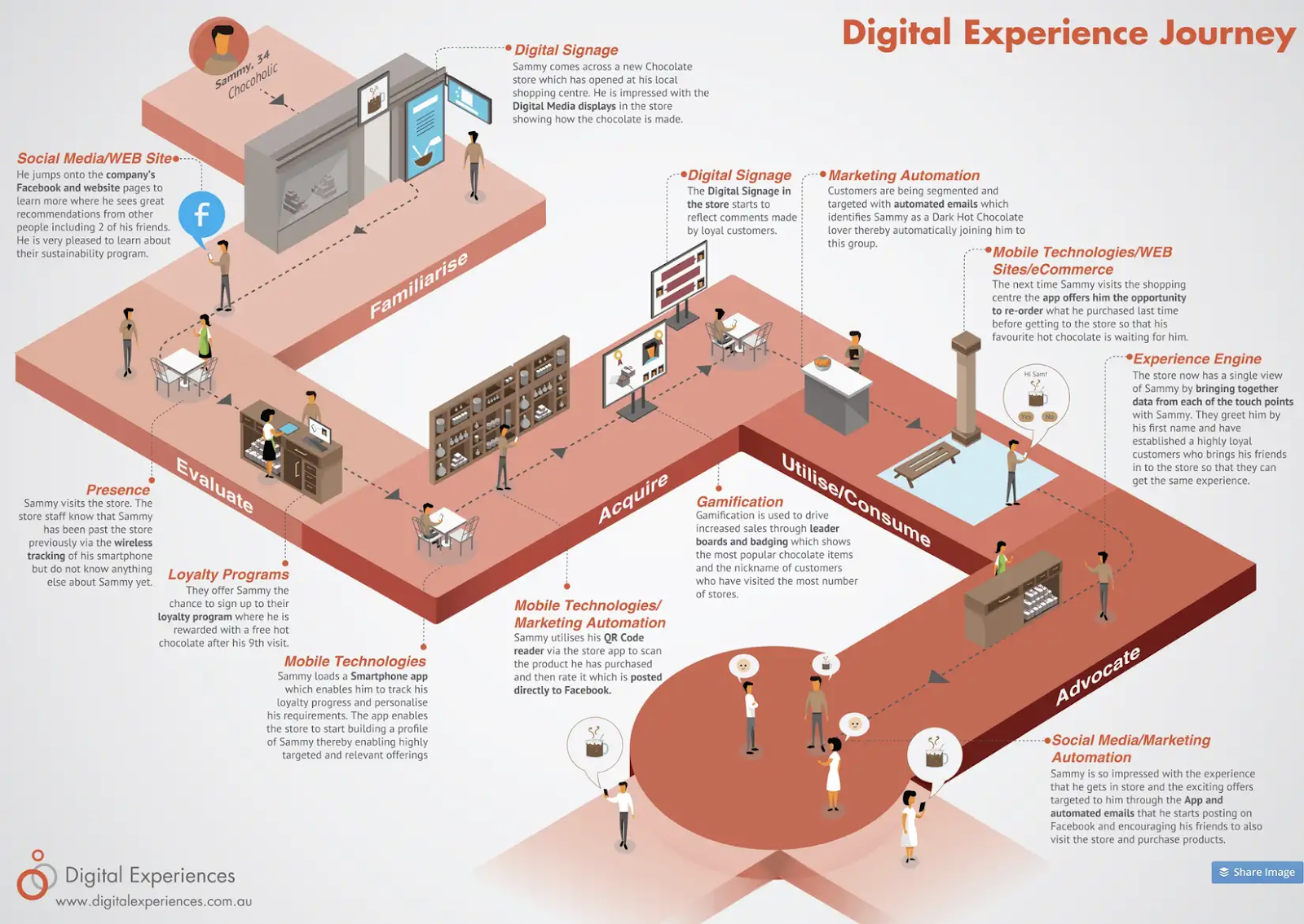
*This customer journey map clearly outlines where marketing can have the most impact for this hypothetical hot chocolate shop.*
The map from [Digital Experiences](http://digitalexperiences.com.au/) has an elegant depiction of key touchpoints for a hypothetical hot chocolate store. This map makes it easy to see exactly when there is the greatest opportunity for marketing to make a difference, how different marketing technologies affect consumer choices, and what marketing’s end goal is for the ideal customer.
### 5. Make It Visual
The goal should be for your map to be as widely seen in the organization as possible. As such, it should be pleasing and rewarding to look at. A well-designed customer journey map is equally at home on a PowerPoint slide and hanging on the wall above your desk.
It’s worth having your design team participate in distilling your data into something both visually appealing and easily understandable. Here are three potential templates to work with:
1. A fully-designed [infographic](https://digitalmarketing.temple.edu/mis5102sum2018/2018/06/11/customer-journey-mapping-where-to-start/), like the one for the hot chocolate shop above, can convey the information with a creative twist. If you have the design resources, going full visual will help keep the information manageable and consumable.
2. A simple [table or graph](https://www.brandingstrategyinsider.com/images/2018/04/Customer-Journey-Map.png) puts the focus more squarely on the data. It’s a good idea to still add some design flourish for visual interest, though.
3. A [grid or flowchart](https://cdn.productplan.com/wp-content/uploads/2017/02/productplan-journey-map.png) is the most “pure data” version, but it can still be visually appealing (as the example shows).
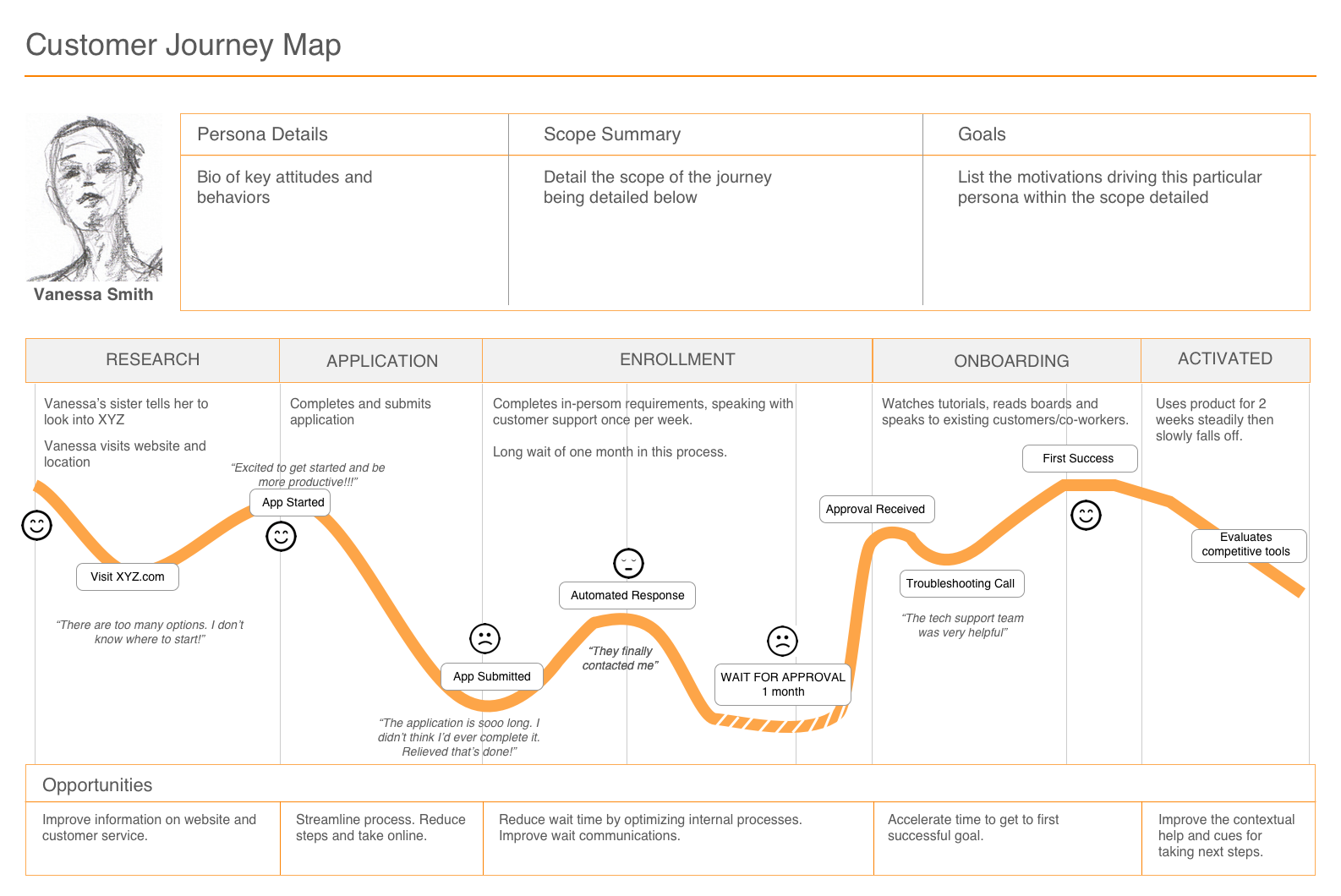
*Here is an example of a customer journey map created using a table or graph template.*
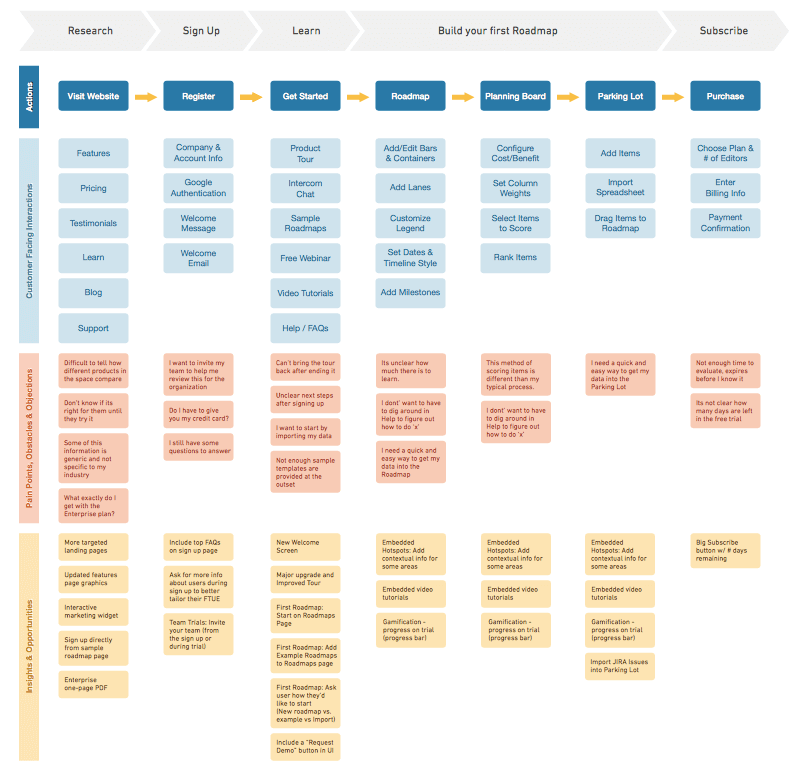
*This is an example of how a grid or flowchart can be used to create a customer journey map.*
### A Good Customer Journey Map Helps You Understand Your Customers
The days when marketers could only do a few things to cause customers to passively fall through the standard-issue marketing funnel are over. Today, marketing journeys take countless shapes, with many diverse touchpoints.
But one thing hasn’t changed: The goal of all your marketing efforts is *still* to help customers—who come to you through many different media, channels and paths—to realize that your brand is the best solution for a particular problem. A good customized customer journey map will help you understand how your customer searches for a solution. And ultimately, it will enable you to meet the customer wherever they may be, and become a trusted guide for the rest of their journey.
### [Learn more about customer journey orchestration](/glossary/customer-journey-orchestration/).
## Customer journey map mistakes and how to fix them
Most journey maps fail after the drawing is done, not during it. They describe the path the company wishes customers took rather than the path the data shows customers actually take, and every strategy built on the map inherits that error. The failure modes below do the most damage; each row pairs the mistake with what it looks like in practice and the correction that fixes it.
| Mistake | What it looks like | The fix |
|---|---|---|
| Mapping the ideal path | One clean line from first touch to purchase, with no exits or loops | Pull actual paths from analytics and support logs, and mark where customers stall, circle back, and leave |
| Using internal labels for the stages | Stages named after campaigns or funnel phases only your team recognizes | Rename each stage in the customer's own words — "figuring out whether this is worth the money," not "consideration" |
| Stopping the map at purchase | No stages for onboarding, support, renewal, or expansion | Extend the map through the post-purchase stages where retention and referrals are won |
| Collecting pain points with no owner | A visually strong map that has changed nothing a year later | Assign every pain point an owner and a next action, or cut it from the map |
A one-line test catches most of these before they harden into strategy: if you cannot point to the data behind a given arrow on the map, that arrow is an assumption, not an observation. Mark assumptions visibly until evidence replaces them. An unlabeled assumption is the one mistake that survives every review.
## Which customer journey map should you build first?
Three formats dominate in practice, and they answer different questions. A current-state map documents how customers move today. A future-state map designs how you want them to move. A day-in-the-life map zooms out to the context around your product — when the need arises and what else competes for the customer's attention. Choosing the wrong one wastes the mapping effort, so the trade-offs belong in a table:
| Map type | Best for | What it requires | Failure mode | Skip if |
|---|---|---|---|---|
| Current-state | A first map, or finding where today's customers drop off | Real path data plus input from sales and support | Documenting friction without ranking what to fix first | You can observe almost no customer behavior yet — start with interviews instead |
| Future-state | Redesigning a broken stage or supporting a launch | A validated current-state map underneath it | Designing an idealized path no real customer context supports | Your current-state map is more than a quarter out of date |
| Day-in-the-life | Understanding when and why the need for your product arises | Interviews or diary studies with real customers | Generalizing a few anecdotes into a universal pattern | Your buying cycle is long, considered, and already well documented |
Sequence matters more than the choice itself. Build the current-state map first unless you genuinely cannot: a future-state map built without one redesigns your assumptions rather than your customers' behavior. There is also a practical signal that current-state work is overdue — when your team cannot agree on where customers drop off today, that disagreement is the agenda for the map, not an argument to settle first.
## Keeping a customer journey map current
An accurate map that has gone stale is more dangerous than no map at all, because teams keep making confident decisions from it after the behavior it describes has moved on. The fix is structural rather than motivational: give the map a named owner, a fixed review cadence, and a standing rule that data outranks the drawing.
Each review compares the map against current evidence — path analytics, conversion by stage, win-loss notes from sales, and recent support themes. Where the two agree, leave the map alone. Where they diverge, correct the map first and the strategy second, in that order, so downstream teams are not left executing against a version of the customer that no longer exists. Many teams fold the review into an existing [agile cadence](/glossary/agile-methodology-definition/) rather than inventing a separate ceremony; the ritual matters less than the rule that the map changes when the evidence does.
The review also determines whether the map stays usable by software, not just by people. Personalization programs and [agentic customer experience](/glossary/agentic-customer-experience/) setups act on stage-level assumptions in real time, and an out-of-date map quietly misdirects them; [agentic personalization](/glossary/agentic-personalization/) tunes individual interactions against whatever journey model it is given. A current map keeps those systems aimed at the customer your data says you actually have.
## FAQ
### What is a customer journey map?
A customer journey map is a visual representation of the steps a customer takes when interacting with your brand, from initial awareness through purchase and beyond. It identifies key touchpoints, customer emotions, and opportunities where marketing can influence decisions, helping teams align their strategies around the actual customer experience rather than assumptions.
### What should be included in a customer journey map?
A customer journey map should include the key stages of the buying process, critical touchpoints where customers interact with your brand, customer emotions or pain points at each stage, and the marketing channels involved. Keep it simple and focused on a single customer persona rather than trying to capture every possible variation in one map.
### How do you use a customer journey map to improve marketing?
Use your customer journey map to identify gaps and drop-off points where customers lose interest or fail to convert, then create targeted content and campaigns to address those moments. By aligning marketing efforts to specific stages of the journey, teams can deliver more relevant messaging, reduce friction, and guide more prospects toward purchase.
### How often should you update a customer journey map?
**Review it quarterly, and update it off-cycle whenever something changes how customers find and buy from you.** Product launches, new channels, pricing changes, and shifts in where your leads originate are the usual triggers. A lighter check is often enough if nothing structural has changed: confirm the stages still match observed behavior, then move on. The map must never become the oldest document in the marketing stack; a stale map misdirects every team that trusts it.
### What data do you need to build a customer journey map?
**Pull from four sources: behavioral analytics, sales records, support interactions, and direct customer research.** Behavioral analytics shows the paths customers actually take. Sales records add objections, referral sources, and the reasons deals die. Support tickets and surveys surface the friction customers feel after purchase. Interviews and win-loss calls explain the why behind the numbers. Triangulating all four keeps the map honest — any single source, used alone, produces a map of what you already believe.
---
### How to Deliver CX Personalization with a CDP
URL: https://cdp.com/articles/how-to-deliver-real-time-personalized-experiences-with-a-cdp/
Imagine you could increase every transaction your business does by 20 percent. How much business value would that bring in? It’s a compelling calculation that’s even more important in times of economic uncertainty. This can be accomplished by delivering customer experience personalization with a CDP.
No doubt, the rewards of personalization can be high. However, on a daily basis it can pose significant challenges—especially when marketing teams are spread across the globe, and data is splintered across multiple silos. If global personalization at scale was easy, wouldn’t everyone use it?
While a path toward improving your bottom line may not seem clear, one marketing strategy, with the right supporting technology infrastructure, can yield impressive returns. A [Forbes Insights survey of 200 marketing leaders](https://www.forbes.com/sites/insights-treasuredata/2019/05/01/the-path-to-personalization/) found that 40 percent report their personalization efforts had a direct impact on sales, basket size, and profits — a self-reported perception, not an incrementality-tested figure (see the measurement mistake below for why that distinction matters). [McKinsey](https://www.mckinsey.com/capabilities/tech-and-ai/our-insights/marketings-holy-grail-digital-personalization-at-scale) finds that personalization can reduce customer acquisition costs (CAC) by as much as 50 percent and increase marketing and [ad spend efficiency](/articles/3-ways-to-improve-your-ad-spend-with-a-cdp/) by 10 to 30 percent. Personalization can also reduce churn and improve customer retention, improve customer engagement, and increase cross-sell of relevant products.
One of the leading data management solutions that can make personalization at scale a reality is the [customer data platform (CDP)](/basics/what-is-a-customer-data-platform-cdp/). Brands are quickly learning that to do true data-driven, customer-centric personalization that provides value to both the customer and business they must have a centralized data management solution to truly understand their customers as full individuals. A CDP can help brands not only glean insights into their most valuable customers, but can deliver that data out to other technology solutions to customize the customer experience (CX) across any channel.
## Customer Experience Personalization Needs the Right CDP
Today’s customers have come to expect hyper-personalization based on their needs and desires — 74 percent are more likely to purchase from brands that let them pick up where they left off ([Attentive, 2026 Consumer Pulse survey](https://www.attentive.com/blog/2026-personalization-trends)).
However, coordinating and tracking highly personalized experiences can be next to impossible without the [right CDP](/basics/how-to-choose-the-right-customer-data-platform-cdp/). Here’s why:
- **Customer data is siloed.** Data lives in various sources across the organization; stitching it back together is difficult. Without connecting the dots, how can you identify interested customers? If you don’t know your customers, how can you effectively segment your audiences or send them relevant messages?
- **Who individuals are and where they are in their journey isn’t transparent.** It’s impossible to know exactly where each individual is on their customer journey, especially when you haven’t first resolved each customer's identity into a single customer view (SCV). How can you determine where customers should go next in the funnel when the same customer is using multiple devices and identities without your knowledge?
- **Messaging isn’t comprehensively tracked.** Tracking how many messages customers receive from disconnected platforms is time-consuming and impractical. If you can’t track your messaging, then how do you know when you should reach out again and when you should stop?
## Customer Experience Personalization in 3 Steps
In this article, we will take a deeper dive into each of the following steps.
- **Step 1: Audience Management.** Combine customer data to ensure you’re targeting the right customers at the right time with the right messaging.
- **Step 2: [Customer Journey Orchestration](/articles/using-a-cdp-to-orchestrate-the-customer-journey/).** Make sure marketing campaigns are effective at moving customers towards a conversion.
- **Step 3: Omnichannel Messaging.** Deliver messages across digital, social, display, email, and more to targeted audience segments.
### Step 1: Audience Management, Segmentation, and Targeting
Before you can deliver customer experience personalization, the first step is to understand your customers. Essentially, the purpose of audience management is to aggregate all available customer data and sift through it to find common demographics, attributes, and behaviors — some of this runs on a batch cadence suited to planning, and some needs to be read live at the moment of a decision (see the batch-versus-real-time mistake below for where that split actually matters). Depending on the size of your organization, your parent segment might include tens of millions of users. Such an enormous dataset can be overwhelming, so where do you start? You begin by identifying your business goals.
To do that, you need to stitch together data from all of your silos to create the most complete user dataset possible using a enterprise-grade CDP.
Exploring data helps you:
- Identify key attributes of both high lifetime value customers and customers that churn.
- Better inform customer acquisition efforts by finding lookalike audiences.
- Discover common behaviors and attributes that can be grouped into smaller audience segments for activation.
#### Audience Exploration
Perhaps your business goal is to increase revenue. Or, maybe it’s brand awareness. Think of your goals as you explore your data, including geographic location, products, user commonalities, product purchase history, and usage patterns. Generally, you’re aiming to understand where your consumers are today and where you want them and your business to be in the future.
#### **Using Geo Location and Product Targeting to Boost Revenues**
With the goal of increasing revenue, a global beverage firm wanted to know the best geo locations to focus marketing efforts. So their marketers created a report that divided its audience by country to see which locations generated the brand’s highest revenues and which had the most active users. Results showed that Japan had the most users, but their spending habits were low. In comparison, users in the U.S. and South America spent considerably more. This enabled the firm to focus marketing in locations that would generate the most revenue.
The beverage firm also had a number of product lines under various labels, ranging from small craft beers to globally recognized liquor brands. Aiming to improve revenue through savvy product targeting, the firm wanted to promote its most profitable products and engage in cross-promotion. Marketers were able to view product lines by usage, user interests, revenue, and other key metrics. Reports showed that while beer was the most popular category, whiskey generated the most revenue. Also, interest in sake was slowing. With this data, marketers were able to boost revenue by launching campaigns promoting whiskey. And they began cross-promoting sake to beer users because they knew sake and beer users shared similar interests.
#### Segment Exploration
Exploring your data by audience segments is another way to achieve your goals. Enriched with [third-party data](/articles/the-difference-between-first-party-second-party-and-third-party-data/), these segments can help you better understand common user interests and how user behavior represents important business trends.
### Step 2: Orchestrating Customer Experiences and Journeys
After you’ve explored your audiences, it’s time to design paths for your users and segments. Using customer journey orchestration, you’re solving the problem of knowing where users are in the funnel, and then designing where you want them to go next. That way, you can make sure users are receiving relevant content at every step.
Typically, customers move closer to a purchase through these stages: awareness > interest > intent > purchase > retention. Frequently, designing customer journeys and customer experiences means mapping out all the combinations of behaviors a customer may take, creating hundreds of micro-journeys that look like this: “If a user clicks this link, then send this email,” or “if a user opens this email, then send this coupon.” Such a highly detailed approach requires considerable time and effort to build on a granular level.
#### Segmenting Out the Journey
Customer journey orchestration provides the ability to mark critical stages in the journey to trigger messaging that helps users move from awareness to intent, and from interest towards purchase. For additional customer journey insights, machine learning such as next-best-action modeling can be used to identify the most marketing activation to deliver next and influence your users.
Customer journey orchestration helps marketers see whether their marketing efforts are working and moving customers closer towards a purchase. This enables marketers to plan the best possible journey to progress a customer towards a purchase.
**Check out [How To Use A CDP For Customer Journey Orchestration](/articles/using-a-cdp-to-orchestrate-the-customer-journey/)**
### Step 3: Omnichannel Messaging
Omnichannel messaging is intrinsically connected to the customer journey. During each stage of the journey, there might be a different activation. For example, in the awareness stage you might want to activate to your social channel and use lookalike modeling to reach a wider audience, while in the interest stage an email activation might work best since you’ve already collected their [personally identifiable information (PII)](/glossary/pii-personally-identifiable-information/).
## Common Mistakes in CDP Personalization Programs
The three steps above describe what a working program does. The failure patterns are more consistent than the successes, and most of them appear after the CDP is live and the data is unified.
**Personalizing before identity resolution is trustworthy.** Segments built on device or email identifiers rather than resolved profiles split one person into several records, so the same customer receives the acquisition offer they converted on last week alongside the win-back email meant for lapsed buyers. Segment counts still look healthy, because duplicates inflate them.
**Fix:** measure the share of revenue-bearing interactions that attach to a resolved profile, source by source, under the [identity resolution](/glossary/identity-resolution/) rules the program will run on — and gate the first campaign on that figure, not on total profile count.
**Driving in-the-moment decisions from batch audiences.** Nightly audience refreshes are fine for model-driven segments — lifetime value, churn risk, propensity — and wrong for on-site and in-app decisions, where the profile the page reads can be hours old. That is how a homepage banner promotes the product a customer bought that morning.
**Fix:** split the audience layer in two — batch segments for planned campaigns, event-triggered profile lookups for [real-time personalization](/glossary/real-time-personalization/) — and route each to the channels its latency can support.
**Letting every channel enforce its own frequency cap.** Unifying data does not unify cadence. Email, push, SMS, and paid social each apply their own limits, so a customer enrolled in four journeys receives four separately reasonable streams at once. The result arrives as unsubscribes, which channel reports read as creative fatigue rather than a coordination failure.
**Fix:** hold send counts and suppression state as profile attributes and enforce one cross-channel ceiling in the orchestration layer — channel-specific technical and compliance limits (carrier throttling, quiet-hours rules) still apply downstream, but the marketing-driven cap should not.
**Reporting channel metrics instead of incremental lift.** Open and click rates rise as soon as messages get more relevant to customers who already intended to buy, so a program can post better engagement every quarter without adding revenue. Channel-level reporting cannot separate the two.
**Fix:** withhold a randomized control group from each personalized journey and report conversion and revenue per customer against it, not the campaign's own rates.
## Looking Forward
The be able to deliver customer experience personalization at scale you must first understand your customers across all their interactions with your company. Disparate data needs to be brought together into a single centralized repository. Once it is brought together, its needs to be combined into single customer view profiles, so a common source of information can be used to feed personalization engines. Then, that unified data needs to be delivered and activated in the appropriate technology platforms to deliver superior personalized customer experiences.
The only all-in-one customer data management solution that can deliver on all these promises to enable brands to deliver personalization at scale globally is the CDP. Learn more about how a CDP can deliver [personalized omnichannel experiences here](/articles/customer-experience-management-how-to-provide-an-exceptional-omnichannel-customer-experience/).
## FAQ
### How does a CDP enable real-time personalization?
A CDP enables real-time personalization by unifying customer data from all channels into a single customer view, then making that unified profile available to activation platforms with sub-second latency — when it is served through event-triggered lookups rather than a nightly batch refresh, which is a configuration choice, not a default (see the batch-audiences mistake below). This allows marketing, sales, and service teams to deliver relevant messages based on up-to-the-moment customer behavior, preferences, and journey stage across every touchpoint.
### What is the difference between audience segmentation and customer journey orchestration?
Audience segmentation groups customers by shared attributes, behaviors, or demographics to identify who to target, while customer journey orchestration maps the sequence of interactions that move each segment toward conversion. Segmentation answers "who are my customers," whereas orchestration answers "what should happen next" at each stage of the funnel.
### What are the benefits of omnichannel personalization with a CDP?
Omnichannel personalization with a CDP is associated with customer acquisition cost reductions of up to 50 percent and marketing spend efficiency gains of 10 to 30 percent in McKinsey's client analysis ([McKinsey](https://www.mckinsey.com/capabilities/tech-and-ai/our-insights/marketings-holy-grail-digital-personalization-at-scale)) — confirm your own program's lift with a holdout rather than assuming industry figures transfer directly — and improves customer retention by delivering consistent, relevant experiences across email, social, display, and other channels. A CDP makes this possible by centralizing all customer data and coordinating messaging so that each interaction builds on previous ones rather than starting from scratch.
---
### How to Democratize AI Across the Enterprise with a CDP
URL: https://cdp.com/articles/how-to-democratize-ai-across-the-enterprise-with-a-cdp/
Data democratization, a critical step in the process to democratize AI across an enterprise, is all about enabling both technical and non-technical users to access and leverage unified data profiles in order to gain insights and make real-time, data-driven decisions. Those decisions may involve tasks such as sending valuable customer data to the right [martech](/glossary/martech/) platforms and tools to tailor the customer experience across all channels.
Data democratization is being viewed as a critical process that needs to happen for data to be leveraged effectively across an organization so it can make an impact on innovation, customer support, product development, and revenue. In order for companies to achieve this level of data sharing and equity, forward-looking businesses are deploying [customer data platforms (CDPs)](/basics/what-is-a-customer-data-platform-cdp/) to [achieve enterprise-wide data democratization](/glossary/data-democratization-definition/).
Data democratization is a key step in the implementation of [artificial intelligence (AI)](/glossary/artificial-intelligence-ai/) across a business. For AI to be used at scale across all departments of an organization, it must be fed with clean, secure, and accurate data . After all, data is the differentiator between companies who thrive in uncertainty and ones who falter during darkening macroeconomic conditions.
To get all of this together, not just for ingesting and integrating data together into [single customer view (SCV)](/glossary/single-customer-view-scv/) unified profiles, but to do [data cleansing](/glossary/data-cleansing-definition/) and data democratization, companies are using CDPs as a way to stitch different groups and employees together against a single source of customer truth to market and sell against.
So, how can a CDP be used to implement and democratize AI use across an enterprise through data democratization?
## Connecting Departments with a CDP
While CDPs have been initially adopted by data-driven marketing departments to make their campaigns both more effective and efficient, by enabling marketers to understand their customers as fully rounded-people better than ever before, they are now being used beyond marketing in many critical departments across the enterprise, most notable sales, customers service, and the business.
Since CDPs gather data from multiple disparate sources, and integrate them together through a process called [identity resolution](/glossary/identity-resolution/), they create unified profiles all groups can tap into to leverage for support or insights.
Let’s say a customer calls into customer service after having troubles processing a transaction on your web property. With unified profiles in a CDP, that history can be shared with the service rep in real-time, while some more advanced CDPs can also offer next-best action recommendations or automation triggers for AI chatbots.
A CDP is being used as infrastructure in many enterprise organizations to create the bridges between different departments, by giving them all access to the same unified profiles, or single sources of truth, for everyone to benefit from. For sales, it's about getting a better pipeline of highly qualified buyers. For marketing it's about better targeting and more effective campaigns. For CS it's about serving the customers, and for the business it's all about the bottom line. All departments beyond marketing can benefit from a CDP and unified data, they just need to see it and understand the value to their group.
## Deploying AI at Scale with a CDP
CDPs are in fact data management infrastructure for your company. And as your primary data platform, in which all your other data platforms, like [CRM and DMP](/basics/cdp-vs-dmp-vs-crm-differences-similarities-and-best-practices/), feed into to inform and enrich the unified profiles, CDPs become the glue that enables your company to work together more closely with data-driven insights and actions.
This type of customer data infrastructure is just what is needed for companies to implement AI beyond low-hanging-fruit use cases and deploy AI at scale across the enterprise.
First, CDPs can assist in cleansing your data so it can be ready for ingestion and integration to be used by AI systems. Clean data is critical for modern omnichannel marketing, and it’s required to train AI systems to make them more effective and accurate.
Second, with that clean data fed into a CDP, it can be integrated into a unified profile which can then be fed into AI systems to make them more effective and accurate as well. Now, AI can see an individual profile to generate insights and next-best actions from it, not from a series of disconnected actions and interactions. AI also needs clean, accurate first-party data and profiles to improve the accuracy of [predictive analytics](/glossary/predictive-analytics/) and modeling.
Finally, if you want to differentiate your company from competitors by delivering hyper-personalized experiences at scale with the assistance of AI, a CDP powered by AI/ML is going to be one of the only technology solutions that can make that a reality.
## Looking Forward
There is just too much data out there for marketers and companies to make sense out of it and use it effectively without AI assistance. But for companies to be able to use AI, not just in discrete instances, but across the entire business, AI must be fed with clean data and unified profiles so it can do both predictive modeling and suggest accurate next-best actions.
There are few platforms, if any, that are as broad in application as the customer data platform. By deploying [the right CDP](/basics/how-to-choose-the-right-customer-data-platform-cdp/), a company can get data cleansed for integration, do data unification through identity resolution, and deliver personalized experiences at scale. All while offering your team common sources of data and reporting and analytics that will help bridge the gaps between departments with common tools and metrics.
Depending on your company's [digital transformation](/basics/what-is-digital-transformation/) maturity, using a CDP as your data management infrastructure platform can be the foundation you need to democratize AI across the enterprise, allowing you to connect departments and individuals together to leverage data and AI for business and customer value.
## How to roll out democratized AI without recreating silos
Most programs stall here because they treat democratization as an access decision — one grant of permissions — rather than a sequence with a defined order. When every department receives access on the same day, each builds its own queries, its own definition of a valuable customer, and its own reports, and the unified profile fragments politically even though it is technically unified. A staged sequence prevents that:
1. **Unify before you open access.** Finish identity resolution and data cleansing on the core customer objects first. AI built on partial profiles is confident and wrong at the same time: a churn score computed from a subset of channels misses the one where the customer actually churned. Agree on a small set of canonical fields — identity, consent state, lifetime value, engagement recency — before any team gets access.
2. **Start with one department and one observable decision.** Customer service is usually the fastest proving ground: unified context during live interactions either shortens resolution or it does not, and the outcome is visible in days rather than quarters. Choose a first use case whose decision repeats often enough to evaluate honestly.
3. **Publish shared definitions with the access.** When sales, marketing, and service each compute "active customer" differently, every automated decision inherits the disagreement. Metric definitions belong where the profiles live — versioned, visible, and imported — not in departmental spreadsheets.
4. **Expand only after the loop closes.** A use case earns wider rollout when its outputs flow back into the profile and its accuracy has a named owner. Until then it is a pilot, and pilots should stay small.
Teams that sequence this way spend their first quarter building data trust instead of arbitrating whose dashboard is right.
## Governance guardrails that make wider access safe
Democratization fails when access is treated as binary: everyone sees everything or no one sees anything. Governance is the mechanism that widens access without widening risk, and the practical unit of governance is the access tier. Three tiers cover most enterprise access decisions:
| Access tier | Best for | What the tier can do | Guardrail to require | What breaks without it |
|---|---|---|---|---|
| Read-only consumer | Sales reps, service agents | View unified profiles and recommended next actions during live interactions | Field-level masking of sensitive attributes and an audit log of profile lookups | Sensitive fields leak into notes, tickets, and call summaries |
| Segment builder | Marketers, lifecycle managers | Build audiences, apply predictive scores, and activate campaigns across channels | Consent-state filters applied automatically and peer review for new segments | Campaigns activate against suppressed or opted-out profiles |
| Model operator | Data science, analytics engineering | Train models on unified profiles, deploy scores, and define shared features | Change review on shared features plus drift monitoring with a named owner | One silent feature change degrades every downstream score at once |
Two properties make the tiers work in practice. Consent state travels inside the profile itself, so a profile that cannot be messaged for marketing can still ground a service conversation — the tier governs the action, not the person. And every tier has a named owner: a tier without one is an unmanaged surface, and unmanaged surfaces are where unapproved copies of customer data first appear.
## Failure modes that stall democratized AI, and the fixes
Four failure modes account for most stalled programs, and each has a structural fix rather than a tooling one:
**Definition drift.** Each department quietly computes "churn risk" or "high value" its own way, and automated campaigns start acting on the disagreement. **Fix:** keep shared metric definitions versioned next to the profiles and require new use cases to import them rather than recompute.
**Shadow AI.** When the approved path to customer data is slow, employees paste records into unapproved tools to get an answer today, and governed data leaves the governed environment. **Fix:** make the sanctioned path the fastest one — self-serve profile access with documented APIs — and log lookups so unmanaged copies become visible instead of invisible.
**Predictions without a feedback loop.** A model that never observes the outcome of its own recommendations cannot improve, so its accuracy stalls and teams stop trusting it. **Fix:** write outcomes back into the unified profile so the next decision is informed by the last one.
**Automation without a human checkpoint.** A campaign acting on a stale profile can repeat the same mistake across an entire segment before anyone reviews it. **Fix:** pair automated actions with a human review path for the highest-stakes segments, and treat AI as handling speed and scale while people hold judgment and guardrails.
## Where AI agents take democratization next
The newest consumers of democratized data are not analysts — they are agents. [Agentic AI](/glossary/agentic-ai/) systems plan and execute tasks on their own, which means they need programmatic access to the same unified profiles people use, at machine speed and around the clock. A CDP built for this shift — the [Agentic CDP](/glossary/agentic-cdp/) — treats agents as first-class data consumers rather than bolt-on integrations.
That shift extends democratization to software. Every agent that touches customer data should read from the shared profiles, under the same consent rules and audit trail as a person, instead of keeping its own private copy of the customer. The access tiers above carry over directly: an agent is just another consumer whose tier, guardrails, and audit trail you can name. The same structure covers [agentic personalization](/glossary/agentic-personalization/), where agents assemble individualized experiences from the governed profile rather than from extracts.
The practical consequence is sequencing. The governance work that makes data safe for human departments is the same work that makes it safe for agents; an enterprise that skips the tiers and the audit trail now will rebuild them under pressure later, when agents — not analysts — are the ones asking for access.
## FAQ
### What does it mean to democratize AI across the enterprise?
Democratizing AI across the enterprise means making AI-driven insights and capabilities accessible to all departments, not just data science teams, so that marketing, sales, customer service, and operations can all leverage AI for data-driven decisions. A CDP supports this by providing clean, unified customer profiles that serve as the shared data foundation AI systems need to deliver accurate predictions and recommendations across the organization.
### Why is data quality important for enterprise AI deployment?
AI systems are only as effective as the data they are trained on, so clean, accurate, and unified data is essential for reliable predictions, next-best-action recommendations, and predictive analytics. A CDP addresses data quality by ingesting data from disparate sources, performing identity resolution, and cleansing records before they are fed into AI models. Without this data preparation step, AI outputs will be unreliable and potentially harmful to business decisions.
### How does a CDP connect different departments for AI-powered collaboration?
A CDP creates a single source of truth by unifying customer data into shared profiles that every department can access with appropriate governance controls. Sales teams use these profiles for qualified pipeline insights, marketing uses them for targeting and campaign optimization, and customer service uses them for real-time context during interactions. This shared data foundation eliminates silos and ensures AI applications across the business are all working from the same accurate, up-to-date customer information.
### Do you need a data science team to democratize AI with a CDP?
**No — a dedicated data science team is not a prerequisite for most AI use cases a CDP supports.** Packaged predictive capabilities such as churn scoring, lifetime value estimates, and next-best-action recommendations live in the same interfaces marketers and service teams already use, so non-technical staff can apply AI outputs without building models. A data science function still earns its place for custom models and for validating that packaged scores behave on your data.
### Who should own the CDP once AI is democratized across departments?
**A cross-functional owner with a data governance mandate should own it — not the first department that adopted it.** When ownership sits inside one team, other departments treat the profiles as that team's asset, definitions drift, and access requests queue behind its priorities. A shared owner, commonly a data or analytics leader with named counterparts in each department, keeps metric definitions, access tiers, and consent rules consistent while each team builds its own use cases on top.
---
### Top CDP Use Cases and How To Develop Them
URL: https://cdp.com/articles/how-to-develop-cdp-use-cases/
The first step to determining which [customer data platform (CDP)](/basics/what-is-a-customer-data-platform-cdp/) will be the right fit for your organization is defining the key CDP use cases that will drive the most value for your organization.
Establishing CDP use cases up front will ensure you are looking at [the right CDP platform](/basics/how-to-choose-the-right-customer-data-platform-cdp/) and CDP vendor for your particular industry and applications, as well as help your company align internally around what goals, processes and outcomes will define success.
According to Gartner, in the **[2025 Magic Quadrant for Customer Data Platforms](https://www.treasure.ai/forrester-wave-cdp/?utm_source=cdp-dot-com&utm_medium=website-referral&utm_campaign=articles&utm_content=inline)** (courtesy of Treasure Data.), a CDP is defined “as software applications that support marketing and customer experience use cases by unifying a company’s customer data from marketing and other channels. CDPs optimize the timing and targeting of messages, offers and customer engagement activities, and enable the analysis of individual-level customer behavior over time.”
It is important to make sure there is a shared understanding across your organization as to what constitutes a customer data platform use case, and align everyone around that common definition. Without a shared understanding internally, there can be a lack of clarity around prioritization of CDP use case development. Ill-defined use cases lead to an oversimplified assessment of what is needed to achieve success. Balance is important too. In some cases, organizations focus too much on the technology and features within a software package, and not enough on what internal resources, skills, and modern agile processes are needed for success.
The process of getting buy-in and alignment across an organization cannot be understated in importance. Having the right executives involved in the early stages of customer data use case development ensures you can develop a proof-of-concept (PoC) pilot program. A simple pilot CDP use case that can be seen and understood by all stakeholders across a company will help to exemplify the value a customer data platform can provide.
## What Is Your Pilot CDP Use Case?
A successful [CDP pilot program](/basics/how-to-choose-the-right-customer-data-platform-cdp/) can help prove value from your initial CDP efforts, and set your CDP initiatives up for success. Your pilot use case should be something that is intrinsic to your company's needs. The most important thing to remember is to not bite off too much in the pilot. The program should be simple, executable, and easy to translate to multiple stakeholders with measurable ROI and value.
[](https://www.treasure.ai/your-complimentary-rfp-template/?utm_source=cdp-dot-com&utm_medium=website-referral&utm_campaign=articles&utm_content=inline)
## Top Customer Data Platform Use Cases
Regardless of your industry or particular needs, CDPs are extremely broad in application and can address many diverse customer data use cases. The following CDP use cases will give you a good idea on how to define your pilot use case, and plan your CDP roadmap for both short-term and long-term success. This will help you evolve data-driven processes across the entire organization as your company increases its [digital maturity](/basics/what-is-digital-transformation/).
### 1. Data Integration and Data Management
This will be the primary use case for many companies who are considering adopting a CDP. The ability to collect data from various channels and systems is a core capability all CDPs should offer. The data a CDP ingests can be structured, unstructured or semi-structured, can be stored without modification, or it can be reformatted and unified to be used in data-driven marketing campaigns. A unified customer data foundation helps marketing, sales, and customer service teams provide personalized experiences that increase loyalty and lifetime value.
### 2. Single View of the Customer
CDPs are designed to be a centralized data foundation, and a single source of truth for customer data. CDPs ingest, cleanse, de-dupe, analyze, and sync customer data from across first, second, and third-party sources to create a single customer view, also called the unified view. AI-powered identity resolution capabilities help fill in gaps in the process and ensure data is clean, accurate and reliable.
### 3. Identity Resolution
[Identity resolution](/glossary/identity-resolution/) compiles data collected from across first, second-and-third-party sources and attributes it to a single customer identity. Some CDPs have integrated identity resolution technology into their overall product offering. Identity resolution helps enhance the value of CDPs by enriching customer profiles, and making clean, accurate customer data accessible across different business units.
### 4. Identify and Segment High-Value Audiences
It’s imperative that you understand your consumers and are able to remain relevant, especially when consumers spend more time online. A first-rate CDP will have prebuilt propensity models, so your marketers know in real time which customers are the most important, high-value, or likely to churn.
You can use a CDP to improve retargeting accuracy by connecting customer data with advertising data, creating optimized audience segments. Lookalike audiences are a staple of many advertising campaigns and programs, but they can be too broad and generic to be effective. Focusing your audiences down to multiple micro-audiences will allow the machine learning based lookalike algorithm to start with less noise and be able to find much more accurate audiences.
### 5. Personalize the Customer Experience (CX)
Personalization helps businesses create highly relevant experiences across the customer journey. Once segments and audiences are identified, marketing, sales, and customer service teams can tailor messaging that speak directly to target audiences, and delivered through the right channel, at the right time.
### 6. Data Privacy, Compliance, and Governance
Consumers demand more control over their data, and expect companies to provide them with the ability to manage consent. Add in new and evolving privacy regulations, and it’s clear that companies have work to do to ensure personal data is properly managed and used across the organization.
CDPs give IT and data teams [more control over data management](/articles/data-privacy-compliance-cdp/), with the ability to manage access controls and permissions across teams. CDPs can also integrate with [consent management software](/articles/consent-management-customer-data-platform-cdp/), which allows data privacy preferences to be shared as part of a single customer view.
### 7. Artificial Intelligence and Advanced Analytics
Many CDP platforms come equipped with [advanced analytics features](/articles/analytics-capabilities-cdp/), typically powered by AI, that give marketers an easy way to visualize, predict, and activate on customer behavior in near real time. Predictive analytics uses data, algorithms, and machine learning techniques to assign predictive scores to various user segments based on historical data – which can be used to determine next-best action, recommendations, or forecasting demand.
### 8. Marketing Automation
CDPs improve the efficacy and efficiency of your marketing operations. Marketing automation can typically make time-consuming activities like lead qualification and campaign creation much less onerous.
Some CDPs provide advanced artificial intelligence (AI) and machine learning (ML) tools to assist in automating marketing tasks. This could include [next-best action recommendations](/glossary/next-best-action/), real-time campaign activations, and [customer journey orchestration](/articles/using-a-cdp-to-orchestrate-the-customer-journey/) capabilities.
### 9. Improving Operational Efficiency
All industries are seeing budgets under increasing scrutiny. It is imperative that you are able to track the impact of your marketing spend, and forecast demand to meet consumers’ needs accurately. You need to know your return on investment, so you can allocate spend accordingly through each channel.
A strong customer data foundation forms part of the blueprint for accurate attribution. This enables your business to track the impact of marketing efforts. And, if it is being tracked accurately, it makes forecasting more effective – which essentially means you can do more with less.
## CDP Use Cases and the CDP RFP Process
Defining your primary CDP use cases will give you the information you need to do proper due diligence when evaluating customer data platform vendors.
While there are several popular use cases that CDPs deliver, starting with a pilot use case can help set your business up for success, and prove value across the business. Customer data platforms are extremely broad in application and can be used in dozens of ways. It all depends on what your needs are.
#### Want more? Check out our [CDP RFP guide and CDP RFP template to](https://www.treasure.ai/your-complimentary-rfp-template/?utm_source=cdp-dot-com&utm_medium=website-referral&utm_campaign=articles&utm_content=inline) kickstart your customer data vendor evaluation and selection process.
## FAQ
### What are the most common CDP use cases?
The most common CDP use cases include data integration and management, creating a single customer view through identity resolution, audience segmentation, customer experience personalization, and marketing automation. Organizations typically start with data unification as the foundational use case before expanding into AI-powered analytics and cross-channel activation.
### How do you build a CDP use case for a pilot program?
A successful CDP pilot use case should be simple, measurable, and directly tied to a core business need. Choose a use case that can demonstrate clear ROI to stakeholders across departments, such as improving retargeting accuracy for a specific audience segment. The goal is to prove value quickly so you can build internal buy-in for broader CDP adoption.
### How does a CDP differ from a CRM or DMP for use case planning?
A CDP unifies first-party, second-party, and third-party data from all sources into persistent, unified customer profiles accessible across the entire organization, whereas a CRM primarily manages direct sales interactions and a DMP focuses on anonymous audience segments for advertising. When planning use cases, CDPs are better suited for cross-channel personalization, identity resolution, and AI-driven analytics because they maintain a comprehensive, always-on view of each customer.
---
### Improve Targeting Accuracy With Real-Time CDP Data
URL: https://cdp.com/articles/how-to-do-more-accurate-targeting-with-real-time-data-a-cdp/
**Real-time first-party data improves targeting accuracy in a [customer data platform (CDP)](/basics/what-is-a-customer-data-platform-cdp/) by updating audience segments and consent status the moment a behavior occurs, so ad platforms and messaging tools always act on a customer's current state instead of a stale, batch-processed snapshot from hours or days earlier.** Cart abandonment is the clearest example: if a customer adds a product to their cart but doesn't complete the purchase, a CDP with real-time processing can trigger a retargeting campaign through Google Ads or Bing within minutes — before the intent behind that action has faded, and this same freshness carries into [personalization](/glossary/personalization/) across every other channel.
Keeping audiences up to date is crucial for accurate targeting in a CDP. When a new visitor engages with your website, you can promptly add them to a specific audience based on their behavior to maximize accuracy. Similarly, if a visitor changes their consent, updating the audience ensures compliance with [privacy regulations](/basics/international-u-s-data-privacy-laws-and-regulations-you-need-to-know/) and maintains [data privacy](/glossary/data-privacy/).
## What Are the Benefits of Real-Time Data Processing?
Real-time data also enables timely optimization signals. When a customer converts, a CDP can immediately pass the transaction's profit value to marketing channels, so bidding and reporting reflect actual value rather than an average. The same immediacy applies to operational alerts — a tracking tag failing on the website, for instance — where an instant notification lets a team fix the issue before it distorts a day of data.
Similar cloud platforms such as AWS also offer real-time data ingestion frameworks.
Real-time processing takes different forms depending on the use case. Some scenarios call for streaming analytics with windowing, aggregating events over a set time interval before acting on them. Others simply stream each update as it arrives into an analytical data store such as Google BigQuery or Snowflake, where it becomes available for querying within seconds rather than after the next batch load.
Additionally, there are various data sources that can be streamed directly into analytical data stores without the need for data transformation. Moreover, specific data sources, such as Google Analytics, have native integration with public clouds and packaged CDPs, enabling near real-time data delivery through features like streaming data export.
A CDP typically ingests data through two paths that converge on the same framework. Sources capable of streaming — website events, mobile SDKs, connected devices — flow into a streaming or pub-sub pipeline the moment they occur. Sources that only produce periodic exports, such as legacy systems or vendor batch files, arrive as files and are then broken into individual records that join the same pipeline. Routing every source through one common framework, regardless of how it arrives, keeps the architecture scalable: adding a new source, or a new field from an existing one, extends an established pattern rather than requiring a one-off integration.
## Conclusion
Real-time data sharpens CDP-driven targeting on three fronts: audience segments that reflect the latest event instead of last night's batch job, consent status that updates the moment a customer changes it, and campaign signals — profit value, broken-tracking alerts — that reach marketing channels while they are still actionable.
Real-time streaming and pub-sub infrastructure have also grown more accessible, putting this capability within reach of teams that once needed a dedicated data engineering build. The remaining question for most organizations is a cost comparison: the price of building or licensing real-time processing against the cost of retargeting, compliance checks, and optimization decisions that lag actual customer behavior by hours or days.
## FAQ
### What is real-time data processing in a CDP?
**Real-time data processing means a CDP ingests, transforms, and activates customer data as events happen, rather than waiting for a batch update.** This enables immediate actions such as updating audience segments the moment a visitor's behavior changes, sending conversion signals to ad platforms as a purchase happens, and triggering personalized messages based on live interactions rather than yesterday's activity.
### How does real-time data improve targeting accuracy in audience platforms?
**Real-time data improves targeting accuracy by keeping audience segments and consent status current to the moment an event occurs, so audience platforms and ad networks always act on a customer's latest behavior instead of a delayed batch export.** For example, when a customer converts, they can be instantly removed from acquisition audiences and added to retention segments, preventing wasted spend. Real-time profit signals also let marketers optimize bidding on actual value rather than a stale average.
### How does a CDP support retargeting campaigns?
**A CDP supports retargeting by giving ad platforms a continuously updated view of who abandoned a cart, browsed a product, or lapsed after purchase, so retargeting audiences reflect the last few minutes of behavior instead of a nightly export.** When a shopper adds an item to their cart but doesn't check out, a real-time CDP can push that signal to Google Ads or Bing within minutes, and just as quickly suppress the ad once the shopper completes the purchase elsewhere.
### How do contextual and behavioral signals improve targeting model accuracy?
**Contextual signals (page content, device, location, time of engagement) and behavioral signals (browsing history, purchases, engagement frequency) improve targeting model accuracy by giving the model fresher, more relevant inputs than demographic data alone.** A CDP that unifies these signals into one real-time profile lets a targeting model score audience membership and next-best-action against what a customer is doing now, not a static segment assigned weeks earlier — which is why model accuracy tracks signal freshness.
### What is the difference between real-time and batch data processing for CDPs?
**Batch processing collects and updates data at scheduled intervals — hourly or daily — while real-time processing handles each event as it arrives.** Real-time processing is essential for time-sensitive use cases like cart-abandonment retargeting, consent compliance, and live personalization, while batch processing remains sufficient for reporting and long-term analytics. Most modern CDPs support both modes to balance cost efficiency with responsiveness.
---
### How to Evaluate a CDP in the AI Era: 10 Questions
URL: https://cdp.com/articles/how-to-evaluate-cdp-ai-era/
The customer data platform market has entered a new phase. AI agents, real-time decisioning, and autonomous customer interactions are redefining what a CDP must do — and what it must be. Buyers who evaluate CDPs using the criteria from 2021 risk selecting a platform that cannot support [AI-driven marketing](/glossary/ai-marketing/) at scale.
The challenge is not whether a CDP can unify customer data. That problem is largely solved. The real question is whether the platform can serve as a real-time data foundation for [AI agents](/glossary/agentic-ai/) that read profiles, take action, and learn from outcomes in seconds — not hours or days.
This guide presents ten evaluation questions designed to separate platforms built for the AI era from those retrofitting AI onto legacy architectures. Whether you are evaluating a [composable CDP](/glossary/composable-cdp/), an enterprise marketing suite, or an [agentic CDP](/glossary/agentic-cdp/) with native AI capabilities, these questions will expose the architectural strengths and weaknesses that matter most.
## Why Traditional Evaluation Frameworks Fall Short
Most CDP buyer guides focus on integrations, data sources, and segmentation features. These remain relevant, but they miss the structural requirements that AI introduces:
- **Latency tolerance drops to near zero.** AI agents making real-time decisions cannot wait for batch syncs or overnight ETL jobs.
- **Data gravity shifts to the execution layer.** When AI models need to act on customer data, the platform that owns both the data and the execution layer has a fundamental advantage.
- **The bundling moment is real.** As venture capitalist Tomasz Tunguz has argued in [AI's Bundling Moment](https://www.linkedin.com/pulse/ais-bundling-moment-tomasz-tunguz-wucfc/), AI rewards platform breadth over best-of-breed specialization. When ingestion, decisioning, and activation must happen in a single real-time loop, stitching together four or five separate vendors introduces latency, context loss, and integration fragility.
These dynamics structurally favor platforms that control the full pipeline — from data ingestion through [AI decisioning](/glossary/ai-decisioning/) to message delivery.
This shows up in why buyers actually switch. The [2026 IDC MarketScape for Worldwide AI-Enabled Customer Data Platforms for B2C Users](https://www.treasure.ai/idc-marketscape-2026?utm_source=cdp-dot-com&utm_medium=website-referral&utm_campaign=articles&utm_content=inline) found that the most cited reasons organizations replace an existing CDP were "data readiness and quality, inability to demonstrate ROI, scalability or real-time performance issues, and AI features that did not work in practice" — trust and execution gaps, not missing connectors ([IDC #US53952526, June 2026](https://my.idc.com/getdoc.jsp?containerId=US53952526)).
## The 10 Questions
### 1. Can AI agents operate in closed feedback loops on this platform?

The defining capability of an [Agentic CDP](/glossary/agentic-cdp/) is the ability to support the full [Customer Intelligence Loop](/glossary/customer-intelligence-loop/) — closed-loop learning where an AI agent can read a customer profile, decide on an action, execute that action, observe the outcome, and update its model — all within seconds.
**What good looks like:** The platform supports sub-second feedback loops where agent actions and customer responses flow back into the same profile and model without leaving the platform boundary. Campaign outcomes, behavioral signals, and agent decisions all update in real time within a single system.
**Red flag:** Outcomes take hours to flow back because they must traverse [reverse ETL](/glossary/reverse-etl/) pipelines, warehouse sync jobs, or multi-vendor data transfers before the agent can learn from them. If the feedback loop is measured in hours rather than seconds, the platform cannot support true [agentic marketing](/glossary/agentic-marketing/).
### 2. Does the platform own the messaging layer?
When the CDP and the messaging layer are separate systems, every campaign activation requires copying personally identifiable information ([PII](/glossary/pii-personally-identifiable-information/)) to an external email service provider (ESP), SMS gateway, or push notification vendor. This creates privacy risk, adds latency, and slows the feedback loop that AI agents depend on.
**What good looks like:** Email, SMS, push notifications, and in-app messaging are native to the platform. The CDP can trigger a message, observe the open or click, and feed that signal back into the customer profile — all without data leaving a single platform boundary.
**Red flag:** PII must be copied to a third-party vendor for every campaign send. The platform relies on external connectors for all messaging channels, and campaign performance data takes hours to reconcile back into the customer profile.
### 3. How long does implementation take?
In the AI era, "time to AI" is as important as "time to value." A platform that takes 12 months to deploy is a platform that delays your ability to run AI-driven campaigns by 12 months. Every quarter spent in implementation is a quarter your competitors are learning from AI-powered customer interactions.
**What good looks like:** Initial deployment in weeks, not quarters. Pre-built connectors handle common data sources. The platform provides out-of-the-box AI models that work with minimal configuration, allowing teams to start running AI-powered campaigns within the first month.
**Red flag:** The implementation requires a systems integrator and a 6 to 18 month deployment timeline. Custom data modeling must be completed before any activation can begin. The vendor's reference customers describe multi-quarter implementations as typical.
### 4. Is AI native to the architecture or bolted on?
There is a meaningful difference between a platform that was [designed from the ground up with AI at its core and one that added AI features](/glossary/ai-native-vs-ai-bolted/) through acquisitions, partnerships, or separate product modules. Bolted-on AI introduces friction: separate data stores, different APIs, additional licensing, and models that cannot access the full customer profile in real time.
**What good looks like:** AI models operate directly on the unified customer profile with full access to behavioral, transactional, and interaction data. [AI decisioning](/glossary/ai-decisioning/), [predictive analytics](/glossary/predictive-analytics/), and [next-best-action](/glossary/next-best-action/) capabilities share the same data layer as segmentation and activation. No separate SKU or API is required to access AI features.
**Red flag:** AI features require additional licensing, separate API endpoints, or external model hosting. The AI layer operates on a different data store or requires data to be exported to a separate environment for model training. AI capabilities were added through acquisition and are not fully integrated into the core product.
### 5. Where does customer PII reside during activation?
Data privacy regulations like [GDPR](https://gdpr-info.eu/art-17-gdpr/) and [CCPA](https://oag.ca.gov/privacy/ccpa) require organizations to know where customer PII resides and to be able to delete it on request. When PII is copied across three to five vendor systems during activation, [data governance](/glossary/data-governance/) becomes exponentially more complex.
**What good looks like:** Customer PII remains within a single platform boundary during the entire lifecycle of ingestion, decisioning, and activation. Deletion requests can be fulfilled from a single system. The platform maintains a clear data residency model with regional deployment options.
**Red flag:** GDPR deletion requires coordinating across multiple vendor systems. PII is routinely copied to external ESPs, analytics platforms, and advertising tools. The organization cannot produce a definitive map of where a specific customer's data resides across the activation stack.
### 6. What is the total cost of ownership at scale?
CDP pricing models vary dramatically. Per-profile pricing can become unsustainable as customer databases grow. Composable stacks accumulate hidden costs across connector licensing, compute fees, sync volumes, and engineering time to maintain integrations. Enterprise suites bundle features at premium prices, creating a "[suite tax](/glossary/suite-tax/)" where organizations pay for capabilities they never use.
**What good looks like:** Transparent pricing that scales predictably with business growth. The total cost includes not just licensing but also integration maintenance, engineering time, and operational overhead. The vendor provides a clear TCO model that accounts for three-year growth projections.
**Red flag:** Unexpected cost escalation as connector counts and sync volumes grow. Per-profile pricing that doubles when the customer database crosses a threshold. Suite licensing that bundles mandatory modules the organization does not need. In composable stacks, the aggregate cost of five to seven vendors plus engineering time to maintain integrations exceeds the cost of a unified platform.
### 7. Can marketers self-serve without engineering support?
AI-powered marketing moves fast. If every [audience segmentation](/glossary/audience-segmentation/) change requires a SQL query and a dbt model rebuild, the organization cannot iterate at the speed that AI-driven optimization demands. The platform should empower marketers to build segments, design journeys, and configure AI models without filing engineering tickets.
**What good looks like:** Point-and-click segmentation, visual journey builders, and natural language query interfaces allow marketers to create and modify audiences independently. AI-powered recommendations and [customer segmentation](/glossary/customer-segmentation-definition/) are accessible through a marketer-friendly UI. Changes take effect in minutes, not days.
**Red flag:** Every audience change requires SQL and a dbt model rebuild. Marketers must submit requests to a data engineering team and wait days for implementation. The platform's primary interface is a query console rather than a visual workspace. Building a new segment requires understanding the underlying [data model](/glossary/data-modeling/).
### 8. Does the platform support warehouse connectivity?
Even platforms with robust managed storage should connect to the modern [data warehouse](/glossary/data-warehouse/) ecosystem. Organizations that have invested in Snowflake, BigQuery, or Databricks need a CDP that can read from and write to those environments without forcing a complete data migration.
**What good looks like:** The platform offers native connectors to major cloud data warehouses. It can read data directly from warehouse tables, enrich profiles with warehouse-resident data, and write activation results back to the warehouse. This creates a [hybrid CDP](/glossary/hybrid-cdp/) architecture that leverages existing data investments while providing the real-time capabilities that AI requires.
**Red flag:** The platform forces all data into proprietary-only storage with no option to connect to existing warehouse infrastructure. Alternatively, the platform is warehouse-only and cannot maintain its own profile store, making real-time AI operations dependent entirely on warehouse query performance.
### 9. How does the platform handle identity resolution?
[Identity resolution](/glossary/identity-resolution/) — the process of linking disparate customer identifiers into a [single customer view](/glossary/single-customer-view-scv/) — is foundational to every CDP use case. AI models cannot deliver accurate [personalization](/glossary/personalization/) if the underlying identity graph is fragmented or stale.
**What good looks like:** Built-in deterministic and probabilistic matching that operates continuously as new data arrives. The platform maintains a real-time identity graph that merges known and anonymous profiles automatically. Match rules are configurable through a visual interface, and the resolution process provides transparency into match confidence and merge decisions. Critically, [identity resolution](/glossary/identity-resolution/) should be built into the same platform that handles activation and AI decisioning — not a separate vendor whose output must be copied elsewhere before it becomes actionable.
**Red flag:** Identity resolution requires building and maintaining custom SQL logic, or is only available through a standalone vendor that cannot activate on the profiles it creates. The platform provides only deterministic matching and cannot handle probabilistic scenarios. Identity graphs update in batch rather than in real time, meaning that a customer who identifies themselves mid-session may not see a unified experience until the next batch run. Requiring a separate identity vendor adds cost, PII duplication, and integration complexity without meaningful accuracy advantages over modern built-in alternatives.
### 10. Can the platform scale beyond marketing to sales, service, and commerce?
The most valuable CDP use cases increasingly span departments. AI agents that optimize the customer experience need access to data and activation channels across marketing, sales, customer service, and commerce. A platform confined to marketing creates the same data silos it was supposed to eliminate.
**What good looks like:** The platform supports cross-functional [agentic experiences](/glossary/agentic-experience-platform/) where AI agents can orchestrate interactions across marketing campaigns, sales outreach, service ticket routing, and commerce recommendations. A single customer profile powers all departments, and AI models can optimize across the full customer lifecycle — not just the marketing funnel.
**Red flag:** Separate platforms are needed for each department, creating new data silos. The CDP serves marketing only, and extending AI-powered customer experiences to sales or service requires purchasing additional products with separate data stores. Cross-departmental use cases require custom integration work.
## Deployment Model Comparison: How Each CDP Type Performs
Customer Data Platforms have evolved through [three architectural generations](/articles/packaged-cdp-vs-composable-cdp/) — each closing the [Customer Intelligence Loop](/glossary/customer-intelligence-loop/) faster than the last: Packaged (Stage 1), Composable (Stage 2), and Agentic (Stage 3). The following table summarizes how three common deployment models — composable, enterprise suite, and agentic — typically perform against these ten evaluation criteria.
| Evaluation Criteria | Agentic CDP | Enterprise Suite | Composable CDP |
|---|---|---|---|
| 1. Closed feedback loops | Strong — single-platform, sub-second loops | Moderate — possible within suite but often batch-based | Weak — multi-hop latency across vendors |
| 2. Native messaging layer | Yes — modern, integrated channels | Yes — but often legacy channels | No — requires external ESP |
| 3. Implementation time | Short — weeks to initial value | Long — complex suite deployment | Long — multi-vendor integration |
| 4. AI native to architecture | Yes — designed into the core | Partial — often acquired, not native | No — AI added via separate tools |
| 5. PII data residency | Consolidated in single boundary | Consolidated but may span modules | Fragmented across vendors |
| 6. Total cost of ownership | Moderate — predictable scaling | High — suite tax | High — composable sprawl |
| 7. Marketer self-service | Strong — intuitive, AI-assisted UI | Moderate — complex interfaces | Weak — requires engineering |
| 8. Warehouse connectivity | Strong — hybrid by design | Moderate — proprietary preference | Strong — warehouse-native |
| 9. Identity resolution | Built-in, real-time, configurable | Built-in but often batch | Manual — SQL-based |
| 10. Cross-functional scale | Strong — agentic across functions | Strong — broad suite coverage | Weak — marketing-focused tools |
Composable CDPs offer flexibility and strong warehouse connectivity but struggle with the real-time, closed-loop requirements that AI demands. Enterprise suites provide broad functionality but often carry legacy architecture, high costs, and bolt-on AI. Agentic CDPs are designed from the ground up for the AI era, combining managed storage with warehouse connectivity, native AI, and integrated activation — the architecture best positioned for the bundling moment that Tunguz describes.
## Building Your Evaluation Scorecard
Use these ten questions as a structured scorecard during your CDP evaluation process. For each question, score vendors on a 1 to 5 scale:
1. **Does not meet criteria** — fundamental architectural limitation
2. **Partially meets criteria** — possible with workarounds or additional cost
3. **Meets criteria** — functional but not differentiated
4. **Exceeds criteria** — strong capability with clear advantages
5. **Best in class** — defining strength of the platform
Weight the questions based on your organization's priorities. If AI-driven [personalization](/glossary/personalization/) is your primary use case, questions 1, 4, and 9 deserve the highest weight. If [data privacy](/glossary/data-privacy/) compliance is the top concern, prioritize questions 2 and 5. If speed to market matters most, question 3 should carry extra weight.
The goal is not to find a perfect platform — one does not exist. The goal is to find the platform whose architectural strengths align with where your organization is headed, not just where it is today.
To build the internal expertise needed to evaluate platforms effectively, [CDP Training from Treasure AI](https://www.treasure.ai/cdp-training?utm_source=cdp-dot-com&utm_medium=website-referral&utm_campaign=articles&utm_content=inline) covers data unification, identity resolution, and AI activation — the foundational concepts behind these evaluation criteria.
## Related Articles
- [10 Capabilities You Need in an Enterprise CDP](/articles/10-capabilities-you-need-in-an-enterprise-cdp/) — Core feature checklist for evaluating enterprise CDP platforms
- [CDP Vendor Demo Checklist: 20 Questions to Ask](/articles/cdp-vendor-demo-checklist/) — Structured questions for CDP vendor evaluation demos
- [Hidden ROI of a CDP in Digital Transformation](/articles/hidden-roi-of-a-cdp-digital-transformation/) — Quantifying the less obvious returns from CDP investment
- [What CDP Use Cases Should You Focus On?](/articles/marketers-eyeing-cdps-what-you-can-learn-from-six-dozen-customer-data-platform-use-cases/) — CDP use case prioritization from real deployments
- [8 CDP Best Practices for Marketers and Data Leaders](/articles/cdp-best-practices-january-2022-expert-round-up/) — Expert CDP implementation best practices
- [CDP Use Cases](/basics/cdp-use-cases/) — Comprehensive guide to the most impactful CDP use cases
- [Why Do You Need a CDP?](/articles/why-do-you-need-a-cdp/) — The strategic business case for investing in a CDP
- [Do You Need a CDP with Your Engagement Platform?](/articles/do-you-need-cdp-with-engagement-platform/) — Choosing between a standalone CDP and an integrated engagement solution
## FAQ
### What is the most important question to ask when evaluating a CDP for AI use cases?
The single most revealing question is whether AI agents can operate in closed feedback loops on the platform. This question exposes the fundamental architecture: if an AI agent cannot read a profile, take action, and learn from the outcome within seconds — all within a single platform boundary — the CDP lacks the real-time infrastructure that AI-driven marketing requires. Platforms that depend on [reverse ETL](/glossary/reverse-etl/) or multi-vendor data pipelines for feedback introduce latency that prevents AI models from learning and optimizing effectively.
### How does the AI bundling thesis affect CDP evaluation?
The [AI bundling thesis](https://www.linkedin.com/pulse/ais-bundling-moment-tomasz-tunguz-wucfc/), articulated by Tomasz Tunguz, argues that AI rewards platform breadth over best-of-breed specialization. In practical terms, this means that CDPs with native messaging, built-in AI, and integrated activation have a structural advantage over [composable stacks](/glossary/composable-cdp/) that stitch together multiple specialized vendors. When AI models need to ingest data, make decisions, and trigger actions in real time, every vendor boundary introduces latency and context loss. Buyers should evaluate whether a CDP can execute the full loop — data ingestion through decisioning through activation — within a single platform.
### What is the difference between a composable CDP and an agentic CDP in the context of AI readiness?
A [composable CDP](/glossary/composable-cdp/) relies on the cloud data warehouse as its primary storage and processing layer, connecting specialized best-of-breed tools for activation, identity resolution, and analytics. An [agentic CDP](/glossary/agentic-cdp/) bundles data unification, messaging, and AI within a single platform — typically using [hybrid deployment](/glossary/hybrid-cdp/) (managed storage plus warehouse connectivity) to offer both real-time profile access and the flexibility to leverage existing data infrastructure. For AI readiness, the key difference is that agentic CDPs can maintain real-time customer profiles optimized for sub-second AI access with closed feedback loops, while composable CDPs depend on warehouse query performance and multi-vendor orchestration — which typically cannot support the real-time requirements of agentic use cases.
---
### Identity Resolution & Privacy Compliance in a CDP
URL: https://cdp.com/articles/how-to-implement-identity-resolution-and-privacy-compliance-with-an-identity-graph-in-a-cdp/
One critical best practice when setting up a [customer data platform (CDP)](/basics/what-is-a-customer-data-platform-cdp/) is to implement comprehensive [identity resolution](/glossary/identity-resolution/) logic that is fully aligned with the given consent of the customer. And a good way of doing that is maintaining an [identity graph](/glossary/identity-graph/).
Tracking and maintaining relationships between identifiers is crucial in managing data across various source systems. An identity graph serves as a valuable tool for formalizing the implementation of these relationships, accommodating multiple identifiers within a single environment. Moreover, it enables the establishment of connections not only between identifiers of individual customers, but also between individuals themselves, which is particularly valuable in B2B scenarios where understanding the affiliation of individuals to specific companies is essential.
An identity graph serves as a highly adaptable and efficient method for organizing and managing information. It enables storing consent alongside relevant identifiers, ensuring a clear understanding of the data and its authorized usage for activation purposes. By incorporating this data into the overall data structure, you can ensure that your automation processes and activities align with customer consent, thereby upholding [privacy and compliance](/basics/international-u-s-data-privacy-laws-and-regulations-you-need-to-know/) standards.
A well-structured identity graph offers the advantage of quickly and reliably identifying whether a visitor or customer is new or returning, which is valuable for various marketing strategies. This information can be quickly communicated to the marketing platform for optimization purposes. Additionally, the identity graph plays a significant role in maintaining audiences accurately, particularly when consent is implemented. It enables the timely updating of audiences based on changes in consent or additional behavioral patterns, ensuring that the right individuals are included in the appropriate audience segments.
Some other interesting parts here are that, as a best practice, you can utilize nice features like dynamic [data masking](/glossary/data-masking/) in a data warehouse to make sure that people, analysts, and data scientists don't have access to data that they should not be able to see. And also, of course, automated scanning and discovery of [PII](/glossary/pii-personally-identifiable-information/) data. You can use Google's Data Loss Prevention or similar services from other providers for that. This is an automated process to make sure that you are compliant with regulations.
You can use real-time data to do more accurate targeting in a CDP to ensure that everything is up to date. The framework is able to handle that in real-time and update the proper fields that you need, either in your real-time data store or in a real-time no SQL datastore such as Google Cloud Datastore, or in your analytical data store, such as Snowflake.
Use your real-time data ingestion framework to implement the identity resolution logic that is fully aligned with the given customer consent. I have added an example of a project for a media company below. We designed and built a custom CDP, and one of the responsibilities of the CDP is maintaining the audiences that can be shared with the different brands and the different channels that are used by this media company. So in this implementation, the identity resolution and the consent that can be given via several channels, are being collected and managed in the central layer in the CDP. This way, analytics and channel communications are always compliant. Also, the customer and the customer service department are enabled to see where the consent was given and apply [GDPR](https://gdpr-info.eu/) customer rights such as preferences and the right to be forgotten. These preferences will then automatically be deployed for analytics and activations.
In the end everything is automated. In this we are sure that we are fully compliant with the regulations based on the consent that is given.
## Conclusion
An identity graph serves as a highly adaptable and efficient method for organizing and managing information in areas of consent management and for new and returning customer recognition, both for customer and business contacts. By using an identity graph in a CDP, you can ensure compliance with data privacy regulations and implement identity resolution logic that is fully aligned with the consent of the customer.
## FAQ
### What is an identity graph in a customer data platform?
An identity graph is a data structure within a CDP that maps and maintains relationships between all known identifiers for a customer, such as email addresses, device IDs, cookie IDs, and phone numbers. It connects these identifiers into a unified profile, enabling organizations to recognize returning visitors, link cross-channel interactions, and store consent preferences alongside each identifier for privacy compliance.
### How does an identity graph help with GDPR and privacy compliance?
An identity graph stores consent data directly alongside the relevant customer identifiers, ensuring that every activation, analytics process, and communication channel only uses data the customer has explicitly authorized. This structure automates compliance by propagating consent changes — including the right to be forgotten and preference updates — across all downstream systems in real time, reducing the risk of regulatory violations.
### What is the difference between identity resolution and an identity graph?
Identity resolution is the process of matching and merging disparate customer identifiers from multiple data sources into a single unified profile. An identity graph is the underlying data structure that stores and visualizes those relationships between identifiers, making it the foundation on which identity resolution logic operates within a CDP.
---
### How to Improve Customer Lifetime Value with a CDP
URL: https://cdp.com/articles/how-to-improve-customer-ltv-with-a-cdp/
While the importance of [Customer Lifetime Value (CLV)](/glossary/customer-lifetime-value/), also known as Lifetime Value (LTV) or customer LTV, has been a topic of discussion in marketing circles for some time, it has not been embraced fully as a key performance indicator (KPI) in most organizations' marketing strategies. LTV is the most important metric that companies currently ignore, and should become a keystone metric to measure customer value going forward.
Up until recently, businesses have mostly relied on [third-party cookies](/glossary/third-party-cookie/) to inform their digital marketing activities. But with the evolution of data privacy laws around the globe, marketers need to embrace [first-party data](/articles/what-is-first-party-data-and-why-is-it-so-important/) to have a more personal, one-to-one conversation with their customers and prospects. This can lead to improving customer lifetime value.
One of the most popular, purpose-built platforms for ingesting and integrating first-party data to be used to affect the customer experience across the full [customer journey](/glossary/customer-journey/) is the [customer data platform (CDP)](/basics/what-is-a-customer-data-platform-cdp/). CDPs have been gaining popularity over the past few years because they can collect customer data from disparate silos and create a single customer view from that data. This gives organizations the ability to manage first-party data centrally to provide users the right to control their data.
CDPs allow you to understand your customers as full individuals, and can affect content and the customer experience through more relevant offers and messaging, improving retention and creating brand advocates with greater customer lifetime value.
## Customer Lifetime Value Defined
Customer Lifetime Value represents a customer’s value to a company during their lifespan as a customer. Knowing the value of a customer will allow companies to make smarter and more informed decisions regarding how much budget and resources are allocated, and how profitable their marketing efforts will be. Knowing LTV enables a company to focus on its most loyal and profitable customers, and the ones most likely to become advocates. Marketers who know a customer’s LTV have a better base of business intelligence to make decisions to maximize effectiveness of their ad spending.
LTV is a critical metric for any business that relies on subscription-based models and monthly recurring revenue. With more people open to and trying subscription services than ever before, focusing on retention to improve LTV and reducing churn of new customers is a key step for companies that rely on recurring revenue business models.
**Check out:** [3 Ways to Improve Your Ad Spend with a CDP](/articles/3-ways-to-improve-your-ad-spend-with-a-cdp/)
## How to Calculate Customer Lifetime Value
Lifetime Value can be calculated in a variety of ways, depending on your business model, pricing, and customers. Different types of customers can have different LTVs, especially if you have different pricing tiers that they fall into.
If you are using a subscription-based model, one method to calculate LTV is to take the average monthly revenue expected from each customer and then divide it by your churn rate. For example, if you charge $250 per month and your churn rate is 5 percent then your LTV for a new customer is (250/0.05) or $5,000.
If you are using a non-subscription model, you can calculate based on a more historical method.
(Yearly Revenue from Customer) x (Relationship length in Years) – (Total Acquisition and Serving Costs).
For example, a customer spends $1,000 per year with you, and they have been a customer for five years. You spent $100 on acquisition costs. In this case, $1000 x 5= $5,000. Then $5,000 - $100 = $4,900, which is this customer's LTV.
## Using a CDP to Improve Customer Lifetime Value
For many organizations, getting an accurate and complete read on LTV is challenging because customer data is spread out across multiple data silos and customer touchpoints. These data sources include points-of-sale (in-store, online, phone, mobile apps, IoT, etc.), social media, and other ways a company interacts with its customers, like through a call center. Following are several ways a CDP can improve customer lifetime value.
- **CDPs provide a unified customer profile** that combines activities across channels and interaction points, making it easier to calculate LTV with greater accuracy.
- **A CDP can enable one-to-one [personalization](/glossary/personalization/)** for successful data-driven marketing campaigns.
- **CDPs allow** **marketers to collect visitor data** of your website or applications and build a 360-degree profile for them.
- Based on the customer data collected, you can **segment the data based on various categories and behaviors**.
- **Companies are leveraging CDPs for advanced analysis**, actionable insights, and the ability to do predictive segmentation and [predictive analytics](/glossary/predictive-analytics/) to know what customers want before they know it themselves.
Today, in an environment where customers expect more from brands in terms of experience and relevance than ever before, brands must differentiate themselves by providing superior contextualized content, messaging, and experiences.
Understanding your customers as complete people, not just segments or anonymous targets, is what will enable your company to deliver the kind of highly personalized customer experiences that will improve retention, increase loyalty, and improve the overall LTV of your customers.
## Looking Forward
Customer LTV is a data-driven, customer-centric metric that all companies need to establish as a keystone KPI for their organizations. Tracking and focusing on LTV will allow you to retain your most valuable customers, increase revenue from less valuable customers, and improve the overall customer experience across multiple touchpoints. LTV will push your organization to pay attention to the full customer journey buying cycle, and help you spot issues you may not have noticed prior.
## Segment customers by lifetime value
A blended average cannot tell you where to act. It mixes customers who generate most of your profit with customers who barely cover the cost of serving them, and any budget decision aimed at the average is aimed at neither group. The first operational step after you can calculate customer lifetime value reliably is to turn it into segments: split the customer base into value tiers, and give each tier its own objective.
Build the tiers from behavior the CDP already unifies — purchase recency and frequency, order or subscription value, engagement across channels, and margin where cost data is available. Define the tiers inside the CDP rather than in a spreadsheet export so that membership updates as behavior changes, and set a review cadence for the definitions themselves. A customer whose purchasing slows should drift out of top-tier treatment automatically, not at the next annual planning cycle.
Give each tier a distinct job. The top tier is a retention problem: protect the relationship, watch for early signs of disengagement, and avoid burying these customers in discount offers they did not ask for. The middle tier is a growth problem: category expansion and relevant cross-sell move customers up a tier, and this is where personalized treatment earns its keep. The bottom tier is a cost problem: automate outreach, keep paid spend away from it, and accept that some customers are profitable only to serve at low cost.
Two failure modes recur. Tiers defined on revenue alone flatter buyers who purchase often but return heavily or negotiate deep discounts, so bring returns and cost data into the definition where finance will share it. And tiers that never recompute go stale: a top-tier list frozen at import keeps sending premium treatment to customers who have already stopped buying, which trains them to ignore your messages and quietly drains the budget the tier was supposed to protect.
## Choosing where to focus: retention, reactivation, or expansion
With tiers in place, the real question is which play to fund first. Retention, reactivation, and expansion compete for the same budget and the same campaign calendar, and each fails in a characteristic way when applied to the wrong customers. A unified profile makes the choice tractable, because it shows not just how much a segment is worth today but how fast that worth is moving.
| Play | Choose it when | Signals in the CDP | Primary metric | Failure mode |
|---|---|---|---|---|
| Retention | High-value customers show early disengagement | Falling purchase frequency, lapsed email or app engagement, open service issues | Churn rate within the top tier | Blanket discounts that teach loyal customers to wait for a promotion |
| Reactivation | A large middle tier has gone quiet but is still reachable | No recent purchases, prior engagement history intact, subscriptions paused rather than canceled | Win-back rate | One generic win-back message that ignores what each lapsed customer used to buy |
| Expansion | The top tier is stable and engaged | Consistent purchases across channels, single-category concentration, healthy response rates | Revenue per customer and cross-category adoption | Growth offers sent to customers who were actually at risk of churning |
Sequence the plays by urgency, not by campaign habit. Value leaking out of the top tier is the most expensive problem on the list, because replacing those customers costs acquisition money and time; an emptying middle tier is next; expansion can wait until the leaks are plugged. All three plays are segmentation, activation, and measurement work inside the CDP — the same unified profile feeds each of them. Teams that want the platform to assemble those segments and trigger the campaigns themselves, rather than rebuilding the same audience every quarter, are moving toward [agentic marketing](/glossary/agentic-marketing/) and, at the infrastructure layer, an [agentic CDP](/glossary/agentic-cdp/) that keeps profiles current enough for agents to act on. The plays themselves do not change.
## Mistakes that hold customer lifetime value down
**Optimizing the next purchase instead of the relationship.** Discount-heavy campaigns reliably lift this quarter's repeat rate while teaching customers that the list price is a negotiation opener, and lifetime value moves the opposite way. Judge campaigns on the value of the cohort they touch over a defined window — six or twelve months for most businesses — rather than on redemption rates or 30-day revenue, or you will keep scaling the campaigns that erode LTV fastest.
**Trusting a profile that is quietly wrong.** Duplicate identities split one customer's history across two or three profiles and understate their value; stale email and consent states send retention spend to inboxes nobody reads. The LTV number inherits every defect in the data beneath it, so audit merge rules, confirm identity resolution behavior on your highest-value customers, and decay inactive profiles before betting budget on the result.
**Treating all churn as one event.** A failed payment and a deliberate cancellation look identical in a blended churn rate, but only one of them is a customer decision. Involuntary churn — expired cards, billing failures — is a recoverable operations problem, while voluntary churn calls for a persuasion campaign with a different message and a different offer. Separate the two in the CDP so that well-meant win-back campaigns stop being spent on customers whose cards simply expired.
## FAQ
### How does a CDP help increase customer lifetime value?
A CDP unifies customer data from all channels and touchpoints into a single profile, giving marketers a complete view of each customer's behavior, preferences, and purchase history. This unified view enables more accurate LTV calculations, targeted retention campaigns, and personalized experiences that increase loyalty and repeat purchases over time.
### What is a good customer lifetime value formula?
For subscription-based businesses, LTV is calculated by dividing average monthly revenue per customer by the monthly churn rate. For non-subscription models, the formula is (average annual revenue per customer multiplied by the average customer lifespan in years) minus total acquisition and serving costs.
### Why is customer lifetime value more important than acquisition cost?
Customer lifetime value measures the total long-term revenue a customer generates, making it a far more strategic metric than acquisition cost alone. Focusing on LTV shifts marketing spend toward retention and loyalty programs that deliver compounding returns, whereas focusing solely on acquisition often leads to high churn and unsustainable growth.
### How often should you recalculate customer lifetime value?
**Recalculate customer lifetime value at least quarterly, and monthly for subscription businesses with fast churn.** Cohort behavior, churn rates, and average order values all shift over time, and tier definitions built on a stale calculation quietly misdirect spend. Tie the recalculation to your reporting calendar so that budget decisions, retention campaigns, and service-level commitments all reference the same current figure.
### What data does a CDP need to calculate customer lifetime value accurately?
**A CDP needs unified transaction history, subscription or order status, channel engagement records, and cost data to calculate customer lifetime value accurately.** Identity resolution matters as much as the metrics: if the same buyer exists as three separate profiles, their value splits three ways. Revenue without returns, discounts, and serving costs overstates what a customer is worth, so bring finance data into the profile where possible.
---
### How to Improve ROAS with AI & First-Party Data
URL: https://cdp.com/articles/how-to-improve-roas-with-ai-first-party-data/
Two advertisers in the same category, buying the same inventory, running Google's Performance Max and Meta's Advantage+ side by side. Same algorithms, same auctions, same creative-testing engines. One posts a 6:1 return; the other struggles past 2:1. The bidding AI did not treat them differently — they fed it differently. **The fastest way to improve ROAS in 2026 is not a better algorithm but better first-party data flowing into the algorithm everyone already shares.**
If your [return on ad spend](/glossary/return-on-ad-spend-roas/) has plateaued despite adopting every automation the platforms offer, this is usually why. The lever most teams still reach for — more automation — is already maxed out. The lever that still moves is the data.
## Why ROAS Plateaus When Everyone Runs the Same AI
Ad-platform machine learning has commoditized. More than 80% of Google advertisers now use automated bidding (Think with Google), and Performance Max and Advantage+ apply the same underlying models to every account. That is the point of them: Google and Meta invest billions so that any advertiser, large or small, gets frontier optimization out of the box.
The consequence is uncomfortable. When the optimization engine is identical for you and your competitor, it stops being a source of advantage. You cannot out-tune a system your rival runs the same way. The gains from "switch to Smart Bidding" or "turn on Advantage+" are one-time and available to everyone — so they show up as a step change, then a plateau.
What the models still respond to is their inputs. A bidding algorithm is only as discriminating as the signals it receives about which users are worth pursuing. Two accounts feeding the same engine different-quality data will get different results, and that gap is the only part of the equation you actually control. This is the shift behind [agentic advertising](/glossary/agentic-advertising/): the strategic work moves from operating the platform to supplying it.
## The Real Differentiator Is the Data You Feed the AI
Google is unusually direct about this. Its [value-based bidding](/glossary/value-based-bidding/) guidance frames the whole strategy around a data question — can you assign accurate values to your conversions, such as revenue, profit, lead scores, or predicted lifetime value? The bidding engine is assumed; the differentiator it names is the quality of the value signal you provide.
The performance math backs the framing. Advertisers who move from Target CPA (optimizing for conversion count) to Target ROAS (optimizing for conversion value) see conversion values rise by an average of 14%, and Think with Google's own case examples run further: H&M grew online revenue from paid Search more than 70% year over year while increasing new customers 65% at a more efficient ROAS; Zurich Switzerland reported a 9X sales increase and a 52% ROAS lift within four weeks (Think with Google). None of those results came from a proprietary algorithm. They came from feeding the shared algorithm a richer definition of value.
That definition has to come from data the platform does not have: your customers' actual purchase history, margins, and long-term worth. Which is exactly what [first-party data](/articles/what-is-first-party-data-and-why-is-it-so-important/) is — and why it has become the input that separates advertisers.
## Four Ways to Feed Google and Meta Your First-Party Data
There are four practical mechanisms for getting first-party data into the ad platforms. Each strengthens a different part of what the AI learns.
### 1. Customer Match (audience signals)
Customer Match uploads hashed first-party identifiers — email, phone, address — which Google matches to logged-in users to build audiences across Search, Shopping, Gmail, YouTube, and Display (About Customer Match). Meta's equivalent is Custom Audiences. Beyond re-engaging known customers, these lists become the seeds for lookalike and expansion audiences and — critically — the negative audiences that suppress people you should not pay to reach (recent purchasers, churned accounts, open support tickets). The identifiers are normalized and SHA-256 hashed before upload, and Google matches them against hashes of its own logged-in users, so raw PII never leaves your systems. Treat this as pseudonymized matching, not anonymization: a deterministic hashed email is still a matchable identifier, so the upload is a regulated data transfer that requires a lawful basis and consent.
### 2. Enhanced Conversions (measurement accuracy)
Enhanced conversions "supplements your existing conversion tags by sending hashed first-party conversion data from your website in a privacy-safe way" (Google Ads Help). In a world of blocked cookies and consent gaps, a growing share of real conversions go unattributed — the bidding model never learns they happened. Enhanced conversions recovers those observations by matching first-party identifiers server-side, which sharpens the signal the AI trains on. Better measurement is not a reporting nicety here; it is training data.
### 3. Offline Conversion Import (closing the loop to revenue)
For businesses where the sale completes off-site — a closed deal in the CRM, an in-store purchase, a subscription that survives its trial — the platform only sees the lead, not the outcome. Offline conversion import (and Google Ads Data Manager, which connects first-party sources directly) sends the downstream result back, matched to the original click via its GCLID — or GBRAID/WBRAID for app and iOS traffic. The engineering prerequisite is real: you must capture that click ID on the landing page and carry it through the CRM to the closed-won record, because if the GCLID is lost the conversion cannot be attributed. (Enhanced conversions for leads is the hashed-identifier fallback when you cannot persist the click ID.) Done right, this teaches the algorithm which clicks became revenue rather than which clicks became forms — the difference between optimizing for cheap leads and optimizing for leads that close.
### 4. Value-Based Bidding (optimizing for worth, not volume)
The first three mechanisms get accurate events to the platform. Value-based bidding tells it how much each event is worth. Instead of every conversion counting equally, you attach a value — order revenue, margin-adjusted profit, or a predicted [lifetime value](/glossary/customer-lifetime-value/) score — and the engine bids up for high-value users and down for low-value ones. This is where a modeled LTV or propensity score stops being a dashboard number and becomes a live bid. The mechanics, and the data prep behind them, are covered in the [value-based bidding](/glossary/value-based-bidding/) entry.
**Where to start.** These four differ enormously in effort. Enhanced conversions is largely a tagging change you can ship this week, and suppression-list Customer Match cuts obvious waste almost as fast — do both first. Layer in offline conversion import once your CRM outcomes are pipeable with the click ID intact. Save value-based bidding for last: it only pays off once you can actually score conversions by worth, which is a data problem before it is a bidding one.
## Why Data Quality Is the Bottleneck
Every mechanism above assumes you can produce clean, unified, consented data on demand. Most organizations cannot, and that — not bidding strategy — is where ROAS programs stall.
You can, of course, export a list from your CRM and upload it by hand today — no new software required. The problem is the day after: that list is already stale, it contains only the fragment of each customer the CRM happens to know, and it carries no consent state. The manual path works once and decays, while the paid spend running against it does not pause. Three failures make this concrete.
**Identity fragmentation.** The same customer is a hashed email in the ESP, a device ID in the analytics tool, a loyalty number in the POS, and an account in the CRM. If those are never stitched into one profile, your Customer Match lists are partial, your suppression leaks (you keep advertising to people who already bought on another device), and your conversion values attach to the wrong person. [Identity resolution](/glossary/identity-resolution/) is the precondition for every feed.
**Consent.** First-party data is only usable for advertising if you can prove the customer agreed to that use. Feeding unconsented identifiers into Customer Match is a compliance exposure, not an optimization. [Consent management](/glossary/consent-management/) has to travel with the data, so activation respects each customer's permissions per platform — which is impossible if consent lives in one system and the audiences are built in another. In practice consent is an API contract, not a policy that travels: Google's Consent Mode v2 fields (`ad_user_data`, `ad_personalization`) and Meta's data-processing options have to be set correctly on every sync, per customer.
**Stale segments.** A high-value segment built last quarter is wrong today: people churned, changed tiers, stopped opening. When audiences and conversion values are exported in batch on a weekly cadence, the AI optimizes against a customer base that no longer exists. Freshness is a data-pipeline property, not a campaign setting.
## Where the CDP Fits: Unify, Score, Activate
A [customer data platform](/basics/what-is-a-customer-data-platform-cdp/) exists to solve exactly those three problems, which is why it has become the engine behind ad-platform performance. It does three jobs in sequence:
- **Unify.** It resolves identity across sources into a persistent profile, so "high-value customer" means the whole person, not a fragment.
- **Score.** It runs the models — predicted LTV, churn risk, [propensity](/glossary/value-based-bidding/) — on that unified history, producing the value signals that value-based bidding needs. This is the [AI decisioning](/glossary/ai-decisioning/) layer applied to acquisition rather than retention.
- **Activate.** It pushes both the audiences and the per-conversion values into Google, Meta, and other platforms as profiles change, carrying consent signals with them. This removes the weekly batch-export bottleneck — though ad-platform ingestion latency and audience-size minimums still apply on the platform side, so "fresh" means the CDP is no longer the delay, not that an audience goes live within seconds.
Done well, this closes the [Customer Intelligence Loop](/glossary/customer-intelligence-loop/) across paid media: ad exposure and outcomes flow back into the profile, which sharpens the next audience and the next bid. Universal Music Group ran this pattern on unified first-party data and reported more than 7x ROAS on CRM and paid collaborations in the US, alongside a 32% average reduction in cost per engagement on paid campaigns in Canada. ([See the full case study](https://www.treasure.ai/blog/universal-music-group-journey-with-treasure-data/?utm_source=cdp-dot-com&utm_medium=website-referral&utm_campaign=articles&utm_content=inline)) The result is not a smarter auction — it is a better-informed one.
## Measure Beyond Last-Click
Improving ROAS is meaningless if you are measuring it wrong, and platform-reported ROAS is the most common trap. Each platform claims the conversions it can see, so summing Google's and Meta's reported returns double-counts customers both touched and ignores the ones neither could attribute.
Two disciplines correct for this. **Blended ROAS** divides total revenue by total ad spend across all channels — a coarser number, but an honest one that no single platform can inflate. **[Incrementality testing](/glossary/incrementality-testing/)** goes further, using holdout groups to measure the revenue a campaign actually caused versus the revenue that would have happened anyway (the retargeting that "converts" buyers who were already checking out). Feeding first-party data improves the ROAS you can measure honestly; measuring honestly keeps you from optimizing toward attribution artifacts. Both depend on the same unified data foundation.
## Related Articles
- [How AI-Powered CDPs Give Marketers a Data-Driven Edge](/articles/data-driven-marketing-ai/) — How unified data powers AI-driven marketing decisions
- [AI Marketing Agents: 2026 Complete Guide](/articles/ai-marketing-agents-guide/) — The autonomous agents that run campaigns end to end
- [Why Every Customer-Facing AI Agent Needs a Customer Data Platform](/articles/why-every-customer-facing-ai-agent-needs-a-cdp/) — The data foundation behind any marketing AI
- [How AI Is Redefining the CDP](/articles/how-ai-is-redefining-the-cdp/) — The architectural shift making real-time data feeds possible
- [AI Ad Creative: Why First-Party Data Picks Winners](/articles/ai-ad-creative-first-party-data/) — The creative-side counterpart: data decides which AI-generated creative wins
## FAQ
### How does first-party data improve ROAS?
**First-party data improves ROAS by giving the ad platforms' shared AI a stronger signal about which users are valuable.** The bidding models are the same for every advertiser; the differentiator is the audiences, accurate conversions, and per-conversion values you feed them. Richer inputs let the algorithm bid up for high-value buyers, suppress wasted spend, and optimize toward revenue rather than raw conversion count.
### Does Performance Max work without first-party data?
**Yes, but at a disadvantage.** Performance Max runs on Google's signals alone if you give it nothing, optimizing toward whatever conversions its default tracking sees. Adding Customer Match audiences, enhanced conversions, and value-based bidding gives it your business's definition of value instead of a generic one — which is what separates a strong Performance Max account from a mediocre one buying the same inventory.
### What data should you feed Google's ad AI?
**Feed it audiences, accurate conversions, and conversion values from your first-party data.** In practice: Customer Match lists (and suppression lists) for targeting, enhanced conversions for measurement accuracy, offline conversion import to connect ad clicks to real revenue, and value-based bidding values — order profit or predicted LTV — so the AI optimizes for worth, not volume.
### Why do I need a CDP to improve ROAS with AI?
**Because the ad AI needs unified, scored, consented data that raw source systems cannot produce.** A CDP resolves fragmented identities into one profile, runs the LTV and propensity models that generate value signals, and activates fresh audiences and conversion values into the platforms with consent attached. Without that layer, advertisers default to partial audiences and flat conversion values — and leave the algorithm guessing.
### Is a higher platform-reported ROAS always better?
**No — platform-reported ROAS is often inflated by double-counting and attribution artifacts.** Each channel claims credit for conversions it merely touched, so the sum overstates true performance. Blended ROAS (total revenue over total spend) and incrementality testing (holdout-based causal lift) reveal the return your advertising actually drove, which is the number worth optimizing.
---
### Customer Data for Hyper-Personalized Sales Outreach
URL: https://cdp.com/articles/how-to-leverage-customer-data-for-hyper-personalized-sales-outreach/
Customers are at the very top of every business’s priority list, making data about their behaviors, preferences, and challenges a critical asset when harnessed and leveraged appropriately. Today, it has reached a point where virtually all businesses rely on this knowledge to connect with their customers and effectively create and navigate sales and marketing strategies.
Luckily over the past few years [customer data management](/glossary/customer-data-management-definition/) technology solutions have advanced considerably, and now there is an abundance of [Customer Data Platforms (CDPs)](/basics/what-is-a-customer-data-platform-cdp/) designed to collect, manage, and analyze all our customer data gathered from diverse channels, creating one centralized database for all departments to utilize for their own [use-cases](/articles/how-to-develop-cdp-use-cases/).
In the sales world, customer data is the key to crafting meaningful, hyper-personalized outreach to all potential and existing buyers in order to create, nurture, and maintain long-lasting connections. And such tailored outreach is not just a neat sales strategy but an absolute necessity for any company wishing to meet modern buyers’ high expectations and, ultimately - to survive.
## How Sales Teams Leverage Customer Data To Personalize Outreach
Thanks to the rapid rise of CDPs, sales teams no longer have to spend countless hours gathering and making sense of customer data. However, it *is* their prime duty to properly leverage that data to create individualized outreach campaigns.
This effort is well worth it, given that personalized outreach is the most effective way to connect with customers on a deeper level to build a loyal customer base and a reliable revenue stream.
Following are the 3 ways customer data helps sales teams hyper-personalize their outreach.
1. **Identifying The Best Outreach Strategy**
I believe that the very first step of every tailored sales outreach is accurate targeting and has nothing to do with the outreach itself. Simply because even the most well-crafted, personalized sales email will never be effective when reaching out to the wrong people.
Analyzing existing customer data gives businesses a clear overview of their ideal customer profile (ICP), in other words - the most common characteristics of prospects with the highest chance of making a purchase.
With their predictive scoring features, CDPs can then help sales teams swiftly qualify the most suitable leads to engage by comparing their derived profiles against the ICP. Afterward, sales teams will segment their entire customer base into separate [customer personas](/glossary/customer-persona/) united by similar demographics, behaviors, purchase histories, or other notable features.
Further analyzing each [customer segment](/glossary/customer-segmentation-definition/) will bring to light the most effective outreach strategy sales teams should use for each case, identifying:
- the most effective & preferred channels;
- the most effective way to deliver the value proposition;
- the best number of touchpoints before going for the sale, and so on.
This empowers sales teams to begin crafting the most objectively effective outreach pathways tailored to each unique customer group. Meanwhile, all new potential customers will be automatically assigned to the most appropriate group for the first stage of [personalization](/glossary/personalization/) to begin.
Taking it a step further, leveraging customer data can help sales teams decentralize buyer segments to an individual level, where each customer has their own sales approach based on their personal data attributes.
While such account-based selling may seem complicated at first glance, modern [CDPs paired with AI](/articles/how-ai-is-redefining-the-cdp/) can skim through tons of data and create detailed, hyper-personalized [single customer view (SCV)](/glossary/single-customer-view-scv/) profiles in seconds. AI sales assistants can then analyze those profiles to create the most optimal multichannel outreach sequence**.**
After qualifying and segmenting customers into separate groups with the most effective outreach strategy in place, sales teams can double down on personalization by tweaking each individual engagement plan based on their unique customer data points, such as personal hobbies or achievements.
2. **Crafting The Best Messages**
After creating the best engagement strategies for each buyer segment, sales teams can now fully focus on personalizing their outreach to provide value with every email and message they send.
So, besides having a tailored outreach strategy designed for their buyer persona, customers will also get the most relevant and personalized messages speaking to their individual pain points and topics of interest.
This is especially relevant in the B2B space, as sales reps rarely go for the pitch in the first or even second email. As a matter of fact, it takes [an average of 8 touchpoints to get an initial meeting](https://www.rainsalestraining.com/blog/how-many-touchpoints-does-it-take-to-make-a-sale) with a new prospect (RAIN Group Center for Sales Research, Top Performance in Sales Prospecting).
To keep prospects engaged throughout those lengthy outreach journeys, sales reps ensure each touchpoint carries at least some personalized value to each customer to establish trust and rapport.
Customer data sets can help with that by revealing what triggered each customer’s initial engagement, which ads they interacted with most, and what content they spent most time reading. This hands sales teams a blueprint for each prospect’s business on a silver platter, which includes what gets their attention, the challenges they face, and how your product can be of value to them.
The results are impressive. Sales reps get to keep each touchpoint personalized with the help of CDPs analyzing and updating all that customer data in real-time. Then, whether it’s an email with a relevant article, report, or some niche case study, your customers will greatly appreciate the effort you put into catering to their needs with constant personalized messaging.
Coming back to the topic of AI, customer data fuels [virtual AI assistants](https://reply.io/virtual-ai-assistant/). With enough relevant data on each prospect they can generate hyper-personalized, top-quality outreach in seconds, being close to impossible to tell that it wasn’t written by a human.
With dedicated sales engagement platforms, this outreach process can then be mass-scaled to hundreds or thousands of customers while preserving the high level of personalization in each message.
3. **Reaching Out At The Best Time**
Believe it or not, in many instances, the timing of sales or marketing outreach is just as important as the message itself.
For the modern business, the dynamic of the average buyer journey has changed dramatically. Most customers now prefer no help from sales reps when researching and learning about products, at least in the first stages. They do it themselves digitally.
So, it’s crucial for sales teams to keep their customer data flowing in real-time to know exactly where each customer is in their [customer journey](/glossary/customer-journey/) and determine the best time to reach out, follow up, and invite them to a short demo call.
Not bombarding leads with follow-ups when they’re just browsing their options, yet sending that message the moment they show signs of purchase intent provides its own type of personalization. It shows potential customers they are looked out for, and your mission is to assist them rather than ‘close’ them at any cost.
For instance, CDPs can alert sales reps in real-time when certain leads have just signed up for a trial or spent ‘X’ hours reading your blog’s product-related content. This will be the green light for sales reps to get in the action and start talking business.
Some of the top CDPs also pack a really cool, AI-powered feature known as the ‘[next-best action](/glossary/next-best-action/)’, which basically produces the most optimal upcoming day/time and message for outreach to help drive conversions.
Timing is equally important when it comes to existing customers. By paying attention to customers’ product usage data, businesses can anticipate any potential issues and provide timely solutions, building more trust and loyalty for future [customer retention](/glossary/customer-retention/) rates.
Similarly, sales teams can leverage [behavioral customer data](/glossary/behavioral-data/) to identify tailored upsell & cross-sell outreach opportunities. One of the most common examples in the SaaS industry is re-engaging customers with plan upgrade options and personalized discounts the moment their number of users begins significantly growing, leaving the business potentially needing more functionality.
## When hyper-personalization pays for itself — and when segment-level is enough
Not every touch deserves the full treatment. Writing one-to-one outreach takes rep time or agent compute, and spending both on a prospect who is nowhere near a decision wastes them, while spending too little on a live deal loses it. The practical question is not "should we personalize?" but "how much does this specific touch deserve?" The answer depends on two things: how much real data you hold on the recipient, and how close they are to a decision.
| Situation | Data you typically hold | Depth that fits | Where this approach breaks |
|---|---|---|---|
| Inbound trial or demo request | Their behavior on your product and site, the role they signed up with | Deep: reference what they actually did and connect it to a next step | Speed — an alert that reaches the rep after the buying window has moved on is worth nothing, however tailored the message |
| Cold outbound to a target account | Firmographics and public signals only | Account-level: speak to the company's situation, never pretend to know the person | Faked familiarity — claiming to have read a post you never opened gets spotted and costs you the reply |
| Active opportunity mid-cycle | Email threads, meeting notes, the stakeholder map | Fully individual: every follow-up advances that specific conversation | Notes trapped in one rep's inbox — the next touch repeats a question the prospect already answered |
| Existing customer worth expanding | Product usage, support history, plan limits | Trigger-based: reach out when usage crosses a threshold, with the reason attached | A delayed usage feed, or an upsell pitch sent while an open support ticket says the customer is struggling |
| Dormant customer you want back | Last activity, the reason they drifted | Light: acknowledge the gap and name what has changed since | A message that pretends no time has passed — it reads as an automated sequence nobody maintained |
One rule holds across all five rows: personalization should match the specificity of the data behind it. A merge field dropped into a template anyone could receive is not personalization; it is mail merge with extra steps, and buyers have learned to skim past it. Honest segment-level relevance outperforms fake individual attention every time a prospect compares the two.
## The data failures that make personalized outreach backfire
Hyper-personalization amplifies whatever sits in the profile, and that includes errors. At segment scale, a wrong detail embarrasses a whole campaign; at one-to-one scale, it ships with the recipient's name on it. Teams that run data-driven outreach treat the following failures as routine maintenance rather than edge cases.
**Stale trigger data.** A rep works a "hot" signal that is weeks old and discovers the buyer already chose a vendor. Every signal needs a timestamp, an owner, and a shelf life: once a signal has been actioned or has expired, it should stop firing alerts and stop counting toward the profile's current-intent picture.
**Identity mismatch.** Two contacts at the same company share a mailbox, or the profile still belongs to the predecessor who left in the spring. The outreach then references a webinar the recipient never attended. Identity resolution should gate the send: when confidence in the profile is low, write to the account's situation instead of the individual's history.
**Signals read without context.** A usage spike can mean expansion, or it can mean a new hire struggling with a confusing product while an open support ticket says exactly that. No signal should trigger outreach on its own. Combine it with the account's state first, and let contradictory evidence pause the sequence until a human has looked.
**Every team acting on the same trigger.** The sales rep emails, the marketing drip follows up, and the renewal notice lands, all inside one week, because three systems watched the same event. One orchestration layer should own contact frequency per profile so that enthusiasm does not turn into bombardment.
These checks matter more, not less, as [agentic AI](/glossary/agentic-ai/) starts composing and sending outreach on its own. An automated system reproduces a data error at machine speed, and it will do so confidently unless the guardrails above sit between the profile and the send button.
## Close the loop: feed outreach outcomes back into the profile
Most teams get the outbound half of the loop right and skip the return half. Outreach produces data — a reply, an objection, a meeting booked, a flat no — and that data belongs in the same profile the outreach was built from. When it lands there, the next touch reflects reality: the prospect who said "not this quarter" stops getting pitch emails and starts seeing something worth reading when the quarter turns, and the objection your team has heard ten times becomes a content gap someone can fix.
The failure mode is the one-way sync. Reps read the profile, act on it, and learn plenty from the replies — but their learning stays in their inbox and in their heads, so the platform never gets smarter and the same tone-deaf sequence runs against the next hundred prospects. Treat outcome data with the same seriousness as engagement data: record replies and their sentiment against the profile, honor negative answers with real suppression instead of a slower cadence, and let the profile's own history decide when the next touch is welcome.
Run the improvement itself in short cycles, the way [agile methodology](/glossary/agile-methodology-definition/) treats software: change one variable — the trigger, the channel, the opening line — measure it against replies and meetings booked, keep what wins, and write the conclusion back into the profile. This is also where [agentic personalization](/glossary/agentic-personalization/) earns its keep: an agent can only adapt outreach per profile if the outcomes of previous outreach are sitting in that profile for it to read. The loop, not the volume, is what compounds.
## Related Articles
- [How to Connect Customer Data to AI Agents](/articles/connect-customer-data-to-ai-agents/) — Giving an [AI sales agent](/glossary/ai-sales-agent/) the same account context this guide describes, through a real-time profile lookup
- [Why Every Customer-Facing AI Agent Needs a Customer Data Platform](/articles/why-every-customer-facing-ai-agent-needs-a-cdp/) — The cross-department case for shared customer data across marketing, sales, and support AI
## Over To You
Customer data and CDPs have changed the sales game. Modern, data-driven businesses use them to create a cohesive bridge between businesses and customers through meaningful connections and hyper-personalized outreach.
Sales teams that take the time to understand and accurately leverage their existing customer data will provide that A-class service built on personalization, which entices potential buyers to give their product a shot and existing ones to stick around for the long run.
Moving forward, customer data will only play an even busier role in sales and marketing teams of all kinds of industries because in our modern market economy - personalized customer journeys and engagement take the crown.
## FAQ
### What is hyper-personalized sales outreach?
Hyper-personalized sales outreach goes beyond basic segmentation by using real-time customer data to tailor every message, channel, and timing to each individual prospect's behavior, pain points, and preferences. It leverages CDPs and AI to create one-to-one engagement plans that feel genuinely relevant rather than templated, resulting in significantly higher response and conversion rates.
### How do CDPs help sales teams personalize outreach at scale?
CDPs collect and unify customer data from all touchpoints into a single profile, then use predictive scoring and AI to automatically segment leads, identify ideal customer profiles, and generate personalized messaging for each prospect. This allows sales teams to scale individualized outreach to hundreds or thousands of prospects without sacrificing the quality of personalization in each interaction.
### When is the best time to reach out to a sales prospect?
The best time to reach out is when a prospect shows clear buying intent signals, such as signing up for a trial, spending significant time on product-related content, or returning to pricing pages. CDPs can detect these behavioral triggers in real time and alert sales reps, ensuring outreach happens at the moment prospects are most receptive rather than at arbitrary intervals.
### How do you personalize cold outreach to a prospect you have never interacted with?
**Anchor the message in account-level data and admit nothing you cannot verify.** Firmographics, the technologies a company advertises, hiring posts, and public statements tell you enough to write a relevant opening without pretending to know the person. Reference the company's situation, make one specific claim about why you are writing, and ask a question their team can answer. Their replies then become the behavioral data the next touch builds on — that is how cold profiles warm up.
### How do you measure whether hyper-personalized outreach is working?
**Compare reply rates, meetings booked, and pipeline created against the same team's segment-level outreach from the period before.** Hyper-personalization earns its cost only when those numbers move, so measure like for like: same rep, same segment, same offer, one variable changed at a time. Watch unsubscribes and negative replies as closely as wins — outreach that books meetings while irritating everyone else is failing quietly. Write what you learn back into each profile so the measurement shapes the next touch.
---
### How to Use a CDP with AI to Automate Data Cleansing
URL: https://cdp.com/articles/how-to-use-a-cdp-with-ai-to-automate-data-cleansing/
The key differentiator for today’s businesses is how they [manage their valuable customer data](/glossary/customer-data-management-definition/) and leverage it for both customer and business value. A whopping 66 percent of senior managers say AI is important to remaining competitive over the next five years.
With a data-driven, customer-centric business and marketing strategy, and the right accompanying technology and employee skill sets, brands can increase their operation efficiency, improve decision-making, tailor the [customer experience](/glossary/customer-experience-cx/) at scale, and increase ROI and profitability.
Much of the concern for the modern business then becomes how good is the data you are using to feed your systems to do things like personalization at scale and [predictive analytics](/glossary/predictive-analytics/) to decide [next-best action in the customer journey](/glossary/next-best-action/)? Is that data clean, accurate, and reliable enough to be used to leverage for business and customer value? Today, just 20% of organizations report their data accuracy is 80% or higher.
This question gets even more pertinent when talking about advanced [AI/ML](/glossary/artificial-intelligence-ai/) algorithms that are either stand-alone like ChatGPT, or embedded into more enterprise-grade data management infrastructure platforms like the [customer data platform (CDP)](/basics/what-is-a-customer-data-platform-cdp/). AI systems need to be fed with clean, quality data for it to make good recommendations and decisions from. As the old saying goes, garbage in, garbage out.
But, are you aware that AI/ML tools built into some CDPs can be used to detect anomalies in your data and fix errors and inconsistencies, allowing you to leverage AI for data quality management by automating the [data cleansing](/glossary/data-cleansing-definition/) process?
## Using a CDP for Validation and Data Cleansing
While senior managers and marketers agree that AI is critical to their future success, only 12 percent of company’s report having a mature AI strategy, and only 9 percent are confident in their AI governance. The concerns for getting AI up and running more enterprise-wide include getting poor results, unintended consequences, privacy violations, security risks, and future regulations.
All of these concerns can be addressed by deployment of an advanced CDP platform to automate the data cleansing process, and to provide the security and [data privacy governance](/articles/data-governance-best-practices/) controls to be compliant wherever the data may travel.
But data cleansing, and the validation of that data, can be very time-consuming and resource-heavy tasks. This is where AI/ML models come in. AI/ML models are really good at detecting patterns, trends, and correlations within a dataset, especially ones that deviate from the norm. AI/ML can analyze huge volumes of data, and compare it against existing patterns and flag potential issues. AI is smart and will be able to identify relationships between data points that a human may not have picked up. In fact, AI/ML can identify common sources of errors or patterns that may contribute to data inconsistencies. This gives companies the information they need to improve their data collection processes, update data entry guidelines, or identify training requirements for employees.
By using AI-powered tools embedded within a CDP platform, brands can automate the data cleansing and validation process, as AI/ML can be trained on historical data to recognize data quality issues and automatically correct them. AI/ML can do things for data like standardizing formats, filling in missing values, and reconciling inconsistent data.
Automation of data cleansing with AI isn’t just about saving time and manual effort, it's also about reducing human errors and shortening the time of the data preparation process so it can be used more quickly. When an organization starts to continuously monitor data quality metrics and applying [predictive analytics](/glossary/predictive-analytics/), companies can detect potential issues before they become more severe.
## CDP Data Cleansing Functionality
What type of CDP platform your company chooses to go with will affect your ability to do data cleansing, so it’s important to look for certain features that will enable you to automate your data cleansing process. This higher level of data quality you can achieve before that data goes into other platforms will lead towards better results, decision-making, and outcomes.
Some enterprise-grade CDPs offer content affinity engines, which allow you to enrich your customer data based on customer web behaviors. AI-powered CDPs may also come with predictive customer scoring, which helps detect high value and high potential value customers to focus your efforts on. In some CDPs, if you have the skills, you can also run your own SQL queries, allowing you to build prediction models of your own.
AI-driven CDPs may also have a variety of built-in AI/ML models that allow you to build your own predictive models from. This can include pre-built multi-touch attribution models, real-time next-best action recommendation, CLTV predictions, data preparation, and CTR prediction for digital ads.
## Conclusion
By this point hopefully every marketer and business leader knows the value of data to their organization. Customer data is the differentiator, and how smart businesses are in managing it, and then leveraging it for both business and customer value, will be the difference between brands that thrive in uncertainty, and ones that flounder.
Data can be monetized both directly and indirectly, so in challenging economic conditions it is incumbent on brands to ensure their data is clean, accurate, and of quality so it can be used to feed advanced AI and [personalization](/glossary/personalization/) engines.
By using a CDP powered by AI/ML algorithms, brands can automate data cleansing, refine their data quality strategy, and implement preventative measures to ensure their data is clean and accurate. With that nice clean data, AI will be empowered to take your organization to the next level of data-driven automation.
*Want to learn more about how to choose the right customer data platform for your organization? Our comprehensive guide explores the key steps needed to create a successful CDP evaluation and selection process – from the capabilities to consider, to the questions you should ask prospective vendors to make sure you’re making the right decision. Access your copy of our guide [here.](https://www.treasure.ai/your-complimentary-rfp-template/?utm_source=cdp-dot-com&utm_medium=website-referral&utm_campaign=articles&utm_content=inline)*
[](https://www.treasure.ai/your-complimentary-rfp-template/?utm_source=cdp-dot-com&utm_medium=website-referral&utm_campaign=articles&utm_content=inline)
## FAQ
### What is automated data cleansing in a CDP?
Automated data cleansing is the process of using AI and machine learning models embedded within a CDP to detect, flag, and correct data quality issues such as duplicate records, missing values, inconsistent formats, and anomalies. Unlike manual cleansing, AI-powered automation runs continuously, reducing human error and ensuring customer data remains accurate and ready for analytics and activation.
### Why is clean data important for AI and machine learning?
AI and ML models depend on high-quality input data to produce accurate predictions, recommendations, and decisions. Poor data quality — including duplicates, missing fields, and formatting inconsistencies — leads to unreliable outputs, biased models, and flawed business decisions, which is why the principle of "garbage in, garbage out" is especially critical for AI-driven initiatives.
### How does a CDP improve data quality across an organization?
A CDP centralizes customer data from all sources into a unified platform where AI-powered tools can standardize formats, reconcile inconsistencies, fill missing values, and continuously monitor data quality metrics. This proactive approach catches issues before they propagate to downstream systems like marketing automation, analytics, and personalization engines, ensuring every team works from a single source of clean, reliable data.
---
### Identity Resolution Is Table Stakes in the AI Era
URL: https://cdp.com/articles/identity-resolution-table-stakes-ai-era/
For years, [identity resolution](/glossary/identity-resolution/) was the capability that defined whether a customer data platform was worth buying. The ability to match disparate customer identifiers — email addresses, device IDs, loyalty numbers, CRM records — into a single, unified profile was the hardest technical problem in the CDP space, and the vendors that solved it best won the market.
That era is over.
Identity resolution hasn't become less important. It has become ubiquitous. Every serious CDP now includes deterministic and probabilistic matching as a built-in feature, powered by machine learning models that improve automatically over time. The accuracy gap between platforms has narrowed to the point where identity resolution alone no longer justifies a purchasing decision.
The real question in the AI era isn't "who is this customer?" It's "what should we do about it — and how fast can we act?"
## The Identity Resolution Era (2016-2020)
When customer data platforms emerged as a category around 2016, the market was fragmented. Customer data lived in dozens of disconnected systems: email platforms, CRM databases, web analytics tools, point-of-sale systems, mobile app SDKs. The same customer might appear as five different records across five different tools, with no way to connect them.
[Identity resolution](/glossary/identity-resolution/) was the breakthrough capability that made CDPs valuable. By ingesting raw data from every source and applying matching algorithms — deterministic rules for exact matches (same email, same phone number) and probabilistic models for fuzzy matches (similar names, overlapping behavioral patterns) — CDPs could stitch together a [single customer view](/glossary/single-customer-view-scv/) from fragmented data.
This was genuinely difficult. Building an identity graph that could handle billions of identifiers, resolve conflicts between contradictory data sources, and maintain accuracy as new data streamed in required significant engineering investment. Early CDPs differentiated primarily on match rates, false positive rates, and the sophistication of their probabilistic algorithms.
Standalone identity resolution vendors also emerged during this period, positioning themselves as specialized layers that could sit beneath any marketing stack. Their pitch was compelling: let us handle the hard problem of identity, and let your other tools handle activation.
## Identity Resolution Has Been Commoditized
Fast forward to 2026, and the landscape has changed fundamentally. Identity resolution is no longer a differentiator — it's a prerequisite.
Several forces drove this commoditization:
**Machine learning matured.** The algorithms that power probabilistic matching have become well-understood and widely available. What once required a dedicated data science team to build and maintain can now be implemented using open-source libraries and pre-trained models. The gap between a "best-in-class" identity resolution engine and a "good enough" one has narrowed dramatically.
**Data standards improved.** As more customer interactions moved digital, the quality and consistency of input data improved. Better data in means easier matching. Standardized event schemas, universal tracking pixels, and API-first architectures reduced the chaos that made identity resolution so difficult in the early days.
**Every major platform invested.** Enterprise suite vendors, [hybrid CDPs](/glossary/hybrid-cdp/), and even [composable CDP](/glossary/composable-cdp/) architectures now include identity resolution as a core module. When every platform in the market offers ML-powered matching with deterministic and probabilistic capabilities, the feature itself stops being a reason to choose one over another.
**Privacy regulations raised the bar uniformly.** GDPR, CCPA, and subsequent regulations forced every identity resolution system to handle consent management, data deletion, and cross-border compliance. The regulatory floor lifted all platforms to a similar baseline.
The result: identity resolution is table stakes. It's the cost of entry, not the reason to buy.
## The New Differentiator: From "Who Is This Customer?" to "What Should We Do?"
If identity resolution tells you who a customer is, the AI era demands you answer a much harder question: what should you do about it, right now, automatically?
This is where the value has shifted — from identification to action. Modern [AI agents](/glossary/agentic-ai/) and autonomous marketing systems don't just need a unified profile. They need an end-to-end pipeline that moves from recognition to outcome in seconds:
**Step 0: Resolve identity.** Match the incoming signal (a website visit, an app open, a purchase) to a unified profile. This is identity resolution — necessary, but just the starting line.
**Step 1: Read the profile in real time.** The unified profile must be accessible in sub-second latency. An AI agent evaluating whether to intervene in a customer's journey can't wait for a batch pipeline to refresh. It needs the full behavioral history, preference data, and transaction record available instantly.
**Step 2: Decide the optimal action.** [AI decisioning](/glossary/ai-decisioning/) — sometimes called [next best action](/glossary/next-best-action/) — evaluates the customer's context, history, and real-time signals to determine what to do. Should the platform send a discount offer? Trigger a retention campaign? Suppress messaging entirely because the customer just purchased? This requires ML models trained on outcome data, running in real time, with access to the full profile.
**Step 3: Execute the action natively.** The decision must translate into execution without leaving the platform. Native messaging channels — email, SMS, push notifications, in-app messages — eliminate the latency, data loss, and privacy risk that come with sending profile data to external activation tools. [Data activation](/glossary/data-activation/) happens within the same system that made the decision.
**Step 4: Learn from the outcome.** Did the customer open the email? Click the offer? Convert? Ignore it? The outcome must flow back into the profile within seconds, updating the AI models and informing the next decision. This closed feedback loop is what turns a static profile into a living, learning system.
Identity resolution is step 0. Steps 1 through 4 are where business value is created — and where platforms differentiate in the AI era.
## The Problem with Identity-Only Platforms
Standalone identity resolution vendors and identity-focused platforms face a structural challenge in this new landscape. They solve step 0 brilliantly — sometimes with marginally better match rates than bundled alternatives — but they have no native capability for steps 1 through 4.
Here's what that means in practice:
**Activation requires data export.** Once an identity-only platform creates a unified profile, that profile must be copied to external systems for activation: an ESP for email, a messaging platform for SMS, an ad platform for paid media. Each copy creates latency. Each copy duplicates [personally identifiable information (PII)](/glossary/pii-personally-identifiable-information/) across systems. Each copy introduces a point of failure.
**No closed feedback loop.** When an external ESP sends an email, the engagement data (opens, clicks, conversions) lives in the ESP's system. Getting that data back into the identity platform requires another integration, another pipeline, another batch job. By the time the outcome updates the profile, the moment for real-time learning has passed.
**PII sprawl increases risk.** Every time a unified profile is exported to an activation tool, PII spreads to another system with its own security posture, its own access controls, and its own compliance obligations. This is the same fragmentation problem that CDPs were designed to solve — identity-only platforms just recreate it one layer up.
**AI decisioning becomes impossible.** Without native access to both the profile and the activation channel, there's no way to implement real-time AI decisioning within the platform. The identity vendor becomes a data preparation layer, not an intelligence layer. The actual [Agentic CDP](/glossary/agentic-cdp/) capabilities must live elsewhere.
The pattern mirrors the challenges of [composable CDP](/glossary/composable-cdp/) architectures more broadly. When capabilities are spread across specialized vendors — identity here, decisioning there, activation somewhere else — the integration tax, latency overhead, and data duplication costs compound. As Tomasz Tunguz has argued in [AI's Bundling Moment](https://www.linkedin.com/pulse/ais-bundling-moment-tomasz-tunguz-wucfc/), AI rewards platform breadth because AI models need the full context loop (data, decision, action, outcome) to function effectively.
## Precision vs. Speed to Action
Some identity-focused vendors compete on matching precision. They'll claim 99.5% accuracy versus a competitor's 97%. On paper, that sounds meaningful. In practice, the question is: what do you do with that precision?
Consider two scenarios:
**Platform A** achieves 99.5% identity resolution accuracy. It creates a near-perfect unified profile. But activation requires exporting that profile to an external ESP via a [reverse ETL](/glossary/reverse-etl/) pipeline that runs every four hours. The AI decisioning layer is a separate ML service that requires manual model deployment. End-to-end time from identity resolution to customer action: 4-8 hours.
**Platform B** achieves 96% identity resolution accuracy — slightly lower, but well within the range of actionable precision. It has a built-in real-time profile store, native AI decisioning, and integrated messaging channels. End-to-end time from identity resolution to customer action: under 5 seconds.
Which platform delivers more business value?
In most real-world scenarios, Platform B wins decisively. The 3.5% accuracy gap means a small number of profiles might be slightly less complete. But the speed gap means Platform B can intervene at the moment of intent — when a customer is browsing, considering, about to churn — while Platform A is still waiting for its batch pipeline to refresh.
Precision matters. But precision without speed to action is an academic exercise. The AI era rewards platforms that can complete the full loop — identify, decide, act, learn — in real time. A slightly less precise profile that powers immediate, intelligent action outperforms a perfect profile sitting in a data warehouse waiting to be activated.
## What to Look for in a CDP Beyond Identity Resolution
If identity resolution is table stakes, what should organizations evaluate when choosing a CDP? Here's a checklist of the capabilities that actually differentiate platforms in the AI era:
**AI decisioning built into the platform.** The CDP should include native machine learning models for [next best action](/glossary/next-best-action/), churn prediction, propensity scoring, and real-time personalization. These models should train on outcome data automatically — not require a separate ML engineering team to build and deploy. Look for [Agentic CDP](/glossary/agentic-cdp/) architectures where decisioning is a core capability, not a bolt-on.
**Native messaging channels.** The platform should be able to send emails, SMS, push notifications, and in-app messages without relying on an external ESP or messaging vendor. Native channels eliminate the latency, PII duplication, and integration complexity of multi-vendor activation stacks. This is the foundation of an agentic marketing platform — one where AI agents can decide AND act within the same system.
**Closed feedback loops.** When the platform sends a message, the outcome (open, click, conversion, ignore) should update the customer profile within seconds. This feedback loop is what allows AI models to learn and improve continuously. Without it, decisioning models degrade over time because they never see the results of their own recommendations.
**Real-time profile store optimized for AI agent access.** The unified profile should be stored in a format and infrastructure designed for sub-second reads. [Agentic marketing](/glossary/agentic-marketing/) architectures require AI agents to query profiles thousands of times per second across millions of customers. Batch-oriented profile stores designed for human analysts can't support this access pattern.
**Warehouse connectivity for non-real-time data.** Not all data needs sub-second access. Historical transaction logs, long-term analytics, and compliance archives can live in a data warehouse. A [hybrid CDP](/glossary/hybrid-cdp/) architecture connects to your warehouse for this data while maintaining a real-time profile store for AI-driven activation — giving you the benefits of both worlds without forcing an either/or choice.
**Privacy-first architecture.** When identity resolution, decisioning, and activation happen within a single platform, PII doesn't need to be copied across systems. Look for platforms that minimize data movement and maintain consent enforcement across every stage of the pipeline.
## The Bottom Line
Identity resolution was the defining CDP capability of the 2016-2020 era. It solved a real, hard problem — and it still matters. No platform can deliver value without the ability to unify customer identities across channels and touchpoints.
But in the AI era, identity resolution is the foundation, not the building. The platforms that win are the ones that turn unified profiles into intelligent, real-time action: AI decisioning that knows what to do, native activation that does it instantly, and closed feedback loops that learn from every interaction.
When evaluating CDPs, don't ask "how good is your identity resolution?" Ask "what can your platform do with a unified profile in the next five seconds?" The answer to that question is what separates table stakes from true differentiation.
## Related Articles
- [Identity Resolution & Privacy Compliance in a CDP](/articles/how-to-implement-identity-resolution-and-privacy-compliance-with-an-identity-graph-in-a-cdp/) — Building identity graphs with privacy safeguards
- [Building a Single Customer View in 5 Steps](/articles/building-a-single-customer-view-in-5-steps/) — Unifying customer profiles across channels
- [Single Customer View Benefits: Turn Data Into Revenue](/articles/single-customer-view-benefits/) — Business value of unified customer identity
## FAQ
### Do I still need a separate identity resolution vendor if my CDP has built-in matching?
In most cases, no. Modern CDPs — both [hybrid](/glossary/hybrid-cdp/) and [composable](/glossary/composable-cdp/) — include deterministic and probabilistic identity resolution as standard functionality. The accuracy gap between built-in CDP matching and standalone identity vendors has narrowed significantly. Unless your use case involves extremely complex identity scenarios (such as matching across hundreds of millions of anonymous profiles with no deterministic keys), a CDP's built-in identity resolution will meet your needs. More importantly, using a separate identity vendor introduces integration complexity, data duplication, and latency that can undermine the real-time capabilities your [AI decisioning](/glossary/ai-decisioning/) models require.
### Is identity resolution accuracy more important than activation speed?
It depends on the magnitude of the gap, but in most practical scenarios, activation speed delivers more business value. A platform with 96% match accuracy that can identify a customer, decide the optimal action, and execute it in seconds will outperform a platform with 99.5% accuracy that requires hours of batch processing before it can act. The marginal improvement in match precision rarely compensates for the lost revenue from delayed activation. That said, accuracy still matters — a platform with 80% match rates would leave too many customers unrecognized. The key insight is that once accuracy crosses a threshold of practical sufficiency (roughly 95%+), speed to action becomes the dominant factor in business outcomes.
### How does identity resolution change in an agentic marketing architecture?
In an agentic marketing architecture, AI agents autonomously manage customer interactions across channels. Identity resolution becomes a real-time, continuous process rather than a batch operation. When an AI agent encounters a customer signal — a website visit, a support inquiry, a purchase — it needs to resolve that identity instantly, access the full unified profile, make a decision, and act, all within seconds. This means identity resolution must be deeply integrated with the real-time profile store and the [AI decisioning](/glossary/ai-decisioning/) layer. Standalone identity platforms that resolve identities in batch and export profiles to external systems cannot support this architecture. The shift to agentic marketing platforms favors CDPs where identity resolution, profile access, decisioning, and activation are unified in a single real-time system.
---
### Is Snowflake a CDP?
URL: https://cdp.com/articles/is-snowflake-a-cdp/
**No — Snowflake is a cloud data warehouse optimized for analytical queries, not a [customer data platform](/basics/what-is-a-customer-data-platform-cdp/) (CDP).** A cloud data warehouse stores and analyzes historical data. A CDP unifies customer profiles and activates them in real time across channels. The two are increasingly complementary, but they solve fundamentally different problems: Snowflake helps you *understand* customers; a CDP helps you *act on* that understanding and *learn* from the outcomes.
This guide explains what Snowflake does well, where it stops short of CDP capabilities, and how to decide whether your organization needs one, the other, or both. [Forrester's Wave evaluation of B2B CDPs](https://www.treasure.ai/forrester-wave-b2b-cdp/?utm_source=cdp-dot-com&utm_medium=website-referral&utm_campaign=articles&utm_content=inline) is a useful third-party reference point for that decision.
## What Snowflake Does Well for Customer Data
Snowflake is one of the strongest cloud data warehouses available, and its strengths are genuine:
- **Analytical power**: Elastic compute clusters handle complex joins across billions of rows. For customer analytics — cohort analysis, funnel reporting, attribution modeling — Snowflake is purpose-built and excellent
- **Data governance**: Role-based access control, row-level security, data masking, and audit logging provide enterprise-grade governance out of the box
- **AI and ML capabilities**: Snowflake Cortex brings LLM-powered analysis, natural language querying, and ML model training directly into the warehouse. For batch prediction use cases — churn scoring, lifetime value modeling, demand forecasting — Cortex is a capable platform
- **Near-real-time ingestion**: Snowpipe Streaming and Dynamic Tables enable continuous data transformation, narrowing the gap between batch and streaming workloads
- **Data sharing**: Snowflake's data sharing and marketplace features let organizations exchange datasets without copying data, supporting privacy-preserving collaboration
- **Extensibility**: Snowflake Marketplace provides access to third-party data and ML models, while Snowpark and user-defined functions (UDFs) let teams build custom logic in Python, Java, or Scala directly inside the warehouse
For organizations whose primary need is customer analytics, reporting, and batch machine learning, Snowflake may be sufficient without any additional platform.
## Snowflake and the Customer Intelligence Loop

**The [Customer Intelligence Loop](/glossary/customer-intelligence-loop/) — COLLECT → UNIFY → UNDERSTAND → DECIDE → ENGAGE → back to COLLECT — is the continuous cycle through which organizations turn raw customer data into action and learning. AI agents run the loop continuously; humans harness the direction with strategy, creativity, and guardrails.** Mapping Snowflake's capabilities to each stage reveals where the loop slows down without a CDP:
| Loop stage | Snowflake's role | What a CDP adds |
|---|---|---|
| **COLLECT** | Strong — Snowpipe Streaming ingests high-volume events | Real-time event streaming with immediate profile updates |
| **UNIFY** | Batch — SQL joins and dbt models on deterministic keys | Real-time probabilistic [identity resolution](/glossary/identity-resolution/) that stitches anonymous and known profiles as events arrive |
| **UNDERSTAND** | Strong — Cortex for churn, LTV, and recommendation models | Native predictive scoring, or imports warehouse-trained models |
| **DECIDE** | Limited — analytical query latency typically ranges from hundreds of milliseconds to seconds depending on warehouse size and query complexity, which is too slow for sub-second in-session decisioning | Sub-50ms [AI decisioning](/glossary/ai-decisioning/) on unified profiles |
| **ENGAGE** | None — requires external messaging platform | Native email, SMS, push notification delivery |
| **Loop closure** | Open — outcomes return via batch ETL (hours to days) | Closed — outcomes update profiles and models within seconds |
Snowflake excels at the analytical half of the loop (COLLECT, UNIFY, UNDERSTAND). A CDP completes the operational half (DECIDE, ENGAGE) and — critically — closes the loop so AI can learn from every customer interaction. Neither platform alone runs the full cycle.
Not every organization needs every stage to operate in real time. For batch use cases — churn modeling retrained daily, quarterly LTV segmentation, weekly cohort reports — Snowflake's analytical strengths cover the loop stages that matter, and the DECIDE/ENGAGE stages run on comfortable batch cycles. The real-time loop becomes important when use cases shift to triggered messaging, in-session personalization, or AI agents that need to learn from outcomes in seconds. For the complete framework, see [Customer 360 in the AI Era](/articles/customer-360-ai-era/).
## Five CDP Capabilities Snowflake Does Not Provide
The loop stages where Snowflake stops short translate into five specific capability gaps. Despite its analytical strengths, Snowflake was not designed for the operational workloads that define a CDP:
| Capability | What a CDP provides | What Snowflake offers |
|---|---|---|
| **Native messaging** | Built-in email, SMS, and push notification delivery | None — requires a separate messaging platform connected via [reverse ETL](/glossary/reverse-etl/) |
| **Real-time profile serving** | Sub-50ms API lookups for in-session personalization | Analytical query latency ranges from hundreds of milliseconds to seconds. Search Optimization Service improves point lookups, but the architecture is optimized for analytical queries, not high-concurrency operational profile access |
| **Automated identity stitching** | ML-powered identity resolution that merges anonymous and known profiles in real time as events arrive | Requires custom SQL models; no native probabilistic matching or real-time stitching |
| **[Customer Intelligence Loop](/glossary/customer-intelligence-loop/)** | COLLECT → UNIFY → UNDERSTAND → DECIDE → ENGAGE in seconds within one platform | Stages split across separate systems. Outcome data returns via batch ETL (hours to days) |
| **Marketer self-service** | Visual segmentation UI, drag-and-drop journey builder | Requires SQL proficiency or a data team intermediary |
These are not feature gaps that Snowflake plans to close — they reflect a fundamental architectural boundary between OLAP systems (optimized for analytical queries) and operational platforms (optimized for real-time decisioning and activation).
## The Composable Approach: Snowflake + Reverse ETL + Messaging
Many organizations bridge these gaps by assembling a [composable CDP](/glossary/composable-cdp/) stack on top of Snowflake. A typical architecture includes:
1. **Snowflake** — storage and compute (system of record)
2. **Reverse ETL tool** — syncs audiences from warehouse to activation tools
3. **Messaging platform** — sends emails, push notifications, SMS
4. **Identity resolution** — custom dbt models or a third-party identity tool
5. **Orchestration** — pipeline scheduling and workflow management
This approach is architecturally sound. It leverages existing warehouse investments and gives data engineers full control. But it introduces structural trade-offs that are worth understanding before committing. For a comparison of the activation vendors commonly paired with Snowflake, see the [composable CDP vendors overview](/basics/cdp-vendors/#composable-cdp-vendors).
### PII Duplication
The promise of composable CDPs is "data stays in the warehouse." But reverse ETL — the mechanism that makes composable CDPs operational — copies customer PII to every downstream tool on every sync. A mid-market composable stack typically duplicates PII across 4–6 vendor boundaries: the warehouse, the reverse ETL sync cache, the ESP, ad platforms, and CRM. Each copy multiplies SOC 2 audit surface and complicates GDPR 72-hour breach notification. For a deeper analysis, see [5 Questions Data Engineers Should Ask About Composable CDPs](/articles/composable-cdp-questions-data-engineers/).
### Total Cost of Ownership
Composable stacks appear affordable at entry but scale non-linearly. A representative 3-year cost structure for a mid-market organization (~5M profiles, 10 destinations):
| Cost component | Annual estimate |
|---|---|
| Snowflake compute (identity + segmentation queries) | $80K–$200K |
| Reverse ETL platform | $30K–$100K |
| Messaging platform (ESP) | $50K–$150K |
| Data engineering FTEs (3–5 dedicated) | $450K–$1M |
| Integration maintenance + vendor management | $20K–$50K |
| **Total annual** | **$630K–$1.5M** |
An [Agentic CDP](/glossary/agentic-cdp/) with native messaging, identity resolution, and AI decisioning bundled into a single platform typically falls within the same range — but with fewer integration points, less engineering overhead, and one vendor to manage. Note that both architectures carry operational headcount costs beyond data engineering: composable stacks require pipeline maintenance and vendor coordination, while CDPs require campaign operations and platform administration. The FTE estimates above reflect data engineering effort dedicated to CDP-specific workflows; in practice, these engineers often support broader data initiatives as well.
### On-Call Burden
When a reverse ETL sync fails at 2am, who gets paged? In a composable stack, the failure could originate in the warehouse (compute timeout), the reverse ETL layer (API rate limit), the ESP (delivery failure), or the orchestration layer (DAG failure). Four to five distinct vendors means four to five potential failure points. Mean time to resolution is structurally higher when the root cause spans vendor boundaries. For platform teams already managing infrastructure on-call rotations, adding 3–5 marketing data vendors to the pager is a meaningful burden.
## When Snowflake Alone Is Enough
Not every organization needs a CDP. Snowflake alone is likely sufficient if:
- **Your use cases are batch-oriented**: Weekly cohort reports, monthly churn predictions, quarterly LTV analysis. If you don't need to act on customer data in real time, the analytical power of Snowflake covers your needs
- **Your data team drives activation**: Data engineers write SQL, build dbt models, and manage downstream syncs. Marketing works from pre-built reports and dashboards rather than building their own segments
- **You have fewer than 5 activation destinations**: The integration tax of composable stacks scales with the number of tools you sync to. With 2–3 destinations, the overhead is manageable
- **Latency tolerance is high**: If hours-to-days delay between data change and marketing action is acceptable, batch architectures work fine
- **Churn, LTV, and recommendation models** are your primary AI use cases — these work well with daily or hourly batch retraining on warehouse data
## When to Add a CDP to Snowflake
The inflection point typically arrives when the organization needs *action*, not just *analysis*:
- **Real-time use cases emerge**: Cart abandonment triggers, in-session product recommendations, event-driven welcome series. These require sub-second profile access and immediate activation — architectural capabilities a warehouse cannot provide without building an operational layer (Redis/DynamoDB caching + custom APIs) on top of it
- **Native messaging**: Managing a separate messaging platform means managing a separate vendor, a separate PII boundary, and a separate deliverability stack. A CDP with built-in email, SMS, and push eliminates the reverse ETL sync between decisioning and delivery — the message sends from the same platform that decided to send it
- **Marketing needs autonomy**: Marketers want to create segments, build journeys, and launch campaigns without filing data engineering tickets. A CDP provides the visual self-service layer that lets marketing operate at their own speed
- **AI needs closed loops**: When AI agents need to decide what to send, send it, and learn from the outcome in seconds — not hours — the [feedback loop must close within a single platform boundary](/articles/customer-360-ai-era/). A composable stack structurally cannot close this loop because Decide (warehouse) and Act (ESP) happen in separate systems
- **PII governance becomes critical**: When your CISO asks "how many systems hold customer PII?" and the answer is 5+, consolidating activation into a CDP with native messaging reduces the compliance surface
**Practical example**: A cart abandonment campaign on a Snowflake composable stack requires a data engineer to build the trigger logic in SQL, a reverse ETL sync to push the audience to an ESP, and the ESP to render and send the message. Coordinating across three systems and two teams typically takes 2–3 weeks to ship. On an Agentic CDP with native messaging, a marketer configures the trigger, selects the audience, designs the message, and goes live — often in under an hour.
### Best CDPs for Snowflake and Databricks
Not all CDPs pair equally well with a Snowflake or Databricks data warehouse. The ideal CDP should let you keep your warehouse investment while adding the operational capabilities — real-time identity resolution, native messaging, and closed-loop AI — that a warehouse alone cannot provide. Several vendors have built explicit Snowflake/Databricks integrations, each with a different architecture:
- **Salesforce Data Cloud** connects to Snowflake and Databricks via zero-copy data sharing (Bring Your Own Lake), letting Data Cloud query warehouse tables without a full ingestion pipeline — a fit for organizations already standardized on the Salesforce ecosystem
- **Adobe Real-Time CDP** offers Federated Audience Composition, which queries Snowflake and Databricks directly to build audiences without copying data into Adobe's platform — a fit for organizations invested in Adobe Experience Platform
- **Hightouch**, a [composable CDP](/glossary/composable-cdp/), is built specifically on top of the warehouse: it runs audience logic in Snowflake or Databricks and syncs results downstream via reverse ETL — the canonical warehouse-native approach for data-engineering-led teams
- **Treasure AI** (formerly Treasure Data) uses a [hybrid architecture](/glossary/hybrid-cdp/) that separates the control plane from the data plane, with a managed serving layer that indexes warehouse data for low-latency lookups rather than querying the warehouse live on every request. Customer data can reside in your own Snowflake, Databricks, or BigQuery instance, while the managed control plane handles profile serving, AI decisioning, and native messaging — trading some vendor dependency on that serving layer for lower activation latency than a purely federated approach
The trade-off across these approaches comes down to where real-time serving and activation happen:
| Approach | PII duplication | Feedback loop latency | Real-time profile speed |
|---|---|---|---|
| Composable (warehouse + reverse ETL + ESP, e.g. Hightouch) | Reverse ETL copies PII to every downstream tool per sync | Outcomes return via batch ETL (hours to days) | Warehouse analytical latency (hundreds of ms to seconds); requires custom caching layer |
| Suite-embedded federation (Salesforce, Adobe) | Reduced by querying in place, though activation still syncs audiences to suite channels | Depends on suite messaging cadence, typically batch-to-near-real-time | Federated query latency; varies by warehouse and query complexity |
| Hybrid control/data plane (Treasure AI) | Reduced by serving from an indexed layer rather than syncing to a separate ESP, though the serving layer itself holds indexed profile data | Closed loop within the same platform, typically faster than cross-system handoffs | Low-latency lookups against the indexed serving layer; depends on index freshness relative to the warehouse |
For organizations already running Snowflake or Databricks, the right choice depends on existing platform investment (Salesforce or Adobe suite vs. best-of-breed) and how much real-time activation and closed-loop AI the use case requires. [→ Compare all CDP vendors side-by-side in the CDP Vendor Comparison Guide](/basics/cdp-vendors/)
### The Migration Path
Adding a CDP does not mean abandoning Snowflake. The most common approach is phased:
1. **Phase 1**: Keep Snowflake as the analytical backbone. Connect the CDP via hybrid deployment to read warehouse data for batch use cases (reporting, LTV models)
2. **Phase 2**: Route real-time event streams (web, mobile, transactional) through the CDP for in-session use cases. Snowflake continues to receive these events for historical analysis
3. **Phase 3**: Consolidate activation in the CDP's native messaging layer. Retire the reverse ETL + ESP stack as contracts renew
This phased approach preserves existing warehouse investments while incrementally adding the operational capabilities — real-time profiles, native messaging, a closed [Customer Intelligence Loop](/glossary/customer-intelligence-loop/) — that a warehouse cannot provide.
## Related Articles
- [CDP Alternatives: 7 Options Compared](/articles/cdp-alternatives/) — Side-by-side comparison of data warehouse, CRM, and CDP options
- [Analytics Capabilities in a CDP](/articles/analytics-capabilities-cdp/) — What analytics features to look for in a CDP
- [Marketing Automation vs CDP](/articles/marketing-automation-cdp/) — How to level up marketing automation with unified data
## FAQ
### Can Snowflake replace a CDP?
**No — Snowflake and CDPs serve different architectural purposes.** Snowflake excels at storing, transforming, and analyzing customer data at scale. A CDP excels at unifying profiles in real time, activating them across channels, and closing the feedback loop for AI learning. Organizations that need only batch analytics and reporting may find Snowflake sufficient. Organizations that need real-time personalization, native messaging, or AI-driven decisioning need a CDP — either standalone or alongside their warehouse.
### Do you need a CDP if you have Snowflake?
**It depends on your use cases — particularly whether you need native messaging and real-time activation.** If your primary need is historical analysis, batch ML models (churn, LTV), and data team-driven reporting, Snowflake alone may be enough. If you need real-time triggered messaging, native email/SMS/push delivery without a separate ESP, marketer self-service, or closed-loop AI decisioning, a CDP adds capabilities that Snowflake architecturally cannot provide. Most mid-to-large organizations benefit from using both — Snowflake for analytics, CDP for action.
### What is the difference between Snowflake and a CDP?
**Snowflake is a cloud data warehouse; a CDP is a customer data activation platform.** Snowflake is optimized for storing and querying large datasets using SQL — it answers questions about customers. A CDP is optimized for unifying customer identities, activating audiences across email, SMS, push, and ad platforms, and running AI decisioning in real time — it acts on customer data. The two are complementary: Snowflake provides the analytical foundation, and a CDP provides the operational layer that turns analysis into customer-facing action.
### Do I need a dedicated data engineering team to connect a CDP to Snowflake or Databricks?
**It depends on the integration model.** Reverse-ETL-based composable CDPs like Hightouch require ongoing SQL and pipeline maintenance from a data engineer as models and syncs evolve. Federated approaches from Salesforce and Adobe still need setup and query tuning, but less ongoing pipeline work since there's no sync to maintain. Hybrid platforms like Treasure AI shift more of the operational work to the vendor's managed serving layer, at the cost of depending on that vendor's infrastructure. See the [CDP Vendor Comparison Guide](/basics/cdp-vendors/) for a full comparison of CDPs that integrate with Snowflake and Databricks.
---
### How to Implement and Activate Centralized Customer Data
URL: https://cdp.com/articles/kim-davis-centralized-customer-data/
*Isaac Sacolick, StarCIO recounts his conversation with Kim Davis, editorial director, MarTech, on CDP implementation and overall CDP strategy. Watch or listen to the full conversation below, and check out [more Customer Data Perspectives podcast episodes](/podcasts/).*
I am fortunate to meet many people who share their expertise and opinions about technologies and platforms through my writing, speaking, and travels. In the [first episode of Customer Data Perspectives](/podcasts/customer-data-perspectives-david-raab/), I met David Raab of [The CDP Institute](https://www.cdpinstitute.org/), who explained what a customer data platform (CDP) is, and why you need one.
In that episode, we get into the technical details pretty quickly, reviewing the differences between CDPs and other platforms such as [customer relationship management](/basics/cdp-vs-dmp-vs-crm-differences-similarities-and-best-practices/) (CRM), Data Management Platforms (DMPs), and Master Data Management (MDM). It’s a great listen for everyone who wants to make sense of all the technical buzzwords while learning about the business problems and technical capabilities CDPs address.
In the latest episode of Customer Data Perspectives, I spoke with Kim Davis, Editorial Director at [MarTech](https://martech.org/), and he provided several easy-to-understand lessons about CDPs. It’s a great listen for everyone who wants a 101 course on integrating the data, [customer journeys](/glossary/customer-journey/), and [marketing attribution](/glossary/marketing-attribution/). He leaves the best for last with his insights on zero-trust data, and you’ll have to tune into the podcast to hear them!
If you’re new to CDPs, customer 360 initiatives, personalizing messages, managing activations, and integrating customer support functions, here are some of Davis’ insights.
## CDPs Centralize Customer Data from Hundreds of Platforms
Davis starts with the basics and says, “The outcome marketers are looking for is what is commonly called a single source of truth. It’s also sometimes called a 360-degree view of the customer.”
It seems so basic that centralizing customer data should have been addressed with all the IT invested over the last two decades. But it’s not because, with every set of new capabilities such as mobile apps, social media platforms, and advertising tools, there are new technologies collecting customer data. In fact, the 2022 version of [Chiefmartec’s marketing technology landscape](/glossary/martech/) identifies almost 10,000 technologies used by marketing departments, and the average enterprise uses 91 marketing cloud services. So, it’s not easy to centralize, merge, and cleanse this data.
Davis continues why bringing this data is important for digital marketers, “The question each brand has to figure out is where are their customers? What channels are they in? Because the customer will be insistent that you meet them, where they are.”
While this may all sound like B2C challenges common in retail, e-commerce, and entertainment, both B2B and B2C companies from many industries, including financial services, consumer packaged goods, and [life sciences](/podcasts/customer-data-perspectives-anthony-manson/), are investing in CDPs. David adds, “Increasingly, the B2B buyer expects a frictionless and largely self-serve digital experience, the same as they get from B2C.”
## Implementing a CDP: Define the Goals Before Hitting the Trail
Although CDPs sound simple, they require a customer data platform integration strategy with plans to achieve quick wins and a roadmap to deliver longer-term value. You don’t go on a hike without a trail map, the right gear, and maybe a guide. Business leaders should think about CDP implementations the same way.
Planning a CDP implementation requires answering several upfront questions that Davis simplifies during the podcast. He says, “You have to ask yourself questions like what’s the current state of our data? What do you want to be able to do with the customer data? Have you got the staffing and people who can operate it?”
Here’s how I break this down:
- The current state of the data refers to inventorying data sources, reviewing data quality, and evaluating approaches to [unify customer identities](https://www.treasure.ai/blog/2019/02/11/the-marketers-guide-to-identity-resolution-is-your-data-hiding-things-from-you/?utm_source=cdp-dot-com&utm_medium=website-referral&utm_campaign=articles&utm_content=inline).
- How you want to use customer data depends on the department and business objectives, and common marketing activities include developing multiple customer segments, [experimenting with activations](https://www.treasure.ai/product/?utm_source=cdp-dot-com&utm_medium=website-referral&utm_campaign=articles&utm_content=inline), analyzing results, and iterating on improvements.
- Having the right staffing implies that you organize a multidisciplinary team of marketers, customer support leaders, technologists, data engineers, and privacy officers ready to collaborate on the implementation.
Davis has this key recommendation and says, “Don’t try and do it all at once and grab all your data from everywhere and push it into the CDP. Be guided by the use cases you’re planning to undertake, which will help prioritize the data to focus on.”
## Invest in Realistic and Meaningful Attribution
Once data is loaded, a CDP’s value and impact are driven by how each department uses the data. CDPs are used to nurture leads, manage customer churn, prioritize sales pipelines, and improve customer support processes.
For marketing teams, [primary use cases](/articles/how-to-develop-cdp-use-cases/) include defining campaigns, customizing segments, testing messages, and creating activation workflows. In other words, they are running ads, sending emails, and posting on social media to tailored segments with dozens to hundreds of messages, aiming to learn which ones garner optimal responses.
Understanding who did what before making a purchase is the attribution model, or as David puts it, “identifying the action taken by the marketing or the sales organization which caused the conversion.”
In many cases, looking for causal relationships through customer journeys is a data science pipe dream. Davis acknowledges that “unfortunately, the world got really complicated over the last five to 10 years. The number of touchpoints on a customer journey is bewildering online, offline apps, web advertisements, social media, peer reviews, and customers are getting information from all those different places.”
That doesn’t mean giving up on attribution, but it does require setting realistic and meaningful objectives. There are first touch, last touch, and [multi-touch models](/glossary/multi-touch-attribution-definition/), but as I say in the podcast, if my friend shares a product recommendation at the bar and I one-click-buy it online, there’s no way the attribution model’s going to make that correlation.
“The best you can do is have a real-time understanding of what customers are doing at any moment where they are, what touchpoints are affecting them, and be able in real-time to optimize,” says Davis.
That’s a great place to start, but dedicated organizations find clever ways to capture relevant data to improve their attribution models. One of those ways is by creating experiences that capture zero-party data, but you’ll have to tune into the podcast to get Davis’s views on it!
## Want more Customer Data Perspectives? [Check out our latest podcast episodes.](/podcasts/)
.elementor-widget-theme-post-featured-image, .elementor-widget-image:not(.elementor-widget-theme-site-logo){display:none;}.elementor-widget-theme-post-featured-image + .elementor-widget-spacer, .elementor-widget-image + .elementor-widget-spacer {display: none;}.elementor-widget-theme-post-featured-image + .elementor-widget-spacer + .elementor-widget-spacer, .elementor-widget-image + .elementor-widget-spacer + .elementor-widget-spacer{display: none;}.post-heading + .elementor-widget-spacer, .elementor-widget-image + .elementor-widget-spacer{display: none;}
---
### llms.txt: A Practical Implementation Guide
URL: https://cdp.com/articles/llms-txt-guide/
**llms.txt is a plain-text Markdown file, placed at a website's root, that gives AI systems a curated index of the site's most important pages — a proposed convention from [llmstxt.org](https://llmstxt.org) for making content easy for large language models to find, parse, and ingest.** It is not a ranking mechanism and not an official standard. It is a hint, and this guide covers exactly what it does, how to build one, and what the evidence says about whether it is worth your time.
We run llms.txt on this site and auto-generate it on every build, so the walkthrough below is what we actually operate — not a theoretical spec reading.
## What llms.txt Is (and Is Not)
The idea behind llms.txt is simple. A large language model that wants to answer a question about your site has to work from whatever it can crawl, and most web pages are cluttered with navigation, scripts, and boilerplate that waste an AI's limited context window. llms.txt offers a clean, prioritized map: here are the pages that matter, in plain Markdown, with one-line descriptions.
It helps to be precise about what it is not:
- **Not a ranking factor.** No major AI vendor has confirmed that publishing an llms.txt improves how often you are cited. Treat it as content hygiene, not an optimization lever.
- **Not an official standard.** As of mid-2026 llms.txt is a community convention with no backing from the IETF, W3C, or any recognized standards body.
- **Not a replacement for good content or [SEO](/glossary/seo-analysis/).** It points AI at your pages; it does not make weak pages authoritative.
Think of it as the AI-era analogue of a sitemap: a courtesy index that costs little to maintain and may help the systems that choose to read it.
## The llms.txt Format
The [llmstxt.org](https://llmstxt.org) spec defines a small, strict Markdown structure so the file is readable by both humans and machines:
1. **An H1** with the site or project name (the only required element).
2. **A blockquote summary** immediately after the H1 — a short paragraph describing what the site is and who it serves.
3. **H2 sections**, each grouping related pages as a Markdown link list, where each item is `[Page title](URL): one-line description`.
A minimal llms.txt example reads top to bottom like this (shown with each Markdown mark inline so you can see the exact syntax):
- The H1 site name: `# Example Co`
- A blockquote summary: `> Example Co publishes independent guides on customer data platforms for marketing, data, and IT leaders.`
- An H2 section heading: `## Guides`
- One link per line beneath it: `- [What Is a CDP?](https://example.com/what-is-a-cdp/): Definition, how it works, and how to choose one.`
- Another link: `- [CDP vs CRM](https://example.com/cdp-vs-crm/): Key differences and when you need each.`
- A second H2 section: `## Glossary`
- Its links: `- [Identity Resolution](https://example.com/identity-resolution/): How profiles are stitched from many identifiers.`
That is the entire format. Its restraint is deliberate — a file this predictable is trivial for a model to parse reliably.
## llms.txt vs llms-full.txt vs robots.txt
These three files are often confused. They do different jobs and coexist without conflict.
| File | Job | Content |
|---|---|---|
| **robots.txt** | Access control — tells crawlers what they may and may not fetch | Allow/disallow rules per user-agent |
| **llms.txt** | Index — points AI at the highest-value pages | Curated Markdown link list with descriptions |
| **llms-full.txt** | Full corpus — hands AI the actual content in one file | Concatenated full-text of the site's pages |
`robots.txt` governs *permission*; llms.txt and llms-full.txt govern *convenience*. The split between the two llms files matters: llms.txt is a lightweight table of contents an AI reads to decide what is relevant, while llms-full.txt is the heavy payload — the full Markdown body of every page — that a model can ingest in a single pass without crawling each URL. Small sites may only need llms.txt; content-heavy sites benefit from offering both.
## How to Create an llms.txt File
There are two approaches, and the right one depends on how often your content changes.
### Manual Approach
For a small or slow-moving site, write the file by hand:
1. Create `llms.txt` in your site's public root so it serves at `https://yourdomain.com/llms.txt`.
2. Add the H1 (site name) and a one-paragraph blockquote summary.
3. Group your most important pages under H2 headings, each as a `[title](url): description` list item.
4. Order by importance — put the pages you most want cited first.
5. Deploy it as a static file and re-edit whenever key pages change.
The risk with the manual approach is drift: the file goes stale the moment you publish new content and forget to update it.
### Automated Approach
For any site that publishes regularly, generate the file from your content source so it can never fall out of sync. The pattern: read your content directory at build time, extract each page's title and description from its frontmatter, and write out both llms.txt (index) and llms-full.txt (full bodies). Wire the generator in as the first step of your build so both files always reflect the current content.
## How cdp.com Generates Its llms.txt
This site takes the automated approach, and the mechanics are worth showing because they are the part no generic guide can describe first-hand.
A Node script (`scripts/generate-llms-txt.mjs`) runs as the first step of the build. It walks the five content collections — [basics](/basics/what-is-a-customer-data-platform-cdp/), glossary, articles, industry studies, and podcasts — reads the `title` and `description` from each Markdown file's frontmatter, and emits two files into the public root:
- **llms.txt** — a curated preamble (the CDP definition, the 3-stage evolution framing) followed by one link line per page, grouped by collection. This is the index.
- **llms-full.txt** — the same preamble followed by the complete Markdown body of every page, separated by dividers. This is the full corpus for ingestion.
Two design choices make it durable. First, because generation is tied to the build, the files regenerate on every deploy — a new glossary entry appears in both files automatically, with no manual step to forget. Second, the curated preamble (the parts that state cdp.com's canonical framing) is maintained in the script itself, not derived from a page, so the taxonomy the site wants AI to absorb is stated once, authoritatively, at the top of both files. The per-page lines are mechanical; the framing is deliberate.
The build log confirms the output on each run — the page count and per-collection totals are printed so a stale or truncated file is visible immediately.
## Verifying Your llms.txt
After deploying, confirm three things:
- **It serves.** Fetch `https://yourdomain.com/llms.txt` and check it returns the file as `text/plain` or `text/markdown`, not a 404 or an HTML error page.
- **It parses.** Confirm the H1, blockquote, and H2 link-list structure match the spec — malformed Markdown defeats the purpose.
- **It stays current.** If auto-generated, publish a new page and verify it appears after the next build. If manual, put a recurring reminder on your calendar.
## Does It Actually Work? An Honest Adoption Status
This is where most guides overclaim. The honest picture in 2026:
- **Google does not support it.** Google's Gary Illyes stated publicly at Search Central Live (July 2025) that Google does not use llms.txt and has no plans to. Gemini and Google-Extended behavior does not change in response to the file.
- **Other engines are partial and mostly unconfirmed.** Some retrieval-oriented AI products are reported to fetch llms.txt, but the major model vendors have not published clear commitments that they read it in production, and none has confirmed it as a citation or ranking signal.
- **Adoption is early.** An SE Ranking analysis of 300,000 domains found roughly a 10% adoption rate — about one site in ten — after more than a year of industry discussion.
The reasonable conclusion: publish an llms.txt if the cost is near zero (especially if you can auto-generate it), because it may help the systems that choose to read it and it does no harm. Do not expect it to move citation rates on its own, and do not treat it as a substitute for the [entity consistency, structured data, and authoritative content](/articles/geo-vs-seo/) that AI engines demonstrably do reward.
An llms.txt is only as good as the content it indexes. The same discipline that makes a page worth citing — authoritative, [first-party](/articles/what-is-first-party-data-and-why-is-it-so-important/), well-structured — is what makes the file worth publishing at all.
## Related Articles
- [GEO vs SEO: What Changes for AI Search](/articles/geo-vs-seo/) — Where llms.txt fits in the broader shift to AI-answer optimization
- [What Is LLM SEO?](/glossary/llm-seo/) — The technical mechanics of how models find and cite content, of which llms.txt is one lever
- [How AI Is Redefining the CDP](/articles/how-ai-is-redefining-the-cdp/) — Why structured, unified data signals matter to AI systems
- [Generative Engine Optimization (GEO)](/glossary/generative-engine-optimization/) — The discipline of earning citations in AI-generated answers
- [AI Use Cases That Are Reshaping Marketing in 2026](/articles/ai-use-cases-for-marketers/) — How AI search and content optimization sit in the marketing stack
## FAQ
### Does ChatGPT read llms.txt?
**There is no confirmation from OpenAI that ChatGPT reads llms.txt in production.** Some observers report correlations in citation behavior for sites that publish the file, but OpenAI has not stated that it uses llms.txt, and it is not a confirmed ranking or citation signal. Publish one if it is cheap to maintain, but do not assume ChatGPT depends on it.
### What is the difference between llms.txt and robots.txt?
**robots.txt controls crawler access; llms.txt indexes content for AI ingestion.** robots.txt tells user-agents which URLs they may or may not fetch — a permission layer. llms.txt does the opposite job: it hands AI systems a curated, prioritized Markdown list of your most valuable pages to make ingestion efficient. They serve different purposes and should both exist on a site that wants AI visibility.
### Do I need llms-full.txt as well?
**Only if your site is content-heavy.** llms.txt is a lightweight index; llms-full.txt concatenates the full text of your pages into one file so a model can ingest everything in a single pass without crawling each URL. Small sites can rely on llms.txt alone. Content libraries with dozens or hundreds of pages benefit from also publishing llms-full.txt, ideally auto-generated so it stays current.
### Is llms.txt an official standard?
**No — llms.txt is a community convention, not an official standard.** It originates from llmstxt.org and has no backing from the IETF, W3C, or any recognized standards body as of 2026. That does not make it useless, but it means support is voluntary and varies by vendor, and the format could change. Treat it as a low-cost convention rather than a guaranteed, standardized interface.
---
### Low-Code/No-Code: Benefits, Limits, and Use Cases
URL: https://cdp.com/articles/low-code-no-code-development/
**Low-code and no-code development platforms are software tools that let professional developers and non-technical business users build applications through visual, drag-and-drop interfaces — low-code with minimal hand-written code, no-code with none at all.**
By 2025, 70% of new applications built inside organizations are expected to use low-code or no-code technology, up from less than 25% in 2020, according to Gartner. That forecast, issued in November 2021, has largely held on the evidence since — the tools moved from departmental curiosities to default options on the IT shortlist, and Gartner's market-size data (below) tracks the same trajectory.
The idea of doing [low-code/no-code development](/glossary/low-code-no-code/) to alleviate reliance on overworked IT development and support teams sounds attractive for data-driven marketers and business users who need to react quickly to digital-first customers.
But while the functionality has been talked about in marketing circles for years, is it actually effective at giving marketers autonomy from IT to act in an agile, data-driven fashion? Or is it overhyped for what it can accomplish? The honest answer requires looking at where the category came from, what the adoption data says, and where projects fail.
## How low-code and no-code development works
Low-code and no-code development refers to a set of platforms that enable enterprise developers and non-developer employees (business users) to build software in a modular, componentized, drag-and-drop fashion.
Working this way, professional developers build software quickly by assembling components rather than coding everything from scratch. The same tools let non-professional developers — marketers, business analysts, operations staff — build and test their own applications.
Whether standalone or integrated into a broader platform like a [customer data platform (CDP)](/basics/what-is-a-customer-data-platform-cdp/), these tools provide a visual interface for connecting components and apps through application programming interfaces (APIs). It is essentially a digital flow chart for assembling pieces without code skills; another name for the approach is point-and-click development.
## Where low-code and no-code came from
The ideas are older than the vocabulary. Low-code platforms descend from fourth-generation languages and the rapid application development tools of the 1990s and 2000s, which shared the same principles: model-driven design, automatic code generation, visual programming.
The name is recent. Forrester Research analysts Clay Richardson and John Rymer coined "low-code" in June 2014 to describe a set of platforms they saw customers choosing for speed — declarative tooling, self-service, near-zero cost to start ([SiliconANGLE interview with Rymer, May 2016](https://siliconangle.com/2016/05/21/analyst-gives-the-low-down-on-low-code-know16/)). Gartner began tracking the category as "low-code development technologies" and, through the hyperautomation boom of 2020–2022, folded it into a broader story: business technologists building their own solutions while professional developers stayed scarce and expensive.
That scarcity is still the engine. "The high cost of tech talent and a growing hybrid or borderless workforce will contribute to low-code technology adoption," said Jason Wong, Distinguished VP Analyst at Gartner, in the firm's December 2022 market forecast.
## What are the benefits of low-code and no-code development?
The intent of these systems is to [liberate marketing and the broader business](/podcasts/customer-data-perspectives-scott-brinker/) from relying on enterprise IT to launch products, deploy campaigns, and provide ongoing support. The reality is that consumers move too fast, in too many places, for traditional IT development cycles to keep up.
Deployed properly, low-code and no-code tools reduce time-to-market by compressing development, testing, and delivery. Business users move smaller efforts forward without IT tickets, which frees enterprise developers to work on products with real business value instead of minor production and support duties. Marketers — among the teams most dependent on IT for timely campaign execution — can run more of that work themselves.
In the end, it is about letting employees act directly: clearing IT backlogs and shortening project timelines by moving the simplest builds to the people closest to the problem.
## What are the challenges of low-code and no-code development?
The first challenge is visibility. Easy-to-use tools spread across an organization produce work that IT cannot see — the pattern long called skunk works, now usually [shadow IT](https://www.gartner.com/en/information-technology/glossary/shadow): software outside the ownership or control of the IT organization.
The second is scale and cost. Applications built for one team still need maintenance, storage, and cloud budget, and the bill grows with every build. Low-code/no-code fits use cases that do not demand complex programming or deep infrastructure customization; pushed past that boundary, projects stall.
The third is misdirected effort. Without governance and oversight of app creation, teams burn cycles on test-and-fail projects that never produce measurable results. Section for section, the governance model below is the difference between a program and a sprawl problem.
## How big is the low-code/no-code market?
The adoption numbers come almost entirely from Gartner, which tracks the category as low-code development technologies. The headline figures, with their dates:
| Indicator | Figure | Source, date |
|---|---|---|
| Low-code development technologies market, 2023 | $26.9B, up 19.6% from 2022 | [Gartner, December 2022](https://www.gartner.com/en/newsroom/press-releases/2022-12-13-gartner-forecasts-worldwide-low-code-development-technologies-market-to-grow-20-percent-in-2023) |
| New applications using low-code/no-code by 2025 | 70%, vs. less than 25% in 2020 | [Gartner, November 2021](https://www.gartner.com/en/newsroom/press-releases/2021-11-10-gartner-says-cloud-will-be-the-centerpiece-of-new-digital-experiences) |
| Share of low-code tool users outside formal IT by 2026 | At least 80%, up from 60% in 2021 | [Gartner, December 2022](https://www.gartner.com/en/newsroom/press-releases/2022-12-13-gartner-forecasts-worldwide-low-code-development-technologies-market-to-grow-20-percent-in-2023) |
| Fastest-growing segment, 2023 | Citizen automation development platforms (CADP), +30.2% | [Gartner, December 2022](https://www.gartner.com/en/newsroom/press-releases/2022-12-13-gartner-forecasts-worldwide-low-code-development-technologies-market-to-grow-20-percent-in-2023) |
| CIOs who have deployed or plan to deploy low-code within 24 months | 64% | [Gartner CIO survey, October 2023](https://www.gartner.com/en/newsroom/press-releases/2023-10-17-gartner-survey-of-over-2400-cios-reveals-that-45-percent-of-cios-are-driving-a-shift-to-co-ownership-of-digital-leadership) |
Two details in that table matter more than the totals. First, the fastest growth sits in citizen automation — workflow builders, forms, connectors between SaaS applications — not in the app-platform segment the vendor marketing emphasizes. Second, the user base is shifting outside formal IT: Gartner's prediction of at least 80% non-IT users by 2026 is the quantitative version of the citizen-developer trend, and it is the reason governance (below) stopped being optional.
## What are low-code/no-code use cases?
Robotic process automation (RPA) is one of the most popular: rule sets for simple decision-making, automating multi-system workflows and administrative processes. Other established use cases include business process management tools and [AI-powered](/glossary/artificial-intelligence-ai/) virtual assistants or chatbots, small-business transactional systems, HR and field service management, reservation booking, and quote creation.
The top areas for low-code adoption are business process and workflow applications, web and mobile front ends, and customer-facing applications, according to [Forrester](https://www.forrester.com/blogs/category/low-code-platforms/), which expects the approach to expand into broader reengineering of technology stacks.
Companies also use low-code/no-code for visual [analytics](/glossary/customer-analytics-platform/), with some systems delivering insights through text or voice-based chat experiences.
## Choosing between low-code, no-code, and traditional code
The right choice is a per-project decision, not an enterprise-wide policy. A team that routes every request to engineering spends its most expensive capacity on forms and dashboards; a team that builds everything no-code eventually hits a wall when an application needs logic the visual builder cannot express. Classify each project before anyone opens a builder.
| Question to ask | No-code fits when… | Low-code fits when… | Traditional code fits when… |
|---|---|---|---|
| Who builds and maintains it? | A business user owns it end to end | A developer or technical analyst owns it | An engineering team owns it on a roadmap |
| How complex is the logic? | Simple rules: forms, approvals, filters | Conditional workflows with some custom expressions | Custom algorithms and heavy data processing |
| How does it connect? | Prebuilt connectors cover every system involved | A few systems need API work a developer can write | Deep, bidirectional integration with core systems |
| What if it outgrows the tool? | The process is disposable, so a rebuild is cheap | Logic can be exported or rewritten without starting over | The system must survive platform and vendor changes |
The failure mode is misclassification in either direction. A no-code project that turns out to need custom logic stalls halfway and gets rebuilt in code anyway, so the organization pays for the same application twice; a traditionally engineered project built for what was really a dashboard consumes engineering weeks that simpler work needed. When in doubt, start no-code and define in advance the conditions that would trigger a move to low-code. Running each build as a short, iterative cycle, the way teams work in [agile development](/glossary/agile-methodology-definition/), makes that handoff far cheaper than a single large build would.
## Governance: keeping citizen development from becoming shadow IT
A low-code/no-code program needs a governance model before it needs more builders, because the same ease of use that clears the IT backlog also lets unreviewed applications multiply. Three mechanisms do most of the work:
- **An app inventory with named owners.** Every application gets a register entry and a person responsible for it. The failure mode without one is the orphaned app: its builder moves to another role, nobody dares modify what they do not understand, and an outdated process keeps running for years.
- **Role-based permissions and a sandbox-to-production path.** Builders experiment in a sandbox, and anything that reads or writes customer data or core systems passes a logged review before it goes live — the objective being that no unreviewed app becomes an unmonitored path for customer data to leave. This is the same control model a CDP applies, and it only holds if the platform-administrator roles themselves are governed; admin sprawl inside the builder is its own failure mode.
- **A retirement rule.** Applications that have not been opened or updated in a set period get reviewed for deletion. Without it, the platform bill grows every year while the share of apps anyone actually uses shrinks.
AI agents raise the stakes. [Agentic AI](/glossary/agentic-ai/) can now assemble workflows, segments, and integrations on its own, so the volume of machine-built automation can outgrow any manually maintained inventory. Governance written for human builders needs to cover what agents build, too — an agent-generated workflow needs an owner and a review just as a person-built one does.
## Where low-code/no-code breaks: integration, scale, and lock-in
Three failure modes account for most abandoned low-code/no-code projects, and all three are cheaper to check for before adoption than after.
**Integration gaps.** A platform connector library rarely covers every system a company runs. The fix is unglamorous: list every system the application must read from or write to, and confirm a supported connector or an API path exists for each before committing. An app that cannot reach the system where the data actually lives becomes a manual-export workaround — the exact ticket queue the platform was meant to remove.
**Scale ceilings.** Visual builders are tuned for departmental workloads, not enterprise transaction volumes. Define expected record counts, concurrent users, and run frequencies up front, and ask what happens at ten times those numbers. The failure mode is an application that works in a pilot and times out in production, forcing an emergency rebuild during the busiest period of the year.
**Lock-in.** Logic built in a proprietary visual format is hard to move — and the logic is only half the problem, because the proprietary state stores and data models built inside the platform (custom field schemas, identity keys, segment definitions) rarely export at all. Prefer platforms that expose their logic as exportable, documented artifacts, and keep a written description of what each critical application does, so a rewrite starts from a specification rather than from archaeology. The same principle applies to the data itself: customer data belongs in a governed system of record, not trapped inside an application built on a whiteboard.
## How is AI changing low-code and no-code development?
The boundary between "developer" and "builder" is blurring from both directions. AI code assistants now write production code from natural-language prompts, and Gartner predicts that by 2028, 90% of enterprise software engineers will use them — up from less than 14% in early 2024 — with the developer role shifting "from implementation to orchestration" ([Gartner, July 2025](https://www.gartner.com/en/newsroom/press-releases/2025-07-01-gartner-identifies-the-top-strategic-trends-in-software-engineering-for-2025-and-beyond)). Meanwhile, low-code platforms absorbed the same models: prompt-to-app builders, natural-language formulas, AI-suggested workflow logic.
The practical consequence for the 2026 buyer: the question is no longer "can you code?" but "can you specify and review?" The engineer statistic is the professional side; the citizen side is already sized — at least 80% of low-code users outside formal IT by 2026, per the table above — and either population generating whole workflows on prompt rebuilds the shadow-IT problem at machine speed. A prompt-generated application still needs a stated requirement, a test, and an owner. Teams that route AI-built [workflow automation](/glossary/ai-workflow-automation/) through the same inventory-and-review gates as human builds get the speed without the sprawl.
For the distinction that matters operationally: AI assistants accelerate professional developers working in code, while agentic platforms assemble entire workflows autonomously. Low-code sits between them, and each year the middle of that spectrum does more of what only engineers could do before.
## Low-code/no-code in marketing operations
Marketing teams live inside the pattern this article describes. The everyday builds are no-code: landing pages and forms, approval workflows, lead-routing rules, campaign dashboards. The layer below — [marketing automation](/glossary/marketing-automation/) execution, audience segments, journey logic — started no-code and has been absorbing low-code extension points for years, precisely because marketers cannot wait weeks for a ticket.
The boundary that matters is data. A segment built in a visual interface is only as good as the data behind it; the moment a campaign depends on customer history, consent state, or identity resolution, the right move is to rely on a governed system of record rather than a spreadsheet uploaded to a form builder. The split, practically: route to no-code the landing pages, form logic, lead-routing changes, and dashboard tweaks; keep with IT or engineering anything that touches identity resolution, consent state, or writes customer data — that is CDP work wearing a campaign costume. Marketing ops teams that get this right treat no-code builders as the last mile, not the warehouse.
## Does low-code/no-code live up to the hype?
Like most technologies, low-code/no-code is effective in specific situations and disappointing outside them. It will not end the dominance of IT over marketing architecture. It is a step toward modular, componentized development that serves professional developers and citizen builders alike.
Low-code/no-code still requires IT involvement — especially when applications interconnect with mission-critical systems. The cost savings, time-to-market gains, and error reduction are real within their range, and IT will still scale, maintain, integrate, and govern what gets built.
The market keeps expanding regardless. Expect low-code/no-code to keep taking the simple builds, and expect IT departments to keep practicing traditional development where extensive functionality, data governance, and specific deployment environments demand it.
## FAQ
### What is a citizen developer?
A citizen developer is a business employee who builds applications or automations with low-code or no-code tools instead of waiting for the engineering team. Marketers building segments, analysts assembling dashboards, and operations staff automating approvals all fit the role. The practice speeds delivery, but it works only when every app has a named owner and IT can see what has been built — otherwise citizen development turns into shadow IT.
### Is low-code/no-code secure?
Low-code/no-code is as secure as the governance around it. The visual builder itself introduces little risk; the danger is an unreviewed app that touches customer data, connects to core systems, or outlives its owner. Treat every build like production software: grant role-based permissions, keep an inventory of what exists, review anything that handles personal data, and retire apps nobody maintains. Platforms with admin controls and audit logs make this practical.
### How much do low-code/no-code platforms cost?
**Most platforms price per user per month, with enterprise tiers adding consumption-based and per-application components.** Entry tiers are often free or tens of dollars per seat; enterprise low-code application platform contracts run far higher and are usually quote-based, so total cost includes admin, governance, and the integration work the connector library cannot cover. Model three-year cost including the apps you will retire, not just the seats you will buy — abandoned builds are a real line item.
### What is the difference between LCAP and CADP?
**LCAP (low-code application platform) is the broader category; CADP (citizen automation development platform) is the segment built for non-IT builders.** In Gartner's taxonomy, an LCAP minimizes hand-written code for application development, while a CADP targets workflow automation, forms, and connecting SaaS applications — and CADP was the fastest-growing segment of 2023 at 30.2% (Gartner, December 2022). Gartner treats no-code platforms as a subset of LCAP: an LCAP requiring only simple text expressions. Buy against the use case, not the acronym.
---
### What CDP Use Cases Should You Focus On?
URL: https://cdp.com/articles/marketers-eyeing-cdps-what-you-can-learn-from-six-dozen-customer-data-platform-use-cases/
Are you considering using a [Customer Data Platform (CDP)](/basics/what-is-a-customer-data-platform-cdp/) to improve your marketing in the coming year? If so, you’re probably wondering which [CDP use cases](/articles/how-to-develop-cdp-use-cases/) should receive top priority in your business goals as you roll out your new CDP capabilities. And should you initially confine your CDP use cases to the marketing department, or quickly roll out your CDP for use in service, contact center, sales, and even logistics data support or product design? It will come as no surprise to data-driven marketers that there’s actually good data on these questions, courtesy of the [CDP Institute (CDPI)](https://www.cdpinstitute.org/), which offers a free online Use Case Generator to help organizations define their CDP requirements. (You can [access the Use Case Generator](https://www.cdpinstitute.org/Use-Case-Generator) on the CDP Institute site.) What can you learn from these CDP users, and their six dozen CDP use cases?
## The Data Set Behind Our Report on Customer Data Platform Use Cases
How did we compile the data for our analysis of CDP use cases? Although information collected about CDP use cases in the CDPI system remains private, we recently analyzed the inputs in aggregate. The resulting report provides unique insight into how companies plan to use their CDP and what requirements these new CDP user companies expect it to meet. Here are some key findings from our research.
## Finding #1: Most CDP Use Cases Are Remarkably Simple
The Use Case Generator asks about the data types, source systems, target systems, CDP features, departments, and Key Performance Indicators (KPIs) involved in each use case. There are about a dozen choices for each category. Yet the average use case requires just a few from each group: about six data types, five source systems, four target systems, four departments, six KPIs, and half the available features. About one-quarter of use cases require no more than three data sources.
The implications are significant. CDPs are often expected to assemble all possible data into a comprehensive unified customer view profile. This makes CDP deployment a daunting prospect and can result in a large, complex project plan – or in rejecting the project altogether because of the time, cost, and effort involved. The data tells us that less ambitious projects are feasible because CDPs can deliver value with just a few data sources, target systems, and users.
This confirms the conventional wisdom that recommends you start with a few marketing objectives, and then gradually do more as your teams build experience and demonstrate results, an approach sometimes called “crawl-walk-run incremental deployment.”
## Finding #2: Expand CDP Use One Department at a Time
But that’s not all. The report also highlights the cost of expanding CDP use beyond a single department – since each new department will require training new users and, in most cases, connecting new data sources, data types, and target systems. This adds concrete guidance for incremental deployment; in other words, companies should plan to deploy as many use cases as possible within a single department before moving to applications in other departments. And when they do expand to a new department, they should again deploy many use cases in that department before moving to yet another.
This is an especially important insight for CDPs that are intended from the start to be used across the enterprise. For those projects, there may be substantial pressure to deploy the CDP as widely as possible as soon as possible. Companies should recognize that early, broad deployment is inherently more difficult than narrow, deep deployment. If quick deployment across multiple departments is unavoidable, they should be sure to budget adequate resources to meet this more demanding approach.
## Finding #3: CDP Use Cases Span All Stages of CDP Maturity
The Use Case Generator classifies each use case by its final product. These products are arranged as a sequence that starts with unified customer profiles, next moves to analytics and predictive models, and ends with outbound campaigns, real time interactions, and cross-channel orchestration. The sequence can be considered a maturity model, since early products often provide inputs needed for later products.
About one-third of the use cases built in the Generator were aimed at the first-stage product, assembling unified customer profiles, which can be used to create unified customer views. Interestingly, there were relatively few that targeted the next stages of [analytics or predictive models](/glossary/predictive-analytics/). More aimed at outbound campaigns and real-time interactions, while relatively few were intended to reach the most advanced aim: cross-channel orchestration.
The reason for this distribution is fairly clear, at least in hindsight: Companies are most interested in use cases that deliver measurable revenue gains, something that analytics and predictive models can only create if their results are used in campaigns or interactions. Indeed, about three-quarters of the campaign and interaction use cases included predictive models in their requirements.
It also turns out that most analytics and predictive model use cases were expected to feed their results to something other than the marketing campaigns and interactions listed as an option in the Use Case Generator. So even those projects really had a broader goal beyond analytics or model building itself.
Once more, the lesson here is that CDPs can create value quickly: remember, one-third of the use cases set data assembly as their goal. But this value will only be realized if the project plan includes *all* use cases, simple ones as well as those that support other departments. Business users focused on campaigns, interactions, or other high-maturity applications may not think to include the simpler ones. This means that project teams who want their CDP to deliver value quickly need to check that they’re present.
## Finding #4: Early and Continuous User Involvement Is Key to CDP Success
Incremental deployment focused on a single department and inclusion of profile-building use cases both seem to suggest that for customer data platform use cases, it’s only necessary to engage a few business users at the start of a CDP project.
But that’s just plain wrong.
A narrow set of simple customer data platform use cases may be the fastest way to gain value from the CDP, but a successful CDP will ultimately be used for many more purposes across multiple departments. Finding a CDP that will support this later expansion depends on understanding the requirements of those future use cases when the CDP is being selected. This, in turn, depends on engaging the business users who can define those use cases from the start.
It may seem counterproductive to involve users who will later be told they’ll have to wait to use the system. Including those users will certainly create more work at the start. But results from the CDP Use Case Generator are clear: while most individual use cases have relatively few requirements, those requirements differ from one case to the next. In fact, while few requirements were needed by more than 80 percent of the relevant use cases, none was needed by fewer than 39 percent.
This means the only way to build a comprehensive set of requirements is to explore the full range of future use cases at the start. Incremental deployment is not an excuse for incremental requirements definition. In fact, incremental deployment can *only* go smoothly if a complete vision is developed in advance.
You can download [our full analysis of the Use Case Generator](https://www.cdpinstitute.org/resources/cdp-use-cases-what-users-want/) from the CDP Institute. And of course, you can also create your own use cases in the Generator itself.
## How to prioritize which CDP use case to build first
The Use Case Generator returns a long list of plausible candidates, and a long list creates its own problem: everything looks worth funding, and the committee wants to start all of it. The organizations that stall are rarely the ones that picked the wrong use case — they are the ones that started everything at once and finished none of it. Prioritization goes better when the filter is written down before the first debate starts.
A scorecard turns the argument from enthusiasm into evidence. Score every candidate against the same five questions:
| Criterion | What to establish | Why it matters | Failure mode when skipped |
|---|---|---|---|
| Revenue proximity | Which campaign or interaction the use case feeds, and the KPI it moves | Use cases that end at a report struggle to justify the next round of funding | The project launches successfully and dies quietly at the first budget review |
| Data readiness | Whether the required data types already exist, are consented, and are mapped to identities | Waiting on new data collection dominates the timeline | A "quick win" quietly becomes an unscoped data engineering project |
| Department scope | How many teams must change how they work for the output to matter | Every added department brings training, new connections, and new approval loops | A cross-department launch ships to people who were never onboarded |
| Maintenance owner | Who owns the use case after launch, and how often they revisit it | Segments go stale and definitions drift without an owner | Early wins erode into distrust of everything the CDP produces |
| Reversibility | What it costs to retire the use case if the KPI does not move | Cheap-to-stop bets let you run more experiments per quarter | A failed use case stays in production because unwinding it costs more than running it |
Rank the candidates, fund from the top until the budget stops, and keep the rejected list visible — last quarter's cut is often this quarter's winner. Teams that already run delivery in an [agile methodology](/glossary/agile-methodology-definition/) will recognize the shape: a short backlog, one use case delivered per cycle, and a working result demonstrated at the end rather than a status deck.
## A first CDP use case that fits each department
The department-by-department argument above leaves one question unanswered, and it is the question the department lead actually asks: which use case comes first for my team? The honest answer depends on what data the department already trusts and what decision its people repeat every day. The pattern below is a way to test candidate first use cases, not a prescription.
| Department | Typical first use case | Data it depends on | Watch out for |
|---|---|---|---|
| Marketing | Post-purchase follow-up sequences driven by unified purchase history | Purchase records, email engagement, consent status | Personalization built on incomplete data reads as errors, and customers notice faster than marketers do |
| Customer service | Showing agents recent purchases and open issues in one view | Order history, support tickets, identity resolution across channels | A stale profile is worse than none — an agent who repeats advice the customer already got loses trust for both the agent and the tool |
| Sales | Flagging accounts whose engagement pattern suggests active buying intent | Web engagement, product usage, CRM account records | Scores nobody explained get ignored; introduce the signal to the team before automating it |
| Product | Comparing feature adoption across customer segments and plan tiers | Product usage events, plan data, lifecycle stage | Event instrumentation is thinner than expected — confirm events exist before the project starts, not during it |
What these four share is the property worth protecting when you choose your own: each runs on data the department already owns or already consumes, so none of them waits on another team's roadmap. A first use case that depends on a source scheduled to arrive next quarter is not a first use case.
## How CDP use case rollouts fail, and the fix for each
Most use case failures are not exotic. They repeat across organizations because each one is invisible at planning time and obvious six months later. Four patterns cover most of the damage.
**The orphaned use case.** It launches, works, and slowly rots: the segment no longer matches how the business talks about customers, and nobody notices because nobody owns it. Name the owner and the owner's review cadence before the build starts — a use case without an owner is a demo, not an asset.
**Requirements frozen at selection time.** The use case list written to choose the platform becomes the permanent scope. Two years later the company launches a loyalty program and the requirements document has nothing to say about it. Treat the selection-time list as a sample of future requirements, not the population, and keep a living backlog that outlives the vendor selection.
**The missing baseline.** The use case goes live, the team reports that it is going well, and no one can prove it because the pre-launch number was never recorded. Capture the KPI baseline before launch; retrofitted baselines are where internal debates start.
**Success measured as delivery.** The use case shipped on schedule, so the project is declared a win even though no team uses the output. Define adoption as part of the use case itself: who uses the result, how often, and what tells you they stopped.
## How AI agents change what a use case must define
A conventional use case describes what a person will do with unified profiles: build a segment, launch a campaign, hand sales a prioritized account list. [Agentic AI](/glossary/agentic-ai/) adds a second consumer. In an [agentic CDP](/glossary/agentic-cdp/), software agents read profiles and act on them — choosing the next interaction and executing it without waiting for a campaign calendar.
The planning consequence is easy to miss: a use case written only for human users can underspecify what an agent-run version will demand. A weekly batch segment satisfies a marketer; an agent choosing the next best interaction needs current data, fast profile access, and permission rules a machine can apply consistently. You do not need to build agent-driven use cases first. But when you define each use case now, note whether an agent could eventually execute it, and record the data quality and access requirements that version would need. The note costs an afternoon, and it tells you whether the platform you select will survive the next expansion — the same completeness discipline Finding #4 asks for.
## FAQ
### How many CDP use cases should you start with?
**Start with a small set of use cases inside one department, and expand only after they run in production with results you can measure.** The research behind this page found that each use case carries only a few requirements, so a narrow start keeps training and integration work manageable while your team learns how the platform behaves with real data. Define owners and KPI baselines for the first set before adding a second department.
### What is the difference between a CDP use case and a CDP feature?
**A use case is the business outcome you want; a feature is a platform capability.** "Bring back buyers who have stopped reordering" is a use case: it names a goal, an audience, a KPI, and the team that acts on the result. Predictive scoring is a feature that serves many such outcomes. A complete use case definition adds the data, systems, departments, and KPIs involved, because a feature list cannot say whether the project worked.
---
### Take Marketing Automation to the Next Level with a CDP
URL: https://cdp.com/articles/marketing-automation-cdp/
**[Marketing automation](/glossary/marketing-automation/) combined with a customer data platform (CDP) enables brands to orchestrate personalized customer journeys at scale — and in the AI era, [AI marketing automation](/glossary/ai-marketing-automation/) takes this further by letting AI agents autonomously optimize campaigns, triggers, and content in real time.**
Marketing automation is the use of software to automate tasks that would otherwise require a person to handle manually. With automation, marketing operations can be accomplished more efficiently, allowing brands to deliver personalized and valuable messages at scale. Marketing automation can also deliver cost reductions as well as a more relevant customer experience.
For the modern marketer, marketing automation is more than just streamlining processes, automating social media postings, or scheduling email campaigns. Marketers use automation to free up their time so they can focus more on strategy and delivering more engaging customer experiences. With a CDP, quality data can be used to inform those experiences.
As of 2023, up to 68 percent of marketing leaders used marketing automation platforms (MAPs), a number that has only grown as AI capabilities have made automation more accessible. While many businesses have embraced marketing automation to eliminate repetitive and time-consuming tasks, forward-looking businesses are deploying [customer data platforms (CDPs)](/basics/what-is-a-customer-data-platform-cdp/) equipped with [AI personalization](/glossary/ai-personalization/) to make [customer journey orchestration](/glossary/customer-journey-orchestration/) not just more efficient, but genuinely autonomous.
## How to Enable Marketing Automation with a CDP
Programming content to trigger different marketing outreach is key to automating the buying journey effectively. Marketing automation platforms execute well within their own channel and contact database; orchestrating triggers across channels and data sources no single platform observes on its own is where the CDP comes in.
CDPs are designed to consolidate customer data across channels, sources, and systems to create unified customer profiles that are shared across the organization. CDPs equipped with [customer journey orchestration](/articles/using-a-cdp-to-orchestrate-the-customer-journey/) capabilities use this data to give marketers full visibility across the entire customer journey at scale. This allows marketers to develop highly targeted customer journeys for specific audience segments.
Audience segmentation using a CDP is much more advanced. With a CDP, you can develop micro-segments, and segment your audience by specific customer attributes – making your personalization strategy targeted, relevant, and contextualized.
Marketers can also use a CDP to set up automated [next-best action](/glossary/next-best-action/) triggers using AI-powered marketing automation. In 2026, [AI agents](/glossary/ai-agent/) go beyond pattern detection — they autonomously execute campaign decisions, adjusting channel, timing, and content for each individual. AI can find behavioral patterns using millions of data points, and can act in a predictive capacity to determine what a customer will do next. This gives marketers the real-time insights they need to improve campaign performance while freeing them to focus on creative strategy and brand storytelling.
One of the big benefits of CDPs is they are schema-flexible, and equipped with pre-built connectors and APIs. This allows you to connect to most types of data sources and marketing technology platforms without having to re-architect your whole stack.
## Improving Marketing Efficiency Through Automation
Marketing automation has moved far beyond the days of simply automating email campaigns. Brands are using marketing automation to reduce costs, optimize operations, eliminate mundane tasks, and free up marketers to be more strategic and customer-centric.
By deploying a CDP alongside your marketing automation platform, marketers can understand the customer journey on a deeper level. With unified customer profiles, a CDP can allow marketers to orchestrate the entire customer journey using data-driven insights, and next-best action recommendations, at scale and in real time. The most impactful shift in the AI era is that [data activation](/glossary/data-activation/) now happens in a closed feedback loop: AI agents read unified profiles, decide on actions, execute them, and learn from the outcomes — all within a single platform boundary powered by a [real-time CDP](/glossary/real-time-cdp/).
## How a CDP Feeds Your Marketing Automation Triggers
Connecting the two systems is rarely the hard part — pre-built connectors handle most of the plumbing. What determines whether automated campaigns fire on time is which integration pattern carries each use case. Four patterns are in common use, and a mature stack runs several of them at once.
**Audience membership sync.** The CDP computes a segment and writes membership to the marketing automation platform as a list or a contact property, and a workflow triggers on entry or exit. Most connectors implement this first, and it inherits the sync schedule: a segment that recalculates hourly cannot trigger a message in seconds.
**Profile attribute sync.** The CDP pushes computed fields — propensity score, predicted lifetime value, last category browsed, preferred store — onto the contact record so campaign logic can branch and copy can personalize without the platform holding the underlying event history. Push only the attributes a campaign branches on or renders; every extra field is one more thing to keep current. Consent state is the one field that shouldn't ride this cadence — see the consent mistake below for why it needs a faster path than a periodic attribute sync.
**Event forwarding.** The CDP sends a resolved, enriched event — cart abandoned, subscription lapsed, in-store purchase, support ticket escalated — to the platform as a trigger, usually over a webhook or a streaming connector. This is how a behavior the marketing platform cannot observe on its own becomes something it can act on within seconds.
**Profile lookup at send time.** The platform calls the CDP's profile API while assembling the message, so content reflects the profile as it stands at send rather than as it stood when the segment was built. It needs a CDP that answers sub-second lookups and a platform that supports API-driven content blocks. Where both exist, the staleness problem disappears for the part of the message that carries the offer.
Two details decide whether any of these hold up in production. The first is the join key: the marketing platform is usually keyed on email address, while the CDP is keyed on a persistent ID spanning devices and anonymous sessions, and [identity resolution](/glossary/identity-resolution/) is what reconciles them. Write that persistent ID into a field on the contact record, or the two systems cannot be audited against each other when their counts disagree.
The second is the return path. Sends, opens, clicks, conversions, and unsubscribes have to flow back into the unified profile, or the CDP keeps building segments from a picture that omits everything the marketing platform just did. Whether that return runs as a stream or a nightly file is what sets your loop time — and that figure, not the connector count, limits how fast automated campaigns can react. Inside a [hybrid CDP](/glossary/hybrid-cdp/) with native messaging, the return path stops being an integration to maintain at all.
### Where the Logic Should Live
The recurring argument in these projects is not technical. It is about which system holds which rule. A workable split: anything that needs data from more than one source belongs in the CDP, and anything specific to a single channel belongs in the marketing automation platform. Audience definitions, consent state, predictive scores, and cross-channel decisioning sit on the CDP side; message templates, wait steps, send windows, deliverability management, and subject-line tests stay in the platform. Lead scoring is the honest gray area — a score built from opens and form fills can live where that data already is, while [AI lead scoring](/glossary/ai-lead-scoring/) that reads purchase and product behavior belongs in the CDP and arrives as an attribute. The test: ask which system you would edit to change a rule. If the answer is "both", the boundary is in the wrong place.
## What to Look For When Connecting a CDP to Marketing Automation
Connector catalogs all look alike in a demo. These properties separate an integration that runs unattended from one someone babysits every Monday morning.
**Connector depth, not connector count.** Ask which objects the connector writes — contacts, lists, custom fields, custom objects, events — and whether it supports updates and removals, not inserts alone. Removal breaks first: a customer who exits a segment but stays on the list keeps receiving a campaign written for people who had not yet purchased.
**A documented return path.** Confirm what engagement data comes back, at what granularity, and on what cadence. Aggregate campaign reporting satisfies a marketer and does nothing for a model, which needs the event attached to the profile it reads next.
**A latency number the vendor will state.** Ask for the time from event to available-as-a-trigger, then the time for an engagement event to reach the profile. Vendors who cannot answer usually mean one sync cycle — the answer you were trying to avoid.
**Consent that travels with the profile.** [Consent management](/glossary/consent-management/) enforced only inside the marketing platform protects the email channel and nothing else. Enforcement at the profile layer means every destination — ads, service, in-app — inherits the same state without a second rule to maintain.
**What the sync costs as volume grows.** Marketing platforms price by contact tier and CDPs frequently price by rows or syncs, so one decision to push more attributes more often is billed twice. Model it well beyond a straight-line extrapolation of current volume — teams that budget for linear growth are routinely surprised in year one.
**Whether you are integrating around a gap you could close.** Native messaging in the CDP removes the integration for the channels it covers, which is a different purchase than a better connector. Weigh both options against the same criteria — the vendor-neutral [CDP RFP template](https://www.treasure.ai/your-complimentary-rfp-template/?utm_source=cdp-dot-com&utm_medium=website-referral&utm_campaign=articles&utm_content=inline) and the question set in [How to Evaluate a CDP in the AI Era](/articles/how-to-evaluate-cdp-ai-era/) both cover the latency and integration requirements above.
## Common Mistakes When Combining a CDP with Marketing Automation
These failures turn up in stacks where both products work exactly as sold. They are integration problems, not product defects.
**Syncing everything the CDP knows into the marketing platform.** Pushing the full profile copies personal data into a second system, exhausts contact-field limits, and burns sync quota on attributes no campaign reads. The platform becomes a slightly stale partial copy of the profile, and teams start querying it because it is the system they already have open.
**Fix:** cap what crosses the wire against the platform's own limits — Marketo and HubSpot both degrade well before a few hundred custom fields per object — and keep raw event history in the CDP where the [customer 360](/glossary/customer-360/) lives.
**Building the outbound sync and never the return path.** Audiences reach the platform in week one; engagement data comes back in a project that slips to next quarter. Segments drift from reality, frequency caps cannot be enforced across channels, and models score without knowing what was already sent.
**Fix:** ship the engagement return path in the same release as the outbound sync, and report outcome-to-profile time as a delivery metric.
**Rebuilding the same segment on both sides.** A CDP audience arrives, then someone adds filters on top of it inside the marketing platform. Two definitions of "active customer" now exist, the numbers disagree in the weekly review, and nobody can say which rule triggered a send.
**Fix:** one definition per audience, owned by the CDP; the platform filters only on channel state such as bounced, unsubscribed, or already in a sequence.
**Treating sync cadence as an implementation detail.** A nightly sync is fine for a quarterly win-back and wrong for cart abandonment, but stacks inherit one cadence for everything because that is how the first connector was configured. The symptom is the apology email — a win-back offer sent to someone who bought that morning.
**Fix:** set a latency budget per use case and pick the integration pattern that meets it, rather than one schedule for the whole integration.
**Enforcing consent inside the marketing platform only.** An unsubscribe honored in email while the same person is still retargeted in paid media is a compliance problem that looks like a marketing mistake. It happens because preference state was written to the channel that captured it instead of to the profile.
**Fix:** hold consent and suppression on the profile and let every destination read from it, including the ones marketing does not operate.
**Buying a CDP to fix email performance.** When open rates fall because of deliverability, offer, or copy, better segments will not move them, and the CDP takes the blame for a problem it was never bought to solve. Data breadth raises the ceiling on relevance; it does not repair execution.
**Fix:** test whether existing data already supports a sharper segment — if that lifts results the constraint is data, and if it does not, fix execution first.
## FAQ
### How is a CDP with marketing automation different from an email service provider?
**An email service provider sends messages to the lists you give it; a CDP plus a marketing automation platform decides who should receive what, then sends it.** An ESP owns delivery — templates, sending infrastructure, deliverability. A marketing automation platform adds workflows, lead scoring, and forms on top of its own contact database. The CDP supplies what neither has: identity-resolved profiles built from every source, including systems that never touch email.
### How long does it take to connect a CDP to a marketing automation platform?
**The first audience sync is usually days of work; an integration you can trust takes weeks.** Authenticating a connector and pushing one segment is fast. The time goes into agreeing the join key, mapping the attributes campaigns actually use, wiring the engagement return path, moving consent to the profile, and reconciling counts on both sides before anyone sends to a synced audience.
### How do you measure whether a CDP improved marketing automation performance?
**Compare like for like: run the same campaign against a CDP-built audience and the best audience the platform could assemble on its own, with a holdout in each.** Segment-level lift, incremental revenue per send, and suppression accuracy are the honest measures. Contact counts and profile totals are not — they rise when an identity rule splits one person into three.
### Which channel should you move to native messaging first?
**Start with the channel where sync latency costs the most today — usually cart or browse abandonment — not the channel with the most volume.** Moving the highest-latency-sensitivity use case first proves the pattern on a program where the before-and-after is measurable, and it pays back fastest through the shortened return path. A high-volume but latency-insensitive program, such as a monthly newsletter, can stay on the existing sync without costing anything.
## Related Articles
- [CDP vs Marketing Automation: Data Layer vs Execution Layer](/articles/cdp-vs-marketing-automation/) — Where data unification ends and campaign execution begins
- [How to Use a CDP for Customer Journey Orchestration](/articles/using-a-cdp-to-orchestrate-the-customer-journey/) — Designing the journeys these triggers execute
- [CDP vs CRM: How to Master Your MarTech Stack](/articles/cdp-vs-crm-martech/) — Where the CRM fits alongside the CDP and the marketing platform
- [How to Evaluate a CDP in the AI Era: 10 Questions](/articles/how-to-evaluate-cdp-ai-era/) — The buyer questions that expose latency and feedback-loop limits
---
### Top MarTech & CDP Industry Analysts You Need to Know
URL: https://cdp.com/articles/martech-cdp-industry-analysts/
With increased interest in CDPs, industry analysts and experts have emerged to help organizations evaluate, select and implement CDP solutions. In this post, we feature well-known CDP industry analysts and experts you should follow for the latest updates on the state of the CDP industry.
Know a CDP analyst or expert who’s not on the list? Reach out and let us know on [Linkedin](https://www.linkedin.com/company/customer-data-platforms) or [Twitter.](https://twitter.com/CDPdotcom)

### Benjamin Bloom, VP Analyst, [Gartner](https://www.gartner.com/en)
Benjamin Bloom is VP Analyst at Gartner who specialized in MarTech stack optimization and customer data management. Bloom writes frequently on the Gartner blog about CDPs. You can check out his recent articles [on his Gartner profile](https://www.gartner.com/en/experts/benjamin-bloom).

### Tony Byrne, Founder, [Real Story Group](https://www.realstorygroup.com/)
Tony Byrneis founder of analyst firm Real Story Group. Real Story Group provides [extensive research of the CDP industry](https://www.realstorygroup.com/Reports/cdp#), including evaluations of the weaknesses and strengths of 31 CDP products. In addition to providing vendor analysis of MarTech subcategories, Byrne is author of the book “[The Right Way to Select Technology: Get the Real Story on Finding the Best Fit](https://www.amazon.com/Right-Way-Select-Technology-Finding/dp/1933820543),” published in 2017 with Jarrod Gingras.
You can find Byrne's most recent articles and perspectives [on Real Story Group](https://www.realstorygroup.com/About/Team/Tony-Byrne).

### Brian Carlson, Founder, [RoC Consulting](https://rocontent.com/about)
Brian Carlson is the Founder of RoC Consulting, a digital consultancy focused on helping brands strike the right balance of content, technology and marketing to affect the customer experience. Carlson has over 25 years of experience as a leader in digital content, technology, and marketing. He is hyper-focused on the CDP space, covering the CDP industry, CDP applications, and emerging trends in MarTech. You can check out his recent articles [on CDP.com](/articles/).

### Simon Daniels, Principal Analyst, Marketing Operations Strategies, [Forrester](https://www.forrester.com/)
Simon Daniels is Principal Analyst at Forrester with a background in B2B marketing operations. He focuses on driving and facilitating go-to-market strategy, execution, and measurement. You can find Daniels' most recent articles and perspectives [here.](https://www.forrester.com/analyst-bio/Simon%20Daniels/BIO20059)

### Apoorv Durga, Vice President, Research & Advisory, [Real Story Group](https://www.realstorygroup.com/)
Apoorv Durga is the VP of Research & Advisory for Real Story Group. Durga specializes in omnichannel stack technologies, and covers platforms like CDPs, WCM, MAPs, and others. You can find Durga's latest articles and perspectives [here.](https://www.realstorygroup.com/About/Team/Apoorv-Durga)

### Paul Greenberg, Managing Principal of [The 56 Group](https://the56group.com/)
Paul Greenberg is an author an the Managing Principal of The 56 Group, LLC, a customer-facing strategic consulting company. Paul is a well-known expert on topics like CRM, customer engagement, customer experience, technology integration, marketing and sales alignment. You can find Greenberg's latest articles and perspectives [on The 56 Group](https://the56group.com/).

### Doug Henschen, VP & Principal Analyst, [Constellation Research](https://www.constellationr.com/)
Doug Henschen is a VP and Principal Analyst at Constellation Research. He focuses on analytics, big data platforms, data management, and data management technologies. Henschen's “[Data-to-Decisions](https://www.constellationr.com/business-theme/data-decisions)" research explores how organizations can use data analysis to reimagine their business models and "gain a deeper understanding of their customers." You can find Henschen's most recent articles and perspectives [on Constellation Research](https://www.constellationr.com/user/12260/published).

### Greg Kihlström, Principal, Chief Strategist at [GK5A](https://www.gk5a.com/)
Greg Kihlström is a best-selling author, speaker, and entrepreneur. He has worked with some of the world’s leading organizations on customer experience, employee experience, and digital transformation initiatives. Kihlström is also the host of the "[The Agile Brand](https://www.gregkihlstrom.com/podcast)" podcast, and has authored a number of articles on MarTech, brand, CX, and digital transformation trends. You can check out his latest work [here.](https://www.gregkihlstrom.com/)

### Greg Krehbiel, President at [The Krehbiel Group](https://krehbielgroup.com/)
Greg Krehbiel is a consultant who helps businesses with marketing, technology and operations, with a focus on customer data platform selection, implementation, and optimization. Krehbiel also has expertise in acquisition and retention, e-commerce, RFPs, fulfillment, and project management. You can find Krehbiel's most recent articles and perspectives [on the Krehbiel Group blog](https://krehbielgroup.com/blog/).

### Lizzy Foo Kune, VP Analyst, [Gartner](https://www.gartner.com/en)
Lizzy Foo Kune is a VP analyst at Gartner. Lizzy specializes in marketing data and analytics, with a focus on customer data management, marketing dashboard technology and reporting processes. You can check out her most recent articles and perspectives [on her Gartner profile](https://www.gartner.com/en/experts/lizzy-fookune).

### Katie Linford, Principal Analyst, Marketing Operations, [Forrester](https://www.forrester.com/)
Katie Linford is a principal analyst at Forrester. She has 18+ years of marketing technology experience spanning solutions, implementation, and operations. You can check out her recent articles and perspectives [on Forrester](https://www.forrester.com/analyst-bio/katie-linford/BIO15638).

### Liz Miller, VP & Principal Analyst, [Constellation Research](https://www.constellationr.com/)
We followed Liz’s work when she led research, programs and content for the Chief Marketing Officer Council. Now, Miller is VP & Principal Analyst at Constellation Research.
According to her [Constellation Research bio](https://www.constellationr.com/users/liz-miller), Miller “spends time zeroing in on the business demands on today’s Chief Marketing Officer, the evolution of customer engagement, and the rising requirement for a new security posture that accounts for the threat to brand trust.” You can check out Miller's recent articles and perspectives [here.](https://www.constellationr.com/user/19994/published)

### Gerry Murray, Research Director, Marketing and Sales Technology, [IDC](https://www.idc.com/)
Gerry Murray is the Research Director of Marketing and Sales Technology at IDC. He covers marketing technology and produces competitive assessments, market forecasts, innovator reports, maturity models, case studies, and thought leadership research. You can check out Murray's recent articles and perspectives [on IDC](https://www.idc.com/getdoc.jsp?containerId=PRF003529).

### David Raab, Founder, [CDP Institute](https://www.cdpinstitute.org/)
David Raab is Founder of the [CDP Institute](https://www.cdpinstitute.org/), a research organization that provides information and training on customer data management and customer data platforms. The CDP Institute is known for releasing bi-annual reports on the state of the CDP industry, CDP vendor evaluation guides, and other criteria for the review and selection of customer data platforms.
In addition to his work with CDP Institute, Raab is a marketing consultant who specializes in marketing software and service vendor selection at Raab Associates. For more on Raab's perspectives on the CDP industry, check our his interview on the "[Customer Data Perspectives](/podcasts/customer-data-perspectives-david-raab/)" podcast.

### David Wallace, Research Director, Customer Data and Analytics, [IDC](https://www.idc.com/)
David Wallace is the Research Director for Customer Data and Analytics at IDC. He is also the lead analyst for the worldwide CDP software market. Wallace covers trends in technology, data, and business processes used to improve the customer experience. Other areas of research include AI in marketing, contact centers and customer service, and other SaaS applications used to improve CX for both B2B and B2C brands. You can find Wallace's latest articles and perspectives [here.](https://www.idc.com/getdoc.jsp?containerId=PRF005378)
Want more ways to connect with the best and brightest in marketing? Check our list of [must-see MarTech conferences](/articles/), and our list of [top marketing experts to follow](/articles/top-marketing-experts-to-follow-for-the-latest-in-martech-data-content-and-more/). You can also explore the latest [CDP industry studies and analyst reports](/basics/customer-data-platform-cdp-industry-studies/) from leading research firms.
## Related Articles
- [CDP Industry Studies & Analyst Reports](/basics/customer-data-platform-cdp-industry-studies/) — Curated CDP research from Gartner, Forrester, and CDP Institute
- [MarTech Landscape: Scott Brinker on CDP Trends](/articles/scott-brinker-martech-landscape/) — Expert insights on CDP positioning in the MarTech stack
- [CDP Industry Statistics 2026: Market Size & Trends](/basics/cdp-industry-statistics/) — Adoption, market size, and growth data for the CDP industry
[](https://www.treasure.ai/your-complimentary-rfp-template/?utm_source=cdp-dot-com&utm_medium=website-referral&utm_campaign=articles&utm_content=inline)
---
### How to Optimize Your Omnichannel Marketing Strategy
URL: https://cdp.com/articles/omnichannel-marketing-strategy/
**An omnichannel marketing strategy unifies customer data across every channel, device, and medium to deliver consistent, personalized experiences — and in the AI era, it is the foundation for [AI-driven personalization](/glossary/ai-personalization/) and [customer journey orchestration](/glossary/customer-journey-orchestration/) at scale.**
An [omnichannel marketing strategy](/articles/customer-experience-management-how-to-provide-an-exceptional-omnichannel-customer-experience/) focuses on providing customers with a consistent and positive customer experience (CX) across all channels, devices, and mediums. Putting the customer first and using data to create a unified experience across all channels is at the heart of omnichannel marketing.
Most businesses today understand that adopting an omnichannel strategy can boost their bottom line. While implementing an omnichannel approach isn't simple, the payoff is significant – and can be a point of differentiation for a business.
## How Does Omnichannel Marketing Help Businesses?
Developing an omnichannel marketing strategy that connects data from across online and offline channels can yield incredible results in a numbers of ways:
- **Better Brand Recognition.** Building a consistent and competitive brand identity and strategy across platforms and engagement channels is essential to establishing a strong omnichannel presence. Customer preferences should inform the development of how you use messaging to tell you brand's story. Focus on the customer experience and modify your messaging strategy for each channel to create a marketing plan that builds loyalty by delivering relevancy through the right mediums.
- **More Conversion Opportunities.** An omnichannel strategy works by getting people involved with a business in several ways. Customers who interact with your brand across many touch points are more engaged, so boosting a variety of interactions across the buyer's journey can help increase the speed to conversion.
- **Data-Driven Insights.** Monitoring customer activity across platforms and channels provides valuable insight into the customer lifecycle, peak engagement periods, and best-performing campaigns. You can use this information to refine your [customer journey map](/glossary/customer-journey-orchestration/), create more focused ads, and get the most out of your advertising dollars.
## How to Implement an Effective Omnichannel Strategy for Revenue Growth
If you want to optimize your customer journey, omnichannel marketing is the way. From a marketer's perspective, keeping track of all the different approaches and channels might seem like a nightmare. There are different ways to [map the customer journey](/glossary/customer-journey-orchestration/) which can be used for creating an effective omnichannel strategy. Below are some effective tips that can help increase revenue and optimize your processes.
### Segment Your Audiences to Understand Unique Customer Journeys
Develop rule-based [customer segmentation](/articles/customer-segmentation-cdp/) and automation by categorizing consumers according to demographic characteristics such as age, location, purchasing history, interests, loyalty, and degree of participation. In 2026, [AI-powered segmentation](/glossary/ai-customer-segmentation/) can build these segments dynamically, updating in real time as customer behavior shifts.
It is essential to track multichannel customer journeys to isolate critical touch points that can be streamlined and improved. Put yourself in the shoes of one of your consumer personas and follow the path to advocacy. List the problems that must be fixed, and how each touch point might bring more value.
### Make Data-Driven Channel Choices
Implement omnichannel strategies that improve customer engagement and satisfaction by prioritizing consumer-preferred channels and devices. To achieve this goal, organizations must have a robust presence across all channels, utilize [first-party data](/glossary/first-party-data/) tools like marketing analytics and user feedback to learn about customers' needs and wants. With [data activation](/glossary/data-activation/) capabilities built into modern CDPs, brands can push these insights directly to ad platforms, email systems, and messaging channels in real time.
### Coordinate Omnichannel Efforts Across the Business
A streamlined and unified customer experience is crucial to the success of an omnichannel marketing strategy. All points of contact inside the organization, including marketing, customer support, and sales, must be prepared to handle the process efficiently.
Staffing plans need to be developed in tandem with the marketing strategy to ensure that customers who have difficulties or want further information to make a purchase will be assisted promptly and effectively.
Both on-site and remote workers might participate in this training. Careful preparation and alignment across teams ensures that all those who come into contact with clients follow the same strategy and processes, and adhere to relevant brand rules.
### Provide Omnichannel Customer Support
If a company has bad customer service, it results in a bad customer experience. Online and offline [customer service and support](/glossary/customer-experience-cx/) be seamlessly integrated, much like other communication channels. Consider how to empower in-store associates with the customer data they need to make in-person interactions more convenient and personalized. Online, [AI agents](/glossary/ai-agent/) can now autonomously handle routine inquiries, pull customer context from a [real-time CDP](/glossary/real-time-cdp/), and escalate complex cases to human agents with full conversation history — making support both faster and more personalized.
### Use Personalization and Retargeting
It is crucial to create key performance indicators that correspond to the success of your omnichannel strategy as you develop it. Drawing meaningful comparisons is not easy when there are several different interaction channels. To do so, you might need resources to examine the cross-channel data. You can tell whether or not your campaign is successful by paying close attention to the reports and analytical data.
However, it's not enough to merely measure effectiveness. Your omnichannel approach also has to be adaptable and evolving all the time. Take on each problem that appears and find creative solutions to it. Having an agile and adaptable outlook will help your omnichannel approach succeed.
## Optimize Your Omnichannel Marketing Strategy
With the help of omnichannel marketing, companies can provide clients an integrated service that builds a lasting relationship with the brand. Brand awareness, sales, and ROI are boosted, strengthening the bond between a brand and its customers. With a connected data foundation and [AI marketing automation](/glossary/ai-marketing-automation/), firms can improve campaigns and eliminate wasted ad spend by gaining insights into the ideal media mix, targeting, and engagement on an individual level. In the AI era, the brands that win are those whose omnichannel strategy is powered by a unified customer data layer — enabling AI agents to orchestrate campaigns, personalize content, and optimize spend across every channel simultaneously.
## Related Articles
- [Customer Data: The Key to Cross-Channel Optimization](/articles/customer-data-the-key-to-cross-channel-optimization/) — Leveraging unified customer data for cross-channel marketing performance
- [How to Do More Accurate Targeting with Real-Time Data](/articles/how-to-do-more-accurate-targeting-with-real-time-data-a-cdp/) — Using real-time CDP data for precise audience targeting
- [Hyper-Personalized Sales Outreach with Customer Data](/articles/how-to-leverage-customer-data-for-hyper-personalized-sales-outreach/) — Data-driven personalization techniques for sales teams
- [Customer Acquisition Data Tips](/articles/customer-acquisition-data-tips/) — Optimizing B2B customer acquisition with better data strategies
- [9 Personalization Best Practices for Omnichannel Marketers](/articles/personalization-best-practices/) — Proven personalization tactics across channels
**Read More: [How To Deliver Customer Experience Personalization With A CDP](/articles/how-to-deliver-real-time-personalized-experiences-with-a-cdp/)**
---
### Packaged vs Composable CDP: An Outdated Framing
URL: https://cdp.com/articles/packaged-cdp-vs-composable-cdp/
**The "Packaged CDP vs Composable CDP" framing is a false binary that benefits composable vendors while erasing eight years of platform evolution.** If you search this term today, most results come from composable CDP vendors who divide the market into two camps: "Packaged" (old, rigid, obsolete) and "Composable" (new, flexible, modern). This framing is misleading — and it costs buyers who accept it at face value.
The reality is that the [customer data platform](/basics/what-is-a-customer-data-platform-cdp/) market has not stood still since 2018. Modern CDPs have added warehouse connectivity, real-time streaming, embedded AI, and flexible storage options. Calling these platforms "Packaged" is like calling a 2026 electric vehicle a "traditional car" because automobiles existed in 1908.
This article unpacks the actual evolution of CDPs, explains why the two-category framing persists, and offers a more useful framework for evaluating platforms in the AI era.
## What "Packaged CDP" Actually Means
The term "Packaged CDP" refers to first-generation customer data platforms built between roughly 2013 and 2018. These platforms solved a genuine problem: customer data was trapped in silos across dozens of marketing, sales, and support tools.
First-generation CDPs unified this data into persistent customer profiles. They delivered real value — but they had real limitations:
- **Batch-only ingestion**: Data updates happened on hourly or daily schedules, not in real time
- **Proprietary-only storage**: All data lived inside the vendor's managed environment with limited export options
- **Rule-based segmentation**: Audience building relied on manual rules, not machine learning
- **No AI capabilities**: Predictive models, [next-best-action](/glossary/next-best-action/) decisioning, and automated personalization did not exist
- **Limited activation channels**: Integrations with downstream tools were narrow and often one-directional
These limitations were genuine. The composable CDP movement emerged in part because first-generation platforms did not keep pace with the rise of cloud data warehouses and the expectation of data portability. That critique was valid — in 2020. (For a detailed look at composable CDP architecture, benefits, and limitations, see [What Is a Composable CDP?](/glossary/composable-cdp/))
## How Composable CDP Vendors Exploit the Framing
Vendors like Hightouch and Census popularized the "[composable CDP](/glossary/composable-cdp/)" label starting around 2020. Their argument: the data warehouse (Snowflake, BigQuery, Databricks) should be the single source of truth, and CDP capabilities should be assembled from modular, best-of-breed tools layered on top. For a neutral comparison of these vendors, see the [composable CDP vendors comparison](/basics/cdp-vendors/#composable-cdp-vendors).
This is a technically coherent architecture. But the marketing around it relies on a deliberate framing choice: dividing the entire market into just two categories.
**Packaged CDP** becomes a catch-all for every non-composable platform — including modern platforms that share almost nothing with 2013-era tools. **Composable CDP** becomes the only "modern" option. The framing erases the middle ground and makes every alternative sound obsolete.
This two-category framing benefits composable vendors in several specific ways:
1. **It makes all non-composable CDPs sound outdated** — even platforms with warehouse connectivity, real-time streaming, and embedded AI
2. **It hides the complexity of multi-vendor stacks** — assembling 4-5 tools (warehouse + [reverse ETL](/glossary/reverse-etl/) + identity + activation + analytics) requires significant engineering investment
3. **It ignores AI's structural requirements** — AI agents need closed feedback loops that are difficult to maintain across vendor boundaries
4. **It positions warehouse-only as the only modern architecture** — despite evidence that many enterprise use cases require both warehouse connectivity and managed storage
## The Actual CDP Evolution: Three Stages, Not Two
A more accurate view of CDP history reveals three architectural generations — each closing the [Customer Intelligence Loop](/glossary/customer-intelligence-loop/) faster than the last:
### Stage 1: Packaged CDP
The original CDPs focused on data unification. They ingested customer data from marketing tools, created unified profiles, and enabled basic segmentation. [Identity resolution](/glossary/identity-resolution/) was deterministic (exact-match rules), storage was entirely proprietary, and activation meant pushing segments to a handful of channels.
These platforms proved the CDP category was real and necessary. But they were built for a world of batch processing, manual campaign management, and human-only decision-making.
### Stage 2: Composable CDP
The composable movement shifted the data layer to the cloud warehouse. Instead of copying data into a proprietary CDP, composable architectures query data where it already lives and activate it through modular tools. The [CDP Institute defines](https://www.cdpinstitute.org/composable-cdp-knowledge-hub/) a composable CDP as "an architecture where customer profiles are built in a company's enterprise data warehouse, rather than a separate CDP database" — noting that "the actual advantage of building a CDP depends largely on how much change is required for the existing data warehouse to support CDP requirements. If many new capabilities are needed, it is often more effective to use a conventional CDP instead."
This approach appeals to data engineers who want control, auditability, and vendor portability. Those are legitimate priorities. But the composable architecture introduces its own trade-offs:
- **Multi-vendor complexity**: Stitching together warehouse + reverse ETL + identity + activation + AI creates integration debt
- **PII boundary proliferation**: Each vendor boundary that customer data crosses multiplies SOC 2 audit surface and complicates GDPR compliance
- **No closed feedback loops**: When an [AI agent](/glossary/agentic-ai/) needs to read a profile, decide, act, and learn from the outcome in seconds, splitting that loop across 4-5 systems introduces latency that undermines real-time use cases
- **Engineering dependency**: Building and maintaining a composable stack requires dedicated data engineering resources that many marketing teams lack
### Stage 3: Agentic CDP
The third stage is not an incremental deployment improvement — it is a **definitional reset** driven by AI. The driving force is the [Customer Intelligence Loop](/glossary/customer-intelligence-loop/) — the five-stage cycle of COLLECT → UNIFY → UNDERSTAND → DECIDE → ENGAGE where engagement outcomes feed back to COLLECT, and the system learns from every interaction. AI agents run the loop continuously; humans harness the direction with strategy, creativity, and guardrails.
In Stage 1 and Stage 2, CDPs served humans: marketers queried profiles, built segments, and launched campaigns. In Stage 3, CDPs serve [AI agents](/glossary/agentic-ai/) that autonomously run the Customer Intelligence Loop — in seconds, not days. This shift has three architectural consequences:
- **Bundling, not unbundling**: CDP, messaging (email, SMS, push), and AI decisioning are converging into single platforms. Tomasz Tunguz's [AI bundling thesis](https://www.linkedin.com/pulse/ais-bundling-moment-tomasz-tunguz-wucfc/) explains why: AI models need to operate across the full data pipeline — ingestion, unification, decisioning, activation — without the latency and context loss of crossing vendor boundaries. A composable stack that splits these capabilities across 4-5 vendors structurally prevents the closed loops AI requires
- **Real-time becomes non-negotiable**: When an AI agent decides the [next-best-action](/glossary/next-best-action/) for a customer browsing your site right now, it needs sub-second profile access and immediate activation. Data warehouse query latency (seconds to minutes) and reverse ETL sync schedules (minutes to hours) cannot serve this use case. Native real-time streaming and managed low-latency storage are architectural requirements, not nice-to-have features
- **Closed feedback loops**: The defining capability of Agentic CDPs is the [Customer Intelligence Loop](/glossary/customer-intelligence-loop/) — COLLECT → UNIFY → UNDERSTAND → DECIDE → ENGAGE, with outcomes feeding back to COLLECT — all within a single platform boundary. When the "decide" and "act" steps happen in different vendor systems, the "learn" step is delayed by hours or days, and AI cannot optimize in real time
Agentic CDPs are also defined by their **headless architecture**: they expose capabilities through MCP (Model Context Protocol) servers, APIs, CLIs, and pre-built agent skills that allow AI agents to interact with customer data programmatically — without requiring a human to navigate a GUI. Agent skills are purpose-built capability packages (segment creation, churn intervention, campaign optimization) that agents discover and invoke automatically, transforming the CDP from passive infrastructure into an active collaborator. This headless-first design is what separates Agentic CDPs from earlier generations that assumed a human operator at every step.
[Hybrid CDPs](/glossary/hybrid-cdp/) are the architectural expression of this agentic shift. They connect to the customer's warehouse (preserving data engineering investments) while also providing managed storage for real-time profile access, embedded AI for [decisioning](/glossary/ai-decisioning/), and native [data activation](/glossary/data-activation/) including messaging — all within a single platform. An [Agentic CDP](/glossary/agentic-cdp/) takes this further, building machine learning and agentic capabilities as first-class platform features rather than bolted-on integrations. Some vendors, such as Treasure AI, bridge Stage 2 and Stage 3 by offering both a [Composable CDP](https://www.treasure.ai/product/composable-cdp?utm_source=cdp-dot-com&utm_medium=website-referral&utm_campaign=articles&utm_content=inline) for warehouse-native workflows and a [Complete CDP](https://docs.treasure.ai/products/customer-data-platform/complete-cdp) with closed feedback loops and native messaging.
## Comparison: Three CDP Architectures
| Dimension | Packaged CDP (Stage 1) | [Composable CDP](/glossary/composable-cdp/) (Stage 2) | [Agentic CDP](/glossary/agentic-cdp/) (Stage 3) |
|---|---|---|---|
| **Core purpose** | Unify data for humans | Activate warehouse data | Serve AI agents + humans |
| **Primary user** | Human marketers | Data engineers | AI agents (with human oversight) |
| **Data storage** | Proprietary only | Warehouse only | Warehouse + managed (flexible) |
| **AI capabilities** | None (rule-based) | Requires separate ML tools | Embedded AI, closed feedback loops |
| **Messaging** | Not included | Not included (separate ESP) | Native email, SMS, push (bundled) |
| **Real-time** | Batch only | Depends on warehouse capabilities | Native real-time streaming |
| **Identity resolution** | Deterministic rules | Varies by vendor | ML-powered + deterministic |
| **Feedback loop** | N/A | Open (hours to days via warehouse) | Closed (seconds, single platform) |
| **Time to value** | Weeks to months | Months (engineering-intensive) | Days to weeks |
| **Best for** | Legacy use cases | Data-engineering-led orgs with batch workflows | AI-driven marketing at scale |
| **PII boundaries** | 1 (vendor) | 3-5 (multi-vendor) | 1-2 (platform + warehouse) |
## Why This Framing Matters for Buyers
The "Packaged vs Composable" framing is not just semantically imprecise — it leads to poor purchasing decisions.
**If you accept the two-category frame**, your evaluation becomes: "Do I want the old thing or the new thing?" That is not a real evaluation. It skips the questions that actually determine whether a platform will serve your organization's needs.
**If you recognize three architectures**, your evaluation becomes comparative and evidence-based. You can assess specific capabilities against your requirements rather than choosing between a caricature and its self-proclaimed successor.
This does not mean composable architectures are wrong for every use case. Organizations with mature data engineering teams, primarily batch-oriented workflows, and limited real-time AI requirements may find composable stacks effective. But for organizations pursuing [agentic marketing](/glossary/agentic-marketing/) and AI-driven customer engagement, architectural integration matters.
## What Actually Matters When Evaluating CDPs in 2026
Instead of asking "Packaged or Composable?", buyers should ask these five questions. For a deeper evaluation framework, see our guide on [how to evaluate a CDP in the AI era](/articles/how-to-evaluate-cdp-ai-era/).
### 1. Can the platform connect to my warehouse AND offer managed storage?
Modern enterprises need both. Some data belongs in the warehouse (analytics, compliance). Some data needs managed, low-latency storage (real-time profiles, AI inference). A platform that forces you to choose one model over the other creates unnecessary constraints.
### 2. Does it have embedded AI or require separate ML platforms?
If AI is bolted on through integrations, you inherit all the latency and fragility of a multi-vendor stack — even if the base CDP is a single product. Native AI with closed feedback loops eliminates these integration seams. The difference between [AI-native and AI-bolted](/glossary/ai-native-vs-ai-bolted/) architectures has practical implications for campaign velocity and model accuracy.
### 3. Can AI agents operate in closed feedback loops?
The [Customer Intelligence Loop](/glossary/customer-intelligence-loop/) — COLLECT, UNIFY, UNDERSTAND, DECIDE, ENGAGE, with outcomes feeding back continuously — is the defining capability of Agentic CDPs. If the loop is delayed across vendor boundaries, AI agents cannot learn from outcomes in real time. This matters most for real-time use cases like next-best-action and dynamic personalization; batch-oriented models (churn scoring, lifetime value prediction) can tolerate hourly or daily data refreshes.
### 4. What is the total cost of ownership at enterprise scale?
Composable stacks often appear cheaper at the point of purchase because each component is individually priced. But total cost includes engineering salaries for integration and maintenance, data pipeline monitoring, incident response across vendor boundaries, and the opportunity cost of slower time to value. The [suite tax](/glossary/suite-tax/) concept applies to multi-vendor composable stacks just as it does to enterprise suites — complexity has a cost regardless of the packaging.
### 5. How many vendor boundaries does PII cross?
Every time a customer profile moves from one vendor to another, you create a new data processing agreement, a new SOC 2 audit surface, and a new potential breach notification obligation. For CISOs and Data Protection Officers, this is not a theoretical concern — it is an operational and legal liability.
## FAQ
### Is a composable CDP better than a packaged CDP?
A composable CDP addresses real limitations of first-generation (packaged) CDPs, including data portability and warehouse integration. However, the comparison itself is incomplete because it omits hybrid CDPs, which combine warehouse connectivity with managed storage and embedded AI. Composable CDPs are better than packaged CDPs for data-engineering-led organizations that need warehouse-native architecture, but they introduce their own trade-offs including multi-vendor complexity and delayed AI feedback loops. The relevant comparison in 2026 is across all three architectures, not just two.
### Are hybrid CDPs just packaged CDPs with new branding?
No. Hybrid CDPs share almost nothing with first-generation packaged CDPs beyond the category name. Packaged CDPs offered batch-only ingestion, proprietary-only storage, and rule-based segmentation. Hybrid CDPs provide real-time streaming, flexible deployment (warehouse-native and managed storage), ML-powered identity resolution, embedded AI decisioning, and closed feedback loops for AI agents. The architectural differences are fundamental, not cosmetic. Framing hybrid CDPs as rebranded packaged CDPs is the same false equivalence that composable vendors use to position their approach as the only modern alternative.
### What should I evaluate instead of "packaged vs composable"?
Evaluate CDPs based on five capability dimensions that actually predict success: storage flexibility (warehouse connectivity plus managed storage), AI architecture (embedded versus bolted-on), real-time capabilities (streaming versus batch), total cost of ownership (including engineering resources for integration and maintenance), and data governance (how many vendor boundaries PII crosses). These criteria apply regardless of how a vendor labels itself. For a detailed evaluation framework, see our guide on how to evaluate a CDP in the AI era.
## Related Articles
- [How to Evaluate a CDP in the AI Era](/articles/how-to-evaluate-cdp-ai-era/) — 10 evaluation questions for modern CDP buyers
- [What Is a Customer Data Platform?](/basics/what-is-a-customer-data-platform-cdp/) — Comprehensive guide to CDP fundamentals
- [Composable CDP](/glossary/composable-cdp/) — Definition and architectural trade-offs
- [Hybrid CDP](/glossary/hybrid-cdp/) — Flexible deployment with embedded AI
- [Agentic CDP](/glossary/agentic-cdp/) — Why native AI architecture matters
---
### 9 Personalization Best Practices for Omnichannel Marketers
URL: https://cdp.com/articles/personalization-best-practices/
**Personalization at scale is no longer aspirational — [AI personalization](/glossary/ai-personalization/) and [AI agents](/glossary/ai-agent/) now enable brands to deliver individualized experiences across every channel in real time, making omnichannel personalization a practical reality rather than a theoretical goal.**
*Marketing leaders share their top tips and personalization best practices brands can use to create personal connections with customers.*
In the modern marketplace, one that is fundamentally unpredictable and digital-first, delivering [personalization at scale](/articles/what-is-driving-the-future-of-personalization-in-digital-marketing/) in marketing is no longer a nice-to-have, but something customers have come to expect from brands.
The reality is that consumers simply will not put up with static digital experiences anymore. Research consistently shows that customers are far more likely to become repeat buyers after a personalized shopping experience, but will lose their loyalty if brands deliver generic, un-personalized interactions.
Brands need to get up to speed on delivering [personalization](/glossary/personalization/) at scale. As of 2026, consumers expect seamless experiences across an ever-growing number of channels — and [AI agents](/glossary/ai-agent/) are making it possible for brands of all sizes to deliver on that expectation. However, many organizations still struggle to achieve true [omnichannel marketing](/articles/customer-experience-management-how-to-provide-an-exceptional-omnichannel-customer-experience/) personalization, often due to fragmented data and disconnected tech stacks.
CDP.com talked to some leading personalization luminaries and trend-setters to uncover personalization best practices when delivering a modern, data-driven marketing strategy. Here is what we found — updated with the latest AI-era context.
## Top 9 Personalization Best Practices
### 1. Create a Value Exchange
"Personalization creates value for customers and drives strong business performance. There is a value exchange between customers and businesses, whereby customers provide [first-party data](/glossary/first-party-data/), which is then used to bring more personalized responses from the business thus driving profitable organic growth." - [Marianne Hewitt](https://www.linkedin.com/in/marianneshewitt/), Integrated Growth Solutions.
In 2026, this value exchange has become even more critical as privacy regulations tighten and third-party cookies have been deprecated. Brands that earn customer trust through transparent data practices unlock richer first-party data — which in turn fuels better [AI personalization](/glossary/ai-personalization/).
### 2. Build a Mutually Beneficial Relationship
"To me, offering quality personalization is about both buyers and sellers engaging in a mutually beneficial relationship. It is no longer about brands pushing messaging on a customer, but how a brand effectively offers value to customers by tailoring communications based on real-world user needs." – Brian Carlson[, RoC Consulting](https://rocontent.com/).
### 3. Communicate Effectively
"We are focused on expectation setting with digitally-centric customers. You want to make sure you have the 'right' information in your database, and you want to be certain that you are communicating effectively with your customers, all while acknowledging their help in growing your business." - [Jeanne Hopkins](https://www.linkedin.com/in/jeannehopkins), [OneScreen.AI](https://www.onescreen.ai/).
### 4. Use Personalization to Drive Loyalty
"Sephora's Beauty Insider is an example of serving up personalization at scale. Sephora's loyalty program for its highest-level customers provides early access to new products, invitations to exclusive events. All company channels are updated with unified profile information. The use of triggered content has become commonplace." -[Marianne Hewitt](https://www.linkedin.com/in/marianneshewitt/), Integrated Growth Solutions.
Programs like these are increasingly powered by [AI decisioning](/glossary/ai-decisioning/) that determines the optimal offer, timing, and channel for each loyalty member — moving beyond static tier-based rules to dynamic, individualized engagement.
### 5. Collect and Integrate Buyer Data
"We require all sales team members and customer success team members to rate each interaction with a customer or prospect. We then review that information weekly in a 'Smarketing' (sales & marketing) meeting." - [Jeanne Hopkins](https://www.linkedin.com/in/jeannehopkins), [OneScreen.AI](https://www.onescreen.ai/).
Collecting interaction data is the foundation, but the real advantage comes from unifying it. An [Agentic CDP](/glossary/agentic-cdp/) centralizes data from sales, marketing, support, and product interactions into a single customer profile — enabling AI agents to personalize based on the complete customer context, not just one team's view.
### 6. Improve Key Metrics
"We have seen improvement in the following metrics due to personalization technology and tactics: Reduction of marketing costs; improvement in clickthrough rates; conversion rates; retention; number of service calls, and of course, CLTV." [Marianne Hewitt](https://www.linkedin.com/in/marianneshewitt/), Integrated Growth Solutions.
### 7. Set KPIs that Matter
"[Customer lifetime value](/glossary/customer-lifetime-value/) is considered a core KPI at our company. I cannot imagine any organization not considering it. However, in calculating this number you need more ramp to even out the lumpiness in data from the beginning. Growth brings challenges, and one of the more difficult challenges is having enough information to make better decisions." - [Jeanne Hopkins](https://www.linkedin.com/in/jeannehopkins), [OneScreen.AI](https://www.onescreen.ai/).
### 8. Become a Data-Driven Marketer
"A data-driven marketer is integrating data in real time from all channels, blending in-store and online (including email), and plotting a journey that is personalized in multiple dimensions – including engagement in the channel of preference. Some enterprise-grade CDPs will engage in an omni-channel capacity." - [Marianne Hewitt](https://www.linkedin.com/in/marianneshewitt/), Integrated Growth Solutions.
In 2026, data-driven marketing has evolved into [AI-driven marketing](/glossary/ai-marketing/). [Agentic marketing](/glossary/agentic-marketing/) platforms don't just integrate data — they autonomously act on it, orchestrating personalized customer journeys across channels without requiring manual campaign setup for every segment.
### 9. Get the Right Tech
"You are not going to be able to do serious personalization at scale in a global, enterprise environment without the right technology solutions for your applications and industry. You have to be able to manage customer data centrally, with a unified profile, so it can be used to affect the personalized experience effectively across all channels. Being able to do true omnichannel marketing personalization at scale means deploying a centralized data management platform, like a [CDP](/basics/what-is-a-customer-data-platform-cdp/), that will combine and deliver all that unified customer data to the applications that need it." – Brian Carlson[, RoC Consulting](https://rocontent.com/).
The technology landscape has evolved significantly since this advice was first shared. Today, the most effective approach is an [Agentic CDP](/glossary/agentic-cdp/) that doesn't just unify data but embeds AI decisioning directly into the platform — enabling real-time personalization without requiring data to be exported to separate AI tools or messaging platforms.
## Common Personalization Mistakes and How to Fix Them
The practices above describe what good looks like. The failures are more uniform — five errors turn competent personalization into something customers ignore or resent, and each is cheaper to prevent than to diagnose after launch.
**Personalization that reads as surveillance.** The message names a behavior the customer never knowingly shared: a product viewed on another device, a location, a session from three weeks ago. The offer may be accurate, and accuracy is not the problem — the problem is that the brand has announced how closely it was watching. Fix: use the signal to decide what to show, not to narrate what you know, and keep [consent management](/glossary/consent-management/) and preference controls one click from the experience.
**Personalizing on thin data.** One session and one purchase are enough to generate a recommendation, not enough to make it right. A model working from two signals still produces a confident answer, and that answer reaches everyone in the segment at once. Fix: set a minimum-evidence threshold per use case, and fall back to a category bestseller or a segment default when a profile sits below it.
**Rules that never decay.** A rule written for a product launch keeps firing two years later, and an interest inferred from one December of gift shopping still shapes recommendations the following summer. Static logic ages badly because behavior moves. Fix: attach an expiry date to every rule and a decay window to every inferred attribute, then review both on a fixed cadence instead of when a customer complains.
**Personalization logic reimplemented separately in every channel tool.** Email scores "high-value" one way, the app scores it another, and ads build their own version from whatever data the ad platform can see — not because anyone disagrees on the definition, but because nobody centralized the logic. Fix: run eligibility and scoring once in a shared decision layer, and hand each channel the result rather than letting five systems each re-derive it.
**Buying a decisioning model before naming the outcome.** Teams procure AI decisioning and then ask what it should optimize. Without an answer, it optimizes whatever the tool defaults to — usually clicks, which move for reasons that have nothing to do with revenue. Fix: define one outcome per use case and the guardrails around it, such as frequency, eligibility, and suppression, before the model goes live.
## Coordinating Personalization Across Channels
What separates omnichannel personalization from personalization running in several channels is where the decision gets made. Multichannel programs decide inside each tool: the email platform picks the offer, the app chooses the banner, the ad platform builds its own audience. Each decision is defensible on its own, and together they contradict each other.
Coordination takes three things no individual channel tool can supply. One profile, which means [identity resolution](/glossary/identity-resolution/) tying device, app, email, loyalty, and in-store identifiers to the same person before any channel acts. One decision layer, where [next-best-action](/glossary/next-best-action/) logic ranks the available offers once per customer and hands each channel the result rather than letting five systems rank independently. And one set of guardrails, with frequency, suppression, and eligibility governed on the profile, so a customer who bought yesterday leaves the abandonment flow, the retargeting audience, and the win-back list at the same moment.
Channel granularity still differs, and pretending otherwise causes its own problems. Owned digital channels can act on an individual because they know who is on the other end. Paid media buys an impression through an exchange that knows only the segment attached to it. Coordinate both — the suppression rule matters most in the channel you pay for — but measure them separately, and do not let segment-level results set expectations for one-to-one channels.
Handoffs are where the coordination is tested. A customer abandons a configuration in the app and then calls support: the agent should see the configuration, and the abandonment sequence should stop the moment that call resolves the problem. Nightly reconciliation cannot do this. It requires engagement events returning to the profile in seconds, which is the practical dividing line between [real-time personalization](/glossary/real-time-personalization/) and a personalized batch program.
## Omnichannel Personalization Is Table Stakes
Brands can no longer get away with limited personalization that does not offer real value to a customer.
Bringing quality customer data together and using it to improve the omnichannel [customer experience](/glossary/customer-experience-cx/) is a step every marketer must take. For many companies, deploying a customer data platform is the right way to unify and make sense of all that data. As of 2026, the leading CDPs go further — embedding [AI agents](/glossary/ai-agent/) and [AI decisioning](/glossary/ai-decisioning/) that transform unified data into autonomous, personalized customer experiences at scale. Finding the right technology platform is key to achieving personalization that truly differentiates your brand.
Learn more about what's driving the [future of personalization in marketing here](/articles/what-is-driving-the-future-of-personalization-in-digital-marketing/).
## FAQ
### How do you test whether channels are actually coordinated?
**Run one customer through a state change and watch every channel react to it, not just the one that logged the event.** Make a purchase, then check whether the abandonment email, the app banner, and the retargeting audience all update within the same window. If only the triggering channel responds while the others keep running on stale state, the profile isn't actually shared, whatever the vendor list claims.
### Which channels should you personalize first?
**Start where you already know who the customer is and the outcome is measurable — usually email and your own site or app.** Owned channels carry identity, return a clean feedback signal, and have no auction in the middle. Paid media is the hardest place to begin and the easiest place to waste budget, because the segment attached to the impression is all the exchange knows.
### Who should own personalization across channels?
**One owner above the channel level — typically a customer lifecycle or CRM lead — with channel teams accountable for execution.** When every channel owns its own personalization, nobody arbitrates the conflicts between them and frequency rules have no home. That owner does not need to run each campaign; they need authority over the shared profile, the decision rules, and the guardrails all channels inherit.
---
### Preparing for CDP Success: Beyond the Technology
URL: https://cdp.com/articles/preparing-for-cdp-success-why-its-about-more-than-the-technology/
When we talk about [customer data platforms (CDPs)](/basics/what-is-a-customer-data-platform-cdp/), the conversation usually leans heavily toward the technology: the features, the integrations, the [use cases](https://www.treasure.ai/blog/how-to-develop-cdp-use-cases/?utm_source=cdp-dot-com&utm_medium=website-referral&utm_campaign=articles&utm_content=inline), and the promise of real-time [personalization](/glossary/ai-personalization/). But there’s another side to CDP success that often gets overlooked, and that’s organizational preparedness.
The truth is, even the most advanced CDP with all the bells and whistles won’t succeed if the organization isn’t set up to maximize its potential. The right *people* and the right *processes* are just as critical as the technology itself. In other words, CDP success is a balance of product capability and organizational coordination.
Here’s what organizational preparedness for CDP looks like and why the partnership between marketing and IT is the key to unlocking its value.
## Why The Marketing/IT Partnership Matters
One significant challenge in CDP implementations is the disconnect between two critical stakeholders: marketing and IT. For a CDP to thrive, both teams need to align on priorities, responsibilities, and workflows from day one. Here’s why:
## Marketing’s Role: Knowing the Playbook
Marketing’s responsibility is to have a crystal-clear picture of how they intend to use customer data. Their job is to come to the table with well-defined use cases that tie directly to business outcomes, such as:
- Increasing customer retention
- Driving repeat purchases
- Boosting campaign engagement
- Reducing churn
It’s not enough for marketing teams to have vague aspirations like “becoming more data-driven.” They need to get specific: *What data attributes are necessary for a campaign? What channels will they activate? What’s the measurable impact expected?* To make this happen, marketers must also become more data literate—educated enough to understand the data’s potential and translate it into actionable strategies.
## IT’s Role: Delivering Accessible Data
On the flip side, IT holds the keys to the data kingdom and must focus on making customer data usable for marketing. While many IT departments are capable of building powerful infrastructures that can enable virtually unlimited possibilities, problems arise when they do so without consulting marketing. A CDP built purely from a technical perspective often becomes a massive underutilized system because it hasn’t been designed with marketing workflows in mind.
IT needs to proactively work with marketing to understand:
- What types of customer data and attributes will be most valuable?
- How should marketers be able to access and segment this data?
- What’s the simplest way to enable campaign execution across channels?
This requires IT to go beyond technical expertise and prioritize usability and accessibility. When marketing feels like co-owners of the CDP rather than passive recipients of its capabilities, adoption skyrockets.
## The Roles: CDP Product Owner + Technical Owner
To make sure marketing and IT are working in harmony, many successful organizations create clearly defined responsibilities for the CDP project:
## The CDP Product Owner
The CDP Product Owner is almost always marketing-focused. They understand the business objectives and are the go-to expert on use cases, channels, and campaign needs. Their responsibilities include:
- Talking to teams across marketing, sales, service, e-commerce, and other departments to collect use cases.
- Leading workshops to identify opportunities for improvement in current workflows.
- Acting as an advocate for marketing’s needs and ensuring the CDP delivers business impact.
While they could sit within a marketing operations or IT role initially, the CDP Product Owner needs to have a strategic marketing lens—and their “customer” is the marketing team.
## The Technical Owner
The Technical Owner is IT’s representative for the CDP. They know the customer data ecosystem inside and out—where all the customer data lives, how integrations work, and what the architecture needs to look like to deliver the use cases outlined by the Product Owner. Their expertise would include:
- Designing the CDP to ingest and structure data correctly for easy access.
- Ensuring best practices and scalability by partnering with vendor technical account managers (TAMs) or professional services teams.
- Working closely with the Product Owner to align technical design with marketing workflows.
Together, the Product Owner and Technical Owner form the backbone of CDP success, from implementation and adoption through growth and maintenance. Their partnership is critical to creating solutions that are not only technically impressive but also highly usable.
## Real-World Example: When Partnership Works
Constellation Brands (maker of iconic beverage brands like Modelo, Corona, Svedka, etc.), [adopted a cross-functional product team approach](https://www.treasure.ai/blog/agile-marketing-with-a-cdp-insights-from-an-industry-leader/?utm_source=cdp-dot-com&utm_medium=website-referral&utm_campaign=articles&utm_content=inline), combining IT, marketing, and marketing technology specialists. This structure enabled them to manage organizational change effectively and empower marketers to adopt an agile mindset. By running pilot programs with different brand teams and showcasing measurable success, they built momentum and excitement throughout the organization. This practice made it easier for teams to use the CDP’s capabilities to enhance marketing campaigns and evaluate ROI in real-time.
## What Happens When Partnership Breaks Down
On the other hand, when marketing and IT fail to collaborate, adoption suffers. A common pitfall occurs when IT builds a highly advanced CDP but doesn’t include marketing in the process. Without input on usability, segmentation, or activation workflows, marketing teams end up struggling to understand how to use the system effectively.
This is often a slow, frustrating reality—where adoption feels like “pulling teeth” because marketing doesn’t feel ownership or excitement around the platform. Technical-first CDPs may look good on paper, but they lack the critical element of ease-of-use to drive real adoption.
## A Final Thought: Building With People In Mind
Choosing the right technology is only half the battle. The other half involves setting up your organization for success. That means:
- Prioritizing partnership between marketing and IT.
- Defining responsibilities for both CDP Product Ownership and Technical Ownership.
- Building workflows that integrate marketing feedback into the CDP design.
Regardless of your maturity with CDPs, ensuring you have both marketing and IT on board from the start sets the foundation for long-term success. When your organization is aligned on the *people* side of the equation, the product side becomes exponentially easier to execute.
---
### Reverse ETL vs CDP: What Reverse ETL Can and Cannot Do
URL: https://cdp.com/articles/reverse-etl-vs-cdp/
**Reverse ETL is an activation mechanism that syncs data from a cloud warehouse to downstream tools — it is one component of a customer data platform, not a substitute for one.** Confusing [reverse ETL](/glossary/reverse-etl/) with a [CDP](/basics/what-is-a-customer-data-platform-cdp/) is like confusing a transmission with a car. The transmission is essential, but it cannot steer, brake, or navigate on its own.
This distinction matters because a growing number of composable CDP vendors position reverse ETL as the centerpiece of a warehouse-native alternative to packaged CDPs. The claim is appealing: keep data in the warehouse, sync only what you need, and avoid another monolithic platform. But the reality is more nuanced. Reverse ETL solves one problem well — batch activation — while leaving identity resolution, AI decisioning, real-time personalization, and closed feedback loops entirely unaddressed.
This article breaks down exactly what reverse ETL can and cannot do, examines the PII trade-off that composable architectures rarely acknowledge, and offers practical guidance on when each approach makes sense.
## What Reverse ETL Does — and Does Well
Fairness first: reverse ETL earns its place in modern data stacks. For data-engineering-led organizations that have invested heavily in cloud warehouses like Snowflake, BigQuery, or Databricks, reverse ETL provides a clean way to operationalize warehouse data without writing custom integrations.
Here is what reverse ETL handles effectively:
- **Batch segment activation.** Data teams define audiences using SQL or dbt models in the warehouse, and reverse ETL syncs those segments to marketing tools, ad platforms, and CRMs on a schedule — hourly, daily, or triggered by pipeline completion.
- **Leveraging existing warehouse investments.** Organizations that have already built robust data models in their warehouse can activate those models without migrating data to yet another platform.
- **Data team control over activation.** Reverse ETL gives data engineers and analytics teams direct control over what data reaches operational tools and in what shape. This matters in organizations where data governance is centralized in the data team.
These are real strengths. For organizations with straightforward [data activation](/glossary/data-activation/) needs — batch syncs of well-modeled segments to a handful of tools — reverse ETL can be the right choice.
## What Reverse ETL Cannot Do
The problems begin when reverse ETL is positioned as a CDP replacement. A customer data platform encompasses five core capabilities: data ingestion, [identity resolution](/glossary/identity-resolution/), segmentation, AI/ML decisioning, and activation. Reverse ETL addresses only the last one.
### Identity Resolution
Reverse ETL has no mechanism for merging anonymous browsing behavior with known customer profiles, stitching identities across devices and channels, or maintaining a persistent [golden record](/glossary/golden-record/). It assumes the warehouse already contains a unified customer table — but building and maintaining that table is one of the hardest problems in customer data management. Without built-in ML-powered identity matching, organizations must purchase and integrate a separate identity resolution tool.
### Real-Time Profile Access
Reverse ETL operates on batch schedules. Even "near real-time" reverse ETL runs on intervals of minutes, not milliseconds. This means it cannot power sub-second API lookups for in-session personalization — the kind of use case where a returning visitor sees personalized content before the page finishes loading. CDPs with managed profile stores serve these lookups in single-digit milliseconds.
### AI Decisioning
Propensity scoring, [next-best-action](/glossary/next-best-action/) recommendations, churn prediction, and journey optimization all require ML models that run against unified customer profiles. Reverse ETL provides no AI capabilities. Organizations using reverse ETL must add a separate ML platform (and integrate it with both the warehouse and the reverse ETL tool), adding another vendor to the stack.
### Native Messaging
Reverse ETL syncs data to external messaging platforms. It does not send emails, push notifications, or SMS messages itself. Every message requires a separate ESP or messaging vendor, which means more vendor contracts, more integration maintenance, and — critically — more PII duplication.
### Closed Feedback Loops
When an [Agentic CDP](/glossary/agentic-cdp/) sends a message, observes the customer response, and updates its model within seconds, that is a closed feedback loop. Reverse ETL creates open loops: data flows out to an ESP, the ESP sends the message, engagement data flows back to the warehouse hours later, and only then can models retrain. For batch use cases this delay is acceptable. For real-time [agentic marketing](/glossary/agentic-marketing/) — where AI agents autonomously decide what to send and when — it is a structural limitation.
## The PII Contradiction
This is the argument composable CDP advocates rarely confront directly.
The core promise of the [composable CDP](/glossary/composable-cdp/) is that "data stays in the warehouse." It is a compelling pitch: no data copies, no vendor lock-in, one source of truth. But reverse ETL's entire purpose is to copy data out of the warehouse and into external tools. Every sync job copies customer profiles — names, emails, phone numbers, behavioral attributes — to a downstream system.
The more channels you activate, the more PII you copy. The more frequently you sync, the more copies exist at any given moment. A typical composable stack might push customer data to an ESP for email, an SMS gateway for text messages, an ad platform for suppression lists, and a personalization engine for on-site experiences. That is four separate systems holding PII outside the warehouse.
This is not a bug in reverse ETL. It is the fundamental mechanism. Reverse ETL works by copying data. The "data stays in the warehouse" promise applies to storage and modeling, not to activation. And activation — reaching actual customers through actual channels — is the entire point of having customer data in the first place.
The privacy implications are concrete:
- **SOC 2 audit surface multiplies.** Each vendor holding PII requires its own SOC 2 assessment. Four activation tools means four vendor security reviews.
- **GDPR breach notification becomes complex.** Under GDPR's 72-hour breach notification requirement, an organization must know exactly which systems held the affected data. When PII is scattered across five vendors via reverse ETL, the incident response surface area grows proportionally.
- **Data residency risk.** Each vendor may store data in different geographic regions, creating compliance exposure under GDPR, LGPD, and emerging US state privacy laws.
A [hybrid CDP](/glossary/hybrid-cdp/) with native messaging keeps PII within one or two system boundaries. The activation happens inside the platform — no external PII copies required for email, push, or SMS.
## The Composable Stack, Unpacked
When composable CDP vendors describe their architecture, the full picture typically includes:
1. **Cloud warehouse** — storage and modeling (Snowflake, BigQuery, Databricks)
2. **Reverse ETL** — activation sync (Census, Hightouch) — see the [composable CDP vendors comparison](/basics/cdp-vendors/#composable-cdp-vendors) for a full vendor list
3. **Identity resolution tool** — profile unification (separate vendor or warehouse-side logic)
4. **ML platform** — scoring and prediction (separate vendor)
5. **ESP / messaging platform** — email, SMS, push (separate vendor)
That is four to five separate vendor contracts, four to five SOC 2 audits, four to five data processing agreements, and four to five integration points to maintain. Each integration is a potential failure point. Each vendor upgrade can break downstream dependencies.
A hybrid CDP consolidates these capabilities into a single platform with a single security boundary. Ingestion, identity resolution, segmentation, AI decisioning, and multi-channel activation all operate on the same customer profile, in the same system, under one vendor agreement.
This does not mean composable architectures are poorly engineered. Data engineers' concerns about data ownership, auditability, and vendor portability are valid and worth respecting. The argument is structural: AI-driven marketing requires closed feedback loops operating in real time, and distributing the pipeline across five vendors makes that structurally difficult to achieve. Some platforms address this by offering both composable and integrated modes — for example, Treasure AI's [Composable CDP](https://www.treasure.ai/product/composable-cdp?utm_source=cdp-dot-com&utm_medium=website-referral&utm_campaign=articles&utm_content=inline) provides warehouse-native audience building while its [Complete CDP](https://docs.treasure.ai/products/customer-data-platform/complete-cdp) closes the feedback loop with native messaging and embedded AI. As Tomasz Tunguz argued in [AI's Bundling Moment](https://www.linkedin.com/pulse/ais-bundling-moment-tomasz-tunguz-wucfc/), AI rewards platform breadth over best-of-breed specialization because the ingestion-to-action loop must complete in seconds, not hours.
## Reverse ETL vs CDP: Capability Comparison
| Capability | Reverse ETL | CDP |
|---|---|---|
| Data storage | Warehouse (customer-managed) | Managed + warehouse connectivity |
| Identity resolution | None (relies on warehouse logic) | Built-in ML-powered matching |
| Segmentation | SQL/dbt in warehouse | Point-and-click + SQL + AI |
| Activation | Batch sync to external tools | Native + real-time + API |
| AI/ML | None (separate platform needed) | Embedded (propensity, NBA, churn) |
| Feedback loops | Open (hours to days) | Closed (seconds) |
| PII copies created | 3–5+ systems | 1–2 systems |
## When Reverse ETL Makes Sense
Reverse ETL is the right choice when:
- **Batch activation of warehouse segments is sufficient.** If your activation cadence is daily or weekly email campaigns driven by well-modeled warehouse data, reverse ETL handles this cleanly.
- **You are supplementing an existing CDP.** Some organizations use reverse ETL alongside a CDP to sync warehouse-derived attributes into the CDP's profile store. This is a complementary pattern, not a replacement.
- **Data-engineering-led activation with simple needs.** If your data team owns activation, your channel mix is narrow (one or two tools), and you have no real-time or AI requirements, the simplicity of reverse ETL is an advantage.
## When a CDP Makes Sense
A CDP becomes necessary when:
- **Real-time activation matters.** In-session personalization, triggered messaging, and sub-second profile lookups require a managed profile store, not batch warehouse syncs.
- **AI decisioning drives customer interactions.** Propensity models, next-best-action, and autonomous AI agents require closed feedback loops that [evaluate CDPs in the AI era](/articles/how-to-evaluate-cdp-ai-era/) specifically address.
- **PII minimization is a priority.** If your CISO or DPO is concerned about PII sprawl across vendor boundaries, consolidating activation inside a CDP with native messaging reduces the attack surface.
- **Marketing teams need self-service.** When marketers need to build segments, launch campaigns, and iterate without filing data engineering tickets, a CDP's visual interface eliminates the bottleneck.
- **You are activating across many channels.** As channel count grows — email, SMS, push, in-app, ads, on-site — the PII duplication and integration complexity of reverse ETL grows linearly. A CDP with native channels keeps that complexity constant.
It is worth noting that the reverse ETL vs. CDP distinction is itself evolving. In June 2026, Databricks launched [CustomerLake](/articles/what-is-databricks-customerlake-cdp/), an [Agentic CDP](/glossary/agentic-cdp/) embedded directly in the lakehouse — effectively building CDP capabilities where reverse ETL used to sit. For organizations already on Databricks, this creates a third option beyond "reverse ETL as activation layer" or "separate CDP": the data platform itself becomes the CDP.
## Related Articles
- [CDP vs ESP: Which Does Your Marketing Stack Need?](/articles/cdp-vs-esp/) — Comparing CDP and email service provider roles
- [Take Marketing Automation to the Next Level with a CDP](/articles/marketing-automation-cdp/) — Combining CDP with marketing automation
- [What Is RudderStack?](/articles/what-is-rudderstack/) — RudderStack's CDP and event streaming capabilities
- [What Is GrowthLoop?](/articles/what-is-growthloop/) — A composable CDP that added its own email and SMS sending
## FAQ
### Can reverse ETL replace a CDP?
No. Reverse ETL handles one of five core CDP capabilities: activation. It does not provide identity resolution, AI decisioning, real-time profile access, or native messaging. Organizations that use reverse ETL as a CDP replacement must purchase and integrate three to four additional tools to cover the missing capabilities, resulting in a multi-vendor stack with more complexity, more PII duplication, and open feedback loops that cannot support real-time AI use cases.
### Does reverse ETL keep data in the warehouse?
Only partially. Reverse ETL keeps the modeling and storage layer in the warehouse, but its entire purpose is to copy data out of the warehouse and into external tools for activation. Every sync job creates PII copies in downstream systems — ESPs, ad platforms, CRMs, and personalization engines. The more channels and more frequent the syncs, the more copies exist. The claim that "data stays in the warehouse" applies to the source of truth, not to the activated data.
### What is the difference between a composable CDP and a CDP with reverse ETL?
A composable CDP is a multi-vendor architecture that combines a cloud warehouse, reverse ETL, and several other tools (identity resolution, ML platform, ESP) to approximate CDP functionality across four to five separate systems. A CDP with reverse ETL is a single platform that provides all core CDP capabilities natively and optionally uses reverse ETL as a supplementary sync mechanism for warehouse-derived data. The key differences are PII boundaries (one system vs. many), feedback loop speed (seconds vs. hours), and operational complexity (one vendor vs. many).
## Related Terms
- [Data Pipeline](/glossary/data-pipeline/) — The ingestion infrastructure that feeds data into warehouses and CDPs upstream of activation
- [Customer 360](/glossary/customer-360/) — The unified profile that CDPs build and reverse ETL alone cannot create
- [Data Governance](/glossary/data-governance/) — The policies and controls that become harder to enforce as PII spreads across more vendor systems
- [First-Party Data](/glossary/first-party-data/) — The customer data asset that both reverse ETL and CDPs activate, with different privacy trade-offs
---
### How to Measure CDP ROI: KPIs for IT Teams
URL: https://cdp.com/articles/roi-of-a-cdp-it-and-data/
**IT and data teams measure customer data platform (CDP) ROI by benchmarking five KPI categories before and after implementation: unified profile counts and match rates, data quality and cleansing efficiency, integration and pipeline consolidation savings, compliance risk reduction, and time-to-insight for data requests.**
*This is part of an ongoing series that explores how different members of an organization can measure the ROI of a customer data platform (CDP).*
Our [previous article](/articles/business-value-cdp/) looked at how marketers build the business case for a CDP. This one covers the metrics data and IT teams use to benchmark CDP ROI on the operational side: data quality, integration overhead, and compliance risk — not campaign revenue.
## Number of Unified Customer Profiles
A CDP enables IT and data teams to deliver insights that improve marketing campaigns and guide strategic decisions. A CDP stitches together [first-party data](/glossary/first-party-data/), second, and third-party data points, attributing them to the same person to create a unified customer profile, also known as a single customer view (SCV). Industry surveys consistently show that a unified customer view remains the most important benefit of a CDP — and in 2026, it has become the prerequisite for [AI-driven marketing](/glossary/ai-marketing/), where AI agents need complete, real-time profiles to make autonomous decisions.
Each unique customer profile has its own permanent ID and includes customer data like demographics, contact information, purchase records, history of communications, and other consumer touch points.
An [Agentic CDP](/glossary/agentic-cdp/) with built-in machine learning can provide predictive analytics and [identity resolution capabilities](/glossary/identity-resolution/), which help organizations understand and convert both known and unknown audiences. This enables the CDP to become more effective at data unification over time, as profiles are enriched and attributes are updated with the most recent information from connected data sources. For IT teams, a key ROI metric is "time to AI" — how quickly unified profiles become available for AI agents and [real-time personalization](/glossary/real-time-personalization/) engines.
## Cleanliness and Accuracy of Customer Data
CDPs enable IT teams to offer stakeholders a more accurate picture of a customer’s needs by collecting, cleansing, and enriching unified customer profiles. CDPs ingest and cleanse data coming from multiple sources to ensure consistency by:
- Resolving identities
- De-duping profiles
- Purging inaccurate and out-of-date data
- Resolving discrepancies and redundancies
Some CDPs also have [ETL (extract, transform, and load)](/glossary/etl-and-elt/) functionality for building data pipelines in support of these activities.
## Efficiency of Data Processing
CDPs optimize business processes and make organizations more efficient when retrieving, classifying, and activating on customer data. The ability to capture bulk data in real time, handle identity resolution, unify customer profiles and deliver meaningful analytics enables data professionals to get insights directly — and quickly — into the hands of the people who need them.
As a result, business users become less reliant on IT teams for their data needs and enables data teams focus on more meaningful work – making processes more efficient, while boosting productivity. For example, an organization’s IT staff will spend less time fielding query and report requests related to:
- Prospecting and sales
- Marketing campaign management
- Audience management
- Customer service and support
## Data Privacy, Compliance and Governance Across the Organization
CDPs help IT teams keep their organization in compliance with [data privacy laws and regulations](/basics/international-u-s-data-privacy-laws-and-regulations-you-need-to-know/) by instituting a system for data access and control across teams, and by integrating consent and privacy data into unified customer profiles.
CDPs centralize the management of consent, personal data privacy, [compliance and governance](/articles/data-privacy-governance-best-practices/). With a CDP, an organization can effectively capture customer consent and privacy preferences from online, mobile, and call center apps, store that information, and apply it to downstream applications. Those personal preferences become a part of the customer’s unified data record, and are enforced throughout all activations and interactions with the organization.
A CDP helps protect customers’ personally identifiable information more efficiently, reducing the liability risks of a breach and the penalties of non-compliance with regulatory requirements.
## Efficiency of Connected Systems
CDPs help break down data silos by integrating with independent platforms. This streamlines processes and increases the efficiency and accessibility of relevant data across an organization. A CDP with connectors to key second-and-third-party systems reduces the time and effort IT teams must spend to develop custom integrations.
CDP vendors’ selection of out-of-the-box integrations varies. Integrations may export data from or import data to the CDP, depending on the platform. Several examples of the technology verticals and platforms that CDP vendors provide integrations for include:
- Business intelligence (e.g., Microsoft Power BI, Tableau, Google Sheets, Excel)
- Customer relationship management (e.g., Gigya, Intercom, Salesforce)
- Cloud and file storage (e.g., Adobe Analytics, Dropbox, Google Drive, FTP server)
- Databases (e.g., Amazon Redshift, Microsoft SQL, My SQL, Snowflake)
- Data management (e.g., Hive, Salesforce, Oracle Bluekai, Repro)
- E-commerce (e.g., Magento, Shopify, VTEX)
- Email marketing (e.g., HubSpot, MailChimp, Marketo)
- File importing (e.g., CSV, TSV, AWS S3, legacy bulk)
- IaaS and PaaS (e.g., Heroku, Java Apps, REST API)
- Mobile and desktop applications (e.g., Android SDK, iOS SDK, Mobile SDK, Unity SDK)
- Web and mobile analytics services (e.g., Amplitude, Dynalyst, Google Analytics)
## Data Democratization
In many enterprise organizations, IT teams are stretched thin and overworked. Implementing a CDP with [low-code/no-code development](/articles/low-code-no-code-development/) functionality enables non-technical employees to quickly build and execute campaigns or programs with less reliance on their IT department.
Low-code and no-code development functionality in a CDP allows for modular “drag-and-drop” coding. Developers and non-developer employees (such as marketers and business analysts) can quickly build and test software applications without coding everything from scratch.
By democratizing data access, CDPs enable business users to execute smaller development projects without IT support. That eliminates IT bottlenecks, freeing IT staff to focus on larger, more complex initiatives. It also reduces the demands on IT staff involved in data management, database administration, and data analysis.
## Build the Baseline Before the CDP Arrives
Every KPI above is a comparison, and the comparison only exists if someone wrote down the "before." This is where most IT-side ROI models fail — not in the analysis, but months earlier. By the time the CDP is live, the duplicate rate in the old CRM, the hours the team spent nursing nightly jobs, and the real turnaround on ad hoc data requests have stopped being anybody's numbers.
Capture the baseline during vendor selection, while the current pain is still being documented for the business case. Five measurements cover most of what a 12-month audit will ask for:
- **Record and duplicate counts per source system.** Row counts for every system that will feed the CDP, plus an estimate of duplicates within and across them. These become the denominators for match rate and duplicate reduction later.
- **The integration inventory.** Every point-to-point job moving customer data today: what it connects, who maintains it, and how many engineering hours a month it consumes. Include the jobs nobody owns. Those are usually the expensive ones.
- **Request turnaround.** Median and worst-case time from "marketing asks for a segment or a report" to delivery, pulled from the ticket queue rather than from memory.
- **Deletion and access request fulfillment time.** How long a data subject access request (DSAR) takes today, and how many systems a person has to touch to complete one.
- **License and infrastructure lines the CDP is expected to absorb.** Name them individually — ETL tooling, a standalone consent tool, the warehouse tables that exist only to reconcile customer records — with their annual cost. Vague "consolidation savings" do not survive a finance review, and the [pricing model you are moving to](/articles/cdp-pricing/) has to be weighed against something specific.
Record the query definitions alongside the numbers. A match-rate gain measured under a different definition of "known profile" than the baseline used is not a gain, it is a redefinition, and the first analyst who re-runs it will say so. [Data quality](/glossary/data-quality/) metrics are especially prone to this, because every team has its own threshold for what counts as a complete record.
## Common Mistakes When Measuring CDP ROI for IT and Data Teams
IT-side ROI cases fail for predictable reasons. These six account for most of them.
**Reporting only marketing-side outcomes.** Campaign lift and revenue per send are easy to attribute, so they take the whole review, while the engineering hours freed by retiring custom integrations never enter the model at all. The ROI case ends up belonging to marketing, and the data team looks like a cost center on a project it largely delivered.
**Fix:** put an engineering-hours line in the same deck as the campaign metrics, sourced from the integration inventory rather than estimated afterwards.
**Comparing against a straw-man manual baseline.** Models that assume the alternative is hand-built pipelines and manual deduplication produce enormous savings, and get discounted to zero the moment someone questions the assumption. The realistic alternative is usually a warehouse plus [reverse ETL](/glossary/reverse-etl/), or simply the stack you run today with two more engineers on it.
**Fix:** baseline against the option you would actually fund if the CDP were rejected, and state that option in the model so reviewers can argue with it directly.
**Counting profiles instead of match quality.** Profile count is the easiest number to produce and the easiest to inflate — a misconfigured identity rule raises it by splitting one person into three. A rising profile count with a flat match rate is a data quality regression wearing a growth chart.
**Fix:** never report profile count on its own. Pair it with match rate and duplicate rate, measured the same way each quarter.
**Leaving decommissioned systems on the books.** The integration savings in the model assume old pipelines, the legacy consent tool, and the nightly reconciliation job all go away. Eighteen months later they are frequently still running, because switching them off is unglamorous work that no sprint ever claims. The CDP then shows up in the budget as an addition rather than a replacement.
**Fix:** publish a decommission list with owners and target dates at kickoff, treat it as part of the [implementation plan](/articles/cdp-implementation-guide/), and audit it at the 12-month mark.
**Valuing compliance risk with an invented number.** Risk reduction is the weakest line in most IT ROI models because it is the easiest to fabricate, and a made-up probability multiplied by a made-up impact discredits the sourced numbers next to it. The magnitude is available from published research — IBM's [Cost of a Data Breach Report 2026](https://www.ibm.com/reports/data-breach) puts the global average cost of a breach at USD 4.99 million — but the probability change attributable to your CDP is not.
**Fix:** report exposure in units you can measure — the number of systems holding PII, DSAR fulfillment time, consent coverage across sources — and cite a published figure for magnitude instead of modeling a probability you cannot defend.
**Measuring once and calling it done.** Identity resolution and integration work compound, so a snapshot taken at go-live understates the return, and one taken a year later has no baseline to stand against. Neither is falsifiable, and neither persuades a skeptical CFO.
**Fix:** run the same measurement quarterly with the same definitions, and report the trend rather than the endpoint.
## Bringing Value for Data and IT Teams
The versatility and flexibility of a customer data platform helps IT professionals and data teams provide more value, while using resources more efficiently. While mainly deployed for data integration, CDPs have many other uses that expand how IT and data teams can help their companies operate more efficiently and increase profitability. In 2026, the highest-value CDPs — particularly [hybrid CDPs](/glossary/hybrid-cdp/) — also reduce integration complexity by combining data unification, AI, and activation in a single platform, eliminating the need to maintain separate [data pipelines](/glossary/data-pipeline/) across multiple vendors.
## FAQ
### How do you measure CDP ROI for IT and data teams?
**IT and data teams measure CDP ROI by benchmarking five KPI categories before and after implementation.** These include unified profile counts and match rates, data quality and cleansing efficiency, integration and pipeline consolidation savings, compliance risk reduction, and time-to-insight for data requests. Track each metric quarterly to show the CDP's cumulative operational impact.
### What KPIs track CDP ROI on the data and IT side?
**The core data-side KPIs are profile match rate, duplicate reduction, and integration count.** Track the percentage of known vs. anonymous profiles, duplicate record reduction rate, identity resolution accuracy, the number of point-to-point integrations eliminated, time-to-insight for ad hoc data requests, and consent coverage across data sources. Together these show whether the CDP is reducing data debt, not adding a new system to maintain.
### What's a realistic benchmark for a CDP ROI audit?
**Expect data-quality and identity-match KPIs to improve within 90 days, with integration-efficiency KPIs stabilizing by 6 to 12 months.** Integration and identity resolution are foundational work, so cost and efficiency gains lag revenue-focused ROI metrics. Run a CDP ROI audit at the 90-day and 12-month marks, comparing each KPI against your pre-implementation baseline to confirm the gains are compounding.
---
### Scott Brinker on MarTech and Customer Data
URL: https://cdp.com/articles/scott-brinker-martech-landscape/
“Categories suck, but the only thing that would suck worse than categories is having no categories,” says Scott Brinker, VP of Platform Ecosystems at HubSpot and Editor at [chiefmartec.com](http://www.chiefmartec.com).
Scott’s remark on categorization is an ironic truism because of the marketing technology landscape he publishes almost yearly. The newest version recently published has nearly 10,000 technologies identified by 49 categories, so Scott knows a thing or two about categorizing marketing technologies and optimizing customer data.
In the latest [Customer Data Perspectives](/podcasts/customer-data-perspectives-scott-brinker/) podcast episode, I caught up with Scott to discuss marketing technology, customer data, along with best practices for integrating platforms, workflows, and data. You’re in for a real treat listening to Scott about the evolution of digital marketing and how we break down the challenges marketers, data scientists, and technologists have in integrating SaaS tools and centralizing customer data.
## MarTech Experimentation is Driven by Customer, Competition, and Technology Evolutions
I decided to expose the elephant in the room right at the start of the episode. Not only are there thousands of technologies to choose from, but [the typical enterprise marketing stack also has 120 SaaS technologies](https://chiefmartec.com/2020/02/average-enterprise-uses-1295-cloud-services/) and tools used to advertise, nurture prospects, and personalize customer journeys.
The growth even surprised Scott.
“I would’ve never been able to predict the scale at which marketing technology has grown, and pretty much every category keeps going through a renewal,” he said.
Some may accuse marketers of being [kids in the candy store](https://blogs.starcio.com/2021/06/how-to-buy-digital-tech-beware-of-these.html) looking to try out the latest technologies, but the truth is far from it. The number of technologies available reflects the different data sources, customer segments, activation platforms, and personalization tactics marketers use to optimize their campaigns.
Scott summarizes these drivers: “These three factors are all intertwined. What are the competitors doing? What are customers or consumers expecting because those expectations continue to change? And then, there’s the technology that continues to evolve.”
I added three other factors that are at the forefront for transformation leaders:
- Increases in speed, smartness, and innovation at which companies must transform their business models
- Impacts of changing regulations, especially around data privacy
- Opportunities to improve collaboration between marketers, technologists, and data scientists
So while marketers may have many tools, Scott has one overarching recommendation: “Architecting your tech stack matters.” And as a former CIO, I couldn’t agree more.
## Centralizing Customer Data Should Be Job Number One
If the tech stack matters, then where should leaders start bringing order to all the tools, platforms, experiments, and data?
Scott’s answer: “It’s hard for me to imagine a business today that doesn’t need a primary centralized customer data authority. What customer data platform (CDP) do I need?” Scott chuckles before answering, “That’s the harder question to answer.”
Our conversation veers into the technical weeds because customer data is everywhere, and CDPs come in many flavors. [In one previous episode of Customer Data Perspectives](/articles/why-you-need-a-cdp-david-raab/), David Raab sorted out what a CDP is and why most companies need them. [This CDP selection guide](/articles/how-to-evaluate-cdp-ai-era/) suggests reviewing how platforms manage identity resolution, manage cross-channel campaigns, enable machine learning, and ensure data security and privacy.
Reliable, accurate, and timely customer data is needed across the organization, and marketers were one of the first to realize the importance of centralization. Today, customer data is vital to customer support teams, financial service analysts, data scientists, field operations, and just about everyone in the organization who provides direct or indirect customer services.
Scott summarizes the benefits of centralizing customer data like this:
“Marketers have a ton of data that they can now feed to sales, customer success, product ops, finance… and many people who can get value from having that data in the common environment. But marketing is also a huge beneficiary of this because now they’re also able to see data in the other direction, including data about how customers actually use our product.”
## Integration of Marketing Tech Drives Experimentation and Collaboration
In the podcast, Scott shares his perspectives on the past and present needs around centralizing customer data. “MarTech spent the past ten years growing up in its own silo because, quite frankly, the rest of the organization wasn’t really ready for it. This whole martech stack got created in a silo disconnected from the rest of the company, and that was probably okay at that stage of what needed to happen then, but today that’s a terrible thing.”
Centralizing customer data is pivotal for marketing organizations that want to experiment with different messaging, activations, and campaigns. [But centralizing requires integrations](https://www.treasure.ai/data-integrations/?utm_source=cdp-dot-com&utm_medium=website-referral&utm_campaign=articles&utm_content=inline) with CRMs, CMS, advertising platforms, marketing automation platforms (MAPs), and any platform where customer data is collected and activations enabled.
“I’m a big advocate for integration,” says Scott. “Ideally, what you want to be able to do is as new technologies emerge, is the ability to experiment with them at relatively low risk.”
## Low-code and No-code Accelerate Marketing’s Capabilities
If step one is customer data centralization, and step two is integration, then the third step is empowering the workforce with self-service low-code and no-code capabilities. For example, marketers want to create customer segments, activations, and analytics without needing a technologist or data scientist to develop basic configurations.
Scott explains, “Say I have a question about data. Do I have to get a ticket in the queue for a specialized data analyst to track it down in the data warehouse? Or is there a simplified interface where, for a bunch of questions, I could just go in directly and query it myself?”
[The most powerful platforms](https://www.treasure.ai/product/?utm_source=cdp-dot-com&utm_medium=website-referral&utm_campaign=articles&utm_content=inline) offer a mix of no-code and low-code capabilities, which cements the collaboration between marketers, technologists, and data scientists to enable ongoing experimentation.
Tune into the podcast where Scott and I break down how we would help marketers with integrations, surprises Scott found in this year’s marketing tech landscape quadrant, and the one easy button Scott wishes for in marketing technologies.
## Related Articles
- [Q2 2022 Market Report: Digital Media and Marketing](/industry-studies/q2-2022-market-report-digital-media-and-marketing/) — Market data on the evolving digital media and marketing landscape
- [Top Marketing Experts to Follow](/articles/top-marketing-experts-to-follow-for-the-latest-in-martech-data-content-and-more/) — Key voices in MarTech, data, and content marketing
- [CDP Industry Studies & Analyst Reports](/basics/customer-data-platform-cdp-industry-studies/) — Curated CDP research from Gartner, Forrester, and CDP Institute
- [MarTech CDP Industry Analysts](/articles/martech-cdp-industry-analysts/) — How leading analysts cover the CDP market
- [Agentic Marketing](/glossary/agentic-marketing/) — How the martech stack Scott describes is evolving from automation toward AI agents that plan and run campaigns autonomously
.elementor-widget-theme-post-featured-image, .elementor-widget-image:not(.elementor-widget-theme-site-logo){display:none;}.elementor-widget-theme-post-featured-image + .elementor-widget-spacer, .elementor-widget-image + .elementor-widget-spacer {display: none;}.elementor-widget-theme-post-featured-image + .elementor-widget-spacer + .elementor-widget-spacer, .elementor-widget-image + .elementor-widget-spacer + .elementor-widget-spacer{display: none;}.post-heading + .elementor-widget-spacer, .elementor-widget-image + .elementor-widget-spacer{display: none;}
---
### Single Customer View Benefits: Revenue, Retention
URL: https://cdp.com/articles/single-customer-view-benefits/
**A single customer view (SCV) benefits a business by replacing fragmented, siloed customer records with one governed, real-time profile per person — the direct result is higher marketing ROI, faster personalization, stronger retention, and simpler privacy compliance across every team that touches customer data.**
A [single customer view (SCV)](/glossary/single-customer-view-scv/), also known as a unified customer view, unified customer profile, or golden profile, is a centralized profile — often surfaced through a dashboard for human review, but valuable only once it also reaches the systems that act on it — that contains all the customer data for a single person.
A single customer view profile will have various [personally identifiable information (PII)](/glossary/pii-personally-identifiable-information/) data points, including name, mobile, address, and age, along with other potential information like purchase history, loyalty programs, and previous communications or interactions.
More comprehensive SCV data points include things like current [customer lifetime value (CLTV](/articles/how-to-improve-customer-ltv-with-a-cdp/)), total revenue spent at the store to date, recent purchase information, loyalty app usage, segments, and predictive scores.
One of the main functions of a customer data platform (CDP) is to create a single customer view to be used as a unified source of data-driven truth to align initiatives across your organization. This is especially advantageous for account-based marketing (ABM) campaigns that target individual decision makers in a B2B enterprise environment.
Single customer view benefits your business with a much more comprehensive view of an individual customer, allowing you to develop more effective and highly targeted personas, personalized ads and messaging, and more relevant and valuable customer experiences.
What data your particular single customer view contains will be particular to your business, its industry, and your customers. [Look for an enterprise-grade CDP](/articles/10-capabilities-you-need-in-an-enterprise-cdp/) that allows you to tailor the SCV to meet your specific application needs.
Without a single customer view with real-time insights, companies will continue to struggle to deliver the personalized, real-time experiences that AI-driven marketing and customer service now require as the baseline, not the differentiator.
## Single Customer View Benefits
The single customer view isn’t just about understanding a single customer. Several benefits of having and rallying teams around the SCV include more accurate analytics, a reduction in redundant or poor performing marketing, and real-time views of customer behavior. The profiles can be used in aggregate by AI to [analyze trends and make more accurate predictions.](/articles/enterprise-ai-trends/)
When it comes to implementing a personalized customer experience, it’s not just marketers who need a single customer view. Beyond marketing roles like customer service, product development, sales, data science, security, and C-suite executives need to have unified single customer views updated in real-time to do their jobs effectively and efficiently.
**Read more:** [How is AI impacting the way marketers deliver personalized customer experiences?](/industry-studies/getting-personal-consumer-perspectives-on-ai-in-marketing-and-customer-service/)
## Obstacles to Creating a Single Customer View
There are several obstacles you may face when trying to create a single customer view.
The first and most relevant (and the bane of data-driven marketers everywhere) is data that exists in disparate silos across an organization. Your [customer service team](https://www.treasure.ai/blog/2022/04/28/contact-center-transformation/?utm_source=cdp-dot-com&utm_medium=website-referral&utm_campaign=articles&utm_content=inline) may have some data in their system. Your analytics team will have other customer data in a product database. Your marketing team will have social media and site data. All of these data silos must be integrated properly and accurately. Platforms like a CDP can accomplish this.
All that disparate data isn’t always clean, accurate, or in the right format. Disparate data is disconnected and can easily be linked together. The data in the different systems and platforms most likely will have duplicated profiles between different systems and need to be de-duped. Data can be decayed, meaning things like email or phone are out of date and not updated frequently. Finally not all data is as trustworthy as other data in the way it was collected. Centralized data management platforms can help address these issues.
Ensuring you comply with emerging and established data privacy laws is another primary consideration when creating a single customer view. You must have some form of centralized data management solution to store that data centrally to ensure compliance with the right to be forgotten and other data privacy mandates.
## How to Create a Single Customer View
The first step is to identify all your data sources needed for ingestion. You will face all sorts of potential roadblocks in getting all this data together, including departmental specialization, multiple SaaS platforms, and widely dispersed data silos.
Next up is to ensure everyone is aligned on what your key performance indicators (KPIs) will be so all groups and individuals are on the same page and working towards the same goal.
You must identify what the right technology will be to integrate and manage all that data. For many this will be a CDP or something similar. You must also have the right skills and roles internally to manage and get data prepared, so you will need data miners, data analysts, and data migration specialists.
Next step is you need to gather all that data and scrub it for ingestion. The process of data ingestion, or data collection, will bring data together from sources such as sales records, loyalty programs, CRMs, in-store purchases, and digital engagement and interactions.
After the data is collected, it needs to be cleaned, or scrubbed, to make it ready for integration and profile unification. The data you collect needs to be accurate, consistent, and secure. In order for a data management platform like a CDP to ingest the data and unify it, missing, irrelevant, and inaccurate data must be cleaned for proper consolidation.
Once all that juicy data is clean and prepped for integration, it can be combined into a unified customer profile. CDPs are particularly suited and designed to perform ID resolution and profile unification.
Finally, you will also need a formal data governance strategy to establish operating guidelines for retrieving, storing, and processing customer data.
**Read More: [How to Create a Single Customer View in 5 Steps](/articles/building-a-single-customer-view-in-5-steps/)**
## Common Mistakes When Building a Business Case for a Single Customer View
The benefits above are real, and the funding request for them still gets rejected — usually for reasons that have nothing to do with the data. The pattern repeats across enough approved-then-cancelled projects to name: the request gets funded on the data-quality story, and it gets cancelled a year later on the ROI story, because nobody named a decision the profile would change. Seven patterns account for most of the weak cases, and each has a cheap correction; the [five-slide CDP business case framework](/articles/cdp-business-case/) covers the structure they break.
**Selling the profile instead of the decision it changes.** The deck opens on unified records, match rates, and a dashboard mockup, and finance hears a data project with no revenue attached. Nothing in it names a decision the business gets wrong today — which offer a returning customer sees, which existing customers keep receiving acquisition ads — that the profile would change.
**Fix:** lead with one recurring decision, what it costs to get wrong, and the specific profile field that would change the answer.
**Counting the same revenue three times.** Retention lift, personalization lift, and reduced ad waste each get modeled against the full customer base, so one repeat purchase shows up in all three lines. A reviewer who spots the overlap discounts the entire model rather than the one line, and the sourced numbers lose credibility along with the invented ones.
**Fix:** assign every revenue line one owner metric, and state the exclusions in the model ("suppression savings exclude customers already counted in retention").
**Promising outcomes the scope does not fund.** A single customer view delivered only as a dashboard is a reporting asset; retention and personalization gains require the profile to reach the email platform, the ad platforms, and the service desk. Projects that stop at the profile produce a complete record and no change in what any customer experiences.
**Fix:** put at least one [activation](/glossary/data-activation/) path in phase one, and name the receiving system in the business case rather than in a later roadmap slide.
**Quoting profile coverage instead of match quality.** "One profile per customer" describes an intent. The number that carries the benefits is the share of revenue-bearing interactions that attach to a resolved profile, and point-of-sale, guest checkout, and call center records are where that share usually collapses — the same records the case depends on.
**Fix:** measure matched share per source before approval, using the same [identity resolution](/glossary/identity-resolution/) rules the project will ship with, and quote that figure instead of a record count.
**Claiming compliance savings with no consent workstream.** Centralizing profiles does make deletion and access requests easier to fulfill, but only once consent state and source-level permissions are modeled inside the unified record. A case that books the saving without funding that work produces a profile assembled from sources whose permissions disagree, which is harder to defend in an audit than the silos it replaced.
**Fix:** budget [consent management](/glossary/consent-management/) mapping per source as its own line, and claim the fulfillment-time benefit only for sources covered by it.
**Scoping every source and every team into the first phase.** Enterprise-wide unification before a single use case pushes the timeline past a year, which pushes payback past the horizon most CFOs will underwrite and past the tenure of the sponsor who approved it. The scope also hides the cheap wins, because the easiest sources to unify are rarely the ones with the loudest stakeholders.
**Fix:** scope phase one to the sources one revenue decision needs, ship it, and use its measured result to fund the next set.
**Leaving out the cost of keeping the profile current.** Business cases fund the build. Identity rules drift as new sources, apps, and checkout flows arrive, and an unattended profile degrades quietly — nobody files a ticket when a match rate slips four points. Two years on, the benefits case is still on the intranet and no longer true.
**Fix:** include a named owner and a quarterly match-rate and duplicate-rate review in the same budget, not in a separate operations request.
## How to Measure Single Customer View Benefits After Go-Live
Approval buys twelve months of goodwill. What keeps the program funded after that is a small set of measures taken the same way before and after, on outcomes a skeptical reviewer can check. Four cover most of the value a unified profile creates.
**Suppression savings.** Match the audience of an acquisition campaign against the unified profile and count how many of those people are already customers, then multiply by the media cost of reaching each one — the placement's CPM or per-send cost, not its cost per acquisition, which is a blended figure that assumes everyone reached converts. Exclude anyone already counted in the retention-lift holdout below, so the same customer's value isn't booked twice. This is the fastest honest number available (the same mechanic as the business-case framework's Ad ROAS slide, measured here on actuals rather than a pre-approval estimate) — it needs no model training and can be read in the first campaign cycle after launch.
**Retention lift against a holdout, not against unmatched customers.** Comparing resolved profiles with unresolved ones overstates everything, because customers who use more channels are easier to match and were more engaged to begin with. Hold a random slice of the resolved audience out of profile-driven treatment instead, and read repeat purchase rate across both groups over a full purchase cycle — excluding anyone already counted in suppression savings above, for the same double-counting reason.
**Profile-to-decision latency.** Measure the lag from an event happening to its appearance in the profile, and from that update to the next customer-facing decision that uses it. The second half is what most teams never instrument, and it is where real-time claims usually turn out to be daily ones.
**Repeat contacts in service.** Track the share of support interactions resolved without a transfer or a follow-up contact, compared against a holdout or a pre-launch baseline rather than a raw before/after reading, since staffing and seasonal volume confound this number the same way they confound retention. Service is where a unified profile shows its value earliest, because an agent either can see the order, the open complaint, and the last marketing message, or cannot.
One discipline holds all four together: write down how each number is calculated before the first reading, and keep that calculation when you report the second one. A benefit claim whose denominator moves between quarters costs more credibility at review than the smaller, stable number would have.
## Leveraging Data as a Currency
Implementing a single customer view is a critical first step in delivering valuable and relevant experiences to your customers.
Being able to have a single version of the truth that can be used to align efforts across the enterprise is the primary goal of establishing a SCV. The insights generated can be used to optimize your marketing and sales efforts and create more loyal customers and advocates.
Customer data is the fuel that modern businesses run on. It is their most valuable asset and should be treated as such for business and customer value.
With single customer view benefits built on quality real-time data, businesses can improve retention rates, increase loyalty and create brand advocates, improve customer satisfaction, optimize processes, and improve customer support.
## Related Articles
- [Building a Single Customer View in 5 Steps](/articles/building-a-single-customer-view-in-5-steps/) — Step-by-step guide to unifying customer profiles
- [Identity Resolution & Privacy Compliance in a CDP](/articles/how-to-implement-identity-resolution-and-privacy-compliance-with-an-identity-graph-in-a-cdp/) — Implementing identity graphs with privacy safeguards
- [Kim Davis on Centralized Customer Data](/articles/kim-davis-centralized-customer-data/) — Expert insights on implementing unified customer data
- [Customer Data: The Key to Cross-Channel Optimization](/articles/customer-data-the-key-to-cross-channel-optimization/) — Cross-channel marketing through unified customer data
- [A Marketer's Guide to Customer Data Orchestration](/articles/flawless-customer-data-orchestration-a-marketers-guide/) — Managing customer data flows across channels
## FAQ
### What is the difference between a single customer view and a CDP?
**A single customer view is the unified profile itself; a CDP is the software that builds and maintains it.** A [customer data platform (CDP)](/basics/what-is-a-customer-data-platform-cdp/) ingests data from CRM, web, mobile, and transaction systems, resolves identities across those sources, and outputs the SCV as one governed, real-time record. You can assemble a rough single customer view manually in a warehouse, but it will not update in real time or scale identity resolution the way a CDP does.
### How can enterprise marketers build a governed single customer view across systems?
**Governance starts with an ownership model, not just a data pipeline.** Enterprises typically designate a CDP as the system of record for identity resolution, define consent and access rules per source system, and route every downstream tool — ESPs, ad platforms, analytics — through that one governed profile instead of letting each team sync its own copy. [Data governance](/glossary/data-governance/) rules for retention, consent flags, and audit trails should live in the CDP itself, not be re-implemented separately in every connected system.
### How does AI change the value of a single customer view?
**AI turns a single customer view from a static record into a continuous decisioning input.** Instead of teams pulling reports from the SCV on a schedule, AI agents read it in real time to trigger next-best-action offers, flag churn risk, and personalize content — compressing the gap between a data update and a customer-facing decision toward seconds — though as the profile-to-decision latency measure above notes, verify that against your own instrumentation before reporting it, since most stacks fall short of it. A governed, real-time SCV is the data foundation every AI use case in the [Customer Intelligence Loop](/glossary/customer-intelligence-loop/) depends on.
---
### Data Protection vs Regulatory Compliance: Finding Balance
URL: https://cdp.com/articles/striking-the-right-balance-between-data-protection-and-regulatory-compliance/
The value of data security and [data privacy](/glossary/data-privacy/) compliance in the interconnected business landscape goes beyond mere checklists; it's the cornerstone of trust in digital transactions. Companies often grapple with the complexity of simultaneously ensuring data protection and abiding by evolving international regulatory standards.
For IT professionals, this means staying in the loop with the latest technological advancements and potential vulnerabilities.
When we talk about data privacy and security compliance, several technological advancements stand out — such as [Customer Data Platforms (CDPs)](/basics/what-is-a-customer-data-platform-cdp/), Blockchain, and Multi-Factor Authentication (MFA).
CDPs, in particular, offer a centralized database that not only integrates customer data from multiple sources but also manages consent attributes, aiding in compliance with emerging data privacy regulations. These technologies collectively contribute to building a robust framework for data privacy and security compliance.
Meanwhile, C-suite executives need a strategic overview of their data protection plans, must understand the business implications of data compliance, and ensure alignment with company objectives.
## Understanding Data Security Compliance
Data security and data privacy compliance revolves around abiding by [external regulatory standards](/basics/international-u-s-data-privacy-laws-and-regulations-you-need-to-know/), often mandated by governments or industry bodies. This requires robust technologies like centralized customer data management, [data masking](/glossary/data-masking/), [data cleansing](/glossary/data-cleansing-definition/), data encryption, [consent management](/glossary/consent-management/), data classification, and [identity resolution](/glossary/identity-resolution/).
Keeping track of regulations like [GDPR](https://gdpr-info.eu/), [CCPA](https://oag.ca.gov/privacy/ccpa), or [HIPAA](https://www.hhs.gov/hipaa/index.html) demands a proactive approach. For instance, IT teams can employ automated compliance monitoring solutions, whether they are stand alone or incorporated into an all-in-one data management solution like a CDP, while CISOs need to ensure that policies are continuously updated to reflect the evolving regulatory requirements.
## The Challenges of Balancing Security and Compliance
Every [MarTech](/glossary/martech/) professional knows the challenges of integrating multiple tools without exposing data. An overemphasis on compliance can sometimes stifle systems, leading to longer processing times and inefficiencies. For instance, implementing rigid access controls might hinder timely data access for marketing campaigns. To ensure that data is both securely but quickly shared across different teams, organizations could implement automated self-service data access controls like Role-Based Access Control (RBAC) in CDPs, API Gateways for selective data exposure, and Data Masking for non-production environments.
Conversely, the cost of non-compliance is high — both in terms of potential fines and reputational damage. Regular penetration testing, vulnerability assessments, and a keen understanding of data flow within the organization are essential to anticipate potential pitfalls. In this context, CDPs can offer granular access controls and audit trails, ensuring that only authorized personnel have access to sensitive data, thereby aiding in compliance and risk management.
## Frameworks and Tools for Compliance
With privacy regulations like GDPR and CCPA growing increasingly stringent, a comprehensive compliance framework is essential. Cloud Access Security Brokers (CASBs) are becoming invaluable for secure and compliant cloud operations, offering visibility, threat protection, and data security.
To navigate the evolving landscape of compliance, organizations are adopting a range of specialized tools:
- **Cloud Access Security Brokers (CASBs)**: These provide real-time visibility and control over data in the cloud, making them especially useful for meeting various regulatory standards.
- **Data Loss Prevention (DLP) Software**: This tool helps in identifying and securing sensitive data, ensuring it doesn't leave the network, which is crucial for compliance.
- **Compliance management platforms**: These platforms offer templates and checklists specifically designed to meet GDPR and CCPA requirements, streamlining the compliance process.
- **Identity and Access Management (IAM) Systems**: IAM controls who has access to what within your network, a key component in ensuring only authorized personnel have access to personal data.
- **Vulnerability management tools**: These tools scan for weaknesses that could be exploited, helping organizations to be proactive in securing data, a requirement under GDPR.
- **Encryption tools**: Encrypting data at rest and in transit is a fundamental requirement for compliance.
- **Automated audit and assessment tools**: These can automatically assess the state of compliance, providing actionable insights for improvement.
By integrating these tools into their compliance framework, organizations can better prepare for the challenges of ensuring both data privacy and security.
## Best Practices for Risk Management
At its core, risk management evaluates potential threats in relation to existing vulnerabilities. Tools like Threat Intelligence Platforms can help organizations anticipate and respond to emerging threats. Additionally, utilizing [data classification](https://satoricyber.com/data-classification/data-classification/) tools ensures that sensitive data gets the highest protection.
An integrated approach is pivotal. This includes establishing an Incident Response Plan (IRP), continuous user training, and leveraging AI-driven anomaly detection tools to identify unusual patterns that might indicate a breach or non-compliance.
## Building a Robust Security Compliance Program
Cross-functional collaboration is another aspect of utmost importance. Sales and customer service teams should be trained in data handling best practices, regularly using tools like Data Loss Prevention (DLP) software and customer data platforms (CDP), ensuring that sensitive information doesn't leave the organization without proper authorization.
For CIOs and CISOs, the emphasis should be on creating a culture of data security and data privacy. This entails investing in the right tools, but also ensuring that these tools are effectively integrated into daily operations, complemented by regular audits and employee training sessions.
## Case Study: Successful Balance between Security and Compliance
Microsoft Corporation is a multinational technology company known for its software products like Microsoft Windows, Microsoft Office, and others. The company is subject to a variety of compliance standards, including GDPR, HIPAA, and many more. To balance security and compliance, Microsoft has established a comprehensive compliance framework. This includes a detailed risk assessment, implementation of robust security controls, and constant monitoring and improvement.
Microsoft has implemented strategies like [Privacy by Design](https://blogs.microsoft.com/on-the-issues/2010/11/30/privacy-by-design-at-microsoft/) and Privacy by Default, which take privacy into account throughout the entire engineering process. They also conduct regular [Red Team exercises](https://learn.microsoft.com/en-us/security/benchmark/azure/security-control-penetration-tests-red-team-exercises) (simulated attacks) to find and fix security vulnerabilities.
Their security measures have helped them maintain a strong security posture while adhering to regulatory requirements. Their approach has been recognized in the industry as a good example of balancing data security and privacy and compliance.
## The Future of Data Security and Privacy Compliance
Emerging technologies like quantum computing pose both challenges and opportunities. Quantum encryption could redefine data security and privacy, but businesses also need to anticipate potential threats from quantum-powered cyber-attacks.
IoT devices, given their proliferation, necessitate an entirely new approach to data security compliance. Network segmentation, ensuring these devices operate in a restricted environment, and regular firmware updates are just a few practices that IT professionals need to incorporate.
Striking the perfect balance between data security and data privacy and compliance is an intricate dance that requires both technical acumen and strategic foresight. For IT professionals, this means continuous learning and adapting; C-suite executives, on the other hand, need to foster a company-wide culture of data awareness and compliance.
To truly thrive in this environment, businesses must view security and compliance not as burdens but as integral components of their operational blueprint, evolving with every technological advance and regulatory shift.
As technology and regulations continue to evolve, the role of CDPs and similar tools will only become more critical in maintaining the delicate balance between data security and privacy. For businesses to thrive in this complex environment, a proactive approach to data privacy and security is non-negotiable.
This involves not only using advanced tools and technologies but also fostering a culture that values data privacy as a cornerstone of business integrity. In doing so, organizations can turn the challenges of compliance into opportunities for building trust and delivering exceptional customer experiences
## When security and compliance pull in opposite directions
Most teams assume security and compliance point the same way, and they usually do — encryption serves both. The conflicts are where programs break. A retention policy that deletes personal data on schedule is sound compliance and poor incident response if the same schedule erases the logs an investigation needs. Test environments want production-realistic data, while purpose limitation keeps processing inside what was declared. Each conflict resolves through a control that satisfies both constraints at once, not a verdict for one side.
| Conflict | Compliance pulls toward | Security pulls toward | A resolution that serves both |
|---|---|---|---|
| Logs that contain personal data | Deletion on the published retention schedule | Keeping evidence long enough to investigate incidents | Pseudonymize the identifiers, keep the archive under restricted access, and document the window |
| Realistic test data | No processing beyond the declared purpose | Production fidelity that exposes real failures | Masked or synthetic datasets generated per environment |
| Broad data sharing between marketing tools | Purpose limitation and as few copies as possible | Fewer copies to defend and monitor | Contract-scoped integrations with audit trails instead of an all-or-nothing ban |
| One global profile vs regional residency expectations | Regional separation of personal data | A single profile, because fragmentation breeds inconsistency | Region-tagged profiles with residency enforced at the storage layer |
Write each resolution down. During an audit, an undocumented exception is indistinguishable from a violation.
## Choosing the framework to anchor the program
A program without an anchor drifts: every team maps its own controls, and nobody can say what "compliant" means. A framework gives security, legal, and engineering one vocabulary and gives auditors something concrete to test. Fit matters more than prestige — the right framework is the one your customers, your auditors, and your team will actually use.
| Framework | What it establishes | Best fit | Failure mode |
|---|---|---|---|
| NIST Cybersecurity Framework | A shared risk vocabulary organized by outcome | Organizations that need security, legal, and engineering to speak the same language | Mapped once for a slide deck, then never measured again |
| ISO/IEC 27001 | A certifiable information security management system with a defined scope | Companies whose customers and procurement teams ask for a recognized certificate | Certifying a narrow scope while implying company-wide coverage |
| SOC 2 | An independent attestation on controls over a period | B2B software teams that face security questionnaires in every deal | Chasing the report while leaving its findings unfixed |
| CIS Critical Security Controls | A prioritized list of safeguards | Small teams that need an ordered starting point | Stalling after the first safeguards and never reaching logging and recovery |
Adopt one framework fully rather than three partially. When a customer or an auditor asks for another mapping, translate from the anchor instead of running a second program.
## Operationalizing deletion and access requests
Privacy rights become real the moment a person asks what you hold about them or asks you to delete it. Policy decides the answer; the mechanism delivers it. A request must resolve to one person across every identifier you keep — email, device ID, hashed identifiers — and then propagate to every store that holds their data: the warehouse, the CDP profile, downstream marketing tools, and the backups.
Three failures recur. First, backups: a restore can resurrect data deleted months earlier, so schedule backups so the oldest restorable copy ages out within your published retention period. Second, orphaned identifiers: deletion keyed on one attribute leaves device-level profiles intact, and the person is re-identified on their next visit — match on the full identity graph, not on a single field. Third, downstream copies: a partner that received supposedly anonymized exports can re-link them if it holds other identifiers, so treat every outbound copy as carrying the same deletion obligation as the source.
Automation earns its place here, within limits. An [agentic CDP](/glossary/agentic-cdp/) can execute the propagation across connected systems, but a missed store is still your compliance failure — keep a human review step for identity merges and run a verification pass that makes every connected store confirm the deletion.
## Failure modes that quietly unbalance a program
Four failure modes account for most of the drift between a program that works and one that exists only on paper:
- **Compliance theater.** Controls exist to pass the audit, and nobody reads the alerts they generate. Give every control a test that can fail: rehearse the incident response plan on a schedule and let the drill, not the policy document, tell you whether it works.
- **Shadow retention.** Exports, spreadsheet copies, and analyst extracts keep personal data alive after the system of record deletes it. Inventory where data actually lives, and treat an export as a governed asset with an owner and an expiry date.
- **Access sprawl.** Permissions accumulate as people change roles, and the marketer who once needed raw table access still holds it two reorganizations later. Review access on a fixed cadence and remove rights on role change, not on request.
- **Agents acting as invisible users.** An [agentic AI](/glossary/agentic-ai/) workflow that reads customer profiles through a service account can move data in ways no human access review covers. An [agentic data platform](/glossary/agentic-data-platform/) needs what any employee gets: per-agent scopes, action logs, and revoked access the moment a use case ends.
## FAQ
### Should security or compliance drive the roadmap?
**Neither — plan one control set that serves both, and sequence by fixed dates.** Compliance deadlines are external and immovable, so date-bound obligations come first. The controls that satisfy them should still be chosen for security value: encryption, access control, and retention enforcement reduce risk on their own. A control that only passes an audit is waste; one that reduces risk without evidence will be questioned at every review — pick the controls that do both.
### How often should a data security compliance program be reviewed?
**Review the program at least annually, and again after any material change.** Material changes include a new data use case, a new vendor or integration, entry into a new market, a security incident, and any regulatory change affecting data you already hold. Between reviews, automated monitoring should surface drift — expired certificates, unused access rights, unlogged data flows — so the annual review confirms trends rather than discovering them.
## Related Articles
- [Data Privacy, Security, and Trust](/industry-studies/data-privacy-security-and-the-importance-of-trust/) — Research on consumer trust and data privacy expectations
- [Data Privacy Statistics & Brand Trust](/basics/data-privacy-statistics-brand-trust/) — Consumer survey data on privacy and brand trust
- [HIPAA and the CDP: What Healthcare Marketers Need to Know](/articles/hipaa-customer-data-platform/) — HIPAA compliance considerations for healthcare CDP deployments
---
### Find Out About Structured Data vs. Unstructured Data
URL: https://cdp.com/articles/structured-data-vs-unstructured-data/
Data has become integral to how a modern company strategizes, operates, and executes on its goals and objectives. For marketers, it's all about understanding customers better than ever before, and delivering tailored messaging, offers, and [customer experiences](/articles/how-to-deliver-real-time-personalized-experiences-with-a-cdp/) to achieve these goals.
Being able to target buyers throughout the [customer journey](/glossary/customer-journey/) accurately becomes a reality when companies deploy advanced data management platforms like the [customer data platform (CDP)](/basics/what-is-a-customer-data-platform-cdp/). By leveraging a CDP as part of your larger marketing technology stack, all types of customer data can be ingested, combined into a unified profile, and shared with the right technology solution to affect content, campaigns, and experiences.
But as any data-driven marketer knows, not all data is the same. Depending on the type of data management platform you purchase for your particular needs, you'll have different features for [data ingestion and integration](/glossary/data-integration/).
So, prior to getting too deep in the weeds on customer data management, it’s important to ask an important question – what is the difference between structured and unstructured data?
## What is Structured Data?
[Structured data](/glossary/structured-data-definition/) is data that is predefined. This means each of the data points has assigned fields in a spreadsheet, table, or database. Typical examples of fields would be someone’s name, address, phone number, income, transaction history, hobbies, etc. For data to be structured, someone like an enterprise architect must create a data model to determine which types of data go into what fields.
Structured data is the end goal for all data. The more structured it is, the more valuable and useful it is to different people and applications. Structured data can be more easily input from a data entry perspective, can be searched against more effectively, and can be changed and integrated with other data where fields can be mapped to like fields.
## What are the Different Types of Structured Data?
CDPs are ideal platforms for structured data, as they can use that data to create unified profiles for individual customers. Enterprises can then use those unified profiles as a single source of truth for an organization to market and sell against. CDPs take in all forms of structured data – from demographic to firmographic, and from behavioral to transactional.
### **Demographic Data**
Demographic data is data related to personal and geographic attributes, like:
- Age
- Current Location
- Email
- Mailing Address
- Name
- Telephone number
### **Firmographic Data**
Firmographic data is data related to companies, used for account-based marketing (ABM) campaigns. This data can include:
- Company Address
- Company Name
- Industry
- Number of Employees
- Revenue
### **Behavioral Data**
[Behavioral data](/glossary/behavioral-data/) is data related to deeper insights into your customers. This allows brands to do more effective audience segmentation, targeting, and [behavioral marketing](/glossary/behavioral-marketing/). Insights include:
- Email Open Rates
- Product and Service Usage Patterns
- Purchase Patterns
- Social Media Engagement
- Videos and Content Consumed
- Web Activity history
### **Transactional Data**
Transactional data is data related to how a customer transacts with your business, including:
- Credit Card Payments
- Insurance Claims
- Invoices
- Purchase Orders
- Sales Orders
- Shipping Documents
## What is Unstructured Data?
Most data, unfortunately, is not so nicely structured, but is raw and unstructured. In fact, [unstructured data](/glossary/unstructured-data-definition/) makes up 80-90% of all data in the world today. This unstructured data usually gets dumped into a [data lake](/glossary/data-lake-definition/) or a similar storage system. A data model can be developed to structure the data to support business and customer value.
One way to look at all this unstructured data is the potential opportunity to deploy it for various business needs and applications. If it can be structured and combined into unified customer profiles, it can help you understand and market to your customers holistically, from customizing content, messaging, and the customer experience to delivering value to customers and prospects.
## What are the Different Types of Unstructured Data?
Different types of unstructured data include:
- Audio Files
- Images
- Video
- PDFs
- PPTs
- Social Media Posts, Comments, and Likes
- Word documents
## What is Semi-Structured Data?
[Semi-structured data](/glossary/semi-structured-data-definition/) is a lot like the name implies. It is unstructured data that has some level of metadata tagging to identify the meaning of the data points.
For example, an image may be unstructured data. If you add image ALT tags, it gives some information on the image's subject matter. This transforms it into semi-structured data.
Semi-structured data is the fastest-growing area of data. This is due to the increase of meta tagging across documents, images, and video to help classify and categorize the content for search engine optimization and organization.
### What are the Different Types of Semi-Structured Data?
Different types of semi-structured data includes:
- Compressed Files
- Emails (unstructured body text, but with structured data like subject line and send date)
- Images (that include metadata)
- Webpages
## Getting Value from Data
To get value from your data, you need to prepare it so it can be combined into unified profiles. Data collection needs to be standardized to integrate successfully. And, more often than not, that data is fractured and resides in disparate silos across your enterprise and business units.
Many brands are using CDPs to bring unstructured, structured, and semi-structured data together, integrate it, and deliver it to relevant business teams to affect the customer experience. They are also using CDPs to ensure that data is secure and compliant with emerging global [data privacy regulations](/basics/international-u-s-data-privacy-laws-and-regulations-you-need-to-know/).
With data that is standardized and integrated into unified profiles, teams across the company can now work together using a single source of truth for customer data. Transforming structured, unstructured, and semi-structured data with a CDP can be the differentiator brands need to stay ahead of the competition.
## FAQ
### What is the difference between structured and unstructured data?
Structured data is organized into predefined fields within databases or spreadsheets, such as names, addresses, and transaction records, making it easy to search, query, and analyze. Unstructured data lacks a predefined format and includes files like images, videos, PDFs, and social media posts, which make up 80-90% of all data but require additional processing to extract meaningful insights.
### What is an example of semi-structured data?
Semi-structured data is unstructured data that includes some level of metadata tagging to provide context, such as an email that has an unstructured body but structured fields like subject line, sender, and timestamp. Other common examples include webpages with HTML tags, images with embedded metadata, and compressed files with directory structures.
### How does a CDP handle different data types?
A customer data platform ingests structured, unstructured, and semi-structured data from across the enterprise, standardizes it, and combines it into unified customer profiles. This process transforms raw data from disparate silos into a single source of truth that marketing, sales, and customer service teams can use to deliver personalized experiences and data-driven decisions.
---
### The CDP Cold War: CMOs Must Own Customer Data
URL: https://cdp.com/articles/the-cdp-cold-war-why-its-time-for-cmos-to-take-control-of-customer-data/
In the modern enterprise, there's an unspoken tension brewing between marketing and IT—a silent war over customer data. On one side, IT leaders are pushing for "zero copy" architectures, intent on consolidating all enterprise data within their data warehouses—Snowflake, Databricks, BigQuery. On the other, marketing teams are gravitating toward endpoint platforms like Braze and Salesforce, places where they can execute quickly and feel in control.
Stuck between them is the CMO—tasked with driving customer-centric growth, yet too often sidelined in the technology conversation.
This is the moment for marketing leaders to step up and reclaim ownership of customer data.
## **The Broken Promise of the Composable CDP**
[Composable CDPs](/glossary/composable-cdp/), championed by IT, promise flexibility and cost efficiency by building customer data infrastructure with modular components. But here's the uncomfortable truth: composable still doesn't empower marketers.
Yes, IT gets to keep everything "clean" and centralized, but marketing ends up waiting—on backlogged JIRA tickets, on engineers, on someone else's timeline. By the time the data is available, the opportunity has often passed. The customer has moved on.
A [CDP](/basics/what-is-a-customer-data-platform-cdp/) was never meant to be an engineering project. Its original promise was simple: give non-technical users—marketers, product managers, CX leaders—direct access to all customer data so they can act on it in [real time](/glossary/real-time-cdp/).
## **The Intelligent CDP: Built for Speed, Powered by AI**
Imagine a different model—what we call the *intelligent CDP*. It sits on top of your data warehouse, speaks directly to your marketing tools, and is powered by AI. It doesn't require data to be copied or moved. Instead, it connects, cleans, [unifies](/glossary/identity-resolution/), and activates data on the fly.
You want to build a new [segment](/glossary/audience-segmentation/)? The system pulls what's needed from the warehouse, enriches it with behavioral attributes, and makes it instantly available for targeting—in paid media, email, SMS, web personalization. All from a marketer-friendly UI.
Better yet, with capabilities like Audience Agent, even non-marketers—finance, supply chain, executive teams—can query customer data in [natural language via Slack or Teams](/glossary/agentic-marketing/). No logins, no training, no complexity.
This isn't just self-service. It's enterprise-wide customer centricity.
## **Real-World Proof: Breaking the Logjam**
Here's a real story.
One global brand had successfully deployed its CDP across multiple regions. But expansion into North America stalled for a single reason: one IT leader insisted on zero copy. No exceptions. The result? Marketing teams couldn't do what they needed. The CDP was paralyzed.
Then that IT gatekeeper left. Suddenly, data started flowing. Marketers gained access. Activation skyrocketed.
The takeaway? When marketers are empowered to access and activate customer data, results follow. It's that simple.
## **The CMO's New Mandate: Own the Data**
It's time for CMOs to stop deferring. You wouldn't let IT choose your media agency or write your brand positioning—so why let them control your customer data strategy?
Ask for ownership. Demand access. Insist on platforms that move at the speed of marketing, not the speed of engineering.
Yes, customer data lives in the warehouse. But it's marketing that should control how it's used. AI and automation can now handle the complexity behind the scenes. What matters is giving your teams the power to act.
## **Final Thought**
This isn't a technical debate. It's a strategic one.
In the battle between composable and intelligent CDPs, the real question isn't architecture. It's control. And if CMOs don't take it, someone else will.
---
### First-Party vs Second-Party vs Third-Party Data (2026)
URL: https://cdp.com/articles/the-difference-between-first-party-second-party-and-third-party-data/
**First-party data is information a company collects directly from its customers — website visits, purchases, app usage, and CRM records. Second-party data is another organization's first-party data shared through a partnership. Third-party data is aggregated from external sources by data brokers.** Understanding the differences between these three data types is essential for building a privacy-compliant, accurate [customer data](/articles/what-is-customer-experience-redefining-cx/) strategy.
**Key takeaways:**
- **First-party data** is the most accurate and valuable because you collect it directly with customer consent
- **Second-party data** extends your audience reach through trusted partner relationships
- **Third-party data** offers scale but carries higher privacy risk and lower accuracy
- **Zero-party data** is a subset of first-party data that customers proactively volunteer
- Privacy regulations and the decline of third-party cookies (blocked by default in Safari and Firefox; retained in Chrome after Google's 2024 reversal) are making [first-party data](/articles/what-is-first-party-data-and-why-is-it-so-important/) the foundation of modern data strategy
## First-Party vs Second-Party vs Third-Party Data Comparison
**The core difference between first-party, second-party, and third-party data is the relationship between the data collector and the customer.** First-party data comes directly from your customers, second-party data comes from a partner's customers, and third-party data comes from unknown sources via aggregators. This distinction determines data accuracy, privacy compliance, and strategic value.
| First-Party Data | Second-Party Data | Third-Party Data | |
|---|---|---|---|
| Source | Collected directly from your customers | Shared by a trusted partner | Purchased from data aggregators or brokers |
| Examples | Website visits, purchase history, email engagement, CRM records, app usage | Partner website activity, co-marketing survey data, retailer loyalty data | Demographic data, browsing behavior, income estimates, interest categories |
| Accuracy | High — observed directly | High — collected the same way as first-party | Low — aggregated from unknown sources |
| Cost | Low (infrastructure cost only) | Medium (partnership or marketplace fees) | High (per-record or subscription pricing) |
| Privacy risk | Low — consent is explicit | Low to medium — consent verified through partner | High — consent status often unknown |
| Common uses | Personalization, retention, segmentation, predictive modeling | Audience expansion, co-marketing, lookalike modeling | Broad-reach advertising, demographic targeting |
| Granularity | Individual-level | Individual-level | Aggregate or modeled |
| Exclusivity | Exclusive to your organization | Shared with select partners | Available to any buyer |
 *Diagram based on Adobe's RT-CDP Reference Architecture, with editorial annotations.*
The diagram above shows RT-CDP's layered architecture on Adobe Experience Platform (AEP). All data must pass through the XDM schema layer — a standardized data model where fields cannot be removed once created. Data flows sequentially from Edge Network ingestion through the Data Lake into the Real-Time Customer Profile. The application layer — RT-CDP, Journey Optimizer, Customer Journey Analytics, and Adobe Target — each requires a separate license. Pricing is based on per 1,000 Person Profiles (or Businessperson Profiles for B2B), with three editions (B2C, B2B, B2P) and two tiers (Prime, Ultimate). Organizations that exceed their committed profile count incur daily overage fees.
### Advantages
- **Real-time profile engine**: Millisecond-level profile updates enable in-session personalization that batch-processing architectures cannot deliver
- **DULE governance framework**: Automated data usage labeling and enforcement at the field level provides compliance guarantees that many competing CDPs lack. Organizations in regulated industries (financial services, healthcare) consistently cite this as a deciding factor
- **Adobe ecosystem integration**: Seamless data flow between RT-CDP, Journey Optimizer, Target, and Analytics without custom connectors — when the entire stack is Adobe, the integration is genuinely tight
### Structural Trade-Offs
- **AEP dependency**: Adobe Real-Time CDP cannot be deployed independently of Adobe Experience Platform. Organizations commit to AEP's data model (XDM), identity framework, and governance layer regardless of whether they need these capabilities for their CDP use case
- **[Suite tax](/glossary/suite-tax/)**: Full CDP functionality typically requires licensing RT-CDP plus Journey Optimizer (for messaging), Analytics (for attribution), and potentially Target (for personalization). Each component adds licensing cost and implementation scope. As with [Salesforce Data Cloud](/articles/what-is-salesforce-data-cloud/) and [Oracle Unity](/articles/what-is-oracle-unity/), organizations may pay for capabilities they do not use
- **Acquired-product assembly**: Adobe's experience cloud was assembled through major acquisitions — Marketo (2018), Magento (2018, now Adobe Commerce), Workfront (2020), and Frame.io (2021). Despite sharing the Adobe brand, these products run on different underlying architectures. Internal integration between acquired products can introduce the same friction as connecting products from different vendors — a pattern common across enterprise suites and distinct from platforms [designed and built as a single architecture](/glossary/ai-native-vs-ai-bolted/)
- **Implementation timeline**: Enterprise deployments typically take 3 to 12 months, depending on scope and systems integrator involvement
## XDM: The Data Modeling Challenge
Experience Data Model (XDM) is Adobe's standardized framework for structuring customer data. It is simultaneously one of AEP's greatest strengths and its most significant implementation barrier.
**What XDM does well**: It enforces a consistent, reusable data structure across the entire platform. Once data conforms to XDM, it flows predictably through profiles, segments, and activation. For organizations with complex data governance requirements, this standardization is valuable.
**Why XDM is challenging**:
- **Non-destructive schema evolution**: According to Adobe's own documentation, once a field is added to a schema and data has been ingested against it, the field can never be removed. This means schema design errors made during implementation persist indefinitely. To be fair, all enterprise CDPs require upfront data modeling decisions that are costly to reverse — identity graph configuration, audience taxonomy, and governance policies are never trivial to undo. But XDM's strict immutability makes these decisions more consequential than on platforms that allow schema modification
- **Data transformation burden**: All data from legacy systems must be transformed to conform to XDM format before ingestion. This transformation work is often the most time-consuming part of an AEP implementation
- **B2B schema complexity**: Enterprise B2B implementations require configuring multiple XDM classes (Business Account, Business Opportunity, Account Person Relation, Opportunity Person Relation, Marketing List Members) with interconnected field groups and relationships
- **Engineering dependency**: As one [G2 reviewer noted](https://www.g2.com/products/adobe-real-time-cdp/reviews/adobe-real-time-cdp-review-10960069): *"RTCDP is not for a beginner MarTech user. It is very complex and requires heavy support from data engineering to stand up and maintain."*
- **Data portability risk**: Organizations that invest months transforming data into XDM format should consider exit costs. If the organization later migrates to a different CDP, the XDM-formatted data may require re-transformation for the target platform. This deepens ecosystem lock-in beyond licensing
Adobe has acknowledged this complexity and introduced model-based schemas as a simplified alternative, but the traditional XDM model remains the default for most enterprise implementations.
## Pricing
| Pricing | Adobe Real-Time CDP |
|---|---|
| **Priced on** | Profiles managed, licensed per block of 1,000 profiles, by edition (B2C, B2B, B2P) and tier (Prime, Ultimate); data volume and complexity adjust the quote |
| **Published price** | None — quote-based only |
| **Reported contract range** | No public contract data; cdp.com's modeled enterprise scenario (CDP Pricing guide, linked below) puts a suite deployment at $600,000+ licensing plus ~$300,000 systems-integrator fees in Year 1 |
| **Priced separately** | Adobe Experience Platform (mandatory foundation), Journey Optimizer, Customer Journey Analytics, implementation partner services (often equal to or exceeding software licensing cost over three years) |
Adobe does not publicly disclose specific pricing for Real-Time CDP. Pricing is quote-based and varies by profile volume, data complexity, and which AEP applications are licensed.
**Editions**: Adobe offers three RT-CDP editions — B2C, B2B, and B2P (Business-to-Person) — each available at Prime and Ultimate tiers. Pricing is driven by the number of profiles managed.
**The TCO reality**: As with other suite-embedded CDPs, list pricing for RT-CDP alone does not reflect total investment. A complete CDP deployment typically requires:
- **Adobe Experience Platform** — The foundational infrastructure (mandatory)
- **Real-Time CDP** — Profile unification and segmentation
- **Journey Optimizer** — Email, SMS, push activation (separate license)
- **Customer Journey Analytics** — Attribution and cross-channel measurement (separate license)
- **Implementation partner** — Enterprise deployments typically require an Adobe consulting partner, with professional services fees that can equal or exceed software licensing cost over three years
One [G2 reviewer stated simply](https://www.g2.com/products/adobe-real-time-cdp/reviews/adobe-real-time-cdp-review-12005599): *"I think the cost is high."* Another [noted](https://www.g2.com/products/adobe-real-time-cdp/reviews/adobe-real-time-cdp-review-12230022): *"The cost can be a barrier for smaller teams that do not fully leverage the broader Adobe stack, as much of the value depends on deep integration with other Adobe products."*
For a detailed breakdown of how different CDP architectures compare on pricing, see [CDP Pricing: Models, Ranges, and Hidden Costs](/articles/cdp-pricing/).
## Strengths
A fair evaluation of Adobe Real-Time CDP should acknowledge its genuine advantages:
- **Real-time profile unification**: The most consistently praised capability in G2 reviews. Millisecond-level profile updates via Adobe Edge Network enable in-session personalization, triggered messaging, and real-time audience qualification that batch-processing architectures cannot match. Note that this real-time speed applies to data collected through Adobe's own SDKs; externally ingested batch data updates on a slower cadence
- **Data governance and compliance**: The DULE framework provides field-level data usage labeling and automated policy enforcement across all activation destinations. This is a meaningful advantage over competitors that rely on manual compliance processes — particularly relevant for financial services, healthcare, and organizations operating under GDPR or CCPA
- **Predictive AI**: Adobe Sensei (now Adobe AI) delivers predictive audiences, propensity scoring, churn prediction, and attribution modeling. The platform processes over 600 billion predictive insights annually across its customer base
- **Cookieless and first-party data readiness**: Strong first-party data collection through Experience Platform Web SDK, first-party identity strategies, and RT-CDP Collaboration for privacy-safe data partnerships with publishers
- **Enterprise customer base**: Organizations including The Home Depot, Major League Baseball, Coca-Cola, and T-Mobile run on Adobe Real-Time CDP
## Limitations
These are structural trade-offs inherent to the AEP-embedded architecture. User reviews on G2 consistently surface the same themes:
- **Implementation complexity and learning curve**: The most common complaint. [One reviewer wrote](https://www.g2.com/products/adobe-real-time-cdp/reviews/adobe-real-time-cdp-review-10987177): *"Adobe CDP is a sophisticated tool that needs extensive technical onboarding, the team needs to follow some training to acquire necessary technical knowledge and skills."* [Another noted](https://www.g2.com/products/adobe-real-time-cdp/reviews/adobe-real-time-cdp-review-10960069): *"RTCDP is not for a beginner MarTech user. It is very complex and requires heavy support from data engineering to stand up and maintain"* (Ease of Use: 3/10, Ease of Setup: 3/10). Enterprise deployments typically take 3 to 12 months — significantly longer than purpose-built [hybrid CDPs](/glossary/hybrid-cdp/) that deploy in weeks
- **XDM schema complexity**: The Experience Data Model provides structure and governance but creates a significant upfront investment. Schema design errors are permanent (fields cannot be removed once data is ingested), and all legacy data must be transformed to XDM format before ingestion. See [XDM section above](#xdm-the-data-modeling-challenge) for details
- **Adobe ecosystem dependency**: [G2 reviewers note](https://www.g2.com/products/adobe-real-time-cdp/reviews/adobe-real-time-cdp-review-12230022): *"The cost can be a barrier for smaller teams that do not fully leverage the broader Adobe stack, as much of the value depends on deep integration with other Adobe products."* The deepest integrations are Adobe-to-Adobe — organizations using non-Adobe tools for analytics, personalization, or messaging will not realize the native integration benefits
- **Non-Adobe integration friction**: [One reviewer reported](https://www.g2.com/products/adobe-real-time-cdp/reviews/adobe-real-time-cdp-review-11126116): *"Integration with Microsoft Dynamics 365 isn't always plug-and-play. It often requires custom connectors or middleware."* The same reviewer noted that *"Adobe tends to roll out updates frequently, which can introduce inconsistencies or break existing workflows without ample notice"*
- **UI too technical for non-specialist marketers**: [G2 reviewers flag](https://www.g2.com/products/adobe-real-time-cdp/reviews/adobe-real-time-cdp-review-11337063) that *"the UI is getting better, but still feels a bit too technical for non-specialist marketers. Some use cases around custom data transformations still rely heavily on engineering support"*
- **Cost and pricing opacity**: Adobe does not publish pricing. Organizations must request custom quotes, making it difficult to benchmark against alternatives during the evaluation process
## Who Should Consider Adobe Real-Time CDP
Adobe Real-Time CDP is a strong fit for organizations that meet most of these criteria:
- **Already deep in the Adobe ecosystem**: Using Adobe Analytics, Target, Journey Optimizer, and Commerce as primary systems. The integration value diminishes with each non-Adobe tool in the stack
- **Data governance is a top priority**: Organizations in regulated industries that need field-level data usage labeling, automated policy enforcement, and demonstrable compliance controls
- **Real-time personalization is the primary use case**: The millisecond-level profile engine is genuinely differentiated — if in-session personalization at scale is the driving requirement, Adobe's real-time architecture delivers
- **Enterprise scale with SI relationships**: Organizations with existing Adobe consulting partners who can manage AEP implementation and XDM schema design
- **Dedicated technical resources**: Teams with data engineering support to manage XDM schemas, data transformation, and ongoing platform maintenance
Adobe Real-Time CDP is a weaker fit for organizations that:
- Use non-Adobe tools for analytics, personalization, or messaging — the suite tax adds cost without integration benefit
- Need to deploy a CDP and start running campaigns within weeks, not months
- Have marketing-led teams without dedicated data engineering support
- Want vendor portability and want to avoid deepening ecosystem lock-in by centralizing customer data inside a single vendor's platform
- Need to unify data from many non-Adobe sources where native connectors are limited
- Require a platform where CDP, messaging, and [AI decisioning](/glossary/ai-decisioning/) are native to a single architecture rather than assembled from acquired products
## Alternatives to Adobe Real-Time CDP
Organizations exploring alternatives to Adobe Real-Time CDP generally consider two categories: [agentic CDPs](/glossary/agentic-cdp/) that bundle data unification, messaging, and AI in a single purpose-built platform with closed feedback loops, and [composable CDPs](/glossary/composable-cdp/) that assemble capabilities from multiple tools on top of a cloud data warehouse.
For a comprehensive comparison of CDP vendors across all categories, see the [CDP Vendor Comparison Guide](/basics/cdp-vendors/). For evaluation criteria specific to AI-era requirements, see [How to Evaluate a CDP in the AI Era](/articles/how-to-evaluate-cdp-ai-era/).
**→ [Compare all CDP vendors side-by-side in the CDP Vendor Comparison Guide](/basics/cdp-vendors/)**
*See how independent analysts evaluate CDP vendors — download the [Forrester Wave](https://www.treasure.ai/forrester-wave-cdp/?utm_source=cdp-dot-com&utm_medium=website-referral&utm_campaign=articles&utm_content=inline) or [IDC MarketScape](https://www.treasure.ai/idc-marketscape-2026?utm_source=cdp-dot-com&utm_medium=website-referral&utm_campaign=articles&utm_content=inline) reports for a side-by-side comparison.*
## FAQ
### What is Adobe RT-CDP?
**RT-CDP is the standard abbreviation for Adobe Real-Time Customer Data Platform, the CDP application that runs on Adobe Experience Platform.** Adobe documentation, implementation partners, and G2 reviewers write it as RT-CDP, RTCDP, or Real-Time CDP — all three name the same product. It unifies customer profiles in real time, builds audiences, and activates them to Adobe applications and external destinations such as Meta and Google. It ships in B2C, B2B, and B2P editions.
### Is Adobe Real-Time CDP the same as Adobe Experience Platform?
**No — Adobe Experience Platform (AEP) is the underlying data infrastructure, and Adobe Real-Time CDP is one of several applications built on top of it.** AEP handles data ingestion, XDM schema management, identity resolution, and governance; RT-CDP focuses on profile unification, audience segmentation, and activation. Other AEP applications include Journey Optimizer (messaging) and Customer Journey Analytics (analytics). Purchasing RT-CDP requires AEP as the foundation, but AEP can exist without RT-CDP.
### How much does Adobe Real-Time CDP cost?
**Adobe does not publish pricing — costs are quote-based, driven by profile volume, edition (B2C, B2B, or B2P), and tier (Prime or Ultimate).** Total cost of ownership is higher than the RT-CDP license alone because most CDP use cases also require Journey Optimizer for messaging, Customer Journey Analytics for measurement, and an implementation partner for AEP deployment. Organizations should request itemized quotes that separate AEP infrastructure costs from application licensing to understand the true investment.
### What is XDM in Adobe Experience Platform?
**Experience Data Model (XDM) is Adobe's standardized framework for structuring all customer data within AEP.** Every data source must be mapped to XDM schemas before it can be ingested and used for profiles, segments, or activation. XDM provides consistency and governance but requires significant upfront data modeling work. Critically, XDM schema evolution is non-destructive — once a field is added and data is ingested against it, that field cannot be removed, making initial schema design decisions permanent.
### How does Adobe Real-Time CDP compare to Salesforce Data Cloud?
**Both are suite-embedded, agentic-stage CDPs; the deciding factor is which ecosystem you already run — Adobe's experience stack or Salesforce's CRM.** Adobe anchors on Adobe Experience Platform, mandates XDM schemas, and activates through Journey Optimizer with Adobe AI and Agent Orchestrator. [Salesforce Data Cloud](/articles/what-is-salesforce-data-cloud/) anchors on Sales and Service Cloud — CRM as the hub — and activates through Marketing Cloud with Einstein and Agentforce. Adobe leads on millisecond profile updates and DULE field-level governance; Salesforce on zero-copy warehouse sharing and partner depth.
### Is Adobe Real-Time CDP the right CDP for my organization?
**Adobe Real-Time CDP is the right CDP when your marketing stack is already built on the Adobe ecosystem — and the wrong fit outside it.** Choose it if you run Adobe Analytics, Target, and Journey Optimizer and need real-time profile unification with Adobe-to-Adobe data flow. Skip it if your stack is third-party-first, where integration friction and multi-cloud licensing costs erode the value.
### What are the alternatives to Adobe Real-Time CDP?
**The main alternatives to Real-Time CDP are CDPs outside the suite-embedded model — platforms that bundle data unification, messaging, and AI without requiring a broader suite license.** These offer one contract, [AI-native architecture](/glossary/ai-native-vs-ai-bolted/), and deployment in weeks rather than months. [Composable CDPs](/glossary/composable-cdp/) are one option, using the warehouse as the foundation with [reverse ETL](/glossary/reverse-etl/) syncing to downstream tools. Organizations should evaluate whether a non-suite-embedded CDP can replace RT-CDP while keeping needed Adobe integrations — see the [CDP Vendor Comparison Guide](/basics/cdp-vendors/).
---
### What Is Amperity? CDP Features, Pricing, and Alternatives
URL: https://cdp.com/articles/what-is-amperity/
**Amperity is an identity-resolution-first [customer data platform](/basics/what-is-a-customer-data-platform-cdp/) (CDP) founded in 2016 in Seattle by Kabir Shahani and Derek Slager, with $187 million in funding and a $1 billion-plus valuation (Series D, July 2021).** The platform is built around Stitch, a patented machine learning algorithm that combines deterministic and probabilistic matching to unify fragmented customer records across channels, devices, and data formats. Amperity serves major retail and consumer brands including Starbucks, Alaska Airlines, Nordstrom, DICK'S Sporting Goods, and Wyndham Hotels & Resorts.
Unlike suite-embedded CDPs and developer-first data infrastructure platforms, Amperity is an identity resolution specialist that expanded into broader CDP territory largely through acquisition — its predictive analytics and campaign capabilities came from the [2019 Custora acquisition](https://techcrunch.com/2019/11/05/amperity-acquires-custora/), not from its original platform. This M&A origin matters: Amperity's core strength remains Stitch (identity resolution), while the acquired CDP layers (analytics, segmentation, campaign measurement) remain secondary and are the source of its most persistent user complaints. Amperity was named a Leader in the [2026 IDC MarketScape for Worldwide AI-Enabled Customer Data Platforms for B2C Users](https://www.treasure.ai/idc-marketscape-2026?utm_source=cdp-dot-com&utm_medium=website-referral&utm_campaign=articles&utm_content=inline), but did not make the Leaders cut in IDC's companion [B2B MarketScape](https://my.idc.com/getdoc.jsp?containerId=US53952326), which named Treasure AI and Salesforce among its Leaders. For a side-by-side comparison of all CDP vendors, see the [CDP Vendor Comparison Guide](/basics/cdp-vendors/).
## Amperity at a Glance
| Dimension | Amperity |
|---|---|
| **Best for** | Large B2C enterprises with fragmented online/offline data (POS, ecommerce, CRM) that need AI/ML identity resolution and unified profiles as the first priority |
| **Typical buyer size** | Enterprise and mid-market, on a small base — 45.3% of the 53 G2 reviews classified by company size come from organizations above 1,000 employees, 35.8% from 51–1,000, and 18.9% from 50 or fewer |
| **Pricing model** | Custom enterprise quote; typically from ~$200K/yr, driven by MTUs and add-on features |
| **Typical implementation** | 3-6 months (data model + ML matching engine tuning, usually with a solutions architect) |
| **Key differentiator** | Patented Stitch/Amp ID ML engine for probabilistic + deterministic identity resolution across incomplete multi-channel data |
| **Skip if** | Identity resolution isn't your primary problem — if you need the rest of the CDP (analytics, segmentation, campaign orchestration, native activation) to be first-class rather than secondary, Amperity's acquired layers won't carry it |
Reviewer mix is not a customer base: where a G2 split is quoted above, it describes who reviews the vendor, not who buys it — reviewers self-select and vendors run review-solicitation campaigns. Those counts are G2's company-size-classified subset, which is smaller than the headline review count quoted elsewhere on a page; where a page names no split, the row rests on the structural fact stated in it rather than on reviewer data. The cross-vendor comparison and the methodology behind these splits are in [CDP vendors](/basics/cdp-vendors/).
## How Amperity's Products Fit Together
Amperity's product suite is built in layers, with identity resolution as the foundation that everything else depends on:
| Product | Function |
|---------|----------|
| **AmpID** | AI-powered [identity resolution](/glossary/identity-resolution/) — patented Stitch algorithm merges customer records using deterministic and probabilistic ML matching, householding, and data standardization |
| **Amp360** | Unified customer profiles — [360-degree view](/glossary/customer-360/) across enterprise teams, powered by the [identity graph](/glossary/identity-graph/) created by AmpID |
| **AmpIQ** | Marketing intelligence — [predicted customer lifetime value](/glossary/customer-lifetime-value-prediction/) (pCLV), customer insights, audience segmentation, campaigns, and measurement |
| **DataGrid** | Proprietary data infrastructure — handles ingestion, unification, analysis, and activation as an end-to-end pipeline |
| **Amperity Bridge** | Warehouse connectivity — shares unified profiles to and from Databricks and Snowflake without copying data (Lakehouse CDP, launched 2024) |
This architecture is the inverse of platforms like [Segment](/articles/what-is-twilio-segment/) (data routing first) or [Hightouch](/articles/what-is-hightouch/) (activation first). At Amperity, identity resolution is the starting point — without Stitch unifying records into a [golden record](/glossary/golden-record/), the other products have nothing to work with. This design makes Amperity exceptionally strong at the identity layer but means its downstream capabilities (activation, analytics, campaign management) are secondary to the unification core.
## Product Evolution
Amperity's evolution from identity resolution tool to broader CDP reflects a pattern of expanding scope around a core differentiator.
| Year | Milestone |
|------|-----------|
| 2016 | Founded by Kabir Shahani and Derek Slager (previously co-founded Appature) in Seattle |
| 2017 | Amperity 1.0 — ML-based identity resolution platform |
| 2019 | Series C ($50 million). [Acquired Custora](https://techcrunch.com/2019/11/05/amperity-acquires-custora/), a customer analytics platform ($20.3M raised), adding predictive CLV, cohort analysis, and campaign measurement — capabilities that became AmpIQ and gave Amperity its CDP positioning beyond identity resolution |
| 2020 | Amperity 3.0 — positioned as "first and only CDP to solve end-to-end customer data challenges" |
| 2021 | Series D ($100 million) at $1 billion-plus valuation, led by Tiger Global and HighSage Ventures |
| 2022 | Co-founder Shahani departs as CEO. Barry Padgett becomes CEO |
| 2023 | Approximately 10% workforce reduction |
| 2024 | Padgett departs; Chris Jones becomes interim CEO. Additional layoffs in January and [September (13% of staff)](https://www.geekwire.com/2024/amperity-lays-off-13-of-staff-in-latest-cuts-for-customer-data-startup/). Lakehouse CDP launched — Amperity Bridge enables warehouse connectivity with Databricks and Snowflake. In November, [Tony Alika Owens appointed CEO](https://www.geekwire.com/2024/meet-amperitys-new-ceo-former-salesforce-exec-takes-reins-at-customer-data-startup/) — former Salesforce and Oracle executive |
| 2026 | [Owens departs after less than two years](https://www.geekwire.com/2026/amperity-founders-take-on-co-ceo-roles-say-theyll-carry-the-soul-of-the-startup-forward/). Co-founders Shahani and Slager return as co-CEOs; CFO Amy Kelleran Pelly promoted to president. Two weeks later, [another round of layoffs tied to an AI-driven restructuring](https://www.geekwire.com/2026/amperity-hit-with-layoffs-as-ai-changes-the-shape-of-the-customer-data-startup-and-how-it-operates/) — Amperity did not disclose the number of roles cut, saying only that it is "building AI into how we work across the organization"; headcount remains over 200 globally |
The leadership transitions are important context for buyers evaluating long-term platform commitment. Five CEO transitions since founding (Shahani → Padgett → Jones interim → Owens → Shahani & Slager as co-CEOs) combined with multiple rounds of workforce reductions raise valid questions about product roadmap continuity. The co-founders' return in June 2026 — after Owens lasted less than two years — marks a full circle back to founding leadership, which can signal either renewed focus or an inability to retain outside executives.
## What Amperity Does
Amperity's core capabilities center on identity resolution, with analytics and activation built on top of unified profiles:
- **Identity resolution (Stitch)**: The platform's defining capability. Stitch uses patented ML-based probabilistic and deterministic matching to unify customer records across channels, devices, and data sources. It handles messy real-world data — typos, name changes, multiple addresses, inconsistent formatting — and can both prevent over-merging (incorrectly joining distinct customers) and decompose previously over-merged records. G2 reviewers consistently describe Stitch as the best [identity resolution](/glossary/identity-resolution/) capability in the CDP market
- **Predictive analytics (pCLV)**: Predicted customer lifetime value, acquired through the Custora acquisition in 2019. Retail-proven capabilities include cohort analysis, basket analysis, and CLV-based audience creation for paid media campaigns
- **Format-agnostic data ingestion**: Amperity ingests customer data regardless of format, schema, or structure — eliminating the need for rigid pre-defined schemas before unification can begin. The probabilistic matching approach treats schema inconsistency as expected input rather than an error condition
- **Lakehouse CDP (Amperity Bridge)**: Launched in 2024, Bridge connects to Databricks and Snowflake, enabling organizations to share unified profiles with their data warehouse without reverse ETL or data copying. This positions Amperity as compatible with modern data stack investments rather than competing with them
- **Audience building and activation (AmpIQ)**: Segment creation, campaign measurement, and activation to downstream marketing tools. Activation requires external tools — Amperity does not natively send emails, SMS, or push notifications
## Architecture: Identity-Resolution-First CDP
Amperity occupies a distinct architectural position in the CDP market. It is not a suite-embedded CDP, not a data router, not a [composable CDP](/glossary/composable-cdp/) built on a data warehouse, and not a tag management platform. It is an identity resolution specialist that expanded into broader CDP capabilities through the Custora acquisition — strongest at unifying fragmented customer data, with analytics and activation layered on top. This is structurally similar to the [suite tax](/glossary/suite-tax/) pattern: the CDP capabilities are acquired rather than architected as a unified system, which explains why identity resolution is best-in-class while campaign reporting and analytics remain the platform's weakest areas.
### Advantages
- **Identity resolution quality**: The strongest differentiator. Stitch's patented ML combines probabilistic and deterministic matching to handle real-world data complexity — typos, name changes, multiple addresses, inconsistent formatting across sources. G2 reviewers consistently rate this as the best identity resolution in the CDP market. For organizations where identity unification quality is the highest priority, Amperity is the benchmark
- **Over-merge prevention and decomposition**: Stitch can identify and correct incorrectly merged records — decomposing profiles that were erroneously joined. This is a capability most CDPs lack, and it matters for organizations with large, messy datasets where false positives in identity matching create downstream data quality issues
- **Predicted customer lifetime value (pCLV)**: Retail-proven predictive analytics acquired through Custora. pCLV audiences have demonstrated strong performance in paid media campaigns. G2 reviewers specifically praise this capability for retail and consumer brands
- **Format-agnostic ingestion**: No rigid schema requirements upfront. Amperity accepts data in any format and lets the ML layer handle inconsistencies — reducing the data engineering burden of pre-processing before unification
- **Lakehouse CDP (2024)**: Amperity Bridge enables sharing unified profiles with Databricks and Snowflake without copying data into a separate warehouse — addressing the composable vs. packaged CDP debate by supporting both models. Note: this eliminates data duplication between Amperity and the warehouse, but activation to marketing tools (ESPs, ad platforms) still requires exporting PII to each downstream destination
### Structural Trade-Offs
- **AI matching is a black box**: Stitch's ML algorithms are not explainable — users cannot inspect why specific records were merged or separated. As [one reviewer stated](https://www.g2.com/products/amperity/reviews/amperity-review-7768712): *"The Algorithm is a black box. There is no clearly defined way to validate outputs."* For organizations in regulated industries (financial services, healthcare) where matching decisions must be auditable, this opacity is a significant concern. [Agentic CDPs](/glossary/ai-native-vs-ai-bolted/) with explainable matching may be a better fit for compliance-sensitive use cases
- **Limited reporting and analytics**: The most frequently cited weakness in G2 reviews. Campaign-specific reporting is described as "nearly non-existent," and analytics within Amp360 are characterized as "very limited." Organizations that need built-in campaign measurement, attribution reporting, or self-service analytics will need to supplement Amperity with external BI tools
- **No [real-time](/glossary/real-time-cdp/) capabilities**: Amperity is batch-oriented. It does not support in-session personalization, triggered messaging, or real-time AI decisioning. Organizations that need sub-second profile access for web personalization or event-triggered campaigns should evaluate CDPs with real-time architecture
- **Query performance**: [A reviewer noted](https://www.g2.com/products/amperity/reviews/amperity-review-8126426) that *"Queries take a long time to execute relative to Snowflake running identical code"* and that the platform *"runs a different version of SQL which is painful when moving from QA to production."* For data teams accustomed to warehouse-speed queries, this can be a productivity friction
### Business Considerations
Separately from architectural trade-offs, buyers should evaluate organizational factors:
- **Leadership transitions**: Five CEO transitions since founding — co-founder Shahani departed in 2022, successor Padgett departed in 2024, Chris Jones served as interim CEO, Tony Alika Owens (former Salesforce/Oracle executive) was appointed in November 2024 but departed in June 2026 after less than two years, and co-founders Shahani and Slager returned as co-CEOs. Five leadership changes in a decade warrant serious evaluation of organizational stability
- **Workforce reductions and recovery**: Approximately 10% in 2023, with additional rounds in January and September 2024 (13% in September). The company went from approximately 400 employees to approximately 313. However, 2025 brought stabilization signals: a new CMO (Bridget Perry) was appointed, engineering hiring increased to the highest level in 12 months, and new customer partnerships were announced (including flydubai). Buyers should assess both the organizational disruption and the recovery trajectory
- **Implementation timelines**: G2 reviewers report that implementation took "much longer than promised to stand up and begin using the platform" and that "configuration and validation phase seems long and complex." Organizations should plan conservatively around Amperity's onboarding timeline
- **Support capacity**: While many reviewers praise Amperity's partnership approach, others note that "resources at Amperity are stretched" — potentially connected to the headcount reductions
## Pricing
Amperity does not publish pricing on its website. Pricing is custom and usage-based, typically structured around data volume and customer record count.
Industry estimates place enterprise deployments at $200,000 to $500,000 or more annually, though actual costs vary significantly by data volume and scope. [G2 reviewers flag](https://www.g2.com/products/amperity/reviews/amperity-review-10389916) costs and learning curve as concerns, and multiple reviewers note that the cost structure "discourages high usage with pricing tiers" — a pattern that penalizes organizations as they scale their use of the platform.
For a detailed breakdown of how different CDP architectures compare on pricing, see [CDP Pricing: Models, Ranges, and Hidden Costs](/articles/cdp-pricing/).
## Strengths
A fair evaluation of Amperity should acknowledge its genuine advantages:
- **Identity resolution (Stitch)**: The platform's defining strength and the most consistently praised capability in G2 reviews. Patented ML-based matching that handles messy real-world data, prevents over-merging, and can decompose incorrectly merged records. Multiple reviewers describe it as the best identity resolution available in the CDP market
- **Predicted customer lifetime value (pCLV)**: Retail-proven predictive analytics with strong paid media performance. Cohort analysis and basket analysis complete in minutes. G2 reviewers specifically trust Amperity's CLV team expertise in retail categories
- **Partnership-style support**: When support resources are available, reviewers praise Amperity's collaborative approach — including roadmap co-creation and enabling business users to lead implementation. One reviewer credited Amperity with "changing how we do customer analytics" at their organization
- **Format-agnostic data ingestion**: No rigid schema requirements. The probabilistic approach treats messy, inconsistent data as normal input rather than requiring extensive pre-processing
- **Enterprise retail customer base**: Organizations including Starbucks, Alaska Airlines, Nordstrom, DICK'S Sporting Goods, Wyndham Hotels, Under Armour, Gap Inc, and Planet Fitness run on Amperity
## Limitations
These are structural characteristics and recurring user feedback themes. The first three have specific G2 review citations; the remaining are recurring themes across multiple reviews:
- **AI matching is opaque and unvalidatable**: Stitch's ML is a black box. [One reviewer stated](https://www.g2.com/products/amperity/reviews/amperity-review-7768712): *"The Algorithm is a black box. There is no clearly defined way to validate outputs."* For regulated industries that require auditable matching decisions, this is a material compliance risk
- **Query performance and SQL inconsistencies**: [A reviewer reported](https://www.g2.com/products/amperity/reviews/amperity-review-8126426): *"Queries take a long time to execute relative to Snowflake running identical code. DB Gen runs a different version of SQL which is painful when moving from QA to production."* (Quality of Support: 2/10)
- **Cost, learning curve, and privacy concerns**: [A reviewer flagged](https://www.g2.com/products/amperity/reviews/amperity-review-10389916): *"Costs, learning curve, dependence on third parties, and I am concerned about privacy and information leakage."*
- **Campaign reporting is nearly non-existent**: The most frequently cited weakness (5+ mentions across reviews). Organizations that need campaign-specific reporting, attribution, or measurement must rely on external analytics tools
- **UI is not self-service for non-data users**: Multiple reviewers describe the platform as overwhelming for newcomers and not user-friendly for non-technical team members. Marketing teams without data engineering support may struggle with day-to-day operations
- **Implementation takes longer than promised**: Reviewers report that setup and validation phases are longer and more complex than initially communicated by Amperity's sales team
- **No real-time capabilities**: Batch processing only. No in-session personalization, event-triggered messaging, or real-time decisioning
- **Incomplete features in UI**: Some capabilities appear in the interface before they are fully production-ready — creating confusion about what is and is not available
- **No native execution**: Amperity does not send messages natively. All activation requires external tools, meaning customer [PII](/glossary/pii-personally-identifiable-information/) must be copied to each downstream destination. [Agentic CDPs](/glossary/agentic-cdp/) with built-in messaging eliminate this PII duplication
## Who Should Consider Amperity
Amperity is a strong fit for organizations that meet most of these criteria:
- **Retail and consumer brands with fragmented customer data**: Organizations with customer records scattered across POS, ecommerce, loyalty, CRM, and marketing tools — where identity unification quality is the highest-priority problem to solve
- **Identity resolution as the #1 requirement**: Organizations where the primary CDP need is unifying messy, inconsistent customer data across channels and devices, and where downstream activation and reporting can be handled by existing tools
- **Messy, inconsistent data environments**: Organizations with data quality issues — typos, name changes, multiple addresses, inconsistent formatting — where probabilistic ML matching outperforms rule-based or deterministic-only approaches
- **Existing Databricks or Snowflake users**: The 2024 Lakehouse CDP (Amperity Bridge) enables warehouse connectivity without data copying, making Amperity compatible with modern data stack investments
- **Organizations with data engineering resources**: Amperity's UI is not designed for marketer self-service at the same level as some competitors — data engineering or analytics support is recommended
Amperity is a weaker fit for organizations that:
- Need real-time personalization, in-session decisioning, or event-triggered campaigns — Amperity is batch-oriented
- Require built-in campaign reporting and attribution — Amperity's analytics are limited and require supplementation with external BI tools
- Operate in regulated industries requiring auditable, explainable AI matching decisions — Stitch is a black box
- Are budget-constrained or need predictable pricing — cost structure discourages scaling
- Want a single platform for data unification, messaging, and [AI decisioning](/glossary/ai-decisioning/) within one boundary — Amperity requires external tools for activation and lacks native messaging
- Need self-service UI for non-technical marketers without data engineering support
- Prioritize long-term vendor stability — five CEO transitions and multiple layoff rounds warrant careful evaluation of organizational continuity
## Alternatives to Amperity
Organizations exploring alternatives to Amperity generally consider two directions: [agentic CDPs](/glossary/agentic-cdp/) that bundle data unification, messaging, and AI in a single purpose-built platform with closed feedback loops and built-in activation, and [composable CDPs](/glossary/composable-cdp/) that leverage the data warehouse for identity resolution and activation through [reverse ETL](/glossary/reverse-etl/).
For a comprehensive comparison of CDP vendors across all categories, see the [CDP Vendor Comparison Guide](/basics/cdp-vendors/). For evaluation criteria specific to AI-era requirements, see [How to Evaluate a CDP in the AI Era](/articles/how-to-evaluate-cdp-ai-era/).
---
**Amperity has the strongest identity resolution in the CDP market — Stitch is genuinely best-in-class for unifying messy, fragmented customer data across channels and devices — but its campaign reporting is nearly non-existent, its AI matching algorithm is a black box that cannot be validated or audited, it lacks real-time capabilities for in-session use cases, and five CEO transitions combined with multiple rounds of workforce reductions raise questions about organizational stability that buyers should evaluate alongside the product's technical strengths.**
For a comprehensive comparison of CDP vendors across all categories, see the [CDP Vendor Comparison Guide](/basics/cdp-vendors/). For evaluation criteria specific to AI-era requirements, see [How to Evaluate a CDP in the AI Era](/articles/how-to-evaluate-cdp-ai-era/).
**→ [Compare all CDP vendors side-by-side in the CDP Vendor Comparison Guide](/basics/cdp-vendors/)**
*See how independent analysts evaluate CDP vendors — download the [Forrester Wave](https://www.treasure.ai/forrester-wave-cdp/?utm_source=cdp-dot-com&utm_medium=website-referral&utm_campaign=articles&utm_content=inline) or [IDC MarketScape](https://www.treasure.ai/idc-marketscape-2026?utm_source=cdp-dot-com&utm_medium=website-referral&utm_campaign=articles&utm_content=inline) reports for a side-by-side comparison.*
## FAQ
### What does Amperity do?
**Amperity unifies fragmented customer data into accurate, persistent customer profiles using patented ML-based identity resolution (Stitch).** The platform ingests data from any source regardless of format, matches records using deterministic and probabilistic algorithms, and creates unified profiles that power predictive analytics (pCLV), audience segmentation, and activation to downstream marketing tools. Amperity does not natively execute campaigns — activation requires external email, SMS, and advertising tools. Its 2024 Lakehouse CDP (Amperity Bridge) enables data sharing with Databricks and Snowflake without copying data.
### Is Amperity a CDP?
**Yes — Amperity is a customer data platform, though its heritage and primary differentiator is identity resolution rather than full-lifecycle customer data management.** Amperity excels at data ingestion and identity unification (the "unify" layer of CDP functionality) but has limited native capabilities for campaign reporting, real-time activation, and self-service analytics. Organizations evaluating Amperity should assess whether their primary CDP need is identity resolution quality — where Amperity is best-in-class — or whether they need a more complete platform covering activation, AI decisioning, messaging, and analytics within a single system.
### How much does Amperity cost?
**Amperity enterprise deployments typically cost $200,000 to $500,000 or more annually, with custom usage-based pricing that is not publicly listed.** Costs are structured around data volume and customer record count. G2 reviewers note that the cost structure discourages high usage with pricing tiers and that costs, learning curve, and third-party dependencies are concerns. Total cost of ownership should include Amperity licensing plus external activation tools (ESP, ad platforms), plus analytics/BI tools to supplement Amperity's limited native reporting.
### What is Amperity Stitch?
**Stitch is Amperity's patented ML-based identity resolution engine — the core technology that differentiates Amperity from other CDPs.** It combines deterministic matching (exact field matches like email or phone number) with probabilistic matching (ML-powered fuzzy matching that handles typos, name changes, and inconsistent formatting) to unify customer records across sources. Stitch can prevent over-merging (incorrectly joining distinct customers) and decompose previously over-merged records — capabilities most CDPs lack. The trade-off is that Stitch is a black box: users cannot inspect the algorithm's matching logic or validate why specific records were merged or separated.
### Is Amperity the right CDP for my organization?
**Amperity is the right CDP when identity resolution is your primary problem — and the wrong fit when you need the rest of the CDP to be first-class.** Choose it for fragmented online/offline data (POS, ecommerce, CRM) where ML-powered probabilistic matching is the only way to accurate profiles. Skip it if analytics, segmentation, campaign orchestration, or native activation matter as much as identity.
### What are the alternatives to Amperity?
**The main alternatives are [agentic CDPs](/glossary/agentic-cdp/) that bundle identity resolution, messaging, and AI in a single platform with closed feedback loops, and [composable CDPs](/glossary/composable-cdp/) that activate data from the warehouse.** Agentic CDPs offer native identity resolution alongside built-in activation and analytics that Amperity lacks — a strong fit for organizations that need the full CDP lifecycle, not just identity unification. Composable CDPs use the data warehouse as the foundation, with [reverse ETL](/glossary/reverse-etl/) tools providing activation — a fit for organizations with mature warehouse infrastructure and data engineering teams. For a full comparison, see the [CDP Vendor Comparison Guide](/basics/cdp-vendors/).
---
### What Is Bloomreach? CDP, Pricing & Alternatives
URL: https://cdp.com/articles/what-is-bloomreach/
**Bloomreach is an e-commerce personalization platform built around a [customer data platform](/basics/what-is-a-customer-data-platform-cdp/) called the Customer Data Engine (CDE), which powers unified profiles, identity resolution, and audience segmentation across the vendor's search, discovery, and marketing automation products.** Bloomreach itself answers the CDP question directly in its pricing FAQ: "We can be [a CDP]." That qualified answer is the most important thing for buyers to understand — Bloomreach has genuine CDP capabilities, but they are not sold as a standalone product. The CDP only ships bundled with Bloomreach's marketing automation engagement suite.
This independent overview covers what Bloomreach does, how its CDP capabilities actually work, what it costs, what real users say about it, and when alternatives may be a better fit. For a side-by-side comparison of all CDP vendors, see the [CDP Vendor Comparison Guide](/basics/cdp-vendors/).
## Product Evolution
Bloomreach's history is a story of an e-commerce SEO tool absorbing a purpose-built CDP through acquisition, then unifying both under an AI layer.
| Year | Milestone |
|------|-----------|
| 2009 | Founded by Raj De Datta in San Mateo, CA, as an SEO and site search tool for e-commerce retailers |
| 2012 | Exponea founded in Slovakia by Peter Irikovsky — built from the ground up as a CDP and marketing automation platform, later certified as one of the first GDPR-compliant SaaS companies |
| 2016 | Bloomreach acquires Hippo CMS, adding headless content management to the product line |
| Jan 2021 | Bloomreach acquires Exponea, backed by a $150M investment from Sixth Street Growth, valuing the combined company at $900M. Exponea's CDP becomes the foundation of Bloomreach's Customer Data Engine (CDE) |
| 2023–2024 | Bloomreach consolidates its products into three pillars — Discovery, Engagement, and Content — and introduces Loomi, a cross-pillar AI layer |
| 2026 | Repositioned as an "agentic platform for personalization" ("Commerce Experience Cloud"), with Loomi AI features embedded across search, merchandising, and marketing automation, including a Marketing Agent that generates email workflows from plain-English prompts |
Bloomreach now serves 1,400+ brands, including American Eagle, Sonepar, Pandora, BrewDog, boohooMAN, Yeo Valley, and Woolworths Metro60, concentrated in retail, financial services, hospitality, travel, iGaming, and food & beverage. The company is MACH Alliance certified and holds ISO/SOC 2 Type II compliance.
## What Bloomreach Does
Bloomreach organizes its capabilities into three product pillars, unified by the Loomi AI layer:
- **Autonomous Marketing (Engagement)**: This is where the CDP lives. The Customer Data Engine (CDE) — built on Exponea's original architecture — handles data unification, [identity resolution](/glossary/identity-resolution/), and journey orchestration. Engagement includes 13+ native activation channels: email, SMS, WhatsApp, RCS, push notifications, web personalization, and ad audience syncing. G2 reviewers consistently cite the real-time processing speed here, with data moving from ingestion to activation in as little as 5 milliseconds and no worse than roughly 2 seconds
- **Autonomous Search (Discovery)**: AI-driven site search, merchandising, product recommendations, and long-tail SEO optimization for commerce catalogs
- **Conversational Shopping (Clarity)**: An AI shopping agent embedded directly in the website experience, triggered by visitor behavior to answer product questions and guide purchase decisions
- **Loomi AI**: The intelligence layer spanning all three pillars — powering search ranking, predictive segmentation, real-time recommendations, and the Marketing Agent, which can generate a complete email campaign workflow from a plain-language prompt. Standard AI features are included at every pricing tier; more advanced AI packages are sold separately
Bloomreach's own positioning is telling: the CDE is described as something that "combines data unification, identity resolution, and other CDP capabilities with journey orchestration, AI, and marketing analytics" — but only as a component of the Engagement product, not as an independently licensable asset.
## Architecture: CDP as an Embedded Engine
Bloomreach's Customer Data Engine is a microservices-based, API-first architecture inherited from Exponea. Rather than existing as a freestanding CDP, it functions as the data layer underneath Bloomreach's search, content, and marketing products.
### Advantages
- **Real-time profile updates**: The CDE processes events from ingestion to activation in 5 milliseconds to 2 seconds, enabling real-time behavioral triggers, predictive churn scoring, and LTV modeling that feed directly into campaign orchestration
- **Native e-commerce data model**: Because the platform was built for retail from day one, product catalog data, browsing behavior, and purchase history sit in the same profile as campaign engagement data — third-party analysis of G2 reviews identifies this commerce-anchored data model as Bloomreach's strongest differentiator, cited in 87% of reviews
- **AI integrated at the architecture level, not bolted on**: Loomi AI runs across all three pillars using the same underlying customer data, rather than being layered on top after the fact
- **Genuinely self-service for marketers**: Reviewers consistently note that the audience builder is usable by non-technical marketing teams without engineering support
### Structural Trade-Offs
- **The CDP cannot be purchased standalone**: The Customer Data Engine only ships as part of the Engagement (marketing automation) product. Organizations that want a CDP to feed data into an existing ESP or engagement tool cannot buy just the data layer
- **Narrow integration ecosystem**: Bloomreach lists 135 total integrations — meaningfully fewer than Segment (700+), Tealium (1,300+), or even Hightouch (200+). Native connectors exist for Snowflake, Databricks, and Shopify, but organizations with more varied source systems may need custom work
- **Commerce-only design**: The data model, identity resolution logic, and AI features are built around retail and e-commerce use cases. Organizations outside commerce verticals will find the platform a poor structural fit — third-party review analysis shows 47% of reviewers cite this limitation (Zendikt)
- **Integration maturity of the Exponea acquisition**: Despite five years of integration work since 2021, some users still describe the CDE as feeling "bolted on" relative to Bloomreach's original search and content products
## Is Bloomreach a CDP?
This is the single most common question buyers ask, and the honest answer is: yes and no, depending on how the question is framed.
**Yes** — the Customer Data Engine performs the core functions that define a CDP: data unification from multiple sources, identity resolution to build a single customer view, real-time profile updates, audience segmentation, and activation. These are not superficial features; they are the same functions Exponea was purpose-built to deliver as a standalone CDP starting in 2012.
**But** — Bloomreach does not sell the CDE as an independent product. It is always bundled with the Engagement (marketing automation) module. This makes Bloomreach best described as a "marketing CDP" or a CDP-powered engagement platform, rather than a pure-play CDP in the mold of Segment, Treasure Data, or Tealium, where the data platform itself is the product being sold.
This bundling cuts both ways for buyers:
- **Good fit**: A commerce brand starting fresh, with no existing CDP or engagement tool, that needs both capabilities in one contract. Buying CDP and marketing automation together in a single vendor relationship reduces vendor count and avoids duplicating PII across separate systems
- **Poor fit**: An organization that already runs a mature ESP or engagement tool (Klaviyo, [Braze](/articles/what-is-braze/), [Iterable](/articles/what-is-iterable/)) and simply wants a CDP to feed clean, unified data into that existing system. Bloomreach's bundled model forces a choice between replacing the engagement tool or paying for CDP capability they can't use standalone
Buyers evaluating Bloomreach purely as a data unification layer, separate from its marketing automation, should treat that framing as a mismatch with how the product is actually packaged and sold.
## Pricing
| Pricing | Bloomreach |
|---|---|
| **Priced on** | Module fee plus usage fee, tiered by billable profiles and Monthly Unique Visitors (MUV), with event-processing overages billed on top |
| **Published price** | Engagement from $19,020/yr (Shopify App Store listing); no free tier, no free trial |
| **Reported contract range** | ~$24,000–$60,000/yr for Discovery-only mid-market ($5M–$50M GMV); ~$96,000–$180,000/yr starting for the full enterprise platform; $232,500/yr median (aggregated third-party buyer reports) |
| **Priced separately** | Implementation ($12,000–$40,000), event-processing overages, consultants at $150–$250/hr, each module as its own line item |
Bloomreach does not publish a standard rate card beyond the Shopify App Store listing for Engagement. All contracts are quote-based, built on a module fee plus usage fee structure, with tier determined by billable profiles and Monthly Unique Visitors (MUV).
Publicly visible reference points include:
- **Shopify App Store listing**: Engagement starts at $19,020/year
- **Mid-market, Discovery only**: roughly $2,000–$5,000/month for merchants in the $5M–$50M GMV range
- **Full platform, enterprise**: roughly $8,000–$15,000/month starting, scaling with GMV and contact volume
- **Median contract value**: $232,500/year, based on aggregated third-party buyer reports
- **Implementation**: $12,000–$40,000, typically 80–200 hours of agency time, with average deployment taking about 3 months according to G2
Bloomreach commissioned a Forrester Total Economic Impact study reporting 251% ROI over three years with payback in under six months — a figure worth treating as directional rather than a guarantee, since TEI studies are vendor-sponsored.
Contracts are billed annually with no free tier and no free trial. Beyond list price, buyers should budget for hidden costs: event processing overages, technical consultant fees in the $150–$250/hour range, module fees that stack independently rather than bundling into one line item, renewal price increases, and training beyond the basic onboarding package. Third-party buyer analyses document eight distinct hidden-cost categories beyond the quoted list price. For a broader breakdown of how CDP pricing models compare, see [CDP Pricing: Models, Ranges, and Hidden Costs](/articles/cdp-pricing/).
## Strengths
A fair evaluation of Bloomreach should acknowledge its genuine advantages:
- **Strongest commerce-anchored CDP on the market**: Third-party analysis of G2 reviews shows 87% of reviewers identify this as Bloomreach's core strength — product, catalog, and behavioral data live natively alongside campaign data (Zendikt)
- **Integrated personalization, CDP, and search**: 78% of reviewers cite the value of having discovery, data, and engagement in one platform rather than stitched together across vendors (Zendikt)
- **Real-time data processing**: 5ms–2s from ingestion to activation supports genuinely real-time triggers, not just near-real-time batch updates
- **Self-service audience builder**: Usable by non-technical marketers, a consistent theme across G2, Capterra, and TrustRadius reviews
- **Loomi AI built into the architecture**: Predictive churn scoring, LTV modeling, and cohort-based journey building are native rather than add-on features
- **Strong review scores**: G2 4.6/5 (769 reviews), Capterra 4.8/5 (56 reviews), Gartner Peer Insights 4.6/5 (152 reviews), TrustRadius 4.5/5 (320 reviews). Bloomreach has been named a G2 Leader in CDP and a Gartner Magic Quadrant Leader in Personalization Engines
- **Support and account management**: Consistently rated highly across review platforms, alongside a claimed 99% renewal rate
- **International commerce support**: Multi-language, multi-currency, and multi-brand capabilities suited to global retail operations
## Limitations
Structural trade-offs and recurring themes across independent reviews:
- **Not built for non-commerce verticals**: Third-party review analysis shows 47% of reviewers flag that the platform is retail/DTC-specific, making it a poor structural fit outside commerce (Zendikt)
- **Pricing opacity and cost**: 41% of reviewers cite the lack of public pricing and the cost of the full platform as a barrier, particularly once module fees stack (Zendikt)
- **Reporting and analytics gaps**: The most frequent G2 complaint. One TrustRadius reviewer noted: *"Reporting, in particular, is a bit more complicated."* Another reviewer reported that analytics dashboards can be "painfully slow" when queried across large date ranges
- **UI performance under load**: Complex report queries with heavy segmentation filters can slow noticeably, according to multiple reviewers
- **No staging environment**: One 0-star G2 reviewer reported the absence of a staging environment for testing changes before they go live
- **Slower Discovery implementation**: Reviewers note the Discovery module's implementation timeline runs longer than dedicated site-search competitors like Nosto or Klevu
- **Channel polish below best-of-breed specialists**: The email template builder lags Klaviyo in ease of use, and SMS deliverability in North America has not matched Attentive's, according to reviewer feedback
- **Smaller integration ecosystem**: 135 integrations trail Segment (700+), Tealium (1,300+), and Hightouch (200+), which matters for organizations with a non-standard tool stack
- **Lingering integration seams**: Some users report the Exponea-derived CDE still feels "bolted on" relative to the original search and content products, despite years of integration work
- **Lower brand recognition in some markets**: 31% of reviewers note Bloomreach has less mainstream visibility than Segment as a data platform brand (Zendikt)
- **Cross-market governance**: One TrustRadius reviewer noted that permission structures for multi-market organizations "could be more granular"
- **Steep learning curve**: Reviewers describe a need for dedicated technical resources to get full value from the platform, despite the self-service audience builder
## Who Should Consider Bloomreach
Bloomreach is a strong fit for organizations that meet most of these criteria:
- **Commerce or DTC brands starting fresh**: No existing CDP or mature engagement tool, looking to consolidate data unification and marketing automation into a single vendor contract
- **Need search, discovery, and marketing data unified**: Organizations that want product catalog and behavioral search data feeding directly into campaign personalization
- **Value AI embedded across the funnel**: Teams that want predictive scoring, generative email content, and conversational shopping agents built on the same customer data rather than assembled from separate point solutions
- **International or multi-brand retail operations**: Multi-language, multi-currency requirements are well supported
- **Comfortable with a bundled CDP**: Willing to buy marketing automation and CDP together rather than sourcing them from separate vendors
Bloomreach is a weaker fit for organizations that:
- Operate outside retail and e-commerce — the data model and AI features are commerce-specific
- Already run a mature ESP or engagement tool and want a standalone CDP to feed clean data into it without replacing that tool
- Need a broad, plug-and-play integration ecosystem across many non-commerce data sources
- Require best-in-class email or SMS channel tooling specifically, rather than a bundled engagement suite
- Want transparent, published pricing to benchmark quickly during evaluation
- Need a platform where CDP, messaging, and [AI decisioning](/glossary/ai-decisioning/) are unbundled so each can be sourced from the strongest specialist vendor
## Alternatives to Bloomreach
Organizations exploring alternatives to Bloomreach generally consider two categories: [agentic CDPs](/glossary/agentic-cdp/) that bundle data unification, messaging, and AI in a single purpose-built platform with closed feedback loops, and [composable CDPs](/glossary/composable-cdp/) that assemble capabilities from multiple best-of-breed tools on top of a cloud data warehouse. Organizations already committed to a specific engagement tool should also weigh whether Bloomreach's [suite tax](/glossary/suite-tax/) — paying for CDP capability bundled into a product they'd otherwise replace — outweighs the benefit of consolidation.
For a comprehensive comparison of CDP vendors across all categories, see the [CDP Vendor Comparison Guide](/basics/cdp-vendors/). For evaluation criteria specific to AI-era requirements, see [How to Evaluate a CDP in the AI Era](/articles/how-to-evaluate-cdp-ai-era/).
**→ [Compare all CDP vendors side-by-side in the CDP Vendor Comparison Guide](/basics/cdp-vendors/)**
*See how independent analysts evaluate CDP vendors — download the [Forrester Wave](https://www.treasure.ai/forrester-wave-cdp/?utm_source=cdp-dot-com&utm_medium=website-referral&utm_campaign=articles&utm_content=inline) or [IDC MarketScape](https://www.treasure.ai/idc-marketscape-2026?utm_source=cdp-dot-com&utm_medium=website-referral&utm_campaign=articles&utm_content=inline) reports for a side-by-side comparison.*
## Related Articles
- [What Is Braze? Pricing, BDP, and CDP Alternatives](/articles/what-is-braze/) — Cross-channel engagement platform with CDP considerations
- [What Is Iterable? Features, Pricing & Alternatives](/articles/what-is-iterable/) — Growth-focused engagement platform
- [How to Evaluate a CDP in the AI Era](/articles/how-to-evaluate-cdp-ai-era/) — Framework for assessing CDP vendors on AI readiness
- [CDP Vendor Comparison Guide](/basics/cdp-vendors/) — Side-by-side comparison of all CDP vendors
## FAQ
### Is Bloomreach a CDP?
**Yes, with an important caveat.** Bloomreach's Customer Data Engine (CDE) performs genuine CDP functions — data unification, identity resolution, real-time profile updates, and audience segmentation. But it cannot be purchased standalone; it only ships bundled with Bloomreach's Engagement (marketing automation) product. Bloomreach is best described as a marketing CDP or a CDP-powered engagement platform, best suited to commerce brands that need both a CDP and marketing automation in a single contract — not organizations looking to buy a standalone data layer for an existing engagement tool.
### How much does Bloomreach cost?
**Pricing is quote-based, using a module fee plus usage fee structure tied to billable profiles and Monthly Unique Visitors.** Publicly visible reference points range from $19,020/year for Engagement via the Shopify App Store to roughly $96,000–$180,000/year starting for full enterprise deployments, with a median contract value around $232,500/year based on aggregated third-party buyer reports. There is no free tier and no free trial, and buyers should budget for module fees that stack, usage overages, and consultant fees beyond the quoted list price.
### What is Loomi AI?
**Loomi is Bloomreach's cross-pillar AI layer, running across the Discovery, Engagement, and Clarity products on the same underlying customer data.** It powers search ranking, predictive segmentation, real-time product recommendations, and automated email content generation. The Marketing Agent, one of Loomi's most visible features, can generate a complete email campaign workflow from a plain-English prompt. Standard AI features are included at every pricing tier; more advanced AI packages are sold as premium add-ons.
### What happened with the Exponea acquisition?
**In January 2021, Bloomreach acquired Exponea — a CDP and marketing automation platform founded in Slovakia in 2012 — backed by a $150M investment from Sixth Street Growth that valued the combined company at $900M.** Exponea's CDP architecture became the foundation of what Bloomreach now calls the Customer Data Engine. The integration has matured over five years, but some users still describe the CDE as feeling somewhat "bolted on" relative to Bloomreach's original search and content products.
### How does Bloomreach compare to Klaviyo?
**Bloomreach has stronger native CDP and data unification capabilities, combining search and catalog data with campaign data in a single customer profile — a structural advantage for brands that want unified commerce data from day one.** Klaviyo offers a more polished email template builder, publicly available pricing, and lower switching costs for brands already running an established email program. In practice, Bloomreach tends to suit commerce brands building their data and marketing stack from scratch, while Klaviyo tends to suit brands with a mature email program that don't need a full CDP bundled in.
---
### What Is BlueConic? CDP Features, Pricing, and Alternatives
URL: https://cdp.com/articles/what-is-blueconic/
**BlueConic is a marketer-first [customer data platform](/basics/what-is-a-customer-data-platform-cdp/) (CDP) that provides profile unification, no-code segmentation, on-site personalization, and audience activation with 100+ pre-built connectors.** Founded in 2010 in the Netherlands, BlueConic positions itself as the CDP that marketing teams can operate without dedicated data engineering resources or SQL knowledge. The company serves enterprise clients including Heineken, ING, T-Mobile Netherlands, America's Test Kitchen, Forbes, and Michelin. BlueConic was named a Strong Performer in the 2024 Forrester Wave for CDPs and a Major Player in the [2026 IDC MarketScape for Worldwide AI-Enabled Customer Data Platforms for B2C Users](https://www.treasure.ai/idc-marketscape-2026?utm_source=cdp-dot-com&utm_medium=website-referral&utm_campaign=articles&utm_content=inline).
In June 2026, BlueConic acquired Blueshift, an AI-powered cross-channel marketing platform with native email, SMS, push, and in-app messaging capabilities plus real-time AI decisioning. The acquisition directly addresses BlueConic's most significant structural gap — the lack of native messaging channels — and signals a strategic shift from pure-play CDP toward an integrated platform that captures, decides, and acts on customer data within a single system boundary.
One notable signal: BlueConic has just 15 reviews on G2 (4.4★) — the smallest review footprint among major CDP vendors. By comparison, [Twilio Segment](/articles/what-is-twilio-segment/) has 563 reviews, [Tealium](/articles/what-is-tealium/) has 425, and [Hightouch](/articles/what-is-hightouch/) has 389. This does not mean BlueConic is a weak product — the reviews it has are overwhelmingly positive — but it does indicate a smaller installed base and less independent validation than competitors.
This independent overview covers what BlueConic does, how its products fit together, what it costs, what real users say about it, and when alternatives may be a better fit. For a side-by-side comparison of all CDP vendors, see the [CDP Vendor Comparison Guide](/basics/cdp-vendors/).
## BlueConic at a Glance
| Dimension | BlueConic |
|---|---|
| **Best for** | Marketer-led teams that want no-code first-party data unification and on-site personalization without data engineering support |
| **Typical buyer size** | Mid-market, on a base too thin to read percentages from — G2 classifies only 17 BlueConic reviews by company size: 10 from companies of 51–1,000 employees, 6 from above 1,000, and 1 from 50 or fewer |
| **Pricing model** | Per-profile, quote-based; third-party estimates from roughly $100-200K/yr |
| **Typical implementation** | 1-3 months |
| **Key differentiator** | No-code Listeners and Dialogues for real-time on-site personalization; the 2026 Blueshift acquisition adds native messaging and AI decisioning |
| **Skip if** | You need developer-led event routing, or a custom warehouse-native architecture |
Reviewer mix is not a customer base: where a G2 split is quoted above, it describes who reviews the vendor, not who buys it — reviewers self-select and vendors run review-solicitation campaigns. Those counts are G2's company-size-classified subset, which is smaller than the headline review count quoted elsewhere on a page; where a page names no split, the row rests on the structural fact stated in it rather than on reviewer data. The cross-vendor comparison and the methodology behind these splits are in [CDP vendors](/basics/cdp-vendors/).
## How BlueConic's Products Fit Together
BlueConic's platform bundles CDP functionality with on-site personalization and zero-party data collection into a single managed environment:
| Product | Function |
|---------|----------|
| **BlueConic CDP** (Core) | Profile unification, [identity resolution](/glossary/identity-resolution/), audience segmentation, and lifecycle management — the foundation of the platform |
| **Dialogues** | On-site personalization engine — overlays, banners, forms, and embedded content triggered by segment membership and behavioral signals |
| **Listeners** | Client-side data collection — captures page views, clicks, form submissions, and custom events via a single JavaScript tag |
| **Connections** | Pre-built integrations (100+) for syncing profiles and segments to advertising, email, analytics, and data warehouse destinations |
| **AI Workbench** | Jupyter-based environment for running Python/SQL custom models (CLV, RFM, churn) directly on BlueConic profile data |
| **Jebbit** | [Zero-party data](/glossary/zero-party-data/) collection platform — interactive quizzes, surveys, and product matches that feed declared preferences into BlueConic profiles (acquired July 2024) |
| **Blueshift** | AI-powered cross-channel marketing platform — native email, SMS, push, and in-app messaging with real-time AI decisioning and closed-loop learning (acquired June 2026) |
Unlike suite-embedded CDPs — where the CDP is one product inside a larger enterprise ecosystem — BlueConic is a standalone, purpose-built CDP. The platform does not require commitment to a broader vendor ecosystem. With the Blueshift acquisition (June 2026), BlueConic now includes native cross-channel messaging (email, SMS, push, in-app) and AI-powered decisioning — closing what was previously its most significant structural gap.
The Jebbit acquisition (July 2024) is strategically significant. Zero-party data — preferences, intentions, and interests that customers voluntarily share — becomes increasingly valuable as [first-party data](/glossary/first-party-data/) strategies replace third-party cookies. Integrating Jebbit's interactive data collection directly into BlueConic profiles gives the platform a differentiated data capture capability that most CDPs lack.
## Product Evolution
BlueConic's evolution from a European personalization startup to a pure-play CDP reflects the broader pattern of marketing technology companies expanding into customer data unification.
| Year | Milestone |
|------|-----------|
| 2010 | Founded in the Netherlands by Bart Heilbron and Martijn van Berkum. Initial focus: on-site personalization and dialogue-based engagement |
| 2014–2016 | Expanded into profile unification and audience segmentation, positioning as a CDP as the category gained industry recognition |
| 2020 | Series B funding ($13M, $27M total raised). Expanded U.S. market presence |
| 2023 | AI Workbench launched — Jupyter-based environment for custom predictive models on BlueConic profile data |
| 2024 | Acquired Jebbit (July 2024), a zero-party data collection platform — adding interactive quizzes, surveys, and product matchers to the CDP |
| 2025 | GenAI assistants launched (May 2025) — natural language dialogue creation and code completion. Public MCP server released, enabling external AI agents to access and operate on live customer data |
| 2026 | Acquired Blueshift (June 2026) — AI-powered cross-channel marketing platform adding native email, SMS, push, and in-app messaging plus real-time AI decisioning to the BlueConic platform |
BlueConic's heritage in on-site personalization — Dialogues, Listeners, and behavioral triggers — distinguishes it from CDPs that started as data infrastructure ([Segment](/articles/what-is-twilio-segment/)), tag management ([Tealium](/articles/what-is-tealium/)), or reverse ETL ([Hightouch](/articles/what-is-hightouch/)). The platform was built for marketers first, with data engineering capabilities added later through AI Workbench.
## What BlueConic Does
BlueConic's core capabilities span profile management, segmentation, personalization, and data activation:
- **No-code profile unification and segmentation**: BlueConic's defining strength. Marketers can build segments, create lifecycle stages, and define audience rules through a visual interface without writing SQL or filing engineering tickets. G2 reviewers consistently cite this marketer accessibility as the primary reason they chose BlueConic
- **On-site personalization (Dialogues)**: Built-in overlays, banners, inline content, and forms triggered by segment membership, behavioral signals, and lifecycle stage. Unlike most CDPs that require an external personalization engine, BlueConic includes native on-site personalization — though [G2 reviewers note](https://www.g2.com/products/blueconic/reviews/blueconic-review-559206) it is not as capable as dedicated CMS or email personalization tools
- **Single-tag data collection**: Listeners capture behavioral data via a single JavaScript tag — page views, clicks, scroll depth, form submissions, and custom events. This single-tag model simplifies implementation compared to multi-tag approaches
- **Lifecycle management**: Built-in lifecycle stages (prospect, active, at-risk, lapsed) with automated triggers for moving profiles between stages. This is a lightweight journey orchestration capability — not as sophisticated as dedicated journey builders, but sufficient for retention and re-engagement use cases
- **AI Workbench**: A Jupyter notebook-based environment where data teams can run Python and SQL models directly on BlueConic profile data. Prebuilt models include customer lifetime value (CLV), RFM scoring, and churn prediction. This gives technical teams analytical capabilities while keeping the platform accessible to marketers for day-to-day operations
- **Zero-party data collection (Jebbit)**: Interactive quizzes, product matchers, and surveys that capture declared customer preferences. Responses feed directly into BlueConic profiles, enriching segments with preference data that behavioral tracking alone cannot provide
- **Cross-channel messaging and AI decisioning (Blueshift)**: With the June 2026 Blueshift acquisition, BlueConic adds native email, SMS, push, and in-app messaging with real-time AI decisioning and closed-loop learning. This eliminates the previous requirement for external messaging tools on owned channels and enables real-time personalization at millisecond speed during customer interactions — a fundamental shift from BlueConic's prior analytical-only AI approach
- **MCP server for AI agents**: BlueConic offers a public Model Context Protocol (MCP) server, enabling external AI agents to access and operate on live customer profile data — an early-mover capability in the [agentic CDP](/glossary/agentic-cdp/) space
## Architecture: Marketer-First CDP
BlueConic occupies a distinct position in the CDP market. It is a standalone, managed CDP platform — not embedded in an enterprise suite, not warehouse-native (like [composable CDPs](/glossary/composable-cdp/)), and not data infrastructure that expanded into CDP territory. It is purpose-built for marketers, with data engineering capabilities layered on top. The Blueshift acquisition (June 2026) expands BlueConic from a pure-play CDP into an integrated platform with native messaging and AI decisioning — though the depth of platform unification remains to be proven.
### Advantages
- **Marketer accessibility**: The most significant differentiator. BlueConic's visual interface enables marketing teams to build segments, create personalization dialogues, and manage lifecycle stages without SQL, without engineering tickets, and without a dedicated data team. For mid-market organizations where marketers must operate the CDP themselves, this self-service model eliminates the bottleneck that plagues more technical platforms
- **Fast time-to-value**: 4–8 week implementation is typical. The single-tag data collection model and guided setup reduce deployment complexity compared to suite-embedded CDPs (3–12 months) or composable stacks that require a mature warehouse as a prerequisite
- **On-site personalization**: Built-in Dialogues provide native personalization capabilities — banners, overlays, inline content, forms — that most CDPs delegate to external tools. This keeps on-site personalization within the same platform boundary as customer profiles
- **Zero-party data (Jebbit)**: The Jebbit acquisition gives BlueConic a differentiated data capture channel. Interactive quizzes and product matchers collect declared preferences that supplement behavioral tracking — valuable for personalization and segmentation in a post-cookie environment
- **Pure-play independence**: No ecosystem lock-in. BlueConic works with any martech stack and does not require commitment to a specific CRM, marketing cloud, or commerce platform
### Structural Trade-Offs
- **Native messaging (newly acquired)**: With the Blueshift acquisition (June 2026), BlueConic now includes native email, SMS, push, and in-app messaging. However, this capability is newly acquired — integration depth, migration paths for existing BlueConic customers, and the combined platform's maturity remain to be proven. Organizations evaluating BlueConic should ask about the integration roadmap, whether Blueshift's messaging runs natively within BlueConic profiles or operates as a connected but separate system, and the timeline for full platform unification
- **Scale limitations**: BlueConic is positioned for mid-market organizations. The platform may not meet the scale requirements of the largest enterprises processing billions of events per day across dozens of brands and geographies. Organizations evaluating BlueConic for large-scale, global deployments should validate throughput and multi-brand capabilities against their specific requirements
- **Limited identity resolution sophistication**: BlueConic provides deterministic identity matching, but its identity resolution capabilities are less sophisticated than enterprise CDPs with ML-powered probabilistic matching, graph-based resolution, and cross-device stitching. For organizations where identity resolution is the primary CDP use case, purpose-built solutions offer greater depth
- **AI decisioning (newly acquired)**: Blueshift brings real-time AI decisioning and closed-loop learning to BlueConic — capabilities the platform previously lacked. However, BlueConic's native AI capabilities (AI Workbench, GenAI assistants) remain analytical tools, not real-time [AI decisioning](/glossary/ai-decisioning/) engines. The key question is how deeply Blueshift's decisioning engine integrates with BlueConic's profile and segmentation layer. Until the combined platform matures, organizations that prioritize [next-best-action](/glossary/next-best-action/) recommendations and reinforcement learning-based optimization should evaluate whether BlueConic+Blueshift delivers a unified experience or a two-system bridge
- **Connector breadth**: 100+ pre-built connectors is adequate for many use cases but significantly fewer than Tealium (1,300+), Segment (700+), or Hightouch (200+). Organizations with complex, multi-vendor martech stacks should verify that their critical destinations are supported before committing
## Pricing
BlueConic does not publicly disclose specific pricing. Pricing is quote-based and structured as a platform fee plus per-profile pricing with optional add-ons.
**Pricing model**: BlueConic uses a tiered model based on profile count — the number of unified customer profiles stored in the platform. Add-on pricing applies for capabilities like AI Workbench and Jebbit. The platform fee covers core CDP functionality (segmentation, Dialogues, Listeners, Connections).
**The cost context**: BlueConic's per-profile pricing model means costs scale with the size of the customer database, not with event volume or monthly tracked users. For organizations with large but relatively stable customer databases, per-profile pricing is more predictable than event-based or MTU-based models. For organizations with rapidly growing customer counts — particularly B2C companies acquiring millions of new profiles through digital campaigns — costs may scale faster than anticipated.
Additionally, because BlueConic does not include native messaging, organizations must budget separately for email service providers, SMS platforms, and other activation tools — each with its own licensing costs and PII management obligations.
For a detailed breakdown of how different CDP architectures compare on pricing, see [CDP Pricing: Models, Ranges, and Hidden Costs](/articles/cdp-pricing/).
## Strengths
A fair evaluation of BlueConic should acknowledge its genuine advantages:
- **Marketer self-service**: The strongest differentiator. Marketing teams can build segments, create personalization dialogues, and manage lifecycle stages without SQL or engineering support. G2 reviewers describe the platform as making "difficult tasks easy" and enabling marketers to operate independently — a genuine advantage over platforms that require data engineering resources for routine operations
- **Support and partnership quality**: G2 reviewers consistently praise BlueConic's support team as collaborative and invested. Reviewers describe the team as co-developing features and thinking through use cases together — a level of partnership that smaller vendors can offer but enterprise vendors rarely match at scale
- **Fast implementation**: 4–8 week deployment timelines with guided setup and a single JavaScript tag for data collection. Compared to suite-embedded CDPs (3–12 months) and composable stacks (requiring a mature warehouse first), BlueConic delivers faster time-to-value for organizations that need a CDP operational quickly
- **On-site personalization (Dialogues)**: Native personalization capabilities within the CDP platform — banners, overlays, forms, and inline content — eliminate the need for a separate personalization vendor for basic on-site use cases
- **Zero-party data (Jebbit)**: The Jebbit acquisition gives BlueConic a differentiated data capture capability. Interactive quizzes and product matchers collect declared customer preferences — a data type that behavioral tracking cannot capture and that becomes increasingly valuable as third-party cookies disappear
- **AI Workbench flexibility**: The Jupyter-based environment enables data scientists to run Python and SQL custom models directly on BlueConic profile data — CLV, RFM, churn, and custom scoring. This provides analytical depth beyond what no-code CDP interfaces typically offer
- **MCP server (early mover)**: BlueConic's public MCP server enables external AI agents to access live customer data — an early-mover capability in the agentic AI space that positions the platform for emerging AI-driven use cases
- **Cross-channel messaging and AI decisioning (Blueshift)**: The June 2026 Blueshift acquisition adds native email, SMS, push, and in-app messaging with real-time AI decisioning — directly addressing BlueConic's most significant historical limitation. Combined with BlueConic's profile unification, segmentation, and on-site personalization, this positions the platform as an integrated capture-decide-act system. Integration maturity is still developing, but the strategic direction is clear
- **Notable enterprise customers**: Combined with Blueshift's customer base (StitchFix, Five Below, Tuft & Needle, Udacity, LendingTree), BlueConic now serves 600+ customers including Heineken, ING, ASICS, Free People, Marmot, L'Oréal, T-Mobile Netherlands, America's Test Kitchen, Forbes, and Michelin
## Limitations
These are structural characteristics and recurring user feedback themes. BlueConic has only 15 G2 reviews — the smallest review footprint among major CDP vendors — which limits the statistical significance of user feedback patterns. That said, reviewers in high-rated reviews consistently surface the same concerns:
- **Setup complexity**: Despite the marketer-friendly positioning, initial setup requires more effort than expected. [One reviewer described](https://www.g2.com/products/blueconic/reviews/blueconic-review-8397883) the setup as *"relatively complicated... which takes a lot of time to get it operational."* [Another noted](https://www.g2.com/products/blueconic/reviews/blueconic-review-8205660) that *"implementation can be a complex process, especially for organizations with existing data systems"* and that *"integration with different data sources may require technical expertise and resources."* The gap between the marketer-friendly day-to-day experience and the technical setup process is a recurring theme
- **Bugs and data inconsistencies**: [A reviewer flagged](https://www.g2.com/products/blueconic/reviews/blueconic-review-8488004) that *"it's a relatively young platform... there are bugs here and there"* and that *"for certain combinations of properties and segments the downloaded numbers are different from what is displayed (and they just don't make sense)."* Data discrepancies between dashboard and export are a serious concern for organizations that rely on CDP data for campaign targeting and reporting
- **Integration reliability**: [One reviewer reported](https://www.g2.com/products/blueconic/reviews/blueconic-review-4724932) that *"sometimes the integrations do not work"* and that *"when we reach out to customer service, sometimes it takes a while for the solution to be found and fixed."* With only 100+ connectors — significantly fewer than Tealium (1,300+), Segment (700+), or Hightouch (200+) — both breadth and reliability of integrations are considerations
- **Limited reporting and analytics**: [A reviewer noted](https://www.g2.com/products/blueconic/reviews/blueconic-review-4387077) that *"some of the analytics capabilities could be expanded out to produce a wider range of reports."* For organizations that need CDP-native reporting for campaign performance, audience overlap analysis, and profile growth tracking, BlueConic's analytics may fall short
- **Feature overload through plugins**: [A reviewer observed](https://www.g2.com/products/blueconic/reviews/blueconic-review-8397811) that *"keeping oversight of all possibilities that can be added through plugins can be difficult."* The plugin architecture that enables extensibility also creates complexity in understanding what capabilities are available and how they interact
- **Real-time data collection limitations**: [A reviewer noted](https://www.g2.com/products/blueconic/reviews/blueconic-review-8854190) that Jupyter-based connections make it *"not easily possible to collect real-time data, only with named connections."* For organizations that need real-time data ingestion from non-web sources, this is a meaningful constraint
- **On-site personalization ceiling**: [A reviewer acknowledged](https://www.g2.com/products/blueconic/reviews/blueconic-review-559206) that BlueConic is *"not as easy to create personalization on my site as my CMS and not as easy to create personalization in email as my email distribution system."* Dialogues provide native personalization, but dedicated personalization and email tools offer greater depth and flexibility
- **Native messaging integration maturity**: The Blueshift acquisition (June 2026) adds native email, SMS, push, and in-app messaging — but this is a newly acquired capability. How deeply Blueshift's messaging layer integrates with BlueConic profiles, segments, and Dialogues will determine whether the combined platform delivers a seamless experience or requires users to operate across two interfaces. Organizations should ask about the integration roadmap and timeline for full unification
- **Limited market validation**: 15 G2 reviews — compared to 563 for Segment, 425 for Tealium, and 389 for Hightouch — indicates a smaller installed base. The reviews that exist are overwhelmingly positive (no reviews below 4 stars), but the small sample size limits the ability to identify patterns across diverse use cases, industries, and scale levels. Organizations evaluating BlueConic should request reference customers in their specific industry and at their scale
## Who Should Consider BlueConic
BlueConic is a strong fit for organizations that meet most of these criteria:
- **Marketing-led CDP ownership**: Teams where marketers — not data engineers — will operate the CDP day-to-day. BlueConic's no-code interface eliminates the engineering bottleneck that makes many CDPs impractical for marketing-led organizations
- **Mid-market scale**: Organizations with customer databases in the hundreds of thousands to low millions of profiles, where BlueConic's scale capabilities are well-matched to requirements
- **On-site personalization priority**: Teams that want CDP-powered personalization (banners, overlays, forms) without licensing a separate personalization platform
- **Zero-party data strategy**: Organizations investing in declared preference data (quizzes, surveys, product matchers) as a complement to behavioral tracking — the Jebbit integration makes BlueConic uniquely positioned for this use case
- **Fast deployment requirement**: Organizations that need a CDP operational in 4–8 weeks, not 3–12 months
- **European market presence**: BlueConic's Dutch heritage and European customer base (Heineken, ING, T-Mobile Netherlands) may be advantageous for organizations with European data residency or GDPR compliance priorities
BlueConic is a weaker fit for organizations that:
- Need proven, deeply integrated native messaging today — BlueConic's Blueshift acquisition (June 2026) adds native channels, but integration maturity is unproven
- Process billions of events per day across dozens of brands — BlueConic's scale may not match the largest enterprise requirements
- Require sophisticated ML-powered identity resolution with probabilistic matching, graph-based resolution, and cross-device stitching
- Prioritize AI-first personalization — real-time [AI decisioning](/glossary/ai-decisioning/), next-best-action, and agentic capabilities require a platform with [AI-native architecture](/glossary/ai-native-vs-ai-bolted/), not analytical tooling layered on top
- Have complex, multi-vendor martech stacks requiring 200+ integrations — BlueConic's 100+ connector library may not cover all critical destinations
- Want a single platform for data unification, messaging, and AI decisioning within one system boundary today — BlueConic is moving in this direction via the Blueshift acquisition, but integration maturity is unproven
## Alternatives to BlueConic
Organizations exploring alternatives to BlueConic generally consider three deployment models:
| Dimension | BlueConic (Pure-Play) | Agentic CDP | Composable CDP | Suite-Embedded CDP |
|---|---|---|---|---|
| **Native messaging** | Yes (via Blueshift, June 2026) — email, SMS, push, in-app; integration depth TBD | Yes — email, SMS, push built in | No — requires external tools | Yes — within suite ecosystem |
| **AI decisioning** | Real-time via Blueshift (integration depth TBD) + analytical (AI Workbench) | Real-time, closed feedback loops | Warehouse-based, open loops | Suite AI (varies by vendor) |
| **Connector count** | 100+ | Varies (50–200+) | 200+ (warehouse-first) | Deep within ecosystem |
| **Deployment time** | 4–8 weeks | 4–8 weeks | 2–6 weeks (assumes warehouse) | 3–12 months |
| **Best for** | Mid-market marketers | Unified platform buyers | Data engineering teams | Existing ecosystem customers |
| **Best evaluated via** | This article | [CDP Vendor Comparison Guide](/basics/cdp-vendors/) | [CDP Vendor Comparison Guide](/basics/cdp-vendors/) | [CDP Vendor Comparison Guide](/basics/cdp-vendors/) |
[Agentic CDPs](/glossary/agentic-cdp/) bundle data unification, messaging, and AI decisioning in a single platform with closed feedback loops. [Composable CDPs](/glossary/composable-cdp/) assemble capabilities from multiple tools on top of a cloud data warehouse using [reverse ETL](/glossary/reverse-etl/). Suite-embedded CDPs embed CDP capabilities within broader enterprise ecosystems.
For a comprehensive comparison of CDP vendors across all categories, see the [CDP Vendor Comparison Guide](/basics/cdp-vendors/). For evaluation criteria specific to AI-era requirements, see [How to Evaluate a CDP in the AI Era](/articles/how-to-evaluate-cdp-ai-era/).
---
**BlueConic is the strongest marketer-first CDP for mid-market organizations that need no-code segmentation, on-site personalization, and fast deployment without dedicated data engineering resources. The Blueshift acquisition (June 2026) adds native cross-channel messaging and real-time AI decisioning — directly closing BlueConic's most significant historical gaps. However, the combined platform's integration depth, migration experience, and unified product maturity remain to be proven. Buyers should evaluate the Blueshift integration roadmap, validate scale fit and connector coverage (100+), and assess whether the combined platform delivers a unified experience or a two-system bridge before committing.**
For a comprehensive comparison of CDP vendors across all categories, see the [CDP Vendor Comparison Guide](/basics/cdp-vendors/). For evaluation criteria specific to AI-era requirements, see [How to Evaluate a CDP in the AI Era](/articles/how-to-evaluate-cdp-ai-era/).
**→ [Compare all CDP vendors side-by-side in the CDP Vendor Comparison Guide](/basics/cdp-vendors/)**
*See how independent analysts evaluate CDP vendors — download the [Forrester Wave](https://www.treasure.ai/forrester-wave-cdp/?utm_source=cdp-dot-com&utm_medium=website-referral&utm_campaign=articles&utm_content=inline) or [IDC MarketScape](https://www.treasure.ai/idc-marketscape-2026?utm_source=cdp-dot-com&utm_medium=website-referral&utm_campaign=articles&utm_content=inline) reports for a side-by-side comparison.*
## FAQ
### What does BlueConic do?
**BlueConic is a customer data platform (CDP) that unifies customer profiles, enables no-code segmentation, provides on-site personalization, and activates audiences to 100+ destinations.** Personalization runs through Dialogues (banners, overlays, forms); AI Workbench supports custom predictive models (CLV, RFM, churn); and Jebbit collects zero-party data through interactive quizzes and surveys. With the Blueshift acquisition (June 2026), BlueConic adds native cross-channel messaging (email, SMS, push, in-app) and real-time AI decisioning — though integration depth between the two platforms is still maturing.
### Is BlueConic a CDP?
**Yes — BlueConic is a standalone customer data platform that can be deployed independently of any specific CRM, marketing cloud, or data infrastructure.** Unlike suite-embedded CDPs or [composable CDPs](/glossary/composable-cdp/) assembled on a data warehouse, BlueConic covers core CDP capabilities — data collection, profile unification, identity resolution, segmentation, and activation — in a single managed environment. With the Blueshift acquisition (June 2026), it is evolving from a pure-play CDP into an integrated platform with native messaging and AI decisioning.
### How much does BlueConic cost?
**BlueConic does not publish pricing — costs are quote-based, structured as a platform fee plus per-profile pricing with optional add-ons (AI Workbench, Jebbit).** Tiers are based on the number of unified profiles stored, so costs scale with database size rather than event volume (Tealium) or monthly tracked users (Segment). Total cost of ownership should also include the external messaging and activation tools (ESP, SMS platform, ad platforms) required for campaign execution.
### What is BlueConic AI Workbench?
**AI Workbench is BlueConic's Jupyter notebook-based environment for running Python and SQL custom models directly on BlueConic profile data.** Prebuilt models include customer lifetime value (CLV), RFM scoring, and churn prediction. Marketers operate segments and Dialogues through the no-code UI, while data scientists build predictive models whose scores feed back into profiles for segmentation and activation. In 2025, BlueConic added GenAI assistants and a public MCP server that lets external AI agents access live customer data.
### Is BlueConic the right CDP for my organization?
**BlueConic is the right CDP when a marketing team needs to run personalization without data engineering — and the wrong fit for developer-led or warehouse-native requirements.** Choose it for no-code profile unification and on-site Dialogues, plus native messaging since the Blueshift acquisition. Skip it if you need code-level event routing or a custom warehouse-native architecture.
### What are the alternatives to BlueConic?
**The main alternatives to BlueConic are [agentic CDPs](/glossary/agentic-cdp/), [composable CDPs](/glossary/composable-cdp/), and suite-embedded CDPs.** Agentic CDPs bundle data unification, messaging, and AI in one system with closed feedback loops. Composable CDPs build on the data warehouse with reverse ETL syncing to downstream tools. Suite-embedded CDPs fit organizations already deep in one vendor's ecosystem. With the Blueshift acquisition (June 2026), BlueConic is moving toward the integrated platform model — evaluate BlueConic's maturity against established alternatives. See the [CDP Vendor Comparison Guide](/basics/cdp-vendors/).
---
### What Is Braze? Features, Pricing & Alternatives
URL: https://cdp.com/articles/what-is-braze/
**Braze is a customer engagement platform (CEP) that orchestrates and delivers personalized messages across email, push, SMS, in-app, and web channels — it is not a customer data platform.** Founded in 2011 and publicly traded on Nasdaq (BRZE) since November 2021, Braze built its reputation on Canvas, a visual journey-orchestration engine, and has spent the past two years adding AI decisioning and data-ingestion features to narrow the gap with dedicated CDPs.
This independent overview covers what Braze does, where it fits on the [Customer Intelligence Loop](/glossary/customer-intelligence-loop/), what it costs, and when alternatives are worth evaluating. For a side-by-side comparison of all CDP vendors, see the [CDP Vendor Comparison Guide](/basics/cdp-vendors/).
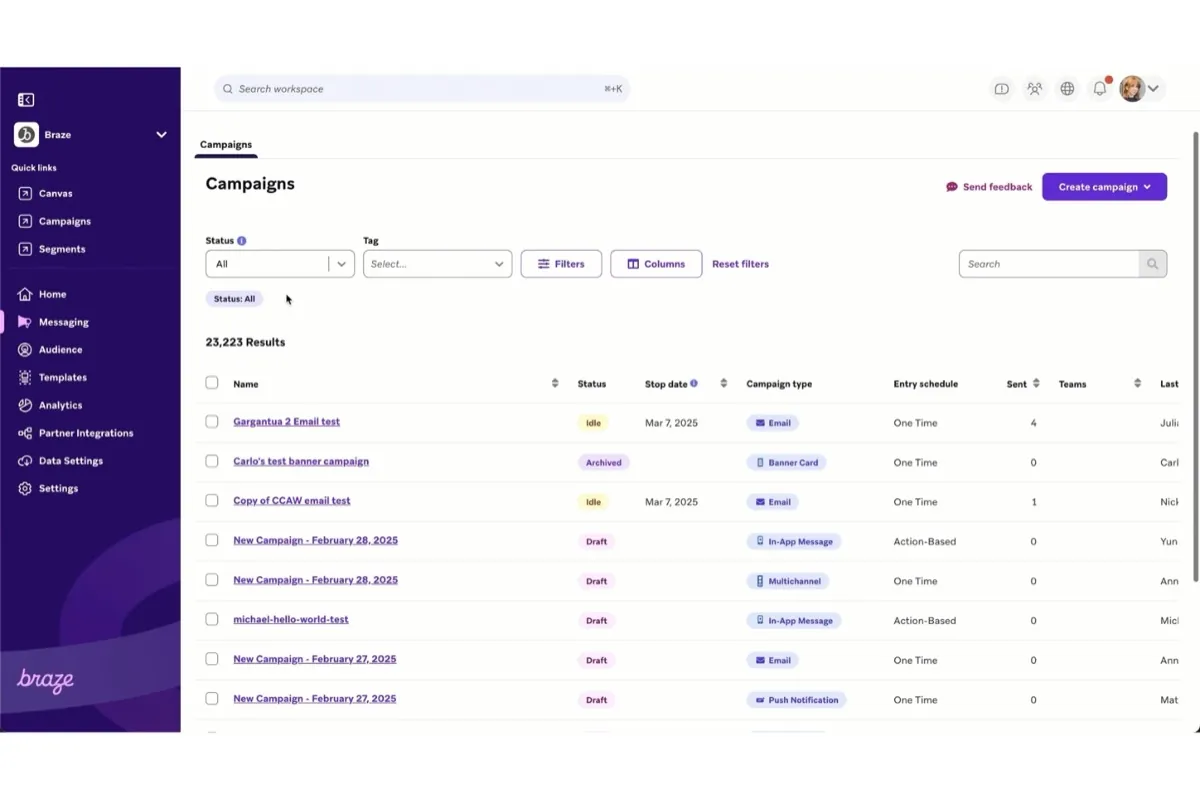
## Product Evolution
Braze's evolution tracks a common pattern among engagement platforms: start with mobile messaging, expand channel coverage, then reach upstream toward the data layer as customers ask for more than execution.
| Year | Milestone |
|------|-----------|
| 2011 | Founded as Appboy by Bill Magnuson, Jon Hyman, and Mark Ghermezian, focused on mobile push and in-app messaging |
| 2017 | Rebranded to Braze, reflecting expansion into a cross-channel engagement platform beyond mobile |
| Nov 2021 | IPO on Nasdaq under ticker BRZE |
| 2024 | Braze Data Platform (BDP) launched — Cloud Data Ingestion, Currents, and Connected Content added to reduce the data-integration burden |
| 2023 | Sage AI by Braze launched — existing AI/ML capabilities (Intelligent Timing, Intelligent Selection, Winning Path) unified under a single brand, with expanded generative AI features for content creation and campaign optimization |
| 2024 | BrazeAI introduced at Forge 2024 — rebranded and expanded from Sage AI, adding an agentic layer (Project Catalyst) for 1:1 engagement optimization, AI Liquid Assistant, and Message Template Assistant |
| 2025 | Braze acquired OfferFit, an AI-powered marketing experimentation and decisioning company, rebranded as BrazeAI Decisioning Studio — folding reinforcement-learning-based testing into BrazeAI |
| 2025–2026 | Braze positions the "4 D's" — Data, Decisioning, Design, Distribution — as its product throughline connecting BDP, BrazeAI, and Canvas |
Each addition — BDP, BrazeAI, Decisioning Studio — extends Braze further from its messaging core, but the underlying product is still built around orchestrating and delivering campaigns, not unifying customer records. That distinction shapes what Braze can and cannot do architecturally, covered below.
## What Braze Does
- **Canvas**: Braze's visual journey-orchestration engine — branching logic, wait steps, and multivariate testing across channels, triggered by user behavior or scheduled campaigns
- **Multi-channel messaging**: Native delivery across email, push, SMS, in-app messages, webhooks, and WhatsApp, all executed from a single campaign interface
- **Intelligent Timing and Intelligent Selection**: AI models that choose the optimal send time and channel per user, based on that user's own engagement history within Braze
- **BrazeAI**: An agentic layer added in 2024 — a copilot for building campaigns, personalization for generating content variants, and data-science agents that surface engagement insights from Braze's own event data
- **BrazeAI Decisioning Studio**: Reinforcement-learning-based testing and decisioning engine — acquired via OfferFit in 2025 — that optimizes offers, channels, and messages per user beyond static A/B tests
- **Braze Data Platform (BDP)**: Cloud Data Ingestion (Snowflake, BigQuery, Databricks, Redshift), Currents (streaming engagement events out to external systems), and Connected Content (pulling external data into messages at send time)
BDP is a genuine improvement to how data moves into and out of Braze — but it is an integration layer, not a CDP-grade data-unification layer. Braze supports identifier-based profile merging within its platform (matching by email, phone, and custom IDs), but not the governed, cross-source identity resolution across all enterprise systems that a dedicated CDP provides. Braze itself lists CDP vendors as technology partners rather than replacements. For the full breakdown of what BDP does and does not solve, see [Do You Need a CDP with an Engagement Platform?](/articles/do-you-need-cdp-with-engagement-platform/)
## Where Braze Sits on the Customer Intelligence Loop
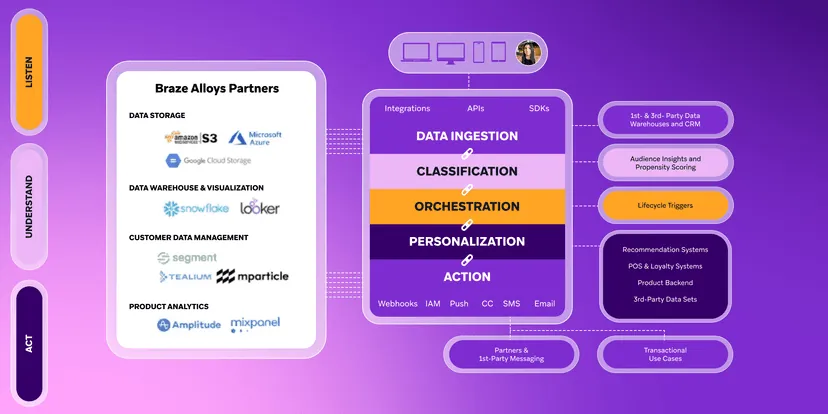
*Diagram from Braze's AI marketing automation guide, showing how Braze positions its platform components.*
The [Customer Intelligence Loop](/glossary/customer-intelligence-loop/) maps the full cycle from raw data to delivered message and back. Braze's product suite covers the back half of that cycle deeply and the front half only partially:
| Stage | Braze Coverage |
|-------|----------------|
| 1. COLLECT | Partial — SDK-based engagement events plus BDP's Cloud Data Ingestion; no independent server-side collection outside a handful of first-party sources |
| 2. UNIFY | Minimal — matches known user and device IDs within Braze; no deterministic-plus-probabilistic [identity resolution](/glossary/identity-resolution/) across anonymous and known states from outside systems |
| 3. UNDERSTAND | Limited — BrazeAI's data-science agents surface anomaly detection and segment discovery from in-Braze behavioral patterns; cross-channel predictive modeling (churn, LTV) requires external tools |
| 4. DECIDE | Strong — Canvas branching logic, Intelligent Timing/Selection, and BrazeAI Decisioning Studio |
| 5. ENGAGE | Core strength — native delivery across email, push, SMS, in-app, webhooks, and WhatsApp |
Braze's own "4 D's" framework — Data, Decisioning, Design, Distribution — describes this same territory. It is a linear pipeline that starts once data has already arrived and ends at delivery, with no mechanism for engagement outcomes to flow back into cross-channel identity resolution or predictive modeling. That maps cleanly to stages 4 and 5 of the Customer Intelligence Loop, with partial coverage of stage 1 through BDP's Cloud Data Ingestion — but stages 2 and 3 remain outside the framework entirely.
For organizations relying on Braze as their only customer data system, this gap is the practical question: campaigns can only be as targeted as the data Braze itself collects and stores. **The core decision: if a CDP is already feeding Braze clean, unified audiences, Braze is a strong execution layer. If Braze is the only customer data system in place, it is missing the identity resolution and cross-channel predictive modeling a CDP provides.**
## Braze Pricing
| Pricing | Braze |
|---|---|
| **Priced on** | Monthly active users (MAU) or tracked users, plus which modules are licensed |
| **Published price** | None — quote-based only |
| **Reported contract range** | $50,000–$200,000/yr mid-market (Vendr, G2); $500,000+ enterprise, seven figures for the largest consumer brands; ~$265,000 all-customer average derived from FY2026 ARR ÷ customer count, skewed upward by enterprise accounts |
| **Priced separately** | Canvas, Currents, BrazeAI, BrazeAI Decisioning Studio; the CDP or warehouse that supplies unified audiences |
Braze does not publish list pricing. Contracts are quote-based and driven primarily by monthly active users (MAU) or tracked users, plus which modules are licensed — Canvas, Currents, BrazeAI, and BrazeAI Decisioning Studio are typically priced as separate line items rather than bundled by default.
Based on publicly reported Vendr and G2 contract data, mid-market consumer brands commonly land in the $50,000–$200,000 per year range, consistent with other CEPs. Large-scale MAU volumes, combined with BrazeAI, Decisioning Studio, and Currents add-ons, can push enterprise contracts past **$500,000 annually — and for the largest consumer brands with hundreds of millions of monthly active users, seven-figure annual contracts are common.** Braze's own FY2026 investor materials report roughly $693M in ARR across approximately 2,609 customers, implying an average spend of roughly $265,000 per year — meaning a substantial portion of the customer base spends well above that to balance the long tail of smaller accounts. Because Braze does not unify or store data outside its own channels, the true cost of a complete customer-intelligence stack should also include whatever CDP, warehouse, or identity-resolution tooling feeds Braze accurate, unified audiences — see [CDP Pricing: Models, Ranges, and Hidden Costs](/articles/cdp-pricing/) for a full TCO comparison across architectures.
## Strengths
- **Best-in-class journey orchestration**: Canvas's branching logic and multivariate testing are consistently cited as among the strongest in the engagement-platform category
- **Deep channel coverage**: Native delivery across email, push, SMS, in-app, webhooks, and WhatsApp reduces the number of point tools needed for execution
- **AI-driven send-time and channel optimization**: Intelligent Timing and Intelligent Selection improve engagement without manual rule-building
- **Real investment in AI decisioning**: BrazeAI and the BrazeAI Decisioning Studio launch (via the 2025 OfferFit acquisition) show Braze moving beyond static rules toward reinforcement-learning-based experimentation
- **BDP narrows the data gap**: Cloud Data Ingestion and Currents make it meaningfully easier to connect Braze to a warehouse or CDP than pure messaging-only platforms offer
- **Public-company scale**: As a Nasdaq-listed company since 2021, Braze brings the balance sheet and enterprise support infrastructure large consumer brands expect
## Limitations
- **No cross-source identity resolution**: Braze matches known user and device IDs within its own SDKs. It does not perform the deterministic-plus-probabilistic matching across anonymous and known states, devices, and offline records that a dedicated [identity resolution](/glossary/identity-resolution/) system provides
- **No governed system of record**: Profiles in Braze exist to serve messaging, not to act as a source other teams query. Like any single-channel tool, Braze has no mechanism to propagate a deletion or consent change beyond its own SDKs — that propagation must be handled by a CDP or consent-management layer sitting upstream
- **Cross-channel understanding is thin**: BrazeAI's data-science agents work on Braze's own engagement data. Predictive scoring that spans channels outside Braze — in-store purchases, support tickets, website behavior captured elsewhere — requires external modeling
- **The feedback loop only closes inside Braze's channels**: Engagement outcomes feed Braze's own optimization models, but anything happening outside Braze's SDKs never reaches those models unless it is piped in through BDP or a separate CDP
- **Add-on pricing adds up**: BrazeAI, Currents, and BrazeAI Decisioning Studio are typically priced as adjacent modules rather than included by default, so the full Braze stack often costs meaningfully more than a base Canvas license suggests
## Who Should Consider Braze
Braze is a strong fit for organizations that meet most of these criteria:
- Consumer-facing, mobile- or app-led brands with high message volume and a need for channel diversity
- Marketing teams that want sophisticated journey orchestration and experimentation without heavy data-engineering investment
- Organizations that already have a CDP or warehouse feeding Braze clean, unified audiences and just need best-in-class execution
- Teams prioritizing AI-driven send-time and channel optimization now, with data unification planned as a separate workstream
Braze is a weaker fit for organizations that:
- Need a single platform for data collection, identity resolution, and messaging rather than assembling one from multiple tools
- Have customer data scattered across five or more non-messaging sources — POS, support, offline — that require real identity resolution
- Operate under compliance regimes that need centralized consent and deletion propagation across every system, not just messaging channels
- Want an AI feedback loop that spans every customer touchpoint, not only the channels flowing through Braze's own SDKs
## The Warehouse-to-Braze Stack: Is the Middle Layer Necessary?
A common enterprise pattern runs: **Cloud Data Warehouse (Snowflake, BigQuery, Databricks) → Reverse ETL (Hightouch, Census) → Braze**. The warehouse models customer data with dbt, reverse ETL syncs segments to Braze, and Braze handles messaging. This stack has been the de facto standard for data-mature organizations that want warehouse-native modeling paired with best-in-class engagement.
But two shifts are making the middle layer look increasingly optional — and both have implications for the stack's total cost and structural integrity.
### Shift 1: Braze Cloud Data Ingestion Cuts Out Reverse ETL
Braze Cloud Data Ingestion (CDI) now connects directly to Snowflake, BigQuery, Databricks, and Redshift — syncing profiles, attributes, and computed fields into Braze without a reverse ETL tool in between. Combined with CDI Segments (zero-copy audience building from warehouse data) and zero-copy Canvas triggers (launched April 2026), Braze can now activate warehouse data without Hightouch or Census sitting in the middle. For teams whose only use case is "push warehouse audiences to Braze," CDI makes the reverse ETL layer redundant — one fewer vendor to pay for, one fewer sync to debug at 2 a.m.
### Shift 2: Agentic CDPs Combine the Data and Messaging Layers
The larger strategic question is whether the three-layer stack itself — warehouse, activation middleware, engagement platform — is the right architecture. [Agentic CDPs](/glossary/agentic-cdp/) that include native messaging collapse the stack into one platform: data unification, identity resolution, AI decisioning, and cross-channel delivery all operate within a single system boundary. There is no warehouse-to-Braze sync to maintain because the CDP handles both the data layer and the messaging layer. There is no reverse ETL to pay for because activation is native, not bolted on.
### What Both Approaches Still Miss
Whether you connect your warehouse to Braze directly (CDI) or through reverse ETL (Hightouch), the same structural gaps remain:
- **No cross-source identity resolution**: Both approaches depend on identities already being resolved upstream — in the warehouse or a separate CDP. Braze matches known IDs within its own SDKs but does not do the probabilistic cross-device, cross-channel matching a dedicated [identity resolution](/glossary/identity-resolution/) system provides
- **PII still moves**: Every CDI sync or reverse ETL job copies customer data into Braze. If you activate to five other destinations, that is five more copies at five more vendor boundaries — the same PII sprawl problem [composable stacks](/glossary/composable-cdp/) face, just one layer downstream
- **The feedback loop stays open**: Engagement outcomes (opens, clicks, conversions) flow back to Braze's optimization models, but anything outside Braze's SDKs — in-store purchases, support tickets, ad interactions — never reaches those models unless separately piped in. The [Customer Intelligence Loop](/glossary/customer-intelligence-loop/) remains open at stage 5
The practical question for most teams is not "do I need reverse ETL between my warehouse and Braze?" — CDI already answers that for simple syncs. The real question is whether a three-vendor stack (warehouse + CDP-or-reverse-ETL + CEP) is structurally sound for AI-driven marketing, or whether a single [agentic CDP](/glossary/agentic-cdp/) with native messaging closes the loop more effectively at lower total complexity. For a full comparison of the costs and trade-offs between these stack patterns, see [CDP Pricing: Models, Ranges, and Hidden Costs](/articles/cdp-pricing/).
## Alternatives to Braze
Organizations evaluating Braze alongside broader customer-data needs generally choose one of two paths: pairing Braze with a dedicated CDP that owns collection, identity resolution, and cross-channel modeling — or replacing the combination with a single [agentic CDP](/glossary/agentic-cdp/) that includes native messaging and closes the Customer Intelligence Loop inside one platform boundary. Direct engagement-platform competitors include [Iterable](/articles/what-is-iterable/) (more approachable journey builder, lower cost at mid-market scale) and [MoEngage](/articles/what-is-moengage/) (deeper mobile-app and APAC penetration, Aampe per-user AI decisioning). For a side-by-side comparison of vendors across both approaches, see the [CDP Vendor Comparison Guide](/basics/cdp-vendors/). Teams building an AI-era RFP should also read [How to Evaluate a CDP in the AI Era](/articles/how-to-evaluate-cdp-ai-era/) before comparing Braze against pure-play CDPs.
**→ [Compare all CDP vendors side-by-side in the CDP Vendor Comparison Guide](/basics/cdp-vendors/)**
*See how independent analysts evaluate CDP vendors — download the [Forrester Wave](https://www.treasure.ai/forrester-wave-cdp/?utm_source=cdp-dot-com&utm_medium=website-referral&utm_campaign=articles&utm_content=inline) or [IDC MarketScape](https://www.treasure.ai/idc-marketscape-2026?utm_source=cdp-dot-com&utm_medium=website-referral&utm_campaign=articles&utm_content=inline) reports for a side-by-side comparison.*
## Related Articles
- [Do You Need a CDP with an Engagement Platform?](/articles/do-you-need-cdp-with-engagement-platform/) — Full breakdown of what Braze Data Platform does and does not solve
- [CDP vs Customer Engagement Platform](/articles/cdp-vs-customer-engagement-platform/) — The full framework comparison and convergence thesis
- [CDP Pricing: Models, Ranges, and Hidden Costs to Budget For](/articles/cdp-pricing/) — How CDP and CEP total cost of ownership compares across architectures
- [What Is Hightouch?](/articles/what-is-hightouch/) — Another vendor repositioning around the "agentic CDP" label
- [What Is Iterable? Features, Pricing & Alternatives](/articles/what-is-iterable/) — Growth-focused engagement platform with AI-driven personalization
- [What Is MoEngage? Features, Pricing & Alternatives](/articles/what-is-moengage/) — The same self-branded-data-layer pattern at a mobile-first engagement platform
- [CDP Alternatives: 7 Options Compared and When You Need Each](/articles/cdp-alternatives/) — Where Braze fits among broader CDP alternatives
## FAQ
### Is Braze a CDP?
**No — Braze is a customer engagement platform, not a CDP.** While Braze Data Platform (BDP) adds Cloud Data Ingestion and Currents for moving data in and out of Braze, it does not provide cross-source identity resolution, a governed customer profile that serves as a system of record, or centralized consent and deletion propagation across systems. For the full breakdown of what BDP does and does not solve, see [Do You Need a CDP with an Engagement Platform?](/articles/do-you-need-cdp-with-engagement-platform/).
### How much does Braze cost?
**Braze pricing is quote-based and not published — cost is driven primarily by monthly active users (MAU) plus which modules you license.** Canvas, multi-channel messaging, Currents, BrazeAI, and Decisioning Studio are typically priced as separate line items. Based on publicly reported Vendr and G2 contract data, mid-market contracts commonly fall in the $50,000–$200,000 per year range; large MAU volumes can push enterprise deals past $500,000, with the largest consumer brands spending $1M or more annually.
### What is Braze Data Platform?
**Braze Data Platform (BDP) is a 2024 addition that pipes external data into Braze and streams engagement events back out — it does not turn Braze into a CDP.** Its three components — Cloud Data Ingestion, Currents, and Connected Content — improve data flow into and out of Braze's messaging layer, but Braze itself lists CDP vendors as technology partners rather than replacements. For the full breakdown, see [Do You Need a CDP with an Engagement Platform?](/articles/do-you-need-cdp-with-engagement-platform/)
### What are alternatives to Braze?
**Organizations typically move in one of two directions: adding a dedicated CDP for data unification alongside Braze, or replacing the combination with a single agentic CDP that includes native messaging.** [Agentic CDPs](/glossary/agentic-cdp/) close the Customer Intelligence Loop within one platform boundary instead of splitting collection, identity, and messaging across systems. See the [CDP Vendor Comparison Guide](/basics/cdp-vendors/) for a full comparison.
---
### What Is Customer Experience (CX)? Strategy Guide
URL: https://cdp.com/articles/what-is-customer-experience-redefining-cx/
According to a [Treasure Data and Forbes Insights study](https://www.treasure.ai/blog/2020/03/10/new-study-finds-data-key-to-unlocking-superior-customer-experience/?utm_source=cdp-dot-com&utm_medium=website-referral&utm_campaign=articles&utm_content=inline), 74% of consumers are at least somewhat likely to buy based on experience alone. It’s clear that consumers care about how their [customer experience (CX)](/glossary/customer-experience-cx/) *feels*, not just what they buy or how much it costs. **Redefining customer experience means moving from brand-driven touchpoints to customer-driven interactions that adapt in real time — a data problem before it is a design problem.**
The more we know about the current needs and preferences of our customers, the easier it is to create relevant customer experiences. The challenge is providing positive and profitable CX as tools continue to evolve and take on more and more complexity with every new technology. And, of course, new developments like the depreciation of third-party cookies, add another hurdle as we attempt to get to know and serve our customers.
## CX Defined
The definition of customer experience (CX) isn’t complicated—it is the interaction a person has with your business at every touch point, from marketing to purchasing to ongoing customer service.
While the definition is simple, managing CX is anything but. Evolving customer expectations continue to change marketing best practices. Each CX at every touch point is a pass/fail test. You pass if your messaging, promotions, products and services line up with the consumer’s current needs and preferences. You fail if they don’t. Because customer journeys are omnichannel and constantly evolving, the chances to fail increase right along with the rewards for success.
## CX Redefined
The redefinition of CX is the shift in focus from brand-driven to customer-driven, adapting to your customers’ changing needs in real time. In order to gain and retain loyal customers, brands have to be able to gather and use customer data from all channels and make CX the heart of the business. [Stephanie Thum](https://www.linkedin.com/in/stephaniethum/), CX Consultant and Practitioner explains that:
“If you want a customer-centric company, then CX practices need to touch every corner of your business: Risk management, marketing, strategic planning, business process improvement, policy development, digital, etc.”
Changing your business to a customer-centric model also means redefining your customer experience management (CXM) strategies. The best CXM strategies are seamless, [omnichannel](/glossary/omnichannel-marketing/), real-time, and data driven.
## Relevant & Seamless: CX Expectations
Customers expect prompt, easy, and consistent service. They want interactions to be relevant and seamless no matter how they choose to contact the brand. If your website is clean and easy to navigate but your customer service is spotty and difficult to reach, people may take their business elsewhere. Customers are increasingly blending digital and in-store shopping and want it to be easy to jump from one to the other.
A seamless CX builds confidence and encourages additional customer engagement. To create and maintain seamless customer experiences, your business must collaborate and share data internally. Analysis of customer data can identify pain points and challenges that create friction for the customer.
## Omnichannel: Everywhere, All the Time
Customers should be able to interact with your business through as many channels as possible. All businesses need to be reachable through mobile devices, desktops, email, chat, and more. All of this connectivity offers your customers easy access to purchasing and offers your business multiple ways to increase engagement and profitability.
For example, Muji, a global retailer, wanted to plan for growth beyond their existing 650+ store locations. They discovered that people browsing their website were looking for products to buy in-store. Unfortunately, Muji’s online and social campaigns weren’t reliably driving foot traffic to in-store locations.
To bridge this gap, Muji used a [customer data platform (CDP)](/basics/what-is-a-customer-data-platform-cdp/) to integrate online browsing data with in-store purchases. The result was a mobile app with relevant and timely personal coupons and in-app push notifications. Using the mobile app in combination with highly targeted promotions led to a 100% increase in coupon redemptions across all store locations, higher volumes of in-store foot traffic, and a 46% increase in revenue over a two-year period.
Muji’s story highlights the true power of the right offer delivered at the right time. Consumers expect purchasing to be easy and nearly instantaneous, and businesses need to be agile and ready to meet customers where they are, when they want to buy. The only way to truly keep up with changing customer expectations is to have clear data profiles that can be updated in real-time.
A timely auto-generated coupon or push notification can increase sales. Current data about customers also avoids gaffs like offering a coupon for a product that the consumer just purchased.
## Data Driven: What Do They Want?
CX data can also help analyze and improve your bottom line. Successful businesses are rolling out data-driven initiatives based on individual customer experiences. The paradigm shift from, “who wants my products?” to, “what products do you want?” can only be achieved through intense analysis of customer data.
Stephanie notes that, “You need both operational and experience data to power your business decisions. Operational data tells you what’s happening. Experience data can help you to understand why.”
Companies that provide excellent CX use insights gleaned from clean, comprehensive, near real-time data. [A Customer Data Platform (CDP)](/basics/what-is-a-customer-data-platform-cdp/) can not only gather and unify this data, but it can also power analytics and insights that drive decision-making.
## How a CDP Drives CX
To be relevant and profitable, businesses need to collect, unify, and analyze as much consumer data as possible. A CDP does the grunt work of stitching together different sources of data to create an actionable single source of truth. The right CDP gives you the tools to really know your customers as individuals and to use that data to create exceptional experiences.
CDPs store data about the entire customer journey and can automatically focus on the most profitable channels for any given customer. From preferences about communication to predictive modeling, CDPs keep up with marketplace and individual customer changes so brands can make the right choices at the right time.
Customers expect business to offer personally relevant CX at every touch point. To meet these demands, your business needs a single view of the customer that unites data from across the organization. CDPs create centralized, accurate, and relevant data streams that allow your business to redefine CX for your customers.
## What Changes When AI Runs the Experience
The data could already update in real time once a CDP was in place — what stayed on a human clock was deciding what to do with it. A segment was rebuilt on Monday, the campaign shipped Thursday, and results were read the following month — by which point the customer's situation had moved on.
AI changes the clock speed rather than the goal. The underlying cycle is the [Customer Intelligence Loop](/glossary/customer-intelligence-loop/): collect, unify, understand, decide, engage, with engagement outcomes feeding back into collection. AI agents can run that loop continuously — reading a profile and choosing an action in minutes rather than in weekly campaign cycles, while the models behind that choice keep retraining on their own, slower cadence — while people set the strategy, own the brand's voice, and decide which moments are off-limits to automation. That division is the point: [agentic customer experience](/glossary/agentic-customer-experience/) is harnessed by human creativity and strategic judgment, not a substitute for it.
The practical consequence is that the data foundation, not the channel tooling, becomes the binding constraint on CX. An agent that decides in seconds is worth little against a profile that updates overnight, and an agent that cannot write its outcome back into the profile learns nothing from the interaction it just had. This is the most common shape CX failures now take.
## Common Mistakes When Redefining CX with AI
The sections above describe what a redefined CX program looks like when it works. The failure patterns below turn up most often in organizations that already have the data and the tools — they are ownership and measurement failures more than technical ones.
**Treating CX as a redesign project rather than an operating model.** A website refresh, a new chat widget, or a loyalty relaunch gets funded as "the CX initiative," and each team optimizes the touchpoint it owns. The handoffs between them — where a customer explains the same problem to a third agent, or is marketed a product that support already flagged as out of stock — belong to nobody. That is where the experience actually breaks.
**Fix:** give one person ownership of the cross-channel profile and report at the journey level, so handoff failures land on a named dashboard instead of between two of them.
**Letting AI write the message but never read the outcome.** Generative tools produce subject lines, product copy, and chat replies at a volume no team can match, and most of that output is judged once, by the person who approved it, and never again. When responses do not flow back to the profile that triggered the message, the system produces faster without getting better.
**Fix:** require every AI-generated interaction to write its outcome — open, reply, resolution, return — back to the same profile the next [AI decisioning](/glossary/ai-decisioning/) step reads.
**Treating consent as a downstream filter.** Preference and consent state usually sits in the tool that collected it — the cookie banner, the email platform, the service desk — while decisions are made against the [unified profile](/glossary/customer-360/). Suppression then arrives one sync late, which is how an unsubscribed customer receives one more campaign and a deletion request produces a message nobody can account for.
**Fix:** hold [consent](/glossary/consent-management/) as profile attributes — per channel, per purpose — enforced at the decision point, rather than as a filter each channel applies before send.
**Scoring CX on survey averages alone.** NPS and CSAT are cheap to run and slow to move, respondents self-select, and the customers who leave quietly are the ones who never answer. Stephanie Thum's distinction applies directly here: experience data explains why something happened, but operational data is what tells you it is happening now.
**Fix:** pair every survey metric with a behavioral counterpart measured on the same profile — repeat purchase rate, time to resolution, second-contact rate — and investigate wherever the two diverge.
**Automating the moments that need a person.** Scale is not the constraint in a billing dispute, a complaint, or a bereavement call; judgment and tone are. Routing those into the same automated flow that answers order-status questions saves minutes and costs the relationship, and the cases most likely to escalate are the ones automation handles worst.
**Fix:** define the handoff categories before launch and track the human-handoff rate as a designed CX metric, not as an automation defect.
**Buying an experience layer before the data layer can feed it.** New engagement, personalization, and service tools each arrive with a profile store of their own, and a tool that assembles its own view of the customer adds a fragment rather than removing one. The integration project that follows exists only to reconcile the copy the purchase created.
**Fix:** before signing, confirm the tool reads the unified profile and writes events back to it in real time — check whether the CDP can feed the tool a live profile, not just accept a one-way connection from it.
**Measuring the experience only up to the sale.** Marketing touchpoints get instrumented in detail while returns, service contacts, and renewals are logged in systems nobody joins back to the profile. Churn then surfaces in a quarterly report with no attributable cause, and the post-purchase experience that produced it stays invisible.
**Fix:** bring at least one post-purchase touchpoint per journey into the same event schema as marketing data, starting with the one customers contact most.
## FAQ
### What is customer experience (CX) and why does it matter?
Customer experience (CX) is the total perception a customer forms across every interaction with your brand — from browsing your website to post-purchase support. CX matters because it directly drives loyalty, retention, and revenue. Companies that deliver superior CX outperform competitors and build stronger long-term customer relationships.
### How does data improve customer experience?
Data enables businesses to understand individual customer preferences, predict behavior, and deliver personalized interactions at the right time. By combining operational data (what is happening) with experience data (why it is happening), companies can identify friction points, optimize journeys, and create relevant offers that increase satisfaction and conversions.
### What role does a CDP play in customer experience management?
A customer data platform (CDP) unifies data from all customer touchpoints into a single, actionable profile. This gives marketing, sales, and support teams a consistent view of each customer, enabling real-time personalization, predictive modeling, and omnichannel orchestration that would be impossible with siloed data systems.
## Related Articles
- [How to Deliver Real-Time Personalized Experiences With a CDP](/articles/how-to-deliver-real-time-personalized-experiences-with-a-cdp/) — The activation side of CX, step by step
- [Customer Experience Management: Omnichannel Guide](/articles/customer-experience-management-how-to-provide-an-exceptional-omnichannel-customer-experience/) — Managing CX consistently across channels
- [How to Use a CDP for Customer Journey Orchestration](/articles/using-a-cdp-to-orchestrate-the-customer-journey/) — Sequencing interactions once the data is unified
- [How AI Is Redefining the CDP](/articles/how-ai-is-redefining-the-cdp/) — The platform shift behind agent-run customer experience
---
### What Is Databricks CustomerLake? Agentic CDP Explained
URL: https://cdp.com/articles/what-is-databricks-customerlake-cdp/
**On June 16, 2026, Databricks answered a question this site has covered since April: [Is Databricks a CDP?](/basics/what-is-a-customer-data-platform-cdp/) The answer was "no" — until it wasn't.** At the Data + AI Summit 2026, Databricks launched CustomerLake, a purpose-built [Agentic CDP](/glossary/agentic-cdp/) embedded natively in the [data lakehouse](/glossary/data-lakehouse/). The platform that data engineers already trust for analytics and ML is now making a direct play for the customer engagement layer that CDPs have owned for a decade.
**Databricks CustomerLake is an agentic customer data platform (CDP) that runs inside the Databricks lakehouse, unifying customer profiles, identity resolution, audience building, and campaign activation on the data platform itself instead of in a separate CDP.** It is in Private Preview and works through two agent families: Profile Agents for data unification and Campaign Agents for activation.
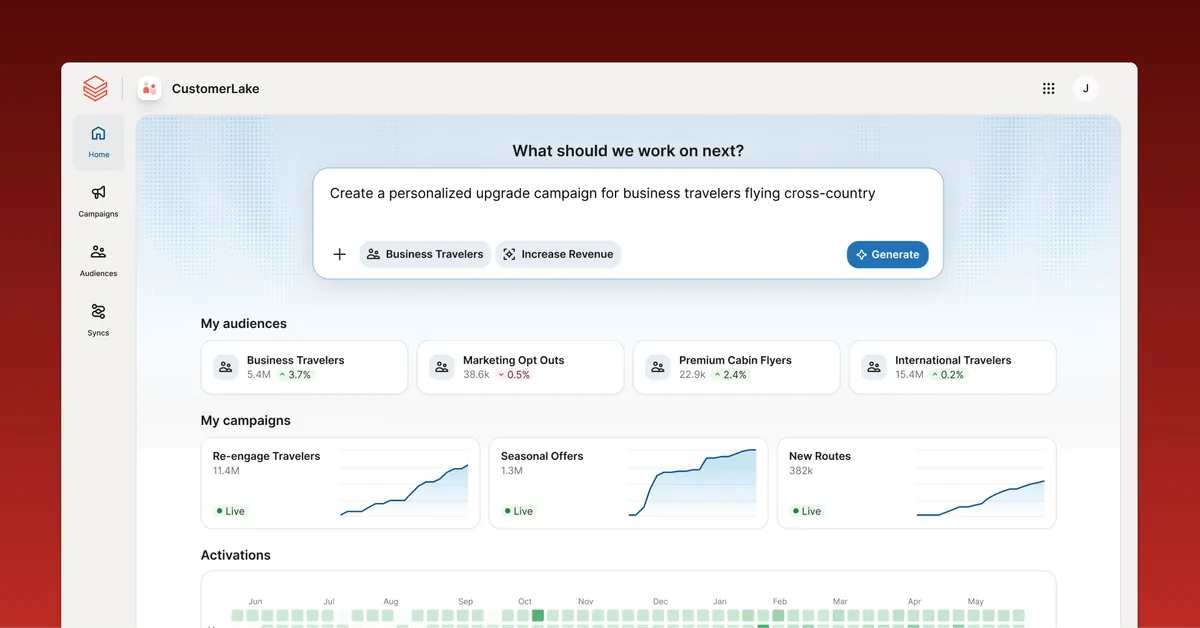
This guide covers what CustomerLake is, how it works, where it fits in the CDP category's evolution, and what remains unproven.
## Databricks CustomerLake at a Glance
| Dimension | Databricks CustomerLake |
|---|---|
| **Best for** | Organizations on the Databricks lakehouse (Unity Catalog) that want CDP capabilities without moving data to a separate system |
| **Typical buyer size** | Enterprise, by positioning rather than measured usage — it targets lakehouse organizations whose platform and data-engineering teams already run Unity Catalog, and no public peer mix exists yet because it remains in Private Preview |
| **Pricing model** | Consumption-based, described by Databricks as a value-aligned alternative to traditional software licensing; no rate card published |
| **Typical implementation** | Not yet established (Private Preview); Databricks indicates weeks, depending on lakehouse readiness |
| **Key differentiator** | Zero data movement — identity resolution and agentic CDP built directly on the lakehouse under Unity Catalog governance |
| **Skip if** | You are not on Databricks, or want marketer-only campaign operations |
No peer-review mix exists for CustomerLake: it remains in Private Preview, so the row above describes who can adopt it — organizations already running the Databricks lakehouse under Unity Catalog — not measured usage. The cross-vendor comparison and the methodology behind these splits are in [CDP vendors](/basics/cdp-vendors/).
## What Is CustomerLake?
CustomerLake is Databricks' first marketing product — an Agentic CDP that unifies customer data, AI models, [identity resolution](/glossary/identity-resolution/), audience building, and activation on the same lakehouse where organizations already run analytics and ML workloads. It is currently in **Private Preview**.
The core concept is what Databricks calls **Infinity campaigns** — a shift from static, one-off campaigns to continuous agentic loops where AI agents constantly analyze customer signals, decide next-best actions, and optimize engagement in real time. As CEO Ali Ghodsi framed it: *"Marketing stops being a series of campaigns and becomes a continuous loop — agents that constantly analyze, decide, and act on every customer in real time."*
CustomerLake is built on three design principles:
- **Embedded** — built directly on existing Databricks data foundations. No data duplication into a separate CDP
- **Democratized** — marketers operate through agent-first interfaces on trusted data, reducing ad hoc requests to data teams
- **Autonomous** — agents analyze customer signals, recommend next-best actions, and optimize engagement around business goals at 1:1 scale
CustomerLake follows the pattern Databricks established with Lakewatch (its security analytics product): building vertical application layers directly on the lakehouse rather than leaving those markets to third-party tools. This pattern signals that CustomerLake is unlikely to be the last category Databricks enters.
**Team lineage matters:** CustomerLake's leadership includes Tasso Argyros and Justin DeBrabant (both from [ActionIQ](/articles/what-is-actioniq/), an enterprise CDP acquired by Uniphore) and Katy Yuan (from Census, a composable CDP pioneer). The people who spent the past decade building packaged and composable CDPs are now inside the lakehouse, building something architecturally different from either.
## Profile Agents
Profile Agents handle the data engineering side of CDP functionality — transforming raw customer data into business-ready Customer 360 profiles directly inside Databricks.
**What Profile Agents automate:**
- **Bronze-to-gold data transformation** — raw event data is cleaned, enriched, and structured into unified customer profiles. The agent identifies data quality issues, recommends fixes, and supports third-party data enrichment
- **Agentic Identity Resolution** — a multi-method approach that combines deterministic matching, probabilistic matching, and agentic workflows (where the AI identifies edge cases and improves quality iteratively through continuous feedback loops). Teams can integrate their existing identity rules, models, and third-party enrichment alongside Agentic Identity Resolution
- **Identity Provider marketplace** — pre-built integrations with Acxiom, Epsilon, LiveRamp, TransUnion, and Adstra enable one-click access to third-party identity graphs for enrichment and resolution
For data engineers, Profile Agents reduce the manual pipeline work that typically consumes weeks when building customer 360 views from scratch on a lakehouse.
## Campaign Agents
Campaign Agents handle the activation side — moving from audience creation to channel delivery with AI assistance at every step.
**What Campaign Agents provide:**
- **Goal-driven campaign generation** — agents use business goals and customer context to recommend audiences, messaging, timing, and channel selection
- **Genie-powered interface** — marketers interact through Databricks' natural language interface (Genie) to build audiences, define campaign briefs, and set guardrails — without writing SQL
- **Pre-launch simulation** — campaigns can be simulated against a sample of customer profiles before going live, providing visibility into how decisions will play out
- **Built-in guardrails** — marketing opt-out enforcement, suppression for customers with unresolved support tickets, and frequency capping are native to the decisioning layer
Campaign Agents represent Databricks' answer to the "marketer self-service" gap that has historically separated lakehouses from CDPs. Whether the agent-first interface achieves the usability of mature CDP journey builders remains to be validated at scale — CustomerLake is still in Private Preview.
## Architecture
CustomerLake's architecture reflects a fundamental bet: the [data lakehouse](/glossary/data-lakehouse/) should be the system of record for marketing, not a data source that feeds a separate CDP.
**Key architectural components:**
| Component | Role |
|---|---|
| **Lakehouse + Unity Catalog** | Foundation layer — all customer data stays governed in one place. No data copies to external CDP systems |
| **Lakehouse Federation** | Query customer data across Snowflake, BigQuery, cloud storage, and operational databases without copying it into Databricks |
| **Lakehouse//RT** | Real-time serving layer for the lakehouse, announced at the same summit; Databricks has not said whether or how CustomerLake uses it |
| **Genie** | Natural language interface enabling marketers to build audiences and campaigns without SQL |
| **Lakeflow** | Data ingestion layer for streaming and batch customer data |
| **Bi-directional reverse ETL** | Native pipelines to marketing tools, advertising platforms, identity providers, and engagement channels |
**Activation partners** at launch include Adobe, Meta (Audience and Conversions API), The Trade Desk, Braze, Bloomreach, Iterable, Snapchat, Magnite, Twilio, IAS, and Unity.
**Pricing model:** Databricks describes CustomerLake pricing as a consumption model — "a flexible, value-aligned alternative to traditional software licensing" on its product page — and has published no rate card. Martech Therapy's Matthew Niederberger reports that it carries no platform fee, with Databricks earning on the compute used to build profiles and resolve identities. As he put it: *"You cannot win a price war against a company that does not need your product to make money."*
This creates a structural asymmetry: standalone CDP vendors must recover their entire R&D and infrastructure costs from CDP revenue alone. Databricks can treat CustomerLake as a compute driver for its existing platform — even subsidizing the CDP layer if it increases lakehouse adoption. For CDP-only companies, this is an existential pricing challenge, not a feature gap.
## CDP Evolution: Where CustomerLake Fits
The CDP category has evolved through three stages, each driven by pressure to close the [Customer Intelligence Loop](/glossary/customer-intelligence-loop/) faster:
| Stage | Era | Architecture | Data model |
|---|---|---|---|
| **[Packaged CDP](/articles/packaged-cdp-vs-composable-cdp/)** | 2016–2020 | All-in-one platform with proprietary data store | Data copied into the CDP |
| **[Composable CDP](/glossary/composable-cdp/)** | 2020–2025 | Warehouse/lakehouse as source of truth + activation layer on top | Data stays in the warehouse; activation tools read via reverse ETL or zero-copy |
| **[Agentic CDP](/glossary/agentic-cdp/)** | 2024+ | AI agents embedded in the data platform, closing the loop autonomously | Agents operate on data wherever it lives — data location is secondary to decision orchestration |
The evolution from Packaged to Composable to Agentic reflects a deeper shift. The 2020–2025 era settled the question of **data gravity** — where customer data lives (answer: the warehouse/lakehouse won). The emerging question is **decision gravity** — who controls where and how business decisions are made on that data. CustomerLake is Databricks' bid to own not just data storage but the decisioning layer: the place where AI agents analyze, decide, and act on customer data in real time.
CustomerLake is a Stage 3 entry — but it arrives from a different direction than most Agentic CDPs. Where traditional CDP vendors are *adding* AI agents to existing platforms, Databricks is *adding* CDP capabilities to an existing data platform. The result is architecturally similar but organizationally different: CustomerLake's buyer is likely the data team (who already owns Databricks), not the marketing team (who typically owns CDP procurement).
## CDP Capabilities: What CustomerLake Covers and What It Does Not
A [customer data platform](/basics/what-is-a-customer-data-platform-cdp/) is defined by five core capabilities. Before CustomerLake, a Databricks lakehouse covered none of them natively. Here is where CustomerLake stands:
| Capability | What a CDP requires | What CustomerLake provides | Status |
|---|---|---|---|
| **Identity resolution** | ML-powered stitching of anonymous and known profiles | Agentic Identity Resolution — deterministic + probabilistic + agentic matching, plus identity provider marketplace | **Addressed** |
| **Real-time profile serving** | Sub-100ms API lookups for in-session personalization | The product page lists a "Real-Time Profile API" in one line; no documentation, specification, or latency figures are published | **Not addressed** (unverified) |
| **Marketer self-service** | Visual segmentation and journey building without SQL | Genie-powered natural language interface + Campaign Agents in what Databricks calls a marketer-friendly workspace — but inside Databricks, not a standalone marketing application | **Partially addressed** (UX maturity TBD) |
| **[Customer Intelligence Loop](/glossary/customer-intelligence-loop/)** | COLLECT → UNIFY → UNDERSTAND → DECIDE → ENGAGE in seconds | Infinity campaigns — agents close the loop continuously | **Addressed in design** (Private Preview) |
| **Native messaging** | None — required separate ESP | None — activation via partner integrations (Braze, Iterable, Twilio, etc.) | **Not addressed** |
The most significant shift is identity resolution: Agentic Identity Resolution's multi-method approach (deterministic + probabilistic + agentic matching) with a built-in identity provider marketplace directly addresses what was previously Databricks' weakest CDP gap. The most notable *absence* is native messaging — CustomerLake activates through partner channels, not built-in email, SMS, or push. This is a deliberate architectural choice: Databricks is building the intelligence and decisioning layer, not the delivery infrastructure.
## Competitive Impact
CustomerLake's entry reshapes competitive dynamics across the CDP landscape:
**Composable CDP vendors ([Hightouch](/articles/what-is-hightouch/), Census, [GrowthLoop](/articles/what-is-growthloop/))** face structural pressure. These companies built their value proposition on being the activation layer between the warehouse and marketing tools — the position CustomerLake now occupies natively. As Niederberger observes, composable vendors won the argument so thoroughly that *"the warehouse ended up with a fully paved on-ramp to build its own front door."* That said, composable vendors have mature integrations, established customer bases, and multi-warehouse support (Snowflake, BigQuery, Redshift) — switching costs are real, and CustomerLake's Private Preview status limits near-term displacement.
**Packaged CDP vendors ([Segment](/articles/what-is-twilio-segment/), [mParticle](/articles/what-is-mparticle/), Lytics)** face a different challenge. CustomerLake does not replicate their full feature sets (particularly native messaging and event SDKs), but it undermines the data-copy model that packaged CDPs require. For organizations already on Databricks, the value proposition of copying customer data into a separate platform weakens when the lakehouse itself offers identity resolution, segmentation, and activation.
**Enterprise suite CDPs (Adobe AEP, Salesforce Data Cloud)** are less directly threatened but not immune. Their CDP capabilities are embedded within broader marketing clouds that include content management, journey orchestration, and cross-channel delivery — layers CustomerLake does not attempt to replace. However, CustomerLake's Lakehouse Federation (which can query Snowflake, BigQuery, and cloud storage without copying data) challenges the data gravity that suite vendors rely on. Notably, Adobe is a CustomerLake launch partner — suggesting coexistence rather than displacement in the near term.
Adweek characterized CustomerLake as *"an agentic challenger to traditional CDPs"* — framing it as a category disruptor rather than a feature addition.
## What Remains Unproven
CustomerLake is in Private Preview. Several critical questions will only be answered as the product matures:
- **Marketer UX maturity** — agent-first interfaces are novel. Whether Genie + Campaign Agents can match the usability of purpose-built CDP journey builders (which have had years of iteration with marketing teams) is the largest open question
- **Event collection SDKs** — CustomerLake's ingestion relies on Lakeflow and existing Databricks pipelines. Whether it will offer client-side SDKs for web and mobile event collection (comparable to Segment's analytics.js or mParticle's SDK) has not been announced
- **Real-time profile serving** — the product page names a Real-Time Profile API in a single line, but Databricks has published no documentation, specification, or latency figures for it. Until it does, sub-100ms in-session lookups remain unverified
- **General availability timeline** — Databricks has not announced a GA date. Forrester's Joe Stanhope expects it to be generally available later in 2026 (Forrester, June 2026). Until then, enterprise procurement cycles may stall on Private Preview status
- **Buyer and operator mismatch** — CustomerLake is sold to data teams and CIOs, but operated (in part) by marketers. Purpose-built CDPs have spent years iterating their UX with marketing teams — journey builders, drag-and-drop segmentation, campaign calendars. Whether Genie + Campaign Agents can match that usability maturity is the largest adoption question. Organizations without an existing Databricks practice will face a steeper learning curve, even with agent-first interfaces
- **Cost predictability** — consumption-based pricing means costs scale with agent compute. When Campaign Agents run autonomously and continuously (Infinity campaigns), forecasting monthly spend becomes harder than with traditional per-seat or per-profile licensing
- **Migration complexity** — switching identity resolution providers or moving from an existing CDP's identity graph to Agentic Identity Resolution is a multi-month effort. Mid-contract transitions are operationally risky
- **Multi-cloud neutrality** — CustomerLake runs on Databricks. Organizations with customer data split across Snowflake and Databricks can use Lakehouse Federation, but the control plane, governance, and billing flow through Databricks. As Niederberger notes, federation *"still runs it across Databricks' control plane, its governance, its bill, and its roadmap"*
These open questions are the material for an evaluation, not a reason to wait. Teams weighing a Private Preview platform against an established one can [use the same scored criteria across every candidate](https://www.treasure.ai/cdp-training?utm_source=cdp-dot-com&utm_medium=website-referral&utm_campaign=articles&utm_content=inline) — marketer UX, SDK coverage, real-time serving, GA timeline, and cost predictability are answerable today even where a vendor's roadmap is not.
## FAQ
### What is Databricks CustomerLake?
**Databricks CustomerLake is an Agentic CDP that runs on the lakehouse rather than alongside it — Databricks' first product line built for marketing teams.** Launched in Private Preview at the Data + AI Summit on June 16, 2026, it combines Profile Agents (bronze-to-gold transformation and Agentic Identity Resolution) with Campaign Agents (goal-driven audience and campaign generation through Genie). Activation happens through partners such as Braze, Iterable, and The Trade Desk rather than native messaging.
### Is Databricks a CDP now?
**Yes — with the launch of CustomerLake, Databricks is now a CDP, specifically an [Agentic CDP](/glossary/agentic-cdp/).** CustomerLake adds identity resolution, audience segmentation, campaign automation, and multi-channel activation natively on the lakehouse. The key distinction from traditional CDPs: CustomerLake embeds these capabilities in the data platform rather than operating as a separate system that ingests copies of customer data. It is currently in Private Preview.
### How does CustomerLake compare to packaged CDPs?
**CustomerLake addresses most core CDP capabilities but takes a fundamentally different architectural approach.** Packaged CDPs copy customer data into a proprietary store, then build identity, segmentation, and activation on top. CustomerLake operates directly on the lakehouse — data stays in place, governed by Unity Catalog. It provides identity resolution (Agentic Identity Resolution), marketer self-service (Genie), and partner-based activation, but does not include native messaging (email, SMS, push). Organizations that need built-in message delivery will still require a messaging platform alongside CustomerLake.
### What is an Infinity campaign?
**An Infinity campaign is Databricks' term for a continuously running, agent-driven engagement loop that replaces static one-off campaigns.** Instead of the traditional workflow — define objective, request data, build segment, launch, measure — Campaign Agents continuously analyze customer signals, recommend next-best actions, and optimize engagement in real time. The "infinity" framing reflects the shift from discrete campaign cycles to always-on 1:1 personalization. The concept is central to CustomerLake's value proposition but remains in Private Preview as of September 2026.
### Is Databricks CustomerLake the right CDP for my organization?
**CustomerLake is the right CDP when you already run the Databricks lakehouse and want CDP capabilities without moving data — and the wrong fit today for anything requiring a battle-tested, generally available platform.** Choose it if zero data movement and Unity Catalog governance outweigh Private Preview risk. Skip it if you are not on Databricks, need marketer-only operation, or cannot accept unproven maturity.
### Should I replace my CDP with Databricks CustomerLake?
**It depends on your current architecture and where your data lives.** If your organization already runs Databricks as its primary data platform and uses a composable CDP stack (warehouse + reverse ETL + activation tools), CustomerLake may consolidate that stack into fewer moving parts. If you rely on a packaged CDP with native messaging, journey orchestration, and mature marketer UX, CustomerLake does not yet replicate those capabilities end-to-end. Evaluate based on your specific [Customer Intelligence Loop](/glossary/customer-intelligence-loop/) requirements — particularly whether native messaging and client-side event SDKs are critical to your use cases. For evaluation criteria, see [How to Evaluate a CDP in the AI Era](/articles/how-to-evaluate-cdp-ai-era/).
---
*Sources: Databricks press release (June 16, 2026), Databricks blog, Adweek, Martech Therapy (Matthew Niederberger).*
---
### The Future of Personalization: Trends Driving 2026
URL: https://cdp.com/articles/what-is-driving-the-future-of-personalization-in-digital-marketing/
Personalization technology has changed more in the past two years than in the decade before it. Third-party tracking has become an unreliable foundation — blocked by default in Safari and Firefox, and left to the user's choice in Chrome after Google reversed its plan to remove it — privacy regulation has tightened across most large markets, and generative AI has made it possible to build a genuinely individual experience instead of a segment-based one. **The future of personalization in digital marketing is being driven by three converging forces: AI systems that personalize each customer interaction in real time, the shift from third-party data to first-party data as the primary identity signal, and agentic systems that execute personalized decisions autonomously instead of through static rules.**
Marketers who built their programs around cookie-based retargeting and manually maintained segments are running a playbook that no longer matches the technology available or the privacy environment they operate in. The shift underway is toward personalization rebuilt on first-party data, real-time decisioning, and — increasingly — AI agents that execute the decision instead of just recommending it.
## Why Personalization Had to Change
[Personalization](/glossary/personalization/) stopped being optional years ago — 71% of consumers expect personalized interactions, and 76% get frustrated when they don't get them, according to [McKinsey](https://www.mckinsey.com/business-functions/marketing-and-sales/our-insights/the-value-of-getting-personalization-right-or-wrong-is-multiplying) — which also finds that faster-growing companies drive 40% more of their revenue from personalization than their slower-growing peers. Consumers want personalization, and they have for years. What changed is the infrastructure marketers use to deliver it, and how tolerant consumers are of getting it wrong.
Three shifts explain why the old playbook stopped working:
- **Third-party tracking became unreliable.** Safari and Firefox have blocked third-party cookies by default since around 2020, and although Google reversed its plan to remove them from Chrome in 2025 — leaving the choice to users instead — the third-party signal is now fragmented and shrinking rather than dependable. Mobile limits like Apple's App Tracking Transparency narrowed it further. The data source most retargeting and behavioral personalization once relied on can no longer be assumed.
- **Privacy regulation raised the cost of guessing.** GDPR, CCPA, and a growing list of U.S. state privacy laws require [consent management](/glossary/consent-management/) and give consumers the right to see and limit how their data gets used — turning invasive personalization from a growth tactic into a compliance liability.
- **Consumers can tell the difference.** A Twilio Segment survey found that 85% of businesses believe they deliver personalized experiences, but only 60% of consumers agree — a trust gap that widens every time a brand mistakes a first name in an email for real personalization.
## The Three Forces Driving the Future of Personalization
Three technology shifts are doing the actual work of moving personalization from segment-based to individual, from reactive to real-time, and from human-configured to autonomous.
### AI Personalizes Every Interaction, Not Just the Segment
[AI personalization](/glossary/ai-personalization/) replaces the segment ("customers who bought in the last 30 days") with a model that scores what one specific customer is likely to want right now. Instead of marketers manually building rules for a few dozen segments, machine learning models evaluate hundreds of variables per customer and adapt continuously as new behavior arrives. Generative AI adds a second capability on top: producing the specific email subject line, product description, or landing page copy for that one customer instead of selecting from a fixed content library.
### First-Party Data and Contextual Personalization Replace Behavioral Tracking
As third-party signals grow unreliable, [first-party data](/glossary/first-party-data/) — information a customer gives a brand directly, through a purchase, a form, or a logged-in session — is the identity signal marketers most fully control. That shift is pushing contextual personalization back into favor: instead of following a shopper across the web with retargeted ads, brands personalize based on what the customer is doing in the current session — the page they're on, the device, the time of day, the products already in their cart — combined with what the brand already knows from its own first-party relationship. Contextual personalization is less precise than cross-site behavioral tracking, but it doesn't depend on data a brand doesn't own and can't fully govern.
### Agentic Systems Execute Personalization, Not Just Recommend It
The newest shift is autonomy. [Agentic personalization](/glossary/agentic-personalization/) uses AI agents that perceive customer context, decide the next best action, and execute it — choosing the content, offer, channel, and timing for each customer without a human approving each decision. This is the personalization layer of the broader move toward [agentic marketing](/glossary/agentic-marketing/), where AI agents run entire campaign workflows instead of assisting a human who runs them. The practical difference from AI-assisted personalization: an agent doesn't just recommend the next email a customer should get — it sends it, watches whether it worked, and adjusts the next decision, all within the same interaction.
## Consumer Personalization Trends to Watch
Three consumer-facing trends are shaping how personalization actually shows up in 2026:
- **D2C brands are rebuilding around owned data.** Without reliable third-party cookies or a retailer's shared customer base, direct-to-consumer brands have the most exposure to the cookie shift. A working D2C personalization strategy now starts with the brand's own loyalty program, email list, and post-purchase data — not paid retargeting.
- **Consumers reward relevance and punish surveillance.** The line between "this brand knows me" and "this brand is watching me" has gotten sharper. Personalization built on data a customer knowingly gave — loyalty status, stated preferences, purchase history — reads as helpful; personalization that infers private details from behavior the customer didn't realize was tracked reads as invasive, even when it's accurate.
- **Omnichannel consistency is now the baseline expectation, not the differentiator.** Customers expect [omnichannel](/glossary/omnichannel-marketing/) personalization to persist across web, mobile, and email as a matter of course, not as a premium feature.
## The Data Foundation Data-Driven Personalization Requires
None of the three forces above work without a data foundation to run on. Data-driven personalization depends on a single, current view of each customer — pulled from web, app, email, purchase, and service interactions — which is exactly what a [Customer Data Platform (CDP)](/basics/what-is-a-customer-data-platform-cdp/) is built to provide. Without a unified profile, an AI model is personalizing against a fragmented, partial view of the customer, and an agent is making decisions on stale context.
This is also where the architecture question closes the loop back to AI: an [AI-powered CDP](/articles/data-driven-marketing-ai/) doesn't just centralize the data — it applies the segmentation and predictive models on top of it and serves the resulting profile at API speed — a real-time profile store an agent or model can query in milliseconds, not a batch export refreshed overnight — which is what makes real-time, individual-level personalization operationally possible instead of a spreadsheet exercise.
## Common Personalization Mistakes as AI Scales It
AI introduces few genuinely new personalization failures. What it removes is the friction that used to contain the old ones: a badly written rule reached one segment on Tuesday, while a badly specified model reaches every customer within the hour and an agent acting on it waits for nobody's approval. Profile completeness, decision volume, agent-data latency, and consent propagation are where that friction used to do its quiet work.
**Letting scale outrun identity fragmentation.** A single unresolved identity gap used to cost one badly targeted campaign send; an agent making thousands of independent, real-time decisions a day multiplies the same gap across every one of them, and no single human ever sees enough of those decisions in one place to notice the pattern. The scoring-level cause — a customer scored as three fragments instead of one — is the mistake covered in [how AI-powered CDPs give marketers a data-driven edge](/articles/data-driven-marketing-ai/); what changes at AI scale is that the error stops being occasional and starts being systemic.
**Fix:** sample a rolling set of the agent's live decisions daily and check them against the resolved profile, rather than trusting a one-time model-accuracy audit to catch a problem that compounds continuously.
**Treating personalization as a content problem.** Generative tooling makes hundreds of subject-line variants cheap, so teams produce them — against the same four segments, on the same weekly calendar, with the same eligibility logic underneath. Asset volume rises while the number of distinct decisions made per customer does not, which is why these programs so often land within noise of the control.
**Fix:** count decisions per customer — offer, channel, timing, eligibility — not assets produced, and treat variants without added decisions as production spend.
**Giving an agent autonomy over a profile that updates on a batch schedule.** Decision speed and data speed are separate properties, and buying the first does not deliver the second. An agent that acts in seconds still acts on whatever the profile last received — which is how a win-back offer reaches someone who purchased that morning, or a service apology reaches someone whose ticket closed hours ago.
**Fix:** measure the lag from event to profile availability per source, and treat the slowest source as the ceiling on how much autonomy an agent gets.
**Treating consent as one flag an agent checks once per cycle.** Real consent is per-purpose, not a single switch — a customer can revoke profiling consent while keeping transactional messages, or opt out of one channel and not another. An agent that reads a single suppression bit at the start of its decision loop and then acts for the next several minutes can execute against a revocation that landed mid-cycle. That is a different failure than the tool-by-tool consent gap covered in [how AI-powered CDPs give marketers a data-driven edge](/articles/data-driven-marketing-ai/), where the problem is consent never reaching a tool at all — here it reaches the agent and the agent still acts on stale state.
**Fix:** model consent per purpose and channel on the profile rather than as one flag, and have the agent re-check it immediately before each action executes, not only at the start of the decision cycle.
**Letting generated copy narrate what the model inferred, with no editor catching it before it ships.** This is the same surveillance problem covered in [personalization best practices](/articles/personalization-best-practices/) — the line between relevant and invasive crossed by wording, not by data collection — but generative AI removes the safeguard that used to catch it. A human copywriter used to read every subject line before it went out and would flag "we noticed you're expecting" on sight; per-customer generation produces that sentence at a volume no one reviews line by line, so the invasive version ships before anyone sees it.
**Fix:** let generated copy reference only attributes the customer knowingly supplied, keep inferred attributes as ranking input rather than narrated content, and route a daily random sample of live generated output to a human reviewer checking specifically for inference leakage.
**Measuring the AI against nothing.** Personalization engines report lift against the traffic they chose not to personalize, and the customers a model declines to target commonly differ systematically from the ones it selects. The reported number is real, and the incremental one commonly turns out smaller — a pattern that tends to surface as steady dashboard gains sitting next to flat category revenue.
**Fix:** hold a randomized slice of every audience out of personalization entirely and read performance there — [incrementality testing](/glossary/incrementality-testing/) against a clean holdout, not the vendor's internal comparison.
## What This Means for Marketing Teams
Three practical shifts follow from the forces above:
1. **Audit what personalization depends on today.** Pull the share of active campaigns still keyed to third-party-cookie segments or static RFM buckets — if it's above roughly a third, that logic is the first thing to replace.
2. **Invest in the data foundation before the AI layer.** AI models and agents inherit whatever the underlying customer data gives them — unify and clean the data first, or the personalization built on top of it will be no better than what came before.
3. **Decide how much autonomy you're ready to hand an agent.** Full agentic personalization requires guardrails: frequency caps, content boundaries, and consent enforcement. Most teams are better served starting with AI-assisted personalization and expanding agent autonomy as trust in the system builds.
## Related Articles
- [9 Personalization Best Practices for Omnichannel Marketers](/articles/personalization-best-practices/) — practical steps for building the omnichannel program described above.
- [How to Deliver CX Personalization with a CDP](/articles/how-to-deliver-real-time-personalized-experiences-with-a-cdp/) — the implementation path from unified data to real-time experience delivery.
- [How AI-Powered CDPs Give Marketers a Data-Driven Edge](/articles/data-driven-marketing-ai/) — how AI and CDP data combine to power the forces described above.
- [Customer Data for Hyper-Personalized Sales Outreach](/articles/how-to-leverage-customer-data-for-hyper-personalized-sales-outreach/) — applying the same first-party-data foundation to sales personalization.
## FAQ
### What is contextual personalization?
**Contextual personalization tailors an experience to what a customer is doing right now — their device, location, session behavior, and cart contents — rather than tracking them across other websites.** It typically combines real-time session signals with a brand's own first-party data instead of third-party behavioral profiles, making it a practical replacement for cookie-based retargeting as third-party tracking disappears.
### Will AI replace marketers in personalization programs?
**No — AI and agents handle the scale and speed of individual decisioning, but marketers still set the strategy, brand voice, and guardrails those systems operate within.** Someone has to decide what "good" personalization looks like for the brand, set frequency and content boundaries for agents, and catch the cases where a statistically optimal decision is still the wrong call for the relationship. AI expands what one marketing team can personalize; it doesn't remove the need for their judgment.
### How can D2C brands build a personalization strategy without third-party data?
**A D2C personalization strategy without third-party data starts with owned channels: post-purchase data, loyalty program activity, and direct email or SMS opt-ins.** Because direct-to-consumer brands don't have a retailer's shared customer base or a large ad network's tracking reach, they depend more heavily on getting customers to willingly share data — through account creation, preference centers, and loyalty incentives — and then acting on it consistently across every channel they own.
### Are consumers becoming less tolerant of poor personalization?
**Yes — the gap between what consumers expect and what generic personalization delivers is getting less forgiving, not more.** Consumers who have experienced individually relevant recommendations from leading platforms now compare every brand's personalization against that bar. A first-name-only email or a product recommendation from a purchase made two years ago now reads as outdated rather than novel, raising the baseline every marketing team has to clear.
---
### What Is First-Party Data? Definition & Examples
URL: https://cdp.com/articles/what-is-first-party-data-and-why-is-it-so-important/
**First-party data is information a company collects directly from its own customers and audience through owned channels** — website behavior, purchase history, email engagement, app usage, and direct feedback — rather than through third parties. Because it comes straight from the customer relationship, first-party data carries a clear consent trail: you know where it came from and why the customer shared it, which data bought or assembled from other sources cannot guarantee.
Data breaks into three additional categories that play different roles: second-party data (another company’s first-party data, shared directly), [third-party data](/articles/the-difference-between-first-party-second-party-and-third-party-data/) (aggregated and resold by data brokers with no direct relationship to the source), and [zero-party data](/articles/zero-party-data/) (information a customer volunteers proactively, like a stated preference). First-party data remains the foundation the other types build on.
## What is First-Party Data?
First-party data is data you collect directly from interactions with your customers and audiences on channels you own. It is also written **1st-party data** or abbreviated **1P data**; all three names describe the same thing. The defining test is the relationship, not the storage location: the customer interacted with you, on your property, and you recorded it. A purchased email list loaded into your CRM is still third-party data, and a partner’s audience shared under contract is second-party data, however long it sits in your systems.
Because you captured it yourself, you can vouch for its provenance and its relevance to what you sell, which no purchased dataset can offer. For the data-strategy concepts built on this definition, see the [first-party data glossary entry](/glossary/first-party-data/).
### First-Party Data Examples by Source
**Common first-party data examples include website browsing behavior, mobile app events, purchase and point-of-sale transactions, CRM and sales records, email and SMS engagement, support interactions, loyalty program activity, survey or preference-center responses, and consent records.** The table maps each source to the data points it produces and the system that usually holds them.
| Source | Example data points | Typical system of record |
|---|---|---|
| Website | Pages viewed, search terms, product views, cart adds, form submissions, referral source | Web analytics platform, event pipeline or data warehouse (collected via tag manager or SDK) |
| Mobile app | Screens viewed, feature usage, session length, push-notification opt-in, in-app purchases | Mobile analytics platform, data warehouse |
| Ecommerce and POS transactions | Order history, basket contents, order value, returns, store location, payment method type | Ecommerce platform, POS system, order management system |
| CRM and sales | Account and contact details, deal stage, meeting notes, contract terms, renewal dates | CRM |
| Email and SMS engagement | Opens, clicks, unsubscribes, send-time response, channel opt-ins | Email service provider, SMS platform, marketing automation |
| Customer support | Ticket history, call reasons, chat transcripts, satisfaction scores, resolution time | Help desk, contact center platform |
| Loyalty program | Membership tier, points balance, redemptions, enrollment date | Loyalty platform, CRM |
| Surveys and preference centers | Stated interests, product preferences, communication frequency, NPS responses | Survey tool, preference center |
| Consent and preference records | Purposes granted, timestamp, policy version, jurisdiction | Consent management platform |
The surveys row overlaps with zero-party data: survey and preference-center answers are first-party by collection method and zero-party by intent. Flag declared answers separately in the profile, because a stated preference and an observed behavior can disagree.
## Why First-Party Data is More Important Than Ever
Every customer-facing team depends on two questions: what does the company know about this person, and is it allowed to use it? First-party data is the only category that answers both on your own authority. That is why it has become the foundation for personalization, advertising, and customer-facing AI.
The upside has been measured. In a BCG and Google study, Asia Pacific brands that deployed at least one advanced activation on first-party data — precise audience definition, lifecycle marketing, personalization engines, or advanced cross-channel lead management — saw 1.5 times higher revenue uplift than brands that deployed none, and brands that deployed all four saw 2.9 times ([BCG](https://www.bcg.com/responsible-marketing-with-first-party-data-in-asia-pacific-a-200-billion-value-unlock-opportunity), 2019 fieldwork, published 2020).
### Leveraging Data to Create Personalized Experiences
The [customer experience](/glossary/customer-experience-cx/) bar keeps rising because customers compare every brand against the best experience they have had anywhere. They expect a company to remember what they bought, what they asked support last week, and which channel they prefer.
Customers will trade information for relevance when they can see the return. First-party data makes that exchange work because it records what this customer did with you. When the experience ignores what they shared, customers leave and take their data with them.
### Privacy and its Impact on Data Collection
[Privacy regulations](/basics/international-u-s-data-privacy-laws-and-regulations-you-need-to-know/) have moved from a few landmark laws to a dense patchwork. Beyond GDPR in the EU, 24 U.S. states had enacted comprehensive consumer privacy laws by mid-2026, California’s CCPA among them; Alabama, Louisiana, Oklahoma, and Vermont joined in 2026, and not all of those laws are in force yet ([Husch Blackwell](https://www.bytebacklaw.com/2026/06/u-s-state-privacy-law-landscape-expands-to-24-states-what-the-latest-legislative-wave-means-for-businesses/), 2026). Each one gives consumers rights over how their data is collected, used, and shared.
The consequence is that data without a documented origin and purpose has become a liability. First-party data is not automatically compliant, but it is the only category where you control the notice, the consent capture, and the record of both.
## Benefits of First-Party Data
**The benefits of first-party data are accuracy, a documented consent trail, durability against browser and platform signal loss, spending that builds an owned asset, and a competitive advantage that rivals cannot buy.** Each benefit follows from the same fact: you collected the data yourself, from people who chose to interact with you.
- **Accuracy.** First-party data records what customers did, not what a model inferred about a lookalike population. A logged purchase is a fact; a broker’s “in-market for outdoor gear” segment is a guess. Some first-party signals still need interpretation: Apple Mail Privacy Protection preloads messages, which inflates open rates ([Litmus](https://www.litmus.com/blog/apple-mail-privacy-protection-for-marketers)).
- **A consent trail.** You know when and where each record was captured and what the customer agreed to, which is exactly what a regulator, auditor, or customer request asks for.
- **Durability against signal loss.** Browser tracking protections and mobile tracking permissions degrade signals that depend on cross-site identifiers. Data tied to a logged-in customer on your own domain and app does not depend on them.
- **Spending that builds an asset.** Third-party data is a recurring per-segment cost that stops delivering the day you stop paying. First-party infrastructure to collect, unify, and govern data is also a cost, but the asset it builds compounds with every customer interaction.
- **Differentiation for AI and advertising.** Any competitor can license the same third-party segment; none can license your order history or support transcripts. When AI models and ad platforms optimize on the data you feed them, proprietary data is what separates your results.
The trade-off is reach. First-party data only covers people who have already interacted with you, so on its own it cannot find audiences who have never heard of you. It also does not arrive clean: the same customer typically appears in the CRM, the ecommerce platform, and the email tool under different identifiers. You get these benefits only after the data is unified and governed.
## Use Cases for First-Party Data
### Personalization of Web and Mobile Experiences
[Personalization](/glossary/personalization/) goes well beyond a first name in an email. First-party data records which products a customer already owns, so the website can surface accessories or setup guides instead of an ad for the product they bought last month. Behavior shapes format too: a visitor who watches most of your videos can see video-first product pages.
### Advertising
First-party data gives advertising three capabilities. Targeting: show accessory ads to customers who bought a specific product, or invite recent buyers to a product event. Suppression: exclude current customers from acquisition campaigns so you stop paying to reach people you already have. Seeding: give ad platforms a list of your best customers as the starting point for finding similar prospects. These lists are usually uploaded as hashed emails, which are pseudonymised rather than anonymous and remain personal data under the GDPR ([Recital 26](https://gdpr-info.eu/recitals/no-26/)).
Measurement has moved the same direction. Server-side [conversion APIs](/glossary/conversion-api/) send conversion events from your own systems to ad platforms. Meta’s Conversions API is designed to run alongside the pixel, with the two deduplicated by a shared event ID; Google’s enhanced conversions add SHA-256-hashed customer data to existing conversion tags. Neither removes the need for a lawful basis.
A [data clean room](/glossary/data-clean-room/) lets two companies match audiences without exchanging raw customer records. For the bidding side, see [how to improve ROAS with AI and first-party data](/articles/how-to-improve-roas-with-ai-first-party-data/).
### Predict Consumer Behavior
[Predictive analytics](/glossary/predictive-analytics/) uses first-party activity to estimate what a customer is most likely to do next, also known as next-best action. If visitors who follow a particular path through certain product pages usually buy a specific product, you can surface the content or offer that moves the next visitor along that path. Predictions are only as good as the history underneath them: a model that sees web sessions but not purchases will score customers confidently and wrongly.
### Audience Insights
Audience insights group customers with similar traits and analyze their activity with your company: content consumed, products purchased, paths through the website. If a defined audience browses camping equipment heavily in summer, you can time category promotions for that audience instead of discounting for everyone.
The same analysis applies to your own properties: which content performs, which app features go unused, and where cart abandonment clusters.
## Moving to Cookieless Marketing
The case for first-party data used to be told as “third-party cookies are going away.” That framing is out of date. On April 22, 2025, Google announced it would keep its current approach of offering users third-party cookie choice in Chrome and would not roll out a new standalone prompt ([Google Privacy Sandbox](https://privacysandbox.google.com/blog/privacy-sandbox-next-steps), 2025). In October 2025, Google announced it would retire most Privacy Sandbox APIs, including Topics, Protected Audience, and Attribution Reporting, while keeping CHIPS and FedCM ([Google Privacy Sandbox](https://privacysandbox.google.com/blog/update-on-plans-for-privacy-sandbox-technologies), 2025). Third-party cookies still work in Chrome by default.
They do not work across the rest of the web. Safari became the first mainstream browser to fully block third-party cookies by default in March 2020 ([WebKit](https://webkit.org/blog/10218/full-third-party-cookie-blocking-and-more/), 2020). Safari also caps persistent cookies set through JavaScript at seven days, a limit introduced with ITP 2.1 in 2019 ([WebKit](https://webkit.org/blog/8613/intelligent-tracking-prevention-2-1/), 2019), so even a site’s own analytics identifiers expire unless the visitor returns or logs in.
Firefox began rolling out Total Cookie Protection by default in June 2022, confining each website’s cookies to that site so they cannot follow users across the web ([Mozilla](https://blog.mozilla.org/en/products/firefox/firefox-rolls-out-total-cookie-protection-by-default-to-all-users-worldwide/), 2022). On iOS 14.5 and later, apps must ask permission through App Tracking Transparency before tracking users across other companies’ apps and websites ([Apple](https://developer.apple.com/app-store/user-privacy-and-data-use/)).
So the argument for first-party data now rests on three things that hold regardless of Chrome’s roadmap. Signal loss is already real on Safari, Firefox, and iOS traffic. Consent requirements under GDPR, CCPA, and state privacy laws apply whatever technology collects the data. And data you own does not change when a browser vendor changes its policy. [Cookieless tracking](/glossary/cookieless-tracking/) methods recover some measurement, but they complement a first-party foundation rather than replace it.
## How Do AI Agents Use First-Party Data?
**An AI agent acting for a customer can personalize only from the first-party data a brand is able to serve it — the agent brings no memory of the relationship.** When a customer’s agent reorders staples, compares options, or disputes a charge, it does not read a landing page and infer intent; it queries. Purchase history, stated preferences, service tickets, and consent status are what answer that query, and every one of them is a first-party record. A brand whose data is fragmented, stale, or missing consent context returns answers the customer cannot trust, however strong its campaigns are.
Three consequences follow for anyone collecting first-party data now.
**The profile becomes machine-readable infrastructure.** Human-facing personalization tolerates latency and gaps; an agent acting in the moment needs a current, complete profile served at API speed. That is the design premise of an [agentic CDP](/glossary/agentic-cdp/), which exposes unified profiles and decisioning to agents through MCP, APIs, and pre-built skills instead of dashboards built for marketers.
**Consent has to travel with the record.** An agent deciding what it may use — and a regulator asking afterward — both need machine-readable consent status attached to the profile, not a policy page somewhere on the website. The consent capture in step 3 of the strategy below is what makes agent-era activation defensible.
**Creative advantage is already data advantage.** When generation is commoditized, the variant that wins is the one selected by the richest behavioral record — the argument in [AI ad creative: why first-party data picks winners](/articles/ai-ad-creative-first-party-data/). Agents extend that logic from choosing creatives to choosing entire offers on the customer’s behalf.
## Planning Your First Party Data Strategy
**A first-party data strategy runs in eight steps: define goals, inventory data sources and the value exchange, capture consent and set governance, standardize the data, unify identities, enrich profiles, activate across channels, and measure outcomes.** The order matters, because each step depends on the one before it. The [first-party data strategy](/glossary/first-party-data-strategy/) glossary entry covers maturity stages and ownership; this section is the working sequence.
1. **Define your goals and objectives** — decide which customer experiences and business outcomes the data must support.
2. **Identify customer data sources and the type of data collected** — inventory every system that captures customer data, and the reasons customers have to identify themselves.
3. **Capture consent and set governance** — record what each customer agreed to and who may use which data.
4. **Develop a data standardization strategy** — make the same field mean the same thing in every system.
5. **Unify customer identities** — resolve records from different systems into one profile per customer.
6. **Use data enrichment** — add attributes that fill known gaps in the profile.
7. **Activate across channels** — deliver profiles and segments to the tools that engage customers.
8. **Measure and refine** — track whether the data changes outcomes, then feed results back into step 1.
### Define Your Goals and Objectives
Is the goal to sell more of a product, acquire customers for a new service, improve support, or build loyalty? Map the tactics that achieve it; the tactics, not the goals, dictate which customer data you need.
### Identify Customer Data Sources and the Type of Data Collected
Use the examples table above as a checklist and document what each system records. Expect data hidden in siloed applications, regional tools, and legacy systems nobody has mapped.
Then look at how much of your audience you can actually recognize. Most visitors are anonymous until they have a reason to identify themselves: account creation that saves real effort, preference selection that visibly changes what they receive, loyalty benefits. Track the known share of sessions or revenue, meaning the portion tied to an authenticated customer, as the metric for whether that value exchange is working.
### Capture Consent and Set Governance
A [consent management](/glossary/consent-management/) platform records the purpose each customer agreed to and when; governance rules define which teams and tools may use which data. Do this before unification, because merging records without their consent status produces profiles for which you cannot demonstrate a lawful basis or honor a withdrawal.
### Develop a Data Standardization Strategy
The same data is stored in different formats and updated on different schedules across systems. A standardization strategy defines how each data type is formatted, updated, cleaned, and validated.
### Unify Customer Identities
One customer appears as an email address in the email platform, a loyalty number at the register, and an app-scoped vendor ID in the app (IDFV on iOS; the advertising ID, IDFA, requires App Tracking Transparency permission). [Identity resolution](/glossary/identity-resolution/) matches those identifiers into a single profile; without it, every downstream use case works from a fragment.
Deterministic matching links records that share a key, such as a login or a hashed email. Probabilistic matching infers links from weaker signals — IP ranges, device patterns, name-and-location scoring — and needs confidence thresholds before it merges anything. Survivorship rules decide which value wins when sources disagree, for example whether the CRM or the ecommerce platform holds the current address. Guard against over-merging too: a shared family email or a household tablet can collapse several people into one profile.
Integration is also where the return appears. BCG's global maturity survey found that companies linking all of their first-party data sources generate twice the incremental revenue from a single ad placement, communication, or outreach, and 1.5 times the cost-efficiency improvement, compared with companies whose data integration is limited ([BCG](https://www.bcg.com/publications/2020/responsible-marketing-with-first-party-data), 2020).
### Use Data Enrichment
[Data enrichment](/glossary/data-enrichment/) adds attributes your own collection misses, such as firmographics for B2B accounts. Second- and third-party data can fill specific gaps, but only as a supplement to the first-party profile and only when its source and permitted use are documented.
### Activate Across Channels
[Data activation](/glossary/data-activation/) sends unified profiles and segments to email, ads, web personalization, support, and AI agents. Every channel should read the same current profile, so a customer who complains to support on Monday does not get an upsell email on Tuesday.
### Measure and Refine
Measure each use case against the goal from step one: conversion, retention, support cost, or ad efficiency. [Marketing attribution](/glossary/marketing-attribution/) ties outcomes to the data and campaigns behind them, and the results show which data is worth collecting more of.
Start with one use case rather than all of them. Suppressing existing customers from acquisition ads is a common first move: measure how much acquisition spend reaches people who are already customers, turn on suppression, measure again, then expand to the next use case.
## Manage Your First-party Data With a CDP
Every customer-facing system collects some customer data, and each one stores it differently, so the systems disagree. A [customer data platform](/basics/what-is-a-customer-data-platform-cdp/) consolidates first-party data, resolves identities, and makes unified profiles available to every system, so marketing, sales, service, and AI agents act on the same information.
A CDP is not the only tool involved. Tag managers and SDKs collect events, data warehouses hold modeled customer history, consent management platforms record permissions, CRMs and ecommerce platforms generate records, and data clean rooms handle partner matching. The CDP unifies their output into profiles and hands them to channels.
When evaluating that layer, compare how quickly profile updates reach channels and how each platform enforces consent at activation time. The question a privacy lead will ask is concrete: does a consent withdrawal propagate to every downstream destination, including copies already synced to ad and email tools? The [CDP vendor comparison guide](/basics/cdp-vendors/) covers the major options, including [Treasure AI’s customer data platform](https://www.treasure.ai/product/?utm_source=cdp-dot-com&utm_medium=website-referral&utm_campaign=articles&utm_content=inline).
## FAQ
### How do you collect first-party data?
**First-party data is collected directly from customer interactions across your owned channels.** These include website visits, mobile app usage, purchase transactions, email engagement, support calls, surveys, and loyalty programs. The key is to offer clear value in exchange for data, such as personalized experiences, saved preferences, or member benefits, so customers choose to identify themselves and share information willingly.
### Why is first-party data important in a cookieless world?
**First-party data matters because third-party signals are already unreliable across much of the web, even though Chrome still supports third-party cookies.** Google confirmed in April 2025 that it is keeping user choice. But Safari blocks them by default, Firefox keeps a separate cookie jar for each website, so third-party cookies cannot follow users from site to site, and iOS requires permission for cross-app tracking. First-party data does not depend on those identifiers or on any browser vendor’s policy.
### What is the best way to manage first-party data?
**Most organizations centralize first-party data in a customer data platform (CDP), either as a managed profile store or composed on top of an existing data warehouse.** Warehouse-native suits teams that already model customer data in Snowflake, BigQuery, or Databricks and prioritize ownership. A managed or hybrid CDP suits real-time profile serving and consent-aware activation across channels. Either way, capture consent before unifying records, so every merged profile carries its permissions.
### Is first-party data automatically GDPR compliant?
**No — collecting data yourself does not make it compliant under the GDPR.** Each purpose needs a lawful basis under [Article 6](https://gdpr-info.eu/art-6-gdpr/), and customers keep rights of access, erasure, and [objection to direct marketing](https://gdpr-info.eu/art-21-gdpr/). Storing or reading information on a device (cookies, local storage, SDK identifiers) also requires consent under Article 5(3) of the [ePrivacy Directive, as amended in 2009](https://eur-lex.europa.eu/legal-content/EN/TXT/?uri=CELEX:32009L0136), unless strictly necessary for a service the user requested.
### Is data from a first-party cookie the same as first-party data?
**No — a first-party cookie is one collection mechanism, while first-party data is the whole category.** A [first-party cookie](/glossary/first-party-cookie/) is set by your own domain and typically identifies a browser on your website. First-party data also includes purchase records, CRM entries, support tickets, and app events that never touch a cookie. Cookie-based identifiers are the least durable part, since Safari caps script-set cookies at seven days; logged-in customer records are the most durable.
---
### What Is GrowthLoop? Features, Pricing, and Alternatives
URL: https://cdp.com/articles/what-is-growthloop/
**GrowthLoop is a warehouse-native [composable CDP](/glossary/composable-cdp/) that runs audience building, journey orchestration, and AI decisioning directly on a customer's cloud data warehouse (BigQuery, Snowflake, Databricks, Redshift), and — since July 2026 — sends email and SMS from its own layer rather than only triggering an external ESP.** Founded in 2015 as Flywheel Software and rebranded in June 2023, GrowthLoop targets marketing teams rather than data engineers, which is the clearest line separating it from [Hightouch](/articles/what-is-hightouch/), the category's largest independent vendor.
That native send layer is the development worth understanding. Composable CDPs were defined by what they refused to own: no data store, no messaging, no duplicated profiles. GrowthLoop still refuses the first. It no longer refuses the second.
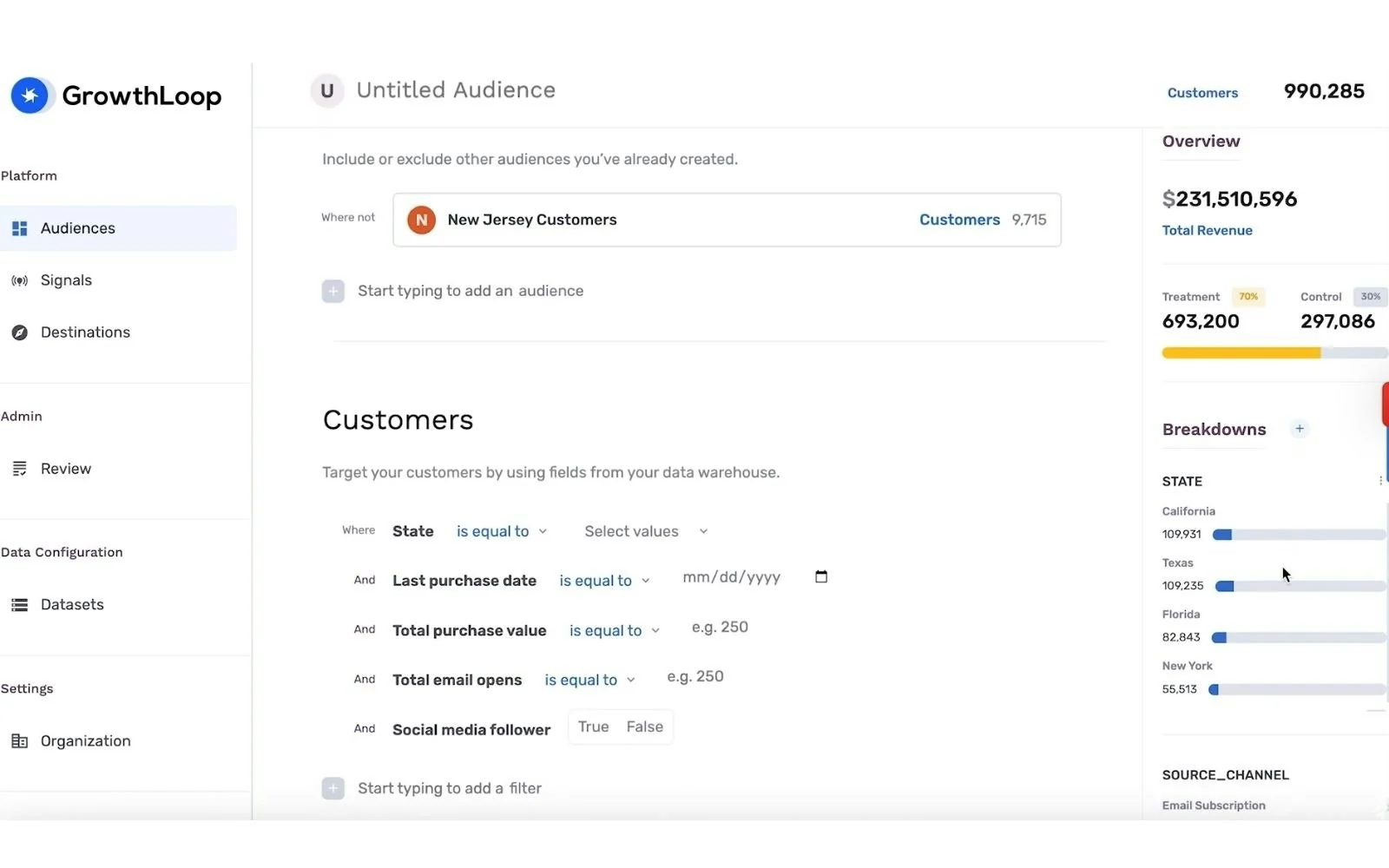
This independent overview covers what GrowthLoop does, how its architecture works, what it costs, what real users report, and when alternatives fit better. For a side-by-side comparison of all CDP vendors, see the [CDP Vendor Comparison Guide](/basics/cdp-vendors/).
## GrowthLoop at a Glance
| Dimension | GrowthLoop |
|---|---|
| **Best for** | Enterprise marketing teams with a modeled warehouse — especially BigQuery — that want to build and activate audiences without filing tickets with the data team |
| **Typical buyer size** | Mostly enterprise — 58.0% of the 112 G2 reviews classified by company size come from organizations above 1,000 employees, 33.0% from 51–1,000, and 8.9% from 50 or fewer |
| **Pricing model** | Quote-only, tiered by unique customer records (Basic / Growth / Enterprise). No free tier. Third-party median contract: $144,000/year (CostBench, n=4, June 2026) |
| **Typical implementation** | 6-8 weeks with a modeled warehouse (vendor claim); longer where warehouse modeling is still in progress |
| **Key differentiator** | A no-code marketer workflow plus incrementality-driven AI decisioning, now paired with first-party email and SMS sending — unusual for a composable vendor |
| **Skip if** | You need broad connector coverage (~60 destinations listed vs Hightouch's published 300+), standalone [identity resolution](/glossary/identity-resolution/), or event collection — GrowthLoop delegates all three to the warehouse |
Reviewer mix is not a customer base: where a G2 split is quoted above, it describes who reviews the vendor, not who buys it — reviewers self-select and vendors run review-solicitation campaigns. Those counts are G2's company-size-classified subset, which is smaller than the headline review count quoted elsewhere on a page; where a page names no split, the row rests on the structural fact stated in it rather than on reviewer data. The cross-vendor comparison and the methodology behind these splits are in [CDP vendors](/basics/cdp-vendors/).
## Product Evolution
GrowthLoop's history splits cleanly at 2022: seven bootstrapped years as a data-activation tool, then private-equity backing and a steady expansion of scope.
| Date | Milestone |
|------|-----------|
| 2015 | Founded as Flywheel Software by David Joosten, Chris Sell, Anthony Rotio, and Tameem Iftikhar. Bootstrapped |
| May 2022 | First institutional capital — a growth equity investment from The Jordan Company (TJC). Amount undisclosed |
| June 2023 | Rebranded Flywheel Software → GrowthLoop, repositioning from data activation to composable CDP |
| August 2024 | Chris O'Neill (former Evernote CEO, Google Canada MD) appointed CEO |
| April 2025 | "Compound Marketing Engine" launched — agentic AI running on the data cloud |
| January 2026 | TJC follow-on investment. Amount undisclosed |
| April 2026 | Composable AI Decisioning launched — Bayesian optimization against business outcomes rather than campaign metrics |
| April 2026 | Co-founders Anthony Rotio and Tameem Iftikhar named co-CEOs, replacing O'Neill after 20 months |
| July 2026 | Engagement Suite launched — Content Studio, Composable Destinations, and GrowthLoop Channels (first-party email and SMS) |
Two things stand out for buyers. GrowthLoop has had three CEO configurations in under two years, and its most architecturally significant release — native sending — shipped without a press release, announced only through a company blog post and LinkedIn. Composable AI Decisioning, three months earlier, got a full wire release. The quieter rollout is consistent with a controlled release rather than a finished, broadly available product.
## What GrowthLoop Does
- **Audience Builder** — a no-code visual segmentation canvas that compiles to SQL against the warehouse. This is the product's center of gravity and the capability reviewers cite most
- **Universal Journeys** — cross-channel orchestration across advertising platforms, CRMs, ESPs, and now GrowthLoop's own channels. Real-time Messaging, a 2025 addition, triggers journeys from event streams (Kafka, Pub/Sub, SQS) rather than waiting for a batch cycle
- **Composable AI Decisioning** — Bayesian multi-armed bandit optimization that targets business outcomes (lifetime value, ROAS, retention, margin) rather than campaign-level metrics, using holdout groups to measure [incremental lift](/glossary/incrementality-testing/). Results are written back to the warehouse so subsequent decisions inherit the history
- **Growth Agents / AI Studio** — agents that propose audiences and build journeys, executing after human approval
- **Engagement Suite** (July 2026) — Content Studio for templates and creative, Composable Destinations for triggering campaigns inside external platforms, and GrowthLoop Channels for sending directly
What GrowthLoop does not do is as relevant to an evaluation. It consumes event streams as journey triggers but does not collect, store, or model events — there is no SDK and no event store. It does not transform data, and it offers no standalone identity resolution product — a notable gap against Hightouch, which shipped Adaptive Identity Resolution in July 2025. Identity logic lives in the warehouse, which means it lives with the data team.
## Architecture: Warehouse-Native Reads, First-Party Sends
GrowthLoop queries the customer's warehouse in place. On the read path there is no ingestion pipeline and no vendor-side profile store: audience state, journey state, and metrics are written back to the warehouse rather than held privately. This is a conventional composable CDP.
The send path is a different matter, and the distinction is load-bearing for anyone signing a DPA.
The send side is where GrowthLoop now diverges from its category.
### Advantages of the Warehouse-Native Model
- **No duplicated profile store** — customer data stays under the warehouse's existing governance, access controls, and retention policy. No second copy to secure or reconcile
- **Marketer self-service without SQL** — the audience builder is the product's strongest reviewed capability. G2 reviewers rate Ease of Setup 9.2 against a CDP category average of 8.2
- **Portability of the data model** — because segment logic compiles against warehouse tables, replacing the activation layer does not require migrating customer data
- **Outcome data returns to the warehouse** — decisioning history accumulates where the rest of the customer data already lives, rather than inside a vendor's black box
### Structural Trade-Offs
- **Warehouse dependency** — a modeled warehouse is a hard prerequisite. Organizations without one must build it first, a multi-month project, before GrowthLoop delivers anything
- **Query latency** — warehouses answer analytical queries in seconds to minutes, not the milliseconds that in-session personalization requires. Real-time Messaging narrows this for event-triggered journeys but does not change how fast a profile can be read
- **No standalone identity resolution** — deterministic and probabilistic matching is the customer's problem to solve in SQL, or with a separate tool
- **Narrow connector coverage** — GrowthLoop lists roughly 60 destinations; Hightouch publishes 300+ (both retrieved August 27, 2026). GrowthLoop's own framing is depth over breadth, which holds up for mainstream advertising and CRM targets and does not for long-tail tools
- **PII still crosses boundaries at activation** — zero-copy describes the read path. Every activation to an external destination copies customer attributes out of the warehouse, exactly as reverse ETL does
## Engagement Suite: What Native Sending Does and Does Not Change
GrowthLoop Channels is real sending infrastructure, not relabeled orchestration. The product documentation is explicit: *"Use GrowthLoop Channels when you want GrowthLoop to send the message itself—rather than triggering a campaign inside Iterable, Salesforce Marketing Cloud, or another composable destination."* The configuration surface confirms it — sending domain DNS verification, sender identities, IP pools and warming, unsubscribe groups, and SMS number and short-code provisioning. Products that merely trigger an external ESP do not ask you to warm an IP pool.
Four qualifications belong alongside that.
**It is email and SMS only.** No primary source describes native push. Push remains an external destination.
**The delivery layer is SendGrid.** GrowthLoop's own documentation states that for GrowthLoop Email and SMS, *"sends use SendGrid."* First-party here means GrowthLoop controls the sending configuration and the campaign object, not that it operates the underlying delivery infrastructure. That distinction matters twice: for deliverability escalations, and because it inserts two sub-processors — GrowthLoop's send layer and Twilio SendGrid — into the customer-data chain.
**Availability is gated.** The setup documentation lists a prerequisite: *"GrowthLoop has enabled Channels for your organization (contact support@growthloop.com if you do not see Channels in the sidebar)."* Engagement Suite appears on all three public pricing tiers and carries no beta label, but there is no dedicated product page and no press release. Treat it as a controlled release, not a proven, broadly deployed capability.
**Naming is inconsistent.** Marketing calls the content module Content Studio; the documentation and in-app sidebar call it Content Library.
### The PII Reality
Zero-copy describes audience computation, not delivery. Sending requires persisted recipient-side records: unsubscribe groups, suppression state, sender identities, and message payloads live inside GrowthLoop and SendGrid, not in the warehouse. Consent data in particular now has a second home, and the page's usual "outcomes return to the warehouse" pattern is not documented to cover it.
For a data or privacy team, adopting Channels adds two sub-processors to the DPA, the SOC 2 review, and the breach-notification runbook — a smaller expansion than adding a full ESP, but an expansion. GrowthLoop's documentation does not answer four questions worth raising before signing: whether Channels runs on GrowthLoop's own SendGrid tenant or a customer-owned subaccount; whether SendGrid appears on GrowthLoop's published sub-processor list; whether EU data residency is available for the send layer; and whether unsubscribe state syncs back to the warehouse or forks from it.
Activation to external destinations carries the ordinary reverse ETL exposure on top of this — see [CISO Guide to CDP Architecture](/articles/ciso-guide-cdp-architecture/) for how that compares across CDP architectures.
### The Latency Reality
Real-time Messaging consumes event streams (Kafka, Pub/Sub, SQS), so a cart abandonment at 2:00 PM can trigger a journey within seconds rather than waiting for the next batch window. That is a genuine improvement over scheduled reverse ETL syncs.
What GrowthLoop does not publish is what happens next. If the journey step needs any attribute not carried on the event payload — lifetime value, segment membership, a propensity score — that lookup is a warehouse query, and warehouse queries answer in seconds to minutes. Whether Channels sends on the stream payload alone or enriches from the warehouse first is the difference between a sub-second send and a multi-minute one, and the documentation does not say. Ask for the enrichment path and a measured end-to-end time before assuming real-time behavior.
The strategic reading is straightforward. Under the [Customer Intelligence Loop](/glossary/customer-intelligence-loop/), a composable stack breaks at the ENGAGE stage — outcomes must traverse an external ESP before returning to the warehouse. Owning the send path closes that gap for email and SMS. A composable vendor moving delivery inside its own boundary is evidence for the bundling thesis, not against it, and it is a partial move: the loop still opens wherever GrowthLoop routes through Composable Destinations to Iterable, Salesforce Marketing Cloud, or Braze.
## Pricing
GrowthLoop publishes no prices. Three tiers — Basic, Growth, Enterprise — are quoted against the number of unique customer records in the data cloud, with no free tier and no per-sync or per-destination metering. Feature gating is real: independent analysis places AI Studio, Growth Agents, and incrementality measurement on the Enterprise tier.
Record-based pricing is more predictable than the usage-based model Hightouch uses, and G2 reviews support that in an unusual way: across 112 reviews, license cost is essentially absent from the complaints. The counterweight is that unique customer records only accumulate. Tier boundaries are cliff events at renewal, so a contract priced at 4 million records is not the contract you renew at 7 million.
### The TCO Reality
The cost does not disappear — it moves to the warehouse bill. Every audience build, journey evaluation, and sync is a query the customer pays for. A total-cost estimate should carry:
For a mid-market retailer with 5 million unique customer records and ten activation destinations — the same basis used on the [Hightouch page](/articles/what-is-hightouch/) — budget four components:
- **GrowthLoop license** — record-count tiers, quote-only. The CostBench median below is the only public anchor
- **Warehouse compute** — the variable component, and the one a record-based license does not cap. GrowthLoop does not publish whether audience evaluation is incremental or a full recomputation, or how often journeys re-evaluate membership. A nightly full recompute of a 5-million-record audience across a dozen journeys is a materially different BigQuery bill than a diffed sync. Ask for the query pattern and a slot-hour estimate
- **Data engineering** — 2-3 FTEs at $150,000-$200,000 loaded cost for warehouse modeling and identity logic, since GrowthLoop supplies neither
- **External ESP licensing** — reducible for email and SMS via GrowthLoop Channels, but still required for push and for teams keeping creative in Braze or Iterable
- **Warehouse activation-readiness services** where the data model is not yet campaign-ready
The only public benchmark is a CostBench median of $144,000/year, drawn from four third-party buyer reports and labeled by CostBench itself as *"Indicative market pricing — not official vendor pricing or contract-grade data."* Vendr, Spendflo, and Tropic publish no GrowthLoop figure. Four data points is a weak basis for a benchmark, and it is the strongest one available.
Where suite-embedded CDPs impose a [suite tax](/glossary/suite-tax/), composable CDPs impose an engineering tax. GrowthLoop reduces the marketer-side friction of that tax without removing the tax itself. For a fuller breakdown, see [CDP Pricing: Models, Ranges, and Hidden Costs](/articles/cdp-pricing/).
## Strengths
GrowthLoop holds a 4.7/5 rating across 112 G2 reviews (retrieved August 27, 2026), against Hightouch's 4.6 across 404. The higher score sits on roughly a quarter of the sample, so treat the gap as directional. The review base skews enterprise: 65 of 112 reviewers come from organizations above 1,000 employees.
- **Marketer self-service is the consistent theme.** Customer Support (35 mentions) and Ease of Use (34) lead G2's pros clustering. One enterprise reviewer reported GrowthLoop *"made audience creation at least 10x faster and significantly increased the number of users (esp non technical) that were able to create audiences"* compared with an in-house application
- **Support quality is rated well above category average** — 9.8 against 9.1 for the CDP category on G2's Quality of Support metric
- **Outcome-level AI optimization.** Optimizing against lifetime value and margin with holdout-based incrementality measurement is a more defensible approach than campaign-metric optimization, and it is unusual at this price point
- **Commerce and retail media traction.** Costco (August 2025), Gopuff (June 2026), and Whirlpool (July 2026) are named in wire releases. GrowthLoop's published customer list adds Google, Indeed, Mercari, NASCAR, PGA Tour, and the Boston Red Sox
## Limitations
These reviews carry a timing caveat that materially affects how they should be read: nearly all of them predate Engagement Suite (July 2026), so none evaluates the native sending layer.
- **Performance lag** is G2's largest cons cluster (5 mentions), described as *"occasional lags that hinder workflows."* The complaints are mild in tone — one reviewer offered *"Sometimes it takes a while to load, but that could be my internet connection"* — but they cluster consistently around sync and query responsiveness
- **Learning curve** (4 mentions). A mid-market reviewer: *"The downside is trying to teach people how to use GrowthLoop. There is a lot in the tool and a lot of different data points you can segment on."* Independent analysis reaches the same conclusion, noting that *"implementation can be complex and time-consuming"* and that audience logic gets harder to manage as use cases multiply
- **Data access friction.** Attributes outside the primary dataset require manual configuration. One enterprise reviewer migrating from another CDP noted: *"any attribute that the user needs to export that is not on the primary dataset must be configured as a custom attribute. For the client I work with, most of our 'export' attributes are on not on the primary dataset so we 'feel' this a bit"*
- **Silent failures.** G2's error-reporting cluster centers on missing notifications when a filter stops working — a failure mode that quietly changes audience volumes rather than raising an alert
- **Poor fit below enterprise scale**, per reviewers themselves. One reviewer: *"GrowthLoop would not be a great platform for small businesses with simple needs and/or centralized data."* Only 10 of 112 reviewers come from organizations under 50 employees
- **Analyst coverage is thin**, covered below
## Market Position
GrowthLoop's absence from analyst evaluations is the clearest gap between its positioning and its recognized standing. It does not appear anywhere in the 2026 Gartner Magic Quadrant for Customer Data Platforms — not as a Leader, Challenger, Visionary, or Niche Player. Hightouch does, and as a first-time entrant it landed directly in the Leaders quadrant alongside Salesforce, Oracle, and Uniphore ([CX Today](https://www.cxtoday.com/customer-analytics-intelligence/gartner-magic-quadrant-cdp-2026/), February 2026). Magic Quadrant inclusion turns on revenue and customer-count thresholds rather than assessed quality, so absence reflects scale rather than an adverse verdict. It still matters for buyers who weight analyst validation, because two vendors sharing a category and a thesis with only one of them evaluated is the shortlist most enterprises start from.
GrowthLoop's most-cited third-party recognition is a "One to Watch" designation in Snowflake's Modern Marketing Data Stack report. That designation is sourced entirely to GrowthLoop's own press releases; Snowflake's partner directory listing records a Select partner tier without it. "One to Watch" is also, by construction, a label for vendors that are not yet principals.
PeerSpot ranks GrowthLoop 13th in its CDP category against Hightouch's 9th, with mindshare of 2.0% versus 4.2% as of August 2026 — both declining year over year, which says as much about warehouse vendors absorbing this category as it does about either company.
None of this speaks to product quality, and buyers weighting user-reported outcomes over analyst placement will read the G2 data as the more relevant evidence. It does mean GrowthLoop will rarely appear on a shortlist assembled from analyst reports.
## Who Should Consider GrowthLoop
GrowthLoop fits organizations that meet most of these criteria:
- **A modeled warehouse already in production** — BigQuery most commonly, though Snowflake, Databricks, and Redshift are supported
- **Marketing-led audience operations** — the core value is removing the data-team ticket queue, which only matters if that queue is the bottleneck
- **Enterprise scale** — reviewers, pricing tiers, and the vendor's own customer list all point the same direction
- **Outcome-based optimization goals** — teams measuring lifetime value or margin rather than click-through rates get more from the decisioning layer than teams running batch campaigns
- **Retail media or commerce media operations**, where GrowthLoop has concentrated its 2026 product investment
GrowthLoop is a weaker fit for organizations that:
- Need broad connector coverage, standalone identity resolution, or event collection
- Need sub-second profile access for in-session personalization
- Require native push notifications, which GrowthLoop does not send
- Weight analyst validation heavily in vendor selection
- Are small or mid-sized with centralized data, where a marketing automation platform is the better answer
- Want a delivery layer that is proven at scale — Engagement Suite is roughly a month old and gated per organization
## What to Ask GrowthLoop on the Call
This page leaves four questions genuinely open, because GrowthLoop does not publish the answers. Each is answerable in a single vendor call and each changes the evaluation:
1. **Is Engagement Suite enabled for an organization our size today, and how many customers are sending production volume through Channels?** The capability is gated per organization and roughly a month old
2. **Is audience evaluation incremental or a full recomputation, and what slot-hour estimate should we model?** This is the single largest variable in total cost, and it lands on our warehouse bill rather than the license
3. **Who owns a deliverability escalation when SendGrid is the underlying sender, and is SendGrid on your published sub-processor list?** Ask the same question about EU data residency for the send layer
4. **What happens to record-tier pricing at renewal as our record count grows?** Establish the tier boundaries and the escalation terms before the first contract, not the second
## Alternatives to GrowthLoop
Organizations evaluating alternatives generally look at three categories. [Hightouch](/articles/what-is-hightouch/) is the direct composable comparison — roughly five times the published connector coverage, standalone identity resolution, event collection, and Gartner Leader placement, at the cost of a more engineering-centric workflow and no native sending. Third-party comparisons consistently frame this as a use-case choice rather than a ranking: Hightouch where integration breadth and data-platform capabilities dominate, GrowthLoop where marketer autonomy and AI-driven campaign automation do.
[Agentic CDPs](/glossary/agentic-cdp/) bundle unification, messaging, and AI decisioning inside one boundary, closing the feedback loop that composable stacks leave open — the destination GrowthLoop's native send layer is partially moving toward. Suite-embedded CDPs such as [Salesforce Data Cloud](/articles/what-is-salesforce-data-cloud/) and [Adobe Real-Time CDP](/articles/what-is-adobe-cdp/) fit organizations already committed to those ecosystems.
Teams committed to the composable approach can compare Hightouch, Census, RudderStack, and Treasure AI's Composable CDP in the [composable CDP vendors section](/basics/cdp-vendors/#composable-cdp-vendors) of our vendor guide.
**→ [Compare all CDP vendors side-by-side in the CDP Vendor Comparison Guide](/basics/cdp-vendors/)**
*See how independent analysts evaluate CDP vendors — download the [Forrester Wave](https://www.treasure.ai/forrester-wave-cdp/?utm_source=cdp-dot-com&utm_medium=website-referral&utm_campaign=articles&utm_content=inline) or [IDC MarketScape](https://www.treasure.ai/idc-marketscape-2026?utm_source=cdp-dot-com&utm_medium=website-referral&utm_campaign=articles&utm_content=inline) reports for a side-by-side comparison.*
## Related Articles
- [What Is Hightouch?](/articles/what-is-hightouch/) — The direct composable CDP comparison
- [Reverse ETL vs CDP: What Reverse ETL Can and Cannot Do](/articles/reverse-etl-vs-cdp/) — Where warehouse-native activation stops
- [What Is Databricks CustomerLake?](/articles/what-is-databricks-customerlake-cdp/) — Warehouse vendors entering the activation layer
- [CDP Alternatives: 7 Options Compared](/articles/cdp-alternatives/) — When each CDP alternative makes sense
- [How to Evaluate a CDP in the AI Era](/articles/how-to-evaluate-cdp-ai-era/) — Evaluation criteria for AI-era requirements
## FAQ
### Is GrowthLoop a CDP?
**GrowthLoop is a composable CDP — it covers segmentation, orchestration, decisioning, and activation, but not ingestion, storage, or standalone identity resolution.** Those remain with the warehouse. Its July 2026 addition of first-party email and SMS sending makes it more complete than a pure [reverse ETL](/glossary/reverse-etl/) tool, though delivery runs on SendGrid underneath and push is still handled by external platforms.
### How much does GrowthLoop cost?
**GrowthLoop publishes no prices — quotes are tiered by unique customer records across Basic, Growth, and Enterprise plans, with no free tier.** The only public benchmark is a $144,000/year median from CostBench, drawn from four buyer reports (June 2026) and labeled indicative rather than contract-grade. Budget separately for warehouse compute, which absorbs the query cost of every audience build and sync.
### Does GrowthLoop send email and SMS itself?
**Yes — GrowthLoop Channels, launched July 2026, sends email and SMS directly, with GrowthLoop-controlled sending domains, IP pools, and unsubscribe groups.** Delivery runs on SendGrid infrastructure. Push notifications are not sent natively. GrowthLoop also still triggers campaigns inside Iterable, Salesforce Marketing Cloud, and Braze, and the capability is enabled per organization rather than broadly self-service.
### How does GrowthLoop compare to Hightouch?
**Hightouch suits data teams; GrowthLoop suits marketing teams.** Hightouch publishes 300+ destinations, standalone identity resolution, event collection, and 2026 Gartner Magic Quadrant Leader placement. GrowthLoop offers a no-code audience builder, outcome-level AI decisioning with incrementality measurement, and native email and SMS — with roughly 60 destinations and no analyst coverage.
### Is GrowthLoop the right CDP for my organization?
**GrowthLoop is the right CDP when you have a modeled warehouse and marketers blocked behind a data-team queue — and the wrong fit when connector breadth or identity resolution is the requirement.** Choose it if enterprise marketing self-service and outcome-based optimization are the priority. Skip it without a modeled warehouse, below enterprise scale, or where analyst validation is required.
### What are the alternatives to GrowthLoop?
**The main alternatives are [Hightouch](/articles/what-is-hightouch/) and Treasure AI among composable vendors, [agentic CDPs](/glossary/agentic-cdp/) that bundle data, messaging, and AI in one boundary, and suite-embedded CDPs.** Treasure AI is the one vendor spanning both models — a composable CDP for zero-copy warehouse queries, and a complete CDP adding real-time identity stitching and native messaging. For a full comparison, see the [CDP Vendor Comparison Guide](/basics/cdp-vendors/).
---
### What Is Hightouch? Features, Pricing, and Alternatives
URL: https://cdp.com/articles/what-is-hightouch/
**Hightouch is a warehouse-native activation platform that uses [reverse ETL](/glossary/reverse-etl/) to sync customer data from cloud data warehouses (Snowflake, BigQuery, Databricks, Redshift) to marketing, sales, and advertising tools.** Founded in 2019, Hightouch has repositioned from reverse ETL tool to [composable CDP](/glossary/composable-cdp/) (2022) to "agentic marketing platform" (2025) to "[agentic CDP](/glossary/agentic-cdp/)" (2026) — though the underlying architecture remains the same: query the warehouse, push results to external destinations. It does not store customer data or send messages natively.
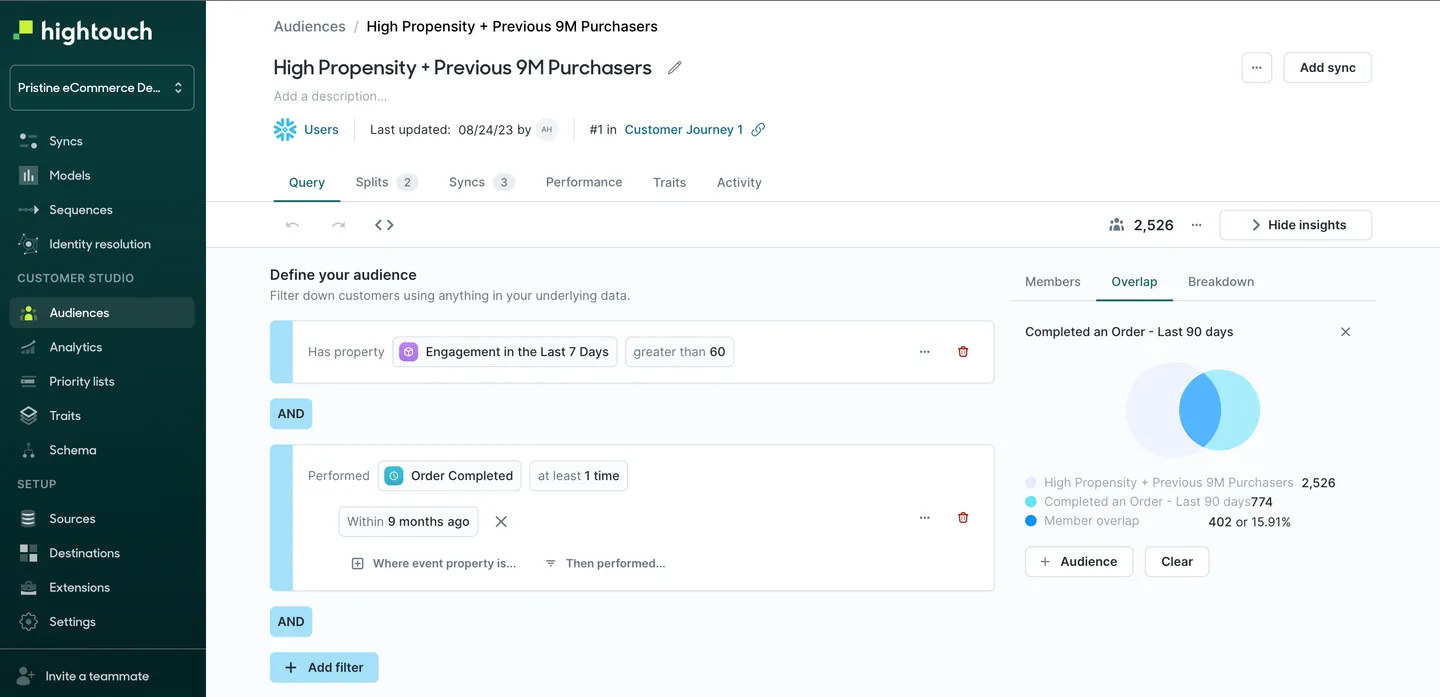
Hightouch reports being named a Leader in the [2026 IDC MarketScape for Worldwide AI-Enabled Customer Data Platforms for B2C Users](https://hightouch.com/about) (IDC doc US53952526) — a different evaluation lens than cdp.com's own [agentic CDP litmus test](/glossary/agentic-cdp/#the-agentic-cdp-litmus-test), which scores architecture (native messaging, real-time profiles, closed feedback loops) rather than strategy and market execution. Hightouch was not named a Leader in IDC's companion [B2B MarketScape](https://my.idc.com/getdoc.jsp?containerId=US53952326), which named Treasure AI and Salesforce among its Leaders.
This independent overview covers what Hightouch does, how its warehouse-native architecture works, what it costs, what real users say, and when alternatives may be a better fit. For a side-by-side comparison of all CDP vendors, see the [CDP Vendor Comparison Guide](/basics/cdp-vendors/).
## Hightouch at a Glance
| Dimension | Hightouch |
|---|---|
| **Best for** | Data teams with a mature, well-modeled warehouse (Snowflake, BigQuery, Databricks, Redshift) that want to activate warehouse data directly |
| **Typical buyer size** | Mostly mid-market — 62.6% of the 401 G2 reviews classified by company size come from companies of 51–1,000 employees and 23.9% from 50 or fewer, while only 13.5% come from above 1,000 |
| **Pricing model** | Usage-based: active syncs (not destinations) for reverse ETL and the Composable CDP plan, monthly "personalized actions" for the Agentic Marketing Platform plan; free Basic tier up to 2 active syncs, enterprise plans quote-based |
| **Typical implementation** | 2-6 weeks (if the warehouse is already modeled) |
| **Key differentiator** | Reverse ETL composable CDP — activate directly from the warehouse without duplicating data into a separate CDP |
| **Skip if** | No modeled warehouse, no standing data engineering capacity to maintain one, or your ESP already syncs natively from the warehouse |
Reviewer mix is not a customer base: where a G2 split is quoted above, it describes who reviews the vendor, not who buys it — reviewers self-select and vendors run review-solicitation campaigns. Those counts are G2's company-size-classified subset, which is smaller than the headline review count quoted elsewhere on a page; where a page names no split, the row rests on the structural fact stated in it rather than on reviewer data. The cross-vendor comparison and the methodology behind these splits are in [CDP vendors](/basics/cdp-vendors/).
## Product Evolution
Unlike suite-embedded CDPs that evolved through acquisitions and rebranding, Hightouch's evolution has been about expanding scope from a single-purpose tool to a broader platform — while the underlying reverse ETL mechanism remains the foundation.
| Year | Milestone |
|------|-----------|
| 2019 | Founded by Tejas Manohar, Josh Curl and Kashish Gupta as a reverse ETL tool |
| 2020–2021 | Growth alongside the modern data stack movement. Reverse ETL category takes shape |
| 2022 | "Composable CDP" positioning begins — Hightouch reframes reverse ETL as a CDP alternative |
| 2023 | Customer Studio launched — no-code audience builder expanding beyond data engineering users |
| 2024 | AI Decisioning launched — reinforcement learning for campaign-level optimization |
| July 2025 | Adaptive Identity Resolution launched — AI-powered [identity resolution](/glossary/identity-resolution/) within the warehouse |
| 2025 | "Agentic marketing platform" positioning — the latest framing of the same architecture |
| June 2026 | "[Agentic CDP](/glossary/agentic-cdp/)" positioning — "The Agentic CDP" blog published, claiming the Stage 3 label while architecture remains warehouse-native reverse ETL |
The progression from "reverse ETL tool" to "composable CDP" to "agentic marketing platform" to "agentic CDP" reflects strategic repositioning to capture broader market categories. Each shift adds capabilities (audience building, identity resolution, AI decisioning) on top of the same warehouse-query-and-sync foundation. This is worth understanding because it determines what Hightouch can and cannot do architecturally.
## What Hightouch Does
Hightouch's capabilities have expanded significantly since its reverse ETL origins:
- **Reverse ETL activation**: The core capability. Hightouch connects to a data warehouse, runs SQL queries or visual audience definitions, and syncs the results to 300+ destinations (CRMs, ESPs, ad platforms, analytics tools). Every sync is a data push from warehouse to destination
- **Customer Studio**: A no-code audience builder launched in 2023 that lets marketers create segments without writing SQL. Designed to bridge the gap between data engineering and marketing teams
- **Adaptive Identity Resolution**: Launched July 2025, this provides AI-powered identity matching within the warehouse — deterministic and probabilistic matching without requiring a separate identity tool. Before this launch, identity resolution was delegated to warehouse SQL logic or third-party tools
- **AI Decisioning**: Reinforcement learning-style optimization for campaign-level decisions — channel selection, send timing, offer ranking, [next-best-action](/glossary/next-best-action/) recommendations. Operates on warehouse data
- **Hightouch Events**: Collects behavioral data (web, mobile) and streams it to the warehouse, addressing the data collection gap that pure reverse ETL tools leave open
- **Data modeling integration**: Works with dbt and warehouse-native transformation tools. Hightouch does not provide its own transformation or modeling layer
Notably, Hightouch does not store customer data in its own platform and does not provide native messaging (email, SMS, push). Every activation requires an external destination tool.
## Architecture: Warehouse-Native Activation Platform
Hightouch's architecture is fundamentally different from suite-embedded CDPs like [Salesforce Data Cloud](/articles/what-is-salesforce-data-cloud/) and [Adobe Real-Time CDP](/articles/what-is-adobe-cdp/). Rather than ingesting data into a proprietary platform, Hightouch sits on top of the customer's existing data warehouse and activates data in place.
 *Diagram based on Hightouch's product documentation and composable CDP architecture, with editorial annotations showing data flow and cost components.*
The diagram above shows the composable CDP data flow: sources feed into a cloud data warehouse (Snowflake, BigQuery, Databricks, or Redshift), which Hightouch queries via reverse ETL. Each sync copies customer PII from the warehouse to destination tools — including a separate ESP for messaging (e.g., Braze or Iterable at $50K–150K+/yr). Campaign outcome data returns to the warehouse via batch ingestion, creating an AI feedback loop measured in hours to days rather than seconds — meaning AI cannot learn from campaign outcomes in real time. Total cost of ownership spans 4–6 separate vendors (assumes mid-market, ~5M profiles, 10 destinations): Hightouch license, warehouse compute, ESP, data ingestion tools (Fivetran/Airbyte), and 3–5 data engineering FTEs ($150K–200K/yr each). This architecture works well for organizations with mature warehouse infrastructure and batch-oriented use cases — see [Advantages](#advantages-of-warehouse-native-architecture) below.
### Advantages of Warehouse-Native Architecture
- **No separate data store**: Customer data stays in the organization's existing warehouse. No migration into a proprietary CDP database, and no duplicated storage costs. For organizations with mature warehouse infrastructure, this preserves existing investments in data modeling and governance
- **SQL-first flexibility**: Data engineers can define audiences, transformations, and enrichments using familiar tools (SQL, dbt). No proprietary query language to learn
- **Fast initial deployment**: Organizations with well-modeled warehouses can deploy Hightouch in 2–6 weeks. G2 reviewers consistently cite rapid setup as the strongest differentiator — claims of "15 minutes to first sync" are common for simple use cases
- **Vendor portability**: Because customer data remains in the warehouse, switching activation tools does not require data migration — only reconnecting a new tool to the same warehouse tables
### Structural Trade-Offs
- **Warehouse dependency**: Hightouch requires a well-modeled data warehouse as a prerequisite. Organizations without mature warehouse infrastructure must build one first — a project measured in months and requiring dedicated data engineering resources — before Hightouch can deliver value
- **[Real-time](/glossary/real-time-cdp/) limitations**: Data warehouses are optimized for analytical queries, not sub-second profile lookups. In-session personalization, triggered messaging, and real-time AI decisioning require API-speed profile access (milliseconds) that warehouse query latency (seconds to minutes) cannot deliver. This is a structural constraint of the warehouse-native architecture, not an implementation gap
- **[PII](/glossary/pii-personally-identifiable-information/) duplication at activation**: Despite the "data stays in the warehouse" positioning, every reverse ETL sync copies customer data to destination tools. The more destinations and the more frequent the syncs, the more PII is duplicated across vendor boundaries — expanding compliance surface area for [data governance](/glossary/data-governance/) teams
- **No native messaging**: Hightouch does not send emails, SMS, or push notifications. Every campaign execution requires an external ESP or messaging platform, which means every send involves a PII transfer across vendor boundaries
- **Open feedback loops**: [AI decisioning](/glossary/ai-decisioning/) operates on warehouse data, but outcomes from external activation tools (opens, clicks, conversions) must flow back through the destination, into the warehouse, and then be available for the next model query. This cycle is measured in hours, not seconds — preventing the real-time closed feedback loops that [agentic marketing](/glossary/agentic-marketing/) requires
## The Reverse ETL Model: How Hightouch Activates Data
Understanding Hightouch's activation mechanism is essential for evaluating its fit. The [reverse ETL](/glossary/reverse-etl/) model works in four stages:
1. **Query**: Hightouch connects to the warehouse and runs a SQL query (or Customer Studio visual definition) to identify the target audience — for example, "customers who abandoned cart in the last 24 hours with lifetime value above $500"
2. **Diff**: On each sync cycle, Hightouch compares current query results to the previous sync to identify changes — new audience members, removed members, and updated attributes
3. **Sync**: Changed records are pushed to destination tools via API calls. Each sync is a data transfer containing customer attributes — email addresses, names, behavioral data, segment membership
4. **Monitor**: A dashboard displays sync status, row counts, error rates, and latency
### The PII Reality
Consider an organization syncing a "high-value customers" segment to Braze (email), Google Ads (advertising), and Salesforce CRM (sales). Each sync copies customer email addresses, names, purchase history, and behavioral attributes to three separate vendor systems. The warehouse now shares PII with four external boundaries: Hightouch's sync layer, Braze, Google Ads, and Salesforce CRM. Each vendor requires a separate DPA, SOC 2 review, and GDPR breach notification process. The more destinations an organization activates, the more this surface area expands — directly contradicting the "data stays in the warehouse" promise at the moment it matters most: activation.
For a deeper analysis of PII implications across CDP architectures, see [CISO Guide to CDP Architecture](/articles/ciso-guide-cdp-architecture/).
### The Latency Reality
Consider a real-time use case: a customer abandons a shopping cart at 2:00 PM. In a warehouse-native architecture, the event must first land in the warehouse (2:05 PM via streaming ingestion, or next batch window). Hightouch's sync must then run (next scheduled cycle — perhaps 3:00 PM). The audience update reaches the ESP, which triggers the email (3:15 PM). The customer receives a recovery email over an hour after abandoning the cart.
For batch-oriented use cases (daily audience syncs, weekly CRM enrichment, ad platform audience loading), this latency is perfectly acceptable. For real-time personalization and in-session decisioning — where reaching the customer within seconds matters — it is a structural limitation of the warehouse-native model.
## Pricing
| Pricing | Hightouch |
|---|---|
| **Priced on** | Active syncs — no caps on sources, destinations, or user seats, and no monthly-tracked-user limit |
| **Published price** | Free Basic Reverse ETL tier, up to 2 active syncs (pricing page, retrieved August 2026) |
| **Reported contract range** | No public contract data; the Composable CDP and Agentic Marketing Platform plans are quote-based, and G2 reviewers report pricing scales quickly with sync volume |
| **Priced separately** | Warehouse compute for every sync, 3–5 data engineers ($150,000–$200,000 loaded cost each), messaging tools (Braze, Iterable, Klaviyo), identity resolution unless using Adaptive Identity Resolution |
Hightouch meters usage on active syncs, not on destinations. Its pricing page states there are "no caps on sources, destinations, or user seats" and no monthly-tracked-user limit, and the free Basic Reverse ETL tier is bounded at 2 active syncs with unlimited destinations and seats (retrieved August 2026). The Composable CDP and AI Decisioning plans are quote-based.
Unlike suite-embedded CDPs where pricing opacity is the primary concern, Hightouch's entry-level pricing appears straightforward. The challenge emerges at scale.
### The TCO Reality
List pricing for Hightouch alone does not reflect the total investment. A complete composable CDP stack typically requires:
- **Hightouch license** — usage pricing that scales with the number of active syncs and the volume each one moves
- **Data warehouse compute** — every Hightouch sync runs a query against the warehouse; high-frequency syncs across many destinations compound compute costs
- **Data engineering headcount** — composable stacks typically require 3–5 dedicated engineers ($150,000–$200,000/year loaded cost per engineer) for warehouse modeling, identity resolution pipelines, sync maintenance, and on-call rotation
- **External messaging tools** — Braze, Iterable, Klaviyo, or another ESP for email/SMS activation (separate license)
- **Identity resolution tooling** — unless using Adaptive Identity Resolution (July 2025), a separate identity tool or custom warehouse logic
G2 reviewers flag cost escalation as a top concern. A [reviewer who used Hightouch for over two years](https://www.g2.com/products/hightouch/reviews/hightouch-review-11993194) reported: *"They decided to completely change the conditions making it unaffordable, all within 2 months. They did not communicate properly about the changes making our account completely unaccessible, and leaving us with no way to migrate our data."* (Quality of Support: 1/10, Business Partner: 1/10). [Another reviewer noted](https://www.g2.com/products/hightouch/reviews/hightouch-review-7623136): *"Pricing is too high for small organizations. Doesn't have much to differentiate it from competitors. Price scales quickly."*
Where suite-embedded CDPs impose a [suite tax](/glossary/suite-tax/) (licensing products you don't need), composable CDPs impose an engineering tax — the ongoing cost of maintaining warehouse models, sync pipelines, and multi-vendor integrations. Both patterns increase TCO beyond the initial license.
For a detailed breakdown of how different CDP architectures compare on pricing, see [CDP Pricing: Models, Ranges, and Hidden Costs](/articles/cdp-pricing/).
## Strengths
A fair evaluation of Hightouch should acknowledge its genuine advantages:
- **Fastest time to first value**: The most consistently praised aspect in G2 reviews. Organizations with existing warehouse models can run their first sync in minutes, not months. This is a genuine differentiator versus suite-embedded CDPs that require multi-month implementations
- **Warehouse-first philosophy**: Respects data engineering best practices. SQL-first, dbt-compatible, and the warehouse remains the system of record. For data teams that have invested heavily in modern data stack infrastructure, Hightouch extends rather than replaces that investment
- **Customer Studio**: The no-code audience builder bridges the gap between data engineering and marketing, allowing marketers to create segments without SQL and without filing engineering tickets — addressing the self-service gap that plagued early reverse ETL tools
- **Support quality**: G2 reviewers consistently highlight Slack-based, hands-on support as a genuine strength. Named individuals receive praise — a rarity in enterprise software reviews
- **Growing AI capabilities**: AI Decisioning and Adaptive Identity Resolution demonstrate investment in moving beyond pure reverse ETL toward a more complete CDP feature set
- **Modern UI**: Clean, developer-friendly interface that G2 reviewers describe as intuitive and well-designed
## Limitations
These are structural trade-offs inherent to the warehouse-native activation architecture. G2 reviews surface consistent themes:
- **Cost escalation and pricing unpredictability**: Usage pricing multiplied by active-sync count multiplied by sync frequency scales non-linearly. Beyond gradual cost growth, one [reviewer reported](https://www.g2.com/products/hightouch/reviews/hightouch-review-11993194) that Hightouch *"completely changed the conditions making it unaffordable, all within 2 months"* — leaving their *"account completely unaccessible"* with *"no way to migrate our data."* For a platform whose core promise is that data stays in the customer's warehouse, this vendor lock-in at the activation layer is a significant trust concern
- **Sync latency**: Reverse ETL syncs run on schedules (minutes to hours), not in real time. [One reviewer reported](https://www.g2.com/products/hightouch/reviews/hightouch-review-7859170): *"The sync times are slow and our reps complain that the sync takes hours."* [Another noted](https://www.g2.com/products/hightouch/reviews/hightouch-review-7623136): *"Hightouch has more latency than its competitors."* This is a structural constraint of the warehouse-native model — the warehouse is not designed for sub-second activation
- **PII duplication across vendor boundaries**: Every reverse ETL sync copies customer data to external tools. The "data stays in the warehouse" promise holds for storage and modeling but breaks at the moment of activation — exactly when PII protection matters most. Each destination adds a vendor boundary that CISOs and DPOs must audit, govern, and include in breach notification processes
- **No closed feedback loops for AI**: AI Decisioning operates on warehouse data, but campaign outcomes (opens, clicks, conversions) live in external activation tools. These outcomes must flow back through the destination tool, into the warehouse, and then be available for Hightouch's next query — a cycle that can take hours. This structural separation prevents the real-time learning that autonomous [AI agents](/glossary/agentic-ai/) require. For a deeper analysis, see [AI Feedback Loops and CDP Architecture](/articles/ai-feedback-loops-cdp-architecture/)
- **On-call burden on data engineering**: When a sync breaks at 2 AM — due to a warehouse schema change, an API rate limit, or a destination outage — the data engineering team is paged. In a composable stack, every connector is a potential failure point that the customer's own engineers must debug and resolve. Packaged CDPs absorb this operational burden; composable stacks push it to the customer's on-call rotation. The cost is not just headcount but engineering attention diverted from building data products
- **Marketer self-service bottleneck**: Customer Studio provides no-code audience building, but the data underneath must be "activation-ready" in the warehouse — clean, modeled, and joined correctly. When data is missing, malformed, or not yet modeled, marketing campaigns stall until a data engineer can allocate time to fix the warehouse layer. In packaged CDPs, data collection, identity resolution, and segmentation are designed as a self-contained workflow that non-technical marketers can operate end-to-end. In composable stacks, marketer autonomy is bounded by the data engineering team's availability and backlog
- **Warehouse concentration risk**: Composable CDPs are positioned as reducing vendor lock-in, but they concentrate all infrastructure risk on a single warehouse vendor. If the warehouse vendor changes its compute pricing, the economics of the entire CDP stack shift. The warehouse becomes a single point of failure for data unification, identity resolution, segmentation, and activation simultaneously
- **No end-to-end observability**: Each component in a composable stack (warehouse, Hightouch, ESP, ad platform) has its own monitoring dashboard, but no system provides end-to-end visibility. If sync A succeeds but sync B fails silently, downstream tools operate on stale data without knowing it. Verifying that the right customer received the right message at the right time requires manually correlating logs across 4–5 systems — a process that is impractical at scale and impossible to automate across vendor boundaries
- **Operational friction at scale**: [G2 reviewers report](https://www.g2.com/products/hightouch/reviews/hightouch-review-7026030): *"Error messages are not the most helpful. Not able to set the time of day at which your data sync happens. Adding descriptions for each of your syncs is not supported so figuring out what other people have done is often down to looking into the SQL in detail."* These are productivity concerns that compound as the number of syncs and team members grows
- **Identity resolution complexity before July 2025**: Before the launch of Adaptive Identity Resolution in July 2025, composable CDP users had to build their own identity resolution logic in SQL — one of the most complex data engineering challenges in customer data management. Cross-device and cross-channel [identity graphs](/glossary/identity-graph/) require probabilistic matching, transitive closure, and conflict resolution logic that is difficult to implement correctly and maintain over time. Packaged CDPs ship purpose-built matching algorithms that handle this out of the box. Even with Adaptive Identity Resolution now available, buyers should evaluate its maturity against platforms where identity resolution has been a core capability for years
- **Warehouse maturity prerequisite**: Hightouch delivers value quickly — if a well-modeled warehouse already exists. Organizations without mature data infrastructure must build the warehouse layer first, a project requiring 2–6 months and dedicated data engineering resources before Hightouch can even be deployed
- **Limited stack integration depth**: Unlike suite-embedded CDPs that integrate deeply within their ecosystem, Hightouch connects to many tools but integrates deeply with none. [One reviewer noted](https://www.g2.com/products/hightouch/reviews/hightouch-review-11407247): *"It's not a part of my stack integrations/everyday flows."*
## The "Agentic CDP" Claim
In June 2026, Hightouch published "The Agentic CDP", repositioning from "composable CDP" to "[agentic CDP](/glossary/agentic-cdp/)." The blog describes three pillars: a long-running agent harness that continuously discovers marketing opportunities, a composable context layer that connects to warehouses and brand systems without copying data, and forward-deployed teams that customize guardrails per customer.
The agent exploration concept is genuinely novel — the idea that AI agents proactively surface marketing opportunities rather than waiting for human-defined campaigns represents a meaningful product direction. However, Hightouch's underlying architecture has not changed. The platform still queries the warehouse via reverse ETL, still requires external ESPs for messaging, still cannot close the [Customer Intelligence Loop](/glossary/customer-intelligence-loop/) within a single system boundary, and still does not maintain a real-time profile store. Campaign outcomes must traverse ESP → warehouse → model retrain before the system learns — a feedback cycle measured in hours, not seconds.
The forward-deployed teams pillar — vendor engineers who customize guardrails per customer — is a genuine services differentiator, but it is a delivery model, not a platform architecture. It does not change what the underlying system can do.
Against the [Agentic CDP litmus test](/glossary/agentic-cdp/#the-agentic-cdp-litmus-test) — five architectural criteria that define Stage 3 — Hightouch's position is clear:
| Agentic CDP Requirement | Hightouch |
|---|---|
| Real-time profile access (sub-100ms API/MCP) | No — warehouse query latency |
| Closed Customer Intelligence Loop (seconds) | No — outcomes traverse ESP → warehouse → retrain (hours to next-day) |
| Native messaging (email, SMS, push) | No — requires external ESP |
| Embedded AI decisioning (same data model/runtime) | Partial — AI Decisioning exists but with open feedback loops |
| Pre-built agent skills | No — API-based activation, no published skill framework |
Hightouch meets one of five requirements partially. The "agentic CDP" label reflects a positioning shift, not an architectural one.
## Competitive Pressure: Databricks CustomerLake
Hightouch's value proposition has always depended on a structural assumption: the data warehouse is the foundation, and Hightouch is the activation layer on top. [Databricks CustomerLake](/articles/what-is-databricks-customerlake-cdp/), launched in June 2026, directly challenges that assumption by building CDP capabilities — [identity resolution](/glossary/identity-resolution/), audience segmentation, Campaign Agents, and partner-based activation — natively into the lakehouse.
For organizations already running Databricks, CustomerLake occupies the exact position Hightouch built its business around: the layer between the data platform and marketing tools. CustomerLake's consumption-based pricing (no separate platform fee) creates additional structural pressure — as Martech Therapy's Matthew Niederberger observed: *"You cannot win a price war against a company that does not need your product to make money."*
Hightouch retains real advantages: multi-warehouse support (Snowflake, BigQuery, Redshift — not just Databricks), mature integrations with 300+ destinations, an established customer base with proven deployment patterns, and Customer Studio's marketer-friendly audience builder. Organizations running multiple warehouses or those not on Databricks are unaffected by CustomerLake. It is also worth noting that CustomerLake is in Private Preview with no announced GA date — production readiness at enterprise scale remains unproven.
But the strategic position has shifted. The data platforms that composable CDPs depend on as a foundation are becoming direct competitors for the activation layer. CustomerLake is unlikely to be the last warehouse vendor to make this move.
## Who Should Consider Hightouch
Hightouch is a strong fit for organizations that meet most of these criteria:
- **Already has a mature, well-modeled data warehouse**: Snowflake, BigQuery, Databricks, or Redshift with clean customer data models in place
- **Data engineering team with 5+ engineers**: Resources to maintain warehouse models, identity resolution pipelines, multi-vendor sync configurations, and on-call rotation
- **Batch-oriented use cases**: Daily audience syncs, CRM enrichment, ad platform audience loading, and segment-based campaigns that tolerate minutes-to-hours latency
- **SQL-first culture**: Data teams that prefer writing SQL and using dbt over proprietary no-code tools
- **Vendor portability is a priority**: Organizations that want to avoid locking customer data into a proprietary CDP platform
Hightouch is a weaker fit for organizations that:
- Do not have a mature data warehouse — building one first adds months and significant engineering cost
- Need real-time personalization, in-session decisioning, or sub-second profile access
- Need AI agents that learn from activation outcomes in real time (closed feedback loops)
- Have marketing-led teams without dedicated data engineering support — marketer autonomy depends on data engineers keeping the warehouse layer clean, modeled, and activation-ready
- Have CISO/DPO concerns about PII duplication across multiple vendor boundaries with every activation sync
- Want a single platform for data unification, messaging, and AI decisioning rather than a multi-vendor stack
- Require a platform where CDP, messaging, and AI are [native to a single architecture](/glossary/ai-native-vs-ai-bolted/) rather than assembled from separate tools
### G2 Reviewer Mix by Company Size
**Of the 401 Hightouch reviews G2 classifies by company size, 347 (87%) come from companies with 1,000 or fewer employees: 96 (24%) with 50 or fewer employees, 251 (63%) in the 51–1,000 band, and 54 (13%) above 1,000 employees** ([G2 review segment mix](https://www.g2.com/products/hightouch/reviews), retrieved August 2026).
Review mix is not a customer census. Reviewers self-select, vendors run review-solicitation campaigns, and buyers bound by procurement and NDA constraints publish less often — so the split shows where advocacy concentrates, not market share. Read that way, it matches the fit criteria above: adoption clusters in mid-market companies that already run a cloud warehouse but have not yet hit enterprise-scale governance, latency, and multi-region demands. For buyers above 1,000 employees, the practical consequence is fewer public peer references to call during evaluation.
## Alternatives to Hightouch
Alternatives to Hightouch fall into three groups. Other composable tools — RudderStack, Census (sold through Fivetran since its 2025 acquisition), and Treasure AI's Composable CDP — keep the warehouse as the system of record and compete with Hightouch on code ownership or contract consolidation. Databricks CustomerLake, in Private Preview since June 2026, builds identity resolution and audience building into the lakehouse itself, so a Databricks shop gets the layer Hightouch sells as a platform capability. The third group serves profiles from its own store: Twilio Segment's event pipeline, agentic CDPs such as Treasure AI's Complete CDP that bundle unification, messaging, and AI behind one vendor boundary, and suite-embedded CDPs for organizations already committed to Salesforce, Adobe, or Oracle. The [composable CDP vendors section](/basics/cdp-vendors/#composable-cdp-vendors) of our vendor guide compares the first group in depth.
The five alternatives buyers most often weigh against Hightouch, the condition under which each is the better choice, and the condition that rules it out:
| Alternative | Stage · Deployment | Choose it over Hightouch when | Pricing model |
|---|---|---|---|
| [RudderStack](/articles/what-is-rudderstack/) | Composable · warehouse-native (open-source) | You want to own event collection, routing, and reverse ETL in code, with no persistent copy of data in vendor infrastructure; not if you have no engineers or warehouse, or want marketers to run matching and journeys no-code | Event volume; free tier to 250K events/mo, Growth from $265/mo, self-hosted open source is free |
| Census (via Fivetran) | Composable · warehouse-native | Your pipelines already run on Fivetran and you want reverse ETL on the same contract and meter as ingestion; not if you want an activation vendor independent of your ingestion layer | Fivetran Activations pricing: Monthly Active Rows (MAR); free tier to 3,500 activation MAR, then usage-based |
| Databricks CustomerLake | Agentic · lakehouse-embedded (Private Preview) | You already run Databricks under Unity Catalog and want identity resolution and audience building inside the lakehouse with no separate profile store — activation still goes out to partner destinations (Braze, Iterable, Meta); not if you are not on Databricks or your need is marketer-only campaign operations | Databricks Unit (DBU) consumption plus cloud compute |
| [Twilio Segment](/articles/what-is-twilio-segment/) | Packaged · standalone event pipeline | You need SDK-based event collection and routing to 700+ destinations more than warehouse-native activation, and anonymous traffic is modest; not if high anonymous volume makes MTU pricing unpredictable | MTU-based; free to 1,000 MTUs, Team from $120/mo, Business quote-based |
| [Treasure AI](/articles/what-is-treasure-data/)* | Agentic · hybrid (Complete or Composable deployment) | You want real-time profiles and email/SMS/push sent from the same boundary that holds them (Complete CDP), so activation does not copy PII to a separate ESP on every sync; its Composable deployment is a Hightouch peer running warehouse-resident audiences on Snowflake, BigQuery, or Databricks without those additions; not if you need SMB-sized pricing or marketer self-serve simplicity | Per-profile plus per-event, quote-based; no compute charges for queries and segmentation |
*\*Disclosure: cdp.com is managed by Treasure AI.*
For a comprehensive comparison of CDP vendors across all categories, see the [CDP Vendor Comparison Guide](/basics/cdp-vendors/). For evaluation criteria specific to AI-era requirements, see [How to Evaluate a CDP in the AI Era](/articles/how-to-evaluate-cdp-ai-era/).
**→ [Compare all CDP vendors side-by-side in the CDP Vendor Comparison Guide](/basics/cdp-vendors/)**
*See how independent analysts evaluate CDP vendors — download the [Forrester Wave](https://www.treasure.ai/forrester-wave-cdp/?utm_source=cdp-dot-com&utm_medium=website-referral&utm_campaign=articles&utm_content=inline) or [IDC MarketScape](https://www.treasure.ai/idc-marketscape-2026?utm_source=cdp-dot-com&utm_medium=website-referral&utm_campaign=articles&utm_content=inline) reports for a side-by-side comparison.*
## Related Articles
- [What Is GrowthLoop?](/articles/what-is-growthloop/) — The marketer-led composable CDP compared
- [Reverse ETL vs CDP: What Reverse ETL Can and Cannot Do](/articles/reverse-etl-vs-cdp/) — Comparing reverse ETL and CDP approaches
- [CDP Alternatives: 7 Options Compared](/articles/cdp-alternatives/) — When each CDP alternative makes sense
- [What Is Amperity?](/articles/what-is-amperity/) — Amperity's identity resolution approach
- [What Is Lytics?](/articles/what-is-lytics/) — Lytics' real-time personalization capabilities
- [What Is Databricks CustomerLake?](/articles/what-is-databricks-customerlake-cdp/) — Databricks' entry into customer data management
## FAQ
### Is Hightouch a CDP?
**Hightouch positions itself as a [composable CDP](/glossary/composable-cdp/), but its architecture is a warehouse-native activation platform built on [reverse ETL](/glossary/reverse-etl/).** The [CDP Institute](https://www.cdpinstitute.org/) defines a CDP as software that ingests data from any source, builds unified and persistent customer profiles, and makes them available in real time to other systems; cdp.com's [canonical definition](/basics/what-is-a-customer-data-platform-cdp/) extends that to five capabilities — data ingestion, identity resolution, segmentation, AI, and activation — in one platform. Hightouch covers activation (reverse ETL), segmentation (Customer Studio), and identity resolution (Adaptive Identity Resolution, launched July 2025) — ingestion, storage, and AI model training remain with the warehouse and external tools. See [Reverse ETL vs CDP](/articles/reverse-etl-vs-cdp/) for a detailed comparison.
### How much does Hightouch cost?
**Hightouch meters usage on active syncs, not destinations, with a free Basic tier up to 2 active syncs and quote-based enterprise plans.** Total cost of ownership should include warehouse compute (every sync runs a query), data engineering headcount for warehouse modeling and pipeline maintenance ($150,000–$200,000 loaded cost per engineer per year), and licensing for external messaging tools (Braze, Iterable, Klaviyo) since Hightouch does not send messages natively. G2 reviewers report that pricing scales quickly with sync volume.
### Can Hightouch replace a packaged CDP?
**For batch-oriented activation — daily audience syncs, CRM enrichment, ad platform audience loading — Hightouch can serve as the activation layer of a composable stack.** Organizations that need real-time personalization, native messaging, or closed AI feedback loops may find Hightouch addresses only one of the five core CDP capabilities (activation); ingestion, identity resolution, AI, and messaging must be sourced from other tools, each adding licensing cost, integration complexity, and PII transfer across vendor boundaries.
### Is Hightouch the right CDP for my organization?
**Hightouch is the right CDP when you have a mature, well-modeled warehouse and a data team to run it — and the wrong fit without that foundation.** Choose it to activate warehouse data directly via reverse ETL without duplicating it into a separate CDP. Skip it if you lack a modeled warehouse, if you have no standing data engineering capacity to maintain one, or if your ESP already syncs natively from the warehouse.
### What are the alternatives to Hightouch?
**The alternatives to Hightouch fall into three groups: other composable tools (RudderStack, Census, Treasure AI's Composable CDP), a lakehouse-embedded CDP (Databricks CustomerLake), and platforms that serve profiles from their own store — Twilio Segment's event pipeline, Treasure AI's Complete CDP, and suite-embedded CDPs such as Salesforce Data Cloud.** Composable peers compete on code ownership or contract consolidation; CustomerLake removes the separate activation layer for Databricks shops. Segment removes the warehouse prerequisite but still routes [PII](/glossary/pii-personally-identifiable-information/) to every destination; agentic CDPs with native messaging keep activation inside one vendor boundary. Suite-embedded CDPs fit organizations already deep in a specific vendor stack. For a full comparison, see the [CDP Vendor Comparison Guide](/basics/cdp-vendors/).
---
### What Is Iterable? Features, Pricing & Alternatives
URL: https://cdp.com/articles/what-is-iterable/
**Iterable is a customer engagement platform (CEP) that orchestrates and delivers personalized messages across email, mobile push, web push, in-app, and SMS — it is not a customer data platform.** Founded in 2013 in San Francisco, privately held at a roughly $2B valuation with ~$240M ARR and ~850 employees, Iterable serves enterprise brands including Priceline, Fabletics, DoorDash, Calm, and Box. It built its reputation on an approachable visual journey builder and has spent recent years layering on Nova Intelligence AI and warehouse-connectivity features to narrow the gap with dedicated CDPs. G2 users rate it 4.5 ★ across 690+ reviews.
This independent overview covers what Iterable does, where it fits on the [Customer Intelligence Loop](/glossary/customer-intelligence-loop/), what it costs, and when alternatives are worth evaluating. For a side-by-side comparison of all CDP vendors, see the [CDP Vendor Comparison Guide](/basics/cdp-vendors/).

 | Name | Period | Context |
|------|--------|---------|
| Customer 360 Audiences | Oct 2020 – Summer 2021 | Launched as part of Digital 360, positioned as a CDP for marketers |
| Salesforce CDP | Summer 2021 – Summer 2022 | Rebranded in the Summer '21 release to align with the CDP market category |
| Marketing Cloud Customer Data Platform | Summer 2022 – Sep 2022 | Folded under the Marketing Cloud umbrella alongside Pardot → Account Engagement and Interaction Studio → Personalization |
| Salesforce Genie | Sep 2022 – Summer 2023 | Announced at Dreamforce 2022 as a "hyperscale real-time data platform powering the world's first real-time CRM" |
| Data Cloud | Summer 2023 – Oct 2025 | Repositioned as the cross-cloud data foundation for the entire Salesforce platform |
| Data 360 | Oct 2025 – present | Current name, reflecting expanded scope beyond marketing |
The naming history matters for buyers because each rebrand was accompanied by repositioning — shifting from a marketing-specific tool to a platform-wide data layer. Organizations evaluating Salesforce's CDP capabilities should verify which generation of the product their account team is referencing, as documentation, training materials, and partner expertise may reference any of these names.
## What Salesforce Data Cloud Does
At its core, Salesforce Data Cloud performs the functions expected of a modern CDP:
- **Data ingestion**: Connects to Salesforce clouds (Sales, Service, Marketing, Commerce) and external sources via MuleSoft connectors and native integrations
- **Profile unification**: Creates unified customer profiles by resolving identities across data sources using deterministic and probabilistic [identity resolution](/glossary/identity-resolution/) matching
- **Segmentation**: Enables audience creation using both drag-and-drop tools and SQL-based queries
- **AI and analytics**: Einstein AI provides predictive scoring (lead scoring, churn prediction, lifetime value), [next-best-action](/glossary/next-best-action/) recommendations, and generative content capabilities
- **Activation**: Pushes segments and triggers to Marketing Cloud (email, SMS, push, ads), Commerce Cloud, Service Cloud, and third-party destinations
- **Zero-copy data sharing**: Supports bidirectional data access with external warehouses (Snowflake, BigQuery, Redshift) without duplicating data. Note that zero-copy applies to read queries and analytics; activating segments to Marketing Cloud or external destinations still requires copying profile data to those systems
The product's deepest integrations are within the Salesforce ecosystem. Organizations using Salesforce CRM as their primary customer system of record will find the tightest data flows between Sales Cloud, Service Cloud, and Data Cloud.
## Architecture: Suite-Embedded CDP
Salesforce Data Cloud is a suite-embedded CDP — it lives within the Salesforce platform and is designed to serve the entire Salesforce ecosystem. This architecture creates both advantages and structural constraints.
 *Diagram based on Salesforce's Data 360 Technical Capability Map and Reference Architecture, with editorial annotations.*
The diagram above shows Data Cloud's four-stage pipeline — Connect, Harmonize, Analyze, Activate — along with the separate Salesforce licenses required for a complete deployment. Source systems like Sales Cloud, Service Cloud, and Commerce Cloud each require their own license. On the activation side, Marketing Cloud (email, SMS, journeys), Agentforce (autonomous AI agents), and Tableau (analytics) are also separately licensed. A typical enterprise license stack — Data 360 ($60K+/yr) + Marketing Cloud ($120K–180K/yr) + Service Cloud ($60K–100K/yr) + MuleSoft ($20K–50K+/yr) + Agentforce (usage-based) + SI fees ($100K–300K) — totals **$360K–$750K+ in first-year costs**.
### Advantages of Suite Integration
For organizations already committed to Salesforce, Data Cloud delivers meaningful benefits:
- **Native CRM integration**: Customer profiles in Data Cloud reflect real-time changes from Sales Cloud opportunities, Service Cloud cases, and Commerce Cloud transactions without requiring external connectors
- **Unified security model**: Data governance, sharing rules, and field-level security extend from the Salesforce platform to Data Cloud
- **Agentforce foundation**: Data Cloud serves as the grounding layer for Agentforce, Salesforce's autonomous AI agent platform that entered general availability in October 2024. AI agents query unified profiles to make decisions and take actions across Salesforce clouds. Agentforce remains in early enterprise adoption as of Q2 2026
### Structural Trade-Offs
The suite-embedded architecture also introduces constraints that buyers should evaluate:
- **Ecosystem dependency**: Data Cloud delivers maximum value within an all-Salesforce environment. Organizations using competing CRM, marketing automation, or commerce platforms face integration complexity that erodes the native-integration advantage
- **[Suite tax](/glossary/suite-tax/)**: Accessing full CDP functionality often requires licensing multiple Salesforce clouds — Data Cloud alone handles unification, but activation requires Marketing Cloud, service use cases require Service Cloud, and external data integration may require MuleSoft. Each additional cloud adds licensing cost, implementation scope, and maintenance overhead
- **Acquired-product integration**: The Salesforce platform was assembled through major acquisitions — ExactTarget (2013, now Marketing Cloud), MuleSoft (2018), Tableau (2019), Slack (2021). Despite sharing the Salesforce brand, these products run on different underlying architectures with different data models. Internal integration between acquired products can introduce the same friction as connecting products from different vendors. This is a common pattern across enterprise suites and is distinct from platforms that were [designed and built as a single architecture](/glossary/ai-native-vs-ai-bolted/)
## Pricing and Total Cost of Ownership
Salesforce Data Cloud offers two pricing models, as outlined on the official pricing page:
**Credit-based (Flex Credits)**: A consumption-based model where organizations purchase credits and spend them across ingestion, unification, segmentation, AI, and activation. Additional credits are available at $500 per 100,000 credits. Flex Credits are transferable between Data 360 and Agentforce.
**Profile-based**: A flat per-profile cost for predictable billing. Each profile includes 1 Flex Credit per year, with additional credits available as needed.
The Data 360 Starter SKU lists at $60,000 per year and includes 10 million Data Services Credits and 5 TB of storage.
### The TCO Reality
List pricing for Data Cloud alone does not reflect the total investment required for most CDP use cases. Consider a mid-market enterprise with 5 million customer profiles that needs CDP functionality plus email activation:
| Component | Estimated Annual Cost |
|-----------|----------------------|
| Data 360 (Starter+) | $60,000–$120,000 |
| Marketing Cloud (email activation) | $120,000–$180,000 |
| Service Cloud (if service use cases) | $60,000–$100,000 |
| MuleSoft (if custom data sources) | $20,000–$50,000+ |
| Year-one SI/consulting fees | $100,000–$300,000 |
| **First-year total** | **$360,000–$750,000+** |
For alternative pricing models across different CDP architectures, see the [CDP Vendor Comparison Guide](/basics/cdp-vendors/).
Additional TCO factors to account for:
- **Implementation services**: Standard deployments take 2 to 6 months; complex enterprise rollouts with multiple clouds can extend to 12 months. Most deployments require a Salesforce consulting partner or systems integrator, adding professional services fees that can equal or exceed the software cost over three years
- **Ongoing platform expertise**: Each Salesforce cloud has its own certification path, configuration methodology, and upgrade cycle. Organizations must maintain specialized talent across each product layer
For a detailed breakdown of how different CDP architectures compare on pricing, see [CDP Pricing: Models, Ranges, and Hidden Costs](/articles/cdp-pricing/).
## Strengths
A fair evaluation of Salesforce Data Cloud should acknowledge its genuine advantages:
- **Massive ecosystem**: The largest enterprise software ecosystem in the market, with thousands of AppExchange apps, certified consultants, and implementation partners. Organizations that need systems integrator support will find the deepest bench of certified talent
- **Aggressive AI investment**: Salesforce has invested heavily in AI — from Einstein predictive models to Agentforce autonomous agents. The vision of AI agents grounded in unified customer data is architecturally sound, and Salesforce is executing against it faster than most enterprise suite vendors
- **Zero-copy data sharing**: The ability to query data in external warehouses (Snowflake, BigQuery) without copying it addresses a key concern for data engineering teams who want to maintain their warehouse as the system of record
- **Enterprise customer base**: Organizations including Ford, Gucci, L'Oreal, and Bank of America run on Salesforce Data Cloud, providing proof points for large-scale deployments
- **Free Salesforce data ingestion**: As of 2025, ingesting structured data from other Salesforce clouds into Data Cloud is free — removing a cost barrier that previously discouraged adoption among existing Salesforce customers. Note that free ingestion covers data import only; unification, segmentation, and activation still consume Flex Credits
## Limitations
These are structural trade-offs inherent to the suite-embedded architecture, not implementation failures. User reviews on G2 consistently surface the same themes:
- **Implementation timeline and learning curve**: Standard deployments take 8 to 16 weeks; enterprise-scale rollouts with multiple clouds and complex data models typically require 3 to 12 months. This is significantly longer than purpose-built [hybrid CDPs](/glossary/hybrid-cdp/) that deploy in weeks. In the AI era, every month of implementation is a month competitors are learning from AI-powered customer interactions. As one [G2 reviewer noted](https://www.g2.com/products/salesforce-data-360-formerly-data-cloud/reviews/salesforce-data-360-formerly-data-cloud-review-11823865): *"It feels almost like learning a new product from scratch... This steep learning curve makes the overall user experience less intuitive, especially for experienced Salesforce administrators."*
- **Pricing complexity and suite tax**: Organizations that need only CDP functionality — data unification, segmentation, and activation — may find themselves licensing products they do not need. A [recurring complaint on G2](https://www.g2.com/products/salesforce-data-360-formerly-data-cloud/reviews/salesforce-data-360-formerly-data-cloud-review-11810850): *"A separate license needs to be purchased even if you already have Sales, Service, or Marketing Cloud."* Other reviewers flag that [the pricing model itself is difficult to understand](https://www.g2.com/products/salesforce-data-360-formerly-data-cloud/reviews/salesforce-data-360-formerly-data-cloud-review-11826910) and that [getting pricing information is hard](https://www.g2.com/products/salesforce-data-360-formerly-data-cloud/reviews/salesforce-data-360-formerly-data-cloud-review-11815334)
- **Ecosystem lock-in and vendor portability**: The deepest integrations are Salesforce-to-Salesforce. The more customer data, segments, and AI models an organization builds inside Data Cloud, the harder it becomes to migrate to a different platform. Organizations that may want to swap out their CRM, ESP, or commerce platform in the future should consider whether centralizing their customer data inside a suite-embedded CDP creates an exit cost that outweighs the integration benefits. As one [G2 reviewer noted](https://www.g2.com/products/salesforce-data-360-formerly-data-cloud/reviews/salesforce-data-360-formerly-data-cloud-review-11820310): *"It would be even better if you could use it independently of Salesforce and import your own open data."*
- **Data warehouse overlap**: Organizations that already operate a cloud data warehouse (Snowflake, BigQuery, Databricks) may find Data Cloud duplicates infrastructure they already have. Data engineers familiar with warehouse-first architectures often [question the value proposition](https://www.g2.com/products/salesforce-data-360-formerly-data-cloud/reviews/salesforce-data-360-formerly-data-cloud-review-11823865): *"Why do I need another system to get all the data if I already have a data warehouse?"*
- **External data integration**: While Data Cloud includes native connectors for Salesforce-to-Salesforce data flows and zero-copy federation has improved external access significantly since 2024, connecting non-Salesforce sources still requires more configuration than native data. [G2 reviewers note](https://www.g2.com/products/salesforce-data-360-formerly-data-cloud/reviews/salesforce-data-360-formerly-data-cloud-review-11815300): *"Difficult to grab external data in there, specially when you have multiple sources."* Complex custom integrations may still require MuleSoft, which adds licensing cost and development effort
- **Product naming instability**: Six names in six years creates real confusion in the market. Documentation, Trailhead modules, partner certifications, and community resources reference different product names depending on when they were created. As one [G2 reviewer put it](https://www.g2.com/products/salesforce-data-360-formerly-data-cloud/reviews/salesforce-data-360-formerly-data-cloud-review-11806603): *"Confusing name changes. What's it called today?"*
- **AI rebranding**: Salesforce's AI strategy has also undergone rapid rebranding — from Einstein to Einstein Copilot (February 2024) to Agentforce (October 2024). Buyers should evaluate the actual capabilities behind the current branding rather than assuming each rebrand represents a new product generation
- **Privacy concerns in regulated industries**: [G2 reviewers](https://www.g2.com/products/salesforce-data-360-formerly-data-cloud/reviews/salesforce-data-360-formerly-data-cloud-review-11816692) in regulated sectors flag data residency and compliance challenges as a significant concern, with one reviewer rating the product 1.5 out of 5 stars specifically due to privacy risks
- **Large-scale performance**: Reviewers working with large data volumes report [performance and data quality challenges](https://www.g2.com/products/salesforce-data-360-formerly-data-cloud/reviews/salesforce-data-360-formerly-data-cloud-review-10283151), including slow page loads and difficulties with data quality management at scale
## Who Should Consider Salesforce Data Cloud
Salesforce Data Cloud is a strong fit for organizations that meet most of these criteria:
- **Already deep in the Salesforce ecosystem**: Using Sales Cloud, Service Cloud, and Marketing Cloud as primary systems. The value proposition weakens with each non-Salesforce system in the stack
- **Enterprise scale with SI relationships**: Organizations with existing Salesforce consulting partners who can manage a multi-cloud implementation
- **Unified vendor preference**: Companies that prefer a single vendor relationship and are willing to accept the trade-offs of suite-embedded architecture for reduced vendor management overhead
- **Not time-sensitive**: Organizations that can accommodate a 2 to 12 month implementation timeline without competitive disadvantage
Salesforce Data Cloud is a weaker fit for organizations that:
- Use a non-Salesforce CRM as their primary customer system
- Need to unify data from many non-Salesforce sources (e-commerce, POS, mobile apps, external databases) where native connectors are limited
- Need to deploy a CDP and start running AI-driven campaigns within weeks, not months
- Want to avoid multi-cloud licensing complexity and [suite tax](/glossary/suite-tax/)
- Prioritize vendor portability and want to avoid deepening ecosystem lock-in by centralizing customer data inside a single vendor's platform
- Require a platform where CDP, messaging, and [AI decisioning](/glossary/ai-decisioning/) are native to a single architecture rather than assembled from acquired products
## Alternatives to Salesforce Data Cloud
Organizations exploring alternatives to Salesforce Data Cloud generally consider two categories: [agentic CDPs](/glossary/agentic-cdp/) that bundle data unification, messaging, and AI in a single purpose-built platform with closed feedback loops, and [composable CDPs](/glossary/composable-cdp/) that assemble capabilities from multiple tools on top of a cloud data warehouse. Buyers staying inside a suite compare it against [Adobe Real-Time CDP](/articles/what-is-adobe-cdp/) and [Oracle Unity](/articles/what-is-oracle-unity/), where the deciding factor is which vendor already holds the system of record.
For a comprehensive comparison of CDP vendors across all categories, see the [CDP Vendor Comparison Guide](/basics/cdp-vendors/). For evaluation criteria specific to AI-era requirements, see [How to Evaluate a CDP in the AI Era](/articles/how-to-evaluate-cdp-ai-era/).
**→ [Compare all CDP vendors side-by-side in the CDP Vendor Comparison Guide](/basics/cdp-vendors/)**
*See how independent analysts evaluate CDP vendors — download the [Forrester Wave](https://www.treasure.ai/forrester-wave-cdp/?utm_source=cdp-dot-com&utm_medium=website-referral&utm_campaign=articles&utm_content=inline) or [IDC MarketScape](https://www.treasure.ai/idc-marketscape-2026?utm_source=cdp-dot-com&utm_medium=website-referral&utm_campaign=articles&utm_content=inline) reports for a side-by-side comparison.*
## FAQ
### Is Salesforce Data Cloud the same as Salesforce CDP?
Yes — Salesforce Data Cloud is the current name for the product previously called Salesforce CDP. The product has been renamed six times since its 2020 launch as Customer 360 Audiences: Salesforce CDP (2021), Marketing Cloud Customer Data Platform (2022), Salesforce Genie (2022), Data Cloud (2023), and Data 360 (2025). The core functionality — customer data unification, segmentation, and activation — has remained consistent across these rebrandings, though each generation added capabilities.
### What is Salesforce Data 360?
**Salesforce Data 360 is the current name for Salesforce Data Cloud, renamed in October 2025 — the same product, not a new one.** The name signals scope beyond marketing: Data 360 is the data layer for Sales, Service, and Commerce Cloud, and the grounding layer for Agentforce agents. Expect both names in circulation — pricing SKUs and G2 now say Data 360, while much of Salesforce's documentation, Trailhead training, and partner certification material still says Data Cloud.
### How much does Salesforce Data Cloud cost?
Salesforce Data Cloud (Data 360) offers two pricing models: credit-based (Flex Credits at $500 per 100,000 credits) and profile-based (flat per-profile pricing). The Data 360 Starter SKU lists at $60,000 per year. However, total cost of ownership is typically higher because full CDP use cases require additional Salesforce clouds — Marketing Cloud for email activation, Service Cloud for service use cases, and potentially MuleSoft for external data integration. Enterprise implementations also require consulting partner fees that can equal the software licensing cost over three years.
### What is the difference between Salesforce Data Cloud and a standalone CDP?
Salesforce Data Cloud is a suite-embedded CDP — it is designed to work within the Salesforce ecosystem and delivers the most value when paired with other Salesforce clouds. A standalone or [hybrid CDP](/glossary/hybrid-cdp/) is a purpose-built platform that combines data unification, messaging, and AI in a single system without requiring additional product licenses. The key differences are in implementation speed (weeks vs. months), pricing model (single license vs. multi-cloud), and architectural approach (built as one system vs. assembled from acquisitions). Organizations that use Salesforce as their primary system across sales, service, and marketing — with minimal non-Salesforce data sources — may find Data Cloud the most natural choice. Organizations that need to unify data across multiple non-Salesforce systems, that prioritize vendor portability, or that want to avoid deepening ecosystem lock-in should evaluate standalone alternatives regardless of their current Salesforce investment.
### How does Salesforce Data Cloud compare to Adobe Real-Time CDP?
**Both are suite-embedded, agentic-stage CDPs, so the deciding factor is which ecosystem you already run — Salesforce's CRM clouds or Adobe's experience stack.** Salesforce activates through Marketing Cloud with Einstein and Agentforce; Adobe Real-Time CDP activates through Journey Optimizer and requires Adobe Experience Platform's XDM data model. For the full side-by-side — governance, AI capabilities, and lock-in direction — see [What Is Adobe Real-Time CDP?](/articles/what-is-adobe-cdp/)
### Is Salesforce Data Cloud the right CDP for my organization?
**Salesforce Data Cloud is the right CDP when you are invested in Salesforce across CRM and marketing — and the wrong fit outside that ecosystem.** Choose it for Customer 360 profiles native to Sales Cloud and Agentforce, with real-time triggers across the Salesforce stack. Skip it if you run a non-Salesforce CRM and marketing stack.
### What are the alternatives to Salesforce Data Cloud?
**The main alternatives to Data Cloud are CDPs outside the suite-embedded deployment model — platforms that bundle data unification, messaging, and AI without requiring multiple cloud licenses: one contract, [AI-native architecture](/glossary/ai-native-vs-ai-bolted/), and deployment in weeks rather than months.** [Composable CDPs](/glossary/composable-cdp/) are one option within that group, using the data warehouse as the foundation with [reverse ETL](/glossary/reverse-etl/) syncing data to downstream activation tools — a fit for data-engineering-led teams with an existing warehouse investment. For a full vendor comparison, see the [CDP Vendor Comparison Guide](/basics/cdp-vendors/).
---
### What Is Tealium? CDP Features, Pricing & Alternatives
URL: https://cdp.com/articles/what-is-tealium/
**Tealium is an independent [customer data platform](/basics/what-is-a-customer-data-platform-cdp/) (CDP) company whose product suite — the Tealium Customer Data Hub — combines [tag management](/glossary/tag-management/), server-side event routing, and customer data unification with 1,300+ pre-built connectors.** Founded in 2008, Tealium is not tied to a specific CRM or marketing cloud, unlike suite-embedded CDPs. The company serves enterprise clients including Microsoft, Hyatt, and Gap, was named a Strong Performer in the 2024 Forrester Wave for CDPs, and was positioned as a Major Player in the [2026 IDC MarketScape for Worldwide AI-Enabled Customer Data Platforms for B2C Users](https://www.treasure.ai/idc-marketscape-2026?utm_source=cdp-dot-com&utm_medium=website-referral&utm_campaign=articles&utm_content=inline).
This independent overview covers what Tealium does, how its products fit together, what it costs, what real users say about it, and when alternatives may be a better fit. For a side-by-side comparison of all CDP vendors, see the [CDP Vendor Comparison Guide](/basics/cdp-vendors/).
## Tealium at a Glance
| Dimension | Tealium |
|---|---|
| **Best for** | Compliance-heavy organizations (HIPAA/BAA, financial services, data-sovereignty requirements) that need vendor-neutral data collection, tag management, a private-cloud deployment option, and the broadest connector ecosystem alongside a CDP |
| **Typical buyer size** | Just over half enterprise — 50.5% of the 463 G2 reviews classified by company size come from organizations above 1,000 employees, 29.6% from 51–1,000, and 19.9% from 50 or fewer |
| **Pricing model** | Consumption-based (event volume); "Data Cloud Activation" published at $1,000/mo billed annually, while Data Collection and CDP packages are quote-based |
| **Typical implementation** | 4-12 weeks |
| **Key differentiator** | 1,300+ pre-built connectors — the broadest integration ecosystem in the CDP market — built on a tag-management and server-side collection heritage |
| **Skip if** | You want decisioning, campaign execution, and deep batch analytics all native to one platform — Tealium activates to external tools and treats the warehouse as the separate batch layer |
Reviewer mix is not a customer base: where a G2 split is quoted above, it describes who reviews the vendor, not who buys it — reviewers self-select and vendors run review-solicitation campaigns. Those counts are G2's company-size-classified subset, which is smaller than the headline review count quoted elsewhere on a page; where a page names no split, the row rests on the structural fact stated in it rather than on reviewer data. The cross-vendor comparison and the methodology behind these splits are in [CDP vendors](/basics/cdp-vendors/).
## How Tealium's Product Suite Fits Together
Tealium's Customer Data Hub bundles six products into a unified data collection and activation platform:
| Product | Function |
|---------|----------|
| **Tealium iQ** | Client-side tag management — deploy, manage, and orchestrate marketing tags without code changes |
| **Tealium EventStream** | Server-side data collection and real-time event routing to downstream systems |
| **Tealium AudienceStream CDP** | Customer data unification, [identity resolution](/glossary/identity-resolution/), audience segmentation, and activation |
| **Tealium DataAccess** | Raw data export to data warehouses and BI tools for custom analytics |
| **Tealium Predict ML** | Machine learning predictive scoring for engagement, conversion, and churn propensity |
| **Tealium Functions** | Server-side JavaScript runtime for custom data transformations and enrichments |
Unlike suite-embedded CDPs — where the CDP is one product inside a larger enterprise ecosystem — Tealium's CDP is the center of its own product ecosystem. The platform was purpose-built around data collection and distribution, with the CDP (AudienceStream) extending that foundation into profile unification and audience activation.
That said, Tealium's products are sold as separate modules. Organizations that want the full Customer Data Hub — tag management, event streaming, CDP, and predictive ML — license multiple products, each adding to the total cost. This is a different kind of bundling than suite CDPs, but the economic dynamic is similar: full functionality requires multiple purchases.
## Product Evolution
Tealium's evolution from tag management vendor to CDP reflects a broader industry pattern — data collection companies expanding upstream into customer data unification and activation.
| Year | Milestone |
|------|-----------|
| 2008 | Founded by Mike Anderson and Ali Behnam. Initial product: Universal Tag, a tag management solution |
| 2011 | Tealium iQ Tag Management launched — the company's first self-service product |
| 2013 | AudienceStream announced — real-time audience discovery and data distribution, marking Tealium's expansion from tag management into CDP territory |
| 2021 | Series G funding round ($96M pre-money valuation, $263.9M post-money) |
| 2024 | "Tealium for AI" suite launched (May 2024) — a collection of customer data solutions designed for AI model consumption |
| 2025 | MCP server integration for Moments API (April 2025), enabling AI agents to access real-time customer data. Behavioral Insights Agent and Attribute Search launched (October 2025). CloudStream zero-copy orchestration announced (June 2025) |
Tealium's heritage as a tag management company is important context for evaluating its CDP capabilities. The company built its reputation on data collection infrastructure — managing JavaScript tags, routing events, and standardizing data layers. AudienceStream (the CDP) was layered on top of this collection foundation, which gives Tealium genuine strength in [first-party data](/glossary/first-party-data/) capture but also means the CDP product evolved from a different starting point than purpose-built CDPs.
## What Tealium Does
Tealium's core capabilities span data collection, profile unification, and audience activation:
- **Real-time visitor profiles**: AudienceStream creates unified customer profiles by stitching together identifiers across devices and channels. Profiles update in real time as new events arrive, enabling in-session [segmentation](/glossary/customer-segmentation-definition/) and activation
- **1,300+ pre-built connectors**: The broadest integration ecosystem in the CDP market. Connectors span advertising platforms, email service providers, analytics tools, CRMs, data warehouses, and more — enabling vendor-neutral [data activation](/glossary/data-activation/) without ecosystem lock-in
- **Server-side data collection**: EventStream processes events server-side, reducing client-side tag bloat, improving page performance, and enabling data collection that is more resilient to browser privacy restrictions and ad blockers
- **Predictive scoring and AI**: Predict ML provides machine learning-based propensity scoring for engagement likelihood, purchase probability, and churn risk. In 2024-2025, Tealium expanded its AI capabilities with the "Tealium for AI" suite, a Behavioral Insights Agent that classifies event data into actionable intelligence, and an MCP server integration that enables external AI agents to access real-time customer data through the Moments API
- **Data governance and consent management**: Built-in [consent management](/glossary/consent-management/) capabilities enforce privacy preferences across all data collection and activation. Consent state propagates across tags and connectors in real time
- **Healthcare compliance**: Tealium offers Business Associate Agreement (BAA) availability for HIPAA-regulated organizations — a capability not all CDP vendors provide, making it a common choice in healthcare and life sciences
## Architecture: Vendor-Neutral with Data Collection Heritage
Tealium occupies a distinct architectural position in the CDP market. It is neither a suite-embedded CDP nor a [composable CDP](/glossary/composable-cdp/). It is a standalone, independent platform built on a data collection foundation.
### Advantages
- **Vendor neutrality**: Tealium works with any martech stack. Organizations can connect their existing CRM, ESP, ad platforms, and analytics tools without committing to a single vendor's ecosystem. This is Tealium's most significant differentiator — and the opposite of the ecosystem lock-in that characterizes suite-embedded CDPs
- **Data collection strength**: The combination of client-side tag management (iQ) and server-side event streaming (EventStream) provides comprehensive first-party data capture that few CDP vendors match. Most CDPs ingest data; Tealium also controls how data is collected at the source
- **Integration breadth**: 1,300+ pre-built connectors mean organizations rarely need to build custom integrations. New marketing tools can be connected through configuration rather than engineering work
- **Healthcare and compliance**: BAA availability for HIPAA, combined with built-in consent management and data governance, makes Tealium a common choice in regulated industries — particularly healthcare, financial services, and government
### Structural Trade-Offs
- **No native execution**: Tealium does not send emails, push notifications, SMS messages, or serve ads. Every activation channel requires a downstream tool — and every activation copies customer PII to that tool's infrastructure. This creates the same PII duplication challenge that affects [composable CDPs](/glossary/composable-cdp/): the more channels an organization activates, the more copies of customer data exist across vendor boundaries. Tealium's CloudStream (announced June 2025) introduces zero-copy orchestration capabilities designed to reduce data duplication — but as of late 2025, the product is new and its ability to eliminate PII copying across activation destinations remains to be validated at scale. For organizations concerned about data governance and breach surface area, this is a meaningful architectural consideration
- **Tag management heritage**: The platform evolved from tag management into CDP. While this gives Tealium genuine data collection advantages, G2 reviewers consistently note that advanced CDP capabilities — sophisticated identity resolution, [AI decisioning](/glossary/ai-decisioning/), real-time personalization — can feel less mature than platforms that were purpose-built for these use cases from the ground up. As [one reviewer observed](https://www.g2.com/products/tealium-customer-data-hub/reviews/tealium-customer-data-hub-review-8693780), complex use cases are hard to build and out-of-the-box connectors often require engineering effort
- **Real-time specialization, not built-in batch analytics**: Tealium positions itself as the real-time layer — what its own writing calls the "nervous system" — alongside the cloud data warehouse as the "memory." In that framing, large-scale batch processing and deep historical analysis live in the warehouse (Snowflake, Databricks, BigQuery), which Tealium integrates with through DataAccess, while Tealium handles sub-second, in-session collection and activation. Organizations that want heavy batch analytics and real-time execution in a single platform should weigh this division of labor against bundled platforms
- **Connector reliability**: The breadth of 1,300+ connectors comes with a maintenance burden. G2 reviews consistently flag connector stability as a concern — with [one reviewer reporting](https://www.g2.com/products/tealium-customer-data-hub/reviews/tealium-customer-data-hub-review-4677085) a Salesforce connector down for three months while support advised to "just wait longer." The gap between connector quantity and connector quality is a recurring theme in user feedback
- **No native AI decisioning**: Predict ML provides predictive scoring, but real-time AI decisioning, [next-best-action](/glossary/next-best-action/) recommendations, and agentic AI capabilities require external tools. In the AI era, where CDP value increasingly depends on [AI-native architecture](/glossary/agentic-cdp/) that can read a profile, decide, act, and learn in a closed feedback loop, Tealium's activation-through-connectors model introduces latency between decision and action
## Pricing
| Pricing | Tealium |
|---|---|
| **Priced on** | Event volume — inbound events for collection products (EventStream, Customer Data Hub bundles); filtered events for AudienceStream and Predict ML |
| **Published price** | Data Cloud Activation at $1,000/mo, billed annually (Transparent Pricing page) |
| **Reported contract range** | No public contract data; Data Collection and CDP packages are quote-based, and G2 reviewers flag event-based pricing that scales unpredictably as volumes grow |
| **Priced separately** | Each Customer Data Hub product (iQ, EventStream, AudienceStream, Predict ML); the downstream ESP, ad platforms, and other activation tools Tealium feeds |
Tealium uses consumption-based pricing driven by event volume, and publishes a starting price for its activation tier. Its [Transparent Pricing page](https://tealium.com/tealium-pricing/) lists "Data Cloud Activation" at $1,000 per month (billed annually); the Data Collection and CDP packages are priced by quote.
**Pricing model**: Total Inbound Events determine costs for EventStream and Customer Data Hub bundles. AudienceStream Filtered Events determine costs for AudienceStream and Predict ML. Multi-product bundling is available for organizations licensing iQ, EventStream, and AudienceStream together.
**The cost reality**: Like suite-embedded CDPs, the full Tealium Customer Data Hub requires licensing multiple products. Organizations that start with iQ for tag management and later add AudienceStream for CDP capabilities and Predict ML for scoring may find costs escalating as they expand. G2 reviewers flag two recurring cost concerns: [event-based pricing that scales unpredictably](https://www.g2.com/products/tealium-customer-data-hub/reviews/tealium-customer-data-hub-review-6823302) as data volumes grow, and [the cost comparison with free alternatives](https://www.g2.com/products/tealium-customer-data-hub/reviews/tealium-customer-data-hub-review-674851) like Google Tag Manager for basic tag management use cases.
Additionally, because Tealium does not include native execution channels, organizations must budget separately for email service providers, ad platforms, and other activation tools — each with its own licensing costs and PII management obligations.
For a detailed breakdown of how different CDP architectures compare on pricing, see [CDP Pricing: Models, Ranges, and Hidden Costs](/articles/cdp-pricing/).
## Strengths
A fair evaluation of Tealium should acknowledge its genuine advantages:
- **Vendor neutrality**: The most significant differentiator versus Salesforce and Adobe. Tealium does not require commitment to a specific CRM, marketing cloud, or commerce platform. Organizations maintain freedom to swap downstream tools without rebuilding their data foundation — a genuine advantage for teams that value flexibility and want to avoid [suite tax](/glossary/suite-tax/)
- **Integration breadth**: 1,300+ pre-built connectors — the broadest ecosystem in the CDP market. For organizations with complex, multi-vendor martech stacks, Tealium's connector library reduces integration engineering significantly
- **Data collection expertise**: Tealium's tag management heritage translates into genuinely strong first-party data collection. The combination of client-side (iQ) and server-side (EventStream) data capture gives organizations more control over data quality at the point of collection than most CDPs offer
- **Real-time event processing**: EventStream routes events in real time, enabling immediate activation without batch processing delays. This real-time collection capability is consistently praised in G2 reviews
- **Healthcare and compliance readiness**: BAA availability for HIPAA makes Tealium one of the few CDP vendors that can serve healthcare organizations with strict compliance requirements
- **Support quality**: G2 reviewers consistently praise Tealium's customer support team as responsive and knowledgeable — particularly for organizations on premium support tiers
- **Enterprise customer base**: Organizations including Microsoft, Hyatt, Gap, ABN AMRO, TUI, and Intrepid Travel run on Tealium
## Limitations
These are structural characteristics and recurring user feedback themes. G2 reviews consistently surface the same concerns:
- **User interface and experience**: The most consistent criticism in G2 reviews. Multiple reviewers describe the UI as [unintuitive with unclear debugging tools](https://www.g2.com/products/tealium-customer-data-hub/reviews/tealium-customer-data-hub-review-11359531), with [complicated navigation where it's easy to lose unsaved changes](https://www.g2.com/products/tealium-customer-data-hub/reviews/tealium-customer-data-hub-review-3230470) and a steep learning curve. [One reviewer reported](https://www.g2.com/products/tealium-customer-data-hub/reviews/tealium-customer-data-hub-review-2479820) that a UI overhaul made things worse, calling the filtering "the worst thing ever." For marketing teams without deep technical expertise, the UI can be a significant barrier to adoption
- **Connector reliability**: While the 1,300+ connector count is impressive, G2 reviewers flag ongoing reliability issues. [One reviewer reported](https://www.g2.com/products/tealium-customer-data-hub/reviews/tealium-customer-data-hub-review-4677085) a connector being down for three months with support offering no resolution. [Another noted](https://www.g2.com/products/tealium-customer-data-hub/reviews/tealium-customer-data-hub-review-8693780) that out-of-the-box connectors often don't work and require engineering intervention to restore. The gap between connector breadth and connector reliability is a recurring theme
- **No QA or staging environment**: [G2 reviewers](https://www.g2.com/products/tealium-customer-data-hub/reviews/tealium-customer-data-hub-review-4467870) flag the lack of a proper staging or QA environment — changes are pushed directly to production without a safe testing workflow. For enterprise organizations with change management requirements, this is a significant operational risk
- **CI/CD incompatibility**: [Reviewers note](https://www.g2.com/products/tealium-customer-data-hub/reviews/tealium-customer-data-hub-review-3230239) that Tealium is difficult to integrate with modern DevOps workflows. The platform's deployment model does not align well with CI/CD pipelines, git-based version control, or infrastructure-as-code practices — a friction point for engineering-led organizations
- **Setup complexity and learning curve**: [G2 reviewers describe](https://www.g2.com/products/tealium-customer-data-hub/reviews/tealium-customer-data-hub-review-12033628) complex initial setup and [a steep learning curve](https://www.g2.com/products/tealium-customer-data-hub/reviews/tealium-customer-data-hub-review-11359531) that requires significant technical expertise. The platform's configuration model, while powerful, demands specialized knowledge that can create bottlenecks
- **Cost escalation**: Event-based pricing can scale unpredictably as data volumes grow. [Reviewers note](https://www.g2.com/products/tealium-customer-data-hub/reviews/tealium-customer-data-hub-review-6823302) that costs increase significantly as event volumes rise, and [some compare](https://www.g2.com/products/tealium-customer-data-hub/reviews/tealium-customer-data-hub-review-674851) the total cost unfavorably against alternatives like Google Tag Manager for basic tag management use cases. AudienceStream CDP is [priced separately](https://www.g2.com/products/tealium-customer-data-hub/reviews/tealium-customer-data-hub-review-7771798) from iQ tag management, adding cost for organizations that need both
- **Debugging and error handling**: [Reviewers report](https://www.g2.com/products/tealium-customer-data-hub/reviews/tealium-customer-data-hub-review-4995717) that debugging data flows is difficult, with QA and debug tools inferior to Google Tag Manager. For teams troubleshooting data quality issues across complex connector configurations, this creates operational overhead
- **No native execution channels**: Tealium activates audiences to external tools only. Every email, push notification, and ad activation requires a downstream vendor — each receiving a copy of customer PII. [Agentic CDPs](/glossary/agentic-cdp/) that include built-in messaging eliminate this PII duplication by keeping activation within a single platform boundary
## Who Should Consider Tealium
Tealium is a strong fit for organizations that meet most of these criteria:
- **Multi-vendor martech stack**: Using tools from multiple vendors (non-Salesforce CRM, independent ESP, various ad platforms) and needing an independent CDP that connects them all without ecosystem lock-in
- **Tag management consolidation**: Currently managing client-side tags through manual implementation or fragmented tools and wanting to centralize data collection with a CDP foundation
- **Healthcare or regulated industries**: Organizations requiring HIPAA compliance with BAA support, where Tealium's healthcare-specific capabilities are a genuine differentiator
- **Strong data collection requirements**: Teams that prioritize control over how data is collected at the source — both client-side and server-side — as a foundation for downstream activation
- **Existing Tealium iQ customers**: Organizations already using iQ for tag management can add AudienceStream incrementally, leveraging existing data layer investments
Tealium is a weaker fit for organizations that:
- Need native messaging and campaign execution (email, SMS, push) within the CDP platform — Tealium requires external tools for all activation, copying PII to each destination
- Have marketing-led teams without technical resources to manage the platform's complex UI and configuration model
- Need production-grade connector reliability without engineering resources to monitor and troubleshoot connector issues
- Prioritize AI-first personalization — real-time AI decisioning, next-best-action, and agentic capabilities require external tools, and the connector-based activation model introduces latency in the decide-act feedback loop
- Require CI/CD integration and DevOps-compatible deployment workflows
- Want a platform where CDP, messaging, and [AI decisioning](/glossary/ai-decisioning/) are native to a single architecture rather than distributed across multiple vendor boundaries
## Alternatives to Tealium
Organizations exploring alternatives to Tealium generally consider two categories: [agentic CDPs](/glossary/agentic-cdp/) that bundle data unification, messaging, and AI in a single purpose-built platform with closed feedback loops, and [composable CDPs](/glossary/composable-cdp/) that assemble capabilities from multiple tools on top of a cloud data warehouse. Among agentic CDP vendors, platforms like [Treasure AI](/articles/what-is-treasure-data/) also operate as composable CDPs — offering warehouse-native federated queries on Snowflake, BigQuery, or Databricks while keeping real-time identity stitching, native messaging, and [AI decisioning](/glossary/ai-decisioning/) within a single platform boundary.
For a comprehensive comparison of CDP vendors across all categories, see the [CDP Vendor Comparison Guide](/basics/cdp-vendors/). For evaluation criteria specific to AI-era requirements, see [How to Evaluate a CDP in the AI Era](/articles/how-to-evaluate-cdp-ai-era/).
---
**Tealium is the strongest independent CDP for organizations that prioritize data collection flexibility, multi-vendor integration, and healthcare compliance — but its lack of native execution channels and AI decisioning means customer data must flow through external tools for activation and intelligence, creating PII duplication and latency that integrated platforms avoid.**
For a comprehensive comparison of CDP vendors across all categories, see the [CDP Vendor Comparison Guide](/basics/cdp-vendors/). For evaluation criteria specific to AI-era requirements, see [How to Evaluate a CDP in the AI Era](/articles/how-to-evaluate-cdp-ai-era/).
**→ [Compare all CDP vendors side-by-side in the CDP Vendor Comparison Guide](/basics/cdp-vendors/)**
*See how independent analysts evaluate CDP vendors — download the [Forrester Wave](https://www.treasure.ai/forrester-wave-cdp/?utm_source=cdp-dot-com&utm_medium=website-referral&utm_campaign=articles&utm_content=inline) or [IDC MarketScape](https://www.treasure.ai/idc-marketscape-2026?utm_source=cdp-dot-com&utm_medium=website-referral&utm_campaign=articles&utm_content=inline) reports for a side-by-side comparison.*
## FAQ
### What does Tealium do?
**Tealium provides a customer data platform (CDP) alongside tag management and server-side data collection products.** Its Customer Data Hub includes Tealium iQ for client-side tag management, EventStream for server-side event collection and routing, and AudienceStream CDP for customer data unification, audience segmentation, and activation to over 1,300 pre-built connector destinations. Tealium collects, unifies, and distributes customer data — but does not execute campaigns directly. Email, SMS, push notifications, and ad delivery require downstream tools.
### Is Tealium a CDP?
**Yes — Tealium AudienceStream is a customer data platform, but it is one product within the broader Customer Data Hub suite.** AudienceStream unifies customer data, resolves identities, builds audience segments, and activates them to downstream tools. Tealium's heritage is in tag management (Tealium iQ, launched 2011), and AudienceStream (2013) was built on that data collection foundation. Evaluators should decide whether they need the full hub (iQ + EventStream + AudienceStream) or only the CDP — each product is licensed separately.
### Is Tealium the right CDP for my organization?
**Tealium is the right CDP when you need vendor-neutral data collection, tag management, and broad integrations in a regulated industry — and the wrong fit when you need native messaging and AI decisioning inside the CDP.** Choose it for a multi-vendor martech stack that already has a strong ESP and ad platforms, or for HIPAA-eligible healthcare and financial-services deployments. Skip it if your priority is closed-loop, real-time next-best-action decisioning without copying customer data to external tools.
### How much does Tealium cost?
**Tealium uses consumption-based pricing driven by event volume, with a published starting price for its activation tier.** Its Transparent Pricing page lists "Data Cloud Activation" at $1,000 per month (billed annually); Data Collection and CDP packages are priced by quote. Total Inbound Events and AudienceStream Filtered Events drive costs; multi-product bundling is available. Total cost of ownership should include the downstream activation tools (ESP, ad platforms, CRM) that Tealium feeds — request itemized quotes that separate each product's cost.
### What is Tealium iQ?
**Tealium iQ is Tealium's client-side tag management system — the 2011 product that predates its CDP, not the CDP itself.** Marketing teams use it to add and update third-party tags on a site or app from a browser console instead of an engineering release, and to standardize the data layer that EventStream and AudienceStream consume. iQ collects data; it does not build profiles. Google Tag Manager is its closest comparison; G2 reviewers weigh iQ's cost against it.
### What is the difference between Tealium iQ and AudienceStream?
**Tealium iQ is a tag management system; AudienceStream is Tealium's customer data platform.** iQ manages client-side JavaScript tags on websites and apps — controlling which vendor tags fire, when, and what data they receive. AudienceStream unifies customer profiles, resolves identities, builds segments, and activates audiences to downstream marketing and analytics tools. iQ controls data collection at the source; AudienceStream unifies and activates that data downstream. They are complementary but separately licensed products.
### What are the alternatives to Tealium?
**The main alternatives to Tealium are [agentic CDPs](/glossary/agentic-cdp/) and [composable CDPs](/glossary/composable-cdp/).** Agentic CDPs bundle data unification, messaging, and AI in a single system with closed feedback loops, native execution channels, and [AI-native architecture](/glossary/ai-native-vs-ai-bolted/). Composable CDPs use the data warehouse as the foundation, with [reverse ETL](/glossary/reverse-etl/) syncing data to downstream tools. Organizations using Tealium iQ should evaluate whether an agentic CDP with built-in data collection could replace both Tealium and their downstream activation tools. See the [CDP Vendor Comparison Guide](/basics/cdp-vendors/).
### How does Tealium compare to an agentic CDP like Treasure AI?
**Tealium and agentic CDPs like [Treasure AI](/articles/what-is-treasure-data/) differ in where customer data is collected and where decisions are executed.** Tealium's strength is vendor-neutral data collection and 1,300+ connectors across a multi-vendor martech stack. Agentic CDPs bundle data unification, native messaging, and AI decisioning in one closed system — so activation happens within a single platform instead of copying PII to each downstream tool. See the [CDP Vendor Comparison Guide](/basics/cdp-vendors/).
---
### What is the CDP Bureau?
URL: https://cdp.com/articles/what-is-the-cdp-bureau/
On April 4, 2022, the U.S. Department of State established the [Bureau of Cyberspace and Digital Policy](https://www.state.gov/bureaus-offices/deputy-secretary-of-state/bureau-of-cyberspace-and-digital-policy/), also known as the CDP Bureau. The goal of the CDP Bureau is to address the national security challenges, economic opportunities, and potential implications associated with cyberspace, digital technologies, and digital policy.
The CDP Bureau, expected to have nearly 100 employees, will consist of three core policy units: International Cyberspace Security, International Information and Communication Policy (ICP), and Digital Freedom Unit.
## The CDP Bureau Mission
The Bureau of Cyberspace and Digital Policy will lead the U.S. Department of State’s efforts on encouraging responsible state behavior in cyberspace and advance policies that protect the integrity and security of the internet while promoting U.S. interests.
The CDP Bureau states its primary goal is the “desire to promote stability and security in cyberspace.” They also want to enable the advancement of the digital economy by promoting competitive and secure networks, as well as support a vision of an open digital future rooted in “enduring U.S. values.”
## CDP Bureau Divisions
The International Cyberspace Security Division will lead the CDP’s efforts to promote cyberspace stability and security while protecting U.S. national security interests. The International Cyberspace Security Division will lead diplomacy on international cyberspace security across the globe, participate in foreign policy deliberations, as well as advance cyber policy priorities in regional organizations.
The International Information and Communications Policy (ICP) division will promote competitive and secure networks like 5G, protect telecom services and infrastructure through licensing, sanctions enforcement, and implement supply chain security. The ICP will partner with U.S. businesses, civil society, and foreign governments to promote U.S. leadership on digital issues.
The Digital Freedom unit will work with partners to defend against efforts to legitimize and adopt repressive and authoritarian practices in cyberspace.
## The Government Budget
How much will the CDP Bureau be budgeted for?
Congressman Jim Langevin (D-RI), chairman of the House Armed Services Committee’s Subcommittee on Cyber, Innovative Technologies, and Information Systems (CITI), and co-chair of the Congressional Cybersecurity Caucus, a key proponent of the department, said of its funding, “I will be working ardently to ensure that Congress provides the Bureau the resources it needs to fulfill its essential mission.”
The Biden administration has requested a budget of $37 million for the CDP Bureau.
## The Future of Cyber Regulations
The formation of the Bureau of Cyberspace and Digital Policy is a step forward for the U.S. in its efforts to establish and enforce regulations to protect and advance national interests in cyberspace and expand the U.S. government's authority over the inner workings of cyberspace from a national security perspective. Like the establishment of the Space Force to police the outer reaches of the cosmos, the establishment of the CDP Bureau is intended to police the inner dimensions of cyberspace.
**Read more: [International and U.S. Privacy Laws and Regulations You Need to Know](/basics/international-u-s-data-privacy-laws-and-regulations-you-need-to-know/)**
---
### What is the CIO’s Role in Selecting a CDP?
URL: https://cdp.com/articles/what-is-the-cios-role-in-selecting-a-cdp/
What are the top technologies that are central to running today’s digital businesses? Any complete list should include the ERP in all businesses, well-managed CRMs in many firms, and ecommerce, content management (CMS), and [marketing automation](/glossary/marketing-automation/) platforms in most companies. Such a list could also include portfolio management platforms in financial service businesses, point-of-sale platforms in retail, and electronic health record platforms at hospitals. So, what is the CIO's role in selecting a CDP?
CIOs should plan to add enterprise [customer data platforms (CDPs)](/basics/what-is-a-customer-data-platform-cdp/) to their agenda.
All of these platforms support running the business, adding customers, analyzing performance, and enabling decision-making. But only CDPs are truly designed to centralize customer and prospect profiles and their [journeys](/glossary/customer-journey/), activities, and events across hundreds of platforms. CIOs should take a primary role to discuss the need for CDPs, the growth opportunities CDPs enable, and the due diligence on the scalability, security, and flexibility of customer profile data solutions.
## Prioritize CDPs in Digital Transformations
CIOs driving [digital transformation](/basics/what-is-digital-transformation/) should be leading the discussion with their business peers on the strategies, goals, and targeted business outcomes around technology, innovation, and data-driven capabilities. Top CIOs, chief digital officers, and chief data officers should look at market and customer-centric use cases first – the opportunities to target new markets, pilot new products, and improve [customer experiences](/glossary/customer-experience-cx/). Targeting growth opportunities first and efficiency second enables business model evolution, helps business leaders shift away from legacy business practices, and paves the way for investing in quality improvements, automations, safety, and other operational needs.
And CDPs may be the most important [martech](/glossary/martech/) investment for organizations targeting multiple markets, building new product capabilities, improving customer loyalty, and expanding to new geographies.
Targeting growth should start with the marketing and product development teams. They require experimentation capabilities to target, test, and evolve marketing campaigns, aggregate data from multiple martech platforms, and enable real-time decision-making to tune campaigns. Personalizing customer experiences in ecommerce platforms, content management systems, and proprietary applications requires a centralized customer profile to support their recommendation engines and other machine learning algorithms. CDPs also become strategic analytics platforms for centralizing [first-party data](/articles/what-is-first-party-data-and-why-is-it-so-important/), and can be used to identify growth markets, redefine customer segments, and alert on customer retention risks.
While CDPs should drive marketing, product development, and the ongoing evolution of customer-facing applications, they are all instrumental in sales and customer support functions. We want employees in sales and support to access an up-to-date customer profile even though customer activities and interactions occur across a myriad of apps, third-party platforms, and real-world experiences.
Demonstrating the value starts by acknowledging that customer data has, and always will be, captured and managed across disparate platforms, including social media, and someday soon, the metaverse. Because growth should be the primary driver of [digital transformation](/basics/what-is-digital-transformation/), having a centralized customer data platform becomes a top strategic investment.
## Spearhead Discussion on Architecture and Integration Requirements
Once a need for centralizing customer data is recognized, CIOs should expect and be ready to oversee the internal debate around the overall architecture. In my experience, the debate often touches on the following questions.
### Should all customer data get aggregated in the CRM?
CRMs were often sold and sometimes implemented as *the* central data warehouse for all customer profile data, workflow, and activity. Over time, this proved unrealistic, because enterprises often have multiple CRMs for different businesses, products, geographies, or as a byproduct of M&A activities. Furthermore, integrating customer activity is a monumental task, and according to one study, [the average enterprise uses 1,295 cloud services](https://chiefmartec.com/2020/02/average-enterprise-uses-1295-cloud-services/), including 120 in marketing and another 69 in CRM. CIOs looking to use a CRM to aggregate all this data need to consider whether it can efficiently integrate robust and scalable integrations across hundreds of platforms.
### Should the organization use a DMP as a CDP?
Marketers using data management platforms may challenge CIOs to use them for centralizing the enterprise’s first-party data to better support advertising and other marketing needs. But there are downsides to [centralizing customer profile data on DMPs](/basics/cdp-vs-dmp-vs-crm-differences-similarities-and-best-practices/), as DMPs can’t store PII data and can’t help their customers differentiate. While DMPs are good at complimenting your customer data, the same information can be retrieved by any customer of a DMP, so it is not unique.
### Should the organization invest in an MDM or develop a proprietary customer data warehouse?
Chief data officers may translate CDPs as a master data management problem and recommend using these platforms in conjunction with data lakes, dataops, data streaming, data catalog, and other data quality platforms. But CIOs will quickly recognize the complexities in acquiring multiple technologies, building capabilities, and integrating platforms. The build-it-yourself approach is likely to be a longer, more expensive, and harder path than looking at CDPs that support many of these built-in data management capabilities.
CIOs should lead a [CDP vendor selection](/basics/how-to-choose-the-right-customer-data-platform-cdp/) by reviewing the business opportunities, integration needs, compliance factors, and technology capabilities that factor in architecture and platform decisions. CIOs should also consider several [tech buying personas](https://blogs.starcio.com/2021/06/how-to-buy-digital-tech-beware-of-these.html) in their organization, some who may overanalyze and slow decision-making, others who seek to buy without sufficiently reviewing the integration, compliance, and other scalability challenges.
## Oversee CDP Platform Due Diligence on Security, Scalability, Privacy, and Compliance
CDP’s must live up to their primary objective of becoming the centralized data platform for customer data. This means CDPs must scale to support scalability and compliance requirements, which could mean ingesting millions of rows per second and having processing rules and controls to support SOC2 Type 2 audits.
A security review should ensure that the CDP meets infrastructure-level encryption, data archiving, audit, and other compliance requirements. Does the platform have ISO/IEC 27001 certification and have AWS certifications for SSAE 16 and PCI compliance? CIOs and CDOs will want to review how the CDP meets data governance policies and have flexible organization, region, and role-based permissioning.
Critically important is that the CDP should have built-in data privacy functions to ensure compliance with GDPR, CCPA, and other regulations. The CDP should support a variety of consent management functions by channel, region, and timeframe. A CDP’s data catalog should tag PII and other sensitive data. Most importantly, the platform provider must prove they are a trusted partner and advise business leaders, upgrade platforms, and provide guidelines as privacy regulations change.
When you consider the growth opportunity, integration challenges, and compliance factors in centralizing customer data, I believe CIOs need to prioritize this investment, lead stakeholder engagements to define requirements, and oversee architecture and platform reviews.
---
### What Is Treasure AI (Formerly Treasure Data)?
URL: https://cdp.com/articles/what-is-treasure-data/
**Treasure AI (formerly Treasure Data) is an [agentic experience platform](/glossary/agentic-cdp/) that unifies customer data from any source, resolves identities across channels, and deploys AI agents to run [personalization](/glossary/ai-personalization/), messaging, and decisioning autonomously — harnessed by human creativity and strategic judgment.** The platform evolved from one of the original [customer data platforms](/basics/what-is-a-customer-data-platform-cdp/) into a bundled CDP, omni-channel messaging, and AI system designed to run the [Customer Intelligence Loop](/glossary/customer-intelligence-loop/) continuously.
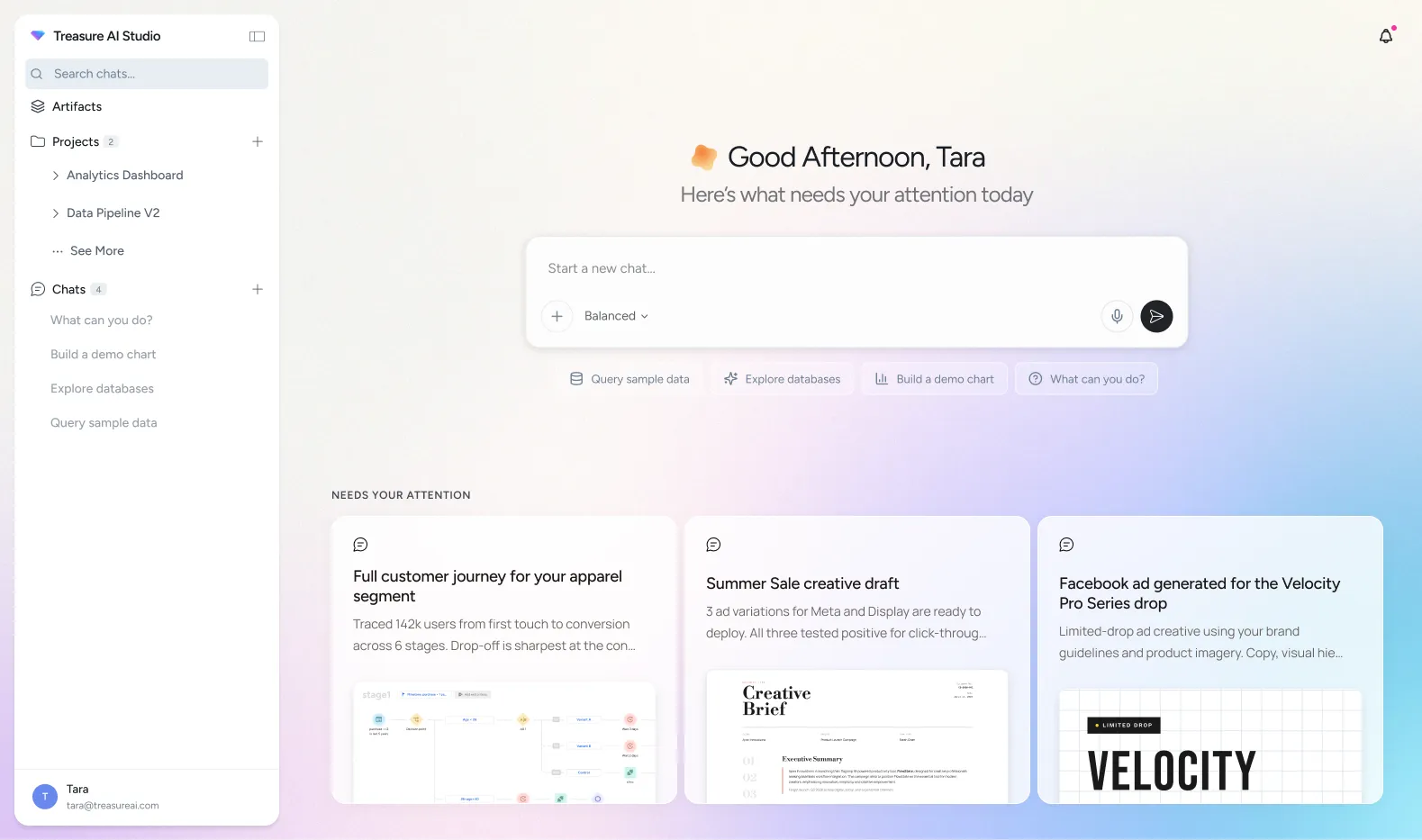 > **Disclosure:** cdp.com is managed by Treasure Data (now Treasure AI). This overview follows the same editorial standards as our other vendor profiles — documented in our [Editorial Policy](/editorial-policy/) — but readers should be aware of the relationship. For a side-by-side comparison of all CDP vendors, see the [CDP Vendor Comparison Guide](/basics/cdp-vendors/).
## Treasure AI at a Glance
| Dimension | Treasure AI |
|---|---|
| **Best for** | Global, multi-brand enterprises — both B2C and B2B — with large-scale data environments, especially those needing APAC coverage and multi-region data residency |
| **Typical buyer size** | Mid-market and enterprise — 39.9% of the 163 G2 reviews classified by company size come from organizations above 1,000 employees, 36.8% from 51–1,000, and 23.3% from 50 or fewer |
| **Pricing model** | Per-profile plus per-event, quote-based; no separate compute charge for queries and segmentation in Complete CDP mode, while Composable mode queries run on (and bill to) the customer's own warehouse compute |
| **Typical implementation** | 4-8 weeks initial; 3-6 months for full enterprise rollout |
| **Key differentiator** | The widest capability span of the packaged CDPs here: packaged or composable deployment, native predictive and agentic AI, and native email/SMS/push inside one platform boundary — with APAC-native connectors (LINE, Yahoo! JAPAN Ads) as an added fit for the region |
| **Skip if** | You need marketer self-serve simplicity or an SMB-sized budget |
Reviewer mix is not a customer base: where a G2 split is quoted above, it describes who reviews the vendor, not who buys it — reviewers self-select and vendors run review-solicitation campaigns. Those counts are G2's company-size-classified subset, which is smaller than the headline review count quoted elsewhere on a page; where a page names no split, the row rests on the structural fact stated in it rather than on reviewer data. The cross-vendor comparison and the methodology behind these splits are in [CDP vendors](/basics/cdp-vendors/).
## Company History
Treasure Data was founded in 2011 in Mountain View, California, originally as a cloud-based data management platform for log data and big data analytics. Over the following years, the company shifted focus toward customer data, building the infrastructure for large-scale [data ingestion](/glossary/data-ingestion/), [identity resolution](/glossary/identity-resolution/), and [audience activation](/glossary/data-activation/) that became its customer data platform.
Key milestones:
| Year | Milestone |
|------|-----------|
| 2011 | Founded in Mountain View, CA as a big data management platform |
| 2013 | Expanded into enterprise customer data management |
| 2018 | [Acquired by Arm Holdings](https://www.arm.com/company/news/2018/08/arm-acquires-treasure-data) (SoftBank Group) for approximately $600 million, accelerating enterprise go-to-market |
| 2020 | Named a Leader in the Forrester Wave for Customer Analytics Technologies |
| 2022 | Named a Strong Performer in the Forrester Wave for CDPs |
| 2024 | Named a Leader in the [2024 Forrester Wave for CDPs](https://www.treasure.ai/forrester-wave-cdp/?utm_source=cdp-dot-com&utm_medium=website-referral&utm_campaign=articles&utm_content=inline), recognized for data foundation strength and enterprise scalability |
| 2026 | Rebranded from Treasure Data to Treasure AI, launched Agentic Experience Platform |
| 2026 | Named a Leader in the [IDC MarketScape for Worldwide AI-Enabled Customer Data Platforms for B2C Users](https://www.treasure.ai/idc-marketscape-2026?utm_source=cdp-dot-com&utm_medium=website-referral&utm_campaign=articles&utm_content=inline) (Doc #US53952526) |
| 2026 | Named a Leader in the [IDC MarketScape for Worldwide AI-Enabled Customer Data Platforms for B2B Users](https://my.idc.com/getdoc.jsp?containerId=US53952326) (Doc #US53952326) — named a Leader in both the B2B and B2C cuts, a distinction shared with Salesforce |
As of 2026, Treasure AI serves over 400 enterprise customers across retail, financial services, healthcare, automotive, CPG, and media. The platform processes billions of unified customer profiles globally.
## The Rebrand: Treasure Data to Treasure AI
On April 20, 2026, Treasure Data officially became [Treasure AI](https://www.treasure.ai/?utm_source=cdp-dot-com&utm_medium=website-referral&utm_campaign=articles&utm_content=inline). The company's domain changed from treasuredata.com to treasure.ai, and the product category shifted from "Customer Data Platform" to "Agentic Experience Platform."
The rebrand reflects a structural shift in what the platform does. Treasure Data began as a system where humans accessed unified customer data to make marketing decisions. Treasure AI is designed as a system where [AI agents](/glossary/ai-marketing-agent/) access unified customer data to make and execute decisions autonomously — with humans providing strategy, creativity, and guardrails.
Three changes define the transition:
1. **From data platform to experience platform.** The original CDP handled data ingestion, unification, and audience activation. The new platform adds native omni-channel messaging (email, SMS, mobile push, in-app, LINE), [AI decisioning](/glossary/ai-decisioning/), and [real-time personalization](/glossary/real-time-personalization/) — eliminating the need to stitch together separate vendors for each stage of the Customer Intelligence Loop.
2. **From human-first to agent-first architecture.** The platform's primary interface is shifting from dashboards and query builders to AI agents that operate through MCP (Model Context Protocol), CLI, APIs, and pre-built agent skills. Humans still direct strategy, but AI agents handle execution at scale.
3. **From batch cycles to continuous loops.** Where the CDP ran [customer segmentation](/glossary/customer-segmentation-definition/) in batch cycles (daily, weekly), the Agentic Experience Platform runs the Customer Intelligence Loop continuously — COLLECT, UNIFY, UNDERSTAND, DECIDE, and ENGAGE in minutes, with engagement outcomes feeding back to inform the next cycle.
All existing APIs, SDKs, and workflows remain backward-compatible. The rebrand is a product evolution, not a migration that breaks existing integrations.
## Platform Architecture
Treasure AI uses a hybrid architecture that separates the control plane from the data plane:
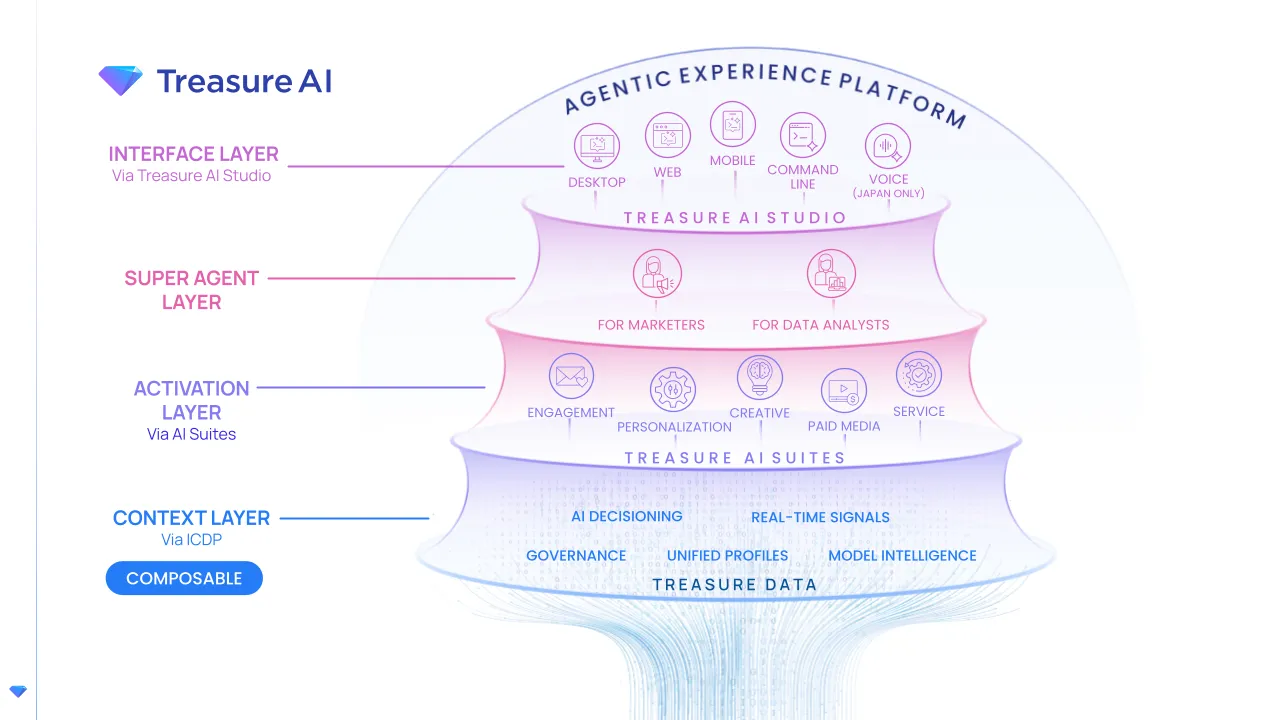 *Treasure AI Agentic Experience Platform architecture. The platform is composable at the Context Layer (iCDP) and bundles activation, AI agents, and multi-surface interfaces above it.*
- **Control plane (Treasure AI):** Identity resolution, audience segmentation, AI decisioning, messaging orchestration, and the AI agent runtime. This is the managed platform layer where the Customer Intelligence Loop executes.
- **Data plane (customer's infrastructure):** Customer data can reside in the customer's own [data warehouse](/glossary/data-warehouse/) — Snowflake, Databricks, BigQuery. Treasure AI queries those tables in place without requiring data to be moved into proprietary storage. In the other direction, the same warehouses can query tables that Treasure AI manages, published in Apache Iceberg format as read-only tables, without a second copy.
This [hybrid deployment model](/glossary/hybrid-cdp/) addresses a core tension in the CDP market: [composable CDPs](/glossary/composable-cdp/) keep data in the warehouse but cannot run real-time AI loops at API speed; packaged CDPs run fast but require copying all data into proprietary storage. Treasure AI's architecture aims to deliver both — warehouse-resident data with a managed control plane designed for low-latency profile access and [real-time activation](/glossary/data-activation/).
## Core Products
### Treasure AI Studio
Treasure AI Studio is the platform's primary interface, available across multiple surfaces:
- **Web** — Browser-based workspace for marketers, analysts, and data teams
- **Desktop** — Native application for macOS and Windows
- **Mobile** — iOS and Android for on-the-go monitoring and approvals
- **CLI (Treasure Code)** — Command-line interface for engineers and data teams to interact with the platform programmatically. Treasure Code is built on Claude Code and provides terminal-native access to customer data, schema inspection, and pipeline operations
- **Voice (Treasure AI Voice)** — AI-powered voice interface for hands-free querying and note capture
Studio provides natural-language access to customer data, segment creation, campaign management, and analytics — designed so that non-technical users can query and act on customer data without SQL or engineering support.
Studio's agents are not limited to data stored in Treasure AI. Since June 2026, [AI Studio Connections](https://docs.treasure.ai/products/ai-studio/connections/snowflake) let an agent explore and visualize data in a Snowflake warehouse (added June 25) or a [Databricks lakehouse](https://docs.treasure.ai/products/ai-studio/connections/databricks) (added June 17) during a chat. A July 14 connector brought the Treasure Data CDP itself onto the same connection model, letting the agent run CDP queries, workflows, and audience-segment operations in a chat. An administrator registers each connector once per organization over OAuth, and each user then authorizes an individual connection; the agent handles only a placeholder token, with the real credential substituted at the network boundary ([June 2026 release note](https://docs.treasure.ai/release-notes/2026/june-2026-release-note#new-feature-snowflake-connector-for-ai-studio)). The agent sees exactly what the authorized warehouse role can see. The AI Studio Snowflake connector authorizes as Snowflake's `PUBLIC` role, so any table granted for agent use is also visible to every other Snowflake user — scope grants accordingly. (Composable Audience Studio, described below, uses its own separately configured Snowflake credential.)
Context in Studio accumulates in work folders rather than in individual chats. Each work folder keeps an instructions file that the AI reads at the start of every chat and can update as work progresses, so table names, conventions, and goals carry across sessions without being restated ([In-Session Memory docs](https://docs.treasure.ai/products/ai-studio/chat/in-session-memory#cross-conversation-memory)). Since September 17, 2026, a work folder can be [shared across an account](https://docs.treasure.ai/products/ai-studio/shared-folders): every member reads one file tree — instructions, reference files, skills, and saved actions — and works in it with their own AI. A marketer who has taught a folder how to build the weekly campaign report — which tables to use, which segments count, how results are formatted — can share it, and a colleague's agent starts from that context instead of rebuilding the brief. What each member's agent writes back, where that member's access allows, becomes the starting point for the next chat, so the team's working knowledge accumulates in one place rather than in individual chat histories.
Sharing the memory does not mean sharing everything. Conversations stay private, as does each member's `my/` directory. Work modes decide where each member's agent may write — nowhere on the shared side, named top-level folders only, or everywhere — and are enforced at the file system rather than by prompt instruction. Authority over a shared folder sits with its managers: an account administrator who holds no work mode in it cannot read its contents ([Access Control](https://docs.treasure.ai/products/ai-studio/security/access-control#layer-2-agent-behavior-enforced-by-treasure-ai-studio)).
Saved workflows can also run on a timetable. Work Folder Actions (August 13, 2026) store a repeated workflow in a folder to rerun on demand, and Action Schedules (August 25, 2026) run those actions daily, on weekdays, weekly, monthly, or on a custom cron schedule without anyone clicking Run ([August 2026 release note](https://docs.treasure.ai/release-notes/2026/august-2026-release-note#ai-studio)). This is scheduled execution rather than an event trigger: it takes recurring analysis and reporting off a person's calendar, while in-the-moment reactions to customer behavior still depend on the real-time layer.
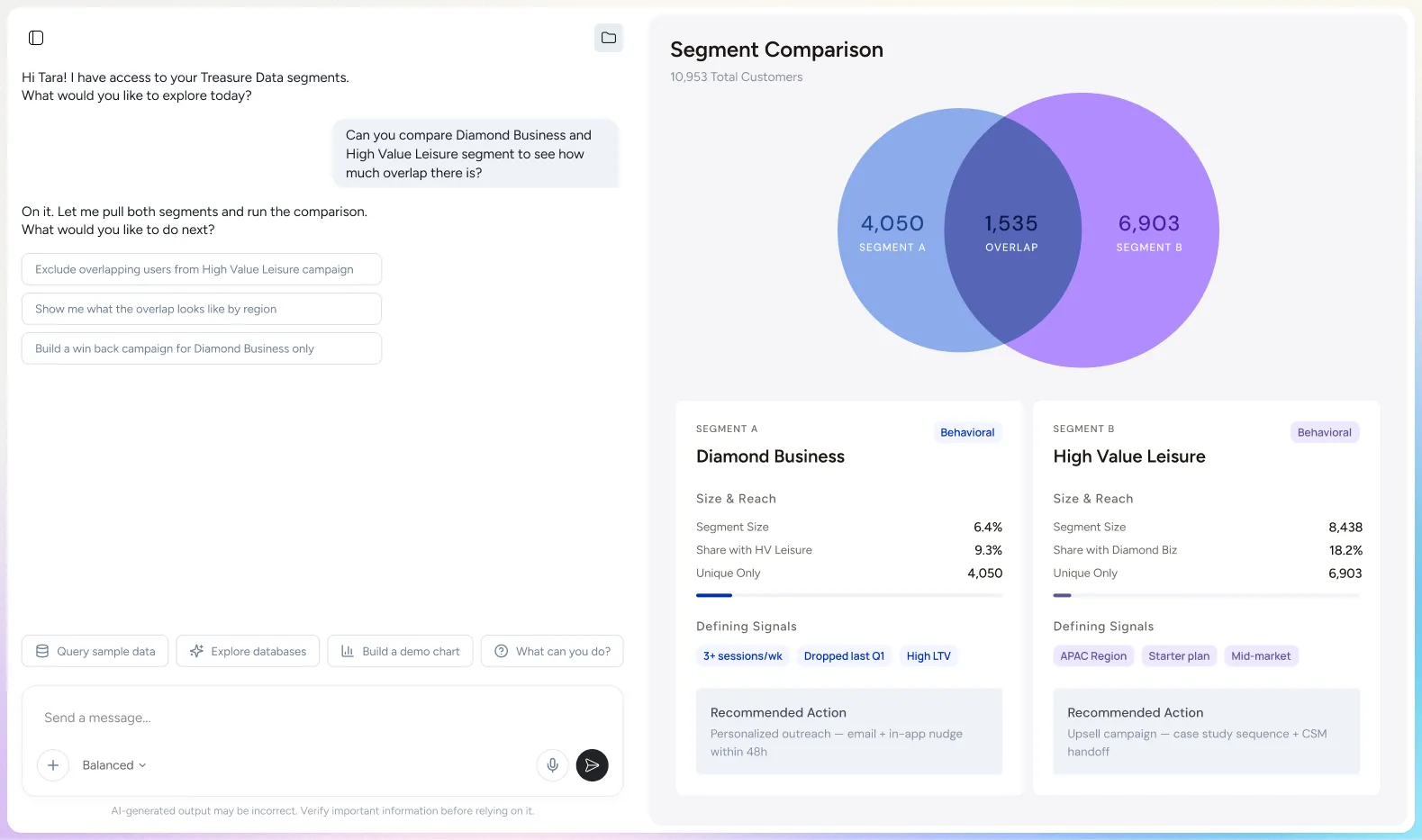 *Segment comparison in Treasure AI Studio. A natural-language query triggers audience overlap analysis with recommended next actions — illustrating how AI agents surface insights without manual SQL or BI workflows.*
### AI Super Agents
AI Super Agents are pre-built, domain-specific AI agents that automate specific workflows within the Customer Intelligence Loop:
- **AI Super Agent for Marketers:** Handles audience discovery, campaign creation, [next-best-action](/glossary/next-best-action/) recommendations, and cross-channel activation. Instead of spending hours building a win-back segment manually, a marketer describes the objective — "find customers who purchased in Q1 but haven't engaged in 60 days" — and the agent builds the segment, selects channels, and launches the campaign.
- **AI Super Agent for Data Analysts:** Automates data exploration, insight generation, and report creation. Analysts ask questions in plain language and receive structured answers with supporting data visualizations. In early access, a financial services team reported reducing report turnaround from three days to 60 seconds for routine customer queries.
These agents are built on the platform's unified customer data foundation, which means they operate on complete, resolved customer profiles rather than fragmented data across siloed tools.
 *Treasure AI Studio (mobile). The same conversational interface available on iOS and Android for on-the-go campaign monitoring and approvals.*
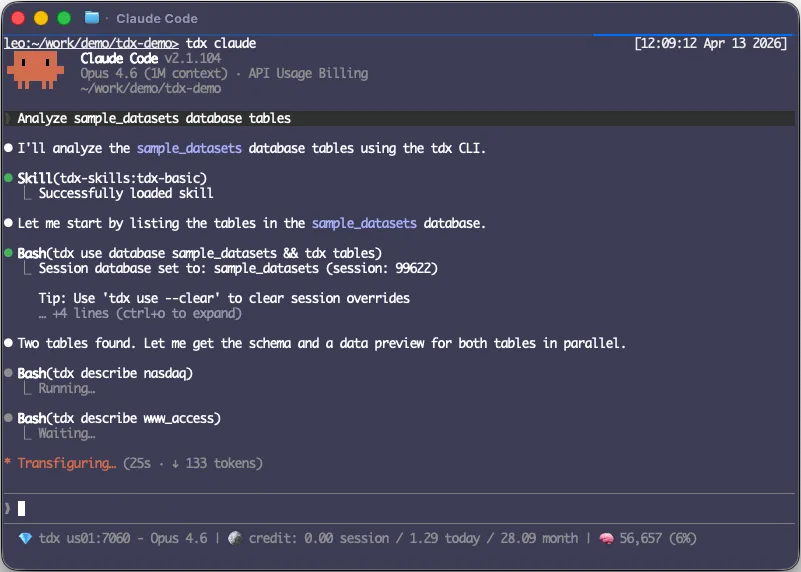 *Treasure Code (CLI). Engineers interact with Treasure AI through a terminal-native interface powered by Claude Code — inspecting schemas, running queries, and managing data pipelines without leaving the command line.*
 Each stage maps to specific platform capabilities:
| Stage | What Happens | Platform Capability |
|-------|-------------|-------------------|
| **COLLECT** | Ingest data from any source — behavioral, transactional, CRM, support, IoT | 170+ pre-built connectors, streaming and batch data ingestion |
| **UNIFY** | Resolve identities across devices, channels, and accounts into unified profiles | ML-powered identity resolution, deterministic and probabilistic matching |
| **UNDERSTAND** | Analyze customer behavior, predict intent, score propensity | Predictive analytics, LTV modeling, churn prediction |
| **DECIDE** | Determine the next best action for each customer | AI decisioning engine, real-time offer arbitration |
| **ENGAGE** | Execute personalized experiences across channels | Native omni-channel messaging, data activation to external systems |
Engagement outcomes (email opens, purchase conversions, support interactions) feed back to the COLLECT stage, closing the loop. In the agentic model, AI agents run this loop continuously rather than waiting for human-initiated campaign cycles. For organizations running weekly batch campaigns with no real-time or in-session personalization requirements, the continuous loop may not be necessary — composable architectures that run the loop on a daily or weekly cadence can deliver sufficient value at lower complexity.
## Governance and Security
Enterprise [data governance](/glossary/data-governance/) is a foundational requirement for any platform handling [PII](/glossary/pii-personally-identifiable-information/) at scale. Treasure AI's governance capabilities include:
- **Compliance certifications:** SOC 2 Type II, GDPR, CCPA, HIPAA-eligible
- **Infrastructure:** Runs on AWS with Bedrock integration for AI workloads
- **Audit trail:** Tamper-evident logging of all data access, agent actions, and activation events
- **[Consent management](/glossary/consent-management/):** Centralized consent enforcement across all activation channels
- **Data residency:** Regional data storage options for organizations subject to data localization requirements
- **Organization-wide agent instructions:** Administrators can set up to 16,384 characters of standing instructions that are added to the system prompt of every AI Studio agent in the organization, applied to new chats. These guide agent behavior; data access is still governed by the enforced controls above, not by instructions
- **AI data policy:** Customer data is never used to train AI models
For a complete list of certifications and security documentation, see the [Treasure AI Trust Center](https://trust.treasure.ai/).
The tamper-evident audit trail is particularly relevant for regulated industries — [financial services](/articles/cdp-for-financial-services/) and [healthcare](/articles/cdp-for-healthcare/) organizations require provable records of who (or what agent) accessed customer data and what actions were taken.
## Who Should Consider Treasure AI
Treasure AI is best suited for organizations that:
- **Need the full Customer Intelligence Loop in one platform** — data ingestion, identity resolution, AI decisioning, and activation without stitching together multiple vendors
- **Want AI agents to operate on unified customer data** — not just dashboards for humans, but an agent-first architecture where AI executes continuously
- **Require enterprise-grade governance** — SOC 2, GDPR, CCPA, HIPAA compliance with auditable AI agent actions
- **Operate across multiple channels** — email, SMS, push, in-app, LINE, web personalization, and paid media activation
- **Have existing data warehouse investments** — Composable Audience Studio builds and activates audiences on Snowflake, Databricks, and BigQuery tables in place, and AI Studio agents can query Snowflake and Databricks directly in a chat
- **Serve APAC markets** — native LINE integration and regional data residency support
Organizations that may find other architectures more suitable:
- **Teams that only need reverse ETL** — organizations with a mature data warehouse, existing segmentation logic in SQL, and no need for identity resolution, AI decisioning, or native messaging may find a standalone [reverse ETL](/glossary/reverse-etl/) tool sufficient. Treasure AI's hybrid architecture can connect to the same warehouses, but the full platform may be more capability than needed
- **Organizations fully committed to a single suite** (Adobe or Salesforce exclusively) may find tighter integration within that ecosystem, despite the [suite tax](/glossary/suite-tax/) trade-offs. However, organizations running both Salesforce and Adobe — or mixing suite products with best-of-breed tools — often find that a vendor-neutral platform like Treasure AI provides better cross-suite data unification than either suite's own CDP
- **Small businesses with simple data needs** (under 100,000 profiles, one or two channels) may not need the platform's enterprise capabilities
## FAQ
### What happened to Treasure Data?
**Treasure Data rebranded to Treasure AI on April 20, 2026.** The company's domain changed from treasuredata.com to treasure.ai, and the product evolved from a customer data platform into an agentic experience platform. All existing customer integrations, APIs, and SDKs remain backward-compatible — the rebrand reflects a product evolution, not a breaking change.
### How does Treasure AI differ from other CDPs?
**Treasure AI bundles CDP, omni-channel messaging, and AI agents into a single platform that runs the Customer Intelligence Loop continuously.** Most CDPs handle data unification and segmentation but require separate tools for messaging and AI decisioning — typically 4-5 vendors in a composable stack (warehouse, reverse ETL, ESP, AI layer). Treasure AI keeps all five stages of the loop within a single platform boundary, eliminating the PII duplication and cross-vendor latency that reverse ETL introduces. For a detailed comparison, see the [CDP Vendor Comparison Guide](/basics/cdp-vendors/).
### Is Treasure AI the right CDP for my organization?
**Treasure AI is the right CDP for global, multi-brand enterprises — both B2C and B2B — with large-scale data and APAC coverage needs, and the wrong fit for small or marketer-self-serve teams.** Choose it for the span the platform covers on its own — packaged or composable deployment, native predictive and agentic AI, and native email, SMS, and push without copying PII to a separate suite product — plus APAC-native connectors (LINE, Yahoo! JAPAN Ads). Skip it if you need marketer self-serve simplicity or an SMB-sized budget.
### Is Treasure AI a CDP or something different?
**Treasure AI includes a full CDP (data ingestion, identity resolution, segmentation, activation) and extends it with native messaging and AI agent capabilities.** The "agentic experience platform" label reflects the addition of AI-driven decisioning and execution on top of the core CDP foundation. Organizations evaluating Treasure AI against CDPs should compare the full platform scope — not just the data unification layer. See [What Is an Agentic CDP?](/glossary/agentic-cdp/) for how this category is evolving.
### Is Treasure AI a real-time CDP?
**Yes — Treasure AI's Real-Time 2.0 layer processes streaming events in milliseconds, stitches identities as events arrive, and publishes a Personalization API SLA of ≤100 ms at p95 for up to 20 attributes, available with Enterprise Support.** Triggered activations are delivered within 3 minutes. A parallel batch path computes predictive scores and refreshes identity relationships on a schedule, and the real-time engine reads that batch profile when it processes an event, so live decisions still carry customer history.
### Does Treasure AI work with Snowflake, Databricks, and BigQuery?
**Yes — Treasure AI's Composable Audience Studio builds and activates audiences directly on Snowflake, Databricks, and BigQuery without copying data into Treasure AI.** Queries run on the warehouse's own compute, so the warehouse bill carries the cost and the data team maintains the schema. AI Studio agents can also query Snowflake and Databricks in a chat through per-user OAuth connections.
---
See how analysts rank CDP vendors → [IDC MarketScape](https://www.treasure.ai/idc-marketscape-2026?utm_source=cdp-dot-com&utm_medium=website-referral&utm_campaign=articles&utm_content=inline) | [Forrester Wave](https://www.treasure.ai/forrester-wave-cdp/?utm_source=cdp-dot-com&utm_medium=website-referral&utm_campaign=articles&utm_content=inline)
---
### What Is Twilio Segment? Features, Pricing & Alternatives
URL: https://cdp.com/articles/what-is-twilio-segment/
**Twilio Segment is a developer-first [customer data platform](/basics/what-is-a-customer-data-platform-cdp/) (CDP) founded in 2011 as a Y Combinator startup and acquired by Twilio in November 2020 for $3.2 billion.** With over 700 pre-built connectors, Segment offers one of the largest integration catalogs in the CDP market, spanning data collection, quality enforcement, [identity resolution](/glossary/identity-resolution/), audience activation, and AI predictions.
Unlike suite-embedded CDPs and standalone vendor-neutral CDPs, Segment is developer-first data infrastructure that expanded into CDP territory — strongest as a data router, with identity resolution, activation, and AI capabilities added later. Segment was named a Leader in the 2024–2025 IDC MarketScape for Customer Data Platforms, and Twilio was named a Leader again in the [2026 IDC MarketScape for Worldwide AI-Enabled Customer Data Platforms for B2C Users](https://www.treasure.ai/idc-marketscape-2026?utm_source=cdp-dot-com&utm_medium=website-referral&utm_campaign=articles&utm_content=inline) — though Twilio did not make the Leaders cut in IDC's companion [B2B MarketScape](https://my.idc.com/getdoc.jsp?containerId=US53952326), which named Treasure AI and Salesforce among its Leaders. Segment serves enterprise clients including IBM, Levi's, Instacart, and DigitalOcean.
This independent overview covers what Twilio Segment does, how its products fit together, what it costs, what real users say about it, and when alternatives may be a better fit.
## Twilio Segment at a Glance
| Dimension | Twilio Segment |
|---|---|
| **Best for** | Developer-first teams needing flexible multi-platform event collection and routing to 700+ destinations |
| **Typical buyer size** | Mid-market and small business — 47.0% of the 566 G2 reviews classified by company size come from companies of 51–1,000 employees and 41.7% from 50 or fewer; at 11.3% above 1,000 employees it carries the lowest enterprise share of the packaged and suite vendors compared here |
| **Pricing model** | MTU-based; free to 1,000 MTUs, Team from $120/mo, enterprise quote-based |
| **Typical implementation** | 2-6 weeks |
| **Key differentiator** | 700+ pre-built connectors and a developer-first event pipeline with strong SDKs |
| **Skip if** | You run high-anonymous-traffic B2C — anonymous visitors count as MTUs and can dominate cost — or want messaging native to the CDP rather than through separate Twilio/SendGrid products |
Reviewer mix is not a customer base: where a G2 split is quoted above, it describes who reviews the vendor, not who buys it — reviewers self-select and vendors run review-solicitation campaigns. Those counts are G2's company-size-classified subset, which is smaller than the headline review count quoted elsewhere on a page; where a page names no split, the row rests on the structural fact stated in it rather than on reviewer data. The cross-vendor comparison and the methodology behind these splits are in [CDP vendors](/basics/cdp-vendors/).
## How Segment's Products Fit Together
Segment's product suite spans data collection, quality enforcement, identity resolution, and activation:
| Product | Function |
|---------|----------|
| **Connections** | Data collection and routing — SDKs and APIs collect events from web, mobile, and server sources, then route to 700+ downstream destinations |
| **Protocols** | Data quality enforcement — schema validation, tracking plans, and event governance to ensure clean, consistent data |
| **Unify** | Identity resolution — merges anonymous and known user identifiers into unified customer profiles across devices and channels |
| **Twilio Engage** | Audience activation and journey orchestration — builds audiences on Segment profiles and triggers campaigns via Twilio messaging (SMS, email via SendGrid) |
| **CustomerAI Predictions** | Machine learning predictive traits — lifetime value prediction, churn likelihood, and purchase propensity scoring |
Segment's architectural DNA is data routing. Connections — the product that collects events and sends them to destinations — was the original product, and it remains the platform's strongest capability. Identity resolution (Unify, originally called Personas) was added in 2017. Activation (Twilio Engage) arrived in 2022. AI (CustomerAI) launched in 2023. Each of these CDP capabilities was layered on top of the data routing foundation rather than built as a core architectural component from the start.
The Twilio relationship adds messaging capabilities but introduces product boundaries. Twilio Engage connects Segment audiences to Twilio's messaging APIs (SMS, voice) and SendGrid (email) — but these are separate products from a separate business unit, requiring separate contracts and integration work. Customer PII flows between Segment and Twilio messaging services. This is not a single-platform closed loop like [hybrid CDPs](/glossary/hybrid-cdp/) that keep data, decisions, and execution within one system boundary.
## Product Evolution
Segment's evolution from analytics library to data infrastructure to CDP reflects a broader pattern of developer tools expanding upstream into customer data management.
| Year | Milestone |
|------|-----------|
| 2011 | Founded by Peter Reinhardt, Ilya Volodarsky, Calvin French-Owen, and Ian Storm Taylor. Y Combinator batch. Initial product: analytics.js, an open-source analytics library |
| 2013 | Pivoted from analytics tool to data infrastructure. The "one API to collect, one API to send" model established Segment as a data router |
| 2017 | Personas launched (later renamed Unify) — identity resolution and unified customer profiles, marking Segment's expansion from data routing into CDP territory |
| 2020 | Acquired by Twilio for $3.2 billion. Positioned as the "customer data engine" within Twilio's communications platform |
| 2022 | Twilio Engage launched — audience activation and journey orchestration connecting Segment profiles to Twilio messaging channels |
| 2023 | CustomerAI announced — predictive traits (LTV, churn, purchase likelihood). Twilio records a $285.7 million impairment on Segment-related intangible assets (Q4 2023) |
| 2024 | Linked Audiences launched — warehouse-connected mode that queries data directly in Snowflake, BigQuery, Redshift, and Databricks without copying it into Segment |
| 2025 | Generative Audiences GA — natural language audience creation. Event-Triggered Journeys GA (July 2025). Twilio restructures into two business units; Segment placed in "Data & Applications" unit (growth-focused) |
The Twilio acquisition story is important context for buyers evaluating long-term platform commitment. The $3.2 billion acquisition in 2020 was followed by a $285.7 million intangible asset impairment in Q4 2023, multiple rounds of layoffs, and a June 2025 restructuring that split Twilio into two separate business units. Segment was placed in the "Data & Applications" unit focused on growth — a positive signal for continued investment — but the organizational instability raises valid questions about roadmap continuity and long-term product direction that buyers should evaluate.
## What Twilio Segment Does
Segment's core capabilities span data collection, quality enforcement, identity resolution, and activation:
- **Developer-first data collection**: Segment's SDKs (JavaScript, iOS, Android, server-side) and APIs provide the most developer-friendly data collection experience in the CDP market. A single API call routes events to any of 700+ destinations without modifying source code for each tool. G2 reviewers consistently cite setup ease and developer experience as Segment's defining strength
- **700+ pre-built connectors**: One of the largest integration catalogs in the CDP market. Connectors span analytics tools, advertising platforms, data warehouses, CRMs, ESPs, and more — enabling vendor-neutral data routing without custom engineering for each destination
- **Data quality enforcement**: Protocols provides schema validation, tracking plans, and event governance. Teams define expected event structures, and Protocols flags violations in real time — reducing bad data before it reaches downstream tools. This is a genuine differentiator that most CDPs lack
- **Identity resolution**: Unify merges anonymous and known user identifiers into unified customer profiles using deterministic identity matching. Profiles update in real time as new events arrive
- **AI and predictive traits**: CustomerAI Predictions provides machine learning-based scoring for lifetime value, churn likelihood, and purchase propensity. Generative Audiences (2025) enables natural language audience creation. These AI capabilities launched in 2023, making them newer than predictive models in platforms like Treasure Data or Salesforce Data Cloud that have offered native ML for longer
- **Real-time event debugger**: A developer-facing tool for inspecting live event data, debugging integrations, and validating tracking implementations in real time — consistently praised in G2 reviews as a productivity tool for engineering teams
## Architecture: Developer-First Data Infrastructure
Segment occupies a distinct architectural position in the CDP market. It is not a suite-embedded CDP, not a standalone vendor-neutral CDP, and not a [composable CDP](/glossary/composable-cdp/) built on a data warehouse. It is developer-first data infrastructure that expanded into CDP territory — strongest as a data router, with CDP capabilities built on top of that foundation.
### Advantages
- **Developer experience**: The cleanest APIs and SDKs in the CDP market. One analytics.js snippet or server-side library call routes data to hundreds of destinations. For engineering teams, the setup experience is unmatched — G2 reviewers consistently rate this as Segment's defining strength
- **Integration breadth**: 700+ pre-built connectors. New marketing and analytics tools can be connected through configuration rather than custom engineering, reducing the integration burden for each new destination
- **Data routing flexibility**: Segment functions as a customer data router — events flow from sources (websites, apps, servers) through Segment to destinations (warehouses, analytics tools, marketing platforms) in real time. This routing architecture gives organizations a single collection point that decouples data sources from downstream tools
- **Protocols (data quality)**: Schema enforcement at the collection layer prevents bad data from reaching downstream systems. For organizations with complex event taxonomies across multiple engineering teams, this is a genuine differentiator that most CDPs lack
### Structural Trade-Offs
- **MTU pricing penalizes B2C scale**: Segment charges based on Monthly Tracked Users (MTUs). Every unique user identifier — including anonymous visitors — counts as a tracked user. For B2C companies with high-traffic websites or mobile apps, anonymous visitors can represent 90%+ of MTU volume, making costs scale dramatically. As [one reviewer described](https://www.g2.com/products/twilio-segment/reviews/twilio-segment-review-524476): *"When they changed pricing to MTUs, it made it extremely pricey for websites and apps with anonymous users."* [Another reported](https://www.g2.com/products/twilio-segment/reviews/twilio-segment-review-10493609) a $400,000 price tag with an implementation that failed. This pricing model structurally favors B2B companies with lower user counts over B2C companies with mass anonymous traffic
- **Data router heritage, not CDP heritage**: Segment's architectural DNA is data routing — collecting events and sending them to destinations. CDP capabilities (identity resolution, AI, activation) were all added later and are less mature than platforms purpose-built for these functions. [G2 reviewers note](https://www.g2.com/products/twilio-segment/reviews/twilio-segment-review-8199089) the absence of built-in ML pipelines and advanced query functions. [Others report](https://www.g2.com/products/twilio-segment/reviews/twilio-segment-review-7983822) that hypersegmentation is complicated or impossible
- **Partial native execution only**: Twilio Engage connects Segment audiences to Twilio messaging APIs (SMS, voice) and SendGrid (email) — but these are separate products requiring separate contracts and integration work. Customer PII flows between Segment and Twilio messaging services. This is not a single-platform closed loop — organizations that need CDP, [AI decisioning](/glossary/ai-decisioning/), and messaging within one boundary should evaluate [hybrid CDPs](/glossary/hybrid-cdp/) that keep [data activation](/glossary/data-activation/) within a single platform
- **Data residency and duplication**: Segment ingests and stores customer event data on its own infrastructure. For organizations that have invested in centralizing all customer data within their own data warehouse (Snowflake, BigQuery, Databricks), adopting Segment creates a second copy of behavioral data outside the organization's governance boundary. This is a legitimate data governance concern — particularly for enterprises with strict data residency requirements or CISO-mandated policies about where PII resides. Segment's 2024 launch of Linked Audiences (warehouse-connected mode) partially addresses this by querying data in place, but the core Connections pipeline still routes events through Segment's infrastructure
- **Schema rigidity (Segment Spec)**: Segment enforces a specific data model — the Segment Spec — that defines how events (track, identify, page, screen, group) must be structured. While this standardization improves data quality and cross-tool consistency, it limits flexibility for organizations with complex or non-standard data structures already modeled in their warehouse. [Composable CDPs](/glossary/composable-cdp/) that query the warehouse directly can leverage any existing data model without conforming to a vendor-imposed schema. Organizations with mature, well-modeled warehouses should evaluate whether Segment's Spec accommodates their data complexity or requires costly re-instrumentation
- **Warehouse and legacy system gaps**: [Reviewers report](https://www.g2.com/products/twilio-segment/reviews/twilio-segment-review-6488847) that *"Segment's BigQuery integration is stuck in 2012, generating a different dataset for each source and a different table for each event."* [Others note](https://www.g2.com/products/twilio-segment/reviews/twilio-segment-review-4699119) that connecting to Hadoop or Oracle traditional data warehouse solutions is impossible. [Databricks is also flagged](https://www.g2.com/products/twilio-segment/reviews/twilio-segment-review-4706574) as unsupported in earlier reviews. Segment's 2024 launch of Linked Audiences — which queries data directly in Snowflake, BigQuery, Redshift, and Databricks — addresses some of these warehouse gaps, though buyers should verify current connector coverage for their specific stack
### Business Considerations
Separately from architectural trade-offs, buyers should evaluate business and organizational factors:
- **Post-acquisition organizational changes**: The $285.7 million intangible asset impairment (Q4 2023), multiple rounds of layoffs, and June 2025 restructuring have created organizational change. Segment now sits in Twilio's growth-focused "Data & Applications" unit — a positive signal for continued investment — but the pace of change warrants evaluation. [G2 reviewers report](https://www.g2.com/products/twilio-segment/reviews/twilio-segment-review-5242241) that the acquisition changed Segment's culture: *"Segment was great when they were an independent company. Since being acquired by Twilio, their culture has changed and they do not treat their customers well."* [Others describe](https://www.g2.com/products/twilio-segment/reviews/twilio-segment-review-4923766) support quality declining to template responses
## Pricing
| Pricing | Twilio Segment |
|---|---|
| **Priced on** | Monthly Tracked Users (MTUs) — every unique identifier processed per month, including anonymous visitors |
| **Published price** | Free: up to 1,000 visitors (MTUs) per month and 2 sources; Team: from $120/mo for 10,000 MTUs (pricing page) |
| **Reported contract range** | No public contract data; Business tier is custom-priced |
| **Priced separately** | Twilio Engage (activation; Business tier only, quoted separately from the core Segment contract), Twilio messaging, SendGrid |
Segment is one of the few CDP vendors that publishes pricing tiers on its pricing page:
- **Free**: Up to 1,000 visitors per month, 2 sources — suitable for evaluation and prototyping
- **Team**: Starting at $120/month for 10,000 MTUs — designed for growing companies
- **Business**: Custom pricing — the only tier on which Unify (identity resolution), Protocols (data quality), Engage (activation), and Predictions (AI) are available; Engage is quoted separately from the core Segment contract
**The MTU reality**: Monthly Tracked Users (MTUs) is the most important pricing concept for Segment buyers. An MTU is any unique user identifier that Segment processes in a given month — including anonymous visitors who have never logged in. For B2C companies with high-traffic websites, anonymous visitors can represent the vast majority of MTU volume, making the effective cost per known customer dramatically higher than the headline per-MTU rate.
G2 reviewers consistently flag MTU pricing as the most significant concern:
- [One reviewer](https://www.g2.com/products/twilio-segment/reviews/twilio-segment-review-524476) removed tracking of anonymous users entirely to reduce costs
- [Another](https://www.g2.com/products/twilio-segment/reviews/twilio-segment-review-935337) described the free-to-paid jump as too large for startups
- [A third](https://www.g2.com/products/twilio-segment/reviews/twilio-segment-review-4706574) flagged costs as problematic at high daily active user counts
Additionally, full activation requires Twilio Engage (separate from Segment's core pricing), plus Twilio messaging and SendGrid (separate products with separate pricing models). Total cost of ownership should include all three product lines.
For a detailed breakdown of how different CDP architectures compare on pricing, see [CDP Pricing: Models, Ranges, and Hidden Costs](/articles/cdp-pricing/).
## Strengths
A fair evaluation of Twilio Segment should acknowledge its genuine advantages:
- **Developer experience**: The strongest differentiator. Clean APIs, comprehensive SDKs (web, mobile, server-side), excellent documentation, and a setup experience that G2 reviewers consistently rate as the best among CDP vendors. For engineering-led organizations, Segment reduces data collection and routing friction significantly
- **Integration breadth**: 700+ pre-built connectors — one of the largest catalogs in the CDP market. New marketing and analytics tools can be connected through configuration rather than custom engineering
- **Data quality enforcement**: Protocols provides schema-level data governance that catches tracking errors before data reaches downstream systems. For organizations with complex event taxonomies across multiple engineering teams, this prevents the bad-data problems that plague organizations without collection-layer quality controls
- **Real-time event debugger**: A developer productivity tool for inspecting live event data, debugging integrations, and validating tracking implementations. Consistently praised in G2 reviews
- **Single source of truth**: Segment as a centralized collection layer creates an event bus where all downstream tools receive the same data, reducing the inconsistencies that occur when multiple tools implement their own tracking
- **Free tier**: The free plan (1,000 MTU) enables developer adoption without procurement — a bottom-up adoption model that has driven Segment's market penetration in engineering-led organizations
- **Enterprise customer base**: Organizations including IBM, Levi's, Instacart, DigitalOcean, and Sotheby's run on Segment
## Limitations
These are structural characteristics and recurring user feedback themes. G2 reviews consistently surface the same concerns:
- **MTU pricing scales unpredictably for B2C**: The most consistent criticism. Anonymous visitors count as MTUs, making costs explode for high-traffic B2C websites and mobile apps. [One reviewer](https://www.g2.com/products/twilio-segment/reviews/twilio-segment-review-524476) was forced to remove tracking of anonymous users to control costs. [Another reported](https://www.g2.com/products/twilio-segment/reviews/twilio-segment-review-10493609) a $400,000 price tag with an implementation that failed at every step. [Others note](https://www.g2.com/products/twilio-segment/reviews/twilio-segment-review-4706574) that costs become problematic at high daily active user counts, and that the [free-to-paid jump](https://www.g2.com/products/twilio-segment/reviews/twilio-segment-review-935337) is prohibitively large for startups
- **Post-acquisition support and culture degradation**: Multiple reviewers report that the Twilio acquisition changed Segment for the worse. [One wrote](https://www.g2.com/products/twilio-segment/reviews/twilio-segment-review-5242241): *"Segment was great when they were an independent company. Since being acquired by Twilio, their culture has changed and they do not treat their customers well."* [Another described](https://www.g2.com/products/twilio-segment/reviews/twilio-segment-review-4923766) debugging support as painful with template-only responses (Quality of Support: 2/10). [A third](https://www.g2.com/products/twilio-segment/reviews/twilio-segment-review-4318025) reported no pricing flexibility during COVID: *"They basically said: you signed a contract: pay up!"*
- **Implementation complexity behind the developer-friendly surface**: Segment's SDK setup is fast for a single source, but full production deployment requires significant engineering investment. Organizations must instrument every data source (web, mobile, server-side) with Segment SDKs, design and enforce a comprehensive tracking plan through Protocols, and map events to the Segment Spec — a re-instrumentation effort that can take weeks or months depending on the number of sources and complexity of the event taxonomy. This contrasts with [composable CDPs](/glossary/composable-cdp/) that leverage existing warehouse data models without re-collecting data from scratch, and with standalone CDPs that offer tag-based collection requiring less engineering overhead
- **AI and ML capabilities are newer**: CustomerAI Predictions launched in 2023, and Generative Audiences reached GA in 2025. [Reviewers note](https://www.g2.com/products/twilio-segment/reviews/twilio-segment-review-8199089) the absence of built-in ML pipelines and advanced query functions. [Others report](https://www.g2.com/products/twilio-segment/reviews/twilio-segment-review-7983822) that hypersegmentation is complicated or not possible. For organizations that need [AI-native](/glossary/ai-native-vs-ai-bolted/) decisioning, platforms like Treasure Data or Salesforce Data Cloud have offered native ML capabilities for longer
- **Warehouse integration gaps (partially addressed)**: Earlier G2 reviews flagged BigQuery, Hadoop, Oracle, and Databricks limitations. Segment's 2024 launch of Linked Audiences — which queries data directly in Snowflake, BigQuery, Redshift, and Databricks — addresses some of these concerns. However, [reviewers noted](https://www.g2.com/products/twilio-segment/reviews/twilio-segment-review-4706574) that Segment's JavaScript dependency injection can bloat client-side performance, and buyers should verify current connector coverage for their specific warehouse stack
- **Partial native execution**: Twilio Engage connects audiences to Twilio/SendGrid messaging, but these are separate products requiring separate integration and licensing. Customer PII flows between Segment and Twilio messaging services. [Agentic CDPs](/glossary/agentic-cdp/) that include built-in messaging eliminate this PII duplication by keeping activation within a single platform boundary
- **Scalability and cost-effectiveness at scale**: [Reviewers note](https://www.g2.com/products/twilio-segment/reviews/twilio-segment-review-10493757) that Segment is not great for scalability and becomes expensive over time. [Others observe](https://www.g2.com/products/twilio-segment/reviews/twilio-segment-review-9120920) that the same capabilities are available from other vendors at significantly lower cost with better documentation and support
## Who Should Consider Twilio Segment
Twilio Segment is a strong fit for organizations that meet most of these criteria:
- **Developer-led data strategy**: Engineering teams that want API-first data collection with clean SDKs and minimal UI overhead. Segment's developer experience is genuinely unmatched
- **B2B SaaS with moderate user counts**: MTU pricing is manageable when tracked user counts are in the tens or hundreds of thousands — not millions of anonymous visitors. B2B companies with identifiable users get the best pricing value
- **Multi-tool data routing**: Organizations using many downstream analytics and marketing tools that need a centralized event bus to feed them all consistently, with schema enforcement at the collection layer
- **Startups and growth-stage companies**: The free tier enables adoption without procurement; the developer-friendly setup means a single engineer can implement Segment quickly
- **Existing Twilio customers**: Organizations already using Twilio messaging or SendGrid can connect Segment profiles to messaging channels through Engage, creating a partial activation loop
Twilio Segment is a weaker fit for organizations that:
- Are B2C with high anonymous traffic — MTU pricing penalizes mass-market websites and mobile apps where anonymous visitors dominate
- Need native campaign execution (email, SMS, push) within a single CDP platform — Segment requires separate Twilio/SendGrid products with separate licensing
- Have marketing-led teams without engineering resources — Segment's value proposition assumes developers are available to implement SDKs and manage the platform
- Require mature AI/ML capabilities — CustomerAI Predictions launched in 2023, and organizations needing production-proven predictive models may find longer-established [Agentic CDPs](/glossary/agentic-cdp/) a better fit
- Want a single vendor for data unification, [AI decisioning](/glossary/ai-decisioning/), and campaign execution within one platform boundary
- Have strict data residency requirements or CISO policies against storing customer event data on third-party infrastructure — Segment ingests and stores data on its own servers, creating copies outside the organization's warehouse
- Already have well-modeled customer data in a warehouse and primarily need activation, not re-collection — composable CDPs can activate existing data without re-instrumentation
- Need advanced identity resolution, hypersegmentation, or custom ML pipelines beyond what Unify and CustomerAI currently provide
- Prioritize long-term platform stability — the post-acquisition impairment, layoffs, and restructuring warrant evaluation of organizational continuity
## Alternatives to Twilio Segment
Organizations exploring alternatives to Twilio Segment generally consider two categories: [agentic CDPs](/glossary/agentic-cdp/) that bundle data unification, messaging, and AI in a single purpose-built platform with closed feedback loops, and [composable CDPs](/glossary/composable-cdp/) that activate data directly from a cloud data warehouse using [reverse ETL](/glossary/reverse-etl/) tools.
For a comprehensive comparison of CDP vendors across all categories, see the [CDP Vendor Comparison Guide](/basics/cdp-vendors/). For evaluation criteria specific to AI-era requirements, see [How to Evaluate a CDP in the AI Era](/articles/how-to-evaluate-cdp-ai-era/).
---
**Twilio Segment is the strongest developer-first data infrastructure in the CDP market — its APIs, SDKs, and 700+ connector catalog make it the fastest way for engineering teams to implement customer data collection and routing — but its MTU pricing penalizes B2C scale, its CDP capabilities (identity resolution, AI, activation) are architecturally later additions rather than foundational strengths, and its activation chain spans Segment, Twilio Engage, and SendGrid as separate products, meaning customer data crosses product boundaries rather than staying within a single platform.**
For a comprehensive comparison of CDP vendors across all categories, see the [CDP Vendor Comparison Guide](/basics/cdp-vendors/). For evaluation criteria specific to AI-era requirements, see [How to Evaluate a CDP in the AI Era](/articles/how-to-evaluate-cdp-ai-era/).
**→ [Compare all CDP vendors side-by-side in the CDP Vendor Comparison Guide](/basics/cdp-vendors/)**
*See how independent analysts evaluate CDP vendors — download the [Forrester Wave](https://www.treasure.ai/forrester-wave-cdp/?utm_source=cdp-dot-com&utm_medium=website-referral&utm_campaign=articles&utm_content=inline) or [IDC MarketScape](https://www.treasure.ai/idc-marketscape-2026?utm_source=cdp-dot-com&utm_medium=website-referral&utm_campaign=articles&utm_content=inline) reports for a side-by-side comparison.*
## FAQ
### What does Twilio Segment do?
**Twilio Segment collects, routes, and activates customer data across more than 700 downstream destinations.** Connections collects events from websites, mobile apps, and servers via SDKs and APIs; Protocols enforces data quality through schema validation; Unify resolves identities into unified customer profiles; Twilio Engage activates profiles through Twilio messaging channels (SMS, email via SendGrid); and CustomerAI Predictions adds machine learning scoring for lifetime value, churn, and purchase propensity. Segment routes data but does not natively execute marketing campaigns.
### Is Segment a CDP?
**Yes — Twilio Segment is a customer data platform, though its heritage is in data infrastructure rather than traditional CDP functionality.** Segment started in 2011 as an analytics library (analytics.js) and added CDP capabilities incrementally: identity resolution (Unify, originally Personas, 2017), audience activation (Twilio Engage, 2022), and AI predictions (CustomerAI, 2023). Evaluators should assess whether its data routing strengths align with their CDP requirements, or whether they need a platform where identity resolution, AI decisioning, and campaign execution are foundational.
### How much does Twilio Segment cost?
**Segment publishes three pricing tiers: Free (up to 1,000 visitors/month), Team (from $120/month for 10,000 MTUs), and Business (custom pricing; the only tier offering Unify, Protocols, Engage, and Predictions, with Engage quoted separately).** Pricing is based on Monthly Tracked Users — every unique identifier processed per month, including anonymous visitors — so MTU costs can scale dramatically for B2C companies with high anonymous traffic. Total cost of ownership should also include Twilio Engage, Twilio messaging, and SendGrid, which are separately licensed products.
### What is the difference between Segment and Twilio?
**Segment is a customer data platform that Twilio acquired in November 2020 for $3.2 billion; Twilio is a cloud communications platform (SMS, voice, email via SendGrid, video).** Twilio Engage is the bridge product connecting Segment's customer profiles to Twilio's messaging channels. As of June 2025, Twilio operates two business units — Communications and Data & Applications (Segment, Engage, Flex) — but the products remain separate, with separate pricing, contracts, and integration requirements.
### Is Twilio Segment the right CDP for my organization?
**Twilio Segment is the right CDP for developer-first teams that need flexible event collection and routing to 700+ destinations — and the wrong fit for high-anonymous-traffic B2C or native-messaging needs.** Choose it for strong SDKs and a broad integration catalog. Skip it if anonymous visitors dominate your traffic (MTU costs scale), or if you want messaging native to the CDP rather than through separate Twilio/SendGrid products.
### What are the alternatives to Twilio Segment?
**The main alternatives to Twilio Segment are [agentic CDPs](/glossary/agentic-cdp/) and [composable CDPs](/glossary/composable-cdp/).** Agentic CDPs bundle data unification, messaging, and [AI](/glossary/ai-native-vs-ai-bolted/) in a single system with closed feedback loops — native execution channels eliminate PII duplication across product boundaries. Composable CDPs use the data warehouse as the foundation, with [reverse ETL](/glossary/reverse-etl/) activating data to downstream tools — a fit for data-engineering-led teams with an existing warehouse investment. For a full comparison, see the [CDP Vendor Comparison Guide](/basics/cdp-vendors/).
---
### How to Integrate a CDP Into Your MarTech Stack
URL: https://cdp.com/articles/where-does-a-cdp-fits-in-your-martech-stack/
If you’re already heavily invested in MarTech, you might wonder where you might integrate a CDP in your [MarTech](/glossary/martech/) stack, and how you’d use it with all your existing marketing technology. The need for a customer data platform (CDP) is clear: Companies need to provide a unified, consistent experience and [single customer view](/glossary/single-customer-view-scv/) in all channels. To do that, they need to combine customer data across silos to get a complete picture of the customer's relationship with the company.
A [customer data platform](/basics/what-is-a-customer-data-platform-cdp/) connects these data silos and helps provide consistent experiences across all touch points and channels. But when it comes to the CDP, people are often confused about where exactly it fits into the MarTech stack, along with other data management solutions, like a customer relationship management (CRM) platform, data lake, or a [data management platform (DMP)](/glossary/data-management-platform-dmp/).
According to David Raab, CEO of the [CDP Institute](https://www.cdpinstitute.org/), in a [webinar on the subject](https://www.brighttalk.com/webcast/15379/512470?utm_source=brighttalk-portal&utm_medium=web&utm_campaign=channel-page&utm_content=recorded), the confusion is understandable. After all, the [CDP Institute](https://www.cdpinstitute.org/) tracks 208 CDP vendors as of January 2026, and they are not all the same. So it's time to step back, look at the big picture, and figure out where and how the CDP fits into your MarTech stack to provide centralized data management capabilities other platforms cannot quite match.
## CDP Integration: The Big Picture
There is one thing all true CDPs do: they build unified customer profiles, sometimes called single customer views (SCVs) or golden profiles. Everything else a CDP does stems from that single critical capability.
But there's more to a CDP than just building a unified profile. Let’s look at all the different features customer data systems can offer.
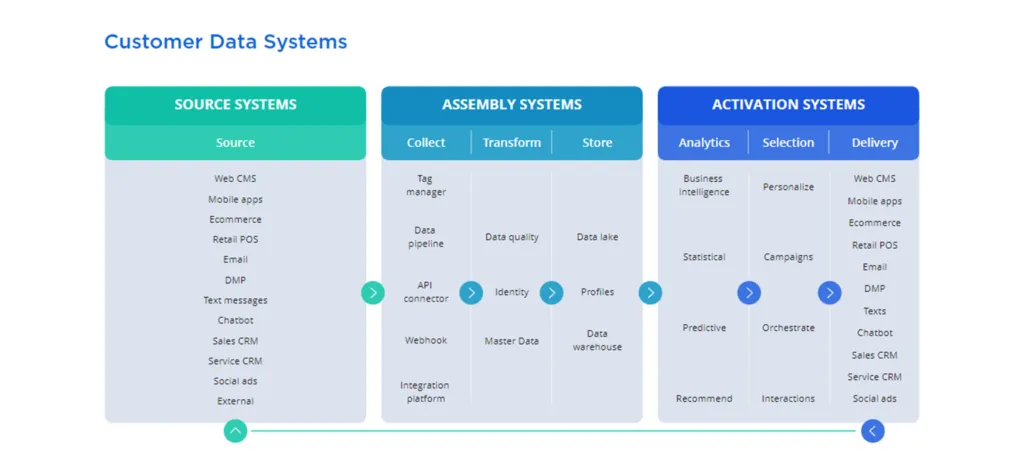
Most companies have a number of systems that manage some type of customer data, and they fall into three broad categories:
- **Source Systems:** Systems that capture data directly (website, email, CRM, DMP, etc.)
- **Assembly Systems:** Systems that ingest customer data from original sources and assemble profiles (including data collection, transform, and store data)
- **Activation Systems:** Systems that use assembled data (analytics, message selection, delivery)
### Quick Tip: Point Solutions are not CDP Solutions
Some end-to-end point solutions look like a CDP, but they aren't. For example, an email solution might add features across the assembly and activation categories. It might even add in an additional data source, but mostly it creates another data silo, not a unified profile.
## The Minimum Viable CDP
Remember, all true CDPs build a shareable customer profile that is unified, persistent, and comprehensive. This unified profile can serve as the single source of truth across an organization regarding a customer, so the entire company is in sync on the data and persona they are modeling against.
Per the CDP Institute, a CDP is defined as a "packaged solution," which means it provides additional capabilities that help marketers assemble and activate data across all channels. CDPs are the only system designed and optimized for this purpose.
A minimum viable CDP must have a particular set of features that fall into the assembly category, including:
- Data pipeline and API connection for collecting data
- Data quality for transforming data
- Data lake and profiles to store data
But this is just the start of what a CDP can do.
## Beyond the MVP: 6 Core Capabilities of CDPs
It's easy to get lost with hundreds of CDPs in the market, all coming from different origins, all with varying features. Although some meet the minimum viable CDP feature set as defined by the CDP Institute, others go beyond and are more sturdy enterprise-grade platforms for global [omnichannel marketing](/glossary/omnichannel-marketing/) requirements. CDPs will have capabilities from some or all of these six areas.
- **Data CDP capabilities:** May come from tag manager legacy software. Include data lakes, data pipeline, profiles, data integration capabilities.
- **Analytics CDP capabilities:** May have predictive models, recommendations, and business intelligence.
- **Campaign CDP capabilities:** Includes [personalization](/glossary/personalization/), orchestration, and campaign management features.
- **Delivery CDP capabilities:** Sending messages to channels for activation.
- **Operational CDP capabilities:** For optimizing and management of business processes and message delivery.
- **Enterprise CDP capabilities:** An enterprise-grade CDP has all of the capabilities mentioned above in a single package, and is built from ground-up as a dedicated centralized data management solution with APIs for connectivity and interoperability.
Connecting data silos using a CDP and providing additional features across assembly and activation benefits companies in two ways. First, it enables marketers to make more profitable decisions because they have that complete, accurate view of the customer and their interactions with the company. And second, it helps reduce costs by eliminating duplicate functions across systems.
#### **Learn more: [10 Capabilities You Need in an Enterprise CDP](/articles/10-capabilities-you-need-in-an-enterprise-cdp/)**
## Find the Right CDP for You
Before you begin the [process of selecting a CDP](/basics/how-to-choose-the-right-customer-data-platform-cdp/), you should ask yourself some key questions:
- What do you want to accomplish?
- What's stopping you from doing it?
- What CDP use cases should you focus on to achieve your goals?
- Is a CDP the best solution to meet your goals?
Once you understand your business objectives and see where the gaps keep you from achieving them, you can decide if a CDP is what you need. By mapping out your use cases, you'll see what CDP features you need, which will help you decide what type of CDP to purchase. It will take a bit of work, but in the end, you'll end up with the right CDP for your needs.
For more information, you can download the whitepaper, “Where CDP Fits In Your Tech Stack” from the CDP Institute and Treasure Data. It covers how CDPs compare to DMPs, Master Data Management, Data Lakes, CRM and other systems.
## The integration sequence: where CDP projects actually fail
The stack diagram tells you where a CDP sits. It does not tell you the order to wire it in, and the order is where integrations go wrong. A CDP connected out of sequence does not fail loudly — it quietly assembles profiles nobody trusts, and every team downstream models against them anyway.
Work the sequence in this order:
1. **Classify your systems before touching anything.** Sort every system that touches customer data into the source, assembly, and activation categories above. The output is not a slide; it is the list you will connect from, and it usually reveals two or three systems duplicating the same job.
2. **Define the profile schema before the first connection.** Decide which fields make up a profile, which identifier wins when two systems disagree, and which events count as the same action across sources. Include consent and preference state from day one — retrofitting consent onto a year of assembled history is far harder than collecting it correctly from the start. Teams that skip this step inherit every source's formatting quirks, and fixing them after load means reprocessing everything.
3. **Connect the sources your first use case needs, and only those.** A first integration built on web behavior, purchases, and email engagement proves the pipeline faster than connecting every source at once, and it surfaces identity problems while the blast radius is small.
4. **Wire one activation end to end before adding more sources.** Pick one destination — an email platform or an ad audience — and push a real segment through it. A profile store with no live activation is a data lake with better marketing, and activation is where data quality problems finally surface.
5. **Write down the operating rule.** Name the team that owns profile schema changes, the process for adding a source, and who gets called when a sync breaks. Without it, six months later nobody knows why a field changed or which system is authoritative.
The same failure modes repeat across companies: profiles assembled before identity rules were set, so the same person exists three times; sources connected by org chart instead of by use case, so data nobody activates still costs money to move; and schema changes made silently in one system, breaking a downstream audience nobody remembered was live. None of these are CDP product problems. They are sequence problems, and they are avoidable in week one.
## Choosing how each system connects to the CDP
The sequence gives you the order; each connection still needs a pattern, and the pattern determines how fresh the profile is and how it fails. Four cover nearly every CDP deployment:
| Connection pattern | Best for | Typical latency | Watch out for |
|---|---|---|---|
| Prebuilt connectors | Standard SaaS sources and destinations — CRM, email, advertising platforms | Minutes to hours | Connector coverage decays; a destination that silently drops a field truncates every profile it touches |
| Event APIs (streaming) | Behavioral data from properties you control — web, mobile apps, checkout | Seconds | Every custom event becomes schema you own; unmapped events pile up as unusable data |
| Batch files | Back-office, legacy, and partner systems that cannot stream | Hours to a day | Nightly loads hide staleness — every profile is up to a day old, which stays invisible until a campaign acts on it |
| Warehouse-centered sync | Teams whose customer analytics already live in a cloud data warehouse | Hours, on the warehouse's schedule | Two profile stores drift apart unless one system is named the source of truth for each attribute |
Two rules keep the choice honest. First, match the pattern to how the data changes, not to what is fastest to switch on: behavioral events lose value by the minute, while a billing address rarely changes fast enough to justify streaming infrastructure. Second, for every attribute, name the one system whose value wins, then configure the other patterns to defer to it. The expensive failure is not picking the wrong pattern — it is running three patterns at once with no owner, so the same attribute arrives by stream, by batch, and by warehouse sync, each carrying a different value. When that happens, every downstream team quotes whichever value suits its argument, and the unified profile is unified in name only.
## Where the CDP sits when AI agents run the campaigns
The newest entrants to the MarTech stack are [agentic AI](/glossary/agentic-ai/) systems that select audiences, draft messages, and trigger journeys with limited human oversight. They change the CDP's position in one specific way: the unified profile stops being a report for people and becomes an instruction set for software. An agent does not open a dashboard and interpret segments — it reads the profile at the moment of decision and acts on what is there, accurate or not.
That raises the stakes of everything earlier in this article. A stale consent flag was once a finding in a quarterly audit; with agents acting on profiles, it becomes an outreach to a customer who opted out — automatically, at machine speed. Suppression lists, frequency caps, and channel preferences are no longer documentation; they are constraints the profile has to enforce at the moment an agent acts.
This is where the [agentic CDP](/glossary/agentic-cdp/) concept comes from: profiles built to be queried and acted on by autonomous systems through governed interfaces, with every agent action written back to the profile as new data. The write-back matters as much as the read. An agent that acts on the profile but never updates it optimizes against a snapshot that decays from the moment it goes live. And because agents compress the time between a data problem and its customer impact, [agentic personalization](/glossary/agentic-personalization/) inherits every identity and quality shortcut taken during integration, at whatever speed the agent runs.
For stack planning, the takeaway is simple: position the CDP as the layer agents read from and write to, run it through the same integration sequence, and treat profile governance as the control surface for AI-driven marketing. The diagram barely changes. The cost of getting it wrong does.
## FAQ
### Do you still need your CRM and marketing automation platform after adding a CDP?
**Yes — the CDP assembles the customer profile; your CRM and marketing automation platforms remain the systems that act on it.** A CRM holds the record a sales team works from, and a marketing automation platform sends the campaigns; neither unifies data from every source. The CDP feeds both a resolved, persistent profile, and their engagement data flows back in. Removing them after a CDP lands recreates the silo problem the CDP was bought to solve.
### Should the CDP or the data warehouse be the source of truth for customer profiles?
**Neither system owns everything: give the CDP authority over engagement-facing profile attributes and the warehouse authority over historical records.** The warehouse is built for analytics at scale; the CDP is built to serve a resolved, current profile to channels and to AI agents. Collisions happen when both assemble the same attribute and no one has named which value wins. Map ownership during profile schema design — before the first sync — so neither system silently overwrites the other.
---
### How CDPs Enable Successful Digital Transformation
URL: https://cdp.com/articles/why-cdps-are-key-digital-transformation-platforms/
I have been a part of many [digital transformation](/basics/what-is-digital-transformation/) initiatives, and they all have several common objectives around driving growth, improving customer experiences, becoming data-driven, and evolving the business model. And because customer data is at the center of all the transformation programs, implementing a [Customer Data Platform or CDP](/basics/what-is-a-customer-data-platform-cdp/) should be a primary investment in many industries, including retail, [consumer package goods (CPG)](/glossary/cpg-marketing/), financial services, automotive, entertainment, media, and life sciences, as CDPs enable successful digital transformations.
These industries have several common needs, including keeping loyal customers, innovating new products, personalizing [customer experiences](/glossary/customer-experience-cx/), addressing [privacy regulations](/basics/international-u-s-data-privacy-laws-and-regulations-you-need-to-know/), and reducing security risks. Leading organizations recognize how new technologies such as AI, AR/VR, IoT, automations, and integrations are opportunities and disruptive threats, and their digital transformations must optimize how they will evolve their business models.
## How Successful Digital Transformation Impact Organizations
Transformation leaders often start with an understanding of changing market conditions, evolving customer needs, and the impacts of new competitors. These drivers frequently lead organizations to invest in building new digitally-enabled products and improving customer experiences.
Successful digital transformations grow revenue and shift the business model to these modernized business capabilities, but leaders must drive significant changes to the operating model to succeed. For example, the marketing team needs to reach new customer segments and efficiently convert new leads to prioritized prospects. Inside sales teams and direct-to-customer digital channels must offer personalized experiences, while sales teams on bigger ticket items must build meaningful relationships with the buyers and influencers.
Digital transformations impact front-office operations significantly, and the net is that back-office functions must keep up with the speed and intelligence required to compete. For example, technology organizations must improve the frequency of delivering innovations and improving employee experiences. Of course, customer support teams must have a full 360-degree view of the customer to provide excellent and efficient services. And as products become hyper-personalized, financial analysts must make faster strategic decisions and need better tools to understand profitability, opportunities, and risks.
## Customer Data Management is Central to Digital Transformations
The common denominator for these transformations is data, specifically customer data, whether in the CRM, e-commerce systems, mobile applications, content management systems, point of sale systems, or data from social networks. Employees typically have access to only one or two systems with customer information, so one primary importance of customer data platform technologies is integrating data into a central repository.
Once integrated, the data can be normalized and enriched, forming a comprehensive, centralized master data source that sales, marketing, and customer service employees can use in their daily work.
But CDPs are not just there to support employee workflows. Machine learning models can use this data to deliver content recommendations, predict buying behaviors, identify customers likely to churn, and rank prospects. CDPs are also integrated into campaign management platforms, CRM workflows, and web platforms to deliver personalized experiences.
CDPs go beyond a centralized data warehouse and deliver a lot more value than just reporting. [Leading organizations use CDPs](/articles/4-reasons-companies-are-turning-to-cdps/) as the source for customer analytics, but they use the platform’s tools to normalize and enrich customer data and turn them into repurposable profiles. And beyond storing and analyzing customer data, CDPs help organizations increase ad click-through rates, centralize customer information across franchise properties, optimize loyalty programs, and track customer behavior patterns.
In other words, CDPs are central to running a modernized, integrated, smart, and fast digital business.
## Aligning the Organization on the CDP Opportunity
Few platforms truly connect all aspects of business operations. ERPs, HR systems, and enterprise CRMs are good examples, and they are all challenging to select, implement, and maintain these platforms.
While CDPs are a central hub for customer information, workflows, and analytics, they can be enabled incrementally and enhanced over time. For example, a retail company may start using CDPs to optimize campaigns on common platforms, then follow this up with using the CDP to enrich the e-commerce platform’s recommendation engine. A bank may start creating customer profiles in wealth management and then expand to other banking areas, including payments, loans, and credit cards.
Similarly, integrating, cleansing, and enriching customer data can be prioritized through a roadmap that delivers incremental business value. It’s best to start with the most essential data sources, cleanse them for accuracy, and then look to enrich with secondary sources.
Successful digital transformation initiatives start with articulating a [business vision](https://blogs.starcio.com/2021/03/vision-statements-digital-transformations.html), driving a planning process based on market and customer needs, and engaging business stakeholders early in the journey. From there, organizations should adopt agile methods to research customer opportunities, discover key business requirements, identify primary data sources, and drive an intelligent CDP vendor selection.
If a CDP isn’t on your [digital transformation](/basics/what-is-digital-transformation/) roadmap, well then, chances are your competitors are a couple of steps ahead of you. But don’t fall too far behind because it’s the organizations that fail to start that get caught in the trailing dust of digital disruption.
---
### Why Do You Need a CDP? 10 Signs It Is Time to Invest
URL: https://cdp.com/articles/why-do-you-need-a-cdp/
**You need a [customer data platform](/basics/what-is-a-customer-data-platform-cdp/) (CDP) when your organization has customer data scattered across multiple systems, cannot build a unified view of each customer, and lacks the ability to activate that data in real time for personalization, analytics, or AI-driven decisioning.** A CDP is not a solution for every organization — but for companies hitting specific data and activation walls, it is the most effective path forward.
The question "do we need a CDP?" is fundamentally different from "what is a CDP?" Understanding the definition is easy. Diagnosing whether your organization has the symptoms that a CDP solves requires honest assessment of your current data architecture, team capabilities, and business objectives.
This guide provides a diagnostic framework: ten specific signs that indicate CDP readiness, situations where a CDP is not the right investment, and a readiness checklist to assess your organization's position. For a comprehensive overview of what CDPs do, see [What Is a Customer Data Platform?](/basics/what-is-a-customer-data-platform-cdp/).
## 10 Signs You Need a CDP
### 1. Customer Data Lives in Silos
Your CRM has contact information. Your e-commerce platform has purchase history. Your website analytics tool has behavioral data. Your support system has ticket history. But no single system connects these records to build a [complete customer profile](/glossary/customer-360/).
**The cost of inaction:** Marketing sends promotional emails to customers who just purchased. Support agents have no visibility into a customer's recent browsing behavior. Sales teams work from incomplete profiles. Every team makes decisions based on a fragment of the customer picture.
### 2. You Cannot Build a Unified Customer Profile
You have attempted to unify customer data using SQL queries, spreadsheets, or custom scripts — but the result is fragile, slow, and requires constant engineering maintenance. [Identity resolution](/glossary/identity-resolution/) across devices, channels, and accounts is too complex for manual approaches.
**The cost of inaction:** Duplicate profiles inflate your audience counts, skew analytics, and cause embarrassing customer experiences like sending the same offer twice to the same person at different email addresses.
### 3. Real-Time Data Activation Is Impossible
By the time your team builds a segment, exports it, and uploads it to an activation channel, the data is hours or days old. You cannot trigger personalized experiences based on what a customer is doing right now — only what they did last week.
**The cost of inaction:** A customer abandons a cart, but the retargeting campaign does not reach them for 48 hours. A high-value customer visits the pricing page, but the sales team is not notified until the next weekly report. [Real-time CDPs](/glossary/real-time-cdp/) close this gap from days to seconds.
### 4. Segmentation Requires Engineering Support
Every time marketing needs a new audience segment, they file a ticket with the data team. The request takes days or weeks to fulfill. By the time the segment is delivered, the campaign window has passed.
**The cost of inaction:** Marketing velocity drops. Campaigns launch with stale segments. Data engineers spend their time fulfilling ad-hoc requests instead of building infrastructure. [Customer segmentation](/glossary/customer-segmentation-definition/) becomes a bottleneck rather than a capability.
### 5. Privacy Compliance Is Manual and Fragile
When a customer submits a GDPR deletion request or withdraws consent, your team must manually track down and delete their data across five, ten, or twenty systems. There is no centralized place to manage [consent](/glossary/consent-management/) and no automated way to enforce it across activation channels.
**The cost of inaction:** A single unprocessed deletion request can result in regulatory fines. More practically, the manual burden of compliance drains resources and slows down every data initiative.
### 6. You Have No Unified Identity Across Channels
A customer who browses on mobile, purchases on desktop, and contacts support by phone appears as three different people in your systems. There is no [identity graph](/glossary/identity-graph/) connecting these interactions, so you cannot understand the full customer journey.
**The cost of inaction:** Customer lifetime value calculations are wrong (split across multiple profiles). Attribution models are inaccurate. Personalization efforts treat the same person as multiple strangers.
### 7. Marketing Depends on Engineering for Every Data Need
Data engineers have become the bottleneck for marketing operations. Every new data source, every new segment, every new report requires engineering involvement. Marketing cannot self-serve, and engineering is drowning in requests.
**The cost of inaction:** Both teams are frustrated. Marketing cannot move at the speed the business requires. Engineering cannot focus on strategic projects because they are fulfilling tactical data requests.
### 8. AI Initiatives Are Stalling Due to Data Fragmentation
Your organization wants to deploy [predictive analytics](/glossary/predictive-analytics/), propensity models, or [AI-powered decisioning](/glossary/ai-decisioning/) — but the models cannot access unified customer data. Training data is incomplete, scattered across systems, and inconsistent in format.
**The cost of inaction:** AI projects fail not because of model quality but because of data quality. A predictive churn model trained on incomplete profile data produces unreliable predictions. [Agentic CDPs](/glossary/agentic-cdp/) solve this by providing AI with direct access to unified profiles.
### 9. Your Personalization Is Basic or Nonexistent
Personalization efforts are limited to inserting a first name in email subject lines. You cannot personalize website content, product recommendations, or campaign timing based on individual customer behavior and preferences.
**The cost of inaction:** Competitors who deliver relevant, timely experiences win customer attention and wallet share. Generic messaging generates lower engagement rates and higher unsubscribe rates.
### 10. Data Activation Requires Manual Exports
Activating customer data means exporting CSV files, uploading them to advertising platforms, and manually syncing audiences across channels. There is no automated [data pipeline](/glossary/data-pipeline/) connecting your customer data to activation endpoints.
**The cost of inaction:** Manual processes are slow, error-prone, and do not scale. A marketer who spends two hours exporting and uploading audience lists is a marketer who is not building campaigns or analyzing performance.
## When You Do NOT Need a CDP
A CDP is not the right investment for every organization. Here are situations where a CDP will not deliver sufficient value:
**Small customer base (under 10,000 profiles).** If your customer base is small enough to manage in a CRM or spreadsheet, a CDP adds complexity without proportional value. The unification and scale benefits of a CDP emerge when data volume and source complexity exceed what simpler tools can handle.
**Single-channel business.** If you interact with customers through a single channel (e.g., only email or only in-store), the cross-channel unification that CDPs provide is less valuable. CDPs deliver the most impact when they connect data across five or more customer touchpoints.
**No personalization or activation goals.** If your organization does not plan to personalize customer experiences, activate data for marketing, or build AI-driven customer interactions, a CDP is an expensive data warehouse. The value of a CDP comes from using unified data, not just storing it.
**Fundamental data quality problems.** If your source systems have severe data quality issues — missing records, incorrect formats, no consistent identifiers — a CDP will unify bad data into bad profiles. Fix data quality at the source before investing in unification.
## CDP Readiness Checklist
Before beginning a CDP evaluation, assess your organization's readiness across five dimensions:
| Dimension | Ready | Not Ready |
|---|---|---|
| **Data sources** | 5+ customer data sources that need unification | 1-2 systems with minimal overlap |
| **Data volume** | 100,000+ customer profiles, growing | Small, static customer base |
| **Use cases** | 3+ defined use cases with measurable KPIs | Vague goals like "better data" |
| **Stakeholder alignment** | Marketing, IT, and data teams agree on the need | Single department initiative |
| **Budget and timeline** | Approved budget and realistic implementation timeline | Exploratory with no budget |
If you score "Ready" on four or more dimensions, you are well-positioned to begin a [CDP evaluation](/articles/cdp-evaluation-criteria/). If you score "Not Ready" on three or more, focus on building the organizational foundation before investing in technology.
## What to Do Next
If the signs above resonate with your organization, the next step is not to start evaluating vendors immediately. Instead:
1. **Document your use cases.** Write down the three to five specific problems a CDP would solve, with measurable success criteria for each.
2. **Audit your data landscape.** Map every system that contains customer data, including the volume, freshness, and quality of data in each. See our [CDP implementation guide](/articles/cdp-implementation-guide/) for a data audit framework.
3. **Align stakeholders.** Ensure marketing, IT, data engineering, and legal teams agree on the need and the approach. CDP implementations that lack cross-functional buy-in fail regardless of the platform selected.
4. **Evaluate architectures.** Understand the trade-offs between [agentic CDPs](/glossary/agentic-cdp/) and [composable CDPs](/glossary/composable-cdp/) to determine which architecture fits your organization. For architecture comparisons, see [How to Evaluate a CDP in the AI Era](/articles/how-to-evaluate-cdp-ai-era/).
5. **Build your RFP.** Use a structured [CDP RFP template](/articles/cdp-rfp-template/) to ensure you evaluate vendors consistently and comprehensively.
For organizations in specific industries, see our industry guides: [CDP for Automotive](/articles/cdp-for-automotive/), [CDP for Convenience Stores](/articles/cdp-for-convenience-stores/), [CDP for Financial Services](/articles/cdp-for-financial-services/), [CDP for Healthcare](/articles/cdp-for-healthcare/), [CDP for Media](/articles/cdp-for-media/), [CDP for QSR](/articles/cdp-for-qsr/), [CDP for Retail](/articles/cdp-for-retail/), [CDP for SaaS](/articles/cdp-for-saas/), and [CDP for Travel](/articles/cdp-for-travel/).
## Related Articles
- [C-Suite Skills for Data-Driven Leadership](/articles/c-suite-executives-top-skills/) — Top skills modern executives need for data-driven success
- [Top CDP Benefits That Drive Enterprise ROI](/articles/top-4-benefits-of-a-cdp/) — Key business benefits of CDP investment
- [4 Reasons Companies Are Turning to CDPs](/articles/4-reasons-companies-are-turning-to-cdps/) — Business drivers for CDP adoption
## FAQ
### What is the minimum company size that benefits from a CDP?
There is no strict minimum, but CDPs typically deliver meaningful ROI for organizations with at least 100,000 customer profiles, five or more customer data sources, and active personalization or AI goals. Below this threshold, CRM platforms with built-in analytics often provide sufficient capability. The deciding factor is not company size but data complexity — a mid-market company with ten data sources and sophisticated personalization goals may need a CDP more than an enterprise with a single-channel business.
### How long does it take to see ROI from a CDP?
Most organizations see initial value within 60 to 90 days of deployment for quick-win use cases like audience deduplication, basic segmentation, and consent centralization. Full ROI — including AI-driven personalization, predictive analytics, and cross-channel orchestration — typically materializes within six to twelve months. The key variable is implementation speed: agentic CDPs that deploy in weeks deliver faster time-to-value than enterprise suites that require six to eighteen months of implementation.
### Can we build a CDP internally instead of buying one?
Building a CDP internally is technically possible but rarely cost-effective. Organizations that attempt it typically spend 12 to 24 months and 2 to 5 million dollars in engineering time before reaching feature parity with commercial platforms — and then face ongoing maintenance costs of 500,000 dollars or more annually. The build-versus-buy math favors buying for all but the largest technology companies with dedicated platform engineering teams. More importantly, internal builds rarely include the AI, activation, and privacy capabilities that commercial CDPs provide out of the box.
---
See how analysts rank the top CDP vendors → [Forrester Wave](https://www.treasure.ai/forrester-wave-cdp/?utm_source=cdp-dot-com&utm_medium=website-referral&utm_campaign=articles&utm_content=inline) | [IDC MarketScape](https://www.treasure.ai/idc-marketscape-2026?utm_source=cdp-dot-com&utm_medium=website-referral&utm_campaign=articles&utm_content=inline)
---
### Why DTC Is The Next Step For CPG Brands
URL: https://cdp.com/articles/why-dtc-is-the-next-step-for-cpg-brands/
**The [consumer packaged goods (CPG)](/glossary/cpg-marketing/) industry is a behemoth, contributing [10% of the national GDP](https://consumerbrandsassociation.org/industry-impact/) and supporting one in ten American jobs.** Yet as consumer habits evolve quickly and ecommerce continues to gain market share, CPG companies are facing three serious challenges:
- **Expenses:** They spend [nearly a quarter of their revenue](https://deloitte.wsj.com/cmo/2017/01/24/who-has-the-biggest-marketing-budgets/) on marketing, by far the largest allocation of any industry (Deloitte/WSJ analysis, 2017).
- **Insufficient Data:** They have little to no first-party customer data because they sell to consumers through retailers and marketplaces, not directly. This gap is accentuated by an increase in [privacy regulations](https://www.forbes.com/sites/forbescommunicationscouncil/2020/06/17/four-forces-driving-the-rise-of-customer-data-platforms/#77d4cf0b1ea5), like [GDPR](https://gdpr.eu/) and CCPA, and a move toward a cookieless digital world.
- **Competitors:** They have growing competition from direct-to-consumer (DTC) startups and private labels from established retailers.
CPG brands have reached a critical decision point. They must expand their traditional B2B2C business model and invest in DTC models to remain relevant and competitive in a changing landscape. The pandemic accelerated ecommerce expansion, and that shift has held.
By creating new products for DTC brands, categories, segments, and themes—especially in emerging markets—CPG companies can become more cost-effective, data-driven, and agile. Instead of carrying a marketing budget that heavy, they can allocate some of that budget toward lower spend channels. They can build direct relationships with customers, cultivating trust, collecting first-party data, and personalizing customer experiences across different brand channels.
Some legacy CPG companies—like [PepsiCo](https://www.forbes.com/sites/louisbiscotti/2020/05/18/direct-to-consumer-dtc-a-fad-or-the-beginning-of-a-trend/#5337d2b34ca3), [Clorox](https://www.modernretail.co/retailers/inside-cloroxs-accelerating-dtc-strategy/) and our client, [AB InBev](https://www.adexchanger.com/ecommerce-2/top-cpg-brands-rush-to-take-advantage-of-dtc-businesses/)—are already rolling out their own DTC brands. This is a smart, low-risk way to experiment with new products and markets, without having to transform a large company overnight. If DTC efforts are successful, they can coexist with traditional channels and contribute to company-wide goals.
## Three Ingredients for a Successful DTC Launch
A DTC launch doesn’t have to be an expensive or laborious undertaking. If your company is considering branching out into DTC sales with your products, you can be ready to go to market in approximately a quarter. Here are the three main elements you need to create an effective DTC technology stack:
### 1. Ecommerce Platform
Ecommerce platforms like Shopify, Wix, and Squarespace make it simple to promote new products and manage sales and fulfillment without a large upfront investment. Since your company sells directly to customers, you own the relationship you build with them. You can expect your marketing execution to improve with your ability to gather first-party data, as you learn more about your customers’ preferences, behaviors, and buying habits. Most importantly, you have permission to use their customer data across your brand, giving you opportunities to offer one-to-one personalization, research new product ideas, and enhance overall customer experience.
### 2. Logistics Provider
The logistics of a DTC model are straightforward: your customer orders a product, and you ship it to their doorstep. Reliability, flexibility, and cost-effectiveness are key when selecting a logistics partner. You need to know that you can rely on them to deliver orders on time and provide real-time updates about delays or other problems. Ecommerce platforms integrate with APIs from traditional shipping companies like FedEx and UPS, as well as newcomer delivery services like DoorDash and Uber.
### 3. Customer Data Platform
Customer data is only useful if you can organize and analyze it strategically. A [customer data platform (CDP)](/basics/what-is-a-customer-data-platform-cdp/) is a centralized database that connects information from disparate data sources, such as social media, email marketing, and ad campaigns. When you have a unified view of all your customer data, across multiple channels and brands, you can optimize your marketing strategy and deliver a more personalized customer experience. You also avoid costly or time-consuming mistakes, such as unwittingly violating data protection regulations or targeting duplicate customer profiles.
As consumers spend more of their money and time online, DTC brands are ideally positioned to grow and thrive. CPG companies have the chance to explore new opportunities in the DTC business model—or risk getting left behind.
*Editor’s note: The above article first appeared on Forbes.com as part of the Forbes Communications Council series, which you can* [*view here*](https://www.forbes.com/sites/forbescommunicationscouncil/2020/07/20/why-dtc-is-the-next-step-for-cpg-brands/#6a00aa2f2e5b)*.*
## Why wholesale-only CPG brands hit a growth ceiling
A wholesale-only model caps how well a CPG brand can know and serve its buyers, and the cap tightens as retail shifts online. Four mechanisms do the damage:
- **You ship product but never meet the customer.** The retailer or marketplace owns the transaction record, so the brand cannot see who bought, what else they bought, or whether they came back. Retention marketing is impossible with a shopper whose name you never learned.
- **Demand signals arrive late and pre-aggregated.** Retailer point-of-sale and syndicated data report what sold, where, and when—weeks after it sold. By the time a decline is visible in the numbers, shoppers have already formed new habits.
- **Trade spend absorbs the marketing budget.** Slotting fees, promotional allowances, and retailer media packages are deducted before the brand sees revenue, and they buy visibility on someone else’s shelf rather than an asset the brand keeps.
- **Innovation moves at the retailer’s cadence.** A new product can wait on the next assortment review, and a slow trial read can end the line before it finds its audience.
The gap is structural, not a marketing problem: it comes from where the transaction happens, so no amount of retail marketing spend closes it. DTC does not replace that system, but it opens a pressure valve. A direct storefront produces full-margin revenue on part of the volume, a live feed of who is buying and why, and a place to test products, claims, and price points without waiting for a planogram decision. Brands that treat DTC as a learning channel, not just a revenue line, carry that evidence back into retail negotiations—with something a syndicated report cannot show.
## How to add DTC without fighting your retail partners
The first objection inside a CPG company is rarely technical—it is the fear that a DTC store reads as a declaration of war on the retailers who carry most of the volume. That outcome is avoidable, and the brands that avoid it follow a recognizable pattern:
- **Hold price parity on identical products.** Undercutting the shelf price of the same SKU turns every retail buyer into an adversary, and retailers notice quickly. The DTC store competes on bundles, subscriptions, and convenience—never on price.
- **Differentiate the assortment.** Give DTC what retail structurally cannot carry: variety packs, larger formats, refills, limited editions, and early access to new lines. When the DTC catalog extends the retail one, the store looks like brand-building rather than volume poaching.
- **Use DTC as demand generation for the shelf.** Sampling, new-product launches, and community programs create pull that shows up in the retailer’s own point-of-sale data. A buyer whose category is growing because of a brand’s DTC activity has no grievance to act on.
- **Bring retail partners along early.** A buyer conversation about the DTC plan, framed around category growth rather than volume shift, costs little and prevents the surprise that poisons the relationship.
Marketplaces deserve their own note. Selling through one puts the brand in front of motivated shoppers, but the platform keeps the customer record, so a marketplace storefront grows revenue while leaving the data gap exactly where it was. If marketplace volume matters, the DTC store is what converts that demand into a relationship—inserts, registration prompts, and refill subscriptions give marketplace buyers a reason to identify themselves.
The classic failure mode runs in the other direction: aggressive DTC discounting, followed by lost shelf space and a smaller business than the brand started with. Price discipline is the difference between adding a channel and starting a conflict.
## The DTC economics check: run the numbers before you launch
DTC for CPG fails on math more often than on marketing, because parcel economics are unforgiving compared with a pallet. A case shipped to a distribution center spreads freight across many units; a single jar in a mailer pays the full fixed cost of the trip. That difference decides which products belong in a DTC assortment, and it is why heavy, low-priced items often lose money before marketing even starts. Before committing budget, establish four numbers and the failure mode each one guards against:
| Question to answer | What to establish | Why it matters | Failure mode |
|---|---|---|---|
| Does a single order make money? | Contribution margin per order: average order value minus landed product cost, picking and packing, parcel shipping, payment fees, and returns | Acquisition is only fundable if the first order carries part of its cost | Orders look profitable until shipping and returns are counted, and every incremental sale loses money |
| How much does a customer cost? | Blended acquisition cost across paid social, search, retail media, and [affiliate marketing](/glossary/affiliate-marketing/), with the payback point measured across the first repeat cycle | Low order values mean repeat purchases, not the first sale, have to repay acquisition | Discount-heavy launches attract one-time deal hunters, and acquisition cost never repays |
| Will customers reorder? | Repeat purchase rate measured against the category’s natural consumption cycle, plus subscription uptake on replenishable products | Lifetime value in CPG is a reordering question, and only lifecycle marketing can drive it | Treating a consumable like a fashion label—campaign-led, with no reordering logic—leaves the channel dependent on paid traffic |
| Where does the data land? | Whether order, consent, and preference data flows automatically into the brand’s CDP instead of staying locked inside the ecommerce platform | The data advantage is the point of the channel | Data trapped in a storefront tool can never inform lifecycle, retail media, or product decisions |
A brand that cannot answer these questions is not ready to spend on acquisition. The safer sequence is to launch narrow—a few SKUs, fulfillment costs measured honestly, lifecycle flows live on day one—and let the numbers mature before scaling spend.
## What first-party DTC data changes in daily operations
Collecting first-party data is the headline benefit of DTC; the benefit only materializes when the data changes what the company does each week. Three loops do most of the work:
- **Lifecycle marketing timed to the consumption cycle.** Replenishable products have a rhythm: welcome flows, refill reminders set to that rhythm, and winback offers after a missed cycle turn one purchase into a habit. This is also where personalization is heading—[agentic personalization](/glossary/agentic-personalization/) applies AI agents to individual journey decisions, which favors brands whose customer data is unified enough for an agent to act on.
- **Evidence that strengthens the retail business.** Which claims drive repeat purchases, which product pairings lift basket size, which cities over-index—these findings sell in. A category buyer who hears that a variant reorders at a rate syndicated data cannot show has a reason to expand shelf placement, which is how DTC becomes an argument for more retail, not less.
- **Reach beyond the storefront.** Consented customer lists can seed prospecting on retail media networks, whose inventory is increasingly traded through programmatic infrastructure such as an [ad exchange](/glossary/ad-exchange/), so the data earns reach even where the brand does not own the shelf.
None of this requires exotic tooling—the third ingredient above, a CDP, exists to make these loops routine. What it requires is ownership: someone in the organization whose weekly job is to read repeat rate, lifecycle performance, and what the data says about the assortment, and to act on it. Data that nobody operates on is just storage.
There is also a second-order reason to own the direct relationship: buying is beginning to shift toward AI-mediated commerce, where assistants research options and complete reorders on a shopper’s behalf. Brands prepared for [agentic commerce](/glossary/agentic-commerce/)—structured product data, subscription and reorder capability, consent-based customer records—are legible to that layer of the market. A wholesale-only brand is invisible to it.
## FAQ
### Does adding DTC mean abandoning retail partners?
**No—for an established CPG brand, DTC works best as a complement to retail, not a replacement.** Retail still moves the bulk of the volume, and the DTC channel adds full-margin revenue on part of the business, direct customer relationships, and a testing ground for new products. The coexistence rules are simple: keep prices consistent on identical products, give DTC an assortment retail cannot carry, and share the plan with retail buyers early.
### Why do most CPG DTC programs stall?
**Most DTC programs stall because the first order never repays acquisition and repeat purchases never compound.** Packaged goods carry small order values, so a channel that leans on constant paid traffic and discounting loses money on every cycle. The fix is unglamorous: measure contribution margin per order honestly, launch lifecycle and replenishment flows on day one, and design the DTC assortment for reorders—bundles, refills, and subscriptions—so later purchases arrive without another ad.
---
### Why Every Customer-Facing AI Agent Needs a CDP
URL: https://cdp.com/articles/why-every-customer-facing-ai-agent-needs-a-cdp/
**Not every AI agent needs customer data — a coding assistant doesn't — but every customer-facing one does. A [customer data platform](/basics/what-is-a-customer-data-platform-cdp/) is the shared memory that AI agents across marketing, sales, support, and commerce read from and write back to, so they make consistent, context-aware decisions instead of conflicting ones.** The CDP is not just a data store; it is the coordination layer that turns independent AI agents into one intelligent system.
Most enterprises today are deploying AI agents across multiple departments simultaneously. Marketing teams use AI for personalization and journey orchestration. Sales teams use AI for lead scoring and conversation intelligence. Support teams use AI for ticket routing and churn prediction. Each of these agents can deliver value in isolation — but without a shared data foundation, they create a new kind of problem: collectively incoherent customer experiences.
## The Problem: AI Agents Operating in Data Silos
The silo problem is not new. CDPs were originally built to solve it for human marketers and analysts who needed a [single customer view](/glossary/single-customer-view-scv/) across channels and departments. But AI agents inherit — and amplify — every data silo that exists in an organization.
Consider what happens when AI agents operate without shared context:
- **Marketing AI** uses email engagement data and website behavior to decide which campaign to send next, but it cannot see that the customer filed a support ticket two hours ago complaining about a billing error.
- **Sales AI** sees CRM records and pipeline data but has no visibility into the fact that the customer just received three promotional emails in the past 24 hours, creating outreach fatigue.
- **Support AI** resolves a complaint and closes the ticket, but Marketing AI — unaware of the interaction — sends an upsell email ten minutes later, undoing the goodwill the support team just built.
- **Each AI agent is individually intelligent but collectively incoherent.** The customer receives contradictory signals from what feels like the same company.
This is not a hypothetical scenario. It is the default state of most enterprise AI deployments today. Every department has its own data, its own models, and its own optimization targets. Without a unifying layer, AI does not just fail to help — it actively harms customer experience at machine speed and scale.
The irony is striking: companies deploy AI to improve customer experience, but siloed AI makes it worse. A human marketer might notice that a colleague in support just handled a complaint and hold off on the upsell email. AI agents operating in separate systems have no such awareness.
Analysts are seeing this play out at scale. The [2026 IDC MarketScape for AI-Enabled Customer Data Platforms](https://www.treasure.ai/idc-marketscape-2026?utm_source=cdp-dot-com&utm_medium=website-referral&utm_campaign=articles&utm_content=inline) found that "AI features that did not work in practice" was among the top reasons organizations replaced their CDP — often a symptom of AI agents acting on fragmented, unreliable data rather than a unified customer record.
## AI for Marketing: What the CDP Enables
Marketing has been the earliest and most aggressive adopter of AI. But [AI-driven marketing](/glossary/agentic-cdp/) is only as good as the data it can access.
**Personalization at scale.** AI reads unified profiles that combine behavioral data (pages viewed, emails opened, products browsed), transactional data (purchase history, subscription tier, lifetime value), and demographic data (industry, company size, role) to personalize content, offers, and timing in real time. Without a CDP, AI personalizes based on whatever fragment of data lives in the marketing automation platform — typically email engagement and web visits, missing the full picture.
**Next best action.** [Next-best-action](/glossary/next-best-action/) decisioning requires AI to evaluate every available action (send an email, show a web banner, trigger a push notification, do nothing) and choose the optimal one based on the customer's full context. This requires access to cross-channel interaction history, purchase patterns, support status, and real-time behavioral signals — data that only a CDP aggregates into a single accessible profile.
**Agentic marketing.** The shift from campaign-based marketing to [agentic marketing](/glossary/agentic-marketing/) means AI agents autonomously orchestrate customer journeys, adjusting in real time based on customer responses. An [agentic CDP](/glossary/agentic-cdp/) enables this by providing the real-time profile and the [decisioning engine](/glossary/ai-decisioning/) in a single platform. Without it, agentic marketing degrades into isolated automations that cannot adapt to cross-channel context.
**Closed feedback loops.** The most critical capability: AI sends a message, observes whether the customer engaged, and feeds that outcome back into the model to improve the next decision. This loop must complete in seconds to minutes, not days. A CDP provides the real-time profile infrastructure where outcomes are written immediately and available for the next decision cycle. Without a CDP, feedback data sits in channel-specific tools, and the AI never learns from cross-channel outcomes.
## AI for Sales: What the CDP Enables
Sales AI has traditionally been confined to CRM data — contact records, deal stages, and activity logs. A CDP expands the intelligence surface dramatically.
**Behavioral lead scoring.** Traditional lead scoring relies on form fills, job titles, and company firmographics. CDP-powered lead scoring incorporates the full behavioral history: which product pages did the prospect visit, which content did they download, how many emails did they engage with, did they attend a webinar. AI models trained on this [first-party data](/glossary/first-party-data/) produce scores that reflect genuine buying intent, not just demographic fit.
**Account intelligence.** For B2B sales teams, the CDP provides a [customer 360](/glossary/customer-360/) view at the account level: which products the account currently uses, their support ticket history, their marketing engagement across all contacts, and their product usage patterns. Sales AI can surface accounts showing expansion signals (increased product usage combined with marketing engagement) or contraction risk (declining usage combined with unresolved support issues).
**Opportunity prediction.** The most accurate opportunity models use signals from multiple departments. A prospect who engages with marketing content, has a positive support experience, and shows increasing product usage is fundamentally different from one who filled out a form but has gone silent. Only a CDP aggregates these cross-department signals into a single profile that AI can score.
**Conversation intelligence.** Before a sales call, AI can arm the rep with full context: recent marketing interactions, open support tickets, product usage trends, and behavioral patterns. The rep walks into the conversation knowing the customer's full relationship with the company, not just what is in the CRM. Without a CDP, the sales rep gets CRM data and nothing more — missing the marketing and support signals that could make or break the conversation.
## AI for Support: What the CDP Enables
Support AI typically operates on ticket data: the current issue, previous tickets, and maybe a customer tier label. A CDP transforms support AI from reactive ticket processing to proactive relationship management.
**Intelligent ticket routing.** When a ticket arrives, AI can route it based not just on the issue category but on the customer's full profile: their lifetime value, their recent interactions across all channels, their sentiment trajectory, and their current stage in the customer journey. High-value customers showing churn signals get routed to senior agents immediately, not after escalation.
**Proactive support.** This is where CDP-powered support AI becomes transformative. AI detects churn signals — declining product usage, reduced email engagement, a negative support interaction last month — and triggers intervention before the customer ever contacts support. A retention offer, a check-in call from the account manager, or a proactive message addressing known friction points. Without a CDP, support AI waits for the ticket. With a CDP, it prevents the ticket.
**Resolution prediction.** AI estimates resolution complexity based on the full interaction history: previous tickets on similar issues, the customer's technical sophistication, their sentiment in recent interactions. This helps support teams allocate resources and set expectations accurately.
**Post-resolution coordination.** After resolving a ticket, support AI flags at-risk customers to the marketing team for retention campaigns or to the sales team for relationship recovery. The outcome (ticket resolved, customer satisfied or dissatisfied) flows back into the unified profile, where marketing and sales AI agents can read it and adjust their strategies. Without a CDP, ticket resolution is a dead end — the outcome stays in the support system and never informs other departments.
## AI for Commerce and Creative: The Same Requirement
The pattern holds beyond marketing, sales, and support. A conversational shopping or checkout agent — the engine behind [agentic commerce](/glossary/agentic-commerce/) — only recommends and completes purchases well when it reads the customer's real cart, order history, and loyalty status, not category-level popularity. AI creative generation follows the same logic: the generation model is a commodity available to every brand, so the unified customer data conditioning it is what decides whether the output is relevant to this customer or generic to everyone. In both cases the requirement is identical to the three domains above — a single, real-time profile the agent reads before it acts.
## The CDP as AI's Shared Memory
The central concept is straightforward: the CDP is a single unified profile that all AI agents read from and write back to. It is AI's shared memory — a persistent, cross-session, cross-channel intelligence layer that remembers every interaction, reasons about what to do next, and learns from every outcome.
Personalization was supposed to be the defining promise of modern marketing: software that learns the customer, not the other way around. Two decades later, most personalization still amounts to inserting a first name into an email or retargeting based on a single page view. The reason is architectural — personalization engines have operated on fragments of customer data scattered across channel-specific tools. AI agents, backed by a CDP that serves as persistent memory, represent the first architecture capable of delivering on that original promise at scale.
Here is how the coordination works in practice:
1. **Marketing AI** evaluates the customer's unified profile and sends a retention offer at 2:14 PM. It writes this action to the profile: "retention offer sent, email channel, 2:14 PM."
2. **Sales AI** reads the profile before the 3:00 PM outreach call. It sees the retention offer was just sent and adjusts its approach — instead of pitching an upsell, the rep focuses on relationship strengthening and addressing any concerns that prompted the retention trigger.
3. **Support AI** receives a ticket from the same customer at 4:30 PM. It reads the profile and sees both the retention offer and the sales call. The support agent (human or AI) knows the full context: this customer was flagged for churn risk, received a retention offer, and spoke with sales an hour ago.
4. **All outcomes flow back.** The customer opened the retention email (marketing outcome), the sales call went well (sales outcome), and the support ticket was resolved with a positive sentiment score (support outcome). All three outcomes are written to the same profile, and every AI agent can learn from them.
This is the closed feedback loop operating across departments, not just within a single channel. Without this shared memory, you have three independent AI systems optimizing their own metrics. With it, you have one intelligent system optimizing the customer relationship.
The difference is not incremental. Three independent AIs will inevitably work at cross-purposes, because their optimization targets conflict. Marketing AI maximizes engagement (more messages), Sales AI maximizes pipeline (more outreach), and Support AI minimizes ticket volume (fewer interactions). Without coordination through a shared profile, these objectives collide on the customer's end. [Data activation](/glossary/data-activation/) across every touchpoint requires a single source of truth.
## Why CRM, DMP, and Data Warehouses Cannot Replace a CDP for AI
If the CDP is AI's shared memory, why not use existing data infrastructure? Because each alternative was built for a different purpose, and none meets the requirements of real-time, cross-department AI coordination.
**CRM** is sales-centric by design. It stores contact records, deal stages, and activity logs — but it does not have marketing behavioral data (email engagement, website visits, ad interactions) or granular support history. CRM data is also manually entered and often incomplete. AI agents need automated, high-frequency behavioral data, not CRM records updated by sales reps between calls.
**DMP (Data Management Platform)** was built for anonymous audience targeting using third-party cookies. DMPs do not store personally identifiable information, cannot build persistent profiles, and are architecturally tied to a cookie ecosystem that is disappearing. They are irrelevant for AI agents that need to act on known customer profiles.
**Data warehouse** is an analytical system optimized for batch queries and business intelligence. It excels at storing large volumes of structured data for reporting and model training. But data warehouses cannot serve sub-second profile lookups for real-time AI inference. When an AI agent needs to decide what to do for a specific customer right now, it needs a profile API that responds in milliseconds — not a SQL query that takes seconds or minutes. Data warehouses also lack the [identity resolution](/glossary/identity-resolution/) layer needed to unify profiles across channels and devices.
**The CDP** combines what none of these systems individually provide: unified profiles built through identity resolution, real-time API access for AI inference, cross-department data aggregation, and a feedback loop where AI actions and outcomes are written back to the profile. It is purpose-built for the operational, real-time use case that AI agents require.
## From Independent AIs to One Intelligent System
The enterprise AI landscape is converging on a clear pattern: every department will have AI agents, and those agents will either coordinate through shared data or conflict through siloed data. There is no middle ground.
The CDP was originally built to give human marketers a unified view of the customer. In the AI era, its role expands: it becomes the shared memory layer that allows AI agents across marketing, sales, support, and commerce to operate as one intelligent system. Every agent reads from the same profile, every action is logged, every outcome feeds back into the model. The result is not just better marketing or better sales or better support — it is a coherent customer experience delivered by AI that actually understands the full relationship.
Companies deploying AI without a CDP are building the next generation of data silos. Each AI agent will optimize its own metrics, in its own system, with its own partial view of the customer. The customer will feel the incoherence. Companies deploying AI with a CDP — particularly a platform built for [real-time AI workloads](/articles/how-to-evaluate-cdp-ai-era/) — are building something fundamentally different: a coordinated intelligence layer that gets smarter with every interaction, across every department, for every customer.
The question is not whether your AI agents need a CDP. The question is how quickly you can give them one.
## Related Articles
- [How to Connect Customer Data to AI Agents](/articles/connect-customer-data-to-ai-agents/) — The implementation guide: unifying data, exposing it as a real-time lookup, and having agents query it
- [How to Democratize AI Across the Enterprise](/articles/how-to-democratize-ai-across-the-enterprise-with-a-cdp/) — Making AI accessible through unified data
- [How AI Is Redefining the CDP](/articles/how-ai-is-redefining-the-cdp/) — How agent-first architecture reshapes what a CDP is and does
- [How to Improve ROAS with AI & First-Party Data](/articles/how-to-improve-roas-with-ai-first-party-data/) — Feeding ad-platform AI the first-party data that lifts returns
## FAQ
### Can AI agents work without a CDP?
Yes, but each agent only sees its own department's data — marketing automation for marketing AI, CRM for sales AI, ticketing for support AI. Decisions rest on partial information, so customer experiences stay inconsistent. Without a shared profile, agents also cannot learn from outcomes in other departments: marketing AI never learns whether a sales follow-up succeeded, and support AI never sees whether a retention campaign changed sentiment. They run independently and miss the compounding value of coordinated AI.
### What is the difference between a CDP and a CRM for AI use cases?
A CRM stores structured sales data — contacts, accounts, deals, activities — optimized for sales workflows. A CDP unifies every touchpoint, including marketing engagement, support history, and product usage, into one real-time profile with identity resolution. For AI, the distinction matters: a CRM shows sales interactions and manually entered fields, while a CDP supplies the high-frequency behavioral data agents need for accurate prediction. A CRM was never designed to capture that data.
### How does a CDP enable cross-department AI coordination?
The CDP acts as a shared read-write layer: marketing AI writes campaign outcomes to the profile, sales AI reads them before outreach, and support AI sees the full context of both. Every action and outcome feeds back into one profile, closing the loop across departments instead of within a single channel. It also prevents conflicts — if support AI flags a customer as at-risk, marketing AI suppresses promotions. Without a CDP, department AIs optimize independently and contradict each other.
## Related Terms
- [Agentic CDP](/glossary/agentic-cdp/) — CDP architecture purpose-built for autonomous AI agent operations
- [Agentic Commerce](/glossary/agentic-commerce/) — AI shopping and checkout agents that need the same unified profile to act on a customer's cart and history
- [Customer 360](/glossary/customer-360/) — The unified customer profile that serves as the foundation for cross-department AI coordination
- [Next Best Action](/glossary/next-best-action/) — AI decisioning framework that selects the optimal action based on the full customer context
- [Data Activation](/glossary/data-activation/) — The process of making unified customer data actionable across channels and systems
- [Agentic Data Platform](/glossary/agentic-data-platform/) — The emerging term for CDPs redesigned to serve AI agents as primary consumers
---
### Customer Data Perspectives: Why You Need a CDP
URL: https://cdp.com/articles/why-you-need-a-cdp-david-raab/
Imagine if a chef had to grow their own food for every meal they cooked. It would be highly inefficient. The gardening, harvesting, and packaging would pull the chef away from their day job of cooking meals that delight diners.
Now, turn that analogy around and apply it to your marketing, sales, and customer service leaders. Do you expect them to hunt and gather different types of data they need to do their jobs effectively? Even if they could find and aggregate the needed data, could they do it repeatedly and efficiently? Unless you’re already using a [customer data platform](/basics/what-is-a-customer-data-platform-cdp/), the answer is likely a hard no.
The farmer and chef analogy comes from David Raab, founder of the [CDP Institute](https://www.cdpinstitute.org/), a vendor-neutral organization dedicated to helping companies manage customer data. I recently sat down with Raab to record an episode of Customer Data Perspectives for CDP.com. In the interview, Raab does an exceptionally good job of demystifying customer data platforms (CDPs), discussing the problems they address, and clearing up misconceptions about CDPs in relation to data lakes, [CRMs](/basics/cdp-vs-dmp-vs-crm-differences-similarities-and-best-practices/), and other platforms.
“People think: ‘oh, a CDP is just a database,’” Raab says, explaining that the function of a CDP is non-trivial and much more than a database. “We sometimes talk about CDPs like a farmer. The farmer does all the work to get the food, but they put it on the shelf so the chef can just go into the store and grab the food they need without worrying about how you grow it.”
This episode is a can’t-miss interview for anyone who has ever wondered what’s so important about CDPs, or struggled to explain what the technology does. Watch below, and [view the full transcript here](/podcasts/customer-data-perspectives-david-raab/).
## CDP Definition
At its core, Raab says he can explain what CDPs do in three simple words: “build customer profiles,” also known as the [single customer view](/glossary/single-customer-view-scv/) or a unified customer profile.
“They take the data from all of your systems that have customer data – and there are a lot of systems that have customer data today – and they pull that data into one place into a unified profile. So you get a complete picture of each customer. Then they make that profile shareable by any system that needs it,” he explains.
I love a simplified definition, and Raab nails it. But his definition also opens up questions about whether CDPs are really all that different from customer relationship management platforms (CRMs), marketing automation platforms, or even data warehouses and data lakes. The answer is a resounding yes. In the interview, Raab explains the differences and clears up the misconceptions. It starts with understanding that each of your systems only has a partial view of the customer.
“The CRM knows what happened in the CRM. The web personalization system knows what’s happening in web personalization. The call center knows what happened in the call center, but they are all separated silos. Bringing that data together is really tricky,” Raab says.
## Diving Into Data Lakes
He goes on to explain why consolidating customer data and unifying customer data is not easy, noting the data complexity problems you encounter when data is stored or when data is collected in different ways. CDPs provide that missing link of data unification. Unlike data warehouses, they can deal with both unstructured and semi-structured data. That opens the doors to tap web behavior logs, behavioral data, and other data sources or customer touchpoints that hold so much rich customer data.
Raab also discusses the benefits of data lakes at length, noting that they are great data sources for CDPs. But he cautions that data lakes are really just the start for companies that want to empower marketers, sales, and customer service leaders to do their jobs better.
“Traditionally, data scientists go into the data lake. They dive around, scavenge, and pick up the little bits they need. They come up to the surface and then go off into their little data scientist hut or boat or wherever it is data scientists live,” Raab jokes before getting serious again. “But they’re not creating an ongoing, clean data repository that other systems can use. That’s not what data lakes are for.”
## Why Adopt a CDP?
So what are the most common [use cases for CDPs](/articles/marketers-eyeing-cdps-what-you-can-learn-from-six-dozen-customer-data-platform-use-cases/), and what industries adopt them? In the interview, Raab puts on his analyst hat and describes the most typical use cases, including enhanced customer support in call centers, customer acquisition through ad retargeting, and the ability to build out more robust customer profiles for marketing and sales.
With revenue generation and [customer experience](/glossary/customer-experience-cx/) sitting at the heart of [digital transformation efforts](/articles/why-cdps-are-key-digital-transformation-platforms/), CDPs are rapidly becoming the next must-have tool for organizations that want to use data to more effectively target growth opportunities, pilot new products, understand customer behavior and improve customer experiences.
Traditionally, CDPs were adopted by those in the media, retail, telco, and financial services industries. But as Raab explains, adoption is becoming more mainstream, with industries including education and healthcare seeing the value in building customer profiles and unifying data. CDPs with built-in data privacy functions are especially appealing for industries with tight privacy regulations such as healthcare and to ensure [compliance with GDPR, CCPA, and other regulations](/basics/international-u-s-data-privacy-laws-and-regulations-you-need-to-know/) touching all industries.
There are many factors to consider when you start the [CDP vendor selection](/articles/how-to-evaluate-cdp-ai-era/) process. Raab ends the interview by offering advice and guidance on factors to consider, including urging business, technology, and data leaders to really understand their use cases and what shape their data is in. Leaders should consider the [tech buying personas](https://blogs.starcio.com/2021/06/how-to-buy-digital-tech-beware-of-these.html) in their organization, so they can identify the value propositions for leaders and departments that have the most to gain from using CDPs.
For organizations trying to convert prospects to buyers, [personalize experiences](/articles/what-is-driving-the-future-of-personalization-in-digital-marketing/), and become more customer-driven, chances are you’re going to have many leaders across the organization ready to partner on implementing a CDP.
### Want more Customer Data Perspectives? [Check out our latest episodes.](/podcasts/)
.elementor-widget-theme-post-featured-image, .elementor-widget-image:not(.elementor-widget-theme-site-logo){display:none;}.elementor-widget-theme-post-featured-image + .elementor-widget-spacer, .elementor-widget-image + .elementor-widget-spacer {display: none;}.elementor-widget-theme-post-featured-image + .elementor-widget-spacer + .elementor-widget-spacer, .elementor-widget-image + .elementor-widget-spacer + .elementor-widget-spacer{display: none;}.post-heading + .elementor-widget-spacer, .elementor-widget-image + .elementor-widget-spacer{display: none;}
---
### Zero-Party Data: The Next Frontier in Brand Loyalty
URL: https://cdp.com/articles/zero-party-data/
**Zero-party data is information that customers intentionally and proactively share with a brand—such as preferences, interests, and purchase intentions—in exchange for more relevant, personalized experiences.**
Consumers have big expectations of the brands they engage with today, and they won't settle for generic experiences. Instead, they want brands to understand who they are and deliver personalized experiences across channels that meet their needs. To do that, brands need data that helps them understand their customers intimately.
Enter zero-party data.
Coined by [Forrester Research](https://www.forrester.com/blogs/straight-from-the-source-collecting-zero-party-data-from-customers/), zero-party data is data that your customers intentionally and proactively share with you in exchange for something of value. The most common zero-party data is preference data, including information such as contact methods, interests, preferences, favorites, etc. But it can also include other data from quizzes or surveys.
## How Zero-Party Data Differs From First, Second, and Third-Party Data
While there is an increased focus on zero-party data, it's not the only type of data available. It's essential to understand the [differences between customer data types](/articles/the-difference-between-first-party-second-party-and-third-party-data/), because they all play unique roles when delivering a great customer experience.
### First-Party Data (1P Data)
[First-party data](/glossary/first-party-data/) is collected through direct interactions with your customers through marketing, sales, and customer support activities. It can include information on products and services customers have interacted with, web pages viewed on your website or mobile application, emails opened or clicked on, and so on. Types of first-party data include personal data like name, address, phone number, demographics, website activity, sales interactions, email engagement, and customer feedback surveys.
### Second-Party Data (2P Data)
Second-party data is data you get from a trusted source, like a partner. It's similar to first-party data in that it's collected from customers but not directly by you. It can include personal data, demographics, website activity for the partner's website, feedback surveys, and more. Because you have a direct, trusted relationship with the partner, you know the data is reliable and high quality.
### Third-Party Data (3P Data)
Third-party data is much different from all other data types. It's usually data obtained from ad platforms and aggregators, and can include data such as demographics, firmographics, and buyer signals. This type of data isn't collected directly from customers, but from multiple sources. It's then combined into a single dataset and sold to companies who then match it up with their first and second-party data. As a result of how this data is captured, you have no way of knowing if it's accurate and reliable.
### Adding Zero-Party Data (0P Data) to the Mix
So how does zero-party data fit in here? First, it's one of the best data sources you can have because it comes directly from the customer, and tells you exactly how that customer wants to be engaged. When connected with first-party data, you can create highly personalized experiences with accuracy.
It's also important to note that zero-party data is given freely, so you have permission to use it to personalize offers, content, and other experiences. At a time when [data privacy regulations](/glossary/data-privacy-regulations/) are expanding globally, and consumers are becoming more particular about how their data is captured and used, having access to zero-party data is crucial.
In 2026, zero-party data has gained a powerful new use case: [AI agents](/glossary/ai-agent/) can now use explicitly stated customer preferences to autonomously personalize interactions in real time. When a customer tells you they prefer email over SMS, or that they are interested in running shoes over casual footwear, an AI agent can act on that data immediately, provided the preference is actually wired into the agent's decision layer rather than merely stored — selecting the right channel, product recommendations, and messaging without human intervention when it is. This makes zero-party data one of the highest-value inputs for [AI personalization](/glossary/ai-personalization/).
## Why Brands Are Shifting To Zero-Party Data Engagement Strategies
The deprecation of [third-party cookies](/glossary/third-party-cookie/) has reduced brands' ability to create personalized experiences through inferred data. Third-party data was never as reliable, and zero-party data offers a far better alternative.
But it's not just the loss of third-party cookies, or the privacy controls built into Apple devices and major browsers. Customers expect you to provide [omnichannel experiences](/articles/customer-experience-management-how-to-provide-an-exceptional-omnichannel-customer-experience/) that shows you know and understand them.
Customer expectations are forcing brands to rethink their idea of customer identity. First-party data tells you a lot about your customers, but doesn't tell you everything. And you don't have that first-party data until you sell something or engage with a consumer who engages back.
That's why many brands are starting to implement zero-party data engagement strategies. Zero-party data can be collected for customers and prospective customers alike. Access to this data type means that you know what customers want; they've told you. You don't have to infer it from less reliable data, and you don't have to make best guesses regarding intentions.
Implementing a zero-party engagement strategy also means you have a greater chance of winning a customer. For example, let's say someone signs up to your website and sets their preferences for products they want to see and how they want you to communicate with them. They've yet to purchase from you, but you now have critical information to engage with them the way they want, increasing the chance they will purchase from you.
## How Zero-Party Engagement Helps Foster Value Exchange
With the economy in a downturn, acquiring new customers is becoming more challenging. But retaining existing customers and building true loyalty to a brand is an equal challenge. It only takes one bad experience for a customer to switch to a competitor. And that experience could be as simple as continually sending a newsletter with content featuring a product they've already purchased. Or, hyping a sale on Nike sneakers when the customer has told you they prefer Reebok.
A zero-party data strategy lets you ask your customers what they want to see and do with you. If they trust you and want the value you are offering in exchange for that data, they will provide it. It's critical that you act on that data — that value exchange is what you need to grow loyalty and retention.
As long as you continue to provide the value you promised, customers will continue to come back and buy from you. Keep in mind that a customer's preferences change over time. Babies turn into toddlers, who turn into teenagers; people keep up to date with the latest fashion trends, or switch from regular cola to diet. Providing a way for them to modify their preferences as needed is also critical to ensuring loyalty and retention.
For example, [Sephora](/articles/personalization-best-practices/) lets its customers set beauty traits to get personalized product recommendations. Then, they can come back any time and update them.

*Sephora Beauty Traits and Color IQ*
## Types of Zero-Party Data Engagement Strategies Brands Are Using Today
There are a number of ways brands can implement a zero-party data engagement strategy. But first, you must know what information you want to capture, and how you will use it.
Spend some time thinking about what type of information you'll need, including data like:
- Favorites
- Interests
- Needs
- Communications
- Preferences
### How to Capture Zero-Party Data
Some examples of how you can capture zero-party data include:
- Interactive funnels like surveys and quizzes
- Social media polls
- Contests
- An email welcome series that includes a "getting to know you better" survey
- Opt-in forms
- A preference center included in the registration or sign-up process.
One example is from Old Navy, which uses the AI tool [True Fit](https://www.truefit.com/) to help people find the right clothing size by taking a visitor through a short quiz.

### Providing Value Using Zero-Party Data
Once you capture that information, what value will you provide? Consider these options:
- Recommendations for products or related content
- Discounts or exclusive offers
- A special gift on their birthday
- Assessments or scores
- Exclusive or personalized content
In this example, Sketchers asks for communication preferences, so it can personalize the types of email campaigns they send to you. The brand also asks for your birthday to provide a special discount when the big day is close.

In all these zero-party data examples, the goal is always to understand the customer well enough to create the personalized experiences they have come to expect. It's critical to be transparent and open about what data you are collecting and how you will use it. It's also important to give consumers the ability to update that information where possible, or opt-out if they change their mind.
Ultimately, brands need to understand their customers on a much more intimate level if they are going to create differentiating personalized experiences and build brand loyalty. As [AI decisioning](/glossary/ai-decisioning/) and autonomous agents become the primary engines of customer engagement, zero-party data provides the explicit, consent-based signal that makes AI recommendations trustworthy and effective. Zero-party data can help lead the way.
## How to Tell Whether a Zero-Party Data Program Is Working
Most zero-party programs report on collection volume — quiz completions, preference-center signups, survey responses. That number rises with promotional spend and says nothing about whether a declared preference ever reached the customer as a better experience. Four measures do, drawn from how loyalty and lifecycle teams actually audit these programs, and each maps to a loyalty outcome rather than a campaign one — including for a program like the Skechers preference center above, where submitting the form is the easy half and honoring the birthday and channel choices it captured is the half that actually keeps the customer.
**Declared coverage.** The share of active customers whose profile carries at least one current declared attribute — not the count of submissions, which the same already-engaged segment inflates by answering everything you publish. Break it out by loyalty tier and by tenure. **Red flag:** coverage concentrated in your top tier. Those customers were already understood; the mid-tier accounts where retention is actually decided remain inferred.
**Preference-honored rate.** Two things, tracked separately: the share of sends that match the customer's selected channel and topic (a per-message check), and the share of customers who stayed within their selected frequency over a rolling period such as the past 30 days (a per-customer check, since frequency compliance isn't something any single message can carry alone). Measure both against sends and customers respectively, not against the preference file. A preference stored but not enforced is worse than one never collected — the customer supplied it, remembers supplying it, and reads the next mistimed email as proof the ask was decorative. **Red flag:** unsubscribes rising fastest among customers who have set preferences. That group told you how to keep them.
**Declared-segment lift.** Randomly hold out a share of the declared-attribute segment from personalization, and compare its performance against a size-matched behavioral-equivalent segment carrying the same holdout structure — a same-mechanism comparison, not a before-and-after, so seasonality and list growth do not get credited to the program. This is the number that keeps the budget. **Red flag:** lift that shrinks once the comparison segment is behavioral rather than the full remaining list — that pattern means you are measuring engagement in general, not the value of what customers specifically told you.
**Re-confirmation rate.** The share of customers who update an expiring attribute when prompted inside something they were already doing — a delivery confirmation, a tier review, a returns flow — tracked per attribute rather than as one program-wide figure, since different attributes expire on different clocks. Report it on the same cadence as the loyalty dashboard it feeds, with one owner per attribute type rather than one owner for "zero-party data" broadly; a profile nobody maintains is a cheaper early warning than a lapsed purchase cycle, if someone is actually watching for it. **Red flag:** re-confirmation prompts performing below your list average. Customers stop maintaining a profile when they stop seeing a return on the last thing they shared.
Read together, these are retention metrics rather than data-quality ones, which is why they belong next to [customer retention](/glossary/customer-retention/) and repeat-purchase reporting rather than in a separate data dashboard. They are also far easier to compute when the declaration, the send, and the outcome sit on the same profile than when each lives separately in the quiz tool, the survey vendor, and the loyalty app that collected it — which is the practical case for routing zero-party data through a [customer data platform](/basics/what-is-a-customer-data-platform-cdp/). Teams without one yet can approximate the same four numbers by joining exports on a shared customer ID: start with declared coverage and preference-honored rate, since those need the least data engineering, and treat lift and re-confirmation as reasons to prioritize the unified profile rather than numbers to fake without it. Brands that can answer all four questions are running a value exchange. Brands that can only report completions are running a data collection campaign and calling it loyalty.
## Industry Studies
### 2022 State of the CDP
URL: https://cdp.com/industry-studies/2022-state-of-the-cdp/
This third annual study documents the growing centrality of CDPs to the marketing technology stack and their role in balancing the priorities of better protecting customer data privacy while also making the customer experience more personalized.
Published by: Tealium
Access the report
---
### The CDP Value Chain: From Baseline to Transformation
URL: https://cdp.com/industry-studies/advertiser-perceptions-cdp-value-chain/
Advertiser Perceptions, a global market intelligence leader, explores CDP selection, uses, benefits, and growth opportunities in enterprise organizations.
The findings are based on a quantitative and qualitative survey of 100 MarTech decision makers in the U.S. from companies of 1,000+ employees who use CDPs in their organization.
Published by: Advertiser Perceptions/Treasure Data
This report is no longer available for download.
---
### Asset Management MarTech Stack Insights and Trends
URL: https://cdp.com/industry-studies/asset-management-martech-stack-study/
New research reveals how asset management firms think about their MarTech stack, data management and operational efficiency.
Published by: Synthesis/Sondhelm Partners/The Growth Strategy Group
[Access the report](https://bit.ly/3eUtdwP)
---
### CDPs in Asset Management: Myth and Reality
URL: https://cdp.com/industry-studies/cdps-in-asset-management-myth-and-reality/
The CDP Institute, [The SME Forum,](https://www.linkedin.com/company/smeforum/) and Marianne Hewitt collaborated on the first industry study of Asset Managers of all sizes to determine their level of understanding of Customer Data Platforms (CDPs) and their plans, if any, to implement CDPs.
The survey and other studies indicate that marketing is evolving in Asset Management firms and is on a journey to become data driven. Distribution is also utilizing data more to strengthen their sales process during the buyer’s journey.
Published by: CDP Institute/SME Forum/Marianne Hewitt
[Access the report](https://bit.ly/3hZY4cy)
---
### Customer Data Maturity: Strategies, Capabilities & Trends
URL: https://cdp.com/industry-studies/customer-data-maturity-strategies-capabilities-trends/
Are businesses implementing a true customer data strategy? How is that strategy used across the organization—beyond marketing—with sales, customer support, and supply chain management?
To find out, we recently surveyed 491 professionals knowledgeable about their companies’ customer data management strategies. The results reveal what’s working and what is still a challenge.
Published by: Treasure Data
This report is no longer available for download.
---
### Customer Data Platform Industry in APAC
URL: https://cdp.com/industry-studies/customer-data-platform-industry-in-apac/
Learn more about the drivers behind the explosive growth of CDPs in APAC. This CDP in APAC report, compiled by the CDP Institute, details the massive, pandemic-driven shifts seen in the Customer Data Platform industry across the Asia Pacific region.
Published by: CDP Institute
This report is no longer available for download.
---
### Customer Data Platform Industry in EMEA
URL: https://cdp.com/industry-studies/customer-data-platform-industry-in-emea/
Learn more about the drivers behind the explosive growth of CDPs in EMEA. This CDP in EMEA report from the CDP Institute highlights the changes driving the 67% year-over-year growth for customer data platforms in EMEA.
Published by: CDP Institute
This report is no longer available for download.
---
### Forbes/Treasure Data Customer Experience Survey 2022
URL: https://cdp.com/industry-studies/customer-experience-survey-2022/
This report from Forbes Insights and Treasure Data explores how today's leaders view the customer experience today, and how different strategies separate the data leaders from the data laggards.
Published by: Forbes Insights/Treasure Data
This report is no longer available for download.
---
### Data Privacy, Security, and the Importance of Trust
URL: https://cdp.com/industry-studies/data-privacy-security-and-the-importance-of-trust/
How are leading brands respecting individual privacy preferences, and delivering the hyper-personalized customer experiences that consumers crave?
Treasure Data shares expert tips on how companies can build a privacy-first framework to manage customer data and deliver exceptional experiences with a customer data platform.
Published by: Treasure Data
This report is no longer available for download.
---
### Consumer Perspectives on AI in Marketing
URL: https://cdp.com/industry-studies/getting-personal-consumer-perspectives-on-ai-in-marketing-and-customer-service/
Artificial intelligence (AI) has completely transformed how marketers interact with customers. But while AI’s value may seem clear to marketers, consumer perception isn’t as cut and dry.
CDP.com asked 2,502 U.S. consumers to share their perspectives on AI in marketing, customer service and the customer experience.
Published by: CDP.com
[Access the report](https://cdp.com/consumer-on-ai-in-marketing-and-customer-service)
---
### How to Leverage a CDP for Contact Center Success
URL: https://cdp.com/industry-studies/how-to-leverage-a-customer-data-platform-for-contact-center-success/
Your customers want personalized interactions, so you need to consider integrating your contact center with the data that comes from a Customer Data Platform (CDP). With access to customer data, contact center agents can anticipate issues and resolve them more quickly, suggest customized products or services, and more.
Published by: Treasure Data
This report is no longer available for download.
---
### How to Optimize Your First-Party Data Strategy
URL: https://cdp.com/industry-studies/how-to-optimize-your-first-party-data-strategy/
In response to the imminent death of cookies, marketers are prioritizing first-party data in order to create a truly connected customer experience. To unlock new opportunities for better segmentation, personalization, and customization, marketers are also investing more heavily in a first-party data strategy.
In this white paper from Treasure Data, you will learn:
- Types of data, including zero-party data
- The importance of data enrichment
- How to optimize your first-party data strategy
Published by: Treasure Data
This report is no longer available for download.
---
### Managing Data for AI: Role of the CDP
URL: https://cdp.com/industry-studies/managing-data-for-ai-cdp-treasure-data/
How can you ensure you’re getting true competitive advantage from your AI investments?
In this white paper, David Raab, founder of the CDP Institute, explores how your organization can address the challenges of AI deployment to reap the rewards of AI success.
Published by: CDP Institute/Treasure Data
[Access the report](https://bit.ly/3eUtdwP)
---
### Q2 2022 Market Report: Digital Media and Marketing
URL: https://cdp.com/industry-studies/q2-2022-market-report-digital-media-and-marketing/
A comprehensive overview of growth, funding, mergers and acquisitions and other ongoing market trends within the digital media and marketing ecosystem through Q2 2022. Data is presented by LUMA Partners, an investment bank focused on media and marketing.
Published by: LUMA
[Access the report](https://lumapartners.com/content/presentations/q2-2022-market-report)
---
### The 2022 State of Marketing AI Report
URL: https://cdp.com/industry-studies/the-2022-state-of-marketing-ai-report/
This annual report from AI Institute breaks down how marketing and sales teams are using artificial intelligence (AI) to evolve their engagement strategies, and what challenges they face when adopting new AI-powered technologies.
Published by: AI Institute
[Access the report](https://www.marketingaiinstitute.com/2022-state-of-marketing-ai-report)
---
### CIO & CDO Customer Data Playbook for Growth
URL: https://cdp.com/industry-studies/the-cio-and-cdo-customer-data-playbook-driving-growth-and-personalized-customer-experiences/
Learn how CIOs and CDOs can partner with marketing to centralize customer profiles, create behavioral analytics, and enable activations with a customer data platform.
Published by: Treasure Data/StarCIO
This report is no longer available for download.
---
### The State of Customer Journey Management
URL: https://cdp.com/industry-studies/the-state-of-customer-journey-management/
New research on customer journey management reveals businesses devote top talent and technology to improve the customer journey but challenges remain. Download the report to learn more.
Published by: Treasure Data
This report is no longer available for download.
---
### Report: Connect the Customer Journey Across All Stages
URL: https://cdp.com/industry-studies/treasure-data-customer-journey/
Treasure Data explores what building a connected customer experience looks like at every stage of the customer journey, along with the tools organizations need to engage customers through the right channels, at the right time.
Published by: Treasure Data
This report is no longer available for download.
---
### Unified Data Operations and the Customer Experience in 2022
URL: https://cdp.com/industry-studies/unified-data-operations-and-the-customer-experience-in-2022/
This new WBR Insights survey of 200 retailers explores how brands intend to use customer data and new data technologies to improve the customer experience in 2022.
Published by: Treasure Data
This report is no longer available for download.
## Podcasts
### Ep. 6: Allison Schiff, AdExchanger
URL: https://cdp.com/podcasts/customer-data-perspectives-allison-schiff-adexchanger/
*[Allison Schiff](https://www.adexchanger.com/), managing editor, AdExchanger, doesn’t hold back her feelings about all the acronyms, jargon, and “mushy” words that permeate the tech world. On this episode of Customer Data Perspectives, Schiff jargon-busts terms like “fingerprinting” and “cookieless,” dives into the future of OTT and CTV advertising, and breaks down what businesses need to understand about data privacy, identity, and evolving regulations.*
*Watch or listen to the full episode below. You can also tune in on [Apple Podcasts](https://podcasts.apple.com/us/podcast/customer-data-perspectives/id1624112037), [Spotify](https://open.spotify.com/show/5ziOAULR6SclaGt6WXK4Q0), [YouTube,](https://www.youtube.com/watch?v=moi12i6YXss) or wherever you choose to listen to your favorite shows.*

## Related Reading
- [How to Improve Your Ad Spend With a CDP](/articles/3-ways-to-improve-your-ad-spend-with-a-cdp/)
- [Best Practices for Data Privacy and Governance](http://Best Practices For Enterprise Data Privacy And Governance)
- [MarTech Landscape: Scott Brinker on CDP Trends](/articles/scott-brinker-martech-landscape/)
## Read the Transcript
**Sacolick:** Hi, everyone, and welcome to this episode of Customer Data Perspectives. I want to welcome today, Allison Schiff – she's the managing editor at AdExchanger. Hi, Allison.
**Schiff:** Hey there. Thanks for having me.
### **Marketing During Economic Uncertainty**
**Sacolick:** Thanks for joining us. And we're going to cover a lot of different ground on many different topics today. I want to start with something I'm hearing and seeing and reading most about. I know some of your writers at AdExchanger have covered this. Let's talk about whether or not you believe there's an impending recession. Marketing is a common line item to get challenged, whacked and hit, depending on the verb you'd like to use, when people are fearful about changes in the economy. Do you have any thoughts for marketers around what they should do during a recession?
**Schiff:** I mean, whacked is, it's an evocative word, but it's probably pretty accurate. Like when money gets tight, people see marketing, like you were saying, they see it as a cost center, rather than a revenue generator, which is kind of short-term thinking. Yeah, I mean, a market downturn will usually lead to a pull back in marketing spend. But, that's, it's really related to fear, because when people are afraid they pause things that don't seem essential to keep the business running, even though, in the long term, marketing really does keep the business running.
But yeah, I mean, what's interesting, I think, about a recession or a time of uncertainty is that marketers will start to reevaluate their partners to try and trim fat and be as efficient as possible. So they might actually look at their technology stack and decide, like, it's time to shake things up a little bit, like in the name of efficiency.
So it might, you know, sound counterintuitive, but like, at a time when marketers are spending, you know, less, they're actually potentially, like more open to new partners and partnerships, because those can potentially help them, you know, spend better and spend smarter. We saw that during the pandemic, it was chaotic, and it was confusing, but it was also an opportunity for companies to clean house, and just to make their tech stack work a little better, and to optimize their revenue.
But uh, one other thing that does occur to me too, is that like, a recession – it's an opportunity to grab market share, while everyone is getting more conservative with their spending. The inclination is to pull back, but if you spend strategically, you could attract people to your brand with messaging that speaks to the current climate. So not that you have to discount everything that you have in your warehouse. But you know, people are in a brand switching kind of mood when money is tight.
**Sacolick:** You know, as a person who comes mostly from a data and technology background, I love your answer, because you're like, you know, let's go address some of the inefficiencies in your technology stack. This is a good thing to invest in now, and just become more efficient. Reevaluate partners, get smarter about what you're doing. But, you know, for me, it's, you know, you made some decisions two, three, four years ago around what experiments and what customer segments you are going after, what products you are pushing, and things like that. And maybe you know, some of that needs to get reevaluated to use your word.
But this is also a good time to really be smart and strategic about growing market share. So, really liked that answer. I don't think people should be fearful of it. Just be smarter about what's coming down the road.
### **Fingerprinting and Consumer Data Privacy**
**Sacolick**: And, you know, that leads into – you've covered so many great topics around using customer data and getting after business outcomes. I want to explore some of these topics with you. One of them is around fingerprinting, and [your recent article said](https://www.adexchanger.com/data-driven-thinking/its-time-for-apple-to-stop-pointing-fingers-at-and-start-enforcing-against-fingerprinting/), quote: “The writing's on the wall.” You share a little bit of a 101 on what fingerprinting is, what Apple is and isn't doing about it, and the impact of both marketers and developers around it.
**Schiff:** Yeah. Okay, so fingerprinting in a nutshell, it's an online tracking technique. Basically, you're linking multiple different device attributes and combining that information into what is known as a hashed identifier. So like a numerical string. And you can still identify someone online fairly accurately, even if you don't have any cookies. People will use fingerprinting when someone has cookies turned off. So, you're cobbling together this ID by looking at all of these different parameters, like the plugin somebody has installed, the timezone on the person's device, their IP address – although IP addresses are getting a little harder to come by. The user agent string, which is what identifies the browser that someone is using, the fonts they have installed, the OSlanguage they use, the screen resolution, it’s like all of these different things.
And it's probabilistic because you're combining data points to make what is essentially an educated guess. But it still can be pretty accurate. And it's problematic.
Although people have been doing it for a very long time, there's crackdowns because it's considered a privacy problem. Because third party cookies for all of their many ills – and we'll probably talk about that a little later in the episode – you can turn them off, you can clear your cookies periodically, but you cannot opt out of fingerprinting. It's not a transparent process, like a fingerprint is not stored locally on a device. So, you can't delete that information really even know if you're being tracked in that way. And what I think is interesting, actually, is that Apple is not the only company that's making moves to curb fingerprinting. There's this proposed API in the Chrome privacy sandbox that is collecting all of these different potential alternatives for the functionality that people lose when third-party cookies go away. So it's an API called [Gnatcatcher](https://developer.chrome.com/en/docs/privacy-sandbox/gnatcatcher/), because most of these APIs have weird bird names, gnat is a kind of bird.
But it basically just hides a user's IP address so that it can't be used to target people, which kind of short-circuits fingerprinting. And Amazon is masking IP addresses for its CTV apps whenever they share ad campaign data. So for Twitch, and also for Freebie, which used to be IMDb TV. And then going back to Apple, it was two years ago, it's a time that every app developer remembers very well, you know, because it was – this is when the writing went on the wall. And it was at the same time that it was first announced that Apple was going to start requiring an opt-in for the IDFA, which is its ad ID for iOS. And Apple, at the same time, said that fingerprinting would not be allowed under its policies. And this was true even before iOS 14.5 was released. But Apple came out and said very definitively, you know, that if you are an app, or an SDK, which is a software development kit, which are the partners that apps work with, if you guys rely on fingerprinting as a as a tracking technique, you run the risk of being rejected from the app store.
**Sacolick:** You know, what I love about the story is that, you know, I was amazed when I went looking up and researching more about fingerprinting – just a number of attributes you can get access to, if you break these rules, and just start doing what developers do, which is get access to data. And, you know, then, you know, there's so much knowledge that you have to have to actually put it to use to be able to capture data, to know the APIs out, to know what you can and can't do with it.
And as Apple and others are coming to realization that they need to put the right technologies and policies in place to protect it, it's also creating sort of this wall; that they're gonna be able to control the data a little bit better, they're gonna be able to control the ad networks a little bit better, and we continue to need to learn and adapt their strategy. And, you know, here's another area, you mentioned, cookie lists. Let's demystify another term around this. It doesn't really mean cookie lists, it means what third-party cookies are going away – what's the implications of that?
### **A Note on Marketing Jargon**
**Schiff:** Right? Well, just to take a step back. This major pet peeve of mine is like mushy words, people just, they hide behind jargon. I deal with a lot of that. When people are explaining their technologies to me, during the background briefing or whatever, they just gloss over stuff, they say things that, if you peel it back, they don't really mean anything. Like, how does that actually work? How are you doing what you do? They're like, kind of minor offenders – like, I hate when people say leverage instead of use.
But I think it's really symptomatic of a problem, because people are trying to make things sound more complicated than they really are. And, and then there are terms that get conflated, or that people get confused, because there are too many meanings that are tossed under one umbrella – like cookieless, which has become like an umbrella term to mean all kinds of signal loss. So, you know, loss of the IDFA on iOS, which is opt in. It's not like Apple got rid of it, but you have to ask people for permission, so people are kind of referring to that, even though it has nothing to do with cookies. And they also, you know, sometimes seem to refer to the use of first-party cookies. But cookieless really is, just very specifically, the end of third-party cookies on Chrome and using cookieless as an umbrella term just obscures, I think, people's understanding of how identity is changing online by just being too general. And yeah, it's annoying.
### **The Cookieless Future is Now**
**Sacolick:** What I like about your answer is, you know, to ask the question to really understand the jargon people are using in front of you. Sometimes it's dropped from, you know, creating a fear factor or an unknown factor intentionally. In other words, use my product because it will help you deal with X, whatever X is, right? It's magic, it's going to solve this problem. But the reality is, we're talking about identity, and identity is not an easy problem to solve. It's always historically been a hard problem to solve. I have multiple mailing addresses, I have dozens of email addresses. I go cookieless in some places, I disabled it before Chrome was preventing it, now it's much easier to control what data is being shared, but it's not perfect. And if you're a marketer, you're going to invest time and energy and dollars to do your best or can't, because it's kind of an incremental spend to get better and more accuracy around identity. But you also have to understand the regulations around it. That's what I'm hearing from this conversation.
**Schiff:** No, definitely. And and one point I did want to make is that people are always talking about this, quote, unquote, “cookieless future,” but one, third-party cookies are still supported on Chrome, the phase out won't start until next year, and that was already delayed, and it's possible that Google will delay it yet again.
And so that speaks to this cookieless future, but we really live in the present where third-party cookies aren't available on two other major browsers that have less market share than Chrome. But third party cookies are not supported on Safari or Firefox. So if you kind of bury your head in the sand, and you know, just pretend like there's some future that's coming, you're ignoring the fact that today, a lot of your users are already, you know, not third party cookie-able. And yeah, you have to really grapple with the fact that, you know, there is a trend right now toward, you know, the crackdown on cross-site tracking. And so that really should inform, you know, everybody's, you know, to-do list. Like, if you're going to, sorry to use kind of an annoying jargony phrase, but if you're going to future-proof yourself, like you really have to understand the reality of what's happening and like, get into the nuances. Otherwise, you're going to be kind of buffeted about by people’s sales pitches, and that's just going to waste your time.
**Sacolick:** Yep, I agree with that. And, you know, again, we're talking about a hard problem to solve, you're only going to get there incrementally. And, I tell people, I tell technologists, data people, marketers, you need to get in the weeds and really understand how some things work. And realize, you know, your dollar added to go after another variable, another dimension, another way of measuring people on different platforms. It's hard, right? And so stay focused on the outcomes that you're trying to get to. And, you know, that gets it to another technology area that you've been covering this, Apple's attribution API, largely ignored by the tech and data providers. Now everybody has to learn it. And you described it as wonky. That's another great word, I love that it. What's the future of attribution on iOS look like for marketers? What does it all mean?
### **On Apple’s Attribution API (SKAd)**
**Schiff:** Well if you don't mind, can I go back and in the past just for a second, because it feels emblematic to me of how a lot of people go about their business not necessarily planning for the future, even when they have a hint that the future is going to change. Because like you said, [SKad network](https://www.appsflyer.com/glossary/skadnetwork/), which is the name, some people call it SKAD or SKAN or whatever –but it was largely ignored by mobile measurement providers. And more than ignoring it, they kind of scoffed at it. Like when the specs for the very, very first version were very quietly released back in 2018, nobody really paid attention to it other than this mobile consultant and writer named Eric Seufert. And I read his post, so then I was intrigued. And [I wrote about it too](https://www.adexchanger.com/mobile/is-apple-angling-to-cut-out-app-attribution-vendors/). And I remember talking to mobile attribution providers at the time, and they just weren't that bothered by it, or at least they told me they weren't. Like they didn't think that Apple would want to, like get his hands dirty and get involved in attribution, and they were wrong. And years went by though, to be fair, until Apple released anything, But in 2020, it became pretty much the only way to get attribution data on iOS devices for users who opt out of letting companies use their their IDFA, which is a large amount.
I've read different numbers and seen different stats, but I think it's more than 50 percent, well over fifty percent will not opt in to have their IDFA used for tracking and for measurement. And the problem is that, you know, SKAd network didn't really work that well, it works a little better now, but I mean, they were bugs and developers barely got back any data, like optimization was really hard and like, still remains hard. It’s a pretty basic tool, even, you know, with the new additions Apple has been, which is uncharacteristic for Apple, listening to suggestions from the developer community and making tweaks so that SKAd network 4.0, which is what we're up to, is a little less wonky and a little more useful. But I would quote, somebody that I spoke with for this [explainer story we wrote about SKAd network 4.0](https://www.adexchanger.com/adexplainer/adexplainer-meet-skadnetwork-4-0-apples-updated-attribution-api-thats-no-longer-actively-painful-to-use/), where he called it “no longer actively painful to use," which is kind of beyond something with faint praise. But um, but yeah, at least the newer version is functional. And, you know, you have to use it. And you have to be, you know, basically, you have to justify your existence as a mobile measurement provider. They have to position themselves as facilitators to help developers use a SKAd network properly, because it can get a little complicated.
**Sacolick:** I'll tell you the story that reminds me, I'm going to date myself too, is when you know, we were doing web sites 10, 15 years ago, sort of had the choice of, you know, are you going to go use a site measurement tool, a Google Analytics and Omniture back in those days, or are you going to use log files and put your own JavaScript on the site and try to do it yourself?
And we quickly realized that the complexity of trying to measure things yourself is really hard, to do it accurately, to get all the data that you want. And so you know, of course, nowadays, most of us are dropping JavaScript on our pages from one or other providers. And what you're seeing is, the providers have to keep up with data, with regulation, with capability. And when you get into newer areas, like mobile, and harder areas, like attribution, we're not going to go do it ourselves. A marketer is not going to ask their development team to go figure this out, you're going to rely on a provider. But you still need to be smart about what's happening across the ecosystem and to pressure your technology providers if that's the direction that you need – that you need attribution data, Apple who has an API out there, maybe it's a little bit wonky, but maybe we should tell us where it is on our on your roadmap. Does that make sense?
**Schiff:** Definitely. And I do think that a lot of mobile measurement providers were right, when I spoke to them back in the day when they said, yeah, we're not going to be completely dis-intermediated. I mean, even though they kind of had their head in the sand about it, and they're like, oh, SKAd network, what is this, whatever, Apple won't get involved in attribution – they were wrong about that. But they were right that their partners will continue, and developers will continue, looking to them for help and for guidance, and to demystify and explain things to them, because attribution is vitally important.
And it really has a massive impact on how they optimize, and how they spend and where they direct their money. But it's not the only thing that they do. They have a lot of considerations. So they do need experts to direct them and to make sure that they're really up to date on technical things, so that they can go to the experts, the people who have made themselves experts over the past couple of years, because it was a mad scramble for advice.
### **OTT and CTV Marketing Trends**
**Sacolick:** Super. So let's shift gears, we talked about identity a little bit, now attribution. Now let's switch to content and platforms. And you know, if we talked about content and platforms, a decade ago, maybe it was 15 years ago, we'd have been talking about the shift from web to mobile, right, the device changes, the user experience changes, how you have to create content a little bit differently. So I want to explore this evolution in two steps. First, this notion of you know, we're moving from set top boxes to OTT and CTV, and what that means. We have a whole new area of platforms to advertise in, to create content for, to actually leverage and reach audiences with. And then let's shift to our future where we're going to Web3 and around the Metaverse. But let's start with OTT and CTV. What should marketers really understand about these platforms today?
**Schiff:** I mean, they are a massive opportunity, but since it seems to be like a little bit of a minor theme for this podcast to talk about defining terms, there is actually a difference between OTT and NCTV. Which I think like bears, you know, like talking about just for a second. The [Media Rating Council](http://mediaratingcouncil.org/), they audit and evaluate measurement companies and they create standards for measurement for different media environments. I believe it was earlier this year they decided on some actual definitions for CTV and OTT, which often get conflated, and they're not synonyms for each other. So, the way I understand it, CTV is any video that isn't linear television that gets delivered onto like a TV screen. So, like a streaming device or a Smart TV, but also including lgaming consoles. And then OTT is when you know, you watch “The Handmaid's Tale,” like on your laptop, or your phone or, or whatever. So just take that for what it's worth. But I think it is worth knowing the difference.
But I mean, in terms of what marketers should know about streaming, it's obviously this massive investment opportunity for them. But what I think is interesting is that it's actually not this unlimited opportunity that everyone seems to frame it as. I mean, there's not unlimited, like premium CTV inventory. I mean, a lot of people watch a lot of random stuff, but people kind of fail to talk about the longtail when they're talking about the potential of streaming. There is a ton of longtail inventory. So you might end up with some premium placements on Hulu, or you might end up on a channel with, I don't know, videos to calm your puppy or whatever, you know, and it's just not inherently premium.
And measurement is also challenging. Like, if you want to be able to really analyze and track the success of performance campaigns, it’s fragmented, and it's really hard to know if your CTV ad had an impact, or even exactly where it ran, because a lot of platforms won't tell you, they'll just tell you that it ran, but not what show. And, there are a lot of people you can reach with ad supported video on demand, but there are a lot of people you can’t reach because they subscribe not to see ads. But then again, look, Netflix is going to launch an ad supported tier sooner rather than later. So that's a lot of premium inventory that'll come onto the scene.
But I would just advise people – what do I know, I just kind of write about whatever seems interesting to me here and there. But, my advice would be not to get the shiny object syndrome with CTV. Just take claims with a grain of salt, really think about the measurement side of things. And don't think of it as some kind of savior, think of it as an opportunity. But you know, not like it's galloping in on a white horse or anything. I will say though that AVOD, ad-supported video on demand, is going to be an opportunity as the recession hits, because people will want to save money, and they still will want to watch stuff, and maybe won't have money to go out to dinner. So they'll order in and they'll watch Pluto TV.
**Sacolick:** There you go. You know, we always talk about this, when the new mediums come out, we tend to repurpose content and repurpose older business models for that medium. And, you know, streaming is just, you know, at the end of the day, it's a pipe, but we really didn't rediscover what that medium was until very recently. And now you're starting to see new ad models against it, you're seeing new business models against it, and you're seeing new types of content being created for it. So, you know, I'll watch a ballgame on my mobile device, and there's content on the right side of the screens, and there's ad placements on the bottom side of the screen while I'm watching the game. And it's interesting that keeps me more engaged. And actually I click on more ads because of it, because it's smarter about who I am and what I'm doing at the time.
### **On Web 3.0 and the Metaverse**
So I think, you know, this is a place where creativity is going to shine a light over the next few years. I don't think there's going to be a winning set of answers for a little bit because it's a pretty wide playing field. And you know, that's going to lead to the next gen of technologies, Web3 and Metaverse are going to be creating new devices again, they're gonna have new technologies against it. They're gonna have new business models and new content created for it. I think you and I have somewhat similar opinions on where the technology is today. But I'll let you share what you know, what should marketers think about. You know, somebody says, let's go do a big campaign, or a big idea for the Metaverse – what are you thinking there?
**Schiff:** I mean, first, I want to solve for frequency capping on CTV. Can we do that first before we go into the Metaverse? Yeah, that'd be nice. I mean, in a weird way, I don't really feel equipped to answer that question, because I don't feel like anyone is equipped to answer that question.
Like, there's a lot of BS peddling that's going on all this hype. And, you know, if an industry is still trying to define what the environment is – and there's probably even going to be like multiple metaverses, and this whole concept of like interoperability, or whatever. It just seems premature to think about how you might want to be present in the metaverse. But definitely premature to really want to monetize it in a way that like other media environments are monetized.
I went to this conference in Toronto last week, so mid-June, and there was a panel discussion on this topic. It was called Advertising in the Metaverse, and it did not answer that question, like how to advertise in the Metaverse. And that's because you know, no one could clearly define what the metaverse is, let alone like what to advertise in it. But one of the speakers did say something which I agree with. She's like: “I really hope it doesn't end up just being like virtual billboards and slapping the display ads everywhere.” And I don't think it will be, but I also don't think it's going to be like the “[Wendyverse,](https://wendyverse.com/)” which is Wendy's version of its restaurant with games and stuff in Horizon Worlds. Or, you know, there's this Chipotle experience where you can wrap burritos and deliver them in Roblox. I mean, I don't know. I'm clearly too old for this. I do know, like people, like young people. The youngs, will play Roblox for hours. And it looks primitive and basic, but it's so interesting to them. They love it. And so I feel like a little bit of a Luddite sometimes.
But those kinds of experiences, right, like Wendy's in Horizon Worlds, and Chipotle in Roblox, that feels like experimentation. It's not a Metaverse strategy. And I think it's a little difficult to have a real Metaverse strategy. But yeah, I mean, it's fine to mess around. But you don't have to feel like FOMO, like everyone's in the metaverse and like, what, what's my strategy? Like, I don't think you're missing out if you don't have a Roblox experience. So like, think about it and, you know, address it in your meetings, but you don't have to, like rush in and create some kind of experience for your brand. It doesn't necessarily make sense. And not everyone needs NFTs either.
**Sacolick:** There you go. You know, your response makes me think of my kids, because they're on Roblox, they're playing all these sort of simulation games, but then when you put the brand on it, right, and you think about brand, recognition, and, you know, early teen, preteen. If they're on those devices, and they're on those applications, they're going to Wendy's before somebody else just because of their presence, if they really liked the experience that brand is offering. And then I think about you know, I'm going to age myself, again, that's sort of very quick, the web was a directory with really primitive graphics, really slow. And, maybe the 1997 experience. And then by 1999, you know, there was the equivalent of unicorns doing primitive e-commerce until the bubble burst in 2001. So, in that five-year period of time, we went from primitive experience to, I need to be there too, we've probably over invested in it. And, you know, the metaverse may be longer, because we may be hopefully a little bit smarter around it. The technology and the content is a little bit more complicated, after all, not just putting HTML up in a browser on a screen. So it's gonna take a little bit longer for all of us to figure out how to put this together. And then we're going to make the same mistakes, right, we're going to start doing, repurposing our content for this new medium, and it's just not going to fit the bill, and we're going to have to evolve and learn about it.
### **Data Privacy and Regulations**
**Sacolick:** Let's cover a couple more dimensions…Talk to me – what the latest and greatest is around regulations and privacy laws that I have to keep in the back of my mind as I'm starting to work in these different areas.
**Schiff:** I mean, there are two new ones. Connecticut and Utah both passed their own privacy laws, which brings [state privacy laws up to five](/basics/international-u-s-data-privacy-laws-and-regulations-you-need-to-know/) because there's California, of course, that was the first, everyone talked a ton about CCPA, and then CPRA. There's also Virginia and Colorado. And I mean, what I would say is that they're not massively different from each other, even though there is nuance that you have to be aware of if you want to comply. So I am not a lawyer. That's my disclaimer. But we published a [useful column in AdExchanger](https://www.adexchanger.com/data-driven-thinking/utahs-and-connecticuts-privacy-laws-may-not-be-that-different-from-the-cdpa-cpra-and-cpa-but-are-you-ready/) in early June. It was written by two lawyers at the law firm Davis and Gilbert, and they talk about the difference between the two new laws, and also bring in examples from the three that are already on the books. Because Connecticut and Utah are not in effect yet, even though they've passed. And they had some words of comfort for companies that are trying to comply, which is you know, that a lot of these state laws, they follow similar patterns. So if you've started to get into compliance with laws in California, and Virginia, and Colorado, and you have also thought deeply and have a strategy for complying with GDPR, then you're not going to be like super surprised what's in Utah's law or Connecticut's law, like, you'll be in a pretty good position to comply.
But you do have to pay attention to the details. So I mean, just like one example, is the difference between what constitutes a quote unquote, “sale,” like under different statutes. You know, usually, it's a sale of personal information that will trigger the the application of any of these laws, but they don't all define sale exactly the same way. So, under Utah's law, a sale is when you exchange personal data for money, some kind of monetary consideration by a data controller to a third party. So that actually might not apply to the exchange of third-party cookie data across platforms. But under the Connecticut law, which is pretty similar to Colorado, and also the laws in California, the sale includes, the definition of a sale also includes, for money or other quote unquote, “valuable consideration,” and that could include the sharing of third-party cookies. So there are so many, you know, overlapping elements, but there are also – the devils in the details, basically, that would be my takeaway,
**Sacolick:** The devils in the details, but I think the big takeaway is that it, you know, in the span of jurisdictions that are creating these laws is increasing. So, you know, if you operated only in the U.S., and we're a medium-sized business, just geographically in the U.S., maybe you didn't pay attention to GDPR very much. If you were a regional business, only operating in the northeast, maybe it didn't pay attention to CCPA as much as you should have. And now, it's in Connecticut, it's in Utah, it's in other places. And yeah, the rules are the same. But now, you're two or three years behind your competitors that might have been putting the regulations, putting the data governance in place, building up an internal understanding of what you can and can't do. And chances are, if it's not in your area, it's probably coming soon. And you're probably going to need somebody who's going to interface with experts to say, here's what you should and shouldn't do around your product or your offering when it comes into your area.
**Schiff:** Zeitgeist. Yeah.
### **Privacy, Identity and Customer Data Platforms**
**Sacolick:** So let's bring this all together, right? We're talking again, identity, attribution, privacy, medium, all this involves customer data, right, and how we're using it. What these platforms, customer data platforms are good for. You have an article from last year: privacy is the number one reasons why marketers say they want to partner with a customer data platform. And that's actually surprised me, because it's usually marketers not following a regulation to go after technology. It's usually, I want more data to be able to do more things with. What are some of the things, why should marketers get more comfortable with the CDP category?
**Schiff:** What's interesting about the data that you cited about privacy being the number one reason why people want a CDP – it's worth understanding what Advertiser Perceptions is, they're the ones that did the study. They're an interesting company, because they poll advertisers, as the name denotes, on their perceptions of the market. So what marketers think is happening is not always what's happening, or it's like just what happens to be on their mind right then. This is actually a funny example, because a few years ago, Advertiser Perceptions, they did another CDP wave, and they found that a lot of marketers said they were using the Salesforce CDP. Salesforce had not released its CDP yet. So like that was just evidence, you know, that Salesforce has a ton of mindshare, because you can't use a CDP that doesn't exist yet. But yeah, I mean, privacy is the top reason why, or at least was last year why marketers want to partner with a CDP, is reflective of that challenge of keeping up with privacy regulations. And it was on their mind at the time. They're trying to be good stewards of data. And, you know, they also want to do all of the cool things that you can do with a CDP.
But I guess they're realizing that you need to really understand what you have in your data stores and get a really good sense of identity before you can do those things. And, you know, if you can do those things, all of those things with a CDP, maybe it makes sense to have just one partner as opposed to you know, like a confusing stack. I mean, it really doesn't mean that privacy is the only reason they want to partner with a CDP. It's just this foundational reason, and once you get your data house in order, you can do all that other stuff like segmentation and activation. And, you know, do it through one kind of pipe.
**Sacolick:** Yeah, I think what's interesting that you bring up where the question came from. You know, a lot of marketers, I keep teasing this out, and you ask him a question like, where do you store your customer data, they say their CRM. And because that's going to be the primary source of where they go look up a customer and where they go look up an account. They're not thinking about all the tentacles, that their data and technology people know that, you know, there's 100, 200, SaaS platforms, all collecting data, or all doing activations on it. And as you get smarter and say, look, I want to do more of this stuff, then you become acclimated in saying, okay, I need platforms to help me do this, and I know, privacy is really important. So if I'm going to bring my customer data together, I want to be able to manage it in a compliant way. So this has been really great. Allison, I want to ask you one last question. I've asked everybody who's participated in Customer Data Perspective, what's your easier button? Right, everything is hard. You know, we dream bigger than we can execute, we plan more things than we can execute, you know, What's your wish list for an easier button, and gaining a competitive advantage with customer data?
### **What is your ‘Easier Button’ for Marketing?**
**Schiff:** I want a BS detector for supposedly cookieless solutions, like truth serum that makes the people who sell those solutions explain them properly, and not obscure what they really do. And I mean, that way, I mean, that would help me do my job. Because I get pitched constantly with all of these companies saying they have really amazing tools and whatever. And I'm not a practitioner, I just write about this stuff. And I try my best to understand it. So it would, it would would help my coverage if I could really understand who was legit and had useful offerings. And then it would help marketers because they could run tests with companies that also have legit solutions and not get sidetracked by nonsensical promises and pitches.
**Sacolick:** So that's a theme of our discussion today. Keep it jargon free. Tell us what you do. And if you don't understand it, as a buyer, ask detailed questions until you do understand it. Allison, this has been a great conversation. We've packed together a lot of different topics that I think marketers are all facing. And, you know, I look forward to listening to this Customer Data Perspectives episode. Have a great day.
**Schiff:** Thanks for having me.
**Sacolick:** Thanks, everybody. Enjoy this episode of customer data perspectives, and we'll see you at the next episode.
## Want more Customer Data Perspectives? [Check out our latest episodes here.](/podcasts/)
---
### Ep. 3: Anthony Manson, WebMD Medscape
URL: https://cdp.com/podcasts/customer-data-perspectives-anthony-manson/
*How people engage with companies today is increasingly digital. And the life sciences industry is not immune to changes in how marketers, sales reps and customer service professionals engage with healthcare providers.*
*In this episode of Customer Data Perspectives, host Isaac Sacolick sits down with Anthony Manson, CDO, [WebMD Medscape](https://www.webmd.com/) to explore how pharmaceutical companies and life science organizations are using data as a fundamental part of their digital transformation strategy and evolving how they do business to meet healthcare provider expectations.*
*Watch or listen to the full episode below. You can also tune in on [Apple Podcasts](https://podcasts.apple.com/us/podcast/customer-data-perspectives/id1624112037), [Spotify](https://open.spotify.com/show/5ziOAULR6SclaGt6WXK4Q0), [YouTube,](https://www.youtube.com/watch?v=moi12i6YXss) or wherever you choose to listen to your favorite shows.*
## Related Reading
- [What is Digital Transformation?](/basics/what-is-digital-transformation/)
- [How To Improve Your Ad Spend With a CDP](/articles/3-ways-to-improve-your-ad-spend-with-a-cdp/)
- [How To Deliver Real-Time Personalized Experiences With A CDP](/articles/how-to-deliver-real-time-personalized-experiences-with-a-cdp/)
## Read the Transcript
**Sacolick:** Hello, everyone, and welcome to this episode of Customer Data Perspectives. I'm here today with a good old friend and neighbor, somebody I worked with in the past, his name is Anthony Manson. Anthony is a senior exec at WebMD Medscape and he heads up Commercial Solutions there. How's it going, Anthony?
**Manson:** It’s going pretty well.
**Sacolick:** It’s always a busy week.
**Manson:** Always a busy week.
**Sacolick**: So Andy, you and I had a start a long time ago working at a SaaS company for newspapers. Before that, you were working at Young and Rubicam, you pivoted into pharmaceuticals and digital health where you made several significant accomplishments. I've been watching you for a long period of time, all the great things that you've been doing. Can you share some of the highlights with everybody?
**Manson:** Sure. As you know, digital has changed so significantly in the past 10 years. I was involved in the early days of digital advertising with WPP and Publicis agencies. We were really consulting with companies – I was doing non-health, as well as healthcare and pharmaceuticals – really helping them figure out how to leverage digital channels to transform their marketing operations and strategies. It was really kind of the wild days in the beginning, where you could do a lot of really cool stuff – people had a lot of risk tolerance at that point just because they were excited to try things. We did one thing with Metallica; it was a live concert outside Canada where they live streamed. It was one of the first concerts that was ever live streamed, so that was pretty exciting stuff. Adam Curry used to be with MTV, not to date myself, but that was fun.
And then, I focused more on really getting into healthcare, which was really interesting. One of my passion areas was people suffering from chronic disease, where they don't get as much help from healthcare professionals on a regular day-to-day basis. I think digital platforms, even back then, were really opportunistic areas to provide that support, even with just providing basic information on the disease and what you could do to manage the symptoms and minimize any complications. So whether it's multiple sclerosis, or whether it's severe asthma – we don't realize how many people suffer from these ailments, and just don't get the support that they need.
So, to me, digital was a natural thing. Before Zoom – obviously, you can talk to a nurse or a dietitian or a psychiatrist today – but back then it was like, finally, there's something where you wake up with some symptoms, you don't know what they are, and you want to talk to a healthcare professional or somebody. Even if it's just support – maybe they're not going to diagnose anything. But to me, it was always a great opportunity for us to provide that level of support to folks that were suffering.
And that's before telehealth was even a word, we were doing things. I built, I registered, multiplesclerosis.com, and basically sold it to Bayer labs – we built the platform out for them.And it was really a way to acquire newly diagnosed patients, and then provide support to them, and provide a platform for Bayer to get their positive message out that they were supporting the multiple sclerosis community. So that was another one that I was pretty proud of, in terms of what the mission for that website was. There was more than a website, it was a real multi-channel platform.
**Sacolick:** Anthony, it's amazing. I mean, I can hear all your experience and knowledge and passion, just working with customers. And you know, in the case of working in the medical profession, really thinking about patient and patient experience, and just some of the things that really are top of mind when people aren't feeling well, and they're just trying to find some basic information. You know, do I have COVID? Or do I have the flu? Or do I have something worse? I mean, just something that's been top of mind for people for the last couple of years.
Now, you know, you work at Medscape, you've been working in a lot of different areas. A lot of the ways people understand bringing drugs to market is, you know, hearing about an FDA approval, seeing an advertisement on TV, or maybe talking to a doctor or pharmacist. And all of a sudden they're being recommended a drug with some ways it's going to help them and maybe some things that they have to be careful about. So, maybe provide a little bit of a one-on-one – this is your bread and butter, what you've been doing for such a long time. How do you bring new drugs to market and what goes into that?
**Manson:** A lot goes into it. Obviously, you have the whole R&D development lifecycle, which is very expensive. And as you know, with drugs, you have a seven-year patent life. So you really have to get out of the gate as quickly as possible. From a marketing perspective, you gotta be targeting the right audience. And a ton of research goes into figuring out exactly who the right patient profile is for that treatment – where are you going to get the best outcomes and best results? And then from the healthcare professional side, which is really important, too, which is really identifying, who are the practices and the doctors and providers that are really going to be most likely to prescribe that treatment?
We live in a world where we have a lot of data, you can micro-target in multiple different ways today that we couldn't do even five years ago. We're in a very sophisticated targeting world. So it's critical if you're launching a drug – you need to know upfront exactly who you want to talk to. It starts early with disease awareness. Behind that drug could be some scientific messages, talking about, what we call mechanism of action – how does that drug work within the body? You may have to educate doctors to get them comfortable with it. It's like, here's exactly how it works. So there could be some scientific and educational programs that are running, that are unbranded, and those are really important. And then of course, have all the major medical conferences where all the research is being presented. And those are critical exposure points and communication touchpoints. And then you get closer and closer to final FDA approval, and then you basically flip the switch on DTC. And then, you have your omnichannel marketing going for the professional audiences, and everything's got to be coordinated.
I think that's where the data comes into play. You really have to be tracking who you're engaging with on almost a real-time basis. And then there's a lot of message sequencing going on, where you sequence your messages depending on what one person consumes, or what they see – what's the next best message that you want to give them?
So one message could be all around safety, and why this drug is safe, and there's minimal side effects, and that the benefits outweigh the risks, which is really critical. It's one-on-one, but that's foundational marketing. And then, the next message might be around efficacy – why this treatment is more effective than others that are out in the market currently.
I think the other huge area today, as you know, I'm sure you've experienced personally, is cost. As we see more expensive drugs coming out, you have to get formulary preference. So there's a whole marketing and communications program. And that's a lot of data intensity too, where you have a lot of data on the different payers and how they review these treatments and how they tier them. So there's a whole sales force that just focuses on payers. There's lobbying – a lot of data analysis that goes into that. I don't deal with that that much. But that's really another big, I will call it a cornerstone, of pharma marketing and new treatment.
**Sacolick:** Some really good stuff there. I mean, when you see the advertisements on TV, you kind of get this picture: you have seven years to go to market, this drug that you spent maybe billions of dollars researching, and you get this feeling like it's a megaphone that the pharmaceutical’s putting out. but we start even before FDA approval. We have to focus on a lot of learning and education. We have multiple actors, multiple people and professionals – we have to get them acclimated to it. There's regulation involved. There's pricing involved in this in terms of, ultimately what the consumers are paying for it, and just a tremendous amount of knowledge that you have to get out there – and do it in an ethical way too, right? Because people have to make smart decisions about what they're going to put in their body, what they're going to spend money on, who they're going to listen to and trust when it comes to medical advice. I think that all plays into that.
**Manson:** Yeah, absolutely. As I said, it occurs a couple of years before, once they get out of what's called Phase Three clinical trials, once they know they have good data, and that they're meeting their endpoints, then they really get into that pre-launch mode and start playbooks, basically. And they start to go down those pathways to figure out exactly what their strategy is going to be. But if you go out with the wrong strategy in the first year, you've lost a ton of revenue and sales on a limited patent life. So you want to get it right. That's the added pressure, as opposed to retail or other verticals. I think the stakes are higher – not that they're not high in retail or other categories. But we always think of it the stakes are higher here, and what do we need to do to get it?
And, we could talk about privacy for another half an hour. Of course, privacy is very important, as well – we have a lot of data. But I think we're all really careful in terms of what data we're collecting. And the security of it is critical. You have to respect all of those data best practices. HIPAA, of course, is a big part of it. So I think that adds another challenge to doing this right, understanding that and having the right experts at the table, so that you're respecting the privacy of you and me. That's what I think – okay, if it was me, what other information do you have on me, and what are you doing with it?
**Sacolick:** That's a really good tool – put yourself in the shoes of the people that you're trying to market to, and sometimes you can understand where they're coming from. You have some kind of affinity with that demographic, with that persona. And other times you – I remember doing focus groups with you – just trying to understand what's in the mind of customers and patients and doctors. Trying to live in their shoes a little bit.
I want to switch gears a little bit, you're talking about data and marketing, pharmaceuticals. You also have an entire set of experiences, building platforms out; obviously, also very important. Your work at jobs and healthcare information…you built a digital healthcare platform, personalized content, and you did something called trigger-based marketing tactics. So explain what that platform was, how you went into personalization, and what these trigger-based marketing tactics are about?
**Manson:** Sure. It’s in terms of being able to sequence messages. So if someone comes in and they're looking up information, if a physician comes in and is looking at side effects on a drug, what's the next message you want to get to that person? Frequency is important, but you don't want them seeing the same message five times because they're just going to tune out. I think, especially with a healthcare professional audience – these are incredibly smart people, they process information at a higher speed than most people do, so they're multitaskers. When you go to the doctor, and they're on the computer, they're asking you questions, and a nurse comes in, fires off three things – most of the time, they're multitasking. They can consume information, so don't waste their time. Get them the right message at the right time. And that's where trigger marketing comes into play.
So, if I see one message, then trigger another message. If you go to a website and trigger an email that goes out within 24 hours that says, “hey, you might be interested in checking out our exhibit booth at the major medical conference coming up next month,” then if they go to that conference, send them another thing that says, “hey, would you like to join one of our free webinars with the leading medical experts in this in this field, you might know them, you went to medical school with them,” – and then invite them to the webinar. It's all about triggering the next best message or action. And we didn't have the tools even 10 years ago that we have today. Now we have sophisticated targeting and personalization tools and CDPs and we've gone way past the CRM platform today. We can track people, we can collect data from multiple different sources, aggregate data, and then trigger messages and marketing programs based on that. So we are in a much better place today in terms of setting that up. It was really manual even five years ago.
**Sacolick:** We came from the world where journey maps were done on PowerPoint and flowcharts. And you would come to me and say, Isaac, you know, can we go implement something that looks like this, and I’d be scratching my head and saying, well, okay, that's gonna take a lot of work, and a lot of customization because my CMS doesn't do things out-of-the-box with that. And now you can implement it directly in platforms, you can collect a lot of information in real time about how people are navigating your information sources. You can tailor it to different groups, different personas, different time of day, trigger based on what information they're looking at, and what they're not looking at. The only thing I didn't hear you say, is just the need to experiment really rapidly with this. It's not like somebody's, like, I write a book and the book goes out. You're constantly evolving this, is that right?
**Manson:** We're used to talking about A/B testing, now we're talking about A-to-C testing, you know, so I think we're always iterating, and testing different messages to different target audiences. That's really where the micro targeting comes into play. So, especially with physicians, it's not just a primary care doctor versus a neurologist. So you have different types of neurologists out there today that specialize in different things. So if you have an Alzheimer's drug, you want to make sure you know exactly which Alzheimer experts you're talking to, and make sure you're tweaking the message properly for that. So I think we're in a one-to-one marketing world. And we have the data collection power now that we didn't have before,with dashboards and being able to get that data on a daily basis.
I think part of the challenge is just the data overload today. Are you using all your data, or you only actioning three percent of it? I think that's a big debate that we're all having in terms of where we just collect data for data's sake. But how do you make it more actionable? I think we still have a ways to go to figure out how we make data more actionable.
**Sacolick:** Yeah. And it's not just where you're at. I mean, I talked to folks working in banking and financial services, and in automotive. Anytime you that big decision, and you're not gonna just go to Amazon and buy a book, right? You're looking at drugs for all your patients with a specific ailment, you're looking at, putting a lot of money into a particular asset manager. I mean, there's all kinds of these large decisions, and we collect a ton of data around it. But obviously, there's so much you can do with heuristics and rule-based systems. And now we're putting a lot of machine learning on top of that to be able to make sense of all this data. Maybe tell us a little bit about your experience at Medscape and WebMD. You're a part of a team during AI-driven intelligence to communicate to healthcare professionals. What can you tell us about that?
**Manson:** I think everybody's looking at AI and beginning to really heavily utilize it in certain areas. I think there's a lot of different ways to apply it. We have a team of people that are evaluating the optimal ways to utilize it to get the best results. I think we're still in kind of a learning mode, but we're certainly aggressively applying it and trying to figure out exactly what is going to make the most sense. You know, the fact that you can teach the machine to learn and figure out patterns that you and I wouldn't be able to figure out. We have tons of data in healthcare, whether it's first party or third party. Being able to have AI and machine learning determine what patterns they're seeing, I think is critical. And that's what that's what we're doing. So we're still kind of in a learning mode. I think it affects the entire organization. I'm just one part of it, but I think every organization is going to, in the next couple of years, be AI driven.
**Sacolick:** I agree with you, Anthony. One of the things that I think about here is, you can think about the sequences, you can think through the heuristics of personas and what messaging to put in there – there's obviously some crafting and A-to-C testing as you put it out there – but then there's a timing element. And then there's a location element, right? When am I going to be most receptive to your message, and now you have a spectrum of answers around that. I think that's one of the better places to really think about machine learning – when is the best time to send a particular message to me? Where's the best time to do that, if you can track locations, track mobile devices, and things like that – a lot of opportunity around that. That's just part of the entire customer engagement and journey mapping and really thinking about bringing together both sides of a marketplace, something that you have a lot of experience with.
Tell me a little bit about how you build up that customer engagement. So I've got all this content, I've got all these ways of marketing to them, I'm trying to get them to see there's something of value that I'm providing to them. Give me a last word on how you engage customers around that.
**Manson:** It's hard to give a short answer to that. But, I think it goes back to – what do you know about that customer? What's their profile look like? What have they looked at in the last 30 days, 60 days, 90 days? Automatically giving them a menu, or personalized feed – we see that all the time, when that's the algorithm that runs that serves up, here's your three best friends that you check their Instagram every single day and you see their messages in the feed. Now algorithms, of course, always change. But I think that's where we all are focusing on, how do we automate this so that, based on what you've looked at, here's what you see more of? Obviously, I'm simplifying it significantly.
I think whether it's a physician or whether it's an 18-year-old attending college, I think it's the same theory behind it, in terms of, how do you personalize that content to get maximum engagement? Whether it's an app, whether it's for advertising, or whether it's a sponsored message? Or, whether it's editorial – it doesn't matter what that content is – how do you maximize engagement? With advertising, the more engaged, the more money the company makes. So you have to look at that and say, what's that conversion rate look like and frequency of engagement?
**Sacolick:** Yeah, it's the optimization of the time you have presenting things to a potential customer, with the dollars that you have against it. And then the creative aspect of, how do you create something that's truly engaging, that's going to really be immersive, and bring them back?
I remember doing this with you a number of times, and your entire career you've been really challenging yourself to go after the big rocks, big areas where you can make some impact. And my word for that is digital trailblazers. It's a word I use to describe my next book, and our persona of people who really challenge the status quo and look for new avenues to make an impact. I'll give you a hint, Anthony, you make a slight appearance in the book, you're gonna have to read it to find it, and you're gonna laugh when you see it. And you're going to recognize many of the stories around there, but I'm interested: what is your advice for transformation drivers, people who are really looking for big and bold ways to do things differently than what's been done in the past?
**Manson:** As you said, I tend to think big, so it's picking out a certain amount of risk, but doing it in a smart way. And then vetting it with the organization. You’ve got to build a virtual team across the organization, get all the stakeholders behind you. So to me, I've always thought about it as you have to be an evangelist. You've got to really drink the Kool Aid and believe in what you're doing in order to convince other folks to come along for the ride.
From the CEO down to the programmer, I think you really got to get everybody on board, if you're gonna go after something big. And then, of course, you have all the financial folks who are critical, because, obviously, what's that investment that it's going to take in terms of resources, people technology. So you got to figure all that upfront and really come up with a plan that is smart. But as I said, it's not just what's in the plan. It's also you're the evangelist and you've got to go out and you've got to convince people internally.
One of the words I heard early on was, you know, there's entrepreneurs that are building companies from scratch. But then there's intrapreneurs, who are internally large organizations, who are really reinventing that organization from the inside out, they're going after ideas and creating new ventures and new opportunities, new platforms, and say sey, here's a new way we can engage our target by creating this type of content, or this type of engagement, or this type of product. I think there's so many things to think about. To me, what's exciting about it is, going after something big and new. I love that. I think that's really what this business is all about – reinventing it while you're flying the plane. I think that's where it's going. If you're operating at status quo, I just don't think you're gonna get where you want to go.
**Sacolick:** What I love about your answers is that you're pointing at the big rocks, you have to acknowledge how important it is to sell that vision – you don't get anywhere without that. But then at the same time, you need to be able to get in the weeds and understand how to execute against it, understand all the parties that are involved with it; convincing stakeholders to think differently. You have to get your hands a little bit dirty with the technology. What does it do? How do you operate it? How do you maximize against it? You’ve got to be able to handle all those different things. And that, to me, is what transformation drivers really need to focus on. So Anthony, it's great to hear you accent that when it comes to building customer data and using it to an advantage.
I want to end with one last question I've been asking everybody on the Customer Data Perspectives podcast and webinar. What's your wish list for an easy button? What's hard to do today, that you do all the time, where you want to gain a competitive advantage with customer data, but it's just not that easy to do?
**Manson:** A lot of things I could list. The goal is, it's not a sprint, it's a marathon, right? I mean, that's an old cliche, but it's really true. I think with data, you got to keep building on top of what you've already built, you know, is it easy now? I wish our reporting, we could basically get 10x smarter on our data measurement and reporting standards. You know, but that takes time and you're trying to keep up with it, and you're trying to elevate it. But there's no easy way to do it other than just keep building it brick by brick, but I wish that was easier. I mean, some of the CDPs and some of the other data, you know, SaaS systems over promise – install the system, and you're gonna have a magic one. I don't think that's true. It takes work to get those things to work the way you want them to work. And there is no easy button there. But we're all we have to do it.
**Sacolick:** I think just acknowledging that it is an iterative process, it is a learning process – the easy button comes from finding and making the right decisions at the right time. And acknowledging there's a lot of really good technology out there that have good processes, good intelligence around it. But you're not going to go from zero to 120 miles-per-hour just by hitting the gas pedal. You're gonna have to do it in steps.
Anthony, thank you for joining me on Customer Data Perspectives, and really excited to see what you're doing now and what you're going to be doing in the future. Thank you, everybody, for joining today. And we'll see you at the next episode of Customer Data Perspectives.
## Want more Customer Data Perspectives? [Check out our latest episodes.](/podcasts/)
---
### Customer Data Perspectives, Ep. 2: Dale Tuck, Primerica
URL: https://cdp.com/podcasts/customer-data-perspectives-dale-tuck/
*Companies now have access to tons of customer data -- but are they getting the most value out of it? In this episode of Customer Data Perspectives, host Isaac Sacolick sits down with Dale Tuck, Chief Information Technology Officer, [Primerica](https://www.primerica.com/public/), to explore how companies can transform their organizations to solve their biggest data challenges.*
*Watch or listen to the full episode below. You can also tune in on [Apple Podcasts](https://podcasts.apple.com/us/podcast/customer-data-perspectives/id1624112037), [Spotify](https://open.spotify.com/show/5ziOAULR6SclaGt6WXK4Q0), [YouTube,](https://www.youtube.com/watch?v=moi12i6YXss) or wherever you choose to listen to your favorite shows.*

## Related Reading
- [What is the CIO's Role In Selecting a CDP?](/articles/what-is-the-cios-role-in-selecting-a-cdp/)
- [How to Integrate a CDP Into Your MarTech Stack](/articles/where-does-a-cdp-fits-in-your-martech-stack/)
- [How CDPs Enable Successful Digital Transformation](/articles/why-cdps-are-key-digital-transformation-platforms/)
## Read the Transcript
**Sacolick:** Hello, everyone, welcome to this episode of Customer Data Perspectives. I am Isaac Sacolick, the president of StarCIO, really happy to have Dale Tuck here with me today. Dale is the CIO at Primerica and a good friend of mine. How's it going Dale?
**Tuck:** I think it's going fantastic. And thanks so much for having me and allowing me to share some of my perspectives on customer data.
**Sacolick:** You're the Chief Information and Technology Officer, well, you got the longer title that I didn't actually read off properly. And now we've been on stage together, we've had lots of conversations around data and analytics, you've had roles at Brambles, at Applied AI, you've worked in CRMs, and lots of different data technologies. Give everybody that two-minute background of Dale Tuck from that lens of managing all this data for these different companies.
**Tuck:** And I will mention Isaac, when you take the word CIO, and you may get CITO, what that really means is you're also the guy that they call on when the projector doesn't work. So that's where it comes from. Yeah, so, very varied background. I started out in the supply chain space, with a global supply chain services company Brambles, you mentioned a moment ago. And as you can imagine, the clients that we served there – they had tons of data. And as a supply chain organization, that data was relevant to us, and the data we had was really relevant to them…a little bit later in my career, I launched Atlanta Applied Artificial intelligence. And actually, part of the reason that Atlanta Applied AI was born as a nonprofit, was actually to help with the adoption of artificial intelligence in Atlanta, which is where I live and really love living. And again there I started to get exposed to the fact that there is lots of data, but there's not as much usable data, as people might suspect. So the goal of Atlanta AI was really to raise the awareness of what was going on, and how could Atlanta businesses really take advantage of this. Ironically, I got pulled out of Atlanta, I spent some time with Rocketdyne and Pratt and Whitney and other companies, but it didn't really materialize. But the messaging and the learning were still there. And then more recently, moving into financial services. That's been a real eye opener for me, because you know, the background of supply chain information, then artificial intelligence. And now seeing the myriad of transactions and requirements around managing data within a financial service industry has really given me a good perspective on not how we use data, but how should we use data? What are some of the things that are well-articulated data programs, specifically around customers, because we all want to grow our business, right? One they can do to accelerate the growth, and possibly even the profitability of an organization?
**Sacolick:** You know, what I love about your answer Dale, is you're talking about profitability and growth. And so much of what I do is in the transformation space, and I remind everybody, there's a lot of what we have to do just for compliance, there's a lot of what we have to do to improve quality or efficiency. But if you're going to do and go after some of the hard things, if you're really going to go into artificial intelligence or machine learning, you got to have growth and customer at the top of the funnel. Because ultimately, you know, this stuff isn't easy. I mean…Dale is one of the people I learned the most from around data and analytics, he's worked at some of the biggest companies that have some of the biggest challenges. So Dale, let's put some bookends on – what's the easy stuff that people should know how to do today, particularly around customer data? And maybe what's some of the hard stuff? That, you know, the vendors have been advertising for 10-15 years, but it's still really hard to do.
**Tuck:** So I think the easy part of data is, it's very easy to ignore it. That's what a lot of people do. The best analogy, I can come up with data, it's kind of the same as building a house, you know, when you if you build a house, you want all your bricks to be neatly lined up. And as you’re building that wall, you want the brick to be available, and bricks, a lot of data. Sadly, a lot of organizations today, the bricks aren't in a neat little pile, they're spread all over the yard, they're spread all over the neighborhood that they’re spread down the road. So it actually impedes your ability to build the house or to build the capability or to get the information that you require. So I think again, it is very easy to ignore that.
Let me talk maybe through two examples that were very interesting to me and kind of just highlight how easy it is to ignore data. One, I was working on a system to actually develop our marketing clouds for our business. And in this particular business, we wanted to develop multiple marketing clouds. So it was on behalf of what we call a base shop. And one of the things you need when you're developing a marketing cloud is you need a client's email address. But in this company, what had happened is, over the years, we had many systems that, you know, the intent of those systems was to gather client information. And what had happened is over the years, all of those systems had a client email input screens. So when it came time for me to say, Okay, we're going to use the client email address, the response was, Well, which one? I'm going, Oh, we've got more than one? And the answer was, yeah, we got many client email addresses. So you can imagine the consternation of me thinking, how hard can it be to get a client email address, and then actually realizing we have multiple of them. So in that particular case, we actually had to come up with an algorithm that said, if you're in this system, and you're in this system, and it's the same, let's use that one, or alternatively, if you and this one and this one, and not in this one, but I see you over here…So that algorithm took us actually months to put together so that we could we could solve that problem and actually use the correct client address. And, and while it's focused around customer, Isaac, that analogy works across a myriad of data types within an organ organization. So that was one of the ones that gave me a couple of gray hairs.
The other one was more related to some regulatory requirements that we had. And we were forced to pull some data out of our system. And the same mentality kicks in again, how hard can this be? And ironically, it really fell back into that [ETL process](/glossary/etl-and-elt/) that you discussed in your first book. But it's extraction, transformation, and then loading into the destination system. Everybody thinks that process is easy. But in this particular example, the transformation required inputs that we didn't have in our data. So even the idea of grabbing data out and maybe modifying it, appending the data, enriching the data with third-party sources, sometimes you just don't have it there to be able to do that. So that became another hard problem. And guess what we had to do again? We had to create a proxy, which was basically an algorithm that said, for that piece of data that isn't giving us the output that we require, this algorithm will fill in the blanks, and we actually got it to within 1 percent of the answer we needed. So as of right now, in my journey, I say that there are very few easy data problems. But there's lots of complex data problems, but they are all solvable. As long as you don't jump too quickly. You got to take the time to ponder what you're trying to achieve, have a look at the assets, the building blocks that you have, the bricks that you have. And if you give yourself that, that leeway, and some of that time, the solutions do materialize. And I'll talk a little bit about that if we get a chance through this podcast.
**Sacolick:** Dale, it's a great answer. Actually, my favorite part of your answer is that somebody in your organization is going to think and say, Well, how hard can that be, right? It seems like such an easy problem. But I know when you go back to the email example, you know, I have a StarCIO email address, I have a Gmail email address. And then underneath that, I have about two dozen aliases, right, for different purposes or for different needs. And now you're a marketer, you're trying to reach me, you send something to the wrong email address, it's getting buried in a folder that I'm never going to see. Right? You send it to the right email address, and I'm probably going to have it at the top and probably have a look at it. And then I have, you know, entire mailboxes that I don't even look at anymore.
**Tuck:** I was gonna say, and while some people might be listening to this guy, well, you know, ours is better – even if you just get a handful of those email addresses wrong. Or even worse, you send it to multiple email addresses. It's particularly in CRM, you want it to feel very personal. Hey, Isaac, you know, happy birthday. So you know, it's coming up on the anniversary of picking your favorite contract. If you're doing that to, you know, 15 different email accounts, and the person knows that, you've removed that personal connection. And that's really what we're trying to create with CRM. And with marketing automation, we're trying to make it feel like there's a human being who's connecting with another human being to try and make that human being’s life better. So your example is spot on.
**Sacolick:** Yeah. So let's jump into CRM a little bit. You're, again, one of the major experts. Having managed a CRM team. I've managed CRM teams before. But we've been doing CRM for two decades, right? And so, you know, the CFO, the CMO thinks, you know, I have my CRM, it's like the ERP for working with customers. It has everything in it, it has all the data in it. Why is this stuff so hard? So let's talk about CRM from the perspective of attracting customers, retaining them growing, you know, growing it and penetrating new markets, things like that. What's missing here? Why has been so hard over the last two decades? Why are we still talking about it?
**Tuck:** Yeah, I think we’re going to be talking about it forever. If you look at the MarTech space, the marketing technology space, [there were 7000 companies out](/glossary/martech/) - it's insane…for me, I like to think in terms of models. And I guess this is where you put me at a disadvantage because you know me so well. So you know, all the buttons to push. But I've been involved in migrations from legacy systems into brand new, top-tier CRMs. And they're difficult for all the reasons that we outlined a little bit earlier.
I've also been involved in Greenfield where we've been able to build something from the ground up. So I'll talk about some of the things on the migration, but it's vision that matters, you have to bring a voice to the vision. And that's sometimes difficult, because the vision of CRM is sometimes a little a little bit nebulous, that data matters, you have to have access to your data. So when I talk about data, again, I use it back to the reference of building blocks of a house. Data not only informs your decision making engine, whatever engine you use to make decisions, but data is also a capability that you use when you build new applications. CRMs have genuinely been intensive – Salesforce has to capture a lot of data, you've got to figure out how you minimize that. And data can help by providing – I'm going to use a phrase - “next best action.” Data can help us really automate and leapfrog things that a human used to do if we use it appropriately and if we don't just try and go for the prize of “oh, I installed the system,” that should never be the goal of a CIO.
It should be how does that system deliver the maximum value, because the value will be remembered long after the missed deadline is forgotten. Principles matter. And so what I mean by principles, I'll give you one example. In one of the CRM implementations we did, the principle we used was two clicks. If my agent or my rep can't enable a campaign in two clicks for his client base – bearing in mind, I've got all of his clients data, so I know who's having a birthday, etc. – then that's not good enough. So we focused a lot on the principle that it needed to be super, super user friendly for our sales force. And when you look at the research, you'll see lots of people say the reason that a lot of CRMs fail is because it puts too much, you know, too much work on the sales guy. So those principles.
Another principle was, there should never be more data on the screen that can fit on a horizontal mobile phone, which meant that we had to design these screens really, really carefully to be able to click through it and get the additional data, we also have to fight. And this happens everywhere in IT at the moment. I'm migrating from one system to the other, the first inclination is just to copy what you have and put it in the new and you've got to blow that puppy up. It doesn't accelerate your timeline, that's for sure. But just taking what was old and migrating it to the new, you're losing a lot of fidelity and a lot of opportunities to do something better. And change management comes into these conversations all the time. On some of the newest stuff that I've done. There was one model we put together. And I wish I had the slide with me here at home. But it was selecting a model that said, I've got to have the right contact, so who am I talking to? I've got to have the right content for that content. For that contact, I've got to have the right context. So why am I reaching out with that content to that contact? Am I going through the right channel, I mean, maybe this person responds better to text messages, or to social media posts or to an email, or maybe even a phone call, or you know, pushing an agent to say, hey, it's time for you to find this person, because that's their preferred method, or actually send them a postcard. So if the right contact the right context, the right content through the right channel, and then having the right controls in place.
**Sacolick:** You're sounding like a CMO right now.
**Tuck:** Right. But again, I think IT is not about technical vanity and building cool stuff. Although I love that part of IT. It's about being an asset to our business. And too often IT are the order takers. And that's the wrong place to be because you got a lot of engineering horsepower in there. The last one I mentioned, and it doesn't really fit into my method, but it's closing the loop. So too often we create these programs that engage the audience or engage clients, but we don't close the loop and say, what did that just give me? You know, what was the value of that campaign that I just sent out now? So we talked about click rates and open rates and drop offs and all of those things, but it's really about – I sent a campaign out to engage with somebody to have them do a specific action – can I look in my system two, three, four weeks later? Did that action prove valuable? And what was the value of that action?If we start building that into our CRM solutions with MarTech that’s really in tune with what drives business growth and what drives profitability there'll be nothing stopping them. Absolutely nothing stopping them.
**Sacolick:** I'm laughing because I had two conversations with other CIOs over the last couple of days, completely different contexts. And one of them, we were talking about how bad it is to do a cloud migration lift and shift – taking all the problems in your old system, bring it to the new system, like it's magically going to be better, different, more impactful for your business, if you're in a different system, but doing the same thing, that doesn't work. And then, you know, the big problem I see in the CRM is typically brought been brought up through that light, or no governance phase, everybody has to have their field, in the contact record, in the deal record, in the account record, you know, four or five different lines of business, over 15 years, different people come and go. All of a sudden, you have a form that has 75 fields in it with no data quality against it.
**Tuck:** I’m gonna tell you another analogy. So in one of the jobs I was in, I asked to take over IT finance, because I believe if you have a good handle on IT finance, it helps you foster the right relationships with other leaders in the organization. And what happened was, they had a data problem, everything was managed on large Excel spreadsheets, and it was just all over the place. So the impact of that for me was I wasn't able to answer questions very, very simply, it was actually very difficult for me to even get the answers to very basic questions. So I'll draw the correlator that we implemented one of the leading IT finance management platforms. And the individual that implemented it for me, was an expert in IT finance. The result? Going from weeks to get an answer to sometimes I get answers within minutes to complex questions about: how are we spending money? What is our unit cost of x? What is our unit cost of y? What is the difference if I move this load from on prem to the cloud? And while that sounds like, Oh, it's a strong finance guy? No, it was actually just having the data available to ask those questions. Because I like to get lots of impressions before I form an opinion. But if just to get one impression takes you three days, guess what – you don't have many inputs to make the decisions you need to make. So just one example of how taking stuff out of you know, unmanaged Excel and thoughtfully executing that in a well-articulated or well-put-together finance management system has changed my decision making ability, at least on the finance side.
**Sacolick:** You're bringing a whole new dimension to this discussion around how much more real time, our decisions have to make, and how many more decisions we're making, but also the fact that we're dealing with multiples of systems, right? You know, all the activity that our customers are doing are not just happening in the CRM, or in our Customer Support System, or in our web systems, or in the 100 marketing systems that you're using. They're happening in a lot of different places, they're happening more in real time. I don't want to wait and make a decision today on data, that's one or two weeks old, that doesn't work for me, I don't want to work on it when there's known data quality issues. I want to be able to put better data quality in. But there's one aspect of this that you have a really unique perspective on and that's this notion of a customer. And a customer in some businesses, you know, in retail, it's the person coming in to buy something in my store or my website. But you've worked in some very complex value chain marketplaces with lots of different people that you can call customer that you're collecting data on that you're providing services to. So give us a flavor of what that looks like.
**Tuck:** So it's funny. I actually view everybody that isn't in IT actually even view some of the people within IT, of being my customers. And that's really my human capital management side is, how can I help my peers and teammates go out and kind of replicate what I'm doing? But coming back specifically to the question. In all of the environments that I've been in, one of the biggest challenges that organizations have had is, who is the customer, and what do I need to know about that customer so that I can have the absolute best engagement with that customer that I can? And we have this concept of customer master data, but that's only one aspect of it. I used a phrase a little bit earlier – next best action – and that's something that I'm currently very passionate about because I do believe we can use some of the data tools, whether it's, you know, AI, or ML regression, etc. – you pick your favorite vernacular around artificial intelligence. But if we have a good understanding of who our customer is, and we understand – and you use the phrase that I love – the interactions that that person has had – whether it's within our ecosystem, or outside of our ecosystem, that we can buy through various means (there's a lot of data aggregators out there that you can buy) what is this person been up to? If you can marry who that person is, and what about them you need to know with those external datas, you're able to start doing the magic of being able to talk to that person in the right context at the right channel at the right time, with the right message. And that will drive up the engagement. And that will then make that customer more sticky.
And you know, sometimes it isn't just about making a sale, it's about just building a stronger relationship with that individual. Even simple things, like being able to identify a birthday and having the system send out a personalized email, Hey, Isaac, happy birthday, I haven't seen you in a while. All of those things can be generated through data, enriching that data, and then using some of these tools. And it goes all the way from that simple example, all the way to some of the examples. And actually, sadly, not all of them are from the U.S.. But where you're able to use the system to recommend the next best interaction. So I've done this with you, what's the next best thing I can do? Because it’s probably 1,000 things that I could do with a client. But the system is getting to the level now where it's able to start suggesting, hey, the next best interaction with this person might be this or it might be that.
**Sacolick:** I just want to pause here, because you're giving everybody an incredible hint on how to think about these systems. When you say the next best interaction, now we're thinking of a machine learning approach? And, you know, we tend to think heuristically, like, we can come up with what that next action is, but you're bringing in, there's a ton of data out there, there's a ton of context. When you're talking to an individual customer, I might be a customer, but I also may be a supplier, I might be an influencer, right. I might, you know, in different situations, I'm playing different roles, but I'm still the same physical person. And so when you're writing an algorithm, what's the next thing that should show up on the screen? You're a customer service rep, what's the next question that you should be asking someone? You're a sales rep – I have certain things that I bought with you, I have certain things that I have bought with you –what's the context that might allow you to say, look, you got one shot at selling me something new?
**Tuck:** I love the fact that that takes three minutes where you can explain it in 15 seconds, which is your secret skill. I want to add one more lane on top of that. And again, you're probably going to accuse me of being more of a CMO. But on all of these journeys, what we've tried to do is instill what's the value of that interaction? And I can't go into details. But in prior organizations, what we've done is there are 52 transactions we do or interactions we do with a client. One of those interactions might be a stepping stone interaction. So once you get the first piece, you can get the second piece, maybe converting a prospect to a lead, or a lead to a prospect depending on your favorite vernacular. Understanding how much that is worth is one of the bigger inputs into your engine, because there's some transactions that might be worth $1. There are other transactions that might be worth $10,000. So in that engine with an AR saying, what's the next best thing for me to do that person, the profitability of that role, of that of that interaction is really, really important. And it's actually something that I've brought with me along my career.
I want to touch on one other thing quickly and I know we've only got limited time. But on this journey, I was also looking at this concept that, you know, people explained, which is, oh, we've got tons of data, it must be valuable. And I think that's flawed. I think within organizations today, there is a lot of data. But there are these kinds of strategic data assets that people need to get their arms around. And I wrote a LinkedIn article about it because I was so passionate about it. It's not all your data, there's just pockets of that data when you append it, when you merge it with other data, it starts to push you in the right direction. So data can help you do analytics. It can help you build better applications because all the bricks are there and available for the users to use. But there's kind of this third piece where it can start guiding you to what your next big business opportunities are gonna be. I'll give you two very quick examples. Red Roof Inn did some work on analytics, using flight patterns and weather patterns to figure out when passengers may be stranded. And they use that in their marketing. And they increased their occupancy by about 12 percent. Another famous example – UPS. Some guy was sitting there going, man, I'm sitting so long. Yeah, if this traffic light is right now, what if I go right, maybe, maybe I can get around quicker. So they upended their logistics system, their route management system, with their delivery. And they created this, this asset, which took thousands of tons of carbon out of the air and delivered packages much more quickly. And that was a really good idea of somebody smart sitting down, pondering and going, Wow, these are strategic data assets? How do I use them a little bit better?
**Sacolick:** I think it goes back to what you said earlier of having really good vision, focusing on problems that really matter. It's one of the things I talked to data scientists about all the time. There's more problems, that we can apply our data, if you’re spending your time in the right area, because we know it's layered, right? Once we solve one problem, that leads to 10 more questions. And you're describing, for those of you who don't know how neural networks work, you're going to decide feature vectors that upfront, right, and you're talking about, which of my data is most important for us to use in those feature vectors? Because if I throw 1,000 parameters, Google can do that. But maybe Isaac can't do that. I don't have a big enough machine, big enough budget to throw at it. And, which of the decisions are we going to weigh higher, which are giving him the right formula to think about it?
But I want to get to one thing – I think our audience would kill me if I didn't ask a Chief Information Technology Officer about technology. I want to make sure we get into this question of technology. What are you using, what architectures, and technologies are in customer data in particular? Give me a sense of using data lakes using data marts, planetary databases, search engines?
**Tuck:** So we're just following that typical path. And that's kind of what I've always done. You get stuck in this conundrum, where you go, do I fix everything that I see that's not working appropriately? Or do I find a way to wrap and renew – you do something new that eventually envelops the old. So, we have always invested in the concept behind a data lake, a data mart, a data puddle, if you want to just dump your data somewhere and make it all messy. What I found to be our secret sauce here is a new technology. It's not really a new technology. But it's a virtualization technology. So imagine an organization that has many datasets all over the place. So your referential integrity is not there, the data is not normalized, it doesn't link up nicely. To try and go and fix all of that, while there are applications interacting with that data, there are reports being run off that data, is incredibly difficult.
So we use a concept called data virtualization. And it is another platform, and that's part of my strategy is to implement a platform that goes on top of it. And the best description is, it kind of shines a flashlight on all of that data. Once you've got the data in the virtualization platform, then the legacy data stays there and it carries on feeding the systems that it needs to feed. But the data virtualization becomes your new source for data for analytics, data for applications, data for just running ad hoc queries. And the beauty of that is it abstracts away all that hideousness, which is sitting within IT, that IT does a very good job of managing, and it creates (I use the word baskets, it's the simplest way for me to explain it to my kids) baskets of customer data, of product data have transactional data. And my strategy has been to make that layer available for business consumers. So I want to do the technology side of things. I want to make the data available, but I want the business to be able to interact with that data in a very easy way to get clean, scrubbed, and described data. And we'll talk about that in a little bit in a moment.
So data marts, data lakes, after the behind the scenes – data virtualization sits on top of that. And as projects are demanding data, we're using that project as the pool to create the next basket of data. So I mentioned earlier, a client was one of them. So we have a clean client basket of client data, which can then be consumed by anybody. We even use it for APIs. And then on top of that, we're trying to standardize on a fairly common brand that has a dashboarding tool. And that seems to be working really, really well.
But the secret sauce of all of that was that middle virtualization layer, because without that you can't create the pool from the business, you can't help them bring voice to the vision. Hey, guys, we said, we're going to make it easier for you to get data out of our system. And then all of a sudden, they see this webpage. And it's got these baskets that are describing data that they need every single day. But now I have to write an SQL query that uses NFF subject matter expertise, because all of that data is described.
And so I'm going to just say one more thing about data virtualization. Imagine bringing a partner in, you're trying to maybe offshore some work, or get some lower cost work done. It's very difficult today, especially in complex environments and organizations to do that. Because you have to have this SME knowledge, where is the data? What does this mean? Data virtualization has the power to put those baskets together, and it also means it's easy for me to bring external people in. I can ramp up new employees far more quickly, when I go, here's all our client data, here's all our contract data, here's all that. So it makes everything better. It isn't measured in months, though. That's the challenge. It's measured in years, it takes years to get these institutionalized and operational hours. But again, the goal, the goal is worth it. Because you're speeding up your organization with every new project with every new bit of work you're doing, you're increasing the velocity of getting new capabilities added to our business, which is ultimately what they want from us.
**Sacolick:** Yeah. You know, what I like about what you're describing here is this notion of a flashlight. You know, I sometimes joke that CIOs used to know more about the box that stored the data than what the data was inside of it. And I think that's changed a lot over the last few years. But you know, in every organization, there's a few people who are the subject matter experts around their datasets. And then the reality is we need a lot more people, if it's 100 people, it's 1,000 people – next year, it's 10,000 people after that. Being versatile to work with our data, we have to do it more real time. It's not just our employees, or it's our contractors. And so now I got policies put in place around that. I don't want to have to rebuild the same basket five times, five different ways.
**Tuck:** And you know how often that happens, Isaac.
**Sacolick:** Everybody has a secret sauce to write a SQL query and has their secret tool to put it in there. And you're saying, Well, you know, how do we get away from this? Because we're going to be using our data for the next 10 years in different ways. Give me a sense of talent around this, right? It's not like data is a new story here. And it's not like, you can just go and hire people with TensorFlow talent. Tomorrow. So what's your secret sauce around data? And then we'll do one wrap up question.
**Tuck:** Yeah, I don't know if I've necessarily got a secret sauce, but I will give you my philosophy. I wanted to share one. One comment that a prior CIO that I worked for made and she said, knowledge is power, shared knowledge is even more powerful. And I've loved that phrase. So making more of our data available in a consumable way for our business, it's actually the right thing to do.
But let me talk about talent. So right now, I think it's a great time to talk about talent and those things. So really, my primary goal is retention. I have so many incredibly talented individuals, I don't want to lose them. And with remote working, there's a lot of pressure on opportunities, even outside of Atlanta. So, back to my model. We've developed a model and the first part of the model, and I'm stealing from CRMs. So it's the four Ps. And the first P is pay. Are we really looking after that person? You know, are they a market related comp comp level, all things considered? The second one is purpose. Does this person feel like they're working for a company that gives them purpose? And I'm fortunate, you know, within the supply chain arena, I was with a company that was really concerned about the environment, in financial services, with a company that was really concerned about helping American families become financially independent. So I've been blessed with a purposeful career.
The next one is their passion. And this is where the data side of it comes in. If I've got some data architects, and if I give them an SOW to write, or something to do that isn't related they go, “I don’t know if you’re using me appropriately.” So we try and make sure that we're using those people appropriately and letting them live their passion. And the last P, just to close it out, is around preferences. If I've got a data engineer, and he lives in, you know, Chicago, and he wants to stay in Chicago, thankfully, these days, we can do that. And they want to start work an hour later and work a little bit later in the evening. So we're also trying to meet people's preferences. And I'm hoping through those four Ps, I can not only retain, but when I share that with recruits, I can also recruit people. So wow, this is a company that seems to have their act together, they're gonna pay me fairly, they're going to leverage my passions, what I want to do, they're going to let me live my preferences. And by the way, they've got a really cool mission in terms of society.
**Sacolick:** That's an incredible answer. What I love about it is when I throw that question out at a lot of folks, I get the gripes about how hard it is to hire people. You know, I can't find cloud, I can't find security, I can't find a digital marketer, all the top skill sets come off the list. And I'm like, Well, what are you doing internally, right? You got talent there, you're always, you know, challenged to retain that talent, under all kinds of circumstances, you're always challenged to make sure they like what they're working on, or they're always stretching their capabilities, so that they're always learning. You got it covered in all four pieces.
**Tuck:** I'll add one more thing to it. And that's learning and development. So we launched, we call it an advanced learning program. And that was part of a recruit from within strategy that I had, because we're always posting new jobs. And there's people inside that just have a few months training or a certificate or a couple of certificates – they could apply for those jobs that have been posted. So the whole recruit from within spawned a learning program, multiple channels, security, cloud, all the things you mentioned, API's backend for frontend. But we're trying to target it so that they qualify for jobs that we’re posting externally. And that's getting a little bit more sticky right now as well. So I think you hit the nail on the head.
**Sacolick:** You know, Dale, you’re CMO, Chief Technology Officer, analytics and ML background, and now you're going into HR territory.
**Tuck:** Hey, that's what makes great companies, is great people. And it's actually one of my pillars in my current strategy is getting closer to the business planning and executing flawlessly. The third pillar is managing our costs appropriately. And the fourth one is pushing people up late, let's invest in our people.
**Sacolick:** I'm gonna have you do my digital Trailblazer keynotes cuz you got all the right recipes in there. I have one last question for us. You've been great. A lot of really good insights here. But I've been asking the same question to all of the guests of Customer Data Perspectives. What do you want as an easy button?
We talked about all the nuances of some of the hard things, some of the things that we all have to do around talent, all the technologies that you're putting in place, but you're the expert. So give a shout out to our vendors and our suppliers and who we're getting technology from. Where do you need an easy button in the next couple of years?
**Tuck:** So I'm going to argue that I found one of the easy buttons with a virtualization platform, but I'm gonna take your lead in terms of vendors and suppliers. The easy button for me with onboarding a vendor or supplier is somebody that doesn't just show me the PowerPoint, but actually says, I'm willing to invest in understanding your environment. So it's not my easy button. But if you're a vendor of your supplier, you think you've got some secret sauce, what I've shared with you today has piqued your interest, then my easy button to push to come in and help me on my journey is: understand my problem. And I find it so funny that so many times people will throw these solutions at me and expect me to find the problem. I've been in five companies and you guys see a lot more you come in and tell me what you've seen and what you can do to help me make this place better. So I think even there, Isaac, you know, vendors and partners that have that mindset of, let me understand before I put a solution in place, they can be my easy button to make things better.
**Sacolick:** That's a great answer to the 9,000 logos on the MarTech landscape. Exactly right. [Know the customer problem](/articles/how-to-develop-cdp-use-cases/) and then present the solution. Dale, this has been awesome. Thank you for being a part of Customer Data Perspectives, a lot of really good insights here. AndI can't wait to break bread and have a beer with you again soon.
**Tuck:** Now, absolutely. Isaac and just want to thank you for all the support you've given me over the years. Your big books have been fantastic in shaping my thinking as well. And you know, good luck. Happy to have a follow up and share with you how we've made progress along this journey but thank you for having me.
**Sacolick:** Absolutely. Thanks again everybody for joining us for customer data perspectives and I can't wait to see you in the next episode. Have a great day.
## Want more Customer Data Perspectives? [Check out our latest episodes.](/podcasts/)
---
### Ep. 1: David Raab, The CDP Institute
URL: https://cdp.com/podcasts/customer-data-perspectives-david-raab/
*What is a Customer Data Platform, and how does it help companies achieve their data goals? How does a CDP compare to CRMs? Data warehouses? DMPs? What do business leaders need to know today to find the right CDP for them? In this episode of Customer Data Perspectives, host Isaac Sacolick, of [StarCIO](https://www.starcio.com/), sits down with [CDP Institute](https://www.cdpinstitute.org/) founder David Raab to answer all of your CDP questions.*
*Watch or listen to the full episode below. You can also tune in on [Apple Podcasts](https://podcasts.apple.com/us/podcast/customer-data-perspectives/id1624112037), [Spotify](https://open.spotify.com/show/5ziOAULR6SclaGt6WXK4Q0), [YouTube,](https://www.youtube.com/watch?v=moi12i6YXss) or wherever you choose to listen to your favorite shows.*

---
### Customer Data Perspectives, Ep. 5: Kim Davis, MarTech
URL: https://cdp.com/podcasts/customer-data-perspectives-kim-davis-martech/
*In this episode of Customer Data Perspectives, host Isaac Sacolick, of [StarCIO](https://www.starcio.com/), sits down with Kim Davis, editorial director, [MarTech,](https://martech.org/) to explore how to get data-driven marketing activations right, attribution challenges, and what companies need to consider before implementing a CDP*.
*Watch or listen to the full episode below. You can also tune in on [Apple Podcasts](https://podcasts.apple.com/us/podcast/customer-data-perspectives/id1624112037), [Spotify](https://open.spotify.com/show/5ziOAULR6SclaGt6WXK4Q0), [YouTube,](https://www.youtube.com/watch?v=moi12i6YXss) or wherever you choose to listen to your favorite shows.*

## Related Reading
- [What CDP Use Cases Should You Focus On?](/articles/marketers-eyeing-cdps-what-you-can-learn-from-six-dozen-customer-data-platform-use-cases/)
- [What is an Attribution Model?](/glossary/multi-touch-attribution-definition/)
- [How to Integrate a CDP Into Your MarTech Stack](/articles/where-does-a-cdp-fits-in-your-martech-stack/)
## Read the Transcript
**Sacolick:** Hello, everyone and welcome to this episode of Customer Data Perspectives. Joining me today is Kim Davis. He's the Editorial Director at MarTech. Hello Kim.
**Davis:** Hi Isaac, thank you for the invitation. Pleasure to be here.
**Sacolick:** Great, I'm so happy you're here, because I love talking to people who've been immersed in marketing technology, pretty much your whole career. Do I have that right?
**Davis:** I've certainly been in marketing technology for a few years now. Before that, for a while I wrote generally about enterprise software. And if you go back far enough, I have all kinds of other journalistic odds and ends on my resume, from music journalism, to philosophy.
**Sacolick:** Excellent. Now, when we last chatted, you talked about the challenges marketers face in activating their customer data. And I thought it was interesting, because you talked a lot about centralizing, cleansing, normalizing, joining – all this stuff that as techies, know we have to deal with, and put technology and process in place around, what I call the “not fun stuff.” But let's talk about what the marketers are really trying to get at at the other end of that funnel. What does it mean, when we say activations? What are they actually trying to accomplish there?
**Davis:** Well, I think the outcome they’re looking for is what is commonly called a single source of truth. It's also sometimes called 360-degree view of the customer. But all that means in simple terms, is that you start from a position where you have customer data in all kinds of different locations, and silos throughout the company – maybe there’s sales data, marketing automation platform, there's transaction data, customer success, call centers – it's all over the place. And where you want to get to is that for one customer, say it's Kim Davis, you know about his interactions with all those different parts of the business, and you want to try and get it all into one place so you can activate messaging that's really relevant and personalized and shows that you know who the person is.
### Understanding Marketing Activations
**Sacolick:** So Kim, you used the word activations, and that word really interests me. Can we talk about some examples of activations? What are marketers trying to do, and what’s similar – and maybe dissimilar – around activations in a B2B and a B2C world?
**Davis:** Very good. Well the kinds of things you want to activate. You could just use the word messaging, that's a very simple word, which covers it all. But obviously, email campaigns, you want to deliver relevant email messages and preferably develop, deliver them at the right time when people are open to reading them. You want to participate in the great social media conversation, the worldwide conversation that's going on as appropriate for your brand. You want to deliver these days you want to deliver push notifications, text messages.
The question which each brand has to figure out is, where are their customers? What channels are they in because the customer is going to be insistent that you meet them where they are. And that brings me on to your second point about B2B and B2C. I think the lines are blurring. We can all remember, it doesn't seem very long ago when most of the B2B buyer’s journey involved direct contact between sales reps, meetings, you know, sitting across the desk from someone, as well as webinars, that kind of thing. But increasingly, the B2B buyer expects a frictionless and largely self-serve digital experience the same as they get from B2C. So they're arranging now across all kinds of channels, they're doing their own research, they're talking to their peers. And you're going to have to look at B2C techniques to reach B2B buyers these days.
### How CDPs Can Vary By Capability
**Sacolick:** Yeah, I think that's really smart. And I'll just use a personal example there. I'm a B2B buyer, I'm a technologist, I'm an influencer on social media. On some channels, I will get called out from a marketer thinking that I’m a CIO for a large enterprise company, that's not the case. And other cases, when I call up customer support on a technology issue, they'll look at me just like any other person that they're servicing, and give me the same rundown of clearing my browser and restarting my machine, not realizing that I've probably done all those things. And all that translates to what I amount to as a poor experience. So now we're trying to bring all this data in. So if I'm a marketer, in support, I can look at this notion of a customer 360 as much of that data, knowing that it's all over the place, I think, firms 10, 20, even up to several 100 different platforms that were collecting data in. And, and so you think CDPs are part of the answer on how to bring all this data in, but you also mentioned there are different kinds of CDPs. Can you elaborate on the kinds of CDP's that are available?
**Davis:** Yeah, there are different kinds. There are the standalone CDPs, independent – the advantage there is that they're agnostic as to what other systems you plug them into. They try and integrate with as many of the big and well-known other kinds of solutions, whether it be marketing automation, or CRM, that are out there. Then you also have the very big marketing clouds, I don't need to name them, we know who they are. And in each case, there I witnessed this over a period of a couple of years, they each built their own CDPs internally. And there was a lot of debate about whether to call them CDPs, but the category was hot so then they went with that. And then interestingly, over the last couple of years, I've seen slightly smaller marketing suites, like your digital experience platforms, things which used to just call themselves commerce plus web content management, but then the DXPs, they've been acquiring CDPs. Some very well known and quite well-established CDPs have been picked up by the DXPs and integrated with their systems. So obviously, with the case with the big marketing clouds and the DXPs, you're not buying an independent CDP, you're buying part of a whole package, so it's going to work. It's going to have other integrations, sure. But it's going to work primarily with the surrounding technology within that suite.
### Determining Whether Your Business Is Ready For A CDP
**Sacolick:** Yeah. And so I think about this, because I'm an architect by nature, you know, I might have an e-commerce platform, a content management system, and maybe several CRMs. And all three of them are coming at me now and saying we have CDP capabilities. And my architect is coming to me and saying, maybe we should get a single pane of glass type of CDP, a horizontal that lives across all those. And maybe my data analyst is coming back and saying, well, I was looking at master data management technologies. And maybe I should be looking at this. Is that sort of the set of questions organizations have to sift through to figure out what's their best play here?
**Davis:** Well, there's really a whole list of questions you need to ask yourself, so it gets quite complex. But, uh, certainly one thing I'd say is that, I remember I came across an example of a very big brand, and they had ended up with more than one CDP, or the CDPs had slightly different capabilities, and they decided they needed this, they needed that. But then suddenly, your data is not all in one place anymore. You've got duplicate records in different places. You don't want to go that way. I mean, if you're thinking about Are you ready for a CDP? You have to ask yourself questions like, what's the current state of our data? What's the purpose, what do we want to be able to do with the customer data? And you've got to think about whether you're really ready for it. Have you got the staffing? Have you got people who can operate it? And it may be for some businesses, if you're working successfully with a combination of marketing, automation, and CRM, even though you've got duplicate records, you can kind of make that work and maybe you don't yet need this, as you describe it, the one big layer which covers everything. But at some point If you really want to do personalized messaging, if you want to do it in real time at scale, you're going to have to think about the CDP.
### How CDPs Are Evolving Alongside Industry Needs
**Sacolick:** Yeah, I like what you said just now about figuring out what do you want to do with this thing, because we get so caught up with getting the data in one place, getting everybody to buy in on the technology, you know, figuring out where all the activation technologies need to come in. And then, you know, I started thinking about, am I going to do workflow out of my CDP? Am I going to do workflow out of my out of my marketing system? And somewhere in here, you know, where am I going to do all my data and analytics around this, which we'll talk about soon. But you know, if you take a step back, and you say, we're going to really look at using a mix of technologies, including a CDP, to solve the following problems, maybe we want to advertise better, maybe we want to improve messaging, maybe we want to do a full lead gen funnel for a B2B company. And these are the actual functions that we're trying to use within the CDP, then it's going to make your selection a lot easier. For your company and multiple CDPs. It really begs the question, is CDP overly generalized? And are we going to start seeing industry specific CDPs? Or are we going to more likely see a horizontal CDP get into industry specific specializations?
**Davis:** I would guess the latter if I had to bet money on it. But we are, I'm certainly seeing some of the enterprise CDPs out there developing specific offerings for specific verticals. And the two obvious ones which come to mind are healthcare, and financial services. And I think the reason is obvious with healthcare, you've got very high levels of compliance that's required, you're going to need some kind of HIPAA certification – I'm not an expert on that. And similarly, with financial services, compliance, regulation, confidentiality. So you can understand CDPs developing very specific capabilities for those kinds of verticals. But I'm talking about primarily, general CDPs, which can operate in a number of verticals. I'm sure there are some CDPs out there who only do this one vertical, but I haven't seen so many of those.
### Understanding CDP Use Cases
**Sacolick:** Yeah, I'm not gonna weigh in on that. But I understand the financial services, challenges around this, because, you know, they have historically a lot of data. I mean, financial services companies have been around for a long time, they generate their own data, they use a lot of third-party data. You know, they're all using Bloomberg, they're you somebody's using Reuters, they have all these different data sets that come in. And you know, what comes out, isn't going to necessarily be a one-size-fits-all. I might all be bringing Bloomberg data, but I'm going to use it in different ways. I'm going to normalize it in different ways. I'm going to say which parts are my customer profiles, and which are my segments a little bit different. Again, going back to what you said – what are you trying to do with the thing? What are you doing to get to the outcome? So even though the data is the same, maybe even elements of the data model is the same, but what I'm trying to do with it is a little bit different. So, go ahead.
**Davis:** Now, obviously, the thing to start off with is use cases, and probably not a huge number of them. Some specific use cases, which are well defined, and when you can also define what will count as success. And, you know, start small, try them out.
### Data Ingestion, Implementation, and Prioritization
**Sacolick:** So let's get into a little bit of the selection and practices around enabling a CDP to be successful. You know, I'm a marketer, I have a CRM, I've got a customer support system, I've got some operational and fulfillment systems. How do I think about whether or not, or how these CDPs can integrate with my systems in my data so I'm not spending a year or two getting all that work done upfront?
**Davis:** Yeah, and I have to say, you're not exaggerating. I've spoken to brands who have spent at least a couple of years getting these things up and running. And even brands who are satisfied with that, thinking it could have been worse. But yeah, it comes back to the use case, as I was just talking about. You've got to decide what kinds of practical business outcomes you're looking for, first of all. And then that's going to guide you in terms of which sets of data you need to be focused on. You're gonna have to ingest data into the CDP, especially if it's one of these independent neutral standalones that we were talking about. So what do you need? Is it the data from your marketing automation system? Is it the data from your CRM? it depends on what kind of use cases you're going to try, first of all. For a lot of people, they'll eventually want data from their social media management platforms, but then that may not be high-priority. So I'm suggesting you don't try and do it all at once. Don't try and grab all your data from everywhere and push it into the CDP. Apart from anything else, going back to the not-fun task you refer to, the data you're putting into the CDP, you do want it to be clean, and deduplicated, and all those other things. And maybe some of that's going to be manual. And some of it's going to take some time. But be guided by the use cases you're planning to undertake. And that will give you some idea of the prioritization of the data which you need to be focused on.
**Sacolick:** I think that's right. I mean, you need that inventory. But more importantly in what you said, is getting one level deeper and saying what data within this system is really important here. You know, the knee jerk reaction is, bring everything over, right? And that's just going to pollute your CDP with a lot of noise, a lot of data to figure out. I think your question about priority is really important. A good CDP shouldn't take a year or two to load in. But if I don't need social media data to start off with for what I'm trying to accomplish, maybe I put that in tier two, and I load in second all.
So how do we get time-to-value because we've done a good job of prioritizing what we're bringing in? And then ultimately, just to put on my technology hat on…there's low-code to bring data in, there's, I need a developer to bring data in, and there's professional services that I need to bring data in, right? And CDPs are going to have one, two, or three of those options. And, you know, sometimes, professional services is what you want, you just don't want to get your hands dirty at all. And other times, you want to be really flexible – your teams and marketers using spreadsheets and other data sources that they want to be able to load in themselves, and join that and create segments themselves.It's not a one-size-fits-all to do all this. And so that's why we have multiple platforms to select from. That's why, go through the analysis to figure out what's going to be most successful.
**Davis:** I want to point out there, and something which people should certainly look at when they're considering CDP selection. And that is that some of the CDP vendors do offer professional services, and you want to know how extensive they are and what kind of support they're going to give you. And then consider whether in addition to that, you need some kind of external implementation partner, which is obviously an additional cost, but it may be the way to go.
### The Challenges of Marketing Attribution
**Sacolick:** Well look, it's a trade off, right? Do you want to do it yourself? You're paying for it. Do you want to take two years to do it? Then you're paying for it. And you know, hopefully, the professional services that are being offered are going to give you some kind of acceleration and also some kind of support model for what you're doing.
I want to switch gears here. Now, you have, obviously, a lot of writing on this, and some of your writing really caught my attention. You have an article about attribution, right? And which, of course, I want you to define, I'll supplement it. But what is really realistic around attribution and what's still hard to do? So first define it. And let's talk about – what are the easy stuff everybody should be able to do, and what are some of the things that everybody's saying we should be doing, but it's still truly hard to do?
**Davis:** There's a big debate going on about this, it's been going on for some time now. Attribution I simply take as being able to identify the action that was taken by the marketing and/or sales organization which caused the conversion. Now, back in the old days, like only a couple of channels, not so hard. And obviously, the the aim of attribution is to be able to do some kind of predictive modeling: showing this ad on this TV show, at this time of day, causes this uptick in conversions. We predict if we do the same again, we'll see the same result. Unfortunately, the world got really complicated over the last five to 10 years. The number of touch points on a customer journey now, is bewildering. Online, offline. Apps, web advertisements, social media, peer reviews, I mean, customers are getting information from all those different places. And how on earth can you tell which of those touch points was really the tipping point for conversion?
There are all kinds of models out there. There are first-touch models, which really look at how you originally grabbed the customer’s attention. There are last-touch models, which focus on the final actions the customer took. There are multi-touch models. And I think a lot of marketers would say you have to adopt some kind of modeling of this kind, otherwise, you're not going to be able to support your budgeting and planning for the future. You need some to be able to show some kind of understanding of what's working. But there's another more radical view, which says that in today's exceptionally complex world, that predictive modeling doesn't work anymore. The best you can do is to have a real-time understanding of what customers are doing at any moment – where they are, what touch points are touching them or affecting them, and be able in real time to optimize. So in other words, you're starting off with an outcome you desire, but you're not predicting the whole journey to get there. You're not predicting the whole campaign. You're adjusting as you go along in response to what the customers are doing. Now, that's a great model, in theory. You're going to need some really good software and some really good processes to be able to do it.
**Sacolick:** I think the point of trying to be completely causal in your attribution model is a fallacy. You know, even in the completely digital world, if you just think about a subscription website trying to figure out what's driving churn, or what's driving the subscription rates, or an e-commerce site – there's a completely digital experience going on there. You have this notion that everything should be measurable and easy to do. And then you find out, there's one link in your platforms that doesn't collect the data in a way that you can connect the dots on very easily. And then of course, you start getting into real-world situations, right?
So I'm walking into the store, I'm walking into my bank, I walked into the hospital, you know, how realistic is it that you're going to be able to connect the data, my identity with what's happening in the digital world? So you got the whole real world scenario on top of that. And then one layer on top of that is, you know, I'm sitting at a bar, and somebody recommends something to me. You don't have any visibility around something around that. But at the same time, I feel the pain point of the marketer – there's a bunch of dollars coming in, they have a certain amount of money to spend on their marketing activities, they're charged with bringing leads in. They can't just look at macro conditions, revenues up, number of customers or market shares up. They need some way of connecting the dots and telling a story around that. And that's what attribution is trying to do. Do I have that right?
**Davis:** I think that's absolutely right. And it's that ancient comment, isn't it? I know, half of my marketing dollars are wasted. I just don't know which half. And it's not that bad anymore. We have better understanding now, especially in the digital world. There is a lot of data we can collect, even though as you say, it's never going to be complete.
### Connecting Data Across the Ecosystem
**Sacolick:** Yeah. And I think one of the things that's worked in our favor, if you get good at it, is connecting the support functions backward. Right? Everybody is trying to get the subscription models. Everybody is trying to get loyalty and repeat customers. Somewhere in this experience, I'm probably having an interface with a brand after I bought the product in some way. And this is a big story of the CDP right? Connect the forward picture with the backward picture and say, how do we improve the experience? Do I have that right as well?
**Davis:** That's an absolutely critical point, you've touched on there. Because if you're just looking at marketing and sales, you're really not getting a rich picture of what's going on. You absolutely want to look at customer success if it’s B2B customer service and call centers. you need that data, and you need to be able to connect it back. And additionally, something I've seen is some CDPs are now selling into customer success organizations. And they're not just selling to the CMO anymore.
**Sacolick:** Yeah. And I think that's ultimately what this comes down to is when we talk about a CDP, in this notion of 360, we're not just talking about the data and trying to bring it in one place, we're trying to bring the entire ecosystem to have access to that data to be able to use that data in some place. So when I do call up customer support, they know something about me, they know the products that I bought, they know that I'm an influencer, they know I'm a technologist, and they're going to maybe even route my support call to somebody who can identify with me a little bit better, and respond a little bit better than somebody else coming through. Do I have that right too?
**Davis:** Well, the word challenges the word I'd emphasize there, because we all as individual consumers know how brands really struggle to do this. For every seamless, perfect customer experience I have, I have goodness knows how many where it's clear that a brand I've been dealing with for years has no idea who I am or what I've done, or what my journey has been. It's tough to do. But there's not much choice because customers really expect you to make an effort.
### Data Privacy, Security and Governance
**Sacolick:** Let's just cover one more nuance to this, obviously not a nuance, I want to talk about compliance and security around all of this data. What are you seeing? What are you writing about in terms of how companies can do this well? Bring all this data in this one place, and not end up with a security gap that exposes all that data?
**Davis:** Yeah, I think most of the CDPs I look at, certainly the ones in the big marketing clouds, they have this built in, or at least, they will tell you they have it built in. Compliance, security comes along with the package. In a sense, it's something to be concerned about, but the fact is, your data already sits on a whole bunch of different platforms, in a whole bunch of different places. And there's no reason to think that the CDP is going to be more vulnerable. It takes me back to the early days of the cloud, when people were saying, I'd like to move my data into the cloud, but I'm worried about security, I'm worried about it leaking out. It turns out the cloud was pretty much safe among a lot of the on premise solutions they were using.
**Sacolick:** Yeah, I agree with you there. And I think the vendors coming back and saying we have itt baked in is maybe 20 percent of the journey. I think the other 80 percent is creating your policies around it. It's instrumenting it. I mean, you have an advantage when you tell your organization that we've centralized 30, 50, 70, 90 percent of the data, now you have a central place where you can manage it, you can decide who gets access to it, you can define what's an acceptable use of that data, what's an unacceptable use of that data. If it's centrally located, it also means I am less likely needing to pull data myself from three or four places and put it into spreadsheets. Chances are, it's already done there for me, and I don't need to pull it into separate tools. So you have, between the vendors’ implementation and your centralization of data, the opportunity to finally get this right. But it's not going to come for free, right? You need to actually take this step and say, okay, as I bring my data source in, how do I define policies around this? Who gets access to it? What's acceptable use? And then you start getting to, I have a a more compliant system. Do I have that right too?
**Davis:** Yeah, and of course, the vendor is going to tell you, though, don’t worry, it’s baked in, we’re handling it, You want to have a whole list of questions to ask them so you can understand how they're handling it, exactly what they're doing, what they're compliant with, how they're ensuring that compliance. You're gonna have to test them.
**Sacolick:** Yeah, I don't think the CEO is going to be able to take the stand and say, Oh, it's vendor X’s problem unless they can really prove that. Kim, this has been a great conversation. We've covered a lot of ground around CDPs, around activations, around attribution. I'm going to ask a question, I asked every panelist who's come on and been on the show for Customer Data Perspectives. What's your wish list, Easier button for gaining competitive advantage with customer data? I mean, we've been talking customer-360 for at least a decade. So what needs to get easier for everybody?
### If You Had an ‘Easy Button’ for Customer Data, What Would it Be?
**Davis:** Well, I'll tell you something I thought of, I'm trying to surprise you. I think people need to think about zero-party data. Now, let's, that's a buzzword which is around. But I think there's some genuinely interesting things about it. It's a bit of a misnomer because it's really first-party data of a certain kind. In other words, this is data which you're going to be collecting from your customers, your users, your visitors, which they're giving you, consensually. Now, obviously, if that's an email address, or a phone number, name, something like that, that's classic first-party data. What zero-party data is, is data offered in that way, but which tells you something about their interests, their activities, what they're doing – gives you something actionable.
And I saw some good examples of this. So there was one e-commerce site, which when a new customer came there, a new visitor there unknown, they don’t know anything about them. And rather than trying to find out who they are, collect the demographic data, what they did instead was have a pop-up quiz, and you can incentivize it. But a fun, quick quiz, three or four questions about what the customer is interested in. And suddenly, even though you don't yet know who they are, you start to know what they're looking for, what they're interested in, and you can start to personalize their experience. I think, especially with third-party cookies, famously being deprecated, we're going to see a lot more interest in zero-party data. I think that what that is going to make easier is starting to deliver a personalized experience very early in the customer journey. In other words, don't be obsessed with who they are, find out what they're interested in.
**Sacolick:** You know, I love that because we go back to, you know, talk about financial services and trying to figure out, you know, I'm a small business owner, I'm interested in managing my small business. Or I walk into the hospital, I'm a runner, I'm a biker, right? I'm interested in proactive ways of taking care of my health. You don't need to know much else about me, you know how to serve me there. And that's ultimately why I'm coming into your establishment. I'm trying to research, I'm trying to learn. I have a screen this big and this amount of time. And all this technology is there to say – what's the best thing I could put in front of them that gains loyalty that gains buyers that gains interest? And ultimately, that's what customer data perspectives and platforms are all about. Kim, any last words? I think this has been great.
**Davis:**I think just to repeat what I said, know what your customers are interested in. And don't be obsessed with finding their postal address and their email address and their phone number.
**Sacolick:** This has been a great talk with Kim Davis of MarTech, and thank you for joining Customer Data Perspectives today. Look forward to seeing you in our next episodes. Have a great day.
### Want more Customer Data Perspectives? [Check out our latest episodes here.](/podcasts/)
.elementor-widget-theme-post-featured-image, .elementor-widget-image:not(.elementor-widget-theme-site-logo){display:none;}.elementor-widget-theme-post-featured-image + .elementor-widget-spacer, .elementor-widget-image + .elementor-widget-spacer {display: none;}.elementor-widget-theme-post-featured-image + .elementor-widget-spacer + .elementor-widget-spacer, .elementor-widget-image + .elementor-widget-spacer + .elementor-widget-spacer{display: none;}.post-heading + .elementor-widget-spacer, .elementor-widget-image + .elementor-widget-spacer{display: none;}
---
### Ep. 7: Paul Roetzer, Marketing AI Institute
URL: https://cdp.com/podcasts/customer-data-perspectives-paul-roetzer-marketing-ai-institute/
*Paul Roetzer, founder and CEO of the [Marketing AI Institute,](https://www.marketingaiinstitute.com/) and author of “[Marketing Artificial Intelligence](https://www.amazon.com/Marketing-Artificial-Intelligence-Future-Business/dp/1637740794),” has been educating marketers on the importance of leaving rule-based marketing tactics behind and shifting to “next-gen” approaches based on machine learning, natural language processing, and other forms of artificial intelligence. In this episode of Customer Data Perspectives, we dive into how AI is changing the way marketers think about strategy and execution, some interesting findings on consumer sentiment around AI, why responsible AI matters, and some surprising takes on what innovation may hold for AI in the future.*
*Watch or listen to the full episode below. You can also tune in on [Apple Podcasts](https://podcasts.apple.com/us/podcast/customer-data-perspectives/id1624112037), [Spotify](https://open.spotify.com/show/5ziOAULR6SclaGt6WXK4Q0), [YouTube,](https://www.youtube.com/watch?v=moi12i6YXss) or wherever you choose to listen to your favorite shows.*

## Related Reading
- [Report: Consumer Sentiment on AI in Marketing and Customer Experience](Consumer Sentiment on AI in Marketing and Customer Experience)
- [6 Ways AI is Transforming Marketing and Customer Experience](/articles/how-ai-is-transforming-marketing/)
- [Top 4 Enterprise AI Trends for 2022 and Beyond](/articles/enterprise-ai-trends/)
## Read the Transcript
**Sacolick:** Hello everyone, and welcome to this episode of the Customer Data Perspectives. Have I got a treat for you! We're talking AI today with Paul Roetzer, he's the founder and CEO of the Marketing Artificial Intelligence Institute. We're gonna get into that a lot today. How's it going, Paul?
**Roetzer:** It's great. Good to be with you. We were just sharing stories of everybody starting back to school. And we're all trying to remember what it's like to be business professionals and not have kids in the house. And so I'm, I'm adjusting so, it's kind of nice. I feel like I've been getting my mind back, my focus back.
**Sacolick:** I hear ya, I have kids starting school. And it's also, you know, it's just that time of year where we're trying to do a lot of things and learn a lot of things. And, you know, that's actually my first question for you. You have a background in journalism and content marketing, but now you're covering AI specifically for marketers. How did you get into AI?
### **On the Marketing AI Institute**
**Roetzer:** Yeah. Curiosity, I think, is probably the shortest answer to that. So in my past life, I owned a marketing agency. And I started it in 2005. We became Hubspot’s first partner in 2007, we became kind of the origin of their partner program, which today is like 45 percent of the revenue – I think comes into the partner program. So I built an agency. And along the way, in 2011, [IBM Watson won on Jeopardy](https://www.amazon.com/Marketing-Agency-Blueprint-Handbook-Advertising/dp/1118131363). And I was writing the manuscript for my first book at the time, [“The Marketing Agency Blueprint,”](https://www.amazon.com/Marketing-Agency-Blueprint-Handbook-Advertising/dp/1118131363) and had nothing to do with AI – didn't even know what AI was. So after I finished that manuscript, I became curious about what is Watson? Like, how did it do that? How did it understand human questions, quote, unquote, understand human questions? And then how did it find the answers and predict? Like I knew it was predicting the answers, it didn't know, actually know {what} the answer was – probability that it was right. That's kind of interesting.
Like, it's what we do in marketing. A lot of people would come to our agency and say, hey, we need to generate 500 new leads a quarter, or we need to increase our audience 20 percent. And so as marketers, we're trying to predict what action to take to generate an outcome. And so I had come to believe by 2011, 2012, that we were incapable of it, that humans couldn't process all the choices, we had – the 1000s and 1000s of ways you could spend marketing dollars. And so my interest in AI was actually very focused on, can it help me build strategies? Can it help me allocate my budget? And that sent me down this whole rabbit hole of what is it, and how does it work? And what are the actual use cases? And so that's really how it started. And then we launched our Marketing AI Institute in 2016, to share what we were learning and tell the story.
So the, the other part of this is, we were journalism people. We were backgrounds in content marketing. But we wanted to tell the story of AI, not build it, we weren't capable of doing that. So we started telling the story of it. And we eventually spun that institute off into its own company and launched an event and online education and wrote a book. And here we are, 11 years later, still trying to tell the story of where we are and where we're going.
### **On How AI is Shaping the Next-Gen Marketer**
**Sacolick:** Yeah, it's fantastic, Paul, I mean, it is a story. I mean, I started working, and learning about artificial intelligence back when I was in grad school, and that's over 20 years ago. And I learned how to program neural networks by hand with C code and, you know, writing for loops to simulate an entire layer of neurons. And here we are today. And we've got, you know, more library, more technology than we can ever handle, but not necessarily all the skill sets and all the know-how, in terms of applying it. And I always tell people – marketing, you know, lots of data, lots of experimentation. When I speak to technologists, I'm always like, why aren't you partnering with your marketers? They have all the data problems they have they bring revenue in. Why wouldn't you want to spend time with them? So, you know, you know, it all came together. When I started reading your book “[Marketing Artificial Intelligence,](https://www.amazon.com/Marketing-Artificial-Intelligence-Future-Business/dp/1637740794)” it's sort of a good play on words there. It's just very useful to just see how marketers are actually using it today. But yeah, one of these quotes from near the opening of your book, and you talk about the difference between last-gen marketers and versus a next-gen marketer, I thought maybe you'd contrast that for me, for everybody here. What is the difference between the two?
**Roetzer:** Yeah, so I mean, it starts with the technology itself. So marketers, we have this, I know if you've seen the [Chief MarTech Scott Brinker,](/podcasts/customer-data-perspectives-scott-brinker/) that landscape it’s like 9,700 marketing technologies, like the little logos on it. And what I always said is the great irony of marketing automation is that it's manual. Like, I wrote that in my second book in 2014. So the joke of marketing automation as a movement within the industry over the last decade is it's all human written rules. Like there's nothing really automated about other than the rules we write, and it doesn't get smarter, it doesn't get better.
And so one of my fundamental first pivot points when I start learning about AI is like, oh, this is real automation. This is intelligent automation. This is, the machine helps you automate. And then it gets smarter as more data comes in and learns. And so what I started thinking about is like, the traditional marketers used to using traditional technology, where they have to write all the rules, it's their brains that figure out everything. And so you mash up your experiences and your best guesses about what's going to happen and your instinct and you set strategies and allocate budgets. And that's it, that's what we do. Where the next-gen sounds {like} – wait a second, there's smarter technology out there. There are ways to do email, smarter, marketing, spend smarter advertising, creative. Like, the tech can actually help us be better at this. And so the next gen became a way for us to just differentiate someone who embraces how quickly this stuff is changing. And the fact that there is smarter technology out there. And they seek one, the knowledge to understand that technology, and two, they actually go apply it. And so they run pilot projects, and they're constantly testing and evolving. So it's more of a mindset of just embracing what AI enables and not hiding from it because it's abstract, or scary or overwhelming.
### **On AI in Content Marketing**
**Sacolick:** Yeah, we actually had Scott on the show on Customer Data Perspectives – fascinating guy, and I've been following his [landscape quadrant](/glossary/martech/) for, I don't know, at least five or six years, because he'd see that, that curve, right. And, you know, now, you know, you pretty much need some kind of machine learning capability built inside these things, and what are marketers doing, right? We're not hand-picking 100 keywords anymore. We're not just doing, you know, highly structured marketing automation funnels in our emails anymore, we're letting the machine help us connect audiences to outcomes. And that's what we're doing. And, you know, I think if you're, if you're trying to be a next-gen marketer, and you're trying to figure this out, I really thought “Marketing Artificial Intelligence” is just a great book to get started. And in your book, you really cover a lot of really good examples. You talk about SEO and e-commerce and advertising and sales. But you say one thing that really caught my attention. Why content marketers must embrace AI before it's too late, like it's already past mainstream? Can you talk about that?
**Roetzer:** Yeah. I just feel like when we think about the maturity curve, or like, the adoption curve, advertising was probably first. Like advertising analytics, you could make an argument for, but programmatic advertising and the need, because so much of the money – I mean, that's where the majority of marketing spend goes, is advertising, digital advertising. So it's very logical, follow the money is the general rule of investing and in technology. So it is logical that a lot of the VC money got poured into advertising tools early on, building smarter advertising tools. But content marketing, when we think about the [main applications of AI in marketing](/articles/how-ai-is-transforming-marketing/), we think in language, vision and prediction. So language is the understanding and generation of words, whether they're written, spoken, whatever. And so when you start thinking about content marketing, you have to devise strategy of what am I going to write about and when, then you have to get into the production of that content, and you have early entries in this like Grammarly, which, you know, almost everybody uses Grammarly.
Realistically, Google Docs and Word docs are using some basic forms of natural language processing, and probably some machine learning in there. So like, it's exposed to everybody, we all create content. And a lot of brands these days are built, in essence, as media companies, where we're pumping out podcasts and webinars and blog posts and newsletters and like content is at the core of all of our growth. And so it makes a lot of sense that this is an area where like, if you're not experimenting with language generation tools like copy.ai, Jasper, HyperWrite, these GPT3 based tools, then you're probably falling behind, because a lot of people that's become an entry point to them. And I think what's happening in terms of understanding adoption is we're now at the point where the average marketer, for either a free trial or $19 a month, can go get a tool and see how AI works.
When we started writing about this in 2016, that was not the case. We would explain it, but I couldn't show it to you. Like there weren't any tools. I'd be here like, look, I'll write a blog post with it right now in front of you. You couldn't do that eight years ago. And so I think in content marketing, one strategy, I don't know how you do it without it. And it kind of dovetails into SEO, too. It's like, how are you building a site now where you're still guessing at what to write about, or just using keyword volume? Like, that's like 2015 stuff. So I feel like content strategists and producers and then people who promote that content, you almost have to be using it or you're, you're just gonna fall behind.
**Sacolick:** Yeah, I mean, I've been doing content writing my whole career since 2005. And I remember the first time we showed a related article algorithm to our editors at Business Week, and it was outperforming them, right? So they were hand crafting and saying these are the best five articles to link, spending 10 to 15 minutes of their day, every time they wrote an article to figure that out. And then we went back to the editor and showed him the algorithm, it does better. Why? Because the algorithm is using more than intuition, it's using actual click throughs. It's actually understanding a little bit about the reader and doing this, it's adjusting not only what articles but what the order of them are, and when to show them. These are just more things than we can handle. So I just think that you're right that with 9,700 technologies, and the majority of them having some kind of machine learning, it's just a matter of rolling up the sleeves and saying, what can I do with this thing? What kind of outcome does it get me?
**Roetzer:** And another example, you just gave is one of the early ones I used to use, like I wrote an article for [Content Marketing Institute](https://contentmarketinginstitute.com/), I think is back in like 2017 – it was that exact premise. Like, okay, user A downloaded this eBook, now show them what? Like, so a human would think we could code this and it's fine, like do that once. What if there's 10,000 downloads in a month? How in the world do we [personalize the journey](/articles/using-a-cdp-to-orchestrate-the-customer-journey/), and like, know which article to show them next? You can't. And yet most brands are still hand coding that.
### **MAICON 2022 and the Future of AI Beyond Marketing**
**Sacolick:** Yep. Now let's take this a little bit further down the road. You just had [MAICON](https://www.marketingaiinstitute.com/events/marketing-artificial-intelligence-conference), which is recently just recently,
**Roetzer:** Yeah, early August.
**Sacolick:** Early, and you told me a story about EY and Google having a little bit of a discussion about what the future of AI looks like, and their perspectives around it. Can you summarize it for the group because I thought it was really interesting.
**Roetzer:** Yeah. So part of my thing, so Marketing AI Conference is, MAICON, started in 2019. We just had our second in person after two years, two year hiatus. So when I build the agenda, my general feeling is we have point of view on a lot of important topics related to AI. But I don't want our audience, our community, to just follow our point of view. What I want to do is to expose them to as many differing opinions as possible, because so much of this is just emerging, like we're just starting to ask the hard questions as an industry. So we had Domhnaill Hernon from EY, who's building their global human enterprise, their cognitive, human enterprise. And they take, well, he takes, a very specific point of view on humanity, its role in creativity, and belief that like AI isn't going to take over this stuff. And so they're infusing human in the loop into everything they do. And they're trying to enhance human creativity with AI. They're not trying to replace it.
So that was one of the keynotes. And it was, it was fantastic. And then we had another from, from a researcher at Google. And his point of view was, he's working on AGI. So like, they're coming at it from, they believe. And it's not just Google, and not not just Vedant – it's Open AI and Deep Mind and others. Their premise and why they're working in this space is to build artificial general intelligence, they believe that we can get there. And to them, teaching language and vision to a machine is just steps along the path to AGI. They're not that interested in GPT3 writing tools, per se, they're interested in what those writing tools can do to build AGI. And so you have like, if you think about a spectrum of where's the AI taking us. EY's stance, or at least Donelle stance is, it's taking us to enhance human creativity. Vedant’s stance and not shared necessarily by everyone at Google, but his stance is it's a path to AGI. And so what I was explaining to our audience is like, these aren't right and wrong. This is, they're building it for this purpose. They're building it for this purpose, and which you as the business person, the data scientists, the CIO, the mark-, whatever. I think it's critical that, one, we have to understand what this stuff is and how it works, so you can ask the next more important question {which} is, why are you building it?
So I'm buying my tool from you, why did you build this tool? Because if you're buying a GPT3 power tool from OpenAI, it isn't to generate $10 million a year in marketing revenue. It's to get to AGI. And like, it's just, I don't think outside of the technical people, I really don't think people even comprehend that that's something they should be thinking about. And it's DALL-E-2 like blown up, like image generations blown up. A lot of that image generation is designed to get to AGI – not to like create stock photos, alternatives to stock photography, like it's not why it exists. So I don't know, like that's the stuff that fascinates me when we need to talk with really smart people like that's the path they want to go down. It's like oh, okay, I get there's use cases for marketing. Let's go talk about the bigger thing though. And it's an uncharted territory because not many people are talking about it.
### **On Customer Data and AI in Marketing**
**Sacolick:** Well, we have to talk about the big things because they tend to start on the cusp of disruption, years before they become mainstream. It takes us years to get our organizations ready to think about how to leverage these things, let alone getting the technologies and the skills in place. I mean, we wouldn't have been talking about AI and VR four or five years ago. But here we are now. It's feels like it's on the cusp of mainstream. And now we're talking Web3 and Metaverse, right?
So this stuff moves pretty quickly, and to know where Google's going with things and where EY is going with things. What the art of the possible might look like, whether it's three, five or 10 years, you know, there's differing opinions around that. I think it's really important. And we know we can experiment right now, right? We have 9,700 technologies to go experiment with. But I want to bring this backwards, one more step, right. And before I even get to experiment, I have to have goals in mind, I have to have some idea of who our customer or target customer segments are, I can experiment with both of those as well. But I do know, as a technologist and a data scientist, it really is garbage in garbage out when it comes to the data, right? We can throw all the data at, you know, any of the algorithms we want. And it's going to just tell us a random answer if we don't feed it, some quality data. So but you know, marketers aren't data scientists, right? They're marketers. So what should a marketer do to ensure their data, and really, specifically, their customer data, is really ready for some kind of AI experimentation?
**Roetzer:** Yeah, I think. So one, I think this, the challenge of data can be an obstacle that prevents people from doing AI or seeking AI because they think they have to solve this big data problem for any AI. And that's not true. Like if you wanted to go start using AI to write your social media posts, the data is the unstructured data from the blog post. Like you just feed it the blog post. So like, every use case does not require working with the data scientists to build a data lake to get like, no. When you're looking at the bigger things, the things that are truly going to accelerate growth, specifically personalization, like out of the CRM, yes. Now, what you need to know is that you need to talk to a data scientist. Like, if that's not you, and most marketers, it is not, then you need to go talk to them.
And to your point earlier, the data scientists need to be going and talking to the marketing. And that's the key, they don't know when to talk to each other. But personalization is kind of like the Holy Grail, it's what a lot of AI promises to do within marketing is this [deep level of personalization](/glossary/next-best-action/). I'm not talking like Company Name, First Name, Last Name, personalization. We're talking like, behavioral and intent, like, truly understanding the difference between your intent and my intent based on our click history, or our opens of the newsletters or whatever it may be, and then taking in all these other factors that you can infuse into the CRM. And so that's where to really scale up AI, and to achieve what's possible with it, then you absolutely need the data scientists and the marketers working together on building those strategies. Because the marketers won't be able to envision all the data they could be using. And they certainly aren't the people to structure it, and figure out how to then apply it. So yeah, it's got we got to get it working hand in hand, and they often don't.
### **On How Data Scientists and Marketers Can Work Together**
**Sacolick:** Well, and I like where you started from right? Let the marketers start the experimentation with what you have, see where it leads to. And then when you start getting some idea of, you know, what are the performance issues? What data might you may be missing? What are some of the data quality issues? How do we make something really run at scale? Then you start talking to your data scientists and to your technologist and say like, look, we're onto something here. Let's figure out how to make this work. Do I have that? Do you think the same thing?
**Roetzer:** Yeah, I think we're always there, you want to like, if you're just getting started, you want some quick win pilot projects. And you don't necessarily need the data scientists involved for that. You're trying to find little things that can intelligently automate stuff that's repetitive, that takes you a while to do it. So like, find somebody who built a tool to do those things. And as you're kind of stacking up those successes with these smaller projects, you should be talking with the data science team about the bigger initiatives that you can be starting to do this at scale, achieving personalization, improving, enhancing decision making, because you're building predictive models for churn, and you know, customer conversions and all these things, lifetime value. That's where the data scientist the marketers need to come into play is like, hey, here's my big picture goals. Here's what we're trying to get to. How should we be working together to achieve that? Meanwhile, I'm over here writing social media posts and blog posts and better email subject lines and all this stuff that I don't I don't need the data science team to do.
### **On Uniting Customer Data and AI Across the Organization**
**Sacolick:** Maybe let's expand the scope also, right? We're talking about data science, technologists and marketers, what about sales? What about customer support? You know, how are we thinking about supplying data across the entire organization, so they're smarter about customers they’re smarter about their own experiments. How do you think about that?
**Roetzer:** Yeah, so we do think about marketing, sales and service, or experience is sort of under an umbrella. It's hard because it's not necessarily under the CMO’s umbrella. Like there isn't always a single person that's in charge of that. So certainly, in smaller companies, maybe in the middle market, it might be the CMO that oversees all of those things, or works with the, you know, head of sales. And experience is probably falling under the CMO in that case. But as you get into the bigger enterprises, you have individual leaders in each of these areas, who are in charge of their individual thing. And this is where I think we may see roles develop. Like, I don't know that it's the CIO, or underneath the domain of the CIO, that is looking across all areas of marketing, sales, service, product, you could throw in there, and thinking about how do we make it all smarter?
I think AIOps is a logical thing. I don't again, I don't know if RevOps, like I don't – these aren't people that are trained to do this. Like that's not their thing. And so I feel like we need to develop talent, that is business strategy, understands the business fundamentals, understands what the AI team, the data team are capable of doing. And just goes, okay, how do we make everything smarter? How do we make it more efficient? How do we unlock creativity? And they're looking at the different domains within the company to do it, starting with marketing, sales, service. And I mean, honestly, like, maybe even starting with sales before marketing and service, I don't know if it just depends on, probably your industry and your business model. But yeah, you need to look at all of those together. In our book, we just kind of lumped them all under this umbrella because we create the content for those areas as part of what we're doing.
### **On AI, Data Cleansing and Identity**
**Sacolick:** Yeah, I kind of like how you're putting this all together. And it just makes me think, and I'm wondering how you answer this, you know, maybe you sell the CMO or the CRO on this idea of experimenting with AI, and they start doing their first experimentations, and they find, well, we do need to do a lot of data cleansing work before we get started. Why isn't there an AI that just fixes all the data from us? Right? IT hasn't done it…so why isn't there an AI that just fixes the data? How do you respond to something like that?
**Roetzer:** I would buy it. Like if we had, we're going through this now because we just did a migration of our site from, so when I sold my agency we had to decouple the Institute and the agency and that was all the same CRM database, basically. So we had to get it all into a new platform and move everything off.
Well, then you start realizing the issues you have with duplicate, duplicate contacts and things like that. And is this person the same as this person? Like a simple thing – it's just pattern recognition. Basically, you're just trying to like, do I think this person is the same as this person? Right, now you have to manually do it. At least within HubSpot, you have to like – it will surface people it thinks is {but} you have to go through and do it every time when you could be talking about 1000s of records like this, and especially if you're a bigger organization. So yeah, I'm trying to wrack my brain, as I'm talking and thinking, you know, because we've profiled almost 200 AI vendors. I’m trying to think if we've come across one that this is their thing, like it's a primary use case.
**Sacolick:** It's something that, you know, it's one of these things, because I often talk to, on the IT and the data side of the equation. And yeah, I mean, there isn't a magic box that you're going to throw in artificial intelligence. It's going to take some automation, right, let's first make sure we understand where all the data is, right? It's not all in the CRM, we have some workflow happening in the CRM, we have some sales happening, some marketing happening, but I also have about 60 or 70 other tools that I'm using for marketing, right? You know, I'm doing advertising in one tool, I'm doing my website in another tool, I'm doing my email marketing and a third tool, there's social media happening outside of that, in platforms that I don't control. All that data is there, I need to bring it into one place. Then I got to deal with duplicates. I got to deal with joining that data. And in some cases, yes, algorithm can say, you know, Isaac Sacolick,, spelled slightly different, is probably the same person. But you know, somebody else with a more popular name, probably needs somebody in the middle, a human in the middle to make some judgment calls at some point and saying, is this the same person or not, you know?
**Roetzer:** They'll see it, where it's like, okay, the AI went through 30,000 contacts that has a 98 percent confidence level, these are correct. And you can like, review 10,20, like, yeah, fine, whatever, do them. Then you have your 70 to 90 some percent and you’re like, human in the loop for these below 70 percent confidence level. That's the humans going through all of them. Like, that's not hard. Like that is a basic function of machine learning, basically. And somebody has to have built it, I assume it exists.
### **On AI, Personalization and the Customer Experience**
**Sacolick:** So there's two equations, right? What can we do with algorithm? You know, what do we need people in the loop to be making decisions around it? And where does it make sense to invest your time into? Right? There's kind of diminishing returns after a certain amount of time. But if it's, you know, the top, you know, 10 percent of your customers, you're looking at what their trends are. Maybe you want to go look at that really well, right? You know, and then notice, obviously, a long tail around that.
I want to shift also gears, you talked about personalization. And that intrigued me as a conversation, because we've been talking about personalization for two decades now, in some form. And some I think, early days, we probably over promised it in the early days. And, you know, the folks at Customer Data Perspectives, [they shared some data with me](/industry-studies/getting-personal-consumer-perspectives-on-ai-in-marketing-and-customer-service/), I'm just going to read this off. When receiving personalized communications – that could be an email, that could be even an ad, it could be a white paper, but now it's personalized, how relevant and accurate are the product or service recommendations? And about a third said extremely accurate, which, you know, we all get our inboxes flooded with information. And a third accurate seems pretty high to me. Where do you think it is? And why is it so hard?
**Roetzer:** Yeah, I mean, I think in some more advanced industries, that it's possible that that third is real, but I could see that being the high end of accuracy. I mean, we all experience it. Whether it's retargeting with ads, or emails for a product we just bought, like, I did this with a bonfire product, I won't name the company, but a company that makes these awesome bonfire things. I've gotten more emails with specials and discounts in the last two weeks since I already received the product to my house and have used it, not even like bought it the week prior. So somewhere, there's a breakdown, I'm getting retargeted, I'm getting email retargeted. That's a major waste on there. And it's kind of annoying.
And so I think a lot of these B2C brands that you assume would have the ability to do personalization at a better level, they're not doing it as well as they should be. And I don't know where the breakdown is, it could be a data breakdown, it could be third-party like API, like legs, and when that data gets processed and infused in the CRM, like, I don't know. But I think that a lot of organizations, a lot of brands, especially in the B2B side, like they just still think personalization is name and company. Or maybe like some simple level of I'm going to show them these links in an email newsletter, because they clicked on those links. And the machines helping do that or write some subject lines that might be more apt for they'll be opened by a cohort of people, like grouping more in.
So I mean, I think it's hard. It's hard because we have, what the average enterprise I think, is like 100, and some 110 120, marketing and sales, tech solutions. So getting all those things talking to each other to drive this personalization is challenging. I don't know that the tech is still what it promises to be, as you said, like 10 years ago, we were talking about this, 20 years ago. And I feel like the tech is just never quite there yet. And so it's almost like you need to think about, on a spectrum of personalization. And we need to try and set some goals for where we're going to get to, because going from zero to 100 is just not going to happen in most organizations. But starting down the path of okay, like the newsletter we send every week, let's do send-time optimization so it goes when Isaac's most likely to open the email. And then let's update the links within there based on his past click history, you know, some simple things.
Now, I might not know your intent to buy something, I'm not further down your journey. But maybe I can at least get basic parts of your journey a little more personalized. And so, you know, I don't know if that's part of it is not thinking about a spectrum of personalization, we're just like, go right for the Holy Grail, one-to-one all the time. But even that has downfalls. So, you know, the story of Target targeting a girl whose dad didn't know she was pregnant, and, you know, it goes haywire, like, and that was a smart algorithm there, it was right. Like, you know, so you have these cases where people are experimenting with that one. But it doesn't mean you should do it. And like, that's where you need the empathy probably injected into this decision of personalization. It's like, okay, at this line of personalization, we're now approaching a conversation – it’s not a tech conversation anymore, it’s a should we do this conversation, which means we need the ethicist in the room to have this conversation. And I just don't think many brands are structured to think that way.
### **On Personalization Strategy and Privacy**
**Sacolick:** Well, I like your thinking around it in terms of a spectrum. And it probably has several flavors. When we say personalized I think people respond to that and say, well, it's not static. I don't have a single one size fits all for everybody and therefore, it's personalized. And obviously, that has several grades of how much data you're taking in to personalize, and how many different experiments, are you able to run realistically on the outside that start personalizing things? Right? How much intelligence are you putting in front of the customer support rep to know, you know, roughly what my demographic is, roughly that I'm a technologist, and, you know, make some better assumptions about how to respond to my question versus when you ask the same question, right? So now we're getting into just better ability to serve the customer. And then you start getting into, okay, at what point does it become creepy? And at what point does it become annoying? And then lastly, what point is it potentially biased and even illegal? Right, we're getting into that spectrum. But we know that regardless of what industry you're in, B2B, B2C, right? This is the competitive landscape that we're in right now. How do we use data to better connect to our customers in an ethical way, that’s personalized enough where I might be able to get a better outcome than my competitors, because I'm using more intelligence around it.
**Roetzer:** And an extreme example would be, let's say, Alexa was always listening, and you gave it permission to always listen, and I yelled to my wife, hey, we're out of paper towels. And Alexa hears it, and sends a text message to me and my wife saying, would you like to order more paper towels right now? It's infinitely doable, like, there's no technology barrier whatsoever to that happening. It's a privacy barrier. It's the creepy factor. And so that's why I'm saying. The level of personalization that is possible is very advanced, in many cases. It's just a question of, should we do it? Or Is society ready for it to be done yet? Doesn't mean it won't happen. It's just like, have we broken down the barriers of privacy enough yet, that we're just gonna allow these devices to always be listening and take actions based on that?
### **On Bias and Responsible AI**
**Sacolick:** Yes, well, I'm gonna put myself in the shoes of that CMO. And I'm hearing about AGI, and I'm hearing about human assisted innovation. And, you know, my team wants to go experiment, and I want to get more personalized and see some outcomes off of it. And now, we're talking about creepiness factors, bias, legalities around it, you know, you have a whole section in your book around this bias and responsible AI. What can you share in that, you know, what does the CMO have to know, before they start embarking on this journey? What's the kind of the one on one around this?
**Roetzer:** Yeah, the first time we did a comment that was more intelligent, more human. And the whole premise was, you're going to have these superpowers. Like AI is going to give you powers to do things you've never done before, to understand human emotion, to affect behaviors, to drive actions based on emotions. Like, you're going to be able to do some pretty crazy stuff. But you always have to put the human at the center of it. You have to understand the impact it's going to have on the end users, on the customers…or whatever it may be. And so the whole idea of responsible AI is, to human-centered AI, is that we aren't making decisions just because we can do something – doesn't mean we should do it. And so that that falls into the Intelligent Automation. It's like, well, I could probably automate this person out of a job, should I? Like, is that the right decision to be making? Or if I'm going to infuse Intelligent Automation that's going to start affecting people's jobs or their fear for their job – do I have an upskilling program in place? Like, have I thought through the impact down the line, this is going to have on my customers, my employees, my community, whatever it may be. And so we wanted to do was once you teach people like, through all these use cases, like okay, cool, this is infinitely doable, I can go start on this stuff now. We wanted to before we left them in the book, take them down the path that you have responsibility – you as the marketer have to own the fact that these tools are very powerful. And you need to be asking hard questions of yourself and your company before you just race ahead and do things just because you can.
**Sacolick:** Yeah, I think there's a balance, is what you're getting at is, you know, we want to experiment, we want to do more. But look, I want to do that in application development, I want to do that moving to the cloud, but I'm going to be working with my Chief Security Officer, because they're the expert. They're going to tell me, okay, if you want to go do this, here's the right way to do this. I'm gonna talk to my compliance officer and say, if you know, if you want to go do this kind of analytics and financial services, here's what you're bounded by, so that you don't get into a bias issue, right? So I look at AI, I think probably the big lesson here is that it's a collaboration, it's going to require multiple skills. It's going to require the marketer, it's going to require the data scientists, we're not just doing this marketing, we’re doing this for customer support and sales.
We know we need to bring our data in, make it as accurate as we can. We're gonna use automation to do this. We're gonna use people in the middle to do this, and we're going to go down this journey in some kind of velocity, right? And we know if we're going too slow, we're gonna get disrupted. If we go too fast, we might make some mistakes along the journey. But that's the nature of transformation that we're in today.
### **What is Your “Easier Button” for Marketing?**
**Sacolick:** I want to leave you the same last question I ask everybody on the Customer Data Perspectives, answer, right? Data fuels, all of this, you know, it takes intelligence, it takes algorithms, it takes technology skills. But what is your wish list, the easier button for gaining a competitive advantage with customer data?
**Roetzer:** You know, I just, I kind of go back to where we're talking about earlier, where the AI is helping us figure out where we have noise, friction within the customer database, the CRM. Like, we're dealing with this as an institute right now, with 35,000 subscribers. Like, I think just the more AI can play an assistive role in identifying patterns, and making recommendations based on data to help us make strategic decisions about what we do – that's where I want it to be. I just wanted to sit there and as an assistive engine that's constantly surfacing for me interesting things. And it could be, you know, we had 25 new contacts yesterday that downloaded an ebook or sent for a webinar. And it knows what my ICP looks like, my ideal customer profile. And it's surfacing, hey, here's seven people you might want to pay attention to. And here's why they're relevant to you like, that's what I want. I want something that's truly there to assist me in making better business decisions.
**Sacolick:** It gets a great answer, you're saying. AI should maybe be telling us, look over here, you know, pay attention to this? Is this right? What do you want to do about it? Whether it's a data quality issue or an anomaly in user activity that you want to potentially take action against, but pay attention over here, I think is a great answer. Thanks for being my guest today on Customer Data Perspective. We're here with Paul Roetzer, he is the founder and CEO of Marketing Artificial Intelligence Institute, and he's got his new book out “Marketing Artificial Intelligence. Thanks for being here with us.
**Roetzer:** Thank you, Isaac. It was great. Thanks.
**Sacolick:** Have a great day, everybody.
## Want more Customer Data Perspectives? [Check out our latest episodes here.](/podcasts/)
---
### Ep. 4: Scott Brinker, Chiefmartec
URL: https://cdp.com/podcasts/customer-data-perspectives-scott-brinker/
*The MarTech landscape has seen continued growth, consolidation, and shifts that reflect the changing dynamics of marketing needs. In this episode of Customer Data Perspectives, host Isaac Sacolick, [StarCIO](https://www.starcio.com/), sits down with Scott Brinker, editor of [Chiefmartec.com](https://chiefmartec.com/ "https://chiefmartec.com/"), VP of platform ecosystems, Hubspot, shares his insights on how evolution in marketing technology is unleashing creativity and productivity, the challenge defining the CDP category, and the value gains across the entire company when customer data is integrated into a common data foundation.*
*Watch or listen to the full episode below. You can also tune in on [Apple Podcasts](https://podcasts.apple.com/us/podcast/customer-data-perspectives/id1624112037), [Spotify](https://open.spotify.com/show/5ziOAULR6SclaGt6WXK4Q0), [YouTube,](https://www.youtube.com/watch?v=moi12i6YXss) or wherever you choose to listen to your favorite shows.*

## Related Reading
- [MarTech Landscape: Scott Brinker on CDP Trends](/articles/scott-brinker-martech-landscape/)
- [Q2 2022 Market Report: Digital Media and Marketing](/industry-studies/q2-2022-market-report-digital-media-and-marketing/)
- [CDP Industry Statistics 2026: Market Size & Trends](/basics/cdp-industry-statistics/)
## Read the Transcript
**Sacolick:** Hello, everyone and welcome to this episode of Customer Data Perspectives. And I've got a super treat for you today. Joining me is Scott Brinker. He's the VP of platform ecosystem at HubSpot and editor at Chiefmartec.com. And, everything in anything around marketing technology – he's the go-to guy. Hi, how's it going, Scott?
**Brinker:** Hi, Isaac, thank you for that wonderful intro. Great to be here with you.
**Sacolick:** Great, Scott. So we're gonna jump right into this. I look forward to this time of year every year. You just released the 2022 marketing technology landscape. And if you've never seen this, it is a work of art, and I'm sure a labor of science, to put it all together. I think it's the ninth edition. The first one had 150 logos on it. If I read that right, you're up to 9,932. It's up from about 8,000 from a couple years ago. Tell me – what were some of the learnings and surprises in putting this particular edition together?
**Brinker:** Oh, well, I mean, I'd say the single biggest surprise in the entire journey here has just been, the incredible expansion of the number of products in this space. I mean, don't get me wrong – I'm an advocate for Martech. I'm an advocate for software, and I would have never been able to predict the scale at which this has grown. And so that continues to be something I learned again and again.
The other thing that is maybe not as surprising anymore – but still, you know, like every year I do this, I always get asked like: “Oh, well, where are the categories where there's new innovation happening?”
It's like pretty much every category keeps going through like this renewal. Like one example that would be, you know, arguably the oldest category on that landscape is content management systems, right? I mean, all right, back in 1995, that's where we started. And so if you were gonna say any category at this point, should be done, mature, consolidated – we're all wrapped up there – it’ll be that category. Yet that category has seen all this disruption, all these new companies. I mean, things around like headless CMS, you know – I mean, it's just, it's amazing. It's that same dynamic and so many of these categories is that they just continue to evolve, which is both exciting, and also for the marketers, frustrating, because it is a constantly moving target.
**Sacolick:** Yeah, I can totally agree and subscribe to that. I mean, you think about – why are we constantly reinventing and re transforming what we're doing? Well, the competitive landscape is changing, you know, what customers are looking at is changing. But the technology is just evolving. And what does that mean? Well, there's certain things I can't do on a platform they invested in just two or three years ago, that my competitors are now getting a leg up on me and can do. And so that constant churn of what do I need to do better than I didn't even have the option to do three years ago, is I think what's fueling this.
**Brinker:** It’s a really important point, by the way. Because like most people, when they're complaining about all the changes in the MarTech landscape, it's like only looking at that piece. But yeah, exactly as you describe it, there's basically these three pieces that are all intertwined. It's: What are the competitors doing? What are customers or consumers expecting because those expectations continue to change? And then, there's the technology that continues to change. And these are all intertwined in really interesting ways. Unfortunately, yeah, it just keeps things very difficult to say like: okay, yes, we made our choice, here's our five-year 10-year plan, we're done.
**Sacolick:** I think the only dimension we left that was data, I mean, our requirements of what data we want to collect and how we want to use it. You know, now we have machine learning as a capability that we never had before, five, 10 years ago, that can be part of our ecosystems. And then you throw regulation in on top of that, and so that's the fourth dimension. Do I have that right too?
**Brinker:** I would buy that, yeah.
**Sacolick:** So there was one thing that surprised me on the landscape – I wonder if you can comment on this. {There was} a 12 percent churn from the previous version that you did, although you did add 2,900 New technologies. Is there any messages, do's and don'ts around this? When I see churn as a technologist, I'm like, how do I protect myself against churn? When I see new incumbents coming in, I'm like, well, do I want to sit on this requirement another year and wait, because there's new technology coming out every day? So I'm wondering how to best interpret this. What do you see out there?
### On Integrations and Tech Stack Architecture
**Brinker:** Yeah, no, it's a great question. Um, so this is one of the things where I feel like to get nerdy right away, I guess is, you know, this is where architecting your tech stack matters. Years ago, Gartner and published in the IT world, their whole concept around piece layering. And this idea of oh, there's systems record and systems of differentiation and systems of innovation, and the sort of recognition that different layers of our tech stack do change at different paces, and as a result, you kind of want to manage those layers slightly differently. And I think, yeah, MarTech is an environment where that really holds true. I mean, there are certain fundamental systems, you know, like, what is the source of truth for like, your customer data, what is the foundation for website customer experience – any sort of system you're using to architect like, say, your marketing automation at scale – these are things that generally you do not want to change very frequently.
But a lot of the innovation that happens with these more specialist apps, okay, well, that's kind of at a different level. And it's one of the reasons why I'm a big advocate for integration between these systems, because ideally, what you want to be able to do is, as new technologies emerge, you want the ability to experiment with them, but to be able to experiment them with them with relatively low risk that, hey, we can try this, {and} whatever interaction we have with it, we will bring that data fundamentally down to our core platforms. If after time, we realize oh, well, that one didn't work. Or maybe there's another vendor who we think is better at it.
I mean, a great example would be for instance, online webinar or virtual event platform, of which there’s hundreds, you know, right? I mean, yes, I'm not saying it is a zero-cost difference to switch from one virtual events platform to another. But it's nowhere near the effort that's required to say, like, oh, I want to fundamentally switch my CRM platform, you know, at this point, and as long as you know, if you start with one virtual events platform, and it's pumping all of its data down to your core CRM, if you decide to then switch to a different virtual events platform, as long as that is also then pulling that shared data down, then yeah, the cost of switching the cost of experimenting with new innovations becomes, I think, a little bit more manageable.
**Sacolick:** Well, you're talking like a CIO to me now, because we think about this changing architectural landscape all the time. You know, when we started the web, it was a two-tiered model. And then it became a three-tiered application model. And then it became cloud. And then it became mobile and web, and then it became mobile first. And now, there's IoT in the middle of this, now I got to separate out API's from the customer experience out in support. So I mean, it's a changing landscape. And what we think about is not trying to get the architecture right – it's planning for what happens when the architecture gets wrong. How do we make it easy and defendable to move from one system to another? How do we think about, you know – we buy a platform, we're going to incrementally experiment with new capabilities and say – what's working well in this platform that we want to continue to invest in? And maybe something else that the platform has, but we want to go get something super specialized, because we know, we can get a differentiating value if we do that.
And that really leads to my next question, because we've been talking about customer data for a long time. Centralizing customer data, customer 360s; we've been talking about activations and attribution models. And then I see another article that you wrote on Chiefmartec.com, not too long ago – 120 marketing cloud technologies being used in the average large enterprise in that article. So you know, how do you deal with this, more companies succeeding with customer data, despite the 120 platforms? Or are many companies just still catching up and trying to figure out — how do I make 120 technologies work? Centralizing data, enabling machine learning, but most importantly, personalized experiences for my end users?
### On Customer Data and Tools in your Tech Stack
**Brinker:** Well, there's a lot to unpack there. I would say, first of all, like these stats about how many SaaS apps companies have are always surprising because if you ask people how many apps they have, or platforms they have, they always underestimate it. They're like, “oh, yeah, no, we only use two or three products,” or, “oh, okay, maybe there's like five or six.” And then you connect them to these SaaS management platforms that actually go – and whether they're looking through like your accounting records or what you're subscribing to, or, single sign-on for what you have connected – all of a sudden they pop out and say: “no, I actually have hundreds of these different SaaS subscriptions.”
And the truth is that they're not all created equal. I mean, like, you know, in marketing again, it was kind of like this pace layering thing. People automatically think of like, yes, I have my CRM, I have my marketing automation platform, I have my CMS, these are the big, big rocks – big ones that come to mind. But meanwhile, when I'm like: “oh, well, I'm running a podcast. Let's see.” So I have maybe Descript, which is a tool, now I'm using to edit these videos, maybe I'm using this social media scheduler for how things are being pulled out. And what's fascinating about a lot of these things is, not all of them are like directly generating or using customer data, they're often, you know, like just sort of pieces in a tool chain of how marketers create collectively their digital experience.
That being said, there still are a fair number that do have some kind of customer touchpoint, in which case, it's really important for there to be a two-way integration. You want those tools to genuinely be aware of existing data, existing relationships that we have with customers. And then also, if they're going to participate in some kind of touchpoint or dialogue with the customer, How do we make sure that data in that interaction then makes it back to our core platforms, too?
Now, for years, this was the single biggest challenge for marketers – is that a lot of these tools just did not talk with each other. I would say at this point in time, we're, we're getting better. You now see – for so many of these MarTech products, when they come to market now – they are actually touting their integrations with these major platforms as one of their key features.
You know, a while ago, integration was kind of like oh, well, that's not the fun stuff, I guess we'll get to that someday. But you know, that isn't where the real thing is. And marketers have just reached a point where they're like, listen, I'm just not gonna buy a tool if it doesn't integrate with my core systems. The feedback loop finally started to take the fact that now companies are like: “Okay, well, if I want to sell my product, I have to make sure it is a first-class feature that integrates with the major platform my customers are going to be using.” So we're getting better there. I don't want to say it's Nirvana yet, it's a journey. But at least it feels like it's headed in the right direction.
**Sacolick:** No, I think you're right. Because that was the question, the head of IT would always ask anytime somebody came in with a platform is – how do I integrate with these things? And very often, it was left to us to figure out okay, you know, does it have a built-in integration? Do I have to put an ETL in there? If I have to put an ETL in there, do the tables line up? So it's an easy mapping to the fields line up? Because it's an easy Mapping? Does it need a two-way conversation between these two systems or is it just really pulling data? Does it need to be real-time or non-real-time – these are all factors that went into this. And you know, now, we at least have a common language of, you know, we're expected to be looking at solutions that have APIs, we're expecting to have solutions that have integrations with common integration platforms. So if I buy an integration platform of some kind, chances are it has a built-in configuration to go talk to certain CRMs. And certain CMS and certain marketing automation platforms.
I still have some work to do, right to get like, the data aligned, right. And we'll be talking more about data. But you know, some of the tooling is there, some of the checkboxes is to at least know that if we put the effort into it, we can get there. And I loved seeing this in one of your articles earlier this year – three big MarTech innovation themes into 2022. You were seeing one of the songs that I've been seeing for 20 years, which is about low-code, and no-code technologies. And I looked at it back then, when I was CIO, as a cheat. I had to build applications out, I had to build integrations out. I was like every other CIO out there – too much demand for what IT could do. And so I was looking for – how can I build apps faster and cheaper? Or even better, how can I enable the marketing department or enable the finance department, a member of operations, to build some of these things themselves? Because chances are there was a millennial in there working in that department who had enough IT talent to actually go build some of this stuff, enough subject matter expertise to go build this stuff. And I have to provide some governance and some practices for them. But I can actually hand the keys to the castle over to them.
And so, give me your perspective on this. Is this something we're going to continue to grow? Do marketers like it that IT solutions have no-code capabilities built into it? And maybe even some examples of you know of any that you could share about how marketers are using these no code capabilities?
### On Benefits and Applications of Low-Code/No-Code Capabilities
**Brinker:** Yeah, this is a favorite subject of mine. So one thing I guess I'd start out by saying is, I think of no-code in a very broad sense. For me, it's not just about like, oh, I'm building an app that I now do visually, instead of having to type in, you know, Java. It's actually to me, I think of it is, anytime we're now taking these tools to empower general business users – you know, marketers – to be able to do more and more things that previously, they just couldn't do on their own. They needed some sort of expert to go and do it for them, which either meant it takes a lot of time, or it's very expensive, or a lot of skill. To be honest, for a whole bunch of things they were like, actually, it's probably not worth that time, or money or skill for that. So yeah, I had this idea, but screw it, I'm not gonna even bother with it.
And what we slowly see with all these no-code tools is as they start to move to more of the domain experts and eventually, more and more of these power users – whether it's, oh, I need this little workflow for what happens when someone signs up for my webinar, and I want to kick off a couple of different things, can I just configure that workflow on my own? Or if I'm launching a campaign, and I want to have a web page that's going to do a special offer, and I want to be able to execute that transaction – can I sort of create that, a landing page through a template without having to have a web developer custom build that for me? Oh, I have a question about data, do I have to, like get a ticket in the queue for a specialized data analyst to go and track it down in the data warehouse? Or, is there some sort of simplified interface, where actually, for a bunch of questions, I can just now go and directly query myself?
And again, all these things aren't to say that it takes away the opportunities for the experts. It's just, it's almost like – I often use Clay Christensen's disruptive innovation model. It's like, there's low-end, mid-end and high-end use cases. And certainly, for the high-end use cases, and even a lot of mid-use cases still, you really do need the experts – because it's not just about the mechanics of it. It's about understanding, the domain expertise, and what's being done. But for all of those low-end use cases, quite frankly, it's a waste of time for the experts to spend their day. I mean, what web developer wants to spend their days building landing pages for the marketing department?
**Sacolick:** It's not just landing pages, it's many, many landing pages and permutations. It's, we're not just doing A/B, we're doing A-Z. And we want to enable that right. That's, that's the experimentation. So there's a volume effect there that we want to empower marketers to do.
### On Empowering Marketing Teams with Self-Service Tools
**Brinker:** Yeah, and you probably actually, where you want the expert is very often to do the templates for those pages to put the guardrails of like, okay, this is the data you can collect. This is where there is definitely need for, you know, governance and oversight, and in how we're empowering people with these tools. But if you put that governance and oversight and guardrails in place, to then allow those frontline domain workers to be able to sort of just run with things, it really is a win for everyone.
And so, again, kind of like the integration story, I feel like this is we're still pretty early, you know, both in the capabilities that these tools provide to people but even more, so, I think we're still trying to wrestle with the way to governance to manage this. Like, what's this balance between empowering people to do more and more self service, while also making sure that yeah, we're being responsible in what's being executed? What's the data? You know, I mean, are there security issues here? Are there legal issues here? I mean, it's both a really exciting field, because you see all this power of creativity and productivity being unleashed. But also, yeah, a lot of really serious questions of like, okay, but how do we keep this from being a runaway train? I think it's gonna be maybe the single greatest challenge for us, you know, for this next decade is like, how do we harness this at scale?
**Sacolick:** I mean, the governance and IT planned. I mean, we're still figuring that out. And that's been a mature area for 20, 30 years now. And just the basics of, putting your code into version control and testing code and automating deployments. It's only really been the last five years. where, you know, a lot of companies have been able to use technologies to do that end-to-end governance model. With cloud native technologies. Now we're going to a marketer, and saying, you know, copying and pasting that landing page 100 times over to do 100 experiments, is probably a bad idea. And maybe we need to find a more efficient way to generate 100 versions from a template. Or, you know, you're gonna go create a data visualization in a tool, creating, you know, 25 dashboards to answer five questions, that your peers’ doing the same thing with a different version of probably a bad idea sounds like Excel 10 years ago, just more complicated.
And, of course what you can enable and the governance model’s so tool dependent – not all tools are equal in terms of what they enable and what structures they provide out of the box. And what we're really trying to do is that what you started with – which is we're trying to do more of the high value things a lot easier, right? In that quadrant of, let me do the high value easy stuff first. And no code is pushing that bar up, we can do many more things easier. And it's giving us more choice to go after high value areas. That's where I see no code’s been playing out for the last 20 years. But it is a lot of figuring out for organizations. So let's try to do a figure-out scenario.
I'm going to start at the top of the food chain. I walk in, you're the CMO, and I'm the CIO. We walk into this organization, they have 120 marketing technologies, they have a growth charter, they have no integration. You know, I know what I'm going to look for. I'm wondering, what are you looking for there to unravel that and say, here's the things that we should do in the first few months around something like this?
### On Defining MarTech Use Cases
**Brinker:** Yeah. I think one of the smartest ways I've heard somebody approach this is to not start with the tech stack. Instead, actually start with, okay, what are the use cases? What are the things that we're trying to do? How does our business run? How does a company acquire leads? How does a company make customers? And I want you to take me through these processes. And then for each one of those processes, explain to me what's happening with the different technologies that are connected to that particular process or activity. Because actually, a lot of times that's really uncovering where the problem isn't so much that underlying technologies itself – it's that we haven't yet…like we've had a bunch of these things sort of organically pop up in different ways, and there hasn't been enough reflection on, okay, well, let's not look at this through the lens of the tools, let's look at this through the lens of the actual customer journey. And then at least find out, okay, as we're going along that journey, are there things where, oh, wait, actually, this tool isn't communicating where it should be. Or, this tool is redundant, we don't actually need this one we can be using the other one. Or, oh my God, this tool is generating a ton of data and it's not going anywhere.
I think if you audit it through the actual use cases, and you prioritize the use cases by the ones that are actually running the business performance, that's a great place to start. You know, I think if you then get to a place where you're like, okay, we now understand everything that we have today, and how it fits together, and we agree, this is probably the right configuration for it – then the next question becomes like, okay, well, what are the things we want to do that are able to?
**Sacolick:** That's always my first question, right? I uncover where the issues are by looking at, I assume, I want to get to tomorrow less about how it was supported today. And so that's where I start from, and then I can start unraveling – where's that tie into existing processes? Where's that tie into existing systems, through the lens of we can't do these things today that we think customers want, or we think that our competitors are doing?
Let's bring this down one level, because a lot of times when I do that analysis, it comes down to, we really don't know, because we've never brought all our customer data together to analyze it. We've never done a true, you know, customer study, we've never done a true market research study. So we have a lot of people say what we want to do, but we don't have a lot of data to back that up. Right. And so I'm wondering, you walk into this organization of data all over the place. How do you start unraveling the customer data issue around that?
### Defining Use cases: What's the Best Approach?
**Brinker:** Yeah, I mean, I think I kind of go back to the use case lens, because in many cases, it's like the use cases are either, they're either a source, or a sink. Now in some cases, they're both. But you know, it's like, okay, for this use case, what data would we need to be able to execute this? Well, and then, alternatively on the other side of that – in this use case, what data is being generated, and where is it going? How do we use that data downstream? And I think just getting that map to make sure that there aren't – you know, if you think of it, like in graph theory, or something like this – it's like, okay, well, is this just a completely disconnected graph? Because ultimately, all this stuff comes together. But I think for most companies today, it is still largely a disconnected graph. Like if your graph is totally connected today, you are in the top 10 percent, 5 percent of creation.
**Sacolick:** Or you’re a ground-floor startup that just hasn't gotten to that point yet.
**Brinker:** That's true. Although, man, boy, it doesn't take long for startups to very quickly. If someone isn't paying attention to this, you know, yeah, these things proliferate without being connected together. And so I don't know, I kind of feel like yeah, if you can get that map, that's the first half of that journey?
**Sacolick:** Yeah, I'm going to share with you one of my secrets around this, because the mapping is actually pretty hard, right? And time consuming, especially if you have 120 systems and you don't know – what's the source system for a piece of data? Well, the chances are, it's four systems that are the source of it, they’re just not talking to each other, and you have a merge that you've never actually done before. So I take a step back and say, let's go create the reference data model of what this should look like, right? If we're gonna go after this type of journey, with this type of workflow to support it with these types of experiments, it's much easier for me to get a group of people to conceive what the ideal model looks like, right? And then when I have the ideal model, which by the way, there's going to be huge debates over if it’s graph, is it SQL…And whatever it is, I don't care how you represent it, I just need a conceptual model, then we could start working backwards.
**Brinker:** It's almost like, yeah, thinking back to my days long ago of being a software engineer, it's almost like this difference between like a top-down design versus a bottom-up design. And there's kind of pros and cons to each one of those approaches. But yeah, I would agree what you're describing is the top-down, like, let's start with the idealized model, and then fixing as we go down, versus yeah, well, I was kind of advocating is like, let's start bottom up of like, what the hell is actually happening today, because I have no idea.
### Using a Customer Data Platform for Use Case Mapping
**Sacolick:** And that's the issue, people don't have any idea. I mean, some of it is baked into common platforms that are reasonably well understood from a concept. But then we go and customize the heck out of them. And we have to go unwind all of the logic that went into that. And then we have a whole slew of proprietary applications and integrations and they're buried in code, in terms of how they're processing. And if you start from that bottom up, I know, I'll be in the weeds for weeks, months for people to unravel all these things. But you know, I might not have to go into that part of the forest, if that data is not important. You know, if I know, this is what we're after, we're really after this type of journey. This is, you know, it's it, we don't need addresses for this type of journey. So I'm not even gonna care whether or not I collect customer addresses for this, I only care about this type of data. That's what intrigues me about, you know, customer data platforms in that I can use that reference model to go back and say okay, I have a place to conceptualize that. And now I can bring my data in from all these different places to start mapping into that I have some tooling around to put it all together. But there's still a conversation, right? Do I need a customer data platform to do this? And what are some of the signs that I might need a data platform like this to do this? I'm interested in your perspective on that.
**Brinker:** So the short version is it's hard for me to imagine a business today that doesn't need a primary centralized customer data authority, right? I mean, like, if you don't have like one place where ultimately that's becoming the system of record by the customer.
**Sacolick**: That's gonna be the quote from this from this recording, it's exactly that I'm telling you.
**Brinker:** Yeah, mean like, how can you do it without that? So I think in that regard, the answer is almost always yes. I think where things are challenging is when we talk about customer data platforms, CDPs as a category. There's a challenge right now, where the definitions in the category are very broad. Like, we could look at 10 different CDPs and they do 10 very different things. You know, some of them are almost marketing automation platforms that call themselves CDPs. There's others on the other end of the spectrum that are really almost like sort of data infrastructure. You know, and then there's others in between – some have identity resolution, as like a key capability, some of them no. And so that makes it even more confusing. There are people who are doing things that are like a CDP, but they're not using a quote unquote, CDP product. Either their CRM has expanded to become their CDP, or they've kind of built their own thing, you know, on top of Snowflake. And so all of this tends to make it actually very challenging to answer the question of, oh, do I need a CDP? And if you do, of course, you do. Okay, well, what vendors, what CDP do I need? That may be the harder question to answer.
### On Categorizing CDPs and Other MarTech Tools
**Sacolick:** I’m laughing so loud, because you're the one putting the product into a box on a landscape. And so somewhere in here, you have to decide, is this a CDP? Or is this a CRM? Or is this a digital experience platform? Or is this an MDM, or data management platform? And it's not so easy to figure that out, is it?
**Brinker:** I mean, I've joked with people for years about this, but categorization basically sucks. Because yeah, these things that are really hard to categorize, Like, legitimately, because here's the thing: categories are very often a way for an analyst to think about an industry like we're trying to put these things in boxes. But the truth is, ultimately, companies don't care about those boxes. What they care about is, I have a job to be done, right? Think Christiansen, again. What's my job to be done? And what software do I need to execute those jobs? And very often, some of the most innovative software out there that's really good at getting jobs done for companies sort of span or blend the boundaries that, you know, a more classic analyst would say, like, was it this? Or is it that other thing?
**Sacolick:** And they come up with a better category name for it.
**Brinker:** And everybody wants to be their own category creator and have a category of one, it's a mess. And so I always say, like, yeah, categories suck, the only thing that would suck worse than categories is having no categories. And so one year, I took the MarTech landscape, I basically removed all the categories, and just threw all the software logos in one big mess. I'm like, well, okay, I mean, this might be technically more accurate. But is it helpful?
**Sacolick:** I couldn't agree more. That's the challenging and the fun part of, of recommending solutions, or at least analyzing solutions is this sort of wavy…this platform has this, this platform has that, what are your use cases? Again, what are you trying to solve for? And what technologies do you already have? So you can figure out which box fits your trap much easier than others. And is it a cost effective solution and so forth.
But what really intrigues me around this, Scott is, when I think about however you get there, and you bring customer data together – going back to something we were talking about, right before we recorded – this notion of bringing the organization together, right, bringing marketing and technologists together, breaking down silos. We know we have a lot of systems, some of them 120, some less than – some companies have 25 content management systems, because they had 50 magazines that they were building at one point – and they each pick their own platform. So I'm kind of interested in how you see, bringing customer data in as a way of breaking silos down organizationally, and aligning the organization to this is what we're really trying to accomplish here.
### On the Benefits of Unified Customer Data Across the Organization
**Brinker:** Yeah, this is one of the most exciting topics to me right now. So my opinion is MarTech kind of spent the past 10 years growing up in its own silo, you know, that when MarTech was actually ready to start taking off 10 years ago, quite frankly, the rest of the organization wasn't really ready for it. And through a combination of marketers just wanting to do what they wanted to do and more than, you know, MarTech vendors being more than happy to like, empower them to go do that. Yeah, this whole MarTech stack that really did get created in a silo disconnected from the rest of the company.
That was probably okay at that stage of what needed to happen. But today, that's a terrible thing, right? Like we're now at a state you know, where the company is actually trying to connect the dots across, the digital customer experience, the digital operations of the firm as a whole. And so what we see happening here is the slow but steady reintegration of MarTech back into the core business. And I think the layer, which that's happening first and foremost logically, is the data layer. And so you know, these common data platforms, these common like data ops processes, increasingly, the marketing stack has to integrate to that common foundation. And to be honest, this is a win for everyone. You know, for marketers, yes, they've got a ton of data, that they can now feed into that engine that then, you know, sales and customer success and product ops and finance, kind of people who can get a lot of value out of having that data now in the common environment. But also, marketing is a huge beneficiary of this, because now that they're also able to do this in the other direction of saying, oh, well, all this data about how customers actually use our product. And when did they call our support department? And, you know, what were the sales interactions that work and which ones don't. To be able to have access to that data is like a goldmine, you know, of what, you know, marketing can feed into. And so, I think we're starting to see this happen at the data layer – again, all these things have a distribution curve, where you know, something, companies are way ahead of the curve, and a lot of companies are still trying to catch up, but at least it feels we're headed in the right direction on that dimension, too.
### If You Had an 'Easy Button' for Customer Data, What Would it Be?
**Sacolick:** Yeah, I think just as things start becoming easier, we start challenging ourselves to doing more and better things, whether it's more data, or more real time, or with better privacy controls, you know, with more apps, doing more capabilities, experiences and physical and digital worlds, and mobile and web, and IoT, and wearable. It's, every time we sort of simplify things, we start doing things more with it. So it's always this evolving window of what we're trying to accomplish. The good news is that some of the technologies are making that easier today. But I'm never going to use the word easy, right? Whenever we're starting to put all of our customer data together. So just a question I've asked every guest on the Customer Data Perspectives podcast, - what's your wish list for the easy button for gaining a competitive advantage with customer data? There’s lots of speed bumps that you can hit, just getting it together, and you say – if I had one easy button, where would it be?
**Brinker:** Wow, you know, I think it would be. And there's a term for this, too – it's the metadata management. So much of the pain I see even now with the reintegration of MarTech into the broader company, while I did ops layer, is just there's a misalignment on labels and definitions. It's easy when we're like, well, email address, okay, there's some fields, we're like, yeah, check. Then you start getting into things like oh, well, segment – and how do we define segment and cohorts? And like, you know, when did these things get started? How do we calculate lifetime value? And is the way I'm calculating that for this campaign, the way that finance is calculating it, in the way that's being reported? I mean, this has nothing to do with the technology, per se. This is mostly about, how do companies get alignment on a shared understanding of the data model? And it's hard because it's such a huge universe. And boy, if there was a way to press it easy button then, and just get everyone to at least agree on the same names for the same things with the same definitions. Holy crap. Yes. That would be awesome.
**Sacolick:** Yeah, the universal enterprise babelfish that we can all talk the same vocabulary. What's the customer, right? Can we agree who the customer is? And what are we calling a name? And what are we calling a date? And what are we calling revenue? You know, these are…you know, we talk about technology, but the real challenge is getting alignment around all the data even though the tools are giving us more capabilities around us.
Scott, it's been a fascinating conversation, great to finally meet you, I want to thank everybody for joining us for this episode of Customer Data Perspectives. Tune in to watch more of our episodes coming up in the future, and have a great day.
**Brinker:** Thanks for having me.
**Sacolick:** Thank you.
## Want more Customer Data Perspectives? [Check out our latest episodes here.](/podcasts/)
.elementor-widget-theme-post-featured-image, .elementor-widget-image:not(.elementor-widget-theme-site-logo){display:none;}.elementor-widget-theme-post-featured-image + .elementor-widget-spacer, .elementor-widget-image + .elementor-widget-spacer {display: none;}.elementor-widget-theme-post-featured-image + .elementor-widget-spacer + .elementor-widget-spacer, .elementor-widget-image + .elementor-widget-spacer + .elementor-widget-spacer{display: none;}.post-heading + .elementor-widget-spacer, .elementor-widget-image + .elementor-widget-spacer{display: none;}
---
### Ep. 8: Ted Rubin, Social Marketing Strategist
URL: https://cdp.com/podcasts/customer-data-perspectives-ted-rubin/
*As a self-proclaimed "relationship" guy, Ted Rubin, speaker, social marketing strategist, and author of "[Retail Relevancy](http://tedrubin.com/book-launch-retail-relevancy-how-brands-and-retailers-will-connect-with-shoppers-in-a-post-physical-retail-world/)," challenges marketers to get back to basics by developing customer relationships. In this episode of Customer Data Perspectives, Rubin shares his take on improving the customer experience, what marketers get wrong about retargeting, and how partnering with customer service can lead to more connected customer journeys.*
*Watch or listen to the full episode below. You can also tune in on [Apple Podcasts](https://podcasts.apple.com/us/podcast/customer-data-perspectives/id1624112037), [Spotify](https://open.spotify.com/show/5ziOAULR6SclaGt6WXK4Q0), [YouTube,](https://www.youtube.com/watch?v=moi12i6YXss) or wherever you choose to listen to your favorite shows.*

## Related Reading
- [How to Provide an Exceptional Omnichannel Customer Experience](/articles/customer-experience-management-how-to-provide-an-exceptional-omnichannel-customer-experience/)
- [CX Analytics: How to Measure and Improve the Customer Experience](/glossary/customer-experience-cx/)
- [The Complete Guide to Customer Journey Mapping](/glossary/customer-journey-orchestration/)
## Read the Transcript
**Sacolick:** Hello everyone, and welcome to this episode of the Customer Data Perspectives. I am your host, Isaac Sacolick, the president of StarCIO. And I have a super guest today, here with me. Welcome Ted Rubin. He's the author of “Retail Relevancy,” a social marketing strategist and a CMO advisor. Welcome Ted, to the show.
**Rubin:** Isaac, thanks so much for having me. I've been excited about this since we chatted a few weeks back.
**Sacolick:** Yeah, I mean, you've been on the road, and I've been on the road. And here we are back in our respective areas to be able to have a really intense conversation around what retailers should be doing and maybe what they shouldn't be doing. But you wear a lot of different hats, I went to your website, I've looked over your book a little bit. I've read your blog. You've written a few books, you have several focus areas, tell everybody who you are so that we get a bearing on your opinions.
### About Ted Rubin
**Rubin:** Well, let's see, who I am – that's really a good question. I guess, I'm still trying to figure that out. You know, I've reinvented myself quite a few times throughout my career, you know, but at the heart of it has always been that I'm all about relationships, you know, I have been for as long as I can remember, I learned that from my dad. And I made it my own. That belief has kind of guided everything, as I've matured and evolved. So I've also taken it, you know, beyond the what you think of as the base of relationships, your family, your friends, your colleagues, maybe even in sales, I've taken it to the consumer, because I just think that the relationship with your customer, your consumer is really what will drive things going forward, especially as things become so commoditized, you know, in recent times.
**Sacolick:** Yeah, Ted, I mean, I completely understand two aspects of this. First, the aspect of being able to reinvent yourself. And you know, so much of what's been happening, whether we call it Web 1.0, Web 2.0, now coming into Web 3.0, so much of the world of technology and marketing is changing. But I think you're getting back to basics. When you say, look, you know, you're not going to get people just to listen to you, or buy from you, or be loyal to you if you're just throwing messaging out there and you're throwing things out there and hoping that it all sticks. I picked out a quote from your new book “[Retail Relevancy](https://www.ror.online/books)” that I think really speaks to me. And I was hoping you would talk more about it.
"Retail relevance exists in the mind of the shopper. And unfortunately, for many brands, relevancy will vanish, as their ability to connect with the shopper is diminished."
That's surprising to me. Can you elaborate on this? What should retailers do differently?
### Disconnected Marketing = Lack of Relevancy
**Rubin:** I just want to make a comment about something you just said. That basics is a really good comment, and it's something I've talked about for a long time, is that we got so wrapped up in all of our abilities to make things mechanical, and send things out en masse and do mass marketing. And we forgot what it means to develop the relationship with the customer. And I think we're really going back there because we have the tools to do it. And it's becoming more like that local merchant that knew you and knew your family, and always had good recommendations, because they knew if they didn't, you'd be back the next week to say, hey, this wasn't good for me. So I just wanted to jump in with that, because I thought it was important with what you said.
You know, getting back to what you talked about, that quote, you know, it simply goes back to the fact that your brand is not how you view it as a marketer or as a brand. It's about how your customer and potential customers view it. And so many brands forget tha.t I can't believe how many don't have customers either as part of that learning process or in the room. I can't tell you how many agencies or brand meetings I've been at, where a 45-year-old guy is talking about what 22-year-old women like. And I'm like, well, where are the women in the room?
And then again, maybe you have a few women in the room, but they're all sophisticated and well educated, not necessarily the exact market that you're trying to sell. So you know, your relevancy at a retail brand is about your customers’ needs and how you fulfill them. And it's becoming more and more like that every day. You know, the problem I see most often now, and this goes way deeper than how you deliver your product and service is the impression you're making on your consumers with your marketing.
Now, here's the disconnect. I'm not referring to how you present your product or service that gained you customers. I'm not talking about the marketing that gets their attention or that makes them think oh my god, Mercedes, or oh, wow, Nike. But how your marketing drives customers away. Not through creative or the ads themselves but how you deliver it. It's the customer experience when you're marketing. We are banging people over the head, consumers don't owe you their attention. And they certainly don't owe you their permission.
I was with Seth Godin when he wrote the original article about marketing. I was sitting across the table from him at Yoyodyne 1998. And that became an article in *Fast Company*, which then became his really famous book, “[Permission Marketing](https://www.amazon.com/Permission-Marketing-Turning-Strangers-Customers/dp/0684856360).” You know, permission is something you earn. And it's earned through quality content and offers, genuine interest and a deep understanding of consumer preferences and needs. And then, you know, a constant track record that builds trust, you know, keep the trust, keep the permission, you keep the customer.
It's not just the volume or brilliance of your content that matters. So many people think that, they guess, they hire great content, people, they create great content. But if it's not relevant to the consumer, if it doesn't relate to them, if it's nothing more than a waste of your time, and a reason for the consumer to take away permission for an ongoing interaction with you, then you're wasting your time, and we bang our customers over the head.
How many email…How many times have you just bought a product, you sign up for an email, you know, and they ask you for your email, of course. And by the way, there's supposed to be this box, and there usually is, and it says, do you want to receive any emails with us about blah, blah, blah, and most often you most people, I shouldn't say that. A lot of people don't check it, and you still get the emails. And then, you unsubscribe, and you still get the emails. And then you buy. I mean, I bought a car from Acura, literally three months ago, and I get seven to 10 emails a month asking me about buying a new car.
You know, to me, people must come first, you know, in your growth strategies, in your marketing plans. And in every interaction you have. You know, brands seem to me, and I see it every day, they're running headlong into brand equity destruction, through this incessant overuse of their email list and permission and incessant digital spamming. I mean, do you like retargeting? I mean, retargeting sounds great. I don't know how much you know about it. But behind it sounds great.
**Sacolick:** Why don't you explain it for everybody, because, you know, it's a pretty wide audience on the “Customer Data Perspectives,” we have marketers, we have data specialists, we have technologists, why don’t you explain that to folks.
### What Marketers Get Wrong About Retargeting
**Rubin:** Just to get to the simplicity of retargeting is that somebody – you write about something, you talk about something, you buy something, they try to sell you something else that's related, or something that's related to your conversation. And what happens is the way these products are sold or presented is they look at lift, meaning if X amount of customers buy, and then X amount of customers buy an additional product, or come back quickly and buy again, you have numbers related to that we all have that kind of data.
So using a retargeting technique, which sends out an email or another ad or something to them very quickly. And I'm really simplifying this. And now you look at your numbers and you go oh, wow, you know, now we've got, you know, instead of 3 percent of customers buying an additional product or buying again in a week, we've got 8 percent. And most of these, most of these retargeting techniques will do a test, like let's do an A/B test, makes a lot of sense right? With the retargeting technique. Wow, we raised our, we lifted our sales by X percent, we have to pay for this service X percent. We made a difference. Wow, we made more money. That's great. Let's keep doing it.
What they don't look at is how it pisses off the customer. Okay, they don't look at how annoyed you and I get that we just bought something. And now you come and offer me 10 percent off. I just bought the damn thing. Why didn't you offer it to me when I was buying it? Now you want me to buy a second one that I don't even need? It makes me wonder every day how many brand managers and more importantly, CMOs bother signing up for their own email distribution lists.
**Sacolick:** Ted, I totally hear what you're saying. I mean, I remember a blog post I wrote, I don't know if it was 10 years ago, and I was getting frustrated by all the emails that I was getting from marketers. And I said, "how good can I make my email filter appear, so I stopped getting some of these emails?" And 10 years ago, you didn't have to be very sophisticated, you know, you look for a few keywords that everybody was using, like unsubscribe, and you'd start filtering, filtering some of these things out, and then, you know, then you had to get a little bit more sophisticated.
And then the email providers got even more sophisticated, to help you weed out spam and weed out repeat messaging. And so what are the marketers doing? Well, they have to beat through that, right, they have to find the right combination, because they know I get 30 to 300 emails a day, I'm opening maybe 10 to 20 percent of them, I may be clicking one to 3 percent of it. And they have 10 different things they can put in front of me. So you know what, instead of trying to figure out who I am a little bit, they're gonna send me 10 messages over three months, and hope that one of them clicks. And you know, and that's, you see a lot of that happening. And as I said, you know, I think, you know, going back to fundamentals, going back to basics, I'm feeling that right now, I have a book that just came out a couple months ago – you know that feeling when you put a book out – you know, you want to see it do well, you want to get it into the right people's hands. And how are you going to do that? Well, you're gonna go back to market your book. And now I'm a technologist by trade. Now, I'm learning the ins and outs of how to market a book, market a brand. And it really isn't easy. You know.
### Why CMOs Should Tap Into Customer Service
**Rubin:** This is a very challenging job. And not only is it a challenging job, CMOs tend to take the most heat for how sales and how the business is doing, when they only have control over a certain part of the business. They don't have control on product delivery, they don't have -usually, here's one of the saddest things. And I know I'm going a little bit off topic here. But most CMOs don't have control over customer service. I mean, how ridiculous is that? I have to tell you that when I was running a CMO for certain brands, or VP of Marketing, the first people I made friends with when I joined an organization was the head of customer service. Because I'm out there saying we love you, and we want to do anything for you. And they're like working in the queues and just dropping people off. And they have different KPIs that they have to realize, versus what we're trying to do with building a relationship with the customer.
**Sacolick:** Look, I think you're dead spot on around that. If you want clues over what's in the mindset of a customer, why don't you talk to the people who are always talking to customers at their lowest points and get their feedback and see what pain points they're reporting and see how they're behaving with that. You even have a blog post around this. I'm going to pull another quote around this. You say customer service is marketing. When else do you have the customer's full attention there in time of need. In many organizations customer service is siloed and focused on operational KPIs. How quickly do you pick up the call? How quickly do you close the ticket, how fast do you resolve issues? What are companies really getting wrong around this around customer support? And who's doing it well?
### Customer Support and Improving Customer Experience
**Rubin:** Well, the way I like to express it specifically is I like to say that customer service is the only time you have 100 percent of your customers’ attention. Don't waste that opportunity to build your brand. Now why? Why do you have 100 percent? Because they're looking for resolution. I mean, I like to talk about so probably a lot of parents out there. You know, I had two daughters that grew up. And you know, as they become teens, it's kind of hard to get their attention like to say the only time I really had 100 percent of my daughter's tension is when their hand was out asking for money.
So you know, they put their hand out,, they say they want something and now I know they are listening to every word that comes out of my mouth waiting to find out whether they're getting the money, and if so how much. This is my chance to, as a dad, to market to them. Please drive safely. Don't get in the car with someone that that's been drinking, call me anytime, and I'll come to get you. Most other times they it goes in one year at the other, but now they're paying attention. Because I might slip in there that how much I'm giving them. And I kind of liken that to when your customers call you for customer service.
They're listening to every word.
So not only are you building your brand, and I like to say a brand is what you do, a reputation is what people remember and share. Not only are you building that reputation, but you also have a chance to talk to them about your service to show them how important things are, to talk about things while you're on the phone with them.
### Examples of Customer Service Wins Across Industries
So, you know, getting to your point of who does it well. So you know, Zappos has always gotten this right. And I think they were probably one of the first major online companies to really grasp this, and I believe they brought that mindset to Amazon when they were acquired. Now, Amazon doesn't quite go to the extent that Zappos did, but you know, Zappos had a policy that if somebody calls in and I've seen this in action, I've been to their offices, I've watched their customer service teams. And this was not a setup, this is when nobody knows you're there. And they have like, they will stay on as long as it takes for someone to feel that they've gotten what they need. They even have like a record up on the wall, like of the hours that customer service people have been on with someone, just because they needed someone to talk to.
And, and again, Amazon's not quite the same way. But I am a dedicated Amazon customer for many reasons. But one of them is when I do have a problem, they listen and they resolve it. And yes, like anybody else, you got to go through the process, you start out with a with it with something online and a text conversation. But you always have the opportunity to move into a call. And I just find that they are, to me, the gold standard, as far as it goes, because they are a huge company. They're working with so many people, but, and they, you know, they, they're public, they need to be profitable. And they get this right.
#### DTC Brands
You know, some of these, some DTC companies are getting it right, as well. Unfortunately, as they grow, what it seems to me is consultants, their VCs insists they hire often move them away from this great customer service, they're giving, you know, for short-term and short-lived financial gains. You know, I believe they have other structural problems that are causing them problems, which is probably for another interview. But it's not the customer experience.
There are a couple of smaller companies out there, like [Veestro](https://www.veestro.com/), which makes vegan meals and “Eat Brave.” And I've had some really good experiences with these companies that really do it right. They, they make their website totally accessible, their subscription services. But anytime you want to pause or cancel, you're able to do it really easily. They alert you before your next order goes out with plenty of time to go in and put it on pause, especially when it's like food delivery services, where you might get something that you just don't need.
And then there's bigger companies that are DTC, like Warby Parker that have done a remarkable job. Warby Parker's product is not great. And I'm wearing them. Why do I wear them? Because they're good enough. They're good, they're stylish. But more importantly, I get what I need, I get in the mail, I go in the store, they fix them, they do a really good job with me as a customer. And to me, that's really what they did that was groundbreaking.
#### Airlines
Now, you mentioned airlines, and airlines, for the most part, get it wrong. But let's also face it and realize how difficult that business is. And I think a lot of companies don't do a good job letting customers understand that because on the one hand, you obviously don't want people to be uncomfortable flying, saying oh my god, this is a really hard business and make people nervous. But another hand, there's so many moving parts, there's there's people who are traveling, people have families, you know, it's a really hard business, but I appreciate how JetBlue used to handle customer service. They're still pretty good. But they had a head of comms for many, many years named Morgan Johnson, who just did an amazing job connecting with people, he was one of the first guys to connect with people on social media. I have a great 2009 JetBlue story that again, save for another time, because it's like it takes a while to get through, I tell it on stage a lot.
You know, Delta does a pretty decent job too. Again, you know, as a customer, you also have to realize there is only so much certain types of companies can do for you at certain times. No plane is taking off because you're annoyed or you're late. Okay, what they can do well, and I find Delta does and JetBlue does really well, is keep you informed. And if you reach out via social media, they reach back. If you ask a question, you get an answer. You know, when you do that for customers, it makes them feel recognized. And to me that's really important.
#### Hospitality
And then I want to just mention hospitality. And I want to mention one particular brand that probably many of your customers are not that aware of because it's a kind of I don't know if you know, the resorts that have water parks in them, they're called [Great Wolf Resorts.](https://www.greatwolf.com/) And they get something right, that most hospitality companies drop the ball on dramatically. And it's an amazing opportunity to shine. And I'm sure you'll relate to this when you hear it but if you leave something behind that a Great Wolf Resort, you will get a call telling you left it behind and asking how you'd like it gotten back to you.
Now, the vast majority of hospitality companies, and I'm talking about the biggest and the best, okay the Marriotts the Hiltons, they don't say a word. You leave something that gets put in a box by the way, they don't get rid of it most of the time unless sometimes they do. Most often it goes in a box, it goes into a room, it gets stored away with a room number on it, and nothing happens unless you call to ask about it and then 99 percent of the time, you can wait 20 minutes on hold, you finally get somebody they have to call you back. And then when you find out that they have it, there's like no process to get it back to you. And to me, this is the best way to differentiate yourself. Imagine you get a call saying you left your you left your cord here in the room, you know, and remember, so many of these customers or business customers, they're spending a fortune in these hotels, it's so easy to do they have all of our information, they have our email addresses our texts our social media profiles.
### Delivering Great Customer Service is About Understanding Pain Points
**Sacolick:** I mean, you know, what bothers me about those examples is that I am a business traveler, and I have left things behind. And I can totally get why Great Wolf does this well. I mean, they got a lot of parents, they're young kids, it happens a lot, that something gets left behind them, a kid leaves their teddy bear behind, you know, fell behind the bed or something like that, the parent doesn't know about it now, they're freaking out. And so what's interesting about that story is, it's obviously a big problem. They've heard about it. And they found a scalable way to do this in such a way that you're telling their story here about it.
**Rubin:** And imagine, every other chain could be doing this.
**Sacolick:** Every other chain, I think the message is, are you looking for these pain points? Yes, right? Because there'll be different with Zappos and Warby, they're similar to my stories with LL Bean. You know, they sell a differentiating product on the margin, but they're highly personalized. And I know if I go to an LL Bean, and the zipper broke on a on a knapsack that I bought 20 years ago, they'll either fix it, or they'll give me a new one. Right. And same thing with the shoelaces. I mean, they do a lot of things like that. They understand lifelong customer value where we have choices, right?
**Rubin:** I love your point, I love pain points. Isaac, that's perfect. You know, because those are the things where you can really make a difference for people and truly stand out and not be just the commodity provider that so many have become.
### Using Data To Connect with Customers - Where's the Balance?
**Sacolick:** Yep. So you're using the word commodity. And we're talking about, you know, how do we look at the vast series of issues that, you know, the majority of your customers are facing, and then potentially turn it around, not only resolve the issue for them, but potentially, you know, make them happy about the service that they got, potentially even upsell them. So much I think that goes behind figuring out how to do this well, is around data. But you said something interesting to me a few weeks ago, you said, you know, companies can't just rely on data, they're losing touch with customers, you know, what should customers do, and maybe not do, with data? You know, how do you not lose touch with customers, but then also get closer to customers when I need it, when I'm doing it at scale to figure out what problems to really focus on?
**Rubin:** Well, my business partner, my business partner, his name is John Andrews. And by the way, he was the co-author of “Retail Relevancy,” and he was actually your retail geek. I'm kind of the relationship guy. But we like to say that marketing will truly win when humans control the machines, instead of machines controlling the humans. And, you know, we say that because it makes an impression, and it sounds good. But it really means something is that too many of these machines, you set them and forget them, you personalize something - by it automatically drops in somebody's name. There's nothing else personalized about it. I mean, it's clear that that most of these are the same for everything. You're not you're using the data, but you're using an on mass, you're looking at numbers you're steering towards, like the percentages that are more, you know, too many make it all about the numbers and conversions that there's so much info out there about how customers really think that's being ignored. A perfect example, is your last question about customer service.
Why are more customer service teams, and I think you mentioned this in one of your comments, why aren't more of them sharing feedback with marketing and operations? I mean, again, I mentioned that I not only made friends with that a marketing, but I also opened up the avenue of communication. I wanted to know what their people were hearing. I mean, they're hearing back to your term. They're hearing the pain points of customers. And so few customer service teams really share that information with marketing. And I say operations too, because I know what you're talking about marketing. But operations is important because and it's important to marketing because if your product isn't getting delivered correctly, it's not being manufactured correctly, if the problems aren't being fixed, you know, marketing can sell a crappy product. There's only so much they can do and they also, they can sell the product that's good. But if customer service isn't good, what's going to happen to resale? What's gonna happen?
**Sacolick:** Or field operations, or an outbound sales group? I mean, anybody who's in that role, talking to a prospect or talking to an existing customer, I mean, we talk about customer service. Part of the issue used to be technology, right? You know, customer service had its technology and marketing had its 9,700 technologies, [if you believe Scott Brinker](/podcasts/customer-data-perspectives-scott-brinker/), or at least 120 of them, and operations had a whole new set of technologies, and I was the CIO. And I had a miniscule budget to bring all this data together and bring workflow together. Part of it used to be a technology issue, right? But now, you know, there's technologies like CDP technologies, like integration technologies, like workflow technologies and collaboration – they'll bring the data together, if there's a will. But we still need to get people interested in having that conversation, right, I'm not going to go talk to customer service, about shaving a minute off their call time or about, you know, how to increase their call volumes, or how to just improve customer satisfaction rates, which would all be really good things I'm saying, which of the, you know, 900,000 customers that are going through our system every day, Which one percent should I really be paying attention to? And that's a really different question, right?
**Rubin:** It is. And you know, you mentioned the technology's here today, but I find it's not being used in so many places. I mean, then and I'm talking I'm not just talking about small companies. I'm talking about very sophisticated companies with huge money and budgets, how many times you call up and you give your account number and they transfer you give your account number again, what is that all about? It's 2022. Every, every bank - American Express, we’re talking about companies that are showing record profits. Again, we're not showing companies that are struggling, or having a hard time, there's just a look, it's a bit don't get me wrong, I don't do technology, it's a big job. And I'm not saying it's easy, but it's all there. And it's so frustrating to a customer, when you've got to do this again and again. And you know, again, even when you know what happens, you keep thinking, okay, they must have fixed this by now. Like, I'm not gonna have to give that account number to them again. And you do. And to me, that's also part of the customer experience. And I also like your point about field operations, people, those are also people, it's so easy, they're all carrying devices now. There's no reason that they can't be giving feedback about their service calls about all the different things they're doing. And then again, have the mechanisms and the data people who can bring that together and make it valuable to marketing and operations.
**Sacolick:** Yeah, it's a trickiness. You know, like you said, the biggest companies have the budgets to do all this. And, you know, like I said, the technology has improved significantly. I could put a CDP and that's gonna bring all my tech data together, I could put machine learning in, that's gonna give me some way to analyze the data. I'm in the camp, just to be clear, I'm in the camp that machine learning is going to augment humans, I don't believe it's going to take over. And we're going to see things like instantly figure out how to do all the marketing campaigns, all the language around it, who to reach with what, you want an example of that, let's go look at the hype that was put around chatbots. And how often do you really want to go to talk to a chatbot when you're really having a problem?
Right, that chat bot does not have enough context, that a good customer service rep with a good screen with a lot of good data with good intuition is going to ask a question about, you know, where are you and what kind of problem you're having today? Right? A lot of context in that question, you know, what part of the world you're in? What's the weather look like? What kind of crisis is going on? A machine isn't ready to handle all that crisis. And, you know, we're talking about getting back to basics, right? Things that good companies are doing and have been doing for the last decade. I also want to think and project out a few years ahead, right? We went from print and retail to web, right?
And maybe web analog to mobile experiences. And now we're starting to talk about Web 3.0, and Metaverse, and that's going to come down the road and create a whole other line of disruption. And you know, I have some opinions around that. But you shared a post that was intriguing to me. And he said brands don't have a clue where the Metaverse is, or how they're actually going to be part of it. So let's talk the next two-year horizon. Let's not talk about when like VR is mainstream and the cloud handles, you know, 1,000s of people talking about a Metaverse. Let's talk about what should brands be thinking about in the next few years with all this hype around Metaverse, Web 3.0 augmented, virtual reality. Are the things they can do now to improve what they're doing with customers?
### What Will Customer Experience in the Metaverse Look Like?
**Rubin:** Well, look, I stand by that, you know, I mean that that quote, that you gave. They're waiting for someone to tell them and, and they're talking about it, and they're investing in it. But that is the same as what they did in the 90s. And the internet in 2007, to 2010 was social media. Each time, the players came along and took the reins, leading us by the news. And hopefully this time, we're actually going to become part of the solution and say, this would, whether it's a brand, or it's a consumer, it's a brand saying, you know, this is what we need. And this is what really makes us relate better to our customers. And then a customer saying, this is really what I want. I'm tired of, you know, algorithms and things following me around the web, you know, I think what brands really need to do is they need to investigate, they need to learn, they need to test. And, I mean, there's a lot of companies out there doing it, but most importantly, they've got to educate themselves. And look, I am learning about this. And I spent a lot of time, I've really gotten into audiobooks, because like all of us, I It helps me multitask, you know, and when I'm working out or riding my bike, or walking, or whatever, I can get so much more done than sitting down and reading a book. But I'm trying to learn about this and trying to understand, you know, all these new technologies. And I think that the brands need to start integrating themselves into the conversation, not just waiting for someone to develop something and say, here it is, and here's our universe, here's what you can get into, you know, it's not rocket science, the learning part, you know.
And I gotta tell you, and you know, you said something about two years and be prepared, because when it happens, it will be faster than the last transition. Things are happening a lot faster than they did in the past. And I think the Metaverse and Web 3.0 is going to be upon us before we know it. I think that they're a combination of the two again, please, I am far from an expert. I'm a relationship guy, and a marketing guy, kind of looking at what's happening here. And I'm trying to understand it myself. But I think Web 3.0 and the metaverse kind of come together and integrate. Metaverse is kind of a place that things happen. That's can be augmented, are augmented or have to do with different types of environments. Where as Web 3.0 is our ability to control our own data, bringing things together, not being bombarded with the marketing that we were talking about before and being banged over our heads. Having more control about how companies reach out and connect with us.
But I think most importantly, back to what I said, we to companies got to test they got to learn, they got to try things, they've got to not jump in with both feet. Because right now I don't think you really know where those two feet should go. But I love seeing some of the companies that are trying things. I love seeing, you know, things that like some of these companies are doing with NFTs or you know, they're buying land or they're doing advertising in certain Metaverses. Is is it going to be multiple? Is it going to be one? Is it going to be all different places? Is one company going to control it? Or are individuals are going to control it? I don't know. But I think companies have to start learning about it and I think they need to encourage their employees to learn about these things on their own.
**Sacolick:** I think you're giving you the perfect answer, right? Get involved and get learning on it. You know, the same thing happened every time in the early stages, this new media came out. And what do we do? We took what worked in the old media and dumped it in the new media. So we took print and threw it up on web pages, we took web pages, we tried to squeeze it into our mobile device. And what's going to happen, you know, the technology is still fairly primitive, right? It's still fairly primitive. When you put up the VRs on, you're walking into one of these shopping experiences and seeing these avatars bouncing around. And like, you know, I think I'd rather just go to the website, or I think I'd rather just go into the store to go see all this. But you know, we don't know, if it's two years or five or 10 years. We know there's going to be a tipping point in there, where the technology is going to be accessible, where consumers are going to start making their choices around things. And the one thing that the Metaverse is going to have to do differently and better, iIt's going to be around data, right? If we take the same universe, single experience or fractional experiences that work in web and mobile and just kind of throw it up there on Metaverse, well, you know, it's too slow and too cumbersome for me to do all this work to see the same thing that you're seeing. You know, you and I have different tastes, we probably both like books, we probably both like retail, just looking around your surroundings over there. I love judging the customer service and the customer experience. But I'm going to do it very differently from a technology lens than from your marketer and relationship building lens. And that's what makes it all great. But when you put up that experience, you're going to need to know something about me, maybe something about what I'm trying to learn and accomplish. And if not, you want to use these experiences to learn a little bit about me at the same time.
**Rubin:** A hundred percent. Now truth be told, I'm a bit of a cynic. I think in the end it's going to be, it's just going to be you know, different environment, same people running it, same kind of thing. I really like you know, a lot of the so-called experts are up on stage now talking about how you can control your own data. We can't control our own data. And we don't have that ability yet. And I'm not sure we ever will because I don't think the powers that be or the companies that are running these things or are investing in it really want to let us control our own data.
**Sacolick:** I agree with that. I mean, we've lumped together Metaverse and Web 3.0, we talked about them in the same sort of angle, but they're really two different things. We're just hoping Metaverse becomes what we aspire Web 3.0 to be. But there's no incentives for big companies to really push for Web 3.0. There's actually a lot of incentives for the big tech companies to push Metaverse, right, they're gonna go sell a whole bunch of new random platforms.
**Rubin:** It's another place to sell advertising, you know, true. Things come together Web 3.0, Metaverse, the real verse, I don't think we're going to be in one place, it's going to be things combining and coming together. Again, I'm not technologically skilled enough to really explain that or understand it myself.
But again, look, in the end that data is so important to companies and them running, I just don't see them giving up access to it. But on the other side, if we as consumers, if we as the people, if people starting the new companies – I've been doing some work with a company called [Peer](https://icx.peer.inc/landing) and a guy by the name of [Tony Tran](https://www.linkedin.com/in/mralfa/), who's the founder. And you know, their goal, whether they'll end up changing as they grow. But their goal is to make this run by the people. And to bring a Web 3.0 and a Metaverse experience that allows us to say what we want to be involved in what we want to give up what we don't, whether that will happen or not, I guess it remains to be seen.
### What is Your 'Easier Button' for Customer Experience?
**Sacolick:** So Ted, that's a great entry into my final question for you. You and I have some common agreement about how far data can go. You know, and I'm trying to stretch it one way and say let's make it work better for us. And you're saying let's get back to basics, and make sure that we can really service customers well, with or without the data, right, you know, go back to intuitions, go back to working with direct one-on-one interactions and make sure you take advantage of every customer touch point that you can create for yourself. What's the easier button right? How do we bring these two worlds together, where I can use my data to competitive advantage, but still have this great relationship with the customer?
**Rubin:** Look, I don't know if there's an easy button, but the button I would like is that I can I can merge human and and and machine is that I get as a human as a customer service person can, can jump into some kind of an app or technology that allows me to quickly view things about the person that I'm talking to, and trying to help and know things about them and have a quick view of it right in front of my screen. So that I know them. I know that they have three kids, I know the things they've bought. And I just don't think that's really available. And more importantly, look, I know all companies right now having trouble hiring we have this whole challenge of, and I think part of it is that we don't train people enough we look to companies look to get by quicker, they look to pay less money. I think our customer service needs to be a key part of our organization. And I would love the tools at my fingertips to do it. Or at least to train somebody to do that when they're able. I'd love it for myself. I mean, before I get on a call now I gotta go to LinkedIn, I gotta go to Facebook, I want to know I say look people in the eye digitally. I want to know something about them. I want to know – I wish there was one place that I could pull it all up and there still isn't.
**Sacolick:** I just got my catchphrase for this episode - look people in the eye digitally. And I love that because when I call my customer support rep or I email them in, I won't use a chatbot and I'm a technologist. I'm a CIO. I'm an influencer. And I'm asking them a problem, about their SaaS product, the first thing that rep should be able to see is my LinkedIn profile, that I'm an ex-CIO, that I write for a bunch of magazines, and have the intuition maybe we should get somebody in level two support who's very technical to talk to this person, because asking them to reset their browser or reset their computer they probably have done that already.
**Rubin:** I was looking behind. I wrote a book called “[How to Look People in the Eye Digitally](https://www.amazon.com/How-Look-People-Eye-Digitally/dp/197687503X).”
**Sacolick:** Oh, look at that.
**Rubin:** And for me, it goes back to what we learned as kids I mean, you know, my dad would say if you're with somebody looking at my mom would say going on my one of my first dates, make sure you look at her know, look at everybody walking in the room, pay attention. For me digitally, people just don't take advantage of that because there's so much information that you can learn about somebody, just by your fingers. I mean, by going to different apps and looking at different places and using Google, but that should be at the fingertips especially if customer service people. I’d like it easily at mine.
**Sacolick:** Fascinating conversation about how to get in touch with your customer, becoming super relevant to them, using data where possible, but not letting it overwhelm the conversation and believing that machine learning and data can take over what you need to provide a great experience. Be good to people and look at them through a digital eye. Great conversation today with you, Ted on the Customer Data {erspectives. Thank you, everybody for joining us. And I look forward to seeing you at future episodes. Have a great day.
## Want more Customer Data Perspectives? [Check out our latest episodes here.](/podcasts/)