
A customer data platform (CDP) for consumer packaged goods (CPG) unifies first-party data from direct-to-consumer (DTC) channels, retailer data shares, loyalty programs, sampling campaigns, and trade promotions into a persistent customer 360 profile — enabling CPG brands to build the owned audience assets they need to compete in a cookieless, retail-media-driven marketplace. For an industry that has historically depended on retailers and third-party cookies for consumer insights, a CDP represents a structural shift from rented data to owned intelligence.
CPG is fundamentally different from retail or ecommerce because the brand rarely owns the point of sale. A grocery company selling through Walmart, Kroger, and Amazon does not receive customer-level transaction data the way a retailer does. This intermediary problem — the retailer sits between the brand and the consumer — is the defining data challenge in CPG. A customer data platform helps CPG brands bridge this gap by capturing and unifying every direct consumer signal available: website visits, DTC purchases, loyalty registrations, coupon redemptions, social engagement, and increasingly, aggregated retailer data accessed through clean rooms and retail media partnerships.
Why CPG Needs a CDP
CPG data challenges are structurally distinct from industries where brands control the customer relationship:
The retailer intermediary problem. CPG brands sell through retail partners who own the transaction data. A cereal brand may sell millions of boxes monthly but know almost nothing about who buys them, how often, or what else those consumers purchase. This fundamental blind spot limits targeting, measurement, and personalization in ways that other industries simply do not face.
The first-party data imperative. CPG has historically relied on third-party data and cookies for digital advertising — more than almost any other industry. With cookie deprecation and tightening privacy regulations, CPG brands must build their own first-party data assets or lose the ability to target, measure, and personalize at scale. DTC websites, loyalty apps, QR-code campaigns, and sampling programs all generate first-party data, but without a CDP, these signals remain scattered across disconnected systems.
DTC channel growth demands unified profiles. DTC ecommerce in CPG has grown significantly as brands launch their own storefronts, subscription services, and mobile apps. Each DTC channel generates valuable behavioral and transactional data, but consumers who interact across multiple brand-owned touchpoints appear as separate records without identity resolution. A CDP unifies these fragments into actionable profiles.
Retail media network participation requires audience data. Retail media networks — projected to exceed $100 billion globally by 2027 (eMarketer) — are now a primary advertising channel for CPG. To bid effectively and measure ROI on retail media, brands need their own audience data for matching, suppression, and incrementality analysis. A CDP provides the first-party audience foundation that makes retail media spend efficient.
Trade promotion optimization remains elusive. CPG companies spend 15-25% of revenue on trade promotions, yet most cannot connect promotion execution to actual consumer response. Siloed coupon, shopper marketing, and syndicated data make it nearly impossible to measure promotion ROI at the household or individual level.
Key Use Cases for CPG CDPs
1. First-Party Data Capture Across DTC and Retail
Problem: A CPG brand collects consumer data from its DTC ecommerce site, loyalty app, sampling campaigns, sweepstakes, and retailer data shares — but each source feeds a separate system. The same consumer who signs up for a loyalty program, redeems a digital coupon, and purchases through the brand’s website appears as three different people.
CDP solution: The CDP ingests consumer data from every owned and partner source, applies identity resolution to match records across channels, and builds a unified profile that includes purchase history, engagement signals, and preference data. Even partial identifiers — an email from a sweepstakes entry and a loyalty ID from a coupon redemption — can be stitched together probabilistically.
Outcome: CPG brands implementing CDP-driven identity resolution typically increase their addressable consumer base by 30-60%, transforming fragmented interactions into a usable first-party audience for personalization and media targeting.
2. Retailer Data Collaboration
Problem: Retailers possess rich transaction data that CPG brands need for targeting and measurement, but privacy regulations and competitive dynamics prevent raw data sharing.
CDP solution: The CDP integrates with data clean rooms to enable privacy-safe data collaboration with retail partners. Brands can match their first-party audiences against retailer purchase data without either party exposing raw PII. This powers closed-loop measurement — connecting media exposure to in-store sales — and enables audience enrichment with purchase frequency and basket composition signals.
Outcome: Clean room-enabled collaboration gives CPG brands retailer-grade purchase insights while maintaining regulatory compliance. Brands report 20-40% improvements in media efficiency when using purchase-based audience targeting through retail partnerships.
3. Trade Promotion Optimization
Problem: Trade promotions represent one of the largest line items in a CPG budget, yet most brands rely on aggregate syndicated data (Nielsen, IRI) to estimate promotion lift — with weeks of latency and limited granularity.
CDP solution: The CDP connects promotion execution data (coupon distribution, in-store display placement, price reductions) with consumer response data (redemption, incremental purchases, brand switching) at the household or individual level. Predictive analytics models identify which consumer segments respond to which promotion types, enabling optimization before the next planning cycle.
Outcome: CPG brands using CDP-driven trade promotion analytics reduce wasted promotion spend by 10-20% by shifting budget from underperforming tactics to high-lift, high-ROI promotions targeted at responsive consumer segments.
4. DTC Personalization and Retention
Problem: CPG DTC sites often offer limited personalization — generic product pages, one-size-fits-all email cadences, and static subscription intervals that ignore individual consumption patterns.
CDP solution: The CDP powers personalized product recommendations, dynamic replenishment timing based on estimated consumption rates, and lifecycle campaigns tailored to each consumer’s engagement history. AI decisioning determines the optimal next action: a refill reminder, a cross-sell offer, a loyalty reward, or a win-back incentive.
Outcome: DTC brands using CDP-driven personalization see 15-30% improvements in subscription retention rates and measurable lifts in cross-category purchase rates.
5. New Product Launch Targeting
Problem: New product launches in CPG historically rely on broad demographic targeting and retailer slotting, with limited ability to identify and reach the consumers most likely to try a new product.
CDP solution: The CDP identifies early adopter segments based on behavioral signals — consumers who frequently try new products, category switchers, heavy category buyers, and brand loyalists who engage with innovation content. Customer segmentation based on unified first-party data enables precision targeting through paid media, sampling campaigns, and retailer media partnerships.
Outcome: Targeted launch campaigns powered by CDP segmentation accelerate trial velocity and improve launch ROI by concentrating sampling and media spend on high-probability adopters rather than broad demographics.
6. Cross-Brand Portfolio Marketing
Problem: Multi-brand CPG companies (Procter & Gamble, Unilever, Nestle) manage dozens of brands, each with its own consumer database, marketing team, and technology stack. Cross-brand opportunities — a laundry detergent buyer who is also a candidate for the company’s fabric softener — go unrealized because consumer data is siloed by brand.
CDP solution: The CDP creates a portfolio-level consumer view that connects interactions across brands while respecting consent and data governance policies. Data activation rules enable cross-brand recommendations and coordinated frequency capping across the portfolio’s advertising spend.
Outcome: Portfolio-level CDPs reduce consumer overlap waste in paid media by 15-25% and unlock cross-brand revenue through intelligent product recommendations that would be impossible with brand-siloed data.
Evaluation Criteria for CPG CDPs
When evaluating a CDP for CPG, prioritize capabilities that address the industry’s unique data challenges:
| Capability | Why It Matters for CPG | What to Look For |
|---|---|---|
| First-party data ingestion | CPG first-party data comes from diverse, often low-volume sources | Support for DTC platforms, loyalty apps, QR codes, sweepstakes, and sampling data |
| Data clean room integration | Retailer collaboration is essential for CPG measurement | Native clean room connectors (AWS Clean Rooms, Snowflake, LiveRamp) |
| Identity resolution at scale | CPG consumer identifiers are sparse and fragmented | Probabilistic matching that works with limited identity signals |
| Retail media activation | Retail media is a primary CPG advertising channel | Audience syndication to major retail media networks |
| Trade promotion analytics | Trade spend optimization requires connecting spend to consumer response | Promotion-to-purchase attribution, lift modeling |
| Multi-brand support | Portfolio CPG companies need cross-brand consumer views | Brand-level data governance with portfolio-level analytics |
| Consent management | CPG collects data through varied opt-in mechanisms | Granular consent tracking across brands, channels, and geographies |
| AI and predictive modeling | Sparse CPG data requires models that extract signal from limited interactions | Native AI for propensity scoring, next-best-action, and LTV prediction |
Deployment Model Considerations for CPG
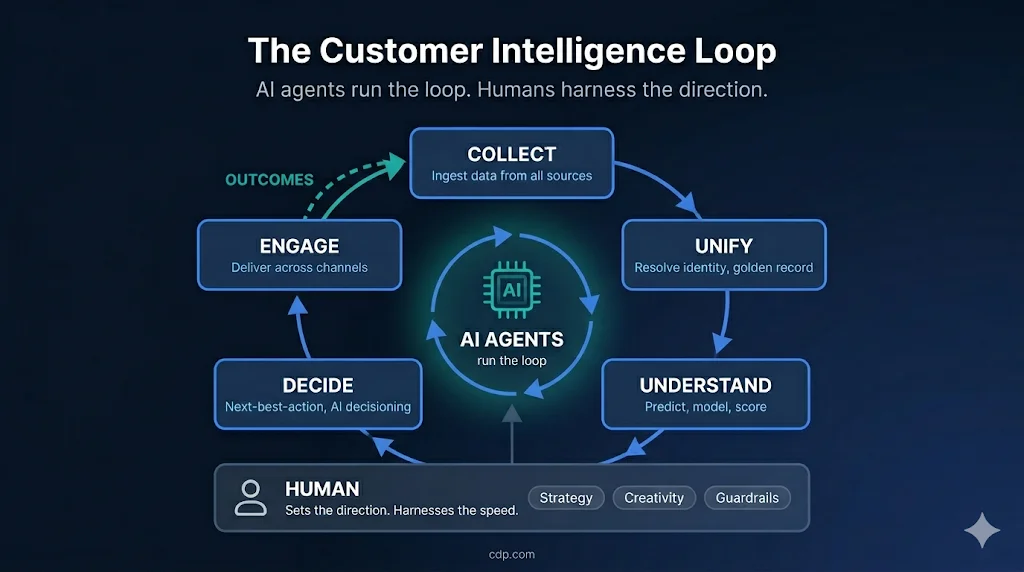
CPG organizations face a specific architectural decision shaped by their data challenges. Agentic CDPs combine managed infrastructure with embedded AI, closed feedback loops that run the full Customer Intelligence Loop, and native activation capabilities — offering faster time-to-value for brands that need to build first-party data assets quickly. Composable architectures may suit CPG companies with mature data engineering teams and existing warehouse investments, though the integration complexity of connecting clean rooms, retail media networks, and DTC platforms through a multi-vendor stack should be carefully considered. Enterprise suite CDPs bundled within broader marketing clouds may appeal to organizations already invested in those ecosystems, though CPG-specific requirements like trade promotion analytics and multi-brand governance often require significant customization.
Deployment Model Comparison for CPG
| Capability | Agentic CDPs | Suite CDPs | Composable CDPs |
|---|---|---|---|
| First-party data ingestion | Native connectors for DTC, loyalty, sampling sources | Via integration layer | Requires warehouse modeling |
| Data clean room integration | Native or partnered | Limited to ecosystem partners | Warehouse-native clean rooms |
| Identity resolution (sparse data) | Deterministic + probabilistic | Primarily deterministic | Depends on warehouse identity model |
| Retail media activation | Direct audience syndication | Suite-integrated | Via warehouse + reverse ETL |
| Multi-brand governance | Platform-level brand isolation | Varies by suite | Custom warehouse schemas |
| Trade promotion analytics | Configurable within platform | Requires additional modules | Custom warehouse analytics |
| AI/ML capabilities | Native AI models | Suite AI (Einstein, Sensei) | Bring-your-own ML |
| Time to value | 4-12 weeks | 3-12 months | 2-6 months (assumes existing warehouse) |
How to Choose a CPG CDP
Selecting the right CDP for CPG requires mapping your organization’s data maturity and strategic priorities to platform capabilities:
-
Quantify your first-party data assets. Inventory every source of consumer data you currently have — DTC sites, loyalty programs, sampling databases, social followers, retailer data shares. If your first-party data is thin and fragmented, prioritize platforms with strong identity resolution that can extract maximum value from sparse signals.
-
Assess your retailer data collaboration needs. If retail media and clean room partnerships are strategic priorities, evaluate each platform’s integration depth with your key retail partners. Some CDPs offer native clean room capabilities; others require third-party orchestration.
-
Evaluate multi-brand requirements. Portfolio CPG companies need brand-level data isolation with portfolio-level analytics. Test whether the platform can enforce consent boundaries between brands while enabling cross-brand insights where consumer consent allows.
-
Model total cost of ownership over three years. CPG data volumes can scale rapidly as first-party data capture expands. Evaluate CDP pricing models (per-profile, per-event, platform fee) against your projected data growth. Include the cost of data engineering resources for composable architectures and the licensing cost of adjacent suite products for enterprise CDPs. For comprehensive guidance on platform selection, see how to choose the right CDP.
FAQ
How does a CDP help CPG brands that don’t sell directly to consumers?
A CDP helps CPG brands build first-party data assets from every available consumer interaction, even without owning the point of sale. Loyalty programs, brand websites, sampling campaigns, sweepstakes, QR code scans, and retailer data clean rooms all generate consumer data that a CDP can unify into addressable profiles for media targeting, measurement, and personalization.
What is the difference between a CDP for CPG and a CDP for retail?
A CDP for CPG focuses on building first-party data from scratch, while a retail CDP organizes abundant transaction data from owned stores. CPG brands face sparse identity signals, retailer intermediary challenges, and trade promotion complexity. Retail CDPs prioritize POS integration, in-store identity resolution, and clienteling. See our CDP for retail guide for a detailed comparison.
Can a CDP measure the ROI of trade promotions?
Yes — a CDP can connect trade promotion execution data to consumer-level purchase response. By integrating coupon distribution, display placement, and price reduction data with retailer purchase data accessed through clean rooms, the CDP enables household-level lift measurement and ROI attribution that aggregate syndicated data alone cannot provide.
CPG brands that build owned first-party data assets now will gain a structural advantage as third-party targeting options continue to erode. To see how leading CDP vendors compare on CPG-relevant capabilities, download the Forrester Wave CDP report for an independent analysis.