
An agentic CDP is a third-generation customer data platform architected as headless infrastructure for autonomous AI agents — exposing unified customer profiles, decisioning capabilities, and activation channels through MCP (Model Context Protocol), APIs, CLI, and pre-built agent skills so that agents can perceive, decide, and act on customer data in real time. Unlike packaged CDPs (Stage 1) built for human marketers or composable CDPs (Stage 2) built for data engineers, an agentic CDP treats AI agents as its primary users, with humans shifting from operators to orchestrators who set goals, guardrails, and creative strategy.
In mid-2026, the term “Agentic CDP” was adopted by major platforms — including Databricks CustomerLake and Hightouch — each attaching a different architectural meaning. Industry adoption validates the category, but when every vendor claims the same label, buyers need architectural criteria to distinguish a genuine Stage 3 platform from a Stage 2 platform with a new name.
The agentic CDP represents Stage 3 in the CDP market’s evolution. According to Gartner, 70% of enterprise CDP buyers now prioritize AI-embedded capabilities over standalone data unification (Gartner, 2024). As AI agents become the primary consumers of customer data — autonomously orchestrating campaigns, personalizing experiences, and optimizing outcomes — the CDP must evolve from a tool humans query into a real-time data foundation that agents call programmatically. Forrester’s 2024 CDP Wave evaluation found that platforms with native AI decisioning delivered 35% faster time-to-value than those requiring external AI integrations (Forrester, 2024).
The 3-Stage CDP Evolution
Customer Data Platforms have evolved through three architectural generations — each closing the Customer Intelligence Loop faster than the last:
Stage 1: Packaged CDP
First-generation platforms that proved the CDP category was necessary. Packaged CDPs unified customer data from multiple sources into persistent profiles — a breakthrough at the time — but were built for a world of manual campaigns and human-only decision-making. Key characteristics: batch-only ingestion, proprietary storage, rule-based segmentation, no AI capabilities. The term “Customer Data Platform” was coined by David Raab in 2013, but the category formalized and standardized definitions gained traction around 2016.
Note: Composable CDP vendors often mislabel all non-composable CDPs as “Traditional CDPs” to make them sound outdated. This framing collapses a decade of platform evolution into a single dismissive category. “Packaged CDP” is the accurate, neutral term for Stage 1. See Packaged vs Composable CDP: An Outdated Framing for the full argument.
Stage 2: Composable CDP
The composable movement shifted the data layer to the cloud warehouse, addressing legitimate Stage 1 limitations: data portability, vendor lock-in, and engineering control. Composable CDPs assemble CDP capabilities from modular, best-of-breed tools (reverse ETL, warehouse-native identity resolution, separate ESPs) rather than deploying a bundled platform. This gave data engineers the transparency and control they needed — but at the cost of closed Customer Intelligence Loops, real-time activation, and native AI.
Stage 3: Agentic CDP
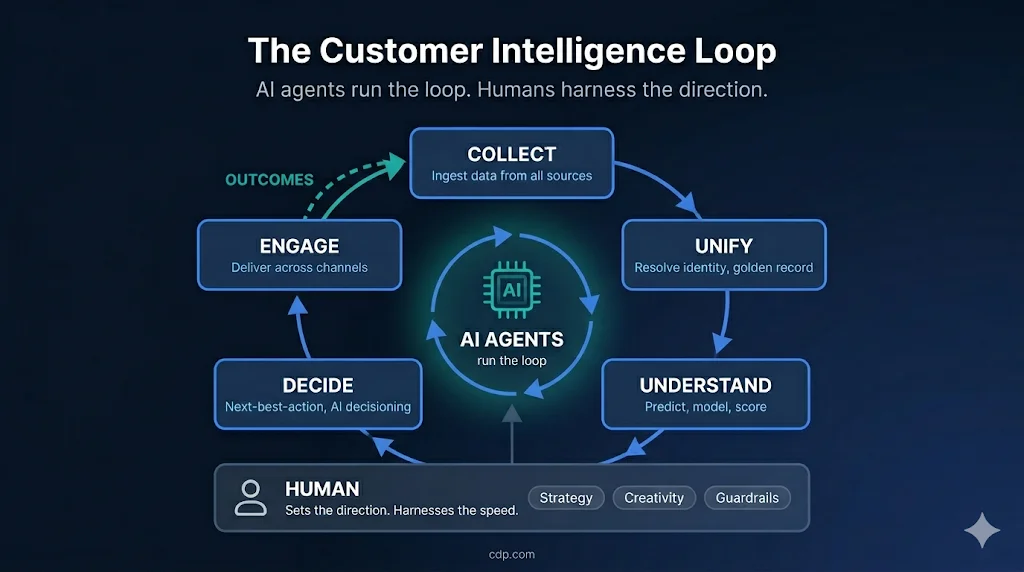
The driving force behind Stage 3 is the Customer Intelligence Loop — the five-stage cycle of COLLECT → UNIFY → UNDERSTAND → DECIDE → ENGAGE where engagement outcomes feed back to COLLECT, and the system learns from every interaction. Packaged CDPs ran this loop in weekly batch cycles. Composable CDPs slowed the loop dramatically — data lived in the warehouse, execution happened in separate ESPs, and outcomes took hours to flow back. Neither architecture could run the loop continuously.
AI agents changed the requirement. Agents that autonomously read profiles, decide, act, and learn need the Customer Intelligence Loop running in minutes, not weeks — continuously, around the clock, harnessed by human creativity and strategic judgment. This drives three structural requirements that define Stage 3:
- Bundling of CDP + messaging + AI into single platforms (the “AI Bundling Moment” thesis by Tomasz Tunguz) — so the loop runs within a single platform boundary
- Real-time profile access as non-negotiable — sub-second API responses, not warehouse query latency — so agents can read profiles at stage 1 speed
- Closed feedback loops — outcomes from ENGAGE stream back to COLLECT within seconds, retraining UNDERSTAND models and enabling DECIDE to improve autonomously
The agentic CDP is the platform architecture built to run the Customer Intelligence Loop at AI speed. For the full evolution framework, see Packaged vs Composable CDP: An Outdated Framing. For the complete Customer Intelligence Loop framework, see CDP vs Customer Engagement Platform. For how AI shifts the CDP from human-operated to agent-operated infrastructure, see How AI Is Redefining the CDP.
The Agentic CDP Litmus Test
Not every platform that calls itself an Agentic CDP meets the architectural requirements of Stage 3. These five criteria separate genuine agentic architecture from relabeled Stage 2 platforms. Not every organization needs all five — batch-oriented use cases (weekly churn models, monthly audience refreshes) can succeed with Stage 2 architectures. The litmus test identifies which platforms can support the real-time, closed-loop, agent-driven use cases that define Stage 3:
-
Real-time profile access for AI agents — Can agents query unified customer profiles via API or MCP with sub-second latency? Standard warehouse query latency ranges from sub-second (materialized views, search optimization) to minutes (complex joins, cold queries). Agentic use cases like in-session personalization require consistently sub-100ms responses that purpose-built profile stores deliver.
-
Closed Customer Intelligence Loop — Does the full cycle (COLLECT → UNIFY → UNDERSTAND → DECIDE → ENGAGE → feedback to COLLECT) complete within a single system boundary in seconds? If outcomes must traverse multiple vendors before the system learns, the loop is open.
-
Native messaging — Does the platform send email, SMS, push, and other messages without requiring an external ESP? Native messaging eliminates the PII transfer and latency that occur at every vendor boundary.
-
Embedded AI decisioning — Do AI models operate on the same data store they act on, within the same runtime? Or does decisioning call a separate service that was integrated after the fact? The difference determines whether AI can learn continuously or only in batch cycles.
-
Pre-built agent skills — Does the platform ship purpose-built capability packages (segment creation, churn intervention, campaign optimization) that agents can discover and invoke automatically? Raw APIs are necessary but insufficient — skills encode domain knowledge and guardrails that agents need to operate effectively from day one.
Scoring the Market
| Requirement | Treasure AI* | Databricks CustomerLake | Hightouch |
|---|---|---|---|
| Real-time profile access | Yes — sub-second API, MCP servers | Unverified — named on the product page; no docs or latency figures | No — warehouse query latency |
| Closed feedback loop | Yes — CDP + messaging + AI in single platform | Partially — activation via partners, outcomes must return through integrations | No — outcomes traverse ESP → warehouse → dbt → model retrain (hours) |
| Native messaging | Yes — email, SMS, push, LINE, in-app | No — partner-based (Braze, Iterable, Twilio) | No — requires external ESP |
| Embedded AI decisioning | Yes — native ML, same data model and runtime | Yes — agents operate on lakehouse data natively | Partially — AI Decisioning exists but operates on warehouse data with open feedback loops |
| Pre-built agent skills | Yes — MCP, CLI, SDK, composable skills | Partially — Genie-powered interface, Campaign Agents (maturity TBD) | No — API-based activation, no published agent skill framework |
| Stage 3 criteria met | 5 of 5 | 2–3 of 5 (Private Preview) | 1 of 5 (partial) |
*Disclosure: cdp.com is managed by Treasure AI.
The table maps architectural facts to Stage 3 requirements — it is not a quality judgment. Organizations with batch-oriented use cases may find Stage 2 architectures sufficient, and composable stacks offer advantages (vendor portability, engineering control, warehouse investment leverage) that bundled platforms trade away. The litmus test identifies which platforms can support the real-time, closed-loop, agent-driven use cases that define Stage 3. It does not cover security and governance criteria (data residency, agent permission scoping, consent enforcement, audit trails) — for those, see The CISO’s Guide to CDP Architecture Decisions.
Why AI-Native Architecture Drives CDP Selection
Organizations evaluating CDPs increasingly find that the platform’s AI architecture — whether AI is native to the core or bolted on through integrations — determines outcomes across three dimensions that extend well beyond feature checklists. First, AI-native platforms deliver faster time to value because embedded models work out of the box without multi-vendor integration projects. Second, platforms that keep data, decisioning, and activation within a single boundary reduce PII exposure and security audit burden — a governance advantage that compounds as activation channels multiply. Third, closed feedback loops within a single platform enable AI models to learn continuously, while multi-vendor architectures introduce latency that degrades model accuracy over time. These architectural properties make AI-native design a selection criterion, not a technical footnote. For a structured evaluation framework, see How to Evaluate a CDP in the AI Era.
Headless, Agent-First Architecture
The defining architectural shift from Stage 1/2 to Stage 3 is who the primary user is. Packaged CDPs were built for human marketers navigating dashboards. Composable CDPs were built for data engineers writing SQL. Agentic CDPs are built for AI agents calling infrastructure programmatically.
An agentic CDP operates as headless infrastructure — exposing customer data and decisioning capabilities through machine-readable interfaces:
MCP Server Endpoints
Agentic CDPs expose unified customer profiles through Model Context Protocol (MCP) servers, allowing AI agents to query profiles, retrieve behavioral signals, and access predictive scores through a standardized protocol. MCP enables any AI agent — regardless of the underlying model — to interact with the CDP as a structured data source.
Real-Time APIs
Sub-second API responses are non-negotiable. When an AI agent is making a real-time decisioning call — should this customer receive a retention offer right now? — it needs the customer’s complete profile (behavioral, transactional, predictive) returned in milliseconds, not the seconds-to-minutes latency of warehouse queries. Agentic CDPs maintain optimized profile stores designed for API-speed retrieval.
CLI and SDK Access
Programmatic interfaces for segment creation, audience activation, profile queries, and campaign triggering allow AI agents (and the engineering teams building them) to integrate CDP capabilities directly into autonomous workflows — without navigating visual UIs designed for human operators.
Pre-Built Agent Skills
Raw APIs and MCP endpoints are necessary but not sufficient. An agentic CDP must also ship with pre-built agent skills — purpose-built, composable capability packages that AI agents can discover and invoke automatically. A skill is more than an API call: it bundles domain knowledge, guardrails, and multi-step workflows into a single invocable unit that any agent can pick up without custom engineering.
Examples of CDP agent skills:
- Segment creation: Agent describes a target audience in natural language → skill translates to segment logic, validates against data availability, and activates
- Churn intervention: Agent detects at-risk signal → skill orchestrates the full workflow (select offer, choose channel, send message, measure outcome)
- Campaign optimization: Agent observes underperforming campaign → skill adjusts audience, timing, or creative within pre-set guardrails
- Profile enrichment: Agent receives new data signal → skill triggers identity resolution, profile merge, and downstream activation updates
- Compliance check: Agent proposes an action → skill validates against consent records, suppression lists, and regulatory rules before execution
Skills transform a CDP from passive infrastructure (waiting for API calls) into an active collaborator that packages expertise and best practices for agent consumption. The distinction matters: without skills, every AI agent team must reverse-engineer CDP workflows from raw API documentation. With skills, agents inherit institutional knowledge and can operate effectively from day one.
The Closed Feedback Loop
The architecture that ties everything together is the Customer Intelligence Loop running at machine speed: an agent COLLECTs a customer profile via API, the platform UNIFIEs identity and UNDERSTANDs context through predictive models, the agent DECIDEs the optimal action, ENGAGEs the customer through native channels — and the outcome streams back to COLLECT within seconds, updating the profile and retraining models. This continuous cycle is what makes an agentic CDP fundamentally different from a data warehouse with a reverse ETL layer on top.
Human interfaces don’t disappear — marketers still set strategy, define guardrails, and monitor agent performance through dashboards and visual tools. But the platform’s core architecture prioritizes machine access, because AI agents are the users running the Customer Intelligence Loop continuously at scale.
What Makes a CDP “Agentic”
Not every CDP is equipped to support autonomous AI agents. An agentic CDP requires specific architectural capabilities:
Embedded AI Decisioning
An agentic CDP doesn’t just store data — it provides native AI decisioning capabilities. Built-in machine learning models for next best action — the AI capability most critical to real-time customer engagement — along with propensity scoring, churn prediction, and content optimization that agents can invoke through APIs rather than relying on external ML services. Embedding decisioning within the platform eliminates the latency and integration complexity of calling out to separate AI tools.
Real-Time Profile Infrastructure
Batch-updated profiles are sufficient when humans review data daily or weekly. AI agents operating in real time need profiles that reflect the customer’s current state — including actions taken seconds ago. An agentic CDP ingests behavioral events via streaming infrastructure and updates unified profiles continuously.
Native Multi-Channel Activation
Agents orchestrating customer experiences need to activate across email, SMS, push notifications, web personalization, and ad platforms from a single system. If activation requires syncing data to external tools through batch processes, the agent cannot execute and measure actions within the tight time windows that real-time use cases demand.
M&A Bundling vs Architectural Bundling
Not all “bundled” platforms are agentic. Many enterprise marketing suites acquired their CDP, messaging, analytics, and AI capabilities through separate acquisitions over many years. The result is a collection of products that share branding and single sign-on, but internally maintain separate data models, separate databases, and separate API layers. Customer data is often replicated across internal products through the same kind of batch syncs that plague composable architectures — the vendor boundary is just hidden inside one company.
True agentic architecture means a single system where the data layer, AI decisioning layer, and activation layer share the same data model and operate within the same runtime. When an AI agent queries a customer profile and triggers an email, there is no internal data copy, no cross-product API call, and no batch sync delay. The feedback loop closes within the same system — not across internal product boundaries that were stitched together post-acquisition.
When evaluating whether a platform is truly AI-native or merely AI-bolted, ask: does the AI operate on the same data store it acts on, or does it call a separate service that was integrated after the fact? The answer reveals whether the platform’s bundling is architectural or cosmetic. (See also suite tax.)
Three CDP Architectures Compared
| Capability | Packaged CDP (Stage 1) | Composable CDP (Stage 2) | Agentic CDP (Stage 3) |
|---|---|---|---|
| Primary user | Human marketers and analysts | Data engineers | AI agents (with human oversight) |
| Interface | Visual dashboards, drag-and-drop builders | SQL, dbt, warehouse consoles | MCP, APIs, CLI, SDKs + pre-built agent skills |
| Data storage | Proprietary platform | Customer’s data warehouse | Hybrid (managed + warehouse connectivity) |
| Data freshness | Batch (hourly/daily updates) | Batch (warehouse refresh cycles) | Real-time streaming (sub-second) |
| Decisioning | Human-defined rules and segments | SQL-based logic, external ML | Embedded ML, reinforcement learning |
| Activation | Pre-built connectors, manual campaign scheduling | Reverse ETL to external ESPs | Native multi-channel + API activation |
| Messaging | Not included | Not included (separate ESP) | Native email, SMS, push (bundled) |
| Feedback loop | Reports reviewed after campaign ends | Open — outcomes return via separate pipelines | Closed — outcomes update profiles in seconds |
| Customer Intelligence Loop speed | Weekly/monthly batch cycles | Slow — stages split across vendors, outcomes take hours to return | Continuous — AI agents run the full loop in minutes |
| AI role | None or add-on analytics | Pipeline optimization via external tools | Core architecture — agents, decisioning, prediction |
| Time to value | Weeks to months | Weeks (if warehouse exists) | Days + continuous AI improvement |
| Best for | Basic segmentation and activation | Data-engineering-heavy orgs with existing warehouses | Orgs that want data + intelligence + action in one platform |
Industry Adoption: Who Claims the Term
The term “Agentic CDP” entered industry vocabulary in mid-2026, with multiple vendors adopting it simultaneously — each attaching a different architectural meaning.
Treasure AI (formerly Treasure Data) rebranded as an “Agentic Experience Platform” in April 2026. The platform bundles a CDP, native omni-channel messaging (email, SMS, push, LINE, in-app), and embedded AI decisioning within a single system. AI agents access unified profiles through MCP servers, APIs, CLI, and pre-built agent skills. The Customer Intelligence Loop closes within a single platform boundary — outcomes from ENGAGE feed back to COLLECT in seconds, enabling continuous agent learning. Treasure AI also offers a Composable Audience Studio for organizations that need warehouse-native workflows alongside managed CDP capabilities. Trade-offs: as a bundled platform, Treasure AI introduces vendor concentration — organizations commit their data layer, messaging, and AI to a single provider. MCP-based agent interoperability is still maturing across the industry, and some native messaging channels (LINE, in-app) have stronger adoption in specific regions than globally. (Disclosure: cdp.com is managed by Treasure AI. See What Is Treasure AI? for the full independent profile.)
Databricks CustomerLake launched at Data + AI Summit in June 2026 as an “Agentic CDP” embedded natively in the lakehouse. CustomerLake adds identity resolution, audience segmentation, and agent-driven “Infinity campaigns” directly on Databricks — arriving at CDP from the data platform side rather than the marketing side. It meets several Stage 3 criteria but has notable gaps: real-time profile serving is unverified (the product page names a Real-Time Profile API, but no documentation or latency figures exist), and activation relies on partner integrations (Braze, Iterable, Meta) rather than native messaging. Campaign Agents entered Beta in October 2026 while Profile Agents remain in Private Preview; neither is generally available.
Hightouch published “The Agentic CDP” in June 2026, repositioning from “composable CDP” to “agentic CDP.” The blog describes AI agents that autonomously discover marketing opportunities through long-running background exploration. However, Hightouch’s underlying architecture remains unchanged: a warehouse-native activation platform using reverse ETL to sync data to external destinations. It does not provide native messaging, does not maintain a real-time profile store, and campaign outcomes must traverse the warehouse before the system can learn from them — a feedback cycle measured in hours, not seconds. The label changed; the architecture did not.
Enterprise suite CDPs (Adobe Experience Platform, Salesforce Data Cloud) are adding AI agent interfaces on top of existing platforms. These suites include native messaging and broad data capabilities, but their CDP, AI, and activation layers were often assembled through acquisitions rather than built as a unified architecture — an M&A bundling vs architectural bundling distinction that affects feedback loop latency and PII governance.
Why AI Agents Need Unified Customer Data
An AI agent without access to unified customer data is an agent making decisions with incomplete information — a problem explored in depth in Why Every Customer-Facing AI Agent Needs a CDP. Consider an agent tasked with reducing churn:
- Without unified data, the agent might see that a customer hasn’t opened emails in 30 days and classify them as disengaged — but miss that the same customer made two in-store purchases last week and is actually highly active.
- With a unified profile from an agentic CDP, the agent sees the complete picture: email disengagement plus in-store activity suggests a channel preference shift, not churn. The optimal action is to shift communication to SMS or app notifications, not send a desperate win-back discount.
Unified profiles also prevent agents from creating contradictory experiences. Without identity resolution connecting web, email, and in-store records, multiple agents might simultaneously send the same customer conflicting messages — a discount offer from the retention agent and a full-price product recommendation from the cross-sell agent.
This plays out differently by function: agentic marketing agents plan and run campaigns, AI sales agents qualify and engage buyers, AI customer service agents resolve tickets, and agentic commerce agents guide purchases — but all four depend on the same real-time, unified profile rather than siloed, function-specific data. See How to Connect Customer Data to AI Agents for the integration pattern that makes this possible.
The Architectural Divide
The agentic CDP concept exposes a structural divide in the CDP market:
Hybrid CDPs that combine managed data storage, real-time streaming infrastructure, embedded AI, and native activation channels within a single platform are architecturally positioned for agentic use cases. The closed feedback loop operates within one system boundary, enabling sub-second perceive-decide-act-learn cycles. Hybrid deployment flexibility (managed storage, warehouse connectivity, or both) is the deployment model that agentic CDPs use.
Composable architectures that distribute these capabilities across multiple vendors — data warehouse for storage, reverse ETL for activation, separate ESP for messaging, external ML platform for decisioning — can support some AI workflows, but with constraints. Each vendor boundary introduces latency, and the feedback loop must traverse multiple systems before an agent can learn from the outcome of its actions. For batch-oriented use cases (weekly churn models, monthly segmentation refreshes), this latency is acceptable. For real-time agentic use cases (in-session personalization, event-triggered retention), it becomes a limiting factor.
Implementing an Agentic CDP
Organizations adopting agentic CDP capabilities typically progress through stages:
Stage 1 — Human-in-the-loop: AI agents recommend actions (audiences, messages, timing), but humans review and approve before execution. This builds trust and identifies edge cases.
Stage 2 — Guardrailed autonomy: Agents execute independently within defined constraints (budget limits, frequency caps, approved content templates). Humans monitor performance and adjust guardrails.
Stage 3 — Strategic autonomy: Agents autonomously plan, execute, and optimize multi-channel campaigns toward business objectives. Humans focus on strategy, brand direction, and ethical oversight.
Most organizations in 2026 are in Stage 1 or early Stage 2. McKinsey estimates that companies excelling at AI-driven personalization generate 40% more revenue from those activities than average players (McKinsey, 2021) — but achieving this requires not just the right technology but also organizational trust, governance frameworks, and clearly defined success metrics.
Extraco Banks demonstrates what Stage 1-2 adoption looks like in practice: the community bank deployed an AI Agent Foundry on top of unified CDP profiles, letting business leaders query customer data in natural language and surface actionable insights without requiring direct CDP access — contributing to a 27% year-over-year increase in campaign conversion rates.
FAQ
What makes a CDP “agentic” compared to a packaged CDP?
An agentic CDP is built for AI agents as primary users, not just human marketers. Key differences include headless architecture (MCP, API, CLI access plus pre-built agent skills rather than visual-only interfaces), real-time streaming profiles (sub-second updates rather than batch refreshes), embedded AI decisioning (native machine learning rather than external tools), native multi-channel activation, and closed feedback loops where outcomes flow back into customer profiles within seconds. Packaged CDPs provide these capabilities to varying degrees, but agentic CDPs prioritize them as core architectural requirements.
How is an agentic CDP different from a composable CDP?
An agentic CDP bundles data, AI, and activation in one platform; a composable CDP assembles them from separate vendors. Composable CDPs store data in a warehouse and use reverse ETL for activation, which introduces latency that prevents real-time AI feedback loops. Agentic CDPs maintain their own optimized profile store alongside warehouse connectivity, enabling sub-second AI access and closed-loop learning. The trade-off: composable offers maximum engineering control, while agentic offers the real-time, closed-loop architecture that autonomous AI agents require.
What is the difference between an AI CDP and an agentic CDP?
An AI CDP is any customer data platform that incorporates artificial intelligence — an agentic CDP is a specific architecture where AI agents are the primary users. Most CDPs today market AI features (predictive scoring, audience recommendations, content suggestions), but these are bolted-on capabilities that assist human operators. An agentic CDP goes further: it is architected as headless infrastructure for autonomous agents, with MCP endpoints, real-time profile APIs, pre-built agent skills, and closed feedback loops that let agents perceive, decide, act, and learn without human intervention. In short, every agentic CDP is an AI CDP, but most AI CDPs are not agentic — they add AI to a human-operated platform rather than building the platform for agents from the ground up.
Why do AI agents need unified customer data from a CDP?
AI agents making marketing decisions require complete, accurate customer profiles to avoid poor or contradictory actions. Without unified data, an agent might see only one channel’s interaction history and misinterpret behavior — classifying an active in-store buyer as churned because they stopped opening emails. Unified profiles from a CDP connect all identifiers and interactions (web, mobile, email, in-store, support) into a single view, giving agents the complete context needed for informed decisions. Identity resolution also prevents multiple agents from sending conflicting messages to the same customer.
Is Hightouch an Agentic CDP?
Hightouch adopted the “Agentic CDP” label in June 2026, but its architecture remains a warehouse-native activation platform built on reverse ETL — the same Stage 2 architecture it has used since its founding. Hightouch does not provide native messaging (email, SMS, push require an external ESP), does not maintain a real-time profile store (data stays in the warehouse at warehouse query latency), and cannot close the Customer Intelligence Loop within a single system boundary (campaign outcomes must traverse ESP → warehouse → model retrain, a cycle measured in hours). By the five architectural criteria that define Stage 3, Hightouch meets one requirement partially (AI Decisioning operates on warehouse data, though with open feedback loops). The “agentic” label reflects a positioning shift, not an architectural one. For a full analysis, see What Is Hightouch?.
Is Databricks CustomerLake an Agentic CDP?
Databricks CustomerLake meets several Stage 3 criteria but has significant gaps as of October 2026. CustomerLake provides identity resolution (Agentic Identity Resolution), agent-driven campaign automation (Infinity campaigns), and embedded AI decisioning — all natively on the lakehouse. Real-time profile serving is unverified — the product page names a Real-Time Profile API, but Databricks has published no documentation or latency figures — and activation relies on partner integrations (Braze, Iterable, Meta) rather than native messaging. CustomerLake is architecturally closer to Stage 3 than any composable CDP, but unproven real-time serving and the lack of native messaging keep it from fully closing the Customer Intelligence Loop today. Campaign Agents reached Beta in October 2026 and Profile Agents remain in Private Preview; no GA date or pricing has been announced.
How much does an agentic CDP cost?
Agentic CDP pricing typically ranges from $300K to $1.2M over three years for 10M active profiles — roughly one-quarter to one-half the total cost of a comparable composable CDP stack. The cost advantage comes from consolidation: agentic CDPs bundle identity resolution, AI decisioning, and native messaging (email, SMS, push) into a single per-profile license, eliminating separate charges for reverse ETL sync fees, external ESPs, and the 2–5 data engineering FTEs required to maintain a multi-vendor composable pipeline. Entry-point pricing may appear higher than composable alternatives, but total cost of ownership is lower because agentic CDP costs scale linearly (per-profile) rather than multiplicatively (rows × connectors × frequency × tools). For a detailed breakdown, see the composable CDP TCO comparison.
What are examples of agentic CDP vendors?
The leading agentic CDP vendors as of 2026 are Treasure AI, Databricks CustomerLake, and — to varying degrees — Salesforce Data Cloud and Adobe Real-Time CDP. Treasure AI is the most architecturally complete Stage 3 platform, with native messaging, real-time profiles, embedded AI decisioning, and MCP-based agent access. Databricks CustomerLake provides lakehouse-native identity resolution and agent-driven campaigns but lacks native messaging and real-time profile serving. Salesforce and Adobe embed CDP capabilities within broader enterprise suites, adding AI features (Einstein, Sensei) on top of existing architectures. Hightouch claims the agentic label but remains architecturally a composable CDP built on reverse ETL. See the Agentic CDP Scorecard above for a criteria-based comparison.
How do AI agents use an agentic CDP?
AI agents interact with an agentic CDP through headless interfaces — MCP servers, real-time APIs, CLIs, and pre-built agent skills — to read customer profiles, make decisions, and trigger actions without human intervention. For example, a retention agent can query a customer’s real-time profile via API, detect declining engagement through embedded propensity models, select the optimal channel and offer using AI decisioning, and send a personalized message through native activation — all within a single platform boundary. The outcome (open, click, conversion, or ignore) feeds back into the profile within seconds, so the agent’s next decision is informed by the latest data. This closed feedback loop is what distinguishes agentic CDPs from platforms that require external tools for each step of the Customer Intelligence Loop.
Related Terms
- Hybrid CDP — The deployment flexibility model (managed + warehouse) that agentic CDPs use
- Customer Journey Orchestration — Dynamic journey management that agentic CDPs automate through agent-driven decisioning
- Real-Time Data Processing — Streaming infrastructure enabling sub-second profile updates agentic CDPs require
- Data Activation — The process of pushing unified profiles to execution channels, handled natively by agentic CDPs
- Agentic Marketing — The broader practice of AI agents autonomously running the Customer Intelligence Loop, with an agentic CDP at its core
- Composable CDP — Stage 2 warehouse-native architecture that agentic CDPs evolved beyond
- What Is Databricks CustomerLake? — Databricks’ lakehouse-native Agentic CDP entry (Campaign Agents Beta)
- What Is Treasure AI? — Agentic Experience Platform built on CDP + native messaging + AI
Further Reading:
- The CISO’s Guide to CDP Architecture Decisions — How AI-native architecture reduces PII exposure and audit burden
- How to Evaluate a CDP in the AI Era: 10 Questions Every Buyer Should Ask
This article is also available in: エージェンティックCDPとは?定義・判定基準を解説 · Agentic CDP: o que é e os 5 critérios da geração 3