The CDP's Primary User Is
Increasingly Becoming an AI Agent
The Customer Intelligence Loop — COLLECT → UNIFY → UNDERSTAND → DECIDE → ENGAGE — running continuously, thousands of times per second.
Humans set the strategy. Agents run the loop.
The Customer Intelligence Loop closes in seconds — not days. Every interaction makes the next one smarter.
The Customer Intelligence Loop
Every step below maps to a stage of the Customer Intelligence Loop — the five-stage cycle where AI agents COLLECT, UNIFY, UNDERSTAND, DECIDE, and ENGAGE continuously, harnessed by human strategy and creativity.
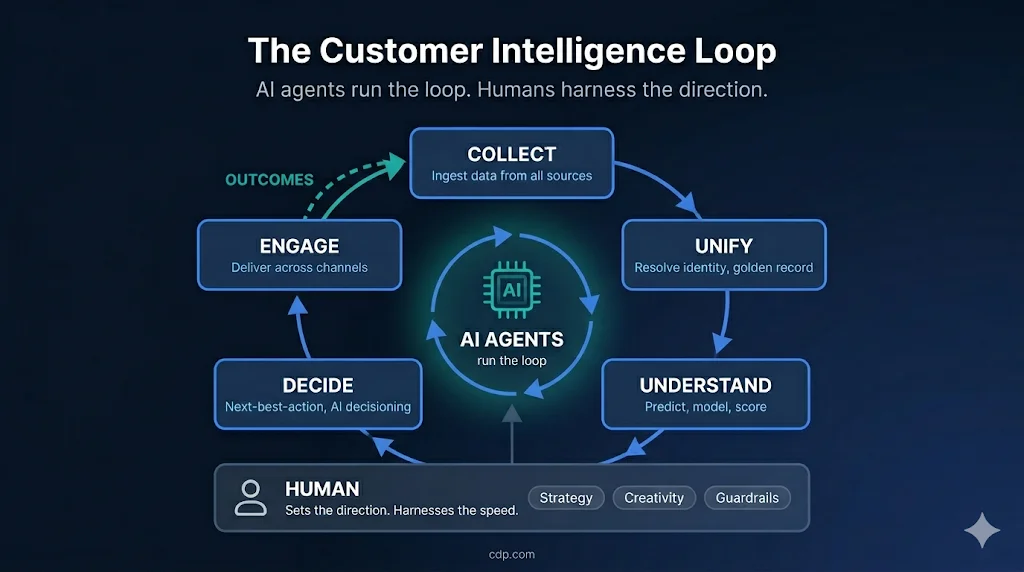
The Customer Intelligence Loop: a five-stage continuous cycle — Collect, Unify, Understand, Decide, Engage — with AI agents at the center running the loop and humans providing strategy, creativity, and guardrails. Engagement outcomes feed back to data collection.
Every Touchpoint, One Pipeline
A CDP ingests data from every customer touchpoint in real time — websites, mobile apps, CRM, POS, email, ads, IoT devices, and more. Over 400 connectors ensure no data silo is left behind.
Unlike traditional data warehouses, a CDP captures behavioral events as they happen: page views, purchases, support tickets, app sessions. This raw, granular stream becomes the fuel for everything downstream.
One Customer, One Profile
The CDP resolves identities across devices, channels, and touchpoints. A visitor on your website, a subscriber in your email list, and a buyer in your POS — all stitched into a single unified profile through deterministic and probabilistic identity resolution.
The result is a persistent identity graph with a 360-degree view of each customer: demographics, behaviors, preferences, consent status, and lifetime value — all queryable in milliseconds.
Autonomous Agents, Human Guardrails
This is where 2026 looks radically different. Instead of marketers manually building segments and campaigns, AI agents autonomously query the CDP thousands of times per second — discovering micro-segments, predicting churn, optimizing bids, and orchestrating journeys.
Humans define the strategy, budgets, and ethical guardrails. Agents execute at machine speed. A Segmentation Agent discovers that "high-LTV users who browsed category X in the last 48 hours" is an opportunity. A Content Agent generates the personalized message. An Ad Bidding Agent adjusts the bid in real time. All coordinated, all autonomous.
Every Channel, Perfectly Timed
AI agents activate decisions across every channel simultaneously — email, web personalization, mobile push, paid ads, SMS, and more. The CDP ensures that each channel receives the same unified customer context, so the experience is consistent and coherent.
No more batch exports or overnight syncs. Activation happens in real time: a customer abandons a cart, and within seconds the Journey Agent decides whether to send a push notification, suppress an ad, or trigger an email — based on that individual's predicted preference.
Every Customer Wins
The end result: customers receive experiences that feel personal, timely, and relevant — not because a marketer manually set up a rule, but because an intelligent system understood their intent, context, and preferences at scale.
Higher engagement. Lower churn. Better lifetime value. And the Customer Intelligence Loop closes — every interaction becomes new data flowing back to COLLECT, making the next decision even smarter. This is what separates an Agentic CDP from a batch pipeline: the loop runs continuously, not on a weekly schedule.
Ready to build your AI-ready data foundation?
The companies winning in 2026 aren't just collecting data — they're letting AI agents act on it, thousands of times per second.
FAQ
How does a customer data platform work?
A CDP works by ingesting customer data from all sources (web, mobile, CRM, POS, IoT), unifying it into persistent individual profiles through identity resolution, and making those profiles available for activation across marketing, sales, and service channels. In 2026, AI agents increasingly query these unified profiles autonomously to deliver real-time, personalized customer experiences.
What is the difference between a CDP and a DMP?
A CDP collects and unifies first-party customer data into persistent profiles tied to known individuals, while a DMP primarily manages anonymous, third-party audience segments for advertising. CDPs retain data long-term for relationship building, whereas DMPs use short-lived cookie-based data that expires within 90 days.
Why do AI agents need a CDP?
AI agents need a CDP because they require a complete, real-time view of each customer to make autonomous decisions about messaging, offers, and channel selection. Without a unified data foundation, AI agents would query fragmented systems, leading to inconsistent experiences and slower response times.
What is the Customer Intelligence Loop?
The Customer Intelligence Loop is the five-stage cycle — COLLECT, UNIFY, UNDERSTAND, DECIDE, ENGAGE — that defines how a CDP turns raw data into customer outcomes. Engagement results feed back to COLLECT, closing the loop. In an Agentic CDP, AI agents run this loop continuously in minutes; in composable architectures, the loop is broken across vendors and takes hours or days to close.