
The five best customer data platforms (CDPs) in 2026 are Adobe Real-Time CDP, Hightouch, Salesforce Data Cloud, Tealium, and Treasure Data (Treasure AI) — each the strongest fit for a different deployment model, team composition, and budget. In one line each:
- Adobe Real-Time CDP — best for enterprises already invested in the Adobe ecosystem
- Hightouch — best for data teams activating a mature, well-modeled data warehouse
- Salesforce Data Cloud — best for organizations running Salesforce CRM, Marketing, and Service clouds
- Tealium — best for compliance-heavy organizations that also need tag management
- Treasure Data (Treasure AI) — best for global, multi-brand enterprises that need native AI and messaging at scale
CDP vendors are the technology companies that build and sell CDP software — customer data platform software that unifies customer data from multiple sources, resolves identities, and activates unified profiles across marketing, sales, and service channels. As of 2026, the CDP Institute catalogs more than 200 vendors globally, but fewer than 20 consistently appear in major analyst evaluations from Gartner and Forrester. This guide compares the 5 leading CDP vendors across deployment model, pricing, AI capabilities, and industry fit — plus six notable alternatives worth evaluating.
Disclosure: cdp.com is managed by Treasure AI (formerly Treasure Data). Vendors in this guide are listed alphabetically rather than ranked, and Treasure Data is profiled using the same template and evaluation criteria as every other vendor. These rules are documented in our Editorial Policy.
The Best Customer Data Platforms at a Glance
| Vendor | Best For | Peer References | Typical Implementation | Pricing Model | Key Differentiator | Skip if |
|---|---|---|---|---|---|---|
| Adobe Real-Time CDP | Enterprises in the Adobe ecosystem | Mostly enterprise (G2 reviews) | 3-12 months | Platform fee + modules | AEP-native ultra-low-latency profile updates across Analytics, Target, and Journey Optimizer | Your marketing stack is not Adobe-centric |
| Hightouch | Data teams with a mature warehouse | Mostly mid-market (G2 reviews) | 2-6 weeks (warehouse ready) | Per active sync (audience→destination feed) + custom tiers | Reverse ETL — activate straight from the warehouse without duplicating data into a separate CDP | No modeled warehouse, no standing data engineering capacity to maintain one, or your ESP already syncs from it |
| Salesforce Data Cloud | Salesforce-invested organizations | Mid-market and enterprise (G2 reviews) | 3-12 months | Credits + per-profile + storage | Customer 360 profiles native to CRM and Agentforce, with real-time bidirectional triggers | You run a non-Salesforce CRM and marketing stack |
| Tealium | Compliance-heavy orgs that also need tag management | Mostly enterprise (G2 reviews) | 4-12 weeks | Platform fee + profiles | 1,300+ pre-built connectors on a tag-management heritage | You want decisioning and execution inside the CDP |
| Treasure Data (Treasure AI) | Global, multi-brand enterprises | Mid-market and enterprise (G2 reviews) | 4-8 weeks initial | Per-profile + events | Packaged or composable deployment with native agentic AI and native email/SMS/push inside one boundary — plus APAC-native connectors (LINE, Yahoo! JAPAN Ads) | You need marketer self-serve simplicity or SMB pricing |
Peer References compares each vendor’s G2 reviews from companies above and below 1,000 employees. The share above 1,000 is 37.3% for Adobe Real-Time CDP, 13.5% for Hightouch, 39.4% for Salesforce Data Cloud, 50.5% for Tealium, and 39.9% for Treasure Data — shares of the reviews G2 classifies by company size, not of any vendor’s customer base. Reviewers self-select and vendors run review-solicitation campaigns, so review volume is not comparable across vendors; each profile below carries that vendor’s full split and denominator.
The pattern that fits is go-to-market, not architecture. The lowest enterprise shares belong to developer-first tools that enter an organization bottom-up: RudderStack at 2.0%, Segment (Twilio) at 11.3%, Hightouch at 13.5%, and mParticle at 20.0%. The highest belong to platforms sold top-down through enterprise procurement: GrowthLoop at 58.0%, ActionIQ at 56.8%, Tealium at 50.5%, and Amperity at 45.3%. Architecture does not predict where a vendor lands, because Hightouch and GrowthLoop are both warehouse-native and sit at opposite ends of that range. Ordering within a group is not meaningful either: Treasure Data at 39.9% and Salesforce Data Cloud at 39.4% are indistinguishable at these sample sizes.
Each vendor’s full profile below covers strengths, limitations, AI capabilities, integrations, and analyst recognition. Additional vendors — ActionIQ, BlueConic, mParticle, Oracle Unity, Segment (Twilio), and Databricks CustomerLake — are covered in Other Notable CDPs.
Why Vendor Choice Matters: The Customer Intelligence Loop
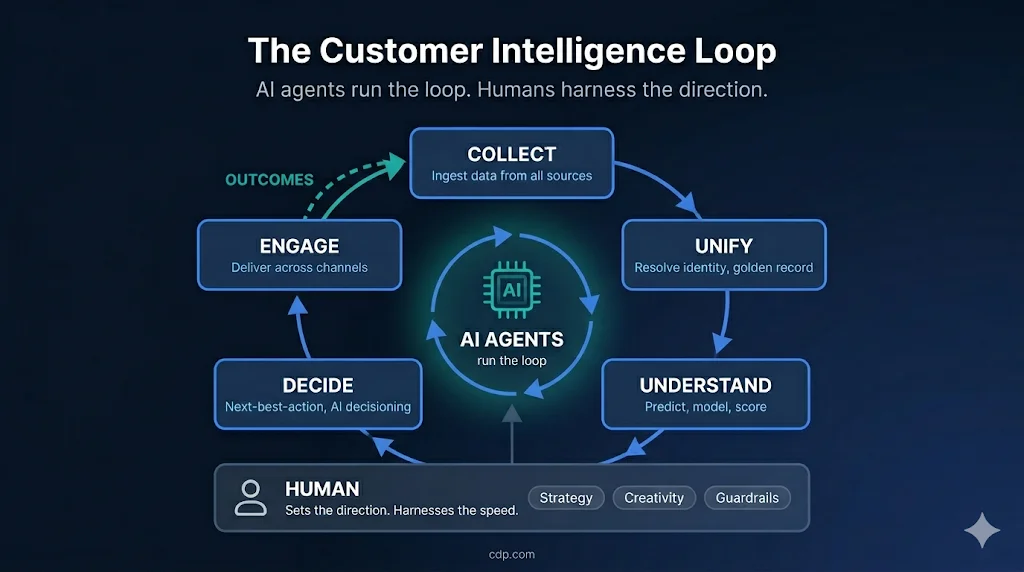
Your CDP is becoming the core of your AI marketing strategy. AI agents will read from, decide against, and write back to your CDP thousands of times per second. The platform you select determines how fast your organization can close the Customer Intelligence Loop — the five-stage cycle (COLLECT → UNIFY → UNDERSTAND → DECIDE → ENGAGE) where outcomes feed back to COLLECT and the system learns from every interaction.
Three market trends make this choice more consequential than ever:
The 3-Stage Evolution. CDPs have evolved from Packaged (Stage 1) to Composable (Stage 2) to Agentic (Stage 3) — with AI agents becoming the primary consumers of customer data. The Architecture and AI Stage Comparison table below shows both axes: the Stage column places each vendor in this evolution, while the Deployment Model column shows how it is deployed (hybrid, warehouse-native, suite-embedded, standalone) — an orthogonal choice. For the full framework, see How AI Is Redefining the CDP.
The Bundling Moment. CDP, messaging, and AI decisioning are converging into unified platforms because AI agents need the full loop running within a single platform boundary. The key question: are a vendor’s AI capabilities native to the architecture or bolted on through acquisitions? The Native Execution column shows which vendors can complete the feedback loop without copying PII to external tools.
Consolidation. ActionIQ was acquired by Uniphore, mParticle by Rokt, Segment by Twilio. Standalone CDP capabilities are being absorbed into larger platform plays. Evaluate not just the current product but the acquiring company’s strategic direction — will the CDP remain a priority, or become a feature?
Architecture and AI Stage Comparison
| Vendor | Stage | Deployment Model | AI Capabilities | Native Execution |
|---|---|---|---|---|
| Adobe Real-Time CDP | Agentic | Suite-embedded | Sensei AI, Agent Orchestrator (10 purpose-built agents), GenAI | Yes — via Journey Optimizer (email, SMS, push) |
| Hightouch | Composable | Warehouse-native | AI Decisioning, adaptive identity resolution, agentic marketing | No — pushes audiences to external tools |
| Salesforce Data Cloud | Agentic | Suite-embedded | Einstein AI, Agentforce 360 (multi-agent), GenAI | Yes — via Marketing Cloud (email, SMS, push, ads) |
| Tealium | Packaged | Hybrid | Predict ML, Behavioral Insights Agent, MCP server | No — audience activation only |
| Treasure Data (Treasure AI) | Agentic | Hybrid | Native predictive, Marketing Super Agent, Treasure Code | Yes — native email, SMS, push with closed-loop learning |
How to Evaluate CDP Vendors
Compare customer data platform vendors on functionality, pricing, support, deployment model, and AI capabilities — with one question framing every evaluation: how fast can this platform close the Customer Intelligence Loop? The ten dimensions below all feed into this question — ingestion speed, identity resolution latency, AI decisioning, native execution, and feedback loop closure are all stages of the same cycle. A vendor that scores well on individual dimensions but cannot run the full loop within a single platform boundary will bottleneck your AI strategy.
This guide does not rank vendors. CDP vendors are listed alphabetically and profiled using an identical template, informed by the ten evaluation dimensions below — aligned with our CDP evaluation criteria and CDP RFP template:
- Data Ingestion & Integration Breadth — Connectors, batch and streaming ingestion, SDK quality
- Identity Resolution Sophistication — Deterministic and probabilistic matching, cross-device stitching
- Segmentation & Audience Building — Real-time vs. batch, SQL and visual builders
- Activation Channels & Real-Time Capabilities — Destinations, latency, real-time capabilities
- Native Execution — Can the platform send email, SMS, push natively without copying PII to external tools? Native execution enables closed-loop AI learning
- AI & Machine Learning — Predictive analytics, AI decisioning, next-best-action, agentic AI
- Privacy, Governance & Compliance — Consent management, data governance, certifications (SOC 2, ISO 27001, HIPAA). Certification scope changes with every audit cycle, so read it at the source rather than in any third-party summary, this page included: Adobe, Hightouch, Salesforce, Tealium, Treasure AI. Then ask the structural question a certificate list does not answer: is regulated-data support (HIPAA, PHI) part of the base platform, or does it require a paid add-on or a separate single-tenant tier? That answer moves the price, not just the paperwork
- Deployment Flexibility — Composable, hybrid, or suite-embedded; warehouse-native options
- Total Cost of Ownership & Time-to-Value — Pricing model, implementation timeline, engineering headcount
- Developer Experience & API Quality — API design, SDK coverage, documentation, sandbox availability
No single vendor excels across all ten. The right CDP depends on your data volume, team composition, existing stack, and primary use cases. For a structured 7-step guide, see how to choose the right CDP.
CDP Vendor Profiles
The 5 major vendors below are profiled alphabetically. Capability, pricing, and analyst-placement details in these profiles are verified against vendor documentation and published analyst reports as of August 2026. For each, we cover architecture, strengths, limitations, AI capabilities, and the question that matters most: can the platform close the Customer Intelligence Loop within a single boundary — or does it require external tools that slow the loop? The Native Execution field in each profile is the fastest way to check. Additional vendors — ActionIQ, BlueConic, mParticle, Oracle Unity, Segment (Twilio), and Databricks CustomerLake — are covered in the Other Notable CDPs section.
Adobe Real-Time CDP
Overview: Adobe Real-Time CDP is part of Adobe Experience Platform (AEP), Adobe’s unified data and experience infrastructure. It is designed to work within the broader Adobe ecosystem — Analytics, Target, Journey Optimizer, and Commerce. For a detailed independent analysis including XDM complexity, pricing, and G2 user reviews, see What Is Adobe Real-Time CDP?
CDP Type: Agentic CDP — suite-embedded deployment within the Adobe Experience Platform ecosystem.
Best For: Enterprise organizations already invested in the Adobe ecosystem that need real-time segmentation and activation.
Skip if: your marketing stack is not Adobe-centric — integration friction, multi-cloud licensing costs, and a systems-integrator-led implementation erode the platform’s value outside the Adobe ecosystem.
Strengths:
- Strong real-time segmentation and activation capabilities
- Adobe Sensei AI powers personalization, anomaly detection, and attribution
- Tight integration with Adobe Analytics, Target, and Journey Optimizer
- Extensive first-party data collection through Experience Platform Web SDK
Limitations:
- Maximum value requires commitment to the Adobe ecosystem — organizations using non-Adobe marketing tools face integration friction
- Complex licensing across multiple Adobe clouds increases cost
- Implementation typically requires a systems integrator, adding time and cost
- AEP’s complexity can overwhelm teams without dedicated Adobe expertise
AI Capabilities: Adobe Sensei provides predictive audiences, propensity scoring, attribution modeling, and content recommendations. Agent Orchestrator (announced at Summit 2025) introduces 10 purpose-built AI agents including Audience Agent for natural language audience creation and Data Engineering Agent for automated data onboarding. Firefly powers generative content creation within the platform.
Native Execution: Yes — via Adobe Journey Optimizer (email, SMS, push, in-app). Native execution within the Adobe ecosystem enables closed-loop optimization without PII leaving the platform boundary.
Pricing Model: Platform fee plus module-based pricing. Multiple Adobe clouds may be required for full functionality, which some characterize as a suite tax.
Integration Count: Extensive catalog within the Adobe ecosystem and partner connectors (no published count). Deepest integrations are Adobe-to-Adobe.
Typical Implementation: 3-12 months depending on scope and systems integrator involvement.
Analyst Recognition: Named a Leader in the 2024 Forrester Wave for B2C CDPs and in the Forrester Wave for B2B CDPs (Q3 2025); evaluated in Gartner Magic Quadrant for CDPs.
Notable Customers: The Home Depot, Major League Baseball, Coca-Cola, T-Mobile.
Peer References: 37.3% of the 158 G2 reviews classified by company size come from organizations above 1,000 employees, 27.2% from 51–1,000, and 35.4% from 50 or fewer — the highest small-business share of any packaged or suite vendor here, on one of the smaller classified bases, so read this split as noisier than the others (G2 company-size filter, retrieved August 2026; reviewer mix, not customer base).
Trust Center: Adobe Trust Center — certifications are published for Experience Cloud as a whole, not per product, so confirm the scope that covers Real-Time CDP.
Hightouch
Overview: Hightouch is a composable CDP that operates on top of existing data warehouses (Snowflake, BigQuery, Databricks, Redshift), enabling organizations to activate warehouse data without copying it to a separate platform through reverse ETL. For a detailed independent analysis including pricing, G2 user reviews, and reverse ETL architecture trade-offs, see What Is Hightouch?
CDP Type: Composable CDP — warehouse-native activation via reverse ETL.
Best For: Data engineering teams with mature, well-modeled data warehouses that want to activate existing data models without duplicating data into a separate CDP.
Skip if: you don’t already have a well-modeled data warehouse — building that layer first adds months and engineering cost; if you have the warehouse but no standing data engineering capacity, since the models, the syncs, and the identity logic all need owners after go-live rather than only at implementation; or if your engagement platform already ingests directly from the warehouse: when a CEP or ESP syncs warehouse tables natively and you activate to only a handful of destinations, a dedicated reverse ETL layer has little left to do.
Strengths:
- No data duplication into a separate platform — the warehouse remains the single source of truth for modeling and governance
- Developer and data team-friendly with SQL-first audience building
- Fast deployment for organizations with existing warehouse data models
- Flexible and modular — organizations use only the components they need
Limitations:
- Depends on the organization having a well-modeled data warehouse — organizations without mature data infrastructure must build the warehouse layer first, adding months and engineering cost
- Real-time activation is constrained by warehouse latency — vendors mitigate this with caching and serving layers in front of the warehouse, but the cache is only as fresh as the last warehouse sync. The freshness gap, not raw lookup speed, is the structural limit for in-session personalization
- Identity resolution is delegated to the warehouse or third-party tools rather than handled natively
- Reverse ETL syncs copy data to downstream tools at activation time, expanding the number of systems handling PII (see Native Execution below)
- Total cost of ownership often exceeds initial license savings once dedicated engineering headcount and warehouse compute are counted — see Structural Considerations for Composable Stacks for the full TCO breakdown
AI Capabilities: AI Decisioning uses reinforcement learning-style optimization on warehouse data for campaign-level decisions (channel selection, send timing, offer ranking). Adaptive Identity Resolution (launched July 2025) provides AI-powered warehouse-native identity unification. Hightouch positions itself as an agentic marketing platform, giving marketers AI agents for personalized campaigns. Hightouch does not provide general-purpose ML model training — predictive scoring and custom ML capabilities depend on models built in the warehouse (dbt, Snowflake Cortex, BigQuery ML).
Native Execution: No. Hightouch pushes audiences and data to external marketing tools via reverse ETL. Every activation sync copies PII to the destination platform, expanding the number of systems handling customer data — a key consideration for data governance and compliance teams.
Pricing Model: Per-active-sync pricing on self-serve plans, with custom sales-led business tiers. Free tier available (two active syncs, unlimited destinations).
Integration Count: 300+ reverse ETL destinations.
Typical Implementation: 2-6 weeks (assumes a well-modeled warehouse already exists; add 2-6 months if warehouse modeling is required).
Analyst Recognition: Named a Leader in the 2025 Gartner Magic Quadrant for Customer Data Platforms — its first inclusion in the evaluation; positioned as a Strong Performer in the Forrester Wave for B2B CDPs (Q3 2025).
Notable Customers: PetSmart, Spotify, GitLab, NBA.
Peer References: The reviewer base runs smaller than those logos suggest. 62.6% of the 401 G2 reviews classified by company size come from companies of 51–1,000 employees and only 13.5% from above 1,000 — an enterprise buyer shortlisting Hightouch will find few published peer references at their own scale (G2 company-size filter, retrieved August 2026; reviewer mix, not customer base). What that does and does not show.
Trust Center: Hightouch security page.
Salesforce Data Cloud
Overview: Salesforce Data Cloud (formerly Salesforce CDP, formerly Salesforce Customer 360 Audiences) is the CDP offering within the Salesforce ecosystem, designed to unify customer data across Sales Cloud, Service Cloud, Marketing Cloud, and Commerce Cloud. For a detailed independent analysis including pricing, G2 user reviews, and the full product naming history, see What Is Salesforce Data Cloud (Now Data 360)?
CDP Type: Agentic CDP — suite-embedded deployment within the Salesforce ecosystem.
Best For: Enterprise organizations already invested in the Salesforce ecosystem that need to unify data across Salesforce clouds and external sources.
Skip if: your CRM, marketing, or commerce platforms are not Salesforce — integration complexity, multi-cloud licensing, and partner-led implementation outweigh Data Cloud’s native-ecosystem advantages.
Strengths:
- Native integration with Salesforce CRM, Marketing Cloud, Commerce Cloud, and Service Cloud
- Einstein AI provides predictive scoring, next-best-action, and generative content within Salesforce workflows
- MuleSoft integration layer connects external data sources, POS systems, and legacy platforms
- Massive partner ecosystem and systems integrator network
Limitations:
- Maximum value requires deep commitment to the Salesforce ecosystem — organizations using competing CRM, marketing, or commerce platforms face significant integration complexity
- Multi-cloud Salesforce licensing creates cost complexity that can result in a suite tax
- Frequent product renaming and repositioning creates confusion about current capabilities
- Implementation typically requires a Salesforce partner or systems integrator, adding cost and timeline
AI Capabilities: Einstein AI provides predictive lead/opportunity scoring, next-best-action recommendations, and generative email content. Agentforce 360 (2025) introduces multi-agent collaboration with Agent2Agent protocols, an Agentforce Testing Center for pre-deployment scenario testing, and an Agentforce Contact Center for AI-powered service. Among the most aggressive agentic AI investments in the CDP market.
Native Execution: Yes — via Marketing Cloud (email, SMS, push, ads). Native execution within the Salesforce ecosystem enables closed-loop campaign optimization without PII leaving the platform boundary.
Pricing Model: Consumption-based credits plus optional per-profile pricing and storage add-ons. Multiple Salesforce clouds may be needed for full CDP functionality.
Integration Count: Extensive catalog within the Salesforce ecosystem plus MuleSoft connectors (no published count). Deepest integrations are Salesforce-to-Salesforce.
Typical Implementation: 3-12 months depending on scope, existing Salesforce footprint, and systems integrator involvement.
Analyst Recognition: Named a Leader in the 2024 Forrester Wave for B2C CDPs and in both the B2C and B2B 2026 IDC MarketScapes for AI-Enabled Customer Data Platforms; evaluated in Gartner Magic Quadrant.
Notable Customers: Ford, Gucci, L’Oréal, Bank of America.
Peer References: 39.4% of the 310 G2 reviews classified by company size come from organizations above 1,000 employees, 39.7% from 51–1,000, and 21.0% from 50 or fewer — the most evenly split of the packaged and suite vendors (G2 company-size filter, retrieved August 2026; reviewer mix, not customer base).
Trust Center: Salesforce Compliance — filter to the Data Cloud service; the per-service certification scope sits in that service’s Security, Privacy and Architecture document rather than on the filter page.
Tealium
Overview: Tealium offers a CDP (AudienceStream) alongside its established tag management (iQ) and server-side data collection (EventStream) products, with strong foundations in data collection and real-time event processing. For a comprehensive independent review, see What Is Tealium? AudienceStream CDP Features, Pricing, and Alternatives.
CDP Type: Packaged CDP — hybrid deployment with tag management heritage.
Best For: Organizations that want a CDP with strong tag management and server-side data collection capabilities in a single vendor relationship.
Skip if: you want decisioning and campaign execution to live inside the CDP — Tealium is a collection-and-distribution platform at its core: every activation copies data to external tools, and its predictive AI trails platforms built around native engines.
Strengths:
- Industry-leading integration count with 1,300+ connectors — the broadest in the market
- Strong server-side tracking and event stream processing capabilities
- Combined tag management + CDP simplifies the data collection stack
- Healthcare-specific compliance capabilities with BAA availability for HIPAA-regulated organizations
Limitations:
- CDP capabilities (AudienceStream) are strong but the platform’s heritage is in tag management — some enterprise use cases require more sophisticated identity resolution or AI
- AI/ML capabilities are less advanced than platforms with native predictive engines
- UI can feel dated compared to newer CDP entrants
- Pricing for the combined iQ + EventStream + AudienceStream stack can escalate
AI Capabilities: Predict ML provides machine learning-based predictive scoring for engagement, conversion, and churn. Behavioral Insights Agent (launched October 2025) transforms event data into actionable intelligence via AI classification. Tealium offers an MCP server (Q2 2025), enabling external AI agents to integrate with CDP data. Conversational “Attribute Search” provides natural language querying.
Native Execution: No. Tealium activates audiences to external marketing platforms through its 1,300+ connector ecosystem. Campaign execution requires downstream tools, and PII is copied to each activation destination.
Pricing Model: Platform fee plus profile-based pricing. Multi-product bundling available.
Integration Count: 1,300+ pre-built connectors — the broadest ecosystem in the CDP market.
Typical Implementation: 4-12 weeks for initial deployment.
Analyst Recognition: Positioned as a Strong Performer in the 2024 Forrester Wave for B2C CDPs; evaluated in Gartner Magic Quadrant.
Notable Customers: Microsoft, Kmart Australia, Hyatt, Gap.
Peer References: 50.5% of the 463 G2 reviews classified by company size come from organizations above 1,000 employees, 29.6% from 51–1,000, and 19.9% from 50 or fewer — the highest enterprise share of the five major vendors profiled above (G2 company-size filter, retrieved August 2026; reviewer mix, not customer base).
Trust Center: Tealium Trust Center — HIPAA/HITECH with a BAA is offered on Tealium Private Cloud, the single-tenant tier, not on the standard deployment.
Treasure Data (Treasure AI)
Overview: Treasure Data — rebranded to Treasure AI in April 2026 — is a hybrid CDP that combines managed cloud infrastructure with flexible deployment options, native AI capabilities, and enterprise-grade security. The platform has evolved into an Agentic Experience Platform that bundles CDP, omni-channel messaging, and AI agents within a single boundary. Evaluated in both the Gartner Magic Quadrant and Forrester Wave for Customer Data Platforms. For a detailed overview of the rebrand, architecture, and product suite, see What Is Treasure AI (Formerly Treasure Data)?
CDP Type: Agentic CDP — bundled CDP + native messaging + embedded AI with closed-loop learning.
Best For: Global enterprises with complex, multi-brand data environments that need large-scale data unification, native AI (Marketing Super Agent, Treasure Code), and flexible deployment — particularly strong for organizations requiring APAC coverage and multi-region data residency.
Skip if: you need a CDP marketers can run without dedicated data-ops support, or an SMB-sized budget — Treasure Data is built for enterprise scale, and its depth comes with a learning curve that marketer-first CDPs avoid.
Strengths:
- Large-scale batch and streaming ingestion — 170+ pre-built connectors plus API/SDK ingestion paths for POS, IoT, and legacy systems
- Native AI capabilities including predictive scoring, customer lifetime value modeling, and next-best-action decisioning
- Enterprise-grade security with SOC 2 Type II, ISO 27001, and HIPAA compliance with BAA
- Multi-brand and multi-region architecture with data centers in Japan, US, and EU — strongest APAC presence among global CDP vendors
Limitations:
- Enterprise-focused platform and pricing — may exceed the needs and budget of SMB and early-stage companies
- UI complexity requires dedicated operations resources; not as marketer-accessible as some mid-market CDPs
- Strongest in APAC and enterprise segments; less brand recognition among mid-market North American buyers compared to Segment or Salesforce
- Implementation for complex enterprise environments requires dedicated data operations resources
AI Capabilities: Native predictive analytics, customer lifetime value scoring, churn prediction, and product affinity modeling. Marketing Super Agent (launched January 2026) is a multi-agent system with specialist task agents for research, creative, activation, and optimization, orchestrated by a Super Agent Orchestrator. Treasure Code (February 2026) is an AI-native CLI for operating the entire platform as code. AI-native architecture positions AI as a core capability rather than an add-on.
Native Execution: Yes — native email, SMS, and mobile push with closed-loop learning. AI agents can read profiles, make decisions, execute campaigns, and learn from outcomes within a single platform boundary — no PII leaves the system during activation.
Pricing Model: Per-profile and per-event pricing with no compute charges — unlimited queries, segmentations, and activations included. Custom enterprise agreements.
Integration Count: 170+ pre-built connectors with coverage across enterprise systems, cloud platforms, and marketing tools. Includes native connectors for APAC-specific platforms (LINE, Yahoo Japan Ads) and regional payment and messaging ecosystems.
Typical Implementation: 4-8 weeks for initial deployment; full enterprise rollout may take 3-6 months for complex data environments.
Analyst Recognition: Named a Leader in the IDC MarketScape: Worldwide AI-Enabled Customer Data Platforms for B2C Users 2026 Vendor Assessment (Doc #US53952526, June 2026) and the IDC MarketScape: Worldwide AI-Enabled Customer Data Platforms for B2B Users 2026 Vendor Assessment (Doc #US53952326) — named a Leader in both the B2B and B2C cuts, a distinction shared with Salesforce; also named a Leader in the 2024 Forrester Wave for B2C CDPs and evaluated in Gartner Magic Quadrant.
Notable Customers: Subaru, Universal Music Group, Hilton, Take-Two Interactive, Shiseido.
Peer References: 39.9% of the 163 G2 reviews classified by company size come from organizations above 1,000 employees, 36.8% from 51–1,000, and 23.3% from 50 or fewer — indistinguishable from Salesforce Data Cloud at these sample sizes (G2 company-size filter, retrieved August 2026; reviewer mix, not customer base).
Trust Center: Treasure AI Trust and Security Center.
Other Notable CDPs
The vendors below are either less prominent in 2026 analyst evaluations, have been acquired by larger platforms, are tied to a single enterprise ecosystem, or are not yet generally available — but they remain relevant to CDP buyers. Each has a dedicated analysis page with full details.
ActionIQ (Uniphore)
ActionIQ is a hybrid CDP acquired by Uniphore (conversational AI) in 2024, designed for enterprise organizations with complex data governance requirements and multi-brand architectures.
Best For: Large enterprises with complex data environments and cross-functional CDP requirements.
Strengths: Strong enterprise data governance and access controls; self-service audience creation for non-technical marketers.
Limitations: Smaller integration ecosystem (100+ connectors); AI capabilities are less mature than some competitors; limited public case studies outside media and retail. No native execution — PII must be copied to each activation destination.
Notable Customers: Albertsons, Autodesk, Forbes, Pandora. For full details, see What Is ActionIQ?
Peer References: 56.8% of the 44 G2 reviews classified by company size come from organizations above 1,000 employees, 22.7% from 51–1,000, and 20.5% from 50 or fewer — the most enterprise-weighted mix on this page, on a small classified base. G2 lists the product as CDP Agent following the Uniphore rebrand (G2 company-size filter, retrieved August 2026; reviewer mix, not customer base).
Trust Center: Uniphore Trust Center — Uniphore-wide, and neither ActionIQ nor CDP Agent is named on it, so confirm which entity the attestations cover.
BlueConic
BlueConic is a marketer-first CDP focused on accessibility, offering profile unification, segmentation, and activation without requiring engineering resources or SQL knowledge. In June 2026, BlueConic acquired Blueshift, adding native cross-channel messaging (email, SMS, push, in-app) and real-time AI decisioning — closing its most significant structural gap.
Best For: Mid-market marketing teams that need a CDP they can operate without dedicated data engineering support.
Strengths: Marketer-friendly interface with fast time-to-value (4-8 weeks); AI Workbench with prebuilt predictive models. With the Blueshift acquisition, now includes native messaging and AI decisioning.
Limitations: May not meet scale requirements of the largest enterprises; less sophisticated identity resolution compared to enterprise-grade platforms. Blueshift integration is newly acquired — combined platform maturity and integration depth remain to be proven.
Notable Customers: Heineken, ING, T-Mobile Netherlands, America’s Test Kitchen. For full details, see What Is BlueConic?
Peer References: G2 classifies only 17 BlueConic reviews by company size: 1 from companies of 50 or fewer employees, 10 from 51–1,000, and 6 from above 1,000. That base is too small to read a mix from, so the counts appear here instead of percentages (G2 company-size filter, retrieved August 2026; reviewer mix, not customer base).
Trust Center: BlueConic Trust Center.
mParticle (Rokt)
mParticle is a customer data infrastructure platform that merged with Rokt (e-commerce optimization) in January 2025, focused on real-time event streaming, data quality, and governance — particularly strong for mobile-first applications.
Best For: Mobile-first organizations and engineering teams that prioritize data quality, governance, and real-time event processing.
Strengths: Excellent real-time event streaming and mobile SDKs; granular consent management enforcement and developer-friendly APIs.
Limitations: Positioned as data infrastructure rather than a marketer-facing CDP; AI/ML capabilities are narrower than platforms with native predictive models. No native execution — PII is copied to each downstream activation tool.
Notable Customers: NBCUniversal, Burger King, Airbnb, PayPal. For full details, see What Is mParticle?
Peer References: 20.0% of the 175 G2 reviews classified by company size come from organizations above 1,000 employees, 53.1% from 51–1,000, and 26.9% from 50 or fewer — closer to the developer-first tools than to the other packaged CDPs (G2 company-size filter, retrieved August 2026; reviewer mix, not customer base).
Trust Center: mParticle Trust Center.
Oracle Unity
Oracle Unity is a suite-embedded CDP that Oracle now sells as Oracle Fusion Unity Data Platform, the customer-data and AI foundation for Oracle Fusion Marketing. Oracle’s own product FAQ answers the question “Is Oracle Fusion Unity Data Platform just a customer data platform?” with “No” — it is positioned as broader than a CDP. Oracle was named a Leader in the Gartner Magic Quadrant for Customer Data Platforms (January 26, 2026) and in The Forrester Wave: Customer Data Platforms for B2B, Q3 2025.
Best For: Enterprises running Oracle Fusion Applications that need customer and account profiles joined to operational records — orders, contracts, renewals, product usage, and service history — rather than marketing engagement alone.
Strengths: Back-office grounding is the real differentiator: profiles carry ERP, supply chain, and finance context that experience-anchored and CRM-anchored CDPs cannot source natively. Prebuilt B2B, B2C, B2B2C, and industry data models; identity resolution into master customer and account entities using deterministic and probabilistic matching with deduplication and promotion rules; Intelligence Workbench with more than 27 ready-to-use AI models; HIPAA, ISO 27001, and SOC 2 support. Oracle is also one of the few CDP vendors that publishes a list price.
Limitations: The published minimum is 5,000 units of 1,000 profiles — 5 million profiles, roughly $200,000 per year at list before any activation product — which rules out mid-market buyers. Activation is licensed separately (Fusion Marketing Orchestration is a Marketing Option, not part of the CDP base), and Oracle states that Fusion Marketing is not a like-for-like replacement for Eloqua or Responsys, so buyers must choose an execution path. Standard Oracle Cloud subscription term is three years. Value is conditional on the Oracle footprint — Oracle’s own FAQ says Unity “delivers the strongest value when customers can connect Oracle Fusion Applications data with broader customer, account, behavioral, and operational context.”
Notable Customers: Mazda Europe, Aegean Airlines, Haymarket Media, Vertiv, PwC. For full details, see What Is Oracle Unity?
Peer References: G2 lists 2 reviews for Oracle Unity, averaging 4.0 (G2 reviews, retrieved August 2026) — too few to classify by company size or to read a mix from. Oracle is the only generally available vendor on this page whose analyst placement is strong while its public peer-review base is effectively absent, so ask Oracle for reference customers in your industry and your Fusion configuration.
Trust Center: Oracle Trust — corporate-wide, with no Unity-specific certification list published.
Segment (Twilio)
Segment is a customer data infrastructure platform with strong developer adoption and one of the largest integration catalogs in the market. Acquired by Twilio in 2020, it follows the same consolidation pattern as ActionIQ and mParticle: product focus has shifted toward communications use cases under the parent platform rather than standalone CDP capability.
Best For: Developer-first organizations that need a flexible data collection and routing layer with an extensive integration ecosystem.
Strengths: 700+ pre-built connectors — one of the largest catalogs in the CDP market; Protocols enforces event data quality standards; Segment Unify provides deterministic identity resolution across channels and devices; strong SDKs and developer documentation. CustomerAI Predictions adds predictive LTV, purchase likelihood, and churn modeling, and Generative Audiences enables natural language audience creation.
Limitations: Operates primarily as data infrastructure rather than a full-featured marketing CDP — campaign orchestration and journey building require complementary tools. MTU-based pricing scales rapidly for B2C properties with high anonymous traffic. Enterprise governance features are less mature than purpose-built enterprise CDPs. Native execution is partial — Twilio messaging APIs (SMS, voice, SendGrid email) are separate products, so PII flows between Segment and Twilio services.
Notable Customers: IBM, Levi’s, Instacart, DigitalOcean. For full details, see What Is Twilio Segment?
Peer References: 11.3% of the 566 G2 reviews classified by company size come from organizations above 1,000 employees, 47.0% from 51–1,000, and 41.7% from 50 or fewer — the lowest enterprise share of any vendor profiled on this page, in the same bottom-up adoption pattern as Hightouch (G2 company-size filter, retrieved August 2026; reviewer mix, not customer base).
Trust Center: Twilio security — Twilio states its listed credentials do not apply to every product across Twilio, Segment, and SendGrid, and Segment’s own security portal requires a request, so ask for the Segment-scoped documents.
Databricks CustomerLake (Private Preview)
Databricks CustomerLake is an Agentic CDP embedded natively in the data lakehouse, announced at the Data + AI Summit 2026. It adds identity resolution, audience segmentation, campaign automation, and multi-channel activation directly on the lakehouse where organizations already run analytics and ML workloads.
Best For: Organizations with an existing Databricks investment that want to consolidate CDP capabilities into their data platform without moving data to a separate system.
Strengths: Zero data movement (operates directly on governed lakehouse data); Agentic Identity Resolution with identity provider marketplace; consumption-based pricing with no separate platform fee; Campaign Agents with a natural language interface.
Limitations: Private Preview as of June 2026 — no GA date announced. No native messaging (activation via partners: Braze, Iterable, Twilio). No client-side event collection SDKs announced. Marketer UX maturity unproven. Requires existing Databricks practice.
For full details, see What Is Databricks CustomerLake?
Trust Center: Databricks Security and Trust Center — platform-wide; CustomerLake is in Private Preview and carries no separate attestation.
CEPs Often Compared to CDPs
Buyers researching this list also run into customer engagement platforms (CEPs) marketed as CDP alternatives — messaging and campaign-orchestration tools that layer AI-driven decisioning on top of the channels they own, rather than perform independent, cross-source identity resolution. Braze, Iterable, and MoEngage each describe themselves in some marketing materials as a CDP or CDP-adjacent, but G2 categorizes none of them as a Customer Data Platform, and each still depends on a CDP or warehouse upstream for governed, unified profiles. Bloomreach is the exception among vendors compared here: its Customer Data Engine performs genuine CDP functions and G2 corroborates the claim — the caveat is that it only ships bundled with Bloomreach’s marketing-automation Engagement suite, not as a standalone product. See CDP vs Customer Engagement Platform for the full framework.
Composable CDP Vendors
Composable CDP vendors provide warehouse-native tools that assemble composable CDP capabilities on top of your existing data warehouse. These vendors appeal to data engineering teams with mature warehouse investments who want to activate existing data models without duplicating data into a separate system. The composable approach emerged around 2021 as cloud data warehouses became the default analytical infrastructure for enterprises.
Key Composable CDP Vendors
| Vendor | Approach | Warehouse Support | Differentiator |
|---|---|---|---|
| ActionIQ (acquired by Uniphore, 2024) | Hybrid CDP + warehouse-native deployment | Snowflake, BigQuery, Databricks | Enterprise audience builder; now part of Uniphore’s conversational AI platform |
| Hightouch | Reverse ETL + audience builder | Snowflake, BigQuery, Databricks, Redshift | Pure-play composable; AI decisioning on warehouse data |
| Salesforce Data Cloud | Suite-embedded CDP + zero-copy data sharing | Snowflake, BigQuery, Redshift, Databricks | Deep Salesforce ecosystem integration; Agentforce AI platform |
| Treasure AI | Reverse ETL + audience builder + Real-Time + Native Messaging | Snowflake, BigQuery, Databricks | Full composable CDP + real-time profiles, native messaging, AI decisioning, enterprise compliance |
ActionIQ — acquired by Uniphore in December 2024 and rebranded as CDP Agent — offers warehouse-native deployment on Snowflake, BigQuery, and Databricks with a visual audience builder praised by enterprise marketers. Post-acquisition, the product is being repositioned toward conversational AI and contact center use cases. Hightouch is a pure-play composable CDP, with AI Decisioning and Adaptive Identity Resolution capabilities added in 2025. Salesforce Data Cloud provides zero-copy data sharing with external warehouses and activates segments across the Salesforce ecosystem — strongest for organizations already running Sales Cloud, Service Cloud, and Marketing Cloud.
Treasure AI provides a full composable CDP comparable to reverse ETL vendors — its Composable Audience Studio uses zero-copy federated queries to build and activate audiences directly on warehouse data. What distinguishes Treasure AI is that the same platform also delivers real-time profile access, native messaging (email, SMS, push, LINE), embedded AI decisioning, and enterprise security and compliance (SOC 2 Type II, GDPR, HIPAA-eligible) — capabilities that pure-play composable vendors require separate tools to provide.
Other notable composable tools include Census (acquired by Fivetran in May 2025, rebranded as Fivetran Activations) and RudderStack (full profile), which focus on reverse ETL and event streaming respectively — developer-first tools that handle the activation layer of a composable stack. Databricks CustomerLake (Private Preview, June 2026) takes a different approach: instead of layering activation tools on top of a warehouse, it embeds identity resolution, segmentation, and campaign automation directly into the data lakehouse — making the data platform itself the CDP.
Structural Considerations for Composable Stacks
When evaluating composable CDP vendors, three structural trade-offs are worth weighing alongside the benefits of warehouse-native architecture:
- PII duplication at activation boundaries — Every reverse ETL sync copies customer PII to downstream tools. Activating across email, ads, push, and CRM creates multiple copies subject to separate vendor DPAs and breach notification obligations
- Total cost of ownership — Plan for 1-3 incremental data engineering FTEs ($150K-$200K/yr loaded cost each) when a mature, well-modeled warehouse already exists, and 3-5 when warehouse modeling and identity resolution pipelines must be built for the CDP. Warehouse compute costs can also escalate non-linearly with sync volume and frequency
- Feedback loop latency — When the Customer Intelligence Loop is split across vendors, AI agents cannot learn from engagement outcomes in real time. The round-trip from activation through warehouse rebuild to model retraining takes hours, not seconds
These trade-offs don’t make composable architecture wrong — they make vendor selection a strategic decision that should weigh engineering control against operational overhead and AI readiness. For a deeper analysis, see 5 Questions Data Engineers Should Ask About Composable CDPs.
Best CDPs by Use Case
Best CDP for Enterprise
Enterprise CDP deployments require platforms that handle 100 million+ profiles with enterprise security, multi-region data residency, and deep integration into complex technology environments. The Forrester Wave for B2C CDPs (Q3 2024) named ActionIQ, Adobe, Salesforce, and Treasure Data as Leaders, with Tealium positioned as a Strong Performer — all five are fixtures in Gartner and Forrester enterprise evaluations. The 2026 IDC MarketScape for Worldwide AI-Enabled Customer Data Platforms for B2C Users named Treasure AI and Salesforce among its Leaders, noting Treasure AI is “most relevant to large enterprises, especially those operating across multiple brands, regions, and lines of business.” Both are also named Leaders in IDC’s companion B2B MarketScape — a relevant signal for enterprises evaluating a CDP across both consumer and B2B go-to-market motions. ActionIQ is also strong for enterprises with complex data governance requirements. For detailed enterprise evaluation criteria, see 10 capabilities you need in an enterprise CDP.
Best CDP for B2B Marketing
B2B CDP use cases — account-based marketing, predictive lead scoring, sales and marketing alignment — require platforms that support account-level identity resolution and native CRM integration. For mid-market B2B companies ($30K-$80K budget, 100-500 employees), Segment and BlueConic offer manageable starting prices with HubSpot and Salesforce connectors, no systems integrator required, and the ability to start with CRM and marketing data before adding product usage telemetry in a later phase. For B2B companies with $80K+ budgets and dedicated data resources, Salesforce Data Cloud integrates natively with Sales Cloud for account-based workflows, and Treasure Data supports flexible account-level data modeling for multi-product and B2B2C companies. mParticle serves B2B product-led growth companies that prioritize product usage data unification. In the separate Forrester Wave for B2B CDPs (Q3 2025), Adobe and Oracle were named Leaders, with Treasure Data and Hightouch positioned as Strong Performers — the Wave evaluates enterprise-scale B2B deployments, while the recommendations above also cover mid-market buyers. Oracle’s CDP (Unity) primarily serves organizations already invested in the Oracle CX and Fusion ecosystem — see What Is Oracle Unity? for the full profile.
Best CDP for Retail and Ecommerce
Retail requires POS integration, loyalty program unification, clienteling, and retail media audience building. Treasure Data handles the identity resolution complexity of matching customers across in-store, online, and mobile channels at enterprise scale. Tealium’s server-side data collection supports real-time retail event processing. For mid-market DTC brands on Shopify ($50K-$150K budget), BlueConic offers marketer-friendly interfaces, Shopify connectors, and pre-built retail use cases (cart abandonment, post-purchase journeys, VIP segmentation) with 4-8 week deployment. For commerce brands wanting integrated CDP + site search + marketing automation, Bloomreach bundles all three in a single commerce-specific platform. For detailed retail CDP guidance, see CDPs for retail and CDPs for ecommerce.
Best CDP for Financial Services
Financial services requires stringent data governance, regulatory compliance (GLBA, SOX, PCI-DSS), and secure data handling. Treasure Data and Tealium offer enterprise security certifications and data residency controls. Salesforce Data Cloud integrates with Financial Services Cloud for banking and wealth management workflows. For organizations with mature data warehouses, Hightouch enables activation on existing compliant infrastructure. For detailed guidance, see CDPs for financial services.
Best CDP for Healthcare
Healthcare CDP deployments require HIPAA compliance, BAA availability, and PHI handling safeguards. The vendor pool is smaller — not all CDPs will sign a BAA. Treasure Data, Tealium, and Salesforce Health Cloud + Data Cloud support HIPAA-compliant deployments. Adobe Experience Platform offers a Healthcare Shield add-on. For detailed guidance, see CDPs for healthcare.
Best CDP for CPG
CPG brands face a unique data challenge: they rarely own the point of sale, so consumer-level transaction data stays with the retailer. CDPs help CPG brands bridge this gap by unifying DTC purchases, loyalty program data, coupon redemptions, sampling campaigns, and retail media signals into first-party audience assets. Treasure Data is the most widely adopted CDP in CPG — 30 of the top 100 CPG companies use the platform — with large-scale data unification across fragmented DTC and retail data sources. Salesforce Data Cloud connects to retail media platforms and CRM data for CPG-specific workflows. The key evaluation criterion for CPG is whether the CDP can unify sparse, cross-retailer consumer signals into actionable profiles despite limited direct transaction data. For detailed guidance, see CDPs for CPG.
Best CDP for Automotive
Automotive CDPs must unify long purchase cycles (6-12 months), dealership DMS data, OEM digital touchpoints, and increasingly connected vehicle telematics. Treasure Data has deep automotive expertise with customers including Subaru (350% CTR improvement on ads) and Maruti Suzuki, offering native connectors for dealership management systems and service lifecycle data. Salesforce Data Cloud integrates with Automotive Cloud for dealer-OEM coordination. Adobe Real-Time CDP connects to Adobe Experience Manager used by many OEM websites. The key evaluation criterion is whether the CDP can bridge the dealer-OEM data divide — most platforms handle one side well but not both. For detailed guidance, see CDPs for automotive.
Best CDP for Convenience Stores
Convenience store CDPs must overcome extremely low customer identification rates while unifying fuel transactions, in-store POS, loyalty programs, and mobile app data. The differentiator is progressive identification — building profiles incrementally through payment token matching and loyalty scans — plus real-time activation for fuel-to-merchandise cross-selling. For detailed guidance, see CDPs for convenience stores.
Best CDP for Media and Publishing
Media CDPs must unify anonymous reader behavior with known subscriber profiles across web, app, and connected TV. The evaluation focus: anonymous-to-known identity stitching, dual revenue model support (advertising CPM optimization alongside subscription conversion), and real-time segment syndication to SSPs and DSPs. For detailed guidance, see CDPs for media.
Best CDP for QSR
QSR CDPs must handle extremely high transaction velocity across mobile app, drive-through, kiosk, and third-party delivery channels while managing franchise data boundaries. The evaluation focus: transactions-per-second capacity, franchise-level access controls, and matching customers across ordering channels when delivery platforms withhold identity. For detailed guidance, see CDPs for QSR.
Best CDP for SaaS (B2B)
B2B SaaS CDPs must bridge product usage telemetry (feature adoption, login frequency, API calls) and go-to-market data (CRM, marketing automation, billing) through account-level identity resolution. The evaluation focus: event volume capacity, account hierarchy modeling, and integration with PLG tooling (Pendo, Amplitude, Mixpanel). For detailed guidance, see CDPs for SaaS.
Best CDP for Travel and Hospitality
Travel CDPs must unify guest profiles across direct websites, OTA channels (Booking.com, Expedia), GDS systems, loyalty programs, and on-property POS. The evaluation focus: GDS/PMS integration depth, cross-property guest matching across hotel brands, and real-time profile access for in-session booking personalization. For detailed guidance, see CDPs for travel.
Best CDP for Mid-Market Companies
Mid-market organizations (typically $50K-$150K annual CDP budget) need platforms with fast time-to-value, marketer accessibility, and manageable total cost of ownership. BlueConic offers a marketer-friendly interface with guided implementation and no-code segmentation. Segment provides developer-friendly infrastructure with a free tier for getting started. For pricing guidance, see CDP pricing models and ranges.
Best CDP for Global Deployment
Global enterprises need CDPs with multi-region data residency (EU, APAC, North America), connectors for region-specific platforms, and compliance with local privacy laws (GDPR, APPI, LGPD). Salesforce Data Cloud and Adobe Real-Time CDP offer multi-region data residency through global cloud infrastructure. Treasure Data has data centers in Japan, US, and EU with native connectors for APAC-specific platforms (LINE, Yahoo Japan Ads). Tealium supports multi-region deployment with regional processing nodes. The key evaluation criteria: data residency controls, regional connector coverage, and local privacy law compliance. For guidance on regional compliance, see international data privacy laws.
CDP Pricing: What to Expect in 2026
CDP pricing varies widely by vendor, pricing model, and contract terms. Most vendors do not publish prices publicly. Here is what buyers should expect based on market data:
| Company Size | Annual License Range | Common Pricing Model |
|---|---|---|
| SMB / Startup | $12,000 - $60,000/yr | Per-profile or per-event with tiers |
| Mid-Market | $60,000 - $200,000/yr | Per-profile + platform fee |
| Enterprise | $200,000 - $500,000+/yr | Platform fee + usage + modules |
| Global Enterprise | $500,000 - $1,000,000+/yr | Custom enterprise agreement |
License fees are only part of the cost. Total cost of ownership includes implementation ($10,000-$500,000 depending on architecture), data engineering headcount (0-5 dedicated FTEs depending on architecture), connector licensing, training, and ongoing maintenance. In our three-year TCO comparison, hybrid-deployed agentic CDPs run $100K-$300K per year in license fees with 0-1 dedicated engineering FTEs and 4-8 week implementations; composable stacks run $80K-$250K in aggregate tool licenses but require 1-3 dedicated FTEs on a mature warehouse — 3-5 if the warehouse and identity pipelines must be built; suite-embedded platforms, including the agentic suites profiled above, run $200K-$600K with 3-12 month initial rollouts that stretch to 6-18 months for full multi-cloud deployments. For the full TCO framework and per-model breakdown, see our CDP pricing guide.
FAQ
What is CDP software?
CDP software is marketing technology that collects customer data from multiple sources, unifies it into persistent individual profiles through identity resolution, and activates those profiles across marketing, analytics, and engagement channels. Unlike CRM software (which stores manually entered sales data) or analytics software (which measures aggregate behavior), CDP software ingests data automatically from every digital and offline touchpoint. As of 2026 it spans three generations — Packaged, Composable, and Agentic CDPs — represented by the vendors compared in this guide.
What is a CDP vendor?
A CDP vendor is a technology company that builds and sells a customer data platform — software that collects customer data from multiple sources, unifies it into persistent customer profiles through identity resolution, and makes those profiles available for marketing, analytics, and customer engagement across channels. Major CDP vendors include Treasure Data, Salesforce, Adobe, Tealium, Segment, Hightouch, and others covered in this guide.
How do I evaluate CDP vendors?
Start with your use cases, not vendor lists. Define 3-5 priority use cases (e.g., real-time personalization, cross-channel audience activation, AI-driven churn prediction), then evaluate vendors against those requirements. Key evaluation dimensions include data ingestion breadth, identity resolution methodology, AI/ML capabilities, activation channel coverage, time to value, and total cost of ownership. Independent analyst reports from Forrester, Gartner, and IDC provide structured vendor comparisons, but your own RFP process — with scored demos against real data — produces the most reliable results. See our CDP evaluation criteria for a tactical checklist.
What is the best CDP platform?
The five best customer data platforms in 2026 — the ones enterprise buyers shortlist most often — are Adobe Real-Time CDP, Hightouch, Salesforce Data Cloud, Tealium, and Treasure Data (Treasure AI). Which is best for your organization depends on your deployment model, data volume, team composition, and budget — see the at-a-glance table above for who each platform fits best and when to skip it.
What CDP vendors are leaders in the Forrester Wave?
The Forrester Wave: Customer Data Platforms for B2C, Q3 2024 named four Leaders: ActionIQ, Adobe, Salesforce, and Treasure Data. Tealium was positioned as a Strong Performer alongside mParticle, BlueConic, and Zeta Global. The evaluation scored vendors across current offering, strategy, and market presence, weighting criteria including AI/ML capabilities, real-time decisioning, and data governance. In the separate Forrester Wave for B2B CDPs (Q3 2025), Adobe and Oracle were named Leaders, with Treasure Data and Hightouch positioned as Strong Performers. For the full B2C scoring breakdown, download the Forrester Wave report.
What CDP vendors are Leaders in the IDC MarketScape for AI-enabled CDPs?
The 2026 IDC MarketScape: Worldwide AI-Enabled Customer Data Platforms for B2C Users (Doc #US53952526) named a broad Leaders cohort including Treasure AI, Salesforce, Amperity (an identity-resolution specialist for consumer brands, not profiled in this guide), Twilio, and Hightouch, with SAS and Resulticks positioned among Major Players. The evaluation weighted how well each platform applies AI to onboarding, audience creation, analysis, and campaign workflows while maintaining governance and human oversight. IDC also noted specific growth areas for individual vendors — for example, flagging that Treasure AI’s data model configuration still has a learning curve for advanced use cases and that its closed-loop campaign optimization is still maturing.
IDC’s companion 2026 IDC MarketScape: Worldwide AI-Enabled Customer Data Platforms for B2B Users (Doc #US53952326) named a narrower Leaders cohort that includes Treasure AI and Salesforce. Several B2C Leaders — including Twilio and Hightouch — did not make the B2B Leaders cut, reflecting the additional requirements (account-based data models, longer sales cycles, multi-stakeholder buying committees) that B2B go-to-market motions place on a CDP.
How many CDP vendors are there?
The CDP Institute catalogs more than 200 vendors that claim CDP capabilities globally. However, major analyst firms like Gartner and Forrester evaluate only 15-20 vendors in their reports. The market includes pure-play CDPs (Treasure Data, Tealium, mParticle), suite-embedded CDPs within larger platforms (Salesforce Data Cloud, Adobe Real-Time CDP), and composable CDPs built on data warehouses (Hightouch, Census).
Is Salesforce Data Cloud a CDP?
Yes, Salesforce Data Cloud is a CDP — but it is a suite CDP bundled within Salesforce’s broader ecosystem. The product has been renamed six times since 2020, most recently to Data 360 in October 2025. It works best for organizations already invested in Salesforce products (Sales Cloud, Service Cloud, Marketing Cloud), where native integration delivers immediate value. Organizations that do not use the broader Salesforce ecosystem may encounter suite tax — paying for platform capabilities they do not need to access CDP functionality. For a full analysis, see What Is Salesforce Data Cloud (Now Data 360)?
Is Tealium a CDP?
Yes — Tealium AudienceStream is a customer data platform that unifies customer data, resolves identities, builds audience segments, and activates audiences to downstream tools. However, Tealium is best understood as a data collection and distribution platform that includes a CDP as one product within its Customer Data Hub suite. The company’s heritage is in tag management (Tealium iQ, launched 2011), and the CDP (AudienceStream, launched 2013) was built on that data collection foundation. Tealium does not include native campaign execution — all activation copies PII to external tools. With 1,300+ connectors, Tealium offers the broadest integration ecosystem in the CDP market but requires downstream vendors for messaging and personalization. For a full analysis, see What Is Tealium?
Is Adobe Real-Time CDP the same as Adobe Experience Platform?
Adobe Real-Time CDP is a component within Adobe Experience Platform (AEP), not a standalone product. AEP is the foundational data infrastructure that also includes Customer Journey Analytics and Journey Optimizer. Organizations purchasing Adobe’s CDP capabilities typically license the full AEP suite, though Adobe offers Real-Time CDP as a separately packaged SKU. This bundled architecture means buyers may pay for broader platform capabilities to access CDP functionality — a pattern common with enterprise suite vendors. For a full analysis, see What Is Adobe Real-Time CDP?
Is Adobe Analytics a CDP?
No. Adobe Analytics is a web and app analytics tool, not a CDP. It measures traffic, conversions, and user behavior but does not unify customer profiles across sources, perform identity resolution, or activate audiences to external channels. Adobe’s actual CDP product is Adobe Real-Time CDP, which is a separate SKU within Adobe Experience Platform. Organizations often confuse the two because both sit within the Adobe ecosystem, but they serve fundamentally different purposes: Analytics measures what happened, while a CDP unifies who did it and enables action.
Is Segment a CDP?
Yes — Segment (now owned by Twilio) is a CDP, though it originated as a customer data infrastructure tool focused on event collection and routing. Segment provides real-time data collection, identity resolution, audience building, and activation to 700+ downstream integrations. Its CustomerAI features add predictive traits and generative audiences. Segment is strongest for developer-led teams that want API-first data collection with broad integration coverage — but its MTU-based pricing can scale rapidly for B2C companies with high anonymous traffic. For a full analysis, see What Is Twilio Segment?
Is HubSpot a CDP?
HubSpot is a CRM and marketing automation platform, not a CDP. While HubSpot stores customer data and supports marketing campaigns, it lacks core CDP capabilities: ingesting data from all sources (not just HubSpot-captured interactions), performing cross-system identity resolution, and activating unified profiles to external channels. Organizations using HubSpot can complement it with a CDP that unifies data from HubSpot alongside other sources. For more on how CDPs differ from CRMs, see CDP vs CRM.
Is Snowflake a CDP?
No. Snowflake is a cloud data warehouse, not a CDP. While composable CDP vendors (Hightouch, Census) position Snowflake plus reverse ETL as a CDP alternative, Snowflake itself lacks core CDP capabilities: identity resolution, real-time segmentation, AI decisioning, and native activation. Organizations using Snowflake as part of their customer data stack typically layer CDP capabilities on top — either through a packaged CDP or through composable tools — creating a multi-vendor architecture with its own trade-offs. For a detailed comparison, see Is Snowflake a CDP?
Is Klaviyo a CDP?
Yes, for its core market — with a gate. Klaviyo launched the Klaviyo Data Platform in November 2025, adding identity resolution and warehouse sync on top of its existing email/SMS engine. For Shopify-native direct-to-consumer brands under $50M, this closes the integration gap between data and messaging. The features that make it competitive with a standalone CDP are gated behind a separate paid add-on, and tiered identity resolution and warehouse sync are not yet generally available above that scale. For a full analysis, see Is Klaviyo a CDP?
Does Microsoft have a CDP?
Yes. Microsoft offers Dynamics 365 Customer Insights, which provides CDP capabilities within the Microsoft ecosystem. It integrates with Dynamics 365 CRM, Azure, and Power Platform. Microsoft’s CDP is strongest for organizations already invested in the Microsoft stack. It was not included in this guide’s vendor profiles because it is less frequently evaluated by Gartner and Forrester in the standalone CDP category compared to the vendors profiled above.
Is Bloomreach a CDP?
Yes — with an important caveat. Bloomreach’s Customer Data Engine (CDE) performs genuine CDP functions: data unification, identity resolution, real-time profile updates, and audience segmentation. However, it cannot be purchased as a standalone product — it only ships bundled with Bloomreach’s Engagement (marketing automation) module. Bloomreach is best described as a marketing CDP or CDP-powered engagement platform, best suited to commerce brands that need both CDP and marketing automation in a single contract. Organizations looking for a standalone CDP to feed an existing engagement tool should consider pure-play alternatives. For a full analysis, see What Is Bloomreach?
How much does a CDP cost?
CDP costs range from $12,000 per year for SMB deployments to over $1,000,000 per year for global enterprise implementations. Pricing models include per-profile, per-event, platform fee plus usage, and custom enterprise agreements. Total cost of ownership — including implementation, engineering headcount, and connector licensing — is typically 2x to 5x the license fee. For detailed pricing guidance, see our CDP pricing guide.
Which CDP vendors publish their pricing?
Oracle, RudderStack, Tealium, and Twilio Segment publish real prices; most enterprise CDPs do not. Oracle lists Fusion Customer Data Platform at $40 per 1,000 unified profiles per year with a 5,000-unit minimum — 5 million profiles, about $200,000/year — in its Fusion Cloud Service Global Price List (August 6, 2026). RudderStack lists a free tier to 250K events/month with its Growth plan at $265/month for 1M events. Tealium publishes Data Cloud Activation at $1,000/month billed annually. Segment is free up to 1,000 MTUs with Team from $120/month. Salesforce lists a Data 360 Starter SKU at $60,000/year. The rest quote based on profiles, events, or credits — see the per-vendor cost table in our pricing guide. Figures captured August 2026 and subject to change.
Who are the leading composable CDP vendors?
The leading composable CDP vendors are Hightouch, Salesforce Data Cloud, Treasure AI, and ActionIQ — platforms that activate customer data directly on or alongside cloud data warehouses. Hightouch is the most established pure-play composable vendor, using reverse ETL to sync warehouse audiences to downstream tools. Salesforce Data Cloud provides zero-copy data sharing within the Salesforce ecosystem. Treasure AI provides full composable CDP capabilities through its Composable Audience Studio (zero-copy federated queries on Snowflake, BigQuery, and Databricks) plus a Complete CDP with real-time profiles, native messaging, AI decisioning, and enterprise compliance. ActionIQ (acquired by Uniphore in 2024) offers a hybrid CDP with warehouse-native deployment. Other notable tools include Census (acquired by Fivetran in 2025) and RudderStack (open-source event streaming + reverse ETL). See the full composable CDP definition for architectural details.
Related Resources
- CDP Industry Statistics 2026 — Market size, growth trends, and adoption data
- How to Choose the Right Customer Data Platform — 7-step buyer’s guide
- CDP Evaluation Criteria — Tactical checklist with 60+ evaluation questions
- CDP RFP Template — 40 RFP questions and scoring methodology
- CDP Pricing: Models, Ranges, and Hidden Costs — Pricing models, TCO framework, and budget planning
- CDP vs DMP — Why CDPs have replaced DMPs for first-party data
- CDP vs CRM — How CDPs complement CRM platforms
- CDP vs Data Warehouse — When you need both
- CDP Implementation Guide — Phases, timelines, and common pitfalls
This guide is updated regularly. For the most current independent analyst assessment of CDP vendors, download the Forrester Wave for Customer Data Platforms or the IDC MarketScape. To start your vendor evaluation, download the CDP RFP template.
This article is also available in: CDP(カスタマーデータプラットフォーム)比較2026|主要4社を解説 · Melhores CDPs no Brasil 2026: 4 fornecedores · Mejores CDP en México 2026: 4 proveedores · Meilleures CDP en France 2026 : 6 éditeurs comparés