
A customer data platform (CDP) is software that collects customer data from multiple sources, uses identity resolution to build persistent unified profiles, and makes those profiles available in real time for personalization, analytics, and AI-driven activation across channels.
CDP stands for customer data platform, also called a CDP platform. The term was coined by David Raab in 2013; the CDP Institute he founded defines the category as packaged software that builds a persistent, unified customer database accessible to other systems. Gartner describes it as “a marketing technology that unifies a company’s customer data from marketing and other channels.” In 2026, both definitions need extending: a CDP must not only unify data but also serve as a real-time foundation for AI-driven activation — because the most important consumer of a unified profile is increasingly an AI agent, not a human analyst.
Key Takeaways
- A customer data platform unifies customer data from every source — websites, apps, CRM, POS, support — into a single persistent profile per customer through identity resolution
- CDPs differ from CRMs, DMPs, and data warehouses in scope: CRMs track known contacts; DMPs targeted anonymous audiences via third-party cookies (now largely defunct); data warehouses store and query data but lack activation capabilities; CDPs unify all first-party data with persistent, cross-device identity and native activation
- Key features of customer data platform software include data ingestion, identity resolution, profile unification, audience segmentation, real-time activation, analytics, privacy governance, and AI/predictive modeling
- The CDP category has evolved through three stages: Packaged (batch, rule-based), Composable (warehouse-native, modular), and Agentic (bundled CDP + messaging + AI that closes the feedback loop in seconds)
- AI is the primary differentiator in 2026 — the key question is whether a CDP can run the Customer Intelligence Loop continuously, with AI agents deciding, acting, and learning autonomously
- Typical enterprise CDP costs range from $200K to $500K+ per year, but total cost of ownership must include integration maintenance, engineering headcount, and compliance overhead — especially for composable deployments
- As of 2026, the CDP Institute catalogs more than 200 CDP vendors globally, but fewer than 20 consistently appear in Gartner and Forrester evaluations
What Is a Customer Data Platform?
In practice, a CDP gives teams a single, reliable customer profile they can use to build audiences, personalize experiences, coordinate campaigns, and measure customer journeys across every channel.
The problem a CDP solves is structural: customer data is fragmented across dozens of systems, and no single tool can collect, unify, and activate it in real time. Unlike a database or data warehouse, a CDP is purpose-built to create actionable customer profiles — not just store data, but resolve identities across channels, build audience segments, and push those segments to the tools that need them.
What makes a CDP distinct from other customer data tools is the combination of four capabilities in one platform:
- Data collection from all customer touchpoints (online and offline)
- Identity resolution that stitches fragmented records into unified profiles
- Segmentation and intelligence that turns profiles into actionable audiences
- Activation that delivers those audiences to downstream channels in real time
No other platform category — not CRM, not DMP, not a data warehouse — combines all four. This is why the CDP category emerged in 2016 and why it persists even as adjacent tools evolve: the unification-plus-activation problem remains unsolved by any single alternative.
What Does a Customer Data Platform Do?
A customer data platform runs a continuous cycle of data collection, profile unification, intelligent analysis, and cross-channel activation — what cdp.com calls the Customer Intelligence Loop. This loop defines the core function of every CDP, regardless of vendor or architecture.
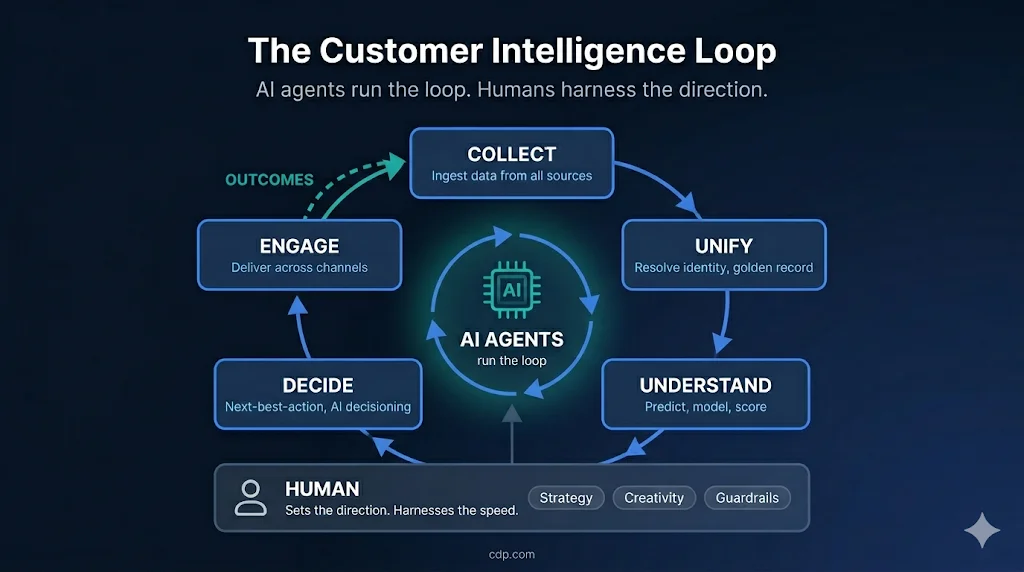
COLLECT → UNIFY → UNDERSTAND → DECIDE → ENGAGE → (back to COLLECT)
A signal arrives (a customer visits a product page). The CDP resolves identity and updates the unified profile. AI evaluates the full context — behavioral history, purchase data, channel preferences — and decides the optimal action. The platform acts (sends an SMS, renders a personalized offer). The outcome (opened? clicked? converted?) flows back into the profile, improving the next decision.
When this loop runs within a single platform in seconds, the CDP becomes a learning system — each interaction makes the next one smarter. When the stages are split across multiple vendors, the loop slows dramatically: the AI acts but learns from stale data, because outcome data is trapped in external systems and takes hours to return.
What closes the loop is the partnership between AI and humans. AI agents close the loop at speed — autonomously cycling through the five stages continuously. Humans close the loop at the strategic level — setting the objectives, defining creative and brand guardrails, and intervening when the system drifts. Neither can close the loop alone.
How the Four Core Functions Work
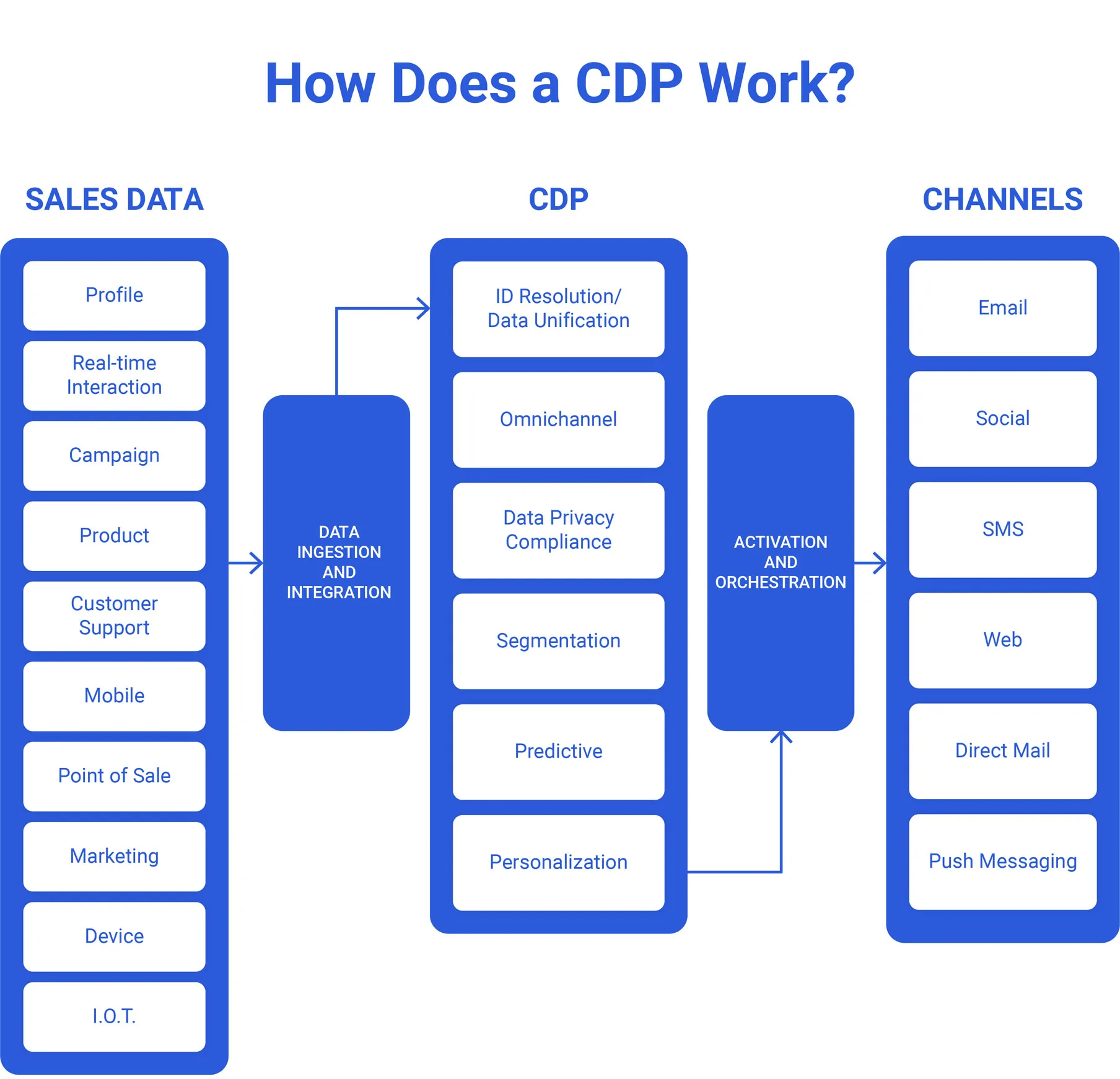
Source: Treasure Data
1. Collect: Ingest data from every source. A CDP connects to every system that generates customer data: websites, mobile apps, CRM, email platforms, point-of-sale systems, loyalty programs, support tickets, advertising platforms, and IoT devices. It ingests structured, semi-structured, and unstructured data through built-in connectors, SDKs, webhooks, and APIs. The key requirement is completeness — an AI agent making a retention decision needs the full picture.
2. Unify: Resolve identities into persistent profiles. Raw data arrives with different identifiers — email addresses, device IDs, loyalty numbers, cookie IDs, CRM records. Identity resolution stitches these into a single, persistent customer profile using deterministic matching (exact identifiers) and probabilistic matching (behavioral patterns, fuzzy logic). The result is a single customer view — a living record that updates in real time.
3. Decide: Apply intelligence to customer data. Basic CDPs let marketers build rule-based segments manually. Advanced CDPs apply machine learning to the unified profile to determine the optimal action for each customer: predictive analytics for churn and lifetime value, AI-discovered customer segments, and next best action decisioning that evaluates a customer’s full context in real time.
4. Activate: Execute across channels. A unified profile with intelligent decisioning is useless if the platform cannot act on it. Data activation means delivering the right message to the right customer at the right moment — through email, SMS, push notifications, in-app messages, paid media, or direct mail. CDPs with native messaging can decide and act within the same platform, completing a closed feedback loop in seconds.
Read More: What is First-Party Data and Why Is It So Important?
Key Features of Customer Data Platform Software
Customer data platform software includes a core set of capabilities that distinguish it from general-purpose data tools. When evaluating CDP solutions, look for these features:
Data ingestion and connectors. A CDP must connect to every customer data source in your stack — CRM, email, web analytics, mobile apps, POS, support, advertising, and more. Look for pre-built connectors, real-time event streaming (not just batch imports), and support for custom data sources via APIs and webhooks.
Identity resolution. The ability to stitch together customer records from different systems using deterministic and probabilistic matching. This is foundational — without accurate identity resolution, every downstream capability degrades. ML-powered matching is now standard across leading platforms, but accuracy on anonymous-to-known stitching still varies. See Identity Resolution: How It Works.
Profile unification. Beyond matching records, the CDP must merge and deduplicate data into a clean, persistent profile that continuously enriches as the customer interacts across channels. This includes data validation, normalization, and conflict resolution when sources disagree.
Audience segmentation. Self-service tools for building customer segments based on behavior, attributes, events, and predictive scores — without SQL or IT support. Advanced CDPs offer AI-powered segmentation that discovers high-value cohorts automatically.
Real-time activation. The ability to push audience segments and individual profile data to downstream tools — email, SMS, advertising platforms, personalization engines, analytics — in real time, not batch. A real-time CDP serves profiles at API speed for in-session personalization.
Analytics and reporting. Built-in dashboards for segment performance, customer journey analysis, marketing attribution, and campaign measurement. The CDP should provide a single source of truth for customer metrics across all channels.
Privacy, consent management, and data governance. Centralized consent tracking, right-to-be-forgotten fulfillment, data access requests, and role-based access controls. Essential for compliance with GDPR, CCPA, and other data privacy regulations.
AI and predictive modeling. Churn prediction, customer lifetime value forecasting, next best action recommendations, and agentic marketing capabilities. The most advanced CDPs embed AI directly into the platform for closed-loop decisioning.
Benefits of a Customer Data Platform
A customer data platform delivers measurable business value by eliminating data silos, enabling personalization at scale, and providing a unified data foundation for AI-driven marketing. Here are the primary benefits organizations gain from deploying a CDP:
Unified customer view. A CDP creates a single customer view by consolidating data from all touchpoints. One retail brand discovered 23% of their “unique” customers were duplicates across email, loyalty, and POS systems — unification revealed their true customer base and corrected lifetime value calculations.
Better personalization. With a complete customer profile, organizations can personalize across every channel — not just email. According to McKinsey, companies that excel at personalization generate 40% more revenue from those activities than average players (McKinsey, 2021).
Improved segmentation. Self-service segmentation reduces segment creation from days to minutes, eliminating dependence on data teams for every campaign. Cross-channel segments combine online behavior, purchase history, and offline interactions.
Stronger campaign performance. Suppression and frequency management prevent over-messaging. According to Forrester, organizations that implement unified customer profiles see a 15-25% improvement in marketing efficiency by eliminating redundant messaging and coordinating outreach across channels (Forrester, 2023).
Reduced ad waste. Suppress existing customers from acquisition campaigns and build high-value lookalike audiences. Boston Consulting Group found that brands using first-party data for key marketing functions achieved up to a 2.9x revenue uplift and 1.5x cost savings compared to those relying on third-party data (BCG, 2022).
Customer retention. AI-powered churn prediction identifies at-risk customers and triggers proactive interventions before they leave — typically one of the first AI use cases marketing teams operationalize on a unified data foundation.
Privacy and governance. Centralized consent management and data governance enforce privacy policies, manage consent, and fulfill deletion requests from a single system — reducing compliance risk across the entire martech stack.
Faster activation across teams. Marketing, sales, service, and analytics teams all work from the same customer profiles, eliminating data reconciliation and enabling faster time-to-action.
See how Subaru achieved 350% CTR lift with CDP — unifying dealership, digital, and CRM data to deliver personalized messages at the right moment, generating $26M in attributed revenue.
Before and After: What a CDP Changes
| Without a CDP | With a CDP | With a CDP + AI | |
|---|---|---|---|
| Segmentation | Email data team, wait 3 days for CSV | Self-service in visual UI, 20 minutes | AI discovers segments automatically |
| Cross-channel data | Siloed — can’t exclude support-ticket customers from campaigns | Unified — Shopify, Zendesk, analytics in one profile | Unified + real-time behavioral signals |
| Attribution | Last-click guesswork (GA credits paid search for email-driven sales) | Cross-device identity resolution gives each channel proper credit | AI optimizes spend allocation across channels |
| Campaign execution | Manual build → launch → wait for report | Build → launch → real-time profile updates | AI agent decides, sends, and learns autonomously |
| Marketer’s role | Data wrangling and campaign ops | Campaign strategy and creative | Strategy, creative direction, and AI oversight |
Customer Data Platform Use Cases
CDP use cases fall into three tiers — unified data, personalized activation, and AI-driven outcomes — with most organizations starting at the foundation and progressing upward. Each tier builds on the capabilities of the one below it.
Foundation: Unified Data
- Single customer view: Merge records from every system into one persistent profile per customer
- Audience segmentation: Build cross-channel segments without SQL or IT support — reducing segment creation from days to minutes
- Suppression and frequency capping: Prevent over-messaging by tracking all communications across channels in one place
- Data governance and consent management: Enforce privacy policies, manage consent centrally, and fulfill GDPR/CCPA deletion requests from a single system
Activation: Personalized Campaigns
- Personalized email and lifecycle marketing: Tailor messages, offers, and content based on the full customer profile — not just email behavior
- Ad spend optimization: Suppress existing customers from acquisition campaigns and build high-value lookalike audiences
- Customer journey orchestration: Design and automate multi-step, cross-channel journeys that adapt based on customer behavior
- Customer support context: Provide support agents with a complete customer history — purchases, interactions, preferences — for faster, more personalized service
- Sales and account intelligence: Enrich CRM records with behavioral and engagement data for more targeted outreach
Intelligence: AI-Driven Outcomes
- Churn prediction and proactive retention: AI identifies at-risk customers and triggers interventions before they leave
- Next best action: Real-time decisioning selects the optimal message, channel, and timing for each individual
- Revenue optimization: AI allocates marketing spend across channels based on predicted incremental value
- Agentic marketing: Autonomous AI agents manage customer interactions end-to-end — deciding, executing, and learning continuously
Read More: CDP Use Cases: 20+ Examples by Industry and Function | How to Develop CDP Use Cases
Customer Data Platform vs CRM vs DMP vs Data Warehouse
A CDP is distinct from a CRM, DMP, and data warehouse in both purpose and architecture: it is the category built to unify first-party customer data with persistent identity resolution and make it available for real-time AI activation. A CRM manages known contacts for sales and support; a DMP targeted anonymous cookie audiences (largely defunct after third-party cookie deprecation); a data warehouse stores and queries all enterprise data but lacks native identity resolution or marketing activation. A CDP sits between these layers as the unification and activation layer — making every other system in the stack smarter by providing a complete, real-time customer profile.
The table leaves out the DMP: cookie-based DMPs are largely obsolete, and the full comparison lives in CDP vs DMP.
| CDP | CRM | Data Warehouse | |
|---|---|---|---|
| Primary data | Customer data from all sources (behavioral, transactional, anonymous, known) | Known contacts (sales, support interactions) | All enterprise data |
| Identity | Deterministic (and often probabilistic) identity resolution across devices and channels | Known identifiers only (email, phone, account and contact IDs) | No native identity resolution |
| Primary users | Marketing, data teams, AI agents | Sales, service teams | Data engineers, analysts |
| Activation | Native or connector-based channel activation + API | Sales workflows | Via reverse ETL, native connectors, or downstream tools |
| Data persistence | Unified, continuously updated customer profiles | Account, contact, and opportunity records, updated by user or workflow entry | Durable analytical storage (tables, not profiles) |
For specific deep dives: CDP vs CRM | CDP vs DMP | Is Snowflake a CDP? | What Is Databricks CustomerLake?
Types of Customer Data Platforms
Customer data platforms have evolved through three architectural generations — Packaged, Composable, and Agentic — each closing the Customer Intelligence Loop faster than the last. Understanding these types helps buyers match platform capabilities to their organization’s needs.
| Dimension | Packaged CDP (Stage 1) | Composable CDP (Stage 2) | Agentic CDP (Stage 3) |
|---|---|---|---|
| Primary user | Human marketers | Data engineers | AI agents (with human oversight) |
| Loop speed | Weekly/monthly batch cycles | Fragmented — streaming syncs speed activation, but outcome data returns across vendor boundaries in hours | Continuous — AI agents close the loop in seconds |
| Data storage | Proprietary only | Warehouse only | Warehouse + managed (hybrid) |
| AI capabilities | None (rule-based) | Requires separate ML tools | Embedded AI, closed feedback loops |
| Messaging | Not included | Not included (separate ESP) | Native email, SMS, push (bundled) |
| Interface | Dashboards, drag-and-drop | SQL, dbt, warehouse consoles | MCP, APIs, CLI, pre-built agent skills |
| PII boundary | Single vendor | Multiplied — reverse ETL copies PII to downstream tools on every sync | Reduced — native messaging eliminates ESP boundary, though external ad platforms still receive PII |
Packaged CDPs (Stage 1, 2016-2018) proved the category was necessary by unifying customer data into persistent profiles. They are batch-only, rule-based, and built for human-operated campaigns. Best for: organizations with straightforward data unification needs and limited AI requirements.
Composable CDPs (Stage 2, 2020+) assemble best-of-breed tools on top of data warehouses, giving engineers control and data portability. The trade-off: the loop slows across vendor boundaries, and every activation sync copies customer PII to external tools. Best for: organizations with mature data engineering teams, existing warehouse investments, and primarily batch-oriented use cases.
Agentic CDPs (Stage 3, 2024+) bundle CDP + messaging + AI into a single platform. As Tomasz Tunguz argues in AI’s Bundling Moment: “The SaaS playbook rewarded specialization. The AI playbook rewards breadth.” Examples of platforms moving toward agentic capabilities include Treasure AI, Salesforce Data Cloud (Agentforce), and Adobe Real-Time CDP (AI Assistant). Best for: organizations that need real-time AI decisioning, closed feedback loops, and native multi-channel activation.
Read More: Packaged vs Composable CDP: An Outdated Framing | How AI Is Redefining the CDP
How to Choose a Customer Data Platform
Selecting the right customer data platform requires evaluating platform capabilities against your specific use cases, data complexity, and organizational readiness. Here are the criteria that matter most — a CDP RFP template turns them into a scored questionnaire you can send to every vendor:
Data sources and integrations. Catalog every system that generates customer data. The CDP must have pre-built connectors for your core systems — CRM, email, web analytics, POS, mobile — and flexible APIs for custom sources. Evaluate the number of connectors, ingestion latency, and maintenance burden.
Identity resolution quality. Test the platform’s ability to match customer records across your specific data sources. Deterministic matching (email, phone, loyalty ID) is table stakes; evaluate probabilistic matching accuracy on anonymous-to-known resolution and cross-device stitching.
Real-time vs batch needs. If your priority use cases include in-session personalization, real-time offer decisioning, or dynamic pricing, you need a platform with sub-second profile lookups. If your use cases are primarily batch segmentation and campaign targeting, query latency is less critical. Validate with live profile reads at your data volumes during a proof of concept, not from datasheet numbers.
Segmentation flexibility. Evaluate whether marketers can build segments self-service or if they need engineering support. Look for behavioral event-based segmentation, nested logic, predictive score filters, and the ability to combine online and offline attributes.
Activation destinations. Verify the CDP can push audiences to every channel you use — email, SMS, push, advertising platforms, personalization engines, analytics tools. Evaluate whether activation is real-time or batch, and whether the platform supports native messaging or requires external ESPs.
Privacy and compliance requirements. For regulated industries, evaluate consent management, data residency controls, right-to-deletion workflows, and security certifications (SOC 2, HIPAA if applicable). Assess how many vendor boundaries customer PII must cross during activation.
Implementation complexity. Evaluate the typical deployment timeline and whether you need a systems integrator. Ask for customer references at your scale and industry.
Scalability. Ensure the platform can handle your current profile volume and projected growth. Evaluate performance under peak load and pricing implications of scaling.
Pricing model. Understand the CDP pricing structure — per-profile, per-event, platform fee, or hybrid. Model 3-year total cost of ownership including implementation, integration maintenance, and engineering headcount.
Vendor and support fit. Evaluate the vendor’s industry expertise, customer success model, and product roadmap alignment with your priorities.
Read More: How to Choose the Right CDP | How to Evaluate a CDP in the AI Era | Building a CDP Business Case
For independent vendor assessments, the 2026 IDC MarketScape for AI-Enabled Customer Data Platforms (Doc #US53952526) evaluates how each platform applies AI to onboarding, audience creation, analysis, and campaign workflows.
How Much Does a Customer Data Platform Cost?
Customer data platform pricing varies widely based on data volume, feature tier, and deployment model — but most enterprise CDPs use custom pricing that depends on your specific requirements.
| Company Size | Annual License Range | Common Pricing Model |
|---|---|---|
| SMB / startup (up to 250K profiles) | $12,000-$60,000 | Per-profile or fixed tier |
| Mid-market (250K-5M profiles) | $60,000-$200,000 | Per-profile + platform fee |
| Enterprise (5M-100M profiles) | $200,000-$500,000+ | Platform fee + usage + modules |
| Global enterprise (100M+ profiles) | $500,000-$1,000,000+ | Custom enterprise agreement |
Ranges based on 2025-2026 published vendor pricing and cdp.com market analysis. These match the detailed breakdown in CDP pricing, which carries per-vendor list prices and worked budget examples.
Pricing factors that drive cost:
- Number of customer profiles — most CDPs price primarily on active profile count
- Event volume — high-velocity businesses (e-commerce, media, SaaS) may hit per-event cost thresholds
- Number of integrations — each connector and activation destination may add cost
- Feature tier — AI capabilities, advanced identity resolution, and real-time activation often sit in premium tiers
- Support level — dedicated customer success, SLA guarantees, and professional services
Hidden costs to budget for:
- Implementation — $15,000-$500,000+ depending on architecture, not just data complexity: agentic deployments with pre-built connectors land at the low end (4-8 weeks), suite deployments requiring a systems integrator at the high end (6-18 months)
- Data modeling and governance — defining schemas, consent frameworks, and data quality rules
- Engineering headcount — especially for composable deployments that require ongoing pipeline maintenance
- Compliance overhead — PII management, audit preparation, and deletion workflows across vendor boundaries
When comparing CDP costs, evaluate 3-year total cost of ownership — not just the annual license. Composable stacks that appear cheaper at entry often scale non-linearly when you factor in per-row sync costs, engineering time, and multi-vendor management.
Read More: CDP Pricing: Models, Ranges, and Hidden Costs
Customer Data Platform Implementation Steps
A successful CDP implementation follows a phased approach — starting with clear business goals and progressively adding data sources, use cases, and activation channels. Mid-market deployments typically take 8-12 weeks; enterprise deployments with complex data environments, multi-region requirements, and custom identity logic routinely take 16-24 weeks, with phased rollouts extending 3-6 months.
1. Define business goals and use cases. Start with 2-3 high-impact use cases — such as audience suppression, email personalization, or unified customer profiles. Clear success criteria prevent scope creep and enable measurable ROI.
2. Identify and prioritize data sources. Catalog every system containing customer data. Prioritize sources by use case impact — typically CRM, web analytics, email, and transaction data come first. Additional sources (mobile app, support, IoT) follow in later phases.
3. Establish governance and consent requirements. Define data ownership, access controls, retention policies, and consent frameworks before ingesting data. This is especially critical for regulated industries and multi-jurisdiction operations.
4. Unify profiles and resolve identities. Connect priority data sources and configure identity resolution rules. Validate match accuracy against known customer records. Clean and deduplicate profiles before activating.
5. Create priority segments. Build the audience segments required for your initial use cases. Start with simple, high-impact segments (active customers, churning customers, high-value prospects) before advancing to complex behavioral or predictive segments.
6. Connect activation channels. Integrate the CDP with your marketing, sales, and service tools — email platforms, advertising accounts, personalization engines, analytics. Validate that audiences flow correctly to each destination.
7. Measure performance and iterate. Track use case KPIs from day one. Expand to additional data sources, segments, and activation channels based on results. Advanced capabilities like AI decisioning and predictive modeling typically follow in a second phase.
Read More: CDP Implementation Guide: Phases, Timelines, and Pitfalls
Customer Data Platform Examples
Customer data platforms serve different industries and use cases, and the right platform depends on your specific requirements. Here are examples of how different types of organizations deploy CDPs:
Retail and e-commerce CDPs unify in-store POS, e-commerce, loyalty, and mobile app data to power personalized product recommendations, cart abandonment campaigns, and unified customer profiles across online and offline channels. See CDP for Retail and CDP for E-Commerce.
B2B CDPs resolve account-level identities, unify product usage data with CRM and marketing automation records, and enable account-based marketing with product-qualified lead scoring. See CDP for SaaS.
Enterprise CDPs handle 100M+ profiles with multi-region data residency, enterprise security certifications, and deep integration into complex technology environments.
Composable CDPs assemble modular tools on top of an existing data warehouse, giving data engineering teams control over the data layer while using reverse ETL for activation. This approach works well for organizations with mature data infrastructure and primarily batch use cases.
Real-time personalization CDPs serve customer profiles at API speed for in-session decisioning — powering dynamic website content, real-time offer selection, and AI-driven next best action across channels.
Customer data platform vendors span multiple categories. Common CDP software vendors include Treasure Data, Salesforce Data Cloud, Adobe Real-Time CDP, Twilio Segment, Tealium, mParticle, BlueConic, ActionIQ, and Hightouch. These platforms differ in architecture (packaged, composable, or agentic), identity resolution approach, real-time capabilities, AI maturity, and pricing model.
For a detailed vendor-by-vendor comparison across deployment models, pricing, AI capabilities, and industry fit, see our customer data platform vendors guide. For the latest analyst research, see our collection of CDP industry studies and analyst reports.
To deepen your understanding of CDP concepts — from data unification and identity resolution to AI-driven activation — explore CDP Training from Treasure AI, a structured learning path for marketing and data professionals.
CDP Examples in Production: Treasure AI Customers Subaru, AB InBev, and Extraco Banks
Three Treasure AI customer deployments show these mechanics in production: Subaru unified dealership, digital, and CRM data to reach in-market buyers; AB InBev consolidated 90 million customer records from 2,000+ sources across 50+ countries; and Extraco Banks put AI agents on top of unified CDP profiles to surface next best actions.
Subaru — 350% lift in ad click-through rates. Dealership records, digital behavior, and CRM history resolved into one profile per customer, letting the marketing team find in-market buyers across channels instead of inferring intent from channel-level reports, for $26 million in attributed revenue. (See the full Subaru case study)
AB InBev — 90 million customer records unified across 2,000+ data sources. The brewer’s brands operate in more than 50 countries, each with its own systems. Consolidating those records into one platform removed the weeks-long data preparation cycle that used to precede every coordinated global campaign. (See the full AB InBev case study)
Extraco Banks — 27% year-over-year increase in campaign conversion. The community bank layered an AI Agent Foundry on unified CDP profiles so business leaders could query customer data in plain language and act on next-best-action insights without engineering support — the agentic pattern applied in a regulated industry. (See the full Extraco Banks case study)
All three are Treasure Data customers, self-reported without third-party audit — read the percentages as single-vendor, directional evidence, not independent benchmarks. What generalizes across them is the mechanism: one persistent profile per customer, and a shorter path from signal to action.
FAQ
What is a customer data platform?
A customer data platform (CDP) is software that ingests customer data from every source, unifies it into persistent profiles through identity resolution, and makes those profiles available for activation, AI decisioning, and analytics. Unlike a CRM or data warehouse, a CDP is purpose-built to create a complete, actionable view of each customer by combining online behavior, offline transactions, and cross-channel interactions into a single profile.
What does a customer data platform do?
A CDP collects customer data from all sources, resolves identities to create unified profiles, enables audience segmentation, and activates data across channels. The platform runs a continuous cycle — collect, unify, understand, decide, engage — that enables personalized marketing, AI-driven decisioning, and cross-channel customer experiences at scale.
What is the difference between a CDP and a CRM?
A CRM stores known customer interactions — sales calls, emails, support tickets — while a CDP unifies data from all sources, including anonymous behavior. CRMs are optimized for sales and support workflows with manually entered data. CDPs automatically ingest behavioral, transactional, and interaction data from every touchpoint and resolve it into unified profiles. Most organizations use both: the CRM for relationship management and the CDP as the underlying data foundation.
What is the difference between a CDP and a DMP?
A DMP collected anonymous, third-party cookie data for ad targeting; a CDP collects first-party, identified data for cross-channel activation. DMPs stored data temporarily (typically 90 days) and relied on third-party cookies that are now deprecated. CDPs store data persistently, build cross-device identity graphs, and activate across marketing, sales, and service. The DMP category is largely defunct — CDPs have absorbed audience-building using first-party data.
What is the difference between a CDP and a data warehouse?
A data warehouse stores and queries large datasets for analytics but lacks identity resolution, real-time profile serving, and native marketing activation. A CDP adds the identity, segmentation, and activation layers that transform raw data into actionable customer profiles. Many CDPs connect to existing warehouses, adding operational capabilities while the warehouse remains the analytical foundation.
Who needs a customer data platform?
You likely need a CDP if customer data is siloed across five or more systems, personalization relies on manual exports, or you want AI-driven marketing but lack a unified data foundation. CDPs deliver the most value for mid-market and enterprise organizations with complex, multi-channel customer relationships. Organizations in regulated industries (healthcare, financial services) also benefit from centralized consent and governance.
How much does a customer data platform cost?
CDP pricing ranges from $60,000-$200,000 per year for mid-market deployments to $200,000-$500,000+ for enterprise deployments. Cost depends on profile volume, event volume, number of integrations, feature tier, and support level. Budget for implementation ($15,000-$500,000+, driven more by architecture than by data volume) and ongoing operational costs including data engineering and compliance management.
What are common customer data platform use cases?
The most common CDP use cases include unified customer profiles, audience segmentation, personalized email campaigns, paid media optimization (suppression and lookalikes), churn prediction, customer journey orchestration, and AI-driven next best action. Most organizations start with data unification and suppression (fastest ROI), then expand to personalization and AI use cases. See CDP Use Cases for 20+ examples by industry.
How do you choose a customer data platform?
Evaluate CDPs across data connectivity, identity resolution quality, real-time capabilities, segmentation flexibility, activation destinations, privacy compliance, implementation complexity, and total cost of ownership. Start by defining 2-3 priority use cases, then match platform capabilities to those requirements. See How to Choose the Right CDP for a step-by-step buyer’s guide.
What does CDP mean in marketing?
In marketing, “CDP” refers to the customer data system the marketing team operates itself: where audiences get built, segmented, and pushed to campaign channels without an engineering ticket. Marketers use the word to separate it from the CRM (sales-owned contact records) and the warehouse (analytics-owned storage). Saying “it’s in the CDP” means the profile is already unified and available to target.
What are examples of customer data platforms?
Major customer data platform examples include Treasure Data (Treasure AI), Salesforce Data Cloud, Adobe Real-Time CDP, Twilio Segment, Tealium, Hightouch, ActionIQ, mParticle, and BlueConic. Each differs in architecture (packaged, composable, or agentic), identity resolution approach, and pricing model — for a shortlist with pricing and fit guidance, see our customer data platform vendors comparison.
Are CDPs still relevant in 2026?
Yes — CDPs have become more relevant in the AI era, because AI agents acting on customers need exactly what a CDP provides: a unified, real-time customer profile as their shared memory. The category is evolving rather than fading — packaged CDPs proved unification, composable CDPs moved it into the warehouse, and agentic CDPs now close the loop with bundled messaging and AI. Even data platform vendors are embedding CDP capabilities directly (such as Databricks CustomerLake) — validation that unified, activatable profiles are core infrastructure. What has declined is the standalone batch-only CDP, not the problem it solved.
How fast should a CDP serve customer profiles?
For in-session use cases — website personalization, real-time offers, AI agent context — a CDP should serve profile lookups in tens to low hundreds of milliseconds; batch use cases like audience exports tolerate minutes to hours. Evaluate p95/p99 latency rather than averages — a sub-second average can still hide lookups that blow an in-session page-render budget. There is no published industry-standard latency benchmark, so ask vendors to demonstrate two numbers at your data volumes: profile lookup latency, and event-to-activation freshness (how fast an update lands in a downstream tool). Sustained performance under production-like load matters more than a datasheet number.
This article is also available in: カスタマーデータプラットフォーム(CDP)とは?仕組みと導入メリット · O que é CDP? Guia de Customer Data Platform · ¿Qué es un CDP? Guía de la customer data platform · Customer data platform (CDP) : définition et guide · Was ist eine Customer Data Platform (CDP)?