
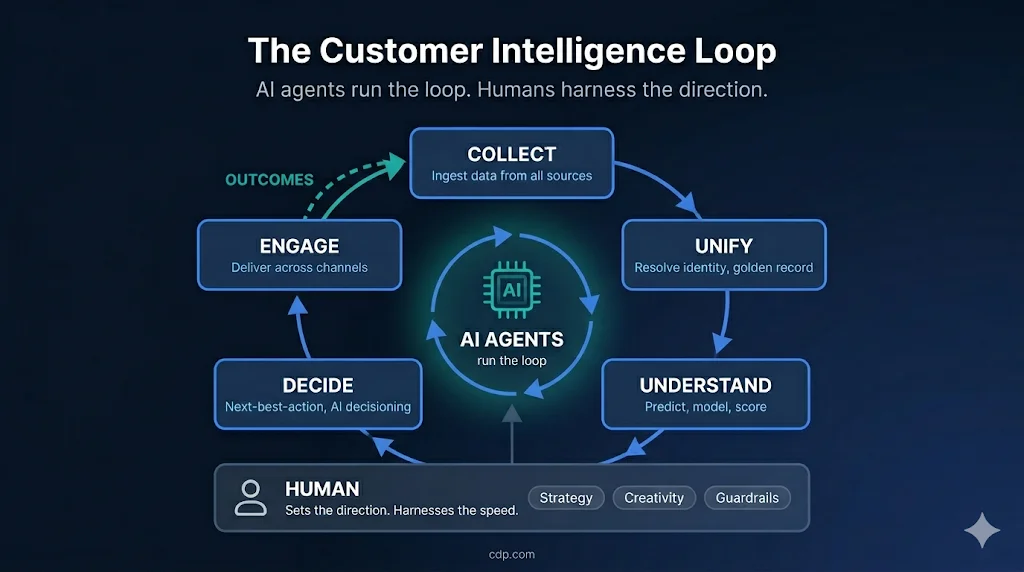
The Customer Intelligence Loop is a five-stage continuous cycle — Collect, Unify, Understand, Decide, Engage — where engagement outcomes feed back to data collection, enabling the system to learn from every customer interaction and improve autonomously over time. AI agents run the loop continuously; humans harness the direction with strategy, creativity, and guardrails. Unlike linear marketing pipelines that end at message delivery, the Customer Intelligence Loop closes the gap between action and learning, making it the architectural foundation that defines how Customer Data Platforms create compounding value — and the evolutionary pressure that drove CDPs from packaged platforms to agentic CDPs.
The Five Stages
1. Collect
Ingest customer data from every source: website behavior, mobile app events, point-of-sale transactions, CRM records, customer service interactions, data warehouse syncs, advertising platforms, and partner data feeds. The Collect stage is not a one-time import — it runs continuously, ingesting streaming events alongside batch loads. In an agentic CDP, Collect also receives engagement outcomes from stage 5, which is what makes the framework a loop rather than a pipeline.
2. Unify
Resolve customer identity across devices, channels, and interaction types. Identity resolution stitches anonymous browsing behavior, known email addresses, device IDs, loyalty numbers, and offline purchase records into a single golden record. Without Unify, subsequent stages operate on fragmented data — an AI model predicting churn from email behavior alone will misclassify customers who are active in other channels.
3. Understand
Apply predictive analytics and machine learning to unified profiles: churn prediction, lifetime value modeling, propensity scoring, audience clustering, and behavioral pattern detection. The Understand stage transforms raw unified data into actionable intelligence — signals that tell the system not just who the customer is, but what they are likely to do next. This stage improves every time the loop cycles, because new engagement outcomes from stage 5 retrain the models with fresh evidence.
4. Decide
Select the optimal action for each customer. AI decisioning engines evaluate the customer’s current profile, predictive scores, business rules, and guardrails to determine next-best-action — which message, which channel, which offer, at what time. In agentic CDPs, AI agents perform this stage autonomously, harnessed by human-defined strategy and constraints. In earlier CDP generations, humans performed this stage manually through segmentation rules and campaign scheduling.
5. Engage
Deliver the chosen action across channels: email, SMS, push notifications, in-app messages, web personalization, or advertising platforms. The Engage stage is the only part of the loop the customer sees — the visible tip of the iceberg. Customer engagement platforms like Braze and Iterable are purpose-built for this stage. Agentic CDPs with native messaging can execute this stage internally, keeping the entire loop within a single platform boundary.
What Closes the Loop
After Engage, outcomes — opens, clicks, purchases, conversions, unsubscribes, support calls, in-store visits — flow back to Collect. This closed feedback loop is the defining architectural feature: the system learns from the results of its own actions. Customer profiles update. Predictive models in Understand retrain on fresh evidence. Decisions in stage 4 improve because they are now informed by what actually happened, not just what was predicted.
What closes the loop is the partnership between AI agents and humans. AI agents close the loop at speed — autonomously cycling through Collect, Unify, Understand, Decide, and Engage millions of times, feeding outcomes back to Collect within seconds. Humans close the loop at the strategic level — setting the objectives the agents optimize toward, defining the creative and brand guardrails that constrain agent actions, and intervening when the system drifts. Neither can close the loop alone: agents without human direction optimize for the wrong outcomes; humans without agents cannot run the loop fast enough for AI-era personalization.
The speed of this feedback determines the intelligence of the system:
| Architecture | Loop Speed | Learning Capability |
|---|---|---|
| Packaged CDP (Stage 1) | Weekly/monthly batch cycles | Models retrain on stale data; campaigns improve slowly |
| Composable CDP (Stage 2) | Slow — stages split across vendors | Outcomes take hours to traverse warehouse → reverse ETL → ESP → warehouse pipeline |
| Agentic CDP (Stage 3) | Continuous — minutes or seconds | Models retrain on real-time outcomes; every engagement makes the next decision smarter |
The Customer Intelligence Loop is the evolutionary driver behind the 3-stage CDP evolution. Packaged CDPs ran the loop too slowly. Composable CDPs slowed the loop by distributing stages across separate vendors. Agentic CDPs exist because AI agents need the full loop running continuously — and that requires bundling data, intelligence, and activation within a single platform.
Customer Intelligence Loop vs Braze’s “4 D’s”
Braze’s “4 D’s” framework — Data, Decisioning, Design, Distribution — describes the engagement workflow from data input to message delivery. It maps to stages 4 and 5 of the Customer Intelligence Loop, with partial coverage of stage 1 through Braze Data Platform’s cloud data ingestion.
The key difference is structural: the 4 D’s is a linear pipeline that ends at Distribution. The Customer Intelligence Loop closes the cycle — engagement outcomes feed back to Collect, retraining predictive models and updating profiles. The 4 D’s describes what happens after data is prepared. The Customer Intelligence Loop describes the full cycle from raw data to delivered message and back, including the upstream stages (Collect, Unify, Understand) that determine whether the downstream stages operate on complete, unified, and predictive intelligence or on partial, siloed, channel-specific data.
Both frameworks are valid within their scope. The question for organizations is whether their marketing stack covers only stages 4-5 or the full loop. For a comprehensive comparison, see CDP vs Customer Engagement Platform.
Why the Loop Matters for AI
AI agents are the users that make the Customer Intelligence Loop transformative. A human marketer can run the loop manually — building segments on Mondays, launching campaigns on Wednesdays, reviewing results on Fridays. An agentic CDP with AI agents runs the loop continuously, around the clock, harnessed by human creativity and strategic judgment.
This changes three things:
- Speed: AI agents cycle through Collect-Unify-Understand-Decide-Engage in minutes, not weeks. Campaign iterations that took a human team five business days happen autonomously before the next meeting.
- Scale: Agents run the loop independently for every customer or micro-segment, not one campaign at a time. A million customers can each be on a personalized loop cycle simultaneously.
- Compounding intelligence: Every loop cycle makes the next one smarter. Predictive models improve with each outcome. Decisioning calibrates with each result. The system compounds intelligence the way interest compounds money — slowly at first, then unmistakably.
Without the loop, AI is a feature bolted onto a static data store. With the loop, AI becomes the engine of a system that learns, adapts, and improves with every customer interaction.
FAQ
What is the Customer Intelligence Loop?
The Customer Intelligence Loop is a five-stage continuous cycle — Collect, Unify, Understand, Decide, Engage — where engagement outcomes feed back to data collection. Unlike linear marketing pipelines that end at message delivery, the loop closes the gap between action and learning. Each cycle updates customer profiles and retrains predictive models, making the system progressively smarter. It is the framework that explains why CDPs evolved from batch platforms to real-time, AI-driven agentic CDPs.
How is the Customer Intelligence Loop different from a marketing funnel?
A marketing funnel describes the customer’s journey; the Customer Intelligence Loop describes the platform’s operating cycle. Funnels are linear — awareness to conversion — and customer-facing. The Customer Intelligence Loop is cyclical and system-facing: it describes how the technology stack collects data, resolves identity, builds intelligence, makes decisions, and delivers engagement — then learns from the outcome. Every marketing funnel benefits from a faster, more complete Customer Intelligence Loop powering it behind the scenes.
Why did the Customer Intelligence Loop drive CDPs to become agentic?
Because AI agents need the full loop running continuously, and earlier CDP architectures could not deliver that. Packaged CDPs ran the loop in weekly batch cycles — too slow for real-time AI. Composable CDPs slowed the loop by splitting stages across separate vendors — data in the warehouse, execution in the ESP, with hours of latency between them. Agentic CDPs bundle data, intelligence, and activation in a single platform specifically so the Customer Intelligence Loop can run at AI speed — continuously, in minutes, with outcomes feeding back to improve every subsequent decision.
Related Terms
- Agentic CDP — The third-generation CDP architecture built to run the Customer Intelligence Loop at AI speed
- AI Decisioning — The Decide stage of the loop, where AI agents select optimal actions based on unified profiles
- Identity Resolution — The Unify stage, which connects fragmented customer data into a single golden record
- Customer Engagement Platform — Platforms that excel at the Engage stage but typically cover only stages 4-5 of the loop