A customer data platform (CDP) unifies customer data from every source into persistent profiles; a customer engagement platform (CEP) delivers personalized messages across channels like email, push, SMS, and in-app. They solve different halves of the same problem — and the market is converging them into a single stack. Understanding the architectural difference is essential because where you start (data or engagement) determines your long-term flexibility, AI readiness, and total cost of ownership.
This article introduces the Customer Intelligence Loop — a five-stage framework — to clarify where CDPs and CEPs overlap, where they diverge, and why the closed feedback loop between them is the capability that matters most in an AI-driven marketing landscape.
What a Customer Engagement Platform Does
Customer engagement platforms — Braze, Iterable, Customer.io, Salesforce Marketing Cloud, and CleverTap — are purpose-built for high-volume, event-driven consumer messaging. For the full definition, see the CEP glossary entry.
CEPs excel at:
- Multi-channel messaging: Native delivery across email, mobile push, SMS, in-app messages, web push, and WhatsApp with channel-specific optimization
- Journey orchestration: Visual workflow builders that define multi-step, branching communication sequences triggered by user behavior
- Real-time triggers: Sub-second responses to behavioral events — abandoned carts, milestone completions, session starts
- A/B testing and optimization: Built-in experimentation for subject lines, content, timing, and channel mix
- Engagement analytics: Campaign performance dashboards tracking delivery, opens, clicks, conversions, and revenue attribution
CEPs have also been expanding their data capabilities. Braze launched its Braze Data Platform (BDP) for improved data ingestion. Iterable has added audience hub features and data feeds. These moves signal that CEP vendors recognize the data gap — but the additions remain supplementary to the platform’s core messaging architecture.
What a CDP Does
CDPs operate upstream from engagement tools. While a CEP manages interactions within its own channels, a CDP ingests data from every customer touchpoint — website behavior, mobile app events, point-of-sale transactions, customer service interactions, CRM records, advertising platforms, and data warehouses — and unifies it into a single customer view.
Core CDP functions include:
- Data ingestion: Streaming and batch connectors to 200+ sources — SDKs, APIs, warehouse syncs, offline imports, and partner data feeds
- Identity resolution: Deterministic and probabilistic matching that stitches anonymous browsing, known email addresses, device IDs, and loyalty numbers into unified profiles across devices and channels
- Audience building: Segments based on the complete behavioral, transactional, and demographic picture — not just engagement metrics
- AI/ML analytics: Predictive models for churn, lifetime value, propensity scoring, and next-best-action recommendations
- Multi-destination activation: Syncing unified audiences to CEPs, ad platforms (Google, Meta, TikTok), analytics tools, CRMs, and personalization engines simultaneously
CDPs have also been expanding into engagement. Agentic CDPs now bundle native email, SMS, and push capabilities alongside data unification and AI decisioning, reducing or eliminating the need for a separate CEP license. This bidirectional convergence — CEPs adding data features, CDPs adding messaging — is reshaping the MarTech landscape.
The Customer Intelligence Loop
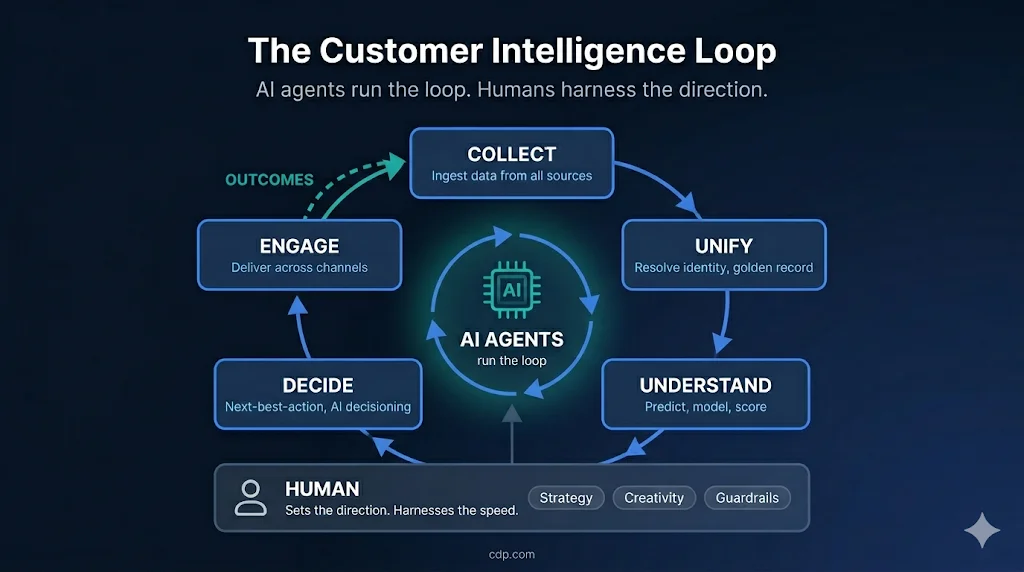
To compare CDPs and CEPs structurally rather than feature-by-feature, it helps to map them against a complete customer intelligence stack. The Customer Intelligence Loop is a five-stage cycle — COLLECT, UNIFY, UNDERSTAND, DECIDE, ENGAGE — where engagement outcomes continuously feed back into data collection, creating a closed loop that gets smarter with every interaction. AI agents run the loop continuously; humans harness the direction with strategy, creativity, and guardrails.
| Stage | Function | CDP | CEP |
|---|---|---|---|
| 1. COLLECT | Ingest data from all sources (web, mobile, POS, CRM, support, warehouse) | Native — 200+ pre-built connectors, streaming + batch | Partial — engagement data + limited cloud data ingestion |
| 2. UNIFY | Resolve identity across devices and channels into a golden record | Native — deterministic + probabilistic cross-device matching | Minimal — email and push-token matching within platform |
| 3. UNDERSTAND | Analyze, model, and predict (churn, LTV, propensity) | Native — cross-channel predictive models | Limited — engagement-focused analytics only |
| 4. DECIDE | Select the optimal action (AI decisioning, reinforcement learning) | Growing — strongest in agentic CDPs | Strong — Braze Canvas, send-time optimization, channel selection |
| 5. ENGAGE | Deliver messages and experiences across channels | Some — agentic CDPs include native messaging | Core strength — email, push, SMS, in-app, web |
After ENGAGE, outcomes (opens, clicks, purchases, conversions, churn events) flow back to COLLECT — updating customer profiles and retraining the predictive models in UNDERSTAND. This is what makes it a loop, not a pipeline: the system learns from every interaction and improves autonomously over time.
Braze’s own framework — the “4 D’s” (Data, Decisioning, Design, Distribution) — is a valid description of the engagement workflow. It maps primarily to stages 4 and 5, with partial coverage of stage 1 through Braze Data Platform’s cloud data ingestion. But the 4 D’s is a linear pipeline — it has no feedback mechanism. The Customer Intelligence Loop adds three upstream stages (COLLECT at depth, UNIFY, UNDERSTAND) and, critically, closes the cycle so that every engagement outcome makes the next decision smarter.
Where the Loop Slows Down
The closed loop is where CDPs and CEPs diverge most sharply:
- CDPs learn from all channels. When a customer converts through a push notification, abandons a cart on mobile, calls customer service, and makes an in-store purchase, all of those outcomes update the unified profile and retrain predictive models. The system learns from the complete picture.
- CEPs learn from their own channels. Braze’s Intelligent Timing and campaign optimization learn from email opens, push engagement, and in-app behavior within Braze. But they cannot learn from in-store purchases, customer service interactions, or website behavior captured by other systems — unless that data is fed back through a CDP or integration layer.
This is not a criticism of CEPs — they learn effectively within their domain. The structural gap is cross-channel unified learning: the ability to use outcomes from every touchpoint to improve decisions across all touchpoints.
Closing the loop requires both AI and humans. AI agents close the loop at speed — autonomously cycling through COLLECT → UNIFY → UNDERSTAND → DECIDE → ENGAGE and feeding outcomes back within seconds. Humans close the loop at the strategic level — setting the objectives agents optimize toward, defining creative guardrails, and intervening when the system drifts. As AI agents increasingly drive personalization decisions in real time, the completeness and speed of the Customer Intelligence Loop becomes the primary differentiator between marketing stacks that improve autonomously and those that plateau.
Feature-by-Feature Comparison
| Capability | CDP | Customer Engagement Platform |
|---|---|---|
| Data ingestion breadth | 200+ connectors, streaming + batch | Engagement data + limited CDI |
| Identity resolution | Cross-device, deterministic + probabilistic | Within-platform (email, push token, device ID) |
| Customer profiles | Universal — all teams, all touchpoints | Engagement-focused — campaign managers |
| Audience building | Based on unified cross-channel data | Based on engagement data + imported segments |
| Predictive AI/ML | Churn, LTV, propensity, next-best-action | Send-time optimization, channel selection |
| Journey orchestration | Growing capability | Core strength — visual builders, branching |
| Message delivery | Some hybrid CDPs; most rely on CEP | Core strength — email, push, SMS, in-app |
| Ad audience activation | Native to Google, Meta, TikTok, etc. | Limited or none |
| Data governance | Centralized consent, deletion propagation | Manages consent within own platform |
| Real-time decisioning | Growing — strongest in agentic CDPs | Core strength |
| Feedback loop scope | All channels, all touchpoints | Own channels only |
| Primary users | Data teams, marketing ops, analytics, sales | Campaign managers, lifecycle marketers |
| Typical annual cost | $100K–$300K (profile/event based) | $50K–$200K (MAU/message based) |
Why CDP and CEP Are Converging
The boundary between CDPs and CEPs is dissolving. This convergence is not theoretical — it is visible in specific vendor moves:
- CDPs expanding into engagement: Agentic CDPs like Treasure Data now bundle native email, SMS, and push alongside data unification and AI decisioning. Bloomreach combines CDP and marketing automation. The data layer is absorbing the execution layer.
- CEPs expanding into data: Braze launched Braze Data Platform in 2024 to improve data ingestion and identity capabilities. Iterable added audience hub features. Klaviyo now positions itself as a “CDP” for e-commerce. The execution layer is reaching toward the data layer.
- Both adding AI decisioning: CDPs are building AI decisioning engines; CEPs are adding reinforcement learning and predictive optimization. AI is the convergence accelerator.
As venture capitalist Tomasz Tunguz argued in AI’s Bundling Moment, AI rewards platform breadth over best-of-breed specialization. The Customer Intelligence Loop requires data, decisioning, and execution within a single platform boundary. When these components span separate vendors connected by APIs and batch syncs, the loop slows from seconds to hours, and AI models learn from stale data.
The structural argument: data unification is infrastructure-hard to retrofit, while message delivery is an application-level capability. Organizations that start with a strong data foundation (CDP) and add engagement capabilities can leverage their unified profiles, identity graph, and predictive models. Organizations that start with a strong engagement engine (CEP) and try to add data unification must solve the harder problem second — rebuilding the foundation while the house is already occupied.
This does not mean CEPs are wrong or inadequate. For many organizations, a CEP paired with a CDP is the right architecture today. But the direction of convergence favors platforms that own the data layer, because data is the structural bottleneck that AI cannot work around.
It is also worth noting that some organizations solve stage 2 (UNIFY) in their data warehouse using SQL-based identity resolution models. This is a valid approach — particularly for teams with strong data engineering resources — though it requires custom maintenance for schema changes, lacks real-time profile serving at API speed, and must be connected to each activation destination individually. CDPs package this infrastructure into a managed service, trading customization for speed-to-value.
How CDPs and CEPs Work Together Today
For most organizations, the practical answer is both platforms, with clear division of responsibilities:
- CDP collects data from all sources — web, mobile, CRM, POS, support, warehouse
- CDP resolves identity into unified profiles using deterministic and probabilistic matching
- CDP builds audiences using predictive models and cross-channel behavioral data
- CDP pushes enriched segments and attributes to CEP via native integration or API
- CEP orchestrates journeys and delivers messages across email, push, SMS, and in-app
- CEP sends engagement data back to CDP — opens, clicks, conversions flow into the unified profile, closing the Customer Intelligence Loop
This architecture lets each platform do what it does best. The CDP handles data complexity; the CEP handles message delivery. The critical integration point is the feedback path (step 6) — without it, the system cannot learn from its own actions.
When evaluating this integration, consider data contracts and schema enforcement between the two systems. The quality of personalization depends not just on whether the integration exists, but on whether profile attributes, event schemas, and audience definitions remain consistent as both platforms evolve independently.
Choosing Which Platform Leads Your Stack
Use these signals to determine where to start:
Start with a CDP if:
- You have 5+ customer data sources with no shared identity key
- Multiple teams (marketing, sales, support, analytics) need access to customer data
- You need to activate audiences beyond messaging — ad platforms, web personalization, analytics
- AI-driven personalization and next-best-action decisioning are strategic priorities
- Compliance requires centralized consent management and deletion propagation
Start with a CEP if:
- Your customer data is already clean and unified (perhaps in a warehouse with identity resolution)
- Your primary need is more sophisticated messaging and journey orchestration
- You operate 3 or fewer customer data sources
- Your activation channels are primarily email, push, and SMS
Signs you have outgrown a CEP-only stack:
- Campaign targeting requires data your CEP does not have (in-store purchases, support interactions, website behavior outside the CEP’s SDK)
- You are manually exporting and importing CSV audience lists between systems
- AI features plateau because models lack cross-channel behavioral data
- Compliance teams flag PII scattered across multiple tools without centralized governance
- Sales and support teams request customer data the CEP cannot provide
Questions to ask your current vendor:
- Can your platform ingest and unify data from all of our customer touchpoints — not just messaging channels?
- How does identity resolution work across anonymous and known interactions, across devices?
- If we add a new activation destination (ad platform, analytics tool, CRM), how long does the integration take?
- How quickly do engagement outcomes update customer profiles and retrain predictive models?
- If we need to delete a customer’s data under GDPR, does the deletion propagate to all connected systems automatically?
Budget considerations: Under $150K annual MarTech budget, pick one platform and maximize it. Over $200K, the combined CDP + CEP stack is justifiable if you are activating across multiple channels and multiple teams need unified customer profiles. For detailed cost guidance, see the CDP pricing guide.
For a comprehensive evaluation framework, see How to Evaluate a CDP in the AI Era.
FAQ
Is a customer engagement platform the same as an ESP?
No — ESPs are a subset of the CEP category. Email Service Providers like Mailchimp and SendGrid focus primarily on email and SMS delivery. Customer engagement platforms like Braze and Iterable are broader: they include journey orchestration, in-app messaging, web personalization, push notifications, and AI-driven optimization across all channels. For a detailed ESP comparison, see CDP vs ESP.
Can a CDP replace a customer engagement platform?
Some agentic CDPs can, but most enterprises use both. Agentic CDPs that bundle native email, SMS, and push alongside data unification and AI decisioning can replace a standalone CEP for organizations ready to consolidate their stack. However, specialized CEPs typically offer more sophisticated journey builders, deliverability optimization, and template editors. The practical answer for most organizations is a CDP handling data and a CEP handling delivery — with a robust feedback loop connecting them.
What is the difference between Braze’s “4 D’s” and the Customer Intelligence Loop?
They describe different scopes of the same system. Braze’s 4 D’s framework (Data, Decisioning, Design, Distribution) describes the engagement workflow — primarily stages 4 and 5 of the Customer Intelligence Loop. The Customer Intelligence Loop adds three upstream stages (Collect, Unify, Understand) and closes the cycle so engagement outcomes feed back into data collection. The frameworks are complementary: the 4 D’s describe what happens after customer data is unified; the Customer Intelligence Loop describes the full cycle from raw data to delivered message and back.
Are CDPs and customer engagement platforms converging?
Yes — and AI is accelerating it. CDPs are adding native messaging capabilities. CEPs are adding data ingestion and identity features. Both are investing in AI decisioning. The structural trend, as Tomasz Tunguz argues in AI’s Bundling Moment, favors platforms that control the full data-to-action pipeline because AI requires closed feedback loops operating in real time. Most enterprises still operate both platforms today, but the category boundary is dissolving.
Wondering whether you need a CDP alongside your engagement platform? Read Do You Need a CDP with an Engagement Platform? for a practical decision guide.