
If your engagement platform is your only system for customer data, you almost certainly need a Customer Data Platform (CDP) alongside it. Engagement platforms like Braze, Iterable, and Customer.io excel at messaging and journey orchestration — roughly 40% of the customer intelligence stack. A CDP covers the remaining 60%: data collection from all sources, cross-device identity resolution, and AI-driven audience understanding.
This article helps you determine whether the gap between what your engagement platform provides and what your marketing strategy requires is large enough to justify adding a CDP to your stack.
What Engagement Platforms Are Built For
Customer engagement platforms (CEPs) are purpose-built for high-volume, event-driven consumer messaging. They are best-in-class execution layers, and their strengths are real:
- Multi-channel messaging: Native delivery across email, mobile push, SMS, in-app messages, web push, and WhatsApp
- Journey orchestration: Visual workflow builders with branching logic, wait conditions, and cross-channel coordination triggered by user behavior
- Real-time triggers: Sub-second responses to behavioral events — abandoned carts, app installs, milestone completions
- A/B testing: Built-in experimentation for subject lines, content, timing, and channel mix
- Send-time and channel optimization: AI-driven delivery tuning based on individual engagement patterns
For the full definition and evaluation criteria, see the customer engagement platform glossary entry.
Nobody disputes that CEPs are excellent at what they do. The question is whether what they do is everything your customers need.
The Customer Intelligence Loop
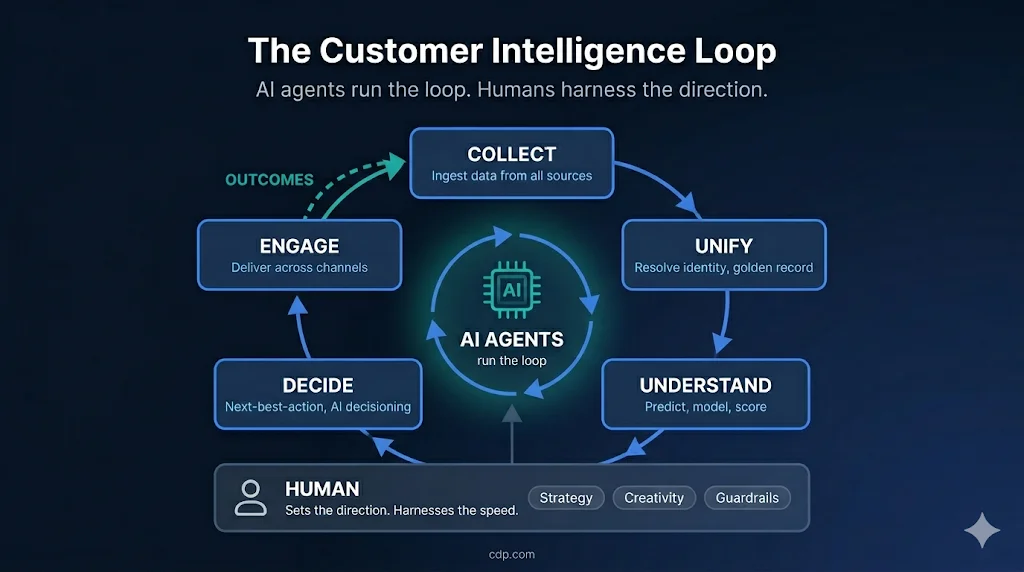
The Customer Intelligence Loop maps the complete cycle from raw customer data to delivered message — and back again. It has five stages, each feeding the next, with engagement outcomes flowing back to data collection to close the loop. Engagement platforms cover some stages deeply and others not at all.
| Stage | What It Does | CEP Coverage | CDP Coverage |
|---|---|---|---|
| 1. COLLECT | Ingest data from all sources | Partial — engagement data + limited integrations | Full — 200+ connectors, streaming + batch |
| 2. UNIFY | Resolve identity, build golden record | Minimal — email/push-token matching within platform | Full — deterministic + probabilistic cross-device |
| 3. UNDERSTAND | Predictive analytics, churn/LTV modeling | Limited — engagement analytics only | Full — cross-channel predictive models |
| 4. DECIDE | AI decisioning, next-best-action | Strong — Canvas flows, reinforcement learning | Strong — especially with unified data from layers 1-3 |
| 5. ENGAGE | Multi-channel delivery | Core strength | Some — agentic CDPs include native messaging |
CEPs cover stages 4 and 5 deeply. They are the visible tip of the iceberg — the part your customer sees. But stages 1 through 3 are the 90% below the waterline: the data collection, identity resolution, and predictive intelligence that determine whether the messages in stages 4 and 5 are relevant, timely, and personalized to the complete customer picture.
What makes the Customer Intelligence Loop a loop — not a pipeline — is that engagement outcomes (opens, clicks, purchases, churn events) flow from ENGAGE back to COLLECT, updating profiles and retraining predictive models. A CDP completes this loop across all channels and touchpoints. A CEP’s loop is limited to its own channel metrics — it cannot learn from in-store purchases, customer service interactions, or website behavior captured outside its SDK.
For a deeper analysis of the Customer Intelligence Loop and the convergence between CDPs and CEPs, see CDP vs Customer Engagement Platform.
What Braze Data Platform Is — and Is Not
Braze launched Braze Data Platform (BDP) in 2024 to address the data gap in its engagement platform. BDP is a meaningful step forward — it adds Cloud Data Ingestion from Snowflake, Redshift, BigQuery, and Databricks; Currents for streaming engagement events to external systems; and Connected Content for pulling external data into messages at send time.
BDP solves real integration problems. It makes it easier to get data into and out of Braze. But BDP is not a CDP — and Braze has acknowledged this directly. In community discussions, Braze employees have described BDP as a “composable set of data capabilities and partner integrations,” explicitly positioning it alongside CDPs rather than as a replacement. Braze lists Treasure Data, Segment, mParticle, Tealium, and Amperity as technology partners specifically for CDP functionality.
What BDP does not provide:
- Cross-source identity resolution: BDP ingests data but does not perform probabilistic identity matching across devices, channels, and anonymous/known states. It works with pre-resolved identities.
- Universal customer profiles: Profiles in Braze are optimized for messaging activation, not for serving as a system of record accessible to sales, support, analytics, and other non-Braze tools.
- Centralized data governance: When a customer requests deletion under GDPR, BDP does not propagate that deletion to your CRM, data warehouse, ad platforms, and other downstream systems. A CDP does.
- Cross-channel predictive models: BDP’s AI capabilities (Intelligent Timing, Intelligent Selection) optimize within Braze’s channels. They do not build churn models, LTV predictions, or propensity scores based on unified cross-channel behavioral data.
The honest assessment: BDP makes Braze a better engagement platform. It does not make Braze a customer data platform. The two solve different problems at different layers of the stack.
When You Do Not Need a CDP
Not every organization needs both platforms. Be honest with yourself — adding a CDP introduces cost, implementation effort, and architectural complexity. Your engagement platform may be sufficient if:
- Messaging channels are your only customer touchpoints. If 80%+ of customer interactions happen through email, push, and SMS, and you are not personalizing web, mobile app, or advertising experiences, your CEP handles the scope.
- Customer data lives in 1-2 systems. If your data exists primarily in your CEP and perhaps an e-commerce platform or CRM, the integration complexity a CDP solves does not exist yet.
- You have fewer than 500K customer profiles. Below this threshold, most CEPs can effectively segment and activate your audience without a separate data unification layer.
- You do not need cross-channel identity resolution. If treating email subscribers, website visitors, and mobile app users as separate entities is acceptable for your use case, CEP segmentation is sufficient.
- Your team is marketing-only. If sales and customer service teams do not need access to unified customer profiles, the cross-functional value of a CDP does not justify the investment.
- You are already getting strong ROI from your CEP. If your current platform drives measurable revenue and your team has capacity to use advanced features, upgrading your CEP tier may deliver better returns than adding a new platform.
Companies with straightforward customer journeys — DTC e-commerce brands, B2C subscription services, early-stage mobile apps — often thrive with just an engagement platform.
When You Need a CDP Alongside Your Engagement Platform
These signals indicate that your engagement platform alone is no longer sufficient:
- You have 5+ customer data sources with no shared identity key. When data flows from your website, mobile app, CRM, support desk, POS system, data warehouse, and third-party tools, manual integration to your CEP becomes unsustainable. A CDP’s pre-built connectors and identity graph automate unification.
- Campaign targeting requires data your CEP does not have. If you need to target “customers who purchased in-store in the last 30 days but have not opened an email in 60 days,” your CEP cannot build that segment — it lacks the POS data.
- You need to activate audiences beyond messaging. If you run personalized website experiences, dynamic ad campaigns on Google and Meta, product recommendations, or in-app personalization, you need customer profiles that extend beyond messaging engagement data.
- Multiple teams need customer data. When sales needs email engagement context, support needs purchase history, and analytics needs cross-channel behavior, the CDP’s universal profile serves all stakeholders. CEPs are built for campaign managers, not cross-functional access.
- AI personalization is a strategic priority. Agentic CDPs support next-best-action decisioning, churn prediction, and autonomous journey optimization. These models require the breadth and depth of unified first-party data that a CEP cannot provide on its own.
- Compliance requires centralized governance. If you operate under GDPR, CCPA, or industry-specific regulations, a CDP centralizes consent management and deletion propagation across all tools — including your CEP.
For detailed guidance on evaluating CDPs, see How to Evaluate a CDP in the AI Era.
How They Work Together
The most effective stacks treat the CDP as the data foundation and the CEP as the execution engine:
- CDP ingests data from all sources — web, mobile, CRM, POS, support, warehouse
- CDP resolves identity into unified profiles using deterministic and probabilistic matching
- CDP builds audiences using predictive models and cross-channel behavioral data
- CDP pushes enriched segments and attributes to CEP via native integration
- CEP orchestrates journeys and delivers messages with its best-in-class delivery infrastructure
- CEP sends engagement data back to CDP — closes the Customer Intelligence Loop so predictive models retrain on real outcomes
This architecture lets each platform do what it does best. The CDP handles data complexity and identity; the CEP handles message delivery and journey orchestration. Neither replaces the other — they amplify each other.
For a deeper comparison of the two categories, including the convergence thesis and a full feature comparison, see CDP vs Customer Engagement Platform.
FAQ
Is Braze a CDP?
No — Braze is a customer engagement platform, not a CDP. Braze Data Platform (BDP) improves data ingestion into Braze with Cloud Data Ingestion and Currents event streaming, but it does not provide cross-source identity resolution, universal customer profiles accessible to non-Braze tools, or centralized data governance with deletion propagation. Braze itself positions BDP alongside CDPs, not as a replacement, and lists CDP vendors as technology partners.
Can I use my data warehouse instead of a CDP to feed my engagement platform?
A data warehouse stores data; a CDP activates it. You can use reverse ETL tools to push warehouse segments to your CEP, but this approach has limitations: warehouse query latency makes real-time personalization difficult, identity resolution must be custom-built and maintained in SQL, and activating to multiple destinations requires separate integrations for each. A CDP packages identity resolution, real-time profile serving, and pre-built connectors into a managed service — trading customizability for speed-to-value.
How much does it cost to add a CDP to my engagement platform stack?
Enterprise CDPs typically cost $100K–$300K per year. Combined with a CEP at $50K–$200K per year, total stack cost ranges from $150K to $500K. The ROI justification depends on whether you are activating data across multiple channels and teams, and whether AI-driven personalization is a strategic priority. Organizations under $150K annual MarTech budget should maximize their CEP before adding platform complexity. For detailed cost breakdowns, see the CDP pricing guide.
What is the difference between a CDP and a customer engagement platform?
A CDP unifies data; a CEP activates it through messaging. CDPs ingest data from all sources, resolve identity, build predictive models, and push audiences to downstream tools. CEPs deliver personalized messages across email, push, SMS, and in-app channels. They are complementary — not competing — systems. For a comprehensive comparison including the Customer Intelligence Loop framework, see CDP vs Customer Engagement Platform.
For the full framework comparison — including the convergence thesis and decision guide — read CDP vs Customer Engagement Platform.