
A customer data platform (CDP) for quick service restaurants (QSR) unifies mobile app, drive-through, kiosk, delivery, and loyalty data into a single customer 360 profile for personalized, daypart-optimized marketing across franchise networks. QSR brands that unify customer data across ordering channels see measurable improvements in average check size, visit frequency, and loyalty program engagement.
Quick service restaurants face a data challenge unlike any other industry: extremely high transaction velocity, multiple ordering channels competing for the same customer, a franchise model that fragments data ownership, and third-party delivery platforms that withhold customer identity. Without a customer data platform, QSR brands operate with incomplete customer profiles — personalizing for app users while treating drive-through and in-store guests as anonymous strangers. A robust data governance framework is essential to manage this complexity across franchise boundaries.
Why QSR Needs a CDP
QSR data challenges are structurally different from traditional retail or ecommerce:
Ordering channels are fragmented and growing. A single QSR brand may operate five or more ordering channels — in-store counter, drive-through, mobile app, website, and third-party delivery platforms. Each channel captures different data at different levels of detail. Mobile app orders include rich behavioral data; drive-through transactions often capture only payment information. A CDP bridges these channels into a unified view.
Franchise models create data silos. Many QSR brands operate through franchise networks where individual franchisees use different POS systems, manage their own local marketing, and may not share customer data with the corporate brand. A CDP provides a centralized data layer that respects franchise data boundaries while enabling brand-wide customer intelligence.
Third-party delivery obscures customer identity. Delivery platforms control the customer relationship, providing QSR brands with order data but withholding customer identity and contact information. This creates a growing blind spot: as delivery orders increase, the percentage of identifiable customers decreases. A CDP helps match delivery order patterns to known customers through identity resolution signals like payment tokens and address matching.
Daypart marketing demands precision. QSR revenue is concentrated in distinct dayparts — breakfast, lunch, dinner, and late-night — each with different customer segments, menu preferences, and competitive dynamics. Effective daypart marketing requires understanding individual customer patterns, not just aggregate traffic data. A CDP enables customer segmentation by daypart behavior, visit frequency, and menu affinity.
Loyalty programs are the identification engine. In an industry where most transactions are anonymous, loyalty programs serve as the primary mechanism for identifying customers and linking their cross-channel behavior. A CDP maximizes loyalty program value by connecting loyalty data to every other customer touchpoint, turning a points-and-rewards system into a comprehensive customer intelligence asset.
Key Use Cases for QSR CDPs
1. Cross-Channel Customer Identification
Problem: A customer who orders breakfast through the mobile app, picks up lunch at the drive-through, and orders dinner via a delivery platform appears as three separate individuals across systems.
CDP solution: The CDP applies identity resolution across ordering channels — matching loyalty IDs, payment tokens, email addresses, phone numbers, and device identifiers to create a persistent profile that recognizes the customer regardless of how they order.
Outcome: QSR brands implementing CDP-driven identity resolution typically increase their identified customer base by 25-40%, directly improving the addressable audience for personalized marketing.
2. Personalized Offer Optimization
Problem: Generic promotions — the same coupon to every customer — erode margins without driving incremental visits. High-value customers receive discounts they do not need, while lapsed customers receive offers that do not match their preferences.
CDP solution: The CDP segments customers by value tier, visit frequency, daypart preference, and menu affinity, enabling differentiated offers: retention rewards for high-value regulars, reactivation incentives for lapsed visitors, and upsell suggestions based on purchase history. AI decisioning determines the optimal offer, timing, and channel for each customer through omnichannel marketing activation.
Outcome: Personalized offer strategies improve redemption rates by 2-3x compared to mass promotions, while reducing unnecessary discounting to already-loyal customers.
3. Daypart-Specific Marketing
Problem: A brand’s breakfast and dinner customers may be entirely different segments with different motivations, but marketing campaigns treat them identically.
CDP solution: The CDP builds daypart-specific segments based on individual ordering patterns — identifying breakfast-only customers who could be converted to lunch, dinner regulars who have never tried breakfast, and customers whose daypart preferences shift seasonally. Predictive analytics models daypart migration probability for each customer.
Outcome: Daypart expansion campaigns targeting customers with high migration probability drive 15-25% higher conversion rates compared to untargeted daypart promotions.
4. Loyalty Program Optimization
Problem: Loyalty programs achieve high enrollment but low sustained engagement. Members earn points but do not change their purchasing behavior, and the program becomes a margin cost without driving incremental revenue.
CDP solution: The CDP connects loyalty tier status, point balances, redemption history, and earning velocity to the full customer profile — enabling behavior-based loyalty strategies. Personalization extends beyond generic points multipliers to tailored challenges (try a new menu category), milestone rewards (celebrate visit streaks), and surprise-and-delight moments triggered by real-time customer behavior.
Outcome: Behavior-driven loyalty personalization improves active member engagement rates by 20-30% and increases program-attributed revenue as a share of total sales.
5. Menu Innovation and LTO Performance
Problem: Limited-time offers (LTOs) are a critical QSR revenue driver, but brands lack customer-level data on which segments respond to which types of menu innovation — making LTO planning reliant on aggregate sales trends rather than customer insights.
CDP solution: The CDP tracks LTO engagement at the individual customer level — who tried it, how many times, whether it drove incremental visits or simply substituted for existing orders, and whether LTO purchasers became regular customers afterward. This customer-level analysis informs future LTO strategy and targeted launch marketing.
Outcome: Customer-informed LTO targeting improves first-week trial rates and helps identify which menu innovations drive genuinely incremental behavior versus substitution.
6. Delivery Channel Intelligence
Problem: Third-party delivery orders represent a growing revenue share, but brands have minimal visibility into who these customers are, whether they also visit physical locations, and how delivery behavior differs from in-store behavior.
CDP solution: The CDP matches delivery order signals — delivery addresses, order patterns, payment data — against known customer profiles to identify overlap between delivery and direct-channel customers. This reveals the true incrementality of delivery and identifies delivery-only customers who could be migrated to higher-margin direct channels.
Outcome: Delivery-to-direct migration campaigns reduce platform commission costs while improving customer lifetime value through direct relationship ownership.
Evaluation Criteria for QSR CDPs
When choosing a CDP for QSR, evaluate these capabilities against your specific requirements:
| Capability | Why It Matters for QSR | What to Look For |
|---|---|---|
| High-volume data ingestion | QSR transaction volumes can reach millions per day across thousands of locations | Scalable ingestion with sub-minute latency for real-time use cases |
| Multi-POS integration | Franchise networks often use multiple POS vendors across locations | Pre-built connectors for major QSR POS systems and flexible API ingestion |
| Mobile app integration | Mobile ordering is the primary identification and personalization channel | SDK and API integration with native mobile apps for real-time profile updates |
| Delivery platform data | Third-party delivery data is fragmented and identity-poor | Ability to ingest delivery order data and match to known customer profiles |
| Loyalty platform sync | Loyalty is the core identification mechanism in QSR | Bidirectional sync with loyalty platforms (points, tiers, challenges, redemptions) |
| Daypart segmentation | Revenue optimization requires daypart-specific customer strategies | Time-based behavioral segmentation and daypart affinity scoring |
| Franchise data governance | Corporate and franchise data boundaries must be respected | Role-based access, location-level data permissions, franchise-safe activation |
| Real-time data activation | Mobile push notifications and in-app offers require immediate profile access | Sub-second profile lookup and real-time segment qualification |
Deployment Model Considerations for QSR
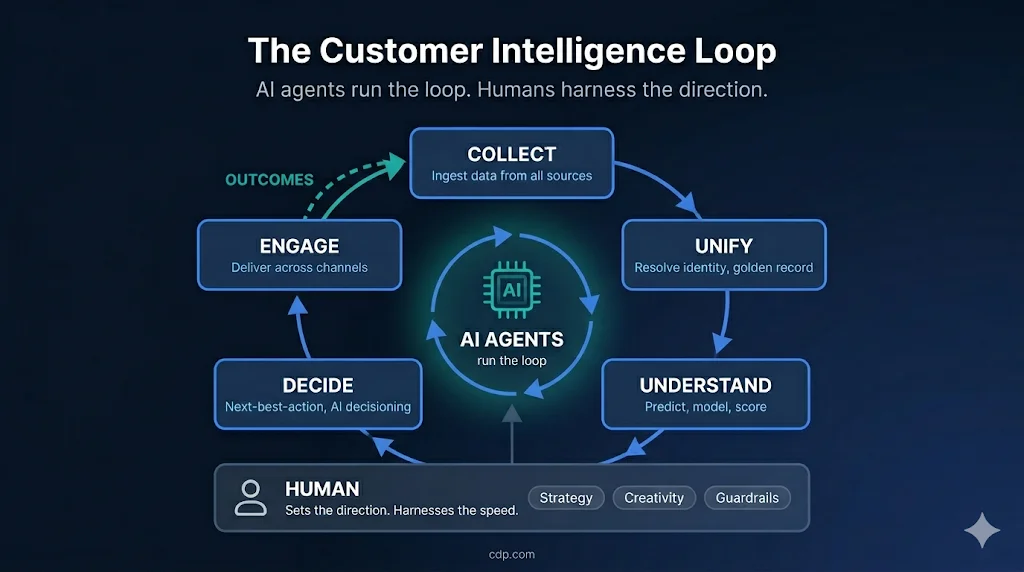
QSR brands face unique architectural considerations when selecting a CDP. Agentic CDPs offer embedded AI, closed feedback loops that run the full Customer Intelligence Loop, and native activation capabilities — critical for QSR brands that need real-time personalization across mobile, drive-through, and in-store channels simultaneously. The high transaction velocity of QSR operations demands a platform that can ingest, process, and act on customer data at scale without pipeline bottlenecks.
Composable architectures may suit QSR brands with mature data engineering teams and existing cloud data warehouse investments, though franchise data governance and real-time activation requirements should be carefully evaluated in the context of AI-era requirements.
Deployment Model Comparison for QSR
| Capability | Agentic CDPs | Suite CDPs | Composable CDPs |
|---|---|---|---|
| High-volume POS ingestion | Scalable native connectors | Via integration layer | Requires warehouse modeling |
| Mobile app personalization | Real-time profile serving | Within suite ecosystem | Warehouse query latency |
| Delivery data matching | Probabilistic identity resolution | Limited matching capability | Depends on warehouse identity model |
| Loyalty integration | Bidirectional API sync | Native within suite | Via warehouse + reverse ETL |
| Franchise data governance | Configurable data boundaries | Suite-level permissions | Warehouse-level access control |
| AI/ML capabilities | Native AI models | Suite AI capabilities | Bring-your-own ML |
| Time to value | 4-12 weeks | 3-12 months | 2-6 months (assumes existing warehouse) |
| Real-time CDP activation | Sub-minute | Varies by suite component | Warehouse query latency |
FAQ
How does a CDP help QSR brands with franchise data challenges?
A CDP provides a centralized data layer that unifies customer data across franchise networks while respecting ownership boundaries. The platform ingests data from multiple POS systems, mobile apps, and loyalty programs across franchise locations, applies identity resolution to create unified customer profiles, and enforces role-based access controls that determine which data franchisees and corporate teams can see and activate.
What is the difference between a CDP for QSR and a CDP for retail?
QSR CDPs must handle higher transaction velocity, deeper daypart segmentation, franchise-specific data governance, and third-party delivery platform integration. While retail CDPs focus on in-store and ecommerce unification, clienteling, and retail media, QSR CDPs prioritize mobile app personalization, drive-through identification, menu-level analytics, and loyalty program optimization across thousands of franchise-operated locations.
How does a QSR CDP handle third-party delivery data?
A CDP ingests delivery order data and uses probabilistic matching to connect delivery customers to known profiles. Delivery platforms typically share order details, delivery addresses, and timestamps but withhold customer contact information. The CDP matches these signals against existing profiles using address matching, order pattern analysis, and payment token correlation — enabling brands to measure delivery-to-direct migration and identify their true delivery-only customer segment.
Does a customer data platform make sense for restaurants beyond quick-service chains?
Yes — full-service and casual dining restaurant groups face the same core identity and loyalty challenges as QSR, just at lower transaction velocity. Multi-location table-service brands still need to unify reservation systems, POS, online ordering, and loyalty data across locations to recognize a guest whether they book a table, order delivery, or walk in. The QSR-specific capabilities above — high-volume ingestion, franchise data governance, daypart segmentation — matter most for high-velocity chains; a smaller full-service group may need a lighter-weight version of the same customer data platform foundation.
QSR brands that unify customer data across mobile, drive-through, kiosk, delivery, and in-store channels gain a structural advantage in an industry where personalization drives visit frequency and check size. To see how leading CDP platforms compare on QSR-relevant capabilities, download the Forrester Wave CDP report or the IDC MarketScape for an independent analysis.
This article is also available in: QSR向けCDPガイド|ファストフード業界の顧客データ活用