
A customer data platform (CDP) for convenience stores (c-stores) unifies fuel, in-store, loyalty, mobile, and payment data into a single customer 360 profile — enabling personalized promotions and fuel-to-merchandise cross-selling in an industry defined by high-frequency, anonymous transactions. Convenience retailers that successfully identify and personalize for their customers gain a structural advantage in one of the most competitive segments of retail.
The convenience store industry faces a unique data paradox: customers visit frequently — often daily — but most transactions are anonymous. Unlike ecommerce or traditional retail where digital accounts and loyalty cards provide identification, the majority of c-store transactions involve cash, contactless payment, or unidentified card swipes. Without a customer data platform, c-store operators cannot connect fuel purchases to in-store buying behavior, identify their most valuable customers, or deliver the personalized experiences that drive incremental visits and basket size.
Why Convenience Stores Need a CDP
Convenience store data challenges are structurally different from other retail segments:
Most transactions are anonymous. Industry estimates suggest that fewer than 20% of c-store transactions are linked to an identified customer. Fuel purchases at the pump, quick in-store cash transactions, and unregistered payment cards create a massive identification gap. A CDP maximizes the value of every identification signal — loyalty scans, mobile app usage, payment tokens — to progressively build customer profiles through identity resolution.
Fuel and merchandise data live in separate systems. Fuel transactions are processed through outdoor payment terminals and fuel management systems that are entirely separate from the in-store POS. Connecting fuel purchase patterns (grade preference, volume, frequency, time of day) to in-store behavior (categories purchased, basket size, promotional response) requires a unification layer that most c-store technology stacks lack.
High frequency creates rich behavioral signals — if captured. A customer who visits three times per week generates over 150 transactions per year. This frequency creates an extraordinarily rich behavioral dataset for predictive analytics — but only if those transactions are identified and connected across visits. A CDP transforms high-frequency visit data into predictive models for churn risk, category affinity, and promotional responsiveness.
Daypart economics are extreme. Morning coffee and breakfast drive the highest margins and visit frequency; midday fuel-only visits have the lowest in-store attachment rates. Understanding individual customer daypart patterns — not just aggregate traffic — enables targeted cross-selling: a morning coffee regular who never buys lunch represents a specific, addressable opportunity.
Age-gated products add regulatory complexity. Tobacco, alcohol, and lottery purchases require age verification and are subject to category-specific marketing restrictions that vary by state and locality. A CDP must manage these regulatory boundaries — ensuring that purchase data for restricted categories is handled within compliant data governance frameworks, that marketing targeting excludes underage profiles, and that consent management captures category-specific opt-ins. Failure to manage age-gated compliance at the data layer exposes c-store operators to regulatory penalties and reputational risk.
Key Use Cases for C-Store CDPs
1. Fuel-to-Merchandise Cross-Selling
Problem: A large percentage of fuel customers never enter the store. Fuel-only visits represent the biggest missed revenue opportunity in convenience retail.
CDP solution: The CDP identifies fuel-only customers through loyalty data and payment token matching, then triggers targeted offers — delivered via mobile app push notifications, pump screen displays, SMS, or loyalty program messaging — designed to drive in-store visits. AI decisioning determines the optimal offer category (coffee, snacks, car wash) based on each customer’s daypart patterns and purchase history through omnichannel marketing activation.
Outcome: CDP-driven fuel-to-store campaigns convert 8-15% of targeted fuel-only customers into in-store purchasers, directly increasing per-visit revenue.
2. Progressive Customer Identification
Problem: The low identification rate in c-stores means most customer intelligence is locked behind anonymous transactions.
CDP solution: The CDP implements progressive profiling — starting with payment token matching to link anonymous card transactions across visits, then layering loyalty enrollment incentives, mobile app adoption campaigns, and receipt-based identification to gradually build known customer profiles. Each identification signal adds to the profile without requiring customers to identify themselves at every visit.
Outcome: Progressive identification strategies increase the identified customer base by 30-50% over 12 months, expanding the addressable audience for personalized marketing.
3. Daypart-Specific Promotions
Problem: Generic promotions (buy one get one, cents-off fuel) treat morning coffee customers and evening beer purchasers identically, wasting promotional spend on irrelevant offers.
CDP solution: The CDP segments customers by daypart behavior — morning commuters, lunch visitors, evening shoppers, late-night customers — and delivers daypart-specific offers that match each segment’s category preferences. Personalization extends to offer timing: a morning coffee regular receives a promotional push at 6:45 AM, not at noon.
Outcome: Daypart-targeted promotions improve redemption rates by 2-4x compared to untargeted mass offers, while reducing margin erosion from unnecessary discounting.
4. Loyalty Program Optimization
Problem: C-store loyalty programs achieve moderate enrollment but struggle with sustained engagement. Many members enroll for a sign-up incentive but do not change their purchasing behavior.
CDP solution: The CDP connects loyalty program data to the full customer profile — fuel purchases, in-store transactions, mobile app engagement, promotional response — to enable behavior-driven loyalty strategies. Instead of generic points-per-gallon rewards, the CDP powers personalized challenges (try a new beverage category), streak rewards (maintain daily visit frequency), and targeted offers that move customers into higher-value behaviors.
Outcome: Behavior-based loyalty personalization increases active member rates by 15-25% and improves program-attributed revenue lift.
5. Location-Level Customer Intelligence
Problem: C-store chains operate hundreds or thousands of locations, each serving a different customer mix. Corporate marketing campaigns treat all locations identically.
CDP solution: The CDP provides location-level customer analytics — revealing the customer segments, daypart patterns, category preferences, and competitive dynamics at each store. This enables location-specific assortment recommendations, targeted local marketing, and staffing optimization based on customer traffic patterns rather than aggregate averages.
Outcome: Location-specific marketing strategies improve campaign performance by tailoring offers, messaging, and timing to each store’s unique customer composition.
6. Churn Prediction and Win-Back
Problem: In a high-frequency business, customer churn can occur rapidly — a daily visitor who stops coming represents significant lost revenue, but the absence may not be noticed for weeks.
CDP solution: The CDP builds visit frequency baselines for each identified customer and applies predictive analytics to detect early churn signals — declining visit frequency, reduced basket size, absence during previously regular dayparts. Automated win-back campaigns trigger before the customer fully lapses, offering personalized incentives based on their historical preferences.
Outcome: Predictive churn detection identifies at-risk customers 2-3 weeks earlier than manual monitoring, enabling proactive retention before the customer establishes new habits elsewhere.
Evaluation Criteria for C-Store CDPs
When choosing a CDP for convenience stores, evaluate these capabilities against your specific requirements:
| Capability | Why It Matters for C-Stores | What to Look For |
|---|---|---|
| Fuel system integration | Fuel data is half the customer picture but lives in separate systems | Connectors for fuel management systems, outdoor payment terminals |
| Payment token matching | Most c-store customers do not identify themselves at checkout | Ability to link anonymous card transactions across visits without PII |
| High-frequency data ingestion | Daily visitors generate 150+ transactions per year per customer | Scalable ingestion that handles high-volume, small-ticket transactions |
| Mobile and loyalty integration | Loyalty and mobile apps are the primary identification channels | Bidirectional sync with loyalty platforms and mobile SDKs |
| Progressive profiling | Low identification rates require gradual profile building | Multi-signal identity resolution that grows profiles over time |
| Daypart segmentation | C-store revenue and margins vary dramatically by time of day | Time-based behavioral segmentation and daypart affinity scoring |
| Age-gated compliance | Tobacco, alcohol, and lottery require regulatory controls | Category-level marketing restrictions and consent management |
| Location-level analytics | Chains need per-store customer intelligence | Store-level segmentation, trade area analysis, customer composition |
Deployment Model Considerations for C-Stores
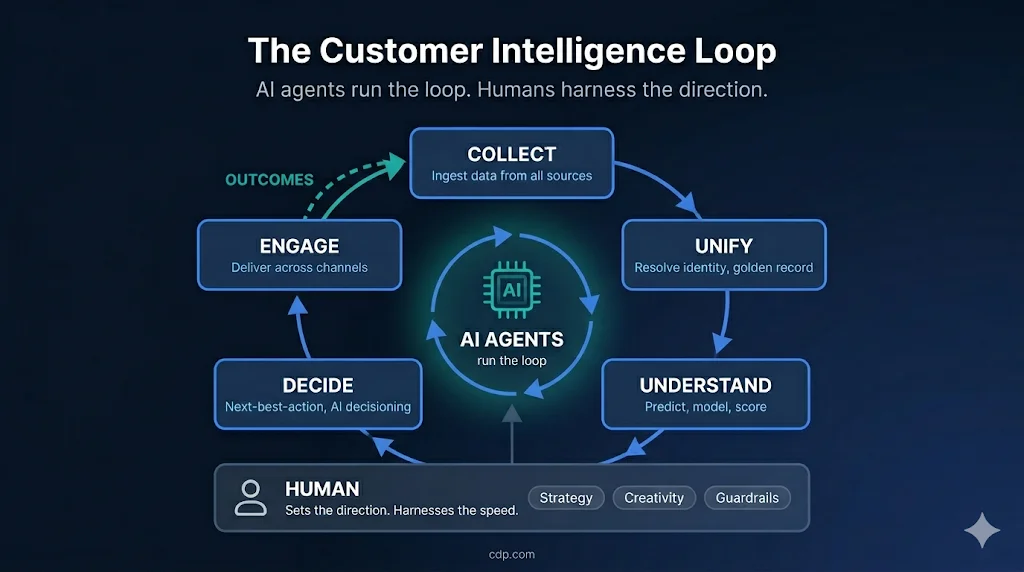
Convenience store operators face specific architectural decisions when selecting a CDP. Agentic CDPs combine managed infrastructure with embedded AI, closed feedback loops that run the full Customer Intelligence Loop, and native activation capabilities — particularly relevant for c-stores that need real-time fuel-to-store cross-selling and daypart-specific mobile push notifications. The high transaction volume and low identification rate of c-store operations demand a platform that excels at progressive identity building and real-time decisioning.
Composable architectures may suit c-store chains with established data warehouse infrastructure and dedicated data engineering teams, though the real-time activation requirements for fuel-to-store campaigns and churn detection should be carefully evaluated in the context of AI-era requirements.
Deployment Model Comparison for C-Stores
| Capability | Agentic CDPs | Suite CDPs | Composable CDPs |
|---|---|---|---|
| Fuel system integration | Native connectors, near real-time | Via integration layer | Requires warehouse modeling |
| Payment token identity | Probabilistic matching at scale | Limited matching capability | Depends on warehouse identity model |
| Progressive profiling | Built-in multi-signal resolution | Within suite ecosystem | Custom warehouse logic |
| Loyalty integration | Bidirectional API sync | Native within suite | Via warehouse + reverse ETL |
| Real-time push notifications | Sub-second profile lookup | Varies by suite component | Warehouse query latency |
| AI/ML capabilities | Native predictive models | Suite AI capabilities | Bring-your-own ML |
| Time to value | 4-12 weeks | 3-12 months | 2-6 months (assumes existing warehouse) |
| Real-time CDP activation | Sub-minute | Varies by suite component | Warehouse query latency |
FAQ
How does a CDP identify convenience store customers when most transactions are anonymous?
A CDP uses progressive identification to build customer profiles from multiple signals over time. Payment token matching links anonymous card transactions across visits without requiring PII. Loyalty program scans, mobile app interactions, and receipt-based email capture each add identification layers. Over time, the CDP stitches these signals together through identity resolution to build persistent profiles — even for customers who never formally register.
What is the difference between a CDP for convenience stores and a CDP for retail?
C-store CDPs must handle fuel system integration, extremely low identification rates, high transaction frequency, and age-gated product compliance — challenges that traditional retail CDPs do not prioritize. While retail CDPs focus on ecommerce and in-store unification, clienteling, and retail media, c-store CDPs prioritize fuel-to-merchandise cross-selling, progressive identification, daypart-specific promotions, and payment token matching across high-volume, low-ticket transactions.
How does a CDP connect fuel purchase data to in-store behavior?
A CDP ingests data from both fuel management systems and in-store POS, then uses identity resolution to match transactions to the same customer profile. Loyalty card scans at the pump and register provide deterministic matches. For unidentified customers, the CDP uses payment token matching, timestamp correlation, and location data to probabilistically link fuel and in-store purchases from the same visit or the same customer over time.
Convenience store operators that unify fuel, in-store, loyalty, and mobile data gain a structural advantage in an industry where customer identification and personalization directly drive visit frequency and basket size. To see how leading CDP platforms compare on retail-relevant capabilities, download the Forrester Wave CDP report or the IDC MarketScape for an independent analysis.
This article is also available in: コンビニ向けCDP活用ガイド:燃料と店内データ統合