
Most of the brands that will run AI marketing agents by 2028 have not deployed one yet. Gartner predicts that by 2028, 60% of brands will use agentic AI to deliver streamlined one-to-one interactions (January 2026). Yet Salesforce’s State of Marketing report (10th edition, 2026) finds only 13% of marketers have adopted agentic AI — and that high performers are twice as likely to use agents as everyone else. The gap between those two numbers is not conviction. It is deployment.
Deploying AI marketing agents successfully requires four things in place before the first autonomous campaign: a unified real-time data foundation, a guardrail framework designed up front, a phased rollout that starts with assisted tasks, and holdout-based measurement of outcomes. This guide covers each for teams putting agentic AI in marketing into production. If you first want to understand what an AI marketing agent is and how one is built, start with the glossary entry; this guide picks up where the definition ends.
When You’re Ready for an Agent — and When You’re Not
The honest first question is whether you need an agent at all. Rule-based marketing automation executes human-designed workflows — “if customer abandons cart, wait 2 hours, send email A” — and it remains the right tool when your campaign portfolio is small, stable, and expressible as rules. An agent changes who designs the strategy: given the objective “reduce churn among premium subscribers by 10%,” it designs the approach, selects the audience, generates the content, launches, and optimizes. Automation follows a script; agents write the script.
| Signal | Automation is enough | You’re ready for an agent |
|---|---|---|
| Campaign volume | 5-10 hand-designed campaigns per quarter cover the plan | The plan calls for dozens to hundreds of personalized micro-campaigns |
| Optimization cadence | Weekly A/B test reviews are acceptable | Decisions must adjust within hours of launch |
| Content | A few templates per campaign suffice | Per-customer variants are needed at scale |
| Data | Profiles are fragmented, refreshed in batch | Unified, real-time profiles are available or funded |
| Team | No one can own guardrail design and agent oversight | Marketers are ready to manage objectives, not workflows |
If the middle column describes you, keep automation — an agent running five stable campaigns adds governance overhead without return. If the right column does, the rest of this guide is the deployment path.
What You’re Actually Deploying
An AI marketing agent is a system of five components — perception, reasoning, planning, action, and memory — not a single model; the glossary entry linked above covers the anatomy component by component. What matters for deployment is that every component has a dependency you must provision:
| Component | What it does in production | What you must provision |
|---|---|---|
| Perception | Reads customer state from profiles and event streams | Unified, real-time profiles from a Customer Data Platform |
| Reasoning | Combines LLMs with ML predictions like propensity and lifetime value scores | Historical performance data for training and evaluation |
| Planning | Decomposes objectives into executable task sequences | Objectives with explicit budget, channel, and frequency constraints |
| Action | Executes across email, SMS, push, ads, and onsite | Credentialed integrations with every execution channel |
| Memory | Stores what worked to improve the next campaign | Outcome data flowing back into profiles |
Read down the right column: everything except the planning constraints and channel credentials is a data problem — and the credentials only matter because of what flows through them. The two integration points that decide deployment success are the perception layer’s profile access and the action interface’s channel connections — every cross-vendor boundary in either adds latency and a failure mode. Both come down to the architecture decision below.
Deploying AI Marketing Agents: What You Need
Data Foundation
Agents make decisions on whatever data they can see. Fragmented or stale profiles mean an agent working with the equivalent of half the customer base. The minimum data requirements:
- Unified customer profiles with identity resolution across devices and channels
- Real-time behavioral event streams, not batch-only refreshes
- Historical performance data for model training and outcome evaluation
- Clean consent management for regulatory compliance
A CDP provides this foundation. The open question is which CDP architecture supports agent workloads — the Customer Intelligence Loop section below compares them. Primary research on enterprise AI agent adoption benchmarks how far organizations have actually gotten answering that question.
Guardrail Framework
Guardrails are where agent deployments live or die. Gartner predicts more than 40% of agentic AI projects will be canceled by the end of 2027, citing escalating costs, unclear business value, or inadequate risk controls (June 2025). All three causes are addressed before launch: risk by the guardrail framework here, value by the measurement discipline below, and cost by the phased rollout — each phase’s spend gated on the previous phase’s measured lift. Every deployment needs:
- Spending limits: maximum budget per campaign, per channel, per day
- Frequency caps: maximum messages per customer per week, minimum gap between sends
- Content policies: brand voice guidelines, prohibited tactics, sensitivity rules
- Compliance checks: consent verification and regulatory requirements (GDPR, CCPA)
- Escalation triggers: when to alert a human — performance drops, budget anomalies, flagged content
Design the guardrail framework as carefully as the agent itself — autonomous marketing without governance is a liability, not a capability. Example failure mode: an agent optimizing short-term revenue over-messages high-value customers, winning the quarter while damaging lifetime value. Frequency caps and customer health scoring prevent exactly this pathology.
Organizational Readiness and Rollout
Start with low-risk, agent-assisted tasks. A typical path: months 1-2, implement the unified data foundation; month 3, pilot assisted tasks (send-time optimization, subject line generation) with human review; months 4-5, expand to semi-autonomous campaigns like cart abandonment and welcome series; month 6+, launch fully autonomous campaigns under the guardrail framework. Advance a phase only on evidence — the pilot beats its holdout for consecutive weeks, within budget, with no guardrail escalations — so spend scales with proven lift.
Redefine the marketer’s role. Marketers shift from designing individual campaigns to setting objectives, defining guardrails, and reviewing agent performance — a career evolution that requires training investment, not a memo.
Establish measurement before launch. Compare agent-driven campaigns against holdout control groups. Measure outcomes (conversion rate, revenue per customer), not activity (emails sent, impressions served).
The Customer Intelligence Loop: Why Architecture Matters
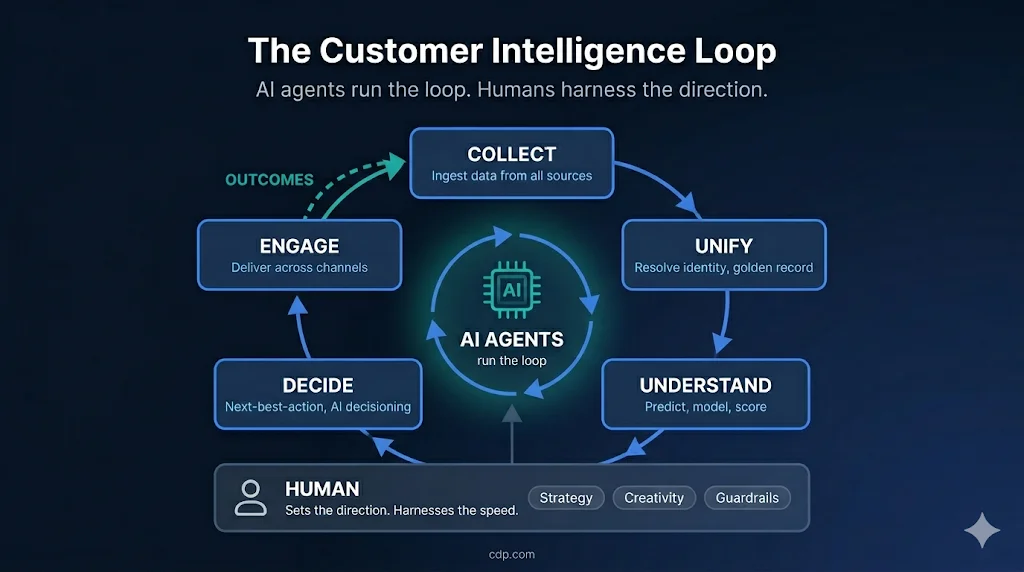
The Customer Intelligence Loop — COLLECT → UNIFY → UNDERSTAND → DECIDE → ENGAGE → back to COLLECT — is the continuous cycle through which AI marketing agents turn raw customer data into action and learning. AI agents run the loop continuously; humans harness the direction with strategy, creativity, and guardrails. A deployed agent’s effectiveness depends on how quickly and completely it can cycle through this loop:
| Loop stage | What the agent needs | Architectural requirement |
|---|---|---|
| COLLECT | Real-time event streams from all touchpoints | Streaming ingestion with immediate profile updates |
| UNIFY | Complete customer view with resolved identities | Identity resolution stitching anonymous and known profiles |
| UNDERSTAND | Predictive scores, behavioral context, segments | ML models with access to unified profiles |
| DECIDE | Sub-50ms action selection on full customer context | Low-latency decisioning engine on unified profiles |
| ENGAGE | Native message delivery across email, SMS, push | Built-in activation channels, not external ESPs |
| Loop closure | Outcomes flowing back within seconds | Closed feedback loop within a single platform |
This is why Tomasz Tunguz argues in AI’s Bundling Moment that AI rewards platform breadth over best-of-breed specialization — splitting the loop across vendors introduces latency and context loss that structurally limits agent effectiveness.
| Architecture | Loop speed | Agent capability |
|---|---|---|
| Composable stack (warehouse + reverse ETL + ESP) | Hours to days — outcomes traverse 3-5 vendor boundaries | Agents predict but cannot learn from outcomes in real time. Effective for batch use cases |
| Agentic CDP (unified data + AI + native messaging) | Seconds to minutes — closed within one platform | Agents perceive, decide, act, and learn continuously |
Both architectures have valid deployments. If your agent use cases are batch-oriented — churn models retrained daily, weekly audience syncs — a composable CDP supports them effectively. When agents must operate in real time — cart abandonment, in-session personalization, event-triggered messaging — the loop must close within seconds, which requires an integrated platform.
Data privacy consideration: composable stacks using reverse ETL copy PII to downstream ESPs on every sync, multiplying SOC 2 audit surface; keeping PII within a single platform boundary reduces compliance risk.
Which Agents to Deploy: The Specialist Roster
Production deployments are not one monolithic agent. Teams deploy specialists sequenced by a coordinating layer — an orchestrator, or at the strategic level an AI CMO.
Campaign Execution Agents
| Campaign phase | Agent | What it does |
|---|---|---|
| Strategy | Campaign Planning Agent | Turns the business objective into segments, channel mix, budget, and KPIs |
| Audience | Audience Discovery Agent | Scores the target audience across hundreds of profile attributes |
| Content | Content Generation Agent | Generates personalized subject lines, email, SMS, and push variants in brand voice |
| Journey setup | Journey Setup Agent | Assembles the multi-step, multi-channel journey with triggers, delays, and branching |
| Optimization | Journey Optimization Agent | Monitors live performance and reallocates traffic, channels, and timing in real time |
| Analysis | Performance Analysis Agent | Synthesizes results against objectives and stores learnings for future campaigns |
Marketing Operations Agents
| Function | Agent | What it does |
|---|---|---|
| SEO | SEO Agent | Monitors rankings, finds content gaps, recommends optimizations |
| GEO | GEO Agent | Optimizes content for citation by ChatGPT, Perplexity, and Gemini |
| Web analytics | Web Analysis Agent | Watches site behavior and surfaces anomalies unprompted |
| Paid media | Ad Buying Agent | Manages bidding, creative rotation, and budget across paid channels by ROAS |
| Social media | Social Media Agent | Develops content strategies and adapts tone and timing per channel |
| Competitive intel | Competitive Intelligence Agent | Tracks competitor pricing, campaigns, and launches 24/7 |
| Brand monitoring | Brand Monitoring Agent | Real-time sentiment analysis across social, reviews, and news |
| Data enrichment | Data Enrichment Agent | Fills profile gaps from external data sources |
| Attribution | Attribution Agent | Scores channel impact and recommends budget reallocation by incrementality |
| Influencer | Influencer Marketing Agent | Identifies aligned creators, detects fraud, manages the partnership lifecycle |
| Conversational | Brand Concierge Agent | Handles customer conversations with brand voice and customer history |
In the phased rollout above, Content Generation and Performance Analysis agents are the natural month-3 assisted pilots; Journey Optimization and Campaign Planning agents belong in month 6+, once the guardrail framework has been exercised. Every agent on both rosters performs better with unified customer data. An Agentic CDP serves as the shared data backbone so every deployed agent reads the same unified profiles.
End-to-End Example: A Deployed Agent Runs a Retention Campaign
Here is an illustrative scenario — representative numbers, not a customer case study — showing how the campaign execution roster works together on a retention campaign for an e-commerce retailer.
Step 1: Objective and Guardrails (Human → Agent)
The marketing director sets the objective: “Reduce 90-day churn among customers who made their first purchase in Q1 by 15%. Budget: $30K. Channels: email, SMS, push. Guardrails: max 2 messages/week, no discounts above 20%, no messaging before 8am or after 9pm local time.” The human sets strategy and boundaries; the agent takes it from here.
Step 2: Audience Discovery
Rather than a static rule (“no purchase in 30 days”), the agent evaluates hundreds of behavioral features — purchase recency against the category’s natural repurchase cycle, engagement trajectory, support interactions, browse-without-buying patterns. It identifies 42,000 at-risk customers and segments them by churn driver: Segment A (18,000, price-sensitive), Segment B (14,000, engagement decline), Segment C (10,000, experience issue flagged by a support ticket).
Step 3: Strategy per Segment
The agent designs a differentiated strategy for each: a tiered discount sequence for Segment A (free shipping first, escalating to 10% then 15% off), content re-engagement via push for Segment B (this segment has 3x higher push open rates than email), and SMS service recovery with a goodwill discount for Segment C. Each strategy includes a 10% holdout control group for measurement.
Step 4: Content Generation
Content is generated per customer, not per segment — a Segment A customer who browsed running shoes gets an email featuring those shoes with free shipping highlighted. Subject line variants are assigned by multi-armed bandit allocation: continuous reallocation toward winners within hours, not a week-long A/B test.
Step 5: Real-Time Optimization
Within the first 24 hours the agent observes that Segment A’s free-shipping emails open well (28%) but convert poorly (2%), and accelerates 30% of the segment to the 10% discount tier — 48 hours ahead of schedule. Segment B’s push notifications outperform email 4x on click-through, so remaining sends shift push-first. Segment C’s SMS drives a 45% response rate, but 60% of responses ask about refund status — the agent adds a refund status link to subsequent messages. Each observe-adjust cycle is the Customer Intelligence Loop closing in real time.
Step 6: Learning and Reporting
After 30 days: 90-day churn reduced 18% against the 15% target. The agent stores segment-level learnings in long-term memory — free shipping alone underperforms for price-sensitive first-time buyers, push beats email for re-engagement, service recovery messages need order-status context — so the next retention campaign starts smarter.
The same campaign on traditional automation would need a data analyst, a workflow designer, a copywriter, and a two-week A/B test: roughly 3-4 weeks to launch and 6-8 weeks to learn. The agent launched in hours and learned continuously from day one.
Five More Deployment Scenarios
1. Cart Abandonment Recovery
The agent detects abandonment in real time, selects the recovery strategy per customer (discount vs. free shipping vs. urgency), and sends within minutes. Traditional workflows send everyone the same email after a fixed delay; the agent personalizes incentive, timing, and channel.
2. Cross-Channel Journey Orchestration
The agent handles customer journey orchestration across email, SMS, push, in-app, and paid media, choosing each touchpoint’s channel from individual engagement history. A customer who ignores email but opens push gets push.
3. Dynamic Content Personalization
The agent generates and evaluates dozens of variants simultaneously — subject lines, body copy, product recommendations, ad creative — learning which messages resonate with which segments.
4. Post-Purchase Experience
After a first purchase, the agent designs the onboarding sequence — usage tips timed to adoption milestones, cross-sell based on what similar customers bought next, review requests at peak satisfaction — and adapts it to each customer’s engagement.
5. Budget Allocation and Optimization
At the strategic level, agents reallocate budget across channels continuously by measured return — toward high-performing retention campaigns, away from underperforming acquisition channels — instead of waiting for quarterly reviews.
The Human Role: Strategy, Creativity, and Guardrails
Deployed agents do not eliminate marketers — they move the role from tactical execution to strategic direction. The working model:
- Humans define brand strategy, creative vision, ethical boundaries, and business objectives
- Agents execute within those boundaries at machine speed and scale
- Humans review agent performance, spot strategic opportunities, and refine objectives as the market changes
This is AI harnessed by human warmth and creativity: agents handle the data-intensive optimization; humans provide the empathy, cultural judgment, and strategic vision that AI cannot replicate. With more than 40% of agentic AI projects predicted to be canceled over cost, value, or risk concerns, the deployments that survive are the ones where humans hold this role firmly.
Related Articles
- How to Improve ROAS with AI & First-Party Data — How agents lift paid-media returns by feeding platforms better data
- How AI-Powered CDPs Give Marketers a Data-Driven Edge — The unified data foundation agents run on
- Why Every Customer-Facing AI Agent Needs a Customer Data Platform — Why agents fail without unified customer data
FAQ
Do you need a CDP before deploying AI marketing agents?
Yes — agents need unified, real-time customer profiles before launch, and a Customer Data Platform is the system that provides them. Without identity resolution, an agent treats one customer as several people. An Agentic CDP with native messaging closes the full Customer Intelligence Loop within one platform; composable stacks can support batch use cases but add latency that limits real-time autonomy.
What is the best first use case for deploying an AI marketing agent?
Start with a bounded, reversible, measurable task — send-time optimization or subject-line generation — where a bad decision costs an open rate, not a customer relationship. These pilots exercise the full deployment path (data access, decisioning, holdout measurement) at low blast radius, and they surface data-quality gaps before you grant an agent autonomy over budgets or discounts.
Can AI marketing agents run paid ads and PPC campaigns?
Yes — dedicated ad buying agents manage bidding, creative rotation, audience targeting, and budget allocation across search, social, and display in real time. They adjust to return on ad spend (ROAS) hour by hour rather than in weekly reviews, shifting budget toward winning placements and pausing underperformers. Paired with unified CDP profiles, they target and suppress audiences using first-party data, not platform-native signals alone.
How do specialized AI marketing agents work together?
Marketing is rarely run by one agent — specialized agents for strategy, audience, content, and optimization coordinate through an orchestration layer that passes shared context between them. In 2026 that coordination increasingly runs on open standards like the Model Context Protocol (MCP), which lets an agent call any CDP, ESP, or ad platform that exposes an MCP server without bespoke integration code — so adding a new specialist to the roster gets cheaper over time.
This article is also available in: Como implementar agentes de IA no marketing