
AI has moved from a promising marketing technology to the operating system of modern marketing — with AI agents autonomously creating content, orchestrating customer journeys, and optimizing campaigns in real time across every channel.
Artificial Intelligence (AI) is the defining technology in marketing today. What started with basic automation and chatbots has evolved into autonomous agentic marketing workflows that handle everything from content creation to real-time personalization. Here are the top AI use cases for marketers in 2026, and how they can transform your marketing efforts.
What Are the Top 5 AI Use Cases for Marketers?
- AI-Powered Content Creation and Optimization
- AI Agents for Customer Interaction
- Autonomous Personalization
- AI-Driven SEO and GEO Optimization
- AI Copywriting and Creative Generation
1. AI-Powered Content Creation and Optimization
AI has fundamentally transformed content creation. Marketers now use AI to generate, optimize, and distribute content at a scale that was impossible just a few years ago. AI tools can produce blog posts, social media content, video scripts, and visual assets — while maintaining brand voice and optimizing for search engines simultaneously.
The key shift in 2026 is that AI doesn’t just create content — it optimizes content performance in real time. AI decisioning engines analyze engagement data and automatically adjust headlines, CTAs, and content distribution to maximize conversions.
2. AI Agents for Customer Interaction
The chatbot era has given way to the age of AI agents. While early chatbots like the initial version of ChatGPT in 2023 demonstrated what AI-powered conversation could look like, today’s AI agents are fundamentally different. They don’t just answer questions — they autonomously manage multi-step customer journeys, from initial inquiry through purchase and post-sale support.
Modern AI agents can access unified customer profiles in real time, understand context across channels, and take autonomous actions — scheduling follow-ups, applying personalized discounts, or escalating complex issues to human agents when needed.
According to CDP.com research, consumer comfort with AI-powered interactions has grown significantly as AI agents have become more capable and contextually aware.
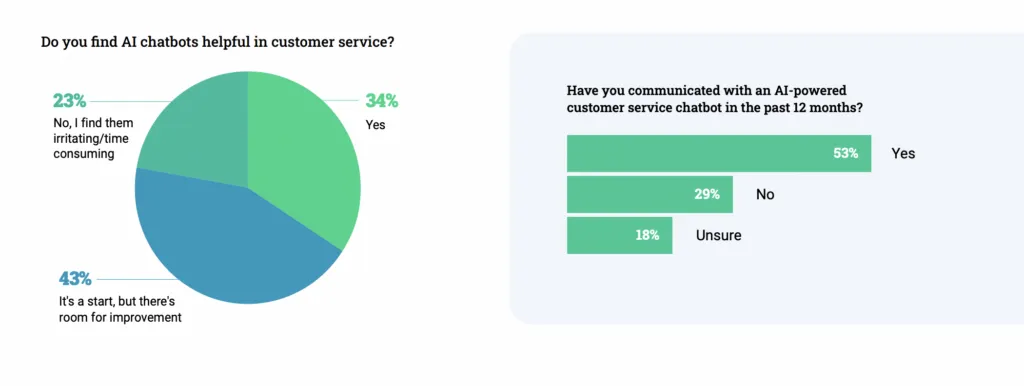
Source: “Consumer Perspectives on AI in Marketing & Customer Service”/CDP.com
The best implementations integrate AI agents with an Agentic CDP so they can access complete customer context and feed interaction data back into the platform for continuous learning.
3. Autonomous Personalization
AI personalization has evolved from simple rule-based segmentation to fully autonomous, real-time personalization at scale. AI can analyze first-party data signals — past purchase history, browsing behavior, engagement patterns, and contextual factors — to deliver individualized experiences across every touchpoint.
This allows marketers to define and target specific segments with precision, but the real breakthrough is moving beyond segments entirely. AI agents can treat every customer as a segment of one, dynamically adjusting messaging, offers, and channel selection in real time.
Email personalization, once the leading edge of AI marketing, is now just one channel in an omnichannel AI personalization strategy that spans web, mobile, in-store, and emerging channels.
4. AI-Driven SEO and GEO Optimization
Search optimization has expanded beyond traditional SEO. In 2026, marketers must optimize for both search engines and AI models — a discipline known as Generative Engine Optimization (GEO). AI tools help marketers:
- Analyze search intent and create content that satisfies both human readers and AI citation patterns
- Structure content with schema markup, definitive answers, and entity-rich information that AI models can extract and cite
- Monitor how AI assistants (ChatGPT, Perplexity, Gemini, Claude) reference their brand and content
- Automatically optimize content performance based on ranking and citation data
AI-powered SEO tools have evolved from simple keyword research assistants to comprehensive platforms that analyze competitive landscapes, generate content briefs, and optimize existing content autonomously.
5. AI Copywriting and Creative Generation
AI copywriting has matured dramatically. Modern AI can analyze customer data and create content that speaks directly to individual customer needs, using natural language processing to understand sentiment and tailor messaging accordingly.
The key advancement is that AI copywriting tools now integrate with CDPs, enabling them to generate personalized copy at scale that’s informed by actual customer behavior data — not just generic prompts. AI agents can autonomously generate, test, and optimize ad copy, email subject lines, and product descriptions across thousands of variations.
What Each AI Use Case Needs From Your Customer Data
The five use cases above are not equally hard to deploy, and the difference is data. Two of them run on content and brand assets. Three of them read a customer profile, and inherit every gap in it.
| Use case | Data it runs on | Latency it needs | Human checkpoint |
|---|---|---|---|
| Content creation and optimization | Brand guidelines, content inventory, engagement history | Hours to days | Editorial review before publication |
| AI agents for customer interaction | Unified profile with behavioral, transactional, and consent state | Sub-second profile lookup | Escalation rules and approval thresholds |
| Autonomous personalization | Identity-resolved profiles and live event streams across channels | Seconds | Offer, discount, and frequency ceilings |
| AI-driven SEO and GEO | Site content, query data, assistant citation monitoring | Weekly | Fact-check before publish |
| AI copywriting and creative generation | Brand voice corpus plus the profile attributes used to personalize | Minutes to hours | Legal and brand review on regulated claims |
Content creation and GEO optimization have no customer-data dependency at all. A team can start both this quarter with the tools it already licenses, which is why they are usually the first two use cases a marketing organization adopts and the two where results arrive fastest.
The other three are gated on the data foundation. An agent answering a billing question needs the last payment, the open ticket, and the consent state in the same read — identity resolution that leaves the mobile app profile unstitched from the web profile produces an agent that confidently contradicts itself. Personalization has the same dependency at higher volume: a segment-of-one decision is only as good as the events that reached the profile before the decision was made.
Latency is the second constraint, and it is the one teams discover late. A churn model scored nightly works fine on any architecture. An agent deciding what to say while a customer waits needs the profile in milliseconds, which is a property of where the data sits rather than of the model. Teams that pilot the profile-dependent use cases against a warehouse and then try to promote them to live interaction usually end up rebuilding the data layer rather than the model.
Treat the checkpoint column as part of the design, not as a phase-two addition. Every use case that reaches a customer needs a named owner who can see what the system sent and reverse it.
Common Mistakes Marketers Make When Deploying AI
Most AI marketing programs do not fail on model quality. They fail on how the output is governed, sequenced, and measured. Five failure modes recur.
Shipping AI output with no editorial checkpoint. Generation capacity removes the bottleneck that used to enforce quality: when a team could publish four posts a month, every one of them was read before it went out. Volume becomes the metric instead, and the first factual error or off-brand claim reaches customers before anyone reviews it. Fix: name one human owner per content type who approves before publication, and cap output at what that reviewer can actually absorb.
Letting personalization erode brand voice. Models optimizing per-channel engagement converge on whatever performs — subject lines that read like every other retailer’s, product copy stripped of any point of view. The lift is real and the brand cost is invisible in the same dashboard. Fix: encode voice as a constraint the model cannot optimize away, using approved vocabulary, tone examples, and a blocked-claims list, then read a sample of live AI copywriting output every month rather than trusting the aggregate.
Deploying agents before the data foundation exists. An agent with write access to a channel and read access to a stale profile does not degrade quietly; it takes a confident wrong action at scale, the failure mode examined in AI Without Unified Data. Fix: before an agent talks to a customer, verify two things — that profile lookups return in milliseconds rather than the seconds-to-minutes latency of a batch pipeline, and identity coverage across every channel the agent can reach.
Running GEO as keyword SEO with new vocabulary. Generative engine optimization rewards extractable answers, named sources, and entity clarity rather than keyword density against a ranked list. A team that reports only positions to its executives will keep optimizing for a surface that is losing clicks. Fix: track how often assistants cite and name the brand, and report that measure alongside rank rather than folding it into rank.
Buying one tool per use case. Five point tools mean five copies of customer data and five sets of outcomes that never return to the profile, so no system learns from what the others did. Licensing cost is the visible problem; the broken feedback loop is the expensive one. Fix: make write-back a purchase requirement — a tool that cannot return outcomes to the customer profile is a feature, not a platform.
The pattern behind all five is the same. AI removes the execution constraint that used to enforce discipline, so the discipline has to be designed back in deliberately.
The Future of AI in Marketing
AI provides transformative opportunities for marketers to improve their campaigns and create better customer experiences. The shift from AI-assisted to agentic marketing means marketing teams are becoming orchestrators of AI systems rather than manual executors of campaigns.
The organizations that succeed will be those that deploy AI within integrated platforms — Agentic CDPs that provide the closed feedback loop AI agents need to continuously learn and improve. It’s important to note that while AI is extremely powerful, it should always be deployed responsibly, with human oversight for strategic decisions and guardrails for autonomous actions.
With this in mind, marketers can take full advantage of AI agents and leverage their capabilities to create successful, self-optimizing marketing programs.
For more on how artificial intelligence is shaping marketing, check out these resources below:
- 6 Ways AI Is Transforming Marketing and CX
- Enterprise AI Trends for 2026
- AI For Next-Gen Marketers: Personalizing Experiences With Customer Data
- GEO vs SEO: What Changes for AI Search — How AI search reshapes SEO and content strategy
- llms.txt: A Practical Implementation Guide — Making your content easy for AI systems to ingest
- The 2022 State of Marketing AI Report — Research on AI adoption across marketing organizations
FAQ
Which AI use cases can you start without unified customer data?
Content creation and GEO optimization run on brand assets and published content, not customer profiles — you can start those today. Autonomous personalization, customer-facing AI agents, and copywriting at scale all read a live profile, so their quality is capped by identity resolution and data freshness. Sequencing the content use cases first buys time to fix the data foundation the other three depend on.
How many AI use cases should a marketing team run at once?
One at a time until each has a measured result, then two. Every use case carries setup cost that is invisible at pilot stage: guardrails, review workflow, holdout groups, and someone accountable for what the system sends. Teams that launch four pilots in a quarter usually end it with four unmeasured pilots. Prove incremental lift on one, keep the operating pattern, and reuse it on the next.
Are AI use cases different for B2B marketers?
The same five use cases apply, but the unit of personalization is the account, not the person. B2B agents are most useful for research, lead qualification, and routing rather than real-time offers, because buying cycles run months and the signal is spread across several stakeholders. Personalization works at the buying-group level, which makes account-level identity resolution the prerequisite rather than individual profile matching.