
Treasure AI (formerly Treasure Data) is an agentic experience platform that unifies customer data from any source, resolves identities across channels, and deploys AI agents to run personalization, messaging, and decisioning autonomously — harnessed by human creativity and strategic judgment. The platform evolved from one of the original customer data platforms into a bundled CDP, omni-channel messaging, and AI system designed to run the Customer Intelligence Loop continuously.
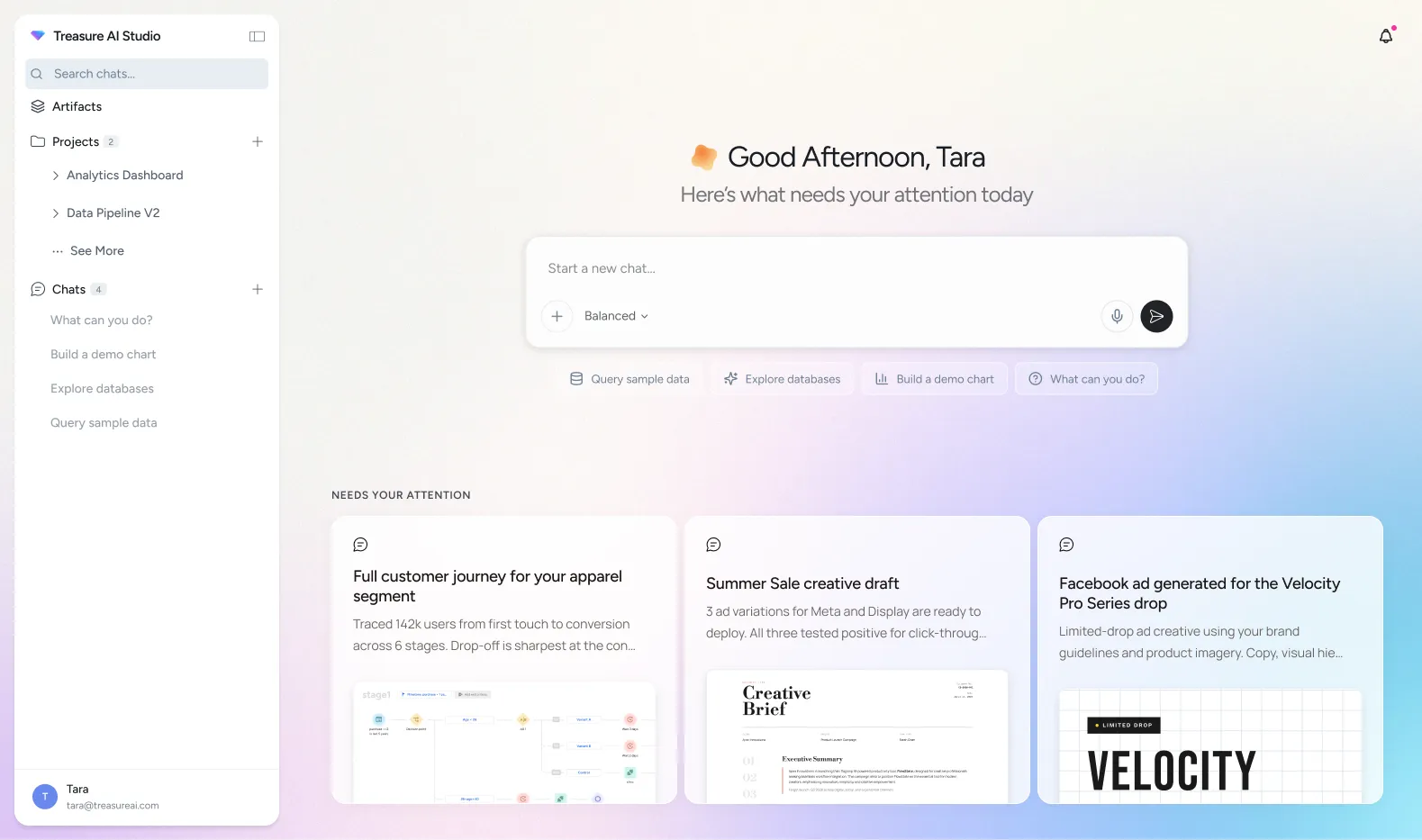
Disclosure: cdp.com is managed by Treasure Data (now Treasure AI). This overview follows the same editorial standards as our other vendor profiles — documented in our Editorial Policy — but readers should be aware of the relationship. For a side-by-side comparison of all CDP vendors, see the CDP Vendor Comparison Guide.
Treasure AI at a Glance
| Dimension | Treasure AI |
|---|---|
| Best for | Global, multi-brand enterprises — both B2C and B2B — with large-scale data environments, especially those needing APAC coverage and multi-region data residency |
| Typical buyer size | Mid-market and enterprise — 39.9% of the 163 G2 reviews classified by company size come from organizations above 1,000 employees, 36.8% from 51–1,000, and 23.3% from 50 or fewer |
| Pricing model | Per-profile plus per-event, quote-based; no separate compute charge for queries and segmentation in Complete CDP mode, while Composable mode queries run on (and bill to) the customer’s own warehouse compute |
| Typical implementation | 4-8 weeks initial; 3-6 months for full enterprise rollout |
| Key differentiator | The widest capability span of the packaged CDPs here: packaged or composable deployment, native predictive and agentic AI, and native email/SMS/push inside one platform boundary — with APAC-native connectors (LINE, Yahoo! JAPAN Ads) as an added fit for the region |
| Skip if | You need marketer self-serve simplicity or an SMB-sized budget |
Reviewer mix is not a customer base: where a G2 split is quoted above, it describes who reviews the vendor, not who buys it — reviewers self-select and vendors run review-solicitation campaigns. Those counts are G2’s company-size-classified subset, which is smaller than the headline review count quoted elsewhere on a page; where a page names no split, the row rests on the structural fact stated in it rather than on reviewer data. The cross-vendor comparison and the methodology behind these splits are in CDP vendors.
Company History
Treasure Data was founded in 2011 in Mountain View, California, originally as a cloud-based data management platform for log data and big data analytics. Over the following years, the company shifted focus toward customer data, building the infrastructure for large-scale data ingestion, identity resolution, and audience activation that became its customer data platform.
Key milestones:
| Year | Milestone |
|---|---|
| 2011 | Founded in Mountain View, CA as a big data management platform |
| 2013 | Expanded into enterprise customer data management |
| 2018 | Acquired by Arm Holdings (SoftBank Group) for approximately $600 million, accelerating enterprise go-to-market |
| 2020 | Named a Leader in the Forrester Wave for Customer Analytics Technologies |
| 2022 | Named a Strong Performer in the Forrester Wave for CDPs |
| 2024 | Named a Leader in the 2024 Forrester Wave for CDPs, recognized for data foundation strength and enterprise scalability |
| 2026 | Rebranded from Treasure Data to Treasure AI, launched Agentic Experience Platform |
| 2026 | Named a Leader in the IDC MarketScape for Worldwide AI-Enabled Customer Data Platforms for B2C Users (Doc #US53952526) |
| 2026 | Named a Leader in the IDC MarketScape for Worldwide AI-Enabled Customer Data Platforms for B2B Users (Doc #US53952326) — named a Leader in both the B2B and B2C cuts, a distinction shared with Salesforce |
As of 2026, Treasure AI serves over 400 enterprise customers across retail, financial services, healthcare, automotive, CPG, and media. The platform processes billions of unified customer profiles globally.
The Rebrand: Treasure Data to Treasure AI
On April 20, 2026, Treasure Data officially became Treasure AI. The company’s domain changed from treasuredata.com to treasure.ai, and the product category shifted from “Customer Data Platform” to “Agentic Experience Platform.”
The rebrand reflects a structural shift in what the platform does. Treasure Data began as a system where humans accessed unified customer data to make marketing decisions. Treasure AI is designed as a system where AI agents access unified customer data to make and execute decisions autonomously — with humans providing strategy, creativity, and guardrails.
Three changes define the transition:
-
From data platform to experience platform. The original CDP handled data ingestion, unification, and audience activation. The new platform adds native omni-channel messaging (email, SMS, mobile push, in-app, LINE), AI decisioning, and real-time personalization — eliminating the need to stitch together separate vendors for each stage of the Customer Intelligence Loop.
-
From human-first to agent-first architecture. The platform’s primary interface is shifting from dashboards and query builders to AI agents that operate through MCP (Model Context Protocol), CLI, APIs, and pre-built agent skills. Humans still direct strategy, but AI agents handle execution at scale.
-
From batch cycles to continuous loops. Where the CDP ran customer segmentation in batch cycles (daily, weekly), the Agentic Experience Platform runs the Customer Intelligence Loop continuously — COLLECT, UNIFY, UNDERSTAND, DECIDE, and ENGAGE in minutes, with engagement outcomes feeding back to inform the next cycle.
All existing APIs, SDKs, and workflows remain backward-compatible. The rebrand is a product evolution, not a migration that breaks existing integrations.
Platform Architecture
Treasure AI uses a hybrid architecture that separates the control plane from the data plane:
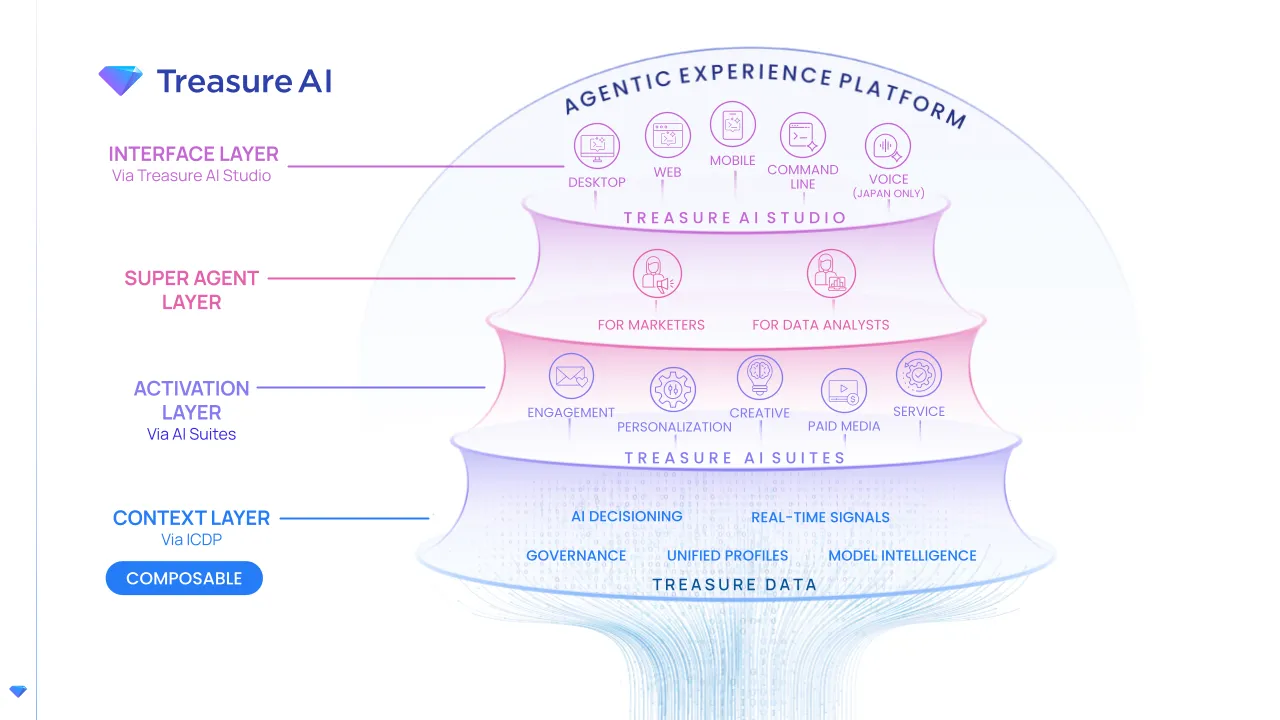
Treasure AI Agentic Experience Platform architecture. The platform is composable at the Context Layer (iCDP) and bundles activation, AI agents, and multi-surface interfaces above it.
-
Control plane (Treasure AI): Identity resolution, audience segmentation, AI decisioning, messaging orchestration, and the AI agent runtime. This is the managed platform layer where the Customer Intelligence Loop executes.
-
Data plane (customer’s infrastructure): Customer data can reside in the customer’s own data warehouse — Snowflake, Databricks, BigQuery. Treasure AI queries those tables in place without requiring data to be moved into proprietary storage. In the other direction, the same warehouses can query tables that Treasure AI manages, published in Apache Iceberg format as read-only tables, without a second copy.
This hybrid deployment model addresses a core tension in the CDP market: composable CDPs keep data in the warehouse but cannot run real-time AI loops at API speed; packaged CDPs run fast but require copying all data into proprietary storage. Treasure AI’s architecture aims to deliver both — warehouse-resident data with a managed control plane designed for low-latency profile access and real-time activation.
Core Products
Treasure AI Studio
Treasure AI Studio is the platform’s primary interface, available across multiple surfaces:
- Web — Browser-based workspace for marketers, analysts, and data teams
- Desktop — Native application for macOS and Windows
- Mobile — iOS and Android for on-the-go monitoring and approvals
- CLI (Treasure Code) — Command-line interface for engineers and data teams to interact with the platform programmatically. Treasure Code is built on Claude Code and provides terminal-native access to customer data, schema inspection, and pipeline operations
- Voice (Treasure AI Voice) — AI-powered voice interface for hands-free querying and note capture
Studio provides natural-language access to customer data, segment creation, campaign management, and analytics — designed so that non-technical users can query and act on customer data without SQL or engineering support.
Studio’s agents are not limited to data stored in Treasure AI. Since June 2026, AI Studio Connections let an agent explore and visualize data in a Snowflake warehouse (added June 25) or a Databricks lakehouse (added June 17) during a chat. A July 14 connector brought the Treasure Data CDP itself onto the same connection model, letting the agent run CDP queries, workflows, and audience-segment operations in a chat. An administrator registers each connector once per organization over OAuth, and each user then authorizes an individual connection; the agent handles only a placeholder token, with the real credential substituted at the network boundary (June 2026 release note). The agent sees exactly what the authorized warehouse role can see. The AI Studio Snowflake connector authorizes as Snowflake’s PUBLIC role, so any table granted for agent use is also visible to every other Snowflake user — scope grants accordingly. (Composable Audience Studio, described below, uses its own separately configured Snowflake credential.)
Context in Studio accumulates in work folders rather than in individual chats. Each work folder keeps an instructions file that the AI reads at the start of every chat and can update as work progresses, so table names, conventions, and goals carry across sessions without being restated (In-Session Memory docs). Since September 17, 2026, a work folder can be shared across an account: every member reads one file tree — instructions, reference files, skills, and saved actions — and works in it with their own AI. A marketer who has taught a folder how to build the weekly campaign report — which tables to use, which segments count, how results are formatted — can share it, and a colleague’s agent starts from that context instead of rebuilding the brief. What each member’s agent writes back, where that member’s access allows, becomes the starting point for the next chat, so the team’s working knowledge accumulates in one place rather than in individual chat histories.
Sharing the memory does not mean sharing everything. Conversations stay private, as does each member’s my/ directory. Work modes decide where each member’s agent may write — nowhere on the shared side, named top-level folders only, or everywhere — and are enforced at the file system rather than by prompt instruction. Authority over a shared folder sits with its managers: an account administrator who holds no work mode in it cannot read its contents (Access Control).
Saved workflows can also run on a timetable. Work Folder Actions (August 13, 2026) store a repeated workflow in a folder to rerun on demand, and Action Schedules (August 25, 2026) run those actions daily, on weekdays, weekly, monthly, or on a custom cron schedule without anyone clicking Run (August 2026 release note). This is scheduled execution rather than an event trigger: it takes recurring analysis and reporting off a person’s calendar, while in-the-moment reactions to customer behavior still depend on the real-time layer.
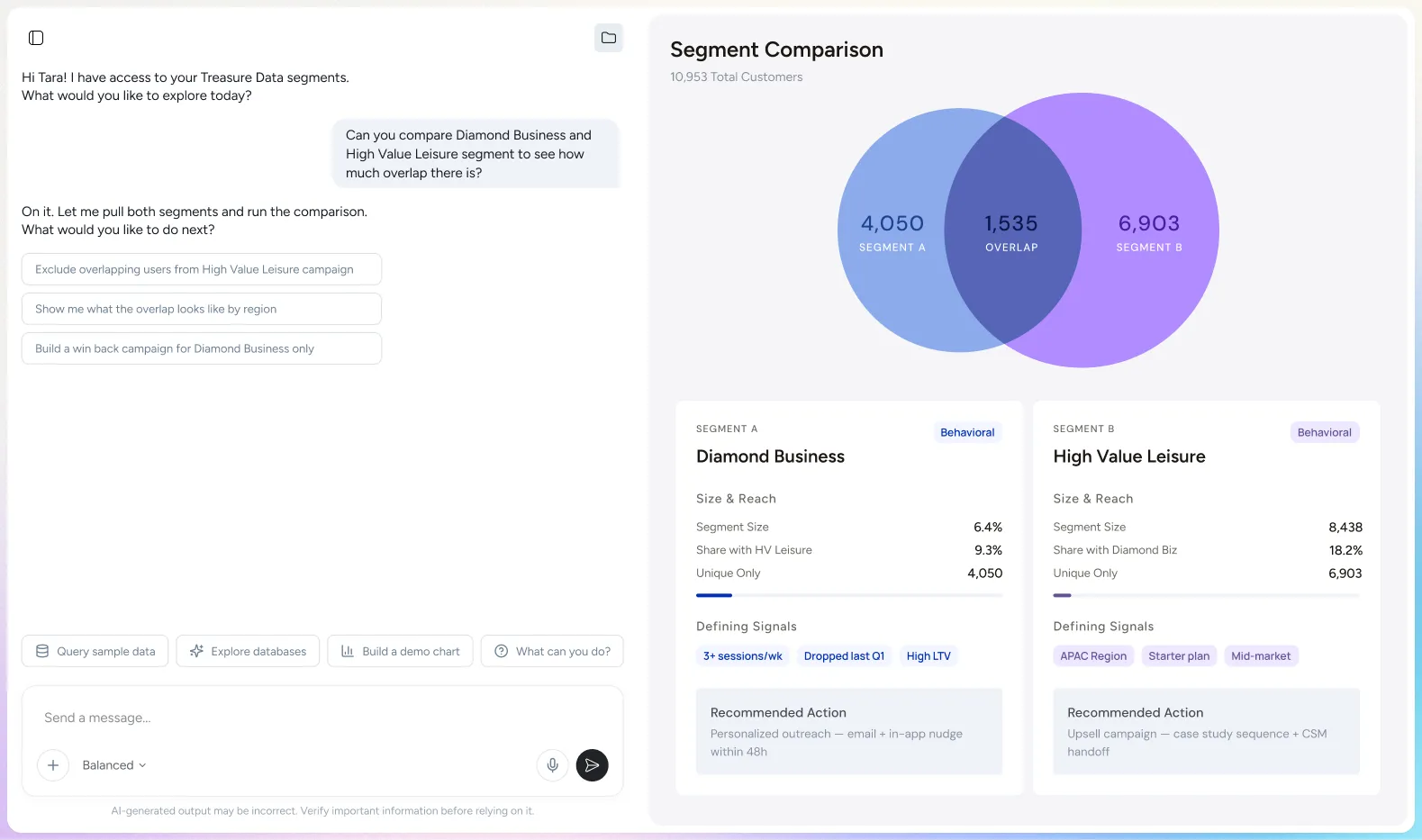
Segment comparison in Treasure AI Studio. A natural-language query triggers audience overlap analysis with recommended next actions — illustrating how AI agents surface insights without manual SQL or BI workflows.
AI Super Agents
AI Super Agents are pre-built, domain-specific AI agents that automate specific workflows within the Customer Intelligence Loop:
-
AI Super Agent for Marketers: Handles audience discovery, campaign creation, next-best-action recommendations, and cross-channel activation. Instead of spending hours building a win-back segment manually, a marketer describes the objective — “find customers who purchased in Q1 but haven’t engaged in 60 days” — and the agent builds the segment, selects channels, and launches the campaign.
-
AI Super Agent for Data Analysts: Automates data exploration, insight generation, and report creation. Analysts ask questions in plain language and receive structured answers with supporting data visualizations. In early access, a financial services team reported reducing report turnaround from three days to 60 seconds for routine customer queries.
These agents are built on the platform’s unified customer data foundation, which means they operate on complete, resolved customer profiles rather than fragmented data across siloed tools.
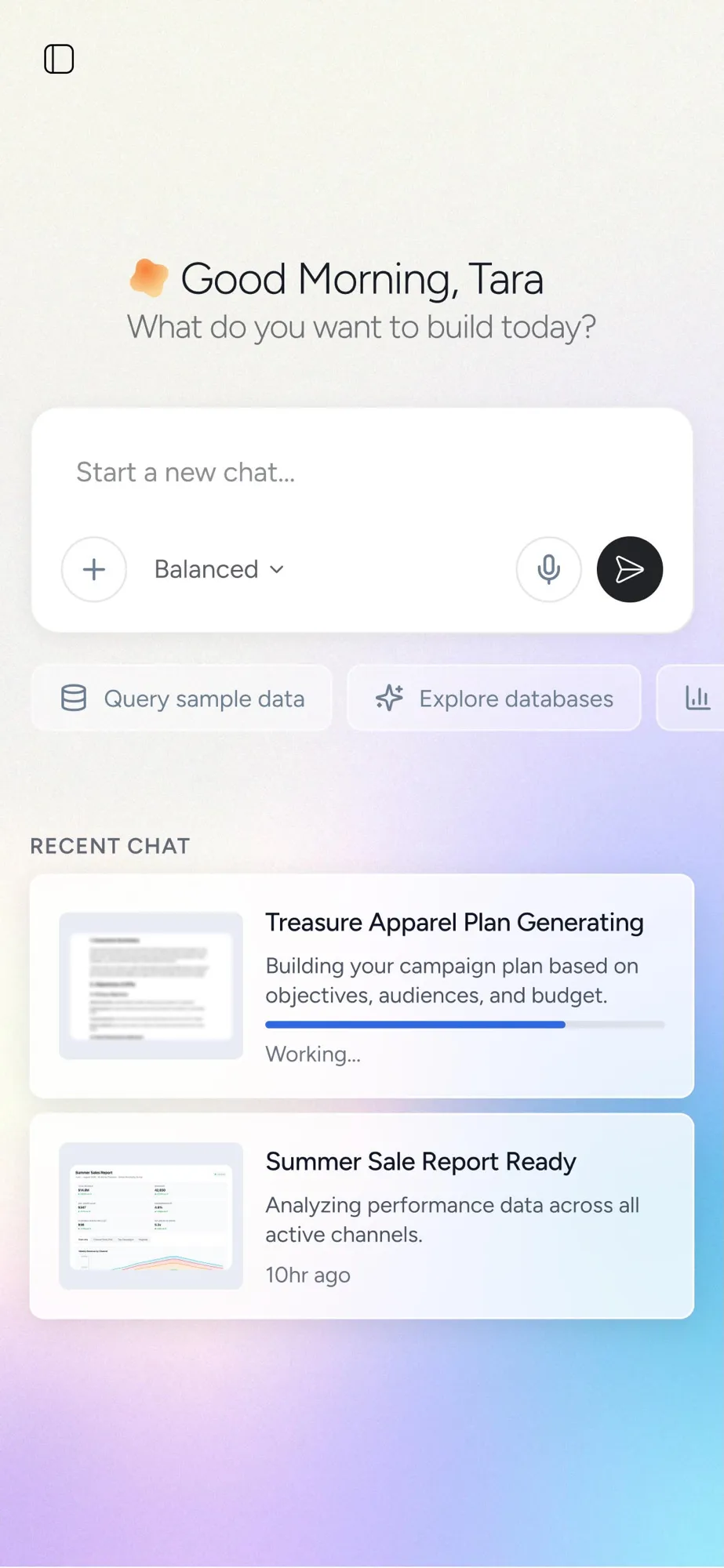
Treasure AI Studio (mobile). The same conversational interface available on iOS and Android for on-the-go campaign monitoring and approvals.
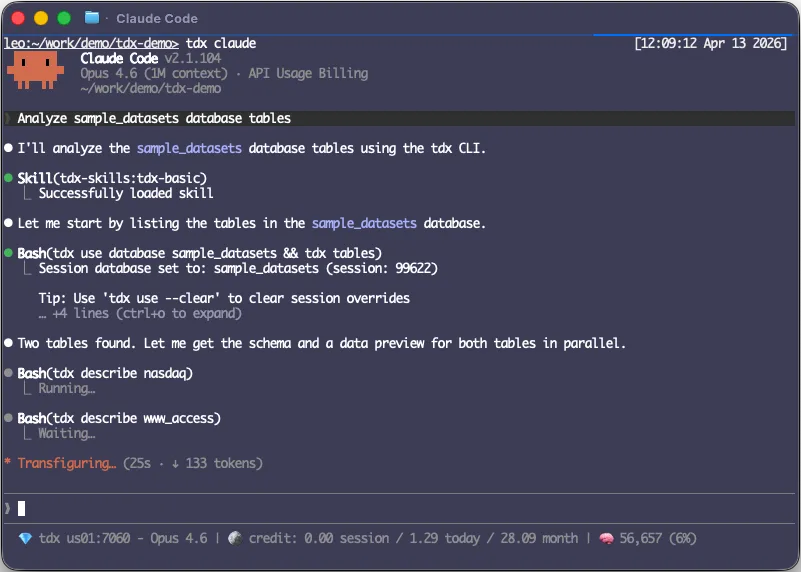
Treasure Code (CLI). Engineers interact with Treasure AI through a terminal-native interface powered by Claude Code — inspecting schemas, running queries, and managing data pipelines without leaving the command line.
Omni-Channel Messaging
The platform includes native messaging capabilities across:
- Email — Personalized content with AI-driven send-time optimization (Email Marketing)
- SMS — Transactional and promotional messaging, with per-recipient short links and native click tracking since September 2026 (SMS Marketing)
- Mobile push — iOS and Android push notifications (Mobile App Marketing)
- In-app messaging — Contextual messages within mobile applications
- LINE — Native integration for the LINE messaging platform (critical for APAC markets); since August 2026, LINE Official Account messages (text, Imagemap, and Flex) also run as always-on campaigns alongside email and push
Bundling messaging natively — rather than requiring a separate customer engagement platform — means that engagement outcomes (opens, clicks, conversions) flow directly back into the Customer Intelligence Loop without cross-vendor data latency.
Treasure Data (CDP) — Context Layer
The foundation of the entire platform is Treasure Data, the intelligent CDP that serves as the context layer. This is where customer data is ingested, identities are resolved, unified profiles are built, and governance policies are enforced. Every product above — Studio, Super Agents, Messaging — reads from and writes to this layer.
Core capabilities of the context layer:
- Data ingestion — 170+ pre-built connectors for batch and streaming ingestion from CRM, e-commerce, web analytics, POS, support, and IoT sources
- Identity resolution — ML-powered deterministic and probabilistic matching that resolves customer identities across devices, channels, and accounts
- Unified profiles — Persistent customer 360 profiles that aggregate behavioral, transactional, and demographic data into a single record
- AI decisioning and model intelligence — Predictive analytics, propensity scoring, and real-time signal processing that power the UNDERSTAND and DECIDE stages of the loop
- Data governance — Field-level access controls, consent enforcement, and compliance automation across all downstream activation
This is the layer labeled “Composable” in the architecture diagram — organizations can connect it to their existing data warehouse (Snowflake, Databricks, BigQuery) through the hybrid deployment model, keeping data warehouse-resident while the context layer handles identity, AI, and governance.
The context layer operates in two modes. Complete CDP is a fully managed, all-in-one deployment where data is ingested and stored within the platform — connectors, identity resolution, segmentation, and activation without requiring existing warehouse infrastructure. Composable CDP (Composable Audience Studio) is the warehouse-first mode: Treasure AI sends federated queries to Snowflake, BigQuery, or Databricks, the warehouse runs them on its own compute, and only results come back — no reverse ETL sync into a second store. Marketers build audiences visually while the source tables stay in the warehouse; query results return to Treasure AI, and customer data reaches a destination only when an audience is activated. The same platform also offers managed identity resolution, AI decisioning, and native messaging — buyers comparing it with pure-play composable CDP vendors should check which of those each alternative provides natively and which it reaches through integrations, and which of them apply in the deployment mode they choose. For a comparison of composable CDP vendors, see the CDP Vendor Comparison Guide.
Composable Audience Studio on Snowflake, Databricks, and BigQuery
Warehouse support is where the composable mode changed most in 2026. Composable Audience Studio became available on Snowflake and Databricks on April 27, 2026, and on BigQuery on May 11, 2026 (April and May release notes). The releases since then address what an enterprise security or data team checks first — audit logging on par with the managed mode, per-segment access control, cost attribution inside the warehouse, and code-based management:
| Date (2026) | Release | What it gives the warehouse team |
|---|---|---|
| Apr 27 | Composable Audience Studio for Snowflake and Databricks | Segmentation, predictive scoring, and activation on warehouse tables, with no copy into Treasure AI |
| May 11 | Composable Audience Studio for BigQuery | Segmentation and activation on Google BigQuery tables |
| Jun 10 | Premium audit log events | Full audit-log parity with the managed Audience Studio, including permission-denial events |
| Jun 30 | Policy-based permissions | Full, limited, or no access per composable parent segment and per segment folder |
| Jul 24 | YAML create and update via tdx cas push | Audiences, attributes, behaviors, segments, and activations managed as code, with a preview before changes apply |
| Aug 16 | Open Catalog Access | The reverse direction: Complete CDP tables published as read-only Apache Iceberg tables that the warehouse queries in place (Snowflake and Databricks generally available, BigQuery experimental; enabled on request) |
| Sep 2 | Snowflake query tags A JSON QUERY_TAG on the segmentation, activation, profile-lookup, and supporting queries Composable Audience Studio runs, so warehouse compute can be attributed to individual audiences, segments, and activations for monitoring or chargeback |
Each warehouse connects through its own native credential model, and all three share one data model: a composable parent segment is a single customers table with one row per profile and a unique ID, joined one-to-many to behavior tables that each carry a time column (Snowflake setup guide).
| Warehouse | Authentication | Selected setup requirements |
|---|---|---|
| Snowflake | Key-pair authentication | A warehouse for query execution; a user and role with SELECT on the target tables |
| Databricks | Service principal with OAuth | Unity Catalog enabled; a SQL warehouse or compute cluster |
| BigQuery | GCP service account with a JSON key | Permission to create service accounts and manage IAM roles |
The composable mode puts Treasure AI in the same buyer conversation as pure-play composable vendors such as Hightouch: audiences built on warehouse tables, governed by the warehouse’s own access controls. The trade-offs move with the data. Treasure AI’s documentation says the composable mode carries variable cost because queries run on the customer’s warehouse compute, and that the customer’s team designs and maintains schemas and tunes performance (Composable CDP docs). The no-copy guarantee also covers batch data up to the point of activation — an audience sent to an ad platform or messaging channel does leave the warehouse, as it would with any composable tool. Teams that want Treasure AI to own the storage and schema work choose the Complete CDP mode instead.
Real-Time 2.0: Real-Time Profiles and Streaming Data
A returning shopper adds a jacket to the cart, browses, and leaves. While they are still on the site, an offer can reflect both the live cart and their purchase history; once they leave, a separate trigger can start a follow-up message. Treasure AI’s Real-Time 2.0 supports both by sending every incoming event down two paths at once (Real-Time overview). The real-time path’s decision engine processes each event in milliseconds: it stitches identities, updates real-time attributes such as session counters and cart value, and combines the live event with the customer’s stored batch profile. The batch path runs scheduled workflows, typically every few minutes to hours, that aggregate event history, compute predictive scores, and refresh identity relationships. Because the real-time engine reads the latest batch profile when it processes a customer’s event, an in-session decision draws on the customer’s history, not only the current session.
Identity stitching runs on the stream itself. When events carry a matching identifier on a configured stitching key — an email and a cookie ID in one event, the same cookie and a device ID in the next — the identifiers are unified into one profile as the events arrive, across both known and anonymous IDs (ID stitching overview). The batch layer remains the source of truth for historical profiles.
Treasure AI publishes the operating envelope for the real-time layer (Performance Limitations):
| Dimension | Published figure |
|---|---|
| Personalization API response | ≤100 ms at p95 for up to 20 attributes (the SLA requires Enterprise Support) |
| Triggered activations | Up to 3 minutes end to end, including evaluation, ID stitching, and dispatch |
| Streaming ingestion | 2,000 events per second per customer by default; the platform scales horizontally to 100,000+ events per second globally |
| Decisioning throughput | 8,000 events per second per customer |
| Identity limits | Up to 100 ID stitching keys; up to 200 IDs per profile, with the oldest ejected first |
| Real-time attributes | Up to 200 per profile, 500 bytes each |
Two 2026 releases extended the layer. The Lookup Catalog (July 17) joins customer profile attributes against an external reference table at runtime, for uses such as product-level decisioning, coupon reminders, and time-limited sale banners. Real-time identity log tables (September 14) record identifier values rejected for stitching, IDs evicted at the 200-ID limit, and the incoming IDs associated with each merge, so a data team can inspect how profiles were joined.
For a buyer, the two timing figures answer different questions. An on-site experience depends on the Personalization API’s read time, where the ≤100 ms p95 figure applies. An abandonment follow-up runs on the triggered-activation path, which Treasure AI bounds at 3 minutes. Deployments with 100 or more parent segments should be validated in a proof of concept first, and teams whose use cases are limited to weekly campaigns and monthly reporting may not need the real-time path at all.
Early Access Results
During 2026 early access, Treasure AI published two enterprise outcomes:
- Enterprise retail: A retail customer compressed the segment-to-launch workflow from five days to eight hours using AI Super Agents. The agent discovered a 340,000-profile high-intent segment that manual analysis had missed, generating a 23 percent conversion lift.
- Financial services: A data analytics team replaced a three-day report cycle with 60-second natural-language queries through Treasure AI Studio, freeing analysts to focus on strategic interpretation rather than data extraction.
These results are self-reported by the vendor and represent early-stage deployments. Independent analyst validation and broader customer benchmarks are expected as the platform matures beyond early access.
Customer Intelligence Loop
The Customer Intelligence Loop is a five-stage continuous cycle that describes how customer data flows from collection through activation — and how engagement outcomes feed back to improve future decisions. Most marketing stacks run this loop in disconnected steps: a warehouse collects data, a separate tool resolves identities, another builds segments, and yet another sends messages. Each handoff introduces latency and context loss. The Customer Intelligence Loop is Treasure AI’s organizing principle for eliminating those gaps — all five stages execute within a single platform, and AI agents run the loop continuously rather than waiting for human-initiated batch cycles.
COLLECT → UNIFY → UNDERSTAND → DECIDE → ENGAGE → (back to COLLECT)
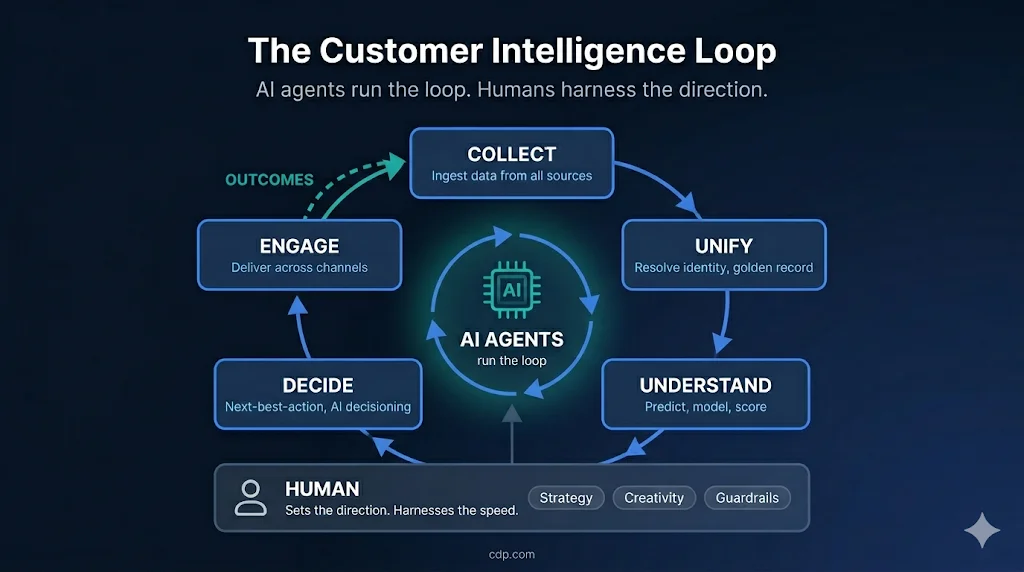
Each stage maps to specific platform capabilities:
| Stage | What Happens | Platform Capability |
|---|---|---|
| COLLECT | Ingest data from any source — behavioral, transactional, CRM, support, IoT | 170+ pre-built connectors, streaming and batch data ingestion |
| UNIFY | Resolve identities across devices, channels, and accounts into unified profiles | ML-powered identity resolution, deterministic and probabilistic matching |
| UNDERSTAND | Analyze customer behavior, predict intent, score propensity | Predictive analytics, LTV modeling, churn prediction |
| DECIDE | Determine the next best action for each customer | AI decisioning engine, real-time offer arbitration |
| ENGAGE | Execute personalized experiences across channels | Native omni-channel messaging, data activation to external systems |
Engagement outcomes (email opens, purchase conversions, support interactions) feed back to the COLLECT stage, closing the loop. In the agentic model, AI agents run this loop continuously rather than waiting for human-initiated campaign cycles. For organizations running weekly batch campaigns with no real-time or in-session personalization requirements, the continuous loop may not be necessary — composable architectures that run the loop on a daily or weekly cadence can deliver sufficient value at lower complexity.
Governance and Security
Enterprise data governance is a foundational requirement for any platform handling PII at scale. Treasure AI’s governance capabilities include:
- Compliance certifications: SOC 2 Type II, GDPR, CCPA, HIPAA-eligible
- Infrastructure: Runs on AWS with Bedrock integration for AI workloads
- Audit trail: Tamper-evident logging of all data access, agent actions, and activation events
- Consent management: Centralized consent enforcement across all activation channels
- Data residency: Regional data storage options for organizations subject to data localization requirements
- Organization-wide agent instructions: Administrators can set up to 16,384 characters of standing instructions that are added to the system prompt of every AI Studio agent in the organization, applied to new chats. These guide agent behavior; data access is still governed by the enforced controls above, not by instructions
- AI data policy: Customer data is never used to train AI models
For a complete list of certifications and security documentation, see the Treasure AI Trust Center.
The tamper-evident audit trail is particularly relevant for regulated industries — financial services and healthcare organizations require provable records of who (or what agent) accessed customer data and what actions were taken.
Who Should Consider Treasure AI
Treasure AI is best suited for organizations that:
- Need the full Customer Intelligence Loop in one platform — data ingestion, identity resolution, AI decisioning, and activation without stitching together multiple vendors
- Want AI agents to operate on unified customer data — not just dashboards for humans, but an agent-first architecture where AI executes continuously
- Require enterprise-grade governance — SOC 2, GDPR, CCPA, HIPAA compliance with auditable AI agent actions
- Operate across multiple channels — email, SMS, push, in-app, LINE, web personalization, and paid media activation
- Have existing data warehouse investments — Composable Audience Studio builds and activates audiences on Snowflake, Databricks, and BigQuery tables in place, and AI Studio agents can query Snowflake and Databricks directly in a chat
- Serve APAC markets — native LINE integration and regional data residency support
Organizations that may find other architectures more suitable:
- Teams that only need reverse ETL — organizations with a mature data warehouse, existing segmentation logic in SQL, and no need for identity resolution, AI decisioning, or native messaging may find a standalone reverse ETL tool sufficient. Treasure AI’s hybrid architecture can connect to the same warehouses, but the full platform may be more capability than needed
- Organizations fully committed to a single suite (Adobe or Salesforce exclusively) may find tighter integration within that ecosystem, despite the suite tax trade-offs. However, organizations running both Salesforce and Adobe — or mixing suite products with best-of-breed tools — often find that a vendor-neutral platform like Treasure AI provides better cross-suite data unification than either suite’s own CDP
- Small businesses with simple data needs (under 100,000 profiles, one or two channels) may not need the platform’s enterprise capabilities
FAQ
What happened to Treasure Data?
Treasure Data rebranded to Treasure AI on April 20, 2026. The company’s domain changed from treasuredata.com to treasure.ai, and the product evolved from a customer data platform into an agentic experience platform. All existing customer integrations, APIs, and SDKs remain backward-compatible — the rebrand reflects a product evolution, not a breaking change.
How does Treasure AI differ from other CDPs?
Treasure AI bundles CDP, omni-channel messaging, and AI agents into a single platform that runs the Customer Intelligence Loop continuously. Most CDPs handle data unification and segmentation but require separate tools for messaging and AI decisioning — typically 4-5 vendors in a composable stack (warehouse, reverse ETL, ESP, AI layer). Treasure AI keeps all five stages of the loop within a single platform boundary, eliminating the PII duplication and cross-vendor latency that reverse ETL introduces. For a detailed comparison, see the CDP Vendor Comparison Guide.
Is Treasure AI the right CDP for my organization?
Treasure AI is the right CDP for global, multi-brand enterprises — both B2C and B2B — with large-scale data and APAC coverage needs, and the wrong fit for small or marketer-self-serve teams. Choose it for the span the platform covers on its own — packaged or composable deployment, native predictive and agentic AI, and native email, SMS, and push without copying PII to a separate suite product — plus APAC-native connectors (LINE, Yahoo! JAPAN Ads). Skip it if you need marketer self-serve simplicity or an SMB-sized budget.
Is Treasure AI a CDP or something different?
Treasure AI includes a full CDP (data ingestion, identity resolution, segmentation, activation) and extends it with native messaging and AI agent capabilities. The “agentic experience platform” label reflects the addition of AI-driven decisioning and execution on top of the core CDP foundation. Organizations evaluating Treasure AI against CDPs should compare the full platform scope — not just the data unification layer. See What Is an Agentic CDP? for how this category is evolving.
Is Treasure AI a real-time CDP?
Yes — Treasure AI’s Real-Time 2.0 layer processes streaming events in milliseconds, stitches identities as events arrive, and publishes a Personalization API SLA of ≤100 ms at p95 for up to 20 attributes, available with Enterprise Support. Triggered activations are delivered within 3 minutes. A parallel batch path computes predictive scores and refreshes identity relationships on a schedule, and the real-time engine reads that batch profile when it processes an event, so live decisions still carry customer history.
Does Treasure AI work with Snowflake, Databricks, and BigQuery?
Yes — Treasure AI’s Composable Audience Studio builds and activates audiences directly on Snowflake, Databricks, and BigQuery without copying data into Treasure AI. Queries run on the warehouse’s own compute, so the warehouse bill carries the cost and the data team maintains the schema. AI Studio agents can also query Snowflake and Databricks in a chat through per-user OAuth connections.
See how analysts rank CDP vendors → IDC MarketScape | Forrester Wave
This article is also available in: Treasure AI(旧Treasure Data)とは?特徴と沿革 · O que é Treasure AI (ex-Treasure Data)? · ¿Qué es Treasure AI (antes Treasure Data)? · Treasure Data (Treasure AI) : la CDP, ses limites · Treasure AI: CDP-Profil für Deutschland