
No — Snowflake is a cloud data warehouse optimized for analytical queries, not a customer data platform (CDP). A cloud data warehouse stores and analyzes historical data. A CDP unifies customer profiles and activates them in real time across channels. The two are increasingly complementary, but they solve fundamentally different problems: Snowflake helps you understand customers; a CDP helps you act on that understanding and learn from the outcomes.
This guide explains what Snowflake does well, where it stops short of CDP capabilities, and how to decide whether your organization needs one, the other, or both. Forrester’s Wave evaluation of B2B CDPs is a useful third-party reference point for that decision.
What Snowflake Does Well for Customer Data
Snowflake is one of the strongest cloud data warehouses available, and its strengths are genuine:
- Analytical power: Elastic compute clusters handle complex joins across billions of rows. For customer analytics — cohort analysis, funnel reporting, attribution modeling — Snowflake is purpose-built and excellent
- Data governance: Role-based access control, row-level security, data masking, and audit logging provide enterprise-grade governance out of the box
- AI and ML capabilities: Snowflake Cortex brings LLM-powered analysis, natural language querying, and ML model training directly into the warehouse. For batch prediction use cases — churn scoring, lifetime value modeling, demand forecasting — Cortex is a capable platform
- Near-real-time ingestion: Snowpipe Streaming and Dynamic Tables enable continuous data transformation, narrowing the gap between batch and streaming workloads
- Data sharing: Snowflake’s data sharing and marketplace features let organizations exchange datasets without copying data, supporting privacy-preserving collaboration
- Extensibility: Snowflake Marketplace provides access to third-party data and ML models, while Snowpark and user-defined functions (UDFs) let teams build custom logic in Python, Java, or Scala directly inside the warehouse
For organizations whose primary need is customer analytics, reporting, and batch machine learning, Snowflake may be sufficient without any additional platform.
Snowflake and the Customer Intelligence Loop
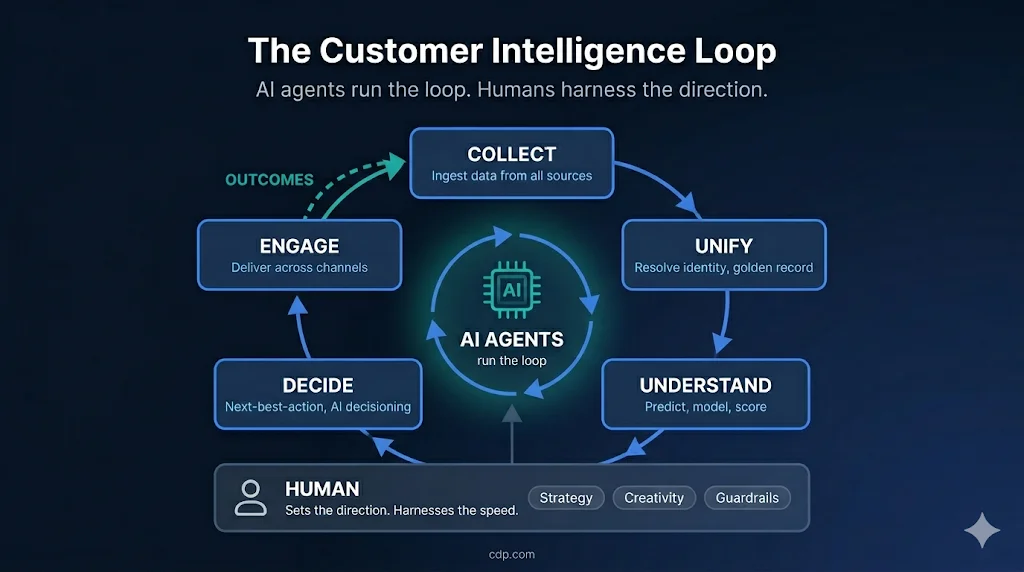
The Customer Intelligence Loop — COLLECT → UNIFY → UNDERSTAND → DECIDE → ENGAGE → back to COLLECT — is the continuous cycle through which organizations turn raw customer data into action and learning. AI agents run the loop continuously; humans harness the direction with strategy, creativity, and guardrails. Mapping Snowflake’s capabilities to each stage reveals where the loop slows down without a CDP:
| Loop stage | Snowflake’s role | What a CDP adds |
|---|---|---|
| COLLECT | Strong — Snowpipe Streaming ingests high-volume events | Real-time event streaming with immediate profile updates |
| UNIFY | Batch — SQL joins and dbt models on deterministic keys | Real-time probabilistic identity resolution that stitches anonymous and known profiles as events arrive |
| UNDERSTAND | Strong — Cortex for churn, LTV, and recommendation models | Native predictive scoring, or imports warehouse-trained models |
| DECIDE | Limited — analytical query latency typically ranges from hundreds of milliseconds to seconds depending on warehouse size and query complexity, which is too slow for sub-second in-session decisioning | Sub-50ms AI decisioning on unified profiles |
| ENGAGE | None — requires external messaging platform | Native email, SMS, push notification delivery |
| Loop closure | Open — outcomes return via batch ETL (hours to days) | Closed — outcomes update profiles and models within seconds |
Snowflake excels at the analytical half of the loop (COLLECT, UNIFY, UNDERSTAND). A CDP completes the operational half (DECIDE, ENGAGE) and — critically — closes the loop so AI can learn from every customer interaction. Neither platform alone runs the full cycle.
Not every organization needs every stage to operate in real time. For batch use cases — churn modeling retrained daily, quarterly LTV segmentation, weekly cohort reports — Snowflake’s analytical strengths cover the loop stages that matter, and the DECIDE/ENGAGE stages run on comfortable batch cycles. The real-time loop becomes important when use cases shift to triggered messaging, in-session personalization, or AI agents that need to learn from outcomes in seconds. For the complete framework, see Customer 360 in the AI Era.
Five CDP Capabilities Snowflake Does Not Provide
The loop stages where Snowflake stops short translate into five specific capability gaps. Despite its analytical strengths, Snowflake was not designed for the operational workloads that define a CDP:
| Capability | What a CDP provides | What Snowflake offers |
|---|---|---|
| Native messaging | Built-in email, SMS, and push notification delivery | None — requires a separate messaging platform connected via reverse ETL |
| Real-time profile serving | Sub-50ms API lookups for in-session personalization | Analytical query latency ranges from hundreds of milliseconds to seconds. Search Optimization Service improves point lookups, but the architecture is optimized for analytical queries, not high-concurrency operational profile access |
| Automated identity stitching | ML-powered identity resolution that merges anonymous and known profiles in real time as events arrive | Requires custom SQL models; no native probabilistic matching or real-time stitching |
| Customer Intelligence Loop | COLLECT → UNIFY → UNDERSTAND → DECIDE → ENGAGE in seconds within one platform | Stages split across separate systems. Outcome data returns via batch ETL (hours to days) |
| Marketer self-service | Visual segmentation UI, drag-and-drop journey builder | Requires SQL proficiency or a data team intermediary |
These are not feature gaps that Snowflake plans to close — they reflect a fundamental architectural boundary between OLAP systems (optimized for analytical queries) and operational platforms (optimized for real-time decisioning and activation).
The Composable Approach: Snowflake + Reverse ETL + Messaging
Many organizations bridge these gaps by assembling a composable CDP stack on top of Snowflake. A typical architecture includes:
- Snowflake — storage and compute (system of record)
- Reverse ETL tool — syncs audiences from warehouse to activation tools
- Messaging platform — sends emails, push notifications, SMS
- Identity resolution — custom dbt models or a third-party identity tool
- Orchestration — pipeline scheduling and workflow management
This approach is architecturally sound. It leverages existing warehouse investments and gives data engineers full control. But it introduces structural trade-offs that are worth understanding before committing. For a comparison of the activation vendors commonly paired with Snowflake, see the composable CDP vendors overview.
PII Duplication
The promise of composable CDPs is “data stays in the warehouse.” But reverse ETL — the mechanism that makes composable CDPs operational — copies customer PII to every downstream tool on every sync. A mid-market composable stack typically duplicates PII across 4–6 vendor boundaries: the warehouse, the reverse ETL sync cache, the ESP, ad platforms, and CRM. Each copy multiplies SOC 2 audit surface and complicates GDPR 72-hour breach notification. For a deeper analysis, see 5 Questions Data Engineers Should Ask About Composable CDPs.
Total Cost of Ownership
Composable stacks appear affordable at entry but scale non-linearly. A representative 3-year cost structure for a mid-market organization (~5M profiles, 10 destinations):
| Cost component | Annual estimate |
|---|---|
| Snowflake compute (identity + segmentation queries) | $80K–$200K |
| Reverse ETL platform | $30K–$100K |
| Messaging platform (ESP) | $50K–$150K |
| Data engineering FTEs (3–5 dedicated) | $450K–$1M |
| Integration maintenance + vendor management | $20K–$50K |
| Total annual | $630K–$1.5M |
An Agentic CDP with native messaging, identity resolution, and AI decisioning bundled into a single platform typically falls within the same range — but with fewer integration points, less engineering overhead, and one vendor to manage. Note that both architectures carry operational headcount costs beyond data engineering: composable stacks require pipeline maintenance and vendor coordination, while CDPs require campaign operations and platform administration. The FTE estimates above reflect data engineering effort dedicated to CDP-specific workflows; in practice, these engineers often support broader data initiatives as well.
On-Call Burden
When a reverse ETL sync fails at 2am, who gets paged? In a composable stack, the failure could originate in the warehouse (compute timeout), the reverse ETL layer (API rate limit), the ESP (delivery failure), or the orchestration layer (DAG failure). Four to five distinct vendors means four to five potential failure points. Mean time to resolution is structurally higher when the root cause spans vendor boundaries. For platform teams already managing infrastructure on-call rotations, adding 3–5 marketing data vendors to the pager is a meaningful burden.
When Snowflake Alone Is Enough
Not every organization needs a CDP. Snowflake alone is likely sufficient if:
- Your use cases are batch-oriented: Weekly cohort reports, monthly churn predictions, quarterly LTV analysis. If you don’t need to act on customer data in real time, the analytical power of Snowflake covers your needs
- Your data team drives activation: Data engineers write SQL, build dbt models, and manage downstream syncs. Marketing works from pre-built reports and dashboards rather than building their own segments
- You have fewer than 5 activation destinations: The integration tax of composable stacks scales with the number of tools you sync to. With 2–3 destinations, the overhead is manageable
- Latency tolerance is high: If hours-to-days delay between data change and marketing action is acceptable, batch architectures work fine
- Churn, LTV, and recommendation models are your primary AI use cases — these work well with daily or hourly batch retraining on warehouse data
When to Add a CDP to Snowflake
The inflection point typically arrives when the organization needs action, not just analysis:
- Real-time use cases emerge: Cart abandonment triggers, in-session product recommendations, event-driven welcome series. These require sub-second profile access and immediate activation — architectural capabilities a warehouse cannot provide without building an operational layer (Redis/DynamoDB caching + custom APIs) on top of it
- Native messaging: Managing a separate messaging platform means managing a separate vendor, a separate PII boundary, and a separate deliverability stack. A CDP with built-in email, SMS, and push eliminates the reverse ETL sync between decisioning and delivery — the message sends from the same platform that decided to send it
- Marketing needs autonomy: Marketers want to create segments, build journeys, and launch campaigns without filing data engineering tickets. A CDP provides the visual self-service layer that lets marketing operate at their own speed
- AI needs closed loops: When AI agents need to decide what to send, send it, and learn from the outcome in seconds — not hours — the feedback loop must close within a single platform boundary. A composable stack structurally cannot close this loop because Decide (warehouse) and Act (ESP) happen in separate systems
- PII governance becomes critical: When your CISO asks “how many systems hold customer PII?” and the answer is 5+, consolidating activation into a CDP with native messaging reduces the compliance surface
Practical example: A cart abandonment campaign on a Snowflake composable stack requires a data engineer to build the trigger logic in SQL, a reverse ETL sync to push the audience to an ESP, and the ESP to render and send the message. Coordinating across three systems and two teams typically takes 2–3 weeks to ship. On an Agentic CDP with native messaging, a marketer configures the trigger, selects the audience, designs the message, and goes live — often in under an hour.
Best CDPs for Snowflake and Databricks
Not all CDPs pair equally well with a Snowflake or Databricks data warehouse. The ideal CDP should let you keep your warehouse investment while adding the operational capabilities — real-time identity resolution, native messaging, and closed-loop AI — that a warehouse alone cannot provide. Several vendors have built explicit Snowflake/Databricks integrations, each with a different architecture:
- Salesforce Data Cloud connects to Snowflake and Databricks via zero-copy data sharing (Bring Your Own Lake), letting Data Cloud query warehouse tables without a full ingestion pipeline — a fit for organizations already standardized on the Salesforce ecosystem
- Adobe Real-Time CDP offers Federated Audience Composition, which queries Snowflake and Databricks directly to build audiences without copying data into Adobe’s platform — a fit for organizations invested in Adobe Experience Platform
- Hightouch, a composable CDP, is built specifically on top of the warehouse: it runs audience logic in Snowflake or Databricks and syncs results downstream via reverse ETL — the canonical warehouse-native approach for data-engineering-led teams
- Treasure AI (formerly Treasure Data) uses a hybrid architecture that separates the control plane from the data plane, with a managed serving layer that indexes warehouse data for low-latency lookups rather than querying the warehouse live on every request. Customer data can reside in your own Snowflake, Databricks, or BigQuery instance, while the managed control plane handles profile serving, AI decisioning, and native messaging — trading some vendor dependency on that serving layer for lower activation latency than a purely federated approach
The trade-off across these approaches comes down to where real-time serving and activation happen:
| Approach | PII duplication | Feedback loop latency | Real-time profile speed |
|---|---|---|---|
| Composable (warehouse + reverse ETL + ESP, e.g. Hightouch) | Reverse ETL copies PII to every downstream tool per sync | Outcomes return via batch ETL (hours to days) | Warehouse analytical latency (hundreds of ms to seconds); requires custom caching layer |
| Suite-embedded federation (Salesforce, Adobe) | Reduced by querying in place, though activation still syncs audiences to suite channels | Depends on suite messaging cadence, typically batch-to-near-real-time | Federated query latency; varies by warehouse and query complexity |
| Hybrid control/data plane (Treasure AI) | Reduced by serving from an indexed layer rather than syncing to a separate ESP, though the serving layer itself holds indexed profile data | Closed loop within the same platform, typically faster than cross-system handoffs | Low-latency lookups against the indexed serving layer; depends on index freshness relative to the warehouse |
For organizations already running Snowflake or Databricks, the right choice depends on existing platform investment (Salesforce or Adobe suite vs. best-of-breed) and how much real-time activation and closed-loop AI the use case requires. → Compare all CDP vendors side-by-side in the CDP Vendor Comparison Guide
The Migration Path
Adding a CDP does not mean abandoning Snowflake. The most common approach is phased:
- Phase 1: Keep Snowflake as the analytical backbone. Connect the CDP via hybrid deployment to read warehouse data for batch use cases (reporting, LTV models)
- Phase 2: Route real-time event streams (web, mobile, transactional) through the CDP for in-session use cases. Snowflake continues to receive these events for historical analysis
- Phase 3: Consolidate activation in the CDP’s native messaging layer. Retire the reverse ETL + ESP stack as contracts renew
This phased approach preserves existing warehouse investments while incrementally adding the operational capabilities — real-time profiles, native messaging, a closed Customer Intelligence Loop — that a warehouse cannot provide.
Related Articles
- CDP Alternatives: 7 Options Compared — Side-by-side comparison of data warehouse, CRM, and CDP options
- Analytics Capabilities in a CDP — What analytics features to look for in a CDP
- Marketing Automation vs CDP — How to level up marketing automation with unified data
FAQ
Can Snowflake replace a CDP?
No — Snowflake and CDPs serve different architectural purposes. Snowflake excels at storing, transforming, and analyzing customer data at scale. A CDP excels at unifying profiles in real time, activating them across channels, and closing the feedback loop for AI learning. Organizations that need only batch analytics and reporting may find Snowflake sufficient. Organizations that need real-time personalization, native messaging, or AI-driven decisioning need a CDP — either standalone or alongside their warehouse.
Do you need a CDP if you have Snowflake?
It depends on your use cases — particularly whether you need native messaging and real-time activation. If your primary need is historical analysis, batch ML models (churn, LTV), and data team-driven reporting, Snowflake alone may be enough. If you need real-time triggered messaging, native email/SMS/push delivery without a separate ESP, marketer self-service, or closed-loop AI decisioning, a CDP adds capabilities that Snowflake architecturally cannot provide. Most mid-to-large organizations benefit from using both — Snowflake for analytics, CDP for action.
What is the difference between Snowflake and a CDP?
Snowflake is a cloud data warehouse; a CDP is a customer data activation platform. Snowflake is optimized for storing and querying large datasets using SQL — it answers questions about customers. A CDP is optimized for unifying customer identities, activating audiences across email, SMS, push, and ad platforms, and running AI decisioning in real time — it acts on customer data. The two are complementary: Snowflake provides the analytical foundation, and a CDP provides the operational layer that turns analysis into customer-facing action.
Do I need a dedicated data engineering team to connect a CDP to Snowflake or Databricks?
It depends on the integration model. Reverse-ETL-based composable CDPs like Hightouch require ongoing SQL and pipeline maintenance from a data engineer as models and syncs evolve. Federated approaches from Salesforce and Adobe still need setup and query tuning, but less ongoing pipeline work since there’s no sync to maintain. Hybrid platforms like Treasure AI shift more of the operational work to the vendor’s managed serving layer, at the cost of depending on that vendor’s infrastructure. See the CDP Vendor Comparison Guide for a full comparison of CDPs that integrate with Snowflake and Databricks.