
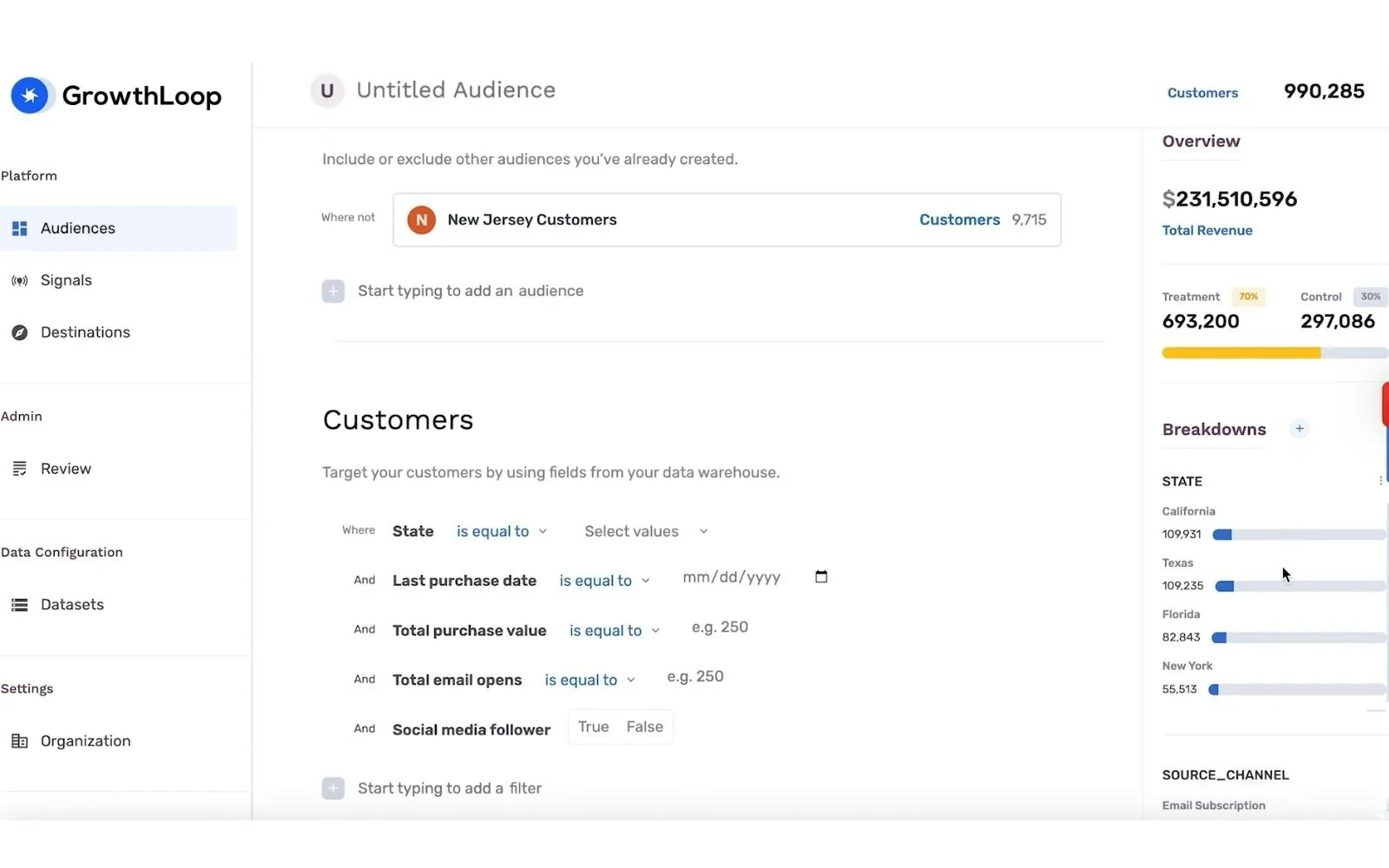
GrowthLoop is a warehouse-native composable CDP that runs audience building, journey orchestration, and AI decisioning directly on a customer’s cloud data warehouse (BigQuery, Snowflake, Databricks, Redshift), and — since July 2026 — sends email and SMS from its own layer rather than only triggering an external ESP. Founded in 2015 as Flywheel Software and rebranded in June 2023, GrowthLoop targets marketing teams rather than data engineers, which is the clearest line separating it from Hightouch, the category’s largest independent vendor.
That native send layer is the development worth understanding. Composable CDPs were defined by what they refused to own: no data store, no messaging, no duplicated profiles. GrowthLoop still refuses the first. It no longer refuses the second.
This independent overview covers what GrowthLoop does, how its architecture works, what it costs, what real users report, and when alternatives fit better. For a side-by-side comparison of all CDP vendors, see the CDP Vendor Comparison Guide.
GrowthLoop at a Glance
| Dimension | GrowthLoop |
|---|---|
| Best for | Enterprise marketing teams with a modeled warehouse — especially BigQuery — that want to build and activate audiences without filing tickets with the data team |
| Typical buyer size | Mostly enterprise — 58.0% of the 112 G2 reviews classified by company size come from organizations above 1,000 employees, 33.0% from 51–1,000, and 8.9% from 50 or fewer |
| Pricing model | Quote-only, tiered by unique customer records (Basic / Growth / Enterprise). No free tier. Third-party median contract: $144,000/year (CostBench, n=4, June 2026) |
| Typical implementation | 6-8 weeks with a modeled warehouse (vendor claim); longer where warehouse modeling is still in progress |
| Key differentiator | A no-code marketer workflow plus incrementality-driven AI decisioning, now paired with first-party email and SMS sending — unusual for a composable vendor |
| Skip if | You need broad connector coverage (~60 destinations listed vs Hightouch’s published 300+), standalone identity resolution, or event collection — GrowthLoop delegates all three to the warehouse |
Reviewer mix is not a customer base: where a G2 split is quoted above, it describes who reviews the vendor, not who buys it — reviewers self-select and vendors run review-solicitation campaigns. Those counts are G2’s company-size-classified subset, which is smaller than the headline review count quoted elsewhere on a page; where a page names no split, the row rests on the structural fact stated in it rather than on reviewer data. The cross-vendor comparison and the methodology behind these splits are in CDP vendors.
Product Evolution
GrowthLoop’s history splits cleanly at 2022: seven bootstrapped years as a data-activation tool, then private-equity backing and a steady expansion of scope.
| Date | Milestone |
|---|---|
| 2015 | Founded as Flywheel Software by David Joosten, Chris Sell, Anthony Rotio, and Tameem Iftikhar. Bootstrapped |
| May 2022 | First institutional capital — a growth equity investment from The Jordan Company (TJC). Amount undisclosed |
| June 2023 | Rebranded Flywheel Software → GrowthLoop, repositioning from data activation to composable CDP |
| August 2024 | Chris O’Neill (former Evernote CEO, Google Canada MD) appointed CEO |
| April 2025 | “Compound Marketing Engine” launched — agentic AI running on the data cloud |
| January 2026 | TJC follow-on investment. Amount undisclosed |
| April 2026 | Composable AI Decisioning launched — Bayesian optimization against business outcomes rather than campaign metrics |
| April 2026 | Co-founders Anthony Rotio and Tameem Iftikhar named co-CEOs, replacing O’Neill after 20 months |
| July 2026 | Engagement Suite launched — Content Studio, Composable Destinations, and GrowthLoop Channels (first-party email and SMS) |
Two things stand out for buyers. GrowthLoop has had three CEO configurations in under two years, and its most architecturally significant release — native sending — shipped without a press release, announced only through a company blog post and LinkedIn. Composable AI Decisioning, three months earlier, got a full wire release. The quieter rollout is consistent with a controlled release rather than a finished, broadly available product.
What GrowthLoop Does
- Audience Builder — a no-code visual segmentation canvas that compiles to SQL against the warehouse. This is the product’s center of gravity and the capability reviewers cite most
- Universal Journeys — cross-channel orchestration across advertising platforms, CRMs, ESPs, and now GrowthLoop’s own channels. Real-time Messaging, a 2025 addition, triggers journeys from event streams (Kafka, Pub/Sub, SQS) rather than waiting for a batch cycle
- Composable AI Decisioning — Bayesian multi-armed bandit optimization that targets business outcomes (lifetime value, ROAS, retention, margin) rather than campaign-level metrics, using holdout groups to measure incremental lift. Results are written back to the warehouse so subsequent decisions inherit the history
- Growth Agents / AI Studio — agents that propose audiences and build journeys, executing after human approval
- Engagement Suite (July 2026) — Content Studio for templates and creative, Composable Destinations for triggering campaigns inside external platforms, and GrowthLoop Channels for sending directly
What GrowthLoop does not do is as relevant to an evaluation. It consumes event streams as journey triggers but does not collect, store, or model events — there is no SDK and no event store. It does not transform data, and it offers no standalone identity resolution product — a notable gap against Hightouch, which shipped Adaptive Identity Resolution in July 2025. Identity logic lives in the warehouse, which means it lives with the data team.
Architecture: Warehouse-Native Reads, First-Party Sends
GrowthLoop queries the customer’s warehouse in place. On the read path there is no ingestion pipeline and no vendor-side profile store: audience state, journey state, and metrics are written back to the warehouse rather than held privately. This is a conventional composable CDP.
The send path is a different matter, and the distinction is load-bearing for anyone signing a DPA.
The send side is where GrowthLoop now diverges from its category.
Advantages of the Warehouse-Native Model
- No duplicated profile store — customer data stays under the warehouse’s existing governance, access controls, and retention policy. No second copy to secure or reconcile
- Marketer self-service without SQL — the audience builder is the product’s strongest reviewed capability. G2 reviewers rate Ease of Setup 9.2 against a CDP category average of 8.2
- Portability of the data model — because segment logic compiles against warehouse tables, replacing the activation layer does not require migrating customer data
- Outcome data returns to the warehouse — decisioning history accumulates where the rest of the customer data already lives, rather than inside a vendor’s black box
Structural Trade-Offs
- Warehouse dependency — a modeled warehouse is a hard prerequisite. Organizations without one must build it first, a multi-month project, before GrowthLoop delivers anything
- Query latency — warehouses answer analytical queries in seconds to minutes, not the milliseconds that in-session personalization requires. Real-time Messaging narrows this for event-triggered journeys but does not change how fast a profile can be read
- No standalone identity resolution — deterministic and probabilistic matching is the customer’s problem to solve in SQL, or with a separate tool
- Narrow connector coverage — GrowthLoop lists roughly 60 destinations; Hightouch publishes 300+ (both retrieved August 27, 2026). GrowthLoop’s own framing is depth over breadth, which holds up for mainstream advertising and CRM targets and does not for long-tail tools
- PII still crosses boundaries at activation — zero-copy describes the read path. Every activation to an external destination copies customer attributes out of the warehouse, exactly as reverse ETL does
Engagement Suite: What Native Sending Does and Does Not Change
GrowthLoop Channels is real sending infrastructure, not relabeled orchestration. The product documentation is explicit: “Use GrowthLoop Channels when you want GrowthLoop to send the message itself—rather than triggering a campaign inside Iterable, Salesforce Marketing Cloud, or another composable destination.” The configuration surface confirms it — sending domain DNS verification, sender identities, IP pools and warming, unsubscribe groups, and SMS number and short-code provisioning. Products that merely trigger an external ESP do not ask you to warm an IP pool.
Four qualifications belong alongside that.
It is email and SMS only. No primary source describes native push. Push remains an external destination.
The delivery layer is SendGrid. GrowthLoop’s own documentation states that for GrowthLoop Email and SMS, “sends use SendGrid.” First-party here means GrowthLoop controls the sending configuration and the campaign object, not that it operates the underlying delivery infrastructure. That distinction matters twice: for deliverability escalations, and because it inserts two sub-processors — GrowthLoop’s send layer and Twilio SendGrid — into the customer-data chain.
Availability is gated. The setup documentation lists a prerequisite: “GrowthLoop has enabled Channels for your organization (contact support@growthloop.com if you do not see Channels in the sidebar).” Engagement Suite appears on all three public pricing tiers and carries no beta label, but there is no dedicated product page and no press release. Treat it as a controlled release, not a proven, broadly deployed capability.
Naming is inconsistent. Marketing calls the content module Content Studio; the documentation and in-app sidebar call it Content Library.
The PII Reality
Zero-copy describes audience computation, not delivery. Sending requires persisted recipient-side records: unsubscribe groups, suppression state, sender identities, and message payloads live inside GrowthLoop and SendGrid, not in the warehouse. Consent data in particular now has a second home, and the page’s usual “outcomes return to the warehouse” pattern is not documented to cover it.
For a data or privacy team, adopting Channels adds two sub-processors to the DPA, the SOC 2 review, and the breach-notification runbook — a smaller expansion than adding a full ESP, but an expansion. GrowthLoop’s documentation does not answer four questions worth raising before signing: whether Channels runs on GrowthLoop’s own SendGrid tenant or a customer-owned subaccount; whether SendGrid appears on GrowthLoop’s published sub-processor list; whether EU data residency is available for the send layer; and whether unsubscribe state syncs back to the warehouse or forks from it.
Activation to external destinations carries the ordinary reverse ETL exposure on top of this — see CISO Guide to CDP Architecture for how that compares across CDP architectures.
The Latency Reality
Real-time Messaging consumes event streams (Kafka, Pub/Sub, SQS), so a cart abandonment at 2:00 PM can trigger a journey within seconds rather than waiting for the next batch window. That is a genuine improvement over scheduled reverse ETL syncs.
What GrowthLoop does not publish is what happens next. If the journey step needs any attribute not carried on the event payload — lifetime value, segment membership, a propensity score — that lookup is a warehouse query, and warehouse queries answer in seconds to minutes. Whether Channels sends on the stream payload alone or enriches from the warehouse first is the difference between a sub-second send and a multi-minute one, and the documentation does not say. Ask for the enrichment path and a measured end-to-end time before assuming real-time behavior.
The strategic reading is straightforward. Under the Customer Intelligence Loop, a composable stack breaks at the ENGAGE stage — outcomes must traverse an external ESP before returning to the warehouse. Owning the send path closes that gap for email and SMS. A composable vendor moving delivery inside its own boundary is evidence for the bundling thesis, not against it, and it is a partial move: the loop still opens wherever GrowthLoop routes through Composable Destinations to Iterable, Salesforce Marketing Cloud, or Braze.
Pricing
GrowthLoop publishes no prices. Three tiers — Basic, Growth, Enterprise — are quoted against the number of unique customer records in the data cloud, with no free tier and no per-sync or per-destination metering. Feature gating is real: independent analysis places AI Studio, Growth Agents, and incrementality measurement on the Enterprise tier.
Record-based pricing is more predictable than the usage-based model Hightouch uses, and G2 reviews support that in an unusual way: across 112 reviews, license cost is essentially absent from the complaints. The counterweight is that unique customer records only accumulate. Tier boundaries are cliff events at renewal, so a contract priced at 4 million records is not the contract you renew at 7 million.
The TCO Reality
The cost does not disappear — it moves to the warehouse bill. Every audience build, journey evaluation, and sync is a query the customer pays for. A total-cost estimate should carry:
For a mid-market retailer with 5 million unique customer records and ten activation destinations — the same basis used on the Hightouch page — budget four components:
- GrowthLoop license — record-count tiers, quote-only. The CostBench median below is the only public anchor
- Warehouse compute — the variable component, and the one a record-based license does not cap. GrowthLoop does not publish whether audience evaluation is incremental or a full recomputation, or how often journeys re-evaluate membership. A nightly full recompute of a 5-million-record audience across a dozen journeys is a materially different BigQuery bill than a diffed sync. Ask for the query pattern and a slot-hour estimate
- Data engineering — 2-3 FTEs at $150,000-$200,000 loaded cost for warehouse modeling and identity logic, since GrowthLoop supplies neither
- External ESP licensing — reducible for email and SMS via GrowthLoop Channels, but still required for push and for teams keeping creative in Braze or Iterable
- Warehouse activation-readiness services where the data model is not yet campaign-ready
The only public benchmark is a CostBench median of $144,000/year, drawn from four third-party buyer reports and labeled by CostBench itself as “Indicative market pricing — not official vendor pricing or contract-grade data.” Vendr, Spendflo, and Tropic publish no GrowthLoop figure. Four data points is a weak basis for a benchmark, and it is the strongest one available.
Where suite-embedded CDPs impose a suite tax, composable CDPs impose an engineering tax. GrowthLoop reduces the marketer-side friction of that tax without removing the tax itself. For a fuller breakdown, see CDP Pricing: Models, Ranges, and Hidden Costs.
Strengths
GrowthLoop holds a 4.7/5 rating across 112 G2 reviews (retrieved August 27, 2026), against Hightouch’s 4.6 across 404. The higher score sits on roughly a quarter of the sample, so treat the gap as directional. The review base skews enterprise: 65 of 112 reviewers come from organizations above 1,000 employees.
- Marketer self-service is the consistent theme. Customer Support (35 mentions) and Ease of Use (34) lead G2’s pros clustering. One enterprise reviewer reported GrowthLoop “made audience creation at least 10x faster and significantly increased the number of users (esp non technical) that were able to create audiences” compared with an in-house application
- Support quality is rated well above category average — 9.8 against 9.1 for the CDP category on G2’s Quality of Support metric
- Outcome-level AI optimization. Optimizing against lifetime value and margin with holdout-based incrementality measurement is a more defensible approach than campaign-metric optimization, and it is unusual at this price point
- Commerce and retail media traction. Costco (August 2025), Gopuff (June 2026), and Whirlpool (July 2026) are named in wire releases. GrowthLoop’s published customer list adds Google, Indeed, Mercari, NASCAR, PGA Tour, and the Boston Red Sox
Limitations
These reviews carry a timing caveat that materially affects how they should be read: nearly all of them predate Engagement Suite (July 2026), so none evaluates the native sending layer.
- Performance lag is G2’s largest cons cluster (5 mentions), described as “occasional lags that hinder workflows.” The complaints are mild in tone — one reviewer offered “Sometimes it takes a while to load, but that could be my internet connection” — but they cluster consistently around sync and query responsiveness
- Learning curve (4 mentions). A mid-market reviewer: “The downside is trying to teach people how to use GrowthLoop. There is a lot in the tool and a lot of different data points you can segment on.” Independent analysis reaches the same conclusion, noting that “implementation can be complex and time-consuming” and that audience logic gets harder to manage as use cases multiply
- Data access friction. Attributes outside the primary dataset require manual configuration. One enterprise reviewer migrating from another CDP noted: “any attribute that the user needs to export that is not on the primary dataset must be configured as a custom attribute. For the client I work with, most of our ‘export’ attributes are on not on the primary dataset so we ‘feel’ this a bit”
- Silent failures. G2’s error-reporting cluster centers on missing notifications when a filter stops working — a failure mode that quietly changes audience volumes rather than raising an alert
- Poor fit below enterprise scale, per reviewers themselves. One reviewer: “GrowthLoop would not be a great platform for small businesses with simple needs and/or centralized data.” Only 10 of 112 reviewers come from organizations under 50 employees
- Analyst coverage is thin, covered below
Market Position
GrowthLoop’s absence from analyst evaluations is the clearest gap between its positioning and its recognized standing. It does not appear anywhere in the 2026 Gartner Magic Quadrant for Customer Data Platforms — not as a Leader, Challenger, Visionary, or Niche Player. Hightouch does, and as a first-time entrant it landed directly in the Leaders quadrant alongside Salesforce, Oracle, and Uniphore (CX Today, February 2026). Magic Quadrant inclusion turns on revenue and customer-count thresholds rather than assessed quality, so absence reflects scale rather than an adverse verdict. It still matters for buyers who weight analyst validation, because two vendors sharing a category and a thesis with only one of them evaluated is the shortlist most enterprises start from.
GrowthLoop’s most-cited third-party recognition is a “One to Watch” designation in Snowflake’s Modern Marketing Data Stack report. That designation is sourced entirely to GrowthLoop’s own press releases; Snowflake’s partner directory listing records a Select partner tier without it. “One to Watch” is also, by construction, a label for vendors that are not yet principals.
PeerSpot ranks GrowthLoop 13th in its CDP category against Hightouch’s 9th, with mindshare of 2.0% versus 4.2% as of August 2026 — both declining year over year, which says as much about warehouse vendors absorbing this category as it does about either company.
None of this speaks to product quality, and buyers weighting user-reported outcomes over analyst placement will read the G2 data as the more relevant evidence. It does mean GrowthLoop will rarely appear on a shortlist assembled from analyst reports.
Who Should Consider GrowthLoop
GrowthLoop fits organizations that meet most of these criteria:
- A modeled warehouse already in production — BigQuery most commonly, though Snowflake, Databricks, and Redshift are supported
- Marketing-led audience operations — the core value is removing the data-team ticket queue, which only matters if that queue is the bottleneck
- Enterprise scale — reviewers, pricing tiers, and the vendor’s own customer list all point the same direction
- Outcome-based optimization goals — teams measuring lifetime value or margin rather than click-through rates get more from the decisioning layer than teams running batch campaigns
- Retail media or commerce media operations, where GrowthLoop has concentrated its 2026 product investment
GrowthLoop is a weaker fit for organizations that:
- Need broad connector coverage, standalone identity resolution, or event collection
- Need sub-second profile access for in-session personalization
- Require native push notifications, which GrowthLoop does not send
- Weight analyst validation heavily in vendor selection
- Are small or mid-sized with centralized data, where a marketing automation platform is the better answer
- Want a delivery layer that is proven at scale — Engagement Suite is roughly a month old and gated per organization
What to Ask GrowthLoop on the Call
This page leaves four questions genuinely open, because GrowthLoop does not publish the answers. Each is answerable in a single vendor call and each changes the evaluation:
- Is Engagement Suite enabled for an organization our size today, and how many customers are sending production volume through Channels? The capability is gated per organization and roughly a month old
- Is audience evaluation incremental or a full recomputation, and what slot-hour estimate should we model? This is the single largest variable in total cost, and it lands on our warehouse bill rather than the license
- Who owns a deliverability escalation when SendGrid is the underlying sender, and is SendGrid on your published sub-processor list? Ask the same question about EU data residency for the send layer
- What happens to record-tier pricing at renewal as our record count grows? Establish the tier boundaries and the escalation terms before the first contract, not the second
Alternatives to GrowthLoop
Organizations evaluating alternatives generally look at three categories. Hightouch is the direct composable comparison — roughly five times the published connector coverage, standalone identity resolution, event collection, and Gartner Leader placement, at the cost of a more engineering-centric workflow and no native sending. Third-party comparisons consistently frame this as a use-case choice rather than a ranking: Hightouch where integration breadth and data-platform capabilities dominate, GrowthLoop where marketer autonomy and AI-driven campaign automation do.
Agentic CDPs bundle unification, messaging, and AI decisioning inside one boundary, closing the feedback loop that composable stacks leave open — the destination GrowthLoop’s native send layer is partially moving toward. Suite-embedded CDPs such as Salesforce Data Cloud and Adobe Real-Time CDP fit organizations already committed to those ecosystems.
Teams committed to the composable approach can compare Hightouch, Census, RudderStack, and Treasure AI’s Composable CDP in the composable CDP vendors section of our vendor guide.
→ Compare all CDP vendors side-by-side in the CDP Vendor Comparison Guide
See how independent analysts evaluate CDP vendors — download the Forrester Wave or IDC MarketScape reports for a side-by-side comparison.
Related Articles
- What Is Hightouch? — The direct composable CDP comparison
- Reverse ETL vs CDP: What Reverse ETL Can and Cannot Do — Where warehouse-native activation stops
- What Is Databricks CustomerLake? — Warehouse vendors entering the activation layer
- CDP Alternatives: 7 Options Compared — When each CDP alternative makes sense
- How to Evaluate a CDP in the AI Era — Evaluation criteria for AI-era requirements
FAQ
Is GrowthLoop a CDP?
GrowthLoop is a composable CDP — it covers segmentation, orchestration, decisioning, and activation, but not ingestion, storage, or standalone identity resolution. Those remain with the warehouse. Its July 2026 addition of first-party email and SMS sending makes it more complete than a pure reverse ETL tool, though delivery runs on SendGrid underneath and push is still handled by external platforms.
How much does GrowthLoop cost?
GrowthLoop publishes no prices — quotes are tiered by unique customer records across Basic, Growth, and Enterprise plans, with no free tier. The only public benchmark is a $144,000/year median from CostBench, drawn from four buyer reports (June 2026) and labeled indicative rather than contract-grade. Budget separately for warehouse compute, which absorbs the query cost of every audience build and sync.
Does GrowthLoop send email and SMS itself?
Yes — GrowthLoop Channels, launched July 2026, sends email and SMS directly, with GrowthLoop-controlled sending domains, IP pools, and unsubscribe groups. Delivery runs on SendGrid infrastructure. Push notifications are not sent natively. GrowthLoop also still triggers campaigns inside Iterable, Salesforce Marketing Cloud, and Braze, and the capability is enabled per organization rather than broadly self-service.
How does GrowthLoop compare to Hightouch?
Hightouch suits data teams; GrowthLoop suits marketing teams. Hightouch publishes 300+ destinations, standalone identity resolution, event collection, and 2026 Gartner Magic Quadrant Leader placement. GrowthLoop offers a no-code audience builder, outcome-level AI decisioning with incrementality measurement, and native email and SMS — with roughly 60 destinations and no analyst coverage.
Is GrowthLoop the right CDP for my organization?
GrowthLoop is the right CDP when you have a modeled warehouse and marketers blocked behind a data-team queue — and the wrong fit when connector breadth or identity resolution is the requirement. Choose it if enterprise marketing self-service and outcome-based optimization are the priority. Skip it without a modeled warehouse, below enterprise scale, or where analyst validation is required.
What are the alternatives to GrowthLoop?
The main alternatives are Hightouch and Treasure AI among composable vendors, agentic CDPs that bundle data, messaging, and AI in one boundary, and suite-embedded CDPs. Treasure AI is the one vendor spanning both models — a composable CDP for zero-copy warehouse queries, and a complete CDP adding real-time identity stitching and native messaging. For a full comparison, see the CDP Vendor Comparison Guide.