
On June 16, 2026, Databricks answered a question this site has covered since April: Is Databricks a CDP? The answer was “no” — until it wasn’t. At the Data + AI Summit 2026, Databricks launched CustomerLake, a purpose-built Agentic CDP embedded natively in the data lakehouse. The platform that data engineers already trust for analytics and ML is now making a direct play for the customer engagement layer that CDPs have owned for a decade.
Databricks CustomerLake is an agentic customer data platform (CDP) that runs inside the Databricks lakehouse, unifying customer profiles, identity resolution, audience building, and campaign activation on the data platform itself instead of in a separate CDP. It is in Private Preview and works through two agent families: Profile Agents for data unification and Campaign Agents for activation.
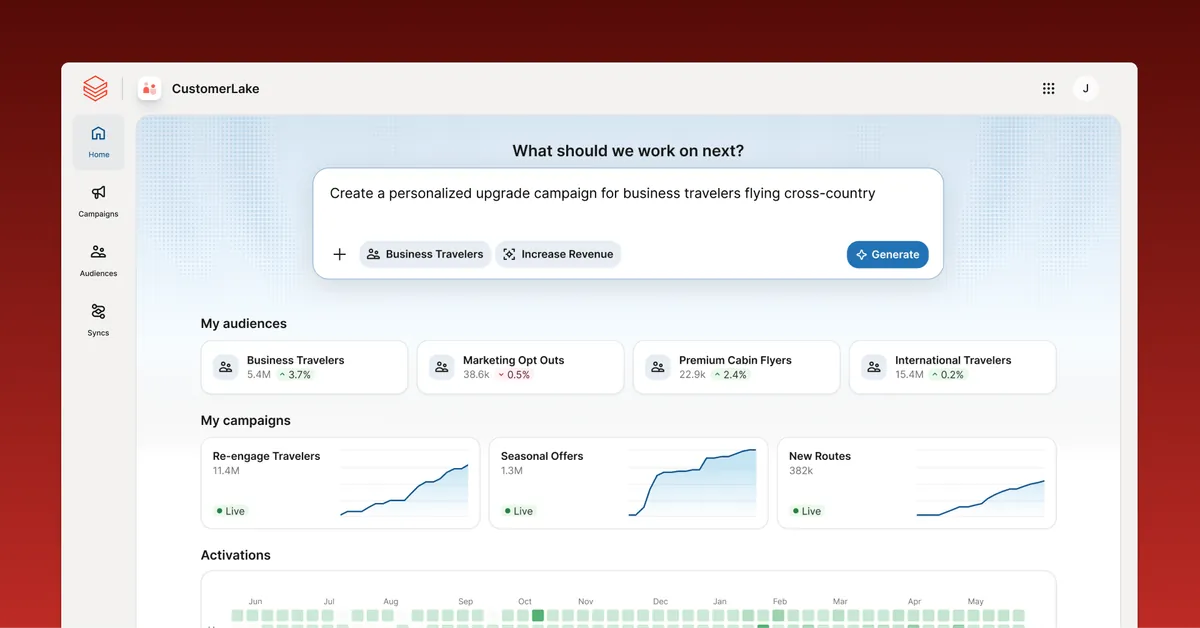
This guide covers what CustomerLake is, how it works, where it fits in the CDP category’s evolution, and what remains unproven.
Databricks CustomerLake at a Glance
| Dimension | Databricks CustomerLake |
|---|---|
| Best for | Organizations on the Databricks lakehouse (Unity Catalog) that want CDP capabilities without moving data to a separate system |
| Typical buyer size | Enterprise, by positioning rather than measured usage — it targets lakehouse organizations whose platform and data-engineering teams already run Unity Catalog, and no public peer mix exists yet because it remains in Private Preview |
| Pricing model | Consumption-based, described by Databricks as a value-aligned alternative to traditional software licensing; no rate card published |
| Typical implementation | Not yet established (Private Preview); Databricks indicates weeks, depending on lakehouse readiness |
| Key differentiator | Zero data movement — identity resolution and agentic CDP built directly on the lakehouse under Unity Catalog governance |
| Skip if | You are not on Databricks, or want marketer-only campaign operations |
No peer-review mix exists for CustomerLake: it remains in Private Preview, so the row above describes who can adopt it — organizations already running the Databricks lakehouse under Unity Catalog — not measured usage. The cross-vendor comparison and the methodology behind these splits are in CDP vendors.
What Is CustomerLake?
CustomerLake is Databricks’ first marketing product — an Agentic CDP that unifies customer data, AI models, identity resolution, audience building, and activation on the same lakehouse where organizations already run analytics and ML workloads. It is currently in Private Preview.
The core concept is what Databricks calls Infinity campaigns — a shift from static, one-off campaigns to continuous agentic loops where AI agents constantly analyze customer signals, decide next-best actions, and optimize engagement in real time. As CEO Ali Ghodsi framed it: “Marketing stops being a series of campaigns and becomes a continuous loop — agents that constantly analyze, decide, and act on every customer in real time.”
CustomerLake is built on three design principles:
- Embedded — built directly on existing Databricks data foundations. No data duplication into a separate CDP
- Democratized — marketers operate through agent-first interfaces on trusted data, reducing ad hoc requests to data teams
- Autonomous — agents analyze customer signals, recommend next-best actions, and optimize engagement around business goals at 1:1 scale
CustomerLake follows the pattern Databricks established with Lakewatch (its security analytics product): building vertical application layers directly on the lakehouse rather than leaving those markets to third-party tools. This pattern signals that CustomerLake is unlikely to be the last category Databricks enters.
Team lineage matters: CustomerLake’s leadership includes Tasso Argyros and Justin DeBrabant (both from ActionIQ, an enterprise CDP acquired by Uniphore) and Katy Yuan (from Census, a composable CDP pioneer). The people who spent the past decade building packaged and composable CDPs are now inside the lakehouse, building something architecturally different from either.
Profile Agents
Profile Agents handle the data engineering side of CDP functionality — transforming raw customer data into business-ready Customer 360 profiles directly inside Databricks.
What Profile Agents automate:
- Bronze-to-gold data transformation — raw event data is cleaned, enriched, and structured into unified customer profiles. The agent identifies data quality issues, recommends fixes, and supports third-party data enrichment
- Agentic Identity Resolution — a multi-method approach that combines deterministic matching, probabilistic matching, and agentic workflows (where the AI identifies edge cases and improves quality iteratively through continuous feedback loops). Teams can integrate their existing identity rules, models, and third-party enrichment alongside Agentic Identity Resolution
- Identity Provider marketplace — pre-built integrations with Acxiom, Epsilon, LiveRamp, TransUnion, and Adstra enable one-click access to third-party identity graphs for enrichment and resolution
For data engineers, Profile Agents reduce the manual pipeline work that typically consumes weeks when building customer 360 views from scratch on a lakehouse.
Campaign Agents
Campaign Agents handle the activation side — moving from audience creation to channel delivery with AI assistance at every step.
What Campaign Agents provide:
- Goal-driven campaign generation — agents use business goals and customer context to recommend audiences, messaging, timing, and channel selection
- Genie-powered interface — marketers interact through Databricks’ natural language interface (Genie) to build audiences, define campaign briefs, and set guardrails — without writing SQL
- Pre-launch simulation — campaigns can be simulated against a sample of customer profiles before going live, providing visibility into how decisions will play out
- Built-in guardrails — marketing opt-out enforcement, suppression for customers with unresolved support tickets, and frequency capping are native to the decisioning layer
Campaign Agents represent Databricks’ answer to the “marketer self-service” gap that has historically separated lakehouses from CDPs. Whether the agent-first interface achieves the usability of mature CDP journey builders remains to be validated at scale — CustomerLake is still in Private Preview.
Architecture
CustomerLake’s architecture reflects a fundamental bet: the data lakehouse should be the system of record for marketing, not a data source that feeds a separate CDP.
Key architectural components:
| Component | Role |
|---|---|
| Lakehouse + Unity Catalog | Foundation layer — all customer data stays governed in one place. No data copies to external CDP systems |
| Lakehouse Federation | Query customer data across Snowflake, BigQuery, cloud storage, and operational databases without copying it into Databricks |
| Lakehouse//RT | Real-time serving layer for the lakehouse, announced at the same summit; Databricks has not said whether or how CustomerLake uses it |
| Genie | Natural language interface enabling marketers to build audiences and campaigns without SQL |
| Lakeflow | Data ingestion layer for streaming and batch customer data |
| Bi-directional reverse ETL | Native pipelines to marketing tools, advertising platforms, identity providers, and engagement channels |
Activation partners at launch include Adobe, Meta (Audience and Conversions API), The Trade Desk, Braze, Bloomreach, Iterable, Snapchat, Magnite, Twilio, IAS, and Unity.
Pricing model: Databricks describes CustomerLake pricing as a consumption model — “a flexible, value-aligned alternative to traditional software licensing” on its product page — and has published no rate card. Martech Therapy’s Matthew Niederberger reports that it carries no platform fee, with Databricks earning on the compute used to build profiles and resolve identities. As he put it: “You cannot win a price war against a company that does not need your product to make money.”
This creates a structural asymmetry: standalone CDP vendors must recover their entire R&D and infrastructure costs from CDP revenue alone. Databricks can treat CustomerLake as a compute driver for its existing platform — even subsidizing the CDP layer if it increases lakehouse adoption. For CDP-only companies, this is an existential pricing challenge, not a feature gap.
CDP Evolution: Where CustomerLake Fits
The CDP category has evolved through three stages, each driven by pressure to close the Customer Intelligence Loop faster:
| Stage | Era | Architecture | Data model |
|---|---|---|---|
| Packaged CDP | 2016–2020 | All-in-one platform with proprietary data store | Data copied into the CDP |
| Composable CDP | 2020–2025 | Warehouse/lakehouse as source of truth + activation layer on top | Data stays in the warehouse; activation tools read via reverse ETL or zero-copy |
| Agentic CDP | 2024+ | AI agents embedded in the data platform, closing the loop autonomously | Agents operate on data wherever it lives — data location is secondary to decision orchestration |
The evolution from Packaged to Composable to Agentic reflects a deeper shift. The 2020–2025 era settled the question of data gravity — where customer data lives (answer: the warehouse/lakehouse won). The emerging question is decision gravity — who controls where and how business decisions are made on that data. CustomerLake is Databricks’ bid to own not just data storage but the decisioning layer: the place where AI agents analyze, decide, and act on customer data in real time.
CustomerLake is a Stage 3 entry — but it arrives from a different direction than most Agentic CDPs. Where traditional CDP vendors are adding AI agents to existing platforms, Databricks is adding CDP capabilities to an existing data platform. The result is architecturally similar but organizationally different: CustomerLake’s buyer is likely the data team (who already owns Databricks), not the marketing team (who typically owns CDP procurement).
CDP Capabilities: What CustomerLake Covers and What It Does Not
A customer data platform is defined by five core capabilities. Before CustomerLake, a Databricks lakehouse covered none of them natively. Here is where CustomerLake stands:
| Capability | What a CDP requires | What CustomerLake provides | Status |
|---|---|---|---|
| Identity resolution | ML-powered stitching of anonymous and known profiles | Agentic Identity Resolution — deterministic + probabilistic + agentic matching, plus identity provider marketplace | Addressed |
| Real-time profile serving | Sub-100ms API lookups for in-session personalization | The product page lists a “Real-Time Profile API” in one line; no documentation, specification, or latency figures are published | Not addressed (unverified) |
| Marketer self-service | Visual segmentation and journey building without SQL | Genie-powered natural language interface + Campaign Agents in what Databricks calls a marketer-friendly workspace — but inside Databricks, not a standalone marketing application | Partially addressed (UX maturity TBD) |
| Customer Intelligence Loop | COLLECT → UNIFY → UNDERSTAND → DECIDE → ENGAGE in seconds | Infinity campaigns — agents close the loop continuously | Addressed in design (Private Preview) |
| Native messaging | None — required separate ESP | None — activation via partner integrations (Braze, Iterable, Twilio, etc.) | Not addressed |
The most significant shift is identity resolution: Agentic Identity Resolution’s multi-method approach (deterministic + probabilistic + agentic matching) with a built-in identity provider marketplace directly addresses what was previously Databricks’ weakest CDP gap. The most notable absence is native messaging — CustomerLake activates through partner channels, not built-in email, SMS, or push. This is a deliberate architectural choice: Databricks is building the intelligence and decisioning layer, not the delivery infrastructure.
Competitive Impact
CustomerLake’s entry reshapes competitive dynamics across the CDP landscape:
Composable CDP vendors (Hightouch, Census, GrowthLoop) face structural pressure. These companies built their value proposition on being the activation layer between the warehouse and marketing tools — the position CustomerLake now occupies natively. As Niederberger observes, composable vendors won the argument so thoroughly that “the warehouse ended up with a fully paved on-ramp to build its own front door.” That said, composable vendors have mature integrations, established customer bases, and multi-warehouse support (Snowflake, BigQuery, Redshift) — switching costs are real, and CustomerLake’s Private Preview status limits near-term displacement.
Packaged CDP vendors (Segment, mParticle, Lytics) face a different challenge. CustomerLake does not replicate their full feature sets (particularly native messaging and event SDKs), but it undermines the data-copy model that packaged CDPs require. For organizations already on Databricks, the value proposition of copying customer data into a separate platform weakens when the lakehouse itself offers identity resolution, segmentation, and activation.
Enterprise suite CDPs (Adobe AEP, Salesforce Data Cloud) are less directly threatened but not immune. Their CDP capabilities are embedded within broader marketing clouds that include content management, journey orchestration, and cross-channel delivery — layers CustomerLake does not attempt to replace. However, CustomerLake’s Lakehouse Federation (which can query Snowflake, BigQuery, and cloud storage without copying data) challenges the data gravity that suite vendors rely on. Notably, Adobe is a CustomerLake launch partner — suggesting coexistence rather than displacement in the near term.
Adweek characterized CustomerLake as “an agentic challenger to traditional CDPs” — framing it as a category disruptor rather than a feature addition.
What Remains Unproven
CustomerLake is in Private Preview. Several critical questions will only be answered as the product matures:
- Marketer UX maturity — agent-first interfaces are novel. Whether Genie + Campaign Agents can match the usability of purpose-built CDP journey builders (which have had years of iteration with marketing teams) is the largest open question
- Event collection SDKs — CustomerLake’s ingestion relies on Lakeflow and existing Databricks pipelines. Whether it will offer client-side SDKs for web and mobile event collection (comparable to Segment’s analytics.js or mParticle’s SDK) has not been announced
- Real-time profile serving — the product page names a Real-Time Profile API in a single line, but Databricks has published no documentation, specification, or latency figures for it. Until it does, sub-100ms in-session lookups remain unverified
- General availability timeline — Databricks has not announced a GA date. Forrester’s Joe Stanhope expects it to be generally available later in 2026 (Forrester, June 2026). Until then, enterprise procurement cycles may stall on Private Preview status
- Buyer and operator mismatch — CustomerLake is sold to data teams and CIOs, but operated (in part) by marketers. Purpose-built CDPs have spent years iterating their UX with marketing teams — journey builders, drag-and-drop segmentation, campaign calendars. Whether Genie + Campaign Agents can match that usability maturity is the largest adoption question. Organizations without an existing Databricks practice will face a steeper learning curve, even with agent-first interfaces
- Cost predictability — consumption-based pricing means costs scale with agent compute. When Campaign Agents run autonomously and continuously (Infinity campaigns), forecasting monthly spend becomes harder than with traditional per-seat or per-profile licensing
- Migration complexity — switching identity resolution providers or moving from an existing CDP’s identity graph to Agentic Identity Resolution is a multi-month effort. Mid-contract transitions are operationally risky
- Multi-cloud neutrality — CustomerLake runs on Databricks. Organizations with customer data split across Snowflake and Databricks can use Lakehouse Federation, but the control plane, governance, and billing flow through Databricks. As Niederberger notes, federation “still runs it across Databricks’ control plane, its governance, its bill, and its roadmap”
These open questions are the material for an evaluation, not a reason to wait. Teams weighing a Private Preview platform against an established one can use the same scored criteria across every candidate — marketer UX, SDK coverage, real-time serving, GA timeline, and cost predictability are answerable today even where a vendor’s roadmap is not.
FAQ
What is Databricks CustomerLake?
Databricks CustomerLake is an Agentic CDP that runs on the lakehouse rather than alongside it — Databricks’ first product line built for marketing teams. Launched in Private Preview at the Data + AI Summit on June 16, 2026, it combines Profile Agents (bronze-to-gold transformation and Agentic Identity Resolution) with Campaign Agents (goal-driven audience and campaign generation through Genie). Activation happens through partners such as Braze, Iterable, and The Trade Desk rather than native messaging.
Is Databricks a CDP now?
Yes — with the launch of CustomerLake, Databricks is now a CDP, specifically an Agentic CDP. CustomerLake adds identity resolution, audience segmentation, campaign automation, and multi-channel activation natively on the lakehouse. The key distinction from traditional CDPs: CustomerLake embeds these capabilities in the data platform rather than operating as a separate system that ingests copies of customer data. It is currently in Private Preview.
How does CustomerLake compare to packaged CDPs?
CustomerLake addresses most core CDP capabilities but takes a fundamentally different architectural approach. Packaged CDPs copy customer data into a proprietary store, then build identity, segmentation, and activation on top. CustomerLake operates directly on the lakehouse — data stays in place, governed by Unity Catalog. It provides identity resolution (Agentic Identity Resolution), marketer self-service (Genie), and partner-based activation, but does not include native messaging (email, SMS, push). Organizations that need built-in message delivery will still require a messaging platform alongside CustomerLake.
What is an Infinity campaign?
An Infinity campaign is Databricks’ term for a continuously running, agent-driven engagement loop that replaces static one-off campaigns. Instead of the traditional workflow — define objective, request data, build segment, launch, measure — Campaign Agents continuously analyze customer signals, recommend next-best actions, and optimize engagement in real time. The “infinity” framing reflects the shift from discrete campaign cycles to always-on 1:1 personalization. The concept is central to CustomerLake’s value proposition but remains in Private Preview as of September 2026.
Is Databricks CustomerLake the right CDP for my organization?
CustomerLake is the right CDP when you already run the Databricks lakehouse and want CDP capabilities without moving data — and the wrong fit today for anything requiring a battle-tested, generally available platform. Choose it if zero data movement and Unity Catalog governance outweigh Private Preview risk. Skip it if you are not on Databricks, need marketer-only operation, or cannot accept unproven maturity.
Should I replace my CDP with Databricks CustomerLake?
It depends on your current architecture and where your data lives. If your organization already runs Databricks as its primary data platform and uses a composable CDP stack (warehouse + reverse ETL + activation tools), CustomerLake may consolidate that stack into fewer moving parts. If you rely on a packaged CDP with native messaging, journey orchestration, and mature marketer UX, CustomerLake does not yet replicate those capabilities end-to-end. Evaluate based on your specific Customer Intelligence Loop requirements — particularly whether native messaging and client-side event SDKs are critical to your use cases. For evaluation criteria, see How to Evaluate a CDP in the AI Era.
Sources: Databricks press release (June 16, 2026), Databricks blog, Adweek, Martech Therapy (Matthew Niederberger).