
Iterable is a customer engagement platform (CEP) that orchestrates and delivers personalized messages across email, mobile push, web push, in-app, and SMS — it is not a customer data platform. Founded in 2013 in San Francisco, privately held at a roughly $2B valuation with ~$240M ARR and ~850 employees, Iterable serves enterprise brands including Priceline, Fabletics, DoorDash, Calm, and Box. It built its reputation on an approachable visual journey builder and has spent recent years layering on Nova Intelligence AI and warehouse-connectivity features to narrow the gap with dedicated CDPs. G2 users rate it 4.5 ★ across 690+ reviews.
This independent overview covers what Iterable does, where it fits on the Customer Intelligence Loop, what it costs, and when alternatives are worth evaluating. For a side-by-side comparison of all CDP vendors, see the CDP Vendor Comparison Guide.
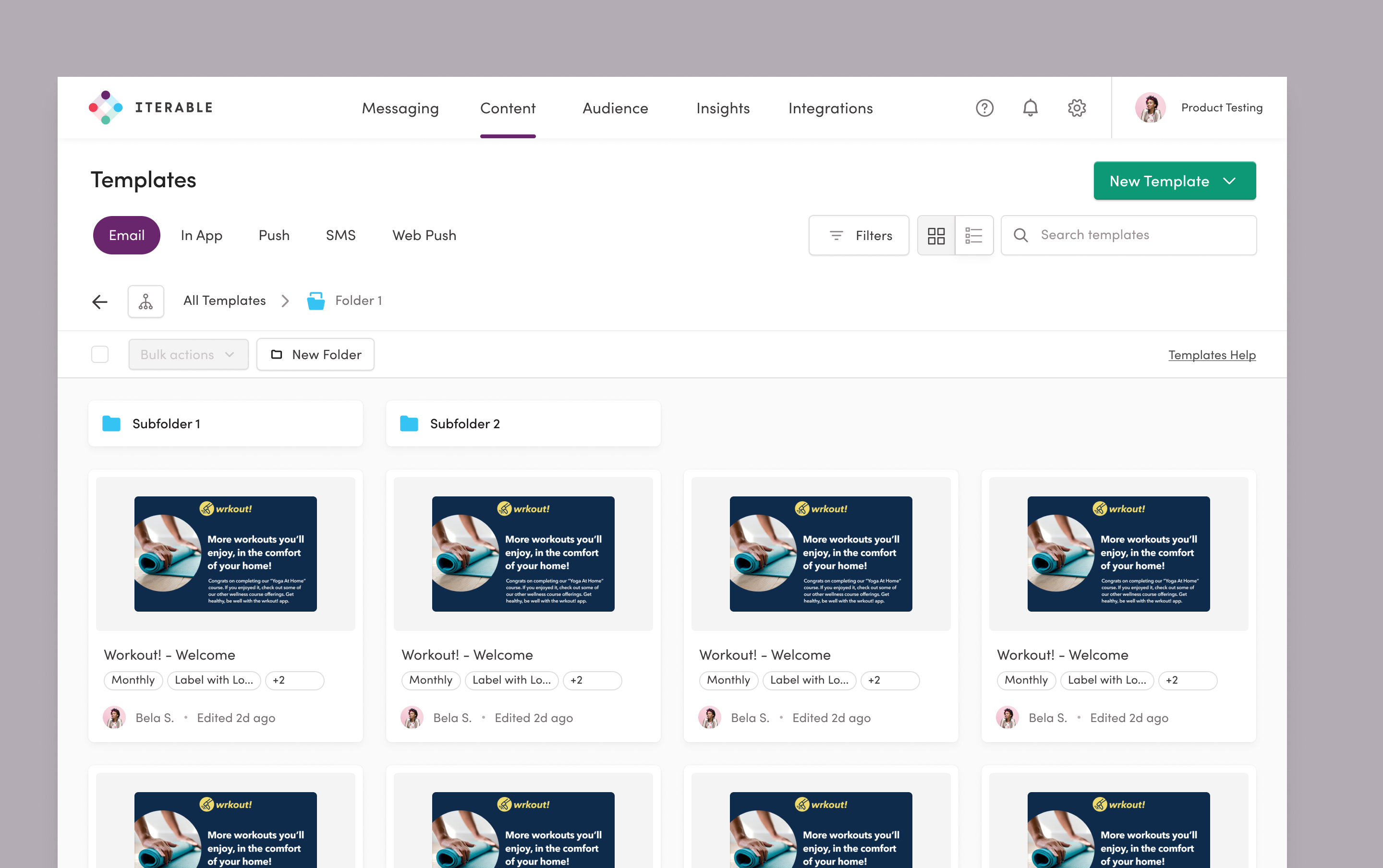
Product Evolution
Iterable’s evolution tracks a common pattern among engagement platforms: start with email, expand channel coverage, then reach upstream toward the data layer as customers ask for more than execution.
| Year | Milestone |
|---|---|
| 2013 | Founded by Justin Zhu (ex-Twitter) and Andrew Boni (ex-Google), incubated at AngelPad |
| 2015 | $1.2M seed round; expands from email into push notifications and SMS |
| 2019 | $60M Series D at a $325M+ valuation; London office opens for European expansion |
| 2020–2023 | 37 AI features released in 2023 alone; surpasses $200M ARR under Boni’s CEO tenure |
| 2024 | Smart Ingest co-developed with Hightouch — embedded reverse ETL inside Iterable; Unknown User Activation beta |
| 2025 | Nova Intelligence launched — Brand Affinity, Predictive Goals, Send Time Optimization, Copy Assistance |
| Spring 2026 | Nova Agent GA, Iterable Command Center, Unknown User Activation GA, Google Ads integration, and SMS Compliance Toolkit shipped |
Each addition — Smart Ingest, Nova Intelligence, Unknown User Activation — extends Iterable further from its email core, but the underlying product is still built around orchestrating and delivering campaigns, not unifying customer records. That distinction shapes what Iterable can and cannot do architecturally, covered below.
What Iterable Does
- Workflow Studio / Journey Builder: Iterable’s visual drag-and-drop orchestration engine — branching logic, wait steps, and multivariate testing across channels, triggered by user behavior or scheduled campaigns
- Cross-channel messaging: Native delivery across email, mobile push, web push, in-app, and SMS from a single campaign interface — no native WhatsApp, RCS, or LINE
- Nova Intelligence: An AI suite added in 2025 — Nova Agent for autonomous campaign building, QA, and optimization; Brand Affinity scoring for per-user channel and content preferences; Predictive Goals for churn risk and conversion probability; Send Time Optimization; and Copy Assistance
- Activate Data layer + Smart Ingest: Warehouse connectivity co-developed with Hightouch, connecting Snowflake, BigQuery, Databricks, and Redshift directly to Iterable
- Iterable Command Center: A centralized, goal-based performance view across campaigns, added in Spring 2026
- Unknown User Activation: Identifies high-intent anonymous visitors before they convert, carrying engagement history forward once a user is identified
Smart Ingest is a genuine improvement to how warehouse data reaches Iterable — but it is reverse ETL (data activation), not a data-unification layer. It does not perform cross-source identity resolution or maintain a governed profile that other teams can query. For the full breakdown of what warehouse connectivity does and does not solve, see Do You Need a CDP with an Engagement Platform?
Where Iterable Sits on the Customer Intelligence Loop
The Customer Intelligence Loop maps the full cycle from raw data to delivered message and back. Iterable’s product suite covers the back half of that cycle deeply and the front half only partially:
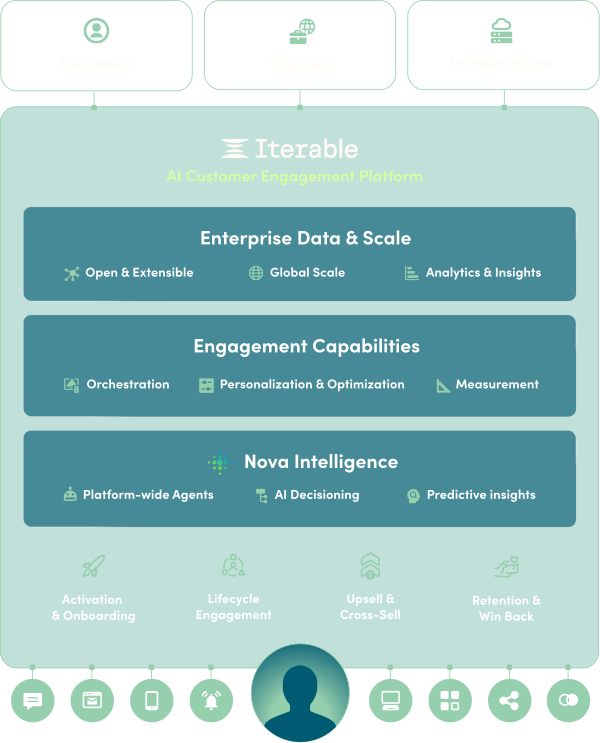
Diagram from Iterable’s product page, showing how Iterable positions its data flow and engagement components.
| Stage | Iterable Coverage |
|---|---|
| 1. COLLECT | Partial — SDK-based event tracking plus Smart Ingest for warehouse data; no independent server-side collection from non-messaging sources |
| 2. UNIFY | Minimal — matches email/userId within Iterable’s own profiles via a merge-users API; Unknown User Activation (2026) enables deterministic anonymous-to-known stitching for data Iterable already collects, but this operates only within Iterable’s profile store and does not resolve identities across external sources (CRM, POS, support) or perform probabilistic matching across multiple ingestion pathways |
| 3. UNDERSTAND | Limited — Nova Predictive Goals and Brand Affinity work on Iterable’s own engagement data; cross-channel predictive modeling (churn, LTV) spanning non-Iterable channels requires external tools |
| 4. DECIDE | Strong — Journey Builder branching logic, Nova Agent optimization, Brand Affinity scoring, and Send Time Optimization |
| 5. ENGAGE | Core strength — native delivery across email, push, SMS, in-app, and web push |
Iterable’s data model reflects this shape. Profiles are JSON/NoSQL user records keyed on email or userId, combining user fields with event data and personalized through handlebars.js templates. It is a messaging-optimized store that starts once data has arrived and ends at delivery, with no mechanism for engagement outcomes to flow back into cross-channel identity resolution or predictive modeling. That maps cleanly to stages 4 and 5, with partial coverage of stage 1 through Smart Ingest — but stages 2 and 3 remain largely outside the product.
For organizations relying on Iterable as their only customer data system, this gap is the practical question: campaigns can only be as targeted as the data Iterable itself collects and stores.
Iterable Pricing
Iterable does not publish list pricing. Contracts are quote-based, with no free trial and no self-serve option, and are driven primarily by the number of profiles in the database — all profiles are counted, not just active users — plus message volume and which modules are licensed. There are three tiers: Growth, Enterprise, and Enterprise Plus.
Growth deployments (email, push, basic SMS) commonly run roughly $50,000–$130,000 per year, while most customers land on the Enterprise tier at $150,000–$600,000 annually with AI Optimization, Flows, Brand Affinity, SSO, and multi-brand support. Enterprise Plus deployments — global, multi-brand, with a dedicated CSM and sandbox — range from $600,000 into the millions; the median contract across a 120-plus sample is around $268,000 per year, based on publicly reported contract data aggregated from Vendr and G2 as of mid-2025. Contracts are annual, implementation typically runs $5,000–$20,000 over 8–16 weeks, and because Iterable does not unify or store data outside its own channels, the true cost of a complete customer-intelligence stack should also include whatever CDP, warehouse, or identity-resolution tooling feeds Iterable accurate, unified audiences.
Strengths
- Intuitive journey builder: Workflow Studio is widely regarded as more approachable than Braze Canvas for mid-market teams
- Category-leading customer support: Support is Iterable’s most-praised attribute, cited as a deciding factor in 185+ G2 reviews for being fast and knowledgeable
- Real investment in AI: Nova Intelligence — Brand Affinity, Predictive Goals, and Nova Agent — handles personalization at scale without heavy engineering
- Mid-market sweet spot: More channel-flexible than Klaviyo and roughly 25–40% less expensive than Braze at equivalent scale
- Smart Ingest reduces CDP dependency: The Hightouch co-development embeds reverse ETL directly, making warehouse data accessible to marketers without engineering
- Stable in production: Multiple G2 reviewers cite reliability improvements after migrating from legacy platforms such as Salesforce Marketing Cloud
Limitations
- No cross-source identity resolution: Iterable merges users within its own profiles but does not perform the deterministic-plus-probabilistic matching across anonymous and known states, devices, and offline records that a dedicated identity resolution system provides
- No governed system of record: Profiles exist to serve messaging, not to act as a source other teams query. A deletion request registered in Iterable does not automatically propagate to a CRM, warehouse, or ad platform
- Analytics and reporting are shallow: Most teams pipe data into Snowflake via Segment for serious lifecycle analysis; conversion tracking and attribution are cited as inconsistent in 45+ G2 reviews
- Missing features: No native preference center; no native WhatsApp, RCS, or LINE; and reviewers note gaps in advanced A/B testing
- Steep learning curve for advanced work: Basic campaigns are quick, but advanced personalization and event-based logic require significant ramp-up, and multi-brand setups face limits on event and profile attributes in single-project configurations
- Not a CDP: Iterable requires a separate CDP (Segment, mParticle, RudderStack) or reverse ETL for full data unification — Iterable itself publishes content on why CDP + Iterable is “better together”
Who Should Consider Iterable
Iterable is a strong fit for organizations that meet most of these criteria:
- Mid-market, consumer-facing brands that want an approachable journey builder without heavy data-engineering investment
- Marketing teams that prioritize responsive support and AI-driven personalization through Nova Intelligence now
- Organizations that already have a CDP or warehouse feeding Iterable clean, unified audiences and just need cross-channel execution
- Teams looking for more channel flexibility than Klaviyo at a lower price point than Braze
Iterable is a weaker fit for organizations that:
- Need a single platform for data collection, identity resolution, and messaging rather than assembling one from multiple tools
- Have customer data scattered across five or more non-messaging sources — POS, support, offline — that require real identity resolution
- Operate under compliance regimes that need centralized consent and deletion propagation across every system, not just messaging channels
- Require deep analytics and attribution, native WhatsApp/RCS/LINE, or a governed profile that non-marketing teams can query
Alternatives to Iterable
Organizations evaluating Iterable alongside broader customer-data needs generally choose one of two paths: pairing Iterable with a dedicated CDP that owns collection, identity resolution, and cross-channel modeling — or replacing the combination with a single agentic CDP that includes native messaging and closes the Customer Intelligence Loop inside one platform boundary. Direct engagement-platform competitors include Braze (broader channel coverage, stronger enterprise AI), Customer.io (transparent pricing, self-serve), and Klaviyo (e-commerce focused, lower cost).
The Iterable + CDP path preserves existing campaign and integration investments but inherits the latency, cost, and PII-duplication trade-offs of a multi-vendor stack. The agentic CDP path eliminates those structural weaknesses but requires migrating campaigns and retraining teams — typically a 3–6 month project depending on organizational complexity. For a side-by-side comparison of vendors across both approaches, see the CDP Vendor Comparison Guide.
→ Compare all CDP vendors side-by-side in the CDP Vendor Comparison Guide
See how independent analysts evaluate CDP vendors — download the Forrester Wave or IDC MarketScape reports for a side-by-side comparison.
Related Articles
- Do You Need a CDP with an Engagement Platform? — Full breakdown of what warehouse connectivity and reverse ETL do and do not solve
- CDP vs Customer Engagement Platform — The full framework comparison and convergence thesis
- CDP vs ESP — Where email service providers end and customer data platforms begin
- What Is Braze? Features, Pricing & Alternatives — The closest engagement-platform competitor, compared independently
- CDP Pricing: Models, Ranges, and Hidden Costs to Budget For — How CDP and CEP total cost of ownership compares across architectures
FAQ
How much does Iterable cost?
Iterable pricing is quote-based only — no public pricing, no free trial, no self-serve option — and is driven by profiles (monthly active users) and message volume. Mid-market contracts typically fall in the $50,000–$200,000 per year range; enterprise deployments with Nova Intelligence and multi-channel volume commonly reach $300,000–$600,000+ annually. Annual contracts are standard, and month-to-month options command 20–30% premiums.
Is Iterable a CDP?
No. Iterable is a customer engagement platform (CEP) — it orchestrates and delivers cross-channel messages but does not provide cross-source identity resolution, universal customer profiles accessible to non-marketing tools, or centralized data governance with deletion propagation. Iterable’s own documentation recommends pairing it with a CDP such as Segment or mParticle for data unification. Smart Ingest improves warehouse data activation but is reverse ETL, not identity resolution.
What are alternatives to Iterable?
Organizations typically move in one of two directions: pairing Iterable with a dedicated CDP for data unification, or replacing the combination with a single agentic CDP that includes native messaging. Direct engagement-platform competitors include Braze, Customer.io, and Klaviyo. Agentic CDPs close the Customer Intelligence Loop within one platform boundary instead of splitting collection, identity, and messaging across systems. See the CDP Vendor Comparison Guide for a full comparison.