
Braze is a customer engagement platform (CEP) that orchestrates and delivers personalized messages across email, push, SMS, in-app, and web channels — it is not a customer data platform. Founded in 2011 and publicly traded on Nasdaq (BRZE) since November 2021, Braze built its reputation on Canvas, a visual journey-orchestration engine, and has spent the past two years adding AI decisioning and data-ingestion features to narrow the gap with dedicated CDPs.
This independent overview covers what Braze does, where it fits on the Customer Intelligence Loop, what it costs, and when alternatives are worth evaluating. For a side-by-side comparison of all CDP vendors, see the CDP Vendor Comparison Guide.
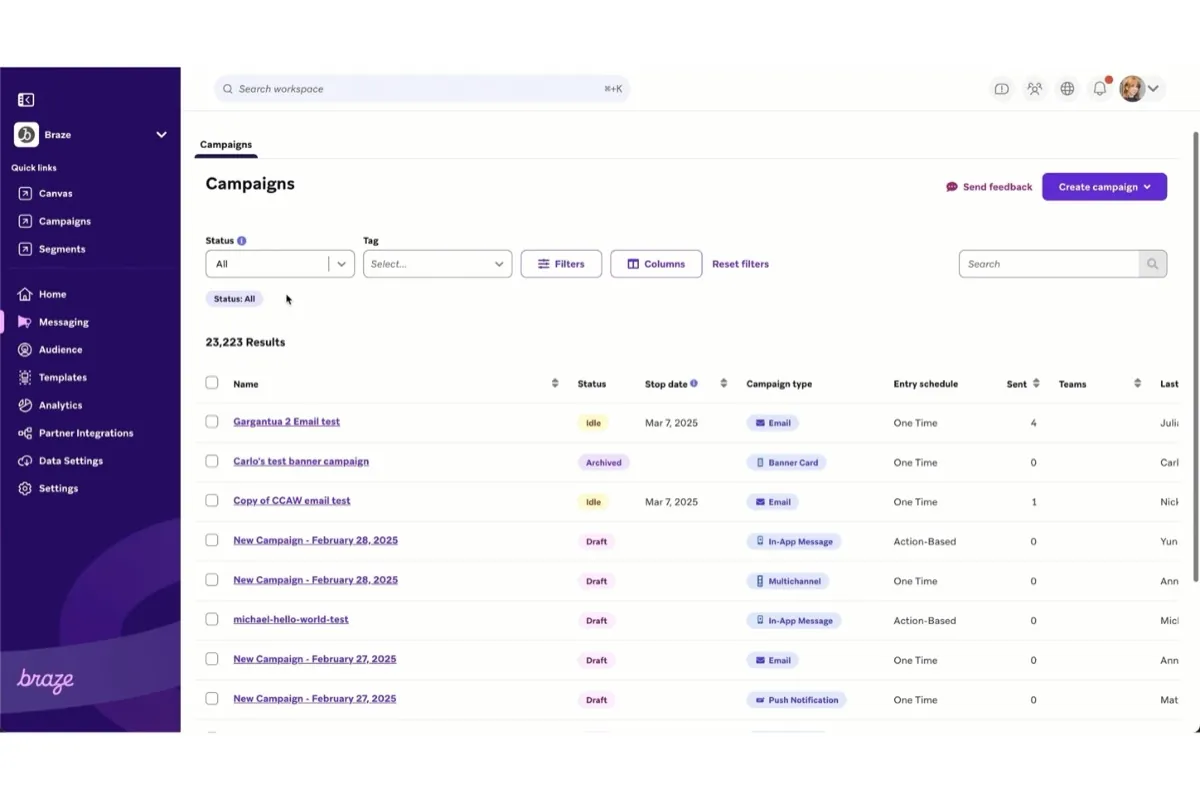
Product Evolution
Braze’s evolution tracks a common pattern among engagement platforms: start with mobile messaging, expand channel coverage, then reach upstream toward the data layer as customers ask for more than execution.
| Year | Milestone |
|---|---|
| 2011 | Founded as Appboy by Bill Magnuson, Jon Hyman, and Mark Ghermezian, focused on mobile push and in-app messaging |
| 2017 | Rebranded to Braze, reflecting expansion into a cross-channel engagement platform beyond mobile |
| Nov 2021 | IPO on Nasdaq under ticker BRZE |
| 2024 | Braze Data Platform (BDP) launched — Cloud Data Ingestion, Currents, and Connected Content added to reduce the data-integration burden |
| 2023 | Sage AI by Braze launched — existing AI/ML capabilities (Intelligent Timing, Intelligent Selection, Winning Path) unified under a single brand, with expanded generative AI features for content creation and campaign optimization |
| 2024 | BrazeAI introduced at Forge 2024 — rebranded and expanded from Sage AI, adding an agentic layer (Project Catalyst) for 1:1 engagement optimization, AI Liquid Assistant, and Message Template Assistant |
| 2025 | Braze acquired OfferFit, an AI-powered marketing experimentation and decisioning company, rebranded as BrazeAI Decisioning Studio — folding reinforcement-learning-based testing into BrazeAI |
| 2025–2026 | Braze positions the “4 D’s” — Data, Decisioning, Design, Distribution — as its product throughline connecting BDP, BrazeAI, and Canvas |
Each addition — BDP, BrazeAI, Decisioning Studio — extends Braze further from its messaging core, but the underlying product is still built around orchestrating and delivering campaigns, not unifying customer records. That distinction shapes what Braze can and cannot do architecturally, covered below.
What Braze Does
- Canvas: Braze’s visual journey-orchestration engine — branching logic, wait steps, and multivariate testing across channels, triggered by user behavior or scheduled campaigns
- Multi-channel messaging: Native delivery across email, push, SMS, in-app messages, webhooks, and WhatsApp, all executed from a single campaign interface
- Intelligent Timing and Intelligent Selection: AI models that choose the optimal send time and channel per user, based on that user’s own engagement history within Braze
- BrazeAI: An agentic layer added in 2024 — a copilot for building campaigns, personalization for generating content variants, and data-science agents that surface engagement insights from Braze’s own event data
- BrazeAI Decisioning Studio: Reinforcement-learning-based testing and decisioning engine — acquired via OfferFit in 2025 — that optimizes offers, channels, and messages per user beyond static A/B tests
- Braze Data Platform (BDP): Cloud Data Ingestion (Snowflake, BigQuery, Databricks, Redshift), Currents (streaming engagement events out to external systems), and Connected Content (pulling external data into messages at send time)
BDP is a genuine improvement to how data moves into and out of Braze — but it is an integration layer, not a CDP-grade data-unification layer. Braze supports identifier-based profile merging within its platform (matching by email, phone, and custom IDs), but not the governed, cross-source identity resolution across all enterprise systems that a dedicated CDP provides. Braze itself lists CDP vendors as technology partners rather than replacements. For the full breakdown of what BDP does and does not solve, see Do You Need a CDP with an Engagement Platform?
Where Braze Sits on the Customer Intelligence Loop
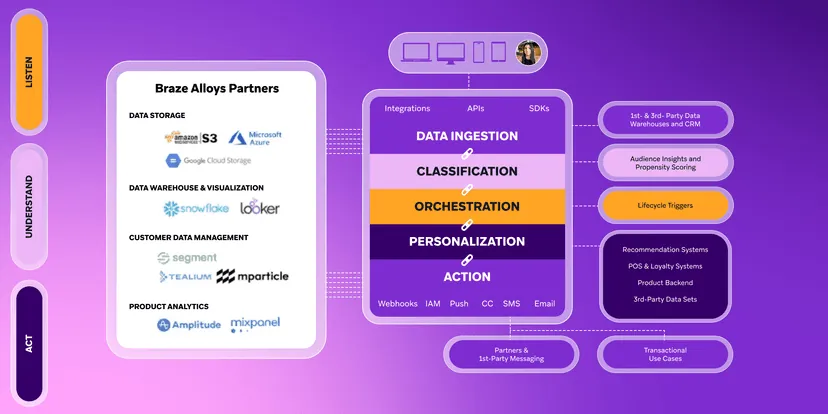
Diagram from Braze’s AI marketing automation guide, showing how Braze positions its platform components.
The Customer Intelligence Loop maps the full cycle from raw data to delivered message and back. Braze’s product suite covers the back half of that cycle deeply and the front half only partially:
| Stage | Braze Coverage |
|---|---|
| 1. COLLECT | Partial — SDK-based engagement events plus BDP’s Cloud Data Ingestion; no independent server-side collection outside a handful of first-party sources |
| 2. UNIFY | Minimal — matches known user and device IDs within Braze; no deterministic-plus-probabilistic identity resolution across anonymous and known states from outside systems |
| 3. UNDERSTAND | Limited — BrazeAI’s data-science agents surface anomaly detection and segment discovery from in-Braze behavioral patterns; cross-channel predictive modeling (churn, LTV) requires external tools |
| 4. DECIDE | Strong — Canvas branching logic, Intelligent Timing/Selection, and BrazeAI Decisioning Studio |
| 5. ENGAGE | Core strength — native delivery across email, push, SMS, in-app, webhooks, and WhatsApp |
Braze’s own “4 D’s” framework — Data, Decisioning, Design, Distribution — describes this same territory. It is a linear pipeline that starts once data has already arrived and ends at delivery, with no mechanism for engagement outcomes to flow back into cross-channel identity resolution or predictive modeling. That maps cleanly to stages 4 and 5 of the Customer Intelligence Loop, with partial coverage of stage 1 through BDP’s Cloud Data Ingestion — but stages 2 and 3 remain outside the framework entirely.
For organizations relying on Braze as their only customer data system, this gap is the practical question: campaigns can only be as targeted as the data Braze itself collects and stores. The core decision: if a CDP is already feeding Braze clean, unified audiences, Braze is a strong execution layer. If Braze is the only customer data system in place, it is missing the identity resolution and cross-channel predictive modeling a CDP provides.
Braze Pricing
| Pricing | Braze |
|---|---|
| Priced on | Monthly active users (MAU) or tracked users, plus which modules are licensed |
| Published price | None — quote-based only |
| Reported contract range | $50,000–$200,000/yr mid-market (Vendr, G2); $500,000+ enterprise, seven figures for the largest consumer brands; ~$265,000 all-customer average derived from FY2026 ARR ÷ customer count, skewed upward by enterprise accounts |
| Priced separately | Canvas, Currents, BrazeAI, BrazeAI Decisioning Studio; the CDP or warehouse that supplies unified audiences |
Braze does not publish list pricing. Contracts are quote-based and driven primarily by monthly active users (MAU) or tracked users, plus which modules are licensed — Canvas, Currents, BrazeAI, and BrazeAI Decisioning Studio are typically priced as separate line items rather than bundled by default.
Based on publicly reported Vendr and G2 contract data, mid-market consumer brands commonly land in the $50,000–$200,000 per year range, consistent with other CEPs. Large-scale MAU volumes, combined with BrazeAI, Decisioning Studio, and Currents add-ons, can push enterprise contracts past $500,000 annually — and for the largest consumer brands with hundreds of millions of monthly active users, seven-figure annual contracts are common. Braze’s own FY2026 investor materials report roughly $693M in ARR across approximately 2,609 customers, implying an average spend of roughly $265,000 per year — meaning a substantial portion of the customer base spends well above that to balance the long tail of smaller accounts. Because Braze does not unify or store data outside its own channels, the true cost of a complete customer-intelligence stack should also include whatever CDP, warehouse, or identity-resolution tooling feeds Braze accurate, unified audiences — see CDP Pricing: Models, Ranges, and Hidden Costs for a full TCO comparison across architectures.
Strengths
- Best-in-class journey orchestration: Canvas’s branching logic and multivariate testing are consistently cited as among the strongest in the engagement-platform category
- Deep channel coverage: Native delivery across email, push, SMS, in-app, webhooks, and WhatsApp reduces the number of point tools needed for execution
- AI-driven send-time and channel optimization: Intelligent Timing and Intelligent Selection improve engagement without manual rule-building
- Real investment in AI decisioning: BrazeAI and the BrazeAI Decisioning Studio launch (via the 2025 OfferFit acquisition) show Braze moving beyond static rules toward reinforcement-learning-based experimentation
- BDP narrows the data gap: Cloud Data Ingestion and Currents make it meaningfully easier to connect Braze to a warehouse or CDP than pure messaging-only platforms offer
- Public-company scale: As a Nasdaq-listed company since 2021, Braze brings the balance sheet and enterprise support infrastructure large consumer brands expect
Limitations
- No cross-source identity resolution: Braze matches known user and device IDs within its own SDKs. It does not perform the deterministic-plus-probabilistic matching across anonymous and known states, devices, and offline records that a dedicated identity resolution system provides
- No governed system of record: Profiles in Braze exist to serve messaging, not to act as a source other teams query. Like any single-channel tool, Braze has no mechanism to propagate a deletion or consent change beyond its own SDKs — that propagation must be handled by a CDP or consent-management layer sitting upstream
- Cross-channel understanding is thin: BrazeAI’s data-science agents work on Braze’s own engagement data. Predictive scoring that spans channels outside Braze — in-store purchases, support tickets, website behavior captured elsewhere — requires external modeling
- The feedback loop only closes inside Braze’s channels: Engagement outcomes feed Braze’s own optimization models, but anything happening outside Braze’s SDKs never reaches those models unless it is piped in through BDP or a separate CDP
- Add-on pricing adds up: BrazeAI, Currents, and BrazeAI Decisioning Studio are typically priced as adjacent modules rather than included by default, so the full Braze stack often costs meaningfully more than a base Canvas license suggests
Who Should Consider Braze
Braze is a strong fit for organizations that meet most of these criteria:
- Consumer-facing, mobile- or app-led brands with high message volume and a need for channel diversity
- Marketing teams that want sophisticated journey orchestration and experimentation without heavy data-engineering investment
- Organizations that already have a CDP or warehouse feeding Braze clean, unified audiences and just need best-in-class execution
- Teams prioritizing AI-driven send-time and channel optimization now, with data unification planned as a separate workstream
Braze is a weaker fit for organizations that:
- Need a single platform for data collection, identity resolution, and messaging rather than assembling one from multiple tools
- Have customer data scattered across five or more non-messaging sources — POS, support, offline — that require real identity resolution
- Operate under compliance regimes that need centralized consent and deletion propagation across every system, not just messaging channels
- Want an AI feedback loop that spans every customer touchpoint, not only the channels flowing through Braze’s own SDKs
The Warehouse-to-Braze Stack: Is the Middle Layer Necessary?
A common enterprise pattern runs: Cloud Data Warehouse (Snowflake, BigQuery, Databricks) → Reverse ETL (Hightouch, Census) → Braze. The warehouse models customer data with dbt, reverse ETL syncs segments to Braze, and Braze handles messaging. This stack has been the de facto standard for data-mature organizations that want warehouse-native modeling paired with best-in-class engagement.
But two shifts are making the middle layer look increasingly optional — and both have implications for the stack’s total cost and structural integrity.
Shift 1: Braze Cloud Data Ingestion Cuts Out Reverse ETL
Braze Cloud Data Ingestion (CDI) now connects directly to Snowflake, BigQuery, Databricks, and Redshift — syncing profiles, attributes, and computed fields into Braze without a reverse ETL tool in between. Combined with CDI Segments (zero-copy audience building from warehouse data) and zero-copy Canvas triggers (launched April 2026), Braze can now activate warehouse data without Hightouch or Census sitting in the middle. For teams whose only use case is “push warehouse audiences to Braze,” CDI makes the reverse ETL layer redundant — one fewer vendor to pay for, one fewer sync to debug at 2 a.m.
Shift 2: Agentic CDPs Combine the Data and Messaging Layers
The larger strategic question is whether the three-layer stack itself — warehouse, activation middleware, engagement platform — is the right architecture. Agentic CDPs that include native messaging collapse the stack into one platform: data unification, identity resolution, AI decisioning, and cross-channel delivery all operate within a single system boundary. There is no warehouse-to-Braze sync to maintain because the CDP handles both the data layer and the messaging layer. There is no reverse ETL to pay for because activation is native, not bolted on.
What Both Approaches Still Miss
Whether you connect your warehouse to Braze directly (CDI) or through reverse ETL (Hightouch), the same structural gaps remain:
- No cross-source identity resolution: Both approaches depend on identities already being resolved upstream — in the warehouse or a separate CDP. Braze matches known IDs within its own SDKs but does not do the probabilistic cross-device, cross-channel matching a dedicated identity resolution system provides
- PII still moves: Every CDI sync or reverse ETL job copies customer data into Braze. If you activate to five other destinations, that is five more copies at five more vendor boundaries — the same PII sprawl problem composable stacks face, just one layer downstream
- The feedback loop stays open: Engagement outcomes (opens, clicks, conversions) flow back to Braze’s optimization models, but anything outside Braze’s SDKs — in-store purchases, support tickets, ad interactions — never reaches those models unless separately piped in. The Customer Intelligence Loop remains open at stage 5
The practical question for most teams is not “do I need reverse ETL between my warehouse and Braze?” — CDI already answers that for simple syncs. The real question is whether a three-vendor stack (warehouse + CDP-or-reverse-ETL + CEP) is structurally sound for AI-driven marketing, or whether a single agentic CDP with native messaging closes the loop more effectively at lower total complexity. For a full comparison of the costs and trade-offs between these stack patterns, see CDP Pricing: Models, Ranges, and Hidden Costs.
Alternatives to Braze
Organizations evaluating Braze alongside broader customer-data needs generally choose one of two paths: pairing Braze with a dedicated CDP that owns collection, identity resolution, and cross-channel modeling — or replacing the combination with a single agentic CDP that includes native messaging and closes the Customer Intelligence Loop inside one platform boundary. Direct engagement-platform competitors include Iterable (more approachable journey builder, lower cost at mid-market scale) and MoEngage (deeper mobile-app and APAC penetration, Aampe per-user AI decisioning). For a side-by-side comparison of vendors across both approaches, see the CDP Vendor Comparison Guide. Teams building an AI-era RFP should also read How to Evaluate a CDP in the AI Era before comparing Braze against pure-play CDPs.
→ Compare all CDP vendors side-by-side in the CDP Vendor Comparison Guide
See how independent analysts evaluate CDP vendors — download the Forrester Wave or IDC MarketScape reports for a side-by-side comparison.
Related Articles
- Do You Need a CDP with an Engagement Platform? — Full breakdown of what Braze Data Platform does and does not solve
- CDP vs Customer Engagement Platform — The full framework comparison and convergence thesis
- CDP Pricing: Models, Ranges, and Hidden Costs to Budget For — How CDP and CEP total cost of ownership compares across architectures
- What Is Hightouch? — Another vendor repositioning around the “agentic CDP” label
- What Is Iterable? Features, Pricing & Alternatives — Growth-focused engagement platform with AI-driven personalization
- What Is MoEngage? Features, Pricing & Alternatives — The same self-branded-data-layer pattern at a mobile-first engagement platform
- CDP Alternatives: 7 Options Compared and When You Need Each — Where Braze fits among broader CDP alternatives
FAQ
Is Braze a CDP?
No — Braze is a customer engagement platform, not a CDP. While Braze Data Platform (BDP) adds Cloud Data Ingestion and Currents for moving data in and out of Braze, it does not provide cross-source identity resolution, a governed customer profile that serves as a system of record, or centralized consent and deletion propagation across systems. For the full breakdown of what BDP does and does not solve, see Do You Need a CDP with an Engagement Platform?.
How much does Braze cost?
Braze pricing is quote-based and not published — cost is driven primarily by monthly active users (MAU) plus which modules you license. Canvas, multi-channel messaging, Currents, BrazeAI, and Decisioning Studio are typically priced as separate line items. Based on publicly reported Vendr and G2 contract data, mid-market contracts commonly fall in the $50,000–$200,000 per year range; large MAU volumes can push enterprise deals past $500,000, with the largest consumer brands spending $1M or more annually.
What is Braze Data Platform?
Braze Data Platform (BDP) is a 2024 addition that pipes external data into Braze and streams engagement events back out — it does not turn Braze into a CDP. Its three components — Cloud Data Ingestion, Currents, and Connected Content — improve data flow into and out of Braze’s messaging layer, but Braze itself lists CDP vendors as technology partners rather than replacements. For the full breakdown, see Do You Need a CDP with an Engagement Platform?
What are alternatives to Braze?
Organizations typically move in one of two directions: adding a dedicated CDP for data unification alongside Braze, or replacing the combination with a single agentic CDP that includes native messaging. Agentic CDPs close the Customer Intelligence Loop within one platform boundary instead of splitting collection, identity, and messaging across systems. See the CDP Vendor Comparison Guide for a full comparison.