
MoEngage is a customer engagement platform (CEP) that orchestrates cross-channel campaigns — email, push, SMS, in-app, and WhatsApp — with a growing layer of AI-driven, per-user decisioning, not an independently recognized customer data platform. Founded in 2014 in Bengaluru by Raviteja Dodda and Yashwanth Kumar, MoEngage now runs cross-channel campaigns for more than 1,350 brands from headquarters split between Bengaluru and San Francisco, and has spent 2026 pushing hard into “agentic” positioning following its acquisition of Aampe.
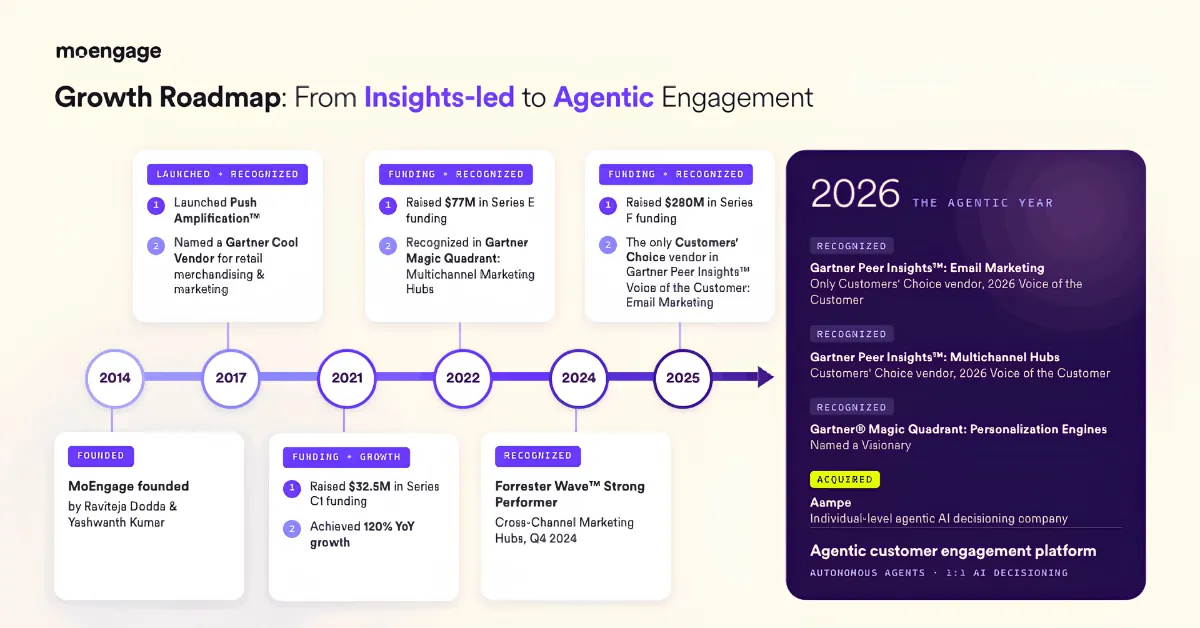
Diagram from MoEngage’s “What Is MoEngage?” blog post, showing the company’s own growth roadmap.
MoEngage’s own marketing does not agree on that CDP question, though. The homepage tagline calls it an “Agentic Customer Engagement Platform.” A dedicated product page one click away is titled, simply, “Customer Data Platform,” and claims MoEngage builds “unified customer profiles” from web, app, offline, CRM, and support data. G2 — which categorizes vendors independently of their own marketing copy — lists MoEngage under Mobile Marketing, Mobile App Analytics, Personalization, and Marketing Analytics, and has never categorized MoEngage as a Customer Data Platform. That gap matters most if you came here hoping MoEngage is a combined CDP-plus-CEP in one platform rather than an engagement layer that still needs a CDP underneath it — which is exactly the question the rest of this page answers.
This independent overview covers what MoEngage does, why its own marketing contradicts itself on the CDP question, where it fits on the Customer Intelligence Loop, what it costs, and when alternatives are worth evaluating. For a side-by-side comparison of all CDP vendors, see the CDP Vendor Comparison Guide.
Product Evolution
MoEngage’s evolution tracks a pattern common to engagement platforms: build channel coverage first, then layer in AI, then reach for the “platform” and “agentic” labels once AI investment reaches critical mass.
| Period | Milestone |
|---|---|
| 2014 | Founded in Bengaluru by Raviteja Dodda and Yashwanth Kumar; headquarters later split between Bengaluru and San Francisco |
| Early years | Sherpa AI engine introduced — predictive send-time optimization, churn prediction, and content/channel recommendation built on MoEngage’s own engagement data |
| Sept 2023 | Merlin AI launched — a generative AI co-pilot for marketers, handling campaign generation and insight discovery |
| 2025–2026 | Merlin AI Agents introduced — an agentic layer on top of Merlin AI for autonomous workflow execution |
| Nov 2025 | $100M raised, led by Goldman Sachs Alternatives and A91 Partners |
| Dec 2025 | An additional $180M raised, led by ChrysCapital and Dragon Funds with participation from Schroders Capital, TR Capital, and B Capital — combined Series F roughly $280M, earmarked for Merlin AI R&D, North America/EMEA expansion, and strategic acquisitions |
| June 24, 2026 | Acquired Aampe, an AI infrastructure company running a dedicated autonomous decisioning agent per individual user, which MoEngage states processes 200B+ decisions weekly — a vendor-reported figure from the acquisition announcement, not independently audited. MoEngage frames the combination as building “a unified platform for agentic marketing and decisioning” |
Each addition — Sherpa, Merlin AI, Merlin AI Agents, Aampe — pushes MoEngage further into AI-driven decisioning. None of them adds independent, cross-source identity resolution outside MoEngage’s own SDKs and integrations. That distinction is the difference between an engagement platform getting smarter and a CDP, and it shapes everything below.
What MoEngage Does
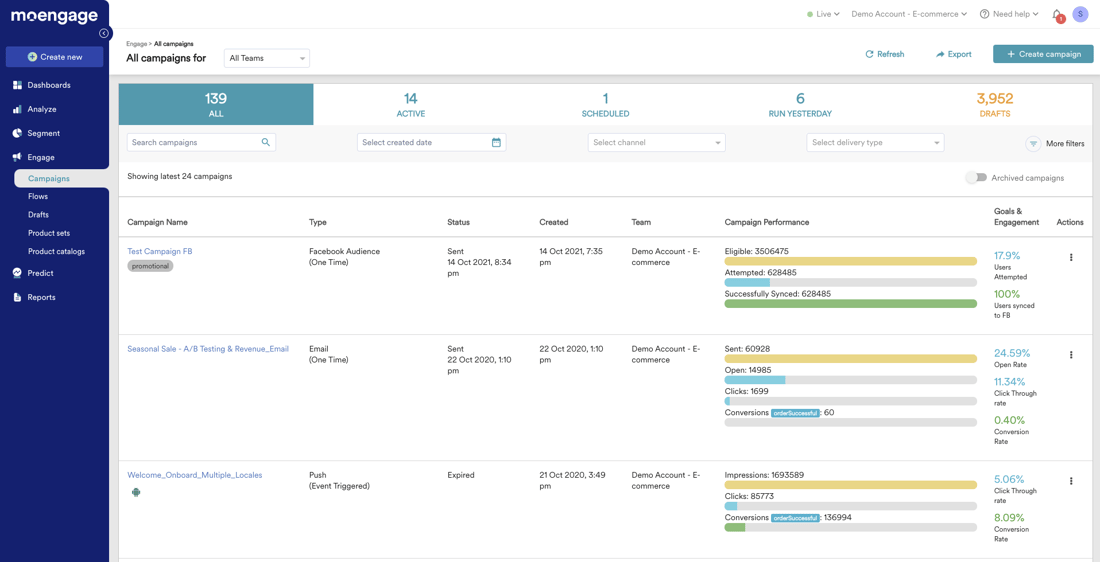
- Cross-Channel Marketing: Journey orchestration across 11 channels (email, push, SMS, in-app, WhatsApp, web push, and others), triggered by user behavior or scheduled sends
- Web & App Personalization: Real-time content and experience personalization on owned digital properties, driven by behavioral signals captured within MoEngage
- Customer Insights & Analytics: Built on the Sherpa AI engine — predictive send-time optimization, churn prediction, and content/channel recommendation from engagement data
- MoEngage Inform: Real-time transactional alerts (order confirmations, OTPs, delivery updates) delivered across channels and vendors through a unified API
- Data Management: Centralizes customer data operations within MoEngage, positioned to eliminate manual ETL work for marketing teams
MoEngage bundles genuine breadth here — few pure messaging tools cover 11 channels plus transactional alerting plus a dedicated data-operations layer. Whether that bundle adds up to a real CDP, despite the branding on one of its own product pages, is worth testing against the Customer Intelligence Loop before taking the label at face value.
Where MoEngage Sits on the Customer Intelligence Loop
The Customer Intelligence Loop maps the full cycle from raw data to delivered message and back. MoEngage’s product suite, including Aampe, covers the back half of that cycle deeply and the front half only within its own ecosystem:
| Stage | MoEngage Coverage |
|---|---|
| 1. COLLECT | Scoped to MoEngage’s own SDKs and connected sources; Data Management centralizes what flows in, but does not independently collect from systems MoEngage does not integrate with |
| 2. UNIFY | Minimal — profile merging happens within MoEngage’s own data model; no independently validated, governed identity resolution across non-MoEngage systems, despite MoEngage’s own CDP-branded marketing claiming “unified customer profiles” (more on this below) |
| 3. UNDERSTAND | Strong within MoEngage — Sherpa’s predictive scoring (churn, engagement) and RFM/affinity segmentation operate well on data already inside the platform |
| 4. DECIDE | Strong and improving fast — Merlin AI Agents handle workflow-level decisioning; Aampe adds per-user reinforcement-learning decisioning (Thompson Sampling/multi-armed bandits) and causal analysis on content, timing, frequency, and channel |
| 5. ENGAGE | Core strength — native delivery across 11 channels plus MoEngage Inform for real-time transactional alerts |
The pattern is clear: every recent investment — Merlin AI, Merlin AI Agents, Aampe — strengthens DECIDE and ENGAGE. None of it strengthens UNIFY, the stage that determines whether “customer data platform” is an accurate label. The core decision: if a CDP or warehouse is already feeding MoEngage clean, unified audiences, MoEngage is a capable execution and decisioning layer. If MoEngage is the only customer data system in place, its own data-management tools do not substitute for independently validated identity resolution.
MoEngage Pricing
| Pricing | MoEngage |
|---|---|
| Priced on | Monthly Tracked Users (MTU), on a Growth or Enterprise tier |
| Published price | None — no per-tier or per-MTU rate card |
| Reported contract range | $186,725 average contract value (Vendr public marketplace data) |
| Priced separately | Customer Journey Analytics, AI Offer Decisioning, Inform (transactional alerts), WhatsApp Native, Outbound Segment Sync, and other add-ons; the CDP or warehouse that supplies resolved audiences |
MoEngage does not publish list pricing. The company offers two named tiers — Growth and Enterprise — priced by Monthly Tracked Users (MTU) rather than a flat platform fee.
The Growth plan includes unlimited email, SMS, push, in-app, WhatsApp Business API, and web push messaging, unlimited segments, and predictive AI with real-time personalization. The Enterprise plan adds AI-driven engagement intelligence (automatically identifying the best send time and channel per user) plus enterprise security and compliance controls — access roles, audit logs, firewall protection, and PII encryption. Several capabilities are priced as separate add-ons rather than bundled into either tier: Customer Journey Analytics, Real-Time Transactional Alerts (Inform), AI Offer Decisioning, WhatsApp Native, real-time data exports, Open Analytics, Content Cards, and Outbound Segment Sync — the last of which exports segment membership changes (added/removed user lists) to downstream platforms, not queryable individual profiles.
Vendr’s public marketplace data puts MoEngage’s average contract value at $186,725 — below the roughly $265,000 average implied by Braze’s FY2026 investor materials, though within the $50,000–$200,000 range Vendr and G2 report for mid-market Braze contracts (see What Is Braze?). Neither vendor publishes a per-tier, per-MTU rate card, so pricing a specific deployment still requires a sales conversation. Because MoEngage does not independently unify data outside its own channels, the true cost of a complete customer-intelligence stack should also account for whatever CDP or warehouse feeds MoEngage clean, resolved audiences — see CDP Pricing: Models, Ranges, and Hidden Costs for a full TCO comparison across architectures.
Strengths
- Deep mobile-app and APAC penetration: MoEngage’s roots in Bengaluru and long track record with mobile-first fintech, e-commerce, and D2C brands in India and Southeast Asia give it configuration depth competitors built for Western enterprise buyers often lack
- Aggressive, well-funded AI investment: A $280M Series F followed within months by the Aampe acquisition signals real capital committed to agentic decisioning, not just marketing language
- Per-user decisioning at scale: Aampe’s reinforcement-learning approach — a dedicated agent per user, which MoEngage states runs 200B+ decisions weekly (a vendor-reported figure, not independently audited) — is a genuinely differentiated decisioning capability, not a repackaged rules engine
- Broad native channel coverage: 11 channels plus MoEngage Inform’s unified API for transactional alerts reduce the number of point tools needed for execution
- Large, recent capital base: The Series F gives MoEngage runway to keep investing in Merlin AI and further acquisitions without near-term fundraising pressure
- Scale claims, if directionally accurate: MoEngage states it engages roughly 20% of the world’s population monthly across 1,350+ brands, including Ola, Airtel, and McAfee — a vendor claim, not an independently audited figure, but indicative of real production scale
- Strong compliance certification stack: SOC 2 Type 2, CSA STAR, ISO 27001:2022 (MoEngage says it is the first customer engagement platform to hold this), ISO 27701 (privacy information management), ISO 22301 (business continuity), and HIPAA compliance, with data centers in the US, EU, India, and Indonesia — a genuine differentiator for regulated industries evaluating engagement platforms
Limitations
- The CDP-labeling contradiction itself is a limitation: A homepage tagline calling MoEngage an engagement platform, a dedicated page calling it a CDP, and a blog post describing it as a CEP that partners with CDPs like mParticle is not just marketing noise — it is a genuine lack of clarity buyers have to resolve themselves before scoping a deal
- No independently validated identity resolution: The CDP page’s “unified customer profiles” claim is not corroborated by G2’s category placement or by MoEngage’s own blog content describing itself as CDP-adjacent rather than CDP-equivalent
- Third-party recognition sits in engagement categories, not data unification: G2 places MoEngage under Mobile Marketing, Mobile App Analytics, Personalization, and Marketing Analytics — categories that reward campaign execution and analytics, not cross-source data governance
- Consent and deletion propagation is scoped to MoEngage’s own channels: Like Braze, MoEngage has no mechanism to propagate a deletion or consent change beyond its own SDKs and integrations — that must be handled by a CDP or consent-management layer sitting upstream
- Aampe integration is unproven at the time of writing: The acquisition closed June 24, 2026; how deeply Aampe’s per-user decisioning integrates with Merlin AI’s workflow layer, rather than operating as a bolted-on module, is not yet demonstrated at scale
- Real-time architecture is not independently documented: MoEngage’s public materials do not specify whether segment evaluation for messaging triggers runs on a continuously streaming architecture or a periodic query model — a meaningful distinction for real-time use cases that buyers should confirm directly with MoEngage’s solutions engineering team rather than relying on marketing copy or competitor claims alone
Who Should Consider MoEngage
MoEngage is a strong fit for organizations that meet most of these criteria:
- Mobile-app-led fintech, e-commerce, D2C, or consumer subscription businesses, particularly with meaningful APAC or emerging-market user bases
- Growth teams that want deep native channel coverage and per-user AI decisioning without assembling a multi-vendor stack
- Organizations that already have a CDP or warehouse feeding MoEngage clean, unified audiences and need a capable execution and decisioning layer on top
- Price-conscious teams comparing MoEngage against CleverTap, Braze, or WebEngage on channel breadth and AI investment rather than data-unification depth
MoEngage is a weaker fit for organizations that:
- Need independently validated, cross-source identity resolution and are inclined to take MoEngage’s own CDP page at face value rather than verifying it against G2 or an analyst evaluation
- Operate under compliance regimes requiring centralized consent and deletion propagation across every connected system, not only MoEngage’s own channels
- Have customer data scattered across five or more non-MoEngage sources — POS, support, offline retail — that require governed identity resolution before activation
- Want public, benchmarked contract pricing to compare against competitors before entering a sales process
For teams actively weighing the three most common comparisons: CleverTap, MoEngage, and WebEngage overlap heavily on core channel coverage, so the deciding factors tend to be need for continuously real-time behavioral triggers (CleverTap’s stronger claim), scale of AI-driven send-time optimization investment (MoEngage’s stronger claim), and ease of use for a mid-market visual journey builder (WebEngage’s stronger claim) — none of which is independently adjudicated by an analyst source, so verify directly against a current trial or sales demo rather than a comparison site. None of the three publishes the identity-resolution depth needed to replace a dedicated CDP.
MoEngage’s Self-Contradiction: CDP or Engagement Platform?
This is where MoEngage’s marketing gets internally inconsistent, and it matters because buyers are being pitched both stories simultaneously.
Claim one: The moengage.com homepage tagline positions the company as an “Agentic Customer Engagement Platform.” Claim two: A separate, dedicated product page at moengage.com/customer-data-platform claims MoEngage aggregates data from web, app, offline, marketplaces, email, social, paid ads, event marketing, customer service, sales intelligence, and CRM sources into “unified customer profiles,” supporting RFM and affinity segmentation into “hundreds of micro-segments.” Claim three, from MoEngage’s own blog: a post titled “A Deep Dive Into How MoEngage Works Alongside a CDP” describes MoEngage as a CEP that integrates with dedicated CDPs like mParticle — a fundamentally different architectural claim than the CDP page next to it, which describes MoEngage building the unified profile itself.
None of this is resolved by an outside authority. G2 independently categorizes MoEngage under Mobile Marketing, Mobile App Analytics, Personalization, and Marketing Analytics — never under Customer Data Platform. Analyst and review-site categorization is not infallible, but it is the closest thing buyers have to a check on vendor self-description, and on this specific claim it does not corroborate MoEngage’s own CDP page. That said, a G2 category tag is a market signal, not a technical audit — this article could not independently verify from public documentation whether MoEngage’s profile merging uses deterministic keys, probabilistic matching, or both, or how it resolves conflicting attributes across sources. That gap in public technical detail is itself part of the buyer’s diligence problem.
The practical read: MoEngage’s data-management capabilities are real and useful for centralizing operations within its own channels, but “unified customer profiles” inside a messaging tool is a different claim than the governed, cross-source identity resolution a dedicated CDP performs — the same distinction that applies to Braze Data Platform and other CEP-adjacent data layers. See What Is Braze? for the same structural pattern at a different vendor. A vendor calling one of its own pages “Customer Data Platform” does not make the underlying architecture a CDP; it makes the buyer’s job figuring out which claim to trust.
Does Aampe Make MoEngage a CDP?
MoEngage’s framing of the Aampe acquisition — “a unified platform for agentic marketing and decisioning,” “1:1 Agentic Decisioning” — deliberately echoes the language of an agentic CDP. Aampe’s real, technically substantive contribution is a dedicated autonomous agent per individual user, using reinforcement learning (Thompson Sampling and multi-armed bandits) plus causal analysis to optimize message content, timing, frequency, and channel — targeting the “human bandwidth” constraint of manually building segments, journeys, and rules at scale.
What Aampe does not add is independent, cross-source identity resolution against systems MoEngage does not integrate with, nor a governed profile store that other teams can query as a system of record — Outbound Segment Sync exports audience membership deltas, not queryable profiles (see Pricing above). This is the same structural pattern seen in Braze’s Braze Data Platform acquisition strategy — real investment that extends coverage of the back half of the loop while leaving the front half (COLLECT/UNIFY) exactly where it was.
Per cdp.com’s 3-stage CDP evolution framework, an Agentic CDP requires real-time profile access, a closed feedback loop within a single platform boundary, native messaging, embedded AI decisioning, and pre-built agent skills — running on top of independently governed, cross-source unified profiles. MoEngage now has strong native messaging and embedded AI decisioning. It does not yet have independently validated identity resolution or a governed profile store outside its own channels. MoEngage is adopting agentic language ahead of the data-layer prerequisites that would make the label accurate — the Aampe acquisition deepens DECIDE, not UNIFY.
Questions worth asking MoEngage’s sales team before signing:
- Ask for a reference where the
/customer-data-platform/page’s “unified customer profiles” claim was validated by a third party, not just MoEngage’s own case-study team - Ask whether profile merging uses deterministic keys, probabilistic matching, or both, and how conflicting attributes are resolved
- Ask how Aampe’s per-user agent handles a person MoEngage has not yet seen in its own SDKs — does it wait for first-party signal, or can it ingest identity from an upstream CDP on day one?
- Ask whether Outbound Segment Sync (or any other export) can expose profile-level data to a downstream system, or only segment membership changes
Alternatives to MoEngage
Organizations evaluating MoEngage alongside broader customer-data needs generally choose one of two paths: pairing MoEngage with a dedicated CDP that owns collection, identity resolution, and cross-channel modeling — or replacing the combination with a single agentic CDP that includes native messaging and closes the Customer Intelligence Loop inside one platform boundary. Teams building an AI-era RFP should read How to Evaluate a CDP in the AI Era before comparing MoEngage against pure-play CDPs, and for a side-by-side comparison of vendors across both approaches, see the CDP Vendor Comparison Guide.
→ Compare all CDP vendors side-by-side in the CDP Vendor Comparison Guide
See how independent analysts evaluate CDP vendors — download the Forrester Wave or IDC MarketScape reports for a side-by-side comparison.
Related Articles
- What Is Braze? Features, Pricing & Alternatives — The same self-branded-data-layer pattern at a different engagement platform
- CDP vs Customer Engagement Platform — The full framework comparison and convergence thesis
- Do You Need a CDP with an Engagement Platform? — Summary of what engagement platforms do and do not solve
- CDP Pricing: Models, Ranges, and Hidden Costs to Budget For — How CDP and CEP total cost of ownership compares across architectures
- CDP Alternatives: 7 Options Compared and When You Need Each — Where MoEngage fits among broader CDP alternatives
FAQ
Is MoEngage a CDP?
No — independent evidence does not support MoEngage’s self-branded “Customer Data Platform” page. MoEngage’s homepage calls it an “Agentic Customer Engagement Platform,” its own blog describes it as a CEP that integrates with dedicated CDPs like mParticle, and G2 categorizes it under Mobile Marketing, Personalization, and Marketing Analytics — never Customer Data Platform. Its data-management tools centralize operations within MoEngage’s own channels but do not perform independently validated, cross-source identity resolution.
How much does MoEngage cost?
MoEngage does not publish list pricing; cost is driven by Monthly Tracked Users (MTU) across its Growth and Enterprise tiers. Growth includes unlimited messaging channels and segments with predictive AI; Enterprise adds AI-driven engagement intelligence and compliance controls. Add-ons like Customer Journey Analytics and AI Offer Decisioning are priced separately. Vendr’s public marketplace data puts MoEngage’s average contract value at $186,725, below the roughly $265,000 average implied by Braze’s FY2026 investor materials, though neither publishes a per-tier rate card.
What is MoEngage’s Aampe acquisition?
On June 24, 2026, MoEngage acquired Aampe, an AI infrastructure company that runs a dedicated autonomous decisioning agent per individual user. Using reinforcement learning (Thompson Sampling, multi-armed bandits) and causal analysis, Aampe optimizes message content, timing, frequency, and channel at the individual level. MoEngage frames the combination with Merlin AI as “a unified platform for agentic marketing and decisioning” — a real advance in DECIDE-stage capability, not in data unification.
What are alternatives to MoEngage?
Organizations typically move in one of two directions: adding a dedicated CDP for data unification alongside MoEngage, or replacing the combination with a single agentic CDP that includes native messaging. Common comparison points include CleverTap, Braze, and WebEngage. Agentic CDPs close the Customer Intelligence Loop within one platform boundary instead of splitting collection, identity, and messaging across systems. See the CDP Vendor Comparison Guide for a full comparison.