
Bloomreach is an e-commerce personalization platform built around a customer data platform called the Customer Data Engine (CDE), which powers unified profiles, identity resolution, and audience segmentation across the vendor’s search, discovery, and marketing automation products. Bloomreach itself answers the CDP question directly in its pricing FAQ: “We can be [a CDP].” That qualified answer is the most important thing for buyers to understand — Bloomreach has genuine CDP capabilities, but they are not sold as a standalone product. The CDP only ships bundled with Bloomreach’s marketing automation engagement suite.
This independent overview covers what Bloomreach does, how its CDP capabilities actually work, what it costs, what real users say about it, and when alternatives may be a better fit. For a side-by-side comparison of all CDP vendors, see the CDP Vendor Comparison Guide.
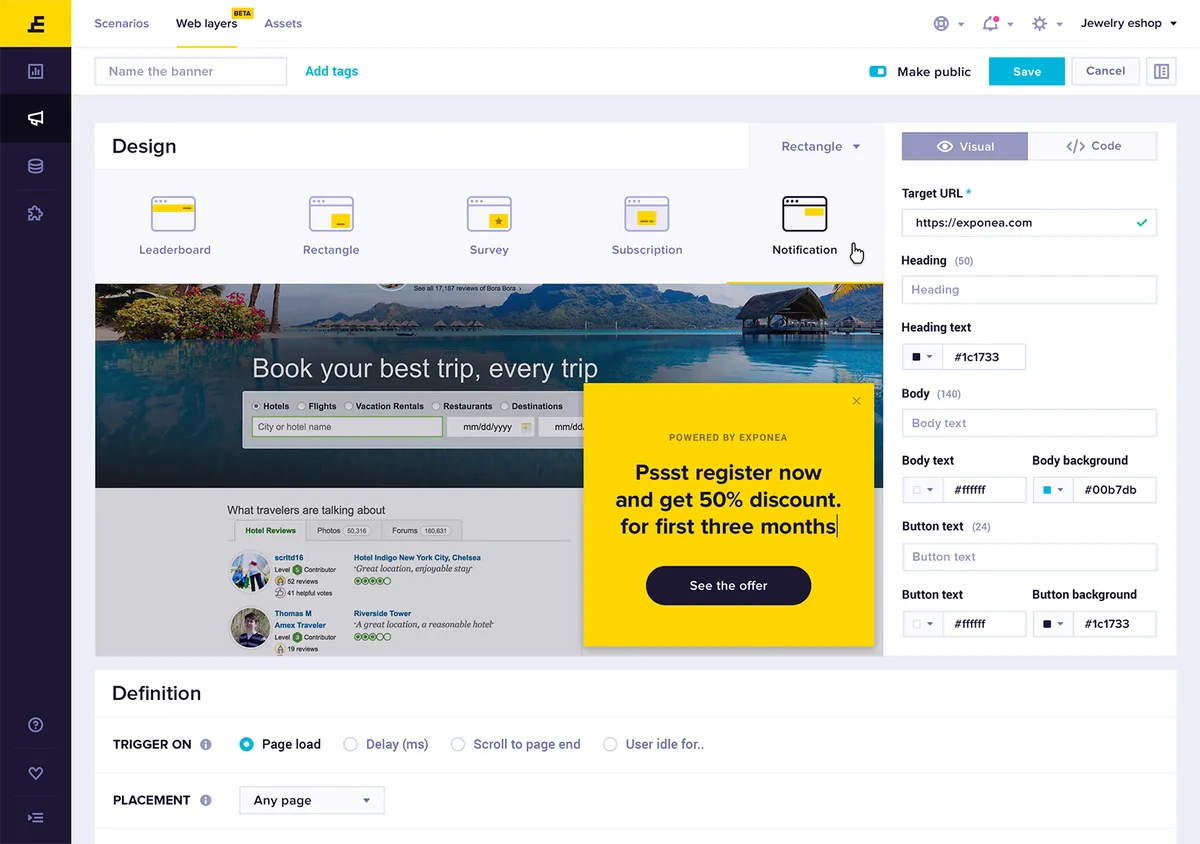
Product Evolution
Bloomreach’s history is a story of an e-commerce SEO tool absorbing a purpose-built CDP through acquisition, then unifying both under an AI layer.
| Year | Milestone |
|---|---|
| 2009 | Founded by Raj De Datta in San Mateo, CA, as an SEO and site search tool for e-commerce retailers |
| 2012 | Exponea founded in Slovakia by Peter Irikovsky — built from the ground up as a CDP and marketing automation platform, later certified as one of the first GDPR-compliant SaaS companies |
| 2016 | Bloomreach acquires Hippo CMS, adding headless content management to the product line |
| Jan 2021 | Bloomreach acquires Exponea, backed by a $150M investment from Sixth Street Growth, valuing the combined company at $900M. Exponea’s CDP becomes the foundation of Bloomreach’s Customer Data Engine (CDE) |
| 2023–2024 | Bloomreach consolidates its products into three pillars — Discovery, Engagement, and Content — and introduces Loomi, a cross-pillar AI layer |
| 2026 | Repositioned as an “agentic platform for personalization” (“Commerce Experience Cloud”), with Loomi AI features embedded across search, merchandising, and marketing automation, including a Marketing Agent that generates email workflows from plain-English prompts |
Bloomreach now serves 1,400+ brands, including American Eagle, Sonepar, Pandora, BrewDog, boohooMAN, Yeo Valley, and Woolworths Metro60, concentrated in retail, financial services, hospitality, travel, iGaming, and food & beverage. The company is MACH Alliance certified and holds ISO/SOC 2 Type II compliance.
What Bloomreach Does
Bloomreach organizes its capabilities into three product pillars, unified by the Loomi AI layer:
- Autonomous Marketing (Engagement): This is where the CDP lives. The Customer Data Engine (CDE) — built on Exponea’s original architecture — handles data unification, identity resolution, and journey orchestration. Engagement includes 13+ native activation channels: email, SMS, WhatsApp, RCS, push notifications, web personalization, and ad audience syncing. G2 reviewers consistently cite the real-time processing speed here, with data moving from ingestion to activation in as little as 5 milliseconds and no worse than roughly 2 seconds
- Autonomous Search (Discovery): AI-driven site search, merchandising, product recommendations, and long-tail SEO optimization for commerce catalogs
- Conversational Shopping (Clarity): An AI shopping agent embedded directly in the website experience, triggered by visitor behavior to answer product questions and guide purchase decisions
- Loomi AI: The intelligence layer spanning all three pillars — powering search ranking, predictive segmentation, real-time recommendations, and the Marketing Agent, which can generate a complete email campaign workflow from a plain-language prompt. Standard AI features are included at every pricing tier; more advanced AI packages are sold separately
Bloomreach’s own positioning is telling: the CDE is described as something that “combines data unification, identity resolution, and other CDP capabilities with journey orchestration, AI, and marketing analytics” — but only as a component of the Engagement product, not as an independently licensable asset.
Architecture: CDP as an Embedded Engine
Bloomreach’s Customer Data Engine is a microservices-based, API-first architecture inherited from Exponea. Rather than existing as a freestanding CDP, it functions as the data layer underneath Bloomreach’s search, content, and marketing products.
Advantages
- Real-time profile updates: The CDE processes events from ingestion to activation in 5 milliseconds to 2 seconds, enabling real-time behavioral triggers, predictive churn scoring, and LTV modeling that feed directly into campaign orchestration
- Native e-commerce data model: Because the platform was built for retail from day one, product catalog data, browsing behavior, and purchase history sit in the same profile as campaign engagement data — third-party analysis of G2 reviews identifies this commerce-anchored data model as Bloomreach’s strongest differentiator, cited in 87% of reviews
- AI integrated at the architecture level, not bolted on: Loomi AI runs across all three pillars using the same underlying customer data, rather than being layered on top after the fact
- Genuinely self-service for marketers: Reviewers consistently note that the audience builder is usable by non-technical marketing teams without engineering support
Structural Trade-Offs
- The CDP cannot be purchased standalone: The Customer Data Engine only ships as part of the Engagement (marketing automation) product. Organizations that want a CDP to feed data into an existing ESP or engagement tool cannot buy just the data layer
- Narrow integration ecosystem: Bloomreach lists 135 total integrations — meaningfully fewer than Segment (700+), Tealium (1,300+), or even Hightouch (200+). Native connectors exist for Snowflake, Databricks, and Shopify, but organizations with more varied source systems may need custom work
- Commerce-only design: The data model, identity resolution logic, and AI features are built around retail and e-commerce use cases. Organizations outside commerce verticals will find the platform a poor structural fit — third-party review analysis shows 47% of reviewers cite this limitation (Zendikt)
- Integration maturity of the Exponea acquisition: Despite five years of integration work since 2021, some users still describe the CDE as feeling “bolted on” relative to Bloomreach’s original search and content products
Is Bloomreach a CDP?
This is the single most common question buyers ask, and the honest answer is: yes and no, depending on how the question is framed.
Yes — the Customer Data Engine performs the core functions that define a CDP: data unification from multiple sources, identity resolution to build a single customer view, real-time profile updates, audience segmentation, and activation. These are not superficial features; they are the same functions Exponea was purpose-built to deliver as a standalone CDP starting in 2012.
But — Bloomreach does not sell the CDE as an independent product. It is always bundled with the Engagement (marketing automation) module. This makes Bloomreach best described as a “marketing CDP” or a CDP-powered engagement platform, rather than a pure-play CDP in the mold of Segment, Treasure Data, or Tealium, where the data platform itself is the product being sold.
This bundling cuts both ways for buyers:
- Good fit: A commerce brand starting fresh, with no existing CDP or engagement tool, that needs both capabilities in one contract. Buying CDP and marketing automation together in a single vendor relationship reduces vendor count and avoids duplicating PII across separate systems
- Poor fit: An organization that already runs a mature ESP or engagement tool (Klaviyo, Braze, Iterable) and simply wants a CDP to feed clean, unified data into that existing system. Bloomreach’s bundled model forces a choice between replacing the engagement tool or paying for CDP capability they can’t use standalone
Buyers evaluating Bloomreach purely as a data unification layer, separate from its marketing automation, should treat that framing as a mismatch with how the product is actually packaged and sold.
Pricing
| Pricing | Bloomreach |
|---|---|
| Priced on | Module fee plus usage fee, tiered by billable profiles and Monthly Unique Visitors (MUV), with event-processing overages billed on top |
| Published price | Engagement from $19,020/yr (Shopify App Store listing); no free tier, no free trial |
| Reported contract range | ~$24,000–$60,000/yr for Discovery-only mid-market ($5M–$50M GMV); ~$96,000–$180,000/yr starting for the full enterprise platform; $232,500/yr median (aggregated third-party buyer reports) |
| Priced separately | Implementation ($12,000–$40,000), event-processing overages, consultants at $150–$250/hr, each module as its own line item |
Bloomreach does not publish a standard rate card beyond the Shopify App Store listing for Engagement. All contracts are quote-based, built on a module fee plus usage fee structure, with tier determined by billable profiles and Monthly Unique Visitors (MUV).
Publicly visible reference points include:
- Shopify App Store listing: Engagement starts at $19,020/year
- Mid-market, Discovery only: roughly $2,000–$5,000/month for merchants in the $5M–$50M GMV range
- Full platform, enterprise: roughly $8,000–$15,000/month starting, scaling with GMV and contact volume
- Median contract value: $232,500/year, based on aggregated third-party buyer reports
- Implementation: $12,000–$40,000, typically 80–200 hours of agency time, with average deployment taking about 3 months according to G2
Bloomreach commissioned a Forrester Total Economic Impact study reporting 251% ROI over three years with payback in under six months — a figure worth treating as directional rather than a guarantee, since TEI studies are vendor-sponsored.
Contracts are billed annually with no free tier and no free trial. Beyond list price, buyers should budget for hidden costs: event processing overages, technical consultant fees in the $150–$250/hour range, module fees that stack independently rather than bundling into one line item, renewal price increases, and training beyond the basic onboarding package. Third-party buyer analyses document eight distinct hidden-cost categories beyond the quoted list price. For a broader breakdown of how CDP pricing models compare, see CDP Pricing: Models, Ranges, and Hidden Costs.
Strengths
A fair evaluation of Bloomreach should acknowledge its genuine advantages:
- Strongest commerce-anchored CDP on the market: Third-party analysis of G2 reviews shows 87% of reviewers identify this as Bloomreach’s core strength — product, catalog, and behavioral data live natively alongside campaign data (Zendikt)
- Integrated personalization, CDP, and search: 78% of reviewers cite the value of having discovery, data, and engagement in one platform rather than stitched together across vendors (Zendikt)
- Real-time data processing: 5ms–2s from ingestion to activation supports genuinely real-time triggers, not just near-real-time batch updates
- Self-service audience builder: Usable by non-technical marketers, a consistent theme across G2, Capterra, and TrustRadius reviews
- Loomi AI built into the architecture: Predictive churn scoring, LTV modeling, and cohort-based journey building are native rather than add-on features
- Strong review scores: G2 4.6/5 (769 reviews), Capterra 4.8/5 (56 reviews), Gartner Peer Insights 4.6/5 (152 reviews), TrustRadius 4.5/5 (320 reviews). Bloomreach has been named a G2 Leader in CDP and a Gartner Magic Quadrant Leader in Personalization Engines
- Support and account management: Consistently rated highly across review platforms, alongside a claimed 99% renewal rate
- International commerce support: Multi-language, multi-currency, and multi-brand capabilities suited to global retail operations
Limitations
Structural trade-offs and recurring themes across independent reviews:
- Not built for non-commerce verticals: Third-party review analysis shows 47% of reviewers flag that the platform is retail/DTC-specific, making it a poor structural fit outside commerce (Zendikt)
- Pricing opacity and cost: 41% of reviewers cite the lack of public pricing and the cost of the full platform as a barrier, particularly once module fees stack (Zendikt)
- Reporting and analytics gaps: The most frequent G2 complaint. One TrustRadius reviewer noted: “Reporting, in particular, is a bit more complicated.” Another reviewer reported that analytics dashboards can be “painfully slow” when queried across large date ranges
- UI performance under load: Complex report queries with heavy segmentation filters can slow noticeably, according to multiple reviewers
- No staging environment: One 0-star G2 reviewer reported the absence of a staging environment for testing changes before they go live
- Slower Discovery implementation: Reviewers note the Discovery module’s implementation timeline runs longer than dedicated site-search competitors like Nosto or Klevu
- Channel polish below best-of-breed specialists: The email template builder lags Klaviyo in ease of use, and SMS deliverability in North America has not matched Attentive’s, according to reviewer feedback
- Smaller integration ecosystem: 135 integrations trail Segment (700+), Tealium (1,300+), and Hightouch (200+), which matters for organizations with a non-standard tool stack
- Lingering integration seams: Some users report the Exponea-derived CDE still feels “bolted on” relative to the original search and content products, despite years of integration work
- Lower brand recognition in some markets: 31% of reviewers note Bloomreach has less mainstream visibility than Segment as a data platform brand (Zendikt)
- Cross-market governance: One TrustRadius reviewer noted that permission structures for multi-market organizations “could be more granular”
- Steep learning curve: Reviewers describe a need for dedicated technical resources to get full value from the platform, despite the self-service audience builder
Who Should Consider Bloomreach
Bloomreach is a strong fit for organizations that meet most of these criteria:
- Commerce or DTC brands starting fresh: No existing CDP or mature engagement tool, looking to consolidate data unification and marketing automation into a single vendor contract
- Need search, discovery, and marketing data unified: Organizations that want product catalog and behavioral search data feeding directly into campaign personalization
- Value AI embedded across the funnel: Teams that want predictive scoring, generative email content, and conversational shopping agents built on the same customer data rather than assembled from separate point solutions
- International or multi-brand retail operations: Multi-language, multi-currency requirements are well supported
- Comfortable with a bundled CDP: Willing to buy marketing automation and CDP together rather than sourcing them from separate vendors
Bloomreach is a weaker fit for organizations that:
- Operate outside retail and e-commerce — the data model and AI features are commerce-specific
- Already run a mature ESP or engagement tool and want a standalone CDP to feed clean data into it without replacing that tool
- Need a broad, plug-and-play integration ecosystem across many non-commerce data sources
- Require best-in-class email or SMS channel tooling specifically, rather than a bundled engagement suite
- Want transparent, published pricing to benchmark quickly during evaluation
- Need a platform where CDP, messaging, and AI decisioning are unbundled so each can be sourced from the strongest specialist vendor
Alternatives to Bloomreach
Organizations exploring alternatives to Bloomreach generally consider two categories: agentic CDPs that bundle data unification, messaging, and AI in a single purpose-built platform with closed feedback loops, and composable CDPs that assemble capabilities from multiple best-of-breed tools on top of a cloud data warehouse. Organizations already committed to a specific engagement tool should also weigh whether Bloomreach’s suite tax — paying for CDP capability bundled into a product they’d otherwise replace — outweighs the benefit of consolidation.
For a comprehensive comparison of CDP vendors across all categories, see the CDP Vendor Comparison Guide. For evaluation criteria specific to AI-era requirements, see How to Evaluate a CDP in the AI Era.
→ Compare all CDP vendors side-by-side in the CDP Vendor Comparison Guide
See how independent analysts evaluate CDP vendors — download the Forrester Wave or IDC MarketScape reports for a side-by-side comparison.
Related Articles
- What Is Braze? Pricing, BDP, and CDP Alternatives — Cross-channel engagement platform with CDP considerations
- What Is Iterable? Features, Pricing & Alternatives — Growth-focused engagement platform
- How to Evaluate a CDP in the AI Era — Framework for assessing CDP vendors on AI readiness
- CDP Vendor Comparison Guide — Side-by-side comparison of all CDP vendors
FAQ
Is Bloomreach a CDP?
Yes, with an important caveat. Bloomreach’s Customer Data Engine (CDE) performs genuine CDP functions — data unification, identity resolution, real-time profile updates, and audience segmentation. But it cannot be purchased standalone; it only ships bundled with Bloomreach’s Engagement (marketing automation) product. Bloomreach is best described as a marketing CDP or a CDP-powered engagement platform, best suited to commerce brands that need both a CDP and marketing automation in a single contract — not organizations looking to buy a standalone data layer for an existing engagement tool.
How much does Bloomreach cost?
Pricing is quote-based, using a module fee plus usage fee structure tied to billable profiles and Monthly Unique Visitors. Publicly visible reference points range from $19,020/year for Engagement via the Shopify App Store to roughly $96,000–$180,000/year starting for full enterprise deployments, with a median contract value around $232,500/year based on aggregated third-party buyer reports. There is no free tier and no free trial, and buyers should budget for module fees that stack, usage overages, and consultant fees beyond the quoted list price.
What is Loomi AI?
Loomi is Bloomreach’s cross-pillar AI layer, running across the Discovery, Engagement, and Clarity products on the same underlying customer data. It powers search ranking, predictive segmentation, real-time product recommendations, and automated email content generation. The Marketing Agent, one of Loomi’s most visible features, can generate a complete email campaign workflow from a plain-English prompt. Standard AI features are included at every pricing tier; more advanced AI packages are sold as premium add-ons.
What happened with the Exponea acquisition?
In January 2021, Bloomreach acquired Exponea — a CDP and marketing automation platform founded in Slovakia in 2012 — backed by a $150M investment from Sixth Street Growth that valued the combined company at $900M. Exponea’s CDP architecture became the foundation of what Bloomreach now calls the Customer Data Engine. The integration has matured over five years, but some users still describe the CDE as feeling somewhat “bolted on” relative to Bloomreach’s original search and content products.
How does Bloomreach compare to Klaviyo?
Bloomreach has stronger native CDP and data unification capabilities, combining search and catalog data with campaign data in a single customer profile — a structural advantage for brands that want unified commerce data from day one. Klaviyo offers a more polished email template builder, publicly available pricing, and lower switching costs for brands already running an established email program. In practice, Bloomreach tends to suit commerce brands building their data and marketing stack from scratch, while Klaviyo tends to suit brands with a mature email program that don’t need a full CDP bundled in.